FLEXIBLE MODELLING
BASED ON FACETS
Juan de Lara1
Joint work with
E. Guerra1, J. Kienzle2, Y. Hattab2
1Universidad Autónoma de Madrid (Spain)
2McGill University (Canada)
AGENDA
Context: Model-driven Engineering
Motivation
Facets
Interfaces and laws
Tool support
Case studies
Conclusions and future work
2
CONTEXT: MODEL-
DRIVEN ENGINEERING
3
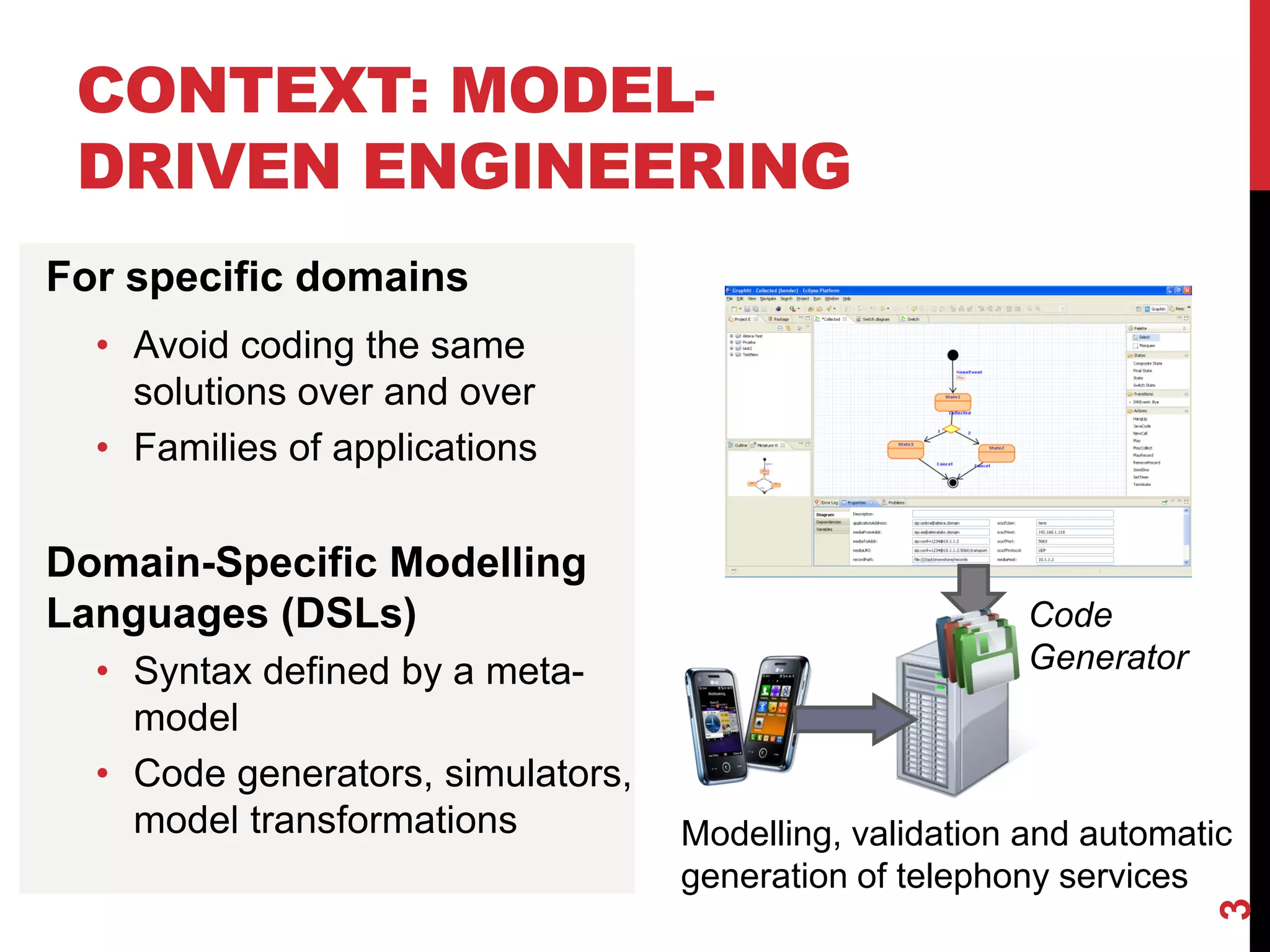
For specific domains
• Avoid coding the same
solutions over and over
• Families of applications
Domain-Specific Modelling
Languages (DSLs)
• Syntax defined by a meta-
model
• Code generators, simulators,
model transformations
Code
Generator
Modelling, validation and automatic
generation of telephony services
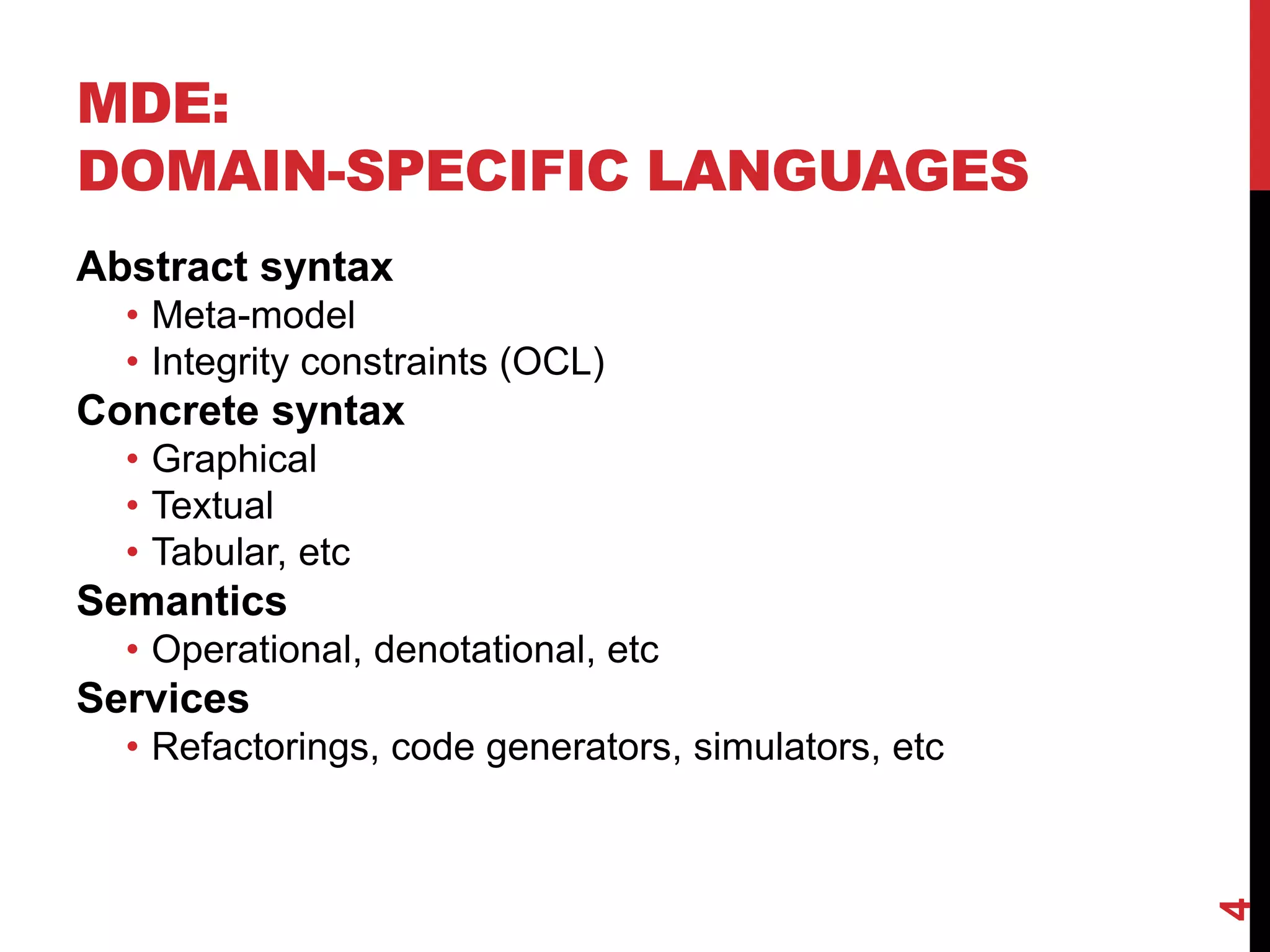
MDE:
DOMAIN-SPECIFIC LANGUAGES
4
Abstract syntax
• Meta-model
• Integrity constraints (OCL)
Concrete syntax
• Graphical
• Textual
• Tabular, etc
Semantics
• Operational, denotational, etc
Services
• Refactorings, code generators, simulators, etc
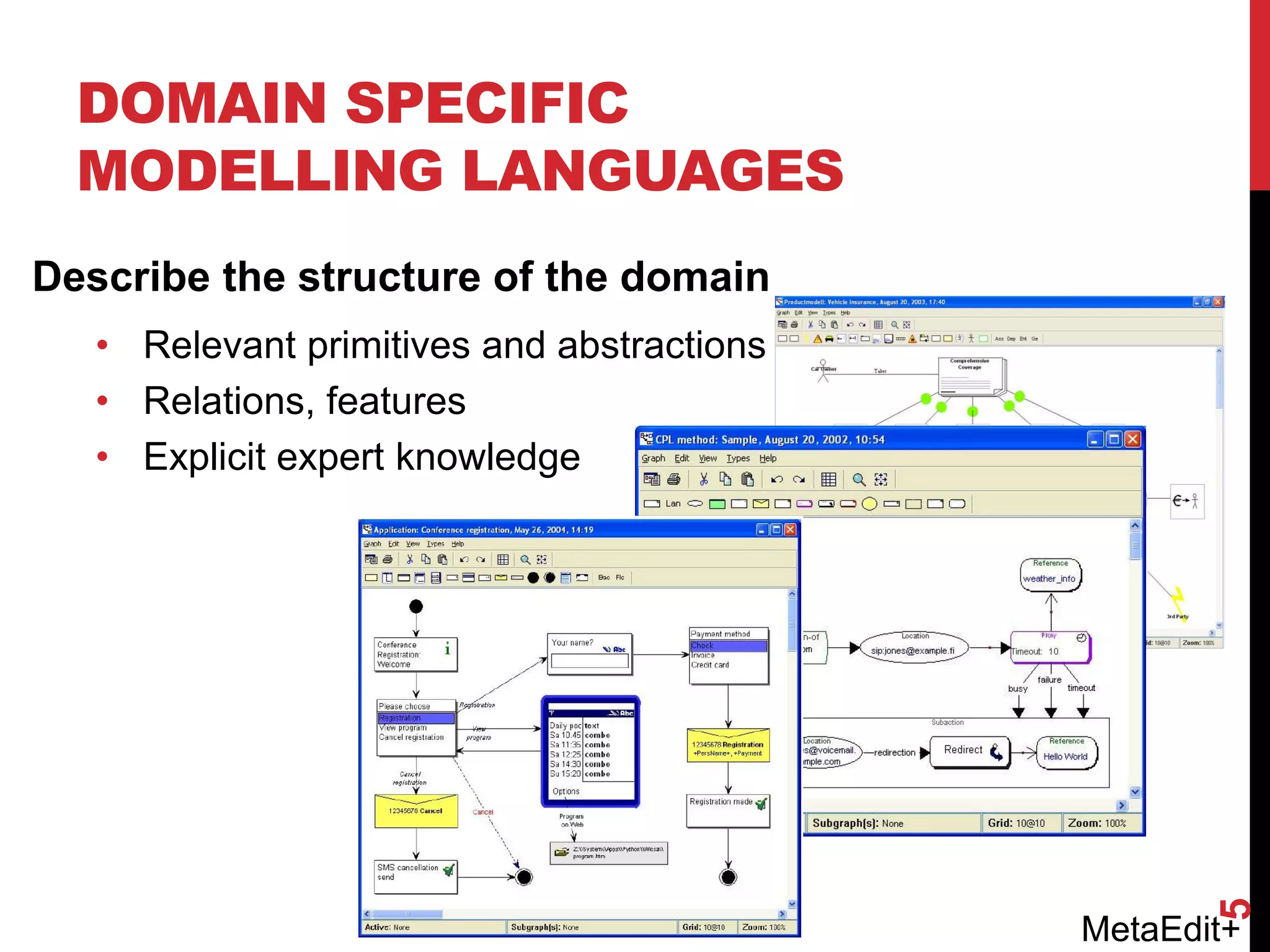
MetaEdit+
DOMAIN SPECIFIC
MODELLING LANGUAGES
Describe the structure of the domain
• Relevant primitives and abstractions
• Relations, features
• Explicit expert knowledge
5
DOMAIN SPECIFIC
MODELLING LANGUAGES
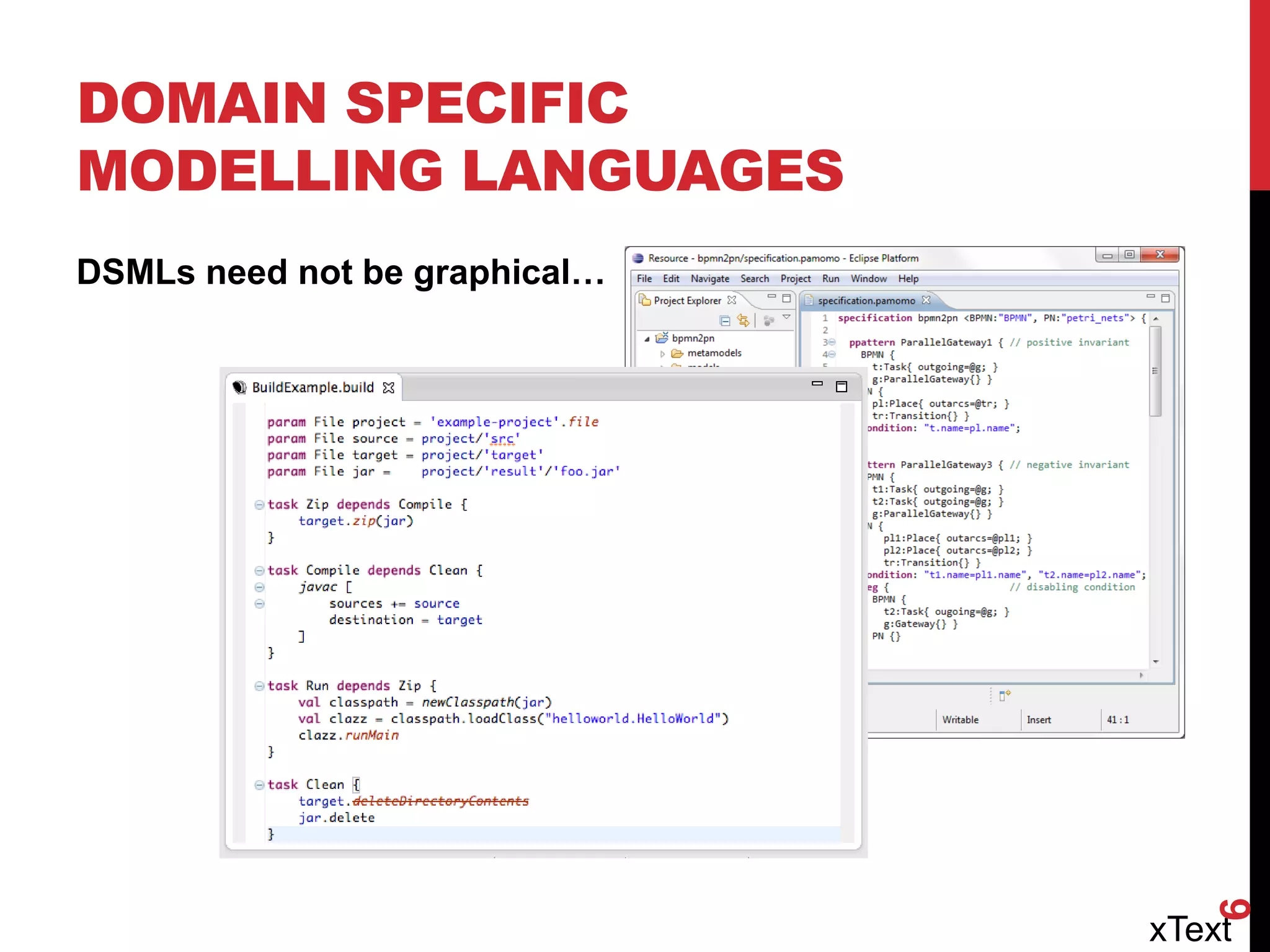
DSMLs need not be graphical…
xText
6
MODELS AND
META-MODELS
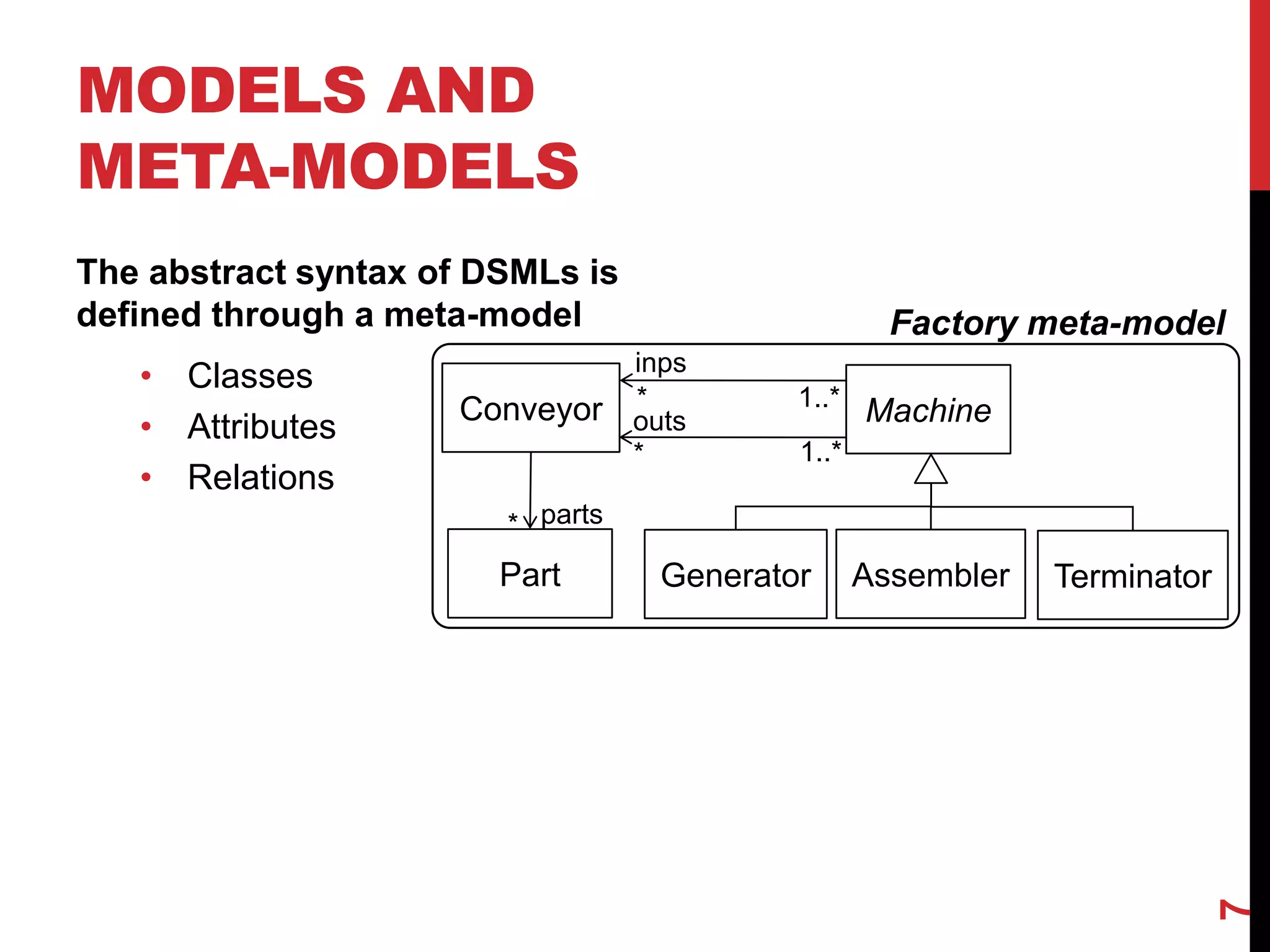
The abstract syntax of DSMLs is
defined through a meta-model
• Classes
• Attributes
• Relations
7
Factory meta-model
Machine
Part
Conveyor
Generator Assembler
inps
outs
*
*
* parts
Terminator
1..*
1..*
MODELS AND
META-MODELS
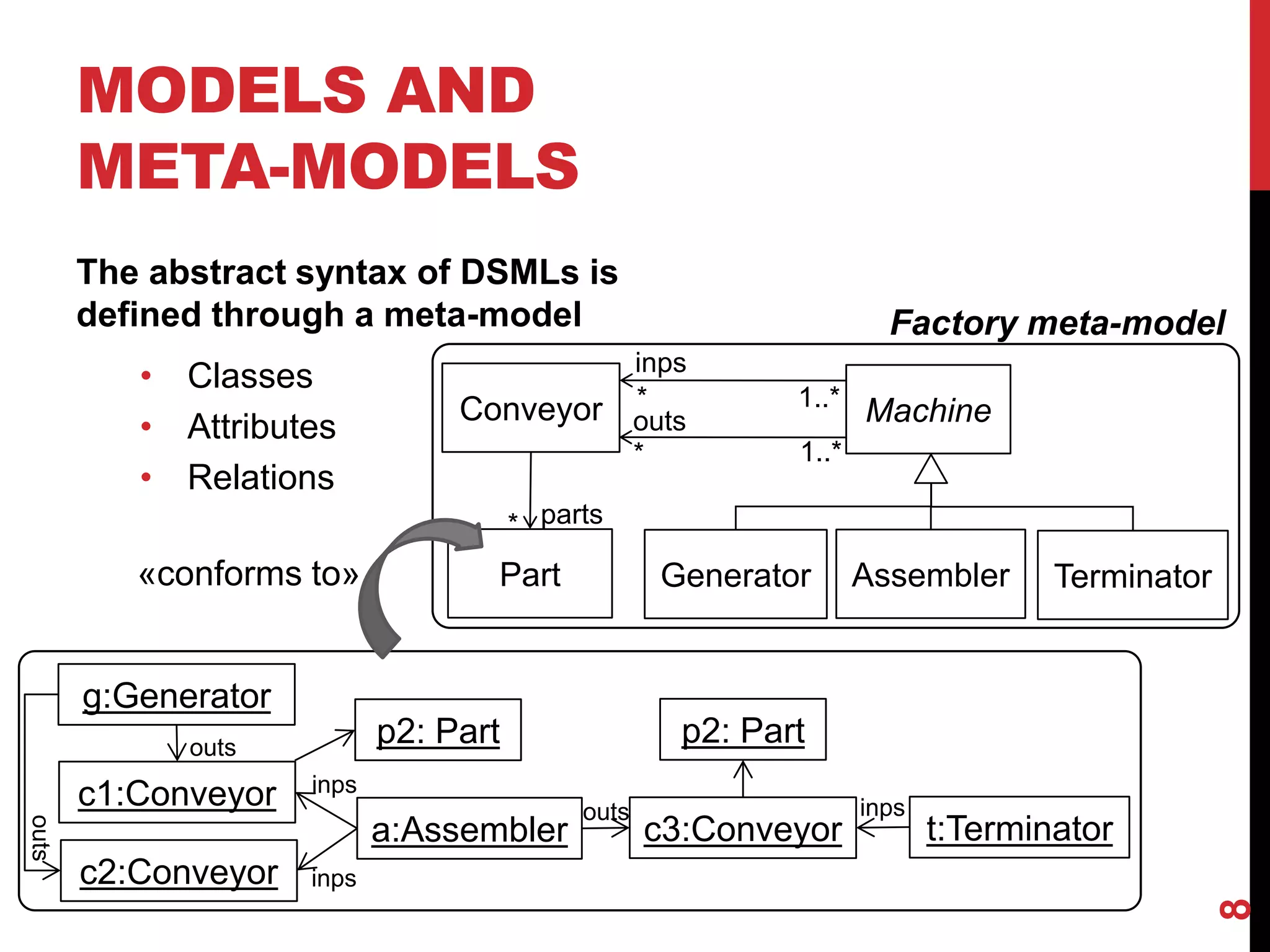
The abstract syntax of DSMLs is
defined through a meta-model
• Classes
• Attributes
• Relations
8
«conforms to»
c1:Conveyor
g:Generator
a:Assembler
c2:Conveyor
c3:Conveyor t:Terminator
p2: Partp2: Partouts
outs
inps
inps
outs inps
Factory meta-model
Machine
Part
Conveyor
Generator Assembler
inps
outs
*
*
* parts
Terminator
1..*
1..*
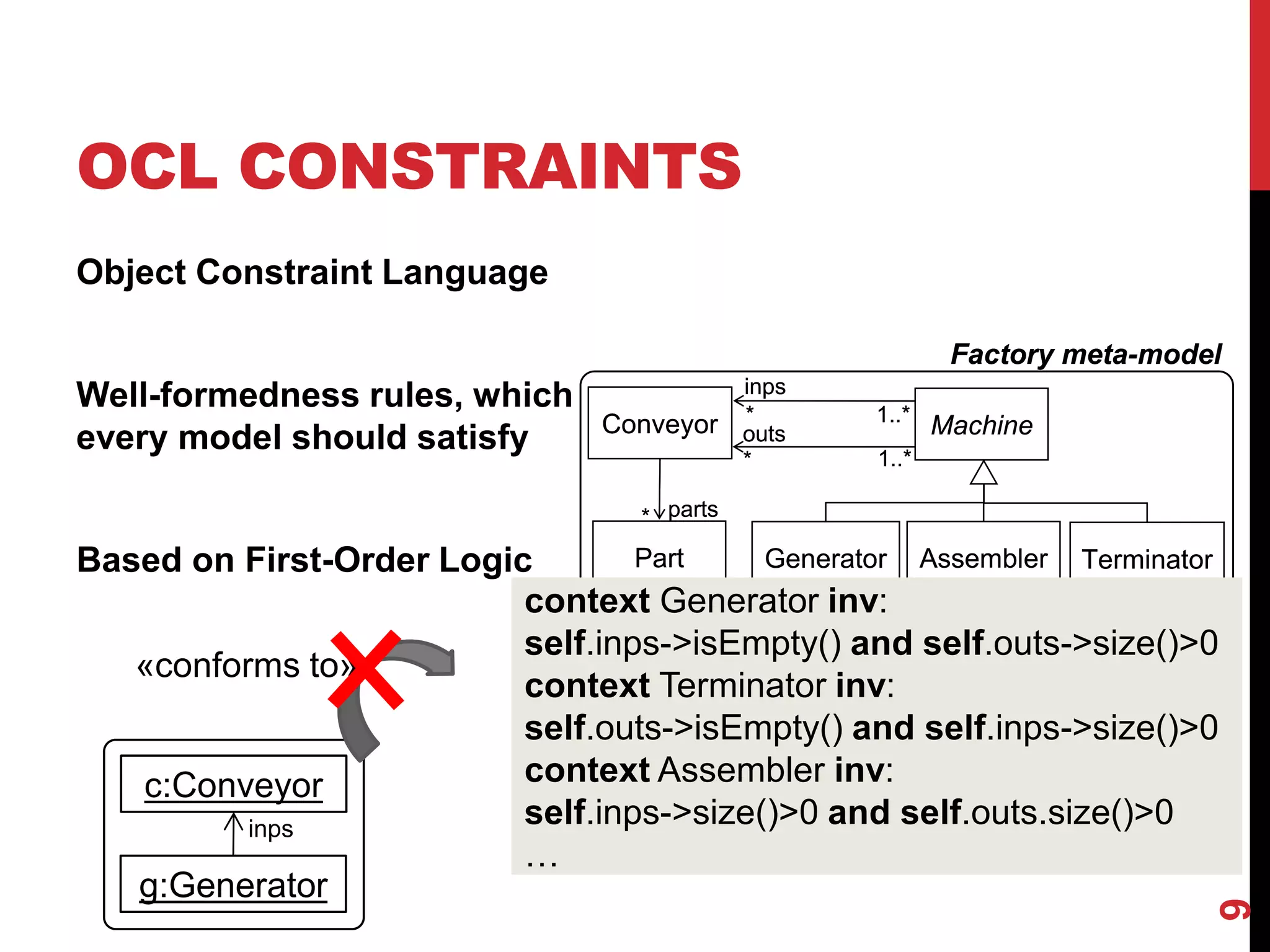
OCL CONSTRAINTS
9
Object Constraint Language
Well-formedness rules, which
every model should satisfy
Based on First-Order Logic
g:Generator
«conforms to»
c:Conveyor
Factory meta-model
Machine
Part
Conveyor
Generator Assembler
inps
outs
*
*
* parts
Terminator
1..*
1..*
Factory meta-model
Machine
Part
Conveyor
Generator Assembler
inps
outs
*
*
* parts
Terminator
1..*
1..*
context Generator inv:
self.inps->isEmpty() and self.outs->size()>0
context Generator inv:
self.inps->isEmpty() and self.outs->size()>0
context Terminator inv:
self.outs->isEmpty() and self.inps->size()>0
context Assembler inv:
self.inps->size()>0 and self.outs.size()>0
…
inps
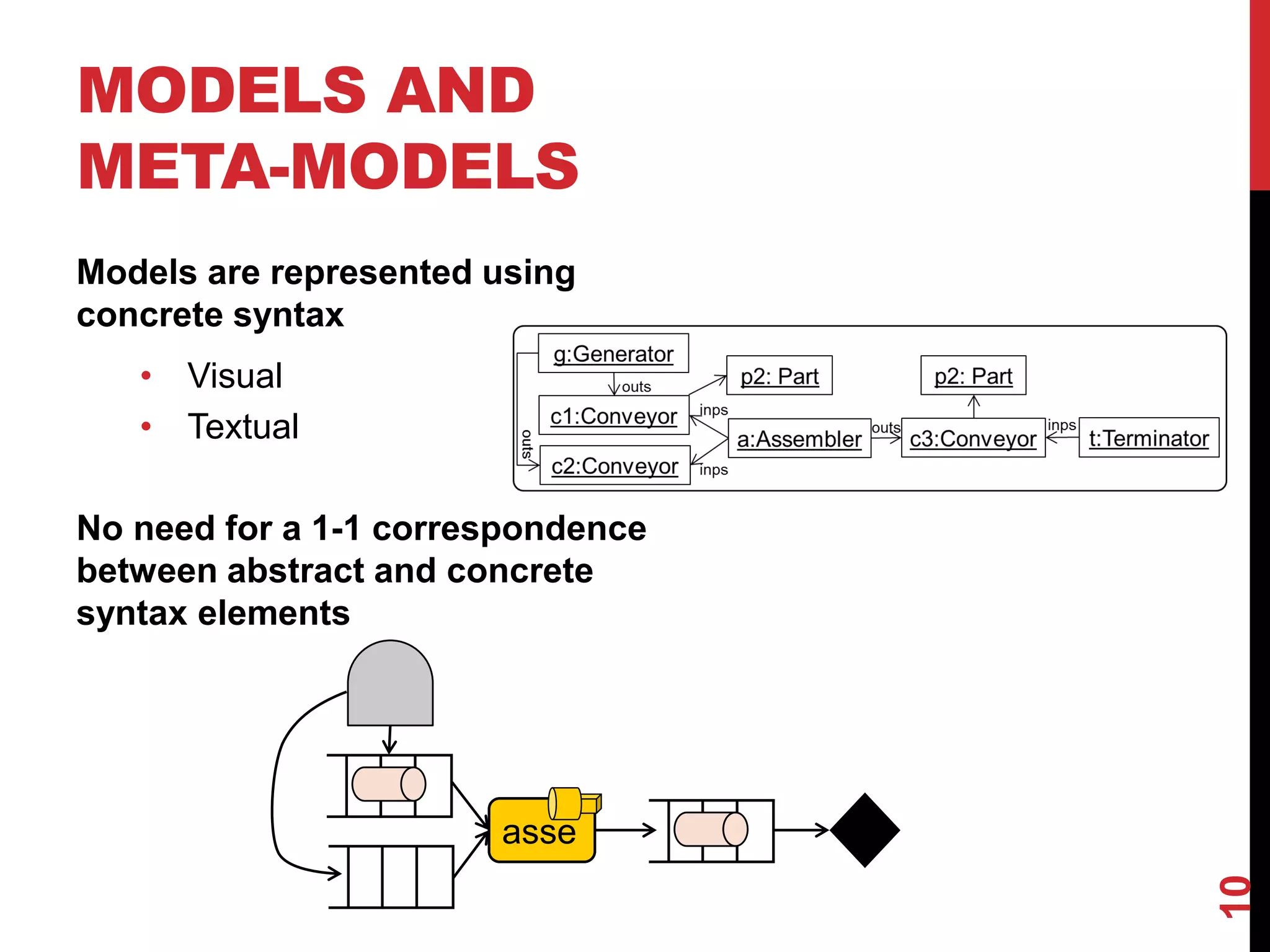
MODELS AND
META-MODELS
Models are represented using
concrete syntax
• Visual
• Textual
No need for a 1-1 correspondence
between abstract and concrete
syntax elements
10
asse
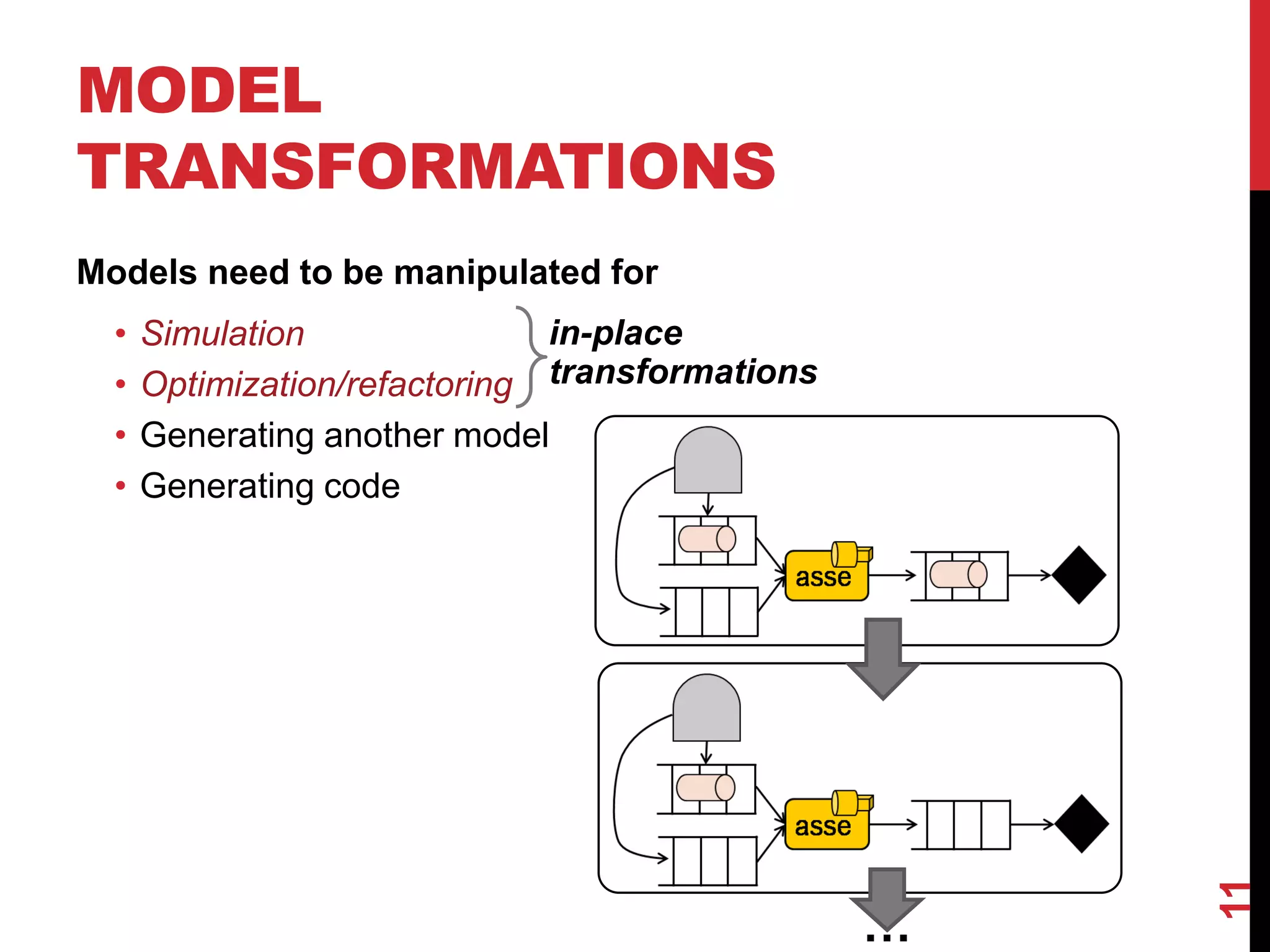
MODEL
TRANSFORMATIONS
Models need to be manipulated for
• Simulation
• Optimization/refactoring
• Generating another model
• Generating code
in-place
transformations
11
…
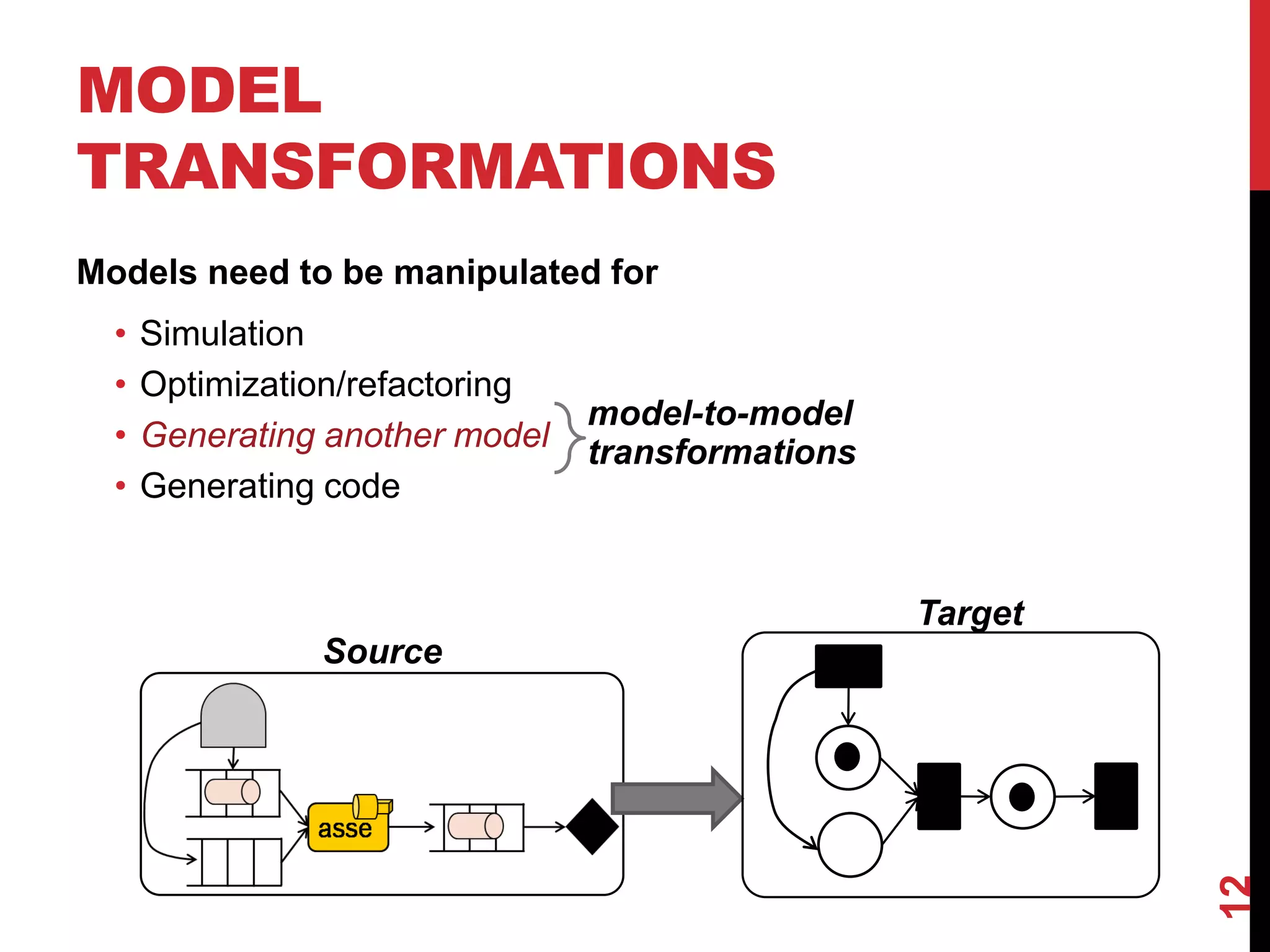
MODEL
TRANSFORMATIONS
Models need to be manipulated for
• Simulation
• Optimization/refactoring
• Generating another model
• Generating code
Source
Target
12
model-to-model
transformations
MODEL
TRANSFORMATIONS
Models need to be manipulated for
• Simulation
• Optimization/refactoring
• Generating another model
• Generating code
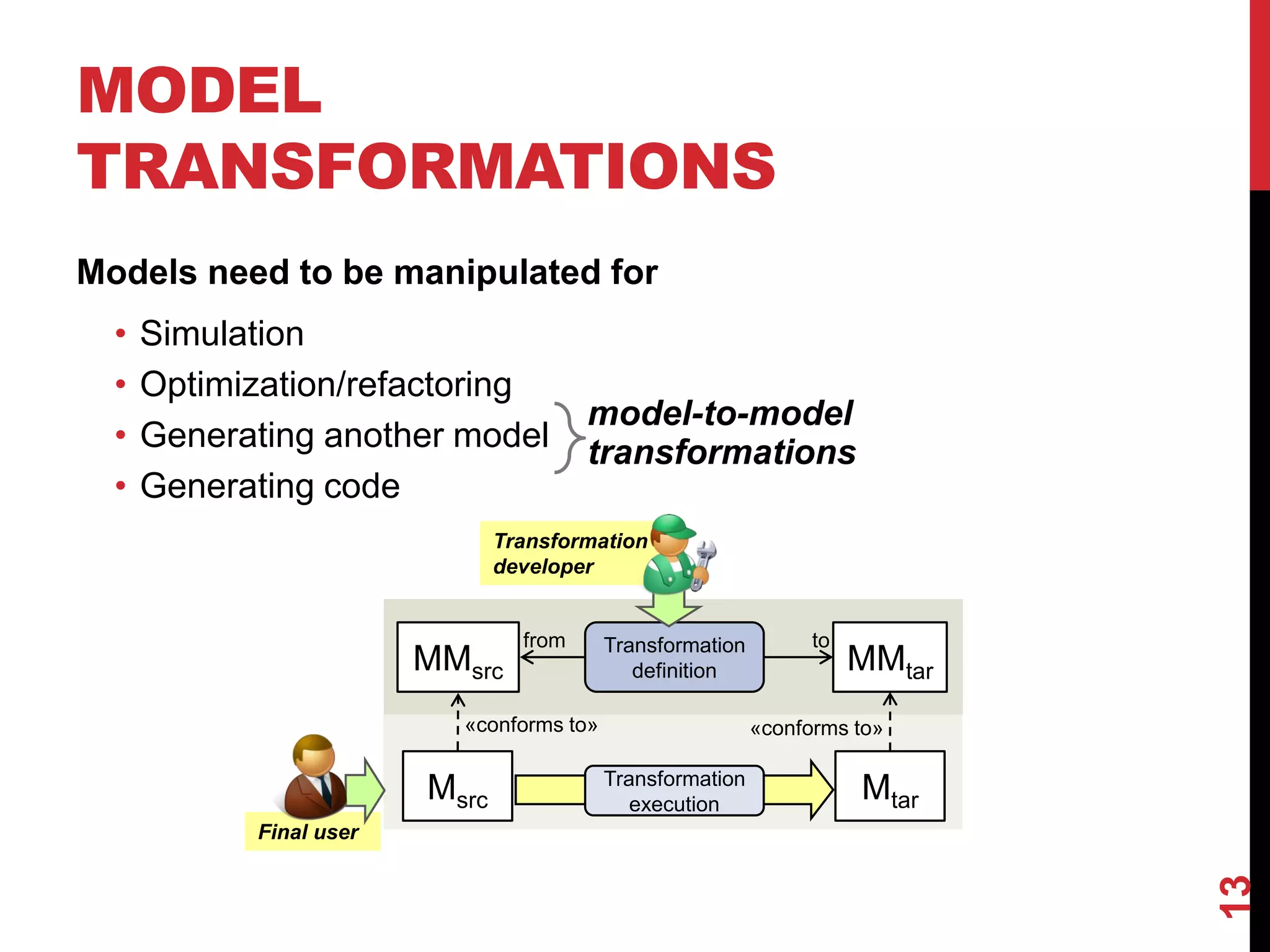
13
MMsrc MMtar
Msrc Mtar
Transformation
definition
from to
«conforms to» «conforms to»
Transformation
execution
Transformation
developer
Final user
model-to-model
transformations
MODEL
TRANSFORMATIONS
Models need to be manipulated for
• Simulation
• Optimization/refactoring
• Generating another model
• Generating code
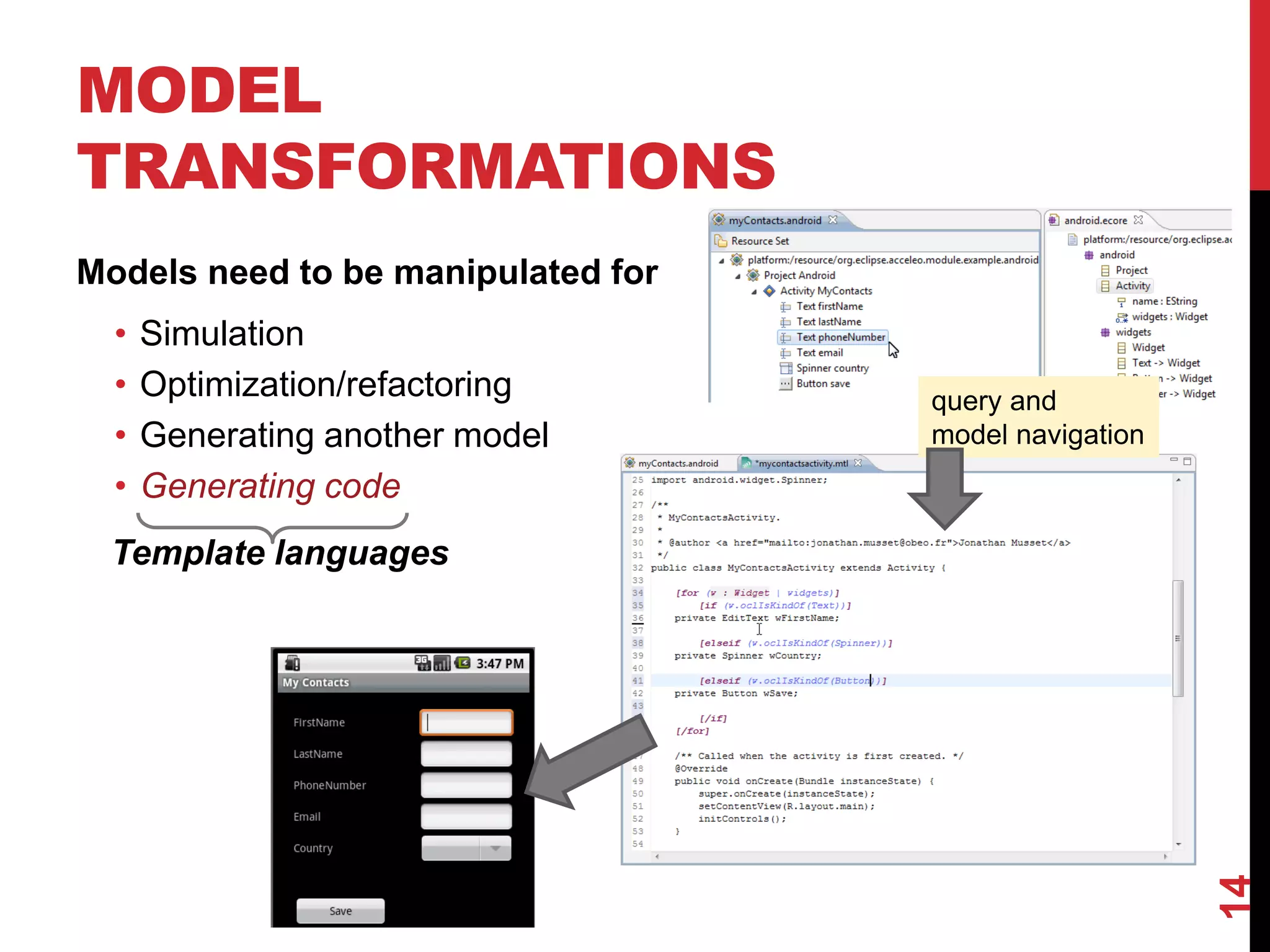
14
Template languages
query and
model navigation
15
Very nice…
Where’s the ugly?
SOME LIMITATIONS…
Model-driven Engineering
• Models are the principal artifacts
• Models conform to a meta-model
Objects are closed
• Created using classes as templates
• Slots, types, and constraints cannot be changed
This rigidity makes some MDE scenarios difficult
• Reuse of model transformations
• Model extension
• Multi-view modelling
• …
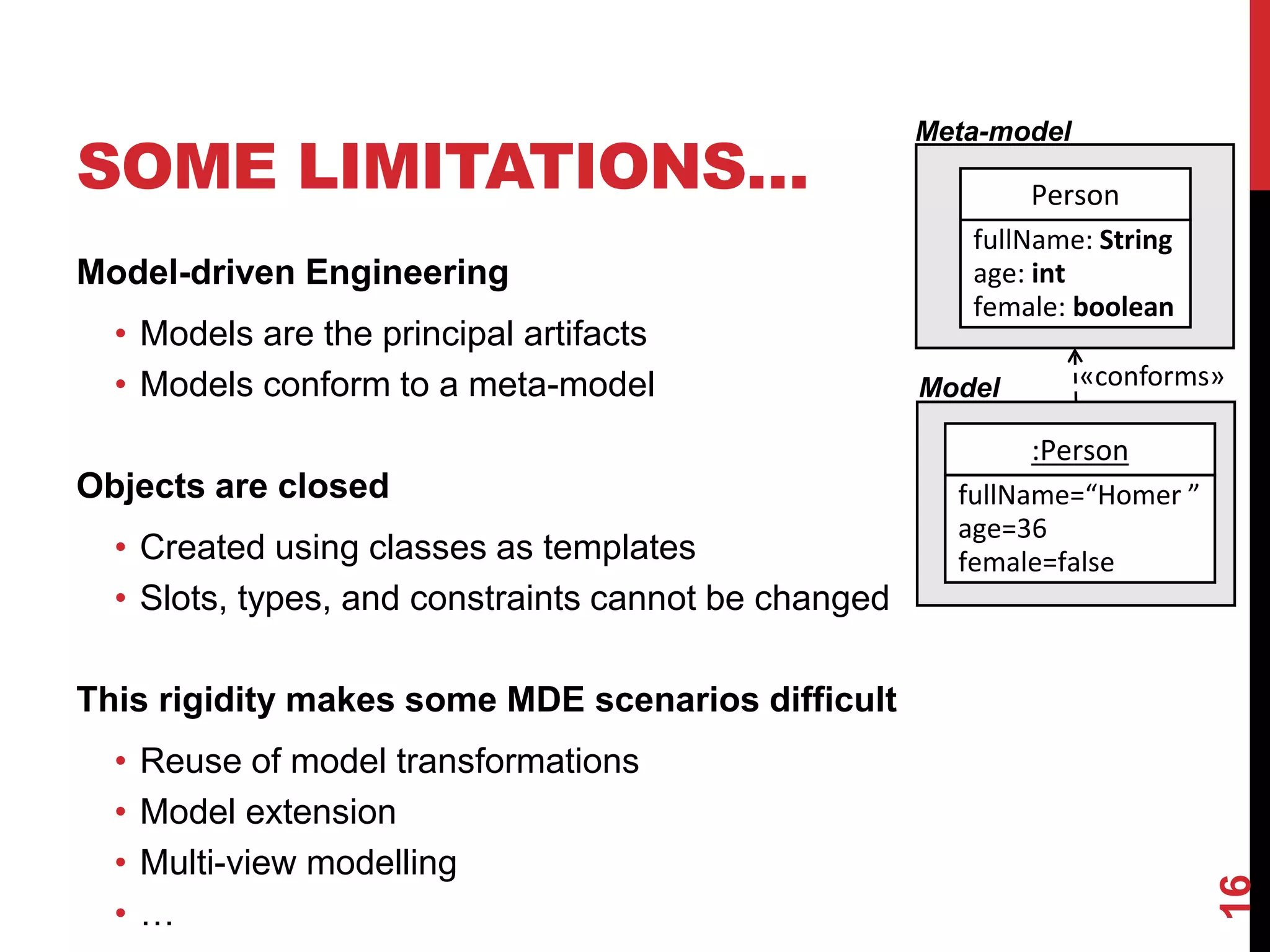
16
Person
fullName: String
age: int
female: boolean
:Person
fullName=“Homer ”
age=36
female=false
Meta-model
Model «conforms»
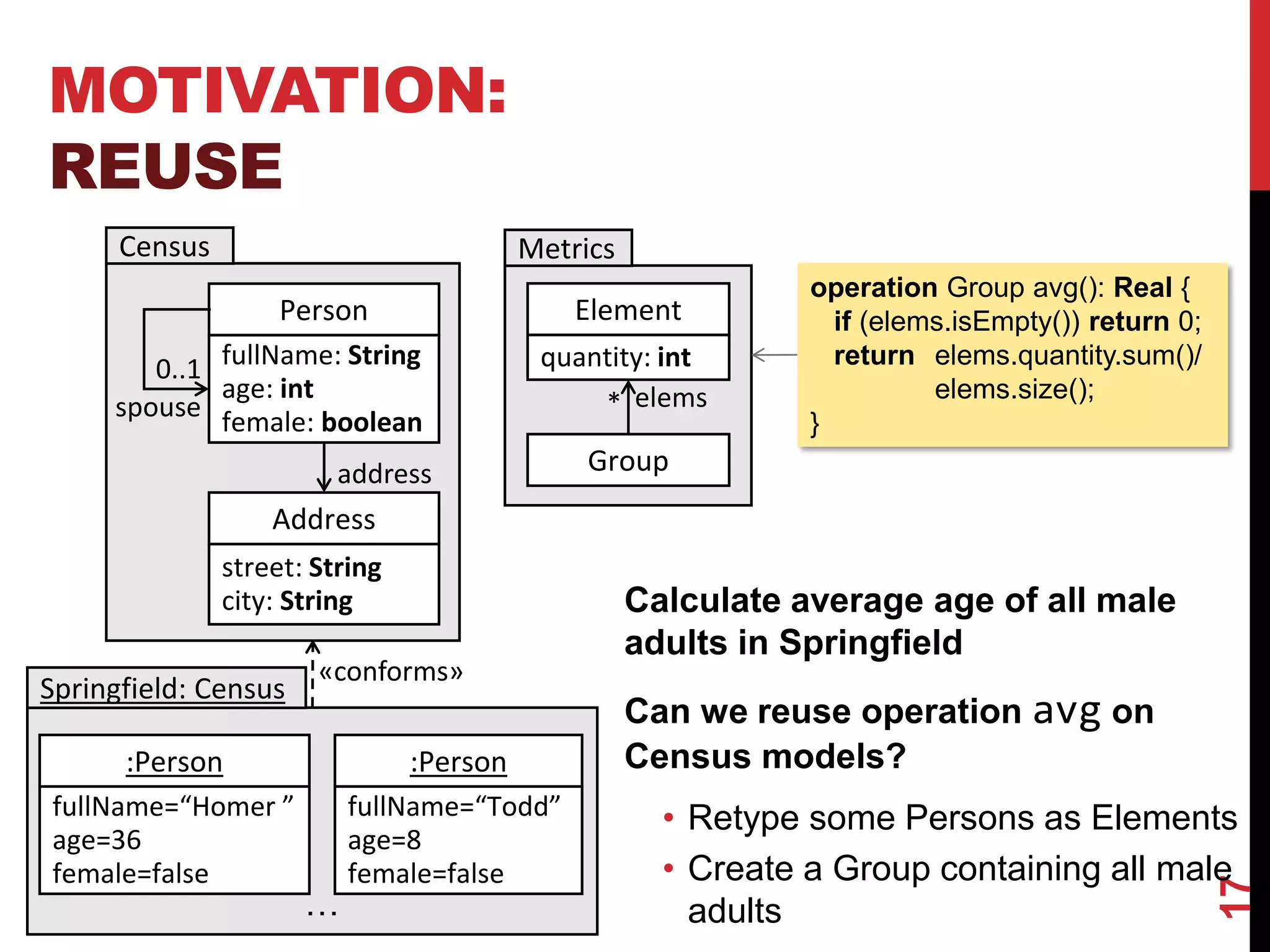
MOTIVATION:
REUSE
17
Person
fullName: String
age: int
female: boolean
Address
street: String
city: String
address
spouse
0..1
Census
:Person
fullName=“Homer ”
age=36
female=false
Group
Element
quantity: int
elems
Metrics
*
operation Group avg(): Real {
if (elems.isEmpty()) return 0;
return elems.quantity.sum()/
elems.size();
}
:Person
fullName=“Todd”
age=8
female=false
…
Springfield: Census
«conforms»
Calculate average age of all male
adults in Springfield
Can we reuse operation avg on
Census models?
• Retype some Persons as Elements
• Create a Group containing all male
adults
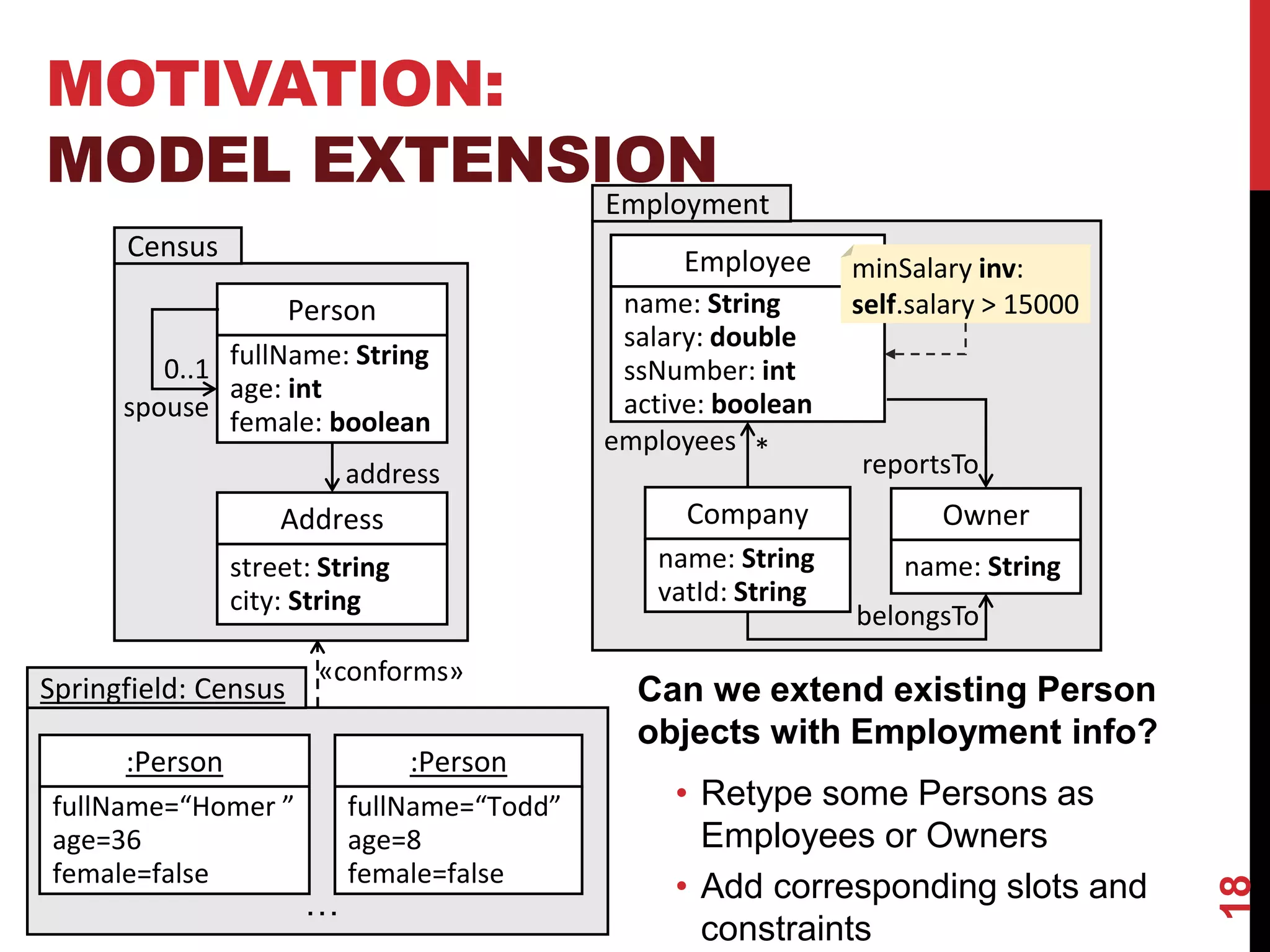
MOTIVATION:
MODEL EXTENSION
18
Person
fullName: String
age: int
female: boolean
Address
street: String
city: String
address
spouse
0..1
Census
:Person
fullName=“Homer ”
age=36
female=false
:Person
fullName=“Todd”
age=8
female=false
…
Springfield: Census
«conforms»
Employment
Company
name: String
vatId: String
employees *
Owner
name: String
Employee
name: String
salary: double
ssNumber: int
active: boolean
belongsTo
minSalary inv:
self.salary > 15000
reportsTo
Can we extend existing Person
objects with Employment info?
• Retype some Persons as
Employees or Owners
• Add corresponding slots and
constraints
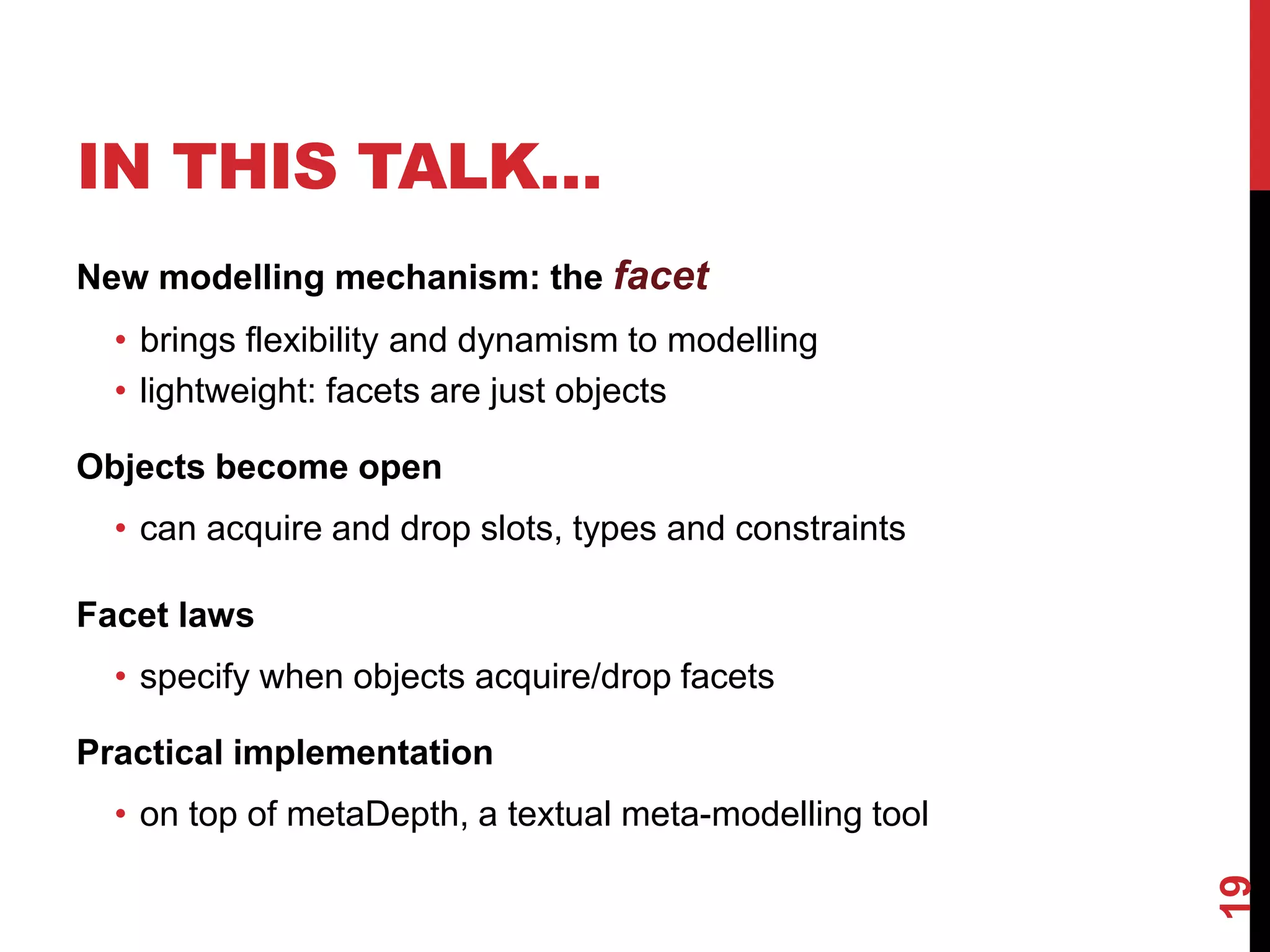
IN THIS TALK…
New modelling mechanism: the facet
• brings flexibility and dynamism to modelling
• lightweight: facets are just objects
Objects become open
• can acquire and drop slots, types and constraints
Facet laws
• specify when objects acquire/drop facets
Practical implementation
• on top of metaDepth, a textual meta-modelling tool
19
WHAT’S A FACET?
A facet is an object
• becomes part of another one(s), called the host object(s),
• the slots of the facet become transparently accessible from the
host, which also acquires the type and constraints of the facet.
A host object can acquire and drop facets dynamically
20
homer :Person
fullName= “Homer”
age= 57
female= false emp: Employee
name= “Homer”
salary=47500
ssNumber=12345
active=true
Springfield :Census
emp: Employee[1]
: Employment
homer :Person :Employee
age= 57
female= false
fullName= name= “Homer”
salary=47500
ssNumber=12345
active=true
Springfield
:Census :Employment
emp: Employee
host
object facet
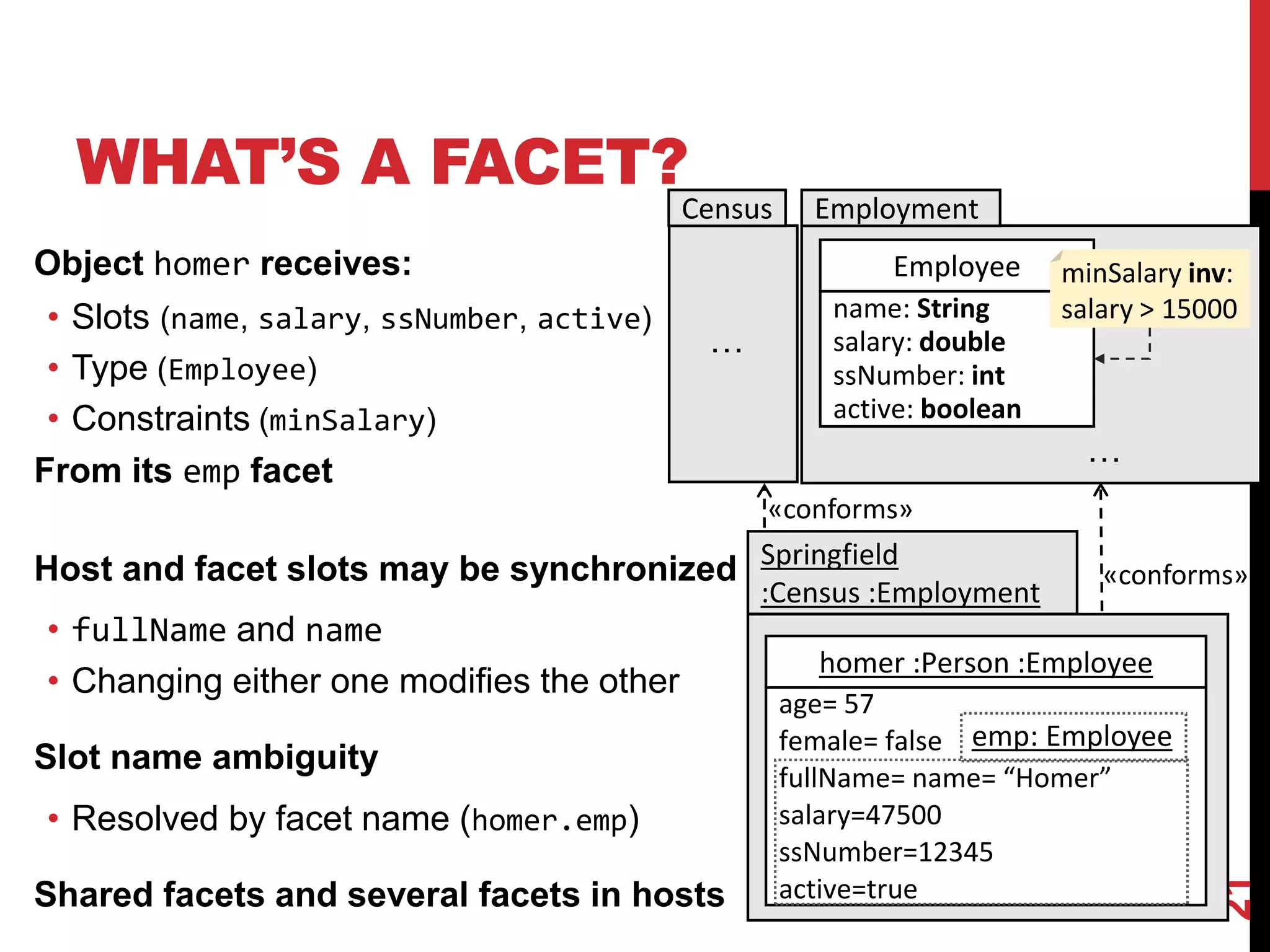
WHAT’S A FACET?
Object homer receives:
• Slots (name, salary, ssNumber, active)
• Type (Employee)
• Constraints (minSalary)
From its emp facet
Host and facet slots may be synchronized
• fullName and name
• Changing either one modifies the other
Slot name ambiguity
• Resolved by facet name (homer.emp)
Shared facets and several facets in hosts
21
homer :Person :Employee
age= 57
female= false
fullName= name= “Homer”
salary=47500
ssNumber=12345
active=true
Springfield
:Census :Employment
emp: Employee
Employment
Employee
name: String
salary: double
ssNumber: int
active: boolean
minSalary inv:
salary > 15000
…
«conforms»
Census
…
«conforms»
FACET MANAGEMENT
A DSL for adding/removing facets to objects
22
addFacet homer
emp: Employment.Employee
with {
name = fullName [equality]
salary = 22345
ssNumber = 12345
active = true
}
addFacet
$Person.allInstances()→select(age>17)$
emp: Employment.Employee with {…}
Explicit host selection
Query-based host selection
addFacet h:Person, w:Person where
$h.spouse=w$
emp: Employment.Employee with {…}
Pattern-based host selection
Selection of host objects by id Selection of host objects by properties
(similar commands for removing a facet)
FACET MANAGEMENT
23
addFacet
$Person.all()→select(age>17)$
emp: Employment.Employee
with {…} reuse
Facet shared among all
selected host objects
addFacet homer
dayJob: Employment.Employee with {
name = fullName [equality]
salary = 15000
ssNumber = 12345
active = true
}
nightJob: Employment.Employee with {
name = fullName [equality]
salary = 16400
ssNumber = dayJob.ssNumber [equality]
active = dayJob.active [equality]
}
Several facets in same host object
One-to-many and many-to-one host/facet relations are supported
REACTIVE FIELD
ADAPTERS
24
addFacet homer
emp: Employment.Employee
with {
ssNumber = 12345 // value semantics: literals
salary = $100*self.age$ // value semantics: expressions
name = fullName [equality] // reference semantics: bx synchronization
active = [self.age < 65] // reference semantics: reactive field adapter
}
Coupled change dependencies
• active = [self.age < 65]  When age changes, active is updated
• name = fullName [equality]  Eq. to name = [fullName] [fullName=name]
N-ary depedencies
• salary = [100*self.age] [rich = self.salary > 10000]
• ill-behaved: name = [fullName] [fullName = ’Mr. ’.concat(name)]
• Safety policy: each field is evaluated once within a cycle
MODEL SCENES
25
Springfield :Census :Employment
homer :Person :Employee
age=57
female=false
fullName=“Homer”
name=“Homer” dayJob, nightJob
ssNumber=12345 dayJob, nightJob
active=true dayJob, nightJob
salary=15000 dayJob
salary=16400 nightJob
simsHome :Address
street=“Evergreen Terrace”
city=“Springfield”
:address
Different visualizations for a model
• “Scenes”
Total scene
• Default visualization
Total scene
MODEL SCENES
26
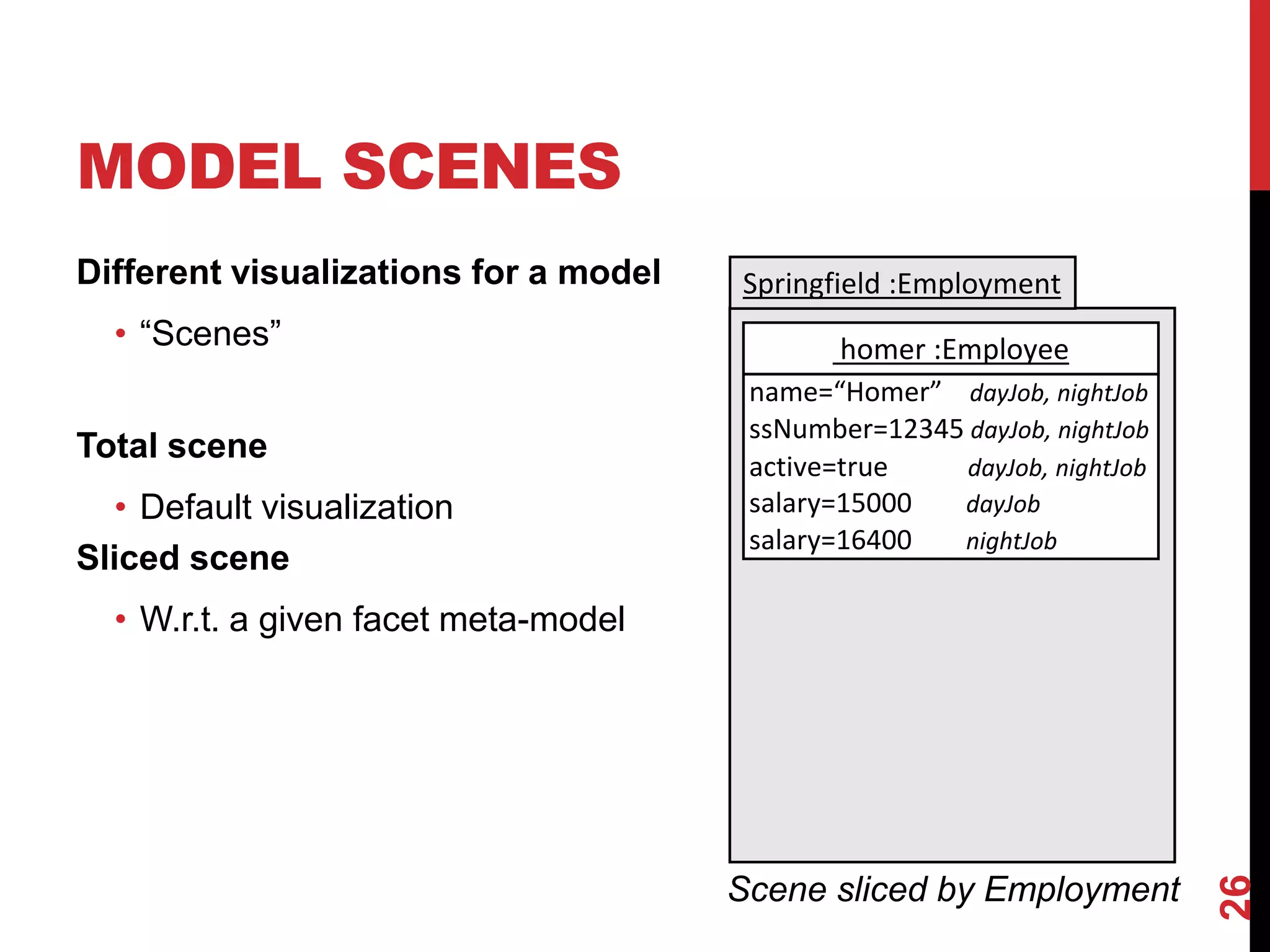
Different visualizations for a model
• “Scenes”
Total scene
• Default visualization
Sliced scene
• W.r.t. a given facet meta-model
Springfield :Employment
homer :Employee
name=“Homer” dayJob, nightJob
ssNumber=12345 dayJob, nightJob
active=true dayJob, nightJob
salary=15000 dayJob
salary=16400 nightJob
Scene sliced by Employment
MODEL SCENES
27
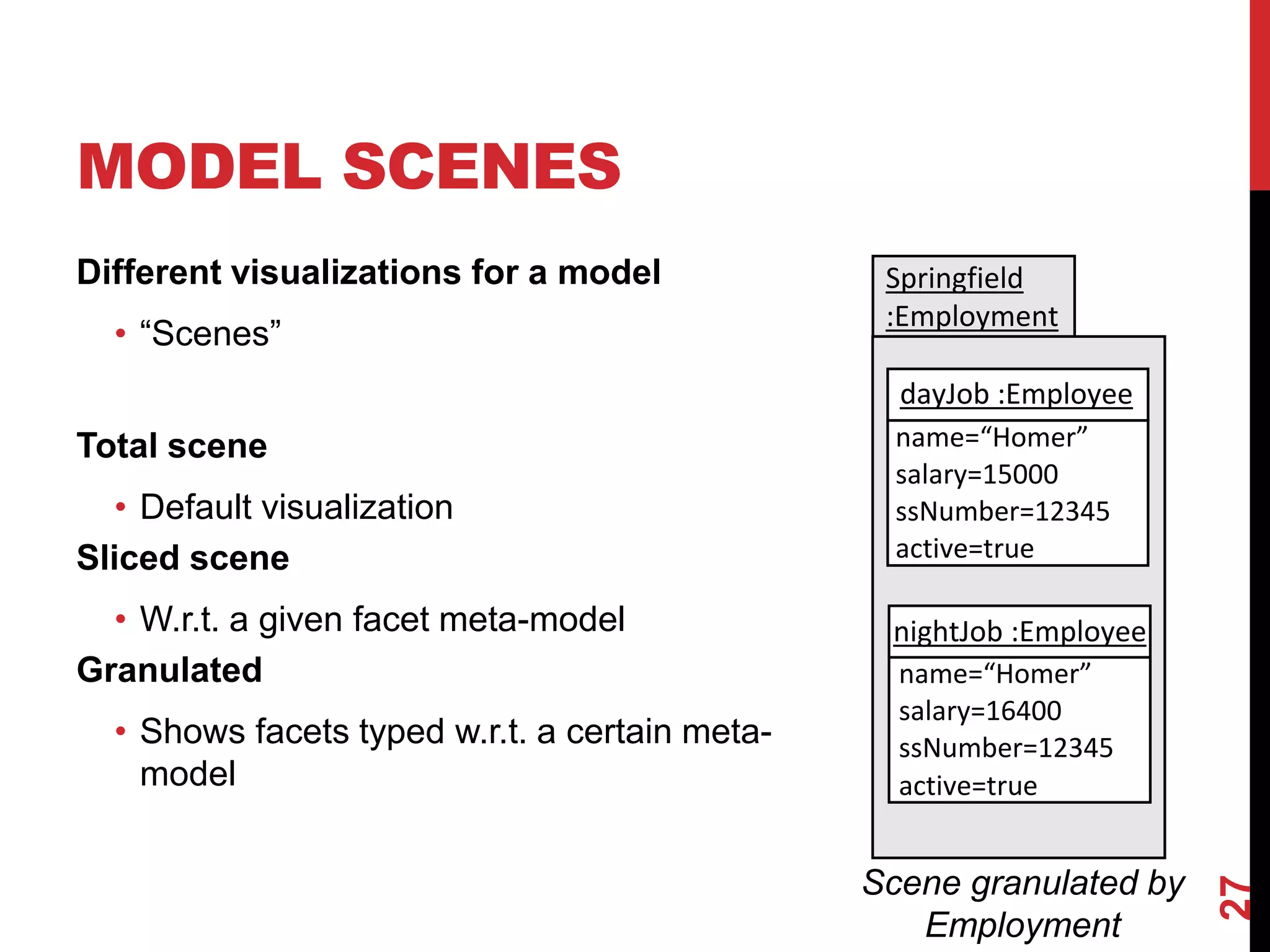
Different visualizations for a model
• “Scenes”
Total scene
• Default visualization
Sliced scene
• W.r.t. a given facet meta-model
Granulated
• Shows facets typed w.r.t. a certain meta-
model
Springfield
:Employment
nightJob :Employee
name=“Homer”
salary=16400
ssNumber=12345
active=true
name=“Homer”
salary=15000
ssNumber=12345
active=true
dayJob :Employee
Scene granulated by
Employment
FACET LAWS
AND INTERFACES
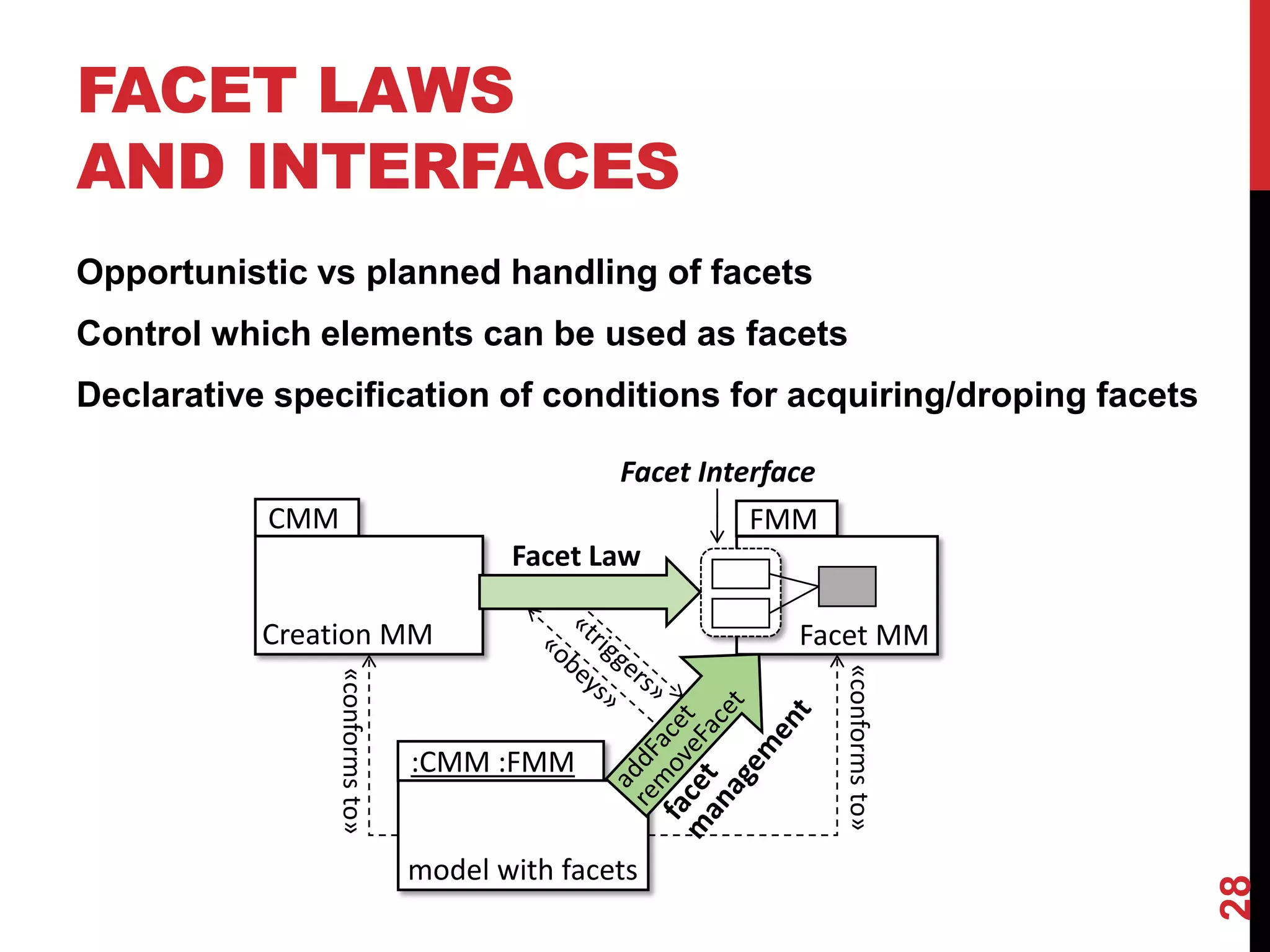
Opportunistic vs planned handling of facets
Control which elements can be used as facets
Declarative specification of conditions for acquiring/droping facets
28
:CMM :FMM
FMMCMM
Facet Interface
«conformsto»
«conformsto»
Creation MM Facet MM
model with facets
Facet Law
FACET INTERFACES
Restricts how a meta-model can be used for facet-based modelling
Declares
• classes that can be used to create facets
• allowed combinations
• extra well-formedness constraints (eg., due to facet combination)
29
FacetInterface for Employment {
public: all
compatible: [Employee, Owner]
constraints: Employee.repToIrreflexive= $self.reportsTo.excludes(self)$
}
FACET LAWS
Specs stating when host objects should acquire/drop a facet
• must/may
Can add additional constraints and set default values
Setting homer.age:=16 makes homer drop the work facet
30
FacetLaws for Census with Employment {
must extend <p:Person> where $p.age>17$
with work:Employee with {
name = fullName [equality]
salary = 24000
minLocalSalary: $ self.salary>16000 $
retirement: $ self.age>65 implies not self.active $
}
}
FACET LAWS
Check manually issued addFacet/removeFacet commands
• Should conform to the facet laws, if defined
Check faceted models for consistency
• Models should satisfy the laws
To complete addFacet commands
• Take default values and slot relations from the laws
To constraint facets
• By adding extra constraints
To automate facet acquisition/loss
• Via the “must” extension laws
• addFacet/removeFacet automatically issued
31
TOOL SUPPORT
MetaDepth (http://metaDepth.org)
• Textual multi-level modelling tool
• Epsilon languages for model
management (EOL, ETL, EGL)
Facets, facet handling, interfaces, laws
Mirror fields
Triggered constraints (add/drop facets)
32
Model Census {
Node Person{
name: String;
age: int;
female: boolean = true;
spouse: Person[0..1];
address: Address[1];
}
Node Address {
street: String;
city: String;
}
}
var p : Person := new Person;
p.age := 23; // implicitly creates an Employee facet (as p.age > 17)
p.salary := 15100; // OK, as p has now an Employee facet
p.age := 16; // p loses its Employee facet (as p.age <= 17)
p.salary := 21000; // Error! p has no Employee facet
EOL program
Census meta-model
EVALUATION
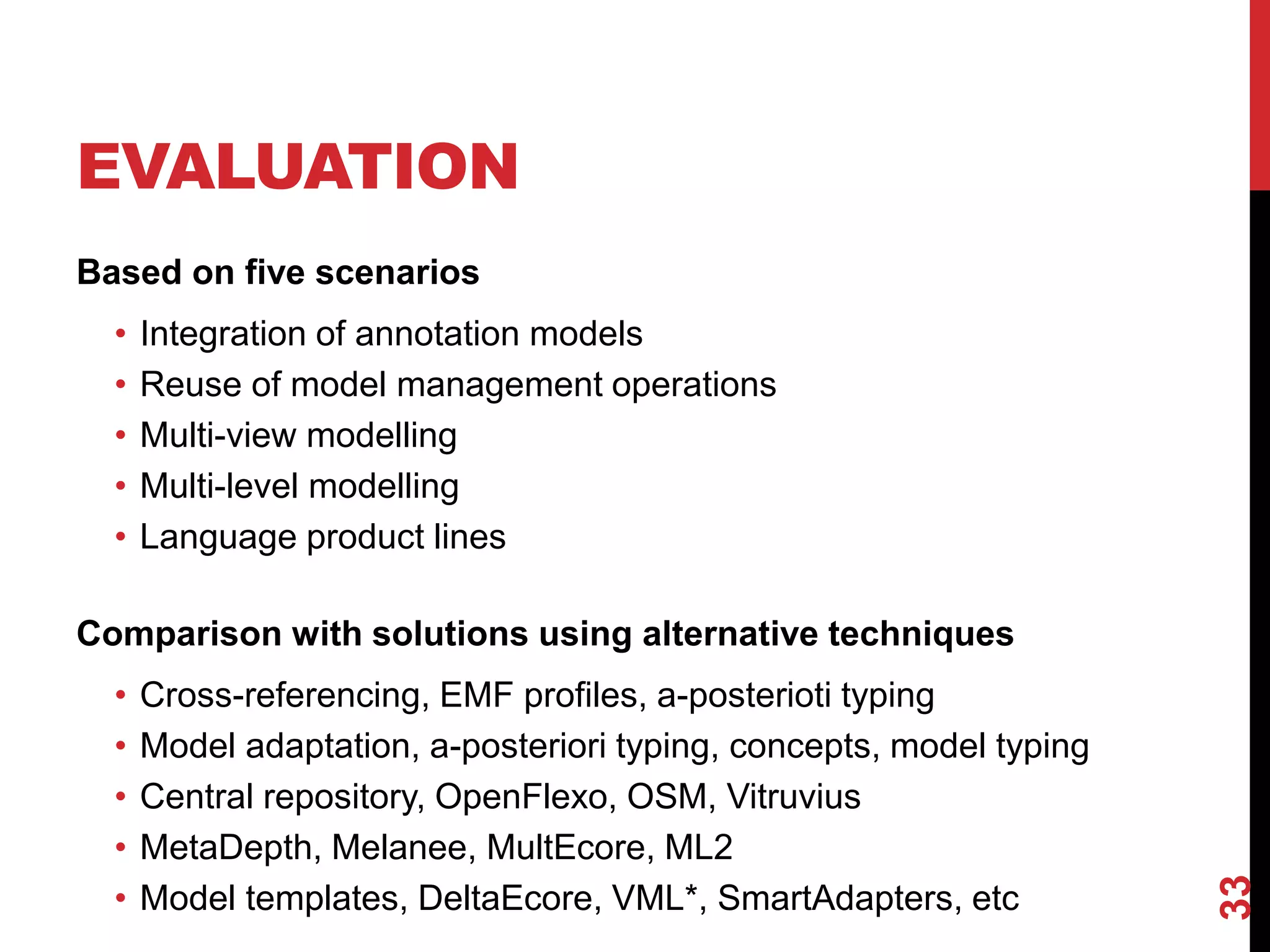
Based on five scenarios
• Integration of annotation models
• Reuse of model management operations
• Multi-view modelling
• Multi-level modelling
• Language product lines
Comparison with solutions using alternative techniques
• Cross-referencing, EMF profiles, a-posterioti typing
• Model adaptation, a-posteriori typing, concepts, model typing
• Central repository, OpenFlexo, OSM, Vitruvius
• MetaDepth, Melanee, MultEcore, ML2
• Model templates, DeltaEcore, VML*, SmartAdapters, etc
33
INTEGRATING
ANNOTATION MODELS
Annotation models widely used in MDE:
• Concrete syntax (CS) representation, uncertainty, variability, access
control, etc.
34
Model ConcreteSyntax {
abstract Node GraphicalElem {
x, y : int;
label : String;
linkedTo : GraphicalElem[∗];
}
Node Rectangle : GraphicalElem {
width, height : int;
}
Node Circle : GraphicalElem {
radius : int;
}
}
Graphical CS support
• Meta-model
• Simple visualizer
• Facet laws to assign CS to
domain meta-models
We obtain for free:
• Bidirectional synchronization
textual/graphical CS.
CS meta-model
35
FacetLaws for Census with ConcreteSyntax {
must extend <p:Person> where $p.female$ with c:Circle with {
label = name [equality]
linkedTo = spouse [equality]
radius = [2*age] [age = radius/2]
}
must extend <p:Person> where $not p.female$ with r:Rectangle with {
label = name [equality]
linkedTo = spouse [equality]
height = age [equality]
width = age [equality]
}
}
CS FOR CENSUS
Census Springfield {
Person marge {
fullName = "Marge";
age = 47;
spouse = homer;
address = simsHouse;
}
…
} (scene sliced by Census)
Synch.
CAN WE DO THIS
DIFFERENTY?
36
Cannot be used to fully solve this case study:
Cross-referencing, EMF profiles
• No direct support for conditional styles (different CS based on female)
• No direct support for bidirectional changes
A-posteriori typing
• Cannot map slots like x and y
[1] Langer, Wieland, Wimmer,Cabot. EMF profiles: a lightweight extension approach for EMF
models. JOT 11,1(2012),1–29.
[2] de Lara, Guerra. A posteriori typing for model-driven engineering: Concepts, analysis, and
applications. ACM TOSEM 25, 4(2017),31:1–31:60.
[1]
[2]
(DYNAMIC) PRODUCT LINES
“SE methods for creating a collection of similar software systems from a
shared set of software assets using a common means of production”
(Dynamic) Language product lines
37
Model Components {
abstract Node NamedElement {
name : String;
}
Node Component : NamedElement {
ports : Port[1..*];
}
abstract Node Port : NamedElement ;
Node InputPort : Port;
Node OutputPort : Port {
target : InputPort[1..*];
}
}
Base language definition
// variability model
Model ComponentFeatures {
Node FeaturedElement {
security : boolean = false;
monitoring : boolean = true;
}
}
Feature model
Component
Features
security monitoring
(DYNAMIC) PRODUCT LINES
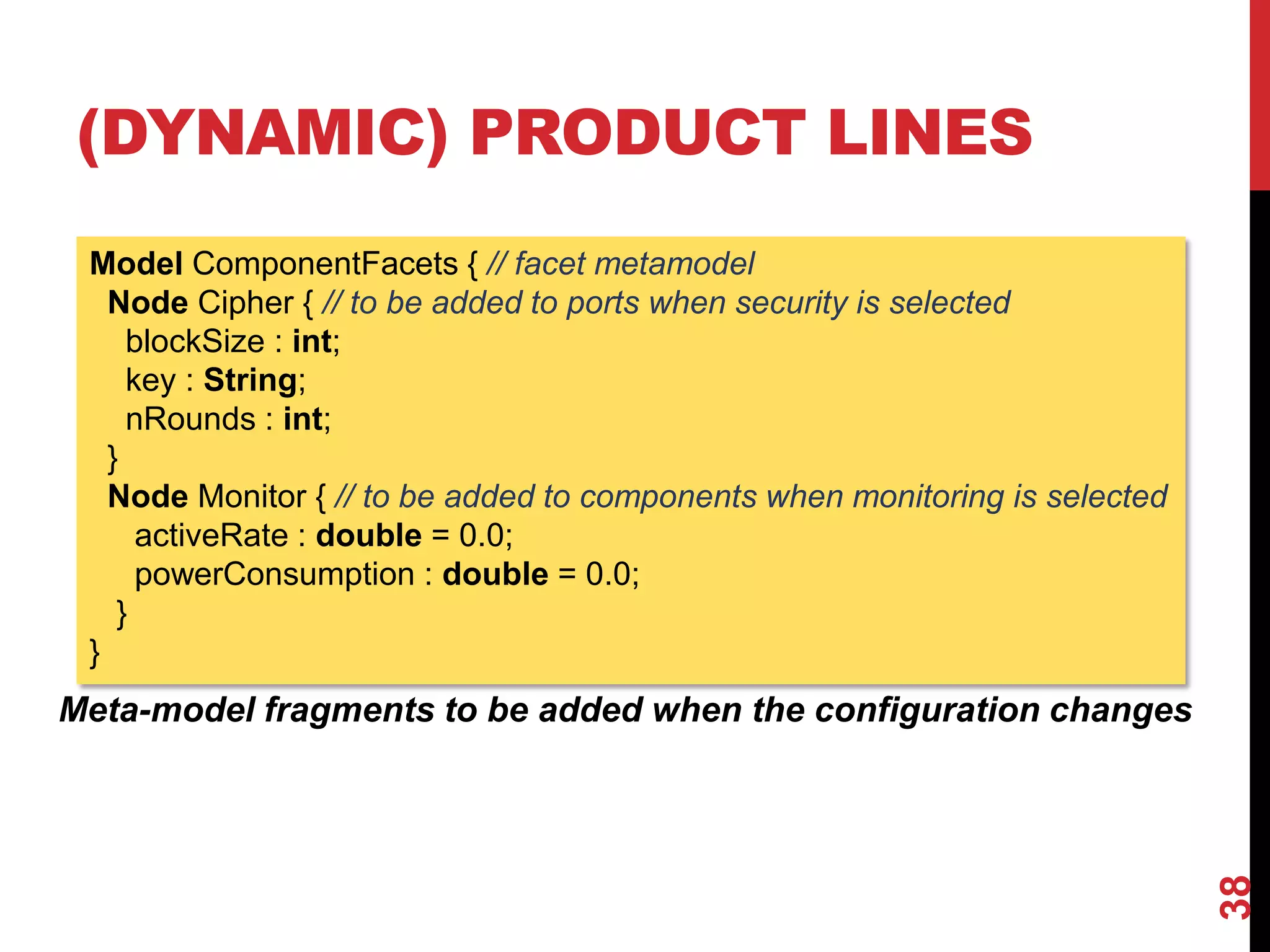
38
Model ComponentFacets { // facet metamodel
Node Cipher { // to be added to ports when security is selected
blockSize : int;
key : String;
nRounds : int;
}
Node Monitor { // to be added to components when monitoring is selected
activeRate : double = 0.0;
powerConsumption : double = 0.0;
}
}
Meta-model fragments to be added when the configuration changes
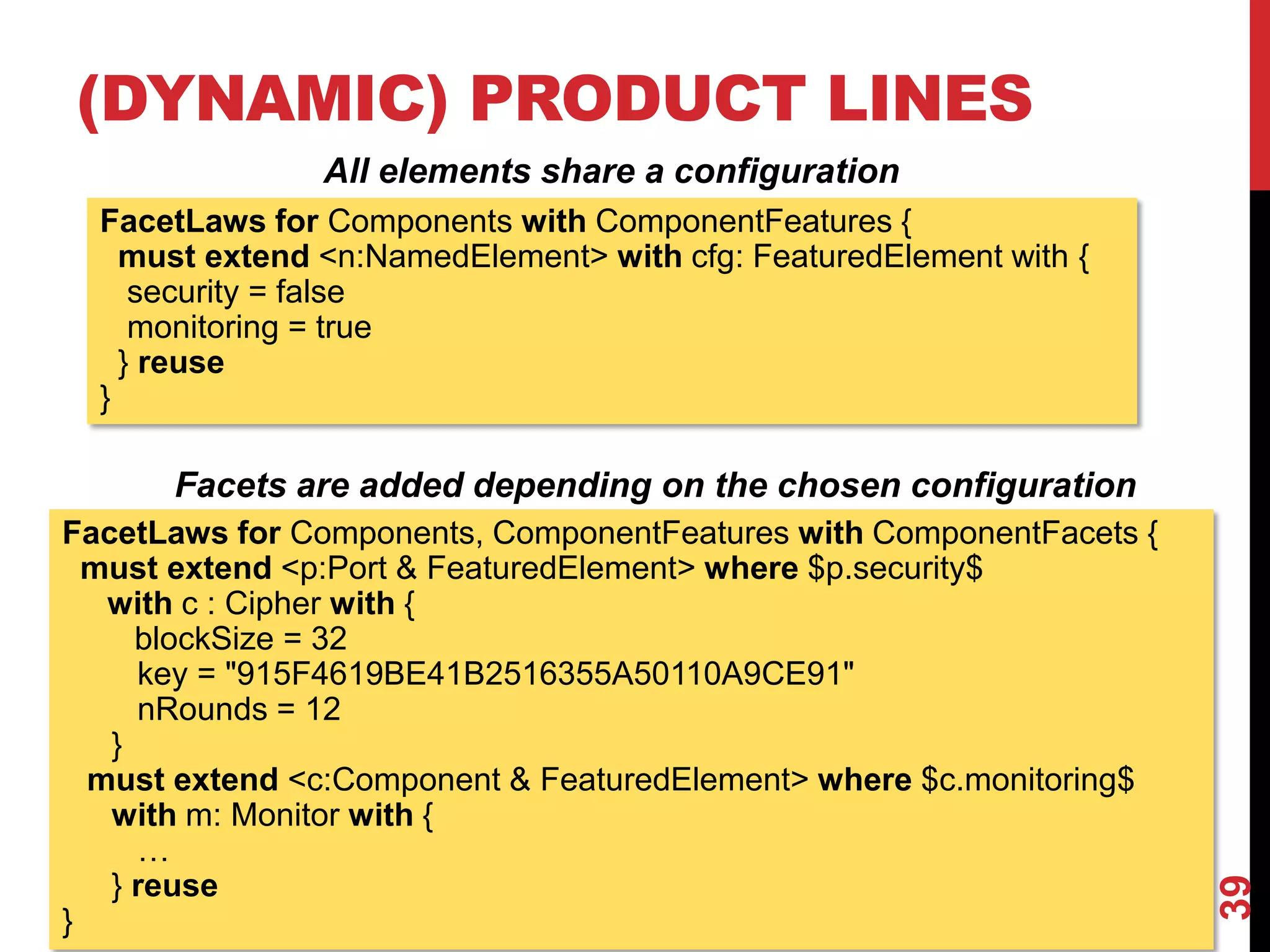
(DYNAMIC) PRODUCT LINES
39
FacetLaws for Components with ComponentFeatures {
must extend <n:NamedElement> with cfg: FeaturedElement with {
security = false
monitoring = true
} reuse
}
All elements share a configuration
FacetLaws for Components, ComponentFeatures with ComponentFacets {
must extend <p:Port & FeaturedElement> where $p.security$
with c : Cipher with {
blockSize = 32
key = "915F4619BE41B2516355A50110A9CE91"
nRounds = 12
}
must extend <c:Component & FeaturedElement> where $c.monitoring$
with m: Monitor with {
…
} reuse
}
Facets are added depending on the chosen configuration
RELATED WORKS
Role-based modelling (eg., Lodwick [1], CROM [2])
• Facets fulfill most typical features of role-based languages
• Heavyweight (role, natural, compartment types)
• Practical integration with MDE: inheritance, attribute/slot handling,
OCL constraints, integration with model management languages
A-posteriori typing
• Can dynamically add/remove types
• Cannot add slots or constraints
40
[1] Steimann. On the representation of roles in object-oriented and conceptual modelling.
Data Knowl. Eng. 35,1(2000),83–106.
[2] Kühn, Böhme, Götz,Aßmann. A combined formal model for relational context-dependent
roles. In SLE’15. pp.:113–124.
de Lara, Guerra. A posteriori typing for model-driven engineering: Concepts, analysis, and
applications. ACM TOSEM 25, 4(2017),31:1–31:60.
CONCLUSIONS AND
FUTURE WORK
Facets add flexibility and dynamicity to modelling
• make objects open
• acquire/drop slots, types and constraints dynamically
• reactive synchronization of fields
Facet interfaces and laws
• property-based facet acquisition and drop
Some scenarios where facets present advantages
Implementation on top of metaDepth
41
Future work
• Improve tooling
• Interaction with behaviour specifications
• Combine operations defined in host objects and facet
• Static analysis
Juan.deLara@uam.es
@miso_uam http://metadepth.org
THANKS!
http://miso.es

Modelado flexible basado en facetas

  • 1.
    FLEXIBLE MODELLING BASED ONFACETS Juan de Lara1 Joint work with E. Guerra1, J. Kienzle2, Y. Hattab2 1Universidad Autónoma de Madrid (Spain) 2McGill University (Canada)
  • 2.
    AGENDA Context: Model-driven Engineering Motivation Facets Interfacesand laws Tool support Case studies Conclusions and future work 2
  • 3.
    CONTEXT: MODEL- DRIVEN ENGINEERING 3 Forspecific domains • Avoid coding the same solutions over and over • Families of applications Domain-Specific Modelling Languages (DSLs) • Syntax defined by a meta- model • Code generators, simulators, model transformations Code Generator Modelling, validation and automatic generation of telephony services
  • 4.
    MDE: DOMAIN-SPECIFIC LANGUAGES 4 Abstract syntax •Meta-model • Integrity constraints (OCL) Concrete syntax • Graphical • Textual • Tabular, etc Semantics • Operational, denotational, etc Services • Refactorings, code generators, simulators, etc
  • 5.
    MetaEdit+ DOMAIN SPECIFIC MODELLING LANGUAGES Describethe structure of the domain • Relevant primitives and abstractions • Relations, features • Explicit expert knowledge 5
  • 6.
    DOMAIN SPECIFIC MODELLING LANGUAGES DSMLsneed not be graphical… xText 6
  • 7.
    MODELS AND META-MODELS The abstractsyntax of DSMLs is defined through a meta-model • Classes • Attributes • Relations 7 Factory meta-model Machine Part Conveyor Generator Assembler inps outs * * * parts Terminator 1..* 1..*
  • 8.
    MODELS AND META-MODELS The abstractsyntax of DSMLs is defined through a meta-model • Classes • Attributes • Relations 8 «conforms to» c1:Conveyor g:Generator a:Assembler c2:Conveyor c3:Conveyor t:Terminator p2: Partp2: Partouts outs inps inps outs inps Factory meta-model Machine Part Conveyor Generator Assembler inps outs * * * parts Terminator 1..* 1..*
  • 9.
    OCL CONSTRAINTS 9 Object ConstraintLanguage Well-formedness rules, which every model should satisfy Based on First-Order Logic g:Generator «conforms to» c:Conveyor Factory meta-model Machine Part Conveyor Generator Assembler inps outs * * * parts Terminator 1..* 1..* Factory meta-model Machine Part Conveyor Generator Assembler inps outs * * * parts Terminator 1..* 1..* context Generator inv: self.inps->isEmpty() and self.outs->size()>0 context Generator inv: self.inps->isEmpty() and self.outs->size()>0 context Terminator inv: self.outs->isEmpty() and self.inps->size()>0 context Assembler inv: self.inps->size()>0 and self.outs.size()>0 … inps
  • 10.
    MODELS AND META-MODELS Models arerepresented using concrete syntax • Visual • Textual No need for a 1-1 correspondence between abstract and concrete syntax elements 10 asse
  • 11.
    MODEL TRANSFORMATIONS Models need tobe manipulated for • Simulation • Optimization/refactoring • Generating another model • Generating code in-place transformations 11 …
  • 12.
    MODEL TRANSFORMATIONS Models need tobe manipulated for • Simulation • Optimization/refactoring • Generating another model • Generating code Source Target 12 model-to-model transformations
  • 13.
    MODEL TRANSFORMATIONS Models need tobe manipulated for • Simulation • Optimization/refactoring • Generating another model • Generating code 13 MMsrc MMtar Msrc Mtar Transformation definition from to «conforms to» «conforms to» Transformation execution Transformation developer Final user model-to-model transformations
  • 14.
    MODEL TRANSFORMATIONS Models need tobe manipulated for • Simulation • Optimization/refactoring • Generating another model • Generating code 14 Template languages query and model navigation
  • 15.
  • 16.
    SOME LIMITATIONS… Model-driven Engineering •Models are the principal artifacts • Models conform to a meta-model Objects are closed • Created using classes as templates • Slots, types, and constraints cannot be changed This rigidity makes some MDE scenarios difficult • Reuse of model transformations • Model extension • Multi-view modelling • … 16 Person fullName: String age: int female: boolean :Person fullName=“Homer ” age=36 female=false Meta-model Model «conforms»
  • 17.
    MOTIVATION: REUSE 17 Person fullName: String age: int female:boolean Address street: String city: String address spouse 0..1 Census :Person fullName=“Homer ” age=36 female=false Group Element quantity: int elems Metrics * operation Group avg(): Real { if (elems.isEmpty()) return 0; return elems.quantity.sum()/ elems.size(); } :Person fullName=“Todd” age=8 female=false … Springfield: Census «conforms» Calculate average age of all male adults in Springfield Can we reuse operation avg on Census models? • Retype some Persons as Elements • Create a Group containing all male adults
  • 18.
    MOTIVATION: MODEL EXTENSION 18 Person fullName: String age:int female: boolean Address street: String city: String address spouse 0..1 Census :Person fullName=“Homer ” age=36 female=false :Person fullName=“Todd” age=8 female=false … Springfield: Census «conforms» Employment Company name: String vatId: String employees * Owner name: String Employee name: String salary: double ssNumber: int active: boolean belongsTo minSalary inv: self.salary > 15000 reportsTo Can we extend existing Person objects with Employment info? • Retype some Persons as Employees or Owners • Add corresponding slots and constraints
  • 19.
    IN THIS TALK… Newmodelling mechanism: the facet • brings flexibility and dynamism to modelling • lightweight: facets are just objects Objects become open • can acquire and drop slots, types and constraints Facet laws • specify when objects acquire/drop facets Practical implementation • on top of metaDepth, a textual meta-modelling tool 19
  • 20.
    WHAT’S A FACET? Afacet is an object • becomes part of another one(s), called the host object(s), • the slots of the facet become transparently accessible from the host, which also acquires the type and constraints of the facet. A host object can acquire and drop facets dynamically 20 homer :Person fullName= “Homer” age= 57 female= false emp: Employee name= “Homer” salary=47500 ssNumber=12345 active=true Springfield :Census emp: Employee[1] : Employment homer :Person :Employee age= 57 female= false fullName= name= “Homer” salary=47500 ssNumber=12345 active=true Springfield :Census :Employment emp: Employee host object facet
  • 21.
    WHAT’S A FACET? Objecthomer receives: • Slots (name, salary, ssNumber, active) • Type (Employee) • Constraints (minSalary) From its emp facet Host and facet slots may be synchronized • fullName and name • Changing either one modifies the other Slot name ambiguity • Resolved by facet name (homer.emp) Shared facets and several facets in hosts 21 homer :Person :Employee age= 57 female= false fullName= name= “Homer” salary=47500 ssNumber=12345 active=true Springfield :Census :Employment emp: Employee Employment Employee name: String salary: double ssNumber: int active: boolean minSalary inv: salary > 15000 … «conforms» Census … «conforms»
  • 22.
    FACET MANAGEMENT A DSLfor adding/removing facets to objects 22 addFacet homer emp: Employment.Employee with { name = fullName [equality] salary = 22345 ssNumber = 12345 active = true } addFacet $Person.allInstances()→select(age>17)$ emp: Employment.Employee with {…} Explicit host selection Query-based host selection addFacet h:Person, w:Person where $h.spouse=w$ emp: Employment.Employee with {…} Pattern-based host selection Selection of host objects by id Selection of host objects by properties (similar commands for removing a facet)
  • 23.
    FACET MANAGEMENT 23 addFacet $Person.all()→select(age>17)$ emp: Employment.Employee with{…} reuse Facet shared among all selected host objects addFacet homer dayJob: Employment.Employee with { name = fullName [equality] salary = 15000 ssNumber = 12345 active = true } nightJob: Employment.Employee with { name = fullName [equality] salary = 16400 ssNumber = dayJob.ssNumber [equality] active = dayJob.active [equality] } Several facets in same host object One-to-many and many-to-one host/facet relations are supported
  • 24.
    REACTIVE FIELD ADAPTERS 24 addFacet homer emp:Employment.Employee with { ssNumber = 12345 // value semantics: literals salary = $100*self.age$ // value semantics: expressions name = fullName [equality] // reference semantics: bx synchronization active = [self.age < 65] // reference semantics: reactive field adapter } Coupled change dependencies • active = [self.age < 65]  When age changes, active is updated • name = fullName [equality]  Eq. to name = [fullName] [fullName=name] N-ary depedencies • salary = [100*self.age] [rich = self.salary > 10000] • ill-behaved: name = [fullName] [fullName = ’Mr. ’.concat(name)] • Safety policy: each field is evaluated once within a cycle
  • 25.
    MODEL SCENES 25 Springfield :Census:Employment homer :Person :Employee age=57 female=false fullName=“Homer” name=“Homer” dayJob, nightJob ssNumber=12345 dayJob, nightJob active=true dayJob, nightJob salary=15000 dayJob salary=16400 nightJob simsHome :Address street=“Evergreen Terrace” city=“Springfield” :address Different visualizations for a model • “Scenes” Total scene • Default visualization Total scene
  • 26.
    MODEL SCENES 26 Different visualizationsfor a model • “Scenes” Total scene • Default visualization Sliced scene • W.r.t. a given facet meta-model Springfield :Employment homer :Employee name=“Homer” dayJob, nightJob ssNumber=12345 dayJob, nightJob active=true dayJob, nightJob salary=15000 dayJob salary=16400 nightJob Scene sliced by Employment
  • 27.
    MODEL SCENES 27 Different visualizationsfor a model • “Scenes” Total scene • Default visualization Sliced scene • W.r.t. a given facet meta-model Granulated • Shows facets typed w.r.t. a certain meta- model Springfield :Employment nightJob :Employee name=“Homer” salary=16400 ssNumber=12345 active=true name=“Homer” salary=15000 ssNumber=12345 active=true dayJob :Employee Scene granulated by Employment
  • 28.
    FACET LAWS AND INTERFACES Opportunisticvs planned handling of facets Control which elements can be used as facets Declarative specification of conditions for acquiring/droping facets 28 :CMM :FMM FMMCMM Facet Interface «conformsto» «conformsto» Creation MM Facet MM model with facets Facet Law
  • 29.
    FACET INTERFACES Restricts howa meta-model can be used for facet-based modelling Declares • classes that can be used to create facets • allowed combinations • extra well-formedness constraints (eg., due to facet combination) 29 FacetInterface for Employment { public: all compatible: [Employee, Owner] constraints: Employee.repToIrreflexive= $self.reportsTo.excludes(self)$ }
  • 30.
    FACET LAWS Specs statingwhen host objects should acquire/drop a facet • must/may Can add additional constraints and set default values Setting homer.age:=16 makes homer drop the work facet 30 FacetLaws for Census with Employment { must extend <p:Person> where $p.age>17$ with work:Employee with { name = fullName [equality] salary = 24000 minLocalSalary: $ self.salary>16000 $ retirement: $ self.age>65 implies not self.active $ } }
  • 31.
    FACET LAWS Check manuallyissued addFacet/removeFacet commands • Should conform to the facet laws, if defined Check faceted models for consistency • Models should satisfy the laws To complete addFacet commands • Take default values and slot relations from the laws To constraint facets • By adding extra constraints To automate facet acquisition/loss • Via the “must” extension laws • addFacet/removeFacet automatically issued 31
  • 32.
    TOOL SUPPORT MetaDepth (http://metaDepth.org) •Textual multi-level modelling tool • Epsilon languages for model management (EOL, ETL, EGL) Facets, facet handling, interfaces, laws Mirror fields Triggered constraints (add/drop facets) 32 Model Census { Node Person{ name: String; age: int; female: boolean = true; spouse: Person[0..1]; address: Address[1]; } Node Address { street: String; city: String; } } var p : Person := new Person; p.age := 23; // implicitly creates an Employee facet (as p.age > 17) p.salary := 15100; // OK, as p has now an Employee facet p.age := 16; // p loses its Employee facet (as p.age <= 17) p.salary := 21000; // Error! p has no Employee facet EOL program Census meta-model
  • 33.
    EVALUATION Based on fivescenarios • Integration of annotation models • Reuse of model management operations • Multi-view modelling • Multi-level modelling • Language product lines Comparison with solutions using alternative techniques • Cross-referencing, EMF profiles, a-posterioti typing • Model adaptation, a-posteriori typing, concepts, model typing • Central repository, OpenFlexo, OSM, Vitruvius • MetaDepth, Melanee, MultEcore, ML2 • Model templates, DeltaEcore, VML*, SmartAdapters, etc 33
  • 34.
    INTEGRATING ANNOTATION MODELS Annotation modelswidely used in MDE: • Concrete syntax (CS) representation, uncertainty, variability, access control, etc. 34 Model ConcreteSyntax { abstract Node GraphicalElem { x, y : int; label : String; linkedTo : GraphicalElem[∗]; } Node Rectangle : GraphicalElem { width, height : int; } Node Circle : GraphicalElem { radius : int; } } Graphical CS support • Meta-model • Simple visualizer • Facet laws to assign CS to domain meta-models We obtain for free: • Bidirectional synchronization textual/graphical CS. CS meta-model
  • 35.
    35 FacetLaws for Censuswith ConcreteSyntax { must extend <p:Person> where $p.female$ with c:Circle with { label = name [equality] linkedTo = spouse [equality] radius = [2*age] [age = radius/2] } must extend <p:Person> where $not p.female$ with r:Rectangle with { label = name [equality] linkedTo = spouse [equality] height = age [equality] width = age [equality] } } CS FOR CENSUS Census Springfield { Person marge { fullName = "Marge"; age = 47; spouse = homer; address = simsHouse; } … } (scene sliced by Census) Synch.
  • 36.
    CAN WE DOTHIS DIFFERENTY? 36 Cannot be used to fully solve this case study: Cross-referencing, EMF profiles • No direct support for conditional styles (different CS based on female) • No direct support for bidirectional changes A-posteriori typing • Cannot map slots like x and y [1] Langer, Wieland, Wimmer,Cabot. EMF profiles: a lightweight extension approach for EMF models. JOT 11,1(2012),1–29. [2] de Lara, Guerra. A posteriori typing for model-driven engineering: Concepts, analysis, and applications. ACM TOSEM 25, 4(2017),31:1–31:60. [1] [2]
  • 37.
    (DYNAMIC) PRODUCT LINES “SEmethods for creating a collection of similar software systems from a shared set of software assets using a common means of production” (Dynamic) Language product lines 37 Model Components { abstract Node NamedElement { name : String; } Node Component : NamedElement { ports : Port[1..*]; } abstract Node Port : NamedElement ; Node InputPort : Port; Node OutputPort : Port { target : InputPort[1..*]; } } Base language definition // variability model Model ComponentFeatures { Node FeaturedElement { security : boolean = false; monitoring : boolean = true; } } Feature model Component Features security monitoring
  • 38.
    (DYNAMIC) PRODUCT LINES 38 ModelComponentFacets { // facet metamodel Node Cipher { // to be added to ports when security is selected blockSize : int; key : String; nRounds : int; } Node Monitor { // to be added to components when monitoring is selected activeRate : double = 0.0; powerConsumption : double = 0.0; } } Meta-model fragments to be added when the configuration changes
  • 39.
    (DYNAMIC) PRODUCT LINES 39 FacetLawsfor Components with ComponentFeatures { must extend <n:NamedElement> with cfg: FeaturedElement with { security = false monitoring = true } reuse } All elements share a configuration FacetLaws for Components, ComponentFeatures with ComponentFacets { must extend <p:Port & FeaturedElement> where $p.security$ with c : Cipher with { blockSize = 32 key = "915F4619BE41B2516355A50110A9CE91" nRounds = 12 } must extend <c:Component & FeaturedElement> where $c.monitoring$ with m: Monitor with { … } reuse } Facets are added depending on the chosen configuration
  • 40.
    RELATED WORKS Role-based modelling(eg., Lodwick [1], CROM [2]) • Facets fulfill most typical features of role-based languages • Heavyweight (role, natural, compartment types) • Practical integration with MDE: inheritance, attribute/slot handling, OCL constraints, integration with model management languages A-posteriori typing • Can dynamically add/remove types • Cannot add slots or constraints 40 [1] Steimann. On the representation of roles in object-oriented and conceptual modelling. Data Knowl. Eng. 35,1(2000),83–106. [2] Kühn, Böhme, Götz,Aßmann. A combined formal model for relational context-dependent roles. In SLE’15. pp.:113–124. de Lara, Guerra. A posteriori typing for model-driven engineering: Concepts, analysis, and applications. ACM TOSEM 25, 4(2017),31:1–31:60.
  • 41.
    CONCLUSIONS AND FUTURE WORK Facetsadd flexibility and dynamicity to modelling • make objects open • acquire/drop slots, types and constraints dynamically • reactive synchronization of fields Facet interfaces and laws • property-based facet acquisition and drop Some scenarios where facets present advantages Implementation on top of metaDepth 41 Future work • Improve tooling • Interaction with behaviour specifications • Combine operations defined in host objects and facet • Static analysis
  • 42.