
AFA Workshop on SMO 2
8 NOVEMBER 2021
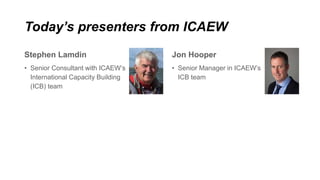
Today’s presenters from ICAEW
Stephen Lamdin
• Senior Consultant with ICAEW’s
International Capacity Building
(ICB) team
Jon Hooper
• Senior Manager in ICAEW’s
ICB team
Where have we helped develop a PQ?
• Bangladesh
• Botswana
• Cambodia
• Ghana
• Kyrgyzstan
• Lesotho
• Malawi
• Myanmar
• Nepal
• Nigeria
• Tanzania
• Zambia
• Zimbabwe
Eight pillars of a Professional Qualification
Technical Competence (IES2)
• Challenges:
1. Credits for prior learning
2. National relevance
3. Keeping up to date
4. Authoring
5. Teachers
6. Teaching in a digital age
• Key elements:
Competency Based
Internationally Recognised
Learning Materials
Quality Tuition
Qualification ladder
Assessment IES6
• Challenges:
1. Finding examiners
2. Pass Rates (IES1)
3. Case Study
4. Examining in a digital age
• Key elements:
High Quality examiners:
 Technically competent
 Willing to engage in the review process
 Modern processes
Strong Governance
Entry and Exit points
Work experience (IES5)
• Challenges:
1. Recording
2. Employer involvement
• Key elements:
Determining requirements:
 Where?
 How much?
 What work?
Policing
Professional Development/Ethics
• Challenges:
1. Creating a skills scheme
2. How do you cover ethics
3. Recruiting employers
• Key elements:
Professional Skills (IES3)
Ethics (IES4):
 In exams
 In practical experience
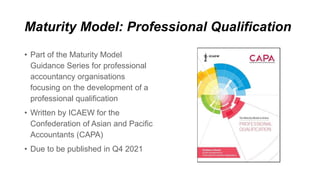
Maturity Model: Professional Qualification
• Part of the Maturity Model
Guidance Series for professional
accountancy organisations
focusing on the development of a
professional qualification
• Written by ICAEW for the
Confederation of Asian and Pacific
Accountants (CAPA)
• Due to be published in Q4 2021
Summary
• Developing a national PQ to comply with SMO2 is not to be undertaken lightly
• Requires significant resources and costs... but significant benefits
• The larger you are the easier it is
• Working with a third party or regional grouping can help
icaew.com
 ICAEW 2020
ICAEW 2021

IFAC-ICAEW Education workshop

  • 1.
    AFA Workshop onSMO 2 8 NOVEMBER 2021
  • 2.
    Today’s presenters fromICAEW Stephen Lamdin • Senior Consultant with ICAEW’s International Capacity Building (ICB) team Jon Hooper • Senior Manager in ICAEW’s ICB team
  • 3.
    Where have wehelped develop a PQ? • Bangladesh • Botswana • Cambodia • Ghana • Kyrgyzstan • Lesotho • Malawi • Myanmar • Nepal • Nigeria • Tanzania • Zambia • Zimbabwe
  • 4.
    Eight pillars ofa Professional Qualification
  • 5.
    Technical Competence (IES2) •Challenges: 1. Credits for prior learning 2. National relevance 3. Keeping up to date 4. Authoring 5. Teachers 6. Teaching in a digital age • Key elements: Competency Based Internationally Recognised Learning Materials Quality Tuition
  • 6.
  • 7.
    Assessment IES6 • Challenges: 1.Finding examiners 2. Pass Rates (IES1) 3. Case Study 4. Examining in a digital age • Key elements: High Quality examiners:  Technically competent  Willing to engage in the review process  Modern processes Strong Governance Entry and Exit points
  • 8.
    Work experience (IES5) •Challenges: 1. Recording 2. Employer involvement • Key elements: Determining requirements:  Where?  How much?  What work? Policing
  • 9.
    Professional Development/Ethics • Challenges: 1.Creating a skills scheme 2. How do you cover ethics 3. Recruiting employers • Key elements: Professional Skills (IES3) Ethics (IES4):  In exams  In practical experience
  • 10.
    Maturity Model: ProfessionalQualification • Part of the Maturity Model Guidance Series for professional accountancy organisations focusing on the development of a professional qualification • Written by ICAEW for the Confederation of Asian and Pacific Accountants (CAPA) • Due to be published in Q4 2021
  • 11.
    Summary • Developing anational PQ to comply with SMO2 is not to be undertaken lightly • Requires significant resources and costs... but significant benefits • The larger you are the easier it is • Working with a third party or regional grouping can help
  • 12.

Editor's Notes

  • #4 Abu Dhabi, Afghanistan, Bangladesh, Belgium, Botswana, Cambodia, Croatia, Cyprus, Dubai, Ghana, Jordan, Kenya, Kyrgyzstan, Lesotho, Malawi, Myanmar, Nepal, Nigeria, Pakistan, Philippines, Samoa, Saudi Arabia, Serbia, Sri Lanka, Tanzania, Thailand, Turkey, Vietnam, Zambia, Zimbabwe = 32 countries around the world 2019 = 24 visits to 13 countries / 490 nights away by our team of consultants