The Human Rights
Compliance Assessment
About this Presentation

      This presentation describes the concept,
      features and application of the Human
      Rights Compliance Assessment, a
      comprehensive tool that allows businesses
      to measure their performance on
      international human rights principles.

      Access the HRCA at
      HumanRightsBusiness.org
Agenda

    1.   The need for a human rights tool
    2.   What is the HRCA?
    3.   HRCA content and features
    4.   How to use the HRCA
    5.   The HRCA in practice
    6.   Accessing the HRCA
1.      The Need for a
        Human Rights Tool
 Why is it important to systematically assess
 your company’s human rights risks and
 performance?
The Need for a Human Rights Tool


1.   Improve Human Rights
     Performance

         Human rights assessments help companies
         prevent and mitigate abuses, and avoid
         complicity in human rights violations committed
         by third parties
The Need for a Human Rights Tool

1.   Improve Human Rights
     Performance

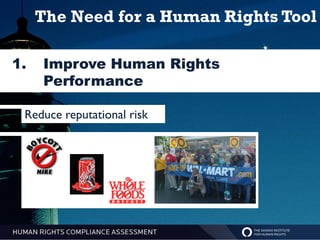
 Reduce reputational risk
The Need for a Human Rights Tool

1.   Improve Human Rights
     Performance

 Reduce reputational risk
 Legal liability
            Companies are increasingly exposed to home,
            host and extraterritorial legislation concerning
            their social impacts
The Need for a Human Rights Tool

1.   Improve Human Rights
     Performance

 Reduce reputational risk
 Legal liability
 Operational risk
            Human rights violations can lead to
            blockades, work stoppages, sabotage and
            other actions that could affect output.
The Need for a Human Rights Tool


2.    Corporate Commitments

         Human rights assessments help
         companies implement their values
The Need for a Human Rights Tool


2.    Corporate Commitments

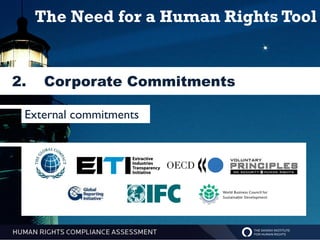
 External commitments
The Need for a Human Rights Tool


2.    Corporate Commitments

 Internal commitments

       Code of conduct
       Business principles

       More than 250 multinational companies have
       publicly committed to upholding human rights
       principles in their operations
The Need for a Human Rights Tool


3.    Investor Requirements

 60% of worldwide project finance includes social criteria

 Socially responsible investment makes up 11% of U.S.
 investment flows
The Need for a Human Rights Tool


4.               Reputational Risk and
     Unclear Responsibilities in
                 Non-Technical Risk
     Challenging Locations
         Human rights assessments help
         companies set standards and
         performance benchmarks when
         operating in high-risk environments
The Need for a Human Rights Tool


4.                  Reputational Risk and
        Unclear Responsibilities in
                    Non-Technical Risk
        Challenging Locations

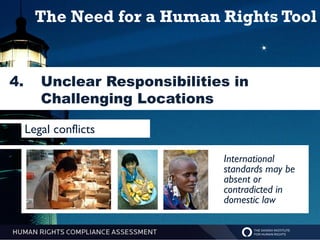
     Legal conflicts

                              International
                              standards may be
                              absent or
                              contradicted in
                              domestic law
The Need for a Human Rights Tool


4.                  Reputational Risk and
        Unclear Responsibilities in
                    Non-Technical Risk
        Challenging Locations

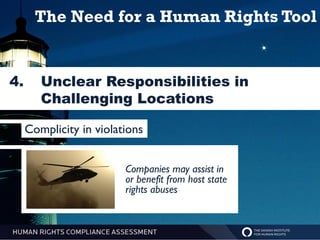
     Complicity in violations


                         Companies may assist in
                         or benefit from host state
                         rights abuses
2.       What is the HRCA?
The Human Rights Compliance Assessment is
an online checklist tool that allows companies
to comprehensively measure their compliance
with international human rights principles.
What is the HRCA?


HRCA objective

 Benchmark and improve human rights
 performance
 Monitor and report progress
 Define legal responsibilities and development
 opportunities
 Build internal awareness and capacity
What is the HRCA?

HRCA Objective:


 Benchmark and improve human rights
 performance
 Monitor and report performance
 Define legal responsibilities and development
 opportunities
 Build internal awareness and capacity
What is the HRCA?

How does the HRCA make human
rights standards operational?
What is the HRCA?

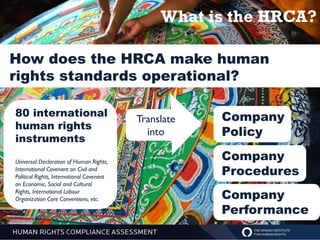
How does the HRCA make human
rights standards operational?

80 international                                       Company
                                           Translate
human rights
                                             into      Policy
instruments

Universal Declaration of Human Rights,
                                                       Company
International Covenant on Civil and
Political Rights, International Covenant
                                                       Procedures
on Economic, Social and Cultural
Rights, International Labour
Organization Core Conventions, etc.                    Company
                                                       Performance
What is the HRCA?

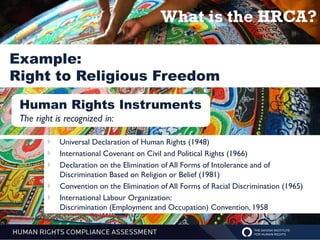
Example:
Right to Religious Freedom
 Human Rights Instruments
 The right is recognized in:

           Universal Declaration of Human Rights (1948)
           International Covenant on Civil and Political Rights (1966)
           Declaration on the Elimination of All Forms of Intolerance and of
            Discrimination Based on Religion or Belief (1981)
           Convention on the Elimination of All Forms of Racial Discrimination (1965)
           International Labour Organization:
            Discrimination (Employment and Occupation) Convention, 1958
What is the HRCA?

Example:
Right to Religious Freedom


       What does this rights
       principle mean for
       companies?
What is the HRCA?

Example:
Right to Religious Freedom

 Company Policy
 The company publicly commits to:


               Recognize religious expression

               Prohibit religious harassment
What is the HRCA?

Example:
Right to Religious Freedom

 Company Procedures
 Systems, directives and guidelines ensure that:

        Workers are allowed to express religion at the workplace
        Workers are allowed to take religious holidays
        If abuses occur, workers can file grievances confidentially
        and anonymously
What is the HRCA?

Example:
Right to Religious Freedom

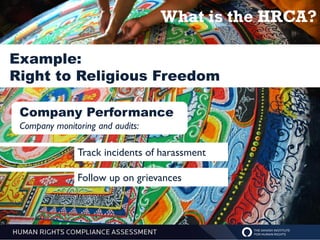
 Company Performance
 Company monitoring and audits:

               Track incidents of harassment

               Follow up on grievances
What is the HRCA?


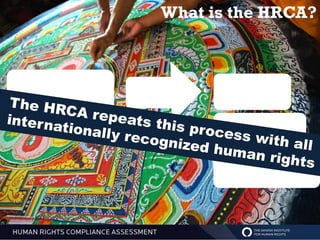
80 international               Company
                   Translate
human rights
instruments
                     into      Policy
                               Company
                               Procedures
                               Company
                               Performance
3.   HRCA Content
     and Features
The HRCA Tool


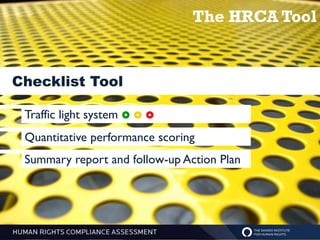
Checklist Tool

 Traffic light system   
 Quantitative
 Legal liability performance scoring
 Summary report and follow-up Action Plan
The HRCA Tool

Comprehensive Coverage

  All internationally recognized human rights
  200 questions and more than 1,000 company
  policy, procedure and performance indicators
The HRCA Tool

Comprehensive Coverage

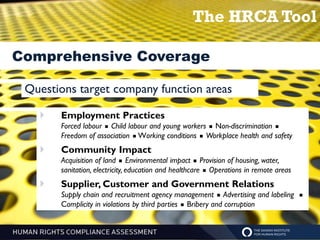
 Questions target company function areas

      Employment Practices
       Forced labour  Child labour and young workers  Non-discrimination 
       Freedom of association  Working conditions  Workplace health and safety
      Community Impact
       Acquisition of land  Environmental impact  Provision of housing, water,
       sanitation, electricity, education and healthcare  Operations in remote areas
      Supplier, Customer and Government Relations
       Supply chain and recruitment agency management  Advertising and labeling        
       Complicity in violations by third parties  Bribery and corruption
The HRCA Tool


Consultation and Testing

 2002-2005: Consultation process
    70 companies, 50 human rights organizations,
    35 international rights experts

 Piloted with Shell International
 Content and interface fully updated in 2010
4. How to Use the HRCA

  Getting started
Using the HRCA


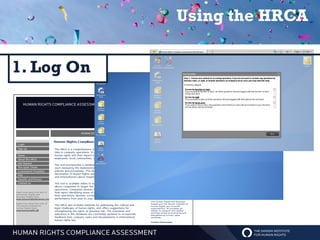
1. Log On
Using the HRCA

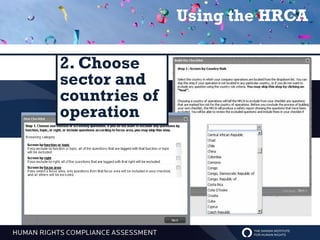
2. Choose
sector and
countries of
operation
Using the HRCA

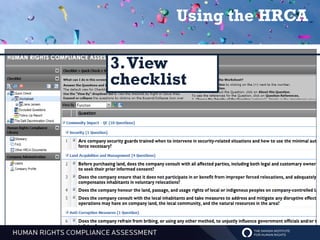
3. View
checklist
Using the HRCA

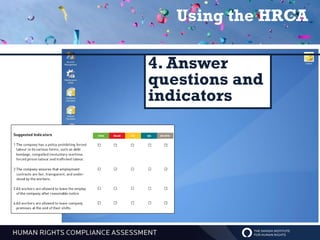
4. Answer
questions and
indicators
Using the HRCA

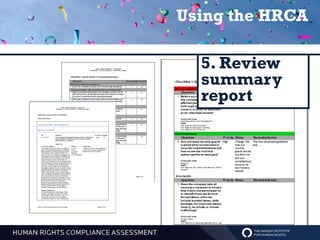
  5. Review
  summary
  report
5. The HRCA in Practice
     How companies use the HRCA
The HRCA in
                                          Practice

Meet human rights commitments
    Develop internal policies and systems


       Compare to external human rights frameworks
The HRCA in
                                                           Practice


Customise to company

  Tailor human rights checklists to company operations,
  locations and function areas

               ‘We have been working with DIHR since 2007 to develop a tool our
               subsidiaries and units can use to make sure that their practices are
               in fact aligned with the Total Code of Conduct and the principles set
               forth in the Universal Declaration of Human Rights and the ILO’s
               fundamental conventions.’
                                       — Total Oil Environment and Society Report 2009
The HRCA in
                                            Practice
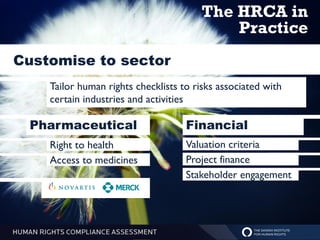
Customise to sector
    Tailor human rights checklists to risks associated with
    certain industries and activities

 Pharmaceutical                     Financial
    Right to health                 Valuation criteria
    Access to medicines             Project finance
                                    Stakeholder engagement
The HRCA in
                                                           Practice


Site Visits

  DIHR applies checklists by interviewing country managers
  and local function-area heads

          ‘The methodology makes it possible, by means of self assessments
          guided by independent experts from the Danish Institute for Human
          Rights, to identify behaviour and decisions that can have an impact on
          human rights in all types of business and operational areas.’
                                                                        — Eni.com
The HRCA in
                                                           Practice


Self-Application

     The company conducts its own site visits and interviews,
     with DIHR assisting in initial scoping and final data analysis


     Novartis Indonesia tested a draft version of the HRCA tool for pharmaceutical
     companies […] Testing the tool particularly improves the methodology and the
     integration into existing management systems of pharmaceutical companies
                                                    — Novartis Communication on Progress, 2009
The HRCA in
                                                  Practice


Supply Chain

    The company applies the HRCA in
    its suppliers and business partners


                    ‘In 2007, Groupe SEB decided to assess the
                    practices of all its sites of more than 10
                    employees regarding respect for human rights,
                    with the HRCA’
                                                  — GroupeSEB.com
The HRCA in
                                             Practice

Identifying Due Diligence
     Companies use the HRCA to identify due diligence steps
     toward preventing and mitigating human rights abuses,
     particularly in challenging contexts


Internal Awareness-Raising
     The operational nature of the tool allows managers and
     employees to tie specific tasks to broader objectives,
     increasing uptake and retention
Additional Checks
Additional Checks


HRCA Quick Check
    Free, condensed version of HRCA
    Developed in cooperation with
    development finance institutions, SMEs
Additional Checks


Measures company performance against
all 10 Global Compact Principles
Additional Checks


China Check

   Checklists tailored to Chinese law
   and practice

   Developed in cooperation with
   Chinese businesses, government
   officials and NGOs
6. Accessing The HRCA
Accessing the HRCA


Subscription

Free versions
Accessing the HRCA


Subscription

Free versions

Human Rights Compliance Assessment Presentation

  • 1.
  • 2.
    About this Presentation This presentation describes the concept, features and application of the Human Rights Compliance Assessment, a comprehensive tool that allows businesses to measure their performance on international human rights principles. Access the HRCA at HumanRightsBusiness.org
  • 3.
    Agenda 1. The need for a human rights tool 2. What is the HRCA? 3. HRCA content and features 4. How to use the HRCA 5. The HRCA in practice 6. Accessing the HRCA
  • 4.
    1. The Need for a Human Rights Tool Why is it important to systematically assess your company’s human rights risks and performance?
  • 5.
    The Need fora Human Rights Tool 1. Improve Human Rights Performance Human rights assessments help companies prevent and mitigate abuses, and avoid complicity in human rights violations committed by third parties
  • 6.
    The Need fora Human Rights Tool 1. Improve Human Rights Performance Reduce reputational risk
  • 7.
    The Need fora Human Rights Tool 1. Improve Human Rights Performance Reduce reputational risk Legal liability Companies are increasingly exposed to home, host and extraterritorial legislation concerning their social impacts
  • 8.
    The Need fora Human Rights Tool 1. Improve Human Rights Performance Reduce reputational risk Legal liability Operational risk Human rights violations can lead to blockades, work stoppages, sabotage and other actions that could affect output.
  • 9.
    The Need fora Human Rights Tool 2. Corporate Commitments Human rights assessments help companies implement their values
  • 10.
    The Need fora Human Rights Tool 2. Corporate Commitments External commitments
  • 11.
    The Need fora Human Rights Tool 2. Corporate Commitments Internal commitments Code of conduct Business principles More than 250 multinational companies have publicly committed to upholding human rights principles in their operations
  • 12.
    The Need fora Human Rights Tool 3. Investor Requirements 60% of worldwide project finance includes social criteria Socially responsible investment makes up 11% of U.S. investment flows
  • 13.
    The Need fora Human Rights Tool 4. Reputational Risk and Unclear Responsibilities in Non-Technical Risk Challenging Locations Human rights assessments help companies set standards and performance benchmarks when operating in high-risk environments
  • 14.
    The Need fora Human Rights Tool 4. Reputational Risk and Unclear Responsibilities in Non-Technical Risk Challenging Locations Legal conflicts International standards may be absent or contradicted in domestic law
  • 15.
    The Need fora Human Rights Tool 4. Reputational Risk and Unclear Responsibilities in Non-Technical Risk Challenging Locations Complicity in violations Companies may assist in or benefit from host state rights abuses
  • 16.
    2. What is the HRCA? The Human Rights Compliance Assessment is an online checklist tool that allows companies to comprehensively measure their compliance with international human rights principles.
  • 17.
    What is theHRCA? HRCA objective Benchmark and improve human rights performance Monitor and report progress Define legal responsibilities and development opportunities Build internal awareness and capacity
  • 18.
    What is theHRCA? HRCA Objective: Benchmark and improve human rights performance Monitor and report performance Define legal responsibilities and development opportunities Build internal awareness and capacity
  • 19.
    What is theHRCA? How does the HRCA make human rights standards operational?
  • 20.
    What is theHRCA? How does the HRCA make human rights standards operational? 80 international Company Translate human rights into Policy instruments Universal Declaration of Human Rights, Company International Covenant on Civil and Political Rights, International Covenant Procedures on Economic, Social and Cultural Rights, International Labour Organization Core Conventions, etc. Company Performance
  • 21.
    What is theHRCA? Example: Right to Religious Freedom Human Rights Instruments The right is recognized in:  Universal Declaration of Human Rights (1948)  International Covenant on Civil and Political Rights (1966)  Declaration on the Elimination of All Forms of Intolerance and of Discrimination Based on Religion or Belief (1981)  Convention on the Elimination of All Forms of Racial Discrimination (1965)  International Labour Organization: Discrimination (Employment and Occupation) Convention, 1958
  • 22.
    What is theHRCA? Example: Right to Religious Freedom What does this rights principle mean for companies?
  • 23.
    What is theHRCA? Example: Right to Religious Freedom Company Policy The company publicly commits to: Recognize religious expression Prohibit religious harassment
  • 24.
    What is theHRCA? Example: Right to Religious Freedom Company Procedures Systems, directives and guidelines ensure that: Workers are allowed to express religion at the workplace Workers are allowed to take religious holidays If abuses occur, workers can file grievances confidentially and anonymously
  • 25.
    What is theHRCA? Example: Right to Religious Freedom Company Performance Company monitoring and audits: Track incidents of harassment Follow up on grievances
  • 26.
    What is theHRCA? 80 international Company Translate human rights instruments into Policy Company Procedures Company Performance
  • 27.
    3. HRCA Content and Features
  • 28.
    The HRCA Tool ChecklistTool Traffic light system    Quantitative Legal liability performance scoring Summary report and follow-up Action Plan
  • 29.
    The HRCA Tool ComprehensiveCoverage All internationally recognized human rights 200 questions and more than 1,000 company policy, procedure and performance indicators
  • 30.
    The HRCA Tool ComprehensiveCoverage Questions target company function areas  Employment Practices Forced labour  Child labour and young workers  Non-discrimination  Freedom of association  Working conditions  Workplace health and safety  Community Impact Acquisition of land  Environmental impact  Provision of housing, water, sanitation, electricity, education and healthcare  Operations in remote areas  Supplier, Customer and Government Relations Supply chain and recruitment agency management  Advertising and labeling  Complicity in violations by third parties  Bribery and corruption
  • 31.
    The HRCA Tool Consultationand Testing 2002-2005: Consultation process 70 companies, 50 human rights organizations, 35 international rights experts Piloted with Shell International Content and interface fully updated in 2010
  • 32.
    4. How toUse the HRCA Getting started
  • 33.
  • 34.
    Using the HRCA 2.Choose sector and countries of operation
  • 35.
    Using the HRCA 3.View checklist
  • 36.
    Using the HRCA 4.Answer questions and indicators
  • 37.
    Using the HRCA 5. Review summary report
  • 38.
    5. The HRCAin Practice How companies use the HRCA
  • 39.
    The HRCA in Practice Meet human rights commitments Develop internal policies and systems Compare to external human rights frameworks
  • 40.
    The HRCA in Practice Customise to company Tailor human rights checklists to company operations, locations and function areas ‘We have been working with DIHR since 2007 to develop a tool our subsidiaries and units can use to make sure that their practices are in fact aligned with the Total Code of Conduct and the principles set forth in the Universal Declaration of Human Rights and the ILO’s fundamental conventions.’ — Total Oil Environment and Society Report 2009
  • 41.
    The HRCA in Practice Customise to sector Tailor human rights checklists to risks associated with certain industries and activities Pharmaceutical Financial Right to health Valuation criteria Access to medicines Project finance Stakeholder engagement
  • 42.
    The HRCA in Practice Site Visits DIHR applies checklists by interviewing country managers and local function-area heads ‘The methodology makes it possible, by means of self assessments guided by independent experts from the Danish Institute for Human Rights, to identify behaviour and decisions that can have an impact on human rights in all types of business and operational areas.’ — Eni.com
  • 43.
    The HRCA in Practice Self-Application The company conducts its own site visits and interviews, with DIHR assisting in initial scoping and final data analysis Novartis Indonesia tested a draft version of the HRCA tool for pharmaceutical companies […] Testing the tool particularly improves the methodology and the integration into existing management systems of pharmaceutical companies — Novartis Communication on Progress, 2009
  • 44.
    The HRCA in Practice Supply Chain The company applies the HRCA in its suppliers and business partners ‘In 2007, Groupe SEB decided to assess the practices of all its sites of more than 10 employees regarding respect for human rights, with the HRCA’ — GroupeSEB.com
  • 45.
    The HRCA in Practice Identifying Due Diligence Companies use the HRCA to identify due diligence steps toward preventing and mitigating human rights abuses, particularly in challenging contexts Internal Awareness-Raising The operational nature of the tool allows managers and employees to tie specific tasks to broader objectives, increasing uptake and retention
  • 46.
  • 47.
    Additional Checks HRCA QuickCheck Free, condensed version of HRCA Developed in cooperation with development finance institutions, SMEs
  • 48.
    Additional Checks Measures companyperformance against all 10 Global Compact Principles
  • 49.
    Additional Checks China Check Checklists tailored to Chinese law and practice Developed in cooperation with Chinese businesses, government officials and NGOs
  • 50.
  • 51.
  • 52.