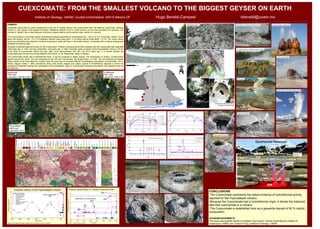
The Cuexcomate in Puebla, Mexico is not a volcano as commonly believed, but rather the largest known geyserite deposit on Earth. At approximately 28.5 x 24.3 m in diameter and up to 12 m deep, it is composed of 90% calcite from hydrothermal activity. While its exact age is unknown, local accounts date activity to 1064 and 1664 AD, corresponding roughly to eruptions of the nearby Popocatépetl volcano 40 km away. Radiometric dating is still needed to confirm its origin from Popocatépetl or other geothermal sources.