BY MAXIM D. WHEATLEY
D E S I G N T H I N K I N G:
T A K I N G A P R O D U C T
T O M A R K E T
ABOUT MAXIM
Maxim is an award-winning product leader and innovator. Maxim co-founded LifeFuels, and
was the founding Chief Product Officer where he won multiple industry awards, including the
coveted CES Innovation Award. He is a prolific inventor with 20+ patents, both issued and
pending. He has previously worked in Venture Capital and as an award-winning film producer.
He also serves as an Entrepreneur in Residence at Georgetown University’s business school.
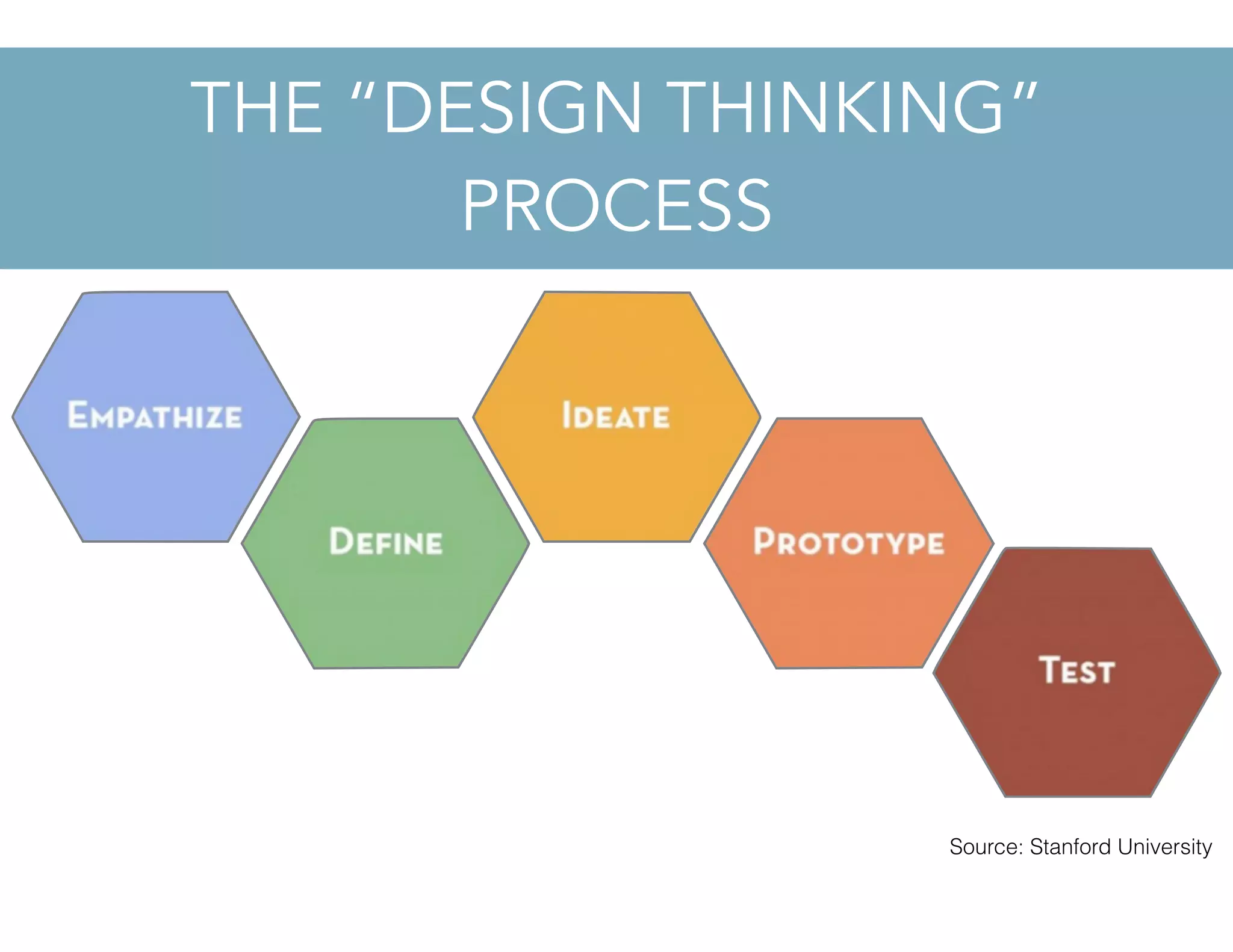
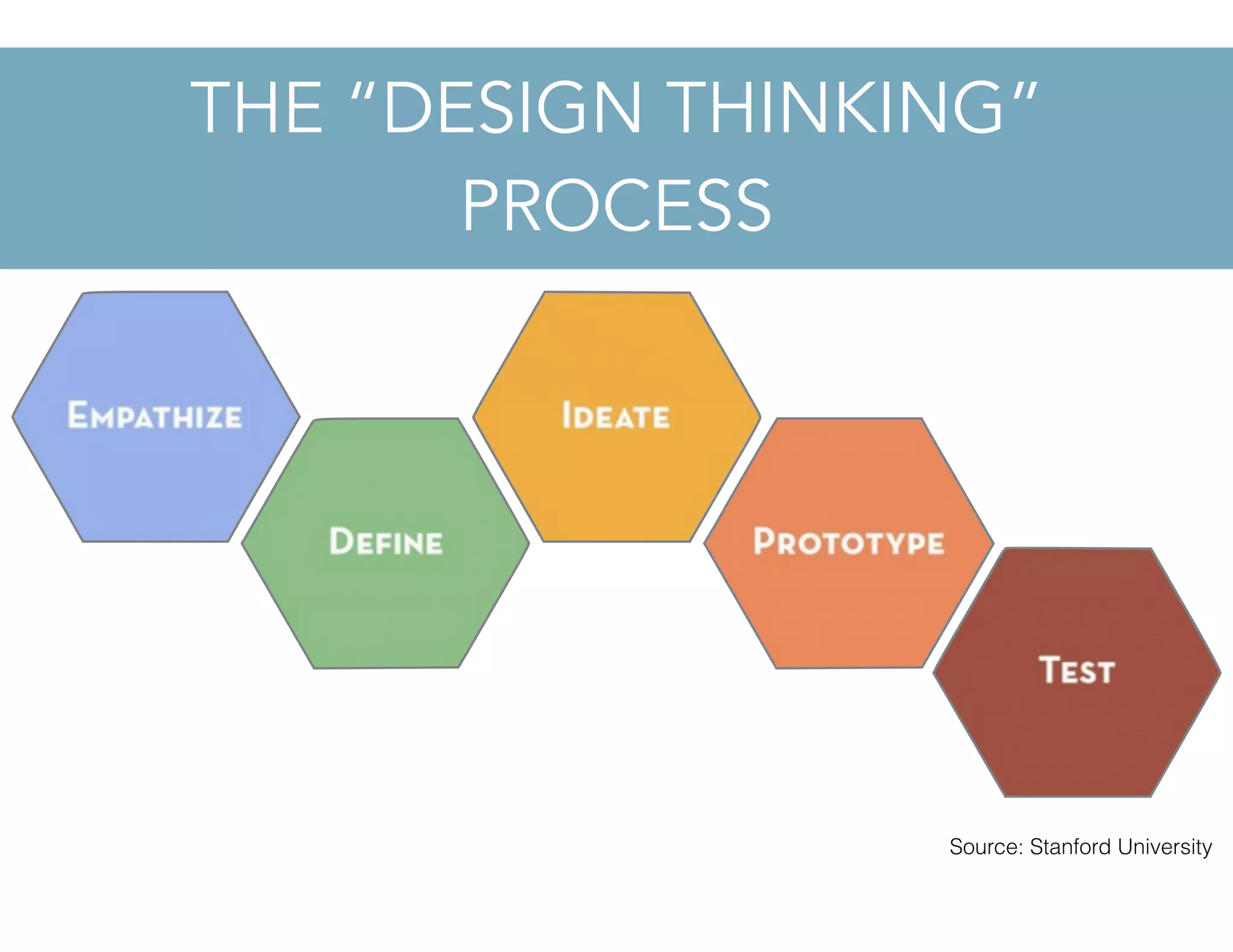
Source: Stanford University
THE “DESIGN THINKING”
PROCESS
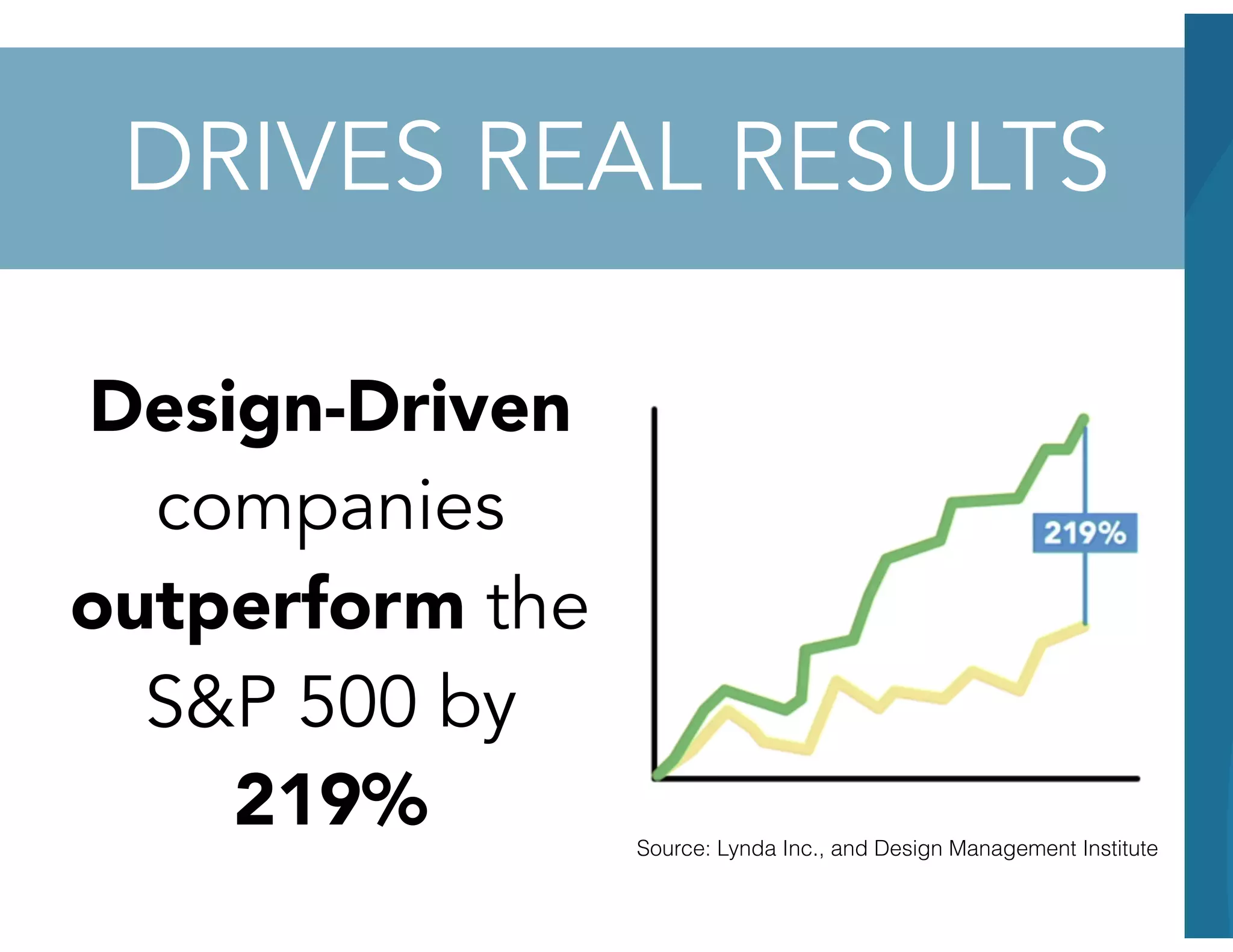
Source: Lynda Inc., and Design Management Institute
DRIVES REAL RESULTS
Design-Driven
companies
outperform the
S&P 500 by
219%
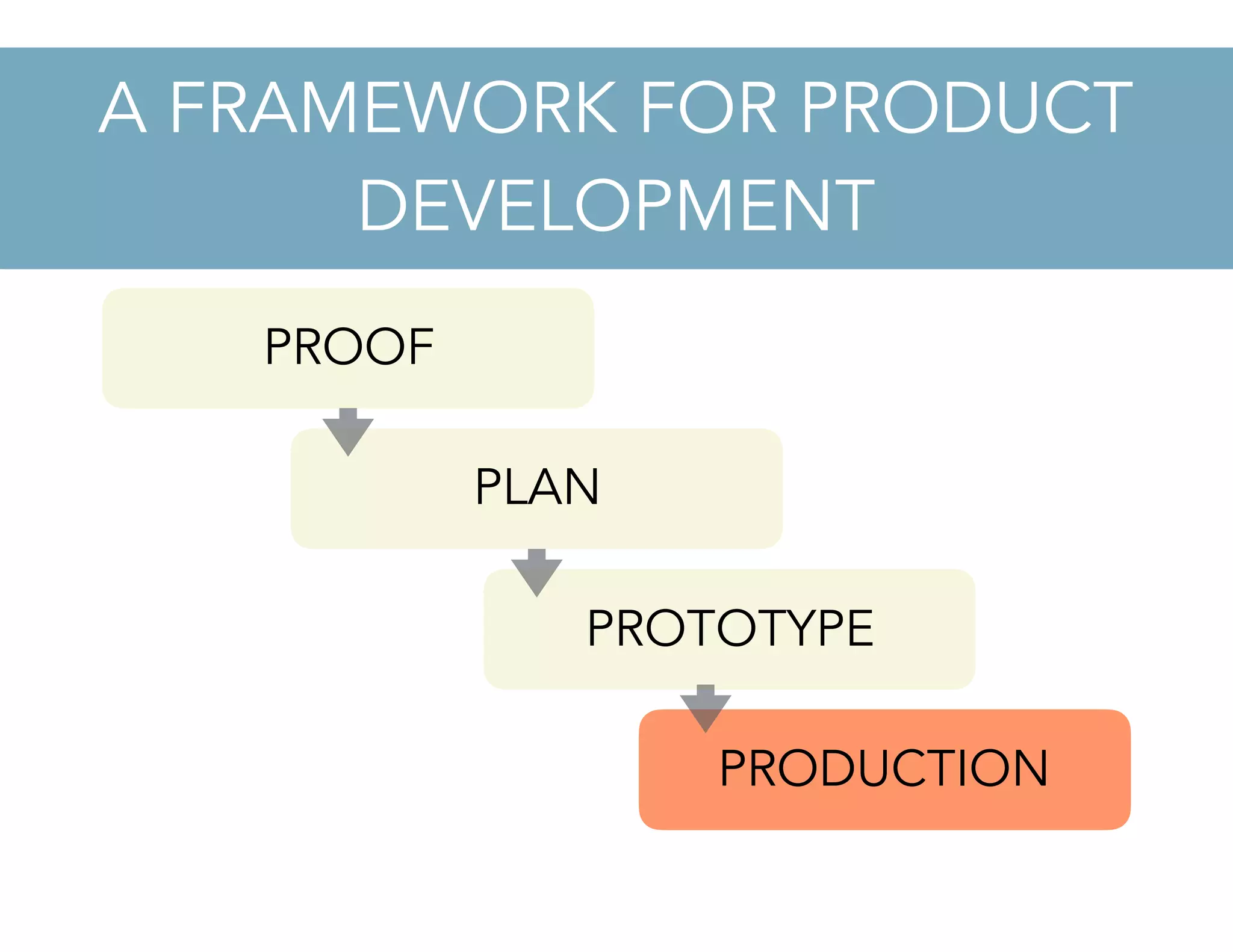
A FRAMEWORK FOR PRODUCT
DEVELOPMENT
PROOF
PLAN
PROTOTYPE
PRODUCTION
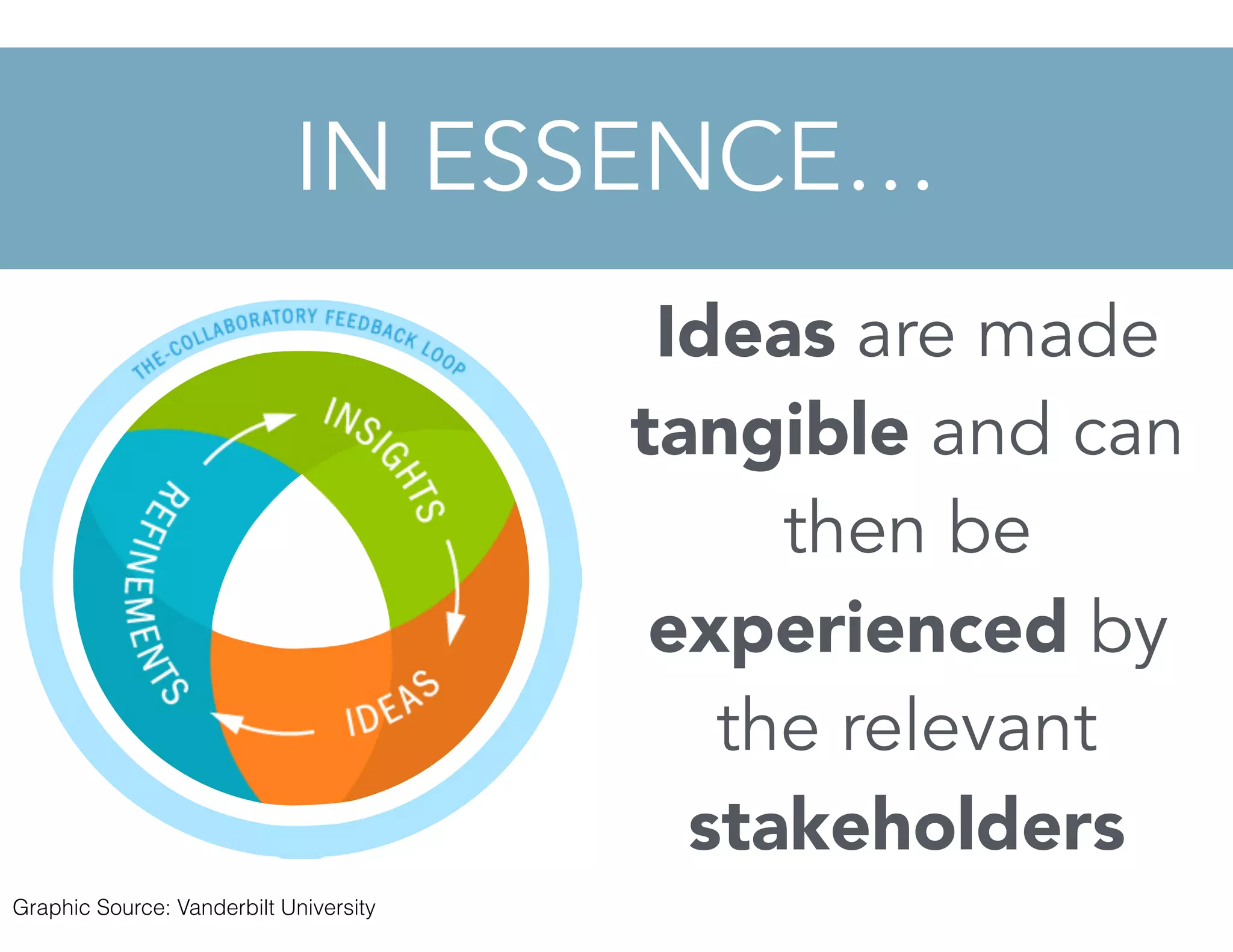
IN ESSENCE…
Ideas are made
tangible and can
then be
experienced by
the relevant
stakeholders
Graphic Source: Vanderbilt University
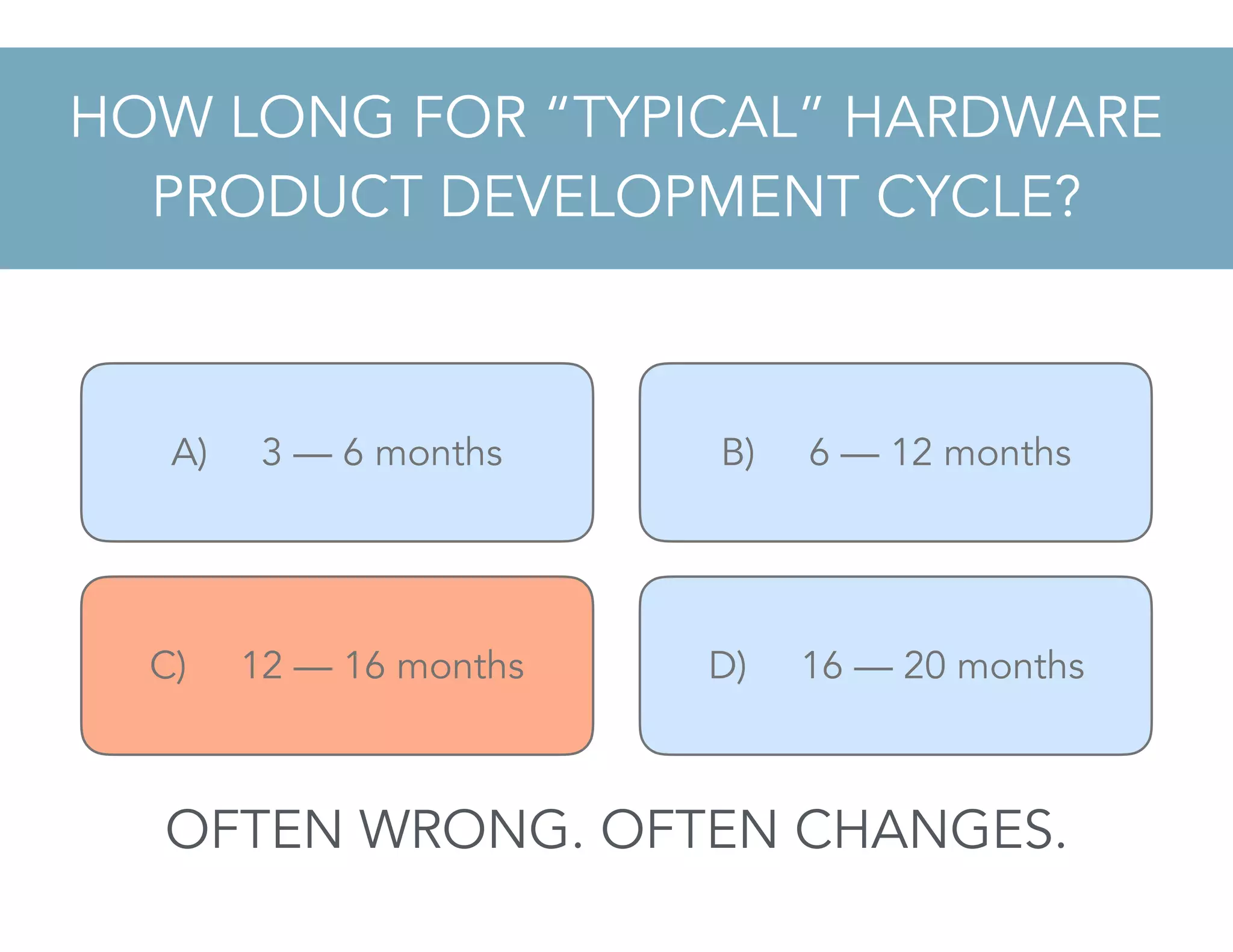
HOW LONG FOR “TYPICAL” HARDWARE
PRODUCT DEVELOPMENT CYCLE?
A) 3 — 6 months B) 6 — 12 months
D) 16 — 20 monthsC) 12 — 16 months
OFTEN WRONG. OFTEN CHANGES.
THE PROCESS OF
DESIGN THINKING
Source: Stanford University
THE “DESIGN THINKING”
PROCESS
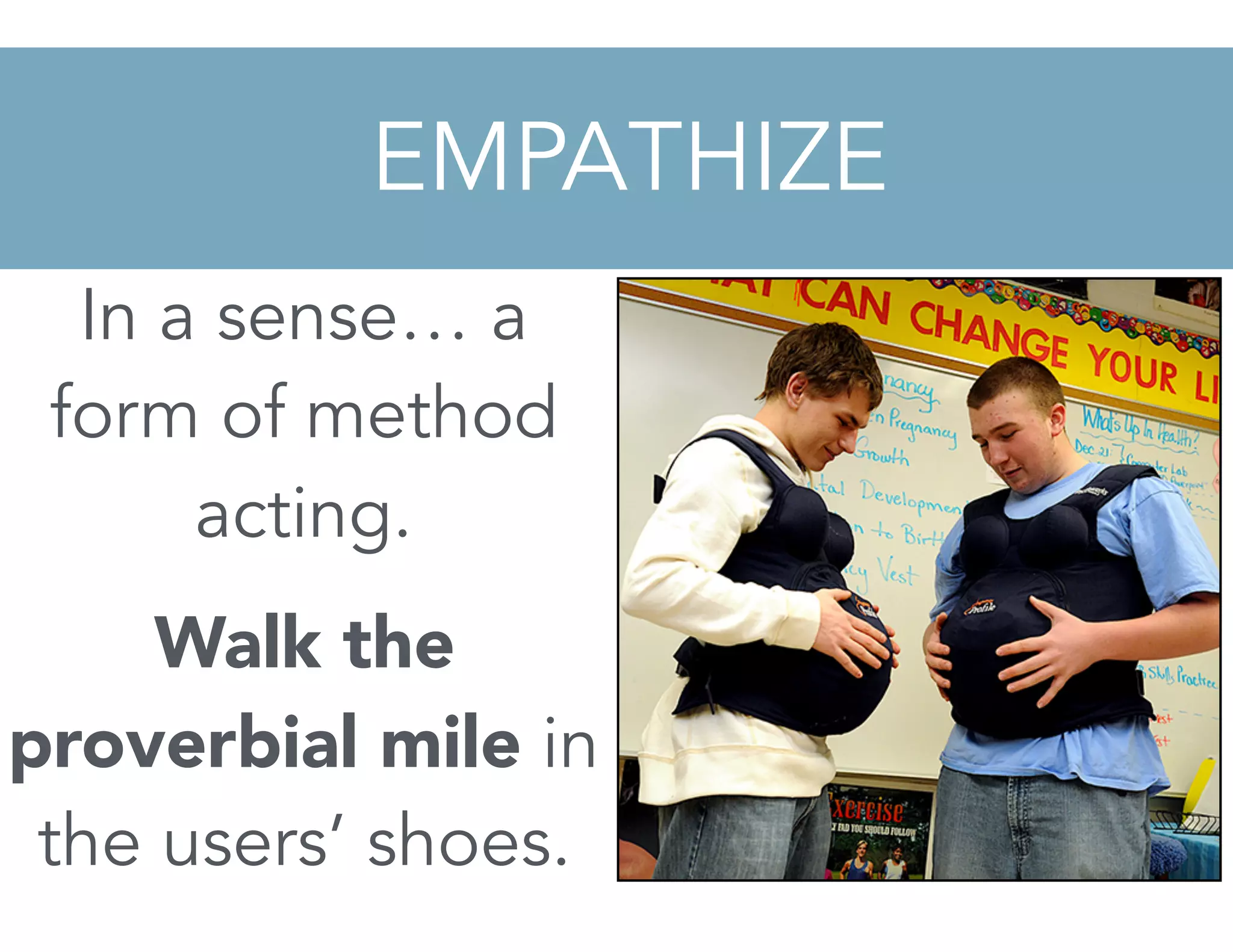
EMPATHIZE
In a sense… a
form of method
acting.
Walk the
proverbial mile in
the users’ shoes.
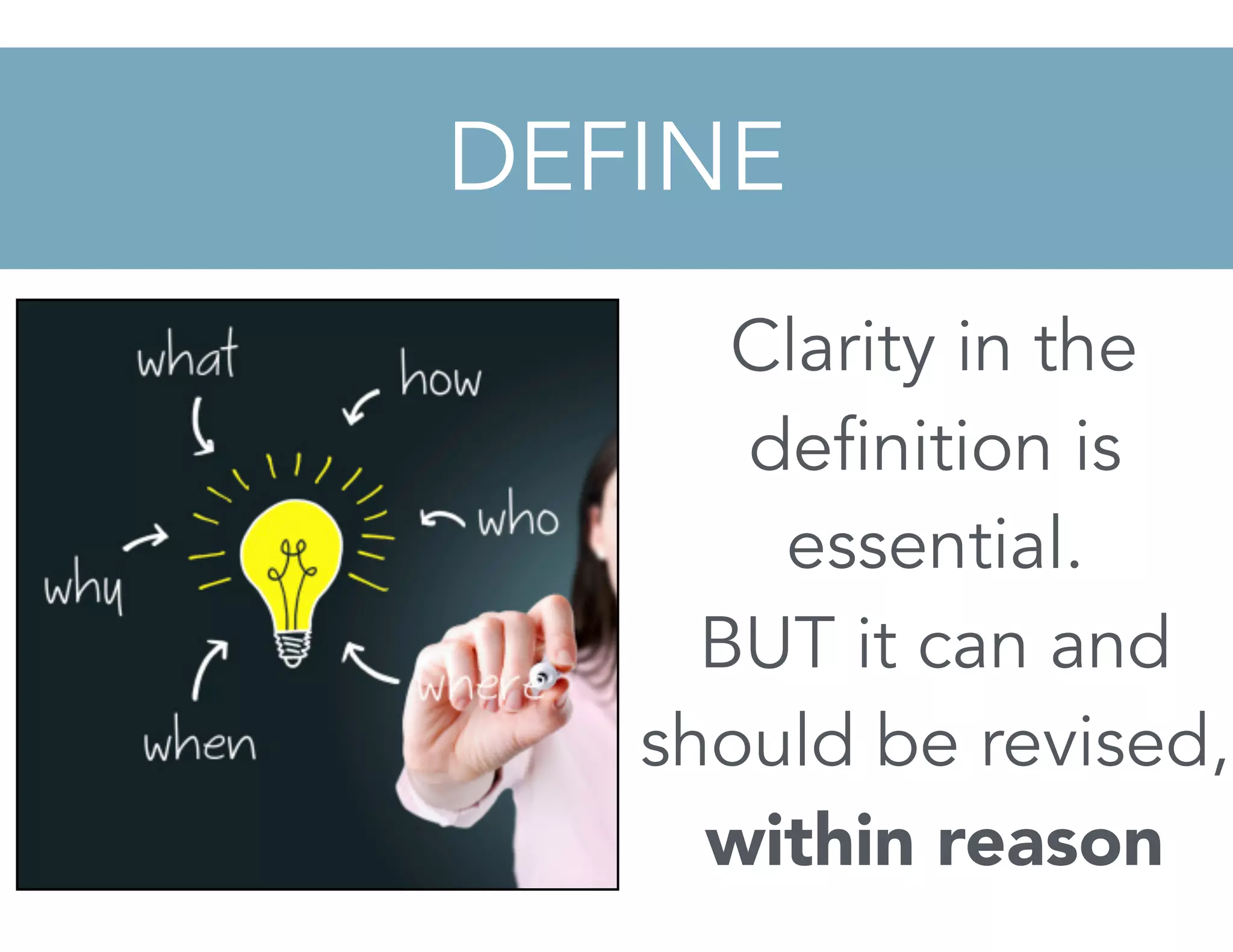
DEFINE
Clarity in the
definition is
essential.
BUT it can and
should be revised,
within reason
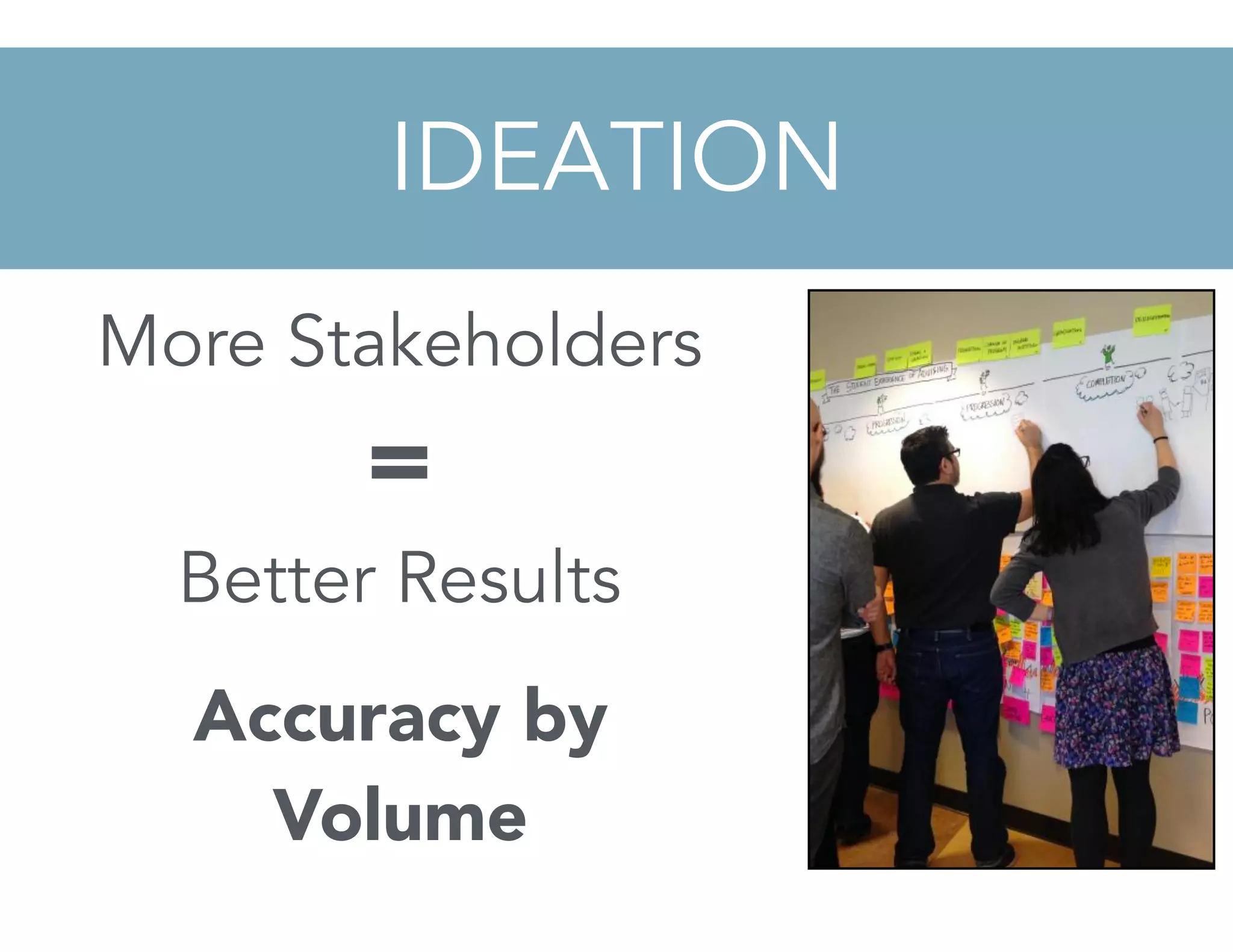
IDEATION
More Stakeholders
=
Better Results
Accuracy by
Volume
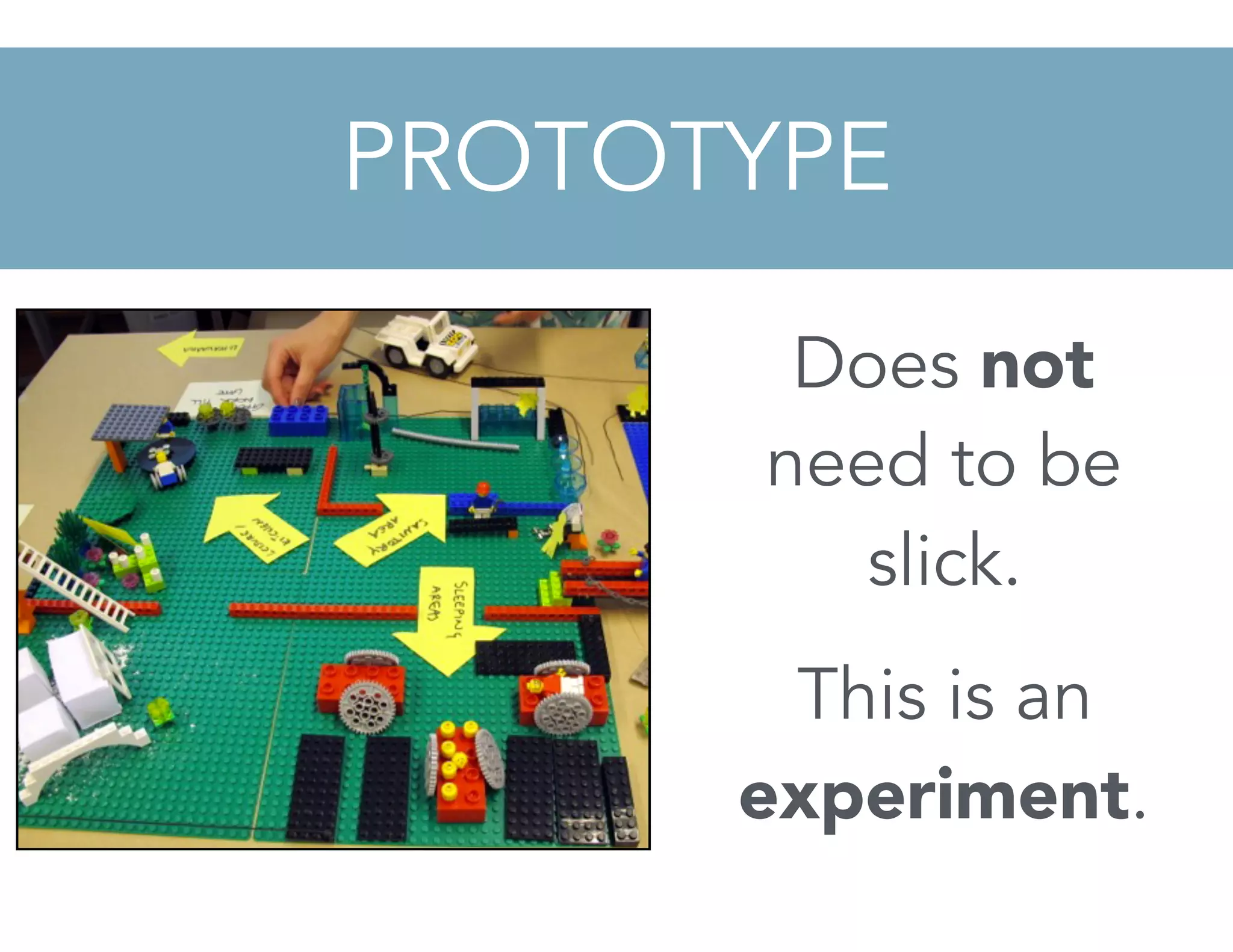
PROTOTYPE
Does not
need to be
slick.
This is an
experiment.
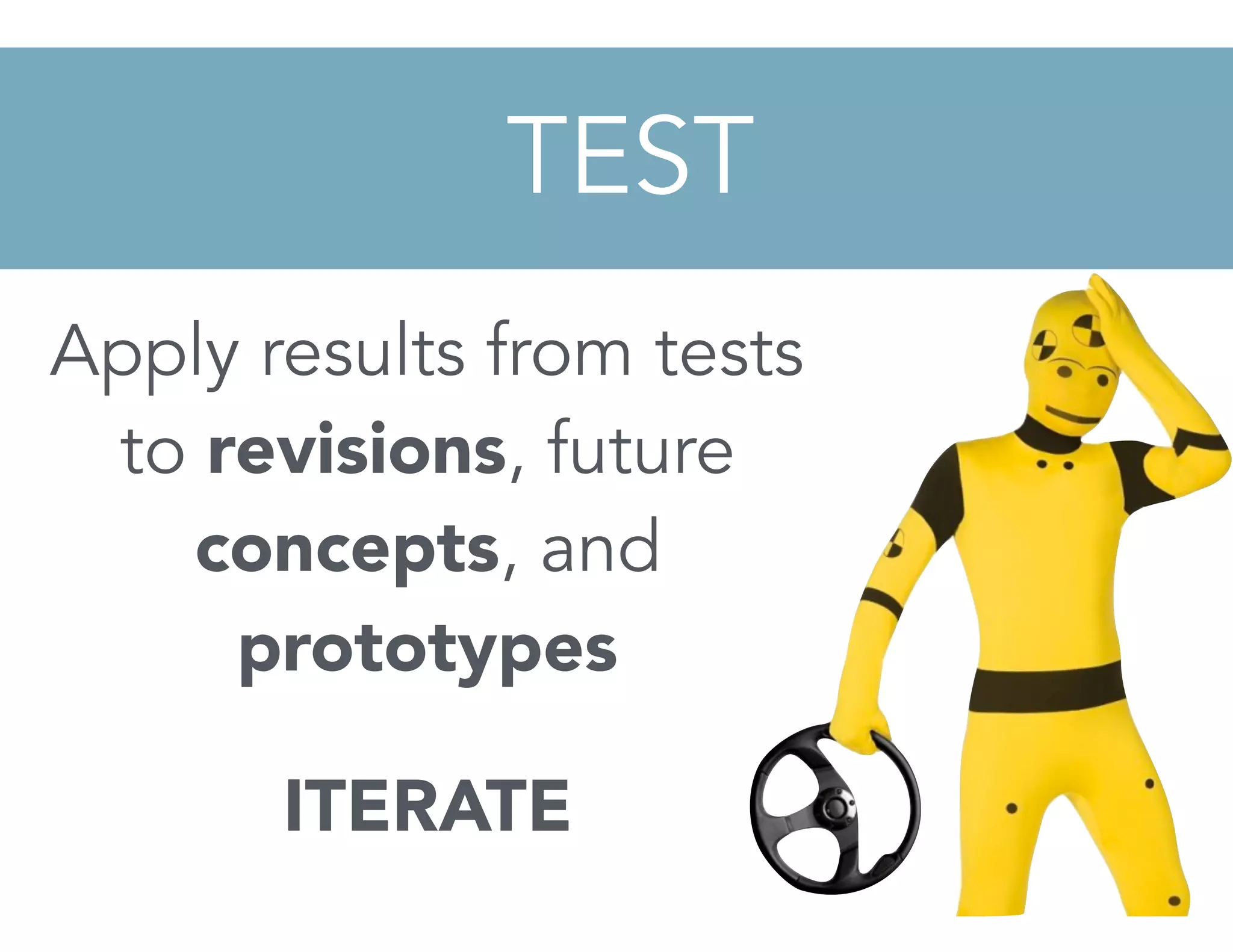
TEST
Apply results from tests
to revisions, future
concepts, and
prototypes
ITERATE
NOT
LINEAR
THE PRODUCTION
JOURNEY
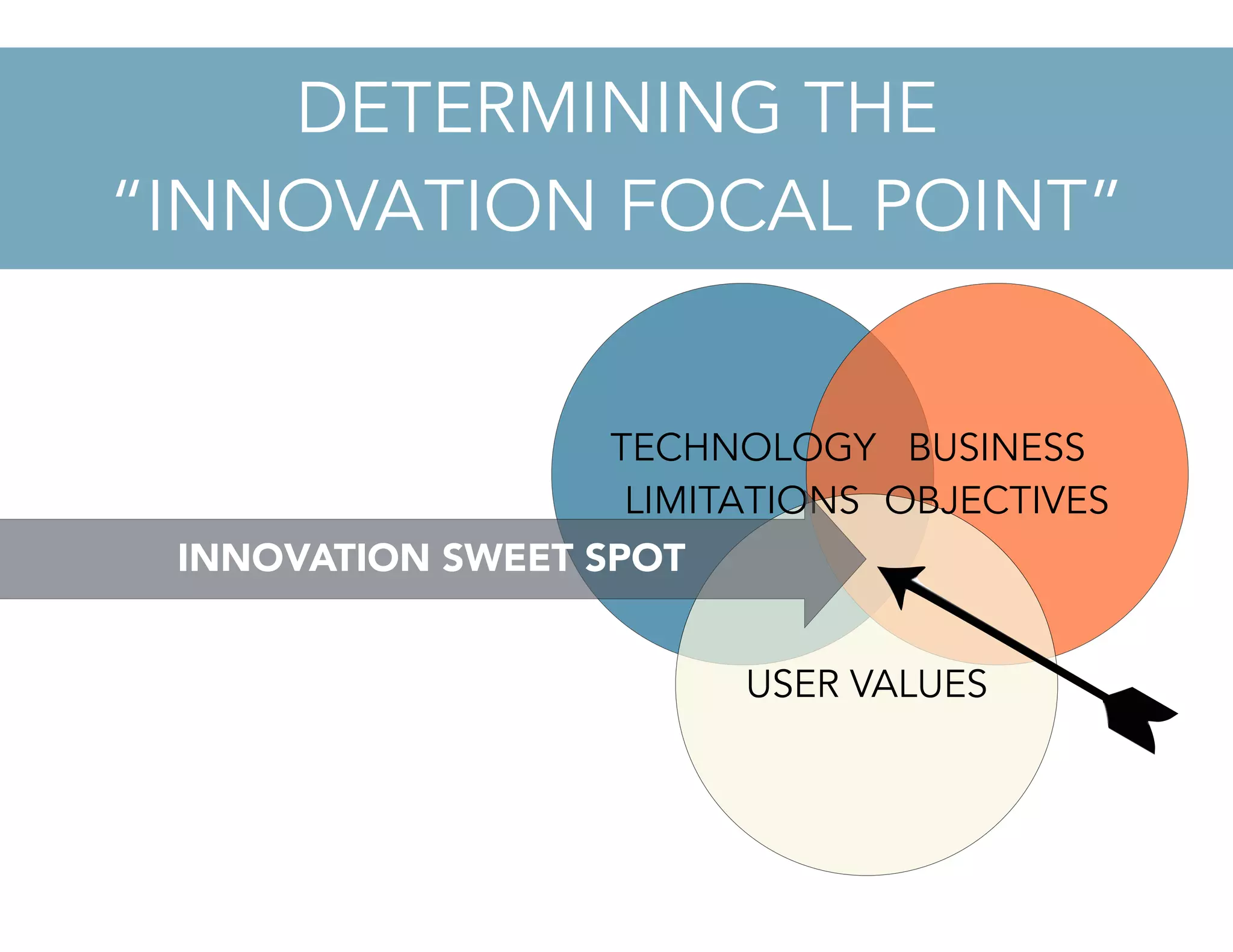
DETERMINING THE
“INNOVATION FOCAL POINT”
TECHNOLOGY
LIMITATIONS
BUSINESS
OBJECTIVES
USER VALUES
INNOVATION SWEET SPOT
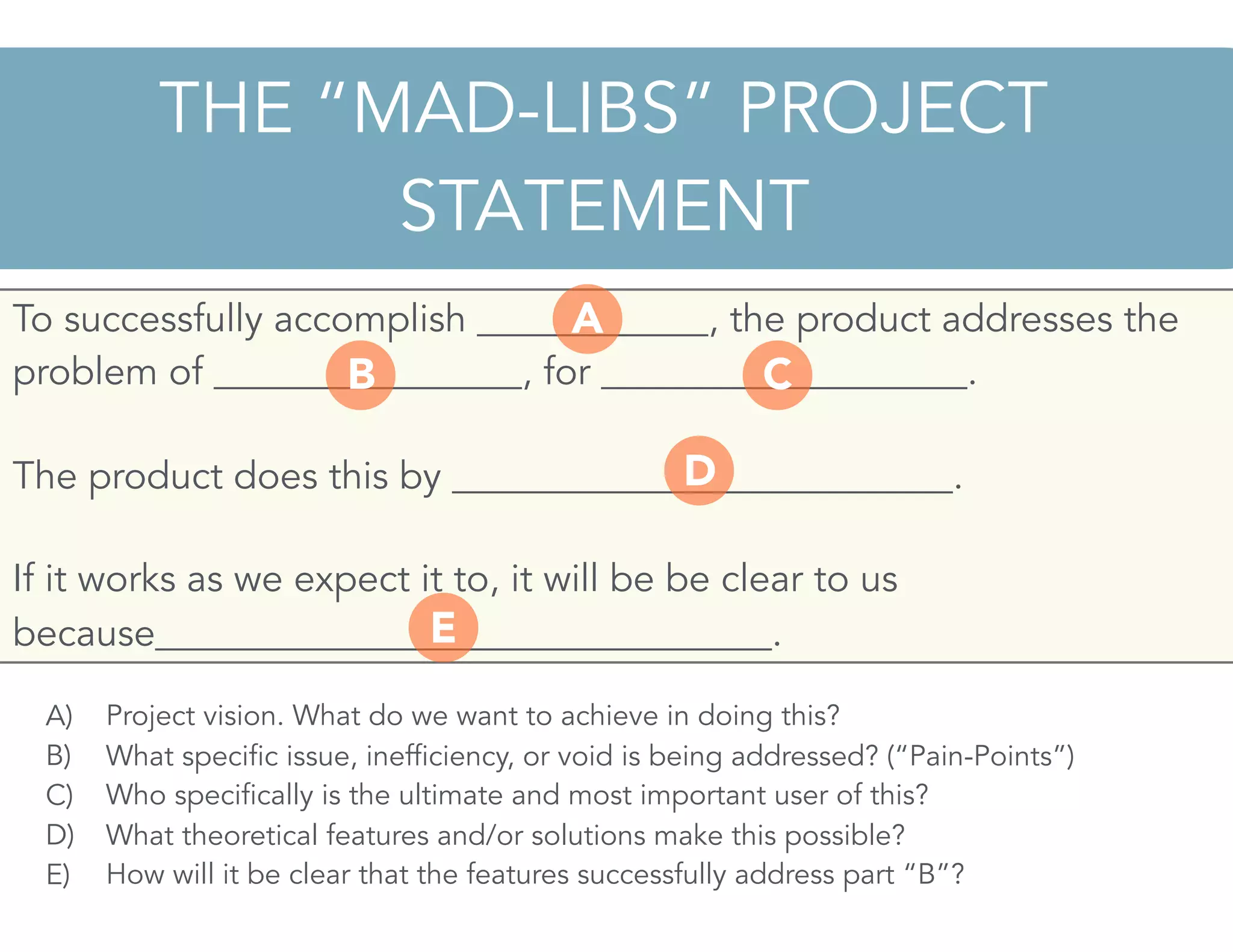
THE “MAD-LIBS” PROJECT
STATEMENT
To successfully accomplish ____________, the product addresses the
problem of ________________, for ___________________.
The product does this by __________________________.
If it works as we expect it to, it will be be clear to us
because________________________________.
A) Project vision. What do we want to achieve in doing this?
B) What specific issue, inefficiency, or void is being addressed? (“Pain-Points”)
C) Who specifically is the ultimate and most important user of this?
D) What theoretical features and/or solutions make this possible?
E) How will it be clear that the features successfully address part “B”?
A
B C
D
E
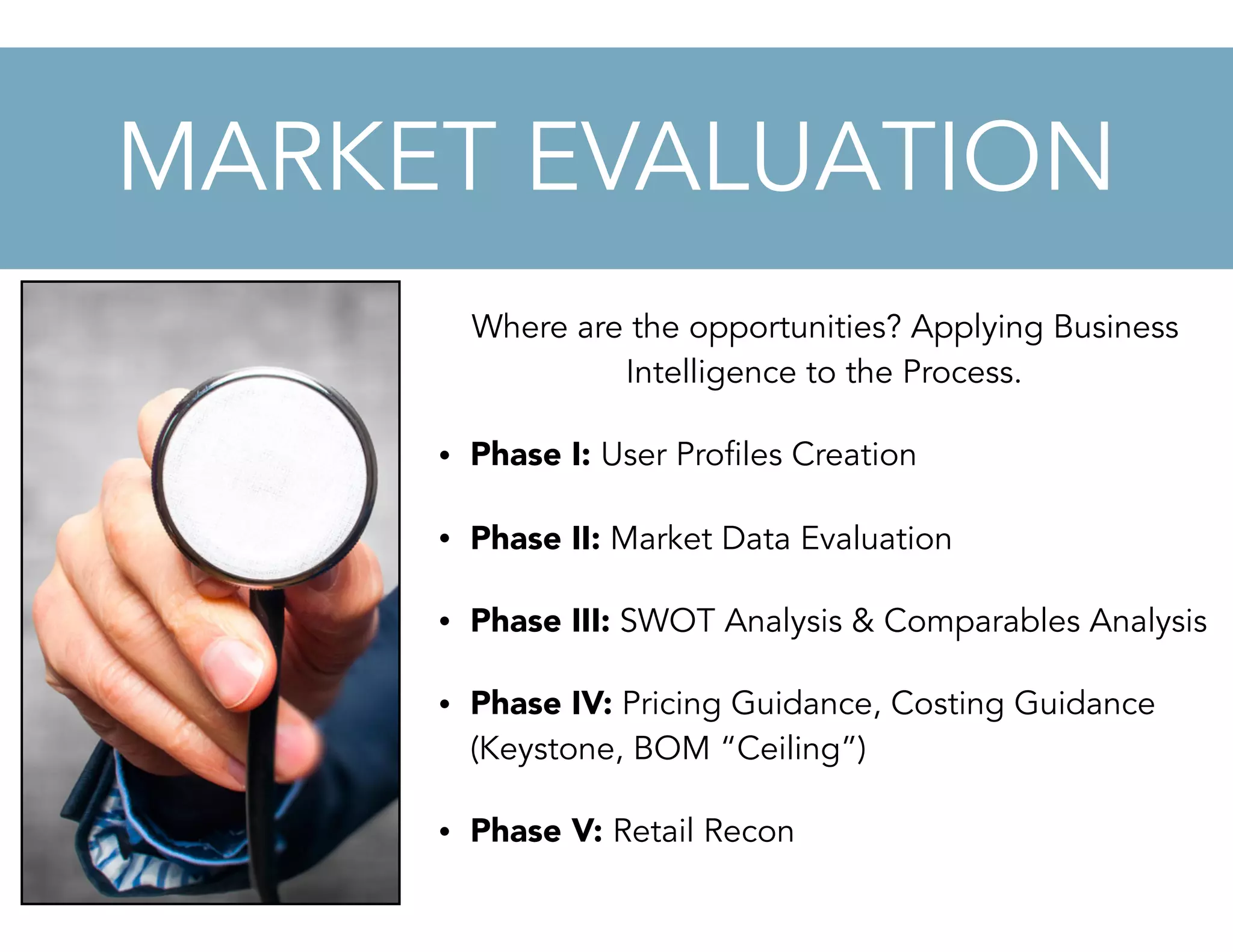
Where are the opportunities? Applying Business
Intelligence to the Process.
• Phase I: User Profiles Creation
• Phase II: Market Data Evaluation
• Phase III: SWOT Analysis & Comparables Analysis
• Phase IV: Pricing Guidance, Costing Guidance
(Keystone, BOM “Ceiling”)
• Phase V: Retail Recon
MARKET EVALUATION
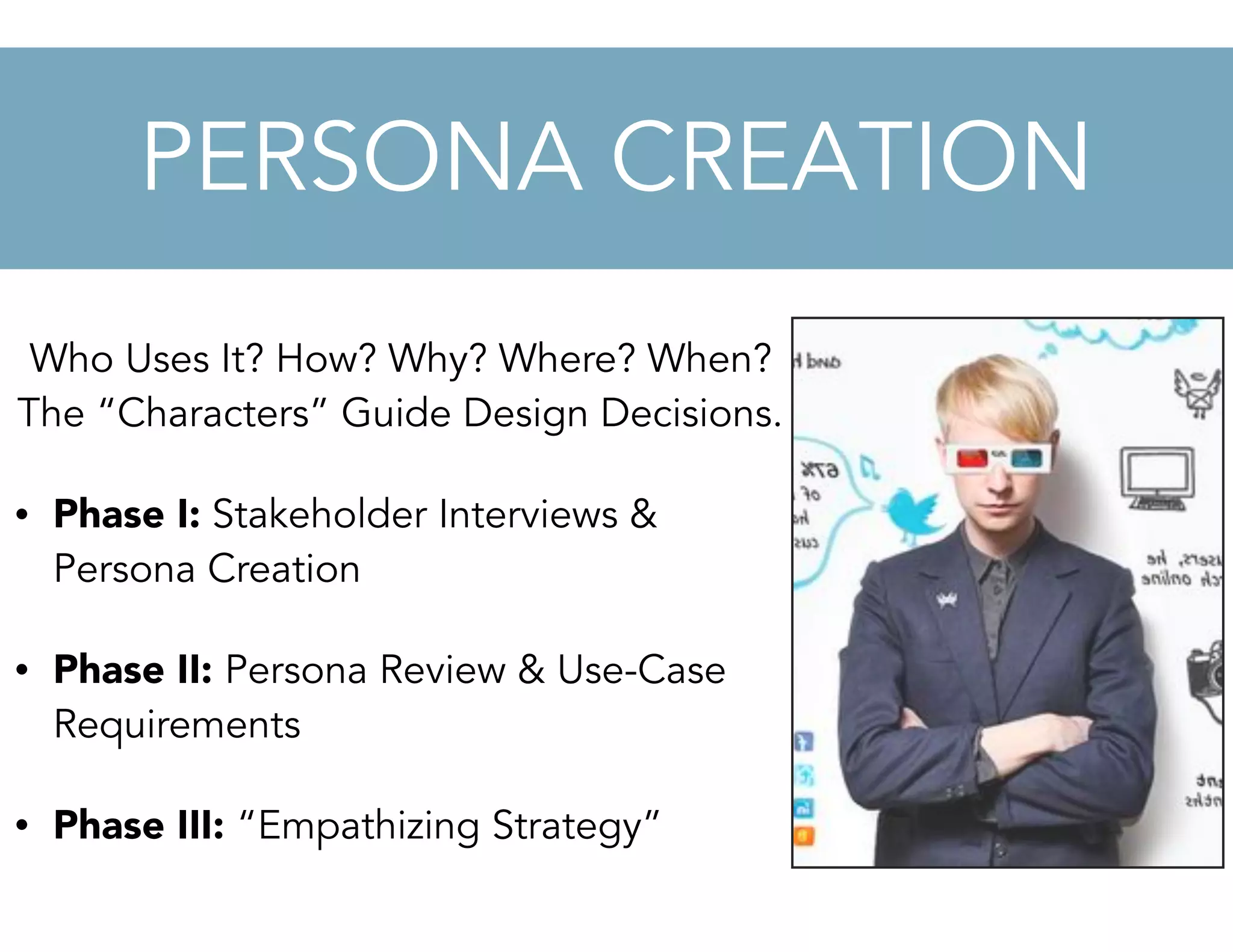
Who Uses It? How? Why? Where? When?
The “Characters” Guide Design Decisions.
• Phase I: Stakeholder Interviews &
Persona Creation
• Phase II: Persona Review & Use-Case
Requirements
• Phase III: “Empathizing Strategy”
PERSONA CREATION
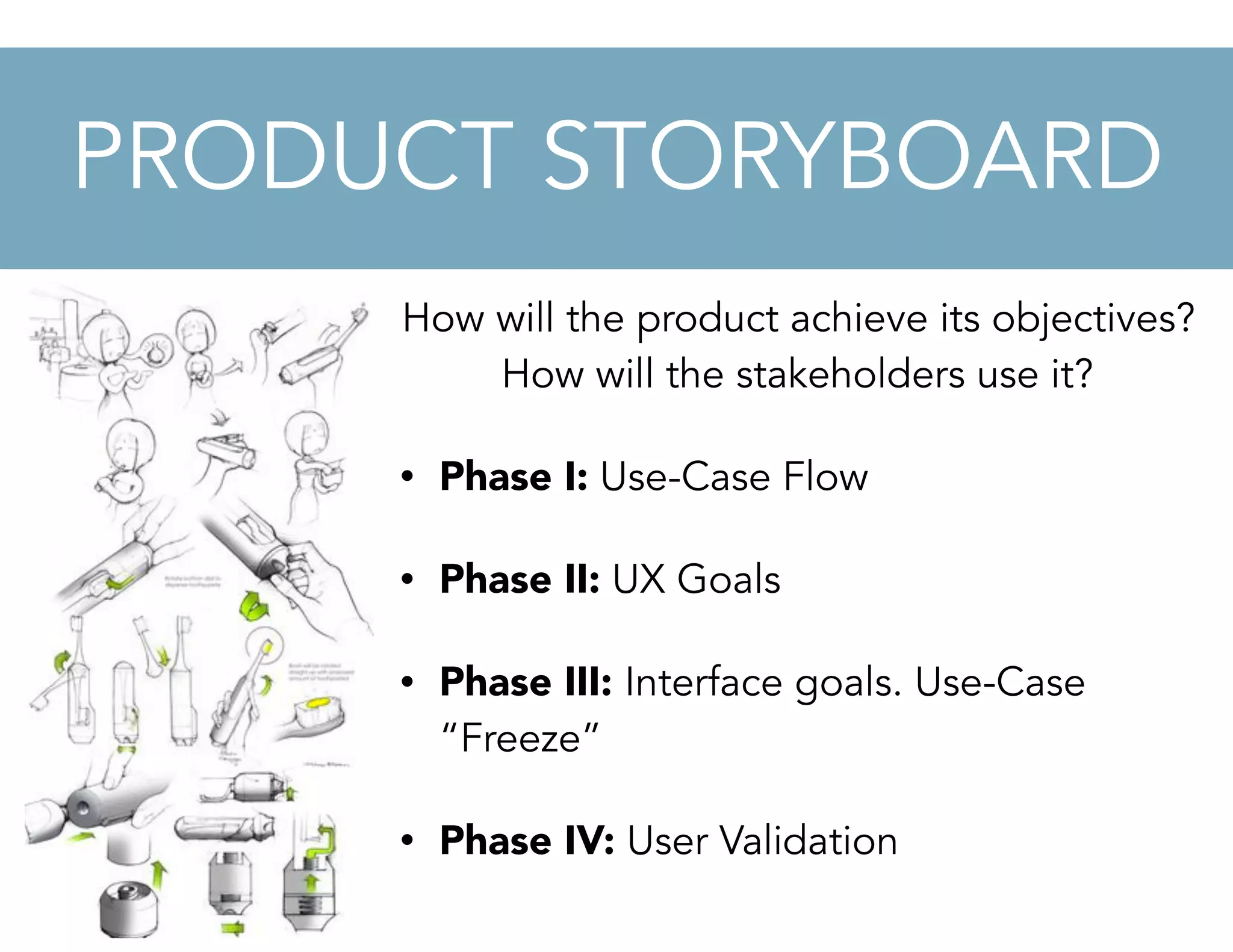
How will the product achieve its objectives?
How will the stakeholders use it?
• Phase I: Use-Case Flow
• Phase II: UX Goals
• Phase III: Interface goals. Use-Case
“Freeze”
• Phase IV: User Validation
PRODUCT STORYBOARD
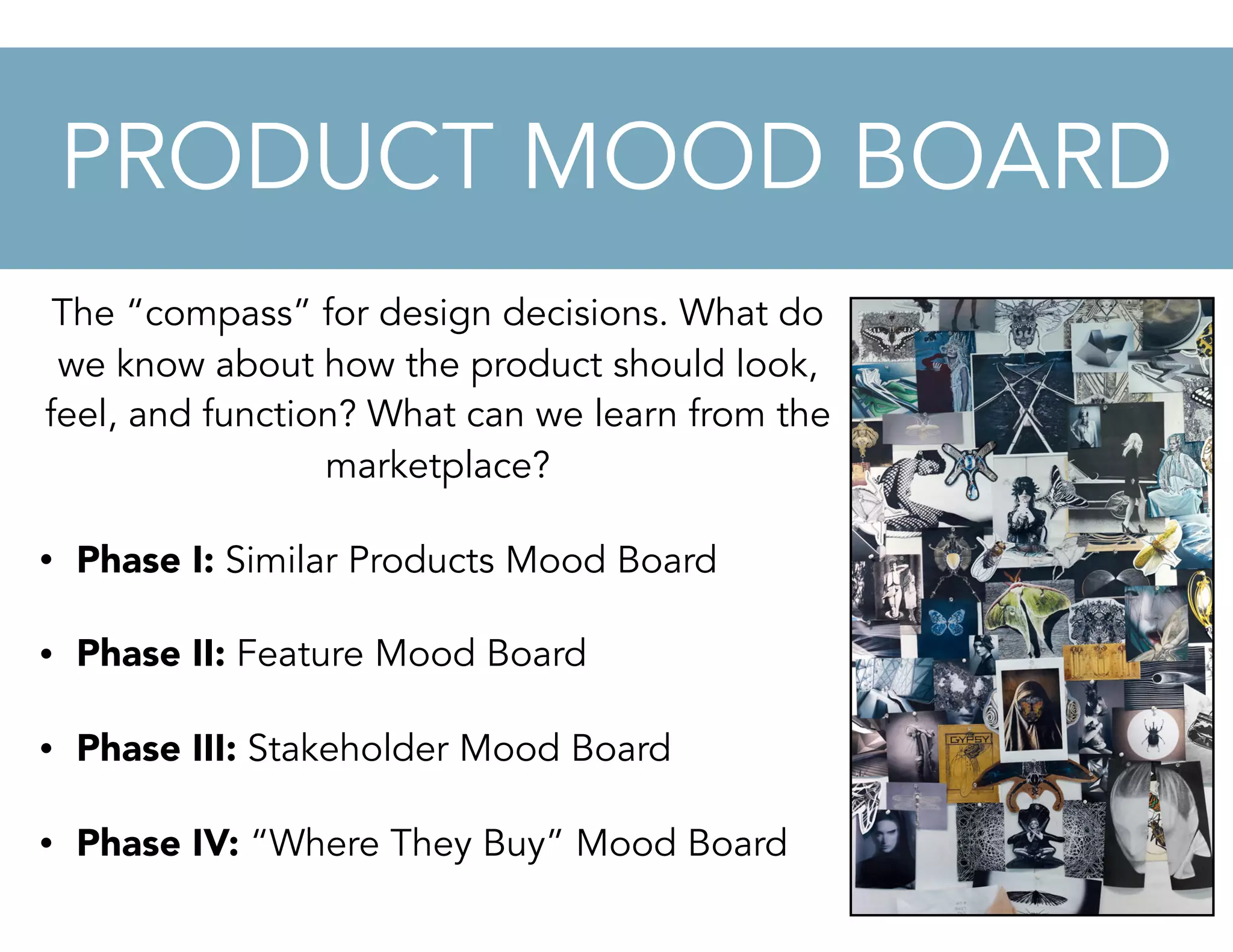
The “compass” for design decisions. What do
we know about how the product should look,
feel, and function? What can we learn from the
marketplace?
• Phase I: Similar Products Mood Board
• Phase II: Feature Mood Board
• Phase III: Stakeholder Mood Board
• Phase IV: “Where They Buy” Mood Board
PRODUCT MOOD BOARD
PRODUCT MOOD BOARD
Pinterest as a real-time, dynamic,
UGC “mood board”
Good prototypes answer questions
that lead to actionable insights.
What question are you finding an
answer to?
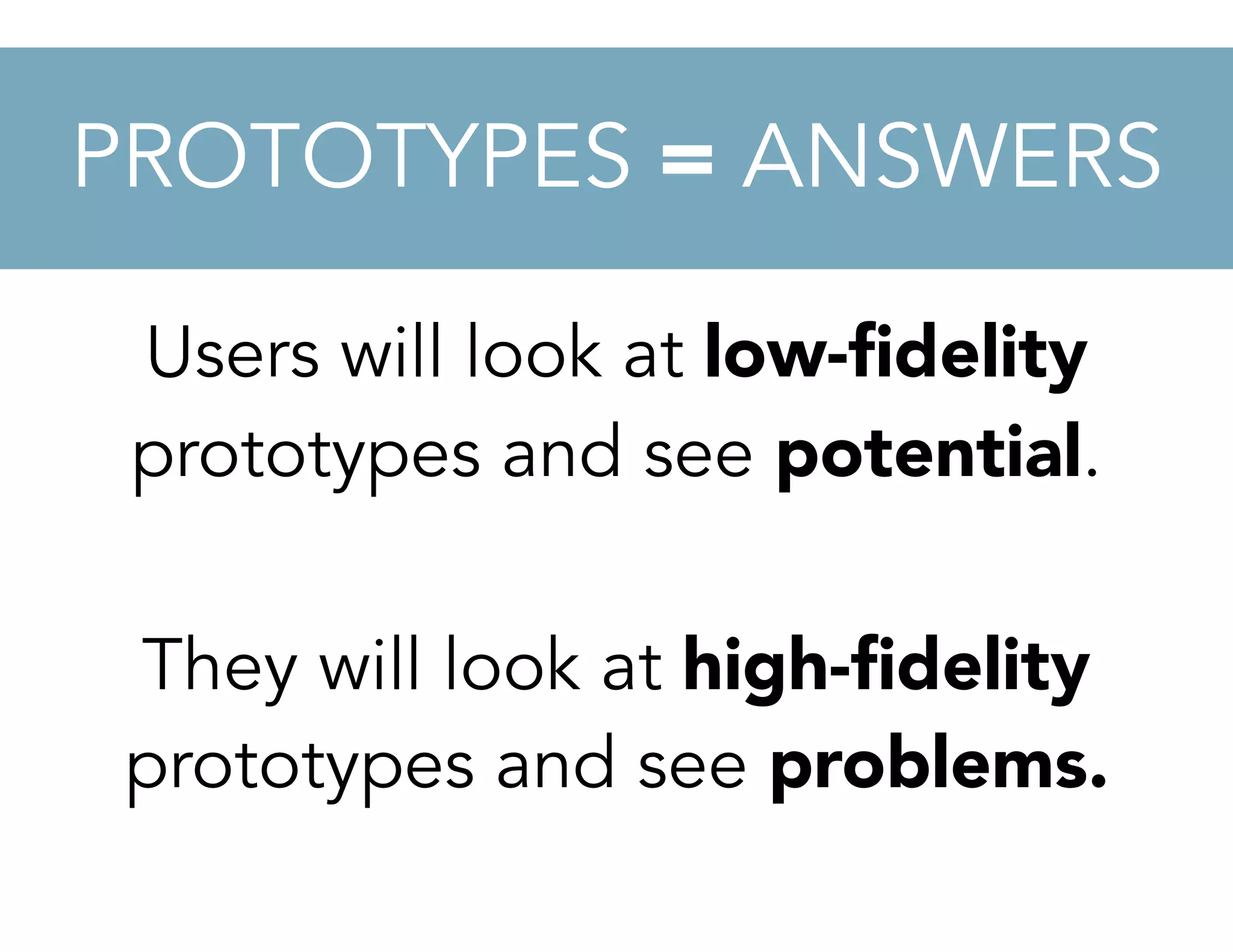
PROTOTYPES = ANSWERS
Users will look at low-fidelity
prototypes and see potential.
They will look at high-fidelity
prototypes and see problems.
PROTOTYPES = ANSWERS
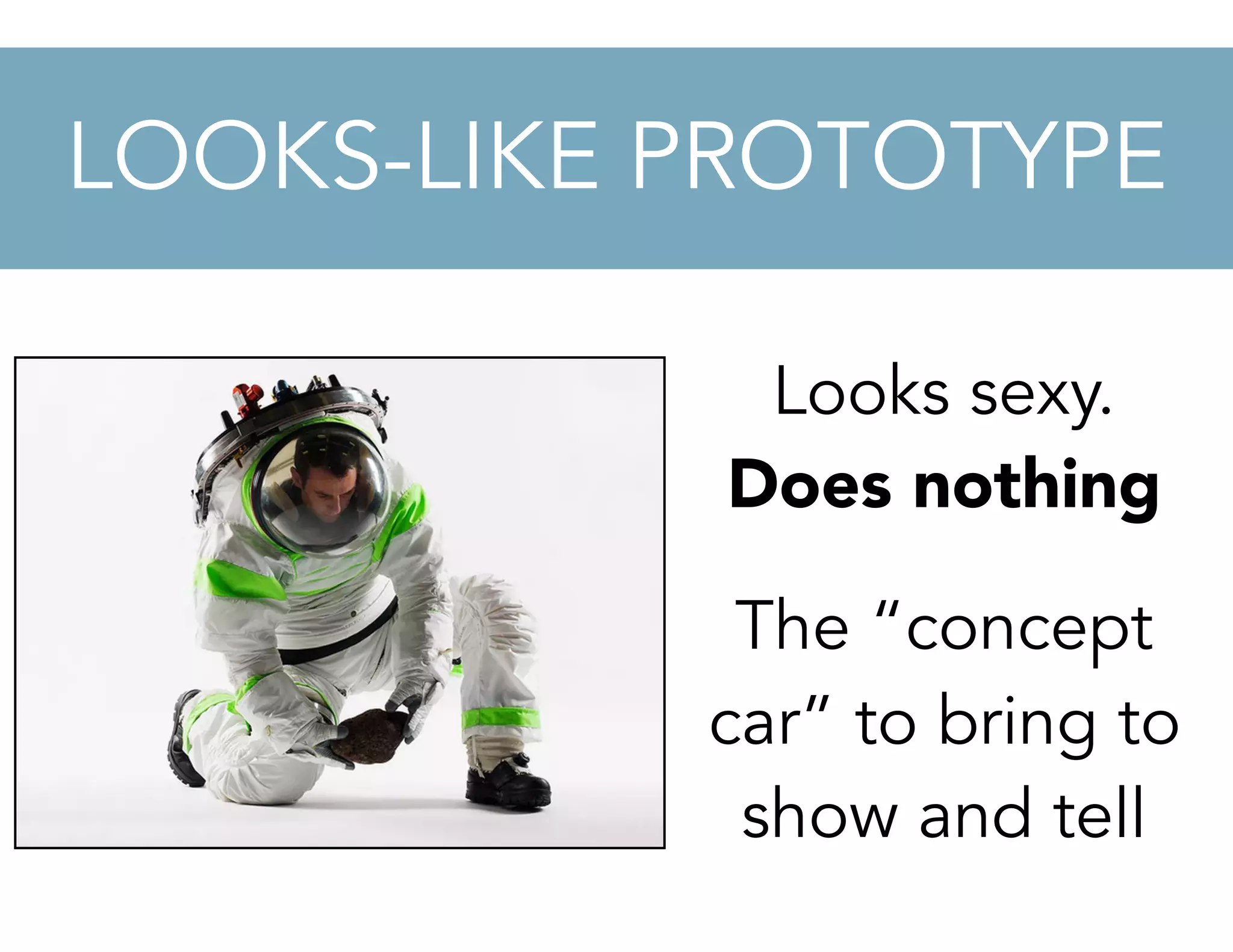
Looks sexy.
Does nothing
The “concept
car” to bring to
show and tell
LOOKS-LIKE PROTOTYPE
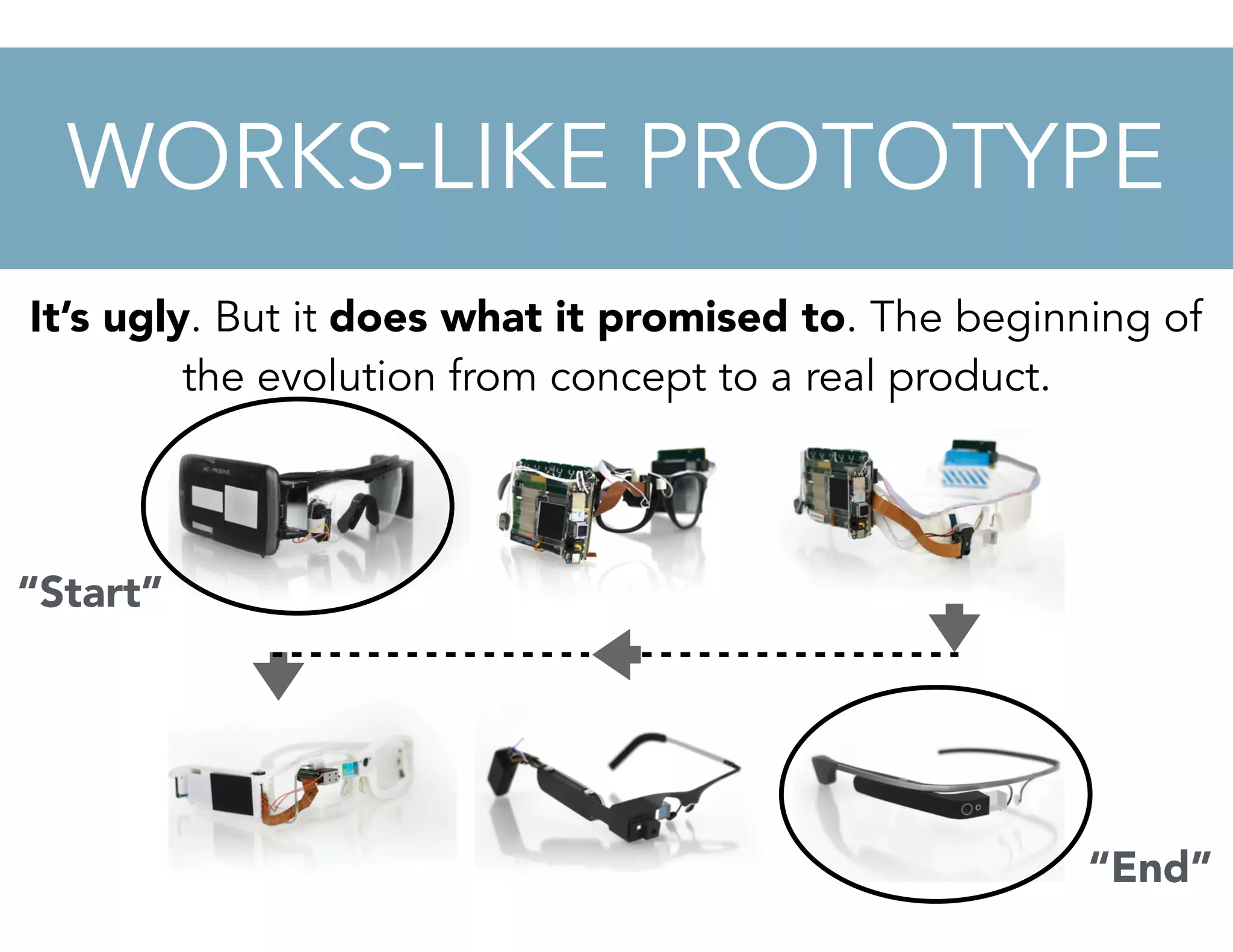
It’s ugly. But it does what it promised to. The beginning of
the evolution from concept to a real product.
WORKS-LIKE PROTOTYPE
“Start”
“End”
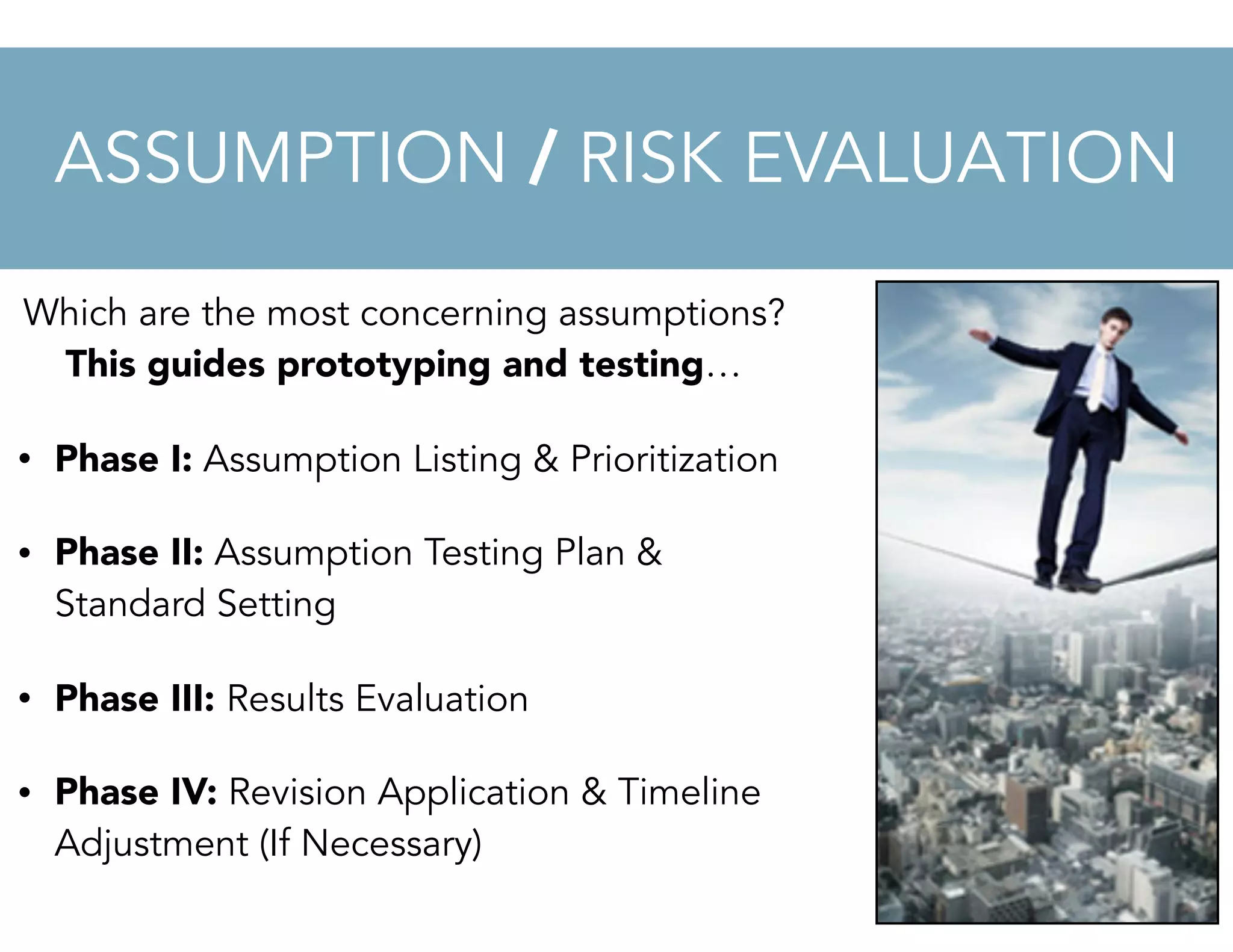
Which are the most concerning assumptions?
This guides prototyping and testing…
• Phase I: Assumption Listing & Prioritization
• Phase II: Assumption Testing Plan &
Standard Setting
• Phase III: Results Evaluation
• Phase IV: Revision Application & Timeline
Adjustment (If Necessary)
ASSUMPTION / RISK EVALUATION
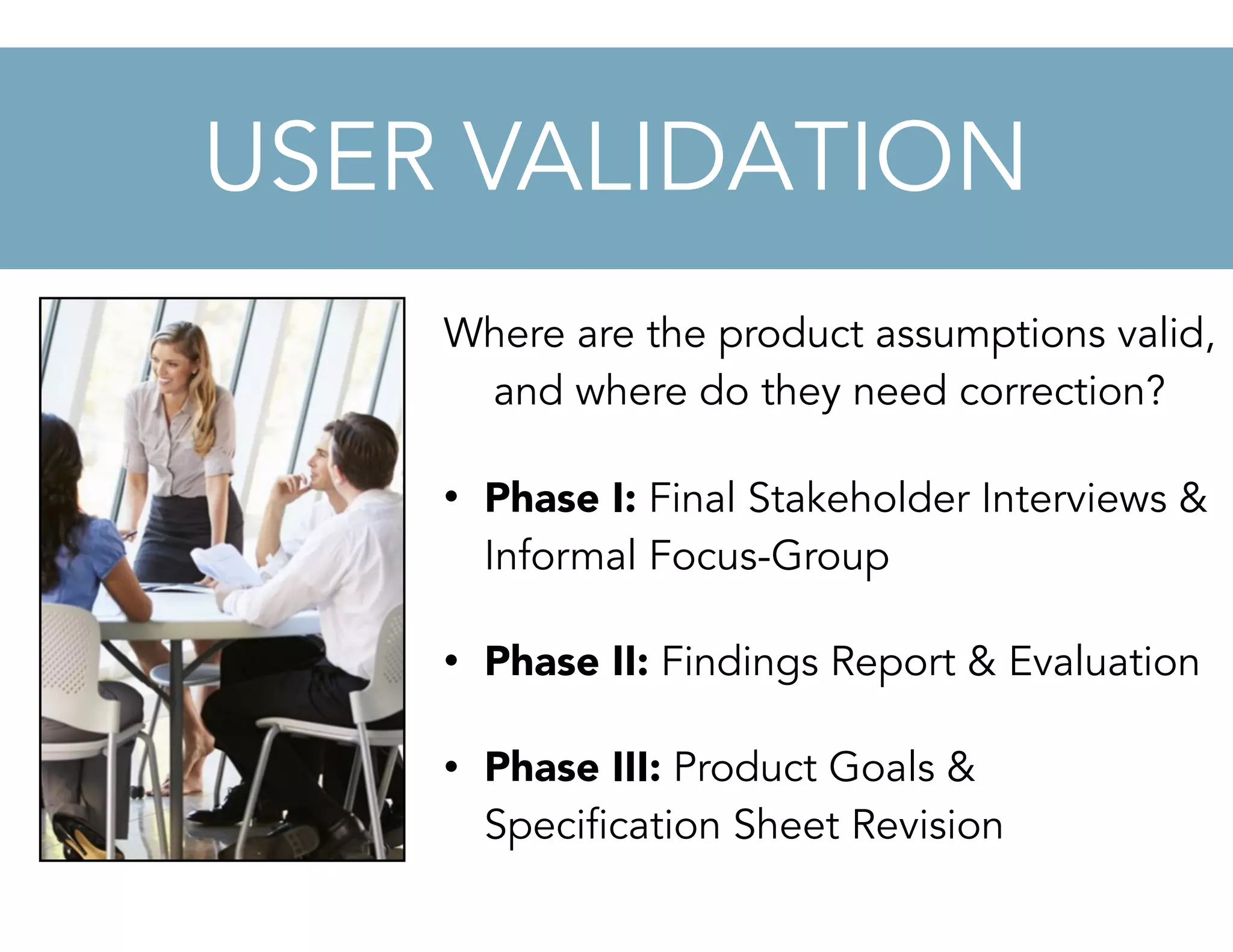
Where are the product assumptions valid,
and where do they need correction?
• Phase I: Final Stakeholder Interviews &
Informal Focus-Group
• Phase II: Findings Report & Evaluation
• Phase III: Product Goals &
Specification Sheet Revision
USER VALIDATION
I LIKE______ ABOUT THE PRODUCT.
I WISH________ ABOUT THE
PRODUCT.
TWO “FILL-IN-THE-BLANKS”
FOR CONSUMER RESEARCH
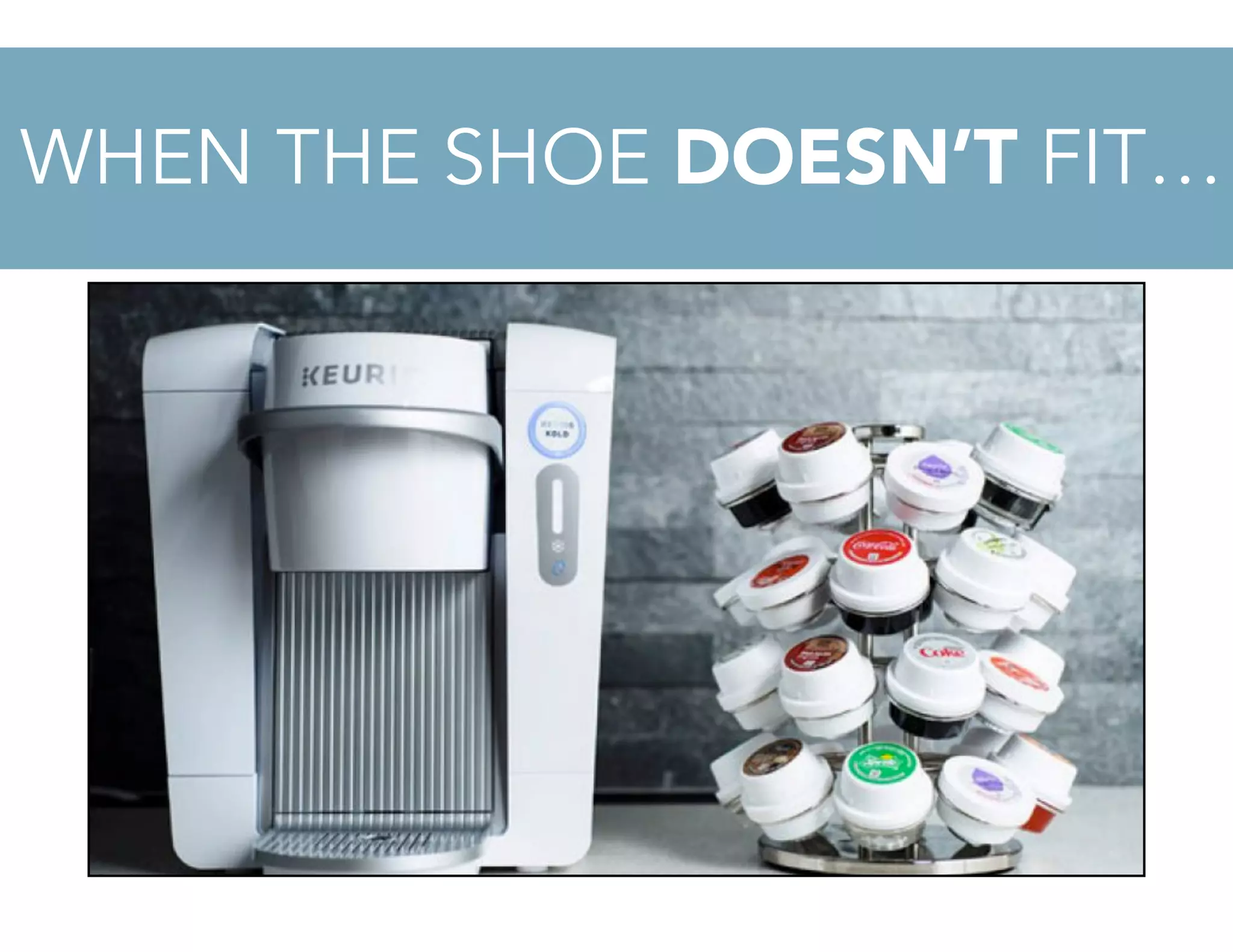
WHEN THE SHOE DOESN’T FIT…
HOW MUCH FOR A “TYPICAL”
CONSUMER ELECTRONIC PROTOTYPE?
A) $300
C) $3,000+++
B) $1,000
D) $9,000
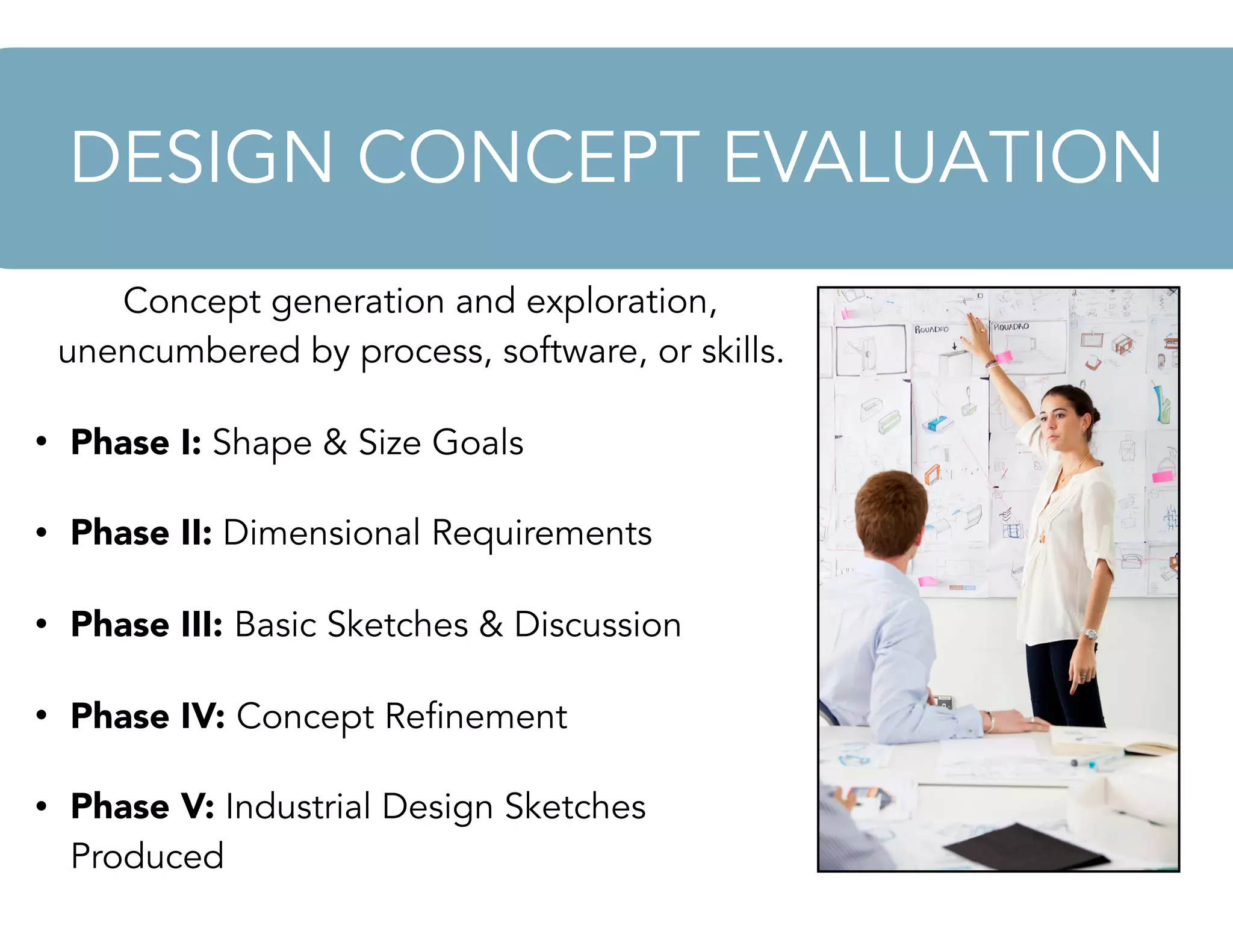
Concept generation and exploration,
unencumbered by process, software, or skills.
• Phase I: Shape & Size Goals
• Phase II: Dimensional Requirements
• Phase III: Basic Sketches & Discussion
• Phase IV: Concept Refinement
• Phase V: Industrial Design Sketches
Produced
DESIGN CONCEPT EVALUATION
v
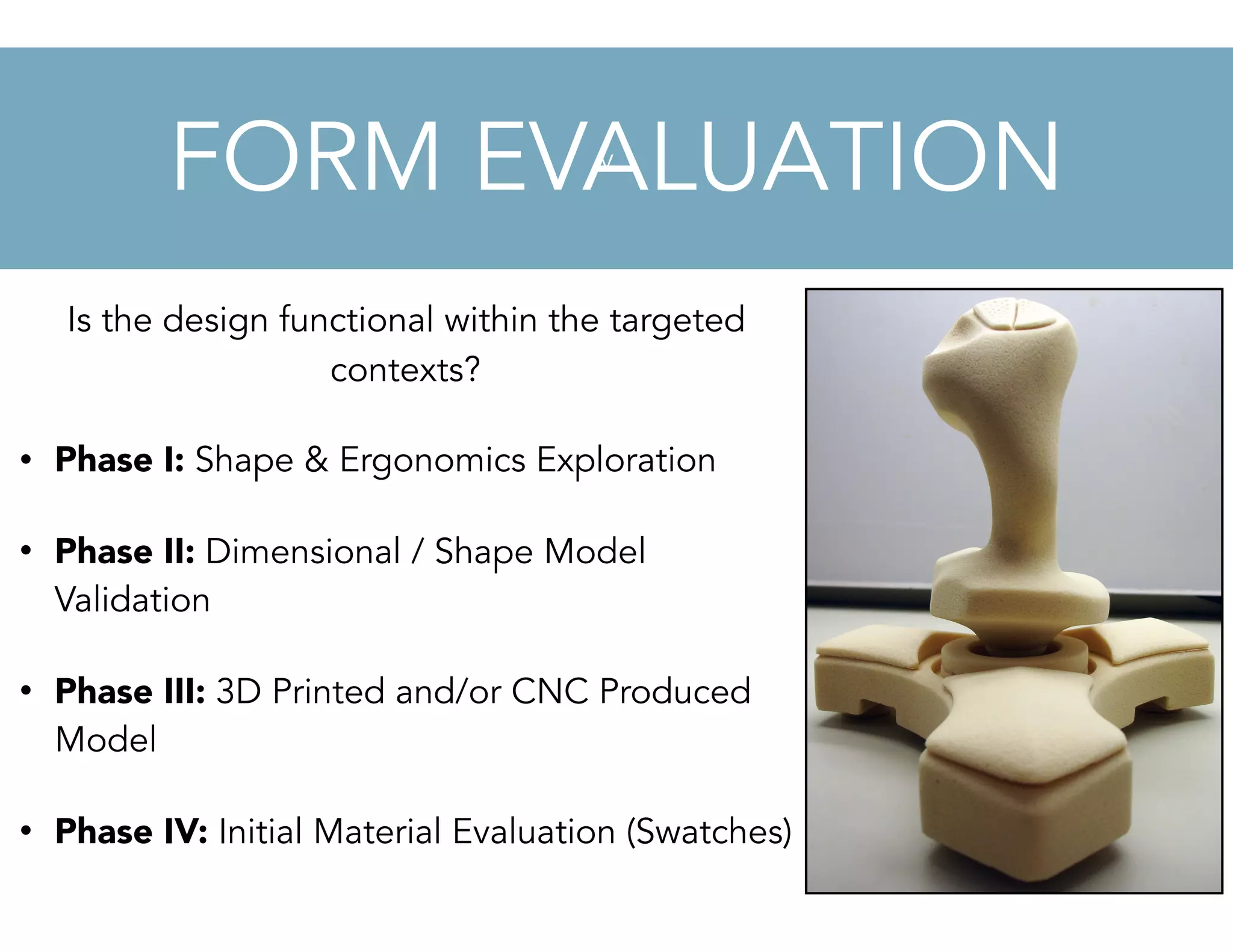
Is the design functional within the targeted
contexts?
• Phase I: Shape & Ergonomics Exploration
• Phase II: Dimensional / Shape Model
Validation
• Phase III: 3D Printed and/or CNC Produced
Model
• Phase IV: Initial Material Evaluation (Swatches)
FORM EVALUATION
After Establishing the Initial Design… Re-Evaluate.
• Phase I: Existing Strengths and Weaknesses of
Design THESIS
• Phase II: What Have We Missed?
• Phase III: What Could We Eliminate?
• Phase IV: How Else Could We Do It?
• Phase V: Concept Creation for Alternate
Approaches
ALTERNATE SOLUTIONS
Based on what we know, how difficult will it
be to produce and succeed?
Do costs/price-points need provisional
revisions?
Vendor Meetings & Discussions Guide:
• DFX Engineering Revisions
• Costing Reality Checks
FEASABILITY
What components are necessary? How do we get them?
Who should we get them from?
Phase I: Prioritization of vendors.
Phase II: Initial reach out and qualification
Phase III: Sample evaluation
Phase IV: Low-Volume Quotation / MOQ Stress Test
SUPPLY—CHAIN DEVELOPMENT
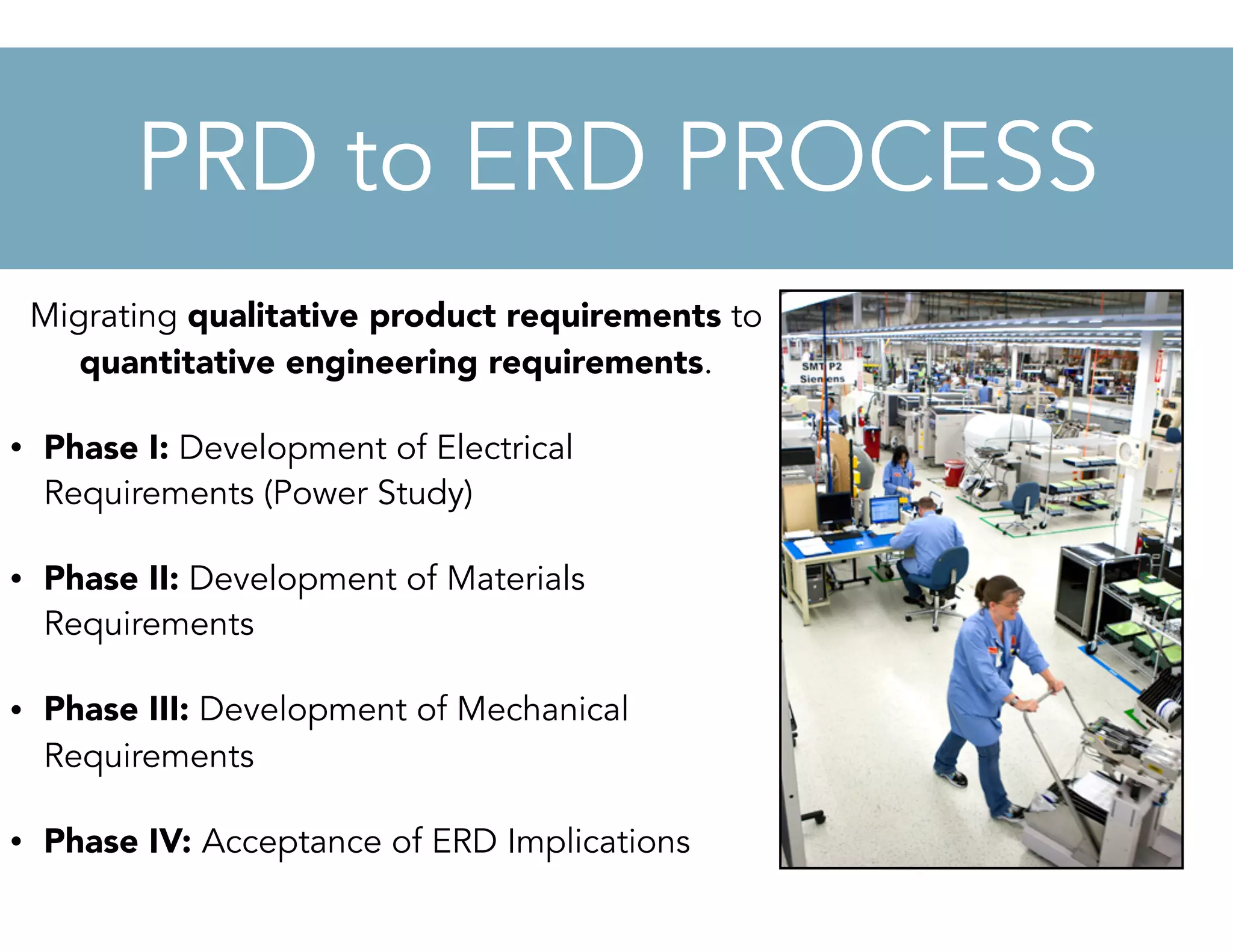
Migrating qualitative product requirements to
quantitative engineering requirements.
• Phase I: Development of Electrical
Requirements (Power Study)
• Phase II: Development of Materials
Requirements
• Phase III: Development of Mechanical
Requirements
• Phase IV: Acceptance of ERD Implications
PRD to ERD PROCESS
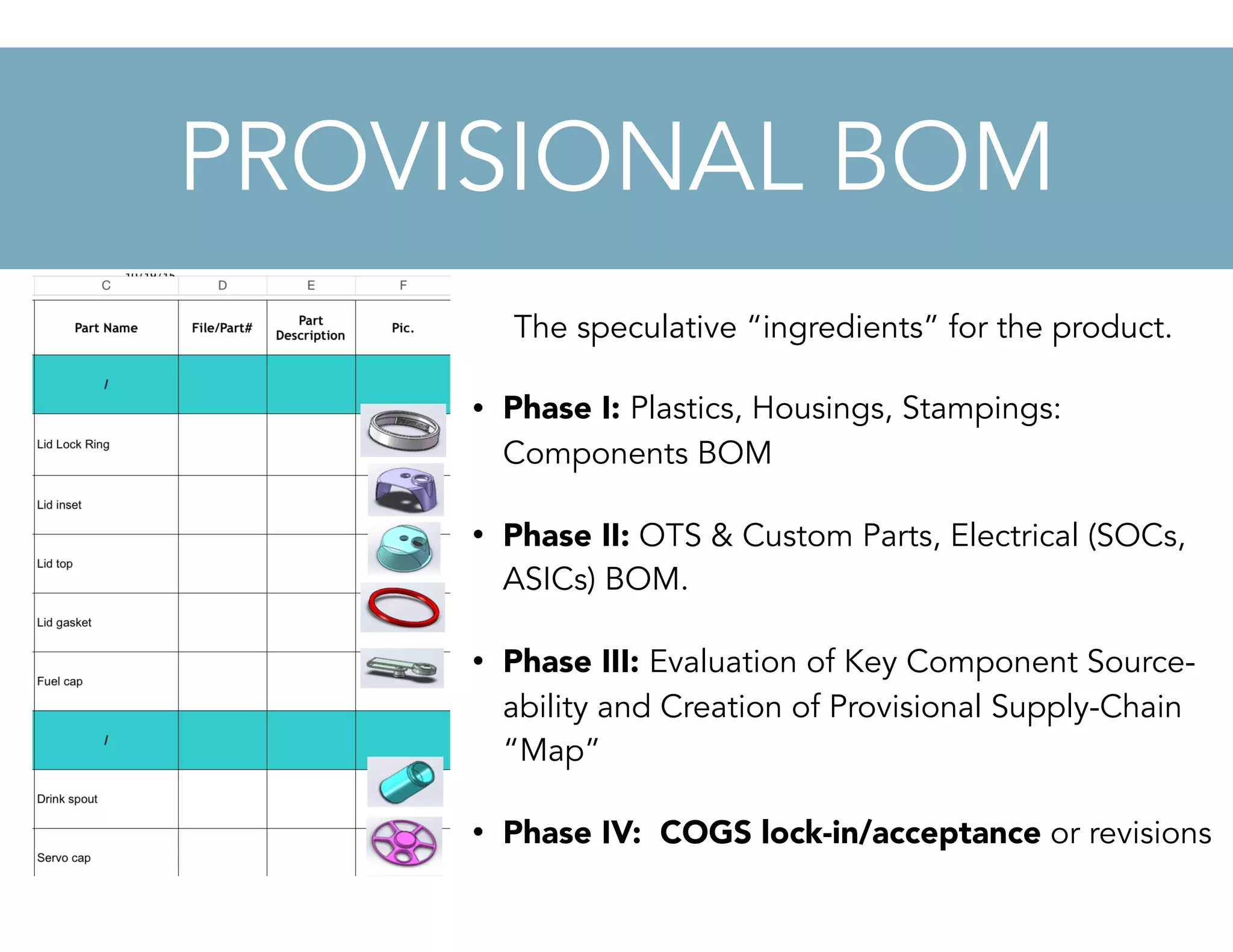
The speculative “ingredients” for the product.
• Phase I: Plastics, Housings, Stampings:
Components BOM
• Phase II: OTS & Custom Parts, Electrical (SOCs,
ASICs) BOM.
• Phase III: Evaluation of Key Component Source-
ability and Creation of Provisional Supply-Chain
“Map”
• Phase IV: COGS lock-in/acceptance or revisions
PROVISIONAL BOM
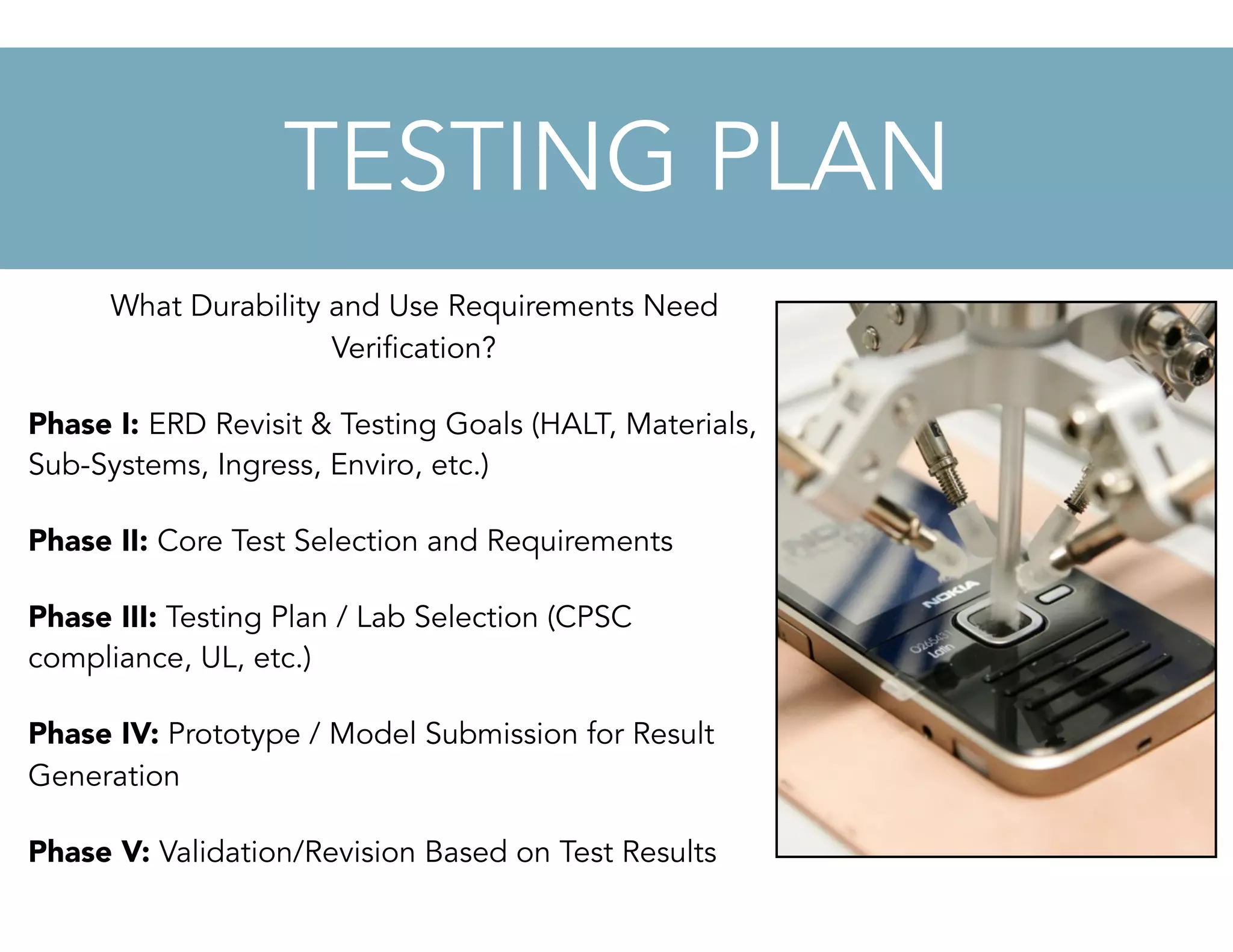
What Durability and Use Requirements Need
Verification?
Phase I: ERD Revisit & Testing Goals (HALT, Materials,
Sub-Systems, Ingress, Enviro, etc.)
Phase II: Core Test Selection and Requirements
Phase III: Testing Plan / Lab Selection (CPSC
compliance, UL, etc.)
Phase IV: Prototype / Model Submission for Result
Generation
Phase V: Validation/Revision Based on Test Results
TESTING PLAN
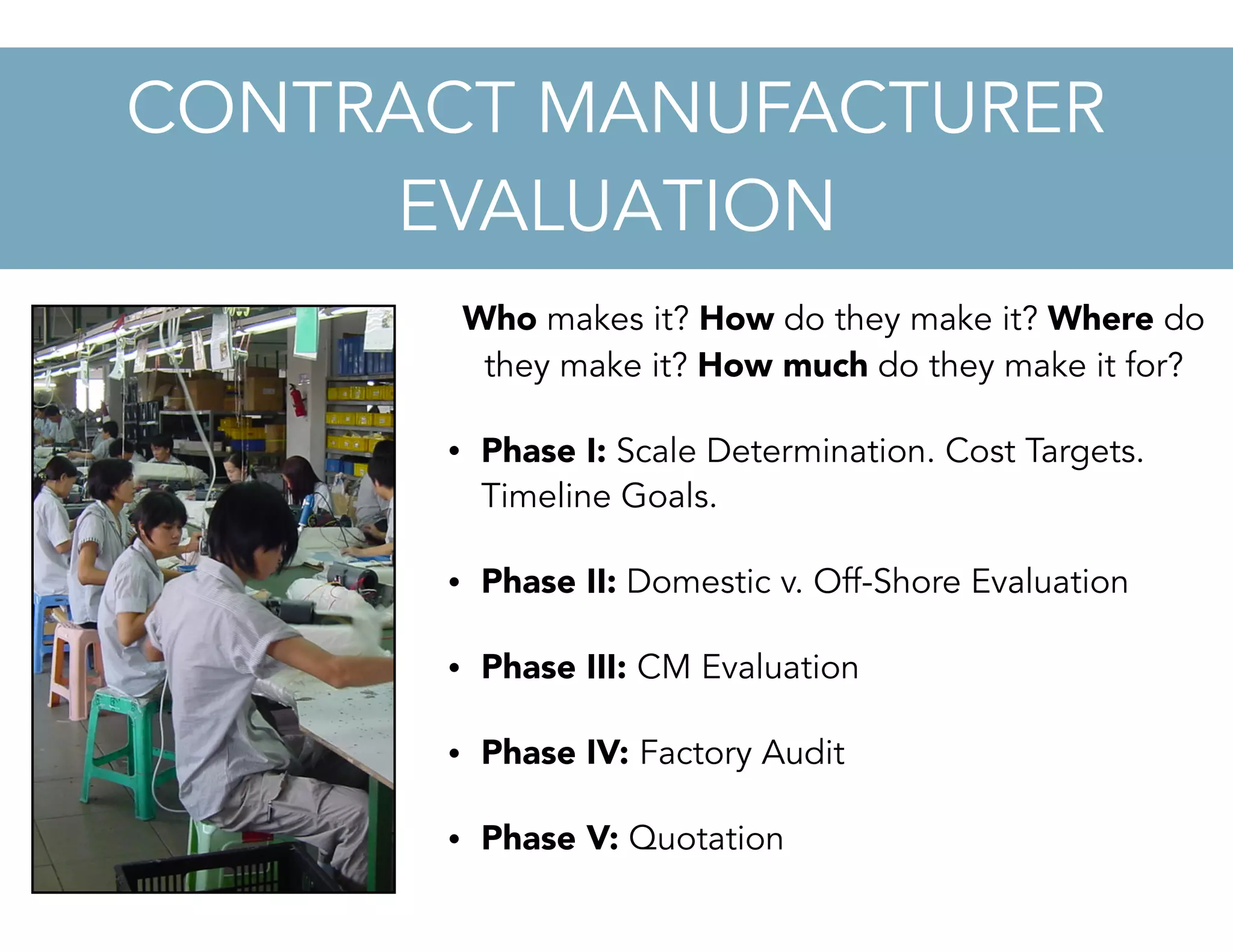
Who makes it? How do they make it? Where do
they make it? How much do they make it for?
• Phase I: Scale Determination. Cost Targets.
Timeline Goals.
• Phase II: Domestic v. Off-Shore Evaluation
• Phase III: CM Evaluation
• Phase IV: Factory Audit
• Phase V: Quotation
CONTRACT MANUFACTURER
EVALUATION
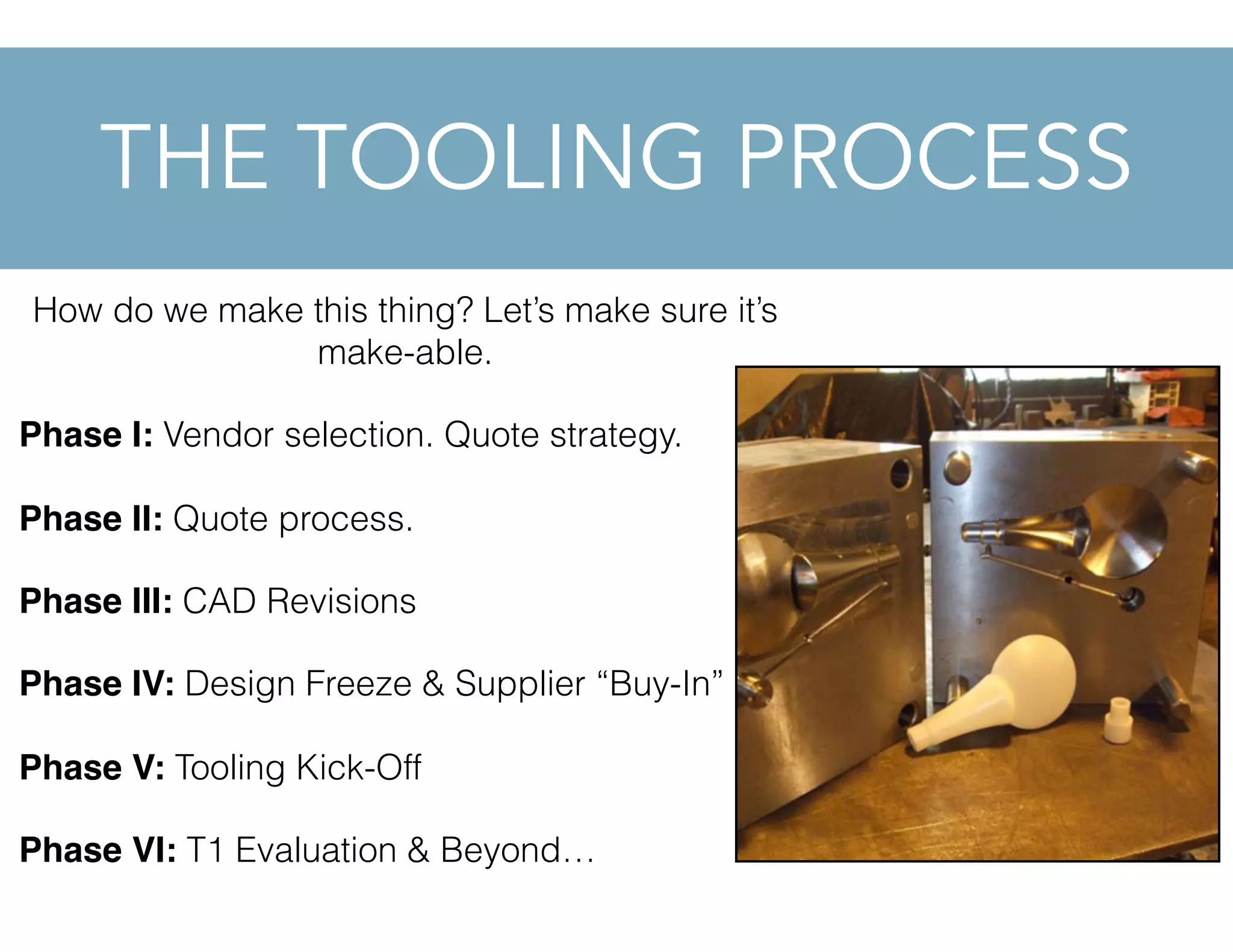
How do we make this thing? Let’s make sure it’s
make-able.
Phase I: Vendor selection. Quote strategy.
Phase II: Quote process.
Phase III: CAD Revisions
Phase IV: Design Freeze & Supplier “Buy-In”
Phase V: Tooling Kick-Off
Phase VI: T1 Evaluation & Beyond…
THE TOOLING PROCESS
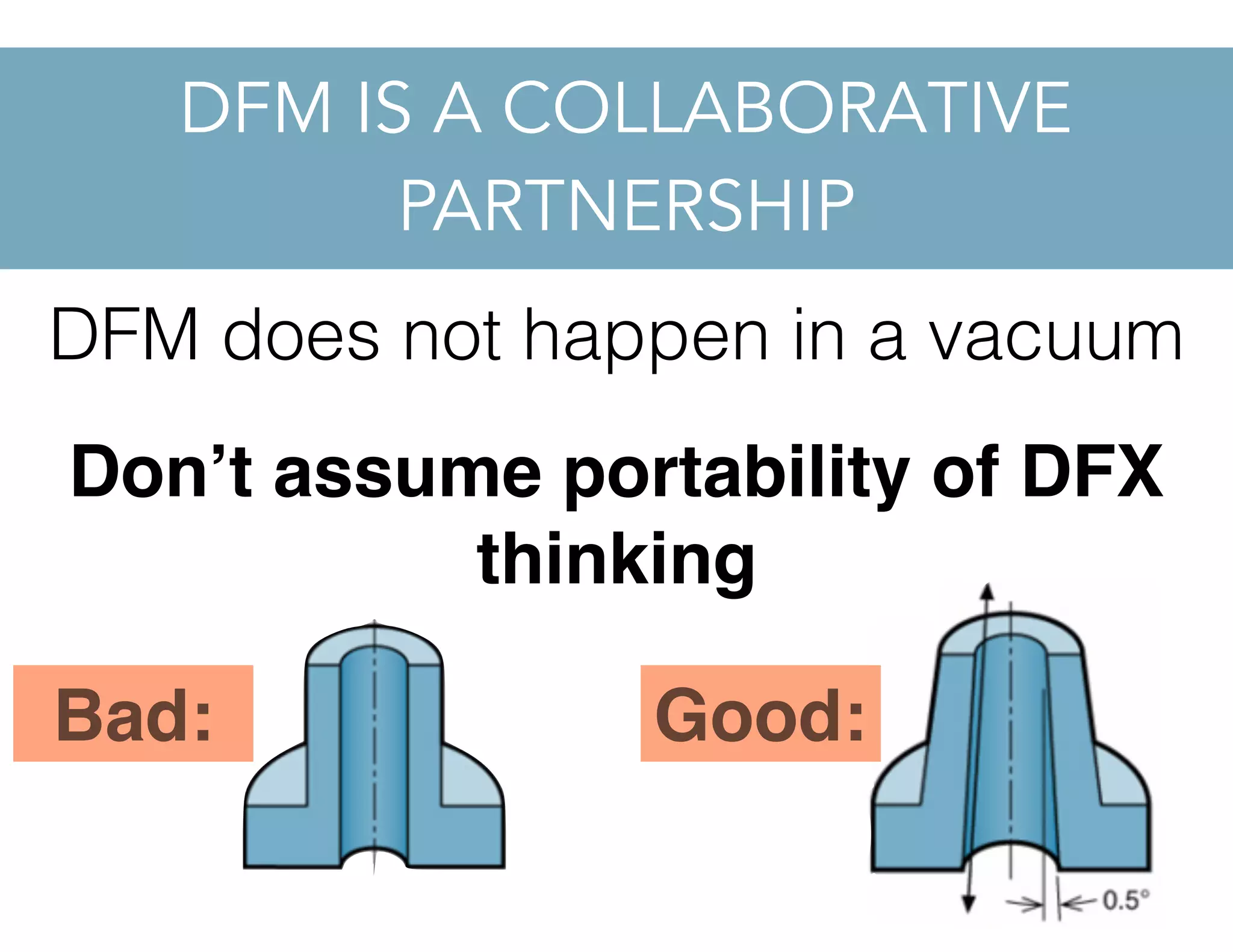
DFM does not happen in a vacuum
Don’t assume portability of DFX
thinking
DFM IS A COLLABORATIVE
PARTNERSHIP
Good:Bad:
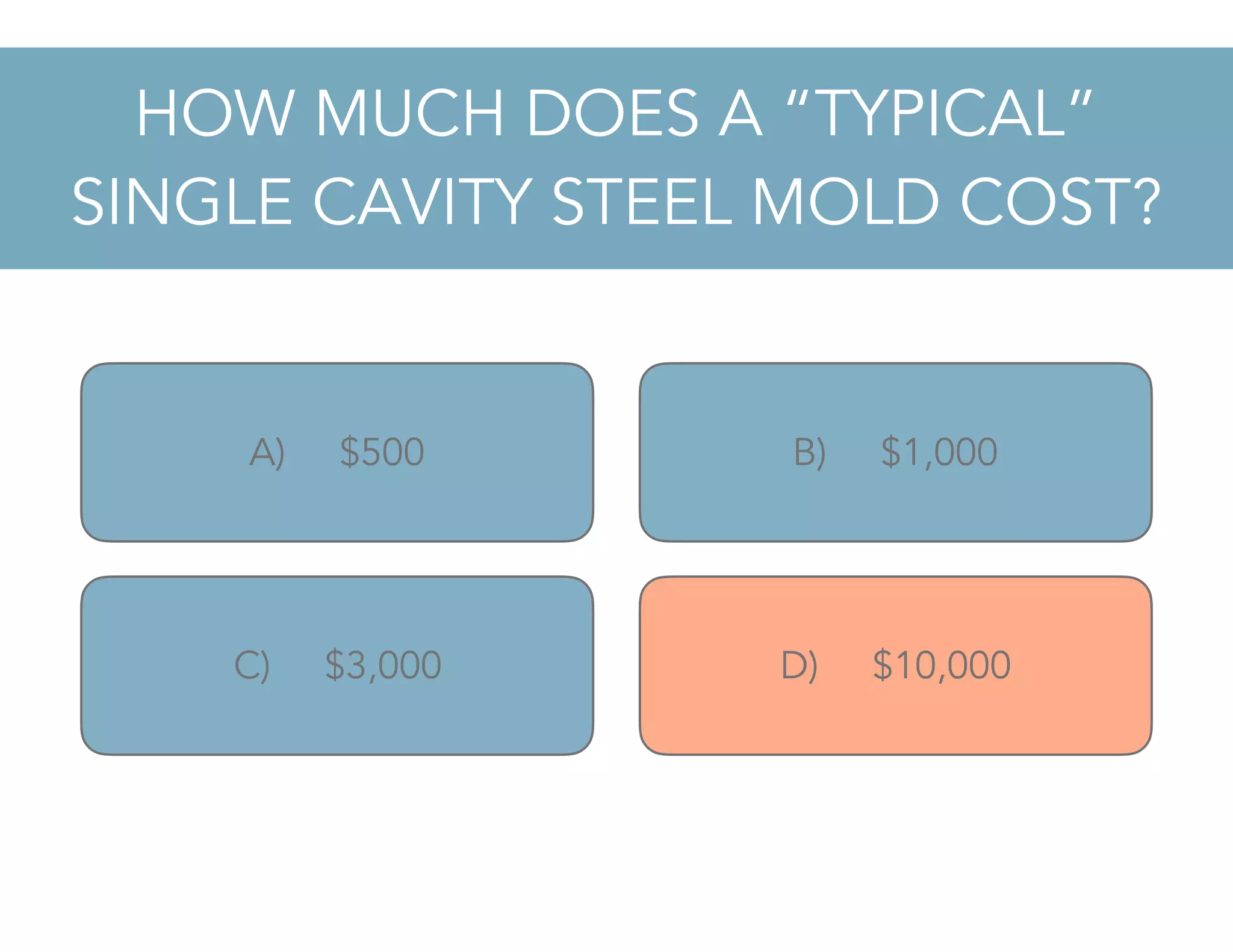
HOW MUCH DOES A “TYPICAL”
SINGLE CAVITY STEEL MOLD COST?
A) $500
C) $3,000
B) $1,000
D) $10,000
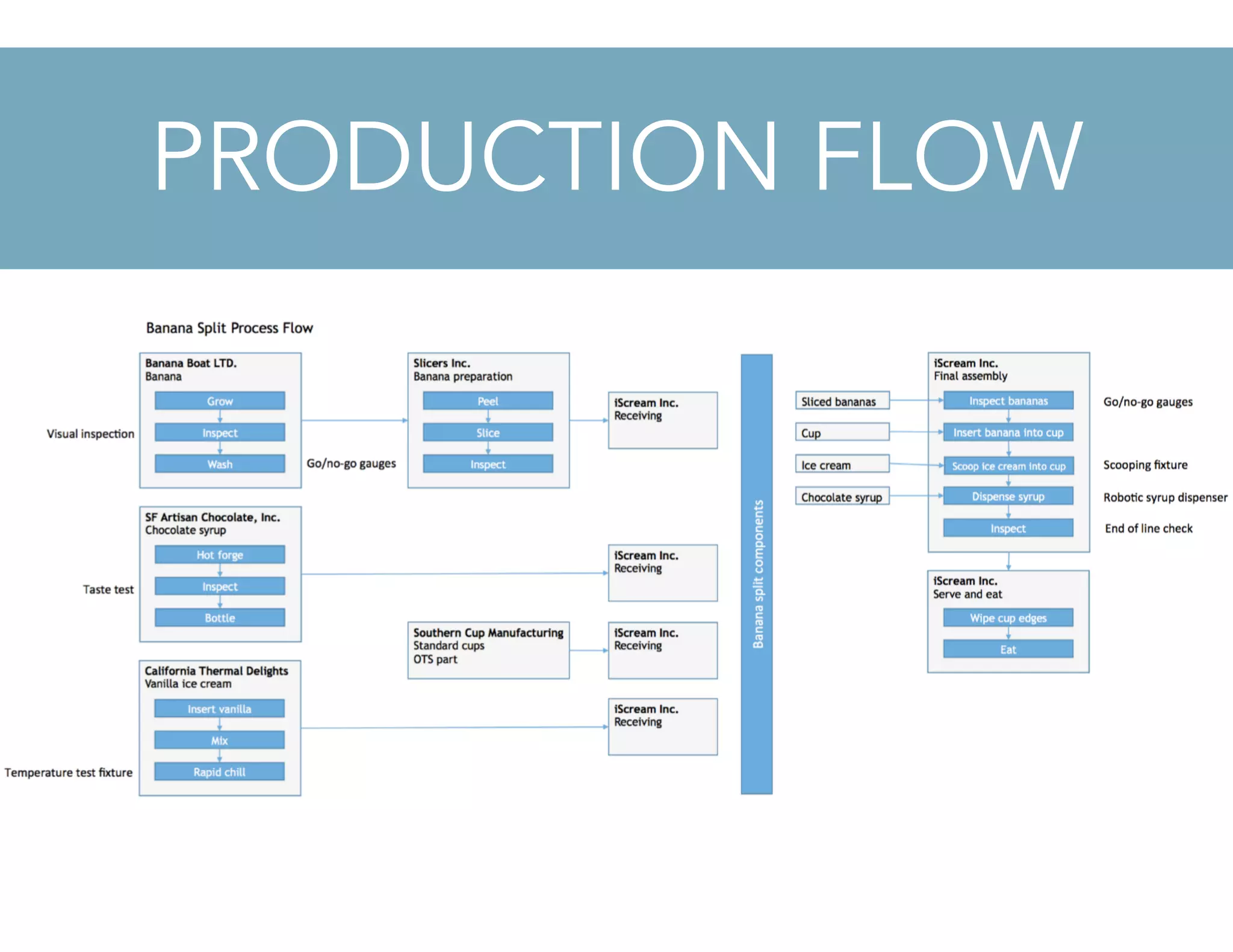
PRODUCTION FLOW
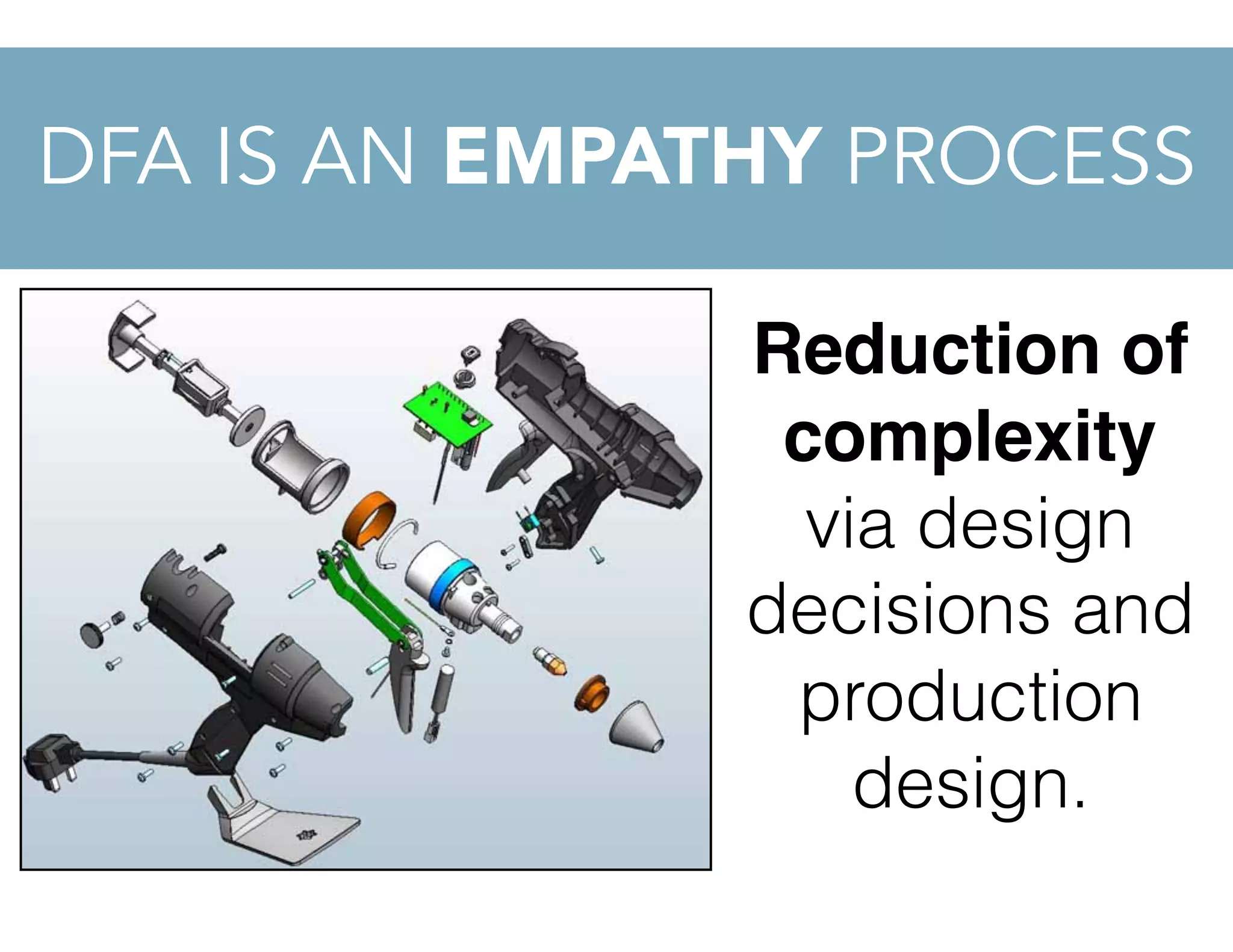
DFA IS AN EMPATHY PROCESS
Reduction of
complexity
via design
decisions and
production
design.
Mapping Out the Crystallized Project
Phase I: Component Lead Times, MOQs, and Payment
Schedules
Phase II: Tooling and Fixtures; Timelines and Requirements
Phase III: T2 Production Unit Creation Plan
Phase IV: Provisional Production Run #1 Scheduling
TIMELINE EVALUATION
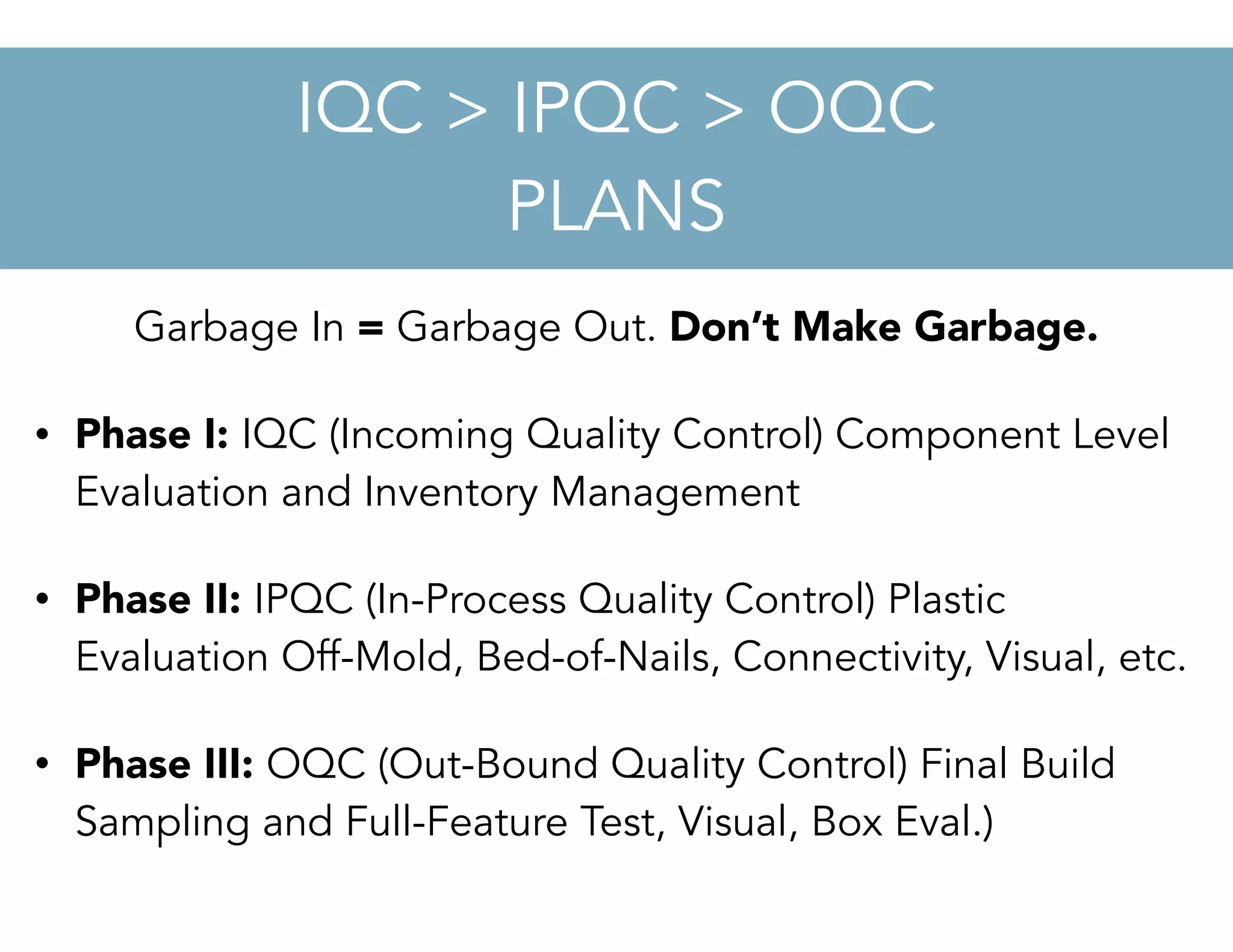
Garbage In = Garbage Out. Don’t Make Garbage.
• Phase I: IQC (Incoming Quality Control) Component Level
Evaluation and Inventory Management
• Phase II: IPQC (In-Process Quality Control) Plastic
Evaluation Off-Mold, Bed-of-Nails, Connectivity, Visual, etc.
• Phase III: OQC (Out-Bound Quality Control) Final Build
Sampling and Full-Feature Test, Visual, Box Eval.)
IQC > IPQC > OQC
PLANS
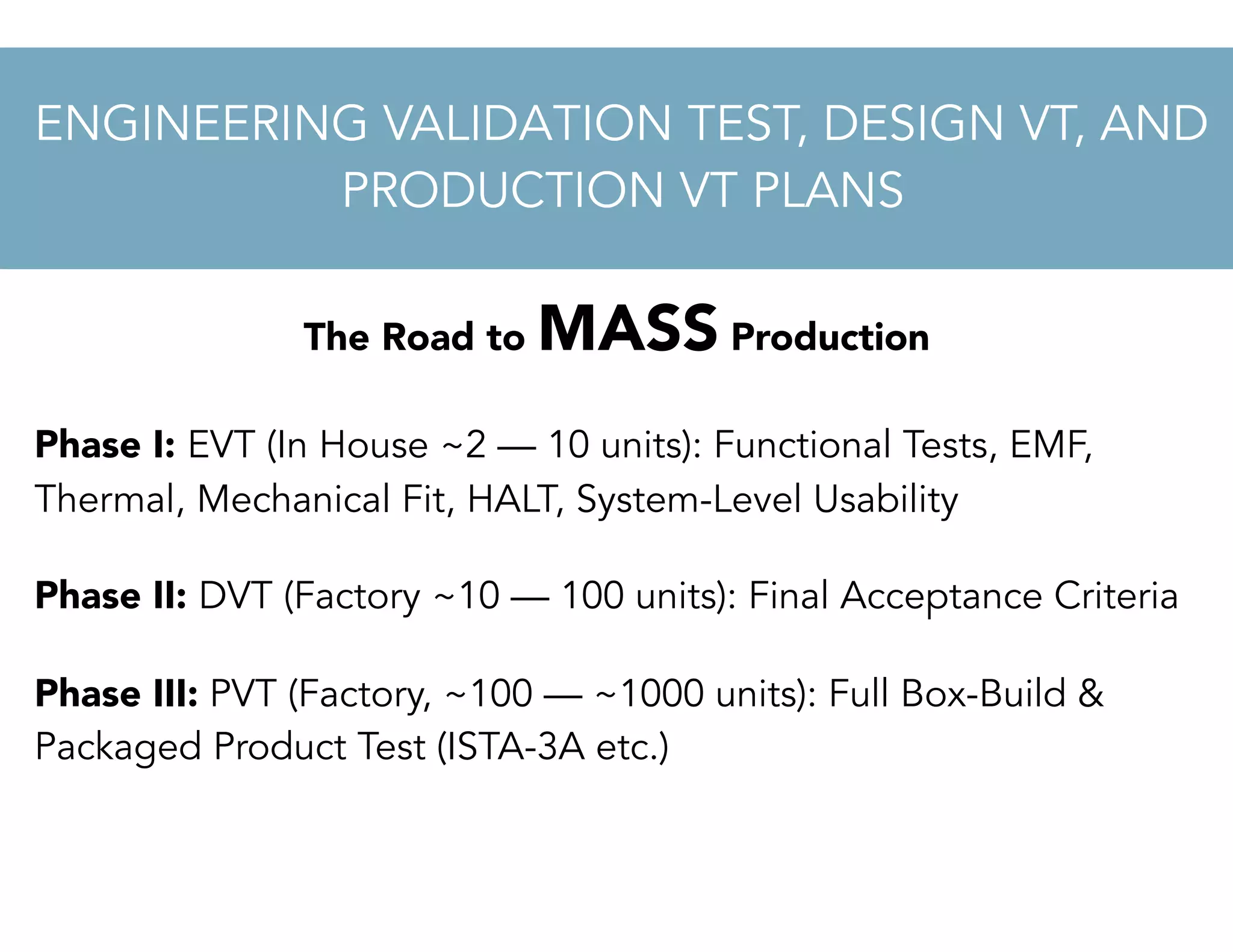
The Road to MASS Production
Phase I: EVT (In House ~2 — 10 units): Functional Tests, EMF,
Thermal, Mechanical Fit, HALT, System-Level Usability
Phase II: DVT (Factory ~10 — 100 units): Final Acceptance Criteria
Phase III: PVT (Factory, ~100 — ~1000 units): Full Box-Build &
Packaged Product Test (ISTA-3A etc.)
ENGINEERING VALIDATION TEST, DESIGN VT, AND
PRODUCTION VT PLANS
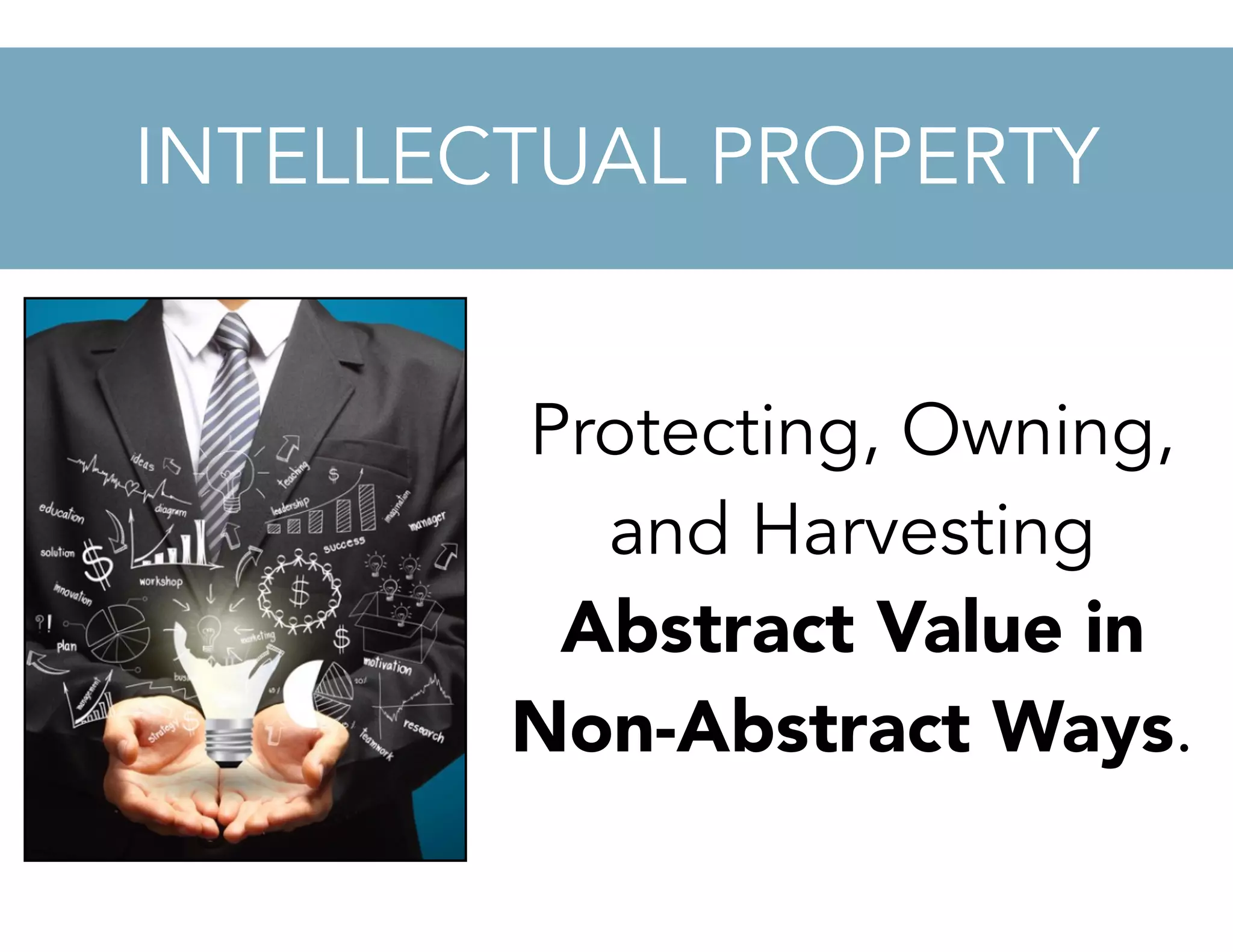
Protecting, Owning,
and Harvesting
Abstract Value in
Non-Abstract Ways.
INTELLECTUAL PROPERTY
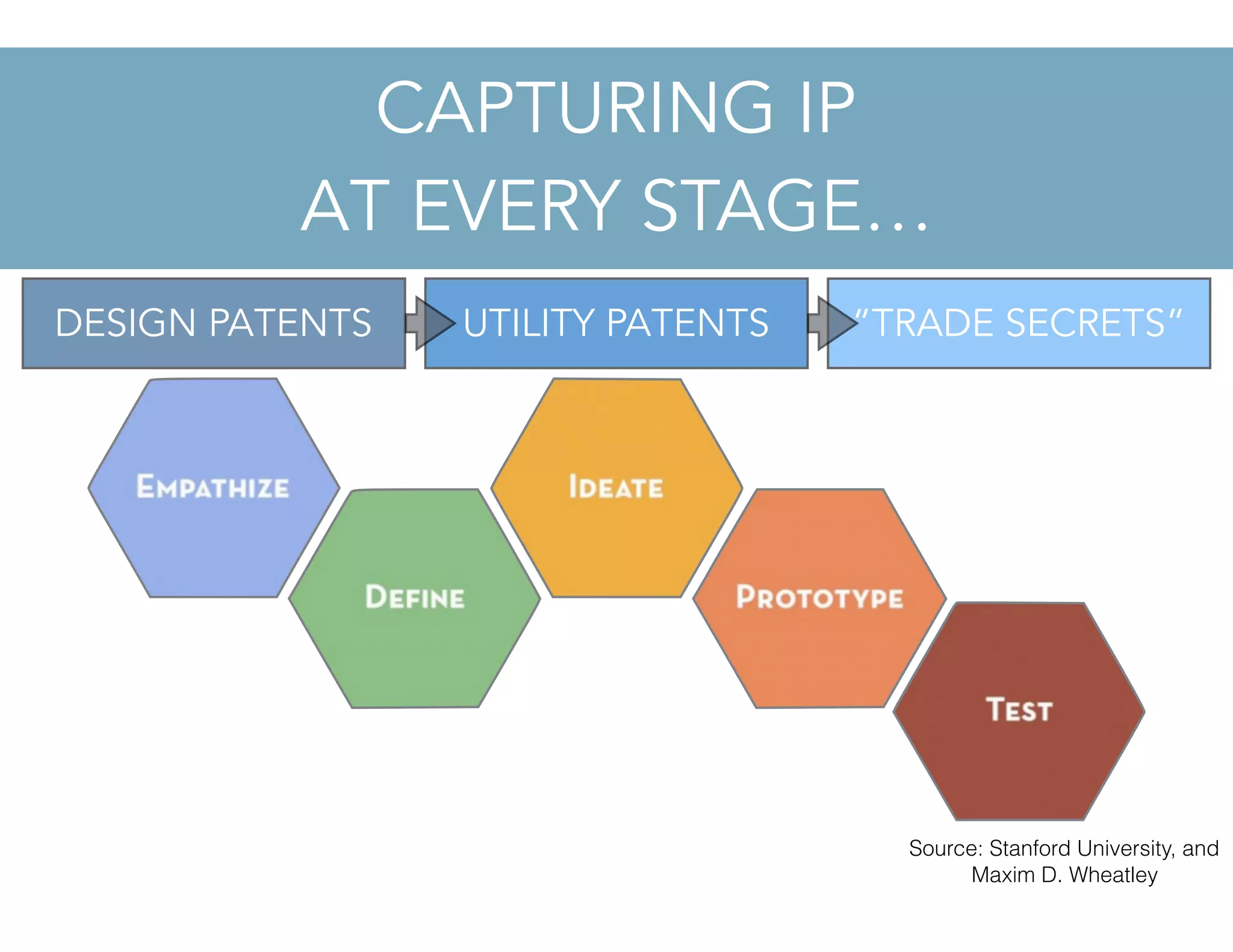
Source: Stanford University, and
Maxim D. Wheatley
CAPTURING IP
AT EVERY STAGE…
DESIGN PATENTS UTILITY PATENTS “TRADE SECRETS”
Go To Market
Crowdfunding should NOT be designated to cover NREs and
R&D
The Crowdfunding Checklist:
• Resolution of BOM AND COGS
• Necessary collateral
• Engaged Audience / Community
• Production Plan & Budget
• +/- 25% Timeline Resolution
Crowdfunding as a Debt-Instrument
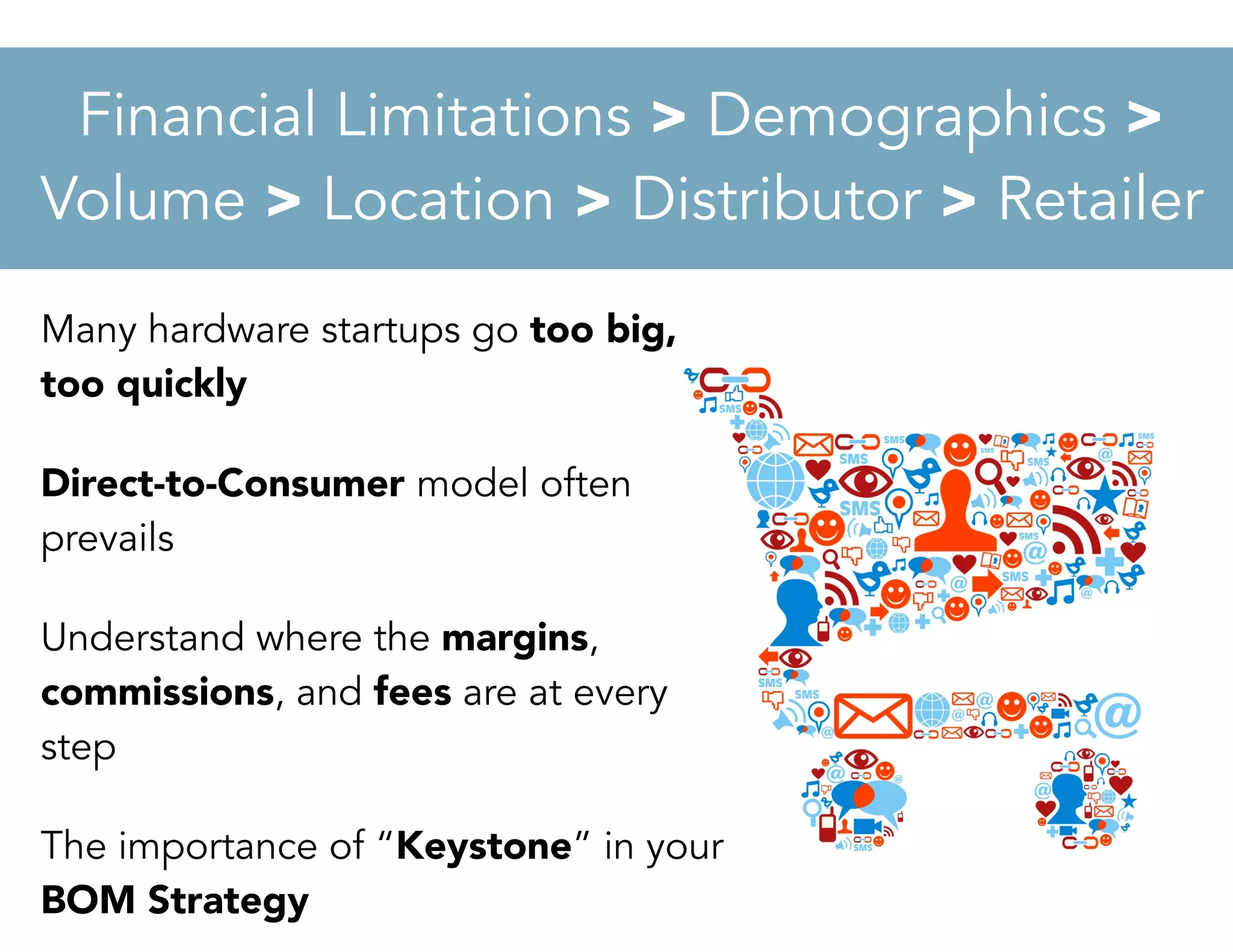
Many hardware startups go too big,
too quickly
Direct-to-Consumer model often
prevails
Understand where the margins,
commissions, and fees are at every
step
The importance of “Keystone” in your
BOM Strategy
Financial Limitations > Demographics >
Volume > Location > Distributor > Retailer
CONTACT
Maxim Wheatley
MaximWheatley@gmail.com
@MaximWheatley

Design Thinking (or: How to Make a Product Happen!)

  • 1.
    BY MAXIM D.WHEATLEY D E S I G N T H I N K I N G: T A K I N G A P R O D U C T T O M A R K E T
  • 2.
    ABOUT MAXIM Maxim isan award-winning product leader and innovator. Maxim co-founded LifeFuels, and was the founding Chief Product Officer where he won multiple industry awards, including the coveted CES Innovation Award. He is a prolific inventor with 20+ patents, both issued and pending. He has previously worked in Venture Capital and as an award-winning film producer. He also serves as an Entrepreneur in Residence at Georgetown University’s business school.
  • 3.
    Source: Stanford University THE“DESIGN THINKING” PROCESS
  • 4.
    Source: Lynda Inc.,and Design Management Institute DRIVES REAL RESULTS Design-Driven companies outperform the S&P 500 by 219%
  • 5.
    A FRAMEWORK FORPRODUCT DEVELOPMENT PROOF PLAN PROTOTYPE PRODUCTION
  • 6.
    IN ESSENCE… Ideas aremade tangible and can then be experienced by the relevant stakeholders Graphic Source: Vanderbilt University
  • 7.
    HOW LONG FOR“TYPICAL” HARDWARE PRODUCT DEVELOPMENT CYCLE? A) 3 — 6 months B) 6 — 12 months D) 16 — 20 monthsC) 12 — 16 months OFTEN WRONG. OFTEN CHANGES.
  • 8.
  • 9.
    Source: Stanford University THE“DESIGN THINKING” PROCESS
  • 10.
    EMPATHIZE In a sense…a form of method acting. Walk the proverbial mile in the users’ shoes.
  • 11.
    DEFINE Clarity in the definitionis essential. BUT it can and should be revised, within reason
  • 12.
  • 13.
    PROTOTYPE Does not need tobe slick. This is an experiment.
  • 14.
    TEST Apply results fromtests to revisions, future concepts, and prototypes ITERATE
  • 15.
  • 16.
  • 17.
    DETERMINING THE “INNOVATION FOCALPOINT” TECHNOLOGY LIMITATIONS BUSINESS OBJECTIVES USER VALUES INNOVATION SWEET SPOT
  • 18.
    THE “MAD-LIBS” PROJECT STATEMENT Tosuccessfully accomplish ____________, the product addresses the problem of ________________, for ___________________. The product does this by __________________________. If it works as we expect it to, it will be be clear to us because________________________________. A) Project vision. What do we want to achieve in doing this? B) What specific issue, inefficiency, or void is being addressed? (“Pain-Points”) C) Who specifically is the ultimate and most important user of this? D) What theoretical features and/or solutions make this possible? E) How will it be clear that the features successfully address part “B”? A B C D E
  • 19.
    Where are theopportunities? Applying Business Intelligence to the Process. • Phase I: User Profiles Creation • Phase II: Market Data Evaluation • Phase III: SWOT Analysis & Comparables Analysis • Phase IV: Pricing Guidance, Costing Guidance (Keystone, BOM “Ceiling”) • Phase V: Retail Recon MARKET EVALUATION
  • 20.
    Who Uses It?How? Why? Where? When? The “Characters” Guide Design Decisions. • Phase I: Stakeholder Interviews & Persona Creation • Phase II: Persona Review & Use-Case Requirements • Phase III: “Empathizing Strategy” PERSONA CREATION
  • 21.
    How will theproduct achieve its objectives? How will the stakeholders use it? • Phase I: Use-Case Flow • Phase II: UX Goals • Phase III: Interface goals. Use-Case “Freeze” • Phase IV: User Validation PRODUCT STORYBOARD
  • 22.
    The “compass” fordesign decisions. What do we know about how the product should look, feel, and function? What can we learn from the marketplace? • Phase I: Similar Products Mood Board • Phase II: Feature Mood Board • Phase III: Stakeholder Mood Board • Phase IV: “Where They Buy” Mood Board PRODUCT MOOD BOARD
  • 23.
    PRODUCT MOOD BOARD Pinterestas a real-time, dynamic, UGC “mood board”
  • 24.
    Good prototypes answerquestions that lead to actionable insights. What question are you finding an answer to? PROTOTYPES = ANSWERS
  • 25.
    Users will lookat low-fidelity prototypes and see potential. They will look at high-fidelity prototypes and see problems. PROTOTYPES = ANSWERS
  • 26.
    Looks sexy. Does nothing The“concept car” to bring to show and tell LOOKS-LIKE PROTOTYPE
  • 27.
    It’s ugly. Butit does what it promised to. The beginning of the evolution from concept to a real product. WORKS-LIKE PROTOTYPE “Start” “End”
  • 28.
    Which are themost concerning assumptions? This guides prototyping and testing… • Phase I: Assumption Listing & Prioritization • Phase II: Assumption Testing Plan & Standard Setting • Phase III: Results Evaluation • Phase IV: Revision Application & Timeline Adjustment (If Necessary) ASSUMPTION / RISK EVALUATION
  • 29.
    Where are theproduct assumptions valid, and where do they need correction? • Phase I: Final Stakeholder Interviews & Informal Focus-Group • Phase II: Findings Report & Evaluation • Phase III: Product Goals & Specification Sheet Revision USER VALIDATION
  • 30.
    I LIKE______ ABOUTTHE PRODUCT. I WISH________ ABOUT THE PRODUCT. TWO “FILL-IN-THE-BLANKS” FOR CONSUMER RESEARCH
  • 31.
    WHEN THE SHOEDOESN’T FIT…
  • 32.
    HOW MUCH FORA “TYPICAL” CONSUMER ELECTRONIC PROTOTYPE? A) $300 C) $3,000+++ B) $1,000 D) $9,000
  • 33.
    Concept generation andexploration, unencumbered by process, software, or skills. • Phase I: Shape & Size Goals • Phase II: Dimensional Requirements • Phase III: Basic Sketches & Discussion • Phase IV: Concept Refinement • Phase V: Industrial Design Sketches Produced DESIGN CONCEPT EVALUATION
  • 34.
    v Is the designfunctional within the targeted contexts? • Phase I: Shape & Ergonomics Exploration • Phase II: Dimensional / Shape Model Validation • Phase III: 3D Printed and/or CNC Produced Model • Phase IV: Initial Material Evaluation (Swatches) FORM EVALUATION
  • 35.
    After Establishing theInitial Design… Re-Evaluate. • Phase I: Existing Strengths and Weaknesses of Design THESIS • Phase II: What Have We Missed? • Phase III: What Could We Eliminate? • Phase IV: How Else Could We Do It? • Phase V: Concept Creation for Alternate Approaches ALTERNATE SOLUTIONS
  • 36.
    Based on whatwe know, how difficult will it be to produce and succeed? Do costs/price-points need provisional revisions? Vendor Meetings & Discussions Guide: • DFX Engineering Revisions • Costing Reality Checks FEASABILITY
  • 37.
    What components arenecessary? How do we get them? Who should we get them from? Phase I: Prioritization of vendors. Phase II: Initial reach out and qualification Phase III: Sample evaluation Phase IV: Low-Volume Quotation / MOQ Stress Test SUPPLY—CHAIN DEVELOPMENT
  • 38.
    Migrating qualitative productrequirements to quantitative engineering requirements. • Phase I: Development of Electrical Requirements (Power Study) • Phase II: Development of Materials Requirements • Phase III: Development of Mechanical Requirements • Phase IV: Acceptance of ERD Implications PRD to ERD PROCESS
  • 39.
    The speculative “ingredients”for the product. • Phase I: Plastics, Housings, Stampings: Components BOM • Phase II: OTS & Custom Parts, Electrical (SOCs, ASICs) BOM. • Phase III: Evaluation of Key Component Source- ability and Creation of Provisional Supply-Chain “Map” • Phase IV: COGS lock-in/acceptance or revisions PROVISIONAL BOM
  • 40.
    What Durability andUse Requirements Need Verification? Phase I: ERD Revisit & Testing Goals (HALT, Materials, Sub-Systems, Ingress, Enviro, etc.) Phase II: Core Test Selection and Requirements Phase III: Testing Plan / Lab Selection (CPSC compliance, UL, etc.) Phase IV: Prototype / Model Submission for Result Generation Phase V: Validation/Revision Based on Test Results TESTING PLAN
  • 41.
    Who makes it?How do they make it? Where do they make it? How much do they make it for? • Phase I: Scale Determination. Cost Targets. Timeline Goals. • Phase II: Domestic v. Off-Shore Evaluation • Phase III: CM Evaluation • Phase IV: Factory Audit • Phase V: Quotation CONTRACT MANUFACTURER EVALUATION
  • 42.
    How do wemake this thing? Let’s make sure it’s make-able. Phase I: Vendor selection. Quote strategy. Phase II: Quote process. Phase III: CAD Revisions Phase IV: Design Freeze & Supplier “Buy-In” Phase V: Tooling Kick-Off Phase VI: T1 Evaluation & Beyond… THE TOOLING PROCESS
  • 43.
    DFM does nothappen in a vacuum Don’t assume portability of DFX thinking DFM IS A COLLABORATIVE PARTNERSHIP Good:Bad:
  • 44.
    HOW MUCH DOESA “TYPICAL” SINGLE CAVITY STEEL MOLD COST? A) $500 C) $3,000 B) $1,000 D) $10,000
  • 45.
  • 46.
    DFA IS ANEMPATHY PROCESS Reduction of complexity via design decisions and production design.
  • 47.
    Mapping Out theCrystallized Project Phase I: Component Lead Times, MOQs, and Payment Schedules Phase II: Tooling and Fixtures; Timelines and Requirements Phase III: T2 Production Unit Creation Plan Phase IV: Provisional Production Run #1 Scheduling TIMELINE EVALUATION
  • 48.
    Garbage In =Garbage Out. Don’t Make Garbage. • Phase I: IQC (Incoming Quality Control) Component Level Evaluation and Inventory Management • Phase II: IPQC (In-Process Quality Control) Plastic Evaluation Off-Mold, Bed-of-Nails, Connectivity, Visual, etc. • Phase III: OQC (Out-Bound Quality Control) Final Build Sampling and Full-Feature Test, Visual, Box Eval.) IQC > IPQC > OQC PLANS
  • 49.
    The Road toMASS Production Phase I: EVT (In House ~2 — 10 units): Functional Tests, EMF, Thermal, Mechanical Fit, HALT, System-Level Usability Phase II: DVT (Factory ~10 — 100 units): Final Acceptance Criteria Phase III: PVT (Factory, ~100 — ~1000 units): Full Box-Build & Packaged Product Test (ISTA-3A etc.) ENGINEERING VALIDATION TEST, DESIGN VT, AND PRODUCTION VT PLANS
  • 50.
    Protecting, Owning, and Harvesting AbstractValue in Non-Abstract Ways. INTELLECTUAL PROPERTY
  • 51.
    Source: Stanford University,and Maxim D. Wheatley CAPTURING IP AT EVERY STAGE… DESIGN PATENTS UTILITY PATENTS “TRADE SECRETS”
  • 52.
  • 53.
    Crowdfunding should NOTbe designated to cover NREs and R&D The Crowdfunding Checklist: • Resolution of BOM AND COGS • Necessary collateral • Engaged Audience / Community • Production Plan & Budget • +/- 25% Timeline Resolution Crowdfunding as a Debt-Instrument
  • 54.
    Many hardware startupsgo too big, too quickly Direct-to-Consumer model often prevails Understand where the margins, commissions, and fees are at every step The importance of “Keystone” in your BOM Strategy Financial Limitations > Demographics > Volume > Location > Distributor > Retailer
  • 55.