STRUCTURING OFFSHORE HEDGE FUNDS
Structuring Offshore Hedge Funds
Contents
Table of Contents:

Overview:

A principal concern when structuring a hedge fund
is to provide the most favorable tax result for the
investors and the fund manager itself.

How are hedge funds structured?

3

Non-U.S. Investors

13

Categories of Investors

4

14

Because U.S. corporations are subject to income
tax on investment income as well as business
income, tax-exempt U.S. investors prefer to invest
in non-U.S. corporations, which are not subject to
income tax in the jurisdiction in which they reside
and which generally can avail themselves of a
safe harbor from U.S. taxation if they receive only
investment and trading income.

Hedge Fund Investor Composition

5

Accommodating the Conflicting
Needs of U.S. and Non-U.S. Investors
in a Hedge Fund’s Structure

Taxable U.S. Investors

6

Tax-Exempt U.S. Investors

7

How does a hedge fund accommodate 15
the interests of different investors at the
same time?

Why do some investors go offshore?

8

Stand-Alone Structure

16

Offshore Jurisdictions – Why do hedge
9
Funds set up entities in the Cayman Islands?

Side-by-side structure

17,18
19

This presentation focuses on the structure of
offshore vehicles and the general business and
regulatory environment in popular offshore
jurisdictions, such as the Cayman Islands, the
British Virgin Islands, Bermuda, and Ireland.

Addressing the Concerns of Tax-Exempt U.S. 12
Investors

Breakdown of Hedge Fund Domiciles

10

Advantages and Disadvantages
of a Side-by-Side Structure

Anti-Money Laundering and Other “Know
Your Customer” Regulation and Supervision

11

Master-Feeder Structure

20, 21, 22

Acknowledgements

23

2
Structuring Offshore Hedge Funds
How are Hedge Funds Structured?
In structuring a hedge fund, a
principal concern is to provide the
most favorable tax result for the
investors and the fund manager itself.

The factors which hold the largest
impact on the chosen structure are
the fund's investment program and
the types of investors who will invest
in the fund.
The fund manager will seek to utilize
entities domiciled in jurisdictions
which have clear and predictable
laws, quality service providers, and
are familiar to investors.
3
Structuring Offshore Hedge Funds
Categories of Investors
The main categories of investors are:
•
•
•

Taxable U.S. investors (e.g., individuals and family partnerships)
Tax-exempt U.S. investors (e.g., pension funds, foundations and
endowments)
Non-U.S. investors. (e.g., individuals and institutions)

U.S. - Domiciled
Vehicle

In order to address the concerns of each of the foregoing types
of investor, a fund manager generally will offer both a U.S.
vehicle and an offshore (non-U.S.) vehicle.
This presentation focuses on the structure of offshore vehicles
and the general business and regulatory environment in
popular offshore jurisdictions, such as the Cayman Islands, the
British Virgin Islands, Bermuda, and Ireland.

Offshore Vehicle

4
Structuring Offshore Hedge Funds
Hedge Fund Investor Composition*
A majority of hedge fund investors are tax-exempt institutional investors.

*Based on Institutional Capital
Source: 2014 Preqin Global Hedge Fund Report, January 2014.

5
Structuring Offshore Hedge Funds
Taxable U.S. Investors

It is Not Often Efficient for Taxable U.S. Investors to Use Offshore Funds.
Taxable U.S. investors include:
•

Natural persons

•

Partnerships

•

Taxable U.S. investors generally prefer to invest in U.S.
domiciled limited partnerships and LLCs, which are
"pass-through" entities that are not subject to entity-level
taxes, but instead pass their gains and losses through to
their investors. This allows taxable individual U.S.
investors to take advantage of capital gains treatment (a
lower tax rate) on their investments where available.

Corporations

•

Trusts

•

Limited liability companies (LLCs)

•

In most cases, it would not be efficient for U.S. investors
to invest in offshore funds, because most offshore funds
are treated as passive foreign investment companies
(PFICs) under the tax code, and are taxed at a higher
rate with the ability to take losses deferred.

Registered investment companies

6
Structuring Offshore Hedge Funds
Tax-Exempt U.S. Investors
Pensions

Endowments

Tax-exempt U.S. investors include government and
corporate pension plans, profit sharing plans, IRAs,
Keogh plans, endowments, foundations, and other
charitable organizations.

Foundations

7
Structuring Offshore Hedge Funds
Why Do Some Investors Go Offshore?
Tax-exempt U.S. investors are generally exempt from paying federal income tax, other
than with respect to debt-financed income and business income (as opposed to
investment or trading income). Such income is referred to as "unrelated business taxable
income," or "UBTI."
A tax-exempt U.S. investor can generally avoid UBTI by investing through a “blocker” – a
corporate entity where the character of the income (such as UBTI) does not “flow through”
to the investor as it does with U.S. pass-through entities. Rather, the corporate entity is
the tax payer.
Because corporations in the U.S. are taxed up to 35%, tax-exempt U.S. investors prefer to
invest in a corporation in a non-U.S. jurisdiction where there is no entity-level taxation,
which allows them to maintain their tax-exempt status while protecting them from incurring
UBTI.

8
Structuring Offshore Hedge Funds
Offshore Jurisdictions – Why Do Hedge Funds Set Up Entities in the Cayman
Islands?
Countries such as the Cayman Islands, Bermuda, Ireland, and the British Virgin Islands
are popular choices for setting up offshore hedge funds because they:
•

Charge no, or low, entity-level taxation.

•

Have a robust regulatory regime, including anti-money laundering measures and bank
regulations.

•

Have a developed financial industry that can supply qualified service providers
(licensed by local governmental authorities) to serve as legal counsel, administrators,
auditors and directors of hedge funds.

Many of these jurisdictions operate as British Overseas Territories and utilize a common
law legal system which provides a familiar foundation in entity and contractual law that
makes them attractive jurisdictions for investors looking to invest abroad.

9
Structuring Offshore Hedge Funds
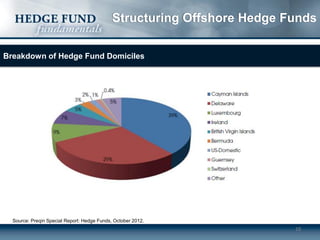
Breakdown of Hedge Fund Domiciles

Source: 2014 Preqin Global Hedge Fund Report, January 2014.

10
Structuring Offshore Hedge Funds
Anti-Money Laundering and Other “Know Your Customer” Regulation and
Supervision
The popular offshore jurisdictions have robust anti-money laundering regimes and
cooperate with international regulatory authorities, including the Organisation for
Economic Co-operation and Development (OECD), Financial Action Task Force, and
International Monetary Fund, to adopt "best practice" international regulatory
standards.
They are party to multiple international treaties to combat bank secrecy, as well as
agreements with numerous other countries (including the U.S. and U.K.) that require
the exchange of information relating to taxes.
Fund bank accounts are usually kept at major U.S. and European banks or local
branches of these banks, which subjects the fund and investors to an additional layer
of anti-money laundering and other "know your customer" regulation and supervision.

11
Structuring Offshore Hedge Funds
Addressing the Concerns of Tax-Exempt U.S. Investors
Because U.S. corporations are subject to income tax on investment income as well as
business income, tax-exempt U.S. investors prefer to invest in non-U.S. corporations, which
are not subject to income tax in the jurisdiction in which they reside and which generally can
avail themselves of a safe harbor from U.S. taxation if they receive only investment and
trading income.
A non-U.S. corporation, however, is subject to U.S. withholding tax on U.S. dividends and
certain other types of U.S. source income.
Tax-exempt U.S. investors do not pay U.S. tax on unleveraged investments in dividendpaying stocks owned through a flow-through entity.

12
Structuring Offshore Hedge Funds
Non-U.S. Investors
Non-U.S. Investors Generally Do Not Want to Incur U.S. Taxes
Non-U.S. investors include foreign natural persons and a variety of foreign entities.
Non-U.S. investors generally prefer not to be U.S. taxpayers or to file U.S. tax returns with
respect to their investment activities, which generally would be the case if they invested in a
U.S. entity or an entity which was a “pass-through” entity for U.S. tax purposes.
Similar to tax-exempt U.S. investors, non-U.S. investors generally prefer to invest in nonU.S. corporations because the corporate entity is the U.S. taxpayer and tax filer and can
often benefit from the safe harbor from U.S. taxation (other than withholding taxes) if it
receives only investment trading income.

13
Structuring Offshore Hedge Funds
Accommodating the Conflicting Needs of U.S. and Non-U.S. Investors in a Hedge
Fund’s Structure
As discussed, taxable U.S. investors generally prefer to invest in U.S.-domiciled passthrough entities, while tax-exempt U.S. investors and non-U.S. investors generally prefer to
invest in offshore corporate entities.
As a result, hedge fund managers which seek to target all types of investors will typically set
up a domestic fund as a U.S. limited partnership or limited liability company to accommodate
U.S. taxable investors and an offshore fund as a corporation domiciled in a jurisdiction with
no or low corporate income tax to accommodate tax-exempt U.S. investors and non-U.S.
investors.
The domestic fund and the offshore fund are both managed by the fund manager.

14
Structuring Offshore Hedge Funds
How does a hedge fund accommodate the interests of different investors at the
same time?
There are a number of structural approaches employed by hedge funds to accommodate
different investors. Three basic structures – a stand-alone structure, a side-by-side
investment structure and a master-feeder structure – are outlined below.

Hedge Fund Investment Structures:

Stand-Alone

Side-by-Side

Master-Feeder

15
Structuring Offshore Hedge Funds
Stand Alone Structure
In its most basic form, a hedge fund is a single entity, to which
the investors contribute funds.
As a result of the considerations outlined above, a stand-alone
structure is limited in the types of investors it can efficiently
accommodate.
General Partner
LLC

Taxable
U.S.
Investors

General Partner of
Investment Manager
LLC

Domestic
Hedge Fund LP

Investment Manager LP

Investments
16
Structuring Offshore Hedge Funds
Side-by-Side Structure

The side-by-side structure is a two-fund structure which includes a U.S. fund (e.g., a
Delaware limited partnership) and an offshore fund (e.g., a Cayman Islands exempted
company).

A side-by-side structure is often formed in order to address the concerns of each type
of domestic and offshore investor.
The fund manager advises each fund in the side-by-side structure, and each fund
makes the same, or substantially the same, investments.

17
Structuring Offshore Hedge Funds
Side-by-Side Structure
General Partner of
Investment Manager
LLC

General Partner
LLC
Taxable U.S.
Investors

Domestic
Hedge Fund LP

Investments

Investment Manager LP

Offshore
Hedge Fund Ltd.

Non-U.S. &
Tax-Exempt
U.S. Investors

Investments

18
Structuring Offshore Hedge Funds
Advantages and Disadvantages of a Side-by-Side Structure
An advantage of the side-by-side structure is that, due to the segregation of taxable and
tax-exempt U.S. investors into separate fund entities, tax and regulatory sensitivities
(e.g., long-term capital gains holding periods) can be managed for a specific type of
investor.
A drawback to the side-by-side structure is that it requires the fund manager to place
separate orders for each fund (often at higher overall cost), and often portfolios are
rebalanced between funds (e.g., when a fund’s size changes due to subscriptions and
redemptions).
Administrative and audit costs may also be higher due to maintaining two portfolios.

19
Structuring Offshore Hedge Funds
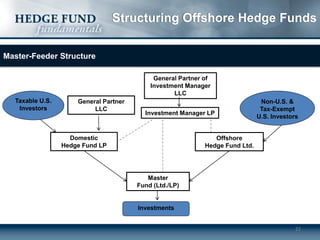
Master-Feeder Structure

In a master-feeder structure, like a side-by-side structure, a domestic fund and an
offshore fund are established.

However, rather than each fund directly holding a portfolio of investments, each fund
(known as a “feeder” fund) invests indirectly in a single portfolio through a master
fund.
The master fund is a pass-through entity for U.S. tax purposes, which preserves the
tax character of investments for taxable U.S. investors.
As a result, the fund manager makes a single investment decision which is then
apportioned to the fund feeders, and then makes its way back to the various
investors. The feeder funds participate indirectly in the master fund’s portfolio
through their ownership of the master fund.

20
Structuring Offshore Hedge Funds
Master-Feeder Structure

A master-feeder structure tends to be efficient and cost effective from a portfolio and
operational perspective.
However, the master-feeder structure can present conflicts of interest in cases where
an investment may be tax-efficient only for either the domestic feeder fund investors
or the offshore feeder fund investors. This can be addressed by having each feeder
fund maintain the discretion to make direct investments, although it is rarely practical
to do so.

21
Structuring Offshore Hedge Funds
Master-Feeder Structure
General Partner of
Investment Manager
LLC

Taxable U.S.
Investors

General Partner
LLC

Investment Manager LP

Domestic
Hedge Fund LP

Non-U.S. &
Tax-Exempt
U.S. Investors

Offshore
Hedge Fund Ltd.

Master
Fund (Ltd./LP)

Investments
22
Structuring Offshore Hedge Funds
Acknowledgements

MFA would like to acknowledge Schulte Roth & Zabel
LLP (www.srz.com) for their advice and counsel
throughout the drafting process of this presentation. SRZ
is a full-service law firm with offices in New York,
Washington, D.C. and London. As one of the leading law
firms serving the alternative investment industry, the firm
regularly advises clients on corporate and transactional
matters, as well as providing counsel on securities
regulatory compliance, enforcement and investigative
issues.

23

Structuring Offshore Hedge Funds

  • 1.
  • 2.
    Structuring Offshore HedgeFunds Contents Table of Contents: Overview: A principal concern when structuring a hedge fund is to provide the most favorable tax result for the investors and the fund manager itself. How are hedge funds structured? 3 Non-U.S. Investors 13 Categories of Investors 4 14 Because U.S. corporations are subject to income tax on investment income as well as business income, tax-exempt U.S. investors prefer to invest in non-U.S. corporations, which are not subject to income tax in the jurisdiction in which they reside and which generally can avail themselves of a safe harbor from U.S. taxation if they receive only investment and trading income. Hedge Fund Investor Composition 5 Accommodating the Conflicting Needs of U.S. and Non-U.S. Investors in a Hedge Fund’s Structure Taxable U.S. Investors 6 Tax-Exempt U.S. Investors 7 How does a hedge fund accommodate 15 the interests of different investors at the same time? Why do some investors go offshore? 8 Stand-Alone Structure 16 Offshore Jurisdictions – Why do hedge 9 Funds set up entities in the Cayman Islands? Side-by-side structure 17,18 19 This presentation focuses on the structure of offshore vehicles and the general business and regulatory environment in popular offshore jurisdictions, such as the Cayman Islands, the British Virgin Islands, Bermuda, and Ireland. Addressing the Concerns of Tax-Exempt U.S. 12 Investors Breakdown of Hedge Fund Domiciles 10 Advantages and Disadvantages of a Side-by-Side Structure Anti-Money Laundering and Other “Know Your Customer” Regulation and Supervision 11 Master-Feeder Structure 20, 21, 22 Acknowledgements 23 2
  • 3.
    Structuring Offshore HedgeFunds How are Hedge Funds Structured? In structuring a hedge fund, a principal concern is to provide the most favorable tax result for the investors and the fund manager itself. The factors which hold the largest impact on the chosen structure are the fund's investment program and the types of investors who will invest in the fund. The fund manager will seek to utilize entities domiciled in jurisdictions which have clear and predictable laws, quality service providers, and are familiar to investors. 3
  • 4.
    Structuring Offshore HedgeFunds Categories of Investors The main categories of investors are: • • • Taxable U.S. investors (e.g., individuals and family partnerships) Tax-exempt U.S. investors (e.g., pension funds, foundations and endowments) Non-U.S. investors. (e.g., individuals and institutions) U.S. - Domiciled Vehicle In order to address the concerns of each of the foregoing types of investor, a fund manager generally will offer both a U.S. vehicle and an offshore (non-U.S.) vehicle. This presentation focuses on the structure of offshore vehicles and the general business and regulatory environment in popular offshore jurisdictions, such as the Cayman Islands, the British Virgin Islands, Bermuda, and Ireland. Offshore Vehicle 4
  • 5.
    Structuring Offshore HedgeFunds Hedge Fund Investor Composition* A majority of hedge fund investors are tax-exempt institutional investors. *Based on Institutional Capital Source: 2014 Preqin Global Hedge Fund Report, January 2014. 5
  • 6.
    Structuring Offshore HedgeFunds Taxable U.S. Investors It is Not Often Efficient for Taxable U.S. Investors to Use Offshore Funds. Taxable U.S. investors include: • Natural persons • Partnerships • Taxable U.S. investors generally prefer to invest in U.S. domiciled limited partnerships and LLCs, which are "pass-through" entities that are not subject to entity-level taxes, but instead pass their gains and losses through to their investors. This allows taxable individual U.S. investors to take advantage of capital gains treatment (a lower tax rate) on their investments where available. Corporations • Trusts • Limited liability companies (LLCs) • In most cases, it would not be efficient for U.S. investors to invest in offshore funds, because most offshore funds are treated as passive foreign investment companies (PFICs) under the tax code, and are taxed at a higher rate with the ability to take losses deferred. Registered investment companies 6
  • 7.
    Structuring Offshore HedgeFunds Tax-Exempt U.S. Investors Pensions Endowments Tax-exempt U.S. investors include government and corporate pension plans, profit sharing plans, IRAs, Keogh plans, endowments, foundations, and other charitable organizations. Foundations 7
  • 8.
    Structuring Offshore HedgeFunds Why Do Some Investors Go Offshore? Tax-exempt U.S. investors are generally exempt from paying federal income tax, other than with respect to debt-financed income and business income (as opposed to investment or trading income). Such income is referred to as "unrelated business taxable income," or "UBTI." A tax-exempt U.S. investor can generally avoid UBTI by investing through a “blocker” – a corporate entity where the character of the income (such as UBTI) does not “flow through” to the investor as it does with U.S. pass-through entities. Rather, the corporate entity is the tax payer. Because corporations in the U.S. are taxed up to 35%, tax-exempt U.S. investors prefer to invest in a corporation in a non-U.S. jurisdiction where there is no entity-level taxation, which allows them to maintain their tax-exempt status while protecting them from incurring UBTI. 8
  • 9.
    Structuring Offshore HedgeFunds Offshore Jurisdictions – Why Do Hedge Funds Set Up Entities in the Cayman Islands? Countries such as the Cayman Islands, Bermuda, Ireland, and the British Virgin Islands are popular choices for setting up offshore hedge funds because they: • Charge no, or low, entity-level taxation. • Have a robust regulatory regime, including anti-money laundering measures and bank regulations. • Have a developed financial industry that can supply qualified service providers (licensed by local governmental authorities) to serve as legal counsel, administrators, auditors and directors of hedge funds. Many of these jurisdictions operate as British Overseas Territories and utilize a common law legal system which provides a familiar foundation in entity and contractual law that makes them attractive jurisdictions for investors looking to invest abroad. 9
  • 10.
    Structuring Offshore HedgeFunds Breakdown of Hedge Fund Domiciles Source: 2014 Preqin Global Hedge Fund Report, January 2014. 10
  • 11.
    Structuring Offshore HedgeFunds Anti-Money Laundering and Other “Know Your Customer” Regulation and Supervision The popular offshore jurisdictions have robust anti-money laundering regimes and cooperate with international regulatory authorities, including the Organisation for Economic Co-operation and Development (OECD), Financial Action Task Force, and International Monetary Fund, to adopt "best practice" international regulatory standards. They are party to multiple international treaties to combat bank secrecy, as well as agreements with numerous other countries (including the U.S. and U.K.) that require the exchange of information relating to taxes. Fund bank accounts are usually kept at major U.S. and European banks or local branches of these banks, which subjects the fund and investors to an additional layer of anti-money laundering and other "know your customer" regulation and supervision. 11
  • 12.
    Structuring Offshore HedgeFunds Addressing the Concerns of Tax-Exempt U.S. Investors Because U.S. corporations are subject to income tax on investment income as well as business income, tax-exempt U.S. investors prefer to invest in non-U.S. corporations, which are not subject to income tax in the jurisdiction in which they reside and which generally can avail themselves of a safe harbor from U.S. taxation if they receive only investment and trading income. A non-U.S. corporation, however, is subject to U.S. withholding tax on U.S. dividends and certain other types of U.S. source income. Tax-exempt U.S. investors do not pay U.S. tax on unleveraged investments in dividendpaying stocks owned through a flow-through entity. 12
  • 13.
    Structuring Offshore HedgeFunds Non-U.S. Investors Non-U.S. Investors Generally Do Not Want to Incur U.S. Taxes Non-U.S. investors include foreign natural persons and a variety of foreign entities. Non-U.S. investors generally prefer not to be U.S. taxpayers or to file U.S. tax returns with respect to their investment activities, which generally would be the case if they invested in a U.S. entity or an entity which was a “pass-through” entity for U.S. tax purposes. Similar to tax-exempt U.S. investors, non-U.S. investors generally prefer to invest in nonU.S. corporations because the corporate entity is the U.S. taxpayer and tax filer and can often benefit from the safe harbor from U.S. taxation (other than withholding taxes) if it receives only investment trading income. 13
  • 14.
    Structuring Offshore HedgeFunds Accommodating the Conflicting Needs of U.S. and Non-U.S. Investors in a Hedge Fund’s Structure As discussed, taxable U.S. investors generally prefer to invest in U.S.-domiciled passthrough entities, while tax-exempt U.S. investors and non-U.S. investors generally prefer to invest in offshore corporate entities. As a result, hedge fund managers which seek to target all types of investors will typically set up a domestic fund as a U.S. limited partnership or limited liability company to accommodate U.S. taxable investors and an offshore fund as a corporation domiciled in a jurisdiction with no or low corporate income tax to accommodate tax-exempt U.S. investors and non-U.S. investors. The domestic fund and the offshore fund are both managed by the fund manager. 14
  • 15.
    Structuring Offshore HedgeFunds How does a hedge fund accommodate the interests of different investors at the same time? There are a number of structural approaches employed by hedge funds to accommodate different investors. Three basic structures – a stand-alone structure, a side-by-side investment structure and a master-feeder structure – are outlined below. Hedge Fund Investment Structures: Stand-Alone Side-by-Side Master-Feeder 15
  • 16.
    Structuring Offshore HedgeFunds Stand Alone Structure In its most basic form, a hedge fund is a single entity, to which the investors contribute funds. As a result of the considerations outlined above, a stand-alone structure is limited in the types of investors it can efficiently accommodate. General Partner LLC Taxable U.S. Investors General Partner of Investment Manager LLC Domestic Hedge Fund LP Investment Manager LP Investments 16
  • 17.
    Structuring Offshore HedgeFunds Side-by-Side Structure The side-by-side structure is a two-fund structure which includes a U.S. fund (e.g., a Delaware limited partnership) and an offshore fund (e.g., a Cayman Islands exempted company). A side-by-side structure is often formed in order to address the concerns of each type of domestic and offshore investor. The fund manager advises each fund in the side-by-side structure, and each fund makes the same, or substantially the same, investments. 17
  • 18.
    Structuring Offshore HedgeFunds Side-by-Side Structure General Partner of Investment Manager LLC General Partner LLC Taxable U.S. Investors Domestic Hedge Fund LP Investments Investment Manager LP Offshore Hedge Fund Ltd. Non-U.S. & Tax-Exempt U.S. Investors Investments 18
  • 19.
    Structuring Offshore HedgeFunds Advantages and Disadvantages of a Side-by-Side Structure An advantage of the side-by-side structure is that, due to the segregation of taxable and tax-exempt U.S. investors into separate fund entities, tax and regulatory sensitivities (e.g., long-term capital gains holding periods) can be managed for a specific type of investor. A drawback to the side-by-side structure is that it requires the fund manager to place separate orders for each fund (often at higher overall cost), and often portfolios are rebalanced between funds (e.g., when a fund’s size changes due to subscriptions and redemptions). Administrative and audit costs may also be higher due to maintaining two portfolios. 19
  • 20.
    Structuring Offshore HedgeFunds Master-Feeder Structure In a master-feeder structure, like a side-by-side structure, a domestic fund and an offshore fund are established. However, rather than each fund directly holding a portfolio of investments, each fund (known as a “feeder” fund) invests indirectly in a single portfolio through a master fund. The master fund is a pass-through entity for U.S. tax purposes, which preserves the tax character of investments for taxable U.S. investors. As a result, the fund manager makes a single investment decision which is then apportioned to the fund feeders, and then makes its way back to the various investors. The feeder funds participate indirectly in the master fund’s portfolio through their ownership of the master fund. 20
  • 21.
    Structuring Offshore HedgeFunds Master-Feeder Structure A master-feeder structure tends to be efficient and cost effective from a portfolio and operational perspective. However, the master-feeder structure can present conflicts of interest in cases where an investment may be tax-efficient only for either the domestic feeder fund investors or the offshore feeder fund investors. This can be addressed by having each feeder fund maintain the discretion to make direct investments, although it is rarely practical to do so. 21
  • 22.
    Structuring Offshore HedgeFunds Master-Feeder Structure General Partner of Investment Manager LLC Taxable U.S. Investors General Partner LLC Investment Manager LP Domestic Hedge Fund LP Non-U.S. & Tax-Exempt U.S. Investors Offshore Hedge Fund Ltd. Master Fund (Ltd./LP) Investments 22
  • 23.
    Structuring Offshore HedgeFunds Acknowledgements MFA would like to acknowledge Schulte Roth & Zabel LLP (www.srz.com) for their advice and counsel throughout the drafting process of this presentation. SRZ is a full-service law firm with offices in New York, Washington, D.C. and London. As one of the leading law firms serving the alternative investment industry, the firm regularly advises clients on corporate and transactional matters, as well as providing counsel on securities regulatory compliance, enforcement and investigative issues. 23