WESTLAWNEXT
Legal - Overview
In this session we will explore:
• -case law searching in Westlaw.
• -statutory searching in Westlaw.
• -the West Key Number System of searching.
• -how to determine if a case or statute is still good law.
• -ALR, aka American Law Reports.
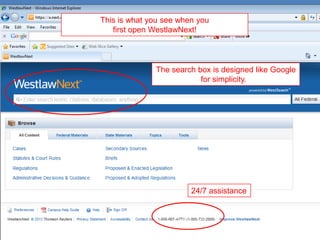
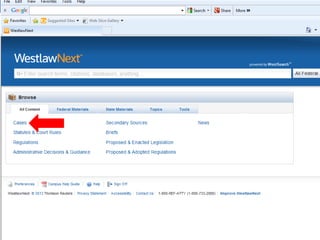
This is what you see when you
first open WestlawNext!
The search box is designed like Google
for simplicity.
24/7 assistance
WESTLAWNEXT
Case Law Searching
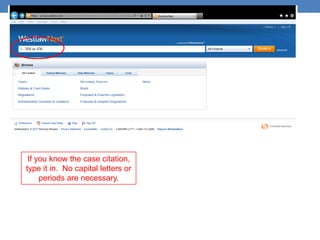
If you know the case citation,
type it in. No capital letters or
periods are necessary.
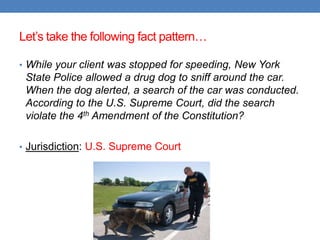
Let‟s take the following fact pattern…
• While your client was stopped for speeding, New York
State Police allowed a drug dog to sniff around the car.
When the dog alerted, a search of the car was conducted.
According to the U.S. Supreme Court, did the search
violate the 4th Amendment of the Constitution?
• Jurisdiction: U.S. Supreme Court
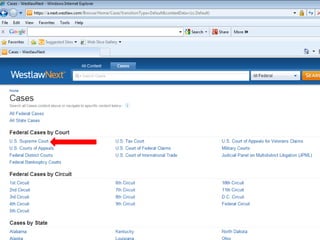
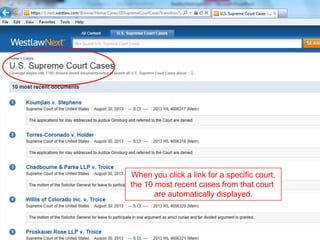
When you click a link for a specific court,
the 10 most recent cases from that court
are automatically displayed.
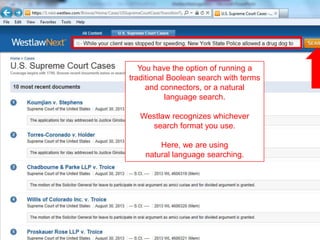
You have the option of running a
traditional Boolean search with terms
and connectors, or a natural
language search.
Westlaw recognizes whichever
search format you use.
Here, we are using
natural language searching.
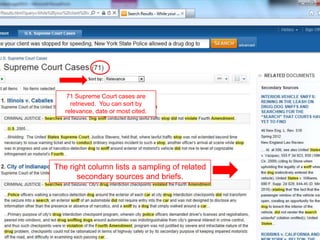
71 Supreme Court cases are
retrieved. You can sort by
relevance, date or most cited.
The right column lists a sampling of related
secondary sources and briefs.
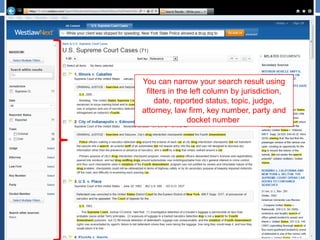
You can narrow your search result using
filters in the left column by jurisdiction,
date, reported status, topic, judge,
attorney, law firm, key number, party and
docket number.
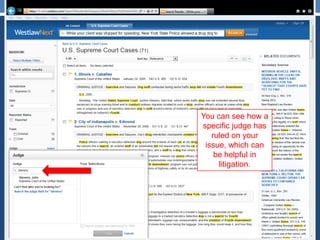
You can see how a
specific judge has
ruled on your
issue, which can
be helpful in
litigation.
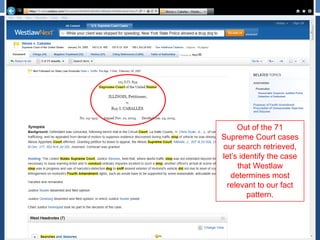
Out of the 71
Supreme Court cases
our search retrieved,
let‟s identify the case
that Westlaw
determines most
relevant to our fact
pattern.
LET‟S RUN THE SEARCH
AGAIN, THIS TIME USING
BOOLEAN CONNECTORS.
Boolean searching, while not as easy as natural
language searching, allows you to control your search
results very specifically.
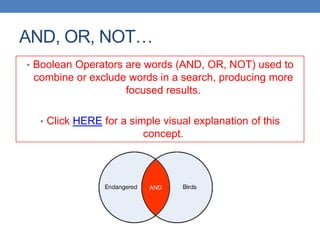
AND, OR, NOT…
• Boolean Operators are words (AND, OR, NOT) used to
combine or exclude words in a search, producing more
focused results.
• Click HERE for a simple visual explanation of this
concept.
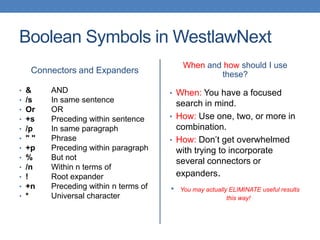
Boolean Symbols in WestlawNext
Connectors and Expanders
• & AND
• /s In same sentence
• Or OR
• +s Preceding within sentence
• /p In same paragraph
• " " Phrase
• +p Preceding within paragraph
• % But not
• /n Within n terms of
• ! Root expander
• +n Preceding within n terms of
• * Universal character
When and how should I use
these?
• When: You have a focused
search in mind.
• How: Use one, two, or more in
combination.
• How: Don‟t get overwhelmed
with trying to incorporate
several connectors or
expanders.
• You may actually ELIMINATE useful results
this way!
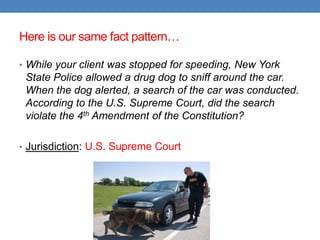
Here is our same fact pattern…
• While your client was stopped for speeding, New York
State Police allowed a drug dog to sniff around the car.
When the dog alerted, a search of the car was conducted.
According to the U.S. Supreme Court, did the search
violate the 4th Amendment of the Constitution?
• Jurisdiction: U.S. Supreme Court
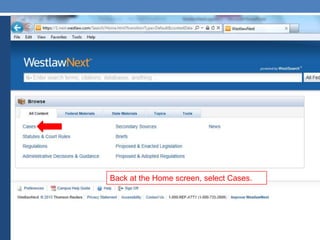
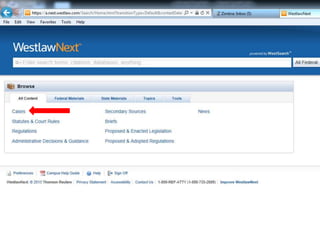
Back at the Home screen, select Cases.
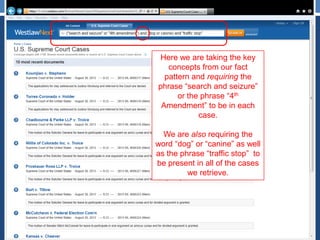
Here we are taking the key
concepts from our fact
pattern and requiring the
phrase “search and seizure”
or the phrase “4th
Amendment” to be in each
case.
We are also requiring the
word “dog” or “canine” as well
as the phrase “traffic stop” to
be present in all of the cases
we retrieve.
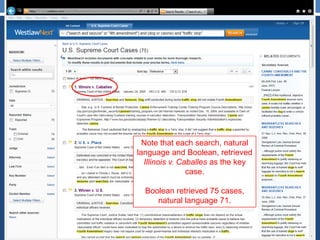
Note that each search, natural
language and Boolean, retrieved
Illinois v. Caballes as the key
case.
Boolean retrieved 75 cases,
natural language 71.
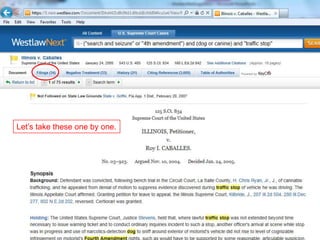
Let‟s take these one by one.
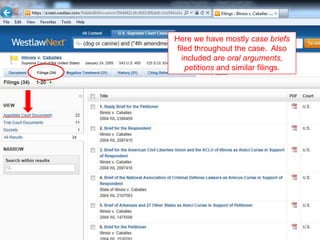
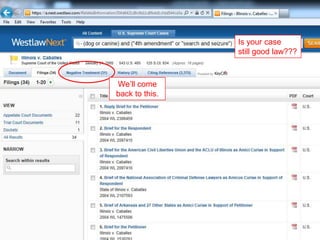
Here we have mostly case briefs
filed throughout the case. Also
included are oral arguments,
petitions and similar filings.
We‟ll come
back to this.
Is your case
still good law???
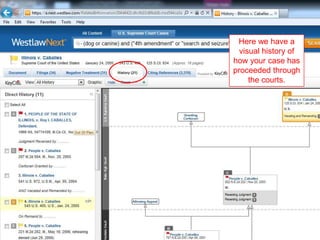
Here we have a
visual history of
how your case has
proceeded through
the courts.
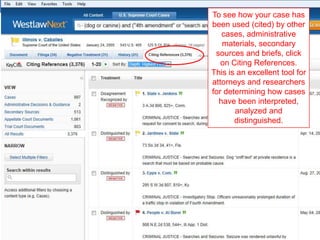
To see how your case has
been used (cited) by other
cases, administrative
materials, secondary
sources and briefs, click
on Citing References.
This is an excellent tool for
attorneys and researchers
for determining how cases
have been interpreted,
analyzed and
distinguished.
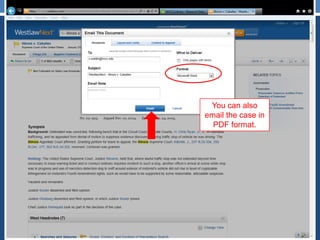
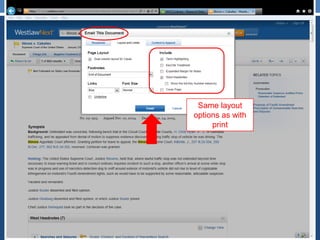
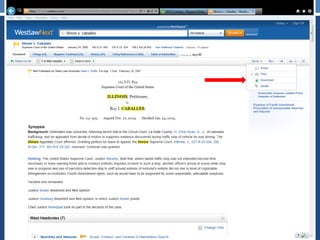
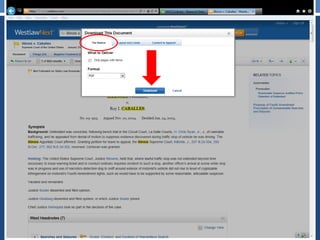
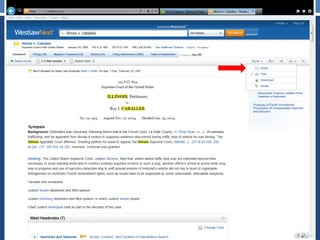
PRINTING, EMAILING…
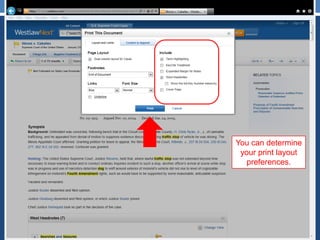
You can determine
your print layout
preferences.
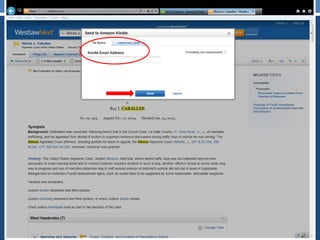
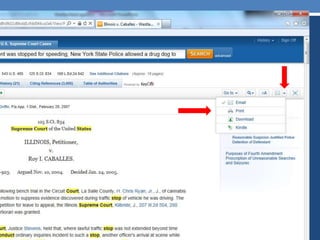
You can also
email the case in
PDF format.
Same layout
options as with
print
NEGATIVE TREATMENT
Is your case still good law?
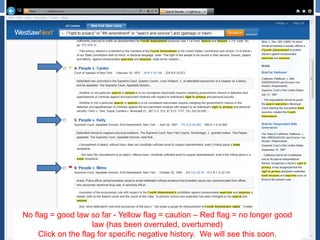
No flag = good law so far - Yellow flag = caution – Red flag = no longer good
law (has been overruled, overturned)
Click on the flag for specific negative history. We will see this soon.
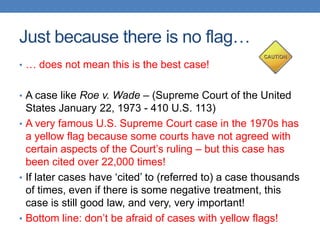
Just because there is no flag…
• … does not mean this is the best case!
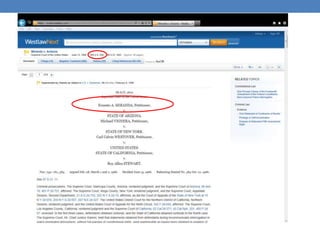
• A case like Roe v. Wade – (Supreme Court of the United
States January 22, 1973 - 410 U.S. 113)
• A very famous U.S. Supreme Court case in the 1970s has
a yellow flag because some courts have not agreed with
certain aspects of the Court‟s ruling – but this case has
been cited over 22,000 times!
• If later cases have „cited‟ to (referred to) a case thousands
of times, even if there is some negative treatment, this
case is still good law, and very, very important!
• Bottom line: don‟t be afraid of cases with yellow flags!
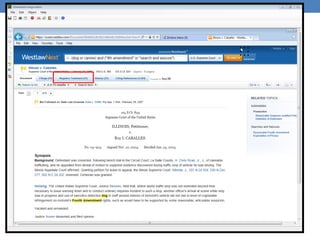
SO LET‟S CHECK THE
NEGATIVE TREATMENT
for Illinois v. Caballes
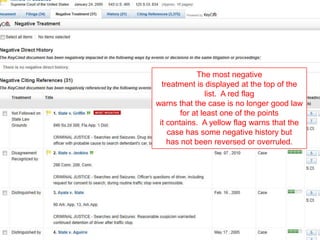
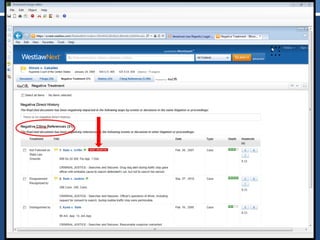
The most negative
treatment is displayed at the top of the
list. A red flag
warns that the case is no longer good law
for at least one of the points
it contains. A yellow flag warns that the
case has some negative history but
has not been reversed or overruled.
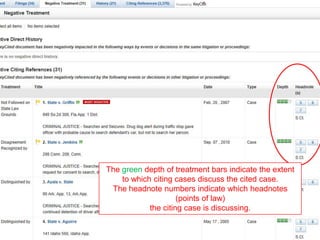
The green depth of treatment bars indicate the extent
to which citing cases discuss the cited case.
The headnote numbers indicate which headnotes
(points of law)
the citing case is discussing.
HEADNOTES….
…explained
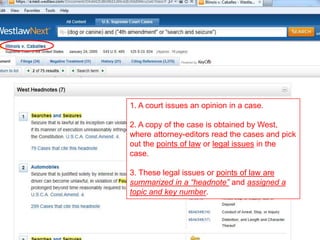
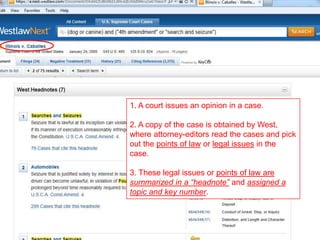
1. A court issues an opinion in a case.
2. A copy of the case is obtained by West,
where attorney-editors read the cases and pick
out the points of law or legal issues in the
case.
3. These legal issues or points of law are
summarized in a “headnote” and assigned a
topic and key number.
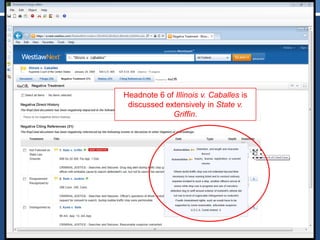
Headnote 6 of Illinois v. Caballes is
discussed extensively in State v.
Griffin.
So is the case good law or what?
• The main ways to access KeyCite information are:
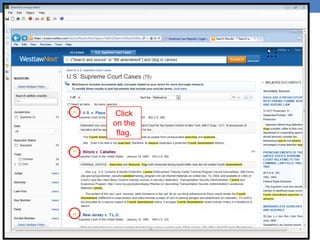
• while viewing a case with a KeyCite flag, click the flag.
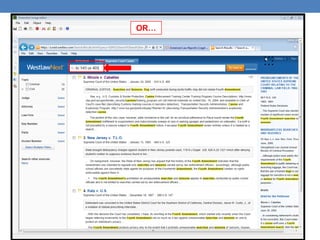
• type kc or keycite followed by the case citation.
Click
on the
flag.
OR…
LET‟S DO ANOTHER
EXAMPLE.
Case Law Searching
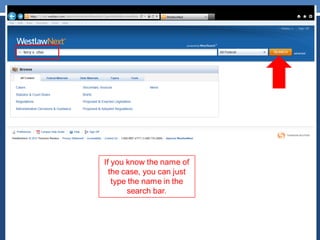
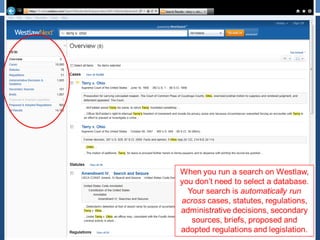
Terry v. Ohio
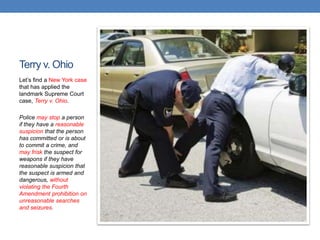
Let‟s find a New York case
that has applied the
landmark Supreme Court
case, Terry v. Ohio.
Police may stop a person
if they have a reasonable
suspicion that the person
has committed or is about
to commit a crime, and
may frisk the suspect for
weapons if they have
reasonable suspicion that
the suspect is armed and
dangerous, without
violating the Fourth
Amendment prohibition on
unreasonable searches
and seizures.
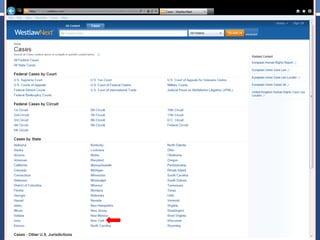
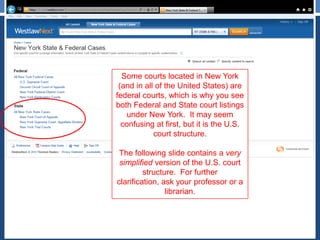
Some courts located in New York
(and in all of the United States) are
federal courts, which is why you see
both Federal and State court listings
under New York. It may seem
confusing at first, but it is the U.S.
court structure.
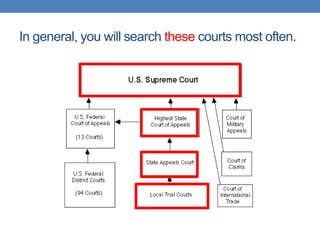
The following slide contains a very
simplified version of the U.S. court
structure. For further
clarification, ask your professor or a
librarian.
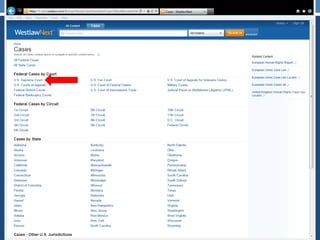
In general, you will search these courts most often.
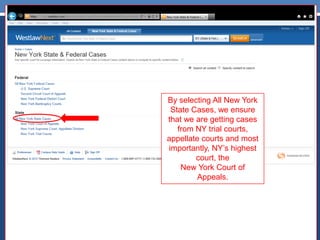
By selecting All New York
State Cases, we ensure
that we are getting cases
from NY trial courts,
appellate courts and most
importantly, NY‟s highest
court, the
New York Court of
Appeals.
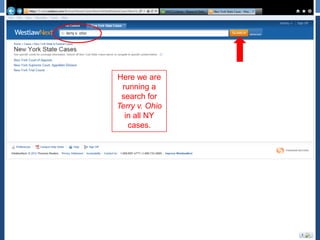
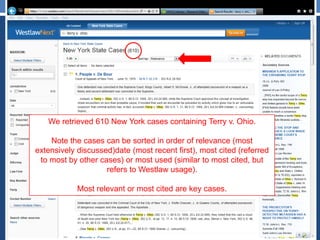
Here we are
running a
search for
Terry v. Ohio
in all NY
cases.
We retrieved 610 New York cases containing Terry v. Ohio.
Note the cases can be sorted in order of relevance (most
extensively discussed)date (most recent first), most cited (referred
to most by other cases) or most used (similar to most cited, but
refers to Westlaw usage).
Most relevant or most cited are key cases.
Which case do I choose?
• After you have identified your issue and your key search
terms (or natural language terms), and retrieved a list of
cases, your challenge is then to determine which case(s)
you should use.
• This is where you need to take some time. Work with a
librarian, ask your professor, and balance whether the
case is still good law, and whether it closely follows your
fact pattern.
• This may sound overwhelming, but it can be done, with
practice and help!
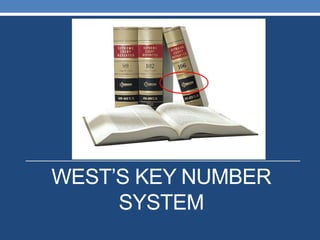
WEST‟S KEY NUMBER
SYSTEM
REFRESHER!!!
WHAT ARE HEADNOTES AND WHY ARE THEY
IMPORTANT???
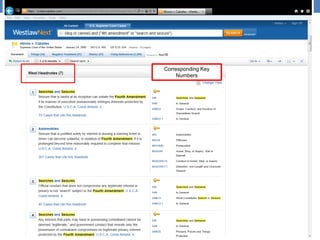
1. A court issues an opinion in a case.
2. A copy of the case is obtained by West,
where attorney-editors read the cases and pick
out the points of law or legal issues in the
case.
3. These legal issues or points of law are
summarized in a “headnote” and assigned a
topic and key number.
Corresponding Key
Numbers
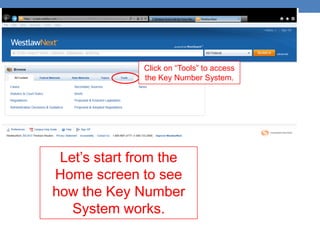
Click on “Tools” to access
the Key Number System.
Let‟s start from the
Home screen to see
how the Key Number
System works.
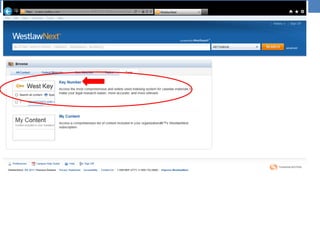
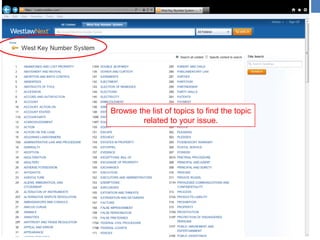
Browse the list of topics to find the topic
related to your issue.
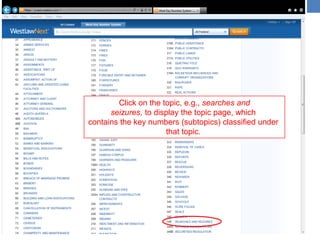
Click on the topic, e.g., searches and
seizures, to display the topic page, which
contains the key numbers (subtopics) classified under
that topic.
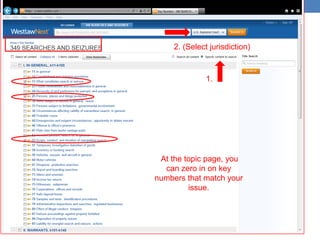
At the topic page, you
can zero in on key
numbers that match your
issue.
1.
2. (Select jurisdiction)
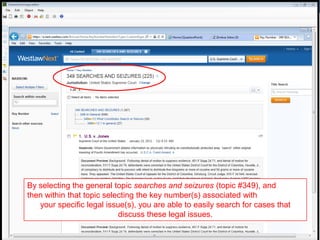
By selecting the general topic searches and seizures (topic #349), and
then within that topic selecting the key number(s) associated with
your specific legal issue(s), you are able to easily search for cases that
discuss these legal issues.
STILL A LITTLE
UNEASY?
Don‟t be. Click here for more info.
WESTLAWNEXT
Statutory Searching
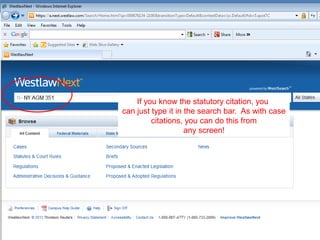
If you know the statutory citation, you
can just type it in the search bar. As with case
citations, you can do this from
any screen!
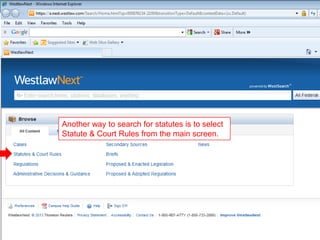
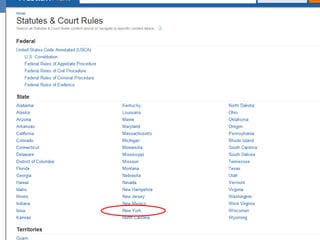
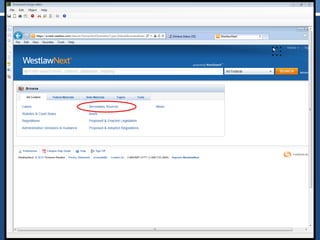
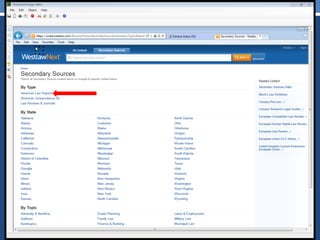
Another way to search for statutes is to select
Statute & Court Rules from the main screen.
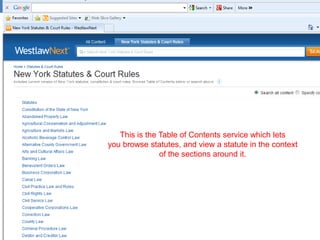
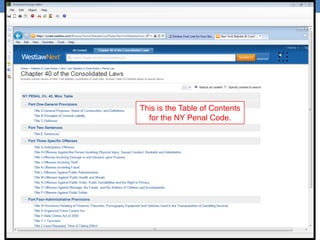
This is the Table of Contents service which lets
you browse statutes, and view a statute in the context
of the sections around it.
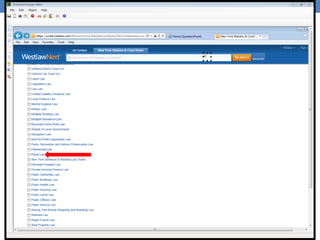
This is the Table of Contents
for the NY Penal Code.
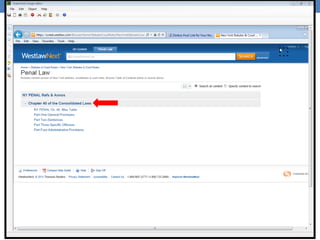
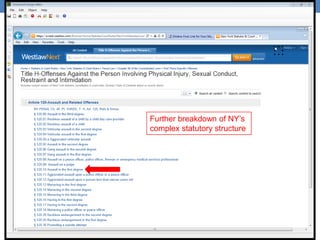
Further breakdown of NY‟s
complex statutory structure
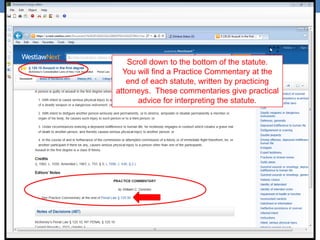
Scroll down to the bottom of the statute.
You will find a Practice Commentary at the
end of each statute, written by practicing
attorneys. These commentaries give practical
advice for interpreting the statute.
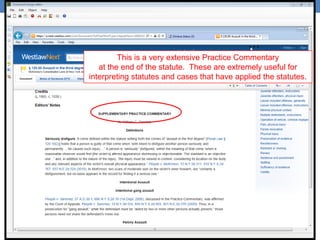
This is a very extensive Practice Commentary
at the end of the statute. These are extremely useful for
interpreting statutes and cases that have applied the statutes.
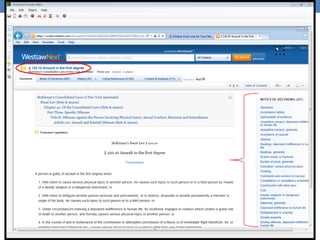
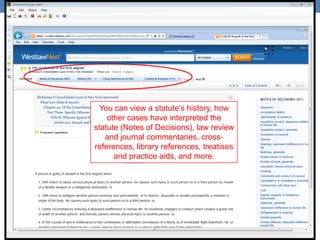
You can view a statute‟s history, how
other cases have interpreted the
statute (Notes of Decisions), law review
and journal commentaries, cross-
references, library references, treatises
and practice aids, and more.
IS YOUR STATUTE STILL
GOOD LAW?
The same steps for cases apply to statute: while
viewing a statute with a KeyCite flag, click the flag; or
type KC or KeyCite followed by a citation in the search
box at the top of the page and click Search.
AMERICAN LAW REPORTS
“ALR”
American Law Reports
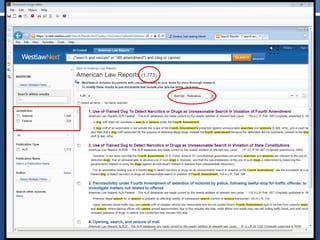
• American Law Reports (ALR) delivers an objective, in-
depth analysis of your specific legal issue, together with a
complete list of every case – in every jurisdiction – that
discusses it.
• With thousands of attorney-authored articles covering the
entire breadth of U.S. law, ALR saves you time by taking
you deeper on a topic, faster.
• Use ALR to:
• Quickly get up to speed in an unfamiliar area of law.
• Locate all relevant case law in one easy step.
• Determine which cases are controlling and understand why.
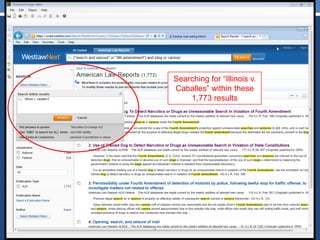
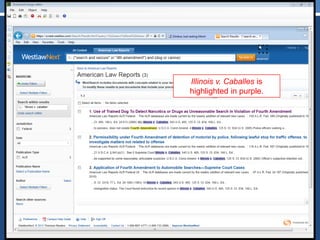
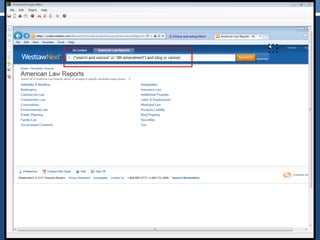
Searching for “Illinois v.
Caballes” within these
1,773 results
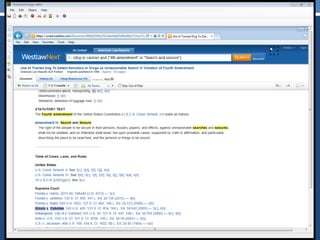
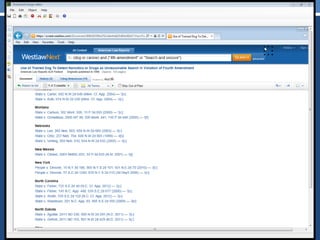
Illinois v. Caballes is
highlighted in purple.
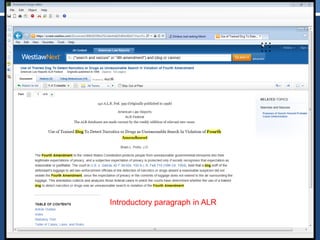
Introductory paragraph in ALR
QUESTIONS?
1-800-REF-ATTY (1-800-733-2889) or
ASK-A-LIBRARIAN!

Westlaw General Legal Overview

  • 1.
  • 2.
    In this sessionwe will explore: • -case law searching in Westlaw. • -statutory searching in Westlaw. • -the West Key Number System of searching. • -how to determine if a case or statute is still good law. • -ALR, aka American Law Reports.

  • 7.
    This is whatyou see when you first open WestlawNext! The search box is designed like Google for simplicity. 24/7 assistance
  • 8.
  • 11.
    If you knowthe case citation, type it in. No capital letters or periods are necessary.
  • 13.
    Let‟s take thefollowing fact pattern… • While your client was stopped for speeding, New York State Police allowed a drug dog to sniff around the car. When the dog alerted, a search of the car was conducted. According to the U.S. Supreme Court, did the search violate the 4th Amendment of the Constitution? • Jurisdiction: U.S. Supreme Court
  • 16.
    When you clicka link for a specific court, the 10 most recent cases from that court are automatically displayed.
  • 17.
    You have theoption of running a traditional Boolean search with terms and connectors, or a natural language search. Westlaw recognizes whichever search format you use. Here, we are using natural language searching.
  • 18.
    71 Supreme Courtcases are retrieved. You can sort by relevance, date or most cited. The right column lists a sampling of related secondary sources and briefs.
  • 19.
    You can narrowyour search result using filters in the left column by jurisdiction, date, reported status, topic, judge, attorney, law firm, key number, party and docket number.
  • 20.
    You can seehow a specific judge has ruled on your issue, which can be helpful in litigation.
  • 21.
    Out of the71 Supreme Court cases our search retrieved, let‟s identify the case that Westlaw determines most relevant to our fact pattern.
  • 22.
    LET‟S RUN THESEARCH AGAIN, THIS TIME USING BOOLEAN CONNECTORS. Boolean searching, while not as easy as natural language searching, allows you to control your search results very specifically.
  • 23.
    AND, OR, NOT… •Boolean Operators are words (AND, OR, NOT) used to combine or exclude words in a search, producing more focused results. • Click HERE for a simple visual explanation of this concept.
  • 24.
    Boolean Symbols inWestlawNext Connectors and Expanders • & AND • /s In same sentence • Or OR • +s Preceding within sentence • /p In same paragraph • " " Phrase • +p Preceding within paragraph • % But not • /n Within n terms of • ! Root expander • +n Preceding within n terms of • * Universal character When and how should I use these? • When: You have a focused search in mind. • How: Use one, two, or more in combination. • How: Don‟t get overwhelmed with trying to incorporate several connectors or expanders. • You may actually ELIMINATE useful results this way!
  • 25.
    Here is oursame fact pattern… • While your client was stopped for speeding, New York State Police allowed a drug dog to sniff around the car. When the dog alerted, a search of the car was conducted. According to the U.S. Supreme Court, did the search violate the 4th Amendment of the Constitution? • Jurisdiction: U.S. Supreme Court
  • 26.
    Back at theHome screen, select Cases.
  • 28.
    Here we aretaking the key concepts from our fact pattern and requiring the phrase “search and seizure” or the phrase “4th Amendment” to be in each case. We are also requiring the word “dog” or “canine” as well as the phrase “traffic stop” to be present in all of the cases we retrieve.
  • 29.
    Note that eachsearch, natural language and Boolean, retrieved Illinois v. Caballes as the key case. Boolean retrieved 75 cases, natural language 71.
  • 30.
  • 31.
    Here we havemostly case briefs filed throughout the case. Also included are oral arguments, petitions and similar filings.
  • 32.
    We‟ll come back tothis. Is your case still good law???
  • 33.
    Here we havea visual history of how your case has proceeded through the courts.
  • 34.
    To see howyour case has been used (cited) by other cases, administrative materials, secondary sources and briefs, click on Citing References. This is an excellent tool for attorneys and researchers for determining how cases have been interpreted, analyzed and distinguished.
  • 35.
  • 37.
    You can determine yourprint layout preferences.
  • 39.
    You can also emailthe case in PDF format.
  • 40.
  • 44.
    NEGATIVE TREATMENT Is yourcase still good law?
  • 45.
    No flag =good law so far - Yellow flag = caution – Red flag = no longer good law (has been overruled, overturned) Click on the flag for specific negative history. We will see this soon.
  • 46.
    Just because thereis no flag… • … does not mean this is the best case! • A case like Roe v. Wade – (Supreme Court of the United States January 22, 1973 - 410 U.S. 113) • A very famous U.S. Supreme Court case in the 1970s has a yellow flag because some courts have not agreed with certain aspects of the Court‟s ruling – but this case has been cited over 22,000 times! • If later cases have „cited‟ to (referred to) a case thousands of times, even if there is some negative treatment, this case is still good law, and very, very important! • Bottom line: don‟t be afraid of cases with yellow flags!
  • 47.
    SO LET‟S CHECKTHE NEGATIVE TREATMENT for Illinois v. Caballes
  • 49.
    The most negative treatmentis displayed at the top of the list. A red flag warns that the case is no longer good law for at least one of the points it contains. A yellow flag warns that the case has some negative history but has not been reversed or overruled.
  • 50.
    The green depthof treatment bars indicate the extent to which citing cases discuss the cited case. The headnote numbers indicate which headnotes (points of law) the citing case is discussing.
  • 51.
  • 52.
    1. A courtissues an opinion in a case. 2. A copy of the case is obtained by West, where attorney-editors read the cases and pick out the points of law or legal issues in the case. 3. These legal issues or points of law are summarized in a “headnote” and assigned a topic and key number.
  • 53.
    Headnote 6 ofIllinois v. Caballes is discussed extensively in State v. Griffin.
  • 54.
    So is thecase good law or what? • The main ways to access KeyCite information are: • while viewing a case with a KeyCite flag, click the flag. • type kc or keycite followed by the case citation.
  • 55.
  • 56.
  • 58.
  • 59.
    Terry v. Ohio Let‟sfind a New York case that has applied the landmark Supreme Court case, Terry v. Ohio. Police may stop a person if they have a reasonable suspicion that the person has committed or is about to commit a crime, and may frisk the suspect for weapons if they have reasonable suspicion that the suspect is armed and dangerous, without violating the Fourth Amendment prohibition on unreasonable searches and seizures.
  • 62.
    Some courts locatedin New York (and in all of the United States) are federal courts, which is why you see both Federal and State court listings under New York. It may seem confusing at first, but it is the U.S. court structure. The following slide contains a very simplified version of the U.S. court structure. For further clarification, ask your professor or a librarian.
  • 63.
    In general, youwill search these courts most often.
  • 64.
    By selecting AllNew York State Cases, we ensure that we are getting cases from NY trial courts, appellate courts and most importantly, NY‟s highest court, the New York Court of Appeals.
  • 65.
    Here we are runninga search for Terry v. Ohio in all NY cases.
  • 66.
    We retrieved 610New York cases containing Terry v. Ohio. Note the cases can be sorted in order of relevance (most extensively discussed)date (most recent first), most cited (referred to most by other cases) or most used (similar to most cited, but refers to Westlaw usage). Most relevant or most cited are key cases.
  • 67.
    Which case doI choose? • After you have identified your issue and your key search terms (or natural language terms), and retrieved a list of cases, your challenge is then to determine which case(s) you should use. • This is where you need to take some time. Work with a librarian, ask your professor, and balance whether the case is still good law, and whether it closely follows your fact pattern. • This may sound overwhelming, but it can be done, with practice and help!
  • 68.
  • 69.
    REFRESHER!!! WHAT ARE HEADNOTESAND WHY ARE THEY IMPORTANT???
  • 70.
    1. A courtissues an opinion in a case. 2. A copy of the case is obtained by West, where attorney-editors read the cases and pick out the points of law or legal issues in the case. 3. These legal issues or points of law are summarized in a “headnote” and assigned a topic and key number.
  • 71.
  • 72.
    Click on “Tools”to access the Key Number System. Let‟s start from the Home screen to see how the Key Number System works.
  • 74.
    Browse the listof topics to find the topic related to your issue.
  • 75.
    Click on thetopic, e.g., searches and seizures, to display the topic page, which contains the key numbers (subtopics) classified under that topic.
  • 76.
    At the topicpage, you can zero in on key numbers that match your issue. 1. 2. (Select jurisdiction)
  • 77.
    By selecting thegeneral topic searches and seizures (topic #349), and then within that topic selecting the key number(s) associated with your specific legal issue(s), you are able to easily search for cases that discuss these legal issues.
  • 78.
    STILL A LITTLE UNEASY? Don‟tbe. Click here for more info.
  • 79.
  • 80.
    If you knowthe statutory citation, you can just type it in the search bar. As with case citations, you can do this from any screen!
  • 82.
    Another way tosearch for statutes is to select Statute & Court Rules from the main screen.
  • 84.
    This is theTable of Contents service which lets you browse statutes, and view a statute in the context of the sections around it.
  • 87.
    This is theTable of Contents for the NY Penal Code.
  • 88.
    Further breakdown ofNY‟s complex statutory structure
  • 90.
    Scroll down tothe bottom of the statute. You will find a Practice Commentary at the end of each statute, written by practicing attorneys. These commentaries give practical advice for interpreting the statute.
  • 91.
    This is avery extensive Practice Commentary at the end of the statute. These are extremely useful for interpreting statutes and cases that have applied the statutes.
  • 92.
    You can viewa statute‟s history, how other cases have interpreted the statute (Notes of Decisions), law review and journal commentaries, cross- references, library references, treatises and practice aids, and more.
  • 93.
    IS YOUR STATUTESTILL GOOD LAW? The same steps for cases apply to statute: while viewing a statute with a KeyCite flag, click the flag; or type KC or KeyCite followed by a citation in the search box at the top of the page and click Search.
  • 94.
  • 95.
    American Law Reports •American Law Reports (ALR) delivers an objective, in- depth analysis of your specific legal issue, together with a complete list of every case – in every jurisdiction – that discusses it. • With thousands of attorney-authored articles covering the entire breadth of U.S. law, ALR saves you time by taking you deeper on a topic, faster. • Use ALR to: • Quickly get up to speed in an unfamiliar area of law. • Locate all relevant case law in one easy step. • Determine which cases are controlling and understand why.
  • 100.
    Searching for “Illinoisv. Caballes” within these 1,773 results
  • 101.
    Illinois v. Caballesis highlighted in purple.
  • 102.
  • 105.