1
Multi Tenant HBase
Introducing Use cases and available solutions
Bhupendra Kumar Jain
bhupendra.jain@huawei.com
2
$ whoami
Senior System Architect @ Huawei India
Tech Lead for Huawei HBase, Zookeeper & Hadoop
~13 years of experience in Big Data and BI Domain
3
Agenda
Multi Tenancy
What it is and Why
Use cases
Goals & Challenges
Achieving Multi Tenancy
Single HBase cluster
Tenant specific cluster
HBase on YARN using Apache Slider
Future Work
4
Agenda
Multi Tenancy
What it is and Why
Use cases
Goals & Challenges
Achieving Multi Tenancy
Single HBase cluster
Tenant specific cluster
HBase on YARN using Apache Slider
Future Work
5
Tenants
Tenant can be thought as
 a single role, a single user, administrator, super user, …
 a group of users (a department in an organization …)
 Share some common objective
 Work on the same set of data
 Hierarchy within tenant is possible
 developers, analysts, data scientists etc.
6
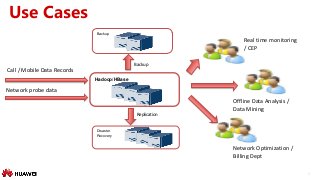
Hadoop/HBase
Backup
Disaster
Recovery
Replication
Real time monitoring
/ CEP
Offline Data Analysis /
Data Mining
Network Optimization /
Billing Dept
Call / Mobile Data Records
Network probe data
Backup
Use Cases
7
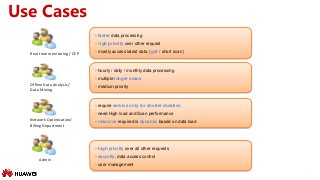
Real time monitoring / CEP
 faster data processing
 high priority over other request
 mostly access latest data ( get / short scan )
Use Cases
Offline Data Analysis /
Data Mining
 hourly / daily / monthly data processing
 multiple longer scans
 medium priority
Network Optimization/
Billing Department
 require service only for shorter duration
 need High load and Scan performance
 resource required is dynamic based on data load
Admin
 high priority over all other requests
 security, data access control
 user management
8
Business Goals
For each tenant / tenant group
- Store the data
- Allow to access the data
- Allow to process the data
- Do everything in fully Secure manner
- Guarantee a certain portion of cluster
- Data Governance
9
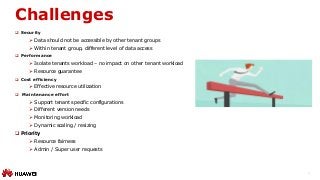
Challenges
 Security
 Data should not be accessible by other tenant groups
 Within tenant group, different level of data access
 Performance
 Isolate tenants workload – no impact on other tenant workload
 Resource guarantee
 Cost efficiency
 Effective resource utilization
 Maintenance effort
 Support tenant specific configurations
 Different version needs
 Monitoring workload
 Dynamic scaling / resizing
 Priority
 Resource fairness
 Admin / Super user requests
10
Agenda
Multi Tenancy
What it is and Why
Use cases
Goals & Challenges
Achieving Multi Tenancy
Single HBase cluster
Tenant specific cluster
HBase on YARN using Apache Slider
Future Work
11
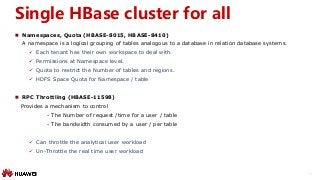
Single HBase cluster for all
 Namespaces, Quota (HBASE-8015, HBASE-8410)
A namespace is a logical grouping of tables analogous to a database in relation database systems.
 Each tenant has their own workspace to deal with.
 Permissions at Namespace level.
 Quota to restrict the Number of tables and regions.
 HDFS Space Quota for Namespace / table
 RPC Throttling (HBASE-11598)
Provides a mechanism to control
- The Number of request /time for a user / table
- The bandwidth consumed by a user / per table
 Can throttle the analytical user workload
 Un-Throttle the real time user workload
12
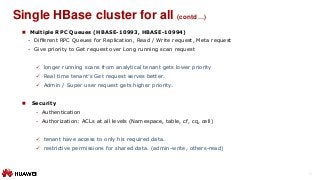
 Multiple RPC Queues (HBASE-10993, HBASE-10994)
- Different RPC Queues for Replication, Read / Write request, Meta request
- Give priority to Get request over Long running scan request
 longer running scans from analytical tenant gets lower priority
 Real time tenant’s Get request serves better.
 Admin / Super user request gets higher priority.
 Security
- Authentication
- Authorization: ACLs at all levels (Namespace, table, cf, cq, cell)
 tenant have access to only his required data.
 restrictive permissions for shared data. (admin-write, others-read)
Single HBase cluster for all (contd …)
13
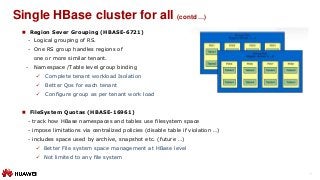
 Region Sever Grouping (HBASE-6721)
- Logical grouping of RS.
- One RS group handles regions of
one or more similar tenant.
- Namespace /Table level group binding
 Complete tenant workload Isolation
 Better Qos for each tenant
 Configure group as per tenant work load
 FileSystem Quotas (HBASE-16961)
- track how HBase namespaces and tables use filesystem space
- impose limitations via centralized policies (disable table if violation …)
- includes space used by archive, snapshot etc. (future …)
 Better File system space management at HBase level
 Not limited to any file system
Single HBase cluster for all (contd …)
14
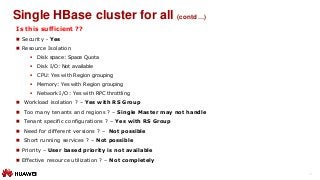
Is this sufficient ??
 Security - Yes
 Resource Isolation
 Disk space: Space Quota
 Disk I/O: Not available
 CPU: Yes with Region grouping
 Memory: Yes with Region grouping
 Network I/O : Yes with RPC throttling
 Workload isolation ? – Yes with RS Group
 Too many tenants and regions ? – Single Master may not handle
 Tenant specific configurations ? – Yes with RS Group
 Need for different versions ? – Not possible
 Short running services ? – Not possible
 Priority – User based priority is not available
 Effective resource utilization ? – Not completely
Single HBase cluster for all (contd …)
15
Agenda
Multi Tenancy
What it is and Why
Use cases
Goals & Challenges
Achieving Multi Tenancy
Single HBase cluster
Tenant specific cluster
HBase on YARN using Apache Slider
Future Work
16
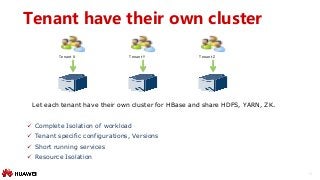
Tenant have their own cluster
Tenant X Tenant Y Tenant Z
Let each tenant have their own cluster for HBase and share HDFS, YARN, ZK.
 Complete Isolation of workload
 Tenant specific configurations, Versions
 Short running services
 Resource Isolation
17
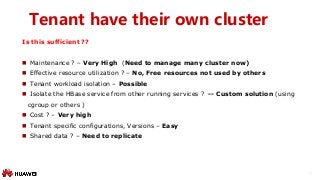
Is this sufficient ??
 Maintenance ? – Very High (Need to manage many cluster now)
 Effective resource utilization ? – No, Free resources not used by others
 Tenant workload isolation – Possible
 Isolate the HBase service from other running services ? -- Custom solution (using
cgroup or others )
 Cost ? – Very high
 Tenant specific configurations, Versions – Easy
 Shared data ? – Need to replicate
Tenant have their own cluster
18
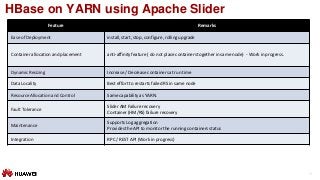
HBase on YARN using Apache Slider
Slider is a YARN application to deploy non-YARN-enabled applications in a YARN cluster
Slider client: Communicates with YARN and the Slider AM via remote procedure calls and/or REST requests
Slider AM: Application master to manage containers( actual application)
Slider Agent: Communicate with AM and mange one container instance.
Component : HBase application component. [ HM,RS etc.]
https://slider.incubator.apache.org/
http://events.linuxfoundation.org/sites/events/files/slides/apachecon-slider-2015.pdf
19
HBase on YARN using Apache Slider
Feature Remarks
Ease of Deployment install, start, stop, configure, rolling upgrade
Container allocation and placement anti-affinity feature ( do not place containers together in same node) - Work in progress.
Dynamic Resizing Increase / Decrease containers at run time
Data Locality Best effort to restarts failed RS in same node
Resource Allocation and Control Same capability as YARN.
Fault Tolerance
Slider AM Failure recovery
Container (HM/RS) failure recovery
Maintenance
Supports Log aggregation
Provides the API to monitor the running containers status
Integration RPC / REST API (Work in progress)
20
Agenda
Multi Tenancy
What it is and Why
Use cases
Goals & Challenges
Achieving Multi Tenancy
Single HBase cluster
Tenant specific cluster
HBase on YARN using Apache Slider
Future Work
21
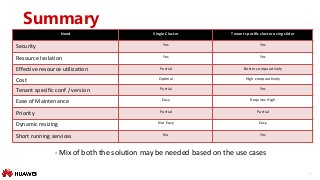
Summary
Need Single Cluster Tenant specific cluster using slider
Security Yes Yes
Resource Isolation Yes Yes
Effective resource utilization Partial Better comparatively
Cost Optimal High comparatively
Tenant specific conf / version Partial Yes
Ease of Maintenance Easy Requires High
Priority Partial Partial
Dynamic resizing Not Easy Easy
Short running services No Yes
- Mix of both the solution may be needed based on the use cases
22
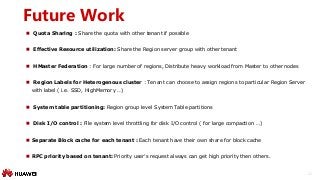
Future Work
 Quota Sharing : Share the quota with other tenant if possible
 Effective Resource utilization: Share the Region server group with other tenant
 HMaster Federation : For large number of regions, Distribute heavy workload from Master to other nodes
 Region Labels for Heterogenous cluster : Tenant can choose to assign regions to particular Region Server
with label ( i.e. SSD, HighMemory ..)
 System table partitioning: Region group level System Table partitions
 Disk I/O control : File system level throttling for disk I/O control ( for large compaction …)
 Separate Block cache for each tenant : Each tenant have their own share for block cache
 RPC priority based on tenant: Priority user’s request always can get high priority then others.
23
mail to: bhupendra.jain@huawei.com
Thank You!

hbaseconasia2017: HBase Multi tenancy use cases and various solution

  • 1.
    1 Multi Tenant HBase IntroducingUse cases and available solutions Bhupendra Kumar Jain bhupendra.jain@huawei.com
  • 2.
    2 $ whoami Senior SystemArchitect @ Huawei India Tech Lead for Huawei HBase, Zookeeper & Hadoop ~13 years of experience in Big Data and BI Domain
  • 3.
    3 Agenda Multi Tenancy What itis and Why Use cases Goals & Challenges Achieving Multi Tenancy Single HBase cluster Tenant specific cluster HBase on YARN using Apache Slider Future Work
  • 4.
    4 Agenda Multi Tenancy What itis and Why Use cases Goals & Challenges Achieving Multi Tenancy Single HBase cluster Tenant specific cluster HBase on YARN using Apache Slider Future Work
  • 5.
    5 Tenants Tenant can bethought as  a single role, a single user, administrator, super user, …  a group of users (a department in an organization …)  Share some common objective  Work on the same set of data  Hierarchy within tenant is possible  developers, analysts, data scientists etc.
  • 6.
    6 Hadoop/HBase Backup Disaster Recovery Replication Real time monitoring /CEP Offline Data Analysis / Data Mining Network Optimization / Billing Dept Call / Mobile Data Records Network probe data Backup Use Cases
  • 7.
    7 Real time monitoring/ CEP  faster data processing  high priority over other request  mostly access latest data ( get / short scan ) Use Cases Offline Data Analysis / Data Mining  hourly / daily / monthly data processing  multiple longer scans  medium priority Network Optimization/ Billing Department  require service only for shorter duration  need High load and Scan performance  resource required is dynamic based on data load Admin  high priority over all other requests  security, data access control  user management
  • 8.
    8 Business Goals For eachtenant / tenant group - Store the data - Allow to access the data - Allow to process the data - Do everything in fully Secure manner - Guarantee a certain portion of cluster - Data Governance
  • 9.
    9 Challenges  Security  Datashould not be accessible by other tenant groups  Within tenant group, different level of data access  Performance  Isolate tenants workload – no impact on other tenant workload  Resource guarantee  Cost efficiency  Effective resource utilization  Maintenance effort  Support tenant specific configurations  Different version needs  Monitoring workload  Dynamic scaling / resizing  Priority  Resource fairness  Admin / Super user requests
  • 10.
    10 Agenda Multi Tenancy What itis and Why Use cases Goals & Challenges Achieving Multi Tenancy Single HBase cluster Tenant specific cluster HBase on YARN using Apache Slider Future Work
  • 11.
    11 Single HBase clusterfor all  Namespaces, Quota (HBASE-8015, HBASE-8410) A namespace is a logical grouping of tables analogous to a database in relation database systems.  Each tenant has their own workspace to deal with.  Permissions at Namespace level.  Quota to restrict the Number of tables and regions.  HDFS Space Quota for Namespace / table  RPC Throttling (HBASE-11598) Provides a mechanism to control - The Number of request /time for a user / table - The bandwidth consumed by a user / per table  Can throttle the analytical user workload  Un-Throttle the real time user workload
  • 12.
    12  Multiple RPCQueues (HBASE-10993, HBASE-10994) - Different RPC Queues for Replication, Read / Write request, Meta request - Give priority to Get request over Long running scan request  longer running scans from analytical tenant gets lower priority  Real time tenant’s Get request serves better.  Admin / Super user request gets higher priority.  Security - Authentication - Authorization: ACLs at all levels (Namespace, table, cf, cq, cell)  tenant have access to only his required data.  restrictive permissions for shared data. (admin-write, others-read) Single HBase cluster for all (contd …)
  • 13.
    13  Region SeverGrouping (HBASE-6721) - Logical grouping of RS. - One RS group handles regions of one or more similar tenant. - Namespace /Table level group binding  Complete tenant workload Isolation  Better Qos for each tenant  Configure group as per tenant work load  FileSystem Quotas (HBASE-16961) - track how HBase namespaces and tables use filesystem space - impose limitations via centralized policies (disable table if violation …) - includes space used by archive, snapshot etc. (future …)  Better File system space management at HBase level  Not limited to any file system Single HBase cluster for all (contd …)
  • 14.
    14 Is this sufficient??  Security - Yes  Resource Isolation  Disk space: Space Quota  Disk I/O: Not available  CPU: Yes with Region grouping  Memory: Yes with Region grouping  Network I/O : Yes with RPC throttling  Workload isolation ? – Yes with RS Group  Too many tenants and regions ? – Single Master may not handle  Tenant specific configurations ? – Yes with RS Group  Need for different versions ? – Not possible  Short running services ? – Not possible  Priority – User based priority is not available  Effective resource utilization ? – Not completely Single HBase cluster for all (contd …)
  • 15.
    15 Agenda Multi Tenancy What itis and Why Use cases Goals & Challenges Achieving Multi Tenancy Single HBase cluster Tenant specific cluster HBase on YARN using Apache Slider Future Work
  • 16.
    16 Tenant have theirown cluster Tenant X Tenant Y Tenant Z Let each tenant have their own cluster for HBase and share HDFS, YARN, ZK.  Complete Isolation of workload  Tenant specific configurations, Versions  Short running services  Resource Isolation
  • 17.
    17 Is this sufficient??  Maintenance ? – Very High (Need to manage many cluster now)  Effective resource utilization ? – No, Free resources not used by others  Tenant workload isolation – Possible  Isolate the HBase service from other running services ? -- Custom solution (using cgroup or others )  Cost ? – Very high  Tenant specific configurations, Versions – Easy  Shared data ? – Need to replicate Tenant have their own cluster
  • 18.
    18 HBase on YARNusing Apache Slider Slider is a YARN application to deploy non-YARN-enabled applications in a YARN cluster Slider client: Communicates with YARN and the Slider AM via remote procedure calls and/or REST requests Slider AM: Application master to manage containers( actual application) Slider Agent: Communicate with AM and mange one container instance. Component : HBase application component. [ HM,RS etc.] https://slider.incubator.apache.org/ http://events.linuxfoundation.org/sites/events/files/slides/apachecon-slider-2015.pdf
  • 19.
    19 HBase on YARNusing Apache Slider Feature Remarks Ease of Deployment install, start, stop, configure, rolling upgrade Container allocation and placement anti-affinity feature ( do not place containers together in same node) - Work in progress. Dynamic Resizing Increase / Decrease containers at run time Data Locality Best effort to restarts failed RS in same node Resource Allocation and Control Same capability as YARN. Fault Tolerance Slider AM Failure recovery Container (HM/RS) failure recovery Maintenance Supports Log aggregation Provides the API to monitor the running containers status Integration RPC / REST API (Work in progress)
  • 20.
    20 Agenda Multi Tenancy What itis and Why Use cases Goals & Challenges Achieving Multi Tenancy Single HBase cluster Tenant specific cluster HBase on YARN using Apache Slider Future Work
  • 21.
    21 Summary Need Single ClusterTenant specific cluster using slider Security Yes Yes Resource Isolation Yes Yes Effective resource utilization Partial Better comparatively Cost Optimal High comparatively Tenant specific conf / version Partial Yes Ease of Maintenance Easy Requires High Priority Partial Partial Dynamic resizing Not Easy Easy Short running services No Yes - Mix of both the solution may be needed based on the use cases
  • 22.
    22 Future Work  QuotaSharing : Share the quota with other tenant if possible  Effective Resource utilization: Share the Region server group with other tenant  HMaster Federation : For large number of regions, Distribute heavy workload from Master to other nodes  Region Labels for Heterogenous cluster : Tenant can choose to assign regions to particular Region Server with label ( i.e. SSD, HighMemory ..)  System table partitioning: Region group level System Table partitions  Disk I/O control : File system level throttling for disk I/O control ( for large compaction …)  Separate Block cache for each tenant : Each tenant have their own share for block cache  RPC priority based on tenant: Priority user’s request always can get high priority then others.
  • 23.