BRIEF HISTORY OF
STATISTICS
STATISTICS
• Derived from Latin statisticum collegium (“council
of state”)
• Italian word statista (“statesman” or “politician”)
BRIEF HISTORY OF
STATISTICS
 As early as 3800 B.C., there were records of
population in Babylonia and in China
 In Biblical times, the census was undertaken by
Moses in 1941 B.C. and by David in 1017 B.C
BRIEF HISTORY OF
STATISTICS
 Indian literature dating back to the reign of the
northern Hindustan King Asoka (270-230 B.C.)
also described methods of taking census.
 The Athenians and other Ancient Greeks
conducted the census in times of stress,
counting the adult male citizens in war time and
general populace every time the food supply
was endangered.
BRIEF HISTORY OF
STATISTICS
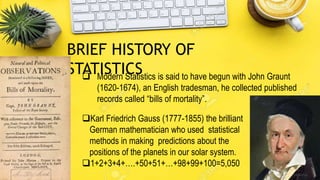
 Modern Statistics is said to have begun with John Graunt
(1620-1674), an English tradesman, he collected published
records called “bills of mortality”.
Karl Friedrich Gauss (1777-1855) the brilliant
German mathematician who used statistical
methods in making predictions about the
positions of the planets in our solar system.
1+2+3+4+….+50+51+…+98+99+100=5,050
BRIEF HISTORY OF
STATISTICS
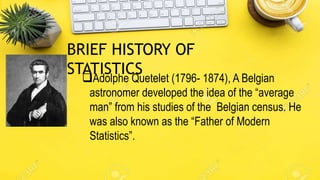
Adolphe Quetelet (1796- 1874), A Belgian
astronomer developed the idea of the “average
man” from his studies of the Belgian census. He
was also known as the “Father of Modern
Statistics”.
BRIEF HISTORY OF
STATISTICS
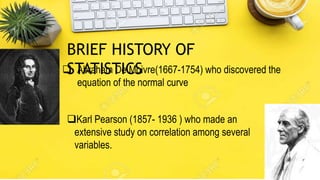
 Abraham De Moivre(1667-1754) who discovered the
equation of the normal curve
Karl Pearson (1857- 1936 ) who made an
extensive study on correlation among several
variables.
BRIEF HISTORY OF
STATISTICS
 In the 20th century, the British statistician Sir Ronald Aylmer Fisher
developed the F-tool in inferential statistics (derived after his name),
this tool has been very useful in testing improvements of production
from agricultural experiments and improvement of precision of
results from medical, biological and industrial experimentation.
F-test/ANOVA
 The American George Gallup (1901-1984)
was instrumental in making statistical polling, a
common tool in political campaigns.
BRIEF HISTORY OF
STATISTICS
 Just right after the World War II, the need for basic
understanding of statistics arose. Statistical literacy
became a necessity in today’s modern world.
 The use of Statistics has extended to such things
such as theater attendance, sports, results, car sales
in a certain period of time, heights, weights, birth
rates, death rates and other things that can be
expressed numerically.
BRIEF HISTORY OF
STATISTICS
In this age of information technology, a lot of computer programs such as
Microstat, Soritec Sampler, SPSS, and others are made available in
diskette or websites that perform more than the manual calculations in
statistics. People working in some government agencies, in
laboratories, in media, and in business generally use these electronic
devices to easily access data, improve graphics, and obtain ready-made
analyses interpretations about the data.
Brief-History-of-Statistics.pptx

Brief-History-of-Statistics.pptx

  • 1.
  • 2.
    STATISTICS • Derived fromLatin statisticum collegium (“council of state”) • Italian word statista (“statesman” or “politician”)
  • 3.
    BRIEF HISTORY OF STATISTICS As early as 3800 B.C., there were records of population in Babylonia and in China  In Biblical times, the census was undertaken by Moses in 1941 B.C. and by David in 1017 B.C
  • 4.
    BRIEF HISTORY OF STATISTICS Indian literature dating back to the reign of the northern Hindustan King Asoka (270-230 B.C.) also described methods of taking census.  The Athenians and other Ancient Greeks conducted the census in times of stress, counting the adult male citizens in war time and general populace every time the food supply was endangered.
  • 5.
    BRIEF HISTORY OF STATISTICS Modern Statistics is said to have begun with John Graunt (1620-1674), an English tradesman, he collected published records called “bills of mortality”. Karl Friedrich Gauss (1777-1855) the brilliant German mathematician who used statistical methods in making predictions about the positions of the planets in our solar system. 1+2+3+4+….+50+51+…+98+99+100=5,050
  • 6.
    BRIEF HISTORY OF STATISTICS AdolpheQuetelet (1796- 1874), A Belgian astronomer developed the idea of the “average man” from his studies of the Belgian census. He was also known as the “Father of Modern Statistics”.
  • 7.
    BRIEF HISTORY OF STATISTICS Abraham De Moivre(1667-1754) who discovered the equation of the normal curve Karl Pearson (1857- 1936 ) who made an extensive study on correlation among several variables.
  • 8.
    BRIEF HISTORY OF STATISTICS In the 20th century, the British statistician Sir Ronald Aylmer Fisher developed the F-tool in inferential statistics (derived after his name), this tool has been very useful in testing improvements of production from agricultural experiments and improvement of precision of results from medical, biological and industrial experimentation. F-test/ANOVA  The American George Gallup (1901-1984) was instrumental in making statistical polling, a common tool in political campaigns.
  • 9.
    BRIEF HISTORY OF STATISTICS Just right after the World War II, the need for basic understanding of statistics arose. Statistical literacy became a necessity in today’s modern world.  The use of Statistics has extended to such things such as theater attendance, sports, results, car sales in a certain period of time, heights, weights, birth rates, death rates and other things that can be expressed numerically.
  • 10.
    BRIEF HISTORY OF STATISTICS Inthis age of information technology, a lot of computer programs such as Microstat, Soritec Sampler, SPSS, and others are made available in diskette or websites that perform more than the manual calculations in statistics. People working in some government agencies, in laboratories, in media, and in business generally use these electronic devices to easily access data, improve graphics, and obtain ready-made analyses interpretations about the data.