Finding
FEEDBACK
@gingerlockeatx
the idea
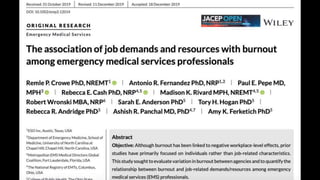
Nearly half reported not receiving
medical care feedback in a 30 day period.
?
Culture of Feedback
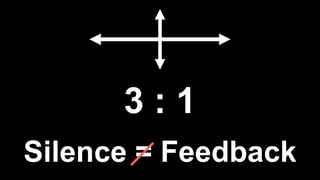
Silence = Feedback
*Formative
versus
Evaluation
Rules of Engagement
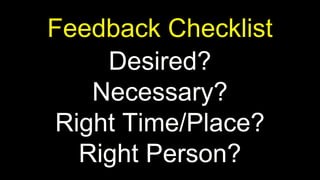
Desired?
Necessary?
Right Time/Place?
Right Person?
Feedback Checklist
Psychomotor
Culture & Safety
Clinical Decisions
Psychomotor
Coach by side
Prompt
Specific
Psychomotor
Peril of Praise
Culture or
Safety
Public
Prompt
Stay connected
Clinical
Decisions
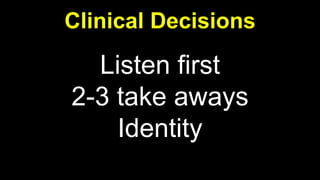
Listen first
2-3 take aways
Identity
Clinical Decisions
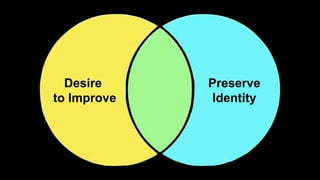
Desire
to Improve
Preserve
Identity
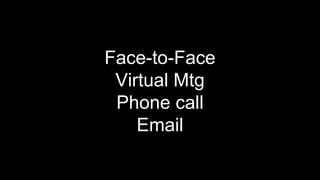
Face-to-Face
Virtual Mtg
Phone call
Email
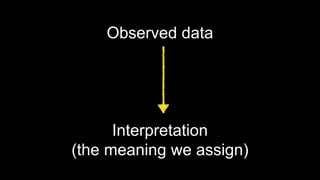
Observed data
Interpretation
(the meaning we assign)
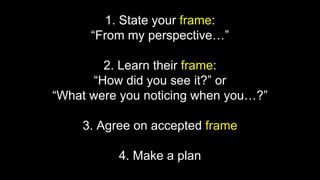
1. State your frame:
“From my perspective…”
2. Learn their frame:
“How did you see it?” or
“What were you noticing when you…?”
3. Agree on accepted frame
4. Make a plan
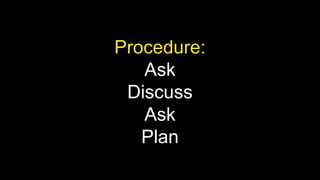
Feedback is a procedure.
Procedure:
Ask
Discuss
Ask
Plan
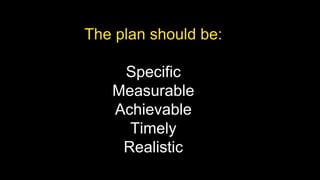
The plan should be:
Specific
Measurable
Achievable
Timely
Realistic
FUTURE
of
FEEDBACK
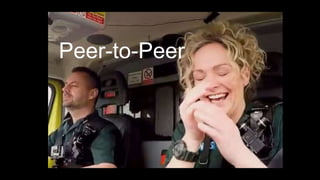
Peer-to-Peer
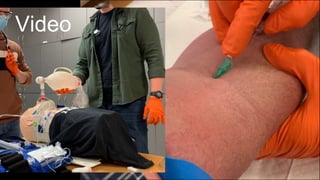
Video
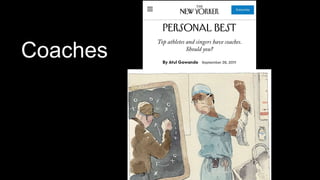
Coaches
(Semi) Public Case Reviews
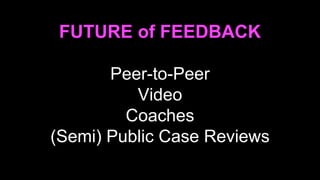
FUTURE of FEEDBACK
Peer-to-Peer
Video
Coaches
(Semi) Public Case Reviews
the idea
@gingerlockeatx

Finding Feedback - Ginger Locke

Editor's Notes

  • #2 Maia Dorsett Story “You are doing fine. You are at the level you should be at this point in your career” This preceptor gave me feedback that was specific, timely and left me with a plan on what I wanted to change to be better for the very next call. Tacit message: that I was worth the time/effort for difficult conversation
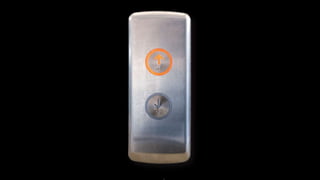
  • #3 Elevator button Design of Everyday Things by Don Norman How humans interface with every day objects. Feedback is key for the design. Click a pen. 0.1 seconds Without feedback, the human in the system is lost. Feedback in med ed is JUST like that.
  • #4 There is a scarcity of feedback in EMS. Anecdotally I know this from my own experience in the field and from talking to paramedics about their experiences in the last 6 years of recording a podcast called Medic Mindset. There is also evidence…
  • #5 In this study with over 15K respondents, nearly HALF reported not receiving medical care feedback in a 30-day period AND nearly a THIRD of providers did not receive ANY feedback in a 30-day period
  • #6 Major errors, serious adverse events, patient complaints Accolades for CPR saves, etc. Middle is day to day performance. unknown how we are doing, generally ignored. This is getting a bit better with ePCRs. BGLs in Strokes. Why is this bad?
  • #7 JACEP: For the EMS professionals who received performance feedback from a supervisor, there was a 64% reduction in odds of experiencing burnout The use of achievable benchmarks, performance feedback and facetime with leadership have been shown to reduce burnout.
  • #8 Ideally you are already in a place where there is a culture of feedback How to know if you are learning/working in a culture of feedback….
  • #9 positive and negative and in all directions; peer to peer, educator to learner, learner to educator BP on manikin 2. ratio 3:1 over the relationship; bad calls will happen…; We are so busy putting out fires- positive feedback; Positive feedback takes gratitude; too much to put on one “boss” - peer to peer feedback adds to the bank 3. Silence is not positive feedback Talked to a medic the other day and she received an email from QA saying good job and she just kept combing through the email. My thought was that she needs 3x this. or 10x this. So when the day does come when she makes an error. 10:1 Greg Henry professor of emergency medicine at the University of Michigan Medical Center
  • #11 Crystal Yates Commissioner of EMS in Philadelphia
  • #13 EM physician - Dr. Natalie May - Sydney HEMS Is it desired? Educator to student - it’s assumed it’s coming… but even then, you might check Peer to peer: 2 occasions: 1. they ask for feedback. Dial them in to be even MORE specific 2. they didn’t ask and you just start giving unsolicited advice. hit the brakes Necessary: Simulations - errors that are not part of the learning objectives sounds crazy human brain can only absorb so much Right Time/Place: Right after a bad call - wait high stakes testing - pass/fail Place: public versus private; quiet T-shirt example Right Person slur against a minority group to which i belong?
  • #15 The most straight-forward
  • #16 best with an expert coach, next best is peer with a task analysis with the best practice outlined Video is great here. don’t let them keep practicing the skill down the line. STOP, “rewind the tape,” growing new neurons they will learn to ride the bike wrong remember: positive feedback as well, 20 chunks to IV, yep, ah ha, good, i like it…. reassuring, reassuring, It’s ok to reassure learners! EMS is tough… educators think they need to prep them for the environment… NO right at their side
  • #17  Praise actually isn’t feedback praise is commentary on who they are as a person, Feedback about the process Puts them on a pedestal with wrong type of feedback. Fixed mindset Carol Dweck- Binary - good or not
  • #18 When they’ve stepped out of bounds Positive and negative in both directions
  • #19 Public versus private Teach the audience Teaching that we can’t walk past this standard Prompt - can’t sit on info ARE YOU OK? The piece that will save the relationship - stand close, smile, eye contact They are US. No cold shoulder here. They get more of me. You messed up big time and I still like you.
  • #20 Decisions on calls or simulated calls. Decision making happens inside one’s head and we can not know what is in their head by watching actions. That’s why they have to talk out loud about their thought process. NEVER from a chart review alone.
  • #21 First step of feedback is to ask a question Get curious. Uncover frame You saw their actions…. you don’t know the thought-process behind the actions Don’t pretend you don’t have a hypothesis. “I read or I saw this… I wondered what you were thinking during this part of the call… tell me about it” Collect more data - DDx We may be wrong… working toward expertise. Actions… not assumed intentions Get CURIOUS about your hypothesis and check it. 2-3 take aways only! After our sims, leave with 2 that stick rather than 10 that don’t Identity: Identity is the story we tell ourselves about who we are and what the future holds for us. Feedback (negative) attacks this story. Remember clinical decision making… their practice of medicine…. that is intimately tied to their identity especially seasoned medics… destabilizing identity. May be another occasion to start with “Are you ok?” poor patient outcome - Outcomes are FEEDBACK
  • #22 Feedback happens at the intersection of the learner’s desire to improve and desire to maintain identity. Both of these desires run deep and Educators have to thread the needle here. Professions can become a surrogate for who we are as a whole person Take good care with them… how do you do that? Talk to them as though you are talking about how they parent or how good of a friend they are. It’s that sensitive. Stay alert for when a seemingly benign conversation turn into a crucial conversation. In crucial conversations, the learner begins dual processing: Emotional content & learning content. The conversation in their head goes from “do you approve of my decision on this one call to do you like me?” These are high stakes.
  • #23 You can document the feedback in written form
  • #24 Unconscious translation
  • #25 Focus on specific actions, not the assumed intentions of the action. The discussion will yield the correct interpretation of the data. I have limited info, here’s my frame/perspective. “How did you see it? What were you seeing on the call” - This exposes gaps in schematic You just did all the work. Make sure they got it! Agreed upon frame. How will we move forward? Discharge instructions - hours in the ER, all of this examination, etc Don’t let them leave without them understanding what is going on and with an agreed upon prescription — inspire them to make a change through a difficult conversation made less difficult by talking about “perspectives” Defensive receivers of feedback (baggage): the convo will be difficult. BUILD the relationship prior to the feedback. and the already know you like them as a person
  • #27 …And it is learner focused. Not what you want to say, but rather what they need to hear. Walk into these difficult conversation with a plan. Pendleton’s old rules of what has been called the critique sandwich is gone. We’ve now moved to learning conversations. Here are some Principles but use your own style and a style that matches the learner.
  • #28 Ask - We need first hand data here to eliminate inference. seek context/frame, uncover intention behind observed info Discuss - I noticed, When you did this, I wondered, Ask - How will they move forward Plan -
  • #29 Example of the feedback I got from the medic
  • #30 Big vision
  • #32 Bosses can’t be everywhere. Guided discussions. Guided safety debrief already exist in some EMS cultures like aeromedical. In fact, going back to the study that looked at how much feedback was happening for medics, the investigators found that HEMS medics got more feedback than ground services. Baked into culture.
  • #33 Still from Video in the classroom Body cams in the field
  • #34 We are not good at knowing if we are good at something or not.
  • #35 Publicly show what psychological safety in feedback can look like. Not anonymous. The medic becomes the expert who works to fix the system. What we know about Grief - meaning Force multiplier Not just M&Ms but also in line with Adrian Plunket’s work at “Learning from Excellence” Dr. Dorsett is highlighting what would called A&As Awesome and Amazing
  • #36 We need more feedback in EMS. It would bring up the profession as a whole. Decrease Burnout. Learn the principles of feedback. Then…Normalize environment where coaching is constant.
  • #37 Where are we in the system?