Evgeny Smirnov, PhD, 4xxi Software Ltd, smirik@gmail.com
A machine-learning approach
for data mining in astronomy
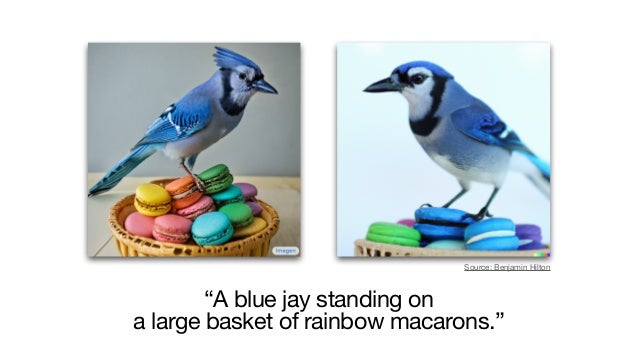
“A blue jay standing on 

a large basket of rainbow macarons.”
Source: Benjamin Hilton
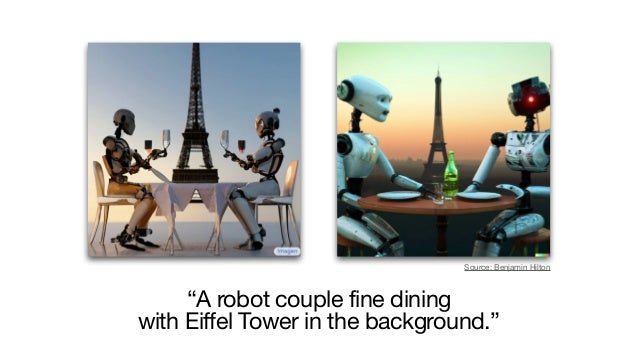
“A robot couple fine dining 

with Eiffel Tower in the background.”
Source: Benjamin Hilton
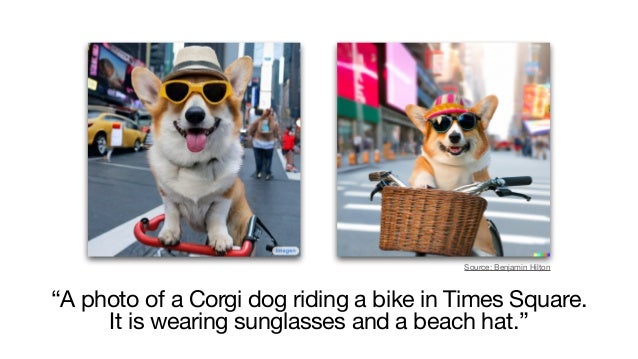
“A photo of a Corgi dog riding a bike in Times Square. 

It is wearing sunglasses and a beach hat.”
Source: Benjamin Hilton
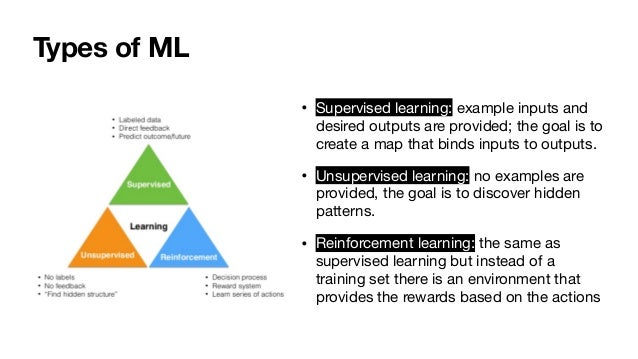
Types of ML
• Supervised learning: example inputs and
desired outputs are provided; the goal is to
create a map that binds inputs to outputs. 

• Unsupervised learning: no examples are
provided, the goal is to discover hidden
patterns.

• Reinforcement learning: the same as
supervised learning but instead of a
training set there is an environment that
provides the rewards based on the actions
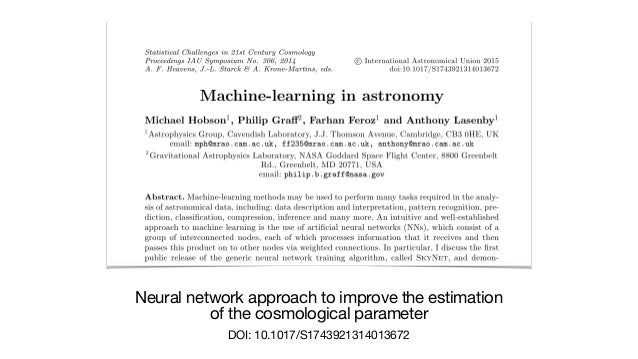
Neural network approach to improve the estimation 

of the cosmological parameter

DOI: 10.1017/S1743921314013672
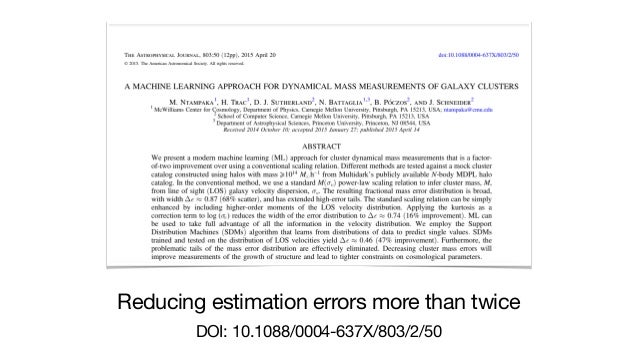
Reducing estimation errors more than twice

DOI: 10.1088/0004-637X/803/2/50
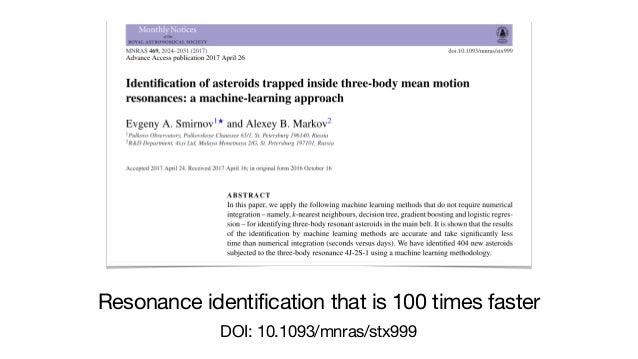
Resonance identification that is 100 times faster

DOI: 10.1093/mnras/stx999
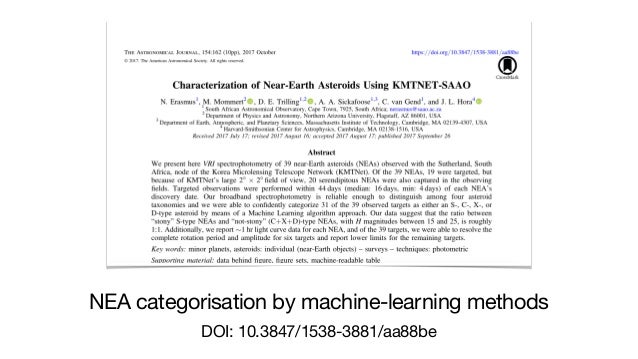
NEA categorisation by machine-learning methods

DOI: 10.3847/1538-3881/aa88be
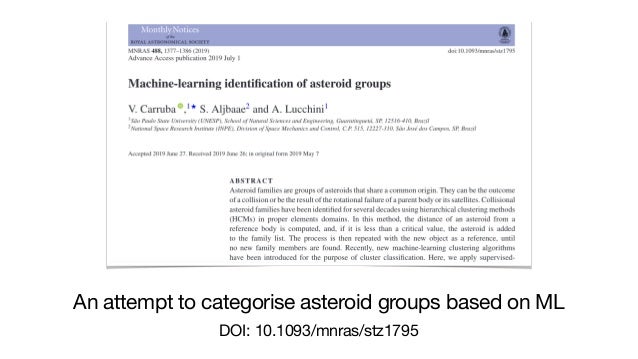
An attempt to categorise asteroid groups based on ML

DOI: 10.1093/mnras/stz1795
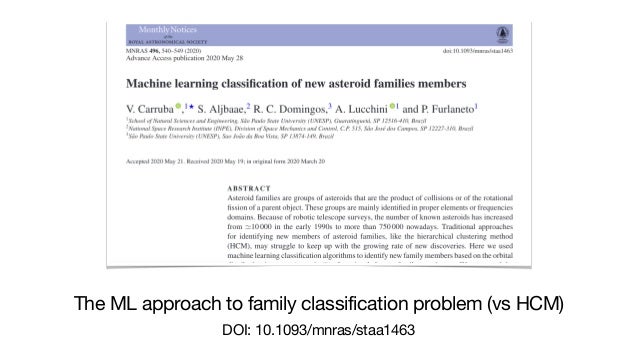
The ML approach to family classification problem (vs HCM)

DOI: 10.1093/mnras/staa1463
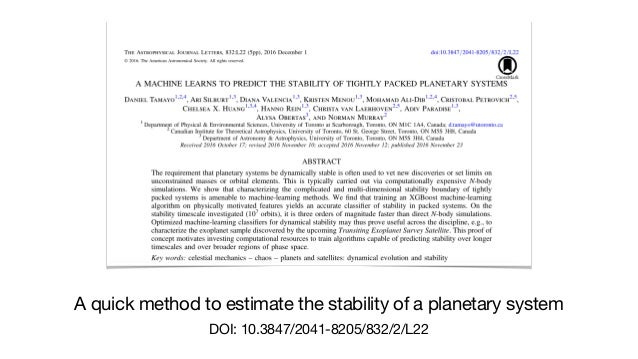
A quick method to estimate the stability of a planetary system

DOI: 10.3847/2041-8205/832/2/L22
Examples
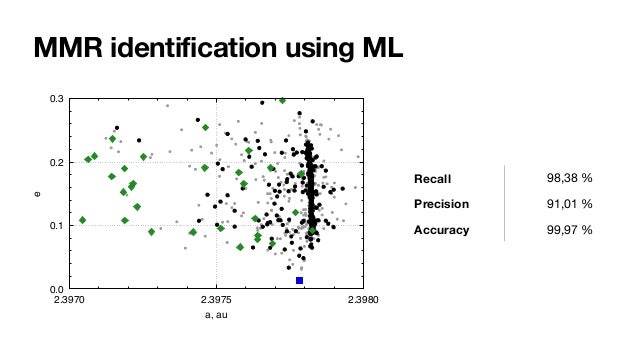
MMR identification using ML
Recall 98,38 %
Precision 91,01 %
Accuracy 99,97 %
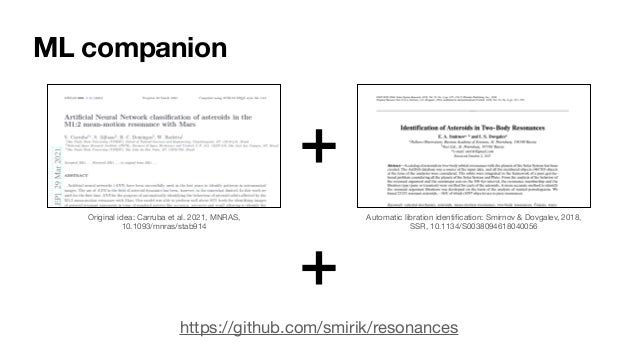
ML companion
Original idea: Carruba et al. 2021, MNRAS, 

10.1093/mnras/stab914
Automatic libration identi
fi
cation: Smirnov & Dovgalev, 2018,
SSR, 10.1134/S0038094618040056
https://github.com/smirik/resonances
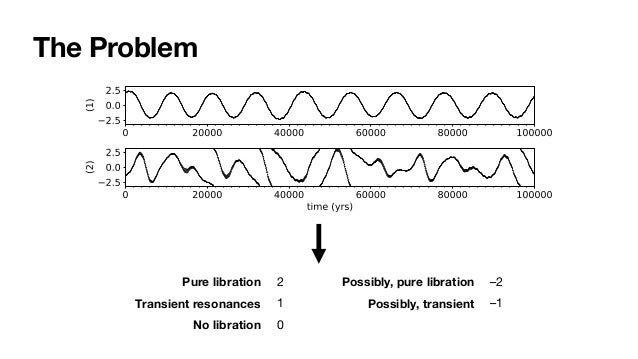
The Problem
Pure libration 2 Possibly, pure libration –2
Transient resonances 1 Possibly, transient –1
No libration 0
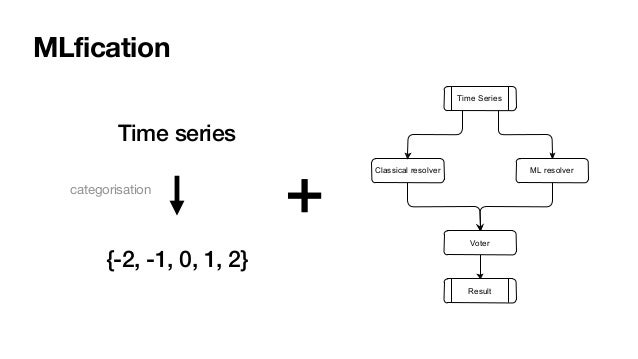
MLfication
Time series
{-2, -1, 0, 1, 2}
categorisation
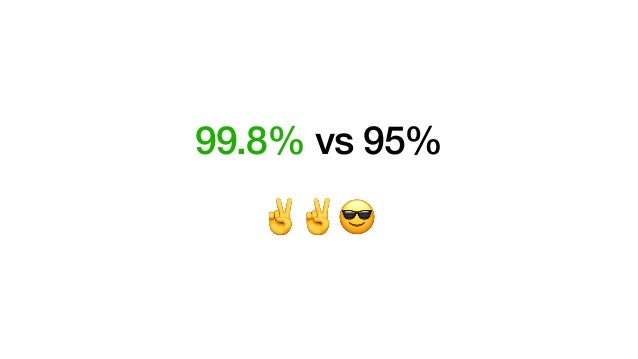
99.8% vs 95%


✌✌😎
How?
A machine-learning approach for data mining in astronomy

A machine-learning approach for data mining in astronomy

  • 1.
    Evgeny Smirnov, PhD,4xxi Software Ltd, smirik@gmail.com A machine-learning approach for data mining in astronomy
  • 2.
    “A blue jaystanding on a large basket of rainbow macarons.” Source: Benjamin Hilton
  • 3.
    “A robot couplefine dining with Eiffel Tower in the background.” Source: Benjamin Hilton
  • 4.
    “A photo ofa Corgi dog riding a bike in Times Square. It is wearing sunglasses and a beach hat.” Source: Benjamin Hilton
  • 6.
    Types of ML •Supervised learning: example inputs and desired outputs are provided; the goal is to create a map that binds inputs to outputs. • Unsupervised learning: no examples are provided, the goal is to discover hidden patterns. • Reinforcement learning: the same as supervised learning but instead of a training set there is an environment that provides the rewards based on the actions
  • 7.
    Neural network approachto improve the estimation of the cosmological parameter DOI: 10.1017/S1743921314013672
  • 8.
    Reducing estimation errorsmore than twice DOI: 10.1088/0004-637X/803/2/50
  • 9.
    Resonance identification thatis 100 times faster DOI: 10.1093/mnras/stx999
  • 10.
    NEA categorisation bymachine-learning methods DOI: 10.3847/1538-3881/aa88be
  • 11.
    An attempt tocategorise asteroid groups based on ML DOI: 10.1093/mnras/stz1795
  • 12.
    The ML approachto family classification problem (vs HCM) DOI: 10.1093/mnras/staa1463
  • 13.
    A quick methodto estimate the stability of a planetary system DOI: 10.3847/2041-8205/832/2/L22
  • 15.
  • 16.
    MMR identification usingML Recall 98,38 % Precision 91,01 % Accuracy 99,97 %
  • 17.
    ML companion Original idea:Carruba et al. 2021, MNRAS, 10.1093/mnras/stab914 Automatic libration identi fi cation: Smirnov & Dovgalev, 2018, SSR, 10.1134/S0038094618040056 https://github.com/smirik/resonances
  • 18.
    The Problem Pure libration2 Possibly, pure libration –2 Transient resonances 1 Possibly, transient –1 No libration 0
  • 19.
    MLfication Time series {-2, -1,0, 1, 2} categorisation
  • 20.
  • 21.