BEYOND THE ENCYCLOPEDIA
THE FRONTIERS OF FREE KNOWLEDGE
               ERIK MÖLLER
          WIKIMANIA – JULY 11, 2010


          WIKIMEDIA FOUNDATION
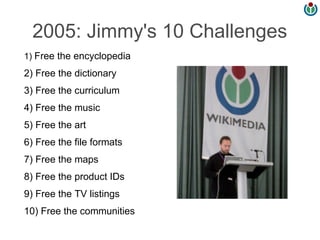
2005: Jimmy's 10 Challenges
1) Free the encyclopedia
2) Free the dictionary
3) Free the curriculum
4) Free the music
5) Free the art
6) Free the file formats
7) Free the maps
8) Free the product IDs
9) Free the TV listings
10) Free the communities
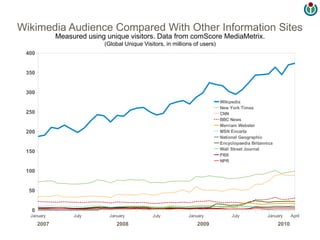
Wikimedia Audience Compared With Other Information Sites
              Measured using unique visitors. Data from comScore MediaMetrix.
                            (Global Unique Visitors, in millions of users)
 400


 350


 300
                                                                             Wikipedia
                                                                             New York Times
 250                                                                         CNN
                                                                             BBC News
                                                                             Merriam Webster
 200                                                                         MSN Encarta
                                                                             National Geographic
                                                                             Encyclopaedia Britannica
                                                                             Wall Street Journal
 150
                                                                             PBS
                                                                             NPR

 100


  50


   0
  January          July       January          July           January             July            January      April
       2007                      2008                             2009                                  2010
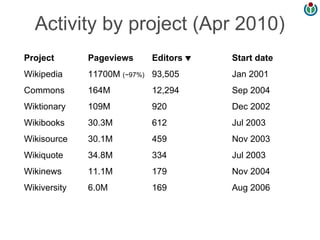
Activity by project (Apr 2010)
Project       Pageviews     Editors    Start date
Wikipedia     11700M (~97%) 93,505      Jan 2001
Commons       164M          12,294      Sep 2004
Wiktionary    109M          920         Dec 2002
Wikibooks     30.3M         612         Jul 2003
Wikisource    30.1M         459         Nov 2003
Wikiquote     34.8M         334         Jul 2003
Wikinews      11.1M         179         Nov 2004
Wikiversity   6.0M          169         Aug 2006
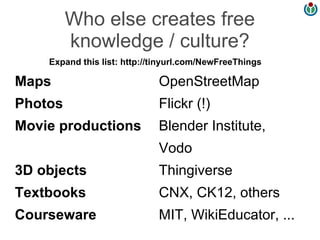
Who else creates free
         knowledge / culture?
    Expand this list: http://tinyurl.com/NewFreeThings

Maps                         OpenStreetMap
Photos                       Flickr (!)
Movie productions            Blender Institute,
                             Vodo
3D objects                   Thingiverse
Textbooks                    CNX, CK12, others
Courseware                   MIT, WikiEducator, ...
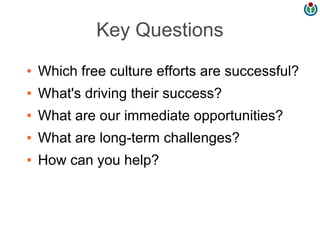
Key Questions
●   Which free culture efforts are successful?
●   What's driving their success?
●   What are our immediate opportunities?
●   What are long-term challenges?
●   How can you help?
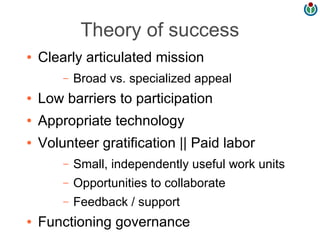
Theory of success
●   Clearly articulated mission
        –   Broad vs. specialized appeal
●   Low barriers to participation
●   Appropriate technology
●   Volunteer gratification || Paid labor
        –   Small, independently useful work units
        –   Opportunities to collaborate
        –   Feedback / support
●   Functioning governance
Emerging Free Culture
     Success Stories
How do they map against these characteristics?
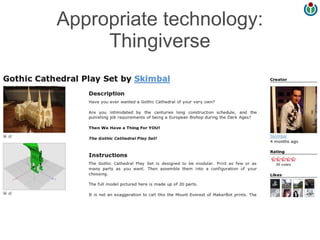
Appropriate technology:
     Thingiverse
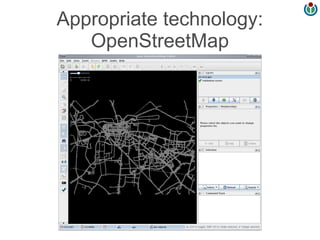
Appropriate technology:
   OpenStreetMap
Paid work / Support:
MIT OpenCourseWare
Paid work: Blender Institute
Paid work: Vodo
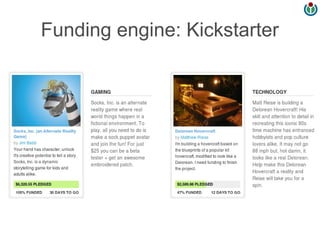
Funding engine: Kickstarter
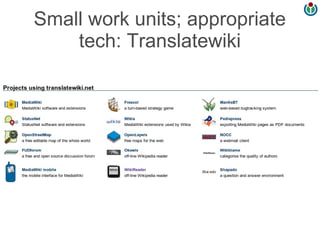
Small work units; appropriate
    tech: Translatewiki
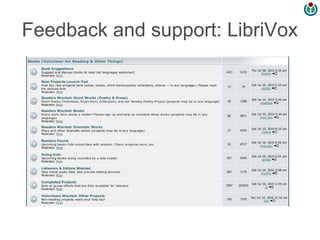
Feedback and support: LibriVox
Wikimedia Projects:
A Preliminary Assessment
      [omitting Wikiquote, Wikispecies]

 Opportunity: How likely are we to succeed?
   Difficulty: How hard is it going to be?
Wikimedia projects assessed
●   Wikipedia
       –   Small, independently useful work units
       –   Critical mass of users provides
            gratification
       –   As expectations grow and gratifications
            diminish, activity maxes out
●   Opportunity: high, Difficulty: high
       –   Usability, social tools, micro-
            contributions, outreach, skills
            development ...
Wikimedia projects assessed
●   Wikimedia Commons
       –   Small, independently useful work units
       –   High usefulness (great traffic/activity
            ratio)
       –   Technology flawed, but usable
●   Opportunity: high, Difficulty: medium
       –   Usability, search, media support, ...
Wikimedia projects assessed
●   Wikinews
        –   Relatively large work units
                 ●   Unfinished units are discarded
        –   Technology still hackish
        –   Limited collaboration
        –   Usefulness falls off quickly
        –   Successes
                 ●   Contests
                 ●   New feedback technology, DPL
●   Opportunity: medium, Difficulty: very high
        –   Funding, spaces, real-time technology, ...
Wikimedia projects assessed
●   Wiktionary
       –   Small, independently useful work units
       –   High usefulness (great traffic/activity
            ratio)
       –   Technology horribly unsuitable
●   Opportunity: high, Difficulty: high
       –   Ontology editing technology
            (OmegaWiki, OntoWiki, ..)
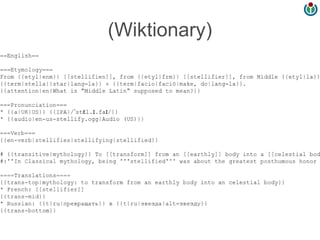
(Wiktionary)
Wikimedia projects assessed
●   Wikibooks
       –   Very large work units
       –   Limited usefulness of incomplete work
       –   Technology perfectly adequate
       –   Successes
               ●   In other projects, via funding/partners,
                     sprints
●   Opportunity: medium, Difficulty: high
       –   Funding, book sprints, partnerships, ...
Wikimedia projects assessed
●   Wikiversity
        –   Still ambiguous mission/scope
        –   Medium-sized work units
        –   Limited usefulness of incomplete work
        –   Technology limited
        –   Governance broken (tiny community)
●   Opportunity: low, Difficulty: high
        –   Clear definition, integration e.g. of quiz
             components with
             Wikipedia/Wikibooks
Wikimedia projects assessed
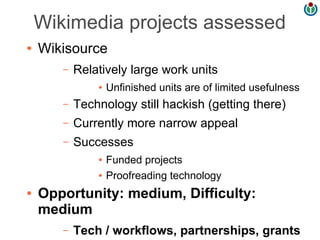
●   Wikisource
       –   Relatively large work units
               ●   Unfinished units are of limited usefulness
       –   Technology still hackish (getting there)
       –   Currently more narrow appeal
       –   Successes
               ●   Funded projects
               ●   Proofreading technology
●   Opportunity: medium, Difficulty:
    medium
       –   Tech / workflows, partnerships, grants
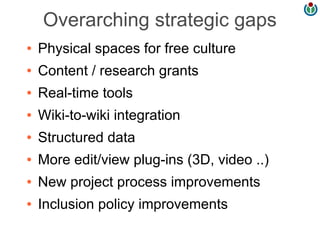
Overarching strategic gaps
●   Physical spaces for free culture
●   Content / research grants
●   Real-time tools
●   Wiki-to-wiki integration
●   Structured data
●   More edit/view plug-ins (3D, video ..)
●   New project process improvements
●   Inclusion policy improvements
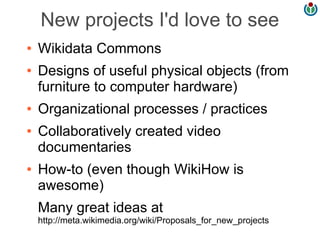
New projects I'd love to see
●   Wikidata Commons
●   Designs of useful physical objects (from
    furniture to computer hardware)
●   Organizational processes / practices
●   Collaboratively created video
    documentaries
●   How-to (even though WikiHow is
    awesome)
    Many great ideas at
    http://meta.wikimedia.org/wiki/Proposals_for_new_projects
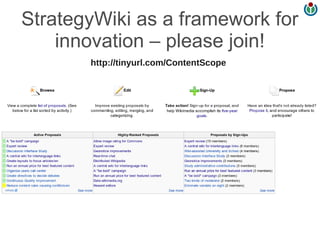
StrategyWiki as a framework for
    innovation – please join!
       http://tinyurl.com/ContentScope

Beyond the Encylcopedia: The Frontiers of Free Knowledge

  • 1.
    BEYOND THE ENCYCLOPEDIA THEFRONTIERS OF FREE KNOWLEDGE ERIK MÖLLER WIKIMANIA – JULY 11, 2010 WIKIMEDIA FOUNDATION
  • 2.
    2005: Jimmy's 10Challenges 1) Free the encyclopedia 2) Free the dictionary 3) Free the curriculum 4) Free the music 5) Free the art 6) Free the file formats 7) Free the maps 8) Free the product IDs 9) Free the TV listings 10) Free the communities
  • 3.
    Wikimedia Audience ComparedWith Other Information Sites Measured using unique visitors. Data from comScore MediaMetrix. (Global Unique Visitors, in millions of users) 400 350 300 Wikipedia New York Times 250 CNN BBC News Merriam Webster 200 MSN Encarta National Geographic Encyclopaedia Britannica Wall Street Journal 150 PBS NPR 100 50 0 January July January July January July January April 2007 2008 2009 2010
  • 4.
    Activity by project(Apr 2010) Project Pageviews Editors  Start date Wikipedia 11700M (~97%) 93,505 Jan 2001 Commons 164M 12,294 Sep 2004 Wiktionary 109M 920 Dec 2002 Wikibooks 30.3M 612 Jul 2003 Wikisource 30.1M 459 Nov 2003 Wikiquote 34.8M 334 Jul 2003 Wikinews 11.1M 179 Nov 2004 Wikiversity 6.0M 169 Aug 2006
  • 5.
    Who else createsfree knowledge / culture? Expand this list: http://tinyurl.com/NewFreeThings Maps OpenStreetMap Photos Flickr (!) Movie productions Blender Institute, Vodo 3D objects Thingiverse Textbooks CNX, CK12, others Courseware MIT, WikiEducator, ...
  • 6.
    Key Questions ● Which free culture efforts are successful? ● What's driving their success? ● What are our immediate opportunities? ● What are long-term challenges? ● How can you help?
  • 7.
    Theory of success ● Clearly articulated mission – Broad vs. specialized appeal ● Low barriers to participation ● Appropriate technology ● Volunteer gratification || Paid labor – Small, independently useful work units – Opportunities to collaborate – Feedback / support ● Functioning governance
  • 8.
    Emerging Free Culture Success Stories How do they map against these characteristics?
  • 9.
  • 10.
  • 11.
    Paid work /Support: MIT OpenCourseWare
  • 12.
  • 13.
  • 14.
  • 15.
    Small work units;appropriate tech: Translatewiki
  • 16.
  • 17.
    Wikimedia Projects: A PreliminaryAssessment [omitting Wikiquote, Wikispecies] Opportunity: How likely are we to succeed? Difficulty: How hard is it going to be?
  • 18.
    Wikimedia projects assessed ● Wikipedia – Small, independently useful work units – Critical mass of users provides gratification – As expectations grow and gratifications diminish, activity maxes out ● Opportunity: high, Difficulty: high – Usability, social tools, micro- contributions, outreach, skills development ...
  • 19.
    Wikimedia projects assessed ● Wikimedia Commons – Small, independently useful work units – High usefulness (great traffic/activity ratio) – Technology flawed, but usable ● Opportunity: high, Difficulty: medium – Usability, search, media support, ...
  • 20.
    Wikimedia projects assessed ● Wikinews – Relatively large work units ● Unfinished units are discarded – Technology still hackish – Limited collaboration – Usefulness falls off quickly – Successes ● Contests ● New feedback technology, DPL ● Opportunity: medium, Difficulty: very high – Funding, spaces, real-time technology, ...
  • 21.
    Wikimedia projects assessed ● Wiktionary – Small, independently useful work units – High usefulness (great traffic/activity ratio) – Technology horribly unsuitable ● Opportunity: high, Difficulty: high – Ontology editing technology (OmegaWiki, OntoWiki, ..)
  • 22.
  • 23.
    Wikimedia projects assessed ● Wikibooks – Very large work units – Limited usefulness of incomplete work – Technology perfectly adequate – Successes ● In other projects, via funding/partners, sprints ● Opportunity: medium, Difficulty: high – Funding, book sprints, partnerships, ...
  • 24.
    Wikimedia projects assessed ● Wikiversity – Still ambiguous mission/scope – Medium-sized work units – Limited usefulness of incomplete work – Technology limited – Governance broken (tiny community) ● Opportunity: low, Difficulty: high – Clear definition, integration e.g. of quiz components with Wikipedia/Wikibooks
  • 25.
    Wikimedia projects assessed ● Wikisource – Relatively large work units ● Unfinished units are of limited usefulness – Technology still hackish (getting there) – Currently more narrow appeal – Successes ● Funded projects ● Proofreading technology ● Opportunity: medium, Difficulty: medium – Tech / workflows, partnerships, grants
  • 26.
    Overarching strategic gaps ● Physical spaces for free culture ● Content / research grants ● Real-time tools ● Wiki-to-wiki integration ● Structured data ● More edit/view plug-ins (3D, video ..) ● New project process improvements ● Inclusion policy improvements
  • 27.
    New projects I'dlove to see ● Wikidata Commons ● Designs of useful physical objects (from furniture to computer hardware) ● Organizational processes / practices ● Collaboratively created video documentaries ● How-to (even though WikiHow is awesome) Many great ideas at http://meta.wikimedia.org/wiki/Proposals_for_new_projects
  • 28.
    StrategyWiki as aframework for innovation – please join! http://tinyurl.com/ContentScope