July 16, 2015
CONFIDENTIALITY STATEMENT
This document is confidential. All rights reserved. No part of this presentation may be reproduced or transmitted in any form
or by any means, electronic or mechanical, without permission in writing from Enhesa.
July 16, 2015
Energy Efficiency Audits:
Compulsory for Corporations in Europe
Presented By:
Paul Olagnier, Senior Consultant and Project Manager EHS Compliance, Enhesa
Peter Tayar-Watson, EU Energy Efficiency Directive Coordinator, GE Global
Operations
3
Practical Details:
Today’s Moderator
Muting and Sound Quality
Question and Answer
• Tjeerd Hendel-Blackford, Business Development Manager EMEA at Enhesa
• Due to the number of participants, we have muted everyone to ensure good
sound quality.
• If you experience sound quality problems, please make sure you are using a wired
connection with adequate bandwidth. If the problem continues, please call into
the teleconference.
• Please submit your questions to the presenters using the question box.
• We will try and answer as many questions as possible at the end of the
presentation.
©2015 Enhesa. All rights reserved.
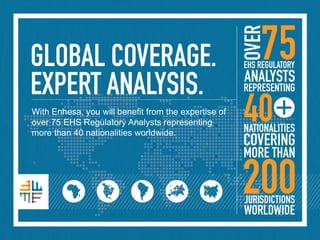
With Enhesa, you will benefit from the expertise of
over 75 EHS Regulatory Analysts representing
more than 40 nationalities worldwide.
5
Today’s Webinar: Energy Efficiency Audits Compulsory in Europe
Today we will cover:
•What is an energy efficiency audit?
•Where does this requirement come from?
•Which companies are impacted by this
requirement?
•By when do the audits need to be completed?
•What should be in the corporate-wide audit
report?
•To whom do the results of the audits need to be
provided?
•How did the different Member States implement
the requirements?
•How do you meet these requirements?
•What do you do with the results?
•Case study from Peter-Tayar Watson of General
Electric
©2015 Enhesa. All rights reserved.
6
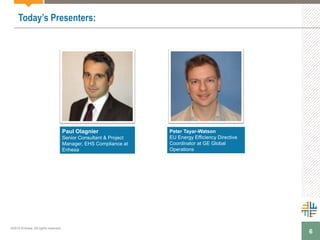
Today’s Presenters:
Peter Tayar-Watson
EU Energy Efficiency Directive
Coordinator at GE Global
Operations
Paul Olagnier
Senior Consultant & Project
Manager, EHS Compliance at
Enhesa
©2015 Enhesa. All rights reserved.
Energy Efficiency
Audit Webinar:
Agenda
• Regulatory perspectives
• Energy Audits in the World
• The Energy Audit (EA) in the Energy
Efficiency Directive
• Transposition in the Member States
• Which companies need to do an EA
• Content of the EA
• Reporting & record keeping
• GE Case Study
7
8
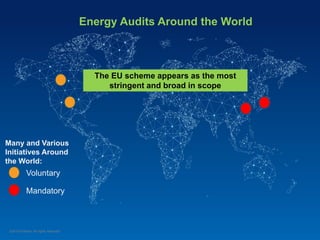
Energy Audits Around the World
The EU scheme appears as the most
stringent and broad in scope
Voluntary
Mandatory
Many and Various
Initiatives Around
the World:
©2015 Enhesa. All rights reserved.
9
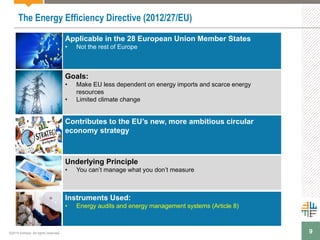
The Energy Efficiency Directive (2012/27/EU)
Applicable in the 28 European Union Member States
• Not the rest of Europe
Goals:
• Make EU less dependent on energy imports and scarce energy
resources
• Limited climate change
Contributes to the EU’s new, more ambitious circular
economy strategy
Underlying Principle
• You can’t manage what you don’t measure
Instruments Used:
• Energy audits and energy management systems (Article 8)
©2015 Enhesa. All rights reserved.
10
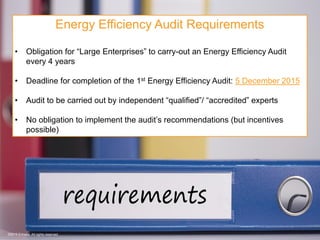
Energy Efficiency Audit Requirements
• Obligation for “Large Enterprises” to carry-out an Energy Efficiency Audit
every 4 years
• Deadline for completion of the 1st Energy Efficiency Audit: 5 December 2015
• Audit to be carried out by independent “qualified”/ “accredited” experts
• No obligation to implement the audit’s recommendations (but incentives
possible)
©2015 Enhesa. All rights reserved.
11
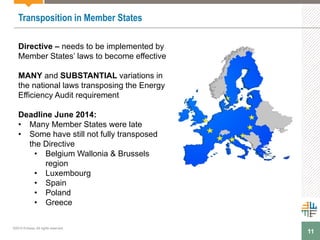
Transposition in Member States
Directive – needs to be implemented by
Member States’ laws to become effective
MANY and SUBSTANTIAL variations in
the national laws transposing the Energy
Efficiency Audit requirement
Deadline June 2014:
• Many Member States were late
• Some have still not fully transposed
the Directive
• Belgium Wallonia & Brussels
region
• Luxembourg
• Spain
• Poland
• Greece
©2015 Enhesa. All rights reserved.
12
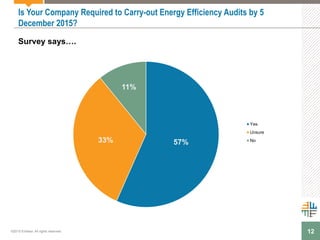
Is Your Company Required to Carry-out Energy Efficiency Audits by 5
December 2015?
Survey says….
57%33%
11%
Yes
Unsure
No
©2015 Enhesa. All rights reserved.
13
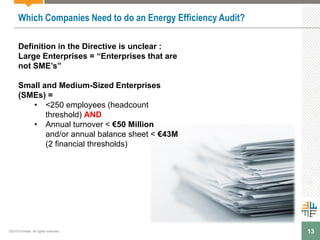
Which Companies Need to do an Energy Efficiency Audit?
Definition in the Directive is unclear :
Large Enterprises = “Enterprises that are
not SME’s”
Small and Medium-Sized Enterprises
(SMEs) =
• <250 employees (headcount
threshold) AND
• Annual turnover < €50 Million
and/or annual balance sheet < €43M
(2 financial thresholds)
©2015 Enhesa. All rights reserved.
14
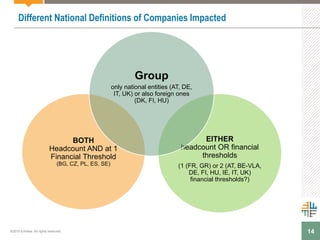
Different National Definitions of Companies Impacted
BOTH
Headcount AND at 1
Financial Threshold
(BG, CZ, PL, ES, SE)
EITHER
headcount OR financial
thresholds
(1 (FR, GR) or 2 (AT, BE-VLA,
DE, FI, HU, IE, IT, UK)
financial thresholds?)
Group
only national entities (AT, DE,
IT, UK) or also foreign ones
(DK, FI, HU)
©2015 Enhesa. All rights reserved.
15
Other Local Peculiarities
Period of Reference
• FR & IT: 2 latest accounting years
• UK: 31 December 2014
• Energy Consumption Threshold
• DK: 100,000 kWh/year
• IT: High energy consumption
companies = those registered with a
body called Cassa Conguaglio
Settore Elettrico (CCSE)
• RO: 1,000 tons of oil equivalent
(TOE)/year
©2015 Enhesa. All rights reserved.
16
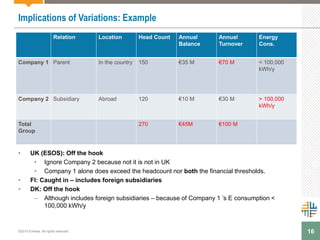
Implications of Variations: Example
• UK (ESOS): Off the hook
• Ignore Company 2 because not it is not in UK
• Company 1 alone does exceed the headcount nor both the financial thresholds.
• FI: Caught in – includes foreign subsidiaries
• DK: Off the hook
– Although includes foreign subsidiaries – because of Company 1 ’s E consumption <
100,000 kWh/y
Relation Location Head Count Annual
Balance
Annual
Turnover
Energy
Cons.
Company 1 Parent In the country 150 €35 M €70 M < 100,000
kWh/y
Company 2 Subsidiary Abroad 120 €10 M €30 M > 100,000
kWh/y
Total
Group
270 €45M €100 M
©2015 Enhesa. All rights reserved.
17
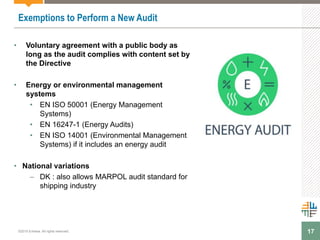
Exemptions to Perform a New Audit
• Voluntary agreement with a public body as
long as the audit complies with content set by
the Directive
• Energy or environmental management
systems
• EN ISO 50001 (Energy Management
Systems)
• EN 16247-1 (Energy Audits)
• EN ISO 14001 (Environmental Management
Systems) if it includes an energy audit
• National variations
– DK : also allows MARPOL audit standard for
shipping industry
©2015 Enhesa. All rights reserved.
18
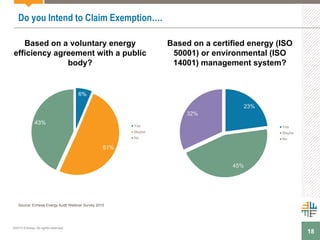
Do you Intend to Claim Exemption….
6%
51%
43% Yes
Maybe
No
Based on a voluntary energy
efficiency agreement with a public
body?
Based on a certified energy (ISO
50001) or environmental (ISO
14001) management system?
23%
45%
32%
Yes
Maybe
No
Source: Enhesa Energy Audit Webinar Survey 2015
©2015 Enhesa. All rights reserved.
19
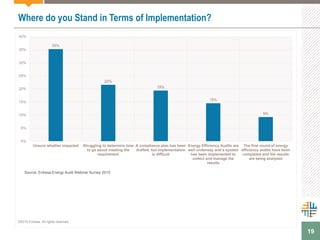
Where do you Stand in Terms of Implementation?
35%
22%
19%
15%
9%
0%
5%
10%
15%
20%
25%
30%
35%
40%
Unsure whether impacted Struggling to determine how
to go about meeting the
requirement
A compliance plan has been
drafted, but implementation
is difficult
Energy Efficiency Audits are
well underway and a system
has been implemented to
collect and manage the
results
The first round of energy
efficiency audits have been
completed and the results
are being analyzed
©2015 Enhesa. All rights reserved.
Source: Enhesa Energy Audit Webinar Survey 2015
20
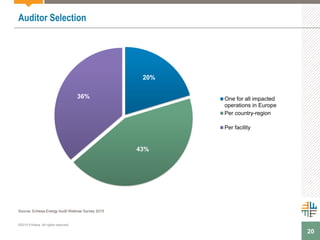
Auditor Selection
Source: Enhesa Energy Audit Webinar Survey 2015
20%
43%
36% One for all impacted
operations in Europe
Per country-region
Per facility
©2015 Enhesa. All rights reserved.
21
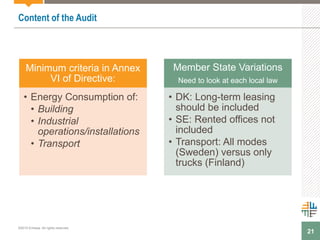
Content of the Audit
Minimum criteria in Annex
VI of Directive:
• Energy Consumption of:
• Building
• Industrial
operations/installations
• Transport
Member State Variations
Need to look at each local law
• DK: Long-term leasing
should be included
• SE: Rented offices not
included
• Transport: All modes
(Sweden) versus only
trucks (Finland)
©2015 Enhesa. All rights reserved.
22
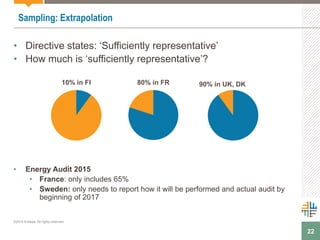
Sampling: Extrapolation
• Directive states: ‘Sufficiently representative’
• How much is ‘sufficiently representative’?
• Energy Audit 2015
• France: only includes 65%
• Sweden: only needs to report how it will be performed and actual audit by
beginning of 2017
90% in UK, DK10% in FI 80% in FR
©2015 Enhesa. All rights reserved.
23
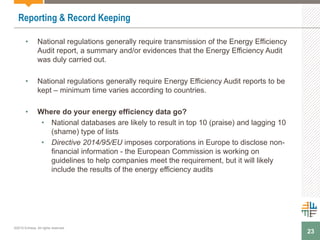
Reporting & Record Keeping
• National regulations generally require transmission of the Energy Efficiency
Audit report, a summary and/or evidences that the Energy Efficiency Audit
was duly carried out.
• National regulations generally require Energy Efficiency Audit reports to be
kept – minimum time varies according to countries.
• Where do your energy efficiency data go?
• National databases are likely to result in top 10 (praise) and lagging 10
(shame) type of lists
• Directive 2014/95/EU imposes corporations in Europe to disclose non-
financial information - the European Commission is working on
guidelines to help companies meet the requirement, but it will likely
include the results of the energy efficiency audits
©2015 Enhesa. All rights reserved.
24
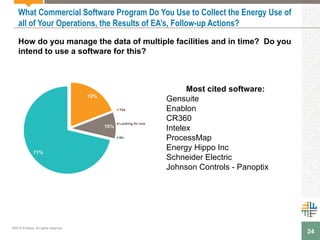
What Commercial Software Program Do You Use to Collect the Energy Use of
all of Your Operations, the Results of EA’s, Follow-up Actions?
19%
10%
71%
Yes
Looking for one
No
Most cited software:
Gensuite
Enablon
CR360
Intelex
ProcessMap
Energy Hippo Inc
Schneider Electric
Johnson Controls - Panoptix
How do you manage the data of multiple facilities and in time? Do you
intend to use a software for this?
©2015 Enhesa. All rights reserved.
25
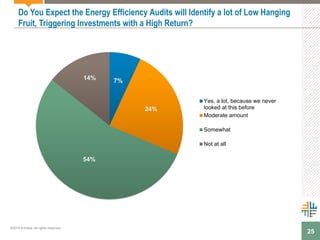
Do You Expect the Energy Efficiency Audits will Identify a lot of Low Hanging
Fruit, Triggering Investments with a High Return?
7%
24%
54%
14%
Yes, a lot, because we never
looked at this before
Moderate amount
Somewhat
Not at all
©2015 Enhesa. All rights reserved.
Case Study:
General Electric
Presented by: Peter Tayar-Watson
26
Imagination at work
EU Energy Efficiency Directive
(Article 8 – Energy Audits Large Enterprises)
Implementation in GE: A Case Study
Peter Tayar-Watson
July 16th 2015
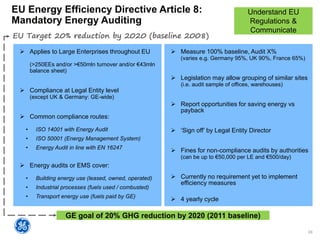
EU Energy Efficiency Directive Article 8:
Mandatory Energy Auditing
28
 Applies to Large Enterprises throughout EU
(>250EEs and/or >€50mln turnover and/or €43mln
balance sheet)
 Compliance at Legal Entity level
(except UK & Germany: GE-wide)
 Common compliance routes:
• ISO 14001 with Energy Audit
• ISO 50001 (Energy Management System)
• Energy Audit in line with EN 16247
 Energy audits or EMS cover:
• Building energy use (leased, owned, operated)
• Industrial processes (fuels used / combusted)
• Transport energy use (fuels paid by GE)
 Measure 100% baseline, Audit X%
(varies e.g. Germany 95%, UK 90%, France 65%)
 Legislation may allow grouping of similar sites
(i.e. audit sample of offices, warehouses)
 Report opportunities for saving energy vs
payback
 ‘Sign off’ by Legal Entity Director
 Fines for non-compliance audits by authorities
(can be up to €50,000 per LE and €500/day)
 Currently no requirement yet to implement
efficiency measures
 4 yearly cycle
EU Target 20% reduction by 2020 (baseline 2008)
GE goal of 20% GHG reduction by 2020 (2011 baseline)
Understand EU
Regulations &
Communicate
29
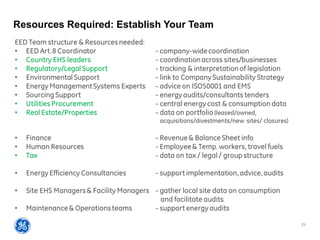
Resources Required: Establish Your Team
30
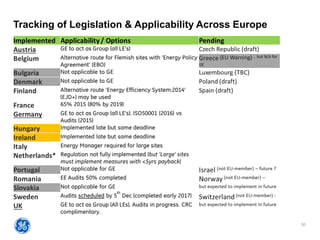
Tracking of Legislation & Applicability Across Europe
31
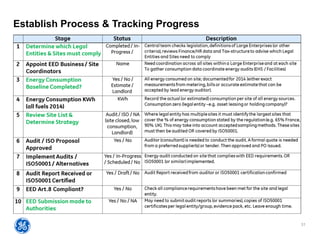
Establish Process & Tracking Progress
32
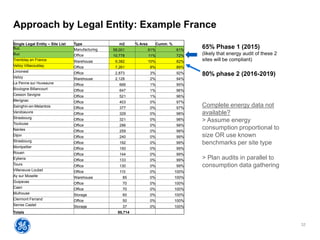
Approach by Legal Entity: Example France
Single Legal Entity – Site List Type m2 % Area Cumm. %
Buc Manufacturing 58,001 61% 61%
Buc Office 10,778 11% 72%
Tremblay en France Warehouse 9,382 10% 82%
Velizy Villacoublay Office 7,261 8% 89%
Limonest Office 2,873 3% 92%
Velizy Warehouse 2,128 2% 94%
La Penne sur Huveaune Office 666 1% 95%
Boulogne Billancourt Office 647 1% 96%
Cesson Sevigne Office 521 1% 96%
Merignac Office 403 0% 97%
Sainghin-en-Melantois Office 377 0% 97%
Vandoeuvre Office 329 0% 98%
Strasbourg Office 321 0% 98%
Toulouse Office 296 0% 98%
Nantes Office 259 0% 98%
Dijon Office 240 0% 99%
Strasbourg Office 192 0% 99%
Montpellier Office 150 0% 99%
Rouen Office 144 0% 99%
Eybens Office 133 0% 99%
Tours Office 130 0% 99%
Villeneuve Loubet Office 110 0% 100%
Ay sur Moselle Warehouse 85 0% 100%
Guipavas Office 70 0% 100%
Caen Office 70 0% 100%
Mulhouse Storage 60 0% 100%
Clermont Ferrand Office 50 0% 100%
Serres Castet Storage 37 0% 100%
Totals 95,714
65% Phase 1 (2015)
(likely that energy audit of these 2
sites will be compliant)
80% phase 2 (2016-2019)
Complete energy data not
available?
> Assume energy
consumption proportional to
size OR use known
benchmarks per site type
> Plan audits in parallel to
consumption data gathering
33
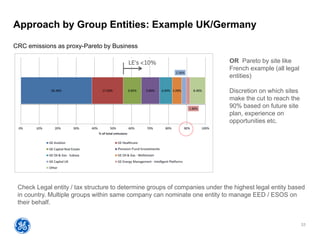
Approach by Group Entities: Example UK/Germany
Pension Fund Investments
CRC emissions as proxy-Pareto by Business
OR Pareto by site like
French example (all legal
entities)
Discretion on which sites
make the cut to reach the
90% based on future site
plan, experience on
opportunities etc.
Check Legal entity / tax structure to determine groups of companies under the highest legal entity based
in country. Multiple groups within same company can nominate one entity to manage EED / ESOS on

their behalf.
34
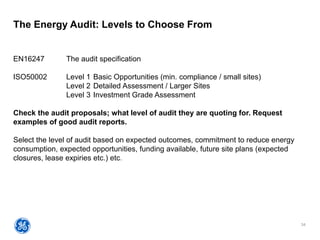
The Energy Audit: Levels to Choose From
EN16247 The audit specification
ISO50002 Level 1 Basic Opportunities (min. compliance / small sites)
Level 2 Detailed Assessment / Larger Sites
Level 3 Investment Grade Assessment
Check the audit proposals; what level of audit they are quoting for. Request
examples of good audit reports.
Select the level of audit based on expected outcomes, commitment to reduce energy
consumption, expected opportunities, funding available, future site plans (expected
closures, lease expiries etc.) etc.
35
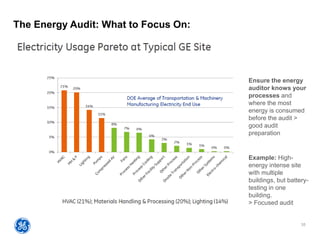
The Energy Audit: What to Focus On:
Ensure the energy
auditor knows your
processes and
where the most
energy is consumed
before the audit >
good audit
preparation
Example: High-
energy intense site
with multiple
buildings, but battery-
testing in one
building.
> Focused audit
36
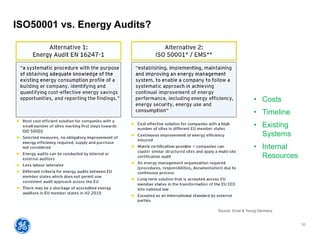
ISO50001 vs. Energy Audits?
Source: Ernst & Young Germany
• Costs
• Timeline
• Existing
Systems
• Internal
Resources
37
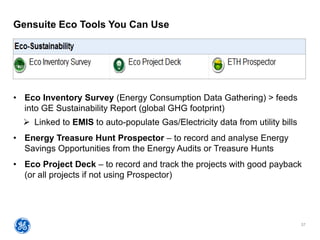
Gensuite Eco Tools You Can Use
• Eco Inventory Survey (Energy Consumption Data Gathering) > feeds
into GE Sustainability Report (global GHG footprint)
 Linked to EMIS to auto-populate Gas/Electricity data from utility bills
• Energy Treasure Hunt Prospector – to record and analyse Energy
Savings Opportunities from the Energy Audits or Treasure Hunts
• Eco Project Deck – to record and track the projects with good payback
(or all projects if not using Prospector)
38
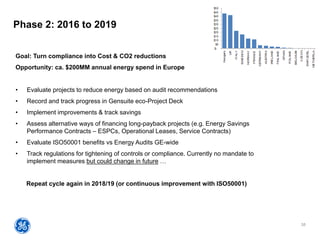
Phase 2: 2016 to 2019
Goal: Turn compliance into Cost & CO2 reductions
Opportunity: ca. $200MM annual energy spend in Europe
• Evaluate projects to reduce energy based on audit recommendations
• Record and track progress in Gensuite eco-Project Deck
• Implement improvements & track savings
• Assess alternative ways of financing long-payback projects (e.g. Energy Savings
Performance Contracts – ESPCs, Operational Leases, Service Contracts)
• Evaluate ISO50001 benefits vs Energy Audits GE-wide
• Track regulations for tightening of controls or compliance. Currently no mandate to
implement measures but could change in future …
Repeat cycle again in 2018/19 (or continuous improvement with ISO50001)
40
You can submit your questions via the
question box on the panel located on the
right hand side of your screen.

Energy Efficiency Audits Webinar

  • 1.
    July 16, 2015 CONFIDENTIALITYSTATEMENT This document is confidential. All rights reserved. No part of this presentation may be reproduced or transmitted in any form or by any means, electronic or mechanical, without permission in writing from Enhesa.
  • 2.
    July 16, 2015 EnergyEfficiency Audits: Compulsory for Corporations in Europe Presented By: Paul Olagnier, Senior Consultant and Project Manager EHS Compliance, Enhesa Peter Tayar-Watson, EU Energy Efficiency Directive Coordinator, GE Global Operations
  • 3.
    3 Practical Details: Today’s Moderator Mutingand Sound Quality Question and Answer • Tjeerd Hendel-Blackford, Business Development Manager EMEA at Enhesa • Due to the number of participants, we have muted everyone to ensure good sound quality. • If you experience sound quality problems, please make sure you are using a wired connection with adequate bandwidth. If the problem continues, please call into the teleconference. • Please submit your questions to the presenters using the question box. • We will try and answer as many questions as possible at the end of the presentation. ©2015 Enhesa. All rights reserved.
  • 4.
    With Enhesa, youwill benefit from the expertise of over 75 EHS Regulatory Analysts representing more than 40 nationalities worldwide.
  • 5.
    5 Today’s Webinar: EnergyEfficiency Audits Compulsory in Europe Today we will cover: •What is an energy efficiency audit? •Where does this requirement come from? •Which companies are impacted by this requirement? •By when do the audits need to be completed? •What should be in the corporate-wide audit report? •To whom do the results of the audits need to be provided? •How did the different Member States implement the requirements? •How do you meet these requirements? •What do you do with the results? •Case study from Peter-Tayar Watson of General Electric ©2015 Enhesa. All rights reserved.
  • 6.
    6 Today’s Presenters: Peter Tayar-Watson EUEnergy Efficiency Directive Coordinator at GE Global Operations Paul Olagnier Senior Consultant & Project Manager, EHS Compliance at Enhesa ©2015 Enhesa. All rights reserved.
  • 7.
    Energy Efficiency Audit Webinar: Agenda •Regulatory perspectives • Energy Audits in the World • The Energy Audit (EA) in the Energy Efficiency Directive • Transposition in the Member States • Which companies need to do an EA • Content of the EA • Reporting & record keeping • GE Case Study 7
  • 8.
    8 Energy Audits Aroundthe World The EU scheme appears as the most stringent and broad in scope Voluntary Mandatory Many and Various Initiatives Around the World: ©2015 Enhesa. All rights reserved.
  • 9.
    9 The Energy EfficiencyDirective (2012/27/EU) Applicable in the 28 European Union Member States • Not the rest of Europe Goals: • Make EU less dependent on energy imports and scarce energy resources • Limited climate change Contributes to the EU’s new, more ambitious circular economy strategy Underlying Principle • You can’t manage what you don’t measure Instruments Used: • Energy audits and energy management systems (Article 8) ©2015 Enhesa. All rights reserved.
  • 10.
    10 Energy Efficiency AuditRequirements • Obligation for “Large Enterprises” to carry-out an Energy Efficiency Audit every 4 years • Deadline for completion of the 1st Energy Efficiency Audit: 5 December 2015 • Audit to be carried out by independent “qualified”/ “accredited” experts • No obligation to implement the audit’s recommendations (but incentives possible) ©2015 Enhesa. All rights reserved.
  • 11.
    11 Transposition in MemberStates Directive – needs to be implemented by Member States’ laws to become effective MANY and SUBSTANTIAL variations in the national laws transposing the Energy Efficiency Audit requirement Deadline June 2014: • Many Member States were late • Some have still not fully transposed the Directive • Belgium Wallonia & Brussels region • Luxembourg • Spain • Poland • Greece ©2015 Enhesa. All rights reserved.
  • 12.
    12 Is Your CompanyRequired to Carry-out Energy Efficiency Audits by 5 December 2015? Survey says…. 57%33% 11% Yes Unsure No ©2015 Enhesa. All rights reserved.
  • 13.
    13 Which Companies Needto do an Energy Efficiency Audit? Definition in the Directive is unclear : Large Enterprises = “Enterprises that are not SME’s” Small and Medium-Sized Enterprises (SMEs) = • <250 employees (headcount threshold) AND • Annual turnover < €50 Million and/or annual balance sheet < €43M (2 financial thresholds) ©2015 Enhesa. All rights reserved.
  • 14.
    14 Different National Definitionsof Companies Impacted BOTH Headcount AND at 1 Financial Threshold (BG, CZ, PL, ES, SE) EITHER headcount OR financial thresholds (1 (FR, GR) or 2 (AT, BE-VLA, DE, FI, HU, IE, IT, UK) financial thresholds?) Group only national entities (AT, DE, IT, UK) or also foreign ones (DK, FI, HU) ©2015 Enhesa. All rights reserved.
  • 15.
    15 Other Local Peculiarities Periodof Reference • FR & IT: 2 latest accounting years • UK: 31 December 2014 • Energy Consumption Threshold • DK: 100,000 kWh/year • IT: High energy consumption companies = those registered with a body called Cassa Conguaglio Settore Elettrico (CCSE) • RO: 1,000 tons of oil equivalent (TOE)/year ©2015 Enhesa. All rights reserved.
  • 16.
    16 Implications of Variations:Example • UK (ESOS): Off the hook • Ignore Company 2 because not it is not in UK • Company 1 alone does exceed the headcount nor both the financial thresholds. • FI: Caught in – includes foreign subsidiaries • DK: Off the hook – Although includes foreign subsidiaries – because of Company 1 ’s E consumption < 100,000 kWh/y Relation Location Head Count Annual Balance Annual Turnover Energy Cons. Company 1 Parent In the country 150 €35 M €70 M < 100,000 kWh/y Company 2 Subsidiary Abroad 120 €10 M €30 M > 100,000 kWh/y Total Group 270 €45M €100 M ©2015 Enhesa. All rights reserved.
  • 17.
    17 Exemptions to Performa New Audit • Voluntary agreement with a public body as long as the audit complies with content set by the Directive • Energy or environmental management systems • EN ISO 50001 (Energy Management Systems) • EN 16247-1 (Energy Audits) • EN ISO 14001 (Environmental Management Systems) if it includes an energy audit • National variations – DK : also allows MARPOL audit standard for shipping industry ©2015 Enhesa. All rights reserved.
  • 18.
    18 Do you Intendto Claim Exemption…. 6% 51% 43% Yes Maybe No Based on a voluntary energy efficiency agreement with a public body? Based on a certified energy (ISO 50001) or environmental (ISO 14001) management system? 23% 45% 32% Yes Maybe No Source: Enhesa Energy Audit Webinar Survey 2015 ©2015 Enhesa. All rights reserved.
  • 19.
    19 Where do youStand in Terms of Implementation? 35% 22% 19% 15% 9% 0% 5% 10% 15% 20% 25% 30% 35% 40% Unsure whether impacted Struggling to determine how to go about meeting the requirement A compliance plan has been drafted, but implementation is difficult Energy Efficiency Audits are well underway and a system has been implemented to collect and manage the results The first round of energy efficiency audits have been completed and the results are being analyzed ©2015 Enhesa. All rights reserved. Source: Enhesa Energy Audit Webinar Survey 2015
  • 20.
    20 Auditor Selection Source: EnhesaEnergy Audit Webinar Survey 2015 20% 43% 36% One for all impacted operations in Europe Per country-region Per facility ©2015 Enhesa. All rights reserved.
  • 21.
    21 Content of theAudit Minimum criteria in Annex VI of Directive: • Energy Consumption of: • Building • Industrial operations/installations • Transport Member State Variations Need to look at each local law • DK: Long-term leasing should be included • SE: Rented offices not included • Transport: All modes (Sweden) versus only trucks (Finland) ©2015 Enhesa. All rights reserved.
  • 22.
    22 Sampling: Extrapolation • Directivestates: ‘Sufficiently representative’ • How much is ‘sufficiently representative’? • Energy Audit 2015 • France: only includes 65% • Sweden: only needs to report how it will be performed and actual audit by beginning of 2017 90% in UK, DK10% in FI 80% in FR ©2015 Enhesa. All rights reserved.
  • 23.
    23 Reporting & RecordKeeping • National regulations generally require transmission of the Energy Efficiency Audit report, a summary and/or evidences that the Energy Efficiency Audit was duly carried out. • National regulations generally require Energy Efficiency Audit reports to be kept – minimum time varies according to countries. • Where do your energy efficiency data go? • National databases are likely to result in top 10 (praise) and lagging 10 (shame) type of lists • Directive 2014/95/EU imposes corporations in Europe to disclose non- financial information - the European Commission is working on guidelines to help companies meet the requirement, but it will likely include the results of the energy efficiency audits ©2015 Enhesa. All rights reserved.
  • 24.
    24 What Commercial SoftwareProgram Do You Use to Collect the Energy Use of all of Your Operations, the Results of EA’s, Follow-up Actions? 19% 10% 71% Yes Looking for one No Most cited software: Gensuite Enablon CR360 Intelex ProcessMap Energy Hippo Inc Schneider Electric Johnson Controls - Panoptix How do you manage the data of multiple facilities and in time? Do you intend to use a software for this? ©2015 Enhesa. All rights reserved.
  • 25.
    25 Do You Expectthe Energy Efficiency Audits will Identify a lot of Low Hanging Fruit, Triggering Investments with a High Return? 7% 24% 54% 14% Yes, a lot, because we never looked at this before Moderate amount Somewhat Not at all ©2015 Enhesa. All rights reserved.
  • 26.
    Case Study: General Electric Presentedby: Peter Tayar-Watson 26
  • 27.
    Imagination at work EUEnergy Efficiency Directive (Article 8 – Energy Audits Large Enterprises) Implementation in GE: A Case Study Peter Tayar-Watson July 16th 2015
  • 28.
    EU Energy EfficiencyDirective Article 8: Mandatory Energy Auditing 28  Applies to Large Enterprises throughout EU (>250EEs and/or >€50mln turnover and/or €43mln balance sheet)  Compliance at Legal Entity level (except UK & Germany: GE-wide)  Common compliance routes: • ISO 14001 with Energy Audit • ISO 50001 (Energy Management System) • Energy Audit in line with EN 16247  Energy audits or EMS cover: • Building energy use (leased, owned, operated) • Industrial processes (fuels used / combusted) • Transport energy use (fuels paid by GE)  Measure 100% baseline, Audit X% (varies e.g. Germany 95%, UK 90%, France 65%)  Legislation may allow grouping of similar sites (i.e. audit sample of offices, warehouses)  Report opportunities for saving energy vs payback  ‘Sign off’ by Legal Entity Director  Fines for non-compliance audits by authorities (can be up to €50,000 per LE and €500/day)  Currently no requirement yet to implement efficiency measures  4 yearly cycle EU Target 20% reduction by 2020 (baseline 2008) GE goal of 20% GHG reduction by 2020 (2011 baseline) Understand EU Regulations & Communicate
  • 29.
  • 30.
    30 Tracking of Legislation& Applicability Across Europe
  • 31.
    31 Establish Process &Tracking Progress
  • 32.
    32 Approach by LegalEntity: Example France Single Legal Entity – Site List Type m2 % Area Cumm. % Buc Manufacturing 58,001 61% 61% Buc Office 10,778 11% 72% Tremblay en France Warehouse 9,382 10% 82% Velizy Villacoublay Office 7,261 8% 89% Limonest Office 2,873 3% 92% Velizy Warehouse 2,128 2% 94% La Penne sur Huveaune Office 666 1% 95% Boulogne Billancourt Office 647 1% 96% Cesson Sevigne Office 521 1% 96% Merignac Office 403 0% 97% Sainghin-en-Melantois Office 377 0% 97% Vandoeuvre Office 329 0% 98% Strasbourg Office 321 0% 98% Toulouse Office 296 0% 98% Nantes Office 259 0% 98% Dijon Office 240 0% 99% Strasbourg Office 192 0% 99% Montpellier Office 150 0% 99% Rouen Office 144 0% 99% Eybens Office 133 0% 99% Tours Office 130 0% 99% Villeneuve Loubet Office 110 0% 100% Ay sur Moselle Warehouse 85 0% 100% Guipavas Office 70 0% 100% Caen Office 70 0% 100% Mulhouse Storage 60 0% 100% Clermont Ferrand Office 50 0% 100% Serres Castet Storage 37 0% 100% Totals 95,714 65% Phase 1 (2015) (likely that energy audit of these 2 sites will be compliant) 80% phase 2 (2016-2019) Complete energy data not available? > Assume energy consumption proportional to size OR use known benchmarks per site type > Plan audits in parallel to consumption data gathering
  • 33.
    33 Approach by GroupEntities: Example UK/Germany Pension Fund Investments CRC emissions as proxy-Pareto by Business OR Pareto by site like French example (all legal entities) Discretion on which sites make the cut to reach the 90% based on future site plan, experience on opportunities etc. Check Legal entity / tax structure to determine groups of companies under the highest legal entity based in country. Multiple groups within same company can nominate one entity to manage EED / ESOS on their behalf.
  • 34.
    34 The Energy Audit:Levels to Choose From EN16247 The audit specification ISO50002 Level 1 Basic Opportunities (min. compliance / small sites) Level 2 Detailed Assessment / Larger Sites Level 3 Investment Grade Assessment Check the audit proposals; what level of audit they are quoting for. Request examples of good audit reports. Select the level of audit based on expected outcomes, commitment to reduce energy consumption, expected opportunities, funding available, future site plans (expected closures, lease expiries etc.) etc.
  • 35.
    35 The Energy Audit:What to Focus On: Ensure the energy auditor knows your processes and where the most energy is consumed before the audit > good audit preparation Example: High- energy intense site with multiple buildings, but battery- testing in one building. > Focused audit
  • 36.
    36 ISO50001 vs. EnergyAudits? Source: Ernst & Young Germany • Costs • Timeline • Existing Systems • Internal Resources
  • 37.
    37 Gensuite Eco ToolsYou Can Use • Eco Inventory Survey (Energy Consumption Data Gathering) > feeds into GE Sustainability Report (global GHG footprint)  Linked to EMIS to auto-populate Gas/Electricity data from utility bills • Energy Treasure Hunt Prospector – to record and analyse Energy Savings Opportunities from the Energy Audits or Treasure Hunts • Eco Project Deck – to record and track the projects with good payback (or all projects if not using Prospector)
  • 38.
    38 Phase 2: 2016to 2019 Goal: Turn compliance into Cost & CO2 reductions Opportunity: ca. $200MM annual energy spend in Europe • Evaluate projects to reduce energy based on audit recommendations • Record and track progress in Gensuite eco-Project Deck • Implement improvements & track savings • Assess alternative ways of financing long-payback projects (e.g. Energy Savings Performance Contracts – ESPCs, Operational Leases, Service Contracts) • Evaluate ISO50001 benefits vs Energy Audits GE-wide • Track regulations for tightening of controls or compliance. Currently no mandate to implement measures but could change in future … Repeat cycle again in 2018/19 (or continuous improvement with ISO50001)
  • 40.
    40 You can submityour questions via the question box on the panel located on the right hand side of your screen.