The Developing Human Connectome Project (dHCP):
Towards a dynamic map of evolving brain
connectivity, reflecting fetal and early neonatal
periods
Dr Emma C. Robinson
@emrobSci
emma.robinson@kcl.ac.uk
https://emmarobinson01.com/
The Developing Human Connectome Project
• Mapping the emergence of brain
connectivity from 20-44 weeks PMA
• ~1500 scans
• Acquisitions (MRI):
Resting state fMRI
Multi-shell HARDI
Structural T1 and T2
• Supported by
Genetic samples
Cognitive test scores/eye tracking
Demographics
http://www.developingconnectome.org/
c/o Dr Bernard Kainz, Imperial College
The Developing Human Connectome Project
• Mapping the emergence of brain
connectivity from 20-44 weeks PMA
• ~1500 scans
• Acquisitions (MRI):
Resting state fMRI
Multi-shell HARDI
Structural T1 and T2
• Supported by
Genetic samples
Cognitive test scores/eye tracking
Demographics
http://www.developingconnectome.org/
c/o Dr Bernard Kainz, Imperial College
The Developing Human Connectome Project
• Mapping the emergence of brain
connectivity from 20-44 weeks PMA
• ~1500 scans
• Acquisitions (MRI):
Resting state fMRI
Multi-shell HARDI
Structural T1 and T2
• Supported by
Genetic samples
Cognitive test scores/eye tracking
Demographics
http://www.developingconnectome.org/
c/o Dr Bernard Kainz, Imperial College
Challenges of working
with developing data
Challenges of working
with developing data
• Developing data is affected by
Challenges of working
with developing data
• Developing data is affected by
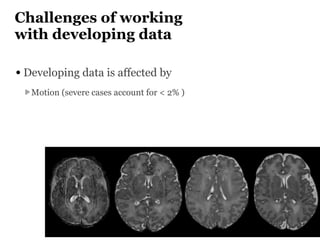
Motion (severe cases account for < 2% )
Challenges of working
with developing data
• Developing data is affected by
Motion (severe cases account for < 2% )
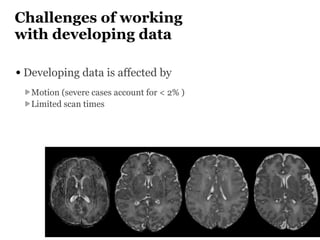
Limited scan times
Challenges of working
with developing data
• Developing data is affected by
Motion (severe cases account for < 2% )
Limited scan times
Relatively low resolution
Challenges of working
with developing data
• Developing data is affected by
Motion (severe cases account for < 2% )
Limited scan times
Relatively low resolution
Inverted contrast
Challenges of working
with developing data
• Developing data is affected by
Motion (severe cases account for < 2% )
Limited scan times
Relatively low resolution
Inverted contrast
spatio-temporal evolution
Neonatal Structural Pipeline
• Reconstruction with motion
correction
• Turbo Spin Echo (TSE) T2
Neonatal Structural Pipeline
• Reconstruction with motion
correction
• Turbo Spin Echo (TSE) T2
• Two stacks of 2D slices
• 0.8x0.8x1.6 mm
(image courtesy: M. Fogtmann, IEEE TMI 2014)
Neonatal Structural Pipeline
• Reconstruction with motion
correction
• Turbo Spin Echo (TSE) T2
• Two stacks of 2D slices
• 0.8x0.8x1.6 mm
• Slice to volume -> 0.5mm3
Cordero-Grande, Lucilio, et al. "Three-dimensional
motion corrected sensitivity encoding reconstruction
for multi-shot multi-slice MRI: Application to
neonatal brain imaging." MRM (2018)”
Neonatal Structural Pipeline
Makropoulos and Robinson et al. The Developing Human Connectome Project: a Minimal Processing Pipeline for Neonatal Cortical Surface
Reconstruction. NeuroImage (2018)
• Reconstruction with motion
correction
Neonatal Structural Pipeline
Makropoulos and Robinson et al. The Developing Human Connectome Project: a Minimal Processing Pipeline for Neonatal Cortical Surface
Reconstruction. NeuroImage (2018)
• Reconstruction with motion
correction
• Tissue segmentation
High intensity white matter correction
Makropoulos, Antonios, et al. "Automatic whole
brain MRI segmentation of the developing neonatal
brain." IEEE transactions on medical imaging 33.9
(2014): 1818-1831.
Neonatal Structural Pipeline
Brain extract
Bias correct T1T2
Align
White
PialMid-thickness Inflated Very Inflated Sphere
T1/T2w ratio
A. Pre-Processing
F
G
C
H
B
DE
I
I
Myelin MapSulcal DepthCurvatureThickness
Segmentation
Makropoulos and Robinson et al. The Developing Human Connectome Project: a Minimal Processing Pipeline for Neonatal Cortical Surface
Reconstruction. NeuroImage (2018)
• Reconstruction with motion
correction
• Tissue segmentation
• Surface mesh modelling
Neonatal Structural Pipeline
Brain extract
Bias correct T1T2
Align
White
PialMid-thickness Inflated Very Inflated Sphere
T1/T2w ratio
A. Pre-Processing
F
G
C
H
B
DE
I
I
Myelin MapSulcal DepthCurvatureThickness
Segmentation
Makropoulos and Robinson et al. The Developing Human Connectome Project: a Minimal Processing Pipeline for Neonatal Cortical Surface
Reconstruction. NeuroImage (2018)
• Reconstruction with motion
correction
• Tissue segmentation
• Surface mesh modelling
• Feature Extraction
Neonatal Surface QC
2 raters rated
• 43 images
• Patches of size
50x50x50mm
• White surface only
Comparison of intensity-based surface refinement (green) to segmentation result (yellow)
Example QC from single rater
Neonatal fMRI
Pipeline
Fitzgibbon, Sean P., et al. "The developing Human Connectome Project (dHCP): minimal functional
pre-processing pipeline for neonates." Fifth Biennial Conference on Resting State and Brain
Connectivity. 2016.
Neonatal fMRI
Pipeline
• FIELDMAP
Fitzgibbon, Sean P., et al. "The developing Human Connectome Project (dHCP): minimal functional
pre-processing pipeline for neonates." Fifth Biennial Conference on Resting State and Brain
Connectivity. 2016.
Neonatal fMRI
Pipeline
• FIELDMAP
• Motion & Distortion
Correction (MCDC)
Fitzgibbon, Sean P., et al. "The developing Human Connectome Project (dHCP): minimal functional
pre-processing pipeline for neonates." Fifth Biennial Conference on Resting State and Brain
Connectivity. 2016.
Neonatal fMRI
Pipeline
• FIELDMAP
• Motion & Distortion
Correction (MCDC)
• REGISTRATION
Fitzgibbon, Sean P., et al. "The developing Human Connectome Project (dHCP): minimal functional
pre-processing pipeline for neonates." Fifth Biennial Conference on Resting State and Brain
Connectivity. 2016.
Neonatal fMRI
Pipeline
• FIELDMAP
• Motion & Distortion
Correction (MCDC)
• REGISTRATION
• ICA+FIX
Fitzgibbon, Sean P., et al. "The developing Human Connectome Project (dHCP): minimal functional
pre-processing pipeline for neonates." Fifth Biennial Conference on Resting State and Brain
Connectivity. 2016.
Neonatal fMRI
Pipeline
• FIELDMAP
• Motion & Distortion
Correction (MCDC)
• REGISTRATION
• ICA+FIX
• NUISANCE REGRESSION
Fitzgibbon, Sean P., et al. "The developing Human Connectome Project (dHCP): minimal functional
pre-processing pipeline for neonates." Fifth Biennial Conference on Resting State and Brain
Connectivity. 2016.
Neonatal fMRI
Pipeline
• FIELDMAP
• Motion & Distortion
Correction (MCDC)
• REGISTRATION
• ICA+FIX
• NUISANCE REGRESSION
• SAMPLE TO SURFACE
Fitzgibbon, Sean P., et al. "The developing Human Connectome Project (dHCP): minimal functional
pre-processing pipeline for neonates." Fifth Biennial Conference on Resting State and Brain
Connectivity. 2016.
Neonatal fMRI
Pipeline
• FIELDMAP
• Motion & Distortion
Correction (MCDC)
• REGISTRATION
• ICA+FIX
• NUISANCE REGRESSION
• SAMPLE TO SURFACE
• QC
Fitzgibbon, Sean P., et al. "The developing Human Connectome Project (dHCP): minimal functional
pre-processing pipeline for neonates." Fifth Biennial Conference on Resting State and Brain
Connectivity. 2016.
Neonatal fMRI
Pipeline
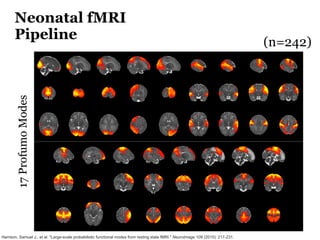
17ProfumoModes
Harrison, Samuel J., et al. "Large-scale probabilistic functional modes from resting state fMRI." NeuroImage 109 (2015): 217-231.
(n=242)
Neonatal dMRI Pipeline
• 300 diffusion volumes (20 b0)
• b = 400 s/mm2 (64)
• b = 1000 s/mm2 (88)
• b = 2600 s/mm2 (128)
Neonatal dMRI Pipeline
• 300 diffusion volumes (20 b0)
• b = 400 s/mm2 (64)
• b = 1000 s/mm2 (88)
• b = 2600 s/mm2 (128)
• Correction for eddy currents, susceptibility and motion
performed with FSL’s Eddy
Jesper L. R. et al. An integrated approach to correction for off-resonance effects and
subject movement in diffusion MR imaging. NeuroImage, 125:1063-1078, 2016. 

Neonatal dMRI Pipeline
• 300 diffusion volumes (20 b0)
• b = 400 s/mm2 (64)
• b = 1000 s/mm2 (88)
• b = 2600 s/mm2 (128)
• Correction for eddy currents, susceptibility and motion
performed with FSL’s Eddy
• Virtual dissection (atlas based)
Bastiani et al., Automated
processing pipeline for
neonatal diffusion MRI in the
developing Human
Connectome Project.
NeuroImage (under review).
• Micro-structural parameter estimates using NODDI (Zhang et al 2012)
Microstructure Tracts (virtual dissection)
Neonatal dMRI Pipeline
Bastiani et al., Automated processing
pipeline for neonatal diffusion MRI in the
developing Human Connectome Project.
NeuroImage (under review).
38 39 40 4138 39 40 41
dHCP spatio-temporal atlases
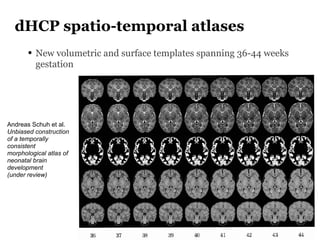
• New volumetric and surface templates spanning 36-44 weeks
gestation
Andreas Schuh et al.
Unbiased construction
of a temporally
consistent
morphological atlas of
neonatal brain
development
(under review)
dHCP spatio-temporal atlases
• New volumetric and surface templates spanning 36-44 weeks
gestation
Jelena Bozek et al.
Construction of a Neonatal
Cortical Surface Atlas Using
Multimodal Surface
Matching in the Developing
Human Connectome Project
(under revision)
dHCP spatio-temporal atlases
• New volumetric and surface templates spanning 36-44 weeks
gestation
Jelena Bozek et al.
Construction of a Neonatal
Cortical Surface Atlas Using
Multimodal Surface
Matching in the Developing
Human Connectome Project
(under revision)
dHCP spatio-temporal atlases
• New volumetric and surface templates spanning 36-44 weeks
gestation
Jelena Bozek et al.
Construction of a Neonatal
Cortical Surface Atlas Using
Multimodal Surface
Matching in the Developing
Human Connectome Project
(under revision)
Surface-based alignment of neonatal
cortical surfaces
• Spherical framework for cortical surface registration: MSM
• Use low resolution control point grids to constrain the deformation
• Optimised using discrete methods
Robinson, Emma C., et al. "MSM: a new flexible framework for Multimodal Surface Matching." Neuroimage (2014)
Surface-based alignment of neonatal
cortical surfaces
• Spherical framework for cortical surface registration: MSM
• Use low resolution control point grids to constrain the deformation
• Optimised using discrete methods
Robinson, Emma C., et al. "MSM: a new flexible framework for Multimodal Surface Matching." Neuroimage (2014)
Surface-based alignment of neonatal
cortical surfaces
• Spherical framework for cortical surface registration: MSM
• Use low resolution control point grids to constrain the deformation
• Optimised using discrete methods
data cost: i.e. correlation, MNI, SSD
Regularisation cost to encourage smoother warp
Robinson, Emma C., et al. "MSM: a new flexible framework for Multimodal Surface Matching." Neuroimage (2014)
SAS SSS
a)	
e)	
b)	
x LABEL	POINT	
OPTIMAL	LABEL	
CONTROL	POINT	
c)	
f)	
d)	
MSS
SSS + G
TSS
DAS TAS
g)	
F
Finding trends in longitudinal cortical
development
MSM now also allows
smooth deformation
of cortical anatomies
Robinson, Emma C., et al.
"Multimodal surface matching
with higher-order smoothness
constraints."  NeuroImage
 (2018).
New MSM: finding trends in
longitudinal cortical development
• 24 very preterm infants (born <30 weeks PMA, 15 male, 15 female)
• scanned 2-4 times before or at term-equivalent (36-40 weeks PMA)
Garcia, Kara E., Robinson E.C. et al. "Dynamic patterns of cortical expansion during folding of the preterm human brain." PNAS (2018)
Deep Learning for Brain Imaging
Transfer learning: Applied to motion artefact
detection of neonatal diffusion MRI (dMRI)
Data from
Developing Human
Connectome
Project (dHCP) Kelly, C., Pietsch, M., Counsell, S., & Tournier, J. D. Transfer learning
and convolutional neural net fusion for motion artefact detection.
Deep Learning for Brain Imaging
Transfer learning: Applied to motion artefact
detection of neonatal diffusion MRI (dMRI)
•Like fMRI highly
sensitive to motion
Data from
Developing Human
Connectome
Project (dHCP) Kelly, C., Pietsch, M., Counsell, S., & Tournier, J. D. Transfer learning
and convolutional neural net fusion for motion artefact detection.
Red boxed highlight motion artifacted slices
Deep Learning for Brain Imaging
Transfer learning: Applied to motion artefact
detection of neonatal diffusion MRI (dMRI)
•Like fMRI highly
sensitive to motion
•Standard practice to
remove noisy slices
Data from
Developing Human
Connectome
Project (dHCP) Kelly, C., Pietsch, M., Counsell, S., & Tournier, J. D. Transfer learning
and convolutional neural net fusion for motion artefact detection.
Red boxed highlight motion artifacted slices
Deep Learning for Brain Imaging
Transfer learning: Applied to motion artefact
detection of neonatal diffusion MRI (dMRI)
•Like fMRI highly
sensitive to motion
•Standard practice to
remove noisy slices
•Train CNN classifier
using transfer learning
Data from
Developing Human
Connectome
Project (dHCP) Kelly, C., Pietsch, M., Counsell, S., & Tournier, J. D. Transfer learning
and convolutional neural net fusion for motion artefact detection.
Red boxed highlight motion artifacted slices
Deep Learning for Medical Imaging
Transfer learning: Applied to motion artefact
detection of neonatal diffusion MRI (dMRI)
Kelly, C., Pietsch, M., Counsell, S., & Tournier, J. D. Transfer learning and convolutional neural net fusion for motion artefact detection.
Deep Learning for Medical Imaging
Transfer learning: Applied to motion artefact
detection of neonatal diffusion MRI (dMRI)
•Trained on 36 subjects
Kelly, C., Pietsch, M., Counsell, S., & Tournier, J. D. Transfer learning and convolutional neural net fusion for motion artefact detection.
Deep Learning for Medical Imaging
Transfer learning: Applied to motion artefact
detection of neonatal diffusion MRI (dMRI)
•Trained on 36 subjects
•Multiple CNNs trained
on different categories
of dMRI data
Kelly, C., Pietsch, M., Counsell, S., & Tournier, J. D. Transfer learning and convolutional neural net fusion for motion artefact detection.
Deep Learning for Medical Imaging
Transfer learning: Applied to motion artefact
detection of neonatal diffusion MRI (dMRI)
•Trained on 36 subjects
•Multiple CNNs trained
on different categories
of dMRI data
•Output of predictions
merged by random
forest
94.8%-99.8%
accuracy
Human level
~99.25%
Kelly, C., Pietsch, M., Counsell, S., & Tournier, J. D. Transfer learning and convolutional neural net fusion for motion artefact detection.
Fetal Pipeline
!18
• T1/T2
• 0.75 mm isotropic
• 141 Diffusion gradients
• b = 0 s/mm2 (15)
• b = 400 s/mm2 (46)
• b = 1000 s/mm2 (80)
• 2mm isotropic
• fMRI
• 12mins 35 secs
• 2.2mm isotropic
Example T2
Fetal Pipeline
!18
• T1/T2
• 0.75 mm isotropic
• 141 Diffusion gradients
• b = 0 s/mm2 (15)
• b = 400 s/mm2 (46)
• b = 1000 s/mm2 (80)
• 2mm isotropic
• fMRI
• 12mins 35 secs
• 2.2mm isotropic
Example T2
Fetal Pipeline
!18
• T1/T2
• 0.75 mm isotropic
• 141 Diffusion gradients
• b = 0 s/mm2 (15)
• b = 400 s/mm2 (46)
• b = 1000 s/mm2 (80)
• 2mm isotropic
• fMRI
• 12mins 35 secs
• 2.2mm isotropic
Example T2
• SLICE-WISE MOTION
CORRECTION AND DYNAMIC
DISTORTION CORRECTION
• SEGMENTATION /
REGISTRATION
• ICA+FIX
• SAMPLE TO SURFACE
• NUISANCE REGRESSION
• QC
Fetal Pipeline: fMRI Piloting
!19
Neonatal
22 - 37 week gestational age scans
Group Mean SNR
Fetal Pipeline: fMRI Piloting
!20
Fetal Pipeline: fMRI Piloting
!20
• RSNs
• Lower SNR/Higher motion than
neonates
• BUT similar structure at
matched ages
Fetal Pipeline: fMRI Piloting
!20
• RSNs
• Lower SNR/Higher motion than
neonates
• BUT similar structure at
matched ages
• Comparable Netmats
Fetal Pipeline: dMRI Piloting
!21
INPUT
SHARD RECONSTRUCTION
Fetal Pipeline: dMRI Piloting
!21
• Slice to Volume
Reconstruction (with
motion correction)
• “Multi-shell SHARD reconstruction
from scattered slice diffusion MRI
data in the neonatal brain.” Daan
Christiaens et al ISMRM 2018
• Deprez, Maria, et al. "Higher order
spherical harmonics reconstruction
of fetal diffusion MRI with intensity
correction." bioRxiv (2018): 297341.
INPUT
SHARD RECONSTRUCTION
Fetal Pipeline: dMRI Piloting
!21
• Slice to Volume
Reconstruction (with
motion correction)
• “Multi-shell SHARD reconstruction
from scattered slice diffusion MRI
data in the neonatal brain.” Daan
Christiaens et al ISMRM 2018
• Deprez, Maria, et al. "Higher order
spherical harmonics reconstruction
of fetal diffusion MRI with intensity
correction." bioRxiv (2018): 297341.
• Spherical
Deconvolution fit
• Constrained
• b 1000
Data Releases
!22
•1st Pilot data release
• https://data.developingconnectome.org/app/template/
Login.vm
• 40 neonatal subjects:
• T1, T2, fMRI and dMRI volumes (minimally processed)
• output of surface extraction pipelines
•2nd Major data release
• Expected summer 2018
• For queries on data releases and pipelines see https://
neurostars.org/tags/developing-hcp
Data Releases
!23
•dHCP structural pipeline
• https://github.com/BioMedIA/dhcp-structural-
pipeline
• Includes docker installation
• Contact j.cupitt@imperial.ac.uk
Acknowledgements
!24
• Professor A. David Edwards (PI)
• Professor Jo Hajnal (PI)
• Dr Lucillio Cordero Grande
• Dr Anthony Price
• Dr Maria Deprez
• Dr Chris Kelly
• Max Pietsch
• Daan Christiaens
• Dr Donald Tournier
• Dr Emer Hughes
http://www.developingconnectome.org/teams-and-collaborators-v2/
• Professor Daniel Rueckert (PI)
• Dr Antonios Makropoulos
• Dr Andreas Schuh
• Dr Jonathan Palmbach-Passerat
• Dr John Cupitt
• Dr Jianling Gao
• Professor Steve Smith (PI)
• Professor Mark Jenkinson
• Dr Eugene Duff
• Dr Matteo Bastiani
• Dr Sean Fitzgibbon
• Dr Saad Jbabdi
• Dr Stam Sotiropoulos
• Dr Jelena Bozek

Big datalittlebrains

  • 1.
    The Developing HumanConnectome Project (dHCP): Towards a dynamic map of evolving brain connectivity, reflecting fetal and early neonatal periods Dr Emma C. Robinson @emrobSci emma.robinson@kcl.ac.uk https://emmarobinson01.com/
  • 2.
    The Developing HumanConnectome Project • Mapping the emergence of brain connectivity from 20-44 weeks PMA • ~1500 scans • Acquisitions (MRI): Resting state fMRI Multi-shell HARDI Structural T1 and T2 • Supported by Genetic samples Cognitive test scores/eye tracking Demographics http://www.developingconnectome.org/ c/o Dr Bernard Kainz, Imperial College
  • 3.
    The Developing HumanConnectome Project • Mapping the emergence of brain connectivity from 20-44 weeks PMA • ~1500 scans • Acquisitions (MRI): Resting state fMRI Multi-shell HARDI Structural T1 and T2 • Supported by Genetic samples Cognitive test scores/eye tracking Demographics http://www.developingconnectome.org/ c/o Dr Bernard Kainz, Imperial College
  • 4.
    The Developing HumanConnectome Project • Mapping the emergence of brain connectivity from 20-44 weeks PMA • ~1500 scans • Acquisitions (MRI): Resting state fMRI Multi-shell HARDI Structural T1 and T2 • Supported by Genetic samples Cognitive test scores/eye tracking Demographics http://www.developingconnectome.org/ c/o Dr Bernard Kainz, Imperial College
  • 5.
  • 6.
    Challenges of working withdeveloping data • Developing data is affected by
  • 7.
    Challenges of working withdeveloping data • Developing data is affected by Motion (severe cases account for < 2% )
  • 8.
    Challenges of working withdeveloping data • Developing data is affected by Motion (severe cases account for < 2% ) Limited scan times
  • 9.
    Challenges of working withdeveloping data • Developing data is affected by Motion (severe cases account for < 2% ) Limited scan times Relatively low resolution
  • 10.
    Challenges of working withdeveloping data • Developing data is affected by Motion (severe cases account for < 2% ) Limited scan times Relatively low resolution Inverted contrast
  • 11.
    Challenges of working withdeveloping data • Developing data is affected by Motion (severe cases account for < 2% ) Limited scan times Relatively low resolution Inverted contrast spatio-temporal evolution
  • 12.
  • 13.
    Neonatal Structural Pipeline •Reconstruction with motion correction • Turbo Spin Echo (TSE) T2
  • 14.
    Neonatal Structural Pipeline •Reconstruction with motion correction • Turbo Spin Echo (TSE) T2 • Two stacks of 2D slices • 0.8x0.8x1.6 mm (image courtesy: M. Fogtmann, IEEE TMI 2014)
  • 15.
    Neonatal Structural Pipeline •Reconstruction with motion correction • Turbo Spin Echo (TSE) T2 • Two stacks of 2D slices • 0.8x0.8x1.6 mm • Slice to volume -> 0.5mm3 Cordero-Grande, Lucilio, et al. "Three-dimensional motion corrected sensitivity encoding reconstruction for multi-shot multi-slice MRI: Application to neonatal brain imaging." MRM (2018)”
  • 16.
    Neonatal Structural Pipeline Makropoulosand Robinson et al. The Developing Human Connectome Project: a Minimal Processing Pipeline for Neonatal Cortical Surface Reconstruction. NeuroImage (2018) • Reconstruction with motion correction
  • 17.
    Neonatal Structural Pipeline Makropoulosand Robinson et al. The Developing Human Connectome Project: a Minimal Processing Pipeline for Neonatal Cortical Surface Reconstruction. NeuroImage (2018) • Reconstruction with motion correction • Tissue segmentation High intensity white matter correction Makropoulos, Antonios, et al. "Automatic whole brain MRI segmentation of the developing neonatal brain." IEEE transactions on medical imaging 33.9 (2014): 1818-1831.
  • 18.
    Neonatal Structural Pipeline Brainextract Bias correct T1T2 Align White PialMid-thickness Inflated Very Inflated Sphere T1/T2w ratio A. Pre-Processing F G C H B DE I I Myelin MapSulcal DepthCurvatureThickness Segmentation Makropoulos and Robinson et al. The Developing Human Connectome Project: a Minimal Processing Pipeline for Neonatal Cortical Surface Reconstruction. NeuroImage (2018) • Reconstruction with motion correction • Tissue segmentation • Surface mesh modelling
  • 19.
    Neonatal Structural Pipeline Brainextract Bias correct T1T2 Align White PialMid-thickness Inflated Very Inflated Sphere T1/T2w ratio A. Pre-Processing F G C H B DE I I Myelin MapSulcal DepthCurvatureThickness Segmentation Makropoulos and Robinson et al. The Developing Human Connectome Project: a Minimal Processing Pipeline for Neonatal Cortical Surface Reconstruction. NeuroImage (2018) • Reconstruction with motion correction • Tissue segmentation • Surface mesh modelling • Feature Extraction
  • 20.
    Neonatal Surface QC 2raters rated • 43 images • Patches of size 50x50x50mm • White surface only Comparison of intensity-based surface refinement (green) to segmentation result (yellow) Example QC from single rater
  • 21.
    Neonatal fMRI Pipeline Fitzgibbon, SeanP., et al. "The developing Human Connectome Project (dHCP): minimal functional pre-processing pipeline for neonates." Fifth Biennial Conference on Resting State and Brain Connectivity. 2016.
  • 22.
    Neonatal fMRI Pipeline • FIELDMAP Fitzgibbon,Sean P., et al. "The developing Human Connectome Project (dHCP): minimal functional pre-processing pipeline for neonates." Fifth Biennial Conference on Resting State and Brain Connectivity. 2016.
  • 23.
    Neonatal fMRI Pipeline • FIELDMAP •Motion & Distortion Correction (MCDC) Fitzgibbon, Sean P., et al. "The developing Human Connectome Project (dHCP): minimal functional pre-processing pipeline for neonates." Fifth Biennial Conference on Resting State and Brain Connectivity. 2016.
  • 24.
    Neonatal fMRI Pipeline • FIELDMAP •Motion & Distortion Correction (MCDC) • REGISTRATION Fitzgibbon, Sean P., et al. "The developing Human Connectome Project (dHCP): minimal functional pre-processing pipeline for neonates." Fifth Biennial Conference on Resting State and Brain Connectivity. 2016.
  • 25.
    Neonatal fMRI Pipeline • FIELDMAP •Motion & Distortion Correction (MCDC) • REGISTRATION • ICA+FIX Fitzgibbon, Sean P., et al. "The developing Human Connectome Project (dHCP): minimal functional pre-processing pipeline for neonates." Fifth Biennial Conference on Resting State and Brain Connectivity. 2016.
  • 26.
    Neonatal fMRI Pipeline • FIELDMAP •Motion & Distortion Correction (MCDC) • REGISTRATION • ICA+FIX • NUISANCE REGRESSION Fitzgibbon, Sean P., et al. "The developing Human Connectome Project (dHCP): minimal functional pre-processing pipeline for neonates." Fifth Biennial Conference on Resting State and Brain Connectivity. 2016.
  • 27.
    Neonatal fMRI Pipeline • FIELDMAP •Motion & Distortion Correction (MCDC) • REGISTRATION • ICA+FIX • NUISANCE REGRESSION • SAMPLE TO SURFACE Fitzgibbon, Sean P., et al. "The developing Human Connectome Project (dHCP): minimal functional pre-processing pipeline for neonates." Fifth Biennial Conference on Resting State and Brain Connectivity. 2016.
  • 28.
    Neonatal fMRI Pipeline • FIELDMAP •Motion & Distortion Correction (MCDC) • REGISTRATION • ICA+FIX • NUISANCE REGRESSION • SAMPLE TO SURFACE • QC Fitzgibbon, Sean P., et al. "The developing Human Connectome Project (dHCP): minimal functional pre-processing pipeline for neonates." Fifth Biennial Conference on Resting State and Brain Connectivity. 2016.
  • 29.
    Neonatal fMRI Pipeline 17ProfumoModes Harrison, SamuelJ., et al. "Large-scale probabilistic functional modes from resting state fMRI." NeuroImage 109 (2015): 217-231. (n=242)
  • 30.
  • 31.
    Neonatal dMRI Pipeline •300 diffusion volumes (20 b0) • b = 400 s/mm2 (64) • b = 1000 s/mm2 (88) • b = 2600 s/mm2 (128)
  • 32.
    Neonatal dMRI Pipeline •300 diffusion volumes (20 b0) • b = 400 s/mm2 (64) • b = 1000 s/mm2 (88) • b = 2600 s/mm2 (128) • Correction for eddy currents, susceptibility and motion performed with FSL’s Eddy Jesper L. R. et al. An integrated approach to correction for off-resonance effects and subject movement in diffusion MR imaging. NeuroImage, 125:1063-1078, 2016. 

  • 33.
    Neonatal dMRI Pipeline •300 diffusion volumes (20 b0) • b = 400 s/mm2 (64) • b = 1000 s/mm2 (88) • b = 2600 s/mm2 (128) • Correction for eddy currents, susceptibility and motion performed with FSL’s Eddy • Virtual dissection (atlas based) Bastiani et al., Automated processing pipeline for neonatal diffusion MRI in the developing Human Connectome Project. NeuroImage (under review).
  • 34.
    • Micro-structural parameterestimates using NODDI (Zhang et al 2012) Microstructure Tracts (virtual dissection) Neonatal dMRI Pipeline Bastiani et al., Automated processing pipeline for neonatal diffusion MRI in the developing Human Connectome Project. NeuroImage (under review). 38 39 40 4138 39 40 41
  • 35.
    dHCP spatio-temporal atlases •New volumetric and surface templates spanning 36-44 weeks gestation Andreas Schuh et al. Unbiased construction of a temporally consistent morphological atlas of neonatal brain development (under review)
  • 36.
    dHCP spatio-temporal atlases •New volumetric and surface templates spanning 36-44 weeks gestation Jelena Bozek et al. Construction of a Neonatal Cortical Surface Atlas Using Multimodal Surface Matching in the Developing Human Connectome Project (under revision)
  • 37.
    dHCP spatio-temporal atlases •New volumetric and surface templates spanning 36-44 weeks gestation Jelena Bozek et al. Construction of a Neonatal Cortical Surface Atlas Using Multimodal Surface Matching in the Developing Human Connectome Project (under revision)
  • 38.
    dHCP spatio-temporal atlases •New volumetric and surface templates spanning 36-44 weeks gestation Jelena Bozek et al. Construction of a Neonatal Cortical Surface Atlas Using Multimodal Surface Matching in the Developing Human Connectome Project (under revision)
  • 39.
    Surface-based alignment ofneonatal cortical surfaces • Spherical framework for cortical surface registration: MSM • Use low resolution control point grids to constrain the deformation • Optimised using discrete methods Robinson, Emma C., et al. "MSM: a new flexible framework for Multimodal Surface Matching." Neuroimage (2014)
  • 40.
    Surface-based alignment ofneonatal cortical surfaces • Spherical framework for cortical surface registration: MSM • Use low resolution control point grids to constrain the deformation • Optimised using discrete methods Robinson, Emma C., et al. "MSM: a new flexible framework for Multimodal Surface Matching." Neuroimage (2014)
  • 41.
    Surface-based alignment ofneonatal cortical surfaces • Spherical framework for cortical surface registration: MSM • Use low resolution control point grids to constrain the deformation • Optimised using discrete methods data cost: i.e. correlation, MNI, SSD Regularisation cost to encourage smoother warp Robinson, Emma C., et al. "MSM: a new flexible framework for Multimodal Surface Matching." Neuroimage (2014)
  • 42.
    SAS SSS a) e) b) x LABEL POINT OPTIMAL LABEL CONTROL POINT c) f) d) MSS SSS+ G TSS DAS TAS g) F Finding trends in longitudinal cortical development MSM now also allows smooth deformation of cortical anatomies Robinson, Emma C., et al. "Multimodal surface matching with higher-order smoothness constraints."  NeuroImage  (2018).
  • 43.
    New MSM: findingtrends in longitudinal cortical development • 24 very preterm infants (born <30 weeks PMA, 15 male, 15 female) • scanned 2-4 times before or at term-equivalent (36-40 weeks PMA) Garcia, Kara E., Robinson E.C. et al. "Dynamic patterns of cortical expansion during folding of the preterm human brain." PNAS (2018)
  • 44.
    Deep Learning forBrain Imaging Transfer learning: Applied to motion artefact detection of neonatal diffusion MRI (dMRI) Data from Developing Human Connectome Project (dHCP) Kelly, C., Pietsch, M., Counsell, S., & Tournier, J. D. Transfer learning and convolutional neural net fusion for motion artefact detection.
  • 45.
    Deep Learning forBrain Imaging Transfer learning: Applied to motion artefact detection of neonatal diffusion MRI (dMRI) •Like fMRI highly sensitive to motion Data from Developing Human Connectome Project (dHCP) Kelly, C., Pietsch, M., Counsell, S., & Tournier, J. D. Transfer learning and convolutional neural net fusion for motion artefact detection. Red boxed highlight motion artifacted slices
  • 46.
    Deep Learning forBrain Imaging Transfer learning: Applied to motion artefact detection of neonatal diffusion MRI (dMRI) •Like fMRI highly sensitive to motion •Standard practice to remove noisy slices Data from Developing Human Connectome Project (dHCP) Kelly, C., Pietsch, M., Counsell, S., & Tournier, J. D. Transfer learning and convolutional neural net fusion for motion artefact detection. Red boxed highlight motion artifacted slices
  • 47.
    Deep Learning forBrain Imaging Transfer learning: Applied to motion artefact detection of neonatal diffusion MRI (dMRI) •Like fMRI highly sensitive to motion •Standard practice to remove noisy slices •Train CNN classifier using transfer learning Data from Developing Human Connectome Project (dHCP) Kelly, C., Pietsch, M., Counsell, S., & Tournier, J. D. Transfer learning and convolutional neural net fusion for motion artefact detection. Red boxed highlight motion artifacted slices
  • 48.
    Deep Learning forMedical Imaging Transfer learning: Applied to motion artefact detection of neonatal diffusion MRI (dMRI) Kelly, C., Pietsch, M., Counsell, S., & Tournier, J. D. Transfer learning and convolutional neural net fusion for motion artefact detection.
  • 49.
    Deep Learning forMedical Imaging Transfer learning: Applied to motion artefact detection of neonatal diffusion MRI (dMRI) •Trained on 36 subjects Kelly, C., Pietsch, M., Counsell, S., & Tournier, J. D. Transfer learning and convolutional neural net fusion for motion artefact detection.
  • 50.
    Deep Learning forMedical Imaging Transfer learning: Applied to motion artefact detection of neonatal diffusion MRI (dMRI) •Trained on 36 subjects •Multiple CNNs trained on different categories of dMRI data Kelly, C., Pietsch, M., Counsell, S., & Tournier, J. D. Transfer learning and convolutional neural net fusion for motion artefact detection.
  • 51.
    Deep Learning forMedical Imaging Transfer learning: Applied to motion artefact detection of neonatal diffusion MRI (dMRI) •Trained on 36 subjects •Multiple CNNs trained on different categories of dMRI data •Output of predictions merged by random forest 94.8%-99.8% accuracy Human level ~99.25% Kelly, C., Pietsch, M., Counsell, S., & Tournier, J. D. Transfer learning and convolutional neural net fusion for motion artefact detection.
  • 52.
    Fetal Pipeline !18 • T1/T2 •0.75 mm isotropic • 141 Diffusion gradients • b = 0 s/mm2 (15) • b = 400 s/mm2 (46) • b = 1000 s/mm2 (80) • 2mm isotropic • fMRI • 12mins 35 secs • 2.2mm isotropic Example T2
  • 53.
    Fetal Pipeline !18 • T1/T2 •0.75 mm isotropic • 141 Diffusion gradients • b = 0 s/mm2 (15) • b = 400 s/mm2 (46) • b = 1000 s/mm2 (80) • 2mm isotropic • fMRI • 12mins 35 secs • 2.2mm isotropic Example T2
  • 54.
    Fetal Pipeline !18 • T1/T2 •0.75 mm isotropic • 141 Diffusion gradients • b = 0 s/mm2 (15) • b = 400 s/mm2 (46) • b = 1000 s/mm2 (80) • 2mm isotropic • fMRI • 12mins 35 secs • 2.2mm isotropic Example T2
  • 55.
    • SLICE-WISE MOTION CORRECTIONAND DYNAMIC DISTORTION CORRECTION • SEGMENTATION / REGISTRATION • ICA+FIX • SAMPLE TO SURFACE • NUISANCE REGRESSION • QC Fetal Pipeline: fMRI Piloting !19 Neonatal 22 - 37 week gestational age scans Group Mean SNR
  • 56.
  • 57.
    Fetal Pipeline: fMRIPiloting !20 • RSNs • Lower SNR/Higher motion than neonates • BUT similar structure at matched ages
  • 58.
    Fetal Pipeline: fMRIPiloting !20 • RSNs • Lower SNR/Higher motion than neonates • BUT similar structure at matched ages • Comparable Netmats
  • 59.
    Fetal Pipeline: dMRIPiloting !21 INPUT SHARD RECONSTRUCTION
  • 60.
    Fetal Pipeline: dMRIPiloting !21 • Slice to Volume Reconstruction (with motion correction) • “Multi-shell SHARD reconstruction from scattered slice diffusion MRI data in the neonatal brain.” Daan Christiaens et al ISMRM 2018 • Deprez, Maria, et al. "Higher order spherical harmonics reconstruction of fetal diffusion MRI with intensity correction." bioRxiv (2018): 297341. INPUT SHARD RECONSTRUCTION
  • 61.
    Fetal Pipeline: dMRIPiloting !21 • Slice to Volume Reconstruction (with motion correction) • “Multi-shell SHARD reconstruction from scattered slice diffusion MRI data in the neonatal brain.” Daan Christiaens et al ISMRM 2018 • Deprez, Maria, et al. "Higher order spherical harmonics reconstruction of fetal diffusion MRI with intensity correction." bioRxiv (2018): 297341. • Spherical Deconvolution fit • Constrained • b 1000
  • 62.
    Data Releases !22 •1st Pilotdata release • https://data.developingconnectome.org/app/template/ Login.vm • 40 neonatal subjects: • T1, T2, fMRI and dMRI volumes (minimally processed) • output of surface extraction pipelines •2nd Major data release • Expected summer 2018 • For queries on data releases and pipelines see https:// neurostars.org/tags/developing-hcp
  • 63.
    Data Releases !23 •dHCP structuralpipeline • https://github.com/BioMedIA/dhcp-structural- pipeline • Includes docker installation • Contact j.cupitt@imperial.ac.uk
  • 64.
    Acknowledgements !24 • Professor A.David Edwards (PI) • Professor Jo Hajnal (PI) • Dr Lucillio Cordero Grande • Dr Anthony Price • Dr Maria Deprez • Dr Chris Kelly • Max Pietsch • Daan Christiaens • Dr Donald Tournier • Dr Emer Hughes http://www.developingconnectome.org/teams-and-collaborators-v2/ • Professor Daniel Rueckert (PI) • Dr Antonios Makropoulos • Dr Andreas Schuh • Dr Jonathan Palmbach-Passerat • Dr John Cupitt • Dr Jianling Gao • Professor Steve Smith (PI) • Professor Mark Jenkinson • Dr Eugene Duff • Dr Matteo Bastiani • Dr Sean Fitzgibbon • Dr Saad Jbabdi • Dr Stam Sotiropoulos • Dr Jelena Bozek