Scholarly Writing in L2 
Chapter 7 
Leki, I, Cumming, A, & Silva, T. (2008). A Synthesis of Research on 
Second Language Writing in English. New York: Routledge. 
Presented by: Entisar Elsherif
• What is scholarly writing? 
• Why L2 scholars write and publish 
in English? 
• Research into L2 Scholars’ 
writing/publishing in English
The first reaction is often: 
“what is a scholarly paper?” 
“How does it differ from other 
types of papers?”
What is scholarly writing? 
 Type of writing required by academics/experts and associated 
with research papers/reports 
Written by academics for an academic audience 
- Authors are academics/experts in particular disciplines 
or fields 
- The targeted audiences are researchers, professors, and 
college/university students 
 Editing is done by experts in the field who review the articles 
submitted for publication 
 The publishers are normally the universities, research institutes 
and scholarly press.
 Articles are more sophisticated and advanced than those in the 
general magazines 
 The language used is specialized vocabulary of the discipline 
covered. 
 The purpose of the article is to give a report on original research, 
experimentation, and methodology, as well as theory. 
 The articles include bibliographies and footnotes, which cite the 
authors of researched materials.
Differs from other writing in four fundamental areas: 
content, references, format, and the writing process 
itself. 
The content of a scholarly paper is characterized by 
critical thinking including: comparison and contrast, 
evaluation, analysis, synthesis, and integration in 
order to form new insights and draw new 
conclusions, and finally application to a real situation.
Why L2 scholars write in English? 
Research showed that L2 scholars write in English for 
different reasons
L2 Scholars write in English for different 
reasons 
 Dominance of English in international publications 
(Crystal, 1997; Gaddol, 1997) 
 Articles published in English-language journals get more 
citations and attention 
(St. John, 1987) 
 To add scholars’ voices and their home countries‘ 
perspectives 
(Casanave, 2002) 
 To get hired, promoted, tenured, or conferral of PhD 
degrees 
(Braine, 2005; Casanave, 1998; Curry & Lillis, 2004; J. 
Flwoerdew, 2000; Gosden, 1992, 1996)
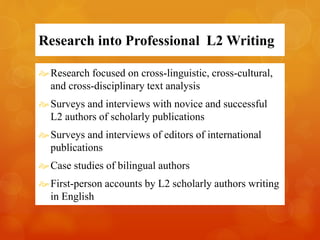
Research into Professional L2 Writing 
 Research focused on cross-linguistic, cross-cultural, 
and cross-disciplinary text analysis 
 Surveys and interviews with novice and successful 
L2 authors of scholarly publications 
Surveys and interviews of editors of international 
publications 
 Case studies of bilingual authors 
First-person accounts by L2 scholarly authors writing 
in English
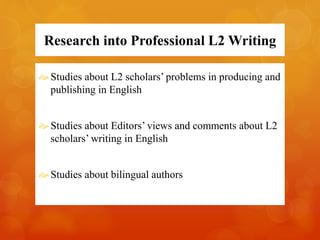
Research into Professional L2 Writing 
Studies about L2 scholars’ problems in producing and 
publishing in English 
 Studies about Editors’ views and comments about L2 
scholars’ writing in English 
 Studies about bilingual authors
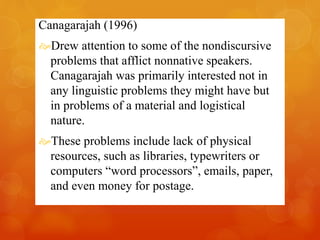
Canagarajah (1996) 
Drew attention to some of the nondiscursive 
problems that afflict nonnative speakers. 
Canagarajah was primarily interested not in 
any linguistic problems they might have but 
in problems of a material and logistical 
nature. 
These problems include lack of physical 
resources, such as libraries, typewriters or 
computers “word processors”, emails, paper, 
and even money for postage.
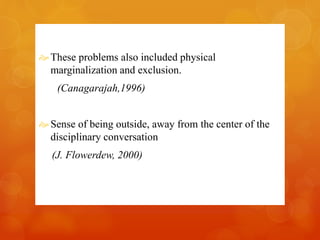
 These problems also included physical 
marginalization and exclusion. 
(Canagarajah,1996) 
Sense of being outside, away from the center of the 
disciplinary conversation 
(J. Flowerdew, 2000)
Flowerdew (1999) 
 He conducted a survey of NNS academics in Hong 
Kong to find out their perceptions, problems, and 
strategies regarding publication in English. 
 One of the significant findings of this survey was that 
just over two thirds of subjects felt themselves to be 
at a disadvantage in publishing in English as 
compared with NSs. 
More disturbing, nearly a third of the respondents felt 
that prejudice by referees, editors, and publishers 
placed NNSs at a disadvantage when writing for 
publication.
Flowerdew (2001) 
Conducted a set of interviews with leading 
international journal editors. His purpose was to 
find out how the editors of leading journals in 
English viewed the issue of NNSs publishing in 
their journals and to gain insight into how the 
chances of successful publication by NNSs might 
be enhanced.
NNS contributions in general tended to contain 
surface language errors. In general, editors felt that 
these were not problematic, as they would be dealt 
with by a copy editor. 
 Failure to show the relevance of the study to the 
international community, parochialism. Their 
contributions tended to be too localized. 
NNS writers failed to indicate how their research 
addressed current issues in the international 
community of scholarship.
Two sections of the article were particularly 
problematic that needed special attention: the 
introduction/literature review and, to a lesser extent, 
the discussion/ conclusion. 
 Lack of authorial voice was identified as a major 
problem by many editors.
Need to control linguistic and rhetorical features of 
English 
(J. Flowerdew, 2000; Gosden, 1996; Sionis, 1995; St. 
John, 1987) 
 Language plays a role in the decision to publish (L2 
writers’ problems with language usage) 
(J. Flowerdew, 2001; Gosden, 1992, 1995)
Problems L2 scholars encounter when they attempt to 
produce and publish their texts 
 Length of time and effort 
 Being limited to a simple style 
 Being limited to a quantitative paradigm 
 Difficulty of making claims 
 Difficulty of revealing or concealing the author’s 
commitment to those claims
These problems resulted in the 
emergence of English-language editors 
who exist worldwide to edit, rewrite, or 
help such authors revise their 
manuscripts.
English-language editors created a number of 
problems: 
 Editing services are expensive. 
 Editors may not be familiar with the writer’s 
disciplinary discourse. 
 Ethical issues arise of whose text it is: 
editor as co-author of the article 
(Burrough-Boenisch, 2003; J. Flowerdew, 2000; 
Gosden, 1996; Quian, 1995)
 Despite the pull from one side to publish in English, 
some scholars experienced a counterpull to publish in 
their first language to participate and contribute to the 
development of their home academic communities.
 being unable to think or write about disciplinary issues in 
their L1s 
(Casanave, 1998, Flowerdew, 2000; Shi, 2003) 
 scholars might be unable to communicate their scholarly 
findings in their L1 to their L1 audiences and in focusing 
on issues of importance to the international 
community at the expense of locally significant issues 
(Skutnabb-Kangas, 2000) 
 By writing in two languages, scholars experience the two 
publishing worlds and the demands of two different 
professional roles. 
(Casanave, 1998)
Summary and Conclusion 
 L2 scholars engage in message reduction allowing ideological 
reformulation by reviewers and editors 
 Displacement of other languages as likely means of 
communication 
 Distortion of scientific knowledge and skewing of meta-analysis 
through the failure to include materials published in languages 
other than English 
 Expensive professional English-language editing service
Summary and Conclusion 
 Reported reactions of L2 scholars (acceptance of the 
unavoidable, irritation, frustration, and discrimination) 
 L2 scholars might chose not to publish at all 
These cause information of vital scientific interest to be distorted or 
to go unreported 
(Baldauf, 1986; Baldauf & Jernudd, 1983; Canagarajah, 2002, J. 
Flowerdew, 1999; Tardy, 2004; J. Flowerdew, 2000; Sionis, 1995 )
How could L2 scholars be helped? 
 A dialogue is recommended between L2 scholars and native 
scholars or L2 scholars who publish in English on how to write 
publishable articles. 
 Attend seminars/workshops lead by editors to show L2 scholars 
the textual problems and how to avoid them. 
 Try to improve their Language. 
 The databases should include other languages to avoid distortion 
of scientific knowledge. 
 NS and NNS could work together .
Any 
Questions?
Scholarly writing in L2

Scholarly writing in L2

  • 1.
    Scholarly Writing inL2 Chapter 7 Leki, I, Cumming, A, & Silva, T. (2008). A Synthesis of Research on Second Language Writing in English. New York: Routledge. Presented by: Entisar Elsherif
  • 2.
    • What isscholarly writing? • Why L2 scholars write and publish in English? • Research into L2 Scholars’ writing/publishing in English
  • 3.
    The first reactionis often: “what is a scholarly paper?” “How does it differ from other types of papers?”
  • 4.
    What is scholarlywriting?  Type of writing required by academics/experts and associated with research papers/reports Written by academics for an academic audience - Authors are academics/experts in particular disciplines or fields - The targeted audiences are researchers, professors, and college/university students  Editing is done by experts in the field who review the articles submitted for publication  The publishers are normally the universities, research institutes and scholarly press.
  • 5.
     Articles aremore sophisticated and advanced than those in the general magazines  The language used is specialized vocabulary of the discipline covered.  The purpose of the article is to give a report on original research, experimentation, and methodology, as well as theory.  The articles include bibliographies and footnotes, which cite the authors of researched materials.
  • 6.
    Differs from otherwriting in four fundamental areas: content, references, format, and the writing process itself. The content of a scholarly paper is characterized by critical thinking including: comparison and contrast, evaluation, analysis, synthesis, and integration in order to form new insights and draw new conclusions, and finally application to a real situation.
  • 7.
    Why L2 scholarswrite in English? Research showed that L2 scholars write in English for different reasons
  • 8.
    L2 Scholars writein English for different reasons  Dominance of English in international publications (Crystal, 1997; Gaddol, 1997)  Articles published in English-language journals get more citations and attention (St. John, 1987)  To add scholars’ voices and their home countries‘ perspectives (Casanave, 2002)  To get hired, promoted, tenured, or conferral of PhD degrees (Braine, 2005; Casanave, 1998; Curry & Lillis, 2004; J. Flwoerdew, 2000; Gosden, 1992, 1996)
  • 9.
    Research into ProfessionalL2 Writing  Research focused on cross-linguistic, cross-cultural, and cross-disciplinary text analysis  Surveys and interviews with novice and successful L2 authors of scholarly publications Surveys and interviews of editors of international publications  Case studies of bilingual authors First-person accounts by L2 scholarly authors writing in English
  • 10.
    Research into ProfessionalL2 Writing Studies about L2 scholars’ problems in producing and publishing in English  Studies about Editors’ views and comments about L2 scholars’ writing in English  Studies about bilingual authors
  • 11.
    Canagarajah (1996) Drewattention to some of the nondiscursive problems that afflict nonnative speakers. Canagarajah was primarily interested not in any linguistic problems they might have but in problems of a material and logistical nature. These problems include lack of physical resources, such as libraries, typewriters or computers “word processors”, emails, paper, and even money for postage.
  • 12.
     These problemsalso included physical marginalization and exclusion. (Canagarajah,1996) Sense of being outside, away from the center of the disciplinary conversation (J. Flowerdew, 2000)
  • 13.
    Flowerdew (1999) He conducted a survey of NNS academics in Hong Kong to find out their perceptions, problems, and strategies regarding publication in English.  One of the significant findings of this survey was that just over two thirds of subjects felt themselves to be at a disadvantage in publishing in English as compared with NSs. More disturbing, nearly a third of the respondents felt that prejudice by referees, editors, and publishers placed NNSs at a disadvantage when writing for publication.
  • 14.
    Flowerdew (2001) Conducteda set of interviews with leading international journal editors. His purpose was to find out how the editors of leading journals in English viewed the issue of NNSs publishing in their journals and to gain insight into how the chances of successful publication by NNSs might be enhanced.
  • 15.
    NNS contributions ingeneral tended to contain surface language errors. In general, editors felt that these were not problematic, as they would be dealt with by a copy editor.  Failure to show the relevance of the study to the international community, parochialism. Their contributions tended to be too localized. NNS writers failed to indicate how their research addressed current issues in the international community of scholarship.
  • 16.
    Two sections ofthe article were particularly problematic that needed special attention: the introduction/literature review and, to a lesser extent, the discussion/ conclusion.  Lack of authorial voice was identified as a major problem by many editors.
  • 17.
    Need to controllinguistic and rhetorical features of English (J. Flowerdew, 2000; Gosden, 1996; Sionis, 1995; St. John, 1987)  Language plays a role in the decision to publish (L2 writers’ problems with language usage) (J. Flowerdew, 2001; Gosden, 1992, 1995)
  • 18.
    Problems L2 scholarsencounter when they attempt to produce and publish their texts  Length of time and effort  Being limited to a simple style  Being limited to a quantitative paradigm  Difficulty of making claims  Difficulty of revealing or concealing the author’s commitment to those claims
  • 19.
    These problems resultedin the emergence of English-language editors who exist worldwide to edit, rewrite, or help such authors revise their manuscripts.
  • 20.
    English-language editors createda number of problems:  Editing services are expensive.  Editors may not be familiar with the writer’s disciplinary discourse.  Ethical issues arise of whose text it is: editor as co-author of the article (Burrough-Boenisch, 2003; J. Flowerdew, 2000; Gosden, 1996; Quian, 1995)
  • 21.
     Despite thepull from one side to publish in English, some scholars experienced a counterpull to publish in their first language to participate and contribute to the development of their home academic communities.
  • 22.
     being unableto think or write about disciplinary issues in their L1s (Casanave, 1998, Flowerdew, 2000; Shi, 2003)  scholars might be unable to communicate their scholarly findings in their L1 to their L1 audiences and in focusing on issues of importance to the international community at the expense of locally significant issues (Skutnabb-Kangas, 2000)  By writing in two languages, scholars experience the two publishing worlds and the demands of two different professional roles. (Casanave, 1998)
  • 23.
    Summary and Conclusion  L2 scholars engage in message reduction allowing ideological reformulation by reviewers and editors  Displacement of other languages as likely means of communication  Distortion of scientific knowledge and skewing of meta-analysis through the failure to include materials published in languages other than English  Expensive professional English-language editing service
  • 24.
    Summary and Conclusion  Reported reactions of L2 scholars (acceptance of the unavoidable, irritation, frustration, and discrimination)  L2 scholars might chose not to publish at all These cause information of vital scientific interest to be distorted or to go unreported (Baldauf, 1986; Baldauf & Jernudd, 1983; Canagarajah, 2002, J. Flowerdew, 1999; Tardy, 2004; J. Flowerdew, 2000; Sionis, 1995 )
  • 25.
    How could L2scholars be helped?  A dialogue is recommended between L2 scholars and native scholars or L2 scholars who publish in English on how to write publishable articles.  Attend seminars/workshops lead by editors to show L2 scholars the textual problems and how to avoid them.  Try to improve their Language.  The databases should include other languages to avoid distortion of scientific knowledge.  NS and NNS could work together .
  • 26.