Practical steps for
writing research
proposal
Dr Elhadi Miskeen, MBBS, MD, FAIMER, TUFH
Faculty of medicine, University of Gezira, Sudan
Faculty of medicine, University of Bisha, Saudi
Arabia
Workshop objectives:
By the end of the workshop, you will be able to:
1. Select a research topic
2. Formulate research question
3. Set of research objectives
4. Plan for proposal of medical research
Workshop sections
• Part 1:
Research Questions
• Part 2:
Criteria of choosing research title-settings-selection criteria
• Part 3:
Set of research objectives
• Part 4:
Research Proposal
Introduction
• Research is a systematic collection, analysis and interpretation of data in order to solve a
research question
• Classification:
• Basic research: necessary to generate new knowledge and technologies.
• Applied research: necessary to identify priority problems and to design and evaluate
policies and programs for optimal health care and delivery.
There are 3 types of medical research:
• Research aimed at developing better treatments for diseases and
conditions. For example, a better medicine for headaches, a new kind of
heart valve or a new treatment for depression.
• Research aimed at learning more about a disease or how the body works.
How does skin react to sunlight? Does eating licorice cause high blood
pressure?
• Research to find better ways to detect and diagnose diseases. How can we
detect cancer earlier? How can we tell if someone has heart disease?
Part 1:
Research Questions
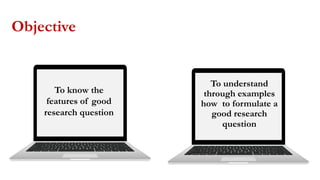
Objective
To know the
features of good
research question
To understand
through examples
how to formulate a
good research
question
A research question is a question
that a research project sets out to
answer
What is the research Question?
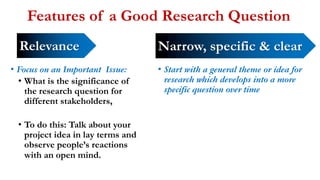
Features of a Good Research Question
• Focus on an Important Issue:
• What is the significance of
the research question for
different stakeholders,
• To do this: Talk about your
project idea in lay terms and
observe people’s reactions
with an open mind.
• Start with a general theme or idea for
research which develops into a more
specific question over time
Relevance Narrow, specific & clear
Examples of how initial research questions,
are refined into appropriate ones
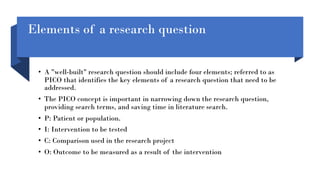
Elements of a research question
• A "well-built" research question should include four elements; referred to as
PICO that identifies the key elements of a research question that need to be
addressed.
• The PICO concept is important in narrowing down the research question,
providing search terms, and saving time in literature search.
• P: Patient or population.
• I: Intervention to be tested
• C: Comparison used in the research project
• O: Outcome to be measured as a result of the intervention
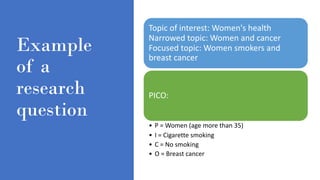
Example
of a
research
question
Topic of interest: Women's health
Narrowed topic: Women and cancer
Focused topic: Women smokers and
breast cancer
PICO:
• P = Women (age more than 35)
• I = Cigarette smoking
• C = No smoking
• O = Breast cancer
Practical 1 • Practical 1:
• Based on the the
information from the above
training
• Choose your research
topic and set the Research
question
Part2 :
Research title
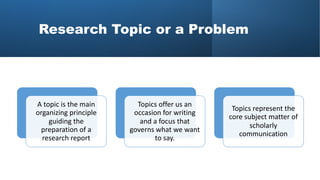
Research Topic or a Problem
A topic is the main
organizing principle
guiding the
preparation of a
research report
Topics offer us an
occasion for writing
and a focus that
governs what we want
to say.
Topics represent the
core subject matter of
scholarly
communication
How to Begin
Do not expect choosing a topic for
research project to be a quick or easy
task!
You should be thinking about it right from
the start of this workshop
CHOOSING A
RESEARCH
TOPIC
THERE ARE 3 SCENARIOS
• Your supervisor /department can
provide you with a general topic area from which you
study a particular aspect;
provide you with a list of possible topics to choose from;
or,
leave it up to you to choose a topic and you only have to
obtain the permission to write about it before beginning
your investigation.
CHOOSING A
RESEARCH TOPIC
how to approach
your chosen topic
Step 1: Understand what the topic is
about.
• What are the key words in the question/topic?
• Which questions am I going to answer?
• What variables will be considered?
• Etc. etc.
CHOOSING A
RESEARCH TOPIC
how to approach
your chosen topic
Step 2:
Review related literature to help refine how
you will approach the topic and finding a
way to analyze it.
Focus on identifying sources (literature)
that support as well as refute this
position
a. Has anybody written about this?
b. If yes, what is it about specifically?
c. If no, what gap is my study filling in?
CHOOSING A
RESEARCH
TOPIC
CAUTION:
• It is ok to review related literature to help refine
how you will approach analyzing a topic, and
then discover that the topic is not all that
interesting after all.
• In that case, you can choose another topic.
• Do not wait too long to make a switch, and
• Be sure to consult with your supervisor first.
GENERATING
RESEARCH TOPICS
where, when & how • Usually, you ask
“How do I choose a topic?”
Considerations For Selecting A Research Problem
1. Interest: One should select a topic of great interest to sustain the required motivation.
2. It is extremely important to select a topic that you can manage within the time and resources at your disposal.
3. Measurement Of Concepts: Make sure that you are clear about the indicators and measurement of concepts (if used)
in your study.
4. Level Of Expertise: Make sure that you have adequate knowledge or expertise for the task you are proposing since
you need to do the work yourself.
5. Relevance/Significance: Ensure that your study
i. adds to the existing body of knowledge,
ii. bridges current gaps in knowledge, and
iii. is useful in policy formulation.
6. Availability Of Data: Before finalizing on your topic, make sure that data are available.
7. Ethical Issues: Ethical issues are research processes and findings that affect the sensibilities and rights of research
participants.
Practical 2:
Based on the the information from the above training
Select research title according to the given criteria you learned in this workshop
Part 3: Set of research objectives
Setting of objectives in research
• Research objectives should be closely related to the statement of the
problem and summarize what you hope will be achieved by the study.
• Writing your research objectives clearly helps to:
• Define the focus of your study.
• Clearly identify variables to be measured.
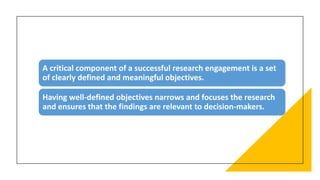
A critical component of a successful research engagement is a set
of clearly defined and meaningful objectives.
Having well-defined objectives narrows and focuses the research
and ensures that the findings are relevant to decision-makers.
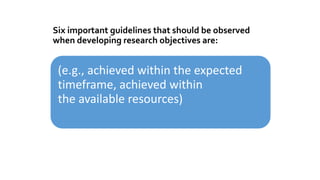
Six important guidelines that should be observed
when developing research objectives are:
(e.g., achieved within the expected
timeframe, achieved within
the available resources)
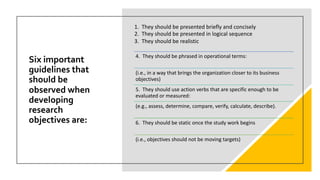
Six important
guidelines that
should be
observed when
developing
research
objectives are:
4. They should be phrased in operational terms:
(i.e., in a way that brings the organization closer to its business
objectives)
5. They should use action verbs that are specific enough to be
evaluated or measured:
(e.g., assess, determine, compare, verify, calculate, describe).
6. They should be static once the study work begins
(i.e., objectives should not be moving targets)
1. They should be presented briefly and concisely
2. They should be presented in logical sequence
3. They should be realistic
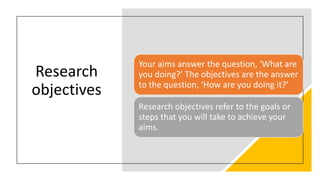
Research
objectives
Your aims answer the question, ‘What are
you doing?’ The objectives are the answer
to the question, ‘How are you doing it?’
Research objectives refer to the goals or
steps that you will take to achieve your
aims.
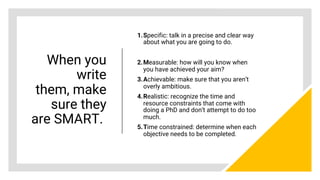
When you
write
them, make
sure they
are SMART.
1.Specific: talk in a precise and clear way
about what you are going to do.
2.Measurable: how will you know when
you have achieved your aim?
3.Achievable: make sure that you aren’t
overly ambitious.
4.Realistic: recognize the time and
resource constraints that come with
doing a PhD and don’t attempt to do too
much.
5.Time constrained: determine when each
objective needs to be completed.
Practical 3:
Based on the the information from the above training
Set research objectives for the title you selected in practical session 2
Part 4:
Proposal
Define research proposal
A research proposal is a
document written by a
researcher that provides a
detailed description of the
proposed program.
It is like an outline of the
entire research process
that gives a reader
summary of the
information discussed in a
project.
How to write research proposal?
• Regardless of your research area and the methodology you
choose, all research proposals must address the following
questions:
üWhat you plan to accomplish
üwhy you want to do it and
ühow you are going to do it.
How to
write
research
proposal?
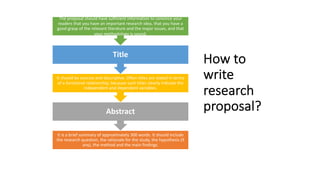
It is a brief summary of approximately 300 words. It should include
the research question, the rationale for the study, the hypothesis (if
any), the method and the main findings.
Abstract
It should be concise and descriptive. Often titles are stated in terms
of a functional relationship, because such titles clearly indicate the
independent and dependent variables.
Title
The proposal should have sufficient information to convince your
readers that you have an important research idea, that you have a
good grasp of the relevant literature and the major issues, and that
your methodology is sound.
How to write research proposal?
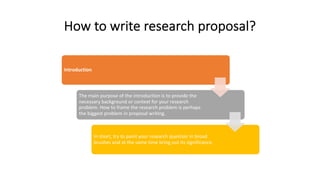
Introduction
The main purpose of the introduction is to provide the
necessary background or context for your research
problem. How to frame the research problem is perhaps
the biggest problem in proposal writing.
In short, try to paint your research question in broad
brushes and at the same time bring out its significance.
How to write
research
proposal?
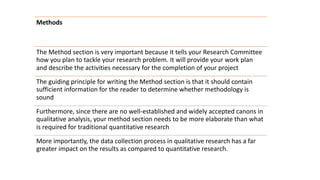
Methods
The Method section is very important because it tells your Research Committee
how you plan to tackle your research problem. It will provide your work plan
and describe the activities necessary for the completion of your project
The guiding principle for writing the Method section is that it should contain
sufficient information for the reader to determine whether methodology is
sound
Furthermore, since there are no well-established and widely accepted canons in
qualitative analysis, your method section needs to be more elaborate than what
is required for traditional quantitative research
More importantly, the data collection process in qualitative research has a far
greater impact on the results as compared to quantitative research.
Guidelines
on writing a
research
proposal
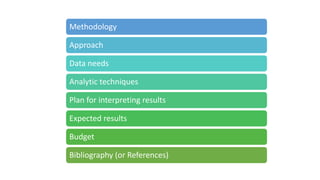
Methodology
Approach
Data needs
Analytic techniques
Plan for interpreting results
Expected results
Budget
Bibliography (or References)
Practical 4:
Based on the the information from the above training
WRITE RESEARCH PROPSAL AND PRESENT IT TO YOUR SUPERVISOR
Conclusion
ØYour research proposal is an important part of the
application process.
ØIt summarises the question you want to answer
through your research.
ØIt demonstrates your knowledge of the subject area
and shows the methods you want to use to complete
your research.
Conclusion
Remember – whenever you write, make it as clear as
possible. Pay attention to the words ‘as possible’ there.
That means you should write as clearly as you can given
the fact that your subject and research is necessarily
complex.
Think of it the other way: it’s about not making things
more complicated and unclear than they need to be.
Closing
• HOW MUCH YOU FEEL CONFIDENT TO WRITE RESEARCH PROPOSAL
Thank you
R
ef
er
e
nc
es
1. FAIMER PME . Foundation of international medical education, program
management and evaluation
2. Marczyk GR. Essentials of Research Design and Methodology. John Wiley
& Sons, Inc; 2005.
3. Shuttleworth M. Definition of Research. 2008 [cited 14 August, 2011;
Available from: http://explorable.com/definition-of-research.
4. Baylor U. Conducting research for building strong interpersonal
relationships. Dr. Keith Sanford; Available from: http://www.baylor.edu/.
5. Vicki L, Plano Clark JWC. Understanding Research: A Consumer's Guide.
Prentice Hall; 2009.
6. Haynes Brian R. Forming research questions. J Clin Epidemiol, 2006.
59(9): 881-6.
7. Aslam S, Emmanuel P. Formulating a researchable question: A critical step
for facilitating good clinical research. Indian J Sex Transm Dis, 2010. 31(1):
47- 50.
8. Stone P. Deciding upon and refining a research question. Palliat Med,
2002. 16(3): 265-7.
DISCUSSION
AND
QUESTIONS
THANKS
hadimiskeen19@gmail.com
proposal writing.pdf

proposal writing.pdf

  • 1.
    Practical steps for writingresearch proposal Dr Elhadi Miskeen, MBBS, MD, FAIMER, TUFH Faculty of medicine, University of Gezira, Sudan Faculty of medicine, University of Bisha, Saudi Arabia
  • 3.
    Workshop objectives: By theend of the workshop, you will be able to: 1. Select a research topic 2. Formulate research question 3. Set of research objectives 4. Plan for proposal of medical research
  • 4.
    Workshop sections • Part1: Research Questions • Part 2: Criteria of choosing research title-settings-selection criteria • Part 3: Set of research objectives • Part 4: Research Proposal
  • 5.
    Introduction • Research isa systematic collection, analysis and interpretation of data in order to solve a research question • Classification: • Basic research: necessary to generate new knowledge and technologies. • Applied research: necessary to identify priority problems and to design and evaluate policies and programs for optimal health care and delivery.
  • 6.
    There are 3types of medical research: • Research aimed at developing better treatments for diseases and conditions. For example, a better medicine for headaches, a new kind of heart valve or a new treatment for depression. • Research aimed at learning more about a disease or how the body works. How does skin react to sunlight? Does eating licorice cause high blood pressure? • Research to find better ways to detect and diagnose diseases. How can we detect cancer earlier? How can we tell if someone has heart disease?
  • 7.
  • 8.
    Objective To know the featuresof good research question To understand through examples how to formulate a good research question
  • 9.
    A research questionis a question that a research project sets out to answer What is the research Question?
  • 10.
    Features of aGood Research Question • Focus on an Important Issue: • What is the significance of the research question for different stakeholders, • To do this: Talk about your project idea in lay terms and observe people’s reactions with an open mind. • Start with a general theme or idea for research which develops into a more specific question over time Relevance Narrow, specific & clear
  • 11.
    Examples of howinitial research questions, are refined into appropriate ones
  • 12.
    Elements of aresearch question • A "well-built" research question should include four elements; referred to as PICO that identifies the key elements of a research question that need to be addressed. • The PICO concept is important in narrowing down the research question, providing search terms, and saving time in literature search. • P: Patient or population. • I: Intervention to be tested • C: Comparison used in the research project • O: Outcome to be measured as a result of the intervention
  • 13.
    Example of a research question Topic ofinterest: Women's health Narrowed topic: Women and cancer Focused topic: Women smokers and breast cancer PICO: • P = Women (age more than 35) • I = Cigarette smoking • C = No smoking • O = Breast cancer
  • 14.
    Practical 1 •Practical 1: • Based on the the information from the above training • Choose your research topic and set the Research question
  • 15.
  • 16.
    Research Topic ora Problem A topic is the main organizing principle guiding the preparation of a research report Topics offer us an occasion for writing and a focus that governs what we want to say. Topics represent the core subject matter of scholarly communication
  • 17.
    How to Begin Donot expect choosing a topic for research project to be a quick or easy task! You should be thinking about it right from the start of this workshop
  • 18.
    CHOOSING A RESEARCH TOPIC THERE ARE3 SCENARIOS • Your supervisor /department can provide you with a general topic area from which you study a particular aspect; provide you with a list of possible topics to choose from; or, leave it up to you to choose a topic and you only have to obtain the permission to write about it before beginning your investigation.
  • 19.
    CHOOSING A RESEARCH TOPIC howto approach your chosen topic Step 1: Understand what the topic is about. • What are the key words in the question/topic? • Which questions am I going to answer? • What variables will be considered? • Etc. etc.
  • 20.
    CHOOSING A RESEARCH TOPIC howto approach your chosen topic Step 2: Review related literature to help refine how you will approach the topic and finding a way to analyze it. Focus on identifying sources (literature) that support as well as refute this position a. Has anybody written about this? b. If yes, what is it about specifically? c. If no, what gap is my study filling in?
  • 21.
    CHOOSING A RESEARCH TOPIC CAUTION: • Itis ok to review related literature to help refine how you will approach analyzing a topic, and then discover that the topic is not all that interesting after all. • In that case, you can choose another topic. • Do not wait too long to make a switch, and • Be sure to consult with your supervisor first.
  • 22.
    GENERATING RESEARCH TOPICS where, when& how • Usually, you ask “How do I choose a topic?”
  • 23.
    Considerations For SelectingA Research Problem 1. Interest: One should select a topic of great interest to sustain the required motivation. 2. It is extremely important to select a topic that you can manage within the time and resources at your disposal. 3. Measurement Of Concepts: Make sure that you are clear about the indicators and measurement of concepts (if used) in your study. 4. Level Of Expertise: Make sure that you have adequate knowledge or expertise for the task you are proposing since you need to do the work yourself. 5. Relevance/Significance: Ensure that your study i. adds to the existing body of knowledge, ii. bridges current gaps in knowledge, and iii. is useful in policy formulation. 6. Availability Of Data: Before finalizing on your topic, make sure that data are available. 7. Ethical Issues: Ethical issues are research processes and findings that affect the sensibilities and rights of research participants.
  • 24.
    Practical 2: Based onthe the information from the above training Select research title according to the given criteria you learned in this workshop
  • 25.
    Part 3: Setof research objectives
  • 26.
    Setting of objectivesin research • Research objectives should be closely related to the statement of the problem and summarize what you hope will be achieved by the study. • Writing your research objectives clearly helps to: • Define the focus of your study. • Clearly identify variables to be measured.
  • 27.
    A critical componentof a successful research engagement is a set of clearly defined and meaningful objectives. Having well-defined objectives narrows and focuses the research and ensures that the findings are relevant to decision-makers.
  • 28.
    Six important guidelinesthat should be observed when developing research objectives are: (e.g., achieved within the expected timeframe, achieved within the available resources)
  • 29.
    Six important guidelines that shouldbe observed when developing research objectives are: 4. They should be phrased in operational terms: (i.e., in a way that brings the organization closer to its business objectives) 5. They should use action verbs that are specific enough to be evaluated or measured: (e.g., assess, determine, compare, verify, calculate, describe). 6. They should be static once the study work begins (i.e., objectives should not be moving targets) 1. They should be presented briefly and concisely 2. They should be presented in logical sequence 3. They should be realistic
  • 30.
    Research objectives Your aims answerthe question, ‘What are you doing?’ The objectives are the answer to the question, ‘How are you doing it?’ Research objectives refer to the goals or steps that you will take to achieve your aims.
  • 31.
    When you write them, make surethey are SMART. 1.Specific: talk in a precise and clear way about what you are going to do. 2.Measurable: how will you know when you have achieved your aim? 3.Achievable: make sure that you aren’t overly ambitious. 4.Realistic: recognize the time and resource constraints that come with doing a PhD and don’t attempt to do too much. 5.Time constrained: determine when each objective needs to be completed.
  • 32.
    Practical 3: Based onthe the information from the above training Set research objectives for the title you selected in practical session 2
  • 33.
  • 34.
    Define research proposal Aresearch proposal is a document written by a researcher that provides a detailed description of the proposed program. It is like an outline of the entire research process that gives a reader summary of the information discussed in a project.
  • 35.
    How to writeresearch proposal? • Regardless of your research area and the methodology you choose, all research proposals must address the following questions: üWhat you plan to accomplish üwhy you want to do it and ühow you are going to do it.
  • 36.
    How to write research proposal? It isa brief summary of approximately 300 words. It should include the research question, the rationale for the study, the hypothesis (if any), the method and the main findings. Abstract It should be concise and descriptive. Often titles are stated in terms of a functional relationship, because such titles clearly indicate the independent and dependent variables. Title The proposal should have sufficient information to convince your readers that you have an important research idea, that you have a good grasp of the relevant literature and the major issues, and that your methodology is sound.
  • 37.
    How to writeresearch proposal? Introduction The main purpose of the introduction is to provide the necessary background or context for your research problem. How to frame the research problem is perhaps the biggest problem in proposal writing. In short, try to paint your research question in broad brushes and at the same time bring out its significance.
  • 38.
    How to write research proposal? Methods TheMethod section is very important because it tells your Research Committee how you plan to tackle your research problem. It will provide your work plan and describe the activities necessary for the completion of your project The guiding principle for writing the Method section is that it should contain sufficient information for the reader to determine whether methodology is sound Furthermore, since there are no well-established and widely accepted canons in qualitative analysis, your method section needs to be more elaborate than what is required for traditional quantitative research More importantly, the data collection process in qualitative research has a far greater impact on the results as compared to quantitative research.
  • 39.
    Guidelines on writing a research proposal Methodology Approach Dataneeds Analytic techniques Plan for interpreting results Expected results Budget Bibliography (or References)
  • 40.
    Practical 4: Based onthe the information from the above training WRITE RESEARCH PROPSAL AND PRESENT IT TO YOUR SUPERVISOR
  • 41.
    Conclusion ØYour research proposalis an important part of the application process. ØIt summarises the question you want to answer through your research. ØIt demonstrates your knowledge of the subject area and shows the methods you want to use to complete your research.
  • 42.
    Conclusion Remember – wheneveryou write, make it as clear as possible. Pay attention to the words ‘as possible’ there. That means you should write as clearly as you can given the fact that your subject and research is necessarily complex. Think of it the other way: it’s about not making things more complicated and unclear than they need to be.
  • 43.
    Closing • HOW MUCHYOU FEEL CONFIDENT TO WRITE RESEARCH PROPOSAL
  • 44.
  • 45.
    R ef er e nc es 1. FAIMER PME. Foundation of international medical education, program management and evaluation 2. Marczyk GR. Essentials of Research Design and Methodology. John Wiley & Sons, Inc; 2005. 3. Shuttleworth M. Definition of Research. 2008 [cited 14 August, 2011; Available from: http://explorable.com/definition-of-research. 4. Baylor U. Conducting research for building strong interpersonal relationships. Dr. Keith Sanford; Available from: http://www.baylor.edu/. 5. Vicki L, Plano Clark JWC. Understanding Research: A Consumer's Guide. Prentice Hall; 2009. 6. Haynes Brian R. Forming research questions. J Clin Epidemiol, 2006. 59(9): 881-6. 7. Aslam S, Emmanuel P. Formulating a researchable question: A critical step for facilitating good clinical research. Indian J Sex Transm Dis, 2010. 31(1): 47- 50. 8. Stone P. Deciding upon and refining a research question. Palliat Med, 2002. 16(3): 265-7.
  • 46.
  • 47.