
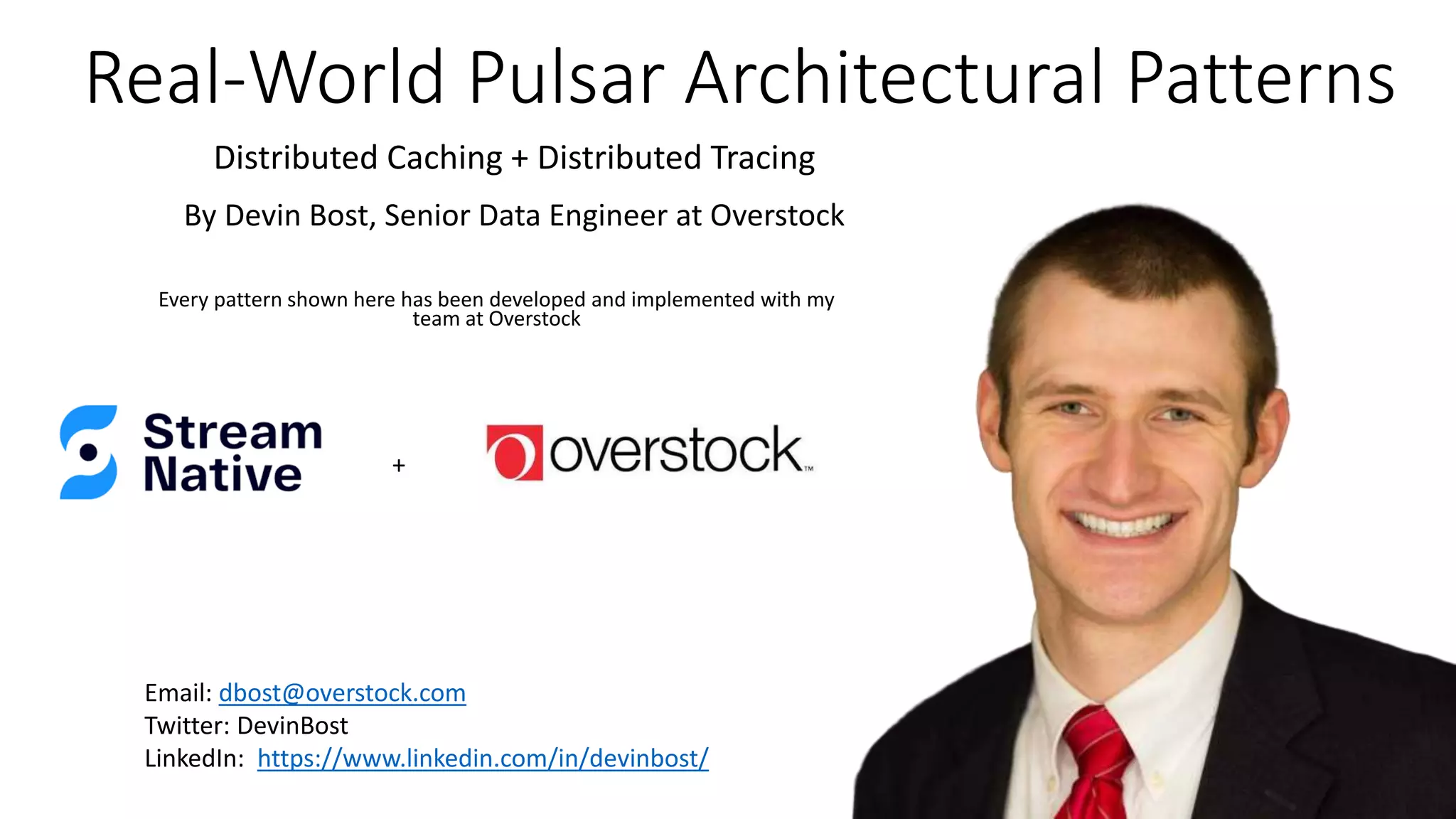


Real-World Pulsar Architectural Patterns
Every pattern shown here has been developed and implemented with my
team at Overstock
Email: dbost@overstock.com
Twitter: DevinBost
LinkedIn: https://www.linkedin.com/in/devinbost/
By Devin Bost, Senior Data Engineer at Overstock
Distributed Caching + Distributed Tracing
+
Missing Stephen Bourke in Ireland and Sam Lowen, our new product manager.
Disclaimer: I’m assuming you
already know that Apache Pulsar is
the future of real-time messaging
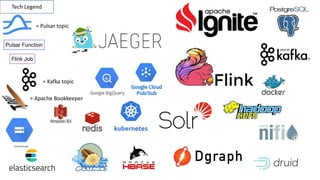
= Pulsar topic
= Kafka topic
= Apache Bookkeeper
Tech Legend
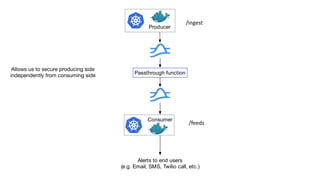
Starting simple with Pub/Sub
Producer
Consumer
Alerts to end users
(e.g. Email, SMS, Twilio call, etc.)
Passthrough function
/ingest
/feeds
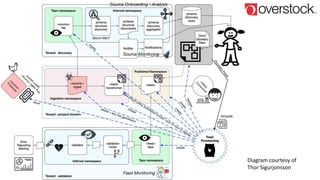
Diagram courtesy of
Thor Sigurjonsson
Producer Producer Producer
Consumer Consumer Consumer
Alerts to end users
(e.g. Email, SMS, Twilio call, etc.)
Passthrough function
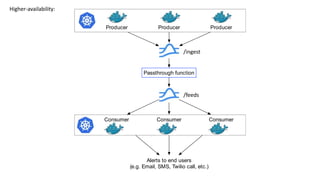
Higher-availability:
/ingest
/feeds
Producer Producer Producer
Consumer Consumer Consumer
Passthrough function
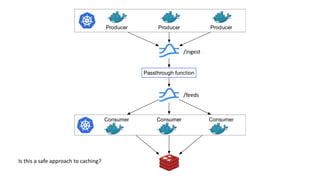
Is this a safe approach to caching?
/ingest
/feeds
Producer Producer Producer
Consumer Consumer Consumer
Passthrough function
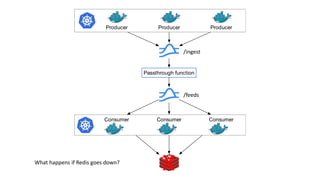
What happens if Redis goes down?
X
/ingest
/feeds
Producer Producer Producer
Consumer Consumer Consumer
Passthrough function
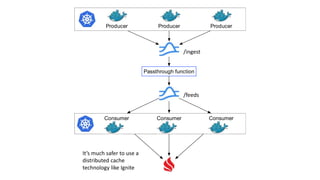
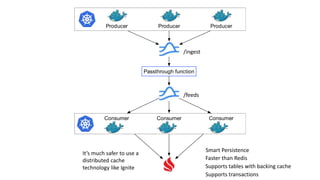
It’s much safer to use a
distributed cache
technology like Ignite
/ingest
/feeds
Producer Producer Producer
Consumer Consumer Consumer
Passthrough function
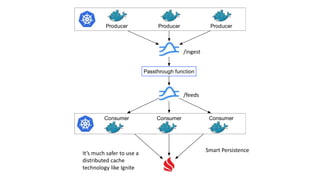
It’s much safer to use a
distributed cache
technology like Ignite
Smart Persistence
/ingest
/feeds
Producer Producer Producer
Consumer Consumer Consumer
Passthrough function
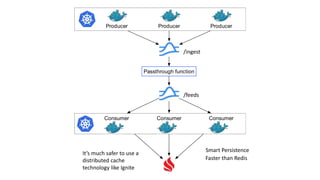
It’s much safer to use a
distributed cache
technology like Ignite
Smart Persistence
Faster than Redis
/ingest
/feeds
Producer Producer Producer
Consumer Consumer Consumer
Passthrough function
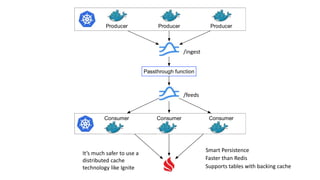
It’s much safer to use a
distributed cache
technology like Ignite
Smart Persistence
Faster than Redis
Supports tables with backing cache
/ingest
/feeds
Producer Producer Producer
Consumer Consumer Consumer
Passthrough function
It’s much safer to use a
distributed cache
technology like Ignite
Smart Persistence
Faster than Redis
Supports tables with backing cache
Supports transactions
/ingest
/feeds
What if you have a business-
critical service that can’t lose
messages?
“But, doesn’t Pulsar already
guarantee that messages
won’t be lost?”
There’s a difference between
Pulsar losing messages and your
application losing messages!
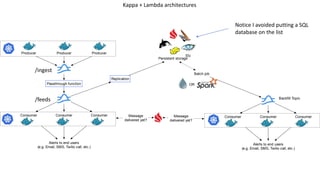
So, we introduce a backfill path.
Notice I avoided putting a SQL
database on the list
Replication
Persistent storage
Producer Producer Producer
Consumer Consumer Consumer
Alerts to end users
(e.g. Email, SMS, Twilio call, etc.)
Passthrough function
Batch job
Backfill Topic
Consumer Consumer Consumer
Alerts to end users
(e.g. Email, SMS, Twilio call, etc.)
OR
Etc
Message
delivered yet?
Message
delivered yet?
Kappa + Lambda architectures
/ingest
/feeds
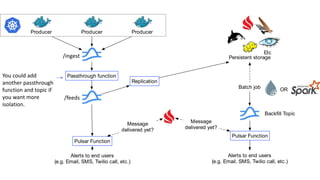
Can we simplify it?
Replication
Persistent storage
Pulsar Function
Alerts to end users
(e.g. Email, SMS, Twilio call, etc.)
Alerts to end users
(e.g. Email, SMS, Twilio call, etc.)
Batch job OR
Etc
Producer Producer Producer
Passthrough function
Backfill Topic
Pulsar Function
Message
delivered yet?
Message
delivered yet?
You could add
another passthrough
function and topic if
you want more
isolation.
/ingest
/feeds
How about just for ingesting
data into a cache with a
backfill?
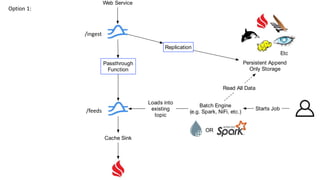
Option 1:
Web Service
Passthrough
Function
Persistent Append
Only Storage
Cache Sink
Batch Engine
(e.g. Spark, NiFi, etc.)
Read All Data
Loads into
existing
topic
OR
Starts Job
Etc
Replication
/ingest
/feeds
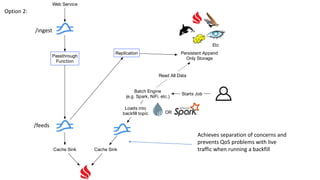
Option 2:
Achieves separation of concerns and
prevents QoS problems with live
traffic when running a backfill
Web Service
Passthrough
Function
Cache Sink
Batch Engine
(e.g. Spark, NiFi, etc.)
Loads into
backfill topic OR
Starts Job
Cache Sink
Persistent Append
Only Storage
Read All Data
Etc
Replication
/ingest
/feeds
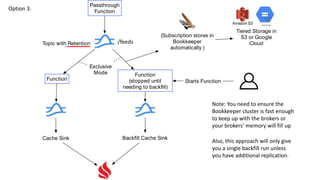
Topic with Retention
Function
Cache Sink
Function
(stopped until
needing to backfill)
Exclusive
Mode
(Subscription stores in
Bookkeeper
automatically.)
Tiered Storage in
S3 or Google
Cloud
Backfill Cache Sink
Starts Function
Passthrough
FunctionOption 3:
Note: You need to ensure the
Bookkeeper cluster is fast enough
to keep up with the brokers or
your brokers’ memory will fill up
Also, this approach will only give
you a single backfill run unless
you have additional replication.
/feeds
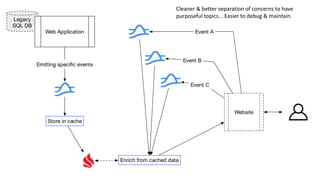
What about adding caching to
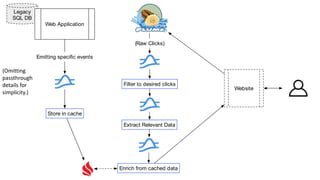
a legacy application?
Legacy
SQL DB
Website
Enrich from cached data
Extract Relevant Data
Filter to desired clicks
(Raw Clicks)
Store in cache
Web Application
Emitting specific events
(Omitting
passthrough
details for
simplicity.)
Legacy
SQL DB
Website
Enrich from cached data
Extract Relevant Data
Filter to desired clicks
Store in cache
Web Application
Emitting specific events
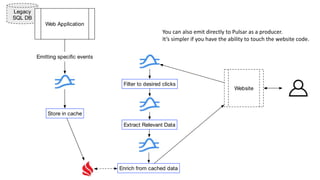
You can also emit directly to Pulsar as a producer.
It’s simpler if you have the ability to touch the website code.
Legacy
SQL DB
Website
Enrich from cached data
Extract Relevant Data
Filter to desired clicks
Store in cache
Web Application
Emitting specific events
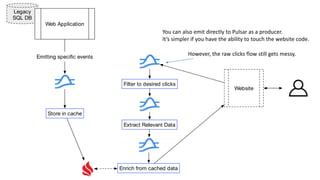
You can also emit directly to Pulsar as a producer.
It’s simpler if you have the ability to touch the website code.
However, the raw clicks flow still gets messy.
Legacy
SQL DB
Website
Enrich from cached data
Store in cache
Web Application
Emitting specific events
Event A
Event B
Event C
Cleaner & better separation of concerns to have
purposeful topics... Easier to debug & maintain.
What if you’re using a graph engine
for more complex query logic but
need that data in real-time?
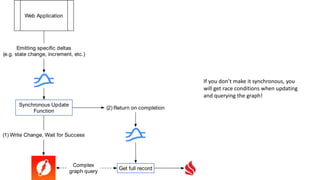
If you don’t make it synchronous, you
will get race conditions when updating
and querying the graph!
Web Application
Emitting specific deltas
(e.g. state change, increment, etc.)
(2) Return on completion
(1) Write Change, Wait for Success
Get full record
Complex
graph query
Synchronous Update
Function
What if you need a more robust verification that deltas are in
order and aren’t duplicates?
(e.g. financially impacting increment/decrement values or
state variables)
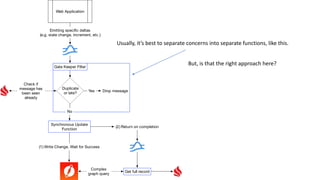
Usually, it’s best to separate concerns into separate functions, like this.
Web Application
Emitting specific deltas
(e.g. state change, increment, etc.)
(2) Return on completion
(1) Write Change, Wait for Success
Get full record
Complex
graph query
Synchronous Update
Function
Gate Keeper Filter
Check if
message has
been seen
already
Duplicate
or late?
Drop messageYes
No
But, is that the right approach here?
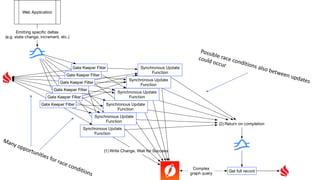
What happens when you turn
up parallelism on the
functions?
Web Application
Emitting specific deltas
(e.g. state change, increment, etc.)
(2) Return on completion
(1) Write Change, Wait for Success
Get full record
Complex
graph query
Synchronous Update
Function
Synchronous Update
Function
Synchronous Update
Function
Synchronous Update
Function
Synchronous Update
Function
Synchronous Update
Function
Gate Keeper Filter
Gate Keeper Filter
Gate Keeper Filter
Gate Keeper Filter
Gate Keeper Filter
Gate Keeper Filter
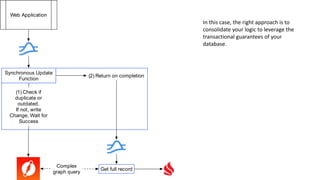
In this case, the right approach is to
consolidate your logic to leverage the
transactional guarantees of your
database.
Web Application
(2) Return on completion
(1) Check if
duplicate or
outdated.
If not, write
Change, Wait for
Success
Get full record
Complex
graph query
Synchronous Update
Function
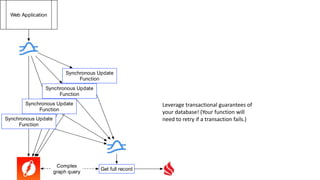
Leverage transactional guarantees of
your database! (Your function will
need to retry if a transaction fails.)
Web Application
Get full record
Complex
graph query
Synchronous Update
Function
Synchronous Update
Function
Synchronous Update
Function
Synchronous Update
Function
Leverage transactional guarantees of
your database! (Your function will
need to retry if a transaction fails.)
Web Application
Get full record
Complex
graph query
Synchronous Update
Function
Synchronous Update
Function
Synchronous Update
Function
Synchronous Update
Function
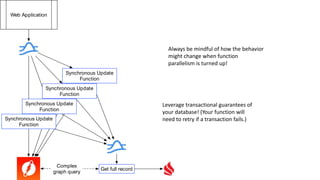
Always be mindful of how the behavior
might change when function
parallelism is turned up!
Leverage transactional guarantees of
your database! (Your function will
need to retry if a transaction fails.)
Web Application
Get full record
Complex
graph query
Synchronous Update
Function
Synchronous Update
Function
Synchronous Update
Function
Synchronous Update
Function
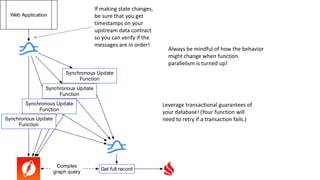
Always be mindful of how the behavior
might change when function
parallelism is turned up!
If making state changes,
be sure that you get
timestamps on your
upstream data contract
so you can verify if the
messages are in order!
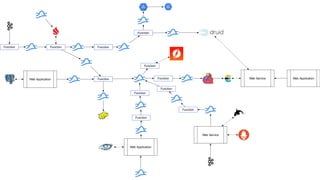
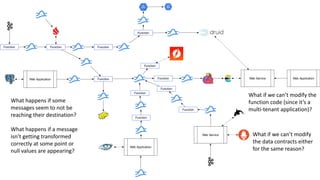
Now, what happens when you
need to debug a large or
complex function flow?
FunctionFunction
Function
Web Application Function
Web Service
Web Application
Function
Function
Web Service Web Application
FunctionFunction
Function
Function
Function
Function
FunctionFunction
Function
Web Application Function
Web Service
Web Application
Function
Function
Web Service Web Application
FunctionFunction
Function
Function
Function
Function
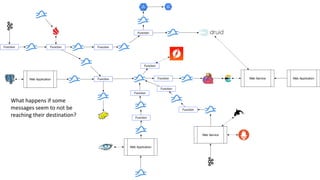
What happens if some
messages seem to not be
reaching their destination?
FunctionFunction
Function
Web Application Function
Web Service
Web Application
Function
Function
Web Service Web Application
FunctionFunction
Function
Function
Function
Function
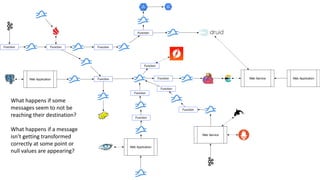
What happens if some
messages seem to not be
reaching their destination?
What happens if a message
isn’t getting transformed
correctly at some point or
null values are appearing?
FunctionFunction
Function
Web Application Function
Web Service
Web Application
Function
Function
Web Service Web Application
FunctionFunction
Function
Function
Function
Function
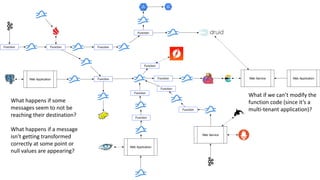
What happens if some
messages seem to not be
reaching their destination?
What happens if a message
isn’t getting transformed
correctly at some point or
null values are appearing?
What if we can’t modify the
function code (since it’s a
multi-tenant application)?
FunctionFunction
Function
Web Application Function
Web Service
Web Application
Function
Function
Web Service Web Application
FunctionFunction
Function
Function
Function
Function
What happens if some
messages seem to not be
reaching their destination?
What happens if a message
isn’t getting transformed
correctly at some point or
null values are appearing?
What if we can’t modify
the data contracts either
for the same reason?
What if we can’t modify the
function code (since it’s a
multi-tenant application)?
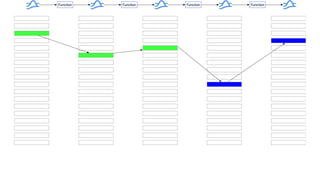
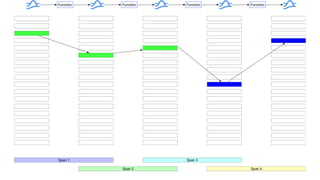
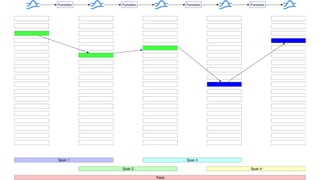
Function Function Function Function
Span 1
Span 2
Span 3
Span 4
Span 1
Trace
Function Function Function Function
Span 1
Span 2
Span 3
Span 4
Span 1
Trace
Function Function Function Function
Span 1
Span 2
Span 3
Span 4
Span 1
Trace
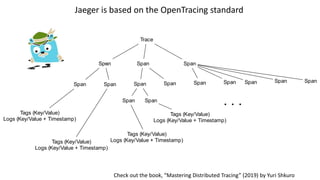
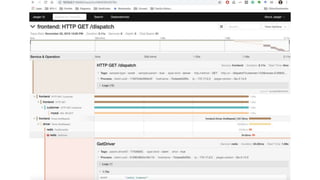
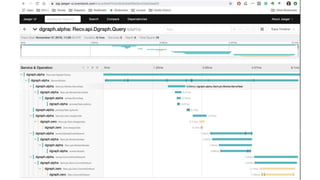
Jaeger is based on the OpenTracing standard
Check out the book, “Mastering Distributed Tracing” (2019) by Yuri Shkuro
Trace
Span Span Span
Span Span Span Span Span Span Span SpanSpan
Tags (Key/Value)
Logs (Key/Value + Timestamp)
Tags (Key/Value)
Logs (Key/Value + Timestamp)
Tags (Key/Value)
Logs (Key/Value + Timestamp)
. . .Span Span
Tags (Key/Value)
Logs (Key/Value + Timestamp)
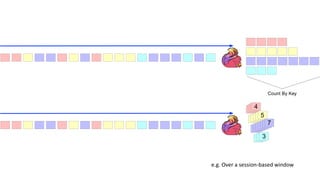
4
5
7
3
Count By Key
e.g. Over a session-based window
+ + + OR
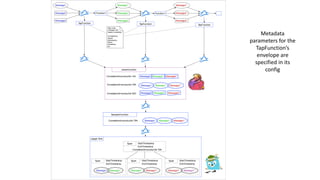
Metadata
parameters for the
TapFunction’s
envelope are
specified in its
config
Message1
Message2
Message3
Message1’
Message2’
Message3’
Message1’’
Message2’’
Message3’’
. . .Function1 Function1
JoinerFunction
Message2 Message2’ Message2’’
CorrelationId=productId-784 Message1 Message1’ Message1’’
CorrelationId=productId-142
Message3 Message3’ Message3’’CorrelationId=productId-923
Jaeger Sink
Taps wrap
message with
header containing:
CorrelationId,
Tenant,
Namespace,
Name,
timestamp,
etc.
TapFunction TapFunction TapFunction
SamplerFunction
CorrelationId=productId-784 Message1 Message1’ Message1’’
StartTimestamp
EndTimestamp
Span
CorrelationId=productId-784
StartTimestamp
EndTimestamp
Span
Message1
StartTimestamp
EndTimestamp
Span
Message1’
StartTimestamp
EndTimestamp
Span
Message1’’Message1’ Message1’’ Message1’’’
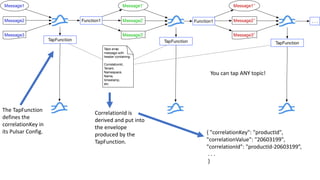
CorrelationId is
derived and put into
the envelope
produced by the
TapFunction.
{ "correlationKey": "productId",
"correlationValue": "20603199",
"correlationId": "productId-20603199”,
. . .
}
The TapFunction
defines the
correlationKey in
its Pulsar Config.
You can tap ANY topic!
Message1
Message2
Message3
Message1’
Message2’
Message3’
Message1’’
Message2’’
Message3’’
. . .Function1 Function1
Taps wrap
message with
header containing:
CorrelationId,
Tenant,
Namespace,
Name,
timestamp,
etc.
TapFunction TapFunction TapFunction
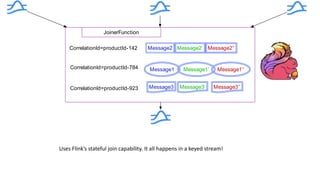
Uses Flink’s stateful join capability. It all happens in a keyed stream!
JoinerFunction
Message2 Message2’ Message2’’
CorrelationId=productId-784 Message1 Message1’ Message1’’
CorrelationId=productId-142
Message3 Message3’ Message3’’CorrelationId=productId-923
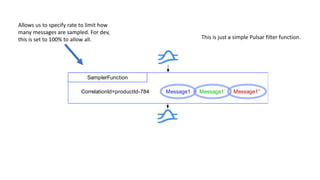
Allows us to specify rate to limit how
many messages are sampled. For dev,
this is set to 100% to allow all. This is just a simple Pulsar filter function.
SamplerFunction
CorrelationId=productId-784 Message1 Message1’ Message1’’
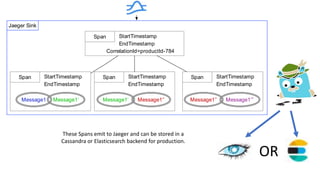
These Spans emit to Jaeger and can be stored in a
Cassandra or Elasticsearch backend for production.
OR
Jaeger Sink
StartTimestamp
EndTimestamp
Span
CorrelationId=productId-784
StartTimestamp
EndTimestamp
Span
Message1
StartTimestamp
EndTimestamp
Span
Message1’
StartTimestamp
EndTimestamp
Span
Message1’’Message1’ Message1’’ Message1’’’
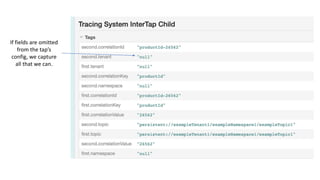
If fields are omitted
from the tap’s
config, we capture
all that we can.
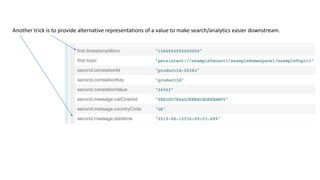
Another trick is to provide alternative representations of a value to make search/analytics easier downstream.
Questions?
Real-World Pulsar Architectural Patterns
Every pattern shown here has been developed and implemented with my
team at Overstock
Email: dbost@overstock.com
Twitter: DevinBost
LinkedIn: https://www.linkedin.com/in/devinbost/
By Devin Bost, Senior Data Engineer at Overstock
Distributed Caching + Distributed Tracing

Real-World Pulsar Architectural Patterns

  • 1.
    Real-World Pulsar ArchitecturalPatterns Every pattern shown here has been developed and implemented with my team at Overstock Email: dbost@overstock.com Twitter: DevinBost LinkedIn: https://www.linkedin.com/in/devinbost/ By Devin Bost, Senior Data Engineer at Overstock Distributed Caching + Distributed Tracing +
  • 2.
    Missing Stephen Bourkein Ireland and Sam Lowen, our new product manager.
  • 3.
    Disclaimer: I’m assumingyou already know that Apache Pulsar is the future of real-time messaging
  • 4.
    = Pulsar topic =Kafka topic = Apache Bookkeeper Tech Legend
  • 5.
  • 6.
  • 7.
  • 8.
  • 9.
    Producer Consumer Alerts to endusers (e.g. Email, SMS, Twilio call, etc.) Passthrough function /ingest /feeds
  • 10.
  • 11.
    Producer Producer Producer ConsumerConsumer Consumer Alerts to end users (e.g. Email, SMS, Twilio call, etc.) Passthrough function Higher-availability: /ingest /feeds
  • 12.
    Producer Producer Producer ConsumerConsumer Consumer Passthrough function Is this a safe approach to caching? /ingest /feeds
  • 13.
    Producer Producer Producer ConsumerConsumer Consumer Passthrough function What happens if Redis goes down? X /ingest /feeds
  • 14.
    Producer Producer Producer ConsumerConsumer Consumer Passthrough function It’s much safer to use a distributed cache technology like Ignite /ingest /feeds
  • 15.
    Producer Producer Producer ConsumerConsumer Consumer Passthrough function It’s much safer to use a distributed cache technology like Ignite Smart Persistence /ingest /feeds
  • 16.
    Producer Producer Producer ConsumerConsumer Consumer Passthrough function It’s much safer to use a distributed cache technology like Ignite Smart Persistence Faster than Redis /ingest /feeds
  • 17.
    Producer Producer Producer ConsumerConsumer Consumer Passthrough function It’s much safer to use a distributed cache technology like Ignite Smart Persistence Faster than Redis Supports tables with backing cache /ingest /feeds
  • 18.
    Producer Producer Producer ConsumerConsumer Consumer Passthrough function It’s much safer to use a distributed cache technology like Ignite Smart Persistence Faster than Redis Supports tables with backing cache Supports transactions /ingest /feeds
  • 19.
    What if youhave a business- critical service that can’t lose messages?
  • 20.
    “But, doesn’t Pulsaralready guarantee that messages won’t be lost?”
  • 21.
    There’s a differencebetween Pulsar losing messages and your application losing messages!
  • 22.
    So, we introducea backfill path.
  • 23.
    Notice I avoidedputting a SQL database on the list Replication Persistent storage Producer Producer Producer Consumer Consumer Consumer Alerts to end users (e.g. Email, SMS, Twilio call, etc.) Passthrough function Batch job Backfill Topic Consumer Consumer Consumer Alerts to end users (e.g. Email, SMS, Twilio call, etc.) OR Etc Message delivered yet? Message delivered yet? Kappa + Lambda architectures /ingest /feeds
  • 24.
  • 25.
    Replication Persistent storage Pulsar Function Alertsto end users (e.g. Email, SMS, Twilio call, etc.) Alerts to end users (e.g. Email, SMS, Twilio call, etc.) Batch job OR Etc Producer Producer Producer Passthrough function Backfill Topic Pulsar Function Message delivered yet? Message delivered yet? You could add another passthrough function and topic if you want more isolation. /ingest /feeds
  • 26.
    How about justfor ingesting data into a cache with a backfill?
  • 27.
    Option 1: Web Service Passthrough Function PersistentAppend Only Storage Cache Sink Batch Engine (e.g. Spark, NiFi, etc.) Read All Data Loads into existing topic OR Starts Job Etc Replication /ingest /feeds
  • 28.
    Option 2: Achieves separationof concerns and prevents QoS problems with live traffic when running a backfill Web Service Passthrough Function Cache Sink Batch Engine (e.g. Spark, NiFi, etc.) Loads into backfill topic OR Starts Job Cache Sink Persistent Append Only Storage Read All Data Etc Replication /ingest /feeds
  • 29.
    Topic with Retention Function CacheSink Function (stopped until needing to backfill) Exclusive Mode (Subscription stores in Bookkeeper automatically.) Tiered Storage in S3 or Google Cloud Backfill Cache Sink Starts Function Passthrough FunctionOption 3: Note: You need to ensure the Bookkeeper cluster is fast enough to keep up with the brokers or your brokers’ memory will fill up Also, this approach will only give you a single backfill run unless you have additional replication. /feeds
  • 30.
    What about addingcaching to a legacy application?
  • 31.
    Legacy SQL DB Website Enrich fromcached data Extract Relevant Data Filter to desired clicks (Raw Clicks) Store in cache Web Application Emitting specific events (Omitting passthrough details for simplicity.)
  • 32.
    Legacy SQL DB Website Enrich fromcached data Extract Relevant Data Filter to desired clicks Store in cache Web Application Emitting specific events You can also emit directly to Pulsar as a producer. It’s simpler if you have the ability to touch the website code.
  • 33.
    Legacy SQL DB Website Enrich fromcached data Extract Relevant Data Filter to desired clicks Store in cache Web Application Emitting specific events You can also emit directly to Pulsar as a producer. It’s simpler if you have the ability to touch the website code. However, the raw clicks flow still gets messy.
  • 34.
    Legacy SQL DB Website Enrich fromcached data Store in cache Web Application Emitting specific events Event A Event B Event C Cleaner & better separation of concerns to have purposeful topics... Easier to debug & maintain.
  • 35.
    What if you’reusing a graph engine for more complex query logic but need that data in real-time?
  • 36.
    If you don’tmake it synchronous, you will get race conditions when updating and querying the graph! Web Application Emitting specific deltas (e.g. state change, increment, etc.) (2) Return on completion (1) Write Change, Wait for Success Get full record Complex graph query Synchronous Update Function
  • 37.
    What if youneed a more robust verification that deltas are in order and aren’t duplicates? (e.g. financially impacting increment/decrement values or state variables)
  • 38.
    Usually, it’s bestto separate concerns into separate functions, like this. Web Application Emitting specific deltas (e.g. state change, increment, etc.) (2) Return on completion (1) Write Change, Wait for Success Get full record Complex graph query Synchronous Update Function Gate Keeper Filter Check if message has been seen already Duplicate or late? Drop messageYes No But, is that the right approach here?
  • 39.
    What happens whenyou turn up parallelism on the functions?
  • 40.
    Web Application Emitting specificdeltas (e.g. state change, increment, etc.) (2) Return on completion (1) Write Change, Wait for Success Get full record Complex graph query Synchronous Update Function Synchronous Update Function Synchronous Update Function Synchronous Update Function Synchronous Update Function Synchronous Update Function Gate Keeper Filter Gate Keeper Filter Gate Keeper Filter Gate Keeper Filter Gate Keeper Filter Gate Keeper Filter
  • 41.
    In this case,the right approach is to consolidate your logic to leverage the transactional guarantees of your database. Web Application (2) Return on completion (1) Check if duplicate or outdated. If not, write Change, Wait for Success Get full record Complex graph query Synchronous Update Function
  • 42.
    Leverage transactional guaranteesof your database! (Your function will need to retry if a transaction fails.) Web Application Get full record Complex graph query Synchronous Update Function Synchronous Update Function Synchronous Update Function Synchronous Update Function
  • 43.
    Leverage transactional guaranteesof your database! (Your function will need to retry if a transaction fails.) Web Application Get full record Complex graph query Synchronous Update Function Synchronous Update Function Synchronous Update Function Synchronous Update Function Always be mindful of how the behavior might change when function parallelism is turned up!
  • 44.
    Leverage transactional guaranteesof your database! (Your function will need to retry if a transaction fails.) Web Application Get full record Complex graph query Synchronous Update Function Synchronous Update Function Synchronous Update Function Synchronous Update Function Always be mindful of how the behavior might change when function parallelism is turned up! If making state changes, be sure that you get timestamps on your upstream data contract so you can verify if the messages are in order!
  • 45.
    Now, what happenswhen you need to debug a large or complex function flow?
  • 46.
    FunctionFunction Function Web Application Function WebService Web Application Function Function Web Service Web Application FunctionFunction Function Function Function Function
  • 47.
    FunctionFunction Function Web Application Function WebService Web Application Function Function Web Service Web Application FunctionFunction Function Function Function Function What happens if some messages seem to not be reaching their destination?
  • 48.
    FunctionFunction Function Web Application Function WebService Web Application Function Function Web Service Web Application FunctionFunction Function Function Function Function What happens if some messages seem to not be reaching their destination? What happens if a message isn’t getting transformed correctly at some point or null values are appearing?
  • 49.
    FunctionFunction Function Web Application Function WebService Web Application Function Function Web Service Web Application FunctionFunction Function Function Function Function What happens if some messages seem to not be reaching their destination? What happens if a message isn’t getting transformed correctly at some point or null values are appearing? What if we can’t modify the function code (since it’s a multi-tenant application)?
  • 50.
    FunctionFunction Function Web Application Function WebService Web Application Function Function Web Service Web Application FunctionFunction Function Function Function Function What happens if some messages seem to not be reaching their destination? What happens if a message isn’t getting transformed correctly at some point or null values are appearing? What if we can’t modify the data contracts either for the same reason? What if we can’t modify the function code (since it’s a multi-tenant application)?
  • 51.
    Function Function FunctionFunction Span 1 Span 2 Span 3 Span 4 Span 1 Trace
  • 52.
    Function Function FunctionFunction Span 1 Span 2 Span 3 Span 4 Span 1 Trace
  • 53.
    Function Function FunctionFunction Span 1 Span 2 Span 3 Span 4 Span 1 Trace
  • 54.
    Jaeger is basedon the OpenTracing standard Check out the book, “Mastering Distributed Tracing” (2019) by Yuri Shkuro Trace Span Span Span Span Span Span Span Span Span Span SpanSpan Tags (Key/Value) Logs (Key/Value + Timestamp) Tags (Key/Value) Logs (Key/Value + Timestamp) Tags (Key/Value) Logs (Key/Value + Timestamp) . . .Span Span Tags (Key/Value) Logs (Key/Value + Timestamp)
  • 57.
    4 5 7 3 Count By Key e.g.Over a session-based window
  • 58.
  • 59.
    Metadata parameters for the TapFunction’s envelopeare specified in its config Message1 Message2 Message3 Message1’ Message2’ Message3’ Message1’’ Message2’’ Message3’’ . . .Function1 Function1 JoinerFunction Message2 Message2’ Message2’’ CorrelationId=productId-784 Message1 Message1’ Message1’’ CorrelationId=productId-142 Message3 Message3’ Message3’’CorrelationId=productId-923 Jaeger Sink Taps wrap message with header containing: CorrelationId, Tenant, Namespace, Name, timestamp, etc. TapFunction TapFunction TapFunction SamplerFunction CorrelationId=productId-784 Message1 Message1’ Message1’’ StartTimestamp EndTimestamp Span CorrelationId=productId-784 StartTimestamp EndTimestamp Span Message1 StartTimestamp EndTimestamp Span Message1’ StartTimestamp EndTimestamp Span Message1’’Message1’ Message1’’ Message1’’’
  • 60.
    CorrelationId is derived andput into the envelope produced by the TapFunction. { "correlationKey": "productId", "correlationValue": "20603199", "correlationId": "productId-20603199”, . . . } The TapFunction defines the correlationKey in its Pulsar Config. You can tap ANY topic! Message1 Message2 Message3 Message1’ Message2’ Message3’ Message1’’ Message2’’ Message3’’ . . .Function1 Function1 Taps wrap message with header containing: CorrelationId, Tenant, Namespace, Name, timestamp, etc. TapFunction TapFunction TapFunction
  • 61.
    Uses Flink’s statefuljoin capability. It all happens in a keyed stream! JoinerFunction Message2 Message2’ Message2’’ CorrelationId=productId-784 Message1 Message1’ Message1’’ CorrelationId=productId-142 Message3 Message3’ Message3’’CorrelationId=productId-923
  • 62.
    Allows us tospecify rate to limit how many messages are sampled. For dev, this is set to 100% to allow all. This is just a simple Pulsar filter function. SamplerFunction CorrelationId=productId-784 Message1 Message1’ Message1’’
  • 63.
    These Spans emitto Jaeger and can be stored in a Cassandra or Elasticsearch backend for production. OR Jaeger Sink StartTimestamp EndTimestamp Span CorrelationId=productId-784 StartTimestamp EndTimestamp Span Message1 StartTimestamp EndTimestamp Span Message1’ StartTimestamp EndTimestamp Span Message1’’Message1’ Message1’’ Message1’’’
  • 65.
    If fields areomitted from the tap’s config, we capture all that we can.
  • 66.
    Another trick isto provide alternative representations of a value to make search/analytics easier downstream.
  • 67.
  • 68.
    Real-World Pulsar ArchitecturalPatterns Every pattern shown here has been developed and implemented with my team at Overstock Email: dbost@overstock.com Twitter: DevinBost LinkedIn: https://www.linkedin.com/in/devinbost/ By Devin Bost, Senior Data Engineer at Overstock Distributed Caching + Distributed Tracing