2012 THIRD-PARTY LOGISTICS STUDY
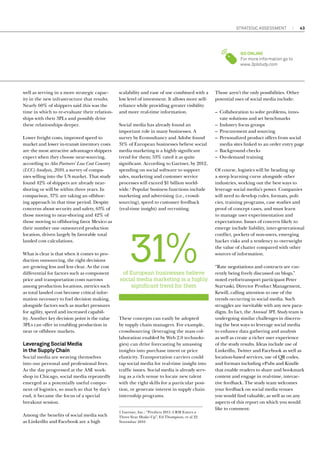
The State of Logistics Outsourcing

Results and Findings of the 16th Annual Study
2012 16Th AnnuAL ThIRD-PARTY LOGISTICS STuDY

Contents

4

Executive Summary

7

Current State of the 3PL Market

15

Emerging Markets

23

Electronics

33

Talent Management

41

Strategic Assessment

44

About the Study

48

About the Sponsors

50

Credits

GIVE US YOUR OPINION
Scan this code and share your
suggestions for topics to cover
in next year’s study.

©2012 C. John Langley, Jr., Ph.D., and Capgemini. All Rights Reserved.
no part of this document may be reproduced, displayed, modified or
distributed by any process or means without prior written permission
from Capgemini. Rightshore ® is a trademark belonging to Capgemini.
www.3plstudy.com

Balance is the state of equilibrium — a continuous and sometimes evasive quest for supply
chain executives — and the theme of this report. Whether they’re exploring emerging markets,
navigating the challenges of the electronics supply chain or in finding the right talent, attaining
equal and satisfactory distribution of resources is an ongoing challenge.

Supporting
Organizations
4

2012 16th annual THIRD-PARTY LOGISTICS study

Executive Summary

This report presents findings
of the 2012 16th Annual ThirdParty Logistics Study, based
on research conducted in
mid-2011. In addition to documenting the ongoing evolution
of the third-party logistics
market, this year’s report also
takes a close-up look at three
special topics:
–– The logistics of operating in
emerging markets
–– The unique challenges facing
the electronics supply chain
–– For the first time in the
study’s history, the report
considers the implications of
talent in the supply chain and
in shipper-3PL relationships
Effective with this report, we
are branding each Annual 3PL
Study in terms of its first full
year of circulation following
the report’s annual October
release. Therefore, this report
constitutes the 2012 3PL Study.

Current State of the Market

Emerging Markets

Survey responses from 1,561 industry executives and managers representing users and
non-users of 3PL services, as well as responses from 697 3PL executives and managers,
confirm that 3PLs continue to provide strategic
and operational value, provide new and innovative ways to improve logistics effectiveness
and are key contributors to shippers’ overall
business success. Total logistics expenditures
represent an average of 12% of shippers’ sales
revenues, and of this, an average 42% is devoted to outsourcing. Metrics relating to logistics
cost reduction, inventory cost reduction, and
logistics fixed asset reduction remain consistent with the two previous years’ studies.

A substantial 80% of shippers and 77% of
3PLs in the survey conduct business with or
within an emerging country — nations with
economies that are experiencing rapid growth
through industrialization. China, India, Brazil
and Mexico are considered top emerging market opportunities by survey respondents.

A majority of shipper respondents, 64%, are
increasing their use of 3PL services, while
24% are returning to insourcing some 3PL
services and 58% report they are reducing
or consolidating the number of 3PLs they
use. Logistics activities most frequently outsourced continue to include those that are
more transactional, operational and repetitive, while those that are more strategic,
customer-facing and IT-intensive tend to be
less frequently outsourced. A similar phenomenon is present in expectations of 3PLs’
IT capabilities; execution-oriented activities
and processes such as transportation and
warehouse/DC management-related IT capabilities are more in demand than those that
are more strategic and analytical.
3PLs continue to rank their relationships
with shippers a bit higher than shippers
do, but the vast majority (88% of shippers
and 94% of 3PLs) view their relationships
as successful. Openness, transparency,
and good communication as well as agility
and flexibility contribute to this success.
Interestingly, figures from this year’s study
suggest decreases in the use of gainsharing and collaboration.

Operational difficulties, including logistics
challenges, threaten to erode the potential
benefits associated with doing business with
or within emerging markets. For shippers
based in mature markets, difficult laws and
regulations, cultural differences, the ability
to deliver against promises or agreed-to service levels and complicated tax regimes top
the list of challenges.
Brazil is representative of the risk/reward
challenges that are posed by an emerging economy. Government investment in
infrastructure, as well as tax reductions
and participation in the Mercosur free trade
agreement, have contributed to the fast
growth that has attracted global manufacturers and 3PLs. But companies moving into
Brazil face the very challenges shippers cite.
Indeed, entering any new market requires
due diligence; when it’s an emerging market, it’s even more critical. More than half of
shippers based in both mature and emerging
markets agree that a global 3PL coordinating
with a local 3PL is the most successful operating model for 3PLs operating with or within
an emerging market.
The 3PL capabilities shippers most value
when entering emerging markets are visibility,
expertise on the latest global trade regulations and managing and optimizing shipment
routing based on free trade agreement (FTA)
knowledge. Those participating in workshops
supporting the study also added proactive
consulting services, local insight and expertise and integrated solutions to that list. The
majority of shippers in mature and emerging
markets call 3PLs’ knowledge of FTAs very
important (65% and 73%, respectively).
EXECUTIVE SUMMARY

5

Electronics 	

Talent Management

Strategic Assessment

Electronics products can be highly popular,
but along with enviable demand comes pressure to make products smaller, faster, cooler
and at a lower price point. Hitting these targets demands a fast and nimble supply chain.

Despite the supply chain’s role as a significant
contributor to attaining strategic business
goals, the logistics industry is experiencing
a shortage of capable and well-rounded supply chain managers prepared to step into key
management positions. This can be overcome
by developing programs for talent management — the vigorous, systematic process of
connecting a clear, well-defined business
strategy to the recruitment, retention and
development of talent.

Constantly changing economic and political
dynamics necessitate continual re-evaluation of supply chain directions. Inspired by
the findings of this year’s study, in this strategic assessment, the study team examines
several trends spurring yet more change and
innovation in the supply chain world.

Increasing pressure to lower costs and manage material and suppliers more efficiently
has triggered a preference among electronics
companies for asset lightness, outsourcing
both production and logistics, especially in
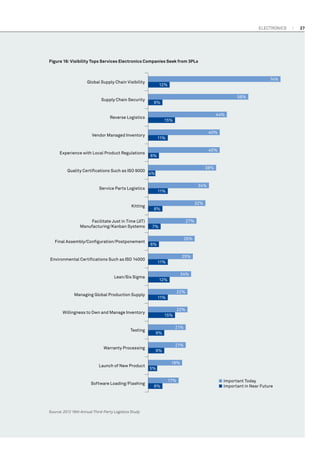
emerging markets. Shippers call price pressure to reduce operating costs their top
logistics challenge (59%), but electronics
manufacturers also wrestle with other issues
incurred by a long, thin supply chain, employing strategies such as postponement.
The electronics industry is notoriously dis­
integrated, with multiple players involved in
the supply chain and a high rate of mergers
and acquisitions. Further complicating matters, electronics companies sell into many vertical markets, each with its own unique needs.
Multiple layers, supply constraints, mashedtogether supply chains and the specific challenges of retail channels introduce cost,
safety stock, forecast challenges and additional time into logistics processes. Another
challenge is to design a common, cost-efficient infrastructure across supply chains.
Because electronics products are often
high value, they pose challenges including
assuring security, preventing counterfeit and packaging sufficiently to handle
long‑distance transportation. Short lifecycles combined with the challenges of
accurately forecasting demand also mean
inventory obsolescence is a significant
problem, leading electronics companies to
seek solutions such as on-line auctions.
Unfortunately, electronics shippers give
low marks to 3PLs’ ability to solve their top
logistics challenges. The largest gaps occur
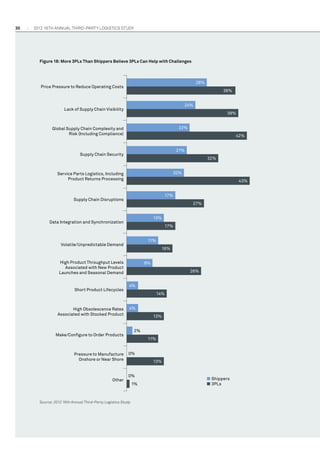
on their highest priorities: for example, 59%
regard price pressure to reduce operating
costs as their top challenge, while just 28%
believe 3PLs can help them with this challenge. 3PLs need to do a better job of selling
the quality and value of their capabilities to
electronics customers, and shippers need to
be more open to collaborating with 3PLs to
address their top challenges.

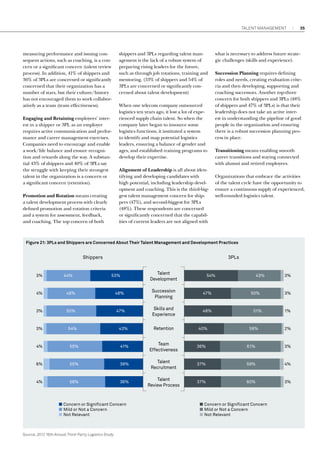
Many shippers and 3PLs are troubled by the
current state of talent management within
their organizations, with promotion and rotation practices and identifying and developing
leaders the top concerns.
As supply chains grow more complex and
intrinsic to a company’s ability to attain its
business goals, they require leaders who are
more diverse and multi-faceted. A significant number of shippers and 3PLs feel their
current leaders don’t have what it takes
to address future business challenges.
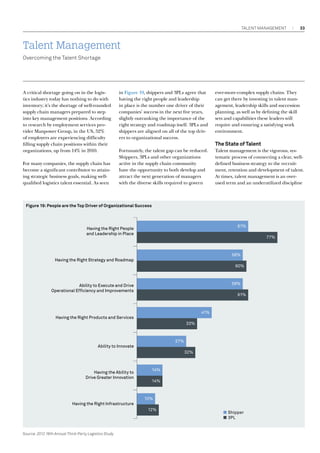
Shippers and 3PLs most highly value operational execution (51% and 60%) followed
by people management and development
skills (54% and 43%) in their leaders.
Today’s supply chain leaders have been
required to grow well beyond their operations backgrounds, developing a broad
range of competencies while on the job;
shippers (37%) and 3PLs (39%) are most
confident in the learning ability of today’s
leaders. Also important are leaders’ ability
to deduce, execute, conduct talent review
processes and lead visionary change and
organization buy-in. But few organizations
have been indoctrinating these competencies into mid-management training and
development, leading to the talent crisis.
The scarcity of supply chain talent presents a real challenge for many shippers and
3PLs. To date, the majority of both shippers and 3PLs recruit from inside their own
industries, but a growing trend is to look for
talent in adjacent industries. Company success and performance, attractive salary and
benefits and personal development opportunities within the company are considered
the top qualities needed to attract talent.

The survey found shippers in developing
regions exhibit a greater inclination to both
outsource and insource logistics services
than those in the more developed countries.
While these results may seem to contradict
one another, the underlying finding is that
shippers in developing economies are more
likely to make changes to their outsourcing strategies than those in more developed
regions. Considering the increasing complexity of many supply chains, there is a strong
argument that shippers should be looking
carefully at bolstering logistics capabilities
via 3PLs and 4PLs.
A growing number of companies aspire to
manage this complexity via supply chain
control towers, a central repository for all
event data, and several 4PLs offer this service. A well-designed supply chain control
tower enables a company to measure and
control the effectiveness of the supply chain
in terms of agility, resilience, reliability and
responsiveness. This trend can be viewed as
a positive method of managing overall supply
chain activities and processes, but 3PL and
shipper must collaborate to prevent duplication of efforts and undue added costs.
Nearshoring is another sign of constantly
changing global dynamics. Companies have
moved production to emerging markets in
pursuit of lower costs, but that decision
sometimes changed conditions in those
very markets. This challenges companies
to reconsider the overall economics and in
some cases return to nearshoring.
Like other industries, the supply chain industry is in the early stages of working out how
to best leverage social media for tasks such
as collaboration, enhancing forecasting and
locating talent, to enhance day-to-day business functions while minimizing the risks.
Though social media was not included as a
topic during this year’s survey, a significant
number of respondents and participants see
the benefits of social media in the logistics
world and question not whether social media
will take off, but only when.
Balancing internal logistics competencies with external expertise
Current state of the 3pl market

7

Current State of the 3PL Market
Shippers Reflect Continued Confidence with Use of 3PL Services

Results of the 2012 16th Annual Third-Party
Logistics Study once again reaffirmed that
third-party logistics providers continue to
provide strategic and operational value to
many shippers across the globe. Shippers
consider logistics and supply chain management as key contributors to their overall business success, and approximately
three-quarters of survey respondents say
3PLs provide new and innovative ways to
improve logistics effectiveness.
These results are based on survey
responses from 1,561 industry executives
and managers representing users and
non-users of 3PL services (referred to as
shippers or shipper respondents throughout this report), as well as 697 executives
and managers representing firms that
provide 3PL services (called 3PLs or 3PL
respondents). 3PLs were added to the
survey group in 2009 in order to capture
both sides of the buyer-seller relationship.
The number of usable survey responses
continues to rise each year, with a significant increase for the 2012 Study.
Please see About the Study on page 44 for
detailed information about survey responses and the four streams of research used to
fully analyze the state of the 3PL market:
a web-based survey, desk research, focus
interviews, and facilitated workshop sessions at Capgemini Accelerated Solutions
Environment® (ASE) locations in Chicago,
Illinois, and Utrecht, The Netherlands,
and at the 2011 eyefortransport 3PL
Summit in Atlanta, Georgia.

Current Global Economic
Climate and Use of 3PLs
As acknowledged in our Annual 3PL Studies
over the past two to three years, economic
volatility and uncertainty have impacted
global business markets and in turn, global
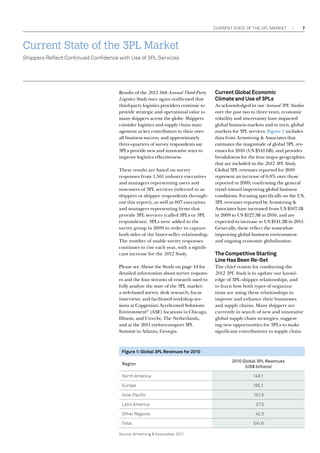
markets for 3PL services. Figure 1 includes
data from Armstrong & Associates that
estimates the magnitude of global 3PL revenues for 2010 (US $541.6B), and provides
breakdowns for the four major geographies
that are included in the 2012 3PL Study.
Global 3PL revenues reported for 2010
represent an increase of 6.8% over those
reported in 2009, confirming the general
trend toward improving global business
conditions. Focusing specifically on the US,
3PL revenues reported by Armstrong &
Associates have increased from US $107.1B
in 2009 to US $127.3B in 2010, and are
expected to increase to US $141.2B in 2011.
Generally, these reflect the somewhatimproving global business environment
and ongoing economic globalization.

The Competitive Starting
Line Has Been Re-Set
The chief reason for conducting the
2012 3PL Study is to update our knowledge of 3PL-shipper relationships, and
to learn how both types of organizations are using these relationships to
improve and enhance their businesses
and supply chains. Many shippers are
currently in search of new and innovative
global supply chain strategies, suggesting new opportunities for 3PLs to make
significant contributions to supply chain

Figure 1: Global 3PL Revenues for 2010
Region

2010 Global 3PL Revenues
(US$ billions)

North America

	149.1

Europe

	165.1

Asia-Pacific

	157.6

Latin America

	27.5

Other Regions

	42.3

Total

	541.6

Source: Armstrong & Associates, 2011
8

2012 16th annual THIRD-PARTY LOGISTICS study

efficiency and effectiveness. Many shippers and 3PLs agree that today’s business
challenges represent some version of a
“new normal,” driving the need for both
types of organizations to identify and
implement new strategies for success. In
effect, the starting line has been re-set,
injecting a new, highly invigorated and
highly competitive spirit into the logistics
business environment.
“Today’s 3PL marketplace is experiencing
significant change. Established 3PLs are recalibrating their business models to provide
greater value to their shipper-customers,”
noted one prominent 3PL industry observer. “At the same time, they are looking over
their shoulders at emerging sources of competition and the new and innovative offerings they are bringing to market.”

Spending on Logistics
and 3PL Services

are also similar to last year. A new series of
questions in the 2012 3PL Study asked shippers to report the percentages of transportation and warehousing spend that are
managed by third parties. As indicated in
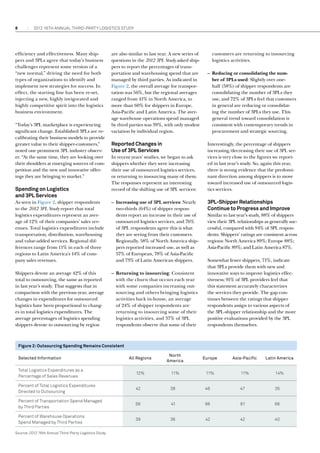
Figure 2, the overall average for transportation was 56%, but the regional averages
ranged from 41% in North America, to
more than 60% for shippers in Europe,
Asia-Pacific and Latin America. The average warehouse operations spend managed
by third parties was 39%, with only modest
variation by individual region.

Reported Changes in
Use of 3PL Services
In recent years’ studies, we began to ask
shippers whether they were increasing
their use of outsourced logistics services,
or returning to insourcing many of them.
The responses represent an interesti­ g
n
record of the shifting use of 3PL services:

As seen in Figure 2, shipper respondents
to the 2012 3PL Study report that total
logistics expenditures represent an average of 12% of their companies’ sales revenues. Total logistics expenditures include
transportation, distribution, warehousing
and value-added services. Regional differences range from 11% in each of three
regions to Latin America’s 14% of company sales revenues.

–– Increasing use of 3PL services: Nearly
two-thirds (64%) of shipper respondents report an increase in their use of
outsourced logistics services, and 76%
of 3PL respondents agree this is what
they are seeing from their customers.
Regionally, 58% of North America shippers reported increased use, as well as
57% of European, 78% of Asia-Pacific
and 73% of Latin American shippers.

Shippers devote an average 42% of this
total to outsourcing, the same as reported
in last year’s study. That suggests that in
comparison with the previous year, average
changes in expenditures for outsourced
logistics have been proportional to changes in total logistics expenditures. The
average percentages of logistics spending
shippers devote to outsourcing by region

–– Returning to insourcing: Consistent
with the churn that occurs each year
with some companies increasing outsourcing and others bringing logistics
activities back in-house, an average
of 24% of shipper respondents are
returning to insourcing some of their
logistics activities, and 37% of 3PL
respondents observe that some of their

customers are returning to insourcing
logistics activities.
–– Reducing or consolidating the number of 3PLs used: Slightly over onehalf (58%) of shipper respondents are
consolidating the number of 3PLs they
use, and 72% of 3PLs feel that customers
in general are reducing or consolidating the number of 3PLs they use. This
general trend toward consolidation is
consistent with contemporary trends in
procurement and strategic sourcing.
Interestingly, the percentage of shippers
increasing/decreasing their use of 3PL services is very close to the figures we reported in last year’s study. So, again this year,
there is strong evidence that the predominant direction among shippers is to move
toward increased use of outsourced logistics services.

3PL-Shipper Relationships
Continue to Progress and Improve
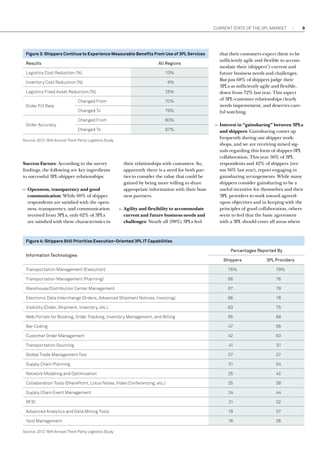
Similar to last year’s study, 88% of shippers
view their 3PL relationships as generally successful, compared with 94% of 3PL respondents. Shippers’ ratings are consistent across
regions: North America 89%; Europe 88%;
Asia-Pacific 89%; and Latin America 87%.
Somewhat fewer shippers, 71%, indicate
that 3PLs provide them with new and
innovative ways to improve logistics effectiveness; 91% of 3PL providers feel that
this statement accurately characterizes
the services they provide. The gap continues between the ratings that shipper
respondents assign to various aspects of
the 3PL-shipper relationship and the more
positive evaluations provided by the 3PL
respondents themselves.

Figure 2: Outsourcing Spending Remains Consistent
Selected Information

All Regions

North
America

Europe

Asia-Pacific

Latin America

Total Logistics Expenditures as a
Percentage of Sales Revenues

	12%

	11%

	11%

	11%

	14%

Percent of Total Logistics Expenditures
Directed to Outsourcing

	42

	38

	46

	47

	35

Percent of Transportation Spend Managed
by Third Parties

	56

	41

	66

	61

	66

Percent of Warehouse Operations
Spend Managed by Third Parties

	39

	36

	42

	42

	40

Source: 2012 16th Annual Third-Party Logistics Study
Current state of the 3pl market

Figure 3: Shippers Continue to Experience Measurable Benefits From Use of 3PL Services
Results

All Regions

Logistics Cost Reduction (%)

	13%

Inventory Cost Reduction (%)

	9%

Logistics Fixed Asset Reduction (%)

	25%

Order Fill Rate

Order Accuracy

Changed From

	70%

Changed To

	79%

Changed From

	80%

Changed To

	87%

Source: 2012 16th Annual Third-Party Logistics Study

Success Factors: According to the survey
findings, the following are key ingredients
to successful 3PL-shipper relationships:
–– Openness, transparency and good
communication: While 69% of shipper
respondents are satisfied with the openness, transparency, and communication
received from 3PLs, only 62% of 3PLs
are satisfied with these characteristics in

their relationships with customers. So,
apparently there is a need for both parties to consider the value that could be
gained by being more willing to share
appropriate information with their business partners.
–– Agility and flexibility to accommodate
current and future business needs and
challenges: Nearly all (98%) 3PLs feel

that their customers expect them to be
sufficiently agile and flexible to accommodate their (shippers’) current and
future business needs and challenges.
But just 68% of shippers judge their
3PLs as sufficiently agile and flexible,
down from 72% last year. This aspect
of 3PL-customer relationships clearly
needs improvement, and deserves careful watching.
–– Interest in “gainsharing” between 3PLs
and shippers: Gainsharing comes up
frequently during our shipper workshops, and we are receiving mixed signals regarding this form of shipper-3PL
collaboration. This year 56% of 3PL
respondents and 42% of shippers (versus 56% last year), report engaging in
gainsharing arrangements. While many
shippers consider gainsharing to be a
useful incentive for themselves and their
3PL providers to work toward agreedupon objectives and in keeping with the
principles of good collaboration, others
seem to feel that the basic agreement
with a 3PL should cover all areas where

Figure 4: Shippers Still Prioritize Execution-Oriented 3PL IT Capabilities
Information Technologies

Percentages Reported By
Shippers

3PL Providers

Transportation Management (Execution)

	75%

	79%

Transportation Management (Planning)

	68

	76

Warehouse/Distribution Center Management

	67

	79

Electronic Data Interchange (Orders, Advanced Shipment Notices, Invoicing)

	66

	78

Visibility (Order, Shipment, Inventory, etc.)

	63

	75

Web Portals for Booking, Order Tracking, Inventory Management, and Billing

	55

	68

Bar Coding

	47

	56

Customer Order Management

	42

	63

Transportation Sourcing

	41

	51

Global Trade Management Tool

	37

	37

Supply Chain Planning

	31

	54

Network Modeling and Optimization

	25

	42

Collaboration Tools (SharePoint, Lotus Notes, Video Conferencing, etc.)

	25

	38

Supply Chain Event Management

	24

	44

RFID

	21

	32

Advanced Analytics and Data Mining Tools

	19

	37

Yard Management

	16

	26

Source: 2012 16th Annual Third-Party Logistics Study

9
10

2012 16th annual THIRD-PARTY LOGISTICS study

performance is expected, and that it is
not necessary or appropriate to engage
in gainsharing practices. Interest in gainsharing may be diminishing somewhat
due to slight improvements in the global
business economy. We plan to follow this
closely in future studies.
–– Interest in collaborating with other companies, even competitors, to
achieve logistics cost and service
improvements: When this question was
asked last year for the first time, 68% of
shipper respondents and 80% of 3PLs
expressed interest in these strategies.
This year these percentages dropped to
44% and 67%, respectively. So, while last
year we stated it was “reassuring to see
percentages that suggest a true interest
by both parties in working with other
companies, even competitors,” perhaps
the easing of global economic conditions have made this less of a priority.
We will continue to focus on this issue in
future studies.
Measurable Benefits: Shipper respondents
experience measurable benefits from 3PL

services, as seen in Figure 3. Metrics relating to logistics cost reduction, inventory
cost reduction, and logistics fixed asset
reduction are consistent with what was
reported in the two previous years’ studies.

3PLs feel are “must haves” for 3PLs to successfully serve customers. Overall, the most
needed capabilities are those that relate
directly to execution-oriented activities
and processes such as transportation, warehouse/DC management, electronic data
interchange, visibility, etc. Others that have
somewhat lower rankings tend to be more
strategic and analytical.

Shippers also report improvements in
order fill rate and order accuracy resulting
from use of 3PLs, although the absolute
levels of these metrics are a little lower
than those reported in both the 2009 and
2010 3PL Studies. This may be an indicator
of the continuing impact of the global economic recession.
Finally, survey results showed that 60% of
the shipper respondents report their use
of 3PLs has led to “year-over-year incremental benefits;” and 88% of 3PL respondents agree. Despite the positive success
ratings perceived by both shippers and
3PLs, there appears to be opportunity to
enhance the benefits experienced by users
of outsourced logistics services.

Information Technology
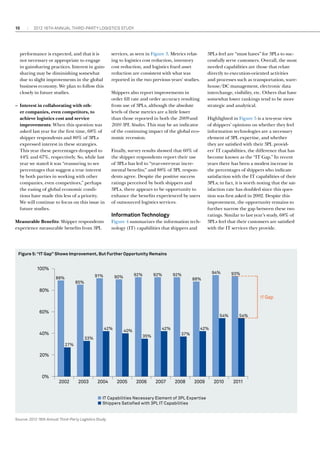
Figure 4 summarizes the information technology (IT) capabilities that shippers and

Highlighted in Figure 5 is a ten-year view
of shippers’ opinions on whether they feel
information technologies are a necessary
element of 3PL expertise, and whether
they are satisfied with their 3PL providers’ IT capabilities, the difference that has
become known as the “IT Gap.” In recent
years there has been a modest increase in
the percentages of shippers who indicate
satisfaction with the IT capabilities of their
3PLs; in fact, it is worth noting that the satisfaction rate has doubled since this question was first asked in 2002. Despite this
improvement, the opportunity remains to
further narrow the gap between these two
ratings. Similar to last year’s study, 68% of
3PLs feel that their customers are satisfied
with the IT services they provide.

Figure 5: “IT Gap” Shows Improvement, But Further Opportunity Remains

100%
91%

89%

92%

90%

92%

92%

85%

94%

93%

88%

80%
IT Gap

60%

54%
42%

40%

42%

40%

42%
37%

35%

33%

54%

27%

20%

0%

2002

2003

2004

2005

2006

2007

2008

2009

■ IT Capabilities Necessary Element of 3PL Expertise
■ Shippers Satisfied with 3PL IT Capabilities

Source: 2012 16th Annual Third-Party Logistics Study

2010

2011
11

Current state of the 3pl market

What 3PL Users Outsource
and What 3PL Providers Offer

is that for the most part, the percentages indicated in Figure 6 for the “all
regions” results are somewhat lower
than comparable percentages from
the previous year’s study. This may be
explained somewhat by the fact that the
current study yielded a higher percentage of shipper respondents in the lowest
revenue category than in the previous year’s study, as noted in the About
the Study chapter later in this report.
Further analysis of the available data
confirmed that the higher the sales category, the higher the average number of
logistics activities outsourced.

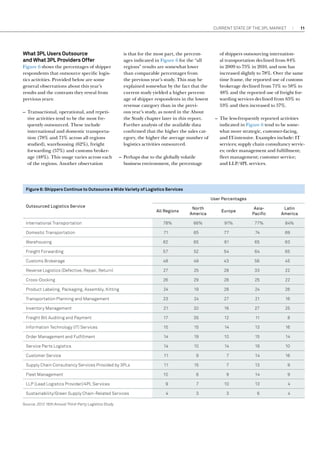
Figure 6 shows the percentages of shipper
respondents that outsource specific logistics activities. Provided below are some
general observations about this year’s
results and the contrasts they reveal from
previous years:
–– Transactional, operational, and repetitive activities tend to be the most frequently outsourced. These include
international and domestic transportation (78% and 71% across all regions
studied), warehousing (62%), freight
forwarding (57%) and customs brokerage (48%). This usage varies across each
of the regions. Another observation

–– Perhaps due to the globally volatile
business environment, the percentage

of shippers outsourcing international transportation declined from 84%
in 2009 to 75% in 2010, and now has
increased slightly to 78%. Over the same
time frame, the reported use of customs
brokerage declined from 71% to 58% to
48% and the reported use of freight forwarding services declined from 65% to
53% and then increased to 57%.
–– The less-frequently reported activities
indicated in Figure 6 tend to be somewhat more strategic, customer-facing,
and IT-intensive. Examples include: IT
services; supply chain consultancy services; order management and fulfillment;
fleet management; customer service;
and LLP/4PL services.

Figure 6: Shippers Continue to Outsource a Wide Variety of Logistics Services
User Percentages
Outsourced Logistics Service

All Regions

North
America

Europe

AsiaPacific

Latin
America

International Transportation

78%

66%

91%

77%

84%

Domestic Transportation

71

65

77

74

69

Warehousing

62

65

61

65

63

Freight Forwarding

57

52

54

64

65

Customs Brokerage

48

49

43

56

45

Reverse Logistics (Defective, Repair, Return)

27

25

28

33

22

Cross-Docking

26

29

28

25

22

Product Labeling, Packaging, Assembly, Kitting

24

19

28

24

26

Transportation Planning and Management

23

24

27

21

16

Inventory Management

21

20

16

27

25

Freight Bill Auditing and Payment

17

35

12

11

8

Information Technology (IT) Services

15

15

14

13

16

Order Management and Fulfillment

14

19

10

15

14

Service Parts Logistics

14

10

14

19

10

Customer Service

11

9

7

14

16

Supply Chain Consultancy Services Provided by 3PLs

11

15

7

13

9

Fleet Management

10

8

9

14

9

LLP (Lead Logistics Provider)/4PL Services

9

7

10

13

4

Sustainability/Green Supply Chain-Related Services

4

3

3

6

4

Source: 2012 16th Annual Third-Party Logistics Study
12

2012 16th annual THIRD-PARTY LOGISTICS study

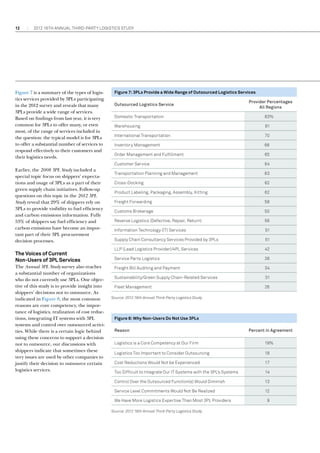
Figure 7 is a summary of the types of logistics services provided by 3PLs participating
in the 2012 survey and reveals that many
3PLs provide a wide range of services.
Based on findings from last year, it is very
common for 3PLs to offer many, or even
most, of the range of services included in
the question: the typical model is for 3PLs
to offer a substantial number of services to
respond effectively to their customers and
their logistics needs.

Figure 7: 3PLs Provide a Wide Range of Outsourced Logistics Services
Outsourced Logistics Service

Provider Percentages
All Regions

The Voices of Current
Non-Users of 3PL Services
The Annual 3PL Study survey also reaches
a substantial number of organizations
who do not currently use 3PLs. One objective of this study is to provide insight into
shippers’ decisions not to outsource. As
indicated in Figure 8, the most common
reasons are core competency, the importance of logistics, realization of cost reductions, integrating IT systems with 3PL
systems and control over outsourced activities. While there is a certain logic behind
using these concerns to support a decision
not to outsource, our discussions with
shippers indicate that sometimes these
very issues are used by other companies to
justify their decision to outsource certain
logistics services.

83%

Warehousing

81

International Transportation

70

Inventory Management

66

Order Management and Fulfillment

65

Customer Service

Earlier, the 2008 3PL Study included a
special topic focus on shippers’ expectations and usage of 3PLs as a part of their
green supply chain initiatives. Follow-up
questions on this topic in the 2012 3PL
Study reveal that 29% of shippers rely on
3PLs to provide visibility to fuel efficiency
and carbon emissions information. Fully
53% of shippers say fuel efficiency and
carbon emissions have become an important part of their 3PL procurement
decision processes.

Domestic Transportation

64

Transportation Planning and Management

63

Cross-Docking

62

Product Labeling, Packaging, Assembly, Kitting

62

Freight Forwarding

58

Customs Brokerage

50

Reverse Logistics (Defective, Repair, Return)

56

Information Technology (IT) Services

51

Supply Chain Consultancy Services Provided by 3PLs

51

LLP (Lead Logistics Provider)/4PL Services

42

Service Parts Logistics

38

Freight Bill Auditing and Payment

34

Sustainability/Green Supply Chain-Related Services

31

Fleet Management

26

Source: 2012 16th Annual Third-Party Logistics Study

Figure 8: Why Non-Users Do Not Use 3PLs
Reason

Percent in Agreement

Logistics is a Core Competency at Our Firm

19%

Logistics Too Important to Consider Outsourcing

18

Cost Reductions Would Not be Experienced

17

Too Difficult to Integrate Our IT Systems with the 3PL’s Systems

14

Control Over the Outsourced Function(s) Would Diminish

13

Service Level Commitments Would Not Be Realized

12

We Have More Logistics Expertise Than Most 3PL Providers
Source: 2012 16th Annual Third-Party Logistics Study

9
Current state of the 3pl market

Go online
For more information go to
www.3plstudy.com

Current State of the Market: Key Takeaways
Key findings regarding the Current State of the Market for the 2012 16th Annual 3PL Study include:
–– 3PLs Make Valued Contributions: Again in 2012, companies
across industries and around the globe regard logistics and
supply chain management as key components of their overall
business success, and many credit their 3PLs with helping to provide new and innovative ways to improve logistics
effectiveness.
–– Logistics Spending is Consistent: Across all regions included in
the 2012 survey, shipper respondents report that total logistics
expenditures represent an average of 12% of sales revenues,
and they spend on average 42% of their total logistics expenditures on outsourcing.
–– Transportation Spend Dominates: Overall, survey respondents
who use 3PL services report that their outsourcing activities
account for 56% of transportation spend and 39% of warehouse
operations spend.
–– 3PL Use is Rising: A majority of shipper respondents, 64%,
report they are increasing their use of 3PL services, while 24%
are returning to insourcing some 3PL services and 58% report
they are reducing or consolidating the number of 3PLs they use.
–– The Success Rating Perception Gap Remains: Most shipper
respondents (88%) and most 3PL providers (94%) view their
relationships as successful. In addition, just over two-thirds of
shippers say 3PLs provide them with new and innovative ways to
improve logistics effectiveness – whereas 91% of 3PL providers
feel this is the case.
–– Gainsharing and Collaboration Lose Ground: The 2012 3PL
Study provides insight into several factors that relate to the
success of 3PL-shipper relationships: openness, transparency,
and good communication; agility and flexibility to accommodate
current and future business needs and challenges; interest in
“gainsharing” between 3PLs and shippers; and interest in collaborating with other companies, even competitors, to achieve
logistics cost and service improvements. Interestingly, results
from the current study suggest that both gainsharing and collaboration may have lost some popularity due to the recent
modest improvements in the global economic picture.

–– 3PL Use Pays Off: Metrics including logistics cost, inventory
cost, and fixed asset reductions due to use of 3PLs, as well as
order fill rate and order accuracy, validate the cost and service
improvements resulting from successful 3PL relationships.
–– Execution-Oriented Activities Still Lead: The logistics activities most frequently outsourced continue to include those that
are more transactional, operational and repetitive, while those
less frequently outsourced are those that are more strategic, customer-facing and IT-intensive. In the future customers
may be more receptive to strategic services that may be available from 3PLs. One observation from this year’s study is that
generally, the percentages reported by shippers for outsourcing of individual logistics activities is down slightly from those
reported in recent years. As indicated earlier, this is likely due
to the fact that this year’s shipper survey respondents included
a higher percentage of respondents in the lowest annual sales
category than in the previous year’s study – and companies in
the lower annual sales categories tend to outsource fewer logistics services.
–– The IT Gap Remains: Information technology remains a key component of 3PL-shipper relationships, and the 2012 3PL Study
results indicate that 54% of shipper respondents are satisfied
with 3PL IT capabilities compared with 93% who indicate that IT
capabilities are a necessary element of 3PL expertise.
–– New 3PL Selection Criteria: Fuel efficiency and carbon emissions are becoming a more important part of shippers’ 3PL
procurement decision processes.
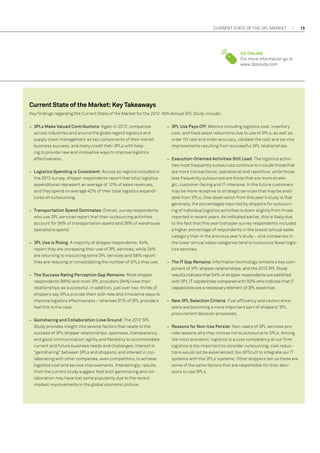
–– Reasons for Non-Use Persist: Non-users of 3PL services provide reasons why they choose not to outsource to 3PLs. Among
the most prevalent: logistics is a core competency at our firm;
logistics is too important to consider outsourcing; cost reductions would not be experienced; too difficult to integrate our IT
systems with the 3PLs’ systems. Other shippers tell us these are
some of the same factors that are responsible for their decisions to use 3PLs.

13
Balancing growth and opportunity
Emerging Markets

15

Emerging Markets
Opportunities for Driving Corporate Growth

For many companies, doing business in
emerging markets is no longer a nice-tohave; it’s a must-have to fuel continued
growth. For example, General Motors
sold more cars in China than it did in
the United States last year, and PepsiCo
captured about half of the Russian juice
market through an acquisition, according to a CNNMoney report. As seen in
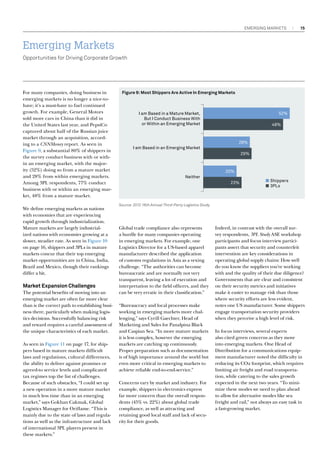
Figure 9, a substantial 80% of shippers in
the survey conduct business with or within an emerging market, with the majority (52%) doing so from a mature market
and 28% from within emerging markets.
Among 3PL respondents, 77% conduct
business with or within an emerging market, 48% from a mature market.
We define emerging markets as nations
with economies that are experiencing
rapid growth through industrialization.
Mature markets are largely industrialized nations with economies growing at a
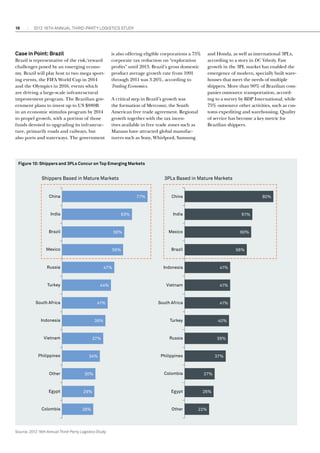
slower, steadier rate. As seen in Figure 10
on page 16, shippers and 3PLs in mature
markets concur that their top emerging
market opportunities are in China, India,
Brazil and Mexico, though their rankings
differ a bit.

Market Expansion Challenges
The potential benefits of moving into an
emerging market are often far more clear
than is the correct path to establishing business there, particularly when making logistics decisions. Successfully balancing risk
and reward requires a careful assessment of
the unique characteristics of each market.
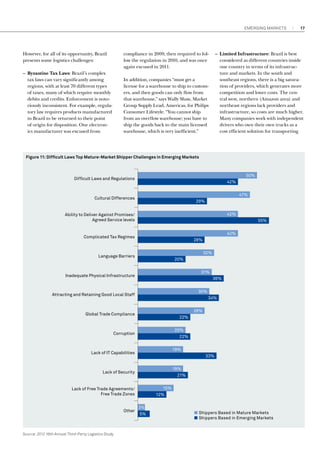
As seen in Figure 11 on page 17, for shippers based in mature markets difficult
laws and regulations, cultural differences,
the ability to deliver against promises or
agreed-to service levels and complicated
tax regimes top the list of challenges.
Because of such obstacles, “I could set up
a new operation in a more mature market
in much less time than in an emerging
market,” says Gokhan Cakmak, Global
Logistics Manager for Oriflame. “This is
mainly due to the state of laws and regulations as well as the infrastructure and lack
of international 3PL players present in
these markets.”

Figure 9: Most Shippers Are Active In Emerging Markets

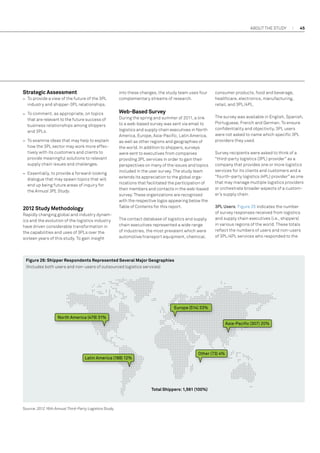
52%

I am Based in a Mature Market,
But I Conduct Business With
or Within an Emerging Market

48%

28%
I am Based in an Emerging Market
29%

20%
Neither
23%

■ Shippers
■ 3PLs

Source: 2012 16th Annual Third-Party Logistics Study

Global trade compliance also represents
a hurdle for many companies operating
in emerging markets. For example, one
Logistics Director for a US-based apparel
manufacturer described the application
of customs regulations in Asia as a vexing
challenge. “The authorities can become
bureaucratic and are normally not very
transparent, leaving a lot of execution and
interpretation to the field officers, and they
can be very erratic in their classification.”
“Bureaucracy and local processes make
working in emerging markets more challenging,” says Cyrill Gaechter, Head of
Marketing and Sales for Panalpina Black
and Caspian Sea. “In more mature markets
it is less complex, however the emerging
markets are catching up continuously.
Proper preparation such as documentation
is of high importance around the world but
even more critical in emerging markets to
achieve reliable end-to-end-service.”
Concerns vary by market and industry. For
example, shippers in electronics express
far more concern than the overall respondents (45% vs. 22%) about global trade
compliance, as well as attracting and
retaining good local staff and lack of security for their goods.

Indeed, in contrast with the overall survey respondents, 3PL Study ASE workshop
participants and focus interview participants assert that security and counterfeit
intervention are key considerations in
operating global supply chains: How well
do you know the suppliers you’re working
with and the quality of their due diligence?
Governments that are clear and consistent
on their security metrics and initiatives
make it easier to manage risk than those
where security efforts are less evident,
notes one US manufacturer. Some shippers
engage transportation security providers
when they perceive a high level of risk.
In focus interviews, several experts
also cited green concerns as they move
into emerging markets. One Head of
Distribution for a communications equipment manufacturer noted the difficulty in
reducing its CO2 footprint, which requires
limiting air freight and road transportation, while catering to the sales growth
expected in the next two years. “To minimize these modes we need to plan ahead
to allow for alternative modes like sea
freight and rail,” not always an easy task in
a fast-growing market.
16

2012 16th annual THIRD-PARTY LOGISTICS study

Case in Point: Brazil
Brazil is representative of the risk/reward
challenges posed by an emerging economy. Brazil will play host to two mega sporting events, the FIFA World Cup in 2014
and the Olympics in 2016, events which
are driving a large-scale infrastructural
improvement program. The Brazilian government plans to invest up to US $880B
in an economic stimulus program by 2014
to propel growth, with a portion of those
funds devoted to upgrading its infrastructure, primarily roads and railways, but
also ports and waterways. The government

and Honda, as well as international 3PLs,
according to a story in DC Velocity. Fast
growth in the 3PL market has enabled the
emergence of modern, specially built warehouses that meet the needs of multiple
shippers. More than 90% of Brazilian companies outsource transportation, according to a survey by BDP International, while
75% outsource other activities, such as customs expediting and warehousing. Quality
of service has become a key metric for
Brazilian shippers.

is also offering eligible corporations a 75%
corporate tax reduction on “exploration
profits” until 2013. Brazil’s gross domestic
product average growth rate from 1991
through 2011 was 3.26%, according to
Trading Economics.
A critical step in Brazil’s growth was
the formation of Mercosur, the South
American free trade agreement. Regional
growth together with the tax incentives available in free trade zones such as
Manaus have attracted global manufacturers such as Sony, Whirlpool, Samsung

Figure 10: Shippers and 3PLs Concur on Top Emerging Markets

Shippers Based in Mature Markets

3PLs Based in Mature Markets

China

77%

India

63%

China

80%

India

61%

60%

Brazil

56%

Mexico

Mexico

55%

Brazil

Russia

47%

Turkey

44%

South Africa

41%

Indonesia

39%

Vietnam

Philippines

37%

34%

56%

Indonesia

41%

Vietnam

41%

South Africa

41%

Turkey

40%

Russia

39%

Philippines

37%

Other

30%

Colombia

27%

Egypt

29%

Egypt

26%

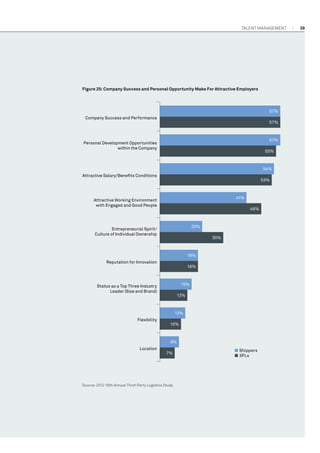
Colombia

28%

Other

Source: 2012 16th Annual Third-Party Logistics Study

22%
Emerging Markets

–– Limited Infrastructure: Brazil is best
considered as different countries inside
one country in terms of its infrastructure and markets. In the south and
southeast regions, there is a big saturation of providers, which generates more
competition and lower costs. The central west, northern (Amazon area) and
northeast regions lack providers and
infrastructure, so costs are much higher.
Many companies work with independent
drivers who own their own trucks as a
cost efficient solution for transporting

compliance in 2009, then required to follow the regulation in 2010, and was once
again excused in 2011.

However, for all of its opportunity, Brazil
presents some logistics challenges:
–– Byzantine Tax Laws: Brazil’s complex
tax laws can vary significantly among
regions, with at least 70 different types
of taxes, many of which require monthly
debits and credits. Enforcement is notoriously inconsistent. For example, regulatory law requires products manufactured
in Brazil to be returned to their point
of origin for disposition. One electronics manufacturer was excused from

In addition, companies “must get a
license for a warehouse to ship to customers, and then goods can only flow from
that warehouse,” says Wally Shaw, Market
Group Supply Lead, Americas, for Philips
Consumer Lifestyle. “You cannot ship
from an overflow warehouse; you have to
ship the goods back to the main licensed
warehouse, which is very inefficient.”

Figure 11: Difficult Laws Top Mature-Market Shipper Challenges in Emerging Markets

50%

Difficult Laws and Regulations

42%
47%

Cultural Differences

29%
42%

Ability to Deliver Against Promises/
Agreed Service levels

55%
42%

Complicated Tax Regimes

28%
32%

Language Barriers

20%
31%

Inadequate Physical Infrastructure

36%
30%

Attracting and Retaining Good Local Staff

34%
28%

Global Trade Compliance

22%
20%
22%

Corruption

19%

Lack of IT Capabilities

33%
19%
21%

Lack of Security

15%
12%

Lack of Free Trade Agreements/
Free Trade Zones

Other

Source: 2012 16th Annual Third-Party Logistics Study

3%
5%

17

■ Shippers Based in Mature Markets
■ Shippers Based in Emerging Markets
18

2012 16th annual THIRD-PARTY LOGISTICS study

Figure 12: Shippers See Global 3PLs with Local 3PL Partners as Most Successful

Shippers Based in Mature Markets

58%

(with Operations in Emerging Markets)

Shippers Based in Emerging Markets

51%

24%

22%

18%

27%

■ Global 3PL Coordinating with a Locally Based 3PL
■ Global 3PL
■ Locally Based 3PL

Source: 2012 16th Annual Third-Party Logistics Study

low-cost products such as seeds and construction materials, but it’s a challenge
for these independent truck drivers to
secure a steady volume. Brazil’s investment in ports and airports has been
limited over the past many years; a consequence is that containers can sit in certain ports for weeks awaiting unloading.
Brazil’s government has resisted private
investment in infrastructure.
–– Trade Zone Tradeoffs: Free trade zones
such as Manaus encourage growth in
underdeveloped areas by attracting
large manufacturers, but also serve as an
example of how tax benefits alone do not
translate into logistics efficiency. Manaus
has one road in and out, which cannot
take heavy truck traffic, forcing many
shippers to use air/water freight.
–– Political and Regulatory Obstacles: Like
many emerging markets, Brazil has its
share of political influences that impact
supply chain efficiency. For example,
Brazil’s customs and duty regulations
have created a protectionist market for
some goods.
–– Evolving Logistics Marketplace: Rapid
growth has fueled demand for outsourcing, creating a fragmented marketplace
populated by a range of providers. Many
were started by individual truck drivers
who acquired more trucks and then eventually bought a warehouse, though Brazil
is also served by major national and international players. “Many logistics providers are individual-function oriented, with
few integrated supply chain, value-added
offerings,” says Mauricio Ferreira, Latin
America Supply Chain Director for Kraft

Foods. A fragmented logistics infrastructure often drives companies to maintain
higher inventory levels.
“In Brazil we are ten hours away from
the US by air and 11 hours from the
main European cities by air. It takes 17
days navigation by water to Europe and
38 to 45 days to reach China ports with
direct service,” says Gilberto Zanon,
Head of Industry Verticals, Brazil at
Panalpina. “The longer lead times mean
planning to avoid stock-outs or excess
stock is a challenge that companies need
to overcome. Successful companies and
3PLs work together to do this.”
Like other emerging markets, Brazil’s compelling rate of growth and potential for
improvement has convinced many companies that the obstacles are worth the investment. As one participant at the eyefortransport workshop noted, emerging markets
have the opportunity to build on what the
developed markets have already done and
then leapfrog over them. One example is
the pervasive use of cell phones for banking purposes in some emerging markets.

Selecting a 3PL Partner
for Emerging Markets
Entering any new market requires due diligence; when it’s an emerging market, gaining local insight is even more critical, since
conditions are often evolving rapidly. 3PLs
can play a critical role in both the planning and execution of shippers’ entry and
growth in emerging markets.
Early in the process, shippers must ask
themselves: What type of 3PL partner do we
want? Is it best to seek out a local player with

intimate knowledge of local practices, or a
global partner with more resources to bear?
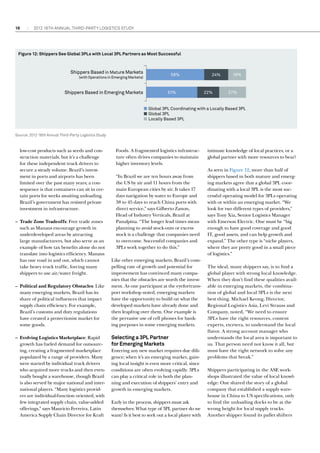
As seen in Figure 12, more than half of
shippers based in both mature and emerging markets agree that a global 3PL coordinating with a local 3PL is the most successful operating model for 3PLs operating
with or within an emerging market. “We
look for two different types of providers,”
says Tony Xia, Senior Logistics Manager
with Emerson Electric. One must be “big
enough to have good coverage and good
IT, good assets, and can help growth and
expand.” The other type is “niche players,
where they are pretty good in a small piece
of logistics.”
The ideal, many shippers say, is to find a
global player with strong local knowledge.
When they don’t find these qualities available in emerging markets, the combination of global and local 3PLs is the next
best thing. Michael Keong, Director,
Regional Logistics Asia, Levi Strauss and
Company, noted, “We need to ensure
3PLs have the right resources, content
experts, etcetera, to understand the local
flavor. A strong account manager who
understands the local area is important to
us. That person need not know it all, but
must have the right network to solve any
problems that break.”
Shippers participating in the ASE workshops illustrated the value of local knowledge: One shared the story of a global
company that established a supply warehouse in China to US specifications, only
to find the unloading docks to be at the
wrong height for local supply trucks.
Another shipper found its pallet shifters
Emerging Markets

did not work in the narrow-bodied aircraft coming out of Panama.
Signs indicate that the combination of
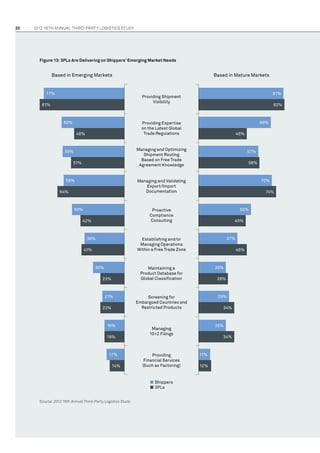
global and local players is working; as seen
in Figure 13 on page 20, shippers and
3PLs are pretty well aligned in what they
believe are the most important services
in emerging markets. Shippers’ primary
needs from 3PLs in emerging markets are
visibility (77% of those based in emerging
markets, 81% of those based in mature
markets), expertise on the latest global
trade regulations (60% and 69%) and
managing and optimizing shipment routing based on free trade agreement knowledge (59% and 57%).
Visibility: With the added risk and uncertainty of emerging markets, the importance of visibility to shippers is understandable. “Delivering products in Russia is
complex,” says Panalpina’s Gaechter, “and
visibility over where our customers’ products are and a reliable service to ensure
products arrive on time are two critical
aspects of our customers’ needs. This is no
different than, for example, China, where
lead-time from factory to exporting port
can take many days. Visibility and reliability play a key role there as well, and excelling in this is more difficult in emerging
markets than more mature markets.”
It’s highly important for service-centric
computer manufacturers to be able to
provide order-level tracking to customers,
says the Supply Chain Director for a large
computer company, and 3PLs need this
capability to provide visibility to customers.
Even better is a 3PL taking proactive steps
to resolve issues detected through visibility,
which many 3PLs in emerging markets do
not do, he says. 	
Global Trade Regulations: As noted in
Figure 13, 3PLs active in emerging markets
concur with shippers’ rankings, with the
exception of providing expertise on the
latest global trade regulations. Shippers
ranked this as the second most important
service they would like to get, whereas 3PLs
in mature and emerging markets ranked it
somewhere in the middle.
Compliance: In emerging markets, many
shippers rely on 3PL expertise to navigate

import/export documentation, embargoed
products/countries screening and other
compliance services. “It would be useful
for 3PLs to have better relationships with
customs officers to ensure they have local
input, etcetera,” said Levi Strauss’ Keong.
“3PLs should engage more in customs
meetings and be the conduit to discuss
customer requirements.”

Other Services Sought From 3PLs
In addition to those capabilities cited in the
survey, ASE workshop and focus interview
participants concur that they would like to
see these additional qualities and capabilities in 3PLs active in emerging markets:
–– Proactive Consulting Services: At the
ASE workshop held in Utrecht, shippers
concurred that the timing of 3PLs’ assistance was also key. Very often an initiative to move into an emerging market
begins with the shipper conducting initial research because their 3PL partners
lack insight into that market. Then the
3PL follows, ramping up its own investigation. Shippers would like to see 3PLs
take a more proactive approach — and
are willing to pay for it.
–– Local Insight and Expertise: It’s the
lack of local expertise on the part of
global 3PLs without a strong local presence, such as the best way to move product in that country, that drives shippers to local 3PLs and other experts.
Shippers want creative, informed ideas
to overcome local barriers, for example,
using a barge in Vietnam to circumvent road congestion, or overland or
cross-border trucking in India and
Bangladesh – or even how to handle
local events such as labor stoppages.
In one telecom company’s emerging
markets experience, “Logistics service
providers fail to come up with new logistics solutions or improvements,” says its
Head of Distribution. “Any new solution
or idea is brought up ourselves. This is
where LSPs really fail.”
–– Integrated Solutions: Shippers that want
to amass the requisite logistics services
and knowledge required for an integrated approach often find they must engage
multiple 3PLs because no single 3PL has

19

what they need. One ASE participant
related how his company was seeking
integrated warehouse and transportation services in an emerging market it
was entering, ideally with the warehouses
located close to air hubs. But the 3PL
they wanted to work with was not set up
to accommodate the shipper’s needs.
–– Security: Shippers in emerging markets
expect 3PLs to address their security
concerns through measures such as
delivery trucks with GPS systems, engine
shut-down systems, and drivers trained
on security protocols.
–– Long-Term Commitment: It’s also
important that 3PLs’ efforts be strategic, not tactical. “3PLs still lack a
longer term sustainable plan for coming into a country,” says Arun Salvi,
Logistics Manager Asia Pacific, for Shell
Lubricants. “They are taking more of
a short-term approach to make profits much quicker than they should be.
Global players end up being like the
local players, but with a foreign name,
because they have not invested properly
in infrastructure, people and processes.”
All of these points can make for a difficult
environment and require 3PLs and shippers to work closely together and with high
degrees of trust if success in emerging markets is to be achieved. This might be one
of the reasons people choose global 3PLs
working with local players.

Free-Trade Agreements and 3PLs
A free trade agreement (FTA) is a pact
between two or more countries or areas in
which they agree to lift most or all tariffs,
quotas, special fees and taxes, and other
barriers to trade among them to allow
faster transactions and a higher volume of
business. According to the United Nations
Statistics Division, FTAs such as the
North American Free Trade Agreement
(NAFTA), the European Union (EU27) and the Organisation for Economic
Co-operation and Development (OECD)
have made a definitive impact on growth
across sectors such as machinery, manufactured goods and chemicals.
FTAs, free trade zones (FTZ) and Special
Economic Zones (SEZ) have in turn fueled
20

2012 16th annual THIRD-PARTY LOGISTICS study

Figure 13: 3PLs Are Delivering on Shippers’ Emerging Market Needs

Based in Emerging Markets

77%

Based in Mature Markets

81%

Providing Shipment
Visibility

81%

60%

82%

69%

Providing Expertise
on the Latest Global
Trade Regulations

48%

46%

Managing and Optimizing
Shipment Routing
Based on Free Trade
Agreement Knowledge

59%
51%

58%

57%
58%

70%

Managing and Validating
Export/Import
Documentation

64%

50%

74%

50%

Proactive
Compliance
Consulting

42%

38%

45%

37%

Establishing and/or
Managing Operations
Within a Free Trade Zone

41%

30%

46%

26%

Maintaining a
Product Database for
Global Classification

23%

21%
23%

19%
19%

17%
14%

29%

Screening for
Embargoed Countries and
Restricted Products

34%

26%

Managing
10+2 Filings

Providing
Financial Services
(Such as Factoring)

■ Shippers
■ 3PLs
Source: 2012 16th Annual Third-Party Logistics Study

28%

34%

11%
12%
21

Emerging Markets

the growth of third-party logistics companies around these zones. For example,
increasing partnerships between US and
Mexican carriers via NAFTA have led to
growth of logistics companies on both
sides of the border, including 3PLs, customs brokers and forwarders. Mexico’s
maquiladora factory system allows materials to be imported into Mexican towns
near the US border, tariff and duty free;
after assembly, the finished products
are exported duty-free back to the US.
The automotive, garment and electronics industries make significant use of the
maquiladora system. Many partner with
3PLs for activities such as transportation
and reverse logistics.
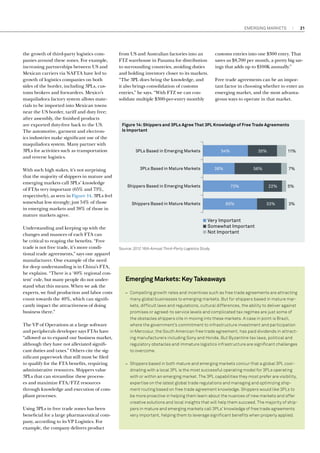
With such high stakes, it’s not surprising
that the majority of shippers in mature and
emerging markets call 3PLs’ knowledge
of FTAs very important (65% and 73%,
respectively), as seen in Figure 14. 3PLs feel
somewhat less strongly; just 54% of those
in emerging markets and 38% of those in
mature markets agree.
Understanding and keeping up with the
changes and nuances of each FTA can
be critical to reaping the benefits. “Free
trade is not free trade, it’s more conditional trade agreements,” says one apparel
manufacturer. One example of the need
for deep understanding is in China’s FTA,
he explains. “There is a ‘40% regional content’ rule, but many people do not understand what this means. When we ask the
experts, we find production and labor costs
count towards the 40%, which can significantly impact the attractiveness of doing
business there.”
The VP of Operations at a large software
and peripherals developer says FTAs have
“allowed us to expand our business market,
although they have not alleviated significant duties and taxes.” Others cite the significant paperwork that still must be filed
to qualify for the FTA benefits, requiring
administrative resources. Shippers value
3PLs that can streamline these processes and maximize FTA/FTZ resources
through knowledge and execution of compliant processes.
Using 3PLs in free trade zones has been
beneficial for a large pharmaceutical company, according to its VP Logistics. For
example, the company delivers product

from US and Australian factories into an
FTZ warehouse in Panama for distribution
to surrounding countries, avoiding duties
and holding inventory closer to its markets.
“The 3PL does bring the knowledge, and
it also brings consolidation of customs
entries,” he says. “With FTZ we can consolidate multiple $300-per-entry monthly

customs entries into one $300 entry. That
saves us $8,700 per month, a pretty big savings that adds up to $100K annually.”
Free trade agreements can be an important factor in choosing whether to enter an
emerging market, and the most advantageous ways to operate in that market.

Figure 14: Shippers and 3PLs Agree That 3PL Knowledge of Free Trade Agreements
Is Important

3PLs Based in Emerging Markets

54%

3PLs Based in Mature Markets

35%

56%

38%

Shippers Based in Emerging Markets

73%

Shippers Based in Mature Markets

11%

65%

7%

22%

33%

5%

3%

■ Very Important
■ Somewhat Important
■ Not Important

Source: 2012 16th Annual Third-Party Logistics Study

Emerging Markets: Key Takeaways
–– Compelling growth rates and incentives such as free trade agreements are attracting
many global businesses to emerging markets. But for shippers based in mature markets, difficult laws and regulations, cultural differences, the ability to deliver against
promises or agreed-to service levels and complicated tax regimes are just some of
the obstacles shippers cite in moving into these markets. A case in point is Brazil,
where the government’s commitment to infrastructure investment and participation
in Mercosur, the South American free trade agreement, has paid dividends in attracting manufacturers including Sony and Honda. But Byzantine tax laws, political and
regulatory obstacles and immature logistics infrastructure are significant challenges
to overcome.
–– Shippers based in both mature and emerging markets concur that a global 3PL coordinating with a local 3PL is the most successful operating model for 3PLs operating
with or within an emerging market. The 3PL capabilities they most prefer are visibility,
expertise on the latest global trade regulations and managing and optimizing shipment routing based on free trade agreement knowledge. Shippers would like 3PLs to
be more proactive in helping them learn about the nuances of new markets and offer
creative solutions and local insights that will help them succeed. The majority of shippers in mature and emerging markets call 3PLs’ knowledge of free trade agreements
very important, helping them to leverage significant benefits when properly applied.
Balancing long lead times with short product lifecycles
Electronics

23

Electronics
Complexity Inside and Out

Electronics products are often the rock
stars of the consumer and business products worlds, with buyers eagerly anticipating the next release with the latest and
greatest features. But along with enviable
demand comes pressure to make products
smaller, faster, cooler and at a lower price
point. Some electronics products’ lifecycles
closely resemble fashion: What’s in today
is out tomorrow. But even everyday devices
are feeling the heat. Everyone wants to produce the next iPad.
Hitting these targets demands a fast and
nimble supply chain. The challenges of
attaining this fall into three major buckets:
global manufacturing and sourcing issues,
channel and network complexity and the
implications of an intricate, high-value
product set.

Electronics Manufacturing and
Sourcing Challenges
Electronics products lifecycles are growing
ever shorter and margins tighter, increasing pressure to lower costs and manage material and suppliers more efficiently. This
has triggered the following trends in manufacturing and sourcing:
–– Asset Lightness: One industry trend
is toward fewer original equipment
manufacturers (OEMs) actually manufacturing, moving or storing their own
products. Many prefer to engage both
contract manufacturers and third-party
logistics providers for these services. For
example, Sony’s adoption of an asset
light philosophy prompted the company to sell off assets including a major
TV manufacturing facility in Mexico to
Foxconn Electronics in January, 2010.
–– Emerging Markets Sourcing: Many
electronics companies have sought out
manufacturing and logistics partners
in emerging markets, a move which can
lower costs but at the same time create a
long, thin supply chain. Sourcing from
emerging markets also often means
insufficient infrastructure and emerging
logistics capabilities, creating challenges

in expediting freight and maintaining
pipeline inventory, as well as increasing
supplier and global trade compliance
risks. 3PLs with experience in these markets can play a critical role in devising
strategies to overcome these obstacles.
–– Global Supply Chain Complexity and
Risk: Too many product lines and too
many components sourced from too
many faraway places creates a complex, costly and long supply chain. As
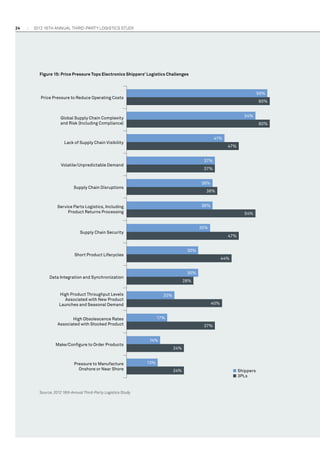
seen in Figure 15 on page 24, supply
chain complexity and risk is the secondhighest-ranked challenge for shippers.
Figure 18 on page 30 reveals that 3PLs
are somewhat more confident in their
ability to help address this challenge
than shippers are (42% to 22%), perhaps because more of the cost emphasis is on the product itself and not the
logistics wrapped around it. An exception is Philips, which merged two divisions, both selling to retail and at times
to the same customers, in an effort to
reduce complexity and lower its warehouse count.
–– Make to Order/Make to Stock: A make
to order production strategy enables
electronics companies to customize
products such as computers to customers’ exacting specifications. Dell
achieved significant supply chain recognition for its work toward its make to
order supply chain model. The majority
of electronics companies in the survey
(78%) agree that for most electronics companies, a make to order supply
chain model may not always be as cost
effective as a make to stock model. It
can also lead to inventory obsolescence,
especially when product lifecycles are
short. Dell maintains as many as six
supply chains. Business products are
made to order, but differing demand
requirements mean some move via air
freight while others leverage alternative
modes, according to a Supply Chain Digest
Webcast. Dell’s retail products are made
to stock and planned well in advance to
get products to market cost effectively
for peak seasons.
24

2012 16th annual THIRD-PARTY LOGISTICS study

Figure 15: Price Pressure Tops Electronics Shippers’ Logistics Challenges

59%

Price Pressure to Reduce Operating Costs

60%
54%

Global Supply Chain Complexity
and Risk (Including Compliance)

60%
41%

Lack of Supply Chain Visibility

47%
37%

Volatile/Unpredictable Demand

37%
36%

Supply Chain Disruptions

38%
36%

Service Parts Logistics, Including
Product Returns Processing

54%
35%

Supply Chain Security

47%
30%

Short Product Lifecycles

44%
30%

Data Integration and Synchronization

28%

High Product Throughput Levels
Associated with New Product
Launches and Seasonal Demand

20%
40%
17%

High Obsolescence Rates
Associated with Stocked Product

Make/Configure to Order Products

Pressure to Manufacture
Onshore or Near Shore

Source: 2012 16th Annual Third-Party Logistics Study

37%
14%
24%
13%
24%

■ Shippers
■ 3PLs
Electronics

The bottom line is that one size does
not fit all, even within one electronics
company, due to varying market and customer needs.
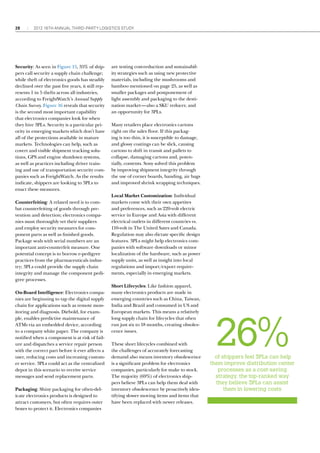
–– Postponement: A related strategy
favored by electronics manufacturers,
which both reduces inventory and provides a higher level of customization, is
postponing final configuration, including packaging, until the product is in or
close to the market where the product
will be consumed – services that may be
performed by 3PLs in these markets.
“People want the benefits of manufacturing in China, but are doing more packaging in the US,” as well as light assembly
where possible, says Wally Shaw, Market
Group Supply Lead, Americas at Philips
Consumer Lifestyle. “This helps with
forecasting by reducing the number of
SKUs you are planning, and also helps
reduce cube in transportation by using a
bulk pack.”
–– Price Pressure: Shippers view price
pressure to reduce operating costs as
their top logistics challenge (59%). One
increasingly common solution is to shift
from a heavy emphasis on fast but costly
air freight to other modes according to
specific channel needs, but this requires
significant advance planning. Nearly
two-thirds (65%) of electronics shippers
in the survey favor air freight over slower
modes to shorten supply chain transit
time. 3PLs believe they can play a larger
role in helping electronics shippers
address this challenge than shippers do
(Figure 18, 38% vs. 28% of shippers).

–– Use of Contract Manufacturers as 3PLs:
The lines between industry groups are
blurring as contract manufacturers in
emerging markets offer services that
are more traditionally associated with
3PLs, a trend noted by about two-thirds
of shippers and 3PLs in the survey. Most
common services include transportation
management, warehousing and distribution services and returns management. Some contract manufacturers are
offering the more “advanced” services
typically provided by 3PLs, such as supply chain network design, logistics planning and consulting services. Contract
manufacturers see this as a logical
extension of their services and a highermargin opportunity. Discussions with
3PLs reveal that they do not see this as
a major threat yet, since logistics is their
core competency and they believe that
electronics companies will choose them
over contract manufacturers for complex
international logistics needs.
–– Environmental and Social
Sustainability: Like many industries,
electronics manufacturers are concerned with CO2 emissions and fuel
consumption, particularly with long supply chains. Manufacturing byproducts
such as lead from printed circuit board
production are an additional concern;
70% of heavy metals in US landfills
come from discarded electronics products, according to Supply Chain Brain’s
High Tech Outlook, February 2011.
Companies – and savvy 3PLs – are getting creative to solve materials and packaging problems. Dell is trying protective
packaging made of bamboo and even
mushrooms and is scaling down package
sizes to fit more on a pallet, according to
an April, 2011, article in Fortune.

25

Complex Networks and Channels
The electronics industry is notoriously
segregated, with multiple players involved
in the supply chain, not all of which are
marching to a common beat. These players include:
–– Component suppliers
–– Contract Manufacturers, Original
Design Manufacturers and Joint Ventures
–– Original Equipment Manufacturers/
Brand Owners
–– Distributors/Partners/Value-Added
Resellers
–– End Customers
Electronics is also a highly dynamic industry: Technology changes so rapidly that
many companies are driven to failure due
to their inability to keep up with changing
technologies. That in turn drives significant merger, acquisition, and divestiture
activity; Cisco alone has acquired more
than 145 companies in the last 18 years,
according to the company’s Web site.
Motorola recently split into a consumer
products company and a business and government products company while selling
off a division that makes network infrastructure equipment.
Further complicating matters, electronics
companies sell into many vertical markets,
each with its own unique needs. Among
the most trying is retail, which offers
opportunity but also complexity to electronics supply chains. Among the challenges of interacting with retailers:
–– Inaccurate retail-level forecasts
–– Retailers’ risk tolerance
–– Exacting vendor compliance programs
with significant penalties
–– Consumer electronics products often
have a long lead time and a short product cycle, which creates obsolescence or
excess stock
26

2012 16th annual THIRD-PARTY LOGISTICS study

More than two-thirds of electronics companies in the survey (73%) agree that
establishing a branded retail presence
themselves is a good way for consumer electronics manufacturers to drive
increased revenue.
Multiple layers, mashed-together supply
chains and the specific challenges of retail
channels introduce cost, safety stock, forecast challenges and additional time into
logistics processes.
One impact can be seen in electronics companies’ forecast accuracy, which
averages 60% to 70%. Chris Armbruster,
Senior Director, Business Transformation,
at Motorola Solutions, who participated in
the ASE workshop in Chicago, noted that
the vertically dis-integrated supply chain
common in electronics slows and often
limits the sharing of forecasts, leading to
a bullwhip effect in inventory levels at both
the retail and sourcing levels, when changes in supply or demand occur. Sharing
information on true demand more quickly
would result in improved forecasts and
reduced inventory levels. Electronics companies must be agile to adapt to market
changes and unanticipated events, such as
the recent Japanese tsunami or earthquake
in China, and use demand sensing and
shaping to detect and influence demand.
Another challenge is to design a common,
cost-efficient infrastructure across supply
chains. Lean is a common goal – reducing
inventory, containing SKU proliferation,
and limiting fixed assets, such as in Sony’s
supply chain, described previously.
These challenges provide opportunity for
3PLs to offer services such as visibility, setting up inventory hubs in key locations,
helping to rationalize inventory across the
supply chain and finding ways to reduce
cycle time on transit legs. Fully 55% of
3PLs report that they can help electronics companies redesign supply chain
networks, which can help them respond
to differing channel needs while sharing common infrastructure and services
wherever cost effective. However, as seen
in Figure 17 on page 29, only 14% of shippers use 3PLs for this service. To capture
more of this business, 3PLs need to invest
in understanding the customer at all levels in the organization. An electronics

manufacturer’s Supply Chain Manager
participating in the ASE workshop in
Utrecht noted that in his experience some
3PLs lack the ability to effectively respond
to shippers’ organizational changes.
Consumer electronics products share
characteristics with fashion retail (velocity) and consumer products (short lifecycles, demand volatility, peak season
demands); 3PLs with experience in retail
and consumer products can also cross-pollinate best practices in product distribution and demand management with electronics companies.

High-Demand, High-Value Products
Electronics companies build products people want, with the latest, most in-demand
features that appeal to specific markets.
That makes them high valued – and subject to theft, counterfeit and the whims of
consumer tastes. These are some of the
challenges this poses:
Visibility: Global supply chain visibility is
a clear priority for electronics shippers. In
Figure 15, it’s the third-most-cited logistics
challenge (41%). Electronics shippers in
the US rank this more highly than those
in Europe and Latin America, and larger
shippers place more importance on it than
smaller companies. Visibility is essential to
provide inventory availability and order status to customers as well as to provide security while in transit.
In Figure 16, 74% of electronics companies
cite visibility as the top service they would
like to see from 3PLs, no matter the size or
location of the shipper. A leading computer manufacturer, for example, has begun
to pursue a model in which a 4PL manages
all of its 3PLs in a given country in order to
ensure visibility.
Figure 17 reveals that improved forecasting and inventory visibility is the third
most-used cost-saving strategy by electronics companies, although curiously,
despite the fact that 3PLs are ideally situated to provide visibility to customers,
both shippers and 3PLs report that 3PLs
are not very likely to be assisting in this
improvement process. Perhaps 3PLs are
providing sufficient visibility, but work
needs to be done on the shipper side to
maximize its use.

74%

of electronics companies cite
visibility as the top service they
would like to see from 3PLs
Electronics

Figure 16: Visibility Tops Services Electronics Companies Seek from 3PLs

74%

Global Supply Chain Visibility

Supply Chain Security

12%
56%
8%
44%

Reverse Logistics

15%
40%

Vendor Managed Inventory

Experience with Local Product Regulations

Quality Certifications Such as ISO 9000

11%
40%
6%
38%
4%
34%

Service Parts Logistics

Kitting
Facilitate Just in Time (JIT)
Manufacturing/Kanban Systems
Final Assembly/Configuration/Postponement

11%
32%
8%
27%
7%
26%
6%
25%

Environmental Certifications Such as ISO 14000

11%
24%

Lean/Six Sigma

12%
22%

Managing Global Production Supply

11%
22%

Willingness to Own and Manage Inventory

Testing

Warranty Processing

Launch of New Product

Software Loading/Flashing

Source: 2012 16th Annual Third-Party Logistics Study

15%
21%
9%
21%
9%
19%
5%
17%
8%

■ Important Today
■ Important in Near Future

27
28

2012 16th annual THIRD-PARTY LOGISTICS study

Security: As seen in Figure 15, 35% of shippers call security a supply chain challenge;
while theft of electronics goods has steadily
declined over the past five years, it still represents 1 in 5 thefts across all industries,
according to FreightWatch’s Annual Supply
Chain Survey. Figure 16 reveals that security
is the second most important capability
that electronics companies look for when
they hire 3PLs. Security is a particular priority in emerging markets which don’t have
all of the protections available in mature
markets. Technologies can help, such as
covert and visible shipment tracking solutions, GPS and engine shutdown systems,
as well as practices including driver training and use of transportation security companies such as FreightWatch. As the results
indicate, shippers are looking to 3PLs to
enact these measures.
Counterfeiting: A related need is to combat counterfeiting of goods through prevention and detection; electronics companies must thoroughly vet their suppliers
and employ security measures for component parts as well as finished goods.
Package seals with serial numbers are an
important anti-counterfeit measure. One
potential concept is to borrow e-pedigree
practices from the pharmaceuticals industry; 3PLs could provide the supply chain
integrity and manage the component pedigree processes.
On-Board Intelligence: Electronics companies are beginning to tap the digital supply
chain for applications such as remote monitoring and diagnosis. Diebold, for example, enables predictive maintenance of
ATMs via an embedded device, according
to a company white paper. The company is
notified when a component is at risk of failure and dispatches a service repair person
with the correct part before it ever affects a
user, reducing costs and increasing customer service. 3PLs could act as the centralized
depot in this scenario to receive service
messages and send replacement parts.
Packaging: Shiny packaging for often-delicate electronics products is designed to
attract customers, but often requires outer
boxes to protect it. Electronics companies

are testing cost-reduction and sustainability strategies such as using new protective
materials, including the mushrooms and
bamboo mentioned on page 25, as well as
smaller packages and postponement of
light assembly and packaging to the destination market — also a SKU reducer, and
an opportunity for 3PLs.
Many retailers place electronics cartons
right on the sales floor. If this packaging is too thin, it is susceptible to damage,
and glossy coatings can be slick, causing
cartons to shift in transit and pallets to
collapse, damaging cartons and, potentially, contents. Sony solved this problem
by improving shipment integrity through
the use of corner boards, banding, air bags
and improved shrink wrapping techniques.
Local Market Customization: Individual
markets come with their own appetites
and preferences, such as 220-volt electric
service in Europe and Asia with different
electrical outlets in different countries vs.
110-volt in The United Sates and Canada.
Regulation may also dictate specific design
features. 3PLs might help electronics companies with software downloads or minor
localization of the hardware, such as power
supply units, as well as insight into local
regulations and import/export requirements, especially in emerging markets.
Short Lifecycles: Like fashion apparel,
many electronics products are made in
emerging countries such as China, Taiwan,
India and Brazil and consumed in US and
European markets. This means a relatively
long supply chain for lifecycles that often
run just six to 18 months, creating obsolescence issues.
These short lifecycles combined with
the challenges of accurately forecasting
demand also means inventory obsolescence
is a significant problem for electronics
companies, particularly for make to stock.
The majority (69%) of electronics shippers believe 3PLs can help them deal with
inventory obsolescence by proactively identifying slower moving items and items that
have been replaced with newer releases.

26%

of shippers feel 3PLs can help
them improve distribution center
processes as a cost-saving
strategy, the top-ranked way
they believe 3PLs can assist
them in lowering costs
Electronics

Figure 17: Electronics Companies Employ Many Logistics Cost Savings Methods

63%

Renegotiated Rates for Logistics Services

18%
62%

Improved Distribution Center Processes

Improved Forecasting and Inventory Visibility

26%
57%
10%
52%

Renegotiated Rates for Warehouse Services

Instituted Internal Training Programs to Encourage
Cost Effectiveness/Lean Behaviors

Increased Outsourcing

17%
49%
10%
49%
10%
48%

Switched to Multimodal or Slower Mode of Transport

19%
47%

Redesigned Supply Chain Network

14%
45%

Improved Shipment Density/Load Utilization

18%
41%

Improved Returns Management/
Reverse Logistics Processes

16%
39%

Implemented or Improved Logistics-Related
Information Technology Tools or Enablers

Rationalized or Decreased the Number of SKUs

Improved Inventory Turns Through
Vendor Managed Inventory

Moved to a Make to Order Model

Employed More Fuel-Efficient Transport

Source: 2012 16th Annual Third-Party Logistics Study

14%
37%
2%
37%
10%
31%
6%
22%
9%

■ Our Company Uses
■ Assisted by 3PLs

29
30

2012 16th annual THIRD-PARTY LOGISTICS study

Figure 18: More 3PLs Than Shippers Believe 3PLs Can Help with Challenges

28%

Price Pressure to Reduce Operating Costs

38%
24%

Lack of Supply Chain Visibility

39%
22%

Global Supply Chain Complexity and
Risk (Including Compliance)

42%
21%

Supply Chain Security

32%
20%

Service Parts Logistics, Including
Product Returns Processing

43%
17%

Supply Chain Disruptions

27%
13%

Data Integration and Synchronization

17%
11%

Volatile/Unpredictable Demand

16%

High Product Throughput Levels
Associated with New Product
Launches and Seasonal Demand

Short Product Lifecycles

High Obsolescence Rates
Associated with Stocked Product

9%
26%
4%
14%
4%
13%
2%

Make/Configure to Order Products

Pressure to Manufacture
Onshore or Near Shore

Other

11%
0%
13%
0%

Source: 2012 16th Annual Third-Party Logistics Study

1%

■ Shippers
■ 3PLs
Electronics

3PLs could help to identify at risk inventory in the warehouses that they manage,
as well as arrange intermodal and other
consolidation services to increase the supply chain velocity without dramatically
increasing transportation costs. “You need
a very good level of integration to be adaptive and flexible to cope with these shorter
life cycles,” says Tony Xia, Sr. Logistics
Manager with Emerson Electric.
When inventoried items become obsolete,
58% of electronics shippers in the survey
agree that online auctions are an important means for electronics companies to
reclaim some value. Facilitating online
inventory disposition is the next logical
step in a 3PL value-added service offering.
A number of electronics companies use
FreeFlow, provider of online private marketplaces and auctions, to sell at-risk inventory through secure channels for each
stage of the inventory aging process.

The Role of 3PLs
As seen throughout this chapter, electronics companies favor outsourcing in both
manufacturing and logistics services.
That’s especially true in emerging markets.
Yet there is a clear gap between the services
3PLs are currently providing and the additional value they could provide.
As seen in Figures 15 and 18, electronics
shippers give low marks to 3PLs’ ability to
solve their top logistics challenges. The
largest gaps occur on their highest priorities: 59% call price pressure to reduce
operating costs their top challenge, while
just 28% believe 3PLs can help them with
this challenge. A similar gap is revealed
in 3PLs’ ability to help electronics companies with global supply chain complexity and risk, including compliance. 3PLs
themselves also see a gap, albeit smaller,
between these challenges and their involvement in helping their customers with these
challenges.

The same is true in top savings methods
used by electronics companies in Figure 17;
there are significant gaps between strategies used and assistance by 3PLs in those
efforts, confirmed by 3PLs themselves.
At the ASE workshop in Utrecht, one contract manufacturer shed some light on
one of the reasons shippers’ may not seek
to undertake problem-solving with 3PLs.
“They do not bring cost reductions and
a lean approach to the table very often,”
he said. “They will do only what they are
asked to do; they do not proactively offer
many value-added services.”
It’s clear in Figure 18 that 3PLs see opportunities to support shippers in ways electronics shippers themselves do not. Both

31

sides need to meet in the middle: 3PLs
need do a better job in selling the quality
and value of their capabilities to electronics customers, and shippers need to be
more open to collaborating with 3PLs to
address their top challenges.
Generally speaking, electronics shippers
view 3PLs as skilled and capable at fundamental logistics capabilities, but don’t
necessarily turn to them for collaborative
problem-solving to address their more strategic supply chain challenges. The results
in Figure 16 confirm that they would like
to see more. Embedded throughout this
chapter are suggestions for significant contributions that 3PLs can make to address
electronics companies’ most vexing supply
chain challenges.

Electronics: Key Takeaways
–– Electronics products are complex inside and out, featuring many components and
delivered to market via a fragmented and far-flung global supply chain. Add to that
high demand and ever-shortening product lifecycles, and you get significant logistical challenges. Issues of concern in manufacturing and sourcing electronics include
complex global sourcing, including heavy reliance on emerging markets; price
pressures; and balancing make to order versus make to stock — issues 3PLs are positioned to help address. Electronics supply chains must also accommodate multiple
channels with differing needs, with retail offering substantial opportunity but also
exacting supply chain demands. Electronics also sees heavy merger and acquisition
activity and a dis‑integrated supply chain, boosting its tendency toward outsourcing.
–– A high-demand, high-value product set also raises issues of visibility, security and
packaging challenges, as well as the need to manage short-lifecycle issues such
as obsolescence and selling off excess inventory. While a fragmented supply chain
means electronics relies heavily on 3PLs to address these problems, survey results
reveal that electronics companies are unlikely to feel 3PLs can help them solve their
top logistics challenges. 3PLs need do a better job in selling their capabilities and
shippers need to be more open to hearing about them.
Striving for excellence requires the best people
Talent Management

33

Talent Management
Overcoming the Talent Shortage

A critical shortage going on in the logistics industry today has nothing to do with
inventory; it’s the shortage of well-rounded
supply chain managers prepared to step
into key management positions. According
to research by employment services provider Manpower Group, in the US, 52%
of employers are experiencing difficulty
filling supply chain positions within their
organizations, up from 14% in 2010.
For many companies, the supply chain has
become a significant contributor to attaining strategic business goals, making wellqualified logistics talent essential. As seen

in Figure 19, shippers and 3PLs agree that
having the right people and leadership
in place is the number one driver of their
companies’ success in the next five years,
slightly outranking the importance of the
right strategy and roadmap itself. 3PLs and
shippers are aligned on all of the top drivers to organizational success.

ever-more-complex supply chains. They
can get there by investing in talent management, leadership skills and succession
planning, as well as by defining the skill
sets and capabilities these leaders will
require and ensuring a satisfying work
environment.

Fortunately, the talent gap can be reduced.
Shippers, 3PLs and other organizations
active in the supply chain community
have the opportunity to both develop and
attract the next generation of managers
with the diverse skills required to govern

Talent management is the vigorous, systematic process of connecting a clear, welldefined business strategy to the recruitment, retention and development of talent.
At times, talent management is an overused term and an underutilized discipline

The State of Talent

Figure 19: People are the Top Driver of Organizational Success

61%

Having the Right People
and Leadership in Place

77%

58%

Having the Right Strategy and Roadmap

60%

58%

Ability to Execute and Drive
Operational Efficiency and Improvements

61%

41%

Having the Right Products and Services
33%

27%

Ability to Innovate

32%

Having the Ability to
Drive Greater Innovation

Having the Right Infrastructure

14%
14%

10%
12%

Source: 2012 16th Annual Third-Party Logistics Study

■ Shipper
■ 3PL
34

2012 16th annual THIRD-PARTY LOGISTICS study

– particularly in the logistics industry. Too
often, senior management turns to talent
management in crisis mode, when a key
logistics employee has given notice and
they dust off that musty, dated talent management manual sitting up high on the
bookshelf. Development may consist of an
annual performance review that gets filed
away in a drawer.
The experience of one manufacturer is
typical of the industry: many executives on
its supply chain team boast more than 20
years at the company. That speaks volumes
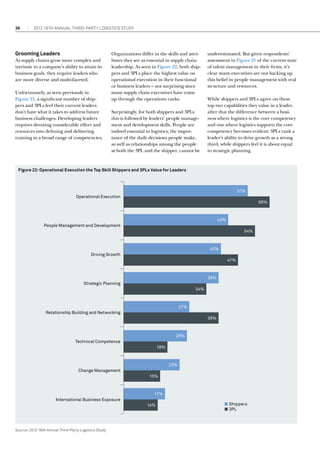
about its attractiveness as a workplace. But
the company lacks a robust talent development process; as those supply chain executives reach retirement age, the depth of
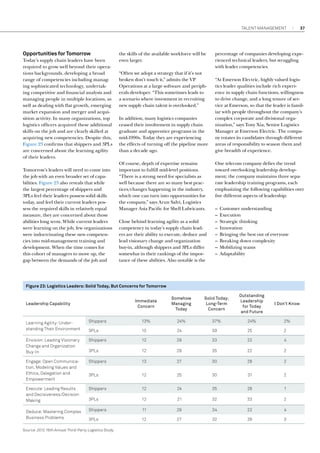
executives on the bench may be limited.
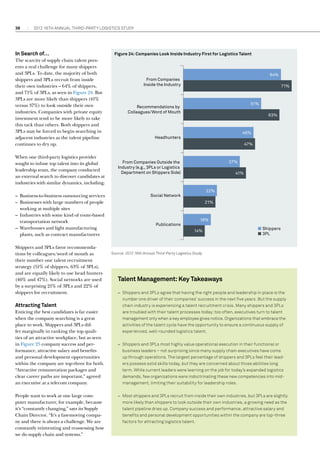
Many progressive companies leading their
industries focus on effective execution of
total management principles. Talent management becomes a strategic tool integrated into a company’s business practices and
a part of every business manager’s responsibilities. Talent is tied to business strategy,
so that if, for example, the company was
moving into an emerging market, or entering new trade lanes, the need for talent
would be a part of that strategic discussion.
At Kraft Foods, for example, “Supply chain
executives are part of day-to-day management, an integral part of the business
planning roundtable and are partnering
with other key functional business leaders on the board,” says Mauricio Ferreira,
Latin America Supply Chain Director. At
one large pharmaceutical manufacturer,
recognition of the significant impact of
supply chain has elevated its importance in
the executive suite. “Supply chain has been
waiting outside the board room for some
time, but it’s getting recognition now,”
says its VP Logistics, who sits on the company’s Global Risk Management board.
“The eruption of the volcanoes in Europe
brought this to the table and made it front
of mind that disruptions can occur.”
Talent can be a critical differentiator for
3PLs. With many of their services under
threat of becoming commoditized on
price, superior talent becomes a competitive advantage. Only those organizations
with the very best people in place deliver
the innovation and standout service that
will set that company apart.

Logistics and the Talent Cycle
The Talent Cycle in Figure 20 captures the
complete lifecycle of an employee’s experience, not just the initial recruitment, but
all of the activities that occur to develop
that person through the end of his career.
The survey results suggest that many shippers and 3PLs are troubled by the current
state of talent management within their
organizations and see an opportunity to
improve it.
Identifying and Attracting skilled talent
starts with creating a workforce strategy
to align with your business strategy, then
devising ways to discover and communicate what your company has to offer to
attract a diverse and talented workforce.
This part of the talent cycle presents tremendous opportunity and high risk. Risk
is highest during the first 60 days of transitioning a leader into a new role either
from inside or outside.
Recruiting and Hiring entails devising
strategies for understanding talent needs
and sources, executing business/talent

plans, establishing interviewing methods
and skills and managing the talent acquisition investment. Often in the logistics
industry, hiring occurs through word of
mouth or hiring from within; as seen in
Figure 21, 39% of shippers and 37% of
3PLs are concerned or significantly concerned that their company could do more
to increase diverse external perspectives,
such as hiring from other industries (talent recruitment).
Onboarding and Integration processes
apply to the period just before and after an
employee is hired, including planning and
supporting transitions and deploying people in the right teams and leadership roles.
Continuous Learning and Development
Experiences occur through formal and
informal training as well as experienceand relationship-based learning and coaching, follow-through, and support. Shippers
and 3PLs report similar experiences within
their organizations; 36% of shippers and
37% of 3PLs say that their companies’ lack
of a meaningful and objective process of

Figure 20: The Talent Cycle

Succession
Planning
Transitioning

Identifying
and
Attracting

Alignment
of Leadership

The
Talent
Cycle

Recruiting
and Hiring

Promotion
and
Rotation

Engaging
and
Retaining

Onboarding and
Integration

Source: Heidrick  Struggles

Continuous
Learning and
Development
Experiences
Talent Management

measuring performance and issuing consequent actions, such as coaching, is a concern or a significant concern (talent review
process). In addition, 41% of shippers and
36% of 3PLs are concerned or significantly
concerned that their organization has a
number of stars, but their culture/history
has not encouraged them to work collaboratively as a team (team effectiveness).
Engaging and Retaining employees’ interest in a shipper or 3PL as an employer
requires active communication and performance and career management exercises.
Companies need to encourage and enable
a work/life balance and ensure recognition and rewards along the way. A substantial 43% of shippers and 40% of 3PLs say
the struggle with keeping their strongest
talent in the organization is a concern or
a significant concern (retention).
Promotion and Rotation means creating
a talent development process with clearly
defined promotion and rotation criteria
and a system for assessment, feedback,
and coaching. The top concern of both

shippers and 3PLs regarding talent management is the lack of a robust system of
preparing rising leaders for the future,
such as through job rotations, training and
mentoring. (53% of shippers and 54% of
3PLs are concerned or significantly concerned about talent development)
When one telecom company outsourced
logistics ten years ago, it lost a lot of experienced supply chain talent. So when the
company later began to insource some
logistics functions, it instituted a system
to identify and map potential logistics
leaders, ensuring a balance of gender and
ages, and established training programs to
develop their expertise.
Alignment of Leadership is all about identifying and developing candidates with
high potential, including leadership development and coaching. This is the third-biggest talent management concern for shippers (47%), and second-biggest for 3PLs
(48%). These respondents are concerned
or significantly concerned that the capabilities of current leaders are not aligned with

what is necessary to address future strategic challenges (skills and experience).
Succession Planning requires defining
roles and needs, creating evaluation criteria and then developing, supporting and
coaching successors. Another top-three
concern for both shippers and 3PLs (48%
of shippers and 47% of 3PLs) is that their
leadership does not take an active interest in understanding the pipeline of good
people in the organization and ensuring
there is a robust succession planning process in place.
Transitioning means enabling smooth
career transitions and staying connected
with alumni and retired employees.
Organizations that embrace the activities
of the talent cycle have the opportunity to
ensure a continuous supply of experienced,
well-rounded logistics talent.

Figure 21: 3PLs and Shippers are Concerned About Their Talent Management and Development Practices

Shippers

3%

44%

3PLs
Talent
Development

53%

54%

4%

48%

48%

Succession
Planning

47%

3%

50%

47%

Skills and
Experience

48%

3%

54%

43%

Retention

40%

43%

50%

51%

58%

3%

3%

1%

2%

4%

55%

41%

Team
Effectiveness

36%

61%

3%

6%

55%

39%

Talent
Recruitment

37%

59%

4%

4%

58%

36%

Talent
Review Process

37%

60%

3%

■ Concern or Significant Concern
■ Mild or Not a Concern
■ Not Relevant

Source: 2012 16th Annual Third-Party Logistics Study

35

■ Concern or Significant Concern
■ Mild or Not a Concern
■ Not Relevant
36

2012 16th annual THIRD-PARTY LOGISTICS study

Grooming Leaders
As supply chains grow more complex and
intrinsic to a company’s ability to attain its
business goals, they require leaders who
are more diverse and multi-faceted.
Unfortunately, as seen previously in
Figure 21, a significant number of shippers and 3PLs feel their current leaders
don’t have what it takes to address future
business challenges. Developing leaders
requires devoting considerable effort and
resources into defining and delivering
training in a broad range of competencies.

Organizations differ in the skills and attributes they see as essential in supply chain
leadership. As seen in Figure 22, both shippers and 3PLs place the highest value on
operational execution in their functional
or business leaders – not surprising since
many supply chain executives have come
up through the operations ranks.
Surprisingly, for both shippers and 3PLs
this is followed by leaders’ people management and development skills. People are
indeed essential to logistics; the importance of the daily decisions people make,
as well as relationships among the people
at both the 3PL and the shipper, cannot be

underestimated. But given respondents’
assessment in Figure 21 of the current state
of talent management in their firms, it’s
clear many executives are not backing up
this belief in people management with real
structure and resources.
While shippers and 3PLs agree on these
top two capabilities they value in a leader,
after that the difference between a business where logistics is the core competency
and one where logistics supports the core
competency becomes evident: 3PLs rank a
leader’s ability to drive growth as a strong
third, while shippers feel it is about equal
to strategic planning.

Figure 22: Operational Execution the Top Skill Shippers and 3PLs Value for Leaders

51%
Operational Execution
60%

43%
People Management and Development
54%

40%
Driving Growth
47%

39%
Strategic Planning
34%

27%
Relationship Building and Networking
39%

26%
Technical Competence
18%

23%
Change Management
15%

17%
International Business Exposure
14%

Source: 2012 16th Annual Third-Party Logistics Study

■ Shippers
■ 3PL
Talent Management

Opportunities for Tomorrow
Today’s supply chain leaders have been
required to grow well beyond their operations backgrounds, developing a broad
range of competencies including managing sophisticated technology, undertaking competitive and financial analysis and
managing people in multiple locations, as
well as dealing with flat growth, emerging
market expansion and merger and acquisition activity. In many organizations, top
logistics officers acquired these additional
skills on the job and are clearly skilled at
acquiring new competencies. Despite this,
Figure 23 confirms that shippers and 3PLs
are concerned about the learning agility
of their leaders.
Tomorrow’s leaders will need to come into
the job with an even broader set of capabilities. Figure 23 also reveals that while
the largest percentage of shippers and
3PLs feel their leaders possess solid skills
today, and feel their current leaders possess the required skills in relatively equal
measure, they are concerned about those
abilities long term. While current leaders
were learning on the job, few organizations
were indoctrinating these new competencies into mid-management training and
development. When the time comes for
this cohort of managers to move up, the
gap between the demands of the job and

the skills of the available workforce will be
even larger.
“Often we adopt a strategy that if it’s not
broken don’t touch it,” admits the VP
Operations at a large software and peripherals developer. “This sometimes leads to
a scenario where investment in recruiting
new supply chain talent is overlooked.”
In addition, many logistics companies
ceased their involvement in supply chain
graduate and apprentice programs in the
mid-1990s. Today they are experiencing
the effects of turning off the pipeline more
than a decade ago.
Of course, depth of expertise remains
important to fulfill mid-level positions.
“There is a strong need for specialists as
well because there are so many best practices/changes happening in the industry,
which one can turn into opportunities for
the company,” says Arun Salvi, Logistics
Manager Asia Pacific for Shell Lubricants.
Close behind learning agility as a solid
competency in today’s supply chain leaders are their ability to execute, deduce and
lead visionary change and organization
buy-in, although shippers and 3PLs differ
somewhat in their rankings of the importance of these abilities. Also notable is the

percentage of companies developing experienced technical leaders, but struggling
with leader competencies.
“At Emerson Electric, highly valued logistics leader qualities include rich experience in supply chain functions, willingness
to drive change, and a long tenure of service at Emerson, so that the leader is familiar with people throughout the company’s
complex corporate and divisional organization,” says Tony Xia, Senior Logistics
Manager at Emerson Electric. The company rotates its candidates through different
areas of responsibility to season them and
give breadth of experience.
One telecom company defies the trend
toward overlooking leadership development; the company maintains three separate leadership training programs, each
emphasizing the following capabilities over
five different aspects of leadership:
–– Customer understanding
–– Execution
–– Strategic thinking
–– Innovation
–– Bringing the best out of everyone
–– Breaking down complexity
–– Mobilizing teams
–– Adaptability

Figure 23: Logistics Leaders: Solid Today, But Concerns for Tomorrow
Immediate
Concern

Somehow
Managing
Today

Solid Today;
Long-Term
Concern

Outstanding
Leadership
for Today
and Future

I Don’t Know

Shippers

13%

24%

37%

24%

2%

3PLs

10

24

39

25

2

Envision: Leading Visionary
Change and Organization
Buy-In

Shippers

12

29

33

22

4

3PLs

12

29

35

22

2

Engage: Open Communication, Modeling Values and
Ethics, Delegation and
Empowerment

Shippers

13

27

30

28

2

3PLs

12

25

30

31

2

Execute: Leading Results
and Decisiveness/Decision
Making

Shippers

12

24

35

28

1

3PLs

12

21

32

33

2

Deduce: Mastering Complex
Business Problems

Shippers

11

29

34

22

4

3PLs

12

27

32

26

3

Leadership Capability

Learning Agility: Understanding Their Environment

Source: 2012 16th Annual Third-Party Logistics Study

37
38

2012 16th annual THIRD-PARTY LOGISTICS study

In Search of…
The scarcity of supply chain talent presents a real challenge for many shippers
and 3PLs. To date, the majority of both
shippers and 3PLs recruit from inside
their own industries – 64% of shippers,
and 71% of 3PLs, as seen in Figure 24. But
3PLs are more likely than shippers (41%
versus 37%) to look outside their own
industries. Companies with private equity
investment tend to be more likely to take
this tack than others. Both shippers and
3PLs may be forced to begin searching in
adjacent industries as the talent pipeline
continues to dry up.
When one third-party logistics provider
sought to infuse top talent into its global
leadership team, the company conducted
an external search to discover candidates at
industries with similar dynamics, including:
–– Business-to-business outsourcing services
–– Businesses with large numbers of people
working at multiple sites
–– Industries with some kind of route-based
transportation network
–– Warehouses and light manufacturing
plants, such as contract manufacturers
Shippers and 3PLs favor recommendations by colleagues/word of mouth as
their number one talent recruitment
strategy (51% of shippers, 63% of 3PLs),
and are equally likely to use head hunters
(46% and 47%). Social networks are used
by a surprising 21% of 3PLs and 22% of
shippers for recruitment.

Attracting Talent
Enticing the best candidates is far easier
when the company searching is a great
place to work. Shippers and 3PLs differ marginally in ranking the top qualities of an attractive workplace, but as seen
in Figure 25 company success and performance, attractive salary and benefits
and personal development opportunities
within the company are top-three for both.
“Attractive remuneration packages and
clear career paths are important,” agreed
an executive at a telecom company.
People want to work at one large computer manufacturer, for example, because
it’s “constantly changing,” says its Supply
Chain Director. “It’s a fast-moving company and there is always a challenge. We are
constantly reinventing and reassessing how
we do supply chain and systems.”

Figure 24: Companies Look Inside Industry First for Logistics Talent

64%

From Companies
Inside the Industry

71%

51%

Recommendations by
Colleagues/Word of Mouth

63%

46%

Headhunters

47%

37%

From Companies Outside the
Industry (e.g., 3PLs or Logistics
Department on Shippers Side)

41%

22%

Social Network

21%

Publications

18%
14%

■ Shippers
■ 3PL

Source: 2012 16th Annual Third-Party Logistics Study

Talent Management: Key Takeaways
–– Shippers and 3PLs agree that having the right people and leadership in place is the
number one driver of their companies’ success in the next five years. But the supply
chain industry is experiencing a talent recruitment crisis. Many shippers and 3PLs
are troubled with their talent processes today; too often, executives turn to talent
management only when a key employee gives notice. Organizations that embrace the
activities of the talent cycle have the opportunity to ensure a continuous supply of
experienced, well-rounded logistics talent.
–– Shippers and 3PLs most highly value operational execution in their functional or
business leaders – not surprising since many supply chain executives have come
up through operations. The largest percentage of shippers and 3PLs feel their leaders possess solid skills today, but they are concerned about those abilities long
term. While current leaders were learning on the job for today’s expanded logistics
demands, few organizations were indoctrinating these new competencies into midmanagement, limiting their suitability for leadership roles.
–– Most shippers and 3PLs recruit from inside their own industries, but 3PLs are slightly
more likely than shippers to look outside their own industries, a growing need as the
talent pipeline dries up. Company success and performance, attractive salary and
benefits and personal development opportunities within the company are top-three
factors for attracting logistics talent.
Talent Management

Figure 25: Company Success and Personal Opportunity Make For Attractive Employers

57%
Company Success and Performance

57%

57%

Personal Development Opportunities
within the Company

55%

54%
Attractive Salary/Benefits Conditions

53%

41%

Attractive Working Environment
with Engaged and Good People

48%

20%

Entrepreneurial Spirit/
Culture of Individual Ownership

30%

18%
Reputation for Innovation

18%

15%

Status as a Top Three Industry
Leader (Size and Brand)

13%

12%
Flexibility

10%

9%
Location

7%

Source: 2012 16th Annual Third-Party Logistics Study

■ Shippers
■ 3PLs

39
Attaining supply chain consistency amid constant change
strategic assessment

41

Strategic Assessment
In Supply Chain, the One Constant is Change

Static: It’s one word you don’t hear in supply chain circles very often, and for good
reason: Logistics is synonymous with movement, both in goods and information, and
in the design and evolution of the supply
chains that make that movement possible. Constantly changing economic and
political dynamics necessitate continual
re-evaluation of supply chain decisions.
The job is never dull, challenging supply
chain professionals to think creatively and
strategically.
Inspired by the findings of this year’s study,
this strategic assessment examines several
trends spurring yet more change and innovation in the supply chain world. First is
the overall rise in outsourcing of logistics, followed by the growing use of supply
chain control towers – both indicators of
the increasingly complexity of managing
today’s supply chains.
Emerging markets are a key factor in that
complexity, and a trend to nearshoring is
another sign of constantly changing global dynamics. Companies have moved production to emerging markets in pursuit
of lower costs, but that decision changed
conditions in those very markets, challenging companies to reconsider the economics and in some cases turn to nearshoring. Finally, a change impacting every
industry is the emergence of social media,
and like others, the supply chain industry
is in the early stages of working out how to
best leverage its power to enhance day-today business functions while minimizing
the risks.

Global Trends in OutsourcingInsourcing of Logistics Services
Outsourcing of logistics activities is on the
rise, according to survey findings reported
in the Current State of the Market Chapter.
Nearly two-thirds (64%) of shippers report
an increase in their use of outsourced
logistics services, and 76% of 3PL respondents agree this is what they are seeing
from their customers. At the same time,
24% of shippers are returning to insourcing some of their logistics activities, a

trend confirmed by 37% of 3PLs. Both are
consistent with past Annual 3PL Studies. So
overall, there is a greater momentum for
shippers to outsource logistics activities
and processes than to insource them. Is
there a tipping point? The point at which
outsourcing reaches saturation? Possibly
there is, but it is our belief that this has not
yet occurred.
Shippers in Asia-Pacific (76%) and Latin
America (73%) are leading the way, with
shippers in these regions much more likely
to increase their use of outsourcing than
those in North America (58%) and Europe
(57%). This suggests that shippers in developing regions of the world have a greater
inclination to increase their use of outsourcing than those in the more developed
economies in North America and Europe.
One possible reason is that 3PLs’ functionality has developed to the point that
the 3PL sector is considered a useful
alternative for companies in regions that
are trying to build out logistics capabilities and infrastructure to support supply
chain activities. Or, it may be that shipper
decision-makers in more mature markets
have become more defensive when making
outsourcing-insourcing decisions, opting
at times for an insourcing strategy they
consider to be less risky. This rationale may
also help to explain why many shippers
appear to be risk-averse, and generally not
very adventuresome, when making decisions as to what activities and processes
they are willing to entrust to 3PLs.
Given all that, it might be surprising to
hear that shippers in Asia-Pacific and Latin
America also report they are returning to
insourcing some of their logistics activities
to a greater extent than their counterparts
in North America and Europe. While this
could be viewed as contradictory to the
findings above, it also could suggest that
shippers in these regions are more likely
to make changes to their outsourcinginsourcing strategies (one way or the other,
or more often) than shippers in the generally more developed regions.
42

2012 16th annual THIRD-PARTY LOGISTICS study

Overall, these results support the assertion
that the markets for outsourced logistics
services in Asia-Pacific and Latin America
can be very attractive, and are clearly targets for globally focused 3PL operations.
Considering the increasing complexity of
supply chains and the growing challenges
of managing global business activity, there
is a strong argument that shippers should
be looking carefully at bolstering logistics
capabilities with services and processes
available from 3PLs and 4PLs.

Creating Supply Chain
Control Towers
As addressed throughout this report, supply chain management is becoming ever
more complex. Globalization trends such
as offshoring, nearshoring and outsourcing of manufacturing and logistics, together with increasing customer demands and
competitive pressures, have made visibility
even more critical for effective decision
making within and across organizations.
A growing number of companies are
addressing this need via supply chain control towers. A supply chain control tower
is a central hub with the required technology, organization and processes to capture and use supply chain data to provide
enhanced visibility for short- and long-term
decision making that is well-aligned with
strategic objectives. Once this is in place,
every product ordered; every shipment
shipped; every document created; every
cost accrued; and every event generated
in the flow of product from order to final
delivery is captured, organized and stored
in the tower.
A well-designed supply chain control tower
enables a company to measure and control the effectiveness of the supply chain
in terms of agility, resilience, reliability
and responsiveness. This delivers benefits
across inbound and outbound logistics processes as well as operational benefits.
One Capgemini electronics customer, for
example, leveraged a supply chain control
tower to attain quick information retrieval

and analysis, faster transactions, in-transit
visibility and compressed cash-to-cash cycle
times. A pharmaceutical manufacturer
used its supply chain control tower to realize increases in transit time consistency,
efficiency in handling of insurance claims,
customer service levels and increased focus
on critical service issues while reducing
safety stock.

supply chain control towers. Some 4PLs
are already offering such services, as noted
in the Electronics chapter. Although this
concept may seem to be more applicable
to shippers having complex global supply
chains, steps in this direction can help to
enhance the efficiency, effectiveness, and
professionalism of the supply chains of
firms of all types.

Such results don’t come without challenges, of course. One common mistake
in implementing is underestimating the
amount of IT collaboration needed with
trading partners to obtain the messaging
and data. Companies also tend to want to
track movement of goods at a level that
is challenging in terms of granularity,

Reconsidering Emerging
Near-Shore Markets

42%

of shippers are already nearshoring or will within three years

resulting in excess cost and over-saturation of information. Inadequate transportation management, such as mismanaged
spend and use of non-integrated carriers, means those shipments will not be
tracked effectively.
Aside from the need for careful and capable planning and implementation of the
control tower concept, this trend should
be viewed as a giant step forward in terms
of better understanding and managing
overall supply chain activities and processes. Correspondingly, it is natural that
development of these capabilities will be
accompanied by the further emergence
of logistics providers who establish a core
competency in assisting shipper-customers
with refining and implementing capable

The term emerging markets often brings
a list of countries to mind: Russia, India,
China, and so on. But what if those emerging countries are not in proximity to the
markets where a company intends to sell
its goods? As companies begin to reconsider the long, thin supply chains that
have chased the lowest prices for key input
factors, many are taking a second look at
emerging or somewhat-more-developed
countries near their target markets whose
proximity makes up for somewhat higher
factor costs. A case in point: The Boston
Consulting Group forecasts net labor costs
for manufacturing in the US and China to
converge by about 2015, and total landed
cost differentials to be in the single digits
to zero.
In the 2009 14th Annual Third-Party
Logistics Study, a chapter on Supply Chain
Optimization noted the trend to reconsider sourcing strategies, fueled by several
factors. For one, after an extended period
of decline, inventory and transportation as
a percent of the US gross domestic product
has been growing. Other factors include a
rise in labor rates in emerging markets as
growth fuels the formation of middle class,
rising fuel prices, the impact of government intervention and emerging transport
alternatives such as the Panama Canal and
intermodal options. Quality and security
concerns are also driving the trend.
The chapter reported that a critical consideration in choosing offshoring versus
near-shoring is the role 3PLs can play in
restructuring the supply chain to better
meet current and emerging conditions, as
strategic assessment

43

Go online
For more information go to
www.3plstudy.com

well as serving in a more strategic capacity in the new infrastructure that results.
Nearly 60% of shippers said this was the
time in which to re-evaluate their relationships with their 3PLs and possibly drive
these relationships deeper.
Lower freight costs, improved speed to
market and lower in-transit inventory costs
are the most attractive advantages shippers
expect when they choose near-sourcing,
according to Alix Partners’ Low Cost Country
(LCC) Analysis, 2010, a survey of companies selling into the US market. That study
found 42% of shippers are already nearshoring or will be within three years. In
comparison, 37% are taking an offshoring approach in that time period. Despite
concerns about security and safety, 63% of
those moving to near-shoring and 42% of
those moving to offshoring favor Mexico as
their number one outsourced production
location, driven largely by favorable total
landed cost calculations.
What is clear is that when it comes to production outsourcing, the right decisions
are growing less and less clear. As the cost
differential for factors such as component
price and transportation costs narrows
among production locations, metrics such
as total landed cost become critical information necessary to fuel decision making,
alongside factors such as market pressures
for agility, speed and increased capability. Another key decision point is the value
3PLs can offer in enabling production in
near or offshore markets.

Leveraging Social Media
in the Supply Chain
Social media are weaving themselves
into our personal and professional lives.
As the day progressed at the ASE workshop in Chicago, social media repeatedly
emerged as a potentially useful component of logistics, so much so that by day’s
end, it became the focus of a special
breakout session.
Among the benefits of social media such
as LinkedIn and Facebook are a high

scalability and ease of use combined with a
low level of investment. It allows more self-­
reliance while providing greater visibility
and more real-time information.
Social media has already found an
important role in many businesses. A
survey by Econsultancy and Adobe found
31% of European businesses believe social
media marketing is a highly significant
trend for them; 53% rated it as quite
significant. According to Gartner, by 2012,
spending on social software to support
sales, marketing and customer service
processes will exceed $1 billion worldwide.¹ Popular business functions include
marketing and advertising (i.e., crowdsourcing), speed to customer feedback
(real-time insight) and recruiting.

31%

of European businesses believe
social media marketing is a highly
significant trend for them

These concepts can easily be adopted
by supply chain managers. For example,
crowdsourcing (leveraging the mass collaboration enabled by Web 2.0 technologies) can drive forecasting by amassing
insights into purchase intent or price
elasticity. Transportation carriers could
tap social media for real-time insight into
traffic issues. Social media is already serving as a rich venue to locate new talent
with the right skills for a particular position, or generate interest in supply chain
internship programs.
1 Gartner, Inc.: “Predicts 2011: CRM Enters a
Three-Year Shake-Up”, Ed Thompson, et al 22
November 2010

Those aren’t the only possibilities. Other
potential uses of social media include:
–– Collaboration to solve problems, innovate solutions and set benchmarks
–– Industry focus groups
–– Procurement and sourcing
–– Personalized product offers from social
media sites linked to an order entry page
–– Background checks
–– On-demand training
Of course, logistics will be heading up
a steep learning curve alongside other
industries, working out the best ways to
leverage social media’s power. Companies
will need to develop rules, formats, policies, training programs, case studies and
proof of concept cases, and must learn
to manage user experimentation and
expectations. Issues of concern likely to
emerge include liability, inter-generational
conflict, pockets of non-users, emerging
hacker risks and a tendency to overweight
the value of chatter compared with other
sources of information.
“Rate negotiations and contracts are currently being freely discussed on blogs,”
noted eyefortransport participant Peter
Starvaski, Director Product Management,
Kewill, calling attention to one of the
trends occurring in social media. Such
struggles are inevitable with any new paradigm. In fact, the Annual 3PL Study team is
undergoing similar challenges in discerning the best ways to leverage social media
to enhance data gathering and analysis
as well as create a richer user experience
of the study results. Ideas include use of
LinkedIn, Twitter and Facebook as well as
location-based services, use of QR codes,
and formats including ePubs and Kindle
that enable readers to share and bookmark
content and engage in real-time, interactive feedback. The study team welcomes
your feedback on social media venues
you would find valuable, as well as on any
aspects of this report on which you would
like to comment.
44

2012 16th annual THIRD-PARTY LOGISTICS study

About the Study

Goals for each portion of the study include:

This report presents findings from the 2012 16th Annual Third-Party
Logistics Study, which was conducted in mid-2011.
This is the 16th year that the Annual Third-Party Logistics Study has
documented the growth and evolution of the third-party logistics (3PL)
industry. The study has evolved and expanded over its history to remain
as current as possible while offering additional perspective and enhancing its value to both users and providers of 3PL services. For example,
while the study has always looked at 3PL services from the point of view
of users of 3PL services (shippers), this is the third year that the study
also has included the viewpoints of providers of 3PL services.
Four streams of research make up the 2012 3PL Study methodology:
a web-based survey, desk research, focus interviews with industry
experts and facilitated shipper workshops, two of which were held at
Capgemini Accelerated Solutions Environment® (ASE) locations. Study
respondents and participants represent a broad range of industries and
are predominantly from North America, Europe, Asia-Pacific and Latin
America, in addition to other locations throughout the world such as
Australia, South Africa and the Middle East.
Multiple research streams and a broad array of perspectives result in a
rich and heterogeneous collection of the attitudes, trends and results
experienced by 3PL users, non-users and 3PL providers.
Observant readers will note that last year’s study was the 2010 15th
Annual Third-Party Logistics Study. The study team chose to call this
year’s report the 2012 Study to better reflect the time frame in which
the results enjoy the most active and lively discussion.
2012 Study Objective
The overall objective of the 2012 Third-Party Logistics Study is to discover and explore 3PL industry trends, issues, and opportunities.
Each year, the study results together with developments in the global
economy and the logistics industry suggest trends that warrant closer examination. Included in the 2012 Study are special topic reports on
emerging markets, electronics and talent management.
The 2012 3PL Study also provides perspectives on what shippers and 3PLs
are doing to enhance their businesses and their business relationships.

Current State of the Market:
–– Understand what shippers outsource and
what 3PL providers offer.
–– Identify trends in shipper expenditures for
3PL services and recognize key shipper
and 3PL perspectives on the use and provision of logistics services.
–– Update our knowledge of 3PL-shipper
relationships, and learn how both types of
organizations are using these relationships
to improve and enhance their businesses
and supply chains.
–– Quantify the benefits reported by shippers
that are attributed to the use of 3PLs.
–– Document what types of information technologies and systems are needed for 3PLs
to successfully serve customers.
–– Comment on the importance of fuel efficiency and carbon emissions information
in the 3PL selection process.
–– Examine why customers outsource or elect
not to outsource to 3PL providers.

Special Topics:
–– Emerging Markets: Examine the role of
3PLs in emerging markets, the challenges
faced by both shippers and 3PLs, and factors that impact the success of conducting
logistics and supply chain activities in
these evolving business environments.
–– Electronics: Conduct an in-depth analysis
of the electronics industry. To identify key
issues relating to shippers and their 3PLs
and how they work together to achieve
individual and mutual objectives.
–– Talent Management: Understand the strategic importance of talent management as
a key set of processes and activities that
can greatly influence the success of a shipper or 3PL operation. This is the first Annual
3PL Study to consider Talent Management,
and the findings and recommendations
should be instructive for shipper and 3PL
organizations that place a high priority on
succession and sustainability of the talent
needed to manage their organizations.
about the study

Strategic Assessment
–– To provide a view of the future of the 3PL
industry and shipper-3PL relationships.
–– To comment, as appropriate, on topics
that are relevant to the future success of
business relationships among shippers
and 3PLs.
–– To examine ideas that may help to explain
how the 3PL sector may work more effectively with its customers and clients to
provide meaningful solutions to relevant
supply chain issues and challenges.
–– Essentially, to provide a forward-looking
dialogue that may spawn topics that will
end up being future areas of inquiry for
the Annual 3PL Study.

2012 Study Methodology
Rapidly changing global and industry dynamics and the evolution of the logistics industry
have driven considerable transformation in
the capabilities and uses of 3PLs over the
sixteen years of this study. To gain insight

into these changes, the study team uses four
complementary streams of research.

Web-Based Survey
During the spring and summer of 2011, a link
to a web-based survey was sent via email to
logistics and supply chain executives in North
America, Europe, Asia-Pacific, Latin America,
as well as other regions and geographies of
the world. In addition to shippers, surveys
were sent to executives from companies
providing 3PL services in order to gain their
perspectives on many of the issues and topics
included in the user survey. The study team
extends its appreciation to the global organizations that facilitated the participation of
their members and contacts in the web-based
survey. These organizations are recognized
with the respective logos appearing below the
Table of Contents for this report.
The contact database of logistics and supply
chain executives represented a wide range
of industries, the most prevalent which were
automotive/transport equipment, chemical,

consumer products, food and beverage,
healthcare, electronics, manufacturing,
retail, and 3PL/4PL.
The survey was available in English, Spanish,
Portuguese, French and German. To ensure
confidentiality and objectivity, 3PL users
were not asked to name which specific 3PL
providers they used.
Survey recipients were asked to think of a
“third-party logistics (3PL) provider” as a
company that provides one or more logistics
services for its clients and customers and a
“fourth-party logistics (4PL) provider” as one
that may manage multiple logistics providers
or orchestrate broader aspects of a customer’s supply chain.
3PL Users: Figure 26 indicates the number
of survey responses received from logistics
and supply chain executives (i.e., shippers)
in various regions of the world. These totals
reflect the numbers of users and non-users
of 3PL/4PL services who responded to the

Figure 26: Shipper Respondents Represented Several Major Geographies
(Includes both users and non-users of outsourced logistics services)

Europe (514) 33%
North America (479) 31%
Asia-Pacific (307) 20%

Latin America (188) 12%

Other (73) 4%

Total Shippers: 1,561 (100%)

Source: 2012 16th Annual Third-Party Logistics Study

45
46

2012 16th annual THIRD-PARTY LOGISTICS study

web-based survey. Many of the shipper survey respondents held corporate positions
including Manager/Director, VP/SVP, and
Corporate Officer/President/CEO. Figure 27
and 28 provide information on the industry
classification and anticipated total sales
for 2011 as reported by respondents who
identified themselves as users of 3PL/4PL
services. A comparison of the sales breakdowns in Figure 28 with those from last year’s
study reveals that this year there were more
respondents (37%) in the lowest sales category than in the previous year’s study (29%).
3PL Non-Users: Included in the totals shown
in Figure 26 are non-users of 3PL services
who provided their perspectives on why they
do not currently use 3PLs, and on a number
of other topics relevant to their classification
as non-users.
3PL Providers: Responses were also received
from 697 executives and managers representing the provider side of the 3PL business.
General characteristics of these respondents included: 1) a wide spread of operating
geographies; 2) an extensive list of industries
served (actually quite similar to the industries represented by the participating 3PL
users); 3) a range of titles, from managers to
Presidents/CEOs; 4) approximately 37% of the
3PL firms expected 2011 company revenues
in excess of US $1 billion (approximately €750
million), while about 53% reported revenues
of less than US$500 million (approximately
€375 million).

Desk Research

Follow-Up Activities

The research team, with the support of Capgemini’s Strategic Research Group, assayed
a variety of published research related to the
special topics to create survey questions and
analyze the responses.

In addition to this publication, the results of
the 2012 16th Annual Third-Party Logistics
Study will be presented in a variety of venues.
These include:

Focus Interviews
Industry observers and experts lent their
expertise to the study team through a significant number of “focus interviews” primarily
relating to the special topics addressed in
this year’s report. These focus interviews
provided exceptionally valuable opportunities to gather pertinent information and
perspectives from a wide range of professionals who have knowledge about the 3PL
sector and these special topics.

ASE Workshops
We leveraged the Capgemini Accelerated
Solutions Environment ® (ASE) as a brainstorming setting where participants, all
shippers, collaborated on shared issues.
(See www.capgemini.com/ase for more
about ASEs.) To better understand the
results of the survey and to gain valuable
perspective from 3PL users, the research
team held facilitated ASE sessions based
on sample supply chain challenges related
to the study material. ASE sessions were
held in Chicago, Illinois and in Utrecht, The
Netherlands. A similar, non-ASE workshop, which included a broader base of
participants, was held in June, 2011, at
the eyefortransport 3PL Summit held in
Atlanta, Georgia.

–– Presentations at influential industry conferences such as the Council of Supply Chain
Management Professionals (CSCMP), eyefortransport 3PL Summit and Chief Supply
Chain Officer Summit.
–– Analyst briefings that are typically conducted in the weeks following release of the
annual study results in the fall of each year.
–– Magazine and journal articles in publications such as Supply Chain Management
Review, Logistics Management, Inbound
Logistics, Logistics Quarterly, and Supply
Chain Quarterly.
–– Webcasts conducted with media and publications such as Supply Chain Management
Review, Logistics Management, and others.
–– A web site, www.3PLstudy.com, which
includes copies of the report for download
as well as supplementary materials.
about the study

Figure 27: Eight Industries Represent Just Over 70% of Shipper Respondents

12%

16%
■ Manufacturing
■ Automotive/Transport Equipment
9%

18%

■ Electronics
■ Consumer Products
■ Healthcare
■ Food and Beverage

9%
5%

■ Chemical
■ Retail
■ Additional

6%

10%
8%

■ Other

7%

Source: 2012 16th Annual Third-Party Logistics Study

Figure 28: Nearly 50% of Shipper Respondents Anticipated 2011 Sales in Excess of US $1 Billion
(€750 Million)

14%

12%

34%

11%

43%

20%

30%

23%

18%

14%

■ US$500 Million - Less Than US$1 Billion/
€375 Million - Less Than €750 Million

13%

14%

All
Regions

■ US$25 Billion or More/€20 Billion or More

35%

15%

37%

18%

■ Less than US$500 Million/€375 Million

45%

North
America

41%

32%

31%

Europe

AsiaPacific

■ US$1 Billion - Less Than US$25 Billion/ €750
Million - Less Than €20 Billion

Latin
America

Source: 2012 16th Annual Third-Party Logistics Study

47
48

2012 16th annual THIRD-PARTY LOGISTICS study

About the Sponsors

Capgemini

Penn State University

With 112,000 people in 40 countries,
Capgemini is one of the world's foremost
providers of consulting, technology and outsourcing services. The Group reported 2010
global revenues of EUR 8.7 billion.

Penn State is designated as the sole landgrant institution of the Commonwealth of
Pennsylvania. The University’s main campus
is located in State College, Pennsylvania.
Penn State’s Smeal College of Business is
one of the largest business schools in the
United States and is home to the Supply
Chain  Information Systems (SCIS) academic department and the Center for Supply
Chain Research (CSCR). With more than
30 faculty members and over 600 students, SCIS is one of the largest and most
respected academic concentrations of supply chain education and research in the
world. SCIS offers supply chain programs
for every educational level, including undergraduate, graduate, and doctorate degrees,
in addition to a very popular online, 30-credit
professional master’s degree program in
supply chain management. The supply chain
educational portfolio also includes open
enrollment, custom, and certificate programs
developed by Smeal’s Penn State Executive
Programs and CSCR, which helps to integrate
Smeal into the broader business community.
Along with executive education, CSCR focuses its efforts in research, benchmarking,
and corporate sponsorship. CSCR corporate
sponsors direct the Center’s research initiatives by identifying relevant supply chain
issues that their organizations are experiencing in today’s business environment. This
process also helps to encourage Penn State
researchers to advance the state of scholarship in the supply chain management field.

Together with its clients, Capgemini creates
and delivers business and technology solutions that fit their needs and drive the results
they want. A deeply multicultural organization, Capgemini has developed its own
way of working, the Collaborative Business
Experience™, and draws on Rightshore ®, its
worldwide delivery model.
Capgemini Consulting is the Global Strategy
and Transformation Consulting brand of the
Capgemini Group, specializing in advising
and supporting organizations in transforming their business, from the development
of innovative strategy through to execution, with a consistent focus on sustainable
results. Capgemini Consulting proposes to
leading companies and governments a fresh
approach which uses innovative methods,
technology and the talents of over 3,600 consultants worldwide.
For more information:
www.capgemini.com/services/consulting/

Penn State’s Smeal College of Business has
the No. 1 undergraduate and graduate programs in supply chain management, according
to the most current report from Gartner.
For more information, please visit
www.smeal.psu.edu/scis and
www.smeal.psu.edu/cscr.
About the sponsors

49

The Panalpina Group

Heidrick  Struggles

eyefortransport

The Panalpina Group is one of the world's
leading providers of supply chain solutions,
combining intercontinental Air and Ocean
Freight with comprehensive Value-Added
Logistics Services and Supply Chain Services.
Thanks to its in-depth industry know-how
and customized IT systems, Panalpina
provides globally integrated door-to-door
solutions tailored to its customers' supply
chain management needs. The Panalpina
Group operates a global network with some
500 branches in more than 80 countries. In
a further 80 countries, it cooperates closely
with partner companies. Panalpina employs
approximately 15,000 people worldwide.

Heidrick  Struggles, the leadership advisory firm providing senior-level executive
search and leadership consulting services,
has one of the industry’s leading, dedicated Transportation and Logistics practices
round the globe. We have a demonstrable
track record of delivery in each niche of the
segment with truly global coverage. Clients
include Integrators, Freight Forwarders, 3PL
Providers, Ocean Carriers, NVOCCs, Airlines,
Rail Operators, Port Operators, Terminal
Operators, and Airport Operators. Our relationships go beyond cargo transportation and
logistics companies themselves as further
convergence emerges in the industry - we
hold key relationships with PE Firms, venture
capitalists, infrastructure funds, deal makers
(both buy and sell side), investment bankers,
management consultants and the academic community. We know the talent and with
our team dispersed all over the world, we are
uniquely equipped to serve an industry that is
being redefined locally, regionally and globally.

Established in 1998, eyefortransport has
become one of the leading providers of business intelligence, independent research,
news and executive level events for the
supply chain  logistics industries. eyefortransport has two primary focuses.

For more information, please visit
www.heidrick.com.

2) To deliver industry education through dozens of industry reports, surveys, newsletters,
webinars and senior-level presentations at
leading events.

Panalpina has extensive experience with
customers in many key industries. With
dedicated experts in key global markets,
Panalpina has the people, products, skills
and capabilities to meet the demanding
needs of its global customers.
Panalpina delivers reliable Supply Chain
Solutions that provide value to our customers
– every time. No matter what the size, exact
business and location is – we are always driven
by qualitative, safety-related and environmental principles that best serve our customers’
and thus our own long-term interest.
For more information please visit
www.panalpina.com.

1) To provide executive networking opportunities in the supply chain  logistics industries via the more than 15 events we annually
organize and host in North America, Europe
and Asia and online via the tens of thousands of users of www.eft.com. The events
are designed to complement and enhance
the business connections available through
our online network, and bring together the
industry elite. Regularly attended by CEOs
and senior management from the transport
and logistics industry and Heads of Supply
Chain of major companies, the events focus
on current developments and latest trends,
and are enhanced by high-level, exclusive
networking opportunities.

For the list of current research, news and
conferences we produce please visit
www.eft.com.
50

2012 16th annual THIRD-PARTY LOGISTICS study

Credits

The 16th Annual 3PL Study team would also like to thank all of the
companies and individuals who shared their experiences and insights
with us through focus interviews, ASE workshops and the workshop
at eyefortransport. Your contributions are invaluable to the analysis
of the survey results and the ideas expressed in this report.

Dan Albright	

Capgemini Consulting

Bill Ladd	

Frito Lay

Michael Alf	

Capgemini

Dr. John Langley	

Penn State University

Frank Arendt 	

Procter  Gamble

Theo Leuthardt	

Panalpina Management Ltd.

Chris Armbruster	

Motorola Solutions

Renee Machovec	

Annie’s Inc.

Matt Bernstein	Helix Logistics

Kasper Madsend	

Carlsberg

Erik Bootsma	

Capgemini

Robert Mellin	

Ericsson

Gohkan Carmat	

Oriflame

Jim Morton	

Capgemini Consulting

Ravdeep Chawla	
	

Capgemini Consulting
Strategic Research Group

Shekar Natarajan	

formerly Pepsico

Jim Nelles	

Capgemini Consulting

Greg Colabello	

Raytheon

Anne Patterson	

FreeFlow

Conrad Persels	

Corvedia

Monika Ribar	

Panalpina Management Ltd.

Shyamal Roy	

Capgemini Consulting

Arun Salvi	

Shell Lubricants

Wally Shaw	

Philips Consumer Lifestyle

Mike Sherman	

Sony Electronics

Neil Collins	Heidrick and Struggles
Maarten Cornelissen	

Ahrend N.V.

Zack Deming	Heidrick and Struggles
David Dorgan	

Raytheon Technical Services Company LLC

Ana Esper	

Energizer

John Ferguson	

SCI Group Inc.

Mauricio Ferreira	Kraft Foods
Brett Fletcher	

Capgemini Consulting

Cyrill Gaechter	

Panalpina

Patrick Gueth	

Panalpina Welttransport GmbH

Andreas Hackl	

Peter Starvaski	Kewill
Michael Stolarczyk	Kontane Logistics
Lisa Terry	

Lisa Terry Editorial Services

Roche Diagnostics

Igor Uman	
	

Capgemini Consulting
Strategic Research Group

Brian Hancock	

Martin-Brower

Floris Van Tol	

Western Digital

Marjanka Haxe	

Canon Europe B.V.

Eric Vennekens	

ASML

Jim Hay	

Capgemini

David Watson	

Capgemini Consulting

Sven Hoemmken	

Panalpina Management Ltd.

Dennis Wereldsma	

Capgemini

Chris Hughes	

Sherborn Ventures, LLC

Morgan Wilson	

Teavana Corp

Johan Jemdahl	

Cisco

Nicholas Wyss	

Panalpina Management Ltd.

Rick Jordon	

Panalpina Management Ltd.

Tony Xia	

Emerson Electric

Mathieu Karel	

Philips

Mark Yonge	

Marine Highways Cooperative

Casey Kelly	Heidrick and Struggles

Gilbert Zanon	

Panalpina

Michael Keong	

Levi Strauss  Co

Sikko Zoer	

Medtronic

Marco Kranenbroek	

Panalpina
www.3plstudy.com

The authors of the study would like to thank eyefortransport; the
Shanghai Logistician Club (ShLC); the hungarian Association of
Logistics; the Latin America Logistics Center (LALC); EVO, the Dutch
Shippers’ Council; The Logistics Institute-Asia Pacific (TLI-AP); Supply
Chain Digest; the Supply Chain Council and the national Shippers
Strategic Transportation Council (nASSTRAC) for serving as supporting organizations for this 16th Annual Third-Party Logistics Study.
under the guidance of Executive Director Maria F. Rey, the LALC
provided contact information for Latin American executives, and
also translated the entire survey into Spanish and Portuguese.

The study team also thanks the north America Strategic Research
Group (nA SRG) for their work in support of the study. The north
America SRG performs strategic research and analysis to support
Capgemini’s sales and delivery teams, business development and
thought leadership.

Lead Writer: Lisa Terry
The study team expresses its appreciation to Jim Morton, Director
of the Study Project, and Brett Fletcher, Project Manager, both of
Capgemini Consulting, for their diligent and helpful work as leaders
of this year’s study.

Disclaimer:
The information contained herein is general in nature and is not intended as, and should not be construed as, professional advice or opinion
provided by the sponsors (Capgemini, Penn State, Panalpina, heidrick  Struggles and eyefortransport) to the reader. While every effort has
been made to offer current and accurate information, errors can occur. This information is provided as is, with no guaranty of completeness,
accuracy, or timeliness, and without warranty of any kind, expressed or implied, including any warranty of performance, merchantability, or
fitness for a particular purpose. In addition, changes may be made in this information from time to time without notice to the user. The reader
also is cautioned that this material may not be applicable to, or suitable for, the reader’s specific circumstances or needs, and may require
consideration of additional factors if any action is to be contemplated. The reader should contact a professional prior to taking any action
based upon this information. The sponsors assume no obligation to inform the reader of any changes in law, business environment, or other
factors that could affect the information contained herein.
For additional copies of this publication or for more information about the study, please contact any of the following:
C. John Langley Jr., Ph.D.
Clinical Professor of Supply Chain Management
Director of Development, Center for Supply Chain Research (CSCR)
Penn State university
university Park, PA
T: +1 814 865 1866
jlangley@psu.edu
Dan Albright
Vice President, Capgemini Consulting uS Supply Chain Leader
Capgemini Consulting
Atlanta, GA, uSA
T: +1 404 806 2169
dan.albright@capgemini.com
Brett Fletcher
Capgemini Consulting
Atlanta, GA, uSA
T: +1 404 277 8332
brett.fletcher@capgemini.com
Dennis Wereldsma
Global Distribution and Transportation Sector Leader
Capgemini nederland B.V.
utrecht, the netherlands
T: +31 30 689 6076
dennis.wereldsma@capgemini.com
Michael Alf
Vice President, head of Sales Asia Pacific
Capgemini
Melbourne, Australia
T: +6 13 9613 3378
michael.alf@capgemini.com
Sven Hoemmken
Executive Vice President, Global head of Marketing and Sales
Panalpina Management Ltd.
Basel, Switzerland
T: +41 61 226 1111
sven.hoemmken@panalpina.com
Theo Leuthardt
Global head of Supply Chain Management
Panalpina Management Ltd.
Basel, Switzerland
T: +41 61 226 1111
theo.leuthardt@panalpina.com

Nicholas Wyss
Senior Vice President, Global head of Industry Vertical Fashion
Panalpina Management Ltd.
Basel, Switzerland
T: +41 61 226 1111
nicholas.wyss@panalpina.com
Patrick Gueth
Senior Vice President, Global head of Industry Vertical hi-Tech
Panalpina Welttransport Gmbh
Frankfurt, Germany
T: +49 6105 937 0
patrick.gueth@panalpina.com
Lucas Kuehner
Managing Director, uSA
Panalpina Inc.
T: +1 973 254 5723
lucas.kuehner@panalpina.com
Neil Collins
Managing Partner, Transportation  Logistics - Americas
heidrick  Struggles
Atlanta, GA, uSA
T: +1 404 783 8811
ncollins@heidrick.com
Zack Deming
heidrick  Struggles
Atlanta, GA, uSA
T: +1 404 682 7380
zdeming@heidrick.com
Chris Saynor
CEO
eyefortransport
T: 1800 814 3459 ext 7529 (from uSA);
T: 1866 996 1235 ext 7529 (from Canada);
T: +44 20 7375 7529 (from Rest of the World)
csaynor@eft.com
Katharine O'Reilly
Executive Director
eyefortransport
T: +44 (0)20 73757207
T: 1800 814 3459 ext.7207
koreilly@eft.com  

The State of Logistics Outsourcing; 2012 Third Party Logistics Study

  • 1.
    2012 THIRD-PARTY LOGISTICSSTUDY The State of Logistics Outsourcing Results and Findings of the 16th Annual Study
  • 2.
    2012 16Th AnnuALThIRD-PARTY LOGISTICS STuDY Contents 4 Executive Summary 7 Current State of the 3PL Market 15 Emerging Markets 23 Electronics 33 Talent Management 41 Strategic Assessment 44 About the Study 48 About the Sponsors 50 Credits GIVE US YOUR OPINION Scan this code and share your suggestions for topics to cover in next year’s study. ©2012 C. John Langley, Jr., Ph.D., and Capgemini. All Rights Reserved. no part of this document may be reproduced, displayed, modified or distributed by any process or means without prior written permission from Capgemini. Rightshore ® is a trademark belonging to Capgemini.
  • 3.
    www.3plstudy.com Balance is thestate of equilibrium — a continuous and sometimes evasive quest for supply chain executives — and the theme of this report. Whether they’re exploring emerging markets, navigating the challenges of the electronics supply chain or in finding the right talent, attaining equal and satisfactory distribution of resources is an ongoing challenge. Supporting Organizations
  • 4.
    4 2012 16th annualTHIRD-PARTY LOGISTICS study Executive Summary This report presents findings of the 2012 16th Annual ThirdParty Logistics Study, based on research conducted in mid-2011. In addition to documenting the ongoing evolution of the third-party logistics market, this year’s report also takes a close-up look at three special topics: –– The logistics of operating in emerging markets –– The unique challenges facing the electronics supply chain –– For the first time in the study’s history, the report considers the implications of talent in the supply chain and in shipper-3PL relationships Effective with this report, we are branding each Annual 3PL Study in terms of its first full year of circulation following the report’s annual October release. Therefore, this report constitutes the 2012 3PL Study. Current State of the Market Emerging Markets Survey responses from 1,561 industry executives and managers representing users and non-users of 3PL services, as well as responses from 697 3PL executives and managers, confirm that 3PLs continue to provide strategic and operational value, provide new and innovative ways to improve logistics effectiveness and are key contributors to shippers’ overall business success. Total logistics expenditures represent an average of 12% of shippers’ sales revenues, and of this, an average 42% is devoted to outsourcing. Metrics relating to logistics cost reduction, inventory cost reduction, and logistics fixed asset reduction remain consistent with the two previous years’ studies. A substantial 80% of shippers and 77% of 3PLs in the survey conduct business with or within an emerging country — nations with economies that are experiencing rapid growth through industrialization. China, India, Brazil and Mexico are considered top emerging market opportunities by survey respondents. A majority of shipper respondents, 64%, are increasing their use of 3PL services, while 24% are returning to insourcing some 3PL services and 58% report they are reducing or consolidating the number of 3PLs they use. Logistics activities most frequently outsourced continue to include those that are more transactional, operational and repetitive, while those that are more strategic, customer-facing and IT-intensive tend to be less frequently outsourced. A similar phenomenon is present in expectations of 3PLs’ IT capabilities; execution-oriented activities and processes such as transportation and warehouse/DC management-related IT capabilities are more in demand than those that are more strategic and analytical. 3PLs continue to rank their relationships with shippers a bit higher than shippers do, but the vast majority (88% of shippers and 94% of 3PLs) view their relationships as successful. Openness, transparency, and good communication as well as agility and flexibility contribute to this success. Interestingly, figures from this year’s study suggest decreases in the use of gainsharing and collaboration. Operational difficulties, including logistics challenges, threaten to erode the potential benefits associated with doing business with or within emerging markets. For shippers based in mature markets, difficult laws and regulations, cultural differences, the ability to deliver against promises or agreed-to service levels and complicated tax regimes top the list of challenges. Brazil is representative of the risk/reward challenges that are posed by an emerging economy. Government investment in infrastructure, as well as tax reductions and participation in the Mercosur free trade agreement, have contributed to the fast growth that has attracted global manufacturers and 3PLs. But companies moving into Brazil face the very challenges shippers cite. Indeed, entering any new market requires due diligence; when it’s an emerging market, it’s even more critical. More than half of shippers based in both mature and emerging markets agree that a global 3PL coordinating with a local 3PL is the most successful operating model for 3PLs operating with or within an emerging market. The 3PL capabilities shippers most value when entering emerging markets are visibility, expertise on the latest global trade regulations and managing and optimizing shipment routing based on free trade agreement (FTA) knowledge. Those participating in workshops supporting the study also added proactive consulting services, local insight and expertise and integrated solutions to that list. The majority of shippers in mature and emerging markets call 3PLs’ knowledge of FTAs very important (65% and 73%, respectively).
  • 5.
    EXECUTIVE SUMMARY 5 Electronics TalentManagement Strategic Assessment Electronics products can be highly popular, but along with enviable demand comes pressure to make products smaller, faster, cooler and at a lower price point. Hitting these targets demands a fast and nimble supply chain. Despite the supply chain’s role as a significant contributor to attaining strategic business goals, the logistics industry is experiencing a shortage of capable and well-rounded supply chain managers prepared to step into key management positions. This can be overcome by developing programs for talent management — the vigorous, systematic process of connecting a clear, well-defined business strategy to the recruitment, retention and development of talent. Constantly changing economic and political dynamics necessitate continual re-evaluation of supply chain directions. Inspired by the findings of this year’s study, in this strategic assessment, the study team examines several trends spurring yet more change and innovation in the supply chain world. Increasing pressure to lower costs and manage material and suppliers more efficiently has triggered a preference among electronics companies for asset lightness, outsourcing both production and logistics, especially in emerging markets. Shippers call price pressure to reduce operating costs their top logistics challenge (59%), but electronics manufacturers also wrestle with other issues incurred by a long, thin supply chain, employing strategies such as postponement. The electronics industry is notoriously dis­ integrated, with multiple players involved in the supply chain and a high rate of mergers and acquisitions. Further complicating matters, electronics companies sell into many vertical markets, each with its own unique needs. Multiple layers, supply constraints, mashedtogether supply chains and the specific challenges of retail channels introduce cost, safety stock, forecast challenges and additional time into logistics processes. Another challenge is to design a common, cost-efficient infrastructure across supply chains. Because electronics products are often high value, they pose challenges including assuring security, preventing counterfeit and packaging sufficiently to handle long‑distance transportation. Short lifecycles combined with the challenges of accurately forecasting demand also mean inventory obsolescence is a significant problem, leading electronics companies to seek solutions such as on-line auctions. Unfortunately, electronics shippers give low marks to 3PLs’ ability to solve their top logistics challenges. The largest gaps occur on their highest priorities: for example, 59% regard price pressure to reduce operating costs as their top challenge, while just 28% believe 3PLs can help them with this challenge. 3PLs need to do a better job of selling the quality and value of their capabilities to electronics customers, and shippers need to be more open to collaborating with 3PLs to address their top challenges. Many shippers and 3PLs are troubled by the current state of talent management within their organizations, with promotion and rotation practices and identifying and developing leaders the top concerns. As supply chains grow more complex and intrinsic to a company’s ability to attain its business goals, they require leaders who are more diverse and multi-faceted. A significant number of shippers and 3PLs feel their current leaders don’t have what it takes to address future business challenges. Shippers and 3PLs most highly value operational execution (51% and 60%) followed by people management and development skills (54% and 43%) in their leaders. Today’s supply chain leaders have been required to grow well beyond their operations backgrounds, developing a broad range of competencies while on the job; shippers (37%) and 3PLs (39%) are most confident in the learning ability of today’s leaders. Also important are leaders’ ability to deduce, execute, conduct talent review processes and lead visionary change and organization buy-in. But few organizations have been indoctrinating these competencies into mid-management training and development, leading to the talent crisis. The scarcity of supply chain talent presents a real challenge for many shippers and 3PLs. To date, the majority of both shippers and 3PLs recruit from inside their own industries, but a growing trend is to look for talent in adjacent industries. Company success and performance, attractive salary and benefits and personal development opportunities within the company are considered the top qualities needed to attract talent. The survey found shippers in developing regions exhibit a greater inclination to both outsource and insource logistics services than those in the more developed countries. While these results may seem to contradict one another, the underlying finding is that shippers in developing economies are more likely to make changes to their outsourcing strategies than those in more developed regions. Considering the increasing complexity of many supply chains, there is a strong argument that shippers should be looking carefully at bolstering logistics capabilities via 3PLs and 4PLs. A growing number of companies aspire to manage this complexity via supply chain control towers, a central repository for all event data, and several 4PLs offer this service. A well-designed supply chain control tower enables a company to measure and control the effectiveness of the supply chain in terms of agility, resilience, reliability and responsiveness. This trend can be viewed as a positive method of managing overall supply chain activities and processes, but 3PL and shipper must collaborate to prevent duplication of efforts and undue added costs. Nearshoring is another sign of constantly changing global dynamics. Companies have moved production to emerging markets in pursuit of lower costs, but that decision sometimes changed conditions in those very markets. This challenges companies to reconsider the overall economics and in some cases return to nearshoring. Like other industries, the supply chain industry is in the early stages of working out how to best leverage social media for tasks such as collaboration, enhancing forecasting and locating talent, to enhance day-to-day business functions while minimizing the risks. Though social media was not included as a topic during this year’s survey, a significant number of respondents and participants see the benefits of social media in the logistics world and question not whether social media will take off, but only when.
  • 6.
    Balancing internal logisticscompetencies with external expertise
  • 7.
    Current state ofthe 3pl market 7 Current State of the 3PL Market Shippers Reflect Continued Confidence with Use of 3PL Services Results of the 2012 16th Annual Third-Party Logistics Study once again reaffirmed that third-party logistics providers continue to provide strategic and operational value to many shippers across the globe. Shippers consider logistics and supply chain management as key contributors to their overall business success, and approximately three-quarters of survey respondents say 3PLs provide new and innovative ways to improve logistics effectiveness. These results are based on survey responses from 1,561 industry executives and managers representing users and non-users of 3PL services (referred to as shippers or shipper respondents throughout this report), as well as 697 executives and managers representing firms that provide 3PL services (called 3PLs or 3PL respondents). 3PLs were added to the survey group in 2009 in order to capture both sides of the buyer-seller relationship. The number of usable survey responses continues to rise each year, with a significant increase for the 2012 Study. Please see About the Study on page 44 for detailed information about survey responses and the four streams of research used to fully analyze the state of the 3PL market: a web-based survey, desk research, focus interviews, and facilitated workshop sessions at Capgemini Accelerated Solutions Environment® (ASE) locations in Chicago, Illinois, and Utrecht, The Netherlands, and at the 2011 eyefortransport 3PL Summit in Atlanta, Georgia. Current Global Economic Climate and Use of 3PLs As acknowledged in our Annual 3PL Studies over the past two to three years, economic volatility and uncertainty have impacted global business markets and in turn, global markets for 3PL services. Figure 1 includes data from Armstrong & Associates that estimates the magnitude of global 3PL revenues for 2010 (US $541.6B), and provides breakdowns for the four major geographies that are included in the 2012 3PL Study. Global 3PL revenues reported for 2010 represent an increase of 6.8% over those reported in 2009, confirming the general trend toward improving global business conditions. Focusing specifically on the US, 3PL revenues reported by Armstrong & Associates have increased from US $107.1B in 2009 to US $127.3B in 2010, and are expected to increase to US $141.2B in 2011. Generally, these reflect the somewhatimproving global business environment and ongoing economic globalization. The Competitive Starting Line Has Been Re-Set The chief reason for conducting the 2012 3PL Study is to update our knowledge of 3PL-shipper relationships, and to learn how both types of organizations are using these relationships to improve and enhance their businesses and supply chains. Many shippers are currently in search of new and innovative global supply chain strategies, suggesting new opportunities for 3PLs to make significant contributions to supply chain Figure 1: Global 3PL Revenues for 2010 Region 2010 Global 3PL Revenues (US$ billions) North America 149.1 Europe 165.1 Asia-Pacific 157.6 Latin America 27.5 Other Regions 42.3 Total 541.6 Source: Armstrong & Associates, 2011
  • 8.
    8 2012 16th annualTHIRD-PARTY LOGISTICS study efficiency and effectiveness. Many shippers and 3PLs agree that today’s business challenges represent some version of a “new normal,” driving the need for both types of organizations to identify and implement new strategies for success. In effect, the starting line has been re-set, injecting a new, highly invigorated and highly competitive spirit into the logistics business environment. “Today’s 3PL marketplace is experiencing significant change. Established 3PLs are recalibrating their business models to provide greater value to their shipper-customers,” noted one prominent 3PL industry observer. “At the same time, they are looking over their shoulders at emerging sources of competition and the new and innovative offerings they are bringing to market.” Spending on Logistics and 3PL Services are also similar to last year. A new series of questions in the 2012 3PL Study asked shippers to report the percentages of transportation and warehousing spend that are managed by third parties. As indicated in Figure 2, the overall average for transportation was 56%, but the regional averages ranged from 41% in North America, to more than 60% for shippers in Europe, Asia-Pacific and Latin America. The average warehouse operations spend managed by third parties was 39%, with only modest variation by individual region. Reported Changes in Use of 3PL Services In recent years’ studies, we began to ask shippers whether they were increasing their use of outsourced logistics services, or returning to insourcing many of them. The responses represent an interesti­ g n record of the shifting use of 3PL services: As seen in Figure 2, shipper respondents to the 2012 3PL Study report that total logistics expenditures represent an average of 12% of their companies’ sales revenues. Total logistics expenditures include transportation, distribution, warehousing and value-added services. Regional differences range from 11% in each of three regions to Latin America’s 14% of company sales revenues. –– Increasing use of 3PL services: Nearly two-thirds (64%) of shipper respondents report an increase in their use of outsourced logistics services, and 76% of 3PL respondents agree this is what they are seeing from their customers. Regionally, 58% of North America shippers reported increased use, as well as 57% of European, 78% of Asia-Pacific and 73% of Latin American shippers. Shippers devote an average 42% of this total to outsourcing, the same as reported in last year’s study. That suggests that in comparison with the previous year, average changes in expenditures for outsourced logistics have been proportional to changes in total logistics expenditures. The average percentages of logistics spending shippers devote to outsourcing by region –– Returning to insourcing: Consistent with the churn that occurs each year with some companies increasing outsourcing and others bringing logistics activities back in-house, an average of 24% of shipper respondents are returning to insourcing some of their logistics activities, and 37% of 3PL respondents observe that some of their customers are returning to insourcing logistics activities. –– Reducing or consolidating the number of 3PLs used: Slightly over onehalf (58%) of shipper respondents are consolidating the number of 3PLs they use, and 72% of 3PLs feel that customers in general are reducing or consolidating the number of 3PLs they use. This general trend toward consolidation is consistent with contemporary trends in procurement and strategic sourcing. Interestingly, the percentage of shippers increasing/decreasing their use of 3PL services is very close to the figures we reported in last year’s study. So, again this year, there is strong evidence that the predominant direction among shippers is to move toward increased use of outsourced logistics services. 3PL-Shipper Relationships Continue to Progress and Improve Similar to last year’s study, 88% of shippers view their 3PL relationships as generally successful, compared with 94% of 3PL respondents. Shippers’ ratings are consistent across regions: North America 89%; Europe 88%; Asia-Pacific 89%; and Latin America 87%. Somewhat fewer shippers, 71%, indicate that 3PLs provide them with new and innovative ways to improve logistics effectiveness; 91% of 3PL providers feel that this statement accurately characterizes the services they provide. The gap continues between the ratings that shipper respondents assign to various aspects of the 3PL-shipper relationship and the more positive evaluations provided by the 3PL respondents themselves. Figure 2: Outsourcing Spending Remains Consistent Selected Information All Regions North America Europe Asia-Pacific Latin America Total Logistics Expenditures as a Percentage of Sales Revenues 12% 11% 11% 11% 14% Percent of Total Logistics Expenditures Directed to Outsourcing 42 38 46 47 35 Percent of Transportation Spend Managed by Third Parties 56 41 66 61 66 Percent of Warehouse Operations Spend Managed by Third Parties 39 36 42 42 40 Source: 2012 16th Annual Third-Party Logistics Study
  • 9.
    Current state ofthe 3pl market Figure 3: Shippers Continue to Experience Measurable Benefits From Use of 3PL Services Results All Regions Logistics Cost Reduction (%) 13% Inventory Cost Reduction (%) 9% Logistics Fixed Asset Reduction (%) 25% Order Fill Rate Order Accuracy Changed From 70% Changed To 79% Changed From 80% Changed To 87% Source: 2012 16th Annual Third-Party Logistics Study Success Factors: According to the survey findings, the following are key ingredients to successful 3PL-shipper relationships: –– Openness, transparency and good communication: While 69% of shipper respondents are satisfied with the openness, transparency, and communication received from 3PLs, only 62% of 3PLs are satisfied with these characteristics in their relationships with customers. So, apparently there is a need for both parties to consider the value that could be gained by being more willing to share appropriate information with their business partners. –– Agility and flexibility to accommodate current and future business needs and challenges: Nearly all (98%) 3PLs feel that their customers expect them to be sufficiently agile and flexible to accommodate their (shippers’) current and future business needs and challenges. But just 68% of shippers judge their 3PLs as sufficiently agile and flexible, down from 72% last year. This aspect of 3PL-customer relationships clearly needs improvement, and deserves careful watching. –– Interest in “gainsharing” between 3PLs and shippers: Gainsharing comes up frequently during our shipper workshops, and we are receiving mixed signals regarding this form of shipper-3PL collaboration. This year 56% of 3PL respondents and 42% of shippers (versus 56% last year), report engaging in gainsharing arrangements. While many shippers consider gainsharing to be a useful incentive for themselves and their 3PL providers to work toward agreedupon objectives and in keeping with the principles of good collaboration, others seem to feel that the basic agreement with a 3PL should cover all areas where Figure 4: Shippers Still Prioritize Execution-Oriented 3PL IT Capabilities Information Technologies Percentages Reported By Shippers 3PL Providers Transportation Management (Execution) 75% 79% Transportation Management (Planning) 68 76 Warehouse/Distribution Center Management 67 79 Electronic Data Interchange (Orders, Advanced Shipment Notices, Invoicing) 66 78 Visibility (Order, Shipment, Inventory, etc.) 63 75 Web Portals for Booking, Order Tracking, Inventory Management, and Billing 55 68 Bar Coding 47 56 Customer Order Management 42 63 Transportation Sourcing 41 51 Global Trade Management Tool 37 37 Supply Chain Planning 31 54 Network Modeling and Optimization 25 42 Collaboration Tools (SharePoint, Lotus Notes, Video Conferencing, etc.) 25 38 Supply Chain Event Management 24 44 RFID 21 32 Advanced Analytics and Data Mining Tools 19 37 Yard Management 16 26 Source: 2012 16th Annual Third-Party Logistics Study 9
  • 10.
    10 2012 16th annualTHIRD-PARTY LOGISTICS study performance is expected, and that it is not necessary or appropriate to engage in gainsharing practices. Interest in gainsharing may be diminishing somewhat due to slight improvements in the global business economy. We plan to follow this closely in future studies. –– Interest in collaborating with other companies, even competitors, to achieve logistics cost and service improvements: When this question was asked last year for the first time, 68% of shipper respondents and 80% of 3PLs expressed interest in these strategies. This year these percentages dropped to 44% and 67%, respectively. So, while last year we stated it was “reassuring to see percentages that suggest a true interest by both parties in working with other companies, even competitors,” perhaps the easing of global economic conditions have made this less of a priority. We will continue to focus on this issue in future studies. Measurable Benefits: Shipper respondents experience measurable benefits from 3PL services, as seen in Figure 3. Metrics relating to logistics cost reduction, inventory cost reduction, and logistics fixed asset reduction are consistent with what was reported in the two previous years’ studies. 3PLs feel are “must haves” for 3PLs to successfully serve customers. Overall, the most needed capabilities are those that relate directly to execution-oriented activities and processes such as transportation, warehouse/DC management, electronic data interchange, visibility, etc. Others that have somewhat lower rankings tend to be more strategic and analytical. Shippers also report improvements in order fill rate and order accuracy resulting from use of 3PLs, although the absolute levels of these metrics are a little lower than those reported in both the 2009 and 2010 3PL Studies. This may be an indicator of the continuing impact of the global economic recession. Finally, survey results showed that 60% of the shipper respondents report their use of 3PLs has led to “year-over-year incremental benefits;” and 88% of 3PL respondents agree. Despite the positive success ratings perceived by both shippers and 3PLs, there appears to be opportunity to enhance the benefits experienced by users of outsourced logistics services. Information Technology Figure 4 summarizes the information technology (IT) capabilities that shippers and Highlighted in Figure 5 is a ten-year view of shippers’ opinions on whether they feel information technologies are a necessary element of 3PL expertise, and whether they are satisfied with their 3PL providers’ IT capabilities, the difference that has become known as the “IT Gap.” In recent years there has been a modest increase in the percentages of shippers who indicate satisfaction with the IT capabilities of their 3PLs; in fact, it is worth noting that the satisfaction rate has doubled since this question was first asked in 2002. Despite this improvement, the opportunity remains to further narrow the gap between these two ratings. Similar to last year’s study, 68% of 3PLs feel that their customers are satisfied with the IT services they provide. Figure 5: “IT Gap” Shows Improvement, But Further Opportunity Remains 100% 91% 89% 92% 90% 92% 92% 85% 94% 93% 88% 80% IT Gap 60% 54% 42% 40% 42% 40% 42% 37% 35% 33% 54% 27% 20% 0% 2002 2003 2004 2005 2006 2007 2008 2009 ■ IT Capabilities Necessary Element of 3PL Expertise ■ Shippers Satisfied with 3PL IT Capabilities Source: 2012 16th Annual Third-Party Logistics Study 2010 2011
  • 11.
    11 Current state ofthe 3pl market What 3PL Users Outsource and What 3PL Providers Offer is that for the most part, the percentages indicated in Figure 6 for the “all regions” results are somewhat lower than comparable percentages from the previous year’s study. This may be explained somewhat by the fact that the current study yielded a higher percentage of shipper respondents in the lowest revenue category than in the previous year’s study, as noted in the About the Study chapter later in this report. Further analysis of the available data confirmed that the higher the sales category, the higher the average number of logistics activities outsourced. Figure 6 shows the percentages of shipper respondents that outsource specific logistics activities. Provided below are some general observations about this year’s results and the contrasts they reveal from previous years: –– Transactional, operational, and repetitive activities tend to be the most frequently outsourced. These include international and domestic transportation (78% and 71% across all regions studied), warehousing (62%), freight forwarding (57%) and customs brokerage (48%). This usage varies across each of the regions. Another observation –– Perhaps due to the globally volatile business environment, the percentage of shippers outsourcing international transportation declined from 84% in 2009 to 75% in 2010, and now has increased slightly to 78%. Over the same time frame, the reported use of customs brokerage declined from 71% to 58% to 48% and the reported use of freight forwarding services declined from 65% to 53% and then increased to 57%. –– The less-frequently reported activities indicated in Figure 6 tend to be somewhat more strategic, customer-facing, and IT-intensive. Examples include: IT services; supply chain consultancy services; order management and fulfillment; fleet management; customer service; and LLP/4PL services. Figure 6: Shippers Continue to Outsource a Wide Variety of Logistics Services User Percentages Outsourced Logistics Service All Regions North America Europe AsiaPacific Latin America International Transportation 78% 66% 91% 77% 84% Domestic Transportation 71 65 77 74 69 Warehousing 62 65 61 65 63 Freight Forwarding 57 52 54 64 65 Customs Brokerage 48 49 43 56 45 Reverse Logistics (Defective, Repair, Return) 27 25 28 33 22 Cross-Docking 26 29 28 25 22 Product Labeling, Packaging, Assembly, Kitting 24 19 28 24 26 Transportation Planning and Management 23 24 27 21 16 Inventory Management 21 20 16 27 25 Freight Bill Auditing and Payment 17 35 12 11 8 Information Technology (IT) Services 15 15 14 13 16 Order Management and Fulfillment 14 19 10 15 14 Service Parts Logistics 14 10 14 19 10 Customer Service 11 9 7 14 16 Supply Chain Consultancy Services Provided by 3PLs 11 15 7 13 9 Fleet Management 10 8 9 14 9 LLP (Lead Logistics Provider)/4PL Services 9 7 10 13 4 Sustainability/Green Supply Chain-Related Services 4 3 3 6 4 Source: 2012 16th Annual Third-Party Logistics Study
  • 12.
    12 2012 16th annualTHIRD-PARTY LOGISTICS study Figure 7 is a summary of the types of logistics services provided by 3PLs participating in the 2012 survey and reveals that many 3PLs provide a wide range of services. Based on findings from last year, it is very common for 3PLs to offer many, or even most, of the range of services included in the question: the typical model is for 3PLs to offer a substantial number of services to respond effectively to their customers and their logistics needs. Figure 7: 3PLs Provide a Wide Range of Outsourced Logistics Services Outsourced Logistics Service Provider Percentages All Regions The Voices of Current Non-Users of 3PL Services The Annual 3PL Study survey also reaches a substantial number of organizations who do not currently use 3PLs. One objective of this study is to provide insight into shippers’ decisions not to outsource. As indicated in Figure 8, the most common reasons are core competency, the importance of logistics, realization of cost reductions, integrating IT systems with 3PL systems and control over outsourced activities. While there is a certain logic behind using these concerns to support a decision not to outsource, our discussions with shippers indicate that sometimes these very issues are used by other companies to justify their decision to outsource certain logistics services. 83% Warehousing 81 International Transportation 70 Inventory Management 66 Order Management and Fulfillment 65 Customer Service Earlier, the 2008 3PL Study included a special topic focus on shippers’ expectations and usage of 3PLs as a part of their green supply chain initiatives. Follow-up questions on this topic in the 2012 3PL Study reveal that 29% of shippers rely on 3PLs to provide visibility to fuel efficiency and carbon emissions information. Fully 53% of shippers say fuel efficiency and carbon emissions have become an important part of their 3PL procurement decision processes. Domestic Transportation 64 Transportation Planning and Management 63 Cross-Docking 62 Product Labeling, Packaging, Assembly, Kitting 62 Freight Forwarding 58 Customs Brokerage 50 Reverse Logistics (Defective, Repair, Return) 56 Information Technology (IT) Services 51 Supply Chain Consultancy Services Provided by 3PLs 51 LLP (Lead Logistics Provider)/4PL Services 42 Service Parts Logistics 38 Freight Bill Auditing and Payment 34 Sustainability/Green Supply Chain-Related Services 31 Fleet Management 26 Source: 2012 16th Annual Third-Party Logistics Study Figure 8: Why Non-Users Do Not Use 3PLs Reason Percent in Agreement Logistics is a Core Competency at Our Firm 19% Logistics Too Important to Consider Outsourcing 18 Cost Reductions Would Not be Experienced 17 Too Difficult to Integrate Our IT Systems with the 3PL’s Systems 14 Control Over the Outsourced Function(s) Would Diminish 13 Service Level Commitments Would Not Be Realized 12 We Have More Logistics Expertise Than Most 3PL Providers Source: 2012 16th Annual Third-Party Logistics Study 9
  • 13.
    Current state ofthe 3pl market Go online For more information go to www.3plstudy.com Current State of the Market: Key Takeaways Key findings regarding the Current State of the Market for the 2012 16th Annual 3PL Study include: –– 3PLs Make Valued Contributions: Again in 2012, companies across industries and around the globe regard logistics and supply chain management as key components of their overall business success, and many credit their 3PLs with helping to provide new and innovative ways to improve logistics effectiveness. –– Logistics Spending is Consistent: Across all regions included in the 2012 survey, shipper respondents report that total logistics expenditures represent an average of 12% of sales revenues, and they spend on average 42% of their total logistics expenditures on outsourcing. –– Transportation Spend Dominates: Overall, survey respondents who use 3PL services report that their outsourcing activities account for 56% of transportation spend and 39% of warehouse operations spend. –– 3PL Use is Rising: A majority of shipper respondents, 64%, report they are increasing their use of 3PL services, while 24% are returning to insourcing some 3PL services and 58% report they are reducing or consolidating the number of 3PLs they use. –– The Success Rating Perception Gap Remains: Most shipper respondents (88%) and most 3PL providers (94%) view their relationships as successful. In addition, just over two-thirds of shippers say 3PLs provide them with new and innovative ways to improve logistics effectiveness – whereas 91% of 3PL providers feel this is the case. –– Gainsharing and Collaboration Lose Ground: The 2012 3PL Study provides insight into several factors that relate to the success of 3PL-shipper relationships: openness, transparency, and good communication; agility and flexibility to accommodate current and future business needs and challenges; interest in “gainsharing” between 3PLs and shippers; and interest in collaborating with other companies, even competitors, to achieve logistics cost and service improvements. Interestingly, results from the current study suggest that both gainsharing and collaboration may have lost some popularity due to the recent modest improvements in the global economic picture. –– 3PL Use Pays Off: Metrics including logistics cost, inventory cost, and fixed asset reductions due to use of 3PLs, as well as order fill rate and order accuracy, validate the cost and service improvements resulting from successful 3PL relationships. –– Execution-Oriented Activities Still Lead: The logistics activities most frequently outsourced continue to include those that are more transactional, operational and repetitive, while those less frequently outsourced are those that are more strategic, customer-facing and IT-intensive. In the future customers may be more receptive to strategic services that may be available from 3PLs. One observation from this year’s study is that generally, the percentages reported by shippers for outsourcing of individual logistics activities is down slightly from those reported in recent years. As indicated earlier, this is likely due to the fact that this year’s shipper survey respondents included a higher percentage of respondents in the lowest annual sales category than in the previous year’s study – and companies in the lower annual sales categories tend to outsource fewer logistics services. –– The IT Gap Remains: Information technology remains a key component of 3PL-shipper relationships, and the 2012 3PL Study results indicate that 54% of shipper respondents are satisfied with 3PL IT capabilities compared with 93% who indicate that IT capabilities are a necessary element of 3PL expertise. –– New 3PL Selection Criteria: Fuel efficiency and carbon emissions are becoming a more important part of shippers’ 3PL procurement decision processes. –– Reasons for Non-Use Persist: Non-users of 3PL services provide reasons why they choose not to outsource to 3PLs. Among the most prevalent: logistics is a core competency at our firm; logistics is too important to consider outsourcing; cost reductions would not be experienced; too difficult to integrate our IT systems with the 3PLs’ systems. Other shippers tell us these are some of the same factors that are responsible for their decisions to use 3PLs. 13
  • 14.
  • 15.
    Emerging Markets 15 Emerging Markets Opportunitiesfor Driving Corporate Growth For many companies, doing business in emerging markets is no longer a nice-tohave; it’s a must-have to fuel continued growth. For example, General Motors sold more cars in China than it did in the United States last year, and PepsiCo captured about half of the Russian juice market through an acquisition, according to a CNNMoney report. As seen in Figure 9, a substantial 80% of shippers in the survey conduct business with or within an emerging market, with the majority (52%) doing so from a mature market and 28% from within emerging markets. Among 3PL respondents, 77% conduct business with or within an emerging market, 48% from a mature market. We define emerging markets as nations with economies that are experiencing rapid growth through industrialization. Mature markets are largely industrialized nations with economies growing at a slower, steadier rate. As seen in Figure 10 on page 16, shippers and 3PLs in mature markets concur that their top emerging market opportunities are in China, India, Brazil and Mexico, though their rankings differ a bit. Market Expansion Challenges The potential benefits of moving into an emerging market are often far more clear than is the correct path to establishing business there, particularly when making logistics decisions. Successfully balancing risk and reward requires a careful assessment of the unique characteristics of each market. As seen in Figure 11 on page 17, for shippers based in mature markets difficult laws and regulations, cultural differences, the ability to deliver against promises or agreed-to service levels and complicated tax regimes top the list of challenges. Because of such obstacles, “I could set up a new operation in a more mature market in much less time than in an emerging market,” says Gokhan Cakmak, Global Logistics Manager for Oriflame. “This is mainly due to the state of laws and regulations as well as the infrastructure and lack of international 3PL players present in these markets.” Figure 9: Most Shippers Are Active In Emerging Markets 52% I am Based in a Mature Market, But I Conduct Business With or Within an Emerging Market 48% 28% I am Based in an Emerging Market 29% 20% Neither 23% ■ Shippers ■ 3PLs Source: 2012 16th Annual Third-Party Logistics Study Global trade compliance also represents a hurdle for many companies operating in emerging markets. For example, one Logistics Director for a US-based apparel manufacturer described the application of customs regulations in Asia as a vexing challenge. “The authorities can become bureaucratic and are normally not very transparent, leaving a lot of execution and interpretation to the field officers, and they can be very erratic in their classification.” “Bureaucracy and local processes make working in emerging markets more challenging,” says Cyrill Gaechter, Head of Marketing and Sales for Panalpina Black and Caspian Sea. “In more mature markets it is less complex, however the emerging markets are catching up continuously. Proper preparation such as documentation is of high importance around the world but even more critical in emerging markets to achieve reliable end-to-end-service.” Concerns vary by market and industry. For example, shippers in electronics express far more concern than the overall respondents (45% vs. 22%) about global trade compliance, as well as attracting and retaining good local staff and lack of security for their goods. Indeed, in contrast with the overall survey respondents, 3PL Study ASE workshop participants and focus interview participants assert that security and counterfeit intervention are key considerations in operating global supply chains: How well do you know the suppliers you’re working with and the quality of their due diligence? Governments that are clear and consistent on their security metrics and initiatives make it easier to manage risk than those where security efforts are less evident, notes one US manufacturer. Some shippers engage transportation security providers when they perceive a high level of risk. In focus interviews, several experts also cited green concerns as they move into emerging markets. One Head of Distribution for a communications equipment manufacturer noted the difficulty in reducing its CO2 footprint, which requires limiting air freight and road transportation, while catering to the sales growth expected in the next two years. “To minimize these modes we need to plan ahead to allow for alternative modes like sea freight and rail,” not always an easy task in a fast-growing market.
  • 16.
    16 2012 16th annualTHIRD-PARTY LOGISTICS study Case in Point: Brazil Brazil is representative of the risk/reward challenges posed by an emerging economy. Brazil will play host to two mega sporting events, the FIFA World Cup in 2014 and the Olympics in 2016, events which are driving a large-scale infrastructural improvement program. The Brazilian government plans to invest up to US $880B in an economic stimulus program by 2014 to propel growth, with a portion of those funds devoted to upgrading its infrastructure, primarily roads and railways, but also ports and waterways. The government and Honda, as well as international 3PLs, according to a story in DC Velocity. Fast growth in the 3PL market has enabled the emergence of modern, specially built warehouses that meet the needs of multiple shippers. More than 90% of Brazilian companies outsource transportation, according to a survey by BDP International, while 75% outsource other activities, such as customs expediting and warehousing. Quality of service has become a key metric for Brazilian shippers. is also offering eligible corporations a 75% corporate tax reduction on “exploration profits” until 2013. Brazil’s gross domestic product average growth rate from 1991 through 2011 was 3.26%, according to Trading Economics. A critical step in Brazil’s growth was the formation of Mercosur, the South American free trade agreement. Regional growth together with the tax incentives available in free trade zones such as Manaus have attracted global manufacturers such as Sony, Whirlpool, Samsung Figure 10: Shippers and 3PLs Concur on Top Emerging Markets Shippers Based in Mature Markets 3PLs Based in Mature Markets China 77% India 63% China 80% India 61% 60% Brazil 56% Mexico Mexico 55% Brazil Russia 47% Turkey 44% South Africa 41% Indonesia 39% Vietnam Philippines 37% 34% 56% Indonesia 41% Vietnam 41% South Africa 41% Turkey 40% Russia 39% Philippines 37% Other 30% Colombia 27% Egypt 29% Egypt 26% Colombia 28% Other Source: 2012 16th Annual Third-Party Logistics Study 22%
  • 17.
    Emerging Markets –– LimitedInfrastructure: Brazil is best considered as different countries inside one country in terms of its infrastructure and markets. In the south and southeast regions, there is a big saturation of providers, which generates more competition and lower costs. The central west, northern (Amazon area) and northeast regions lack providers and infrastructure, so costs are much higher. Many companies work with independent drivers who own their own trucks as a cost efficient solution for transporting compliance in 2009, then required to follow the regulation in 2010, and was once again excused in 2011. However, for all of its opportunity, Brazil presents some logistics challenges: –– Byzantine Tax Laws: Brazil’s complex tax laws can vary significantly among regions, with at least 70 different types of taxes, many of which require monthly debits and credits. Enforcement is notoriously inconsistent. For example, regulatory law requires products manufactured in Brazil to be returned to their point of origin for disposition. One electronics manufacturer was excused from In addition, companies “must get a license for a warehouse to ship to customers, and then goods can only flow from that warehouse,” says Wally Shaw, Market Group Supply Lead, Americas, for Philips Consumer Lifestyle. “You cannot ship from an overflow warehouse; you have to ship the goods back to the main licensed warehouse, which is very inefficient.” Figure 11: Difficult Laws Top Mature-Market Shipper Challenges in Emerging Markets 50% Difficult Laws and Regulations 42% 47% Cultural Differences 29% 42% Ability to Deliver Against Promises/ Agreed Service levels 55% 42% Complicated Tax Regimes 28% 32% Language Barriers 20% 31% Inadequate Physical Infrastructure 36% 30% Attracting and Retaining Good Local Staff 34% 28% Global Trade Compliance 22% 20% 22% Corruption 19% Lack of IT Capabilities 33% 19% 21% Lack of Security 15% 12% Lack of Free Trade Agreements/ Free Trade Zones Other Source: 2012 16th Annual Third-Party Logistics Study 3% 5% 17 ■ Shippers Based in Mature Markets ■ Shippers Based in Emerging Markets
  • 18.
    18 2012 16th annualTHIRD-PARTY LOGISTICS study Figure 12: Shippers See Global 3PLs with Local 3PL Partners as Most Successful Shippers Based in Mature Markets 58% (with Operations in Emerging Markets) Shippers Based in Emerging Markets 51% 24% 22% 18% 27% ■ Global 3PL Coordinating with a Locally Based 3PL ■ Global 3PL ■ Locally Based 3PL Source: 2012 16th Annual Third-Party Logistics Study low-cost products such as seeds and construction materials, but it’s a challenge for these independent truck drivers to secure a steady volume. Brazil’s investment in ports and airports has been limited over the past many years; a consequence is that containers can sit in certain ports for weeks awaiting unloading. Brazil’s government has resisted private investment in infrastructure. –– Trade Zone Tradeoffs: Free trade zones such as Manaus encourage growth in underdeveloped areas by attracting large manufacturers, but also serve as an example of how tax benefits alone do not translate into logistics efficiency. Manaus has one road in and out, which cannot take heavy truck traffic, forcing many shippers to use air/water freight. –– Political and Regulatory Obstacles: Like many emerging markets, Brazil has its share of political influences that impact supply chain efficiency. For example, Brazil’s customs and duty regulations have created a protectionist market for some goods. –– Evolving Logistics Marketplace: Rapid growth has fueled demand for outsourcing, creating a fragmented marketplace populated by a range of providers. Many were started by individual truck drivers who acquired more trucks and then eventually bought a warehouse, though Brazil is also served by major national and international players. “Many logistics providers are individual-function oriented, with few integrated supply chain, value-added offerings,” says Mauricio Ferreira, Latin America Supply Chain Director for Kraft Foods. A fragmented logistics infrastructure often drives companies to maintain higher inventory levels. “In Brazil we are ten hours away from the US by air and 11 hours from the main European cities by air. It takes 17 days navigation by water to Europe and 38 to 45 days to reach China ports with direct service,” says Gilberto Zanon, Head of Industry Verticals, Brazil at Panalpina. “The longer lead times mean planning to avoid stock-outs or excess stock is a challenge that companies need to overcome. Successful companies and 3PLs work together to do this.” Like other emerging markets, Brazil’s compelling rate of growth and potential for improvement has convinced many companies that the obstacles are worth the investment. As one participant at the eyefortransport workshop noted, emerging markets have the opportunity to build on what the developed markets have already done and then leapfrog over them. One example is the pervasive use of cell phones for banking purposes in some emerging markets. Selecting a 3PL Partner for Emerging Markets Entering any new market requires due diligence; when it’s an emerging market, gaining local insight is even more critical, since conditions are often evolving rapidly. 3PLs can play a critical role in both the planning and execution of shippers’ entry and growth in emerging markets. Early in the process, shippers must ask themselves: What type of 3PL partner do we want? Is it best to seek out a local player with intimate knowledge of local practices, or a global partner with more resources to bear? As seen in Figure 12, more than half of shippers based in both mature and emerging markets agree that a global 3PL coordinating with a local 3PL is the most successful operating model for 3PLs operating with or within an emerging market. “We look for two different types of providers,” says Tony Xia, Senior Logistics Manager with Emerson Electric. One must be “big enough to have good coverage and good IT, good assets, and can help growth and expand.” The other type is “niche players, where they are pretty good in a small piece of logistics.” The ideal, many shippers say, is to find a global player with strong local knowledge. When they don’t find these qualities available in emerging markets, the combination of global and local 3PLs is the next best thing. Michael Keong, Director, Regional Logistics Asia, Levi Strauss and Company, noted, “We need to ensure 3PLs have the right resources, content experts, etcetera, to understand the local flavor. A strong account manager who understands the local area is important to us. That person need not know it all, but must have the right network to solve any problems that break.” Shippers participating in the ASE workshops illustrated the value of local knowledge: One shared the story of a global company that established a supply warehouse in China to US specifications, only to find the unloading docks to be at the wrong height for local supply trucks. Another shipper found its pallet shifters
  • 19.
    Emerging Markets did notwork in the narrow-bodied aircraft coming out of Panama. Signs indicate that the combination of global and local players is working; as seen in Figure 13 on page 20, shippers and 3PLs are pretty well aligned in what they believe are the most important services in emerging markets. Shippers’ primary needs from 3PLs in emerging markets are visibility (77% of those based in emerging markets, 81% of those based in mature markets), expertise on the latest global trade regulations (60% and 69%) and managing and optimizing shipment routing based on free trade agreement knowledge (59% and 57%). Visibility: With the added risk and uncertainty of emerging markets, the importance of visibility to shippers is understandable. “Delivering products in Russia is complex,” says Panalpina’s Gaechter, “and visibility over where our customers’ products are and a reliable service to ensure products arrive on time are two critical aspects of our customers’ needs. This is no different than, for example, China, where lead-time from factory to exporting port can take many days. Visibility and reliability play a key role there as well, and excelling in this is more difficult in emerging markets than more mature markets.” It’s highly important for service-centric computer manufacturers to be able to provide order-level tracking to customers, says the Supply Chain Director for a large computer company, and 3PLs need this capability to provide visibility to customers. Even better is a 3PL taking proactive steps to resolve issues detected through visibility, which many 3PLs in emerging markets do not do, he says. Global Trade Regulations: As noted in Figure 13, 3PLs active in emerging markets concur with shippers’ rankings, with the exception of providing expertise on the latest global trade regulations. Shippers ranked this as the second most important service they would like to get, whereas 3PLs in mature and emerging markets ranked it somewhere in the middle. Compliance: In emerging markets, many shippers rely on 3PL expertise to navigate import/export documentation, embargoed products/countries screening and other compliance services. “It would be useful for 3PLs to have better relationships with customs officers to ensure they have local input, etcetera,” said Levi Strauss’ Keong. “3PLs should engage more in customs meetings and be the conduit to discuss customer requirements.” Other Services Sought From 3PLs In addition to those capabilities cited in the survey, ASE workshop and focus interview participants concur that they would like to see these additional qualities and capabilities in 3PLs active in emerging markets: –– Proactive Consulting Services: At the ASE workshop held in Utrecht, shippers concurred that the timing of 3PLs’ assistance was also key. Very often an initiative to move into an emerging market begins with the shipper conducting initial research because their 3PL partners lack insight into that market. Then the 3PL follows, ramping up its own investigation. Shippers would like to see 3PLs take a more proactive approach — and are willing to pay for it. –– Local Insight and Expertise: It’s the lack of local expertise on the part of global 3PLs without a strong local presence, such as the best way to move product in that country, that drives shippers to local 3PLs and other experts. Shippers want creative, informed ideas to overcome local barriers, for example, using a barge in Vietnam to circumvent road congestion, or overland or cross-border trucking in India and Bangladesh – or even how to handle local events such as labor stoppages. In one telecom company’s emerging markets experience, “Logistics service providers fail to come up with new logistics solutions or improvements,” says its Head of Distribution. “Any new solution or idea is brought up ourselves. This is where LSPs really fail.” –– Integrated Solutions: Shippers that want to amass the requisite logistics services and knowledge required for an integrated approach often find they must engage multiple 3PLs because no single 3PL has 19 what they need. One ASE participant related how his company was seeking integrated warehouse and transportation services in an emerging market it was entering, ideally with the warehouses located close to air hubs. But the 3PL they wanted to work with was not set up to accommodate the shipper’s needs. –– Security: Shippers in emerging markets expect 3PLs to address their security concerns through measures such as delivery trucks with GPS systems, engine shut-down systems, and drivers trained on security protocols. –– Long-Term Commitment: It’s also important that 3PLs’ efforts be strategic, not tactical. “3PLs still lack a longer term sustainable plan for coming into a country,” says Arun Salvi, Logistics Manager Asia Pacific, for Shell Lubricants. “They are taking more of a short-term approach to make profits much quicker than they should be. Global players end up being like the local players, but with a foreign name, because they have not invested properly in infrastructure, people and processes.” All of these points can make for a difficult environment and require 3PLs and shippers to work closely together and with high degrees of trust if success in emerging markets is to be achieved. This might be one of the reasons people choose global 3PLs working with local players. Free-Trade Agreements and 3PLs A free trade agreement (FTA) is a pact between two or more countries or areas in which they agree to lift most or all tariffs, quotas, special fees and taxes, and other barriers to trade among them to allow faster transactions and a higher volume of business. According to the United Nations Statistics Division, FTAs such as the North American Free Trade Agreement (NAFTA), the European Union (EU27) and the Organisation for Economic Co-operation and Development (OECD) have made a definitive impact on growth across sectors such as machinery, manufactured goods and chemicals. FTAs, free trade zones (FTZ) and Special Economic Zones (SEZ) have in turn fueled
  • 20.
    20 2012 16th annualTHIRD-PARTY LOGISTICS study Figure 13: 3PLs Are Delivering on Shippers’ Emerging Market Needs Based in Emerging Markets 77% Based in Mature Markets 81% Providing Shipment Visibility 81% 60% 82% 69% Providing Expertise on the Latest Global Trade Regulations 48% 46% Managing and Optimizing Shipment Routing Based on Free Trade Agreement Knowledge 59% 51% 58% 57% 58% 70% Managing and Validating Export/Import Documentation 64% 50% 74% 50% Proactive Compliance Consulting 42% 38% 45% 37% Establishing and/or Managing Operations Within a Free Trade Zone 41% 30% 46% 26% Maintaining a Product Database for Global Classification 23% 21% 23% 19% 19% 17% 14% 29% Screening for Embargoed Countries and Restricted Products 34% 26% Managing 10+2 Filings Providing Financial Services (Such as Factoring) ■ Shippers ■ 3PLs Source: 2012 16th Annual Third-Party Logistics Study 28% 34% 11% 12%
  • 21.
    21 Emerging Markets the growthof third-party logistics companies around these zones. For example, increasing partnerships between US and Mexican carriers via NAFTA have led to growth of logistics companies on both sides of the border, including 3PLs, customs brokers and forwarders. Mexico’s maquiladora factory system allows materials to be imported into Mexican towns near the US border, tariff and duty free; after assembly, the finished products are exported duty-free back to the US. The automotive, garment and electronics industries make significant use of the maquiladora system. Many partner with 3PLs for activities such as transportation and reverse logistics. With such high stakes, it’s not surprising that the majority of shippers in mature and emerging markets call 3PLs’ knowledge of FTAs very important (65% and 73%, respectively), as seen in Figure 14. 3PLs feel somewhat less strongly; just 54% of those in emerging markets and 38% of those in mature markets agree. Understanding and keeping up with the changes and nuances of each FTA can be critical to reaping the benefits. “Free trade is not free trade, it’s more conditional trade agreements,” says one apparel manufacturer. One example of the need for deep understanding is in China’s FTA, he explains. “There is a ‘40% regional content’ rule, but many people do not understand what this means. When we ask the experts, we find production and labor costs count towards the 40%, which can significantly impact the attractiveness of doing business there.” The VP of Operations at a large software and peripherals developer says FTAs have “allowed us to expand our business market, although they have not alleviated significant duties and taxes.” Others cite the significant paperwork that still must be filed to qualify for the FTA benefits, requiring administrative resources. Shippers value 3PLs that can streamline these processes and maximize FTA/FTZ resources through knowledge and execution of compliant processes. Using 3PLs in free trade zones has been beneficial for a large pharmaceutical company, according to its VP Logistics. For example, the company delivers product from US and Australian factories into an FTZ warehouse in Panama for distribution to surrounding countries, avoiding duties and holding inventory closer to its markets. “The 3PL does bring the knowledge, and it also brings consolidation of customs entries,” he says. “With FTZ we can consolidate multiple $300-per-entry monthly customs entries into one $300 entry. That saves us $8,700 per month, a pretty big savings that adds up to $100K annually.” Free trade agreements can be an important factor in choosing whether to enter an emerging market, and the most advantageous ways to operate in that market. Figure 14: Shippers and 3PLs Agree That 3PL Knowledge of Free Trade Agreements Is Important 3PLs Based in Emerging Markets 54% 3PLs Based in Mature Markets 35% 56% 38% Shippers Based in Emerging Markets 73% Shippers Based in Mature Markets 11% 65% 7% 22% 33% 5% 3% ■ Very Important ■ Somewhat Important ■ Not Important Source: 2012 16th Annual Third-Party Logistics Study Emerging Markets: Key Takeaways –– Compelling growth rates and incentives such as free trade agreements are attracting many global businesses to emerging markets. But for shippers based in mature markets, difficult laws and regulations, cultural differences, the ability to deliver against promises or agreed-to service levels and complicated tax regimes are just some of the obstacles shippers cite in moving into these markets. A case in point is Brazil, where the government’s commitment to infrastructure investment and participation in Mercosur, the South American free trade agreement, has paid dividends in attracting manufacturers including Sony and Honda. But Byzantine tax laws, political and regulatory obstacles and immature logistics infrastructure are significant challenges to overcome. –– Shippers based in both mature and emerging markets concur that a global 3PL coordinating with a local 3PL is the most successful operating model for 3PLs operating with or within an emerging market. The 3PL capabilities they most prefer are visibility, expertise on the latest global trade regulations and managing and optimizing shipment routing based on free trade agreement knowledge. Shippers would like 3PLs to be more proactive in helping them learn about the nuances of new markets and offer creative solutions and local insights that will help them succeed. The majority of shippers in mature and emerging markets call 3PLs’ knowledge of free trade agreements very important, helping them to leverage significant benefits when properly applied.
  • 22.
    Balancing long leadtimes with short product lifecycles
  • 23.
    Electronics 23 Electronics Complexity Inside andOut Electronics products are often the rock stars of the consumer and business products worlds, with buyers eagerly anticipating the next release with the latest and greatest features. But along with enviable demand comes pressure to make products smaller, faster, cooler and at a lower price point. Some electronics products’ lifecycles closely resemble fashion: What’s in today is out tomorrow. But even everyday devices are feeling the heat. Everyone wants to produce the next iPad. Hitting these targets demands a fast and nimble supply chain. The challenges of attaining this fall into three major buckets: global manufacturing and sourcing issues, channel and network complexity and the implications of an intricate, high-value product set. Electronics Manufacturing and Sourcing Challenges Electronics products lifecycles are growing ever shorter and margins tighter, increasing pressure to lower costs and manage material and suppliers more efficiently. This has triggered the following trends in manufacturing and sourcing: –– Asset Lightness: One industry trend is toward fewer original equipment manufacturers (OEMs) actually manufacturing, moving or storing their own products. Many prefer to engage both contract manufacturers and third-party logistics providers for these services. For example, Sony’s adoption of an asset light philosophy prompted the company to sell off assets including a major TV manufacturing facility in Mexico to Foxconn Electronics in January, 2010. –– Emerging Markets Sourcing: Many electronics companies have sought out manufacturing and logistics partners in emerging markets, a move which can lower costs but at the same time create a long, thin supply chain. Sourcing from emerging markets also often means insufficient infrastructure and emerging logistics capabilities, creating challenges in expediting freight and maintaining pipeline inventory, as well as increasing supplier and global trade compliance risks. 3PLs with experience in these markets can play a critical role in devising strategies to overcome these obstacles. –– Global Supply Chain Complexity and Risk: Too many product lines and too many components sourced from too many faraway places creates a complex, costly and long supply chain. As seen in Figure 15 on page 24, supply chain complexity and risk is the secondhighest-ranked challenge for shippers. Figure 18 on page 30 reveals that 3PLs are somewhat more confident in their ability to help address this challenge than shippers are (42% to 22%), perhaps because more of the cost emphasis is on the product itself and not the logistics wrapped around it. An exception is Philips, which merged two divisions, both selling to retail and at times to the same customers, in an effort to reduce complexity and lower its warehouse count. –– Make to Order/Make to Stock: A make to order production strategy enables electronics companies to customize products such as computers to customers’ exacting specifications. Dell achieved significant supply chain recognition for its work toward its make to order supply chain model. The majority of electronics companies in the survey (78%) agree that for most electronics companies, a make to order supply chain model may not always be as cost effective as a make to stock model. It can also lead to inventory obsolescence, especially when product lifecycles are short. Dell maintains as many as six supply chains. Business products are made to order, but differing demand requirements mean some move via air freight while others leverage alternative modes, according to a Supply Chain Digest Webcast. Dell’s retail products are made to stock and planned well in advance to get products to market cost effectively for peak seasons.
  • 24.
    24 2012 16th annualTHIRD-PARTY LOGISTICS study Figure 15: Price Pressure Tops Electronics Shippers’ Logistics Challenges 59% Price Pressure to Reduce Operating Costs 60% 54% Global Supply Chain Complexity and Risk (Including Compliance) 60% 41% Lack of Supply Chain Visibility 47% 37% Volatile/Unpredictable Demand 37% 36% Supply Chain Disruptions 38% 36% Service Parts Logistics, Including Product Returns Processing 54% 35% Supply Chain Security 47% 30% Short Product Lifecycles 44% 30% Data Integration and Synchronization 28% High Product Throughput Levels Associated with New Product Launches and Seasonal Demand 20% 40% 17% High Obsolescence Rates Associated with Stocked Product Make/Configure to Order Products Pressure to Manufacture Onshore or Near Shore Source: 2012 16th Annual Third-Party Logistics Study 37% 14% 24% 13% 24% ■ Shippers ■ 3PLs
  • 25.
    Electronics The bottom lineis that one size does not fit all, even within one electronics company, due to varying market and customer needs. –– Postponement: A related strategy favored by electronics manufacturers, which both reduces inventory and provides a higher level of customization, is postponing final configuration, including packaging, until the product is in or close to the market where the product will be consumed – services that may be performed by 3PLs in these markets. “People want the benefits of manufacturing in China, but are doing more packaging in the US,” as well as light assembly where possible, says Wally Shaw, Market Group Supply Lead, Americas at Philips Consumer Lifestyle. “This helps with forecasting by reducing the number of SKUs you are planning, and also helps reduce cube in transportation by using a bulk pack.” –– Price Pressure: Shippers view price pressure to reduce operating costs as their top logistics challenge (59%). One increasingly common solution is to shift from a heavy emphasis on fast but costly air freight to other modes according to specific channel needs, but this requires significant advance planning. Nearly two-thirds (65%) of electronics shippers in the survey favor air freight over slower modes to shorten supply chain transit time. 3PLs believe they can play a larger role in helping electronics shippers address this challenge than shippers do (Figure 18, 38% vs. 28% of shippers). –– Use of Contract Manufacturers as 3PLs: The lines between industry groups are blurring as contract manufacturers in emerging markets offer services that are more traditionally associated with 3PLs, a trend noted by about two-thirds of shippers and 3PLs in the survey. Most common services include transportation management, warehousing and distribution services and returns management. Some contract manufacturers are offering the more “advanced” services typically provided by 3PLs, such as supply chain network design, logistics planning and consulting services. Contract manufacturers see this as a logical extension of their services and a highermargin opportunity. Discussions with 3PLs reveal that they do not see this as a major threat yet, since logistics is their core competency and they believe that electronics companies will choose them over contract manufacturers for complex international logistics needs. –– Environmental and Social Sustainability: Like many industries, electronics manufacturers are concerned with CO2 emissions and fuel consumption, particularly with long supply chains. Manufacturing byproducts such as lead from printed circuit board production are an additional concern; 70% of heavy metals in US landfills come from discarded electronics products, according to Supply Chain Brain’s High Tech Outlook, February 2011. Companies – and savvy 3PLs – are getting creative to solve materials and packaging problems. Dell is trying protective packaging made of bamboo and even mushrooms and is scaling down package sizes to fit more on a pallet, according to an April, 2011, article in Fortune. 25 Complex Networks and Channels The electronics industry is notoriously segregated, with multiple players involved in the supply chain, not all of which are marching to a common beat. These players include: –– Component suppliers –– Contract Manufacturers, Original Design Manufacturers and Joint Ventures –– Original Equipment Manufacturers/ Brand Owners –– Distributors/Partners/Value-Added Resellers –– End Customers Electronics is also a highly dynamic industry: Technology changes so rapidly that many companies are driven to failure due to their inability to keep up with changing technologies. That in turn drives significant merger, acquisition, and divestiture activity; Cisco alone has acquired more than 145 companies in the last 18 years, according to the company’s Web site. Motorola recently split into a consumer products company and a business and government products company while selling off a division that makes network infrastructure equipment. Further complicating matters, electronics companies sell into many vertical markets, each with its own unique needs. Among the most trying is retail, which offers opportunity but also complexity to electronics supply chains. Among the challenges of interacting with retailers: –– Inaccurate retail-level forecasts –– Retailers’ risk tolerance –– Exacting vendor compliance programs with significant penalties –– Consumer electronics products often have a long lead time and a short product cycle, which creates obsolescence or excess stock
  • 26.
    26 2012 16th annualTHIRD-PARTY LOGISTICS study More than two-thirds of electronics companies in the survey (73%) agree that establishing a branded retail presence themselves is a good way for consumer electronics manufacturers to drive increased revenue. Multiple layers, mashed-together supply chains and the specific challenges of retail channels introduce cost, safety stock, forecast challenges and additional time into logistics processes. One impact can be seen in electronics companies’ forecast accuracy, which averages 60% to 70%. Chris Armbruster, Senior Director, Business Transformation, at Motorola Solutions, who participated in the ASE workshop in Chicago, noted that the vertically dis-integrated supply chain common in electronics slows and often limits the sharing of forecasts, leading to a bullwhip effect in inventory levels at both the retail and sourcing levels, when changes in supply or demand occur. Sharing information on true demand more quickly would result in improved forecasts and reduced inventory levels. Electronics companies must be agile to adapt to market changes and unanticipated events, such as the recent Japanese tsunami or earthquake in China, and use demand sensing and shaping to detect and influence demand. Another challenge is to design a common, cost-efficient infrastructure across supply chains. Lean is a common goal – reducing inventory, containing SKU proliferation, and limiting fixed assets, such as in Sony’s supply chain, described previously. These challenges provide opportunity for 3PLs to offer services such as visibility, setting up inventory hubs in key locations, helping to rationalize inventory across the supply chain and finding ways to reduce cycle time on transit legs. Fully 55% of 3PLs report that they can help electronics companies redesign supply chain networks, which can help them respond to differing channel needs while sharing common infrastructure and services wherever cost effective. However, as seen in Figure 17 on page 29, only 14% of shippers use 3PLs for this service. To capture more of this business, 3PLs need to invest in understanding the customer at all levels in the organization. An electronics manufacturer’s Supply Chain Manager participating in the ASE workshop in Utrecht noted that in his experience some 3PLs lack the ability to effectively respond to shippers’ organizational changes. Consumer electronics products share characteristics with fashion retail (velocity) and consumer products (short lifecycles, demand volatility, peak season demands); 3PLs with experience in retail and consumer products can also cross-pollinate best practices in product distribution and demand management with electronics companies. High-Demand, High-Value Products Electronics companies build products people want, with the latest, most in-demand features that appeal to specific markets. That makes them high valued – and subject to theft, counterfeit and the whims of consumer tastes. These are some of the challenges this poses: Visibility: Global supply chain visibility is a clear priority for electronics shippers. In Figure 15, it’s the third-most-cited logistics challenge (41%). Electronics shippers in the US rank this more highly than those in Europe and Latin America, and larger shippers place more importance on it than smaller companies. Visibility is essential to provide inventory availability and order status to customers as well as to provide security while in transit. In Figure 16, 74% of electronics companies cite visibility as the top service they would like to see from 3PLs, no matter the size or location of the shipper. A leading computer manufacturer, for example, has begun to pursue a model in which a 4PL manages all of its 3PLs in a given country in order to ensure visibility. Figure 17 reveals that improved forecasting and inventory visibility is the third most-used cost-saving strategy by electronics companies, although curiously, despite the fact that 3PLs are ideally situated to provide visibility to customers, both shippers and 3PLs report that 3PLs are not very likely to be assisting in this improvement process. Perhaps 3PLs are providing sufficient visibility, but work needs to be done on the shipper side to maximize its use. 74% of electronics companies cite visibility as the top service they would like to see from 3PLs
  • 27.
    Electronics Figure 16: VisibilityTops Services Electronics Companies Seek from 3PLs 74% Global Supply Chain Visibility Supply Chain Security 12% 56% 8% 44% Reverse Logistics 15% 40% Vendor Managed Inventory Experience with Local Product Regulations Quality Certifications Such as ISO 9000 11% 40% 6% 38% 4% 34% Service Parts Logistics Kitting Facilitate Just in Time (JIT) Manufacturing/Kanban Systems Final Assembly/Configuration/Postponement 11% 32% 8% 27% 7% 26% 6% 25% Environmental Certifications Such as ISO 14000 11% 24% Lean/Six Sigma 12% 22% Managing Global Production Supply 11% 22% Willingness to Own and Manage Inventory Testing Warranty Processing Launch of New Product Software Loading/Flashing Source: 2012 16th Annual Third-Party Logistics Study 15% 21% 9% 21% 9% 19% 5% 17% 8% ■ Important Today ■ Important in Near Future 27
  • 28.
    28 2012 16th annualTHIRD-PARTY LOGISTICS study Security: As seen in Figure 15, 35% of shippers call security a supply chain challenge; while theft of electronics goods has steadily declined over the past five years, it still represents 1 in 5 thefts across all industries, according to FreightWatch’s Annual Supply Chain Survey. Figure 16 reveals that security is the second most important capability that electronics companies look for when they hire 3PLs. Security is a particular priority in emerging markets which don’t have all of the protections available in mature markets. Technologies can help, such as covert and visible shipment tracking solutions, GPS and engine shutdown systems, as well as practices including driver training and use of transportation security companies such as FreightWatch. As the results indicate, shippers are looking to 3PLs to enact these measures. Counterfeiting: A related need is to combat counterfeiting of goods through prevention and detection; electronics companies must thoroughly vet their suppliers and employ security measures for component parts as well as finished goods. Package seals with serial numbers are an important anti-counterfeit measure. One potential concept is to borrow e-pedigree practices from the pharmaceuticals industry; 3PLs could provide the supply chain integrity and manage the component pedigree processes. On-Board Intelligence: Electronics companies are beginning to tap the digital supply chain for applications such as remote monitoring and diagnosis. Diebold, for example, enables predictive maintenance of ATMs via an embedded device, according to a company white paper. The company is notified when a component is at risk of failure and dispatches a service repair person with the correct part before it ever affects a user, reducing costs and increasing customer service. 3PLs could act as the centralized depot in this scenario to receive service messages and send replacement parts. Packaging: Shiny packaging for often-delicate electronics products is designed to attract customers, but often requires outer boxes to protect it. Electronics companies are testing cost-reduction and sustainability strategies such as using new protective materials, including the mushrooms and bamboo mentioned on page 25, as well as smaller packages and postponement of light assembly and packaging to the destination market — also a SKU reducer, and an opportunity for 3PLs. Many retailers place electronics cartons right on the sales floor. If this packaging is too thin, it is susceptible to damage, and glossy coatings can be slick, causing cartons to shift in transit and pallets to collapse, damaging cartons and, potentially, contents. Sony solved this problem by improving shipment integrity through the use of corner boards, banding, air bags and improved shrink wrapping techniques. Local Market Customization: Individual markets come with their own appetites and preferences, such as 220-volt electric service in Europe and Asia with different electrical outlets in different countries vs. 110-volt in The United Sates and Canada. Regulation may also dictate specific design features. 3PLs might help electronics companies with software downloads or minor localization of the hardware, such as power supply units, as well as insight into local regulations and import/export requirements, especially in emerging markets. Short Lifecycles: Like fashion apparel, many electronics products are made in emerging countries such as China, Taiwan, India and Brazil and consumed in US and European markets. This means a relatively long supply chain for lifecycles that often run just six to 18 months, creating obsolescence issues. These short lifecycles combined with the challenges of accurately forecasting demand also means inventory obsolescence is a significant problem for electronics companies, particularly for make to stock. The majority (69%) of electronics shippers believe 3PLs can help them deal with inventory obsolescence by proactively identifying slower moving items and items that have been replaced with newer releases. 26% of shippers feel 3PLs can help them improve distribution center processes as a cost-saving strategy, the top-ranked way they believe 3PLs can assist them in lowering costs
  • 29.
    Electronics Figure 17: ElectronicsCompanies Employ Many Logistics Cost Savings Methods 63% Renegotiated Rates for Logistics Services 18% 62% Improved Distribution Center Processes Improved Forecasting and Inventory Visibility 26% 57% 10% 52% Renegotiated Rates for Warehouse Services Instituted Internal Training Programs to Encourage Cost Effectiveness/Lean Behaviors Increased Outsourcing 17% 49% 10% 49% 10% 48% Switched to Multimodal or Slower Mode of Transport 19% 47% Redesigned Supply Chain Network 14% 45% Improved Shipment Density/Load Utilization 18% 41% Improved Returns Management/ Reverse Logistics Processes 16% 39% Implemented or Improved Logistics-Related Information Technology Tools or Enablers Rationalized or Decreased the Number of SKUs Improved Inventory Turns Through Vendor Managed Inventory Moved to a Make to Order Model Employed More Fuel-Efficient Transport Source: 2012 16th Annual Third-Party Logistics Study 14% 37% 2% 37% 10% 31% 6% 22% 9% ■ Our Company Uses ■ Assisted by 3PLs 29
  • 30.
    30 2012 16th annualTHIRD-PARTY LOGISTICS study Figure 18: More 3PLs Than Shippers Believe 3PLs Can Help with Challenges 28% Price Pressure to Reduce Operating Costs 38% 24% Lack of Supply Chain Visibility 39% 22% Global Supply Chain Complexity and Risk (Including Compliance) 42% 21% Supply Chain Security 32% 20% Service Parts Logistics, Including Product Returns Processing 43% 17% Supply Chain Disruptions 27% 13% Data Integration and Synchronization 17% 11% Volatile/Unpredictable Demand 16% High Product Throughput Levels Associated with New Product Launches and Seasonal Demand Short Product Lifecycles High Obsolescence Rates Associated with Stocked Product 9% 26% 4% 14% 4% 13% 2% Make/Configure to Order Products Pressure to Manufacture Onshore or Near Shore Other 11% 0% 13% 0% Source: 2012 16th Annual Third-Party Logistics Study 1% ■ Shippers ■ 3PLs
  • 31.
    Electronics 3PLs could helpto identify at risk inventory in the warehouses that they manage, as well as arrange intermodal and other consolidation services to increase the supply chain velocity without dramatically increasing transportation costs. “You need a very good level of integration to be adaptive and flexible to cope with these shorter life cycles,” says Tony Xia, Sr. Logistics Manager with Emerson Electric. When inventoried items become obsolete, 58% of electronics shippers in the survey agree that online auctions are an important means for electronics companies to reclaim some value. Facilitating online inventory disposition is the next logical step in a 3PL value-added service offering. A number of electronics companies use FreeFlow, provider of online private marketplaces and auctions, to sell at-risk inventory through secure channels for each stage of the inventory aging process. The Role of 3PLs As seen throughout this chapter, electronics companies favor outsourcing in both manufacturing and logistics services. That’s especially true in emerging markets. Yet there is a clear gap between the services 3PLs are currently providing and the additional value they could provide. As seen in Figures 15 and 18, electronics shippers give low marks to 3PLs’ ability to solve their top logistics challenges. The largest gaps occur on their highest priorities: 59% call price pressure to reduce operating costs their top challenge, while just 28% believe 3PLs can help them with this challenge. A similar gap is revealed in 3PLs’ ability to help electronics companies with global supply chain complexity and risk, including compliance. 3PLs themselves also see a gap, albeit smaller, between these challenges and their involvement in helping their customers with these challenges. The same is true in top savings methods used by electronics companies in Figure 17; there are significant gaps between strategies used and assistance by 3PLs in those efforts, confirmed by 3PLs themselves. At the ASE workshop in Utrecht, one contract manufacturer shed some light on one of the reasons shippers’ may not seek to undertake problem-solving with 3PLs. “They do not bring cost reductions and a lean approach to the table very often,” he said. “They will do only what they are asked to do; they do not proactively offer many value-added services.” It’s clear in Figure 18 that 3PLs see opportunities to support shippers in ways electronics shippers themselves do not. Both 31 sides need to meet in the middle: 3PLs need do a better job in selling the quality and value of their capabilities to electronics customers, and shippers need to be more open to collaborating with 3PLs to address their top challenges. Generally speaking, electronics shippers view 3PLs as skilled and capable at fundamental logistics capabilities, but don’t necessarily turn to them for collaborative problem-solving to address their more strategic supply chain challenges. The results in Figure 16 confirm that they would like to see more. Embedded throughout this chapter are suggestions for significant contributions that 3PLs can make to address electronics companies’ most vexing supply chain challenges. Electronics: Key Takeaways –– Electronics products are complex inside and out, featuring many components and delivered to market via a fragmented and far-flung global supply chain. Add to that high demand and ever-shortening product lifecycles, and you get significant logistical challenges. Issues of concern in manufacturing and sourcing electronics include complex global sourcing, including heavy reliance on emerging markets; price pressures; and balancing make to order versus make to stock — issues 3PLs are positioned to help address. Electronics supply chains must also accommodate multiple channels with differing needs, with retail offering substantial opportunity but also exacting supply chain demands. Electronics also sees heavy merger and acquisition activity and a dis‑integrated supply chain, boosting its tendency toward outsourcing. –– A high-demand, high-value product set also raises issues of visibility, security and packaging challenges, as well as the need to manage short-lifecycle issues such as obsolescence and selling off excess inventory. While a fragmented supply chain means electronics relies heavily on 3PLs to address these problems, survey results reveal that electronics companies are unlikely to feel 3PLs can help them solve their top logistics challenges. 3PLs need do a better job in selling their capabilities and shippers need to be more open to hearing about them.
  • 32.
    Striving for excellencerequires the best people
  • 33.
    Talent Management 33 Talent Management Overcomingthe Talent Shortage A critical shortage going on in the logistics industry today has nothing to do with inventory; it’s the shortage of well-rounded supply chain managers prepared to step into key management positions. According to research by employment services provider Manpower Group, in the US, 52% of employers are experiencing difficulty filling supply chain positions within their organizations, up from 14% in 2010. For many companies, the supply chain has become a significant contributor to attaining strategic business goals, making wellqualified logistics talent essential. As seen in Figure 19, shippers and 3PLs agree that having the right people and leadership in place is the number one driver of their companies’ success in the next five years, slightly outranking the importance of the right strategy and roadmap itself. 3PLs and shippers are aligned on all of the top drivers to organizational success. ever-more-complex supply chains. They can get there by investing in talent management, leadership skills and succession planning, as well as by defining the skill sets and capabilities these leaders will require and ensuring a satisfying work environment. Fortunately, the talent gap can be reduced. Shippers, 3PLs and other organizations active in the supply chain community have the opportunity to both develop and attract the next generation of managers with the diverse skills required to govern Talent management is the vigorous, systematic process of connecting a clear, welldefined business strategy to the recruitment, retention and development of talent. At times, talent management is an overused term and an underutilized discipline The State of Talent Figure 19: People are the Top Driver of Organizational Success 61% Having the Right People and Leadership in Place 77% 58% Having the Right Strategy and Roadmap 60% 58% Ability to Execute and Drive Operational Efficiency and Improvements 61% 41% Having the Right Products and Services 33% 27% Ability to Innovate 32% Having the Ability to Drive Greater Innovation Having the Right Infrastructure 14% 14% 10% 12% Source: 2012 16th Annual Third-Party Logistics Study ■ Shipper ■ 3PL
  • 34.
    34 2012 16th annualTHIRD-PARTY LOGISTICS study – particularly in the logistics industry. Too often, senior management turns to talent management in crisis mode, when a key logistics employee has given notice and they dust off that musty, dated talent management manual sitting up high on the bookshelf. Development may consist of an annual performance review that gets filed away in a drawer. The experience of one manufacturer is typical of the industry: many executives on its supply chain team boast more than 20 years at the company. That speaks volumes about its attractiveness as a workplace. But the company lacks a robust talent development process; as those supply chain executives reach retirement age, the depth of executives on the bench may be limited. Many progressive companies leading their industries focus on effective execution of total management principles. Talent management becomes a strategic tool integrated into a company’s business practices and a part of every business manager’s responsibilities. Talent is tied to business strategy, so that if, for example, the company was moving into an emerging market, or entering new trade lanes, the need for talent would be a part of that strategic discussion. At Kraft Foods, for example, “Supply chain executives are part of day-to-day management, an integral part of the business planning roundtable and are partnering with other key functional business leaders on the board,” says Mauricio Ferreira, Latin America Supply Chain Director. At one large pharmaceutical manufacturer, recognition of the significant impact of supply chain has elevated its importance in the executive suite. “Supply chain has been waiting outside the board room for some time, but it’s getting recognition now,” says its VP Logistics, who sits on the company’s Global Risk Management board. “The eruption of the volcanoes in Europe brought this to the table and made it front of mind that disruptions can occur.” Talent can be a critical differentiator for 3PLs. With many of their services under threat of becoming commoditized on price, superior talent becomes a competitive advantage. Only those organizations with the very best people in place deliver the innovation and standout service that will set that company apart. Logistics and the Talent Cycle The Talent Cycle in Figure 20 captures the complete lifecycle of an employee’s experience, not just the initial recruitment, but all of the activities that occur to develop that person through the end of his career. The survey results suggest that many shippers and 3PLs are troubled by the current state of talent management within their organizations and see an opportunity to improve it. Identifying and Attracting skilled talent starts with creating a workforce strategy to align with your business strategy, then devising ways to discover and communicate what your company has to offer to attract a diverse and talented workforce. This part of the talent cycle presents tremendous opportunity and high risk. Risk is highest during the first 60 days of transitioning a leader into a new role either from inside or outside. Recruiting and Hiring entails devising strategies for understanding talent needs and sources, executing business/talent plans, establishing interviewing methods and skills and managing the talent acquisition investment. Often in the logistics industry, hiring occurs through word of mouth or hiring from within; as seen in Figure 21, 39% of shippers and 37% of 3PLs are concerned or significantly concerned that their company could do more to increase diverse external perspectives, such as hiring from other industries (talent recruitment). Onboarding and Integration processes apply to the period just before and after an employee is hired, including planning and supporting transitions and deploying people in the right teams and leadership roles. Continuous Learning and Development Experiences occur through formal and informal training as well as experienceand relationship-based learning and coaching, follow-through, and support. Shippers and 3PLs report similar experiences within their organizations; 36% of shippers and 37% of 3PLs say that their companies’ lack of a meaningful and objective process of Figure 20: The Talent Cycle Succession Planning Transitioning Identifying and Attracting Alignment of Leadership The Talent Cycle Recruiting and Hiring Promotion and Rotation Engaging and Retaining Onboarding and Integration Source: Heidrick Struggles Continuous Learning and Development Experiences
  • 35.
    Talent Management measuring performanceand issuing consequent actions, such as coaching, is a concern or a significant concern (talent review process). In addition, 41% of shippers and 36% of 3PLs are concerned or significantly concerned that their organization has a number of stars, but their culture/history has not encouraged them to work collaboratively as a team (team effectiveness). Engaging and Retaining employees’ interest in a shipper or 3PL as an employer requires active communication and performance and career management exercises. Companies need to encourage and enable a work/life balance and ensure recognition and rewards along the way. A substantial 43% of shippers and 40% of 3PLs say the struggle with keeping their strongest talent in the organization is a concern or a significant concern (retention). Promotion and Rotation means creating a talent development process with clearly defined promotion and rotation criteria and a system for assessment, feedback, and coaching. The top concern of both shippers and 3PLs regarding talent management is the lack of a robust system of preparing rising leaders for the future, such as through job rotations, training and mentoring. (53% of shippers and 54% of 3PLs are concerned or significantly concerned about talent development) When one telecom company outsourced logistics ten years ago, it lost a lot of experienced supply chain talent. So when the company later began to insource some logistics functions, it instituted a system to identify and map potential logistics leaders, ensuring a balance of gender and ages, and established training programs to develop their expertise. Alignment of Leadership is all about identifying and developing candidates with high potential, including leadership development and coaching. This is the third-biggest talent management concern for shippers (47%), and second-biggest for 3PLs (48%). These respondents are concerned or significantly concerned that the capabilities of current leaders are not aligned with what is necessary to address future strategic challenges (skills and experience). Succession Planning requires defining roles and needs, creating evaluation criteria and then developing, supporting and coaching successors. Another top-three concern for both shippers and 3PLs (48% of shippers and 47% of 3PLs) is that their leadership does not take an active interest in understanding the pipeline of good people in the organization and ensuring there is a robust succession planning process in place. Transitioning means enabling smooth career transitions and staying connected with alumni and retired employees. Organizations that embrace the activities of the talent cycle have the opportunity to ensure a continuous supply of experienced, well-rounded logistics talent. Figure 21: 3PLs and Shippers are Concerned About Their Talent Management and Development Practices Shippers 3% 44% 3PLs Talent Development 53% 54% 4% 48% 48% Succession Planning 47% 3% 50% 47% Skills and Experience 48% 3% 54% 43% Retention 40% 43% 50% 51% 58% 3% 3% 1% 2% 4% 55% 41% Team Effectiveness 36% 61% 3% 6% 55% 39% Talent Recruitment 37% 59% 4% 4% 58% 36% Talent Review Process 37% 60% 3% ■ Concern or Significant Concern ■ Mild or Not a Concern ■ Not Relevant Source: 2012 16th Annual Third-Party Logistics Study 35 ■ Concern or Significant Concern ■ Mild or Not a Concern ■ Not Relevant
  • 36.
    36 2012 16th annualTHIRD-PARTY LOGISTICS study Grooming Leaders As supply chains grow more complex and intrinsic to a company’s ability to attain its business goals, they require leaders who are more diverse and multi-faceted. Unfortunately, as seen previously in Figure 21, a significant number of shippers and 3PLs feel their current leaders don’t have what it takes to address future business challenges. Developing leaders requires devoting considerable effort and resources into defining and delivering training in a broad range of competencies. Organizations differ in the skills and attributes they see as essential in supply chain leadership. As seen in Figure 22, both shippers and 3PLs place the highest value on operational execution in their functional or business leaders – not surprising since many supply chain executives have come up through the operations ranks. Surprisingly, for both shippers and 3PLs this is followed by leaders’ people management and development skills. People are indeed essential to logistics; the importance of the daily decisions people make, as well as relationships among the people at both the 3PL and the shipper, cannot be underestimated. But given respondents’ assessment in Figure 21 of the current state of talent management in their firms, it’s clear many executives are not backing up this belief in people management with real structure and resources. While shippers and 3PLs agree on these top two capabilities they value in a leader, after that the difference between a business where logistics is the core competency and one where logistics supports the core competency becomes evident: 3PLs rank a leader’s ability to drive growth as a strong third, while shippers feel it is about equal to strategic planning. Figure 22: Operational Execution the Top Skill Shippers and 3PLs Value for Leaders 51% Operational Execution 60% 43% People Management and Development 54% 40% Driving Growth 47% 39% Strategic Planning 34% 27% Relationship Building and Networking 39% 26% Technical Competence 18% 23% Change Management 15% 17% International Business Exposure 14% Source: 2012 16th Annual Third-Party Logistics Study ■ Shippers ■ 3PL
  • 37.
    Talent Management Opportunities forTomorrow Today’s supply chain leaders have been required to grow well beyond their operations backgrounds, developing a broad range of competencies including managing sophisticated technology, undertaking competitive and financial analysis and managing people in multiple locations, as well as dealing with flat growth, emerging market expansion and merger and acquisition activity. In many organizations, top logistics officers acquired these additional skills on the job and are clearly skilled at acquiring new competencies. Despite this, Figure 23 confirms that shippers and 3PLs are concerned about the learning agility of their leaders. Tomorrow’s leaders will need to come into the job with an even broader set of capabilities. Figure 23 also reveals that while the largest percentage of shippers and 3PLs feel their leaders possess solid skills today, and feel their current leaders possess the required skills in relatively equal measure, they are concerned about those abilities long term. While current leaders were learning on the job, few organizations were indoctrinating these new competencies into mid-management training and development. When the time comes for this cohort of managers to move up, the gap between the demands of the job and the skills of the available workforce will be even larger. “Often we adopt a strategy that if it’s not broken don’t touch it,” admits the VP Operations at a large software and peripherals developer. “This sometimes leads to a scenario where investment in recruiting new supply chain talent is overlooked.” In addition, many logistics companies ceased their involvement in supply chain graduate and apprentice programs in the mid-1990s. Today they are experiencing the effects of turning off the pipeline more than a decade ago. Of course, depth of expertise remains important to fulfill mid-level positions. “There is a strong need for specialists as well because there are so many best practices/changes happening in the industry, which one can turn into opportunities for the company,” says Arun Salvi, Logistics Manager Asia Pacific for Shell Lubricants. Close behind learning agility as a solid competency in today’s supply chain leaders are their ability to execute, deduce and lead visionary change and organization buy-in, although shippers and 3PLs differ somewhat in their rankings of the importance of these abilities. Also notable is the percentage of companies developing experienced technical leaders, but struggling with leader competencies. “At Emerson Electric, highly valued logistics leader qualities include rich experience in supply chain functions, willingness to drive change, and a long tenure of service at Emerson, so that the leader is familiar with people throughout the company’s complex corporate and divisional organization,” says Tony Xia, Senior Logistics Manager at Emerson Electric. The company rotates its candidates through different areas of responsibility to season them and give breadth of experience. One telecom company defies the trend toward overlooking leadership development; the company maintains three separate leadership training programs, each emphasizing the following capabilities over five different aspects of leadership: –– Customer understanding –– Execution –– Strategic thinking –– Innovation –– Bringing the best out of everyone –– Breaking down complexity –– Mobilizing teams –– Adaptability Figure 23: Logistics Leaders: Solid Today, But Concerns for Tomorrow Immediate Concern Somehow Managing Today Solid Today; Long-Term Concern Outstanding Leadership for Today and Future I Don’t Know Shippers 13% 24% 37% 24% 2% 3PLs 10 24 39 25 2 Envision: Leading Visionary Change and Organization Buy-In Shippers 12 29 33 22 4 3PLs 12 29 35 22 2 Engage: Open Communication, Modeling Values and Ethics, Delegation and Empowerment Shippers 13 27 30 28 2 3PLs 12 25 30 31 2 Execute: Leading Results and Decisiveness/Decision Making Shippers 12 24 35 28 1 3PLs 12 21 32 33 2 Deduce: Mastering Complex Business Problems Shippers 11 29 34 22 4 3PLs 12 27 32 26 3 Leadership Capability Learning Agility: Understanding Their Environment Source: 2012 16th Annual Third-Party Logistics Study 37
  • 38.
    38 2012 16th annualTHIRD-PARTY LOGISTICS study In Search of… The scarcity of supply chain talent presents a real challenge for many shippers and 3PLs. To date, the majority of both shippers and 3PLs recruit from inside their own industries – 64% of shippers, and 71% of 3PLs, as seen in Figure 24. But 3PLs are more likely than shippers (41% versus 37%) to look outside their own industries. Companies with private equity investment tend to be more likely to take this tack than others. Both shippers and 3PLs may be forced to begin searching in adjacent industries as the talent pipeline continues to dry up. When one third-party logistics provider sought to infuse top talent into its global leadership team, the company conducted an external search to discover candidates at industries with similar dynamics, including: –– Business-to-business outsourcing services –– Businesses with large numbers of people working at multiple sites –– Industries with some kind of route-based transportation network –– Warehouses and light manufacturing plants, such as contract manufacturers Shippers and 3PLs favor recommendations by colleagues/word of mouth as their number one talent recruitment strategy (51% of shippers, 63% of 3PLs), and are equally likely to use head hunters (46% and 47%). Social networks are used by a surprising 21% of 3PLs and 22% of shippers for recruitment. Attracting Talent Enticing the best candidates is far easier when the company searching is a great place to work. Shippers and 3PLs differ marginally in ranking the top qualities of an attractive workplace, but as seen in Figure 25 company success and performance, attractive salary and benefits and personal development opportunities within the company are top-three for both. “Attractive remuneration packages and clear career paths are important,” agreed an executive at a telecom company. People want to work at one large computer manufacturer, for example, because it’s “constantly changing,” says its Supply Chain Director. “It’s a fast-moving company and there is always a challenge. We are constantly reinventing and reassessing how we do supply chain and systems.” Figure 24: Companies Look Inside Industry First for Logistics Talent 64% From Companies Inside the Industry 71% 51% Recommendations by Colleagues/Word of Mouth 63% 46% Headhunters 47% 37% From Companies Outside the Industry (e.g., 3PLs or Logistics Department on Shippers Side) 41% 22% Social Network 21% Publications 18% 14% ■ Shippers ■ 3PL Source: 2012 16th Annual Third-Party Logistics Study Talent Management: Key Takeaways –– Shippers and 3PLs agree that having the right people and leadership in place is the number one driver of their companies’ success in the next five years. But the supply chain industry is experiencing a talent recruitment crisis. Many shippers and 3PLs are troubled with their talent processes today; too often, executives turn to talent management only when a key employee gives notice. Organizations that embrace the activities of the talent cycle have the opportunity to ensure a continuous supply of experienced, well-rounded logistics talent. –– Shippers and 3PLs most highly value operational execution in their functional or business leaders – not surprising since many supply chain executives have come up through operations. The largest percentage of shippers and 3PLs feel their leaders possess solid skills today, but they are concerned about those abilities long term. While current leaders were learning on the job for today’s expanded logistics demands, few organizations were indoctrinating these new competencies into midmanagement, limiting their suitability for leadership roles. –– Most shippers and 3PLs recruit from inside their own industries, but 3PLs are slightly more likely than shippers to look outside their own industries, a growing need as the talent pipeline dries up. Company success and performance, attractive salary and benefits and personal development opportunities within the company are top-three factors for attracting logistics talent.
  • 39.
    Talent Management Figure 25:Company Success and Personal Opportunity Make For Attractive Employers 57% Company Success and Performance 57% 57% Personal Development Opportunities within the Company 55% 54% Attractive Salary/Benefits Conditions 53% 41% Attractive Working Environment with Engaged and Good People 48% 20% Entrepreneurial Spirit/ Culture of Individual Ownership 30% 18% Reputation for Innovation 18% 15% Status as a Top Three Industry Leader (Size and Brand) 13% 12% Flexibility 10% 9% Location 7% Source: 2012 16th Annual Third-Party Logistics Study ■ Shippers ■ 3PLs 39
  • 40.
    Attaining supply chainconsistency amid constant change
  • 41.
    strategic assessment 41 Strategic Assessment InSupply Chain, the One Constant is Change Static: It’s one word you don’t hear in supply chain circles very often, and for good reason: Logistics is synonymous with movement, both in goods and information, and in the design and evolution of the supply chains that make that movement possible. Constantly changing economic and political dynamics necessitate continual re-evaluation of supply chain decisions. The job is never dull, challenging supply chain professionals to think creatively and strategically. Inspired by the findings of this year’s study, this strategic assessment examines several trends spurring yet more change and innovation in the supply chain world. First is the overall rise in outsourcing of logistics, followed by the growing use of supply chain control towers – both indicators of the increasingly complexity of managing today’s supply chains. Emerging markets are a key factor in that complexity, and a trend to nearshoring is another sign of constantly changing global dynamics. Companies have moved production to emerging markets in pursuit of lower costs, but that decision changed conditions in those very markets, challenging companies to reconsider the economics and in some cases turn to nearshoring. Finally, a change impacting every industry is the emergence of social media, and like others, the supply chain industry is in the early stages of working out how to best leverage its power to enhance day-today business functions while minimizing the risks. Global Trends in OutsourcingInsourcing of Logistics Services Outsourcing of logistics activities is on the rise, according to survey findings reported in the Current State of the Market Chapter. Nearly two-thirds (64%) of shippers report an increase in their use of outsourced logistics services, and 76% of 3PL respondents agree this is what they are seeing from their customers. At the same time, 24% of shippers are returning to insourcing some of their logistics activities, a trend confirmed by 37% of 3PLs. Both are consistent with past Annual 3PL Studies. So overall, there is a greater momentum for shippers to outsource logistics activities and processes than to insource them. Is there a tipping point? The point at which outsourcing reaches saturation? Possibly there is, but it is our belief that this has not yet occurred. Shippers in Asia-Pacific (76%) and Latin America (73%) are leading the way, with shippers in these regions much more likely to increase their use of outsourcing than those in North America (58%) and Europe (57%). This suggests that shippers in developing regions of the world have a greater inclination to increase their use of outsourcing than those in the more developed economies in North America and Europe. One possible reason is that 3PLs’ functionality has developed to the point that the 3PL sector is considered a useful alternative for companies in regions that are trying to build out logistics capabilities and infrastructure to support supply chain activities. Or, it may be that shipper decision-makers in more mature markets have become more defensive when making outsourcing-insourcing decisions, opting at times for an insourcing strategy they consider to be less risky. This rationale may also help to explain why many shippers appear to be risk-averse, and generally not very adventuresome, when making decisions as to what activities and processes they are willing to entrust to 3PLs. Given all that, it might be surprising to hear that shippers in Asia-Pacific and Latin America also report they are returning to insourcing some of their logistics activities to a greater extent than their counterparts in North America and Europe. While this could be viewed as contradictory to the findings above, it also could suggest that shippers in these regions are more likely to make changes to their outsourcinginsourcing strategies (one way or the other, or more often) than shippers in the generally more developed regions.
  • 42.
    42 2012 16th annualTHIRD-PARTY LOGISTICS study Overall, these results support the assertion that the markets for outsourced logistics services in Asia-Pacific and Latin America can be very attractive, and are clearly targets for globally focused 3PL operations. Considering the increasing complexity of supply chains and the growing challenges of managing global business activity, there is a strong argument that shippers should be looking carefully at bolstering logistics capabilities with services and processes available from 3PLs and 4PLs. Creating Supply Chain Control Towers As addressed throughout this report, supply chain management is becoming ever more complex. Globalization trends such as offshoring, nearshoring and outsourcing of manufacturing and logistics, together with increasing customer demands and competitive pressures, have made visibility even more critical for effective decision making within and across organizations. A growing number of companies are addressing this need via supply chain control towers. A supply chain control tower is a central hub with the required technology, organization and processes to capture and use supply chain data to provide enhanced visibility for short- and long-term decision making that is well-aligned with strategic objectives. Once this is in place, every product ordered; every shipment shipped; every document created; every cost accrued; and every event generated in the flow of product from order to final delivery is captured, organized and stored in the tower. A well-designed supply chain control tower enables a company to measure and control the effectiveness of the supply chain in terms of agility, resilience, reliability and responsiveness. This delivers benefits across inbound and outbound logistics processes as well as operational benefits. One Capgemini electronics customer, for example, leveraged a supply chain control tower to attain quick information retrieval and analysis, faster transactions, in-transit visibility and compressed cash-to-cash cycle times. A pharmaceutical manufacturer used its supply chain control tower to realize increases in transit time consistency, efficiency in handling of insurance claims, customer service levels and increased focus on critical service issues while reducing safety stock. supply chain control towers. Some 4PLs are already offering such services, as noted in the Electronics chapter. Although this concept may seem to be more applicable to shippers having complex global supply chains, steps in this direction can help to enhance the efficiency, effectiveness, and professionalism of the supply chains of firms of all types. Such results don’t come without challenges, of course. One common mistake in implementing is underestimating the amount of IT collaboration needed with trading partners to obtain the messaging and data. Companies also tend to want to track movement of goods at a level that is challenging in terms of granularity, Reconsidering Emerging Near-Shore Markets 42% of shippers are already nearshoring or will within three years resulting in excess cost and over-saturation of information. Inadequate transportation management, such as mismanaged spend and use of non-integrated carriers, means those shipments will not be tracked effectively. Aside from the need for careful and capable planning and implementation of the control tower concept, this trend should be viewed as a giant step forward in terms of better understanding and managing overall supply chain activities and processes. Correspondingly, it is natural that development of these capabilities will be accompanied by the further emergence of logistics providers who establish a core competency in assisting shipper-customers with refining and implementing capable The term emerging markets often brings a list of countries to mind: Russia, India, China, and so on. But what if those emerging countries are not in proximity to the markets where a company intends to sell its goods? As companies begin to reconsider the long, thin supply chains that have chased the lowest prices for key input factors, many are taking a second look at emerging or somewhat-more-developed countries near their target markets whose proximity makes up for somewhat higher factor costs. A case in point: The Boston Consulting Group forecasts net labor costs for manufacturing in the US and China to converge by about 2015, and total landed cost differentials to be in the single digits to zero. In the 2009 14th Annual Third-Party Logistics Study, a chapter on Supply Chain Optimization noted the trend to reconsider sourcing strategies, fueled by several factors. For one, after an extended period of decline, inventory and transportation as a percent of the US gross domestic product has been growing. Other factors include a rise in labor rates in emerging markets as growth fuels the formation of middle class, rising fuel prices, the impact of government intervention and emerging transport alternatives such as the Panama Canal and intermodal options. Quality and security concerns are also driving the trend. The chapter reported that a critical consideration in choosing offshoring versus near-shoring is the role 3PLs can play in restructuring the supply chain to better meet current and emerging conditions, as
  • 43.
    strategic assessment 43 Go online Formore information go to www.3plstudy.com well as serving in a more strategic capacity in the new infrastructure that results. Nearly 60% of shippers said this was the time in which to re-evaluate their relationships with their 3PLs and possibly drive these relationships deeper. Lower freight costs, improved speed to market and lower in-transit inventory costs are the most attractive advantages shippers expect when they choose near-sourcing, according to Alix Partners’ Low Cost Country (LCC) Analysis, 2010, a survey of companies selling into the US market. That study found 42% of shippers are already nearshoring or will be within three years. In comparison, 37% are taking an offshoring approach in that time period. Despite concerns about security and safety, 63% of those moving to near-shoring and 42% of those moving to offshoring favor Mexico as their number one outsourced production location, driven largely by favorable total landed cost calculations. What is clear is that when it comes to production outsourcing, the right decisions are growing less and less clear. As the cost differential for factors such as component price and transportation costs narrows among production locations, metrics such as total landed cost become critical information necessary to fuel decision making, alongside factors such as market pressures for agility, speed and increased capability. Another key decision point is the value 3PLs can offer in enabling production in near or offshore markets. Leveraging Social Media in the Supply Chain Social media are weaving themselves into our personal and professional lives. As the day progressed at the ASE workshop in Chicago, social media repeatedly emerged as a potentially useful component of logistics, so much so that by day’s end, it became the focus of a special breakout session. Among the benefits of social media such as LinkedIn and Facebook are a high scalability and ease of use combined with a low level of investment. It allows more self-­ reliance while providing greater visibility and more real-time information. Social media has already found an important role in many businesses. A survey by Econsultancy and Adobe found 31% of European businesses believe social media marketing is a highly significant trend for them; 53% rated it as quite significant. According to Gartner, by 2012, spending on social software to support sales, marketing and customer service processes will exceed $1 billion worldwide.¹ Popular business functions include marketing and advertising (i.e., crowdsourcing), speed to customer feedback (real-time insight) and recruiting. 31% of European businesses believe social media marketing is a highly significant trend for them These concepts can easily be adopted by supply chain managers. For example, crowdsourcing (leveraging the mass collaboration enabled by Web 2.0 technologies) can drive forecasting by amassing insights into purchase intent or price elasticity. Transportation carriers could tap social media for real-time insight into traffic issues. Social media is already serving as a rich venue to locate new talent with the right skills for a particular position, or generate interest in supply chain internship programs. 1 Gartner, Inc.: “Predicts 2011: CRM Enters a Three-Year Shake-Up”, Ed Thompson, et al 22 November 2010 Those aren’t the only possibilities. Other potential uses of social media include: –– Collaboration to solve problems, innovate solutions and set benchmarks –– Industry focus groups –– Procurement and sourcing –– Personalized product offers from social media sites linked to an order entry page –– Background checks –– On-demand training Of course, logistics will be heading up a steep learning curve alongside other industries, working out the best ways to leverage social media’s power. Companies will need to develop rules, formats, policies, training programs, case studies and proof of concept cases, and must learn to manage user experimentation and expectations. Issues of concern likely to emerge include liability, inter-generational conflict, pockets of non-users, emerging hacker risks and a tendency to overweight the value of chatter compared with other sources of information. “Rate negotiations and contracts are currently being freely discussed on blogs,” noted eyefortransport participant Peter Starvaski, Director Product Management, Kewill, calling attention to one of the trends occurring in social media. Such struggles are inevitable with any new paradigm. In fact, the Annual 3PL Study team is undergoing similar challenges in discerning the best ways to leverage social media to enhance data gathering and analysis as well as create a richer user experience of the study results. Ideas include use of LinkedIn, Twitter and Facebook as well as location-based services, use of QR codes, and formats including ePubs and Kindle that enable readers to share and bookmark content and engage in real-time, interactive feedback. The study team welcomes your feedback on social media venues you would find valuable, as well as on any aspects of this report on which you would like to comment.
  • 44.
    44 2012 16th annualTHIRD-PARTY LOGISTICS study About the Study Goals for each portion of the study include: This report presents findings from the 2012 16th Annual Third-Party Logistics Study, which was conducted in mid-2011. This is the 16th year that the Annual Third-Party Logistics Study has documented the growth and evolution of the third-party logistics (3PL) industry. The study has evolved and expanded over its history to remain as current as possible while offering additional perspective and enhancing its value to both users and providers of 3PL services. For example, while the study has always looked at 3PL services from the point of view of users of 3PL services (shippers), this is the third year that the study also has included the viewpoints of providers of 3PL services. Four streams of research make up the 2012 3PL Study methodology: a web-based survey, desk research, focus interviews with industry experts and facilitated shipper workshops, two of which were held at Capgemini Accelerated Solutions Environment® (ASE) locations. Study respondents and participants represent a broad range of industries and are predominantly from North America, Europe, Asia-Pacific and Latin America, in addition to other locations throughout the world such as Australia, South Africa and the Middle East. Multiple research streams and a broad array of perspectives result in a rich and heterogeneous collection of the attitudes, trends and results experienced by 3PL users, non-users and 3PL providers. Observant readers will note that last year’s study was the 2010 15th Annual Third-Party Logistics Study. The study team chose to call this year’s report the 2012 Study to better reflect the time frame in which the results enjoy the most active and lively discussion. 2012 Study Objective The overall objective of the 2012 Third-Party Logistics Study is to discover and explore 3PL industry trends, issues, and opportunities. Each year, the study results together with developments in the global economy and the logistics industry suggest trends that warrant closer examination. Included in the 2012 Study are special topic reports on emerging markets, electronics and talent management. The 2012 3PL Study also provides perspectives on what shippers and 3PLs are doing to enhance their businesses and their business relationships. Current State of the Market: –– Understand what shippers outsource and what 3PL providers offer. –– Identify trends in shipper expenditures for 3PL services and recognize key shipper and 3PL perspectives on the use and provision of logistics services. –– Update our knowledge of 3PL-shipper relationships, and learn how both types of organizations are using these relationships to improve and enhance their businesses and supply chains. –– Quantify the benefits reported by shippers that are attributed to the use of 3PLs. –– Document what types of information technologies and systems are needed for 3PLs to successfully serve customers. –– Comment on the importance of fuel efficiency and carbon emissions information in the 3PL selection process. –– Examine why customers outsource or elect not to outsource to 3PL providers. Special Topics: –– Emerging Markets: Examine the role of 3PLs in emerging markets, the challenges faced by both shippers and 3PLs, and factors that impact the success of conducting logistics and supply chain activities in these evolving business environments. –– Electronics: Conduct an in-depth analysis of the electronics industry. To identify key issues relating to shippers and their 3PLs and how they work together to achieve individual and mutual objectives. –– Talent Management: Understand the strategic importance of talent management as a key set of processes and activities that can greatly influence the success of a shipper or 3PL operation. This is the first Annual 3PL Study to consider Talent Management, and the findings and recommendations should be instructive for shipper and 3PL organizations that place a high priority on succession and sustainability of the talent needed to manage their organizations.
  • 45.
    about the study StrategicAssessment –– To provide a view of the future of the 3PL industry and shipper-3PL relationships. –– To comment, as appropriate, on topics that are relevant to the future success of business relationships among shippers and 3PLs. –– To examine ideas that may help to explain how the 3PL sector may work more effectively with its customers and clients to provide meaningful solutions to relevant supply chain issues and challenges. –– Essentially, to provide a forward-looking dialogue that may spawn topics that will end up being future areas of inquiry for the Annual 3PL Study. 2012 Study Methodology Rapidly changing global and industry dynamics and the evolution of the logistics industry have driven considerable transformation in the capabilities and uses of 3PLs over the sixteen years of this study. To gain insight into these changes, the study team uses four complementary streams of research. Web-Based Survey During the spring and summer of 2011, a link to a web-based survey was sent via email to logistics and supply chain executives in North America, Europe, Asia-Pacific, Latin America, as well as other regions and geographies of the world. In addition to shippers, surveys were sent to executives from companies providing 3PL services in order to gain their perspectives on many of the issues and topics included in the user survey. The study team extends its appreciation to the global organizations that facilitated the participation of their members and contacts in the web-based survey. These organizations are recognized with the respective logos appearing below the Table of Contents for this report. The contact database of logistics and supply chain executives represented a wide range of industries, the most prevalent which were automotive/transport equipment, chemical, consumer products, food and beverage, healthcare, electronics, manufacturing, retail, and 3PL/4PL. The survey was available in English, Spanish, Portuguese, French and German. To ensure confidentiality and objectivity, 3PL users were not asked to name which specific 3PL providers they used. Survey recipients were asked to think of a “third-party logistics (3PL) provider” as a company that provides one or more logistics services for its clients and customers and a “fourth-party logistics (4PL) provider” as one that may manage multiple logistics providers or orchestrate broader aspects of a customer’s supply chain. 3PL Users: Figure 26 indicates the number of survey responses received from logistics and supply chain executives (i.e., shippers) in various regions of the world. These totals reflect the numbers of users and non-users of 3PL/4PL services who responded to the Figure 26: Shipper Respondents Represented Several Major Geographies (Includes both users and non-users of outsourced logistics services) Europe (514) 33% North America (479) 31% Asia-Pacific (307) 20% Latin America (188) 12% Other (73) 4% Total Shippers: 1,561 (100%) Source: 2012 16th Annual Third-Party Logistics Study 45
  • 46.
    46 2012 16th annualTHIRD-PARTY LOGISTICS study web-based survey. Many of the shipper survey respondents held corporate positions including Manager/Director, VP/SVP, and Corporate Officer/President/CEO. Figure 27 and 28 provide information on the industry classification and anticipated total sales for 2011 as reported by respondents who identified themselves as users of 3PL/4PL services. A comparison of the sales breakdowns in Figure 28 with those from last year’s study reveals that this year there were more respondents (37%) in the lowest sales category than in the previous year’s study (29%). 3PL Non-Users: Included in the totals shown in Figure 26 are non-users of 3PL services who provided their perspectives on why they do not currently use 3PLs, and on a number of other topics relevant to their classification as non-users. 3PL Providers: Responses were also received from 697 executives and managers representing the provider side of the 3PL business. General characteristics of these respondents included: 1) a wide spread of operating geographies; 2) an extensive list of industries served (actually quite similar to the industries represented by the participating 3PL users); 3) a range of titles, from managers to Presidents/CEOs; 4) approximately 37% of the 3PL firms expected 2011 company revenues in excess of US $1 billion (approximately €750 million), while about 53% reported revenues of less than US$500 million (approximately €375 million). Desk Research Follow-Up Activities The research team, with the support of Capgemini’s Strategic Research Group, assayed a variety of published research related to the special topics to create survey questions and analyze the responses. In addition to this publication, the results of the 2012 16th Annual Third-Party Logistics Study will be presented in a variety of venues. These include: Focus Interviews Industry observers and experts lent their expertise to the study team through a significant number of “focus interviews” primarily relating to the special topics addressed in this year’s report. These focus interviews provided exceptionally valuable opportunities to gather pertinent information and perspectives from a wide range of professionals who have knowledge about the 3PL sector and these special topics. ASE Workshops We leveraged the Capgemini Accelerated Solutions Environment ® (ASE) as a brainstorming setting where participants, all shippers, collaborated on shared issues. (See www.capgemini.com/ase for more about ASEs.) To better understand the results of the survey and to gain valuable perspective from 3PL users, the research team held facilitated ASE sessions based on sample supply chain challenges related to the study material. ASE sessions were held in Chicago, Illinois and in Utrecht, The Netherlands. A similar, non-ASE workshop, which included a broader base of participants, was held in June, 2011, at the eyefortransport 3PL Summit held in Atlanta, Georgia. –– Presentations at influential industry conferences such as the Council of Supply Chain Management Professionals (CSCMP), eyefortransport 3PL Summit and Chief Supply Chain Officer Summit. –– Analyst briefings that are typically conducted in the weeks following release of the annual study results in the fall of each year. –– Magazine and journal articles in publications such as Supply Chain Management Review, Logistics Management, Inbound Logistics, Logistics Quarterly, and Supply Chain Quarterly. –– Webcasts conducted with media and publications such as Supply Chain Management Review, Logistics Management, and others. –– A web site, www.3PLstudy.com, which includes copies of the report for download as well as supplementary materials.
  • 47.
    about the study Figure27: Eight Industries Represent Just Over 70% of Shipper Respondents 12% 16% ■ Manufacturing ■ Automotive/Transport Equipment 9% 18% ■ Electronics ■ Consumer Products ■ Healthcare ■ Food and Beverage 9% 5% ■ Chemical ■ Retail ■ Additional 6% 10% 8% ■ Other 7% Source: 2012 16th Annual Third-Party Logistics Study Figure 28: Nearly 50% of Shipper Respondents Anticipated 2011 Sales in Excess of US $1 Billion (€750 Million) 14% 12% 34% 11% 43% 20% 30% 23% 18% 14% ■ US$500 Million - Less Than US$1 Billion/ €375 Million - Less Than €750 Million 13% 14% All Regions ■ US$25 Billion or More/€20 Billion or More 35% 15% 37% 18% ■ Less than US$500 Million/€375 Million 45% North America 41% 32% 31% Europe AsiaPacific ■ US$1 Billion - Less Than US$25 Billion/ €750 Million - Less Than €20 Billion Latin America Source: 2012 16th Annual Third-Party Logistics Study 47
  • 48.
    48 2012 16th annualTHIRD-PARTY LOGISTICS study About the Sponsors Capgemini Penn State University With 112,000 people in 40 countries, Capgemini is one of the world's foremost providers of consulting, technology and outsourcing services. The Group reported 2010 global revenues of EUR 8.7 billion. Penn State is designated as the sole landgrant institution of the Commonwealth of Pennsylvania. The University’s main campus is located in State College, Pennsylvania. Penn State’s Smeal College of Business is one of the largest business schools in the United States and is home to the Supply Chain Information Systems (SCIS) academic department and the Center for Supply Chain Research (CSCR). With more than 30 faculty members and over 600 students, SCIS is one of the largest and most respected academic concentrations of supply chain education and research in the world. SCIS offers supply chain programs for every educational level, including undergraduate, graduate, and doctorate degrees, in addition to a very popular online, 30-credit professional master’s degree program in supply chain management. The supply chain educational portfolio also includes open enrollment, custom, and certificate programs developed by Smeal’s Penn State Executive Programs and CSCR, which helps to integrate Smeal into the broader business community. Along with executive education, CSCR focuses its efforts in research, benchmarking, and corporate sponsorship. CSCR corporate sponsors direct the Center’s research initiatives by identifying relevant supply chain issues that their organizations are experiencing in today’s business environment. This process also helps to encourage Penn State researchers to advance the state of scholarship in the supply chain management field. Together with its clients, Capgemini creates and delivers business and technology solutions that fit their needs and drive the results they want. A deeply multicultural organization, Capgemini has developed its own way of working, the Collaborative Business Experience™, and draws on Rightshore ®, its worldwide delivery model. Capgemini Consulting is the Global Strategy and Transformation Consulting brand of the Capgemini Group, specializing in advising and supporting organizations in transforming their business, from the development of innovative strategy through to execution, with a consistent focus on sustainable results. Capgemini Consulting proposes to leading companies and governments a fresh approach which uses innovative methods, technology and the talents of over 3,600 consultants worldwide. For more information: www.capgemini.com/services/consulting/ Penn State’s Smeal College of Business has the No. 1 undergraduate and graduate programs in supply chain management, according to the most current report from Gartner. For more information, please visit www.smeal.psu.edu/scis and www.smeal.psu.edu/cscr.
  • 49.
    About the sponsors 49 ThePanalpina Group Heidrick Struggles eyefortransport The Panalpina Group is one of the world's leading providers of supply chain solutions, combining intercontinental Air and Ocean Freight with comprehensive Value-Added Logistics Services and Supply Chain Services. Thanks to its in-depth industry know-how and customized IT systems, Panalpina provides globally integrated door-to-door solutions tailored to its customers' supply chain management needs. The Panalpina Group operates a global network with some 500 branches in more than 80 countries. In a further 80 countries, it cooperates closely with partner companies. Panalpina employs approximately 15,000 people worldwide. Heidrick Struggles, the leadership advisory firm providing senior-level executive search and leadership consulting services, has one of the industry’s leading, dedicated Transportation and Logistics practices round the globe. We have a demonstrable track record of delivery in each niche of the segment with truly global coverage. Clients include Integrators, Freight Forwarders, 3PL Providers, Ocean Carriers, NVOCCs, Airlines, Rail Operators, Port Operators, Terminal Operators, and Airport Operators. Our relationships go beyond cargo transportation and logistics companies themselves as further convergence emerges in the industry - we hold key relationships with PE Firms, venture capitalists, infrastructure funds, deal makers (both buy and sell side), investment bankers, management consultants and the academic community. We know the talent and with our team dispersed all over the world, we are uniquely equipped to serve an industry that is being redefined locally, regionally and globally. Established in 1998, eyefortransport has become one of the leading providers of business intelligence, independent research, news and executive level events for the supply chain logistics industries. eyefortransport has two primary focuses. For more information, please visit www.heidrick.com. 2) To deliver industry education through dozens of industry reports, surveys, newsletters, webinars and senior-level presentations at leading events. Panalpina has extensive experience with customers in many key industries. With dedicated experts in key global markets, Panalpina has the people, products, skills and capabilities to meet the demanding needs of its global customers. Panalpina delivers reliable Supply Chain Solutions that provide value to our customers – every time. No matter what the size, exact business and location is – we are always driven by qualitative, safety-related and environmental principles that best serve our customers’ and thus our own long-term interest. For more information please visit www.panalpina.com. 1) To provide executive networking opportunities in the supply chain logistics industries via the more than 15 events we annually organize and host in North America, Europe and Asia and online via the tens of thousands of users of www.eft.com. The events are designed to complement and enhance the business connections available through our online network, and bring together the industry elite. Regularly attended by CEOs and senior management from the transport and logistics industry and Heads of Supply Chain of major companies, the events focus on current developments and latest trends, and are enhanced by high-level, exclusive networking opportunities. For the list of current research, news and conferences we produce please visit www.eft.com.
  • 50.
    50 2012 16th annualTHIRD-PARTY LOGISTICS study Credits The 16th Annual 3PL Study team would also like to thank all of the companies and individuals who shared their experiences and insights with us through focus interviews, ASE workshops and the workshop at eyefortransport. Your contributions are invaluable to the analysis of the survey results and the ideas expressed in this report. Dan Albright Capgemini Consulting Bill Ladd Frito Lay Michael Alf Capgemini Dr. John Langley Penn State University Frank Arendt Procter Gamble Theo Leuthardt Panalpina Management Ltd. Chris Armbruster Motorola Solutions Renee Machovec Annie’s Inc. Matt Bernstein Helix Logistics Kasper Madsend Carlsberg Erik Bootsma Capgemini Robert Mellin Ericsson Gohkan Carmat Oriflame Jim Morton Capgemini Consulting Ravdeep Chawla Capgemini Consulting Strategic Research Group Shekar Natarajan formerly Pepsico Jim Nelles Capgemini Consulting Greg Colabello Raytheon Anne Patterson FreeFlow Conrad Persels Corvedia Monika Ribar Panalpina Management Ltd. Shyamal Roy Capgemini Consulting Arun Salvi Shell Lubricants Wally Shaw Philips Consumer Lifestyle Mike Sherman Sony Electronics Neil Collins Heidrick and Struggles Maarten Cornelissen Ahrend N.V. Zack Deming Heidrick and Struggles David Dorgan Raytheon Technical Services Company LLC Ana Esper Energizer John Ferguson SCI Group Inc. Mauricio Ferreira Kraft Foods Brett Fletcher Capgemini Consulting Cyrill Gaechter Panalpina Patrick Gueth Panalpina Welttransport GmbH Andreas Hackl Peter Starvaski Kewill Michael Stolarczyk Kontane Logistics Lisa Terry Lisa Terry Editorial Services Roche Diagnostics Igor Uman Capgemini Consulting Strategic Research Group Brian Hancock Martin-Brower Floris Van Tol Western Digital Marjanka Haxe Canon Europe B.V. Eric Vennekens ASML Jim Hay Capgemini David Watson Capgemini Consulting Sven Hoemmken Panalpina Management Ltd. Dennis Wereldsma Capgemini Chris Hughes Sherborn Ventures, LLC Morgan Wilson Teavana Corp Johan Jemdahl Cisco Nicholas Wyss Panalpina Management Ltd. Rick Jordon Panalpina Management Ltd. Tony Xia Emerson Electric Mathieu Karel Philips Mark Yonge Marine Highways Cooperative Casey Kelly Heidrick and Struggles Gilbert Zanon Panalpina Michael Keong Levi Strauss Co Sikko Zoer Medtronic Marco Kranenbroek Panalpina
  • 51.
    www.3plstudy.com The authors ofthe study would like to thank eyefortransport; the Shanghai Logistician Club (ShLC); the hungarian Association of Logistics; the Latin America Logistics Center (LALC); EVO, the Dutch Shippers’ Council; The Logistics Institute-Asia Pacific (TLI-AP); Supply Chain Digest; the Supply Chain Council and the national Shippers Strategic Transportation Council (nASSTRAC) for serving as supporting organizations for this 16th Annual Third-Party Logistics Study. under the guidance of Executive Director Maria F. Rey, the LALC provided contact information for Latin American executives, and also translated the entire survey into Spanish and Portuguese. The study team also thanks the north America Strategic Research Group (nA SRG) for their work in support of the study. The north America SRG performs strategic research and analysis to support Capgemini’s sales and delivery teams, business development and thought leadership. Lead Writer: Lisa Terry The study team expresses its appreciation to Jim Morton, Director of the Study Project, and Brett Fletcher, Project Manager, both of Capgemini Consulting, for their diligent and helpful work as leaders of this year’s study. Disclaimer: The information contained herein is general in nature and is not intended as, and should not be construed as, professional advice or opinion provided by the sponsors (Capgemini, Penn State, Panalpina, heidrick Struggles and eyefortransport) to the reader. While every effort has been made to offer current and accurate information, errors can occur. This information is provided as is, with no guaranty of completeness, accuracy, or timeliness, and without warranty of any kind, expressed or implied, including any warranty of performance, merchantability, or fitness for a particular purpose. In addition, changes may be made in this information from time to time without notice to the user. The reader also is cautioned that this material may not be applicable to, or suitable for, the reader’s specific circumstances or needs, and may require consideration of additional factors if any action is to be contemplated. The reader should contact a professional prior to taking any action based upon this information. The sponsors assume no obligation to inform the reader of any changes in law, business environment, or other factors that could affect the information contained herein.
  • 52.
    For additional copiesof this publication or for more information about the study, please contact any of the following: C. John Langley Jr., Ph.D. Clinical Professor of Supply Chain Management Director of Development, Center for Supply Chain Research (CSCR) Penn State university university Park, PA T: +1 814 865 1866 jlangley@psu.edu Dan Albright Vice President, Capgemini Consulting uS Supply Chain Leader Capgemini Consulting Atlanta, GA, uSA T: +1 404 806 2169 dan.albright@capgemini.com Brett Fletcher Capgemini Consulting Atlanta, GA, uSA T: +1 404 277 8332 brett.fletcher@capgemini.com Dennis Wereldsma Global Distribution and Transportation Sector Leader Capgemini nederland B.V. utrecht, the netherlands T: +31 30 689 6076 dennis.wereldsma@capgemini.com Michael Alf Vice President, head of Sales Asia Pacific Capgemini Melbourne, Australia T: +6 13 9613 3378 michael.alf@capgemini.com Sven Hoemmken Executive Vice President, Global head of Marketing and Sales Panalpina Management Ltd. Basel, Switzerland T: +41 61 226 1111 sven.hoemmken@panalpina.com Theo Leuthardt Global head of Supply Chain Management Panalpina Management Ltd. Basel, Switzerland T: +41 61 226 1111 theo.leuthardt@panalpina.com Nicholas Wyss Senior Vice President, Global head of Industry Vertical Fashion Panalpina Management Ltd. Basel, Switzerland T: +41 61 226 1111 nicholas.wyss@panalpina.com Patrick Gueth Senior Vice President, Global head of Industry Vertical hi-Tech Panalpina Welttransport Gmbh Frankfurt, Germany T: +49 6105 937 0 patrick.gueth@panalpina.com Lucas Kuehner Managing Director, uSA Panalpina Inc. T: +1 973 254 5723 lucas.kuehner@panalpina.com Neil Collins Managing Partner, Transportation Logistics - Americas heidrick Struggles Atlanta, GA, uSA T: +1 404 783 8811 ncollins@heidrick.com Zack Deming heidrick Struggles Atlanta, GA, uSA T: +1 404 682 7380 zdeming@heidrick.com Chris Saynor CEO eyefortransport T: 1800 814 3459 ext 7529 (from uSA); T: 1866 996 1235 ext 7529 (from Canada); T: +44 20 7375 7529 (from Rest of the World) csaynor@eft.com Katharine O'Reilly Executive Director eyefortransport T: +44 (0)20 73757207 T: 1800 814 3459 ext.7207 koreilly@eft.com