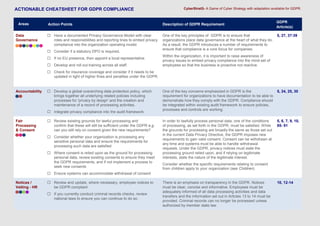
Action Points
GDPR
Article(s)
Data
Governance
 Have a documented Privacy Governance Model with clear
roles and responsibilities and reporting lines to embed privacy
compliance into the organization operating model.
 Consider if a statutory DPO is required.
 If no EU presence, then appoint a local representative.
 Develop and roll out training across all staff.
 Check for insurance coverage and consider if it needs to be
updated in light of higher fines and penalties under the GDPR.
5, 27, 37-39
Accountability  Develop a global overarching data protection policy, which
brings together all underlying related policies including
processes for 'privacy by design' and the creation and
maintenance of a record of processing activities.
 Integrate privacy compliance into the audit framework
5, 24, 25, 30
Fair
Processing
& Consent
 Review existing grounds for lawful processing and
confirm that these will still be sufficient under the GDPR e.g.
can you still rely on consent given the new requirements?
 Consider whether your organization is processing any
sensitive personal data and ensure the requirements for
processing such data are satisfied
 Where consent is relied upon as the ground for processing
personal data, review existing consents to ensure they meet
the GDPR requirements, and if not implement a process to
seek new consents
 Ensure systems can accommodate withdrawal of consent
5, 6, 7, 9, 10,
85- 91
Notices /
Vetting - HR
 Review and update, where necessary, employee notices to
be GDPR compliant
 If you currently conduct criminal records checks, review
national laws to ensure you can continue to do so.
Description of GDPR Requirement
One of the key principles of GDPR is to ensure that
organizations place data governance at the heart of what they do.
As a result, the GDPR introduces a number of requirements to
ensure that compliance is a core focus for companies.
Within the organization, it is important to raise awareness of
privacy issues to embed privacy compliance into the mind-set of
employees so that the business is proactive not reactive.
One of the key concerns emphasized in GDPR is the
requirement for organizations to have documentation to be able to
demonstrate how they comply with the GDPR. Compliance should
be integrated within existing audit framework to ensure policies,
processes and controls are working.
In order to lawfully process personal data, one of the conditions
of processing, as set forth in the GDPR, must be satisfied. While
the grounds for processing are broadly the same as those set out
in the current Data Privacy Directive, the GDPR imposes new
requirements to gain valid consent. Consent can be withdrawn at
any time and systems must be able to handle withdrawal
requests. Under the GDPR, privacy notices must state the
processing ground relied upon, and if relying on legitimate
interests, state the nature of the legitimate interest.
Consider whether the specific requirements relating to consent
from children apply to your organization (see Children).
There is an emphasis on transparency in the GDPR. Notices
must be clear, concise and informative. Employees must be
adequately informed of all data processing activities and data
transfers and the information set out in Articles 13 to 14 must be
provided. Criminal records can no longer be processed unless
authorized by member state law.
10, 12-14
ACTIONABLE CHEATSHEET FOR GDPR COMPLIANCE CyberStratG- A Game of Cyber Strategy with adaptation available for GDPR.
Areas
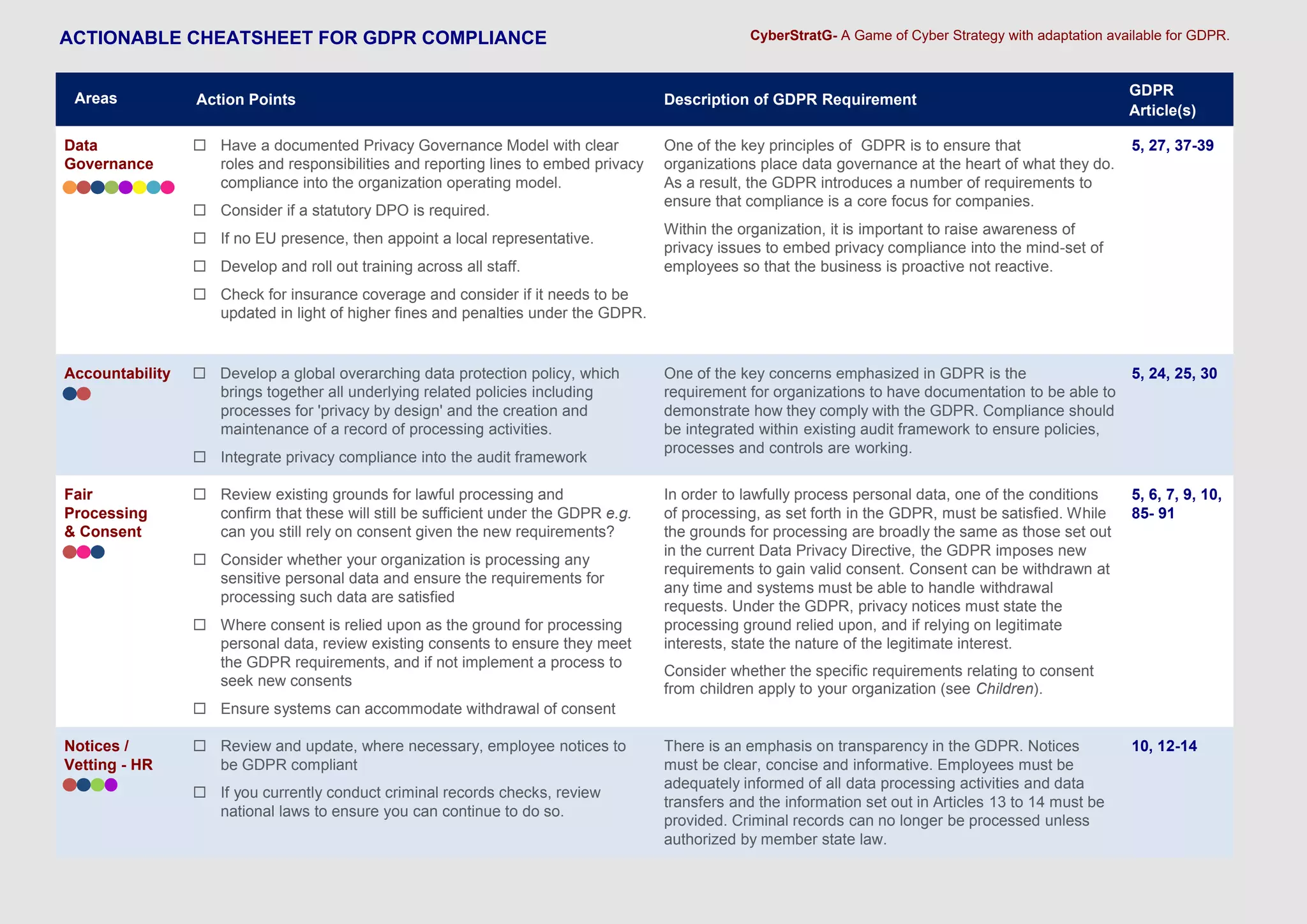
Notices -
Customers
 Review and update, where necessary, customer notices to be
GDPR compliant
 Consider whether your notices have to accommodate “child-
friendly requirements” (see Children)
12-14
Children  Identify whether you process personal data of children
 Seek local counsel advice regarding applicable local law
restrictions, codes and guidance
 If data relating to a child will be processed, ensure that
notices directed at that child are “child-friendly” and if consent
is relied upon, you have implemented a mechanism to seek
parental consent
 Consider alternative protections, e.g. age-gating
8, 12
Data Subject
Rights and
Procedures
 Update data privacy policy and internal processes for dealing
with requests.
 Ensure technical and operational processes are in place to
ensure data subjects’ rights can be met, e.g. right to be
forgotten, data portability and the right to object (see
Governance and Accountability)
16, 17, 18,
19, 20, 21,
22, 23
Record of
Processing
 Identify all data processed in a detailed Record of Processing
 Implement and maintain processes for updating and
maintaining Record of Processing
30
Privacy by
Design and
Default
 Ensure processes are in place to embed privacy by design
into projects (e.g. technical and organizational measures are
in place to ensure data minimization, purpose limitation and
security)
There is an emphasis on transparency in the GDPR. Notices
must be clear, concise and informative. Customers must be
adequately informed of all data processing activities and data
transfers and the information set out in Articles 13 to 14 must be
provided. Notices must also be compliant with the new Consent
requirements where relying on consent as your lawful ground of
processing.
The GDPR requires parental consent for the processing of data
related to information society services offered to a “child” (ranging
from 13 to 16 years old depending on member state). The GDPR
leaves a lot to the discretion of the member states as to how
children must be treated under this provision.
Data subjects are given more extensive rights under the GDPR.
The current rights to request access to data or require it to be
rectified or deleted have been expanded to include a much
broader right to require deletion ("the right to be forgotten"), a
right not just to access your data but have it provided to you in a
machine readable format ("data portability"). Versions of the
existing right to object to any processing undertaken on the basis
of legitimate interests or for direct marketing and the right not to
be subject to decision based on automated processing are also
included and expressly refer a right to object to profiling. These
must be clearly communicated in the notices given to data
subjects, e.g. privacy policy.
The GDPR requires organizations to maintain a detailed record of
all processing activities, including purposes of processing, a
description of categories of data, security measures,
comprehensive data flow map, etc. A number of stakeholders will
need to be involved in creating and maintaining this data record.
In keeping with the GDPR’s objective of bringing privacy
considerations to the forefront of organizations’ decision making,
the GDPR requires data protection requirements to be
considered when new technologies are designed or on boarded
25, 35, 36
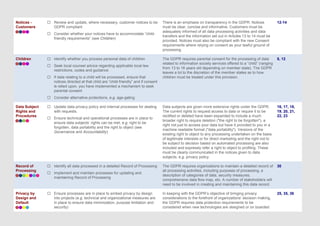
 Put in place a privacy impact assessment protocol
Compliant
Contracting
and
Procurement
 Develop compliant contract wording for customer agreements
and third-party vendor agreements
 Identify all contracts that require relevant contract wording,
prioritize and develop process for amending
 Ensure procurement process has controls to ensure privacy
by design (e.g. security diligence, data minimization, visibility
of onwards data flows)
N/A
Data Breach
Procedures
 Review and update (or develop where not in existence) Data
Breach Response Plan
 Review insurance coverage for data breaches and consider
whether it needs to be updated in light of the higher fines and
penalties under the GDPR
 Review liability provisions in agreements for breaches caused
by service providers and other partners
32-34
Data Export  Identify all cross-border data flows and review data export
mechanisms
 Update cross border mechanisms if necessary
or new projects using data are being considered. Privacy impact
assessments should be used to ensure compliance; these are
required for projects that involve processing, on a large scale, of
sensitive personal data or criminal convictions, monitoring of a
public area or systematic and extensive evaluation by automated
means including profiling.
Procurement processes and vendor contracts will need to be
updated to ensure they reflect the new GDPR requirements and
flow down obligations which must be complied with by parties
processing European personal data on your behalf.
The GDPR introduces a new data breach notification regime. The
process requires organizations to act quickly, mitigate losses
and, where mandatory notification thresholds are met, notify
regulators and affected data subjects.
The GDPR only permits exports of data to entities of its group
and third-party vendors outside the European Economic Area if
the country in which the recipient of such data is established
offers an adequate level of protection.
44-50
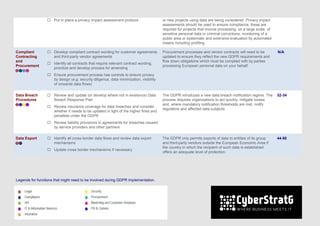
Legends for functions that might need to be involved during GDPR implementation.

GDPR most actionable cheatsheet and checklist by cyberstratg

  • 1.
    Action Points GDPR Article(s) Data Governance  Havea documented Privacy Governance Model with clear roles and responsibilities and reporting lines to embed privacy compliance into the organization operating model.  Consider if a statutory DPO is required.  If no EU presence, then appoint a local representative.  Develop and roll out training across all staff.  Check for insurance coverage and consider if it needs to be updated in light of higher fines and penalties under the GDPR. 5, 27, 37-39 Accountability  Develop a global overarching data protection policy, which brings together all underlying related policies including processes for 'privacy by design' and the creation and maintenance of a record of processing activities.  Integrate privacy compliance into the audit framework 5, 24, 25, 30 Fair Processing & Consent  Review existing grounds for lawful processing and confirm that these will still be sufficient under the GDPR e.g. can you still rely on consent given the new requirements?  Consider whether your organization is processing any sensitive personal data and ensure the requirements for processing such data are satisfied  Where consent is relied upon as the ground for processing personal data, review existing consents to ensure they meet the GDPR requirements, and if not implement a process to seek new consents  Ensure systems can accommodate withdrawal of consent 5, 6, 7, 9, 10, 85- 91 Notices / Vetting - HR  Review and update, where necessary, employee notices to be GDPR compliant  If you currently conduct criminal records checks, review national laws to ensure you can continue to do so. Description of GDPR Requirement One of the key principles of GDPR is to ensure that organizations place data governance at the heart of what they do. As a result, the GDPR introduces a number of requirements to ensure that compliance is a core focus for companies. Within the organization, it is important to raise awareness of privacy issues to embed privacy compliance into the mind-set of employees so that the business is proactive not reactive. One of the key concerns emphasized in GDPR is the requirement for organizations to have documentation to be able to demonstrate how they comply with the GDPR. Compliance should be integrated within existing audit framework to ensure policies, processes and controls are working. In order to lawfully process personal data, one of the conditions of processing, as set forth in the GDPR, must be satisfied. While the grounds for processing are broadly the same as those set out in the current Data Privacy Directive, the GDPR imposes new requirements to gain valid consent. Consent can be withdrawn at any time and systems must be able to handle withdrawal requests. Under the GDPR, privacy notices must state the processing ground relied upon, and if relying on legitimate interests, state the nature of the legitimate interest. Consider whether the specific requirements relating to consent from children apply to your organization (see Children). There is an emphasis on transparency in the GDPR. Notices must be clear, concise and informative. Employees must be adequately informed of all data processing activities and data transfers and the information set out in Articles 13 to 14 must be provided. Criminal records can no longer be processed unless authorized by member state law. 10, 12-14 ACTIONABLE CHEATSHEET FOR GDPR COMPLIANCE CyberStratG- A Game of Cyber Strategy with adaptation available for GDPR. Areas
  • 2.
    Notices - Customers  Reviewand update, where necessary, customer notices to be GDPR compliant  Consider whether your notices have to accommodate “child- friendly requirements” (see Children) 12-14 Children  Identify whether you process personal data of children  Seek local counsel advice regarding applicable local law restrictions, codes and guidance  If data relating to a child will be processed, ensure that notices directed at that child are “child-friendly” and if consent is relied upon, you have implemented a mechanism to seek parental consent  Consider alternative protections, e.g. age-gating 8, 12 Data Subject Rights and Procedures  Update data privacy policy and internal processes for dealing with requests.  Ensure technical and operational processes are in place to ensure data subjects’ rights can be met, e.g. right to be forgotten, data portability and the right to object (see Governance and Accountability) 16, 17, 18, 19, 20, 21, 22, 23 Record of Processing  Identify all data processed in a detailed Record of Processing  Implement and maintain processes for updating and maintaining Record of Processing 30 Privacy by Design and Default  Ensure processes are in place to embed privacy by design into projects (e.g. technical and organizational measures are in place to ensure data minimization, purpose limitation and security) There is an emphasis on transparency in the GDPR. Notices must be clear, concise and informative. Customers must be adequately informed of all data processing activities and data transfers and the information set out in Articles 13 to 14 must be provided. Notices must also be compliant with the new Consent requirements where relying on consent as your lawful ground of processing. The GDPR requires parental consent for the processing of data related to information society services offered to a “child” (ranging from 13 to 16 years old depending on member state). The GDPR leaves a lot to the discretion of the member states as to how children must be treated under this provision. Data subjects are given more extensive rights under the GDPR. The current rights to request access to data or require it to be rectified or deleted have been expanded to include a much broader right to require deletion ("the right to be forgotten"), a right not just to access your data but have it provided to you in a machine readable format ("data portability"). Versions of the existing right to object to any processing undertaken on the basis of legitimate interests or for direct marketing and the right not to be subject to decision based on automated processing are also included and expressly refer a right to object to profiling. These must be clearly communicated in the notices given to data subjects, e.g. privacy policy. The GDPR requires organizations to maintain a detailed record of all processing activities, including purposes of processing, a description of categories of data, security measures, comprehensive data flow map, etc. A number of stakeholders will need to be involved in creating and maintaining this data record. In keeping with the GDPR’s objective of bringing privacy considerations to the forefront of organizations’ decision making, the GDPR requires data protection requirements to be considered when new technologies are designed or on boarded 25, 35, 36
  • 3.
     Put inplace a privacy impact assessment protocol Compliant Contracting and Procurement  Develop compliant contract wording for customer agreements and third-party vendor agreements  Identify all contracts that require relevant contract wording, prioritize and develop process for amending  Ensure procurement process has controls to ensure privacy by design (e.g. security diligence, data minimization, visibility of onwards data flows) N/A Data Breach Procedures  Review and update (or develop where not in existence) Data Breach Response Plan  Review insurance coverage for data breaches and consider whether it needs to be updated in light of the higher fines and penalties under the GDPR  Review liability provisions in agreements for breaches caused by service providers and other partners 32-34 Data Export  Identify all cross-border data flows and review data export mechanisms  Update cross border mechanisms if necessary or new projects using data are being considered. Privacy impact assessments should be used to ensure compliance; these are required for projects that involve processing, on a large scale, of sensitive personal data or criminal convictions, monitoring of a public area or systematic and extensive evaluation by automated means including profiling. Procurement processes and vendor contracts will need to be updated to ensure they reflect the new GDPR requirements and flow down obligations which must be complied with by parties processing European personal data on your behalf. The GDPR introduces a new data breach notification regime. The process requires organizations to act quickly, mitigate losses and, where mandatory notification thresholds are met, notify regulators and affected data subjects. The GDPR only permits exports of data to entities of its group and third-party vendors outside the European Economic Area if the country in which the recipient of such data is established offers an adequate level of protection. 44-50 Legends for functions that might need to be involved during GDPR implementation.