September 14th 2022
THE BOCCONI ALGORAND FINTECH LAB
Claudio Tebaldi
THE BOCCONI ALGORAND FINTECH LAB
Claudio Tebaldi
Department of Finance
 The Lab at a glance
 Research Agenda
Agenda
The Lab Organization
The Algorand Fintech Lab is structured as an Open Research Hub
headed by a Steering Committee.
This structure has been designed to meet the following
organizational challenges:
• Interdisciplinarity
• Diversity of the potential contributors
• Heterogeneity of the engaged institutions and ecosystems.
2
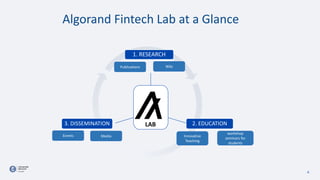
Algorand Fintech Lab at a Glance
Events
2. EDUCATION
3. DISSEMINATION
Publications
Innovative
Teaching
1. RESEARCH
Wiki
Media
LAB
4
workshop
seminars for
students
Open Research Infrastructure
The Lab activities, opportunities and results are available online
through an innovative collaborative platform
• Website: Algorand fintech lab (unibocconi.eu)
• Collaborative Wiki: Fintech Lab Wiki (unibocconi.eu)
• Computing resources for research and teaching:
 Software repositories
 Teaching material.
 Scientific cloud computing dedicated to research teams
funded by the Lab.
• Call for papers will be out soon for a joint conference Center for
Economic Policy ResearchBocconi.
3
• Institutional activities
 Achievement: newly formed Bocconi Computing Sciences
Department is fostering creation of new programs.
 Challenge: tradeoff between hybridization of curricula in Social
and Digital Sciences and quality preservation is hard to find.
• Community Dissemination and Engagement
 Achievement: great push from student community and
associations that are highly engaged with the professional
community
 Challenge: hard-to-achieve coordination between high quality
faculty research standards and high velocity of the crypto-
community innovation waves.
5
Open Challenges
6
Running research and literacy projects
Blockchain, the Economy, and the Law.
• Firm ecosystems and Decentralized Organizations
• Trust, reputation and participation in crypto-financial
markets.
Digital Assets and Crypto Financial Markets
• Crypto-Financial Literacy
• Micro and Macro-economics of Digital Assets
• Market Microstructure and Crypto-exchanges
Work in Progress:
How to exploit benefits from technological innovation avoiding that they are
‘captured’ by ‘experts’ (Biais et al. 2010)?
 Supply side: Investor’s valuation of services offered by Decentralized
Organizations made possible by using of DLT as digital infrastructures.
 Demand side: Implementing sustainable stakeholder finance along supply
chains relying on DLT (National Resilience Plan).
Research Highlights
Crypto-financial Literacy: Who is (should be) buying DO-tokens?
• The cross section of digital token buyers is heterogeneous ranging
between:
 Unsophisticated financial consumers
 Sophisticated venture capital players and other high risk institutional players
• Big uncertainty on statutory goals of Decentralized Organizations
financed through tokens makes the valuation of the opportunity of
the investmentconsumption decision hard-to-assess.
• Differential composition of demand may affect token prices.
C.T. Bocconi Algorand Fintech Lab
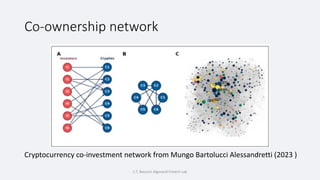
Co-ownership network
C.T. Bocconi Algorand Fintech Lab
Cryptocurrency co-investment network from Mungo Bartolucci Alessandretti (2023 )
D(ecentralized) O(rganization): the DAO case
STATE OF THE ART and open questions on D(ecentralized) A(utonomous) O(rganizations) is
properly described by V. Buterin:
"DAO" is a powerful term that captures many of the hopes …. to build more democratic,
resilient and efficient forms of governance. It's also an incredibly broad term
whose meaning has evolved a lot over the years. Most generally, a DAO is a smart contract
that is meant to represent a structure of ownership or control over some asset or process.
But this structure could be anything…... Many of these structures work, and many others
cannot, or at least are very mismatched to the goals that they are trying to achieve.
There are two questions to answer:
• What kinds of governance structures make sense, and for what use cases?
• Does it make sense to implement those structures as a DAO, or through regular
incorporation and legal contracts?
V. Buterin 2022 Dec 5th
C.T. Bocconi Algorand Fintech Lab
Statutory Goals relevant for DOs
• We assume that the organization’s statutory goal may be:
 the production or optimal sharing of private goods
 the production and provision of public goods
or a blend of the two.
• In both cases we need to take into account externalities:
Within a firm, an employee’s efforts toward team production will benefit other
employees to different degrees.
Investments in research yield different spillovers for various producers and
consumers.
Following an active strand of research, we run valuation quantifying agents’ creation of
externalities in a DO relying on network analysis, see e.g. Elliott Golub (2019).
C.T. Bocconi Algorand Fintech Lab
Demand for digital tokens
• The digital token may work as a hybrid instrument, i.e. it is demanded by multiple
heterogeneous stakeholders like e.g.:
 users
 developers
 participants to the decentralized governance
 external investors of all categories.
• Different stakeholders may have diverging incentives. To maximize coordination,
the institutional structure of a DO and its tokenomics must be designed to
minimize potential conflicting interests.
• This is a typical exercise in Mechanism Design see also ‘Towards a Practice of
Token Engineering’ McConaghy (2018)
C.T. Bocconi Algorand Fintech Lab
THANK YOU!

BocAlg_LAB_Barcelona.pdf

  • 1.
    September 14th 2022 THEBOCCONI ALGORAND FINTECH LAB Claudio Tebaldi THE BOCCONI ALGORAND FINTECH LAB Claudio Tebaldi Department of Finance
  • 2.
     The Labat a glance  Research Agenda Agenda
  • 3.
    The Lab Organization TheAlgorand Fintech Lab is structured as an Open Research Hub headed by a Steering Committee. This structure has been designed to meet the following organizational challenges: • Interdisciplinarity • Diversity of the potential contributors • Heterogeneity of the engaged institutions and ecosystems. 2
  • 4.
    Algorand Fintech Labat a Glance Events 2. EDUCATION 3. DISSEMINATION Publications Innovative Teaching 1. RESEARCH Wiki Media LAB 4 workshop seminars for students
  • 5.
    Open Research Infrastructure TheLab activities, opportunities and results are available online through an innovative collaborative platform • Website: Algorand fintech lab (unibocconi.eu) • Collaborative Wiki: Fintech Lab Wiki (unibocconi.eu) • Computing resources for research and teaching:  Software repositories  Teaching material.  Scientific cloud computing dedicated to research teams funded by the Lab. • Call for papers will be out soon for a joint conference Center for Economic Policy ResearchBocconi. 3
  • 6.
    • Institutional activities Achievement: newly formed Bocconi Computing Sciences Department is fostering creation of new programs.  Challenge: tradeoff between hybridization of curricula in Social and Digital Sciences and quality preservation is hard to find. • Community Dissemination and Engagement  Achievement: great push from student community and associations that are highly engaged with the professional community  Challenge: hard-to-achieve coordination between high quality faculty research standards and high velocity of the crypto- community innovation waves. 5 Open Challenges
  • 7.
    6 Running research andliteracy projects Blockchain, the Economy, and the Law. • Firm ecosystems and Decentralized Organizations • Trust, reputation and participation in crypto-financial markets. Digital Assets and Crypto Financial Markets • Crypto-Financial Literacy • Micro and Macro-economics of Digital Assets • Market Microstructure and Crypto-exchanges
  • 8.
    Work in Progress: Howto exploit benefits from technological innovation avoiding that they are ‘captured’ by ‘experts’ (Biais et al. 2010)?  Supply side: Investor’s valuation of services offered by Decentralized Organizations made possible by using of DLT as digital infrastructures.  Demand side: Implementing sustainable stakeholder finance along supply chains relying on DLT (National Resilience Plan). Research Highlights
  • 9.
    Crypto-financial Literacy: Whois (should be) buying DO-tokens? • The cross section of digital token buyers is heterogeneous ranging between:  Unsophisticated financial consumers  Sophisticated venture capital players and other high risk institutional players • Big uncertainty on statutory goals of Decentralized Organizations financed through tokens makes the valuation of the opportunity of the investmentconsumption decision hard-to-assess. • Differential composition of demand may affect token prices. C.T. Bocconi Algorand Fintech Lab
  • 10.
    Co-ownership network C.T. BocconiAlgorand Fintech Lab Cryptocurrency co-investment network from Mungo Bartolucci Alessandretti (2023 )
  • 11.
    D(ecentralized) O(rganization): theDAO case STATE OF THE ART and open questions on D(ecentralized) A(utonomous) O(rganizations) is properly described by V. Buterin: "DAO" is a powerful term that captures many of the hopes …. to build more democratic, resilient and efficient forms of governance. It's also an incredibly broad term whose meaning has evolved a lot over the years. Most generally, a DAO is a smart contract that is meant to represent a structure of ownership or control over some asset or process. But this structure could be anything…... Many of these structures work, and many others cannot, or at least are very mismatched to the goals that they are trying to achieve. There are two questions to answer: • What kinds of governance structures make sense, and for what use cases? • Does it make sense to implement those structures as a DAO, or through regular incorporation and legal contracts? V. Buterin 2022 Dec 5th C.T. Bocconi Algorand Fintech Lab
  • 12.
    Statutory Goals relevantfor DOs • We assume that the organization’s statutory goal may be:  the production or optimal sharing of private goods  the production and provision of public goods or a blend of the two. • In both cases we need to take into account externalities: Within a firm, an employee’s efforts toward team production will benefit other employees to different degrees. Investments in research yield different spillovers for various producers and consumers. Following an active strand of research, we run valuation quantifying agents’ creation of externalities in a DO relying on network analysis, see e.g. Elliott Golub (2019). C.T. Bocconi Algorand Fintech Lab
  • 13.
    Demand for digitaltokens • The digital token may work as a hybrid instrument, i.e. it is demanded by multiple heterogeneous stakeholders like e.g.:  users  developers  participants to the decentralized governance  external investors of all categories. • Different stakeholders may have diverging incentives. To maximize coordination, the institutional structure of a DO and its tokenomics must be designed to minimize potential conflicting interests. • This is a typical exercise in Mechanism Design see also ‘Towards a Practice of Token Engineering’ McConaghy (2018) C.T. Bocconi Algorand Fintech Lab
  • 14.