NOTES
NOTES:
Hi I’m Chris Grayson, Director of Digital at Humble.
Humble is a pre-to-post production studio and award winning special effects house.
One definition of Augmented Reality is: Special effects, rendered in real time, over real life.
From a content creation perspective, augmented reality is not all that different than what
we do for TV special effects.
NOTES:
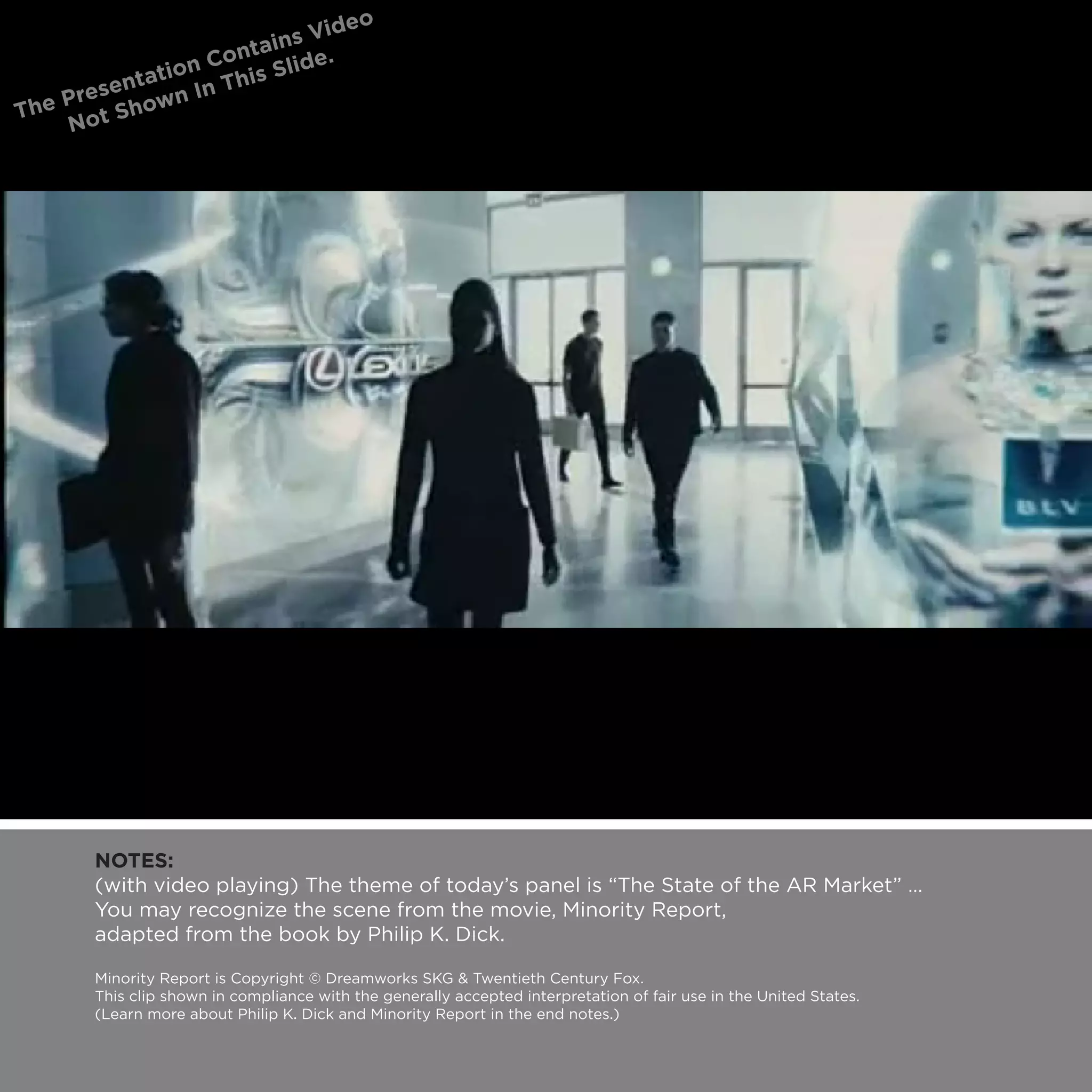
(with video playing) The theme of today’s panel is “The State of the AR Market” …
You may recognize the scene from the movie, Minority Report,
adapted from the book by Philip K. Dick.

Minority Report is Copyright © Dreamworks SKG & Twentieth Century Fox.
This clip shown in compliance with the generally accepted interpretation of fair use in the United States.
(Learn more about Philip K. Dick and Minority Report in the end notes.)
NOTES:
Who here knows the difference between Face Tracking and Facial Recognition?
Face Tracking involves computer vision that is able to identify a face within its camera
view, and can track the face’s movement in space. Facial Recognition is when the
computer is also able to recognize who that face belongs to.
NOTES:
Most AR in advertising is done of the user’s side. This implementation is particularly
interesting because it runs on the analyst’s side.
NOTES:
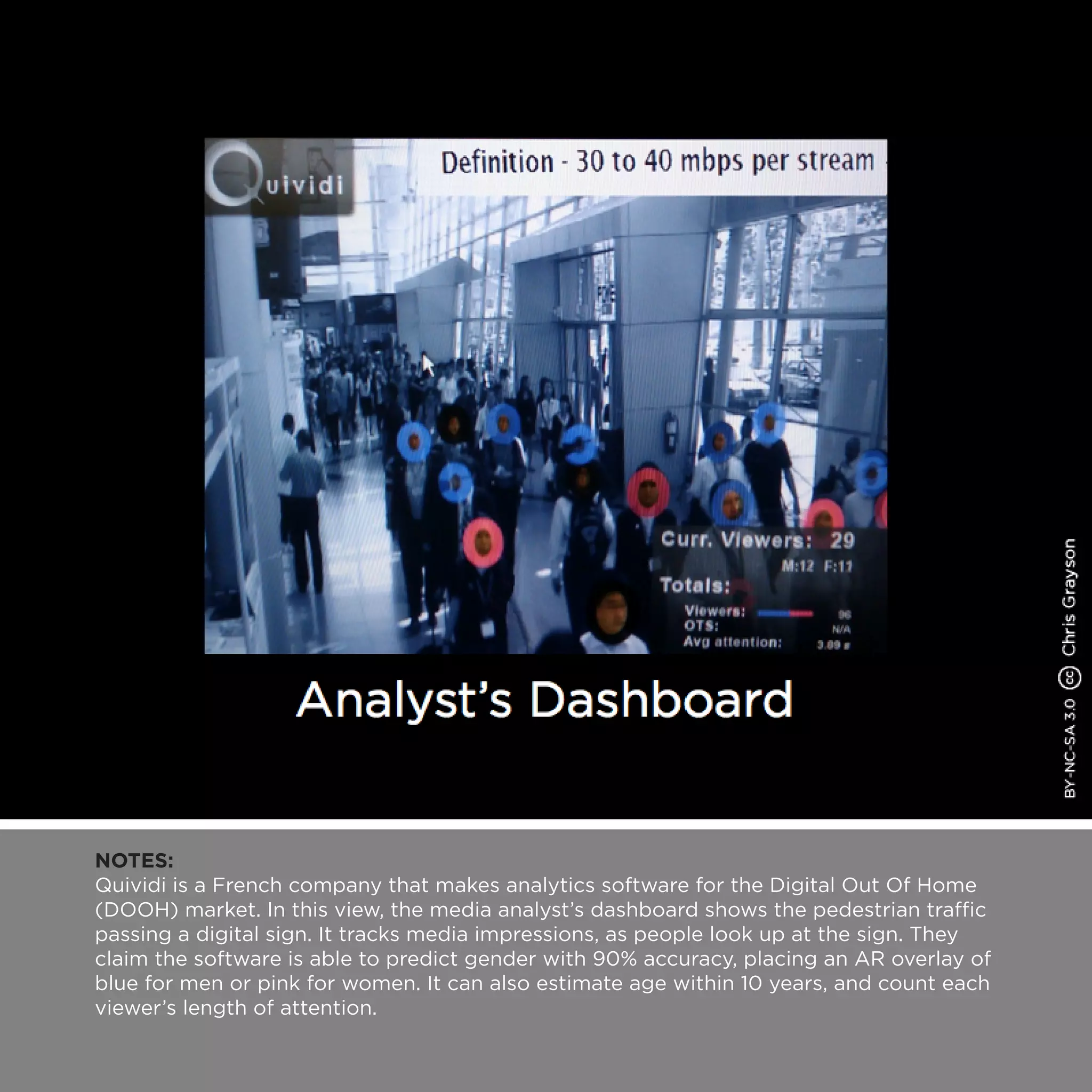
Quividi is a French company that makes analytics software for the Digital Out Of Home
(DOOH) market. In this view, the media analyst’s dashboard shows the pedestrian traffic
passing a digital sign. It tracks media impressions, as people look up at the sign. They
claim the software is able to predict gender with 90% accuracy, placing an AR overlay of
blue for men or pink for women. It can also estimate age within 10 years, and count each
viewer’s length of attention.
NOTES:
Another unique use for face tracking is 3D video without eyewear.
NOTES:
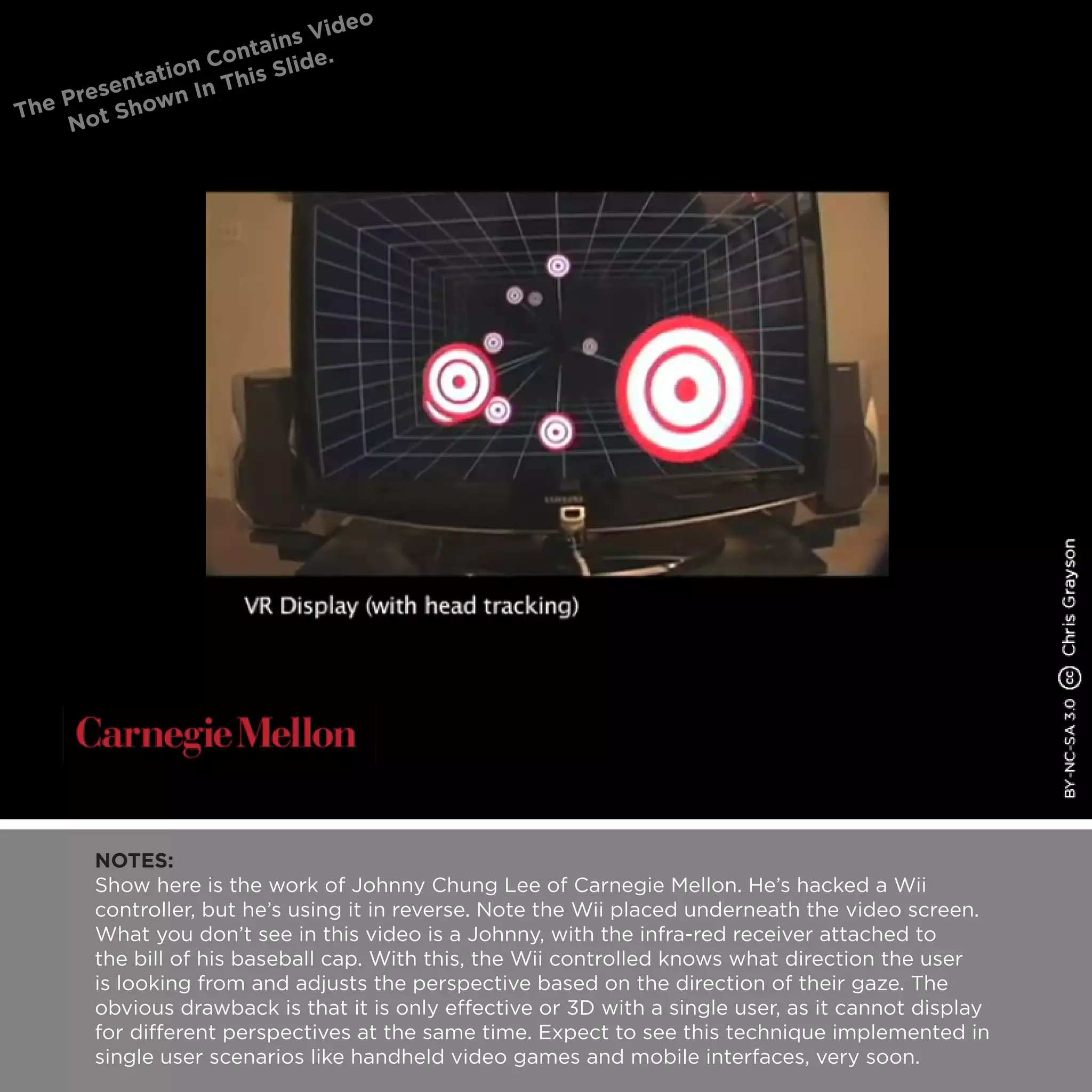
Show here is the work of Johnny Chung Lee of Carnegie Mellon. He’s hacked a Wii
controller, but he’s using it in reverse. Note the Wii placed underneath the video screen.
What you don’t see in this video is a Johnny, with the infra-red receiver attached to
the bill of his baseball cap. With this, the Wii controlled knows what direction the user
is looking from and adjusts the perspective based on the direction of their gaze. The
obvious drawback is that it is only effective or 3D with a single user, as it cannot display
for different perspectives at the same time. Expect to see this technique implemented in
single user scenarios like handheld video games and mobile interfaces, very soon.
NOTES:
NOTES:
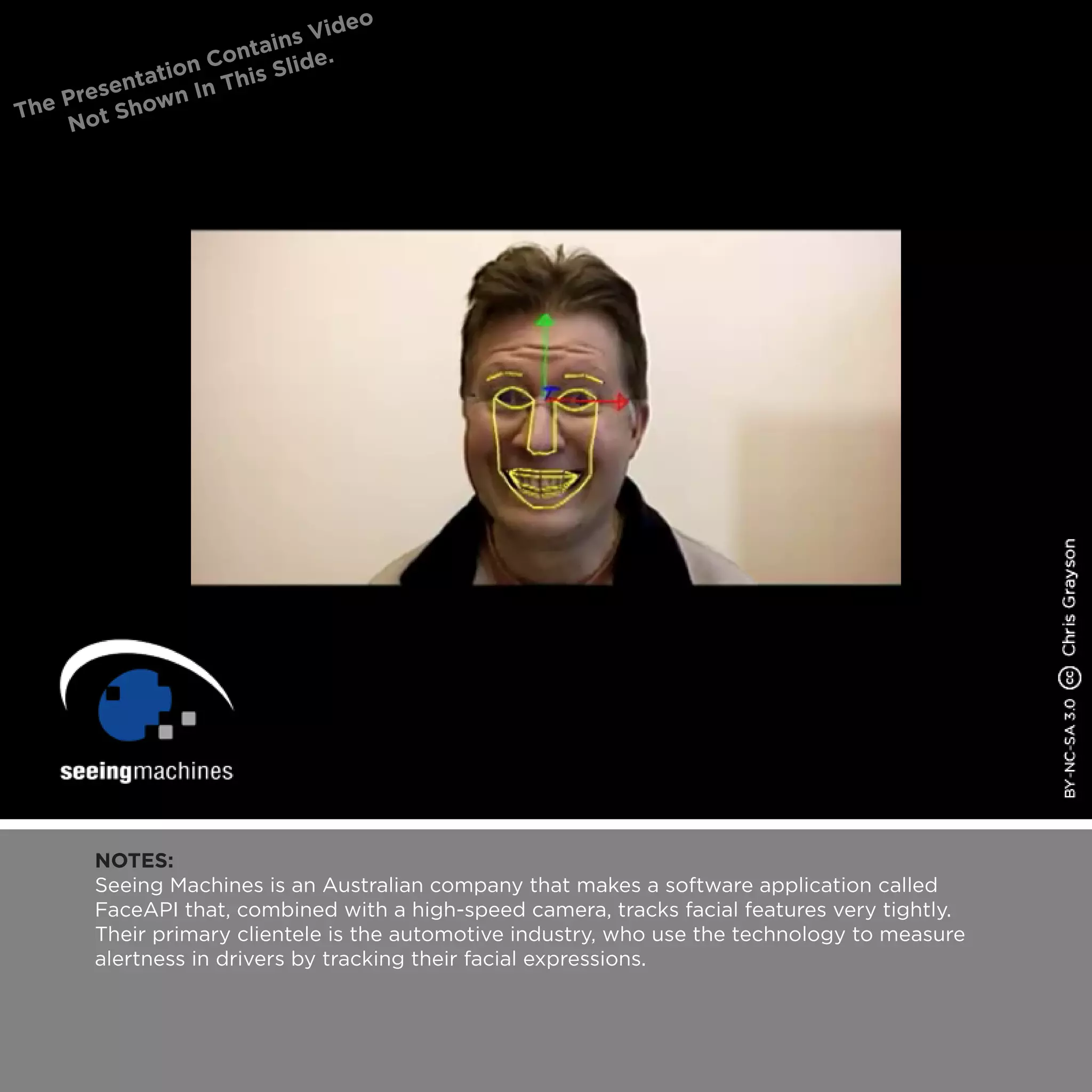
Seeing Machines is an Australian company that makes a software application called
FaceAPI that, combined with a high-speed camera, tracks facial features very tightly.
Their primary clientele is the automotive industry, who use the technology to measure
alertness in drivers by tracking their facial expressions.
NOTES:
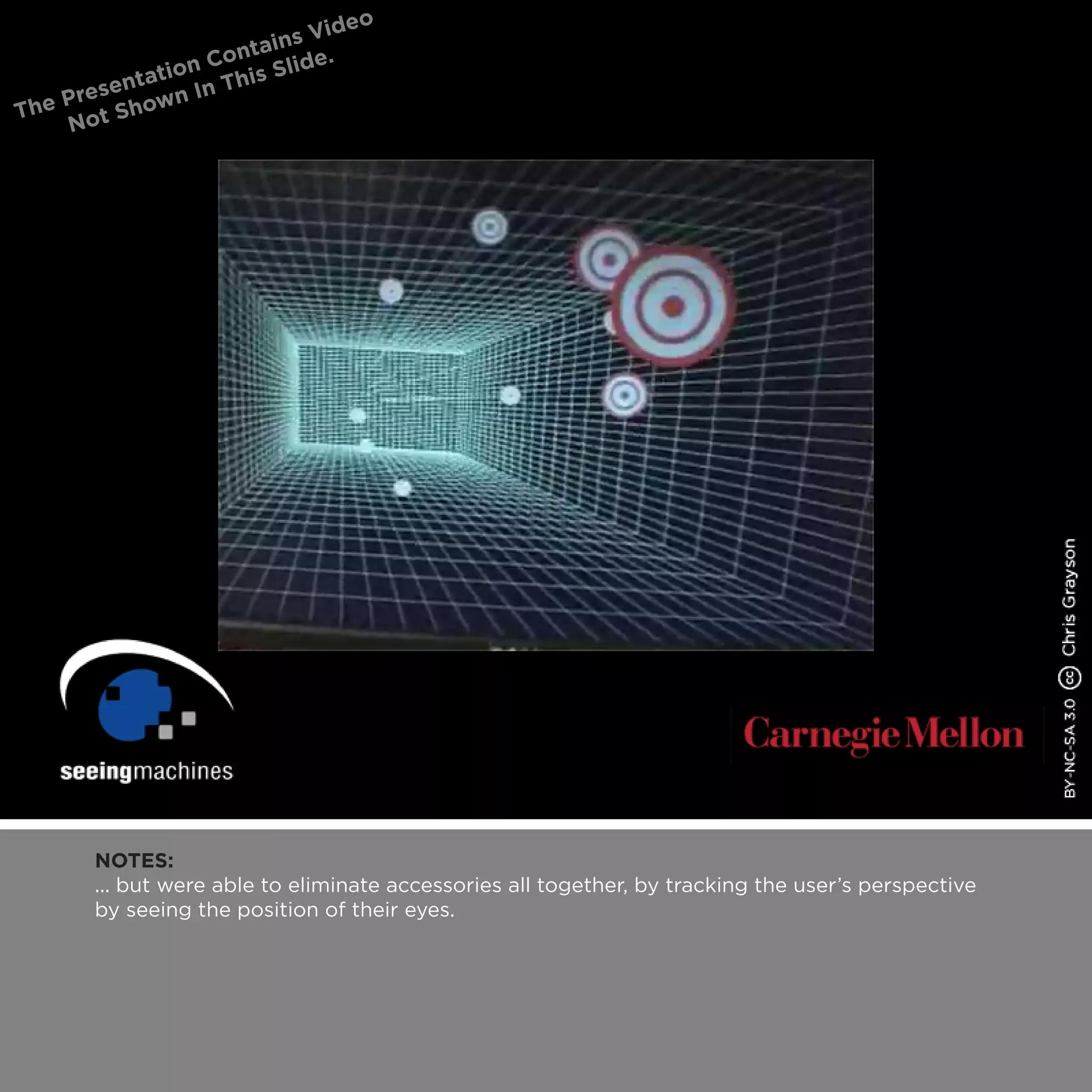
In an experiment, Seeing Machines took their FaceAPI software and paired it together
with Johnny Chung Lee’s face tracking 3D technique ...
NOTES:
... but were able to eliminate accessories all together, by tracking the user’s perspective
by seeing the position of their eyes.
NOTES:
These next two are pretty straight forward applications of augmented reality, using face
tracking for registration.
NOTES:
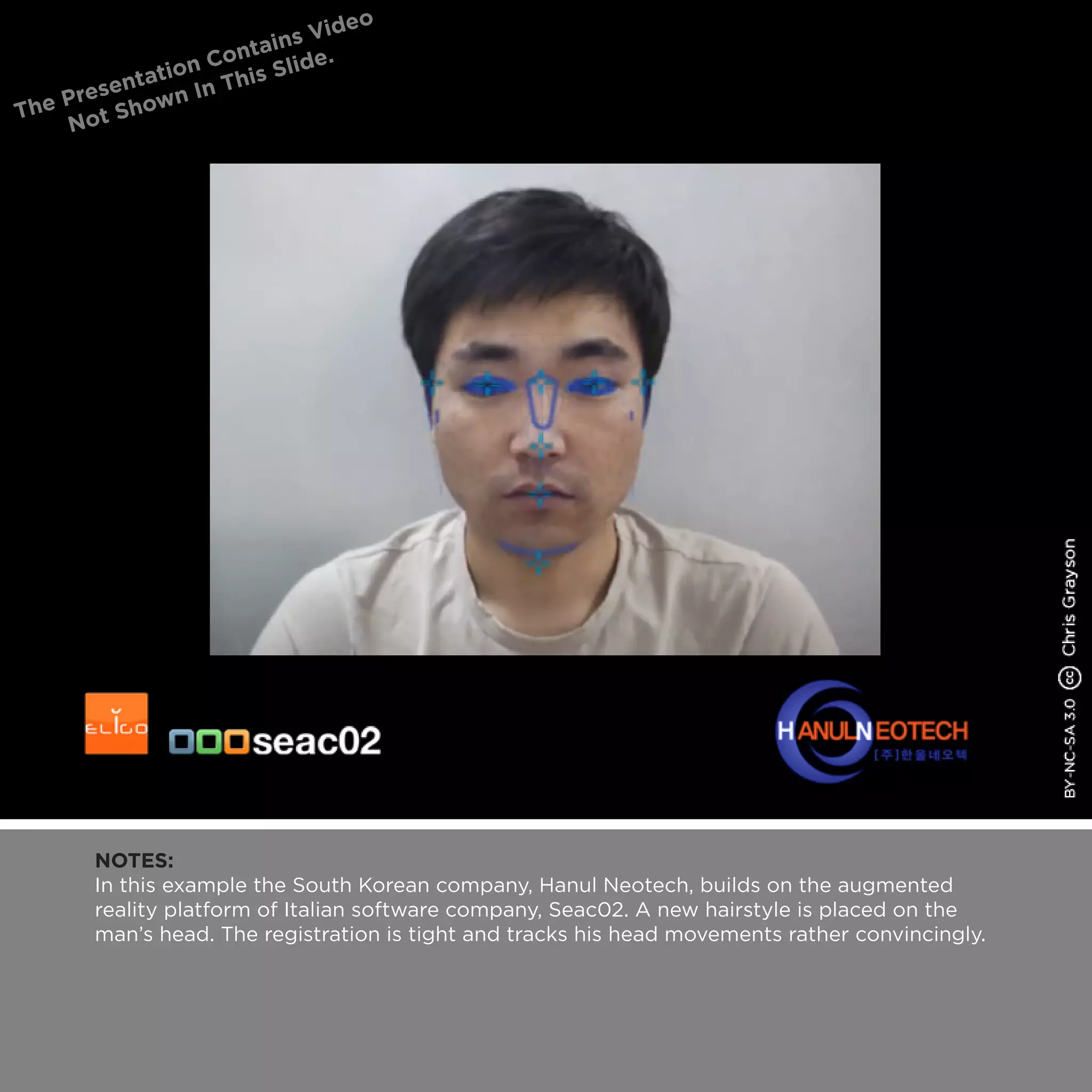
In this example the South Korean company, Hanul Neotech, builds on the augmented
reality platform of Italian software company, Seac02. A new hairstyle is placed on the
man’s head. The registration is tight and tracks his head movements rather convincingly.
NOTES:
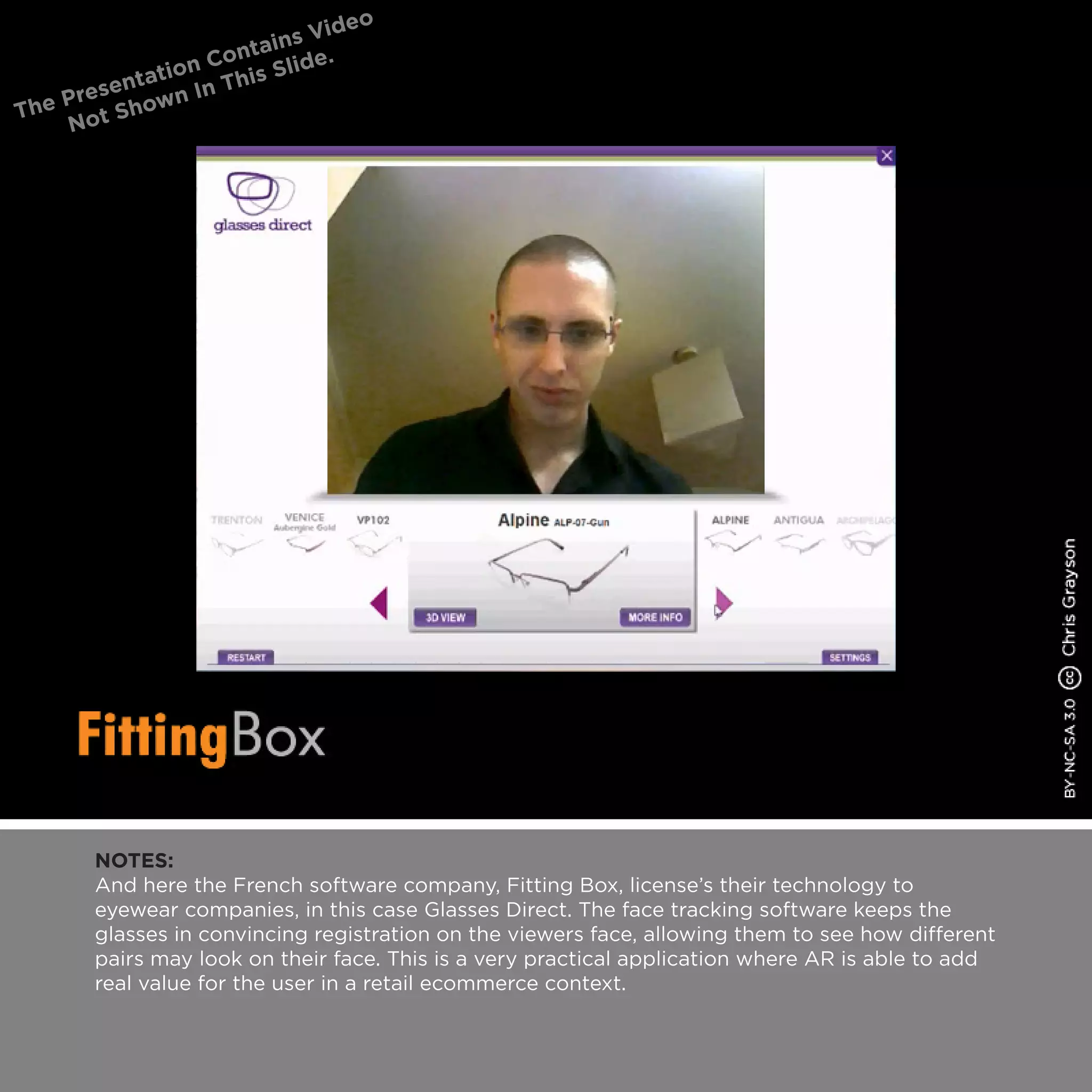
And here the French software company, Fitting Box, license’s their technology to
eyewear companies, in this case Glasses Direct. The face tracking software keeps the
glasses in convincing registration on the viewers face, allowing them to see how different
pairs may look on their face. This is a very practical application where AR is able to add
real value for the user in a retail ecommerce context.
NOTES:
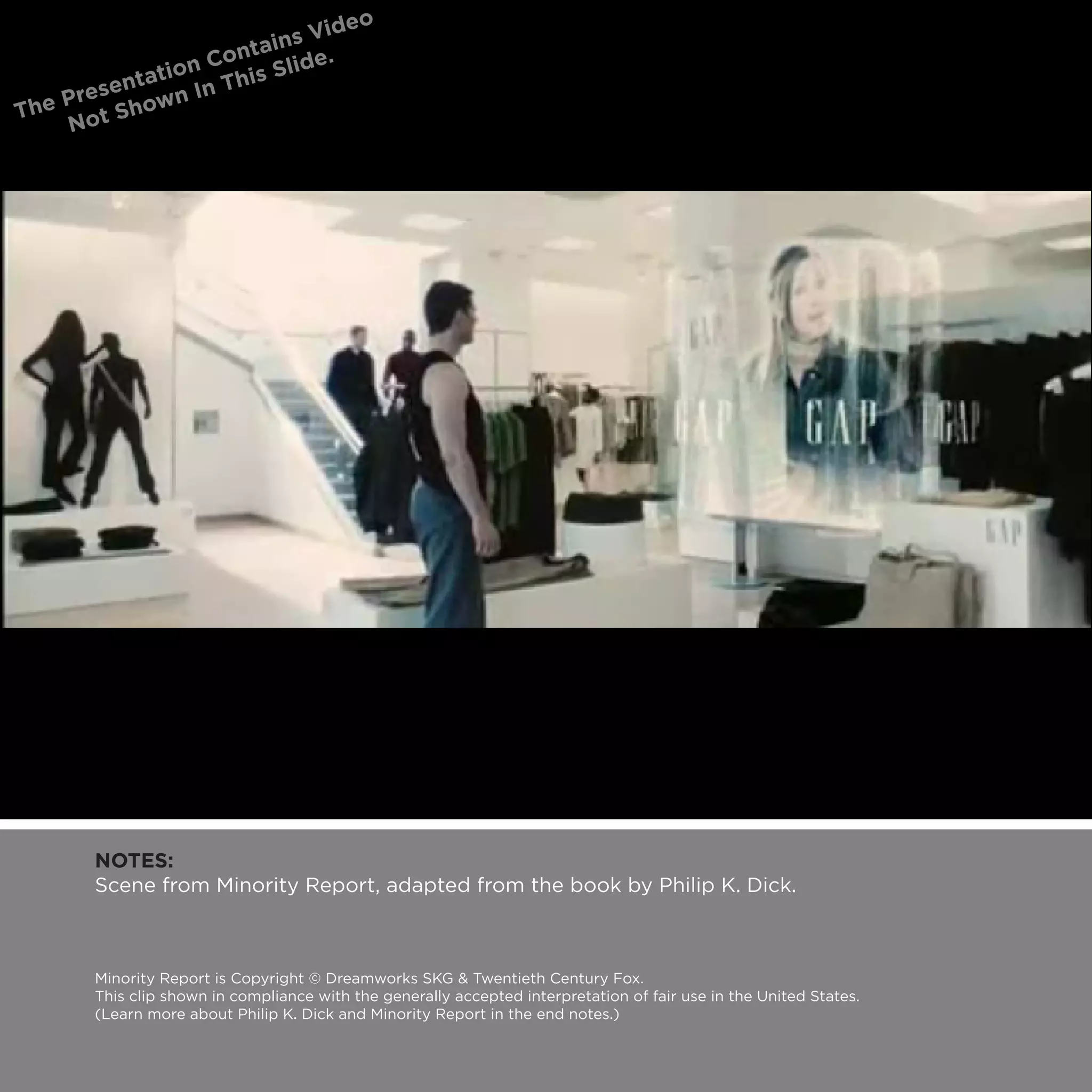
Scene from Minority Report, adapted from the book by Philip K. Dick.


Minority Report is Copyright © Dreamworks SKG & Twentieth Century Fox.
This clip shown in compliance with the generally accepted interpretation of fair use in the United States.
(Learn more about Philip K. Dick and Minority Report in the end notes.)
NOTES:
... and now for Facial Recognition.
NOTES:
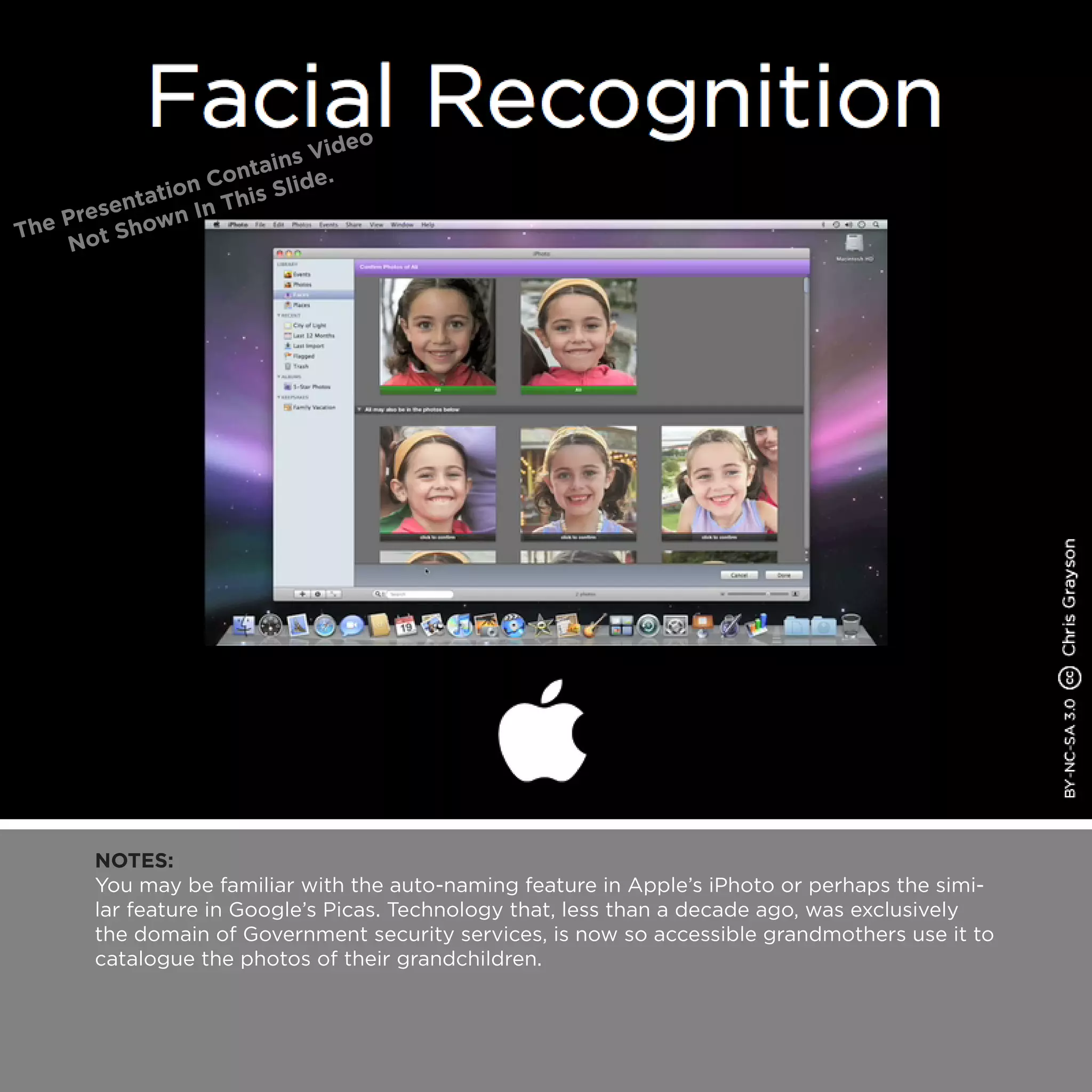
You may be familiar with the auto-naming feature in Apple’s iPhoto or perhaps the simi-
lar feature in Google’s Picas. Technology that, less than a decade ago, was exclusively
the domain of Government security services, is now so accessible grandmothers use it to
catalogue the photos of their grandchildren.
NOTES:
As we meet here today at Engage!, there is another event going on across the pond in
Barcelona. This week is Mobile World Congress. At last year’s MWC there were facial
recognition proof-of-concept applications demoed last year by two different teams.
NOTES:
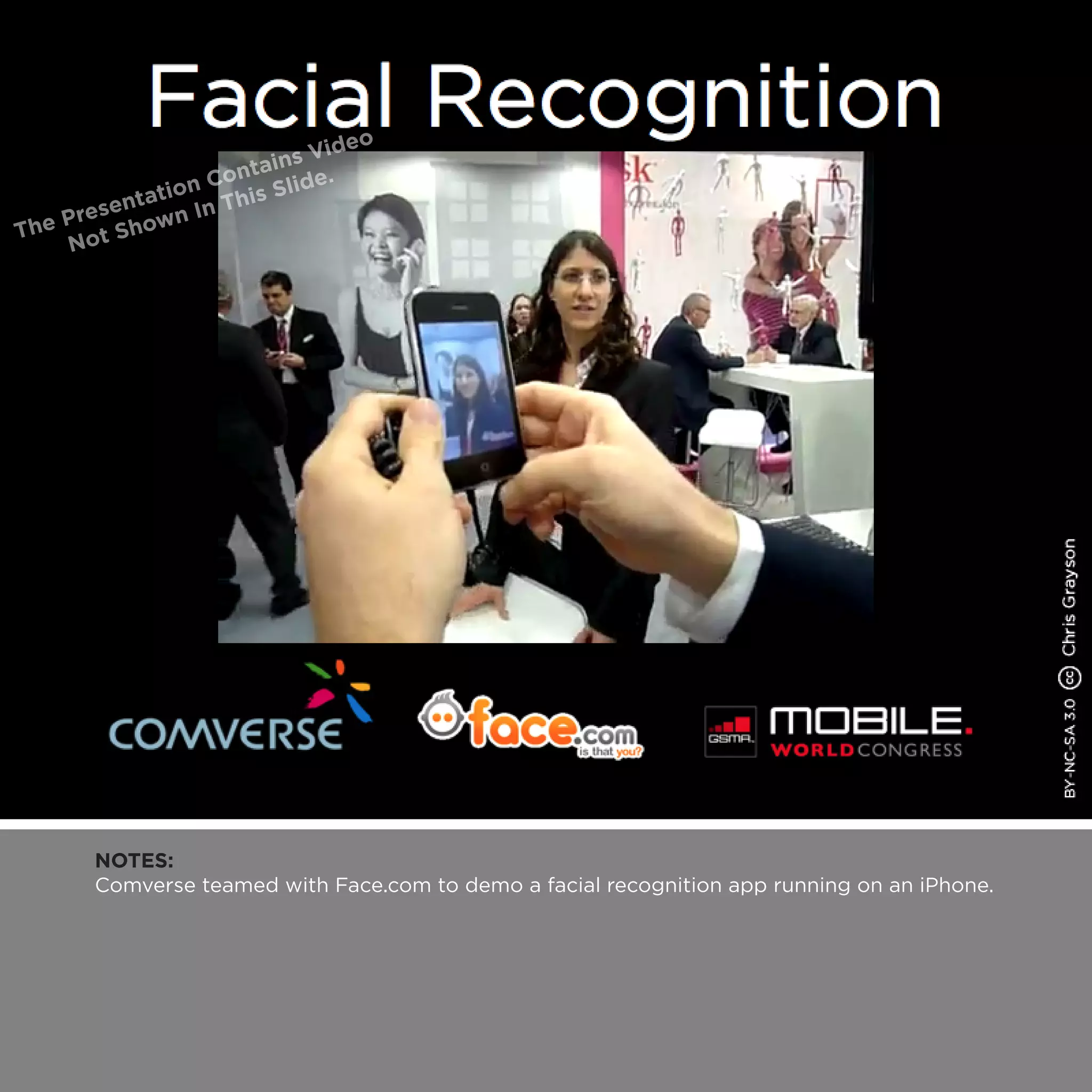
Comverse teamed with Face.com to demo a facial recognition app running on an iPhone.
NOTES:
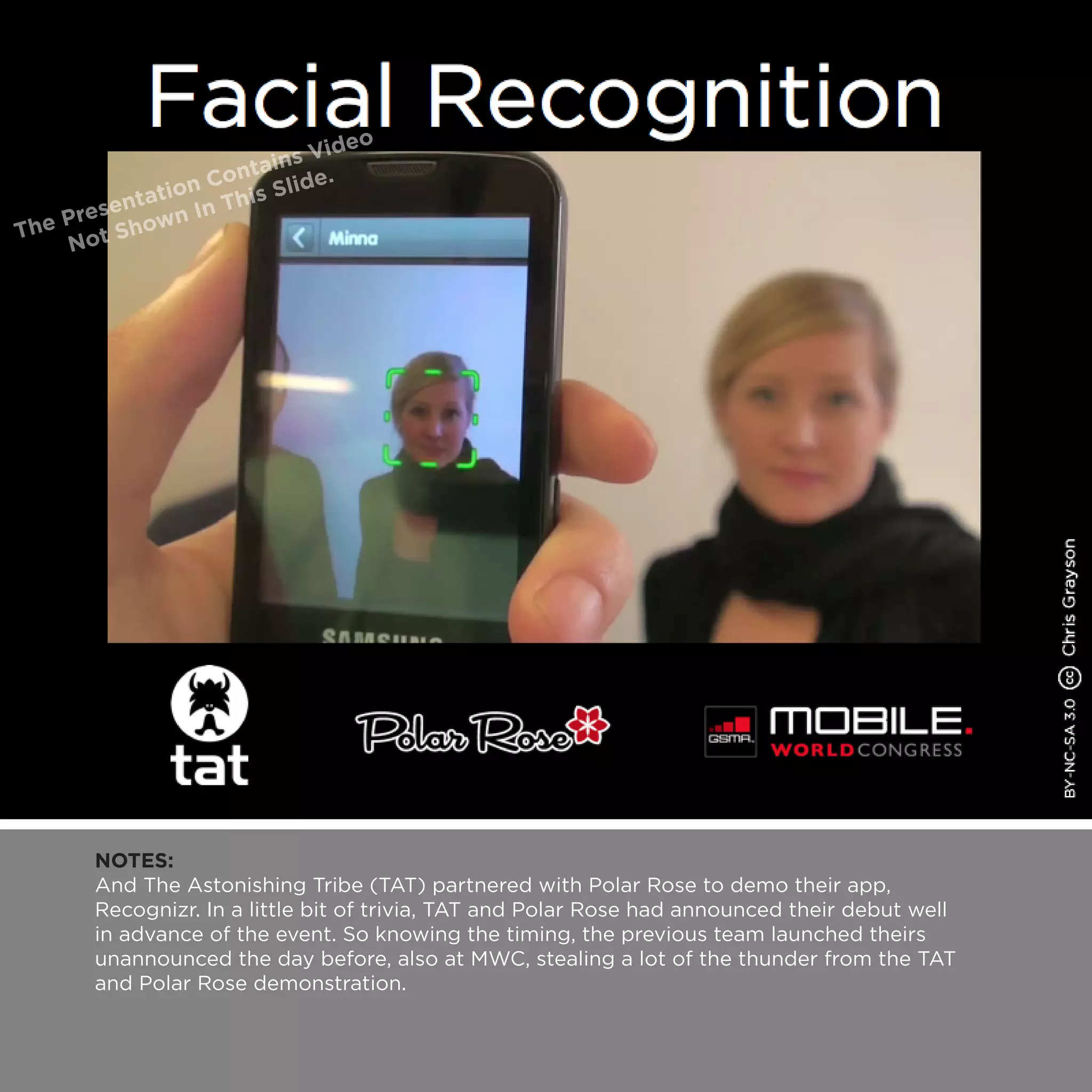
And The Astonishing Tribe (TAT) partnered with Polar Rose to demo their app,
Recognizr. In a little bit of trivia, TAT and Polar Rose had announced their debut well
in advance of the event. So knowing the timing, the previous team launched theirs
unannounced the day before, also at MWC, stealing a lot of the thunder from the TAT
and Polar Rose demonstration.
NOTES:
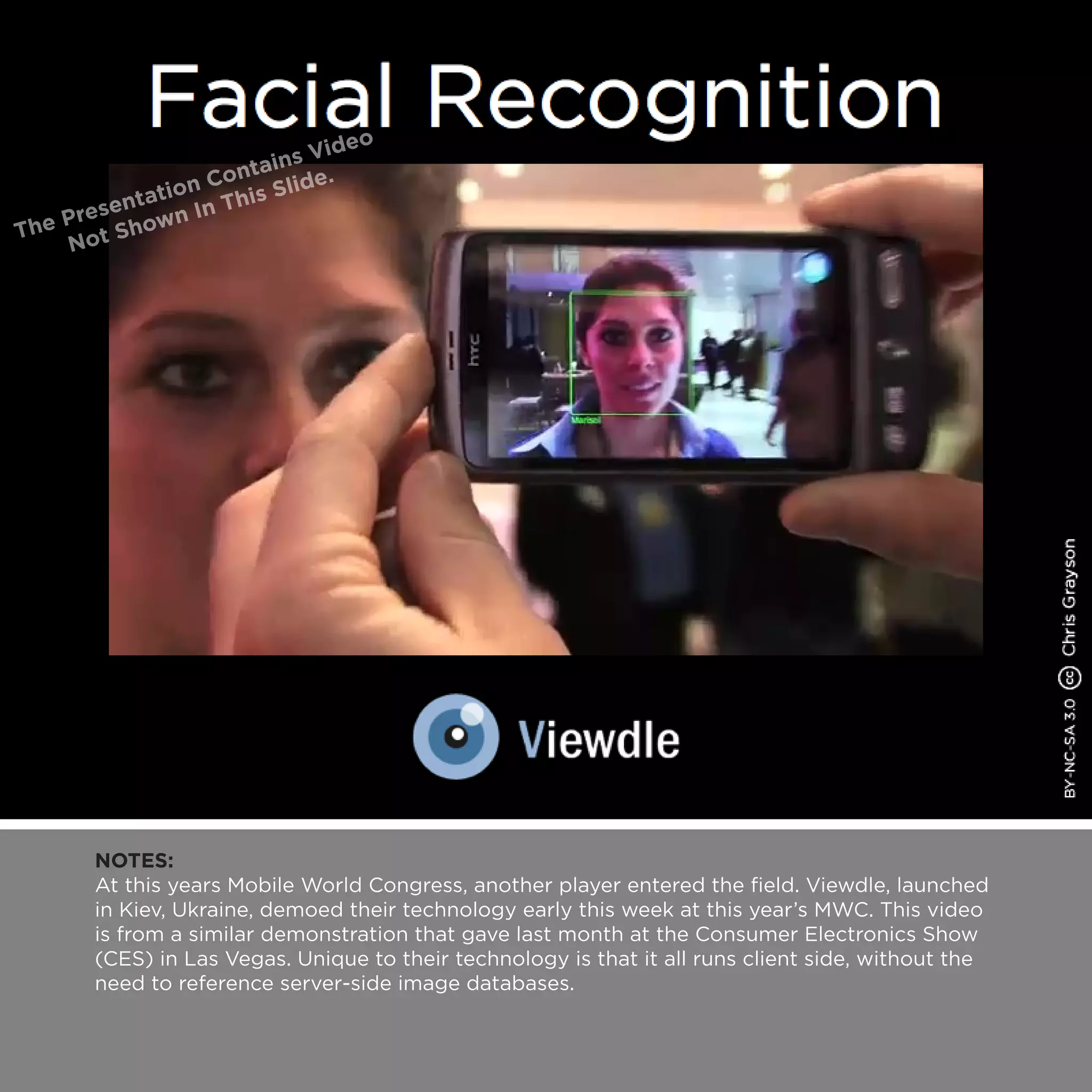
At this years Mobile World Congress, another player entered the field. Viewdle, launched
in Kiev, Ukraine, demoed their technology early this week at this year’s MWC. This video
is from a similar demonstration that gave last month at the Consumer Electronics Show
(CES) in Las Vegas. Unique to their technology is that it all runs client side, without the
need to reference server-side image databases.
NOTES:
You may be familiar with Google Goggles — Google’s mobile image recognition software
for Android. Now, technically Google Goggles doesn’t do facial recognition, but … this is
only because Google has disabled the ability. Those on the Google Goggles team profess
that this is actually something the app does best, but out of concern for privacy issues,
have chosen to disable that feature … for now.
NOTES:
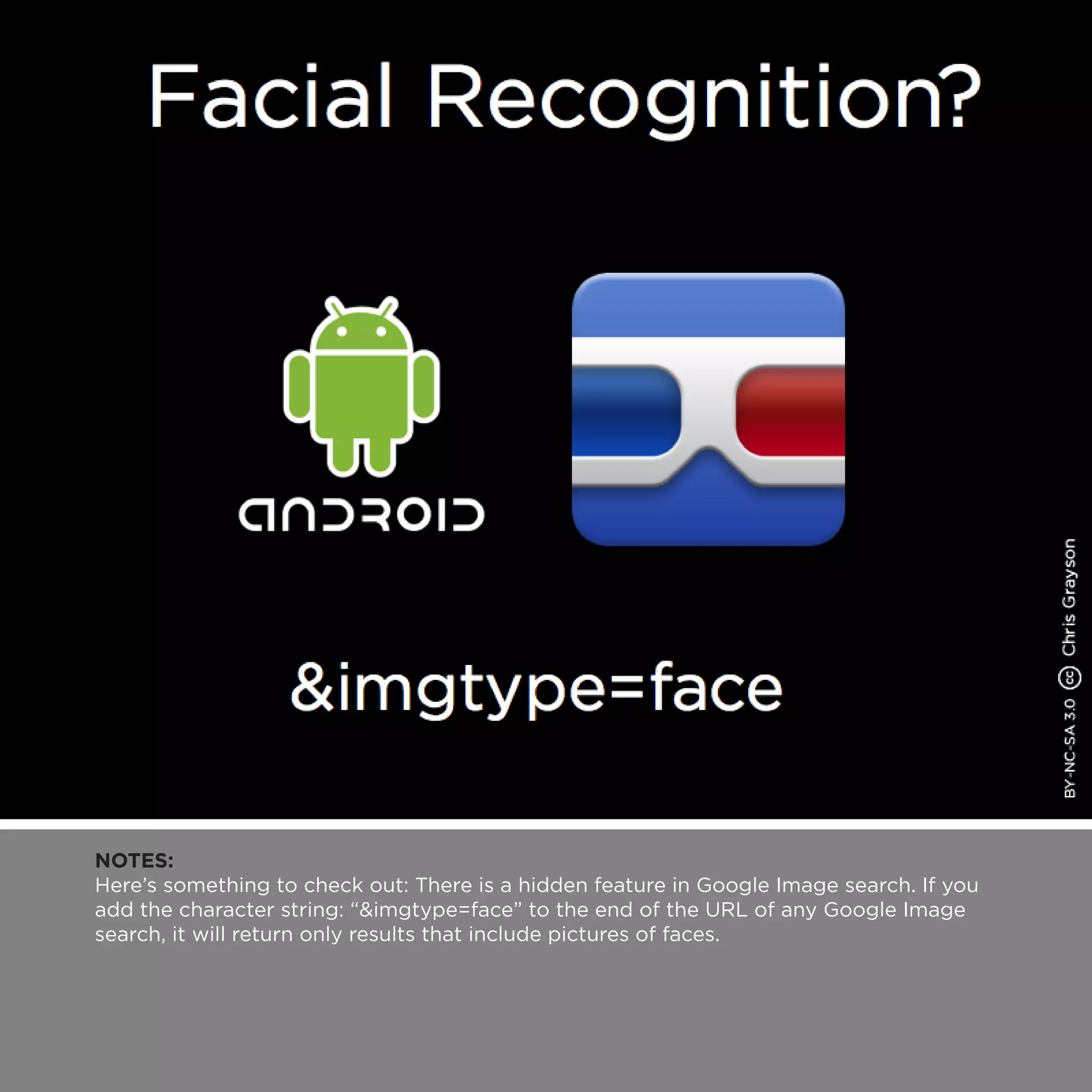
Here’s something to check out: There is a hidden feature in Google Image search. If you
add the character string: “&imgtype=face” to the end of the URL of any Google Image
search, it will return only results that include pictures of faces.
NOTES:
While it hasn’t made it onto the radar of the mass media, this technology — consumer
facial recognition on mobile — is moving fast. By last fall many of the companies in this
space had been snatched up in acquisitions.
NOTES:
May 10, 2010: An investment group, led by Russian search engine Яндекс (Yandex), takes
a US$4.3M stake in Israeli face recognition software company, Face.com.
NOTES:
September 20, 2010: Polar Rose was acquired by Apple (price rumored to be US$29M).
NOTES:
October 5, 2010: A Qualcomm led group of investors take a US$10M stake in Viewdle,
moving their headquarters from the Ukraine to Silicon Valley, and opening outpost
offices in Paris and New York.
NOTES:
December 10, 2010: TAT (The Astonishing Tribe) was acquired my RIM (Research In
Motion, maker of the BlackBerry). Though technically not a face recognition company,
they were Polar Rose’s partner in developing Recognizr.
NOTES:
January 31, 2011: Face.com rebuffs an acquisition offer by Facebook, widely rumored to
be in the “tens of millions.”
NOTES:
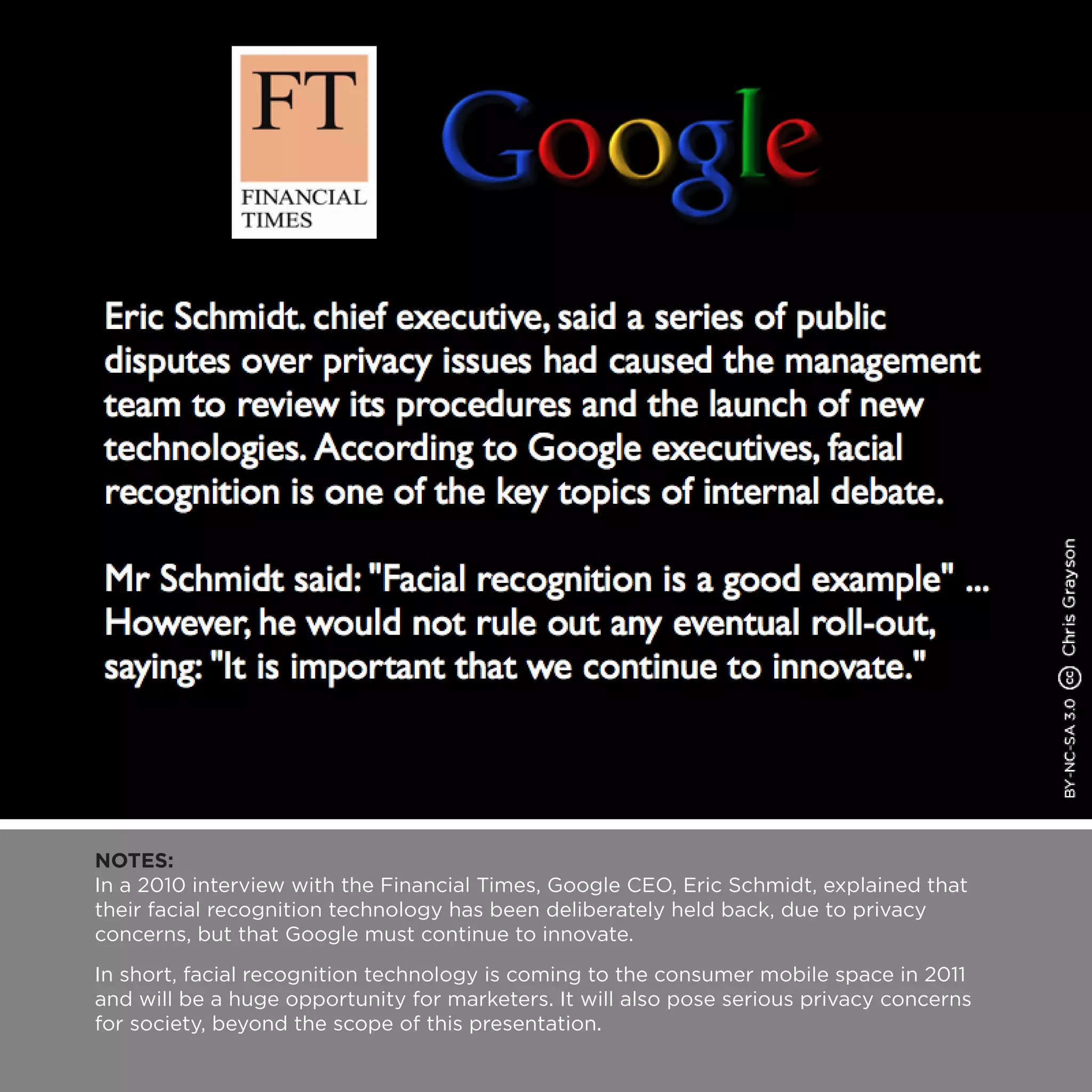
In a 2010 interview with the Financial Times, Google CEO, Eric Schmidt, explained that
their facial recognition technology has been deliberately held back, due to privacy
concerns, but that Google must continue to innovate.
In short, facial recognition technology is coming to the consumer mobile space in 2011
and will be a huge opportunity for marketers. It will also pose serious privacy concerns
for society, beyond the scope of this presentation.
NOTES:
For Engage!, this presentation was edited from a longer version I’ve been giving to
clients of Humble. The longer version containes additional slides on motion tracking and
the impact of open source development for the Microsoft Xbox 360 Kinect controller.
These slides here were also changed slightly from the presentation. The acquisition slides
were put in chronological order.
Chris Grayson is available to speak on augmented reality and emerging platforms.
END NOTES:
This presentation was given on February 16, 2011, 1:00pm at Jacob K. Javits Convention
Center for the occasion of Engage! Expo, on the panel for Augmented Reality: The State
of the Market:
http://EngageExpo.com

Chris Grayson is Director of Digital at Humble:                                    Read his blog, GigantiCo at:
http://Humble.tv                                                                   http://GigantiCo.tv


Companies mentioned in this presentation include:                                  Other related links:

http://Quividi.com                   http://Google.com                             Read more about Johnny Chung Lee’s
http://SeeingMachines.com            http://Yandex.com                             research at Carnegie Mellon, at:
http://English.ARhunt.com            http://Qualcomm.com                           http://JohnnyLee.net
http://Seac02.it                     http://RIM.com
http://FittingBox.com                http://Facebook.com                           Mobile World Congress
http://Apple.com                                                                   is held annually in Barcelona, Spain:
http://Comverse.com                                                                http://MobileWorldCongress.com
http://Face.com
http://TAT.se                                                                      The Financial Times article referenced
http://PolarRose.com                                                               in the presentation can be read at:
http://Viewdle.com                                                                 http://TinyURL.com/FT-Google


Clips from the movie, Minority Report, were used to construct the social narative of this presentation. The movie, directed
by Steven Spielberg and staring Tom Cruise, was an adaptation of the book,”The Minority Report,” by Philip K. Dick.
Minority Report is Copyright © Dreamworks SKG & Twentieth Century Fox. The clips within the presentation have been
shown in compliance with the generally accepted interpretation of fair use in the United States, as described in the
Copyright Act of 1976, 17 U.S.C. § 107.

Other books by Philip K. Dick with movie adaptations:
The book “We Can Remember It for You Wholesale,” was made into the movie, Total Recall, directed by Paul Verhoeven
and staring Arnold Schwarzenegger & Sharon Stone. The book “Do Androids Dream of Electric Sheep,” was made into the
movie, Blade Runner, directed by Ridley Scott and starring Harrison Ford & Rutger Hauer. The book “A Scanner Darkly,”
was made into the movie, A Scanner Darkly, directed by Richard Linklater and staring Keanu Reeves & Winona Ryder.

Amazon affiliate links to the books and movies described above:


 Minority      Total Recall      Blade        A Scanner             The Minority          We Can           Do Androids     A Scanner
 Report                         Runner          Darkly                Report          Remember It for        Dream of        Darkly
                                                                                       You Wholesale      Electric Sheep

Face Tracking & Face Recognition in AR

  • 1.
  • 2.
    NOTES: Hi I’m ChrisGrayson, Director of Digital at Humble. Humble is a pre-to-post production studio and award winning special effects house. One definition of Augmented Reality is: Special effects, rendered in real time, over real life. From a content creation perspective, augmented reality is not all that different than what we do for TV special effects.
  • 3.
    NOTES: (with video playing)The theme of today’s panel is “The State of the AR Market” … You may recognize the scene from the movie, Minority Report, adapted from the book by Philip K. Dick. Minority Report is Copyright © Dreamworks SKG & Twentieth Century Fox. This clip shown in compliance with the generally accepted interpretation of fair use in the United States. (Learn more about Philip K. Dick and Minority Report in the end notes.)
  • 4.
    NOTES: Who here knowsthe difference between Face Tracking and Facial Recognition? Face Tracking involves computer vision that is able to identify a face within its camera view, and can track the face’s movement in space. Facial Recognition is when the computer is also able to recognize who that face belongs to.
  • 5.
    NOTES: Most AR inadvertising is done of the user’s side. This implementation is particularly interesting because it runs on the analyst’s side.
  • 6.
    NOTES: Quividi is aFrench company that makes analytics software for the Digital Out Of Home (DOOH) market. In this view, the media analyst’s dashboard shows the pedestrian traffic passing a digital sign. It tracks media impressions, as people look up at the sign. They claim the software is able to predict gender with 90% accuracy, placing an AR overlay of blue for men or pink for women. It can also estimate age within 10 years, and count each viewer’s length of attention.
  • 7.
    NOTES: Another unique usefor face tracking is 3D video without eyewear.
  • 8.
    NOTES: Show here isthe work of Johnny Chung Lee of Carnegie Mellon. He’s hacked a Wii controller, but he’s using it in reverse. Note the Wii placed underneath the video screen. What you don’t see in this video is a Johnny, with the infra-red receiver attached to the bill of his baseball cap. With this, the Wii controlled knows what direction the user is looking from and adjusts the perspective based on the direction of their gaze. The obvious drawback is that it is only effective or 3D with a single user, as it cannot display for different perspectives at the same time. Expect to see this technique implemented in single user scenarios like handheld video games and mobile interfaces, very soon.
  • 9.
  • 10.
    NOTES: Seeing Machines isan Australian company that makes a software application called FaceAPI that, combined with a high-speed camera, tracks facial features very tightly. Their primary clientele is the automotive industry, who use the technology to measure alertness in drivers by tracking their facial expressions.
  • 11.
    NOTES: In an experiment,Seeing Machines took their FaceAPI software and paired it together with Johnny Chung Lee’s face tracking 3D technique ...
  • 12.
    NOTES: ... but wereable to eliminate accessories all together, by tracking the user’s perspective by seeing the position of their eyes.
  • 13.
    NOTES: These next twoare pretty straight forward applications of augmented reality, using face tracking for registration.
  • 14.
    NOTES: In this examplethe South Korean company, Hanul Neotech, builds on the augmented reality platform of Italian software company, Seac02. A new hairstyle is placed on the man’s head. The registration is tight and tracks his head movements rather convincingly.
  • 15.
    NOTES: And here theFrench software company, Fitting Box, license’s their technology to eyewear companies, in this case Glasses Direct. The face tracking software keeps the glasses in convincing registration on the viewers face, allowing them to see how different pairs may look on their face. This is a very practical application where AR is able to add real value for the user in a retail ecommerce context.
  • 16.
    NOTES: Scene from MinorityReport, adapted from the book by Philip K. Dick. Minority Report is Copyright © Dreamworks SKG & Twentieth Century Fox. This clip shown in compliance with the generally accepted interpretation of fair use in the United States. (Learn more about Philip K. Dick and Minority Report in the end notes.)
  • 17.
    NOTES: ... and nowfor Facial Recognition.
  • 18.
    NOTES: You may befamiliar with the auto-naming feature in Apple’s iPhoto or perhaps the simi- lar feature in Google’s Picas. Technology that, less than a decade ago, was exclusively the domain of Government security services, is now so accessible grandmothers use it to catalogue the photos of their grandchildren.
  • 19.
    NOTES: As we meethere today at Engage!, there is another event going on across the pond in Barcelona. This week is Mobile World Congress. At last year’s MWC there were facial recognition proof-of-concept applications demoed last year by two different teams.
  • 20.
    NOTES: Comverse teamed withFace.com to demo a facial recognition app running on an iPhone.
  • 21.
    NOTES: And The AstonishingTribe (TAT) partnered with Polar Rose to demo their app, Recognizr. In a little bit of trivia, TAT and Polar Rose had announced their debut well in advance of the event. So knowing the timing, the previous team launched theirs unannounced the day before, also at MWC, stealing a lot of the thunder from the TAT and Polar Rose demonstration.
  • 22.
    NOTES: At this yearsMobile World Congress, another player entered the field. Viewdle, launched in Kiev, Ukraine, demoed their technology early this week at this year’s MWC. This video is from a similar demonstration that gave last month at the Consumer Electronics Show (CES) in Las Vegas. Unique to their technology is that it all runs client side, without the need to reference server-side image databases.
  • 23.
    NOTES: You may befamiliar with Google Goggles — Google’s mobile image recognition software for Android. Now, technically Google Goggles doesn’t do facial recognition, but … this is only because Google has disabled the ability. Those on the Google Goggles team profess that this is actually something the app does best, but out of concern for privacy issues, have chosen to disable that feature … for now.
  • 24.
    NOTES: Here’s something tocheck out: There is a hidden feature in Google Image search. If you add the character string: “&imgtype=face” to the end of the URL of any Google Image search, it will return only results that include pictures of faces.
  • 25.
    NOTES: While it hasn’tmade it onto the radar of the mass media, this technology — consumer facial recognition on mobile — is moving fast. By last fall many of the companies in this space had been snatched up in acquisitions.
  • 26.
    NOTES: May 10, 2010:An investment group, led by Russian search engine Яндекс (Yandex), takes a US$4.3M stake in Israeli face recognition software company, Face.com.
  • 27.
    NOTES: September 20, 2010:Polar Rose was acquired by Apple (price rumored to be US$29M).
  • 28.
    NOTES: October 5, 2010:A Qualcomm led group of investors take a US$10M stake in Viewdle, moving their headquarters from the Ukraine to Silicon Valley, and opening outpost offices in Paris and New York.
  • 29.
    NOTES: December 10, 2010:TAT (The Astonishing Tribe) was acquired my RIM (Research In Motion, maker of the BlackBerry). Though technically not a face recognition company, they were Polar Rose’s partner in developing Recognizr.
  • 30.
    NOTES: January 31, 2011:Face.com rebuffs an acquisition offer by Facebook, widely rumored to be in the “tens of millions.”
  • 31.
    NOTES: In a 2010interview with the Financial Times, Google CEO, Eric Schmidt, explained that their facial recognition technology has been deliberately held back, due to privacy concerns, but that Google must continue to innovate. In short, facial recognition technology is coming to the consumer mobile space in 2011 and will be a huge opportunity for marketers. It will also pose serious privacy concerns for society, beyond the scope of this presentation.
  • 32.
    NOTES: For Engage!, thispresentation was edited from a longer version I’ve been giving to clients of Humble. The longer version containes additional slides on motion tracking and the impact of open source development for the Microsoft Xbox 360 Kinect controller. These slides here were also changed slightly from the presentation. The acquisition slides were put in chronological order. Chris Grayson is available to speak on augmented reality and emerging platforms.
  • 33.
    END NOTES: This presentationwas given on February 16, 2011, 1:00pm at Jacob K. Javits Convention Center for the occasion of Engage! Expo, on the panel for Augmented Reality: The State of the Market: http://EngageExpo.com Chris Grayson is Director of Digital at Humble: Read his blog, GigantiCo at: http://Humble.tv http://GigantiCo.tv Companies mentioned in this presentation include: Other related links: http://Quividi.com http://Google.com Read more about Johnny Chung Lee’s http://SeeingMachines.com http://Yandex.com research at Carnegie Mellon, at: http://English.ARhunt.com http://Qualcomm.com http://JohnnyLee.net http://Seac02.it http://RIM.com http://FittingBox.com http://Facebook.com Mobile World Congress http://Apple.com is held annually in Barcelona, Spain: http://Comverse.com http://MobileWorldCongress.com http://Face.com http://TAT.se The Financial Times article referenced http://PolarRose.com in the presentation can be read at: http://Viewdle.com http://TinyURL.com/FT-Google Clips from the movie, Minority Report, were used to construct the social narative of this presentation. The movie, directed by Steven Spielberg and staring Tom Cruise, was an adaptation of the book,”The Minority Report,” by Philip K. Dick. Minority Report is Copyright © Dreamworks SKG & Twentieth Century Fox. The clips within the presentation have been shown in compliance with the generally accepted interpretation of fair use in the United States, as described in the Copyright Act of 1976, 17 U.S.C. § 107. Other books by Philip K. Dick with movie adaptations: The book “We Can Remember It for You Wholesale,” was made into the movie, Total Recall, directed by Paul Verhoeven and staring Arnold Schwarzenegger & Sharon Stone. The book “Do Androids Dream of Electric Sheep,” was made into the movie, Blade Runner, directed by Ridley Scott and starring Harrison Ford & Rutger Hauer. The book “A Scanner Darkly,” was made into the movie, A Scanner Darkly, directed by Richard Linklater and staring Keanu Reeves & Winona Ryder. Amazon affiliate links to the books and movies described above: Minority Total Recall Blade A Scanner The Minority We Can Do Androids A Scanner Report Runner Darkly Report Remember It for Dream of Darkly You Wholesale Electric Sheep