Carolyn Sanders - Fronde Scrum 101 –  end to end, minus the hype
Today – Scrum end to end A tiny bit about where it came from A bunch about how Scrum works… …  with examples from an actual project Where to go for more information Nothing at all about why it’s the best silver bullet since sliced bread Commercial in confidence | Copyright © 2008 Fronde Systems Group Limited
All of these things: A set of  engineering best practices  that allow for rapid delivery of high quality software A  project process  that encourages frequent inspection and adaptation A  philosophy  that encourages team work and accountability 2. What is this “Agile”? Commercial in confidence | Copyright © 2008 Fronde Systems Group Limited
1. Agile Manifesto (philosophy) We have come to value: Individuals and interactions  over processes and tools Working software  over comprehensive documentation Customer collaboration  over contract negotiation Responding to change  over following a plan That is, while there is value in the items on the right, we value the items on the left  more .  Commercial in confidence | Copyright © 2008 Fronde Systems Group Limited
Agile Values (philosophy) Openness:  the project is for the stakeholders Honesty:  in estimating and planning Courage:  to face the consequences Trust:  in those individuals and their estimates Money:  because projects aren’t free Commitment:  to deliver on our promises Credits:  First five from Rob Thomsett, last from Jeff Sutherland Commercial in confidence | Copyright © 2008 Fronde Systems Group Limited
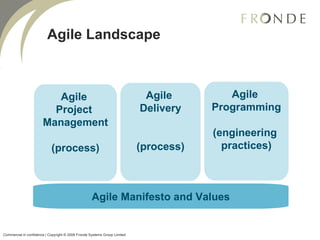
Agile Landscape  Agile Manifesto and Values Agile  Project  Management (process) Agile  Delivery (process) Agile  Programming (engineering  practices) Commercial in confidence | Copyright © 2008 Fronde Systems Group Limited
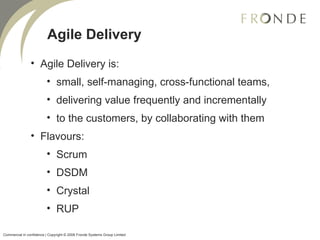
Agile Delivery Agile Delivery is:  small, self-managing, cross-functional teams,  delivering value frequently and incrementally to the customers, by collaborating with them Flavours: Scrum DSDM Crystal  RUP Commercial in confidence | Copyright © 2008 Fronde Systems Group Limited
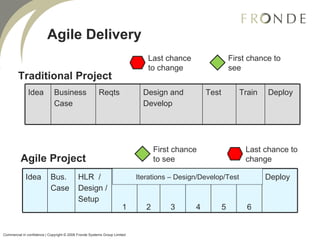
Agile Delivery Commercial in confidence | Copyright © 2008 Fronde Systems Group Limited   Traditional Project Agile Project Iterations – Design/Develop/Test First chance to see Last chance to change First chance to see Last chance to change Idea Business Case Reqts Design and Develop Test Train Deploy Idea Bus. Case HLR  / Design / Setup 1 2 3 4 5 6 Deploy
Where Scrum started and who started it 1986: Hirotaka Takeuchi and Ikujiro Nonaka  use the “rugby scrum” metaphor for product development 1991: Dr Jeff Sutherland  (Easel) and Ken Schwaber (ADM), on real projects and calling it “Scrum” And: Gabrielle Benefield and Pete Deemer at Yahoo And: Alistair Cockburn, and Mike Cohn Commercial in confidence | Copyright © 2008 Fronde Systems Group Limited
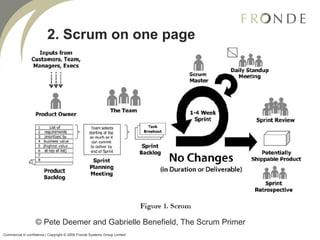
2. Scrum on one page © Pete Deemer and Gabrielle Benefield, The Scrum Primer Commercial in confidence | Copyright © 2008 Fronde Systems Group Limited
3. The example project Project H: building an Intranet in MOSS For a client, with their experts Three MOSS experts, a tester and a BA Very constrained budget and deadline Willing to trade off scope to get quality Commercial in confidence | Copyright © 2008 Fronde Systems Group Limited
“ Individuals and Interactions” – Scrum Roles Product Owner:  get all the stakeholders’ input, prioritise the outputs Team:  build the output. Self Organising, Cross Functional Scrum Master:  get the process going well Stakeholders:  have their say and do their bit Project Manager:  not specified in Scrum Commercial in confidence | Copyright © 2008 Fronde Systems Group Limited
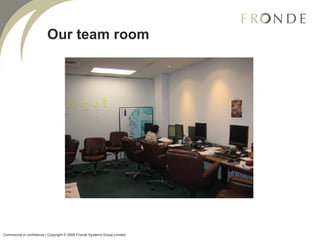
Our team room Commercial in confidence | Copyright © 2008 Fronde Systems Group Limited
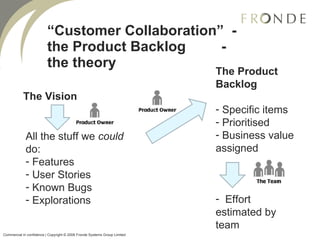
“ Customer Collaboration”  - the Product Backlog  - the theory All the stuff we  could  do: Features User Stories Known Bugs Explorations The Vision The Product Backlog Specific items Prioritised Business value assigned Effort estimated by team Commercial in confidence | Copyright © 2008 Fronde Systems Group Limited
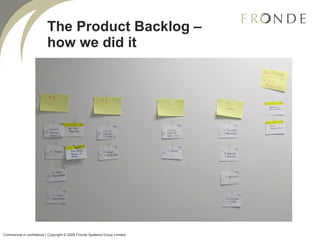
The Product Backlog – how we did it Commercial in confidence | Copyright © 2008 Fronde Systems Group Limited
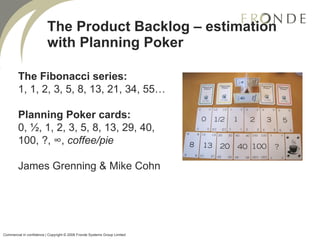
The Product Backlog – estimation with Planning Poker The Fibonacci series:  1, 1, 2, 3, 5, 8, 13, 21, 34, 55… Planning Poker cards:  0, ½, 1, 2, 3, 5, 8, 13, 29, 40, 100, ?, ∞,  coffee/pie James Grenning & Mike Cohn Commercial in confidence | Copyright © 2008 Fronde Systems Group Limited
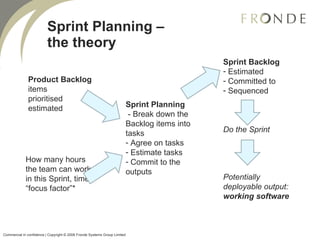
Sprint Planning – the theory Product Backlog  items prioritised estimated How many hours the team can work in this Sprint, times “focus factor”* Sprint Planning - Break down the Backlog items into tasks Agree on tasks Estimate tasks Commit to the outputs Sprint Backlog Estimated Committed to Sequenced Do the Sprint Potentially deployable output:  working software Commercial in confidence | Copyright © 2008 Fronde Systems Group Limited
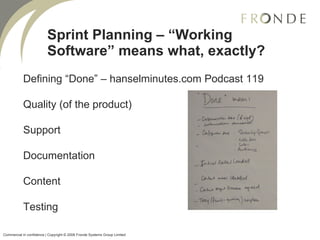
Sprint Planning – “Working Software” means what, exactly? Defining “Done” – hanselminutes.com Podcast 119  Quality (of the product) Support Documentation Content Testing Commercial in confidence | Copyright © 2008 Fronde Systems Group Limited
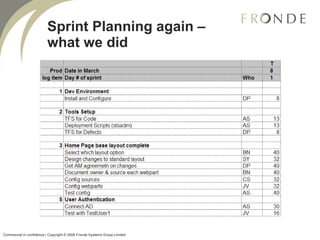
Sprint Planning again – what we did Commercial in confidence | Copyright © 2008 Fronde Systems Group Limited
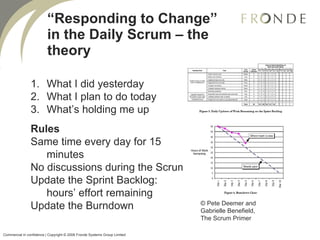
“ Responding to Change” in the Daily Scrum – the theory What I did yesterday What I plan to do today What’s holding me up Rules Same time every day for 15 minutes No discussions during the Scrum Update the Sprint Backlog: hours’ effort remaining Update the Burndown © Pete Deemer and Gabrielle Benefield,  The Scrum Primer Commercial in confidence | Copyright © 2008 Fronde Systems Group Limited
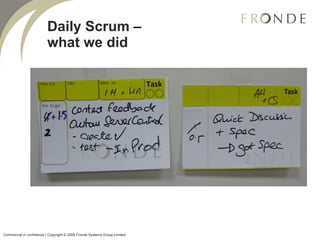
Daily Scrum – what we did Commercial in confidence | Copyright © 2008 Fronde Systems Group Limited
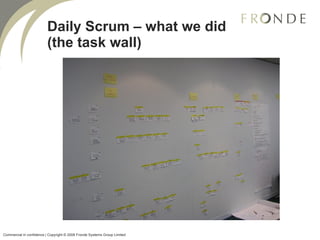
Daily Scrum – what we did (the task wall) Commercial in confidence | Copyright © 2008 Fronde Systems Group Limited
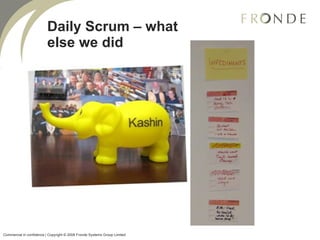
Daily Scrum – what else we did Commercial in confidence | Copyright © 2008 Fronde Systems Group Limited
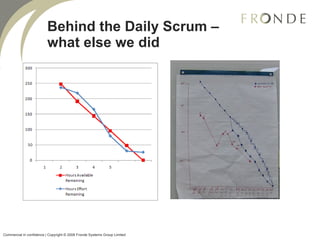
Behind the Daily Scrum – what else we did Commercial in confidence | Copyright © 2008 Fronde Systems Group Limited
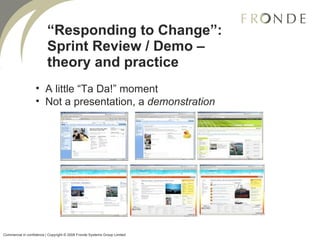
“ Responding to Change”: Sprint Review / Demo – theory and practice A little “Ta Da!” moment Not a presentation , a  demonstration Commercial in confidence | Copyright © 2008 Fronde Systems Group Limited
Retrospective – theory and practice Look Back Plus / Minus / Interesting or Do Again / Do Differently Dot prioritisation  Caused by  / Exposed By Look Forward, Adjust Course Actions Arising Measuring Velocity: focus factor Product Backlog re-estimate Commercial in confidence | Copyright © 2008 Fronde Systems Group Limited
5. How to get more info Scrum in general www.scrumalliance.org scrumtraininginstitute.com/library agileprofessionals.net    blog.crisp.se/henrikkniberg/  - XP from the Trenches Planning Poker and User Stories www.mountaingoatsoftware.com Commercial in confidence | Copyright © 2008 Fronde Systems Group Limited
The big secret Don’t tell anyone, but… Commercial in confidence | Copyright © 2008 Fronde Systems Group Limited
Q&A Carolyn Sanders Principal Consultant – Agile and PM www.fronde.com Commercial in confidence | Copyright © 2008 Fronde Systems Group Limited

Girl Geeks Dinner - Scrum 101

  • 1.
    Carolyn Sanders -Fronde Scrum 101 – end to end, minus the hype
  • 2.
    Today – Scrumend to end A tiny bit about where it came from A bunch about how Scrum works… … with examples from an actual project Where to go for more information Nothing at all about why it’s the best silver bullet since sliced bread Commercial in confidence | Copyright © 2008 Fronde Systems Group Limited
  • 3.
    All of thesethings: A set of engineering best practices that allow for rapid delivery of high quality software A project process that encourages frequent inspection and adaptation A philosophy that encourages team work and accountability 2. What is this “Agile”? Commercial in confidence | Copyright © 2008 Fronde Systems Group Limited
  • 4.
    1. Agile Manifesto(philosophy) We have come to value: Individuals and interactions over processes and tools Working software over comprehensive documentation Customer collaboration over contract negotiation Responding to change over following a plan That is, while there is value in the items on the right, we value the items on the left more . Commercial in confidence | Copyright © 2008 Fronde Systems Group Limited
  • 5.
    Agile Values (philosophy)Openness: the project is for the stakeholders Honesty: in estimating and planning Courage: to face the consequences Trust: in those individuals and their estimates Money: because projects aren’t free Commitment: to deliver on our promises Credits: First five from Rob Thomsett, last from Jeff Sutherland Commercial in confidence | Copyright © 2008 Fronde Systems Group Limited
  • 6.
    Agile Landscape Agile Manifesto and Values Agile Project Management (process) Agile Delivery (process) Agile Programming (engineering practices) Commercial in confidence | Copyright © 2008 Fronde Systems Group Limited
  • 7.
    Agile Delivery AgileDelivery is: small, self-managing, cross-functional teams, delivering value frequently and incrementally to the customers, by collaborating with them Flavours: Scrum DSDM Crystal RUP Commercial in confidence | Copyright © 2008 Fronde Systems Group Limited
  • 8.
    Agile Delivery Commercialin confidence | Copyright © 2008 Fronde Systems Group Limited Traditional Project Agile Project Iterations – Design/Develop/Test First chance to see Last chance to change First chance to see Last chance to change Idea Business Case Reqts Design and Develop Test Train Deploy Idea Bus. Case HLR / Design / Setup 1 2 3 4 5 6 Deploy
  • 9.
    Where Scrum startedand who started it 1986: Hirotaka Takeuchi and Ikujiro Nonaka use the “rugby scrum” metaphor for product development 1991: Dr Jeff Sutherland (Easel) and Ken Schwaber (ADM), on real projects and calling it “Scrum” And: Gabrielle Benefield and Pete Deemer at Yahoo And: Alistair Cockburn, and Mike Cohn Commercial in confidence | Copyright © 2008 Fronde Systems Group Limited
  • 10.
    2. Scrum onone page © Pete Deemer and Gabrielle Benefield, The Scrum Primer Commercial in confidence | Copyright © 2008 Fronde Systems Group Limited
  • 11.
    3. The exampleproject Project H: building an Intranet in MOSS For a client, with their experts Three MOSS experts, a tester and a BA Very constrained budget and deadline Willing to trade off scope to get quality Commercial in confidence | Copyright © 2008 Fronde Systems Group Limited
  • 12.
    “ Individuals andInteractions” – Scrum Roles Product Owner: get all the stakeholders’ input, prioritise the outputs Team: build the output. Self Organising, Cross Functional Scrum Master: get the process going well Stakeholders: have their say and do their bit Project Manager: not specified in Scrum Commercial in confidence | Copyright © 2008 Fronde Systems Group Limited
  • 13.
    Our team roomCommercial in confidence | Copyright © 2008 Fronde Systems Group Limited
  • 14.
    “ Customer Collaboration” - the Product Backlog - the theory All the stuff we could do: Features User Stories Known Bugs Explorations The Vision The Product Backlog Specific items Prioritised Business value assigned Effort estimated by team Commercial in confidence | Copyright © 2008 Fronde Systems Group Limited
  • 15.
    The Product Backlog– how we did it Commercial in confidence | Copyright © 2008 Fronde Systems Group Limited
  • 16.
    The Product Backlog– estimation with Planning Poker The Fibonacci series: 1, 1, 2, 3, 5, 8, 13, 21, 34, 55… Planning Poker cards: 0, ½, 1, 2, 3, 5, 8, 13, 29, 40, 100, ?, ∞, coffee/pie James Grenning & Mike Cohn Commercial in confidence | Copyright © 2008 Fronde Systems Group Limited
  • 17.
    Sprint Planning –the theory Product Backlog items prioritised estimated How many hours the team can work in this Sprint, times “focus factor”* Sprint Planning - Break down the Backlog items into tasks Agree on tasks Estimate tasks Commit to the outputs Sprint Backlog Estimated Committed to Sequenced Do the Sprint Potentially deployable output: working software Commercial in confidence | Copyright © 2008 Fronde Systems Group Limited
  • 18.
    Sprint Planning –“Working Software” means what, exactly? Defining “Done” – hanselminutes.com Podcast 119 Quality (of the product) Support Documentation Content Testing Commercial in confidence | Copyright © 2008 Fronde Systems Group Limited
  • 19.
    Sprint Planning again– what we did Commercial in confidence | Copyright © 2008 Fronde Systems Group Limited
  • 20.
    “ Responding toChange” in the Daily Scrum – the theory What I did yesterday What I plan to do today What’s holding me up Rules Same time every day for 15 minutes No discussions during the Scrum Update the Sprint Backlog: hours’ effort remaining Update the Burndown © Pete Deemer and Gabrielle Benefield, The Scrum Primer Commercial in confidence | Copyright © 2008 Fronde Systems Group Limited
  • 21.
    Daily Scrum –what we did Commercial in confidence | Copyright © 2008 Fronde Systems Group Limited
  • 22.
    Daily Scrum –what we did (the task wall) Commercial in confidence | Copyright © 2008 Fronde Systems Group Limited
  • 23.
    Daily Scrum –what else we did Commercial in confidence | Copyright © 2008 Fronde Systems Group Limited
  • 24.
    Behind the DailyScrum – what else we did Commercial in confidence | Copyright © 2008 Fronde Systems Group Limited
  • 25.
    “ Responding toChange”: Sprint Review / Demo – theory and practice A little “Ta Da!” moment Not a presentation , a demonstration Commercial in confidence | Copyright © 2008 Fronde Systems Group Limited
  • 26.
    Retrospective – theoryand practice Look Back Plus / Minus / Interesting or Do Again / Do Differently Dot prioritisation Caused by / Exposed By Look Forward, Adjust Course Actions Arising Measuring Velocity: focus factor Product Backlog re-estimate Commercial in confidence | Copyright © 2008 Fronde Systems Group Limited
  • 27.
    5. How toget more info Scrum in general www.scrumalliance.org scrumtraininginstitute.com/library agileprofessionals.net blog.crisp.se/henrikkniberg/ - XP from the Trenches Planning Poker and User Stories www.mountaingoatsoftware.com Commercial in confidence | Copyright © 2008 Fronde Systems Group Limited
  • 28.
    The big secretDon’t tell anyone, but… Commercial in confidence | Copyright © 2008 Fronde Systems Group Limited
  • 29.
    Q&A Carolyn SandersPrincipal Consultant – Agile and PM www.fronde.com Commercial in confidence | Copyright © 2008 Fronde Systems Group Limited

Editor's Notes

  • #5 Agile Alliance came up with this manifesto. Note that we value the left hand items MORE, not INSTEAD.
  • #13 Product Owner. Owns the business problem and makes all priority decisions. Come back to this with our experiences. Will do this a bit, so save your questions because I’ll probably answer them. In our case, the senior BA played this role. Team. Pigs and Chickens. The team are the pigs. Scrum Master. Serve and protect the team. Help them understand and follow the practice of Scrum (including product owner). Not the PM role! Stakeholders: first big learning – projects still have lots of these. Product owner must listen & engage. Project Manager (come back to this)
  • #14 Here’s our team room. Colocate! Note the lack of windows. Good things: we were all together, had heaps of wall room, had a door we could shut. Not ideal, but way better than not being in a room together. Ideal room has more people space, a whiteboard, more desk space. And windows. This is the reason the rest of the photos are a bit grey.
  • #15 The theory… Note the actual mechanism for creating a good PB is outside Scrum per se, and where you have to slot in other techniques eg use case, user stories, reqts analysis, solution design Mention User Stories here
  • #16 Photo of a PB card, and photo of site map, and photo of a PB list on a wall. We did start with a big idea and wind up with a list of things to do. How we did that, is not specifically prescribed in the Scrum methodology and it deserves its own place. Once we had the list, here’s how we prioritised it. We were building an intranet site, and we had the sitemap by this point. So … list of non-site-map items and then a site map. Got the stakeholders with the product owner to move the sitemap and non-sitemap items into the sprints. At this point we’d also decided how many sprints and how long: driven entirely by budget. So anything that didn’t go into the sprint was left on the “Later” list. Note: not thrown away.
  • #29 It’s really about micromanagement. But in a good way.