Mohd Asrof Gulam Nabi & Wan Khairuzzaman Wan Ismail
International Journal of Business Research and Management (IJBRM), Volume (7) : Issue (4) : 2016 63
Job Crafting In Public Sector
Mohd Asrof Gulam Nabi asrofg@gmail.com
PhD Student
International Business School,
Jalan Semarak, 50400
Kuala Lumpur, Malaysia
Wan Khairuzzaman Wan Ismail mwkhair@ibs.utm.my
International Business School,
Jalan Semarak, 50400
Kuala Lumpur, Malaysia
Abstract
The changing nature of the workplace has created different employees' expectations and
demands. As a result, the working environment is no longer associated with employees that are
rigid and treating jobs as static sets of tasks. Instead, employees are being proactive in
developing and adjusting their work roles and functions. The act or behaviour of these employees
in adapting their work roles to match their needs and preferences is called job crafting. Goal
orientation is considered as an important dimension in influencing their behaviours. However,
there has been little research on how the mindset, especially public sector employee’s goal
orientation, adapt to the changing and challenging world of work. Using Partial Least Square
approach with 150 samples, the study showed that public employees with learning goal
orientation do embraced job crafting activities and the surprising finding that those with
performance prove do not embraced such activities.
Keywords: Job Crafting, Learning Goal, Performance Prove, Performance Avoid, Public Sector.
1. INTRODUCTION
The workplace is evolving rapidly for the past several decades due to the changing nature of both
organisational and employees’ expectations and demands. As organisations becoming more
dynamic, workforce also is changing in its values, attitudes, behaviours and expectations.
Consequently, all these affect the lifestyles which had impacted economic progress worldwide
and affected individuals, both in terms of mindset as well as physical wellbeing.
In various surveys, locally and on global scale, employees incline to change job when they feel
that they are not being valued by their employers [1, 2]. Employees generally are seeking intrinsic
rewards or "softer factors". Employees tend to seek positive meaning in their work which will
determine their approach, enact and experience of their work and behaviour [3]. Having a
meaningful work situation lead to generally happy and productive workers [4].
It was asserted that in the 21st century work settings, employees' psychological capabilities,
inclusive of their motivational reasons, are constantly being tested [5] and employees are now
expected to shape their work experiences through work design which require proactive behaviour
in work settings [6] which have been demonstrated to be an important driver of performance [7].
The act of learning shows a proactive behaviour and thus proactivity is another dimension that
accentuate individuals’ propensity to change or modify their behaviour and competencies to fit the
environment, while it is also asserted that the environment is malleable and subject to change [8].
The motive to enact learning behaviour is dependent on the goal-orientation of the employees [9],
which is influence by the goal preferences in achievement situations and how individuals view
Mohd Asrof Gulam Nabi & Wan Khairuzzaman Wan Ismail
International Journal of Business Research and Management (IJBRM), Volume (7) : Issue (4) : 2016 64
effort. Dweck [10] posited that an important characteristics of goal orientation is the mindset
within which these individuals interpret and respond to situations.
One of the ways for employees to adapt to the varied environment is by shaping their own work
experiences through taking initiatives in changing their job components with or without the
management involvement. This requires matching their skills and needs with their given jobs.
Consequently, this lead to employees making changes to their job design. This observation of
employees changing their work design was originally put forward by Kulik, Oldham [11], however,
Wrzesniewski and Dutton [12] was the first to formalise the construct that was known as job
crafting.
Various research suggest that job crafting positively related to employee engagement which
ultimately increase the performance of the employees [13] and has the effect of reducing the
turnover intention of employees [14]. As the common occurrence in other countries, Malaysia also
is seeing an increasing trend in employees leaving their organisations [15]. Employees’
engagement effect their turnover intention [16] and their intention or actual action of leaving the
organisation is stated as the ultimate act of disengagement [17]. A study by Esteves and Lopes
[14] found that job crafting dimension such as seeking challenging job demand, has the effect of
reducing the turnover intention of employees. As such, job crafting strategy encouragement can
be used by an organisation to negate the growing trend of employees hopping to another
organisation. As the job crafting is still considered as a new field, this paper takes the view that
identifying the constructs that can lead to job crafting behaviours is beneficial to organisations in
formulating and supplementing their strategy of retaining their valued employees.
Additionally, there has not been many research in job crafting behaviour in the public sector.
Following the classification proposed by Chester [18] that is widely accepted as the influential
model [19], public sector organisations are divided into three types of categories; departments,
local authorities and “the rest” that embrace a mass of quasi-autonomous agencies. This paper
will only consider the first category of public servants that is typically under a ministerial overview.
Public organisations have been associated with having more emphasis on bureaucratic values
than the private organisations. Furthermore, it also posited as having employees that are less
materialistic (extrinsic motives) and having weaker commitment, than the private sectors
employees [20, 21]. However, there are also findings that indicate that the extrinsic motives are
present and public sector employees are also as committed as their counterparts in the private
organisation [22-24]. This inconsistent finding points to the fact that the internal and external
factors within and between employees and organisations such as personalities of the employees,
nature of the organisations and the country it is located (organisational and society culture) can
be the influencing factors. As proposed by Dan [25], level of motivation of public sector
employees generally would be comparable to the private sector and thus it is conceivable with the
prosocial values that normally associated with the public sector employees [26] [27], job crafting
activities in the public sector would be present and magnified.
Consequently, the research question or aims of this paper is to investigate the effect of goal
orientation dimensions with job crafting behaviors within the public sector.
2. LITERATURE REVIEW
2.1 Job Crafting
Job crafting can be defined "as the physical and cognitive changes individuals make in the task or
relationship boundaries of their work" and can be segregated into three types: task, cognitive and
relational job crafting [12]. Task crafting involves changing the physical working conditions.
Cognitive crafting refers to changing employees’ perceptions of the job which involve framing the
way in how these employees view the job or tasks. Lastly, relational crafting refers to
interpersonal relationships at work which may involve interaction or avoiding it with coworkers or
customers to attain the expected outcome of doing so.
Mohd Asrof Gulam Nabi & Wan Khairuzzaman Wan Ismail
International Journal of Business Research and Management (IJBRM), Volume (7) : Issue (4) : 2016 65
Job crafting is a formation of job design from the bottom-up approach rather than the typical top-
down approach. The key element in crafting a job is being proactive to the working environment
that necessitate employees in taking initiatives to have an impactful job role instead of depending
squarely on their supervisors or management, or reacting to change in the job [28]. As for
organisations that generally would find difficulties in creating optimal job designs for employees,
job crafting is a possible mean to overcome the difficulties by accommodating the unique
backgrounds, motives and preferences of the employees to achieve the optimal job fit by the
employees' own initiatives [29].
There are three main motivations for job crafting as proposed by Wrzesniewski and Dutton [12].
Firstly, to engage in job crafting so that employees can maintain interest in their job and the
motivation at their working place by having a sense of control, discretion and work meaning.
Secondly, driven to protect and enhance employees own self-image that form a large part of their
self-identity. Thirdly, to have a meaningful relationship with the people who may benefit as a
result of their action on the jobs. Additionally, Berg, Dutton [30] elaborate that employees derive
meaning at work place by negating adversity by altering their jobs expectations and activities.
There have been many empirical studies that supported and confirmed the validity and
usefulness of the job crafting such as increased in job performance [31], work engagement [32],
organisational commitment [33], well-being [34] and increased in meaning [35]. Various research
carried out have identified discretion or autonomy, task independence and proactive personality
as the initiator or antecedent of job crafting behaviors [12, 36, 37]. As such, it can explain on why
some employees with the same work settings have different motivational orientations.
Additionally, research also have identified environmental factors such as work situation, and
individual motivational orientations such as regulatory focus of employee, in determining
employees tendencies and success to initiate job crafting activities [37].
2.2 Goal Orientation
Goal orientation can be conceptualized as “a mental framework for how individuals interpret and
respond to achievement situations”. Elliot and Dweck [38] proposed that goal orientation can be
defined as specific, desired end states through mastering a concept or skill, to outperform others
and to win a competition. In achieving these end states, the person require cognitive and affective
or emotional components [9].
Elliot and Dweck [38] stated that goals that only focus on competency or ability in achievement-
related activities should be included as achievement goals as it is the foundation of goal
orientation construct. There has been an implicit agreement between researchers to focus on two
main orientations which are learning (also known as mastery goals) and performance goals forms
of competence relevant motivation or goals [9]. Learning goals are where a person seek to
increase or acquire new competencies or skills, while performance goals are sought to gain
favorable judgments of competency or ability or to avoid negative judgments of a person
competence [39]. Therefore, individual with learning goals orientation to achievement
environment will attempt to develop their competence while those with performance goals
orientation will only attempt to demonstrate their competencies.
An extended model in achievement goals was proposed by Elliot and McGregor [40] and
VandeWalle [41] that focus on the approach (prove) and avoidance dimension in performance
goals orientation. Based on the two performance goals dimensions to competence, an approach
goals orientation employees would aim at acquiring positive possibilities, whereas avoidance
goals employees are aimed at avoiding negative possibilities. It was identified that the approach
and avoidance goals are presumed to be rooted in different biologically based sources [42] and
activated by different environmental cues [43].
Among the findings on the positive outcomes from adopting the learning goals orientation are
increased in persistence [44], job performance [45], creativity [46], generally proactive behavior
Mohd Asrof Gulam Nabi & Wan Khairuzzaman Wan Ismail
International Journal of Business Research and Management (IJBRM), Volume (7) : Issue (4) : 2016 66
[47] and higher intrinsic motivation and generally perform better even in the face of challenging
and difficult tasks [48]. However, empirical findings have shown that performance-approach
(prove) goal orientation have either positive or unrelated relationship to beneficial outcomes such
as increased in self-efficacy [49], increased in effort [50] and not showing deep learning strategies
[51]. While, employees with performance-avoidance goals orientation have been associated with
generally negative outcomes such as self-handicapping strategies [52], low performance [45] and
lower intrinsic motivation [53].
2.3 Public Sector Employees Motivation to Work
It is observed that majority of the studies on job crafting so far have been focusing on either
private or a mixed of occupation or sector [54-56]. There are only just a few studies carried out in
the public sector such as those by Heuvel, E. [57] and Petrou, Demerouti [58]. Furthermore, there
are evidence that public service motivation and ethos appear to vary in different cultures and
nations [59, 60]. As such, this paper will focus on the job crafting tendencies of the public sector
employees in Malaysia.
Employees vary in their motives for working and some individuals would prefer to work in
government sector for wide range of reasons such as in seeking secure employment and benefits
that is prevalent in the less developed countries [22, 59]. Additionally, in a study by Taylor, Steel
[61], it was found that distinctive national cultural factors of social ties, personal responsibility and
group focus differentiate the response level of U.S against Asia Pacific public sector employees
where respondents from Asia Pacific reported higher levels on one dimension of job productivity
but lower levels on perceived job effectiveness. Thus, all the studies above point towards the
possible fact that employees in public sector will be driven to work with different motive, focus and
magnitude depending which countries they are from and the cultural association.
Burgess and Ratto [62] argued that money is not the sole motivating factor for public servants as
they are also more motivated by other benefits and incentives than private sector workers. As
such, in general public sector workers are less motivated by monetary gain, however, there are
mixed results for intrinsic motives with higher organisational commitment for public sector workers
than private sector employees [23]. However, according to Wright [63], eventhough work
motivation among the public sector and private employees are very different, both private and
public sector workers want good working conditions, friendly coworkers and task rotation but with
public sector employees are associated with lower levels of organizational commitment [64].
Houston [65] found that public employees are more likely to place a higher value on the intrinsic
rewards of work than their private sector counterparts. One possible explanation for the tendency
to intrinsic factor might be due to the positive choice placed by the public employees to work-life
balances. These employees may be less motivated by money, work challenge and less
committed to long working hours as to balance their work with family time and other leisure
activities [66]. Public employees also was found to choose a prosocial option as compared to
risky option which mean that they have the tendency to be risk averse [67, 68]. However, in
another study it was found that public servants value challenging work more than private sector
employees [69], which depict a riskier attribute. As such, when comes to evaluating public
employees’ attitude towards challenging work or being risk averse, there is no clear finding to
support either position.
However, one factor that are supported by various studies have shown that public employees are
more likely to undertake prosocial or extra role behaviors such as making charitable contributions,
giving blood and various other pro social activities even in their personal time [26, 27, 70]. Thus,
these employees are more likely to participate in helping activities.
Having a prosocial attitude will tend to lead employees in embracing job crafting activities
Additionally, as public employees are more focused on intrinsic factors that relate to meaning in
work rather than extrinsic factors, it can be expected that these intrinsic factors will also lead to
job crafting behaviors [12, 28, 71, 72].
Mohd Asrof Gulam Nabi & Wan Khairuzzaman Wan Ismail
International Journal of Business Research and Management (IJBRM), Volume (7) : Issue (4) : 2016 67
2.4 Hypotheses
Hypotheses 1: Learning goal oriented employees will be positively related to incidences of
job crafting.
As stated earlier, effort and ability of a person have been proposed as antecedents in developing
the goal orientation behaviour [9, 73, 74] and as such it form an important variable in various
applications and implications for an employee and from group perspectives. It is argued that
people who have rich ideas about possible selves are more optimistic and energetic, and are less
vulnerable to depression and thus have a mindset that strive for success [75].
Thus, in a work setting employees require adaptation and "can do" attitude to strive and grow,
and employees’ belief about their ability and the effort that follow are the keys for the path to be
taken. This can be done by adopting appropriate goal orientation including whether to adopt job
crafting activities. Thus, it is expected that those employees with growth mind tendency will adopt
a learning goal orientation approach in view of the possible opportunities for growth and fulfillment
of their goal settings. This will require them to be proactive that may necessitate job crafting
behaviour.
Hypothesis 2: Performance prove orientation will be positively related to incidences of job
crafting
It is expected that those employees with performance prove orientation may also job craft their
jobs as they will want to strive to do better than others which require some proactive attitude and
need to do some changes to their current jobs. This may be influenced by the situational
environment such as supervisory support or promotion opportunities instead of their own
personality or psychology conditioning.
Hypothesis 3: Performance avoid orientation will have no relationship to incidence of job
crafting.
As for the performance avoid oriented employees, their fixed minded tendency may lead them to
be passive employees that only consider avenues to avoid mistakes that does not require them to
initiate new tasks or creative undertakings other than the one given to them.
Figure 1 shows the theoretical framework of the hypothesis developed.
FIGURE 1: Theoretical Framework.
3. MATERIALS AND METHODS
The study was based on a non-experimental correlational design that utilise cross sectional
survey methodology. The study was conducted between January and February 2016. The data
was then input and analysed using SPSS Statistics version 21.0 and SmartPLS 3.2.4.
Job
Crafting
Learning
Performance
Prove
Performance
Avoid
Task
Crafting
Relational
Crafting
Cognitive
Crafting
Mohd Asrof Gulam Nabi & Wan Khairuzzaman Wan Ismail
International Journal of Business Research and Management (IJBRM), Volume (7) : Issue (4) : 2016 68
3.1 Data Collection Method
This study was based on a larger study. Two sets of data were collected, one for the pre-test and
another for the main study. A pre-test study was conducted to ensure best possible response rate
and quality of useable data [76, 77]. By conducting a pre-test, some issues were minimised such
as items not being in the right factor, instructions to respondents not being clear, wordings of the
questions are not correct to convey the same meaning to all respondents and/or having
redundant items [78]. As a result of this strategy, a very high response rate was achieved in the
main study, that is 87%.
Using a combination of non-probability sampling techniques of purposive and snowball approach
[76, 77], the researcher ascertained the contact persons in each agencies which is the best
approach in collecting the data as they should be able to coordinate the timing of the
questionnaire’s distribution more efficiently and effectively. A time frame of maximum 2 weeks
was given to the contact persons, that is from the point of delivering and collecting the
questionnaires from the contact persons. Any submission after 2 weeks was not collected from
the contact persons. The questionnaires were distributed to respective organisations from 6
th
January until 23
rd
January 2016. The last organisation that returned the questionnaires was on
the 10
th
February 2016.
3.2 Measures
All the measurements used a five-point Likert scale. Table 1 shows the sources for the measures
of the constructs used in the research. All questionnaires were translated into Bahasa Malaysia.
The researcher engaged a qualified English and a Bahasa Malaysia lecturers to translate the
English version to Bahasa version and back translate it to English. The questionnaire was
distributed with a dual language version placing it side by side so that the respondents have the
option to refer to both languages, English and Bahasa Malaysia.
The study used the Job Crafting Questionnaire developed by Slemp and Vella-Brodrick [79]. The
questionnaire is not yet widely used in other country other than the origin country (Australia). Prior
to this questionnaire, the only quantitative methodology of measuring job crafting was based on
the Job Demand Resource model (JD-R) by Tims, Bakker [80]. The researcher believes that the
advantage of using Slemp and Vella-Brodrick [79] questionnaire is that it incorporates all
dimensions proposed by Wrzesniewski and Dutton [12] including the cognitive dimension that is
not explicitly measured in Tims, Bakker [80] model.
Constructs Sources Label Remarks
Job crafting [79]
1 (never) to 5 (always) Task (3 items)
Cognition (5 items)
Relational (5 items).
Two items were dropped from
Task for redundancy.
Goal Orientation [41, 81]
1 (strongly disagree) to 5
(strongly agree)
Learning (4 items)
Prove (4 items)
Avoid (3 items).
Two items were dropped for
redundancy, one each from
Learning and Avoid.
TABEL 1: Constructs and Measures.
3.3 Target Respondents and Sample Size
The population in this study was from the clerical to management level in government sector.
Two agencies were approached and a total of 100 questionnaires were distributed to each
agency totaling 200 questionnaires distributed.
Mohd Asrof Gulam Nabi & Wan Khairuzzaman Wan Ismail
International Journal of Business Research and Management (IJBRM), Volume (7) : Issue (4) : 2016 69
3.4 Date Cleaning
Data were checked and screened for missing values, outliers, and normality distributions
according to the guidelines provided by Tabachnick and Fidell [82] and Hair Jr, Hult [83] through
version 21.0 of the SPSS.
Total questionnaire received were 175 out of 200 distributed. At the end of the cleaning data
processes of excluding those questionnaires that had more than 5% (2 items) of incomplete data,
missing items, skewness and kurtosis (-1 or +1) and unengaged respondents (0.50 standard
deviation) a total number of sample size used in this paper is 150.
3.5 Statistical Power Analysis
Based on Hair Jr, Hult [83] recommendation adapted from Cohen’s statistical power analysis, the
overall model in this study has a high statistical power of 80% as it has 150 samples versus 124
samples recommended (arrow = 3, =0.1 and α=5%).
3.6 Respondent Profile
From the sample, 51 (34%) were male and 99 (66%) were females with majority of the
respondents within the age range of 26 to 45 years old, constituting 73% of the total population
sample (Table 2).
Demographic Variables N Percentage
Gender Male 51 34
Female 99 66
Total 150 100
Age Below 25 25 17
26-35 73 49
36-45 36 24
46-55 14 9
56-60 2 1
Total 150 100
Level of Education Secondary 29 19
Tertiary and above 121 81
Total 150 100
Job Roles Non-Executive 90 60
Executive and above 60 40
Total 150 100
Years working in current Less than 3 years 47 32
organisation 3 to 5 years 26 17
More than 5 years 77 51
Total 150 100.0
TABLE 2: Demographic Profile.
Mohd Asrof Gulam Nabi & Wan Khairuzzaman Wan Ismail
International Journal of Business Research and Management (IJBRM), Volume (7) : Issue (4) : 2016 70
3.7 Common Method Variance
To minimise the possibility of common method variance occurring as the data collected were self-
reported questionnaire, various steps were taken by adapting the recommendation set forth by
Podsakoff, MacKenzie [84] on ex-ante (procedural) and post-ante (statistical) approaches.
Among the steps taken were by having two local experts to vent through the questionnaire for
content, context and language readability and comprehension. Additionally, engaging a qualified
English and a Bahasa Malaysia lecturers to translate the English version to Bahasa version and
back translate it to English, and used dual language questionnaire for distribution. Interviewing
session was also conducted with an individual with a doctorate qualification and another with a
secondary (STPM) qualification to read and explain what they understood with the items. A
Harmon one factor analysis was also conducted resulting 6 factor solutions with a total variance
explained of 63% and the first factor only explained 23% which confirms that common method
bias is not a serious problem in this study.
4. RESULTS
To test the model, a Partial Least Squares (PLS) approach was used. Using reflective-reflective
type Hierarchical Component Model (2
nd
order factor approach-repeated indicators approach), a
two-step process was used to assess the reliability, validity and predictive ability of the construct.
4.1 Measurement Model Evaluation
Measurement model is evaluated by looking at the reliability and validity of the model [83]. In
addition, Henseler, Ringle [85] also proposed another discriminant validity test in the form of
Heterotrait-monotrait ratio (HTMT).
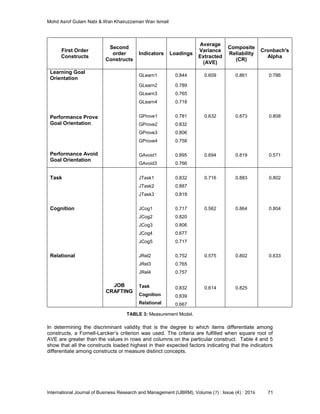
After dropping an item in performance avoid and two items in the relational constructs the overall
loadings for the respective constructs is as shown in Figure 2, which is within the recommended
values for loadings >0.7, average variance extracted (AVE) >0.5 and composite reliability (CR)
>0.7 Hair Jr, Hult [86]. Eventhough, JCog4 still showed loading of below 0.7, it was not dropped
as the internal consistency reliability and convergent validity already exceeded the recommended
values as shown in Table 3.
FIGURE 2: PLS SEM Algorithm.
Mohd Asrof Gulam Nabi & Wan Khairuzzaman Wan Ismail
International Journal of Business Research and Management (IJBRM), Volume (7) : Issue (4) : 2016 71
First Order
Constructs
Second
order
Constructs
Indicators Loadings
Average
Variance
Extracted
(AVE)
Composite
Reliability
(CR)
Cronbach's
Alpha
Learning Goal
Orientation
GLearn1 0.844 0.609 0.861 0.786
GLearn2 0.789
GLearn3 0.765
GLearn4 0.718
Performance Prove
Goal Orientation
GProve1 0.781 0.632 0.873 0.808
GProve2 0.832
GProve3 0.806
GProve4 0.758
Performance Avoid
Goal Orientation
GAvoid1 0.895 0.694 0.819 0.571
GAvoid3 0.766
Task JTask1 0.832 0.716 0.883 0.802
JTask2 0.887
JTask3 0.819
Cognition JCog1 0.717 0.562 0.864 0.804
JCog2 0.820
JCog3 0.806
JCog4 0.677
JCog5 0.717
Relational JRel2 0.752 0.575 0.802 0.633
JRel3 0.765
JRel4 0.757
JOB
CRAFTING
Task 0.832 0.614 0.825
Cognition 0.839
Relational 0.667
TABLE 3: Measurement Model.
In determining the discriminant validity that is the degree to which items differentiate among
constructs, a Fornell-Larcker’s criterion was used. The criteria are fulfilled when square root of
AVE are greater than the values in rows and columns on the particular construct. Table 4 and 5
show that all the constructs loaded highest in their expected factors indicating that the indicators
differentiate among constructs or measure distinct concepts.
Mohd Asrof Gulam Nabi & Wan Khairuzzaman Wan Ismail
International Journal of Business Research and Management (IJBRM), Volume (7) : Issue (4) : 2016 72
Constructs Cognitive Learning
Performance
Avoid
Performance
Prove
Relational Task
Cognitive 0.750
Learning 0.380 0.780
Performance Avoid 0.087 -0.115 0.833
Performance Prove 0.180 0.288 0.378 0.795
Relational 0.320 0.257 0.034 0.266 0.758
Task 0.494 0.278 0.203 0.248 0.479 0.846
TABLE 4: Discriminant Validity (First order).
Constructs
JOB
CRAFTING
Learning
Performance
Avoid
Performance
Prove
JOB CRAFTING 0.619
Learning 0.399 0.780
Performance Avoid 0.143 -0.115 0.833
Performance
Prove
0.281 0.288 0.378 0.795
Note: Diagonals represent the square root of the AVE while the off-diagonals represent
the correlations
TABLE 5: Discriminant Validity (2nd order).
Lastly, a threshold of criterion as set in SmartPLS 3.2.1 was used to test the
measurement model. Table 6 and Table 7 provides evidence of HTMT discriminant validity
among all the constructs where all the values are below the 0.90 threshold [85].
Cognitive Learning
Performance
Avoid
Performance
Prove
Relational Task
Cognitive
Learning 0.487
Performance Avoid 0.142 0.261
Performance Prove 0.220 0.357 0.566
Relational 0.424 0.357 0.075 0.349
Task 0.598 0.338 0.304 0.322 0.654
TABLE 6: HTMT Discriminant Validity (First order constructs).
JOB
CRAFTING
Learning 0.496
Performance Avoid 0.212
Performance Prove 0.342
TABLE 7: HTMT Discriminant Validity (2nd order constructs).
4.2 Structural Model Evaluation
Assessing the structural model through its predictive ability will enable the determination of how
well empirical data supports the theory/concept.
Significance and relevance test on the constructs were carried out as shown in Table 8. Based on
the table, the t values result show that relationships in the inner and outer models were significant
Mohd Asrof Gulam Nabi & Wan Khairuzzaman Wan Ismail
International Journal of Business Research and Management (IJBRM), Volume (7) : Issue (4) : 2016 73
except for the relationship in the inner relationship between Performance Avoid => Job Crafting
(1.734) and Performance Prove=>Job Crafting (1.491) based on the critical value 1.96 (sig = 5%).
While, Learning has a significant effect on job crafting construct (4.550).
Path
Coefficients
Sample
Mean (M)
Standard
Deviation
(STDEV)
T
Statistics
P
Values
JOB CRAFTING -> Cognitive 0.839 0.840 0.031 27.329 0.000
JOB CRAFTING -> Relational 0.667 0.670 0.058 11.479 0.000
JOB CRAFTING -> Task 0.832 0.832 0.032 25.745 0.000
Learning -> JOB CRAFTING 0.382 0.391 0.084 4.550 0.000
Performance Prove -> JOB
CRAFTING
0.117 0.125 0.078 1.491 0.136
Performance Avoid -> JOB
CRAFTING
0.143 0.151 0.082 1.734 0.083
TABLE 8: Significance Testing (Bootstrapping – 5,000).
Next, a Coefficient of determination ( ) was conducted and it represents the exogenous latent
variables’ combined effects on the endogenous latent variable indicating the amount of variance
explained by the exogenous variables [87]. Referring to Table 9, the values of the
endogenous latent constructs were mostly found to be either satisfactorily explained the variance
(cognition = 0.705, relational = 0.445, task=0.693) or appears to be reasonable (job
crafting=0.206).
Sample
Mean (M)
Standard
Deviation
(STDEV)
T Statistics P Values
Cognition 0.705 0.707 0.051 13.852 0.000
Relational 0.445 0.453 0.076 5.835 0.000
Task 0.693 0.694 0.053 13.055 0.000
JOB CRAFTING 0.206 0.239 0.082 2.521 0.012
TABLE 9: Coefficient of Determination ( ).
Another measurement for structural model is the effect of size which measures the changes and
the impact in the value of the endogenous construct when a specified exogenous construct is
omitted. Cohen [88] proposed a guideline for assessing , where 0.02, 0.15 and 0.35 denote
small, medium and large impact respectively. Referring to Table 10, under the three goal
orientation constructs, only Learning construct had any significant impact, that is medium impact
on the job crafting construct. While all the variables in the job crafting dimensions show a large
impact on value.
Mohd Asrof Gulam Nabi & Wan Khairuzzaman Wan Ismail
International Journal of Business Research and Management (IJBRM), Volume (7) : Issue (4) : 2016 74
Sample
Mean (M)
Standard
Deviation
(STDEV)
T
Statistics
P
Values
JOB CRAFTING -> Cognitive 2.385 2.515 0.596 4.003 0.000
JOB CRAFTING -> Relational 0.803 0.863 0.267 3.011 0.003
JOB CRAFTING -> Task 2.252 2.360 0.579 3.891 0.000
Learning -> JOB CRAFTING 0.158 0.188 0.097 1.618 0.106
Performance Prove -> JOB
CRAFTING
0.013 0.023 0.024 0.534 0.594
Performance Avoid -> JOB
CRAFTING
0.021 0.032 0.027 0.774 0.439
TABLE 10: Assessment of the Values.
In determining the predictive relevance, the value is used where it was obtained by using the
blindfolding procedure and values larger than zero indicate the path model’s predictive relevance
for the construct. Using an omission distance of 7 and applying the cross-validated redundancy
approach, all of the four endogenous constructs in the model had values above zero and thus
provided the support for the predictive relevance of the model (Table 11).
Endogenous Latent
Variable
Value Value
JOB CRAFTING 0.206 0.070
Relational 0.445 0.384
Task 0.693 0.483
Cognition 0.705 0.234
TABLE 11: Predictive Accuracy and Predictive Relevance .
In order to evaluate the effect size of omitting the exogenous latent variable on the endogenous
latent variable in respect of the predictive relevance, was also measured. The approach taken
is similar to the procedure in measuring the evaluation in values [89]. Table 12 present the
outcome of the evaluation and it can be observed that effect size for predictive relevance of
Learning on job crafting (0.629) was large. While performance prove (0.029) and performance
avoid (0.071) constructs had low predictive relevance effect on job crafting.
JOB CRAFTING
effect size effect size
Learning 0.158 0.629
Performance Prove 0.013 0.029
Performance Avoid 0.021 0.071
TABLE 12: Effect Size Measures.
5. DISCUSSIONS
Overall, public sector employees with learning goal orientations mindset do undertake job crafting
activities. This finding support research done by Lyons, Duxbury [69] that found public sector
employees value challenging work which is closely related to being proactive that constitute a
major part of job crafting behaviour. Seeking or willing to take up challenging task, as argued by
Belschak and Den Hartog [48] and Wrzesniewski and Dutton [12], are characteristics of those
Mohd Asrof Gulam Nabi & Wan Khairuzzaman Wan Ismail
International Journal of Business Research and Management (IJBRM), Volume (7) : Issue (4) : 2016 75
intrinsically motivated employees. Following on, this finding also supports the position taken by
various researchers such Banuri and Keefer [90], Burgess and Ratto [62], Georgellis, Lossa [91],
Perry, Hondeghem [92] and Bright [93], that state public sector employees placed more emphasis
on intrinsic motivation rather than extrinsic motivation.
However, employees with performance prove and avoid orientations do not show an indication of
embracing the job crafting activities. However, the surprising outcome was the insignificant
relation between those employees with performance prove goal orientation and job crafting
behaviour as it was thought that they may embrace the job crafting activities albeit for different
reason other than due to psychological conditioning. The reason for this may relate to the motive
for working in the public sector. Taylor and Taylor [22] argued that some employees especially in
the less developed country or developing countries, tend to work for securing employment and
the benefits that are found in the public sector. As such, the altruistic and socially beneficial
motives that commonly associated with intrinsic motivation will not be a prominent attribute in
these employees leading to less proactive behaviour.
The argument by Taylor and Taylor [22] is also supported by Georgellis, Lossa [91] whom
observed that there is an increasing emphasis of many governments (including Malaysia) in
remuneration and reward agenda which is claimed to lead to the “crowding out” of those with
altruistic motives with those of extrinsic motives. Instead, Bullock, Stritch [24] suggested that
emphasis should be given in recruiting employees that have altruistic and socially beneficially
motives. As such, it can be generally argued that those employees sampled in this paper
composed of those whom have a goal oriented dimension that is closely linked to their motives of
joining the institutions that is either intrinsically motivated (pro-social) represented by learning
goal orientation or extrinsically motivated (secure employment) represented by performance
prove and avoid dimensions.
One of the most important outcome of the finding on public sector employees is that those
learning goal oriented employees values challenging tasks as much as the private sector
employees. The possible stereotype of viewing public servants as those who are less motivated
by work challenge, less committed to long working hours, and being risk adverse may be over
simplified [66-68].
The results for the hypothesis are summarised in Table 13.
Hypotheses Proposed Beta T value P value Result
Hypothesis 1: Learning goal oriented
employees will be positively related to
incidences of job crafting
Hypothesis 2: Performance prove
orientation will be positively related to
incidences of job crafting
Hypothesis 3: Performance avoid
orientation will have no relationship to
incidence of job crafting
0.382
0.117
0.143
4.550
1.491
1.734
0.000
0.136
0.083
Supported
Not
Supported
Supported
TABLE 13: Summary of Results.
6. IMPLICATION OF THE STUDY
The current research is one of the first known research on job crafting behaviour in public sector
in the country. Additionally, it is the only known questionnaires on job crafting and goal orientation
translated and adapted in Bahasa Malaysia. It is hoped that with the availability of the Bahasa
Malaysia’s version, more research and interest in job crafting behaviour of Malaysian employees
can be carried out.
Mohd Asrof Gulam Nabi & Wan Khairuzzaman Wan Ismail
International Journal of Business Research and Management (IJBRM), Volume (7) : Issue (4) : 2016 76
With the successful replication of the Slemp and Vella-Brodrick [79] approach in this paper,
another quantitative measurement scale can be used incorporating all the dimensions proposed
by Wrzesniewski and Dutton [12] including the cognitive dimension which is not clearly observed
in the model proposed by Tims, Bakker [80].
On the practical contribution, the findings show that public sector employees with learning goal
orientations also tend to job craft similar to their counterparts in the private sector. Additionally,
organisations should encourage and provide avenues for such activities to gain traction to reap
the many positive outcomes from job crafting behaviours such as promotion of job performance
via employees’ engagement [13, 94, 95]. Engaged employees are healthier and perform better at
work and thus will be more productive.
7. LIMITATIONS OF THE STUDY
The data collected were all from the public sector and thus it might be argued that it limits the
generalisability of the findings to other sectors. This study is a self-reported survey and as such
despite the fact that various strategies and processes were put in place to minimise the
possibilities of response bias, it still cannot be discounted that it may to some degree still be
present in the research.
8. CONCLUSION AND FUTURE STUDY
The findings of this paper which show public sector employees with learning goal orientations do
tend to undertake job crafting activities indicate that the public institutions should give more space
and encouragement for these activities to take place. This may not only lead employees to feel
happy, enjoyable and satisfied in their workplace but would also lead to possibilities of higher
productivity and growth to the organisations. The paper had successfully replicated an alternative
job crafting instrument as proposed by Slemp and Vella-Brodrick [79] to the local setting and the
creation of Bahasa Malaysia version of the survey which can be used to encourage more related
research in the Malaysian context. For future research, it is suggested that feedback from the
supervisors in the goal orientation measurement approach can be carried out. In addition,
research can also be undertaken in determining the presence and the different level of job
crafting behaviours between public and private sectors.
9. REFERENCES
1. Aruna, P., Survey: Many planning to switch jobs, in The Star. 2012.
2. Strack, R., et al., Decoding Global Talent. 2014, The Boston Consulting Group.
3. Rosso, B.D., K.H. Dekas, and A. Wrzesniewski, On the meaning of work: A theoretical
integration and review. Research in Organizational Behavior, 2010. 30: p. 91-127.
4. Fisher, C.D., Happiness at work. International Journal of Management Reviews, 2010. 12(4):
p. 384-412.
5. Schaufeli, W.B., What is engagement?, in Employee Engagement in Theory and Practice, C.
Truss, et al., Editors. 2013, Routledge: London. p. 15-35.
6. Grant, A.M. and S.K. Parker, Redesigning Work Design Theories: The Rise of Relational and
Proactive Perspectives. The Academy of Management Annals, 2009. 3(1): p. 317-375.
7. Thomas, J.P., D.S. Whitman, and C. Viswesvaran, Employee proactivity in organizations: A
comparative meta-analysis of emergent proactive constructs. Journal of Occupational and
Organizational Psychology, 2010. 83(2): p. 275-300.
8. DeRue, D.S., S.J. Ashford, and C.G. Myers, Learning agility: In search of conceptual clarity
and theoretical grounding. Industrial and Organizational Psychology, 2012. 5(3): p. 258-279.
Mohd Asrof Gulam Nabi & Wan Khairuzzaman Wan Ismail
International Journal of Business Research and Management (IJBRM), Volume (7) : Issue (4) : 2016 77
9. Dweck, C.S., Motivational processes affecting learning. American psychologist, 1986. 41(10):
p. 1040.
10. Dweck, C.S. Self-theories and goals: Their role in motivation, personality, and development.
in Nebraska symposium on motivation. 1991. University of Nebraska Press Lincoln, NE.
11. Kulik, C.T., G.R. Oldham, and J.R. Hackman, Work design as an approach to person-
environment fit. Journal of vocational behavior, 1987. 31(3): p. 278-296.
12. Wrzesniewski, A. and J.E. Dutton, Crafting a job: Revisioning employees as active crafters of
their work. Academy of Management Review, 2001. 26(2): p. 179-201.
13. Tims, M., et al., Job Crafting at the Team and Individual Level: Implications for Work
Engagement and Performance. Group & Organization Management, 2013. 38(4): p. 427-454.
14. Esteves, T. and M.P. Lopes, Challenging job crafting: The impact of job crafting on the sense
of calling and turnover intention, in C.f.P.A.a.P. Policies, Editor. 2014.
15. Randstad. 70% of employees plan to leave their jobs, says survey. 2014 January 2nd, 2014].
16. Saks, A.M. and J.A. Gruman, What Do We Really Know About Employee Engagement?
Human Resource Development Quarterly, 2014. 25(2): p. 155-182.
17. Shuck, M.B., T.S. Rocco, and C.A. Albornoz, Exploring employee engagement from the
employee perspective: implications for HRD. Journal of European Industrial Training, 2011.
35(4): p. 300-325.
18. Chester, D.N., Lessons of the British war economy. 1951: CUP Archive.
19. Wettenhall, R., Exploring types of public sector organizations: Past exercises and current
issues. Public Organization Review, 2003. 3(3): p. 219-245.
20. Parker, R. and L. Bradley, Organisational culture in the public sector: evidence from six
organisations. International Journal of Public Sector Management, 2000. 13(2): p. 125-141.
21. Boyne, G.A., Public and private management: what’s the difference? Journal of management
studies, 2002. 39(1): p. 97-122.
22. Taylor, J. and R. Taylor, Working Hard for More Money or Working Hard to Make a
Difference? Efficiency Wages, Public Service Motivation, and Effort. Review of Public
Personnel Administration, 2010. 31(1): p. 67-86.
23. Bullock, J., J. Stritch, and H. Rainey. Do sector differences hold across countries? An
international comparison of public and private employees’ work orientations. in th public
management research conference. 2013.
24. Bullock, J.B., J.M. Stritch, and H.G. Rainey, International Comparison of Public and Private
Employees’ Work Motives, Attitudes, and Perceived Rewards. Public Administration Review,
2015. 75(3): p. 479-489.
25. Dan, Z., Differences in work motivation between Public and Private sector organizations.
American Journal of Business, Economics and Management, 2015. 3(2): p. 86-91.
26. Chen, C.A. and Y.J. Lee, A Closer Look at the Difference Between Public and Nonprofit
Employees’ Volunteering. International Public Management Journal, 2014. 18(1): p. 108-129.
27. Esteve, M., et al., Prosocial Behavior and Public Service Motivation. Public Administration
Review, 2016. 76(1): p. 177-187.
Mohd Asrof Gulam Nabi & Wan Khairuzzaman Wan Ismail
International Journal of Business Research and Management (IJBRM), Volume (7) : Issue (4) : 2016 78
28. Wrzesniewski, A., et al., Job Crafting and Cultivating Positive Meaning and Identity in Work.
Advances in Positive Organizational Psychology, 2013. 1: p. 281-302.
29. Peeters, M.C.W., J. De Jonge, and T.W. Taris, An introduction to contemporary work
psychology. 2014: John Wiley & Sons.
30. Berg, J.M., J.E. Dutton, and A. Wrzesniewski, What is job crafting and why does it matter.
Retrieved form the website of Positive Organizational Scholarship on April, 2008. 15: p. 2011.
31. Leana, C., E. Appelbaum, and I. Shevchuk, Work process and quality of care in early
childhood education: The role of job crafting. Academy of Management Journal, 2009. 52(6):
p. 1169-1192.
32. Chen, C.Y., C.H. Yen, and F.C. Tsai, Job crafting and job engagement: The mediating role of
person-job fit. International Journal of Hospitality Management, 2014. 37: p. 21-28.
33. Ghitulescu, B.E., Shaping tasks and relationships at work: Examining the antecedents and
consequences of employee job crafting, in Unpublished doctoral dissertation. 2007, University
of Pittsburgh.
34. Slemp, G.R. and D.A. Vella-Brodrick, Optimising Employee Mental Health: The Relationship
Between Intrinsic Need Satisfaction, Job Crafting, and Employee Well-Being. Journal of
Happiness Studies, 2013.
35. Berg, J.M., A.M. Grant, and V. Johnson, When Callings Are Calling: Crafting Work and
Leisure in Pursuit of Unanswered Occupational Callings. Organization Science, 2010. 21(5):
p. 973-994.
36. Wrzesniewski, A., et al., Jobs, careers, and callings: People's relations to their work. Journal
of research in personality, 1997. 31(1): p. 21-33.
37. Tims, M. and A.B. Bakker, Job crafting: Towards a new model of individual job redesign. SA
Journal of Industrial Psychology, 2010. 36(2): p. 1-9.
38. Elliot, A.J. and C.S. Dweck, A conceptual history of the achievement goal construct, in
Handbook of competence and motivation, A.J. Elliot and C.S. Dweck, Editors. 2005, Guilford
Press: New York. p. 52-72.
39. Ames, C., Classrooms: Goals, structures, and student motivation. Journal of educational
psychology, 1992. 84(3): p. 261.
40. Elliot, A.J. and H.A. McGregor, A 2× 2 achievement goal framework. Journal of personality
and social psychology, 2001. 80(3): p. 501.
41. VandeWalle, D., Development and validation of a work domain goal orientation instrument.
Educational and Psychological Measurement, 1997. 57(6): p. 995-1015.
42. Murayama, K., A.J. Elliot, and S. Yamagata, Separation of performance-approach and
performance-avoidance achievement goals: A broader analysis. Journal of Educational
Psychology, 2011. 103(1): p. 238.
43. Vansteenkiste, M., et al., Moving the achievement goal approach one step forward: Toward a
systematic examination of the autonomous and controlled reasons underlying achievement
goals. Educational Psychologist, 2014. 49(3): p. 153-174.
44. Sideridis, G.D. and A. Kaplan, Achievement goals and persistence across tasks: The roles of
failure and success. The Journal of Experimental Education, 2011. 79(4): p. 429-451.
Mohd Asrof Gulam Nabi & Wan Khairuzzaman Wan Ismail
International Journal of Business Research and Management (IJBRM), Volume (7) : Issue (4) : 2016 79
45. Payne, S.C., S.S. Youngcourt, and J.M. Beaubien, A meta-analytic examination of the goal
orientation nomological net. Journal of Applied Psychology, 2007. 92(1): p. 128-50.
46. Jyoti, J. and M. Dev, The impact of transformational leadership on employee creativity: the
role of learning orientation. Journal of Asia Business Studies, 2015. 9(1): p. 78-98.
47. Parker, S.K. and C.G. Collins, Taking stock: Integrating and differentiating multiple proactive
behaviors. Journal of Management, 2010. 36(3): p. 633-662.
48. Belschak, F.D. and D.N. Den Hartog, Pro-self, prosocial, and pro-organizational foci of
proactive behaviour: Differential antecedents and consequences. Journal of Occupational and
Organizational Psychology, 2010. 83(2): p. 475-498.
49. Bong, M., Age-related differences in achievement goal differentiation. Journal of Educational
Psychology, 2009. 101(4): p. 879.
50. VandeWalle, D., W.L. Cron, and J.W. Slocum Jr, The role of goal orientation following
performance feedback. Journal of Applied Psychology, 2001. 86(4): p. 629.
51. Darnon, C., et al., Mastery and performance goals predict epistemic and relational conflict
regulation. Journal of Educational Psychology, 2006. 98(4): p. 766-776.
52. Smith, L., K.E. Sinclair, and E.S. Chapman, Students' Goals, Self-Efficacy, Self-
Handicapping, and Negative Affective Responses: An Australian Senior School Student
Study. Contemporary Educational Psychology, 2002. 27(3): p. 471-485.
53. Pekrun, R., A.J. Elliot, and M.A. Maier, Achievement goals and discrete achievement
emotions: A theoretical model and prospective test. Journal of Educational Psychology, 2006.
98(3): p. 583.
54. Slemp, G.R., M.L. Kern, and D.A. Vella‑Brodrick, Workplace Well-Being: The Role of Job
Crafting and Autonomy Support. Psychology of Well-Being, 2015. 5(1).
55. Petrou, P., E. Demerouti, and W.B. Schaufeli, Job Crafting in Changing Organizations:
Antecedents and Implications for Exhaustion and Performance. Journal of Occupational
Health Psychology, 2015.
56. Tims, M., D. Derks, and A.B. Bakker, Job crafting and its relationships with person–job fit and
meaningfulness: A three-wave study. Journal of Vocational Behavior, 2016. 92: p. 44-53.
57. Heuvel, M.V.D., D. E., and M.C.W. Peeters, The job crafting intervention: Effects on job
resources, self-efficacy, and affective well-being. Journal of Occupational and Organisational
Psychology, 2015.
58. Petrou, P., E. Demerouti, and W.B. Schaufeli, Crafting the Change: The Role of Employee
Job Crafting Behaviors for Successful Organizational Change. Journal of Management, 2016.
59. Dur, R. and R. Zoutenbier, Working for a good cause. Public Administration Review, 2014.
74(2): p. 144-155.
60. O’Toole, L.J. and K.J. Meier, Public management, context, and performance: In quest of a
more general theory. Journal of public administration research and theory, 2014. 25(1): p.
237-256.
61. Taylor, J., B.S. Steel, and C.A. Simon, The Influence of Job Attributes and Culture on Job
Productivity: Comparing the Views of Public Servants in Asia Pacific and the United States.
Review of Public Personnel Administration, 2013. 33(2): p. 205-224.
Mohd Asrof Gulam Nabi & Wan Khairuzzaman Wan Ismail
International Journal of Business Research and Management (IJBRM), Volume (7) : Issue (4) : 2016 80
62. Burgess, S. and M. Ratto, The role of incentives in the public sector: Issues and evidence.
Oxford review of economic policy, 2003. 19(2): p. 285-300.
63. Wright, B.E., Public-sector work motivation: A review of the current literature and a revised
conceptual model. Journal of public administration research and theory, 2001. 11(4): p. 559-
586.
64. Goulet, L.R. and M.L. Frank, Organizational Commitment across Three Sectors: Public, Non-
profit, and For-profit. Public Personnel Management, 2002. 31(2): p. 201-210.
65. Houston, D.J., Public-service motivation: A multivariate test. Journal of public administration
research and theory, 2000. 10(4): p. 713-728.
66. Buelens, M. and H. Van den Broeck, An analysis of differences in work motivation between
public and private sector organizations. Public administration review, 2007. 67(1): p. 65-74.
67. Buurman, M., et al., Public sector employees: Risk averse and altruistic? Journal of Economic
Behavior & Organization, 2012. 83(3): p. 279-291.
68. Furnham, A., G. Hyde, and G. Trickey, Do your Dark Side Traits Fit? Dysfunctional
Personalities in Different Work Sectors. Applied Psychology: An International Review, 2014.
63(4): p. 589-606.
69. Lyons, S.T., L.E. Duxbury, and C.A. Higgins, A Comparison of the Values and Commitment of
Private Sector, Public Sector, and Parapublic Sector Employees. Public Administration
Review, 2006. 66(4): p. 605-618.
70. Houston, D.J., "Walking the Walk" of Public Service Motivation: Public Employees and
Charitable Gifts of Time, Blood, and Money. Journal of Public Administration Research and
Theory, 2004. 16(1): p. 67-86.
71. Wrzesniewski, A., Finding positive meaning in work, in Positive Organizational Scholarship:
Foundations of a New Discipline, J.E. Dutton, R.E. Quinn, and K. Cameron, Editors. 2003,
Berrett-Koehler Publishers. p. 296-308.
72. Berg, J.M., J.E. Dutton, and A. Wrzesniewski, Job crafting and meaningful work, in Purpose
and meaning in the workplace, B.J. Dik, Z.S. Byrne, and M.F. Steger, Editors. 2013,
American Psychological Association. p. 81-104.
73. Molden, D.C. and C.S. Dweck, Meaning and motivation, in Intrinsic and extrinsic motivation:
The search for optimal motivation and performance, C. Sansone and J.M. Harackiewicz,
Editors. 2000, Academic Press. p. 131-159.
74. Nicholls, J.G., Achievement motivation: Conceptions of ability, subjective experience, task
choice, and performance. Psychological review, 1984. 91(3): p. 328.
75. Markus, H. and P. Nurius, Possible selves. American psychologist, 1986. 41(9): p. 954.
76. Sekaran, U. and R. Bougie, Research Methods for Business: A Skill-Building Approach 5th
Edition ed. 2009: John Wiley & Sons Ltd.
77. Bryman, A., Social Research Methods. 4th ed. 2012: Oxford University Press.
78. Kumar, M., S.A. Talib, and T. Ramayah, Business research methods. 2013: Oxford
Fajar/Oxford University Press.
Mohd Asrof Gulam Nabi & Wan Khairuzzaman Wan Ismail
International Journal of Business Research and Management (IJBRM), Volume (7) : Issue (4) : 2016 81
79. Slemp, G.R. and D.A. Vella-Brodrick, The Job Crafting Questionnaire: A new scale to
measure the extent to which employees engage in job crafting. International Journal of
Wellbeing, 2013. 3(2).
80. Tims, M., A.B. Bakker, and D. Derks, Development and validation of the job crafting scale.
Journal of Vocational Behavior, 2012. 80(1): p. 173-186.
81. VandeWalle, D., Goal orientation:: Why wanting to look successful doesn’t always lead to
success. Organizational Dynamics, 2001. 30(2): p. 162-171.
82. Tabachnick, B.G. and L.S. Fidell, Using Multivariate Statistics. 6th ed. 2013: Pearson
Education.
83. Hair Jr, J.F., et al., A primer on partial least squares structural equation modeling (PLS-SEM).
2014: Sage Publications.
84. Podsakoff, P.M., et al., Common method biases in behavioral research: a critical review of the
literature and recommended remedies. J Appl Psychol, 2003. 88(5): p. 879-903.
85. Henseler, J., C.M. Ringle, and M. Sarstedt, A new criterion for assessing discriminant validity
in variance-based structural equation modeling. Journal of the Academy of Marketing
Science, 2015. 43(1): p. 115-135.
86. Hair Jr, J.F., et al., Assessing PLS-SEM Results Part 1, in A primer on partial least squares
structural equation modeling (PLS-SEM). 2014, Sage Publications. p. 95-117.
87. Barclay, D., C. Higgins, and R. Thompson, The partial least squares (PLS) approach to
causal modeling: Personal computer adoption and use as an illustration. Technology studies,
1995. 2(2): p. 285-309.
88. Cohen, J., Statistical Power Analysis for the Behavioral Sciences. 2nd ed. 1988, New Jersey:
Lawrence Erlbaum.
89. Henseler, J., C.M. Ringle, and R.R. Sinkovics, The use of partial least squares path modeling
in international marketing. Advances in international marketing, 2009. 20(1): p. 277-319.
90. Banuri, S. and P. Keefer, Intrinsic motivation, effort and the call to public service. World Bank
Policy Research Working Paper, 2013(6729).
91. Georgellis, Y., E. Lossa, and V. Tabvuma, Crowding out intrinsic motivation in the public
sector. Journal of Public Administration Research and Theory, 2011. 21(3): p. 473-493.
92. Perry, J.L., A. Hondeghem, and L.R. Wise, Revisiting the motivational bases of public service:
Twenty years of research and an agenda for the future. Public administration review, 2010.
70(5): p. 681-690.
93. Bright, L., Why do public employees desire intrinsic nonmonetary opportunities? Public
Personnel Management, 2009. 38(3): p. 15-37.
94. Tims, M., A.B. Bakker, and D. Derks, Job crafting and job performance: A longitudinal study.
European Journal of Work and Organizational Psychology, 2014: p. 1-15.
95. Bakker, A.B., M. Tims, and D. Derks, Proactive Personality and Job Performance: The Role
of Job Crafting and Work Engagement. Human Relations, 2012. 65(10): p. 1359-1378.

Job Crafting In Public Sector

  • 1.
    Mohd Asrof GulamNabi & Wan Khairuzzaman Wan Ismail International Journal of Business Research and Management (IJBRM), Volume (7) : Issue (4) : 2016 63 Job Crafting In Public Sector Mohd Asrof Gulam Nabi asrofg@gmail.com PhD Student International Business School, Jalan Semarak, 50400 Kuala Lumpur, Malaysia Wan Khairuzzaman Wan Ismail mwkhair@ibs.utm.my International Business School, Jalan Semarak, 50400 Kuala Lumpur, Malaysia Abstract The changing nature of the workplace has created different employees' expectations and demands. As a result, the working environment is no longer associated with employees that are rigid and treating jobs as static sets of tasks. Instead, employees are being proactive in developing and adjusting their work roles and functions. The act or behaviour of these employees in adapting their work roles to match their needs and preferences is called job crafting. Goal orientation is considered as an important dimension in influencing their behaviours. However, there has been little research on how the mindset, especially public sector employee’s goal orientation, adapt to the changing and challenging world of work. Using Partial Least Square approach with 150 samples, the study showed that public employees with learning goal orientation do embraced job crafting activities and the surprising finding that those with performance prove do not embraced such activities. Keywords: Job Crafting, Learning Goal, Performance Prove, Performance Avoid, Public Sector. 1. INTRODUCTION The workplace is evolving rapidly for the past several decades due to the changing nature of both organisational and employees’ expectations and demands. As organisations becoming more dynamic, workforce also is changing in its values, attitudes, behaviours and expectations. Consequently, all these affect the lifestyles which had impacted economic progress worldwide and affected individuals, both in terms of mindset as well as physical wellbeing. In various surveys, locally and on global scale, employees incline to change job when they feel that they are not being valued by their employers [1, 2]. Employees generally are seeking intrinsic rewards or "softer factors". Employees tend to seek positive meaning in their work which will determine their approach, enact and experience of their work and behaviour [3]. Having a meaningful work situation lead to generally happy and productive workers [4]. It was asserted that in the 21st century work settings, employees' psychological capabilities, inclusive of their motivational reasons, are constantly being tested [5] and employees are now expected to shape their work experiences through work design which require proactive behaviour in work settings [6] which have been demonstrated to be an important driver of performance [7]. The act of learning shows a proactive behaviour and thus proactivity is another dimension that accentuate individuals’ propensity to change or modify their behaviour and competencies to fit the environment, while it is also asserted that the environment is malleable and subject to change [8]. The motive to enact learning behaviour is dependent on the goal-orientation of the employees [9], which is influence by the goal preferences in achievement situations and how individuals view
  • 2.
    Mohd Asrof GulamNabi & Wan Khairuzzaman Wan Ismail International Journal of Business Research and Management (IJBRM), Volume (7) : Issue (4) : 2016 64 effort. Dweck [10] posited that an important characteristics of goal orientation is the mindset within which these individuals interpret and respond to situations. One of the ways for employees to adapt to the varied environment is by shaping their own work experiences through taking initiatives in changing their job components with or without the management involvement. This requires matching their skills and needs with their given jobs. Consequently, this lead to employees making changes to their job design. This observation of employees changing their work design was originally put forward by Kulik, Oldham [11], however, Wrzesniewski and Dutton [12] was the first to formalise the construct that was known as job crafting. Various research suggest that job crafting positively related to employee engagement which ultimately increase the performance of the employees [13] and has the effect of reducing the turnover intention of employees [14]. As the common occurrence in other countries, Malaysia also is seeing an increasing trend in employees leaving their organisations [15]. Employees’ engagement effect their turnover intention [16] and their intention or actual action of leaving the organisation is stated as the ultimate act of disengagement [17]. A study by Esteves and Lopes [14] found that job crafting dimension such as seeking challenging job demand, has the effect of reducing the turnover intention of employees. As such, job crafting strategy encouragement can be used by an organisation to negate the growing trend of employees hopping to another organisation. As the job crafting is still considered as a new field, this paper takes the view that identifying the constructs that can lead to job crafting behaviours is beneficial to organisations in formulating and supplementing their strategy of retaining their valued employees. Additionally, there has not been many research in job crafting behaviour in the public sector. Following the classification proposed by Chester [18] that is widely accepted as the influential model [19], public sector organisations are divided into three types of categories; departments, local authorities and “the rest” that embrace a mass of quasi-autonomous agencies. This paper will only consider the first category of public servants that is typically under a ministerial overview. Public organisations have been associated with having more emphasis on bureaucratic values than the private organisations. Furthermore, it also posited as having employees that are less materialistic (extrinsic motives) and having weaker commitment, than the private sectors employees [20, 21]. However, there are also findings that indicate that the extrinsic motives are present and public sector employees are also as committed as their counterparts in the private organisation [22-24]. This inconsistent finding points to the fact that the internal and external factors within and between employees and organisations such as personalities of the employees, nature of the organisations and the country it is located (organisational and society culture) can be the influencing factors. As proposed by Dan [25], level of motivation of public sector employees generally would be comparable to the private sector and thus it is conceivable with the prosocial values that normally associated with the public sector employees [26] [27], job crafting activities in the public sector would be present and magnified. Consequently, the research question or aims of this paper is to investigate the effect of goal orientation dimensions with job crafting behaviors within the public sector. 2. LITERATURE REVIEW 2.1 Job Crafting Job crafting can be defined "as the physical and cognitive changes individuals make in the task or relationship boundaries of their work" and can be segregated into three types: task, cognitive and relational job crafting [12]. Task crafting involves changing the physical working conditions. Cognitive crafting refers to changing employees’ perceptions of the job which involve framing the way in how these employees view the job or tasks. Lastly, relational crafting refers to interpersonal relationships at work which may involve interaction or avoiding it with coworkers or customers to attain the expected outcome of doing so.
  • 3.
    Mohd Asrof GulamNabi & Wan Khairuzzaman Wan Ismail International Journal of Business Research and Management (IJBRM), Volume (7) : Issue (4) : 2016 65 Job crafting is a formation of job design from the bottom-up approach rather than the typical top- down approach. The key element in crafting a job is being proactive to the working environment that necessitate employees in taking initiatives to have an impactful job role instead of depending squarely on their supervisors or management, or reacting to change in the job [28]. As for organisations that generally would find difficulties in creating optimal job designs for employees, job crafting is a possible mean to overcome the difficulties by accommodating the unique backgrounds, motives and preferences of the employees to achieve the optimal job fit by the employees' own initiatives [29]. There are three main motivations for job crafting as proposed by Wrzesniewski and Dutton [12]. Firstly, to engage in job crafting so that employees can maintain interest in their job and the motivation at their working place by having a sense of control, discretion and work meaning. Secondly, driven to protect and enhance employees own self-image that form a large part of their self-identity. Thirdly, to have a meaningful relationship with the people who may benefit as a result of their action on the jobs. Additionally, Berg, Dutton [30] elaborate that employees derive meaning at work place by negating adversity by altering their jobs expectations and activities. There have been many empirical studies that supported and confirmed the validity and usefulness of the job crafting such as increased in job performance [31], work engagement [32], organisational commitment [33], well-being [34] and increased in meaning [35]. Various research carried out have identified discretion or autonomy, task independence and proactive personality as the initiator or antecedent of job crafting behaviors [12, 36, 37]. As such, it can explain on why some employees with the same work settings have different motivational orientations. Additionally, research also have identified environmental factors such as work situation, and individual motivational orientations such as regulatory focus of employee, in determining employees tendencies and success to initiate job crafting activities [37]. 2.2 Goal Orientation Goal orientation can be conceptualized as “a mental framework for how individuals interpret and respond to achievement situations”. Elliot and Dweck [38] proposed that goal orientation can be defined as specific, desired end states through mastering a concept or skill, to outperform others and to win a competition. In achieving these end states, the person require cognitive and affective or emotional components [9]. Elliot and Dweck [38] stated that goals that only focus on competency or ability in achievement- related activities should be included as achievement goals as it is the foundation of goal orientation construct. There has been an implicit agreement between researchers to focus on two main orientations which are learning (also known as mastery goals) and performance goals forms of competence relevant motivation or goals [9]. Learning goals are where a person seek to increase or acquire new competencies or skills, while performance goals are sought to gain favorable judgments of competency or ability or to avoid negative judgments of a person competence [39]. Therefore, individual with learning goals orientation to achievement environment will attempt to develop their competence while those with performance goals orientation will only attempt to demonstrate their competencies. An extended model in achievement goals was proposed by Elliot and McGregor [40] and VandeWalle [41] that focus on the approach (prove) and avoidance dimension in performance goals orientation. Based on the two performance goals dimensions to competence, an approach goals orientation employees would aim at acquiring positive possibilities, whereas avoidance goals employees are aimed at avoiding negative possibilities. It was identified that the approach and avoidance goals are presumed to be rooted in different biologically based sources [42] and activated by different environmental cues [43]. Among the findings on the positive outcomes from adopting the learning goals orientation are increased in persistence [44], job performance [45], creativity [46], generally proactive behavior
  • 4.
    Mohd Asrof GulamNabi & Wan Khairuzzaman Wan Ismail International Journal of Business Research and Management (IJBRM), Volume (7) : Issue (4) : 2016 66 [47] and higher intrinsic motivation and generally perform better even in the face of challenging and difficult tasks [48]. However, empirical findings have shown that performance-approach (prove) goal orientation have either positive or unrelated relationship to beneficial outcomes such as increased in self-efficacy [49], increased in effort [50] and not showing deep learning strategies [51]. While, employees with performance-avoidance goals orientation have been associated with generally negative outcomes such as self-handicapping strategies [52], low performance [45] and lower intrinsic motivation [53]. 2.3 Public Sector Employees Motivation to Work It is observed that majority of the studies on job crafting so far have been focusing on either private or a mixed of occupation or sector [54-56]. There are only just a few studies carried out in the public sector such as those by Heuvel, E. [57] and Petrou, Demerouti [58]. Furthermore, there are evidence that public service motivation and ethos appear to vary in different cultures and nations [59, 60]. As such, this paper will focus on the job crafting tendencies of the public sector employees in Malaysia. Employees vary in their motives for working and some individuals would prefer to work in government sector for wide range of reasons such as in seeking secure employment and benefits that is prevalent in the less developed countries [22, 59]. Additionally, in a study by Taylor, Steel [61], it was found that distinctive national cultural factors of social ties, personal responsibility and group focus differentiate the response level of U.S against Asia Pacific public sector employees where respondents from Asia Pacific reported higher levels on one dimension of job productivity but lower levels on perceived job effectiveness. Thus, all the studies above point towards the possible fact that employees in public sector will be driven to work with different motive, focus and magnitude depending which countries they are from and the cultural association. Burgess and Ratto [62] argued that money is not the sole motivating factor for public servants as they are also more motivated by other benefits and incentives than private sector workers. As such, in general public sector workers are less motivated by monetary gain, however, there are mixed results for intrinsic motives with higher organisational commitment for public sector workers than private sector employees [23]. However, according to Wright [63], eventhough work motivation among the public sector and private employees are very different, both private and public sector workers want good working conditions, friendly coworkers and task rotation but with public sector employees are associated with lower levels of organizational commitment [64]. Houston [65] found that public employees are more likely to place a higher value on the intrinsic rewards of work than their private sector counterparts. One possible explanation for the tendency to intrinsic factor might be due to the positive choice placed by the public employees to work-life balances. These employees may be less motivated by money, work challenge and less committed to long working hours as to balance their work with family time and other leisure activities [66]. Public employees also was found to choose a prosocial option as compared to risky option which mean that they have the tendency to be risk averse [67, 68]. However, in another study it was found that public servants value challenging work more than private sector employees [69], which depict a riskier attribute. As such, when comes to evaluating public employees’ attitude towards challenging work or being risk averse, there is no clear finding to support either position. However, one factor that are supported by various studies have shown that public employees are more likely to undertake prosocial or extra role behaviors such as making charitable contributions, giving blood and various other pro social activities even in their personal time [26, 27, 70]. Thus, these employees are more likely to participate in helping activities. Having a prosocial attitude will tend to lead employees in embracing job crafting activities Additionally, as public employees are more focused on intrinsic factors that relate to meaning in work rather than extrinsic factors, it can be expected that these intrinsic factors will also lead to job crafting behaviors [12, 28, 71, 72].
  • 5.
    Mohd Asrof GulamNabi & Wan Khairuzzaman Wan Ismail International Journal of Business Research and Management (IJBRM), Volume (7) : Issue (4) : 2016 67 2.4 Hypotheses Hypotheses 1: Learning goal oriented employees will be positively related to incidences of job crafting. As stated earlier, effort and ability of a person have been proposed as antecedents in developing the goal orientation behaviour [9, 73, 74] and as such it form an important variable in various applications and implications for an employee and from group perspectives. It is argued that people who have rich ideas about possible selves are more optimistic and energetic, and are less vulnerable to depression and thus have a mindset that strive for success [75]. Thus, in a work setting employees require adaptation and "can do" attitude to strive and grow, and employees’ belief about their ability and the effort that follow are the keys for the path to be taken. This can be done by adopting appropriate goal orientation including whether to adopt job crafting activities. Thus, it is expected that those employees with growth mind tendency will adopt a learning goal orientation approach in view of the possible opportunities for growth and fulfillment of their goal settings. This will require them to be proactive that may necessitate job crafting behaviour. Hypothesis 2: Performance prove orientation will be positively related to incidences of job crafting It is expected that those employees with performance prove orientation may also job craft their jobs as they will want to strive to do better than others which require some proactive attitude and need to do some changes to their current jobs. This may be influenced by the situational environment such as supervisory support or promotion opportunities instead of their own personality or psychology conditioning. Hypothesis 3: Performance avoid orientation will have no relationship to incidence of job crafting. As for the performance avoid oriented employees, their fixed minded tendency may lead them to be passive employees that only consider avenues to avoid mistakes that does not require them to initiate new tasks or creative undertakings other than the one given to them. Figure 1 shows the theoretical framework of the hypothesis developed. FIGURE 1: Theoretical Framework. 3. MATERIALS AND METHODS The study was based on a non-experimental correlational design that utilise cross sectional survey methodology. The study was conducted between January and February 2016. The data was then input and analysed using SPSS Statistics version 21.0 and SmartPLS 3.2.4. Job Crafting Learning Performance Prove Performance Avoid Task Crafting Relational Crafting Cognitive Crafting
  • 6.
    Mohd Asrof GulamNabi & Wan Khairuzzaman Wan Ismail International Journal of Business Research and Management (IJBRM), Volume (7) : Issue (4) : 2016 68 3.1 Data Collection Method This study was based on a larger study. Two sets of data were collected, one for the pre-test and another for the main study. A pre-test study was conducted to ensure best possible response rate and quality of useable data [76, 77]. By conducting a pre-test, some issues were minimised such as items not being in the right factor, instructions to respondents not being clear, wordings of the questions are not correct to convey the same meaning to all respondents and/or having redundant items [78]. As a result of this strategy, a very high response rate was achieved in the main study, that is 87%. Using a combination of non-probability sampling techniques of purposive and snowball approach [76, 77], the researcher ascertained the contact persons in each agencies which is the best approach in collecting the data as they should be able to coordinate the timing of the questionnaire’s distribution more efficiently and effectively. A time frame of maximum 2 weeks was given to the contact persons, that is from the point of delivering and collecting the questionnaires from the contact persons. Any submission after 2 weeks was not collected from the contact persons. The questionnaires were distributed to respective organisations from 6 th January until 23 rd January 2016. The last organisation that returned the questionnaires was on the 10 th February 2016. 3.2 Measures All the measurements used a five-point Likert scale. Table 1 shows the sources for the measures of the constructs used in the research. All questionnaires were translated into Bahasa Malaysia. The researcher engaged a qualified English and a Bahasa Malaysia lecturers to translate the English version to Bahasa version and back translate it to English. The questionnaire was distributed with a dual language version placing it side by side so that the respondents have the option to refer to both languages, English and Bahasa Malaysia. The study used the Job Crafting Questionnaire developed by Slemp and Vella-Brodrick [79]. The questionnaire is not yet widely used in other country other than the origin country (Australia). Prior to this questionnaire, the only quantitative methodology of measuring job crafting was based on the Job Demand Resource model (JD-R) by Tims, Bakker [80]. The researcher believes that the advantage of using Slemp and Vella-Brodrick [79] questionnaire is that it incorporates all dimensions proposed by Wrzesniewski and Dutton [12] including the cognitive dimension that is not explicitly measured in Tims, Bakker [80] model. Constructs Sources Label Remarks Job crafting [79] 1 (never) to 5 (always) Task (3 items) Cognition (5 items) Relational (5 items). Two items were dropped from Task for redundancy. Goal Orientation [41, 81] 1 (strongly disagree) to 5 (strongly agree) Learning (4 items) Prove (4 items) Avoid (3 items). Two items were dropped for redundancy, one each from Learning and Avoid. TABEL 1: Constructs and Measures. 3.3 Target Respondents and Sample Size The population in this study was from the clerical to management level in government sector. Two agencies were approached and a total of 100 questionnaires were distributed to each agency totaling 200 questionnaires distributed.
  • 7.
    Mohd Asrof GulamNabi & Wan Khairuzzaman Wan Ismail International Journal of Business Research and Management (IJBRM), Volume (7) : Issue (4) : 2016 69 3.4 Date Cleaning Data were checked and screened for missing values, outliers, and normality distributions according to the guidelines provided by Tabachnick and Fidell [82] and Hair Jr, Hult [83] through version 21.0 of the SPSS. Total questionnaire received were 175 out of 200 distributed. At the end of the cleaning data processes of excluding those questionnaires that had more than 5% (2 items) of incomplete data, missing items, skewness and kurtosis (-1 or +1) and unengaged respondents (0.50 standard deviation) a total number of sample size used in this paper is 150. 3.5 Statistical Power Analysis Based on Hair Jr, Hult [83] recommendation adapted from Cohen’s statistical power analysis, the overall model in this study has a high statistical power of 80% as it has 150 samples versus 124 samples recommended (arrow = 3, =0.1 and α=5%). 3.6 Respondent Profile From the sample, 51 (34%) were male and 99 (66%) were females with majority of the respondents within the age range of 26 to 45 years old, constituting 73% of the total population sample (Table 2). Demographic Variables N Percentage Gender Male 51 34 Female 99 66 Total 150 100 Age Below 25 25 17 26-35 73 49 36-45 36 24 46-55 14 9 56-60 2 1 Total 150 100 Level of Education Secondary 29 19 Tertiary and above 121 81 Total 150 100 Job Roles Non-Executive 90 60 Executive and above 60 40 Total 150 100 Years working in current Less than 3 years 47 32 organisation 3 to 5 years 26 17 More than 5 years 77 51 Total 150 100.0 TABLE 2: Demographic Profile.
  • 8.
    Mohd Asrof GulamNabi & Wan Khairuzzaman Wan Ismail International Journal of Business Research and Management (IJBRM), Volume (7) : Issue (4) : 2016 70 3.7 Common Method Variance To minimise the possibility of common method variance occurring as the data collected were self- reported questionnaire, various steps were taken by adapting the recommendation set forth by Podsakoff, MacKenzie [84] on ex-ante (procedural) and post-ante (statistical) approaches. Among the steps taken were by having two local experts to vent through the questionnaire for content, context and language readability and comprehension. Additionally, engaging a qualified English and a Bahasa Malaysia lecturers to translate the English version to Bahasa version and back translate it to English, and used dual language questionnaire for distribution. Interviewing session was also conducted with an individual with a doctorate qualification and another with a secondary (STPM) qualification to read and explain what they understood with the items. A Harmon one factor analysis was also conducted resulting 6 factor solutions with a total variance explained of 63% and the first factor only explained 23% which confirms that common method bias is not a serious problem in this study. 4. RESULTS To test the model, a Partial Least Squares (PLS) approach was used. Using reflective-reflective type Hierarchical Component Model (2 nd order factor approach-repeated indicators approach), a two-step process was used to assess the reliability, validity and predictive ability of the construct. 4.1 Measurement Model Evaluation Measurement model is evaluated by looking at the reliability and validity of the model [83]. In addition, Henseler, Ringle [85] also proposed another discriminant validity test in the form of Heterotrait-monotrait ratio (HTMT). After dropping an item in performance avoid and two items in the relational constructs the overall loadings for the respective constructs is as shown in Figure 2, which is within the recommended values for loadings >0.7, average variance extracted (AVE) >0.5 and composite reliability (CR) >0.7 Hair Jr, Hult [86]. Eventhough, JCog4 still showed loading of below 0.7, it was not dropped as the internal consistency reliability and convergent validity already exceeded the recommended values as shown in Table 3. FIGURE 2: PLS SEM Algorithm.
  • 9.
    Mohd Asrof GulamNabi & Wan Khairuzzaman Wan Ismail International Journal of Business Research and Management (IJBRM), Volume (7) : Issue (4) : 2016 71 First Order Constructs Second order Constructs Indicators Loadings Average Variance Extracted (AVE) Composite Reliability (CR) Cronbach's Alpha Learning Goal Orientation GLearn1 0.844 0.609 0.861 0.786 GLearn2 0.789 GLearn3 0.765 GLearn4 0.718 Performance Prove Goal Orientation GProve1 0.781 0.632 0.873 0.808 GProve2 0.832 GProve3 0.806 GProve4 0.758 Performance Avoid Goal Orientation GAvoid1 0.895 0.694 0.819 0.571 GAvoid3 0.766 Task JTask1 0.832 0.716 0.883 0.802 JTask2 0.887 JTask3 0.819 Cognition JCog1 0.717 0.562 0.864 0.804 JCog2 0.820 JCog3 0.806 JCog4 0.677 JCog5 0.717 Relational JRel2 0.752 0.575 0.802 0.633 JRel3 0.765 JRel4 0.757 JOB CRAFTING Task 0.832 0.614 0.825 Cognition 0.839 Relational 0.667 TABLE 3: Measurement Model. In determining the discriminant validity that is the degree to which items differentiate among constructs, a Fornell-Larcker’s criterion was used. The criteria are fulfilled when square root of AVE are greater than the values in rows and columns on the particular construct. Table 4 and 5 show that all the constructs loaded highest in their expected factors indicating that the indicators differentiate among constructs or measure distinct concepts.
  • 10.
    Mohd Asrof GulamNabi & Wan Khairuzzaman Wan Ismail International Journal of Business Research and Management (IJBRM), Volume (7) : Issue (4) : 2016 72 Constructs Cognitive Learning Performance Avoid Performance Prove Relational Task Cognitive 0.750 Learning 0.380 0.780 Performance Avoid 0.087 -0.115 0.833 Performance Prove 0.180 0.288 0.378 0.795 Relational 0.320 0.257 0.034 0.266 0.758 Task 0.494 0.278 0.203 0.248 0.479 0.846 TABLE 4: Discriminant Validity (First order). Constructs JOB CRAFTING Learning Performance Avoid Performance Prove JOB CRAFTING 0.619 Learning 0.399 0.780 Performance Avoid 0.143 -0.115 0.833 Performance Prove 0.281 0.288 0.378 0.795 Note: Diagonals represent the square root of the AVE while the off-diagonals represent the correlations TABLE 5: Discriminant Validity (2nd order). Lastly, a threshold of criterion as set in SmartPLS 3.2.1 was used to test the measurement model. Table 6 and Table 7 provides evidence of HTMT discriminant validity among all the constructs where all the values are below the 0.90 threshold [85]. Cognitive Learning Performance Avoid Performance Prove Relational Task Cognitive Learning 0.487 Performance Avoid 0.142 0.261 Performance Prove 0.220 0.357 0.566 Relational 0.424 0.357 0.075 0.349 Task 0.598 0.338 0.304 0.322 0.654 TABLE 6: HTMT Discriminant Validity (First order constructs). JOB CRAFTING Learning 0.496 Performance Avoid 0.212 Performance Prove 0.342 TABLE 7: HTMT Discriminant Validity (2nd order constructs). 4.2 Structural Model Evaluation Assessing the structural model through its predictive ability will enable the determination of how well empirical data supports the theory/concept. Significance and relevance test on the constructs were carried out as shown in Table 8. Based on the table, the t values result show that relationships in the inner and outer models were significant
  • 11.
    Mohd Asrof GulamNabi & Wan Khairuzzaman Wan Ismail International Journal of Business Research and Management (IJBRM), Volume (7) : Issue (4) : 2016 73 except for the relationship in the inner relationship between Performance Avoid => Job Crafting (1.734) and Performance Prove=>Job Crafting (1.491) based on the critical value 1.96 (sig = 5%). While, Learning has a significant effect on job crafting construct (4.550). Path Coefficients Sample Mean (M) Standard Deviation (STDEV) T Statistics P Values JOB CRAFTING -> Cognitive 0.839 0.840 0.031 27.329 0.000 JOB CRAFTING -> Relational 0.667 0.670 0.058 11.479 0.000 JOB CRAFTING -> Task 0.832 0.832 0.032 25.745 0.000 Learning -> JOB CRAFTING 0.382 0.391 0.084 4.550 0.000 Performance Prove -> JOB CRAFTING 0.117 0.125 0.078 1.491 0.136 Performance Avoid -> JOB CRAFTING 0.143 0.151 0.082 1.734 0.083 TABLE 8: Significance Testing (Bootstrapping – 5,000). Next, a Coefficient of determination ( ) was conducted and it represents the exogenous latent variables’ combined effects on the endogenous latent variable indicating the amount of variance explained by the exogenous variables [87]. Referring to Table 9, the values of the endogenous latent constructs were mostly found to be either satisfactorily explained the variance (cognition = 0.705, relational = 0.445, task=0.693) or appears to be reasonable (job crafting=0.206). Sample Mean (M) Standard Deviation (STDEV) T Statistics P Values Cognition 0.705 0.707 0.051 13.852 0.000 Relational 0.445 0.453 0.076 5.835 0.000 Task 0.693 0.694 0.053 13.055 0.000 JOB CRAFTING 0.206 0.239 0.082 2.521 0.012 TABLE 9: Coefficient of Determination ( ). Another measurement for structural model is the effect of size which measures the changes and the impact in the value of the endogenous construct when a specified exogenous construct is omitted. Cohen [88] proposed a guideline for assessing , where 0.02, 0.15 and 0.35 denote small, medium and large impact respectively. Referring to Table 10, under the three goal orientation constructs, only Learning construct had any significant impact, that is medium impact on the job crafting construct. While all the variables in the job crafting dimensions show a large impact on value.
  • 12.
    Mohd Asrof GulamNabi & Wan Khairuzzaman Wan Ismail International Journal of Business Research and Management (IJBRM), Volume (7) : Issue (4) : 2016 74 Sample Mean (M) Standard Deviation (STDEV) T Statistics P Values JOB CRAFTING -> Cognitive 2.385 2.515 0.596 4.003 0.000 JOB CRAFTING -> Relational 0.803 0.863 0.267 3.011 0.003 JOB CRAFTING -> Task 2.252 2.360 0.579 3.891 0.000 Learning -> JOB CRAFTING 0.158 0.188 0.097 1.618 0.106 Performance Prove -> JOB CRAFTING 0.013 0.023 0.024 0.534 0.594 Performance Avoid -> JOB CRAFTING 0.021 0.032 0.027 0.774 0.439 TABLE 10: Assessment of the Values. In determining the predictive relevance, the value is used where it was obtained by using the blindfolding procedure and values larger than zero indicate the path model’s predictive relevance for the construct. Using an omission distance of 7 and applying the cross-validated redundancy approach, all of the four endogenous constructs in the model had values above zero and thus provided the support for the predictive relevance of the model (Table 11). Endogenous Latent Variable Value Value JOB CRAFTING 0.206 0.070 Relational 0.445 0.384 Task 0.693 0.483 Cognition 0.705 0.234 TABLE 11: Predictive Accuracy and Predictive Relevance . In order to evaluate the effect size of omitting the exogenous latent variable on the endogenous latent variable in respect of the predictive relevance, was also measured. The approach taken is similar to the procedure in measuring the evaluation in values [89]. Table 12 present the outcome of the evaluation and it can be observed that effect size for predictive relevance of Learning on job crafting (0.629) was large. While performance prove (0.029) and performance avoid (0.071) constructs had low predictive relevance effect on job crafting. JOB CRAFTING effect size effect size Learning 0.158 0.629 Performance Prove 0.013 0.029 Performance Avoid 0.021 0.071 TABLE 12: Effect Size Measures. 5. DISCUSSIONS Overall, public sector employees with learning goal orientations mindset do undertake job crafting activities. This finding support research done by Lyons, Duxbury [69] that found public sector employees value challenging work which is closely related to being proactive that constitute a major part of job crafting behaviour. Seeking or willing to take up challenging task, as argued by Belschak and Den Hartog [48] and Wrzesniewski and Dutton [12], are characteristics of those
  • 13.
    Mohd Asrof GulamNabi & Wan Khairuzzaman Wan Ismail International Journal of Business Research and Management (IJBRM), Volume (7) : Issue (4) : 2016 75 intrinsically motivated employees. Following on, this finding also supports the position taken by various researchers such Banuri and Keefer [90], Burgess and Ratto [62], Georgellis, Lossa [91], Perry, Hondeghem [92] and Bright [93], that state public sector employees placed more emphasis on intrinsic motivation rather than extrinsic motivation. However, employees with performance prove and avoid orientations do not show an indication of embracing the job crafting activities. However, the surprising outcome was the insignificant relation between those employees with performance prove goal orientation and job crafting behaviour as it was thought that they may embrace the job crafting activities albeit for different reason other than due to psychological conditioning. The reason for this may relate to the motive for working in the public sector. Taylor and Taylor [22] argued that some employees especially in the less developed country or developing countries, tend to work for securing employment and the benefits that are found in the public sector. As such, the altruistic and socially beneficial motives that commonly associated with intrinsic motivation will not be a prominent attribute in these employees leading to less proactive behaviour. The argument by Taylor and Taylor [22] is also supported by Georgellis, Lossa [91] whom observed that there is an increasing emphasis of many governments (including Malaysia) in remuneration and reward agenda which is claimed to lead to the “crowding out” of those with altruistic motives with those of extrinsic motives. Instead, Bullock, Stritch [24] suggested that emphasis should be given in recruiting employees that have altruistic and socially beneficially motives. As such, it can be generally argued that those employees sampled in this paper composed of those whom have a goal oriented dimension that is closely linked to their motives of joining the institutions that is either intrinsically motivated (pro-social) represented by learning goal orientation or extrinsically motivated (secure employment) represented by performance prove and avoid dimensions. One of the most important outcome of the finding on public sector employees is that those learning goal oriented employees values challenging tasks as much as the private sector employees. The possible stereotype of viewing public servants as those who are less motivated by work challenge, less committed to long working hours, and being risk adverse may be over simplified [66-68]. The results for the hypothesis are summarised in Table 13. Hypotheses Proposed Beta T value P value Result Hypothesis 1: Learning goal oriented employees will be positively related to incidences of job crafting Hypothesis 2: Performance prove orientation will be positively related to incidences of job crafting Hypothesis 3: Performance avoid orientation will have no relationship to incidence of job crafting 0.382 0.117 0.143 4.550 1.491 1.734 0.000 0.136 0.083 Supported Not Supported Supported TABLE 13: Summary of Results. 6. IMPLICATION OF THE STUDY The current research is one of the first known research on job crafting behaviour in public sector in the country. Additionally, it is the only known questionnaires on job crafting and goal orientation translated and adapted in Bahasa Malaysia. It is hoped that with the availability of the Bahasa Malaysia’s version, more research and interest in job crafting behaviour of Malaysian employees can be carried out.
  • 14.
    Mohd Asrof GulamNabi & Wan Khairuzzaman Wan Ismail International Journal of Business Research and Management (IJBRM), Volume (7) : Issue (4) : 2016 76 With the successful replication of the Slemp and Vella-Brodrick [79] approach in this paper, another quantitative measurement scale can be used incorporating all the dimensions proposed by Wrzesniewski and Dutton [12] including the cognitive dimension which is not clearly observed in the model proposed by Tims, Bakker [80]. On the practical contribution, the findings show that public sector employees with learning goal orientations also tend to job craft similar to their counterparts in the private sector. Additionally, organisations should encourage and provide avenues for such activities to gain traction to reap the many positive outcomes from job crafting behaviours such as promotion of job performance via employees’ engagement [13, 94, 95]. Engaged employees are healthier and perform better at work and thus will be more productive. 7. LIMITATIONS OF THE STUDY The data collected were all from the public sector and thus it might be argued that it limits the generalisability of the findings to other sectors. This study is a self-reported survey and as such despite the fact that various strategies and processes were put in place to minimise the possibilities of response bias, it still cannot be discounted that it may to some degree still be present in the research. 8. CONCLUSION AND FUTURE STUDY The findings of this paper which show public sector employees with learning goal orientations do tend to undertake job crafting activities indicate that the public institutions should give more space and encouragement for these activities to take place. This may not only lead employees to feel happy, enjoyable and satisfied in their workplace but would also lead to possibilities of higher productivity and growth to the organisations. The paper had successfully replicated an alternative job crafting instrument as proposed by Slemp and Vella-Brodrick [79] to the local setting and the creation of Bahasa Malaysia version of the survey which can be used to encourage more related research in the Malaysian context. For future research, it is suggested that feedback from the supervisors in the goal orientation measurement approach can be carried out. In addition, research can also be undertaken in determining the presence and the different level of job crafting behaviours between public and private sectors. 9. REFERENCES 1. Aruna, P., Survey: Many planning to switch jobs, in The Star. 2012. 2. Strack, R., et al., Decoding Global Talent. 2014, The Boston Consulting Group. 3. Rosso, B.D., K.H. Dekas, and A. Wrzesniewski, On the meaning of work: A theoretical integration and review. Research in Organizational Behavior, 2010. 30: p. 91-127. 4. Fisher, C.D., Happiness at work. International Journal of Management Reviews, 2010. 12(4): p. 384-412. 5. Schaufeli, W.B., What is engagement?, in Employee Engagement in Theory and Practice, C. Truss, et al., Editors. 2013, Routledge: London. p. 15-35. 6. Grant, A.M. and S.K. Parker, Redesigning Work Design Theories: The Rise of Relational and Proactive Perspectives. The Academy of Management Annals, 2009. 3(1): p. 317-375. 7. Thomas, J.P., D.S. Whitman, and C. Viswesvaran, Employee proactivity in organizations: A comparative meta-analysis of emergent proactive constructs. Journal of Occupational and Organizational Psychology, 2010. 83(2): p. 275-300. 8. DeRue, D.S., S.J. Ashford, and C.G. Myers, Learning agility: In search of conceptual clarity and theoretical grounding. Industrial and Organizational Psychology, 2012. 5(3): p. 258-279.
  • 15.
    Mohd Asrof GulamNabi & Wan Khairuzzaman Wan Ismail International Journal of Business Research and Management (IJBRM), Volume (7) : Issue (4) : 2016 77 9. Dweck, C.S., Motivational processes affecting learning. American psychologist, 1986. 41(10): p. 1040. 10. Dweck, C.S. Self-theories and goals: Their role in motivation, personality, and development. in Nebraska symposium on motivation. 1991. University of Nebraska Press Lincoln, NE. 11. Kulik, C.T., G.R. Oldham, and J.R. Hackman, Work design as an approach to person- environment fit. Journal of vocational behavior, 1987. 31(3): p. 278-296. 12. Wrzesniewski, A. and J.E. Dutton, Crafting a job: Revisioning employees as active crafters of their work. Academy of Management Review, 2001. 26(2): p. 179-201. 13. Tims, M., et al., Job Crafting at the Team and Individual Level: Implications for Work Engagement and Performance. Group & Organization Management, 2013. 38(4): p. 427-454. 14. Esteves, T. and M.P. Lopes, Challenging job crafting: The impact of job crafting on the sense of calling and turnover intention, in C.f.P.A.a.P. Policies, Editor. 2014. 15. Randstad. 70% of employees plan to leave their jobs, says survey. 2014 January 2nd, 2014]. 16. Saks, A.M. and J.A. Gruman, What Do We Really Know About Employee Engagement? Human Resource Development Quarterly, 2014. 25(2): p. 155-182. 17. Shuck, M.B., T.S. Rocco, and C.A. Albornoz, Exploring employee engagement from the employee perspective: implications for HRD. Journal of European Industrial Training, 2011. 35(4): p. 300-325. 18. Chester, D.N., Lessons of the British war economy. 1951: CUP Archive. 19. Wettenhall, R., Exploring types of public sector organizations: Past exercises and current issues. Public Organization Review, 2003. 3(3): p. 219-245. 20. Parker, R. and L. Bradley, Organisational culture in the public sector: evidence from six organisations. International Journal of Public Sector Management, 2000. 13(2): p. 125-141. 21. Boyne, G.A., Public and private management: what’s the difference? Journal of management studies, 2002. 39(1): p. 97-122. 22. Taylor, J. and R. Taylor, Working Hard for More Money or Working Hard to Make a Difference? Efficiency Wages, Public Service Motivation, and Effort. Review of Public Personnel Administration, 2010. 31(1): p. 67-86. 23. Bullock, J., J. Stritch, and H. Rainey. Do sector differences hold across countries? An international comparison of public and private employees’ work orientations. in th public management research conference. 2013. 24. Bullock, J.B., J.M. Stritch, and H.G. Rainey, International Comparison of Public and Private Employees’ Work Motives, Attitudes, and Perceived Rewards. Public Administration Review, 2015. 75(3): p. 479-489. 25. Dan, Z., Differences in work motivation between Public and Private sector organizations. American Journal of Business, Economics and Management, 2015. 3(2): p. 86-91. 26. Chen, C.A. and Y.J. Lee, A Closer Look at the Difference Between Public and Nonprofit Employees’ Volunteering. International Public Management Journal, 2014. 18(1): p. 108-129. 27. Esteve, M., et al., Prosocial Behavior and Public Service Motivation. Public Administration Review, 2016. 76(1): p. 177-187.
  • 16.
    Mohd Asrof GulamNabi & Wan Khairuzzaman Wan Ismail International Journal of Business Research and Management (IJBRM), Volume (7) : Issue (4) : 2016 78 28. Wrzesniewski, A., et al., Job Crafting and Cultivating Positive Meaning and Identity in Work. Advances in Positive Organizational Psychology, 2013. 1: p. 281-302. 29. Peeters, M.C.W., J. De Jonge, and T.W. Taris, An introduction to contemporary work psychology. 2014: John Wiley & Sons. 30. Berg, J.M., J.E. Dutton, and A. Wrzesniewski, What is job crafting and why does it matter. Retrieved form the website of Positive Organizational Scholarship on April, 2008. 15: p. 2011. 31. Leana, C., E. Appelbaum, and I. Shevchuk, Work process and quality of care in early childhood education: The role of job crafting. Academy of Management Journal, 2009. 52(6): p. 1169-1192. 32. Chen, C.Y., C.H. Yen, and F.C. Tsai, Job crafting and job engagement: The mediating role of person-job fit. International Journal of Hospitality Management, 2014. 37: p. 21-28. 33. Ghitulescu, B.E., Shaping tasks and relationships at work: Examining the antecedents and consequences of employee job crafting, in Unpublished doctoral dissertation. 2007, University of Pittsburgh. 34. Slemp, G.R. and D.A. Vella-Brodrick, Optimising Employee Mental Health: The Relationship Between Intrinsic Need Satisfaction, Job Crafting, and Employee Well-Being. Journal of Happiness Studies, 2013. 35. Berg, J.M., A.M. Grant, and V. Johnson, When Callings Are Calling: Crafting Work and Leisure in Pursuit of Unanswered Occupational Callings. Organization Science, 2010. 21(5): p. 973-994. 36. Wrzesniewski, A., et al., Jobs, careers, and callings: People's relations to their work. Journal of research in personality, 1997. 31(1): p. 21-33. 37. Tims, M. and A.B. Bakker, Job crafting: Towards a new model of individual job redesign. SA Journal of Industrial Psychology, 2010. 36(2): p. 1-9. 38. Elliot, A.J. and C.S. Dweck, A conceptual history of the achievement goal construct, in Handbook of competence and motivation, A.J. Elliot and C.S. Dweck, Editors. 2005, Guilford Press: New York. p. 52-72. 39. Ames, C., Classrooms: Goals, structures, and student motivation. Journal of educational psychology, 1992. 84(3): p. 261. 40. Elliot, A.J. and H.A. McGregor, A 2× 2 achievement goal framework. Journal of personality and social psychology, 2001. 80(3): p. 501. 41. VandeWalle, D., Development and validation of a work domain goal orientation instrument. Educational and Psychological Measurement, 1997. 57(6): p. 995-1015. 42. Murayama, K., A.J. Elliot, and S. Yamagata, Separation of performance-approach and performance-avoidance achievement goals: A broader analysis. Journal of Educational Psychology, 2011. 103(1): p. 238. 43. Vansteenkiste, M., et al., Moving the achievement goal approach one step forward: Toward a systematic examination of the autonomous and controlled reasons underlying achievement goals. Educational Psychologist, 2014. 49(3): p. 153-174. 44. Sideridis, G.D. and A. Kaplan, Achievement goals and persistence across tasks: The roles of failure and success. The Journal of Experimental Education, 2011. 79(4): p. 429-451.
  • 17.
    Mohd Asrof GulamNabi & Wan Khairuzzaman Wan Ismail International Journal of Business Research and Management (IJBRM), Volume (7) : Issue (4) : 2016 79 45. Payne, S.C., S.S. Youngcourt, and J.M. Beaubien, A meta-analytic examination of the goal orientation nomological net. Journal of Applied Psychology, 2007. 92(1): p. 128-50. 46. Jyoti, J. and M. Dev, The impact of transformational leadership on employee creativity: the role of learning orientation. Journal of Asia Business Studies, 2015. 9(1): p. 78-98. 47. Parker, S.K. and C.G. Collins, Taking stock: Integrating and differentiating multiple proactive behaviors. Journal of Management, 2010. 36(3): p. 633-662. 48. Belschak, F.D. and D.N. Den Hartog, Pro-self, prosocial, and pro-organizational foci of proactive behaviour: Differential antecedents and consequences. Journal of Occupational and Organizational Psychology, 2010. 83(2): p. 475-498. 49. Bong, M., Age-related differences in achievement goal differentiation. Journal of Educational Psychology, 2009. 101(4): p. 879. 50. VandeWalle, D., W.L. Cron, and J.W. Slocum Jr, The role of goal orientation following performance feedback. Journal of Applied Psychology, 2001. 86(4): p. 629. 51. Darnon, C., et al., Mastery and performance goals predict epistemic and relational conflict regulation. Journal of Educational Psychology, 2006. 98(4): p. 766-776. 52. Smith, L., K.E. Sinclair, and E.S. Chapman, Students' Goals, Self-Efficacy, Self- Handicapping, and Negative Affective Responses: An Australian Senior School Student Study. Contemporary Educational Psychology, 2002. 27(3): p. 471-485. 53. Pekrun, R., A.J. Elliot, and M.A. Maier, Achievement goals and discrete achievement emotions: A theoretical model and prospective test. Journal of Educational Psychology, 2006. 98(3): p. 583. 54. Slemp, G.R., M.L. Kern, and D.A. Vella‑Brodrick, Workplace Well-Being: The Role of Job Crafting and Autonomy Support. Psychology of Well-Being, 2015. 5(1). 55. Petrou, P., E. Demerouti, and W.B. Schaufeli, Job Crafting in Changing Organizations: Antecedents and Implications for Exhaustion and Performance. Journal of Occupational Health Psychology, 2015. 56. Tims, M., D. Derks, and A.B. Bakker, Job crafting and its relationships with person–job fit and meaningfulness: A three-wave study. Journal of Vocational Behavior, 2016. 92: p. 44-53. 57. Heuvel, M.V.D., D. E., and M.C.W. Peeters, The job crafting intervention: Effects on job resources, self-efficacy, and affective well-being. Journal of Occupational and Organisational Psychology, 2015. 58. Petrou, P., E. Demerouti, and W.B. Schaufeli, Crafting the Change: The Role of Employee Job Crafting Behaviors for Successful Organizational Change. Journal of Management, 2016. 59. Dur, R. and R. Zoutenbier, Working for a good cause. Public Administration Review, 2014. 74(2): p. 144-155. 60. O’Toole, L.J. and K.J. Meier, Public management, context, and performance: In quest of a more general theory. Journal of public administration research and theory, 2014. 25(1): p. 237-256. 61. Taylor, J., B.S. Steel, and C.A. Simon, The Influence of Job Attributes and Culture on Job Productivity: Comparing the Views of Public Servants in Asia Pacific and the United States. Review of Public Personnel Administration, 2013. 33(2): p. 205-224.
  • 18.
    Mohd Asrof GulamNabi & Wan Khairuzzaman Wan Ismail International Journal of Business Research and Management (IJBRM), Volume (7) : Issue (4) : 2016 80 62. Burgess, S. and M. Ratto, The role of incentives in the public sector: Issues and evidence. Oxford review of economic policy, 2003. 19(2): p. 285-300. 63. Wright, B.E., Public-sector work motivation: A review of the current literature and a revised conceptual model. Journal of public administration research and theory, 2001. 11(4): p. 559- 586. 64. Goulet, L.R. and M.L. Frank, Organizational Commitment across Three Sectors: Public, Non- profit, and For-profit. Public Personnel Management, 2002. 31(2): p. 201-210. 65. Houston, D.J., Public-service motivation: A multivariate test. Journal of public administration research and theory, 2000. 10(4): p. 713-728. 66. Buelens, M. and H. Van den Broeck, An analysis of differences in work motivation between public and private sector organizations. Public administration review, 2007. 67(1): p. 65-74. 67. Buurman, M., et al., Public sector employees: Risk averse and altruistic? Journal of Economic Behavior & Organization, 2012. 83(3): p. 279-291. 68. Furnham, A., G. Hyde, and G. Trickey, Do your Dark Side Traits Fit? Dysfunctional Personalities in Different Work Sectors. Applied Psychology: An International Review, 2014. 63(4): p. 589-606. 69. Lyons, S.T., L.E. Duxbury, and C.A. Higgins, A Comparison of the Values and Commitment of Private Sector, Public Sector, and Parapublic Sector Employees. Public Administration Review, 2006. 66(4): p. 605-618. 70. Houston, D.J., "Walking the Walk" of Public Service Motivation: Public Employees and Charitable Gifts of Time, Blood, and Money. Journal of Public Administration Research and Theory, 2004. 16(1): p. 67-86. 71. Wrzesniewski, A., Finding positive meaning in work, in Positive Organizational Scholarship: Foundations of a New Discipline, J.E. Dutton, R.E. Quinn, and K. Cameron, Editors. 2003, Berrett-Koehler Publishers. p. 296-308. 72. Berg, J.M., J.E. Dutton, and A. Wrzesniewski, Job crafting and meaningful work, in Purpose and meaning in the workplace, B.J. Dik, Z.S. Byrne, and M.F. Steger, Editors. 2013, American Psychological Association. p. 81-104. 73. Molden, D.C. and C.S. Dweck, Meaning and motivation, in Intrinsic and extrinsic motivation: The search for optimal motivation and performance, C. Sansone and J.M. Harackiewicz, Editors. 2000, Academic Press. p. 131-159. 74. Nicholls, J.G., Achievement motivation: Conceptions of ability, subjective experience, task choice, and performance. Psychological review, 1984. 91(3): p. 328. 75. Markus, H. and P. Nurius, Possible selves. American psychologist, 1986. 41(9): p. 954. 76. Sekaran, U. and R. Bougie, Research Methods for Business: A Skill-Building Approach 5th Edition ed. 2009: John Wiley & Sons Ltd. 77. Bryman, A., Social Research Methods. 4th ed. 2012: Oxford University Press. 78. Kumar, M., S.A. Talib, and T. Ramayah, Business research methods. 2013: Oxford Fajar/Oxford University Press.
  • 19.
    Mohd Asrof GulamNabi & Wan Khairuzzaman Wan Ismail International Journal of Business Research and Management (IJBRM), Volume (7) : Issue (4) : 2016 81 79. Slemp, G.R. and D.A. Vella-Brodrick, The Job Crafting Questionnaire: A new scale to measure the extent to which employees engage in job crafting. International Journal of Wellbeing, 2013. 3(2). 80. Tims, M., A.B. Bakker, and D. Derks, Development and validation of the job crafting scale. Journal of Vocational Behavior, 2012. 80(1): p. 173-186. 81. VandeWalle, D., Goal orientation:: Why wanting to look successful doesn’t always lead to success. Organizational Dynamics, 2001. 30(2): p. 162-171. 82. Tabachnick, B.G. and L.S. Fidell, Using Multivariate Statistics. 6th ed. 2013: Pearson Education. 83. Hair Jr, J.F., et al., A primer on partial least squares structural equation modeling (PLS-SEM). 2014: Sage Publications. 84. Podsakoff, P.M., et al., Common method biases in behavioral research: a critical review of the literature and recommended remedies. J Appl Psychol, 2003. 88(5): p. 879-903. 85. Henseler, J., C.M. Ringle, and M. Sarstedt, A new criterion for assessing discriminant validity in variance-based structural equation modeling. Journal of the Academy of Marketing Science, 2015. 43(1): p. 115-135. 86. Hair Jr, J.F., et al., Assessing PLS-SEM Results Part 1, in A primer on partial least squares structural equation modeling (PLS-SEM). 2014, Sage Publications. p. 95-117. 87. Barclay, D., C. Higgins, and R. Thompson, The partial least squares (PLS) approach to causal modeling: Personal computer adoption and use as an illustration. Technology studies, 1995. 2(2): p. 285-309. 88. Cohen, J., Statistical Power Analysis for the Behavioral Sciences. 2nd ed. 1988, New Jersey: Lawrence Erlbaum. 89. Henseler, J., C.M. Ringle, and R.R. Sinkovics, The use of partial least squares path modeling in international marketing. Advances in international marketing, 2009. 20(1): p. 277-319. 90. Banuri, S. and P. Keefer, Intrinsic motivation, effort and the call to public service. World Bank Policy Research Working Paper, 2013(6729). 91. Georgellis, Y., E. Lossa, and V. Tabvuma, Crowding out intrinsic motivation in the public sector. Journal of Public Administration Research and Theory, 2011. 21(3): p. 473-493. 92. Perry, J.L., A. Hondeghem, and L.R. Wise, Revisiting the motivational bases of public service: Twenty years of research and an agenda for the future. Public administration review, 2010. 70(5): p. 681-690. 93. Bright, L., Why do public employees desire intrinsic nonmonetary opportunities? Public Personnel Management, 2009. 38(3): p. 15-37. 94. Tims, M., A.B. Bakker, and D. Derks, Job crafting and job performance: A longitudinal study. European Journal of Work and Organizational Psychology, 2014: p. 1-15. 95. Bakker, A.B., M. Tims, and D. Derks, Proactive Personality and Job Performance: The Role of Job Crafting and Work Engagement. Human Relations, 2012. 65(10): p. 1359-1378.