NEA PITCH Cassi Macaulay
Overall
messages/ideas
Short introduction/summary of what’s going
to be summarised in documentary
About the rise of online crime including
trolling and exploitation of children, in
particular, analysing the rise in usage of the
app TikTok and the dangers of this, but also
how the app is used to create interesting
content which some people make a career out
of.
Main purpose – to educate parents and
children and to raise awareness of the easily
accessible dangers of the internet.
Language
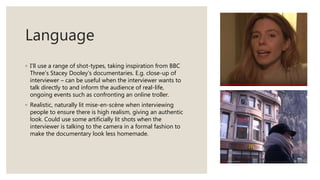
◦ I’ll use a range of shot-types, taking inspiration from BBC
Three’s Stacey Dooley’s documentaries. E.g. close-up of
interviewer – can be useful when the interviewer wants to
talk directly to and inform the audience of real-life,
ongoing events such as confronting an online troller.
◦ Realistic, naturally lit mise-en-scène when interviewing
people to ensure there is high realism, giving an authentic
look. Could use some artificially lit shots when the
interviewer is talking to the camera in a formal fashion to
make the documentary look less homemade.
Industries
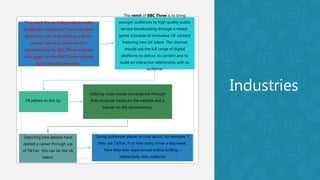
‘You work for an independent media
production company. You have been
given the task of producing a three-
minute opening sequence of a
documentary for BBC Three and two
web pages on the BBC Three website
about the documentary.’
The remit of BBC Three is to bring
younger audiences to high quality public
service broadcasting through a mixed-
genre schedule of innovative UK content
featuring new UK talent. The channel
should use the full range of digital
platforms to deliver its content and to
build an interactive relationship with its
audience.
I’ll adhere to this by:
Utilising cross-media convergence through
links to social media on the website and a
banner on the documentary.
Depicting how people have
started a career through use
of TikTok- this can be the Uk
‘talent’.
Giving audiences places to cote about, for example, if
they use TikTok, if so how many times a day/week,
have they ever experienced online trolling –
interactivity with audience
Audience
I must primarily target a socially-conscious, 16–25,
middle to upmarket demographic.
As being part of Generation Z, it is arguable that
the majority of this demographic will be invested in
technology, in particular, their mobile phones.
Due to this, I’ll utilise cross-media convergence to
engage them through offering interactive activities
as I previously said last slide.
The younger part of this generation are probably
familiar with, and use TikTok, and the older part of
this generation could be young parents with
children who may use TikTok in the near
future. Therefore, this generation is likely to be
most affected by the dangers of the app, or simply
be more aware of the app itself, and so will benefit
from being informed and educated via this
documentary of the dangers and how to protect
themselves/others and can learn what to do when
Representation
◦ Although I’ll briefly introduce TikTok as an extremely popular app that
allows ‘talent’ to be seeked and made into careers(thus constructing an
initial positive representation), I’ll then use different shot types depicting
an interviewer exploring the dangers of the app and how it can be
misused.
◦ TikTok can be associated with grooming, trolling and even drug use, and
so b depicting this, a negative representation will be contracted of the
app, hopefully injecting a sense of fear into parents and children, enticing
them to be more careful of the usage of the app and the care taken when
it’s being used.
◦ I’ll construct these negative representations through use of multiple shots
of the interviewer/interviewee(s), depicting a confrontation in which the
interviewee has been found to be trolling a child on the app.

26 3 nea pitch

  • 1.
  • 2.
    Overall messages/ideas Short introduction/summary ofwhat’s going to be summarised in documentary About the rise of online crime including trolling and exploitation of children, in particular, analysing the rise in usage of the app TikTok and the dangers of this, but also how the app is used to create interesting content which some people make a career out of. Main purpose – to educate parents and children and to raise awareness of the easily accessible dangers of the internet.
  • 3.
    Language ◦ I’ll usea range of shot-types, taking inspiration from BBC Three’s Stacey Dooley’s documentaries. E.g. close-up of interviewer – can be useful when the interviewer wants to talk directly to and inform the audience of real-life, ongoing events such as confronting an online troller. ◦ Realistic, naturally lit mise-en-scène when interviewing people to ensure there is high realism, giving an authentic look. Could use some artificially lit shots when the interviewer is talking to the camera in a formal fashion to make the documentary look less homemade.
  • 4.
    Industries ‘You work foran independent media production company. You have been given the task of producing a three- minute opening sequence of a documentary for BBC Three and two web pages on the BBC Three website about the documentary.’ The remit of BBC Three is to bring younger audiences to high quality public service broadcasting through a mixed- genre schedule of innovative UK content featuring new UK talent. The channel should use the full range of digital platforms to deliver its content and to build an interactive relationship with its audience. I’ll adhere to this by: Utilising cross-media convergence through links to social media on the website and a banner on the documentary. Depicting how people have started a career through use of TikTok- this can be the Uk ‘talent’. Giving audiences places to cote about, for example, if they use TikTok, if so how many times a day/week, have they ever experienced online trolling – interactivity with audience
  • 5.
    Audience I must primarilytarget a socially-conscious, 16–25, middle to upmarket demographic. As being part of Generation Z, it is arguable that the majority of this demographic will be invested in technology, in particular, their mobile phones. Due to this, I’ll utilise cross-media convergence to engage them through offering interactive activities as I previously said last slide. The younger part of this generation are probably familiar with, and use TikTok, and the older part of this generation could be young parents with children who may use TikTok in the near future. Therefore, this generation is likely to be most affected by the dangers of the app, or simply be more aware of the app itself, and so will benefit from being informed and educated via this documentary of the dangers and how to protect themselves/others and can learn what to do when
  • 6.
    Representation ◦ Although I’llbriefly introduce TikTok as an extremely popular app that allows ‘talent’ to be seeked and made into careers(thus constructing an initial positive representation), I’ll then use different shot types depicting an interviewer exploring the dangers of the app and how it can be misused. ◦ TikTok can be associated with grooming, trolling and even drug use, and so b depicting this, a negative representation will be contracted of the app, hopefully injecting a sense of fear into parents and children, enticing them to be more careful of the usage of the app and the care taken when it’s being used. ◦ I’ll construct these negative representations through use of multiple shots of the interviewer/interviewee(s), depicting a confrontation in which the interviewee has been found to be trolling a child on the app.