Openaccessandopenscience-
lessonslearnedinLatinAmerica
• Dominique Babini, Open Science Advisor
CLACSO
• Laura Rovelli, Coordinator, Latin American
Forum for Research Assessment (FOLEC-
CLACSO)
LATINAMERICA
-communityownedandgovernedopenaccess:bibliodiversity+
multilingualism
-regionwithhighest%ofopenaccessadoptioninscholarly journalspublished
intheregion,withnoAPCsandnooutsourcingtocommercialpublishers
-universityleadershipofopenaccess
*openaccessjournalplatforms(universityandnational-OJS+regional
Latindex, Redalyc-AmeliCA,SciELO)
*institutionalrepositories(LaReferencia-COAR)
-nationalandinstitutionalopenaccesspoliciesprioritizeopenaccessrepositories
forpublicationsanddata
-morerecently,openscienceispromotedintheregion
*researchdataplatforms(institutional,national)
*co-productionofknowledgewithothersocietalactors
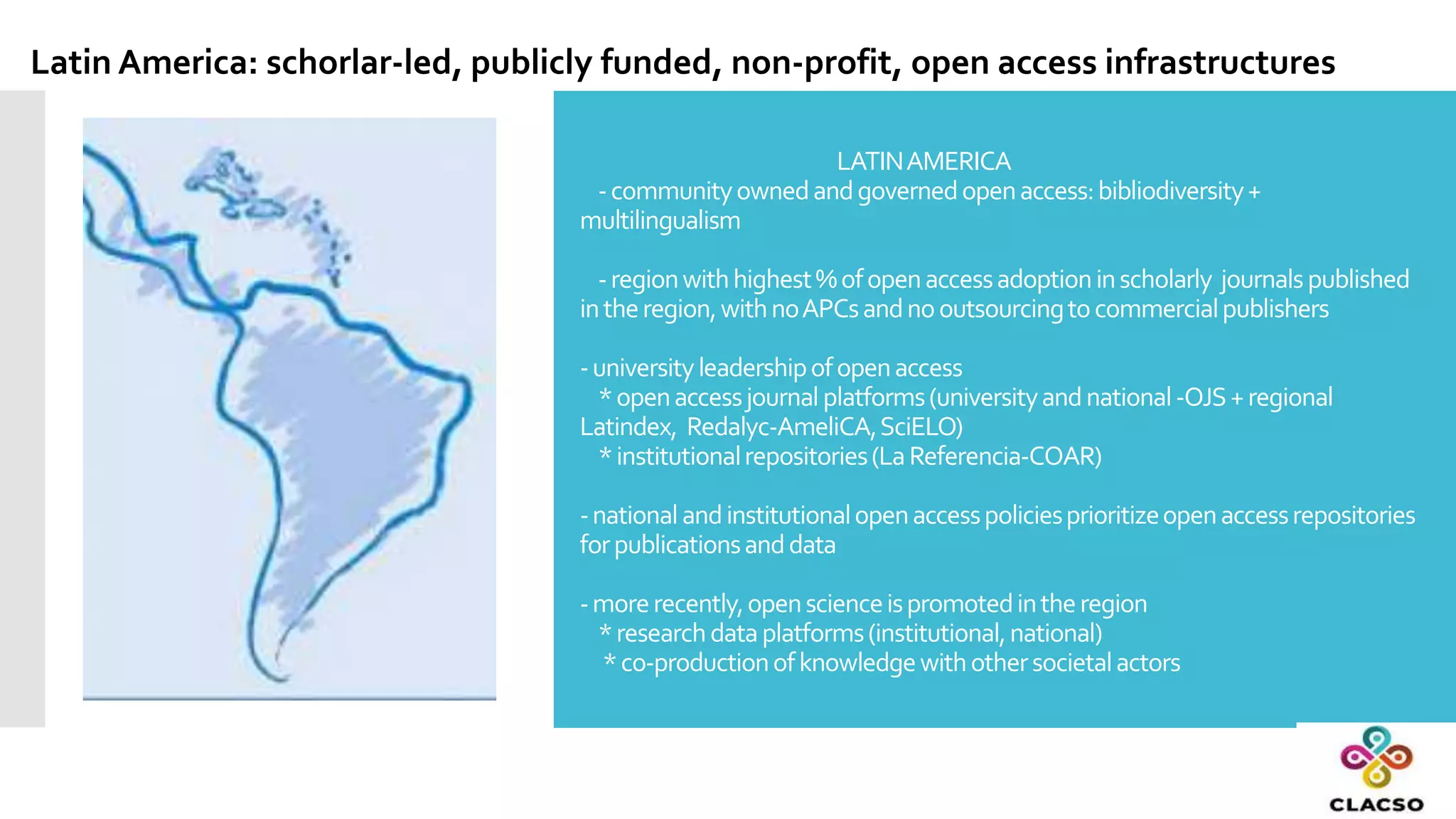
Latin America: schorlar-led, publicly funded, non-profit, open access infrastructures
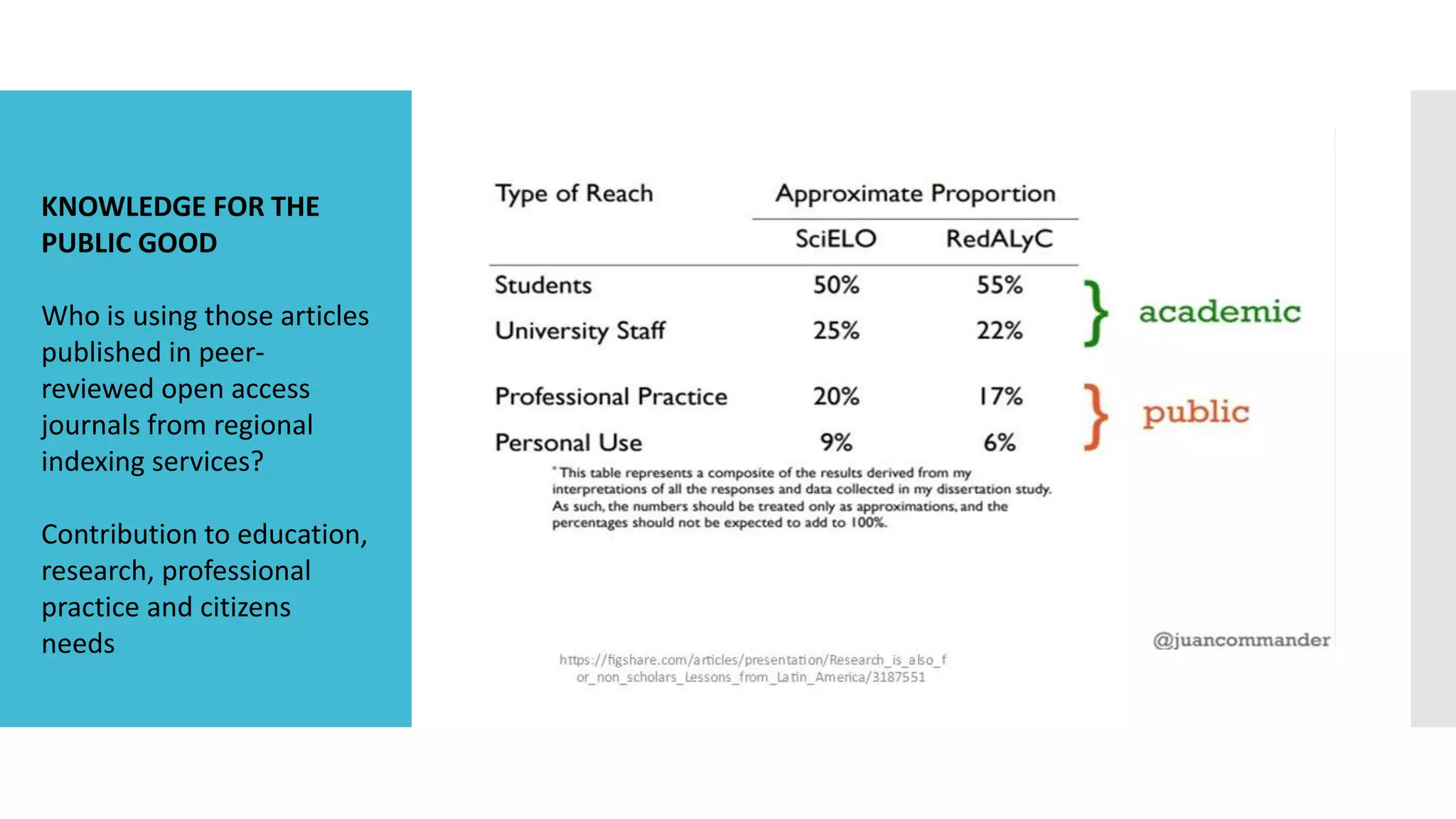
KNOWLEDGE FOR THE
PUBLIC GOOD
Who is using those articles
published in peer-
reviewed open access
journals from regional
indexing services?
Contribution to education,
research, professional
practice and citizens
needs
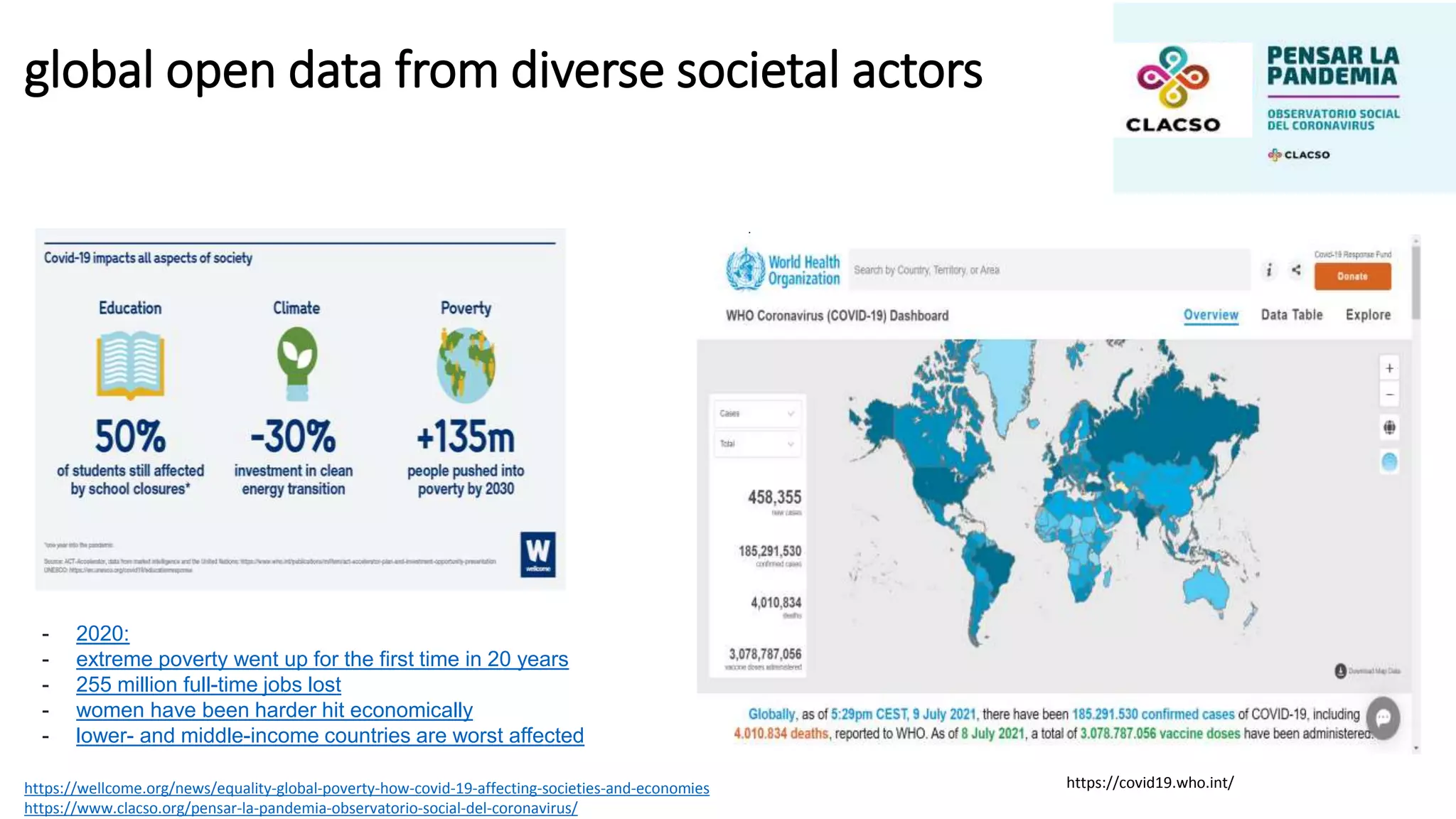
global open data from diverse societal actors
https://covid19.who.int/
.
https://wellcome.org/news/equality-global-poverty-how-covid-19-affecting-societies-and-economies
https://www.clacso.org/pensar-la-pandemia-observatorio-social-del-coronavirus/
- 2020:
- extreme poverty went up for the first time in 20 years
- 255 million full-time jobs lost
- women have been harder hit economically
- lower- and middle-income countries are worst affected
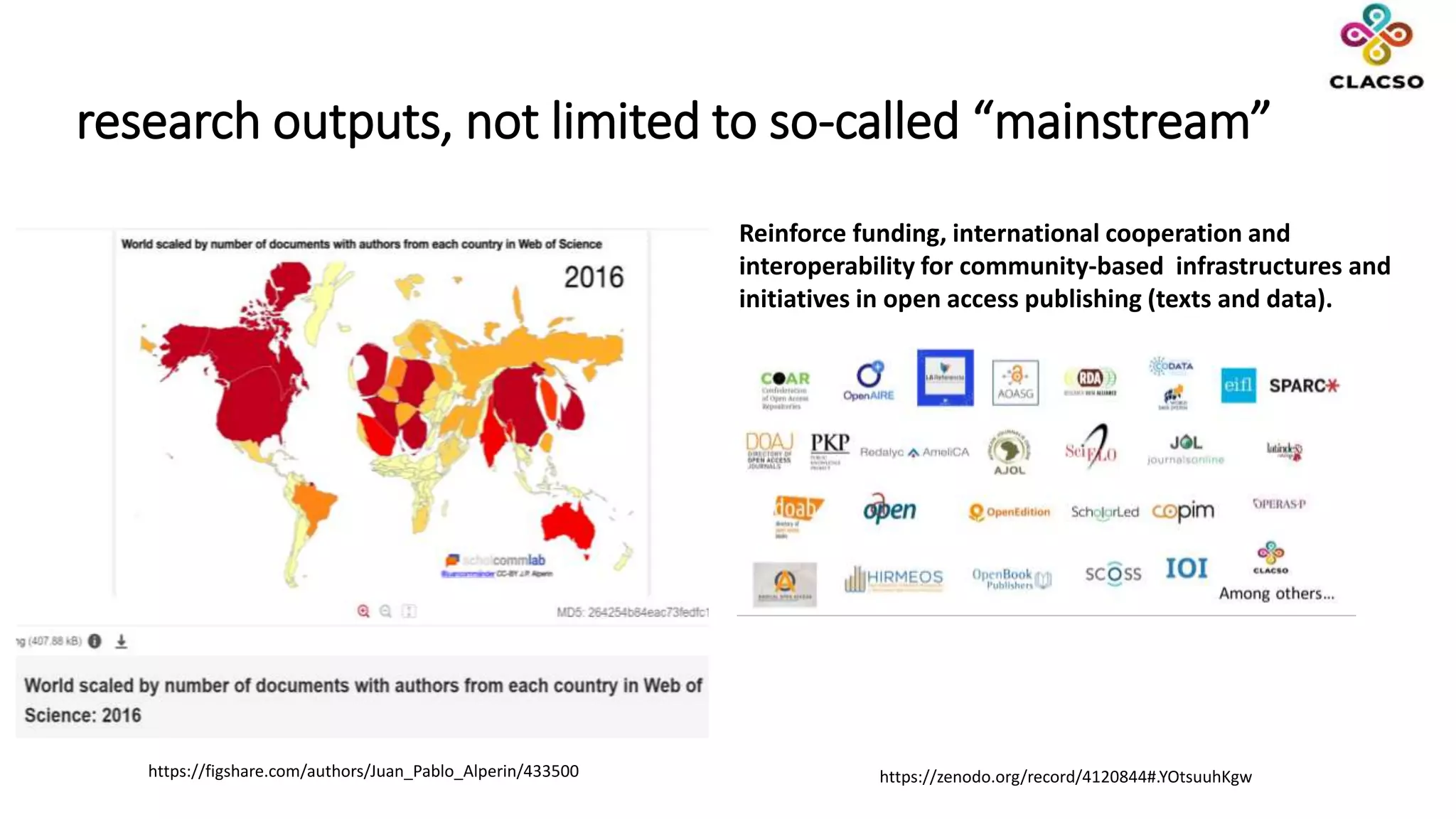
research outputs, not limited to so-called “mainstream”
https://figshare.com/authors/Juan_Pablo_Alperin/433500 https://zenodo.org/record/4120844#.YOtsuuhKgw
Reinforce funding, international cooperation and
interoperability for community-based infrastructures and
initiatives in open access publishing (texts and data).
Lessons learned
Open Science needs to be
community-led in non-profit public
open infrastructures
@_CLACSO
Lessons learned
Open Science needs to be the
default, with no paywalls for
participants and no paywalls for
beneficiaries
@_CLACSO
Call for actions
Underfunding of community-owned infrastructures because scarce funds
directed to APCs
Prioritize funding and resources dedicated to non-APC/BPC
community-based infrastructures/initiatives and quality certification of
its contents
Call for more international collective action, have a stronger and
collective international voice
Researchers rewarded only when publishing in “mainstream” journals with
“prestige industry” indicators, making invisible other contributions
 Reward quality and relevance independent of publication venue
 Reward doing peer-review of contents for community-based
infrastructures
 Promote review of research assessment procedures
(Latin American Forum for Research Assessment FOLEC-CLACSO)
TheCLACSOFOLEC
initiativeinLatin
America
“All voices, formats
and perspectives of
knowledge
production and
circulation
Lessons learned
• ResearchAssessment of
scholarly publishing based
on traditional indicators
(e.g. impact factor of
journals) does not
contribute to incentivize
inclusive and participatory
open science practices using
bibliodiverse and
multilingual local as well as
international open access
venues for publishing
Goals
of research
assessment
 Promote high quality,
diverse, equitable and
relevant research
 Open sciences for social
transformation, sustainable
development and innovation
 Stimulate equitable
collaboration and
participation.
 Reshape and expand the
notion of excellence
 Based on responsible and
situated methodologies.
Future of
research
assessment
 Open Access & Open Science
 Interoperable regional and local
databases
 Qualitative and quantitative
evaluation
 Equity, diversity and inclusion
(EDI)
 Social relevance / linkage /
intervention
 Multilingualism and
bibliodiversity. CSH impact
 Transparency, reproducibility and
integrity.
Lessons learned
 Mission-oriented research
assessment requires
contextualizing frameworks
and situated methodologies,
particular or extended
evaluation criteria, and
reviewers with wider
backgrounds and expertise
and the participation of
social movements and/or
local communities.
Lessons
learned
 To exert its potential, open
science needs review of
research assessment
procedures.
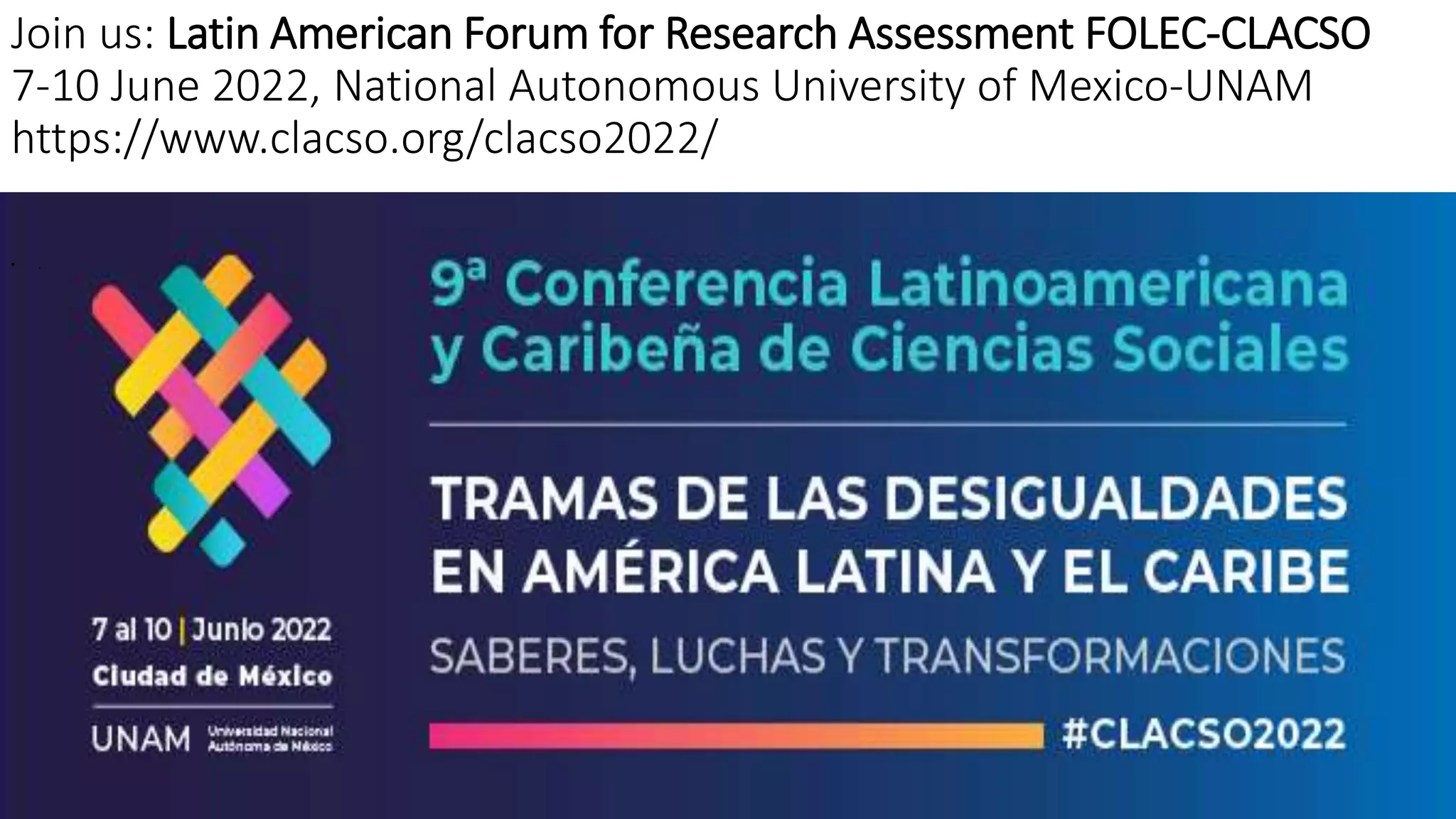
Join us: Latin American Forum for Research Assessment FOLEC-CLACSO
7-10 June 2022, National Autonomous University of Mexico-UNAM
https://www.clacso.org/clacso2022/
• .
Thankyouverymuch
folec@clacso.edu.ar

https://www.clacso.org/en/folec
https://www.clacso.org/

Open access and open science- lessons learned in Latin America