Monitoring Peatland Restoration in
Indonesia
Budi S Wardhana
Badan Restorasi Gambut
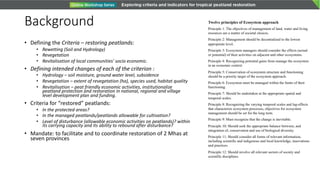
Background
• Defining the Criteria – restoring peatlands:
• Rewetting (Soil and Hydrology)
• Revegetation
• Revitalisation of local communities’ socio economic.
• Defining intended changes of each of the criterion :
• Hydrology – soil moisture, ground water level, subsidence
• Revegetation – extent of revegetation (ha), species used, habitat quality
• Revitalisation – peat friendly economic activities, institutionalize
peatland protection and restoration in national, regional and village
level development plan and funding.
• Criteria for “restored” peatlands:
• In the protected areas?
• In the managed peatlands/peatlands allowable for cultivation?
• Level of disturbance (allowable economic activities on peatlands)? within
its carrying capacity and its ability to rebound after disturbance?
• Mandate: to facilitate and to coordinate restoration of 2 Mhas at
seven provinces
Twelve principles of Ecosystem approach
Principle 1: The objectives of management of land, water and living
resources are a matter of societal choices.
Principle 2: Management should be decentralized to the lowest
appropriate level.
Principle 3: Ecosystem managers should consider the effects (actual
or potential) of their activities on adjacent and other ecosystems.
Principle 4: Recognizing potential gains from manage the ecosystem
in an economic context
Principle 5: Conservation of ecosystem structure and functioning
should be a priority target of the ecosystem approach.
Principle 6: Ecosystem must be managed within the limits of their
functioning.
Principle 7: Should be undertaken at the appropriate spatial and
temporal scales.
Principle 8: Recognizing the varying temporal scales and lag-effects
that characterize ecosystem processes, objectives for ecosystem
management should be set for the long term.
Principle 9: Must recognize that the change is inevitable.
Principle 10: Should seek the appropriate balance between, and
integration of, conservation and use of biological diversity.
Principle 11: Should consider all forms of relevant information,
including scientific and indigenous and local knowledge, innovations
and practices.
Principle 12: Should involve all relevant sectors of society and
scientific disciplines.
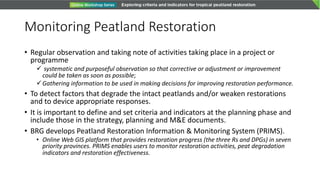
Monitoring Peatland Restoration
• Regular observation and taking note of activities taking place in a project or
programme
ü systematic and purposeful observation so that corrective or adjustment or improvement
could be taken as soon as possible;
üGathering information to be used in making decisions for improving restoration performance.
• To detect factors that degrade the intact peatlands and/or weaken restorations
and to device appropriate responses.
• It is important to define and set criteria and indicators at the planning phase and
include those in the strategy, planning and M&E documents.
• BRG develops Peatland Restoration Information & Monitoring System (PRIMS).
• Online Web GIS platform that provides restoration progress (the three Rs and DPGs) in seven
priority provinces. PRIMS enables users to monitor restoration activities, peat degradation
indicators and restoration effectiveness.
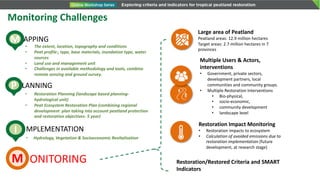
APPINGM
LANNINGP
MPLEMENTATIONI
M ONITORING
• Restoration Planning (landscape based planning-
hydrological unit)
• Peat Ecosystem Restoration Plan (combining regional
development plan taking into account peatland protection
and restoration objectives- 5 year)
• Hydrology, Vegetation & Socioeconomic Revitalisation
Large area of Peatland
Peatland areas: 12.9 million hectares
Target areas: 2.7 million hectares in 7
provinces
Multiple Users & Actors,
interventions
• Government, private sectors,
development partners, local
communities and community groups.
• Multiple Restoration Interventions
• Bio-physical,
• socio-economic,
• community development
• landscape level
Restoration Impact Monitoring
• Restoration impacts to ecosystem
• Calculation of avoided emissions due to
restoration implementation (future
development, at research stage)
Monitoring Challenges
Restoration/Restored Criteria and SMART
Indicators
• The extent, location, topography and conditions
• Peat profile:, type, base materials, inundation type, water
sources
• Land use and management unit
• Challenges in available methodology and tools, combine
remote sensing and ground survey.
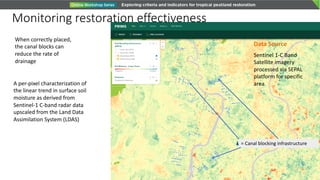
= Canal blocking infrastructure
When correctly placed,
the canal blocks can
reduce the rate of
drainage
Data Source
Sentinel 1-C Band
Satellite imagery
processed via SEPAL
platform for specific
areaA per-pixel characterization of
the linear trend in surface soil
moisture as derived from
Sentinel-1 C-band radar data
upscaled from the Land Data
Assimilation System (LDAS)
Monitoring restoration effectiveness
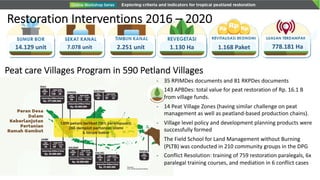
14.129 unit 7.078 unit 2.251 unit 1.130 Ha 1.168 Paket 778.181 Ha
- 35 RPJMDes documents and 81 RKPDes documents
- 143 APBDes: total value for peat restoration of Rp. 16.1 B
from village funds.
- 14 Peat Village Zones (having similar challenge on peat
management as well as peatland-based production chains).
- Village level policy and development planning products were
successfully formed
- The Field School for Land Management without Burning
(PLTB) was conducted in 210 community groups in the DPG
- Conflict Resolution: training of 759 restoration paralegals, 6x
paralegal training courses, and mediation in 6 conflict cases
Peat care Villages Program in 590 Petland Villages
Restoration Interventions 2016 – 2020
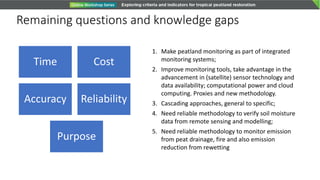
Remaining questions and knowledge gaps
Time Cost
Accuracy Reliability
Purpose
1. Make peatland monitoring as part of integrated
monitoring systems;
2. Improve monitoring tools, take advantage in the
advancement in (satellite) sensor technology and
data availability; computational power and cloud
computing. Proxies and new methodology.
3. Cascading approaches, general to specific;
4. Need reliable methodology to verify soil moisture
data from remote sensing and modelling;
5. Need reliable methodology to monitor emission
from peat drainage, fire and also emission
reduction from rewetting
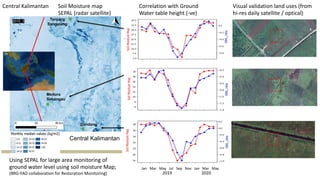
Medura
Sebangau
Tanjung
Sangalang
Dandang
Jan Mar May Jul Sep Nov Jan Mar May
2019 2020
Central Kalimantan Soil Moisture map
SEPAL (radar satellite)
Visual validation land uses (from
hi-res daily satellite / optical)
Correlation with Ground
Water table height (-ve)
Using SEPAL for large area monitoring of
ground water level using soil moisture Map;
(BRG-FAO collaboration for Restoration Monitoring)
THANK YOU

Monitoring peatland restoration in Indonesia

  • 1.
    Monitoring Peatland Restorationin Indonesia Budi S Wardhana Badan Restorasi Gambut
  • 2.
    Background • Defining theCriteria – restoring peatlands: • Rewetting (Soil and Hydrology) • Revegetation • Revitalisation of local communities’ socio economic. • Defining intended changes of each of the criterion : • Hydrology – soil moisture, ground water level, subsidence • Revegetation – extent of revegetation (ha), species used, habitat quality • Revitalisation – peat friendly economic activities, institutionalize peatland protection and restoration in national, regional and village level development plan and funding. • Criteria for “restored” peatlands: • In the protected areas? • In the managed peatlands/peatlands allowable for cultivation? • Level of disturbance (allowable economic activities on peatlands)? within its carrying capacity and its ability to rebound after disturbance? • Mandate: to facilitate and to coordinate restoration of 2 Mhas at seven provinces Twelve principles of Ecosystem approach Principle 1: The objectives of management of land, water and living resources are a matter of societal choices. Principle 2: Management should be decentralized to the lowest appropriate level. Principle 3: Ecosystem managers should consider the effects (actual or potential) of their activities on adjacent and other ecosystems. Principle 4: Recognizing potential gains from manage the ecosystem in an economic context Principle 5: Conservation of ecosystem structure and functioning should be a priority target of the ecosystem approach. Principle 6: Ecosystem must be managed within the limits of their functioning. Principle 7: Should be undertaken at the appropriate spatial and temporal scales. Principle 8: Recognizing the varying temporal scales and lag-effects that characterize ecosystem processes, objectives for ecosystem management should be set for the long term. Principle 9: Must recognize that the change is inevitable. Principle 10: Should seek the appropriate balance between, and integration of, conservation and use of biological diversity. Principle 11: Should consider all forms of relevant information, including scientific and indigenous and local knowledge, innovations and practices. Principle 12: Should involve all relevant sectors of society and scientific disciplines.
  • 3.
    Monitoring Peatland Restoration •Regular observation and taking note of activities taking place in a project or programme ü systematic and purposeful observation so that corrective or adjustment or improvement could be taken as soon as possible; üGathering information to be used in making decisions for improving restoration performance. • To detect factors that degrade the intact peatlands and/or weaken restorations and to device appropriate responses. • It is important to define and set criteria and indicators at the planning phase and include those in the strategy, planning and M&E documents. • BRG develops Peatland Restoration Information & Monitoring System (PRIMS). • Online Web GIS platform that provides restoration progress (the three Rs and DPGs) in seven priority provinces. PRIMS enables users to monitor restoration activities, peat degradation indicators and restoration effectiveness.
  • 4.
    APPINGM LANNINGP MPLEMENTATIONI M ONITORING • RestorationPlanning (landscape based planning- hydrological unit) • Peat Ecosystem Restoration Plan (combining regional development plan taking into account peatland protection and restoration objectives- 5 year) • Hydrology, Vegetation & Socioeconomic Revitalisation Large area of Peatland Peatland areas: 12.9 million hectares Target areas: 2.7 million hectares in 7 provinces Multiple Users & Actors, interventions • Government, private sectors, development partners, local communities and community groups. • Multiple Restoration Interventions • Bio-physical, • socio-economic, • community development • landscape level Restoration Impact Monitoring • Restoration impacts to ecosystem • Calculation of avoided emissions due to restoration implementation (future development, at research stage) Monitoring Challenges Restoration/Restored Criteria and SMART Indicators • The extent, location, topography and conditions • Peat profile:, type, base materials, inundation type, water sources • Land use and management unit • Challenges in available methodology and tools, combine remote sensing and ground survey.
  • 5.
    = Canal blockinginfrastructure When correctly placed, the canal blocks can reduce the rate of drainage Data Source Sentinel 1-C Band Satellite imagery processed via SEPAL platform for specific areaA per-pixel characterization of the linear trend in surface soil moisture as derived from Sentinel-1 C-band radar data upscaled from the Land Data Assimilation System (LDAS) Monitoring restoration effectiveness
  • 6.
    14.129 unit 7.078unit 2.251 unit 1.130 Ha 1.168 Paket 778.181 Ha - 35 RPJMDes documents and 81 RKPDes documents - 143 APBDes: total value for peat restoration of Rp. 16.1 B from village funds. - 14 Peat Village Zones (having similar challenge on peat management as well as peatland-based production chains). - Village level policy and development planning products were successfully formed - The Field School for Land Management without Burning (PLTB) was conducted in 210 community groups in the DPG - Conflict Resolution: training of 759 restoration paralegals, 6x paralegal training courses, and mediation in 6 conflict cases Peat care Villages Program in 590 Petland Villages Restoration Interventions 2016 – 2020
  • 7.
    Remaining questions andknowledge gaps Time Cost Accuracy Reliability Purpose 1. Make peatland monitoring as part of integrated monitoring systems; 2. Improve monitoring tools, take advantage in the advancement in (satellite) sensor technology and data availability; computational power and cloud computing. Proxies and new methodology. 3. Cascading approaches, general to specific; 4. Need reliable methodology to verify soil moisture data from remote sensing and modelling; 5. Need reliable methodology to monitor emission from peat drainage, fire and also emission reduction from rewetting
  • 8.
    Medura Sebangau Tanjung Sangalang Dandang Jan Mar MayJul Sep Nov Jan Mar May 2019 2020 Central Kalimantan Soil Moisture map SEPAL (radar satellite) Visual validation land uses (from hi-res daily satellite / optical) Correlation with Ground Water table height (-ve) Using SEPAL for large area monitoring of ground water level using soil moisture Map; (BRG-FAO collaboration for Restoration Monitoring)
  • 9.