All ruins are narratives. All narratives are ruins. 
All narratives are co-produced. 
Dan Keech, University of Gloucestershire 
and Owain Jones, Bath Spa University 
dkeech@glos.ac.uk 
o.jones@bathspa.ac.uk 
RGS-IBG Annual International Conference 
28th August 2014 
1
This presentation is in three parts, following the title 
1 – All ruins are narratives: this is a relatively straightforward 
claim, (we hope), and will be discussed with reference to the 
works of Wordsworth, Sebald and especially the contemporary 
artist Stephen Turner, and ideas of future ruins. 
2 – All narratives are ruins: this claim is more 
speculative/provocative, but, with reference to Serres, Thrift and 
others, can be argued in a number of ways. 
3 – All narratives are co-produced. We feel this is in 2 ways. 
Firstly in their consumption, narratives are re-created; secondly, 
drawing upon Sebald again, in how the agency of things – or 
others – co-construct narrative. 
2
Part 1 – All ruins are narratives 
Portals to stories know and unknown 
Ruins speak of other (past) stories. That “of” is important because 
it implies complexity and variation in how they do so. 
(i) The ruin is a material indicator of some chapter (narrative) of 
something that has (in some sense or other) ended. The chapter 
itself may be known, or not. In this respect, ruins are portals to 
(other) narratives – both known and unknown 
(ii) Ruins as portals into unknown narratives have a great 
(affective) power – “there is some great story here but I don’t 
know what it is”. 
3
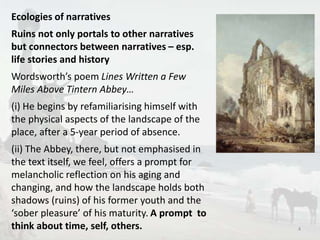
Ecologies of narratives 
Ruins not only portals to other narratives 
but connectors between narratives – esp. 
life stories and history 
Wordsworth’s poem Lines Written a Few 
Miles Above Tintern Abbey… 
(i) He begins by refamiliarising himself with 
the physical aspects of the landscape of the 
place, after a 5-year period of absence. 
(ii) The Abbey, there, but not emphasised in 
the text itself, we feel, offers a prompt for 
melancholic reflection on his aging and 
changing, and how the landscape holds both 
shadows (ruins) of his former youth and the 
‘sober pleasure’ of his maturity. A prompt to 
think about time, self, others. 4
Ecologies of narratives 
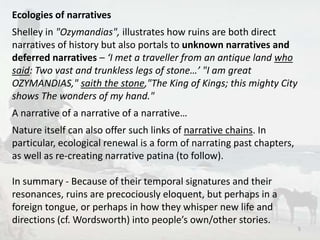
Shelley in "Ozymandias", illustrates how ruins are both direct 
narratives of history but also portals to unknown narratives and 
deferred narratives – ‘I met a traveller from an antique land who 
said: Two vast and trunkless legs of stone…’ "I am great 
OZYMANDIAS," saith the stone,"The King of Kings; this mighty City 
shows The wonders of my hand." 
A narrative of a narrative of a narrative… 
Nature itself can also offer such links of narrative chains. In 
particular, ecological renewal is a form of narrating past chapters, 
as well as re-creating narrative patina (to follow). 
In summary - Because of their temporal signatures and their 
resonances, ruins are precociously eloquent, but perhaps in a 
foreign tongue, or perhaps in how they whisper new life and 
directions (cf. Wordsworth) into people’s own/other stories. 
5
6 
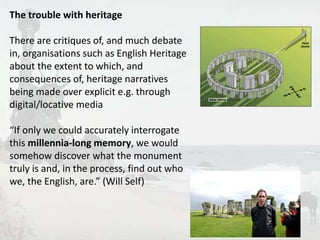
The trouble with heritage 
There are critiques of, and much debate 
in, organisations such as English Heritage 
about the extent to which, and 
consequences of, heritage narratives 
being made over explicit e.g. through 
digital/locative media 
“If only we could accurately interrogate 
this millennia-long memory, we would 
somehow discover what the monument 
truly is and, in the process, find out who 
we, the English, are.” (Will Self)
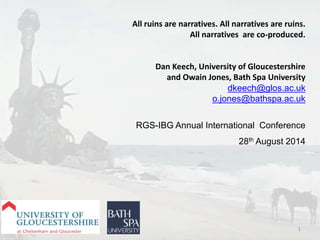
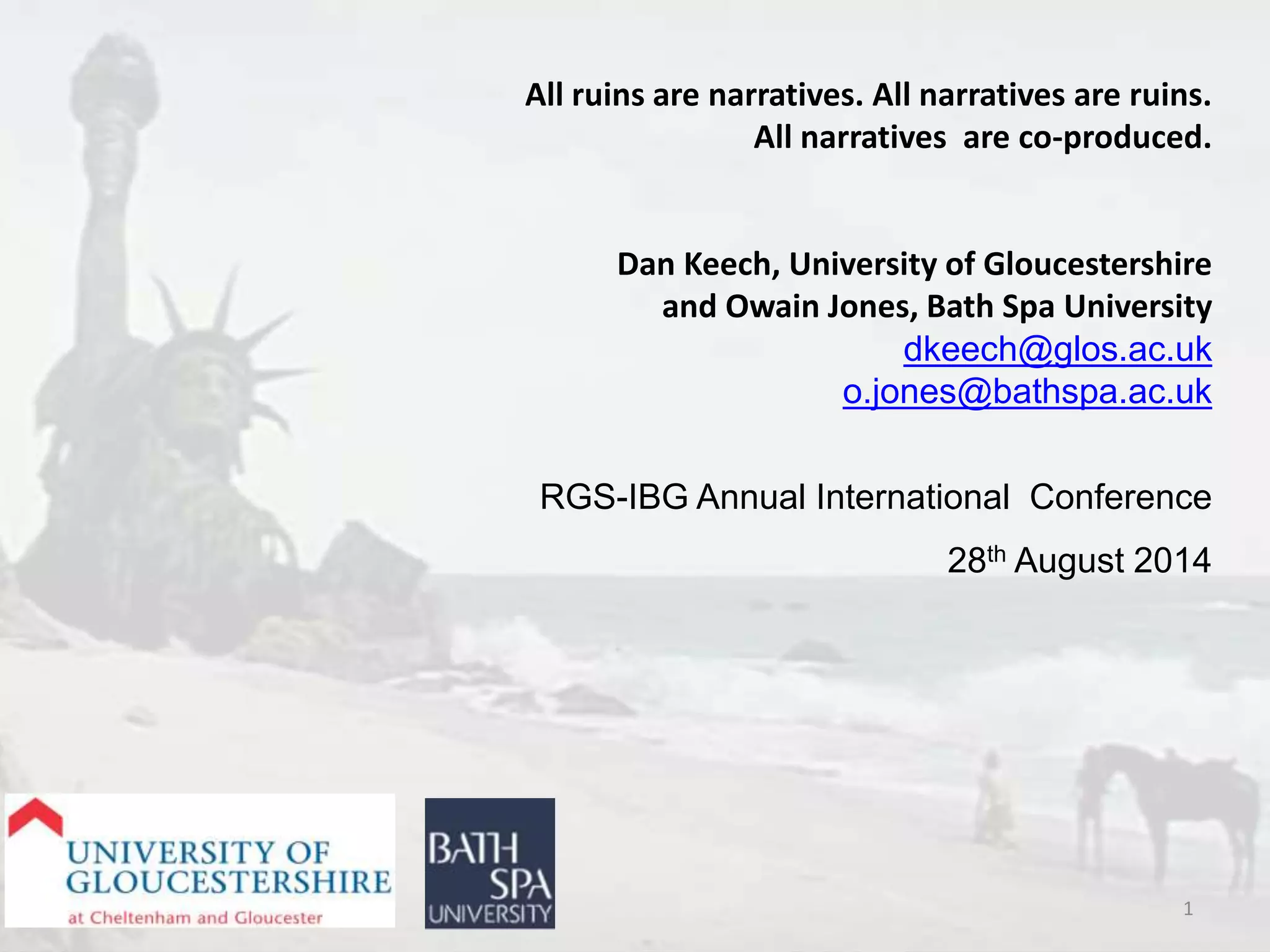
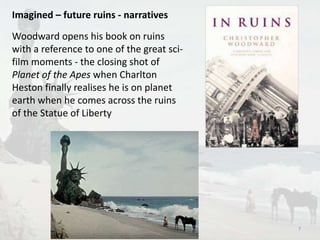
Imagined – future ruins - narratives 
Woodward opens his book on ruins 
with a reference to one of the great sci-film 
moments - the closing shot of 
Planet of the Apes when Charlton 
Heston finally realises he is on planet 
earth when he comes across the ruins 
of the Statue of Liberty 
7
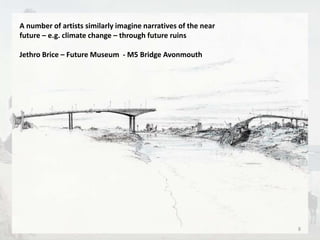
A number of artists similarly imagine narratives of the near 
future – e.g. climate change – through future ruins 
Jethro Brice – Future Museum - M5 Bridge Avonmouth 
8
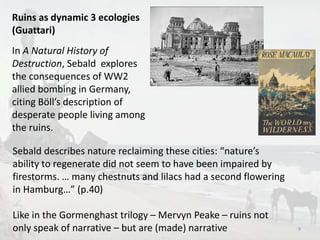
Ruins as dynamic 3 ecologies 
(Guattari) 
In A Natural History of 
Destruction, Sebald explores 
the consequences of WW2 
allied bombing in Germany, 
citing Böll’s description of 
desperate people living among 
the ruins. 
Sebald describes nature reclaiming these cities: “nature’s 
ability to regenerate did not seem to have been impaired by 
firestorms. … many chestnuts and lilacs had a second flowering 
in Hamburg…” (p.40) 
Like in the Gormenghast trilogy – Mervyn Peake – ruins not 
only speak of narrative – but are (made) narrative 9
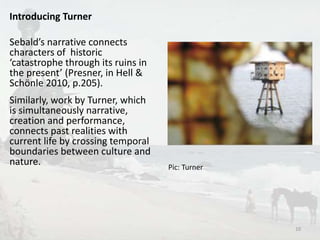
Introducing Turner 
Sebald’s narrative connects 
characters of historic 
‘catastrophe through its ruins in 
the present’ (Presner, in Hell & 
Schönle 2010, p.205). 
Similarly, work by Turner, which 
is simultaneously narrative, 
creation and performance, 
connects past realities with 
current life by crossing temporal 
boundaries between culture and 
nature. 
Pic: Turner 
10
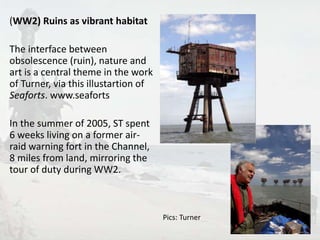
(WW2) Ruins as vibrant habitat 
The interface between 
obsolescence (ruin), nature and 
art is a central theme in the work 
of Turner, via this illustartion of 
Seaforts. www.seaforts 
In the summer of 2005, ST spent 
6 weeks living on a former air-raid 
warning fort in the Channel, 
8 miles from land, mirroring the 
tour of duty during WW2. 
Pics: Turner 
11
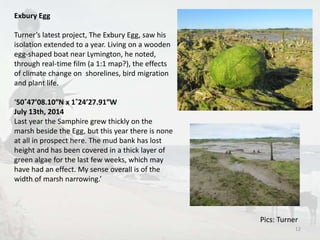
Exbury Egg 
Turner’s latest project, The Exbury Egg, saw his 
isolation extended to a year. Living on a wooden 
egg-shaped boat near Lymington, he noted, 
through real-time film (a 1:1 map?), the effects 
of climate change on shorelines, bird migration 
and plant life. 
‘50˚47’08.10″N x 1˚24’27.91″W 
July 13th, 2014 
Last year the Samphire grew thickly on the 
marsh beside the Egg, but this year there is none 
at all in prospect here. The mud bank has lost 
height and has been covered in a thick layer of 
green algae for the last few weeks, which may 
have had an effect. My sense overall is of the 
width of marsh narrowing.’ 
Pics: Turner 
12
Pin-ups, impressions, seabirds 
‘I will enter one room at a time, exhaustively examine all the nooks and crannies. Each 
doorway is the threshold to a different stage of a journey; where the decaying reality of 
the fort …is, from within, the shaper of memories… It seems important to take this process 
slowly and for it to comfortably fill the time. 
…Today amongst a pile of feathers on the floor, were the leg rings of weary homing 
pigeons that never made it back – GB 2000A25848 and GB99 S44807. They lay not far 
away from a pair of Royal Artillery luggage labels belonging to RA140507 and RA171317.’ 
(Turner 2006 p. 14) 
‘A cupboard on a stairwell is littered with fish bones… last night a gang of around forty 
[comorants] arrived ad took over the control tower and the eastern gun tower. I realise 
that the fort has never been abandoned at all.’ (ibid., p. 26) 
The floors are rich in stories, and their careful sweeping is at the core of creative action. 
(ibid., p.20) 
‘The surface of the floor is a bituminous material… 
Partition walls, fixtures and fittings have very slowly sunk 
into it; leaving […] impressions… How many footsteps are 
Also logged here?, but just harder to see? … what 
percentage of the fort might now be part of me and me of 
the fort? (ibid., p.28) 
13
Part 2 – All narratives are ruins 
‘The fort buildings are decaying, as we all are. Ruin is what we live with. 
What keeps things alive is the telling of stories… about remembering 
sharable moment. …it has to be beautiful, otherwise it’s just more 
data.’ 
‘Inside [the seaforts] was full of stuff and memories. Stories came thick 
and fast. I occupied one room and spent the first day sweeping up 
some debris to clear space to put up the tent. In the morning I noticed 
that the pile of debris was full of the skeletons of birds and bits of 
equipment’ he realized that if he wasn’t careful, he’d destroy them. 
‘They were the stories of the building.’ 
From interview with ST 28th March 2014 
14
15 
Humans are storying creatures 
“Stories are the essence of life, the essence of time” (A. S. Byatt) 
Narratives are key to senses of self, community, politics. 
Damasio (1999) has stated that affective becoming make us transient entities of the 
present moment, and yet, at the same time, we have an ‘autobiographical self', ‘a 
nontransient collection of unique facts and ways of being of systemised memory’ (17). 
So we are very good at concocting them - pulling together fragments and filaments into 
an apparently coherent whole. 
But all such narratives are full of ghosts (as any good ruin is) and ruptures, and scars of 
old ruptures 
Thrift (2008, 118, citing Gell 1998, 222–223) say that people are: 
rather ill-defined constellations [ …] not confined to particular spatio-temporal 
coordinates, but consist of a spread of biographical events and memories of events, 
and a dispersed category of material objects, traces, and leavings.
Mantel writes in her memoir Giving Up The Ghost 
‘When the midwife says “it’s a boy” where does the girl go?’ 
Tamboukou (2010 ) turns to Michel Serres’s work on narrative as a 
source of methodological innovation and political possibility. For 
Serres narrative offers proliferation of difference and possibility 
through “the process of bifurcation”. Sense appearing not in 
coherence but in the ‘eruption of the moment’, which is constructed 
within “the here, there, yesterday, tomorrow” within the specifics of 
unfolding space-time . Narrative is a ‘force’ (ibid) [which] appears as 
fluent [ ] flow and eddy or backwash, pulling its elements forwards 
in a single direction but also redistributing them in new 
compounds, vortices, turbulences (16) 
Narratives: force (or field), rather than 
lines (cf. Ingold). 
16
We suggest that even the most coherent, compelling narratives are 
confections of constructed order which overlay filaments, fragments, 
disjunctures, ghosts and untruths. 
Deconstruction 
“Narrative displaces and overlooks discontinuity, fragmentation and 
ambiguity.” Boje and Jørgensen (2008) 
We need, therefore, to analyse narratives and life materials, in order to 
treat them as instances of social action – as speech-acts or events with 
common properties, recurrent structures, cultural conventions and 
recognisable genres. (Atkinson 2005, 6) 
Noticing how someone narrates their life, we become aware of the ‘versions 
of self, reality, and experience’ (Chase 2005, 657) their story telling produces. 
This allows us to see how they conceive of their place in the world, and 
understand them as socially inscribed beings. 
17
Part 3 – All narratives are co-produced 
In 2 ways at least: 
• Firstly and simply - a story only lives when it is consumed and in the 
consumption it is created afresh 
• Secondly in how the agency of things – or others – co-construct narrative. 
This happens as a matter of course, but some writers embrace it explicitly. 
Sebald’s method: profoundly ad hoc (cf. Waterman 1993) and a form of 
improvised co-production. 
‘But then as you walk along, you find things. I think that’s the advantage of 
walking. It’s just one of the reasons why I do that a lot. You find things by the 
wayside or you buy a brochure written by a local historian, which is in a tiny 
little museum somewhere, which you would never find in London. And in 
that you find odd details which lead you somewhere else, and so it’s a form 
of unsystematic searching, which of course for an academic is far from 
orthodoxy, because we’re meant to do things systematically.’ 
This brings us, in conclusion, back to Turner. 
18
Summary observations 
Ruins hold known and unknown stories. Stories 
themselves are kinds of ruins/fragments/ghosts. 
Ruins are socially and ecologically produced in 
everyday experience but we are often to busy 
tidying them up to read their (our) narratives. 
Impressions are not simply perceptions but 
faint, palpable archaeology. Turner follows 
many in making creative use of isolation. 
However his isolation, while enabling removal 
into a different daily experience, nevertheless 
enables him to retell and share. 
Turner’s narratives allow transgression of 
temporal nature-culture interfaces – this means 
that narratives, as soon as they are articulated 
become ruins (artefacts) and by recounting 
them, we can use the past to co-produce their 
resurrection in the present. 
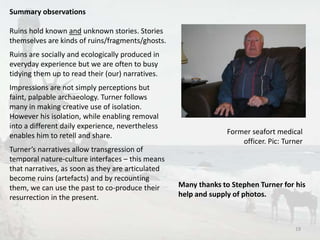
Former seafort medical 
officer. Pic: Turner 
Many thanks to Stephen Turner for his 
help and supply of photos. 
19

Dan Keech & Owain Jones 'Ruins' RGS 2014

  • 1.
    All ruins arenarratives. All narratives are ruins. All narratives are co-produced. Dan Keech, University of Gloucestershire and Owain Jones, Bath Spa University dkeech@glos.ac.uk o.jones@bathspa.ac.uk RGS-IBG Annual International Conference 28th August 2014 1
  • 2.
    This presentation isin three parts, following the title 1 – All ruins are narratives: this is a relatively straightforward claim, (we hope), and will be discussed with reference to the works of Wordsworth, Sebald and especially the contemporary artist Stephen Turner, and ideas of future ruins. 2 – All narratives are ruins: this claim is more speculative/provocative, but, with reference to Serres, Thrift and others, can be argued in a number of ways. 3 – All narratives are co-produced. We feel this is in 2 ways. Firstly in their consumption, narratives are re-created; secondly, drawing upon Sebald again, in how the agency of things – or others – co-construct narrative. 2
  • 3.
    Part 1 –All ruins are narratives Portals to stories know and unknown Ruins speak of other (past) stories. That “of” is important because it implies complexity and variation in how they do so. (i) The ruin is a material indicator of some chapter (narrative) of something that has (in some sense or other) ended. The chapter itself may be known, or not. In this respect, ruins are portals to (other) narratives – both known and unknown (ii) Ruins as portals into unknown narratives have a great (affective) power – “there is some great story here but I don’t know what it is”. 3
  • 4.
    Ecologies of narratives Ruins not only portals to other narratives but connectors between narratives – esp. life stories and history Wordsworth’s poem Lines Written a Few Miles Above Tintern Abbey… (i) He begins by refamiliarising himself with the physical aspects of the landscape of the place, after a 5-year period of absence. (ii) The Abbey, there, but not emphasised in the text itself, we feel, offers a prompt for melancholic reflection on his aging and changing, and how the landscape holds both shadows (ruins) of his former youth and the ‘sober pleasure’ of his maturity. A prompt to think about time, self, others. 4
  • 5.
    Ecologies of narratives Shelley in "Ozymandias", illustrates how ruins are both direct narratives of history but also portals to unknown narratives and deferred narratives – ‘I met a traveller from an antique land who said: Two vast and trunkless legs of stone…’ "I am great OZYMANDIAS," saith the stone,"The King of Kings; this mighty City shows The wonders of my hand." A narrative of a narrative of a narrative… Nature itself can also offer such links of narrative chains. In particular, ecological renewal is a form of narrating past chapters, as well as re-creating narrative patina (to follow). In summary - Because of their temporal signatures and their resonances, ruins are precociously eloquent, but perhaps in a foreign tongue, or perhaps in how they whisper new life and directions (cf. Wordsworth) into people’s own/other stories. 5
  • 6.
    6 The troublewith heritage There are critiques of, and much debate in, organisations such as English Heritage about the extent to which, and consequences of, heritage narratives being made over explicit e.g. through digital/locative media “If only we could accurately interrogate this millennia-long memory, we would somehow discover what the monument truly is and, in the process, find out who we, the English, are.” (Will Self)
  • 7.
    Imagined – futureruins - narratives Woodward opens his book on ruins with a reference to one of the great sci-film moments - the closing shot of Planet of the Apes when Charlton Heston finally realises he is on planet earth when he comes across the ruins of the Statue of Liberty 7
  • 8.
    A number ofartists similarly imagine narratives of the near future – e.g. climate change – through future ruins Jethro Brice – Future Museum - M5 Bridge Avonmouth 8
  • 9.
    Ruins as dynamic3 ecologies (Guattari) In A Natural History of Destruction, Sebald explores the consequences of WW2 allied bombing in Germany, citing Böll’s description of desperate people living among the ruins. Sebald describes nature reclaiming these cities: “nature’s ability to regenerate did not seem to have been impaired by firestorms. … many chestnuts and lilacs had a second flowering in Hamburg…” (p.40) Like in the Gormenghast trilogy – Mervyn Peake – ruins not only speak of narrative – but are (made) narrative 9
  • 10.
    Introducing Turner Sebald’snarrative connects characters of historic ‘catastrophe through its ruins in the present’ (Presner, in Hell & Schönle 2010, p.205). Similarly, work by Turner, which is simultaneously narrative, creation and performance, connects past realities with current life by crossing temporal boundaries between culture and nature. Pic: Turner 10
  • 11.
    (WW2) Ruins asvibrant habitat The interface between obsolescence (ruin), nature and art is a central theme in the work of Turner, via this illustartion of Seaforts. www.seaforts In the summer of 2005, ST spent 6 weeks living on a former air-raid warning fort in the Channel, 8 miles from land, mirroring the tour of duty during WW2. Pics: Turner 11
  • 12.
    Exbury Egg Turner’slatest project, The Exbury Egg, saw his isolation extended to a year. Living on a wooden egg-shaped boat near Lymington, he noted, through real-time film (a 1:1 map?), the effects of climate change on shorelines, bird migration and plant life. ‘50˚47’08.10″N x 1˚24’27.91″W July 13th, 2014 Last year the Samphire grew thickly on the marsh beside the Egg, but this year there is none at all in prospect here. The mud bank has lost height and has been covered in a thick layer of green algae for the last few weeks, which may have had an effect. My sense overall is of the width of marsh narrowing.’ Pics: Turner 12
  • 13.
    Pin-ups, impressions, seabirds ‘I will enter one room at a time, exhaustively examine all the nooks and crannies. Each doorway is the threshold to a different stage of a journey; where the decaying reality of the fort …is, from within, the shaper of memories… It seems important to take this process slowly and for it to comfortably fill the time. …Today amongst a pile of feathers on the floor, were the leg rings of weary homing pigeons that never made it back – GB 2000A25848 and GB99 S44807. They lay not far away from a pair of Royal Artillery luggage labels belonging to RA140507 and RA171317.’ (Turner 2006 p. 14) ‘A cupboard on a stairwell is littered with fish bones… last night a gang of around forty [comorants] arrived ad took over the control tower and the eastern gun tower. I realise that the fort has never been abandoned at all.’ (ibid., p. 26) The floors are rich in stories, and their careful sweeping is at the core of creative action. (ibid., p.20) ‘The surface of the floor is a bituminous material… Partition walls, fixtures and fittings have very slowly sunk into it; leaving […] impressions… How many footsteps are Also logged here?, but just harder to see? … what percentage of the fort might now be part of me and me of the fort? (ibid., p.28) 13
  • 14.
    Part 2 –All narratives are ruins ‘The fort buildings are decaying, as we all are. Ruin is what we live with. What keeps things alive is the telling of stories… about remembering sharable moment. …it has to be beautiful, otherwise it’s just more data.’ ‘Inside [the seaforts] was full of stuff and memories. Stories came thick and fast. I occupied one room and spent the first day sweeping up some debris to clear space to put up the tent. In the morning I noticed that the pile of debris was full of the skeletons of birds and bits of equipment’ he realized that if he wasn’t careful, he’d destroy them. ‘They were the stories of the building.’ From interview with ST 28th March 2014 14
  • 15.
    15 Humans arestorying creatures “Stories are the essence of life, the essence of time” (A. S. Byatt) Narratives are key to senses of self, community, politics. Damasio (1999) has stated that affective becoming make us transient entities of the present moment, and yet, at the same time, we have an ‘autobiographical self', ‘a nontransient collection of unique facts and ways of being of systemised memory’ (17). So we are very good at concocting them - pulling together fragments and filaments into an apparently coherent whole. But all such narratives are full of ghosts (as any good ruin is) and ruptures, and scars of old ruptures Thrift (2008, 118, citing Gell 1998, 222–223) say that people are: rather ill-defined constellations [ …] not confined to particular spatio-temporal coordinates, but consist of a spread of biographical events and memories of events, and a dispersed category of material objects, traces, and leavings.
  • 16.
    Mantel writes inher memoir Giving Up The Ghost ‘When the midwife says “it’s a boy” where does the girl go?’ Tamboukou (2010 ) turns to Michel Serres’s work on narrative as a source of methodological innovation and political possibility. For Serres narrative offers proliferation of difference and possibility through “the process of bifurcation”. Sense appearing not in coherence but in the ‘eruption of the moment’, which is constructed within “the here, there, yesterday, tomorrow” within the specifics of unfolding space-time . Narrative is a ‘force’ (ibid) [which] appears as fluent [ ] flow and eddy or backwash, pulling its elements forwards in a single direction but also redistributing them in new compounds, vortices, turbulences (16) Narratives: force (or field), rather than lines (cf. Ingold). 16
  • 17.
    We suggest thateven the most coherent, compelling narratives are confections of constructed order which overlay filaments, fragments, disjunctures, ghosts and untruths. Deconstruction “Narrative displaces and overlooks discontinuity, fragmentation and ambiguity.” Boje and Jørgensen (2008) We need, therefore, to analyse narratives and life materials, in order to treat them as instances of social action – as speech-acts or events with common properties, recurrent structures, cultural conventions and recognisable genres. (Atkinson 2005, 6) Noticing how someone narrates their life, we become aware of the ‘versions of self, reality, and experience’ (Chase 2005, 657) their story telling produces. This allows us to see how they conceive of their place in the world, and understand them as socially inscribed beings. 17
  • 18.
    Part 3 –All narratives are co-produced In 2 ways at least: • Firstly and simply - a story only lives when it is consumed and in the consumption it is created afresh • Secondly in how the agency of things – or others – co-construct narrative. This happens as a matter of course, but some writers embrace it explicitly. Sebald’s method: profoundly ad hoc (cf. Waterman 1993) and a form of improvised co-production. ‘But then as you walk along, you find things. I think that’s the advantage of walking. It’s just one of the reasons why I do that a lot. You find things by the wayside or you buy a brochure written by a local historian, which is in a tiny little museum somewhere, which you would never find in London. And in that you find odd details which lead you somewhere else, and so it’s a form of unsystematic searching, which of course for an academic is far from orthodoxy, because we’re meant to do things systematically.’ This brings us, in conclusion, back to Turner. 18
  • 19.
    Summary observations Ruinshold known and unknown stories. Stories themselves are kinds of ruins/fragments/ghosts. Ruins are socially and ecologically produced in everyday experience but we are often to busy tidying them up to read their (our) narratives. Impressions are not simply perceptions but faint, palpable archaeology. Turner follows many in making creative use of isolation. However his isolation, while enabling removal into a different daily experience, nevertheless enables him to retell and share. Turner’s narratives allow transgression of temporal nature-culture interfaces – this means that narratives, as soon as they are articulated become ruins (artefacts) and by recounting them, we can use the past to co-produce their resurrection in the present. Former seafort medical officer. Pic: Turner Many thanks to Stephen Turner for his help and supply of photos. 19