Breaking Down Borders
Doing business in India
Padmaja Alaganandan
Vijay Gopal
                          www.mercer.com
Today’s speakers


    Padmaja Alaganandan              Vijay Gopal
    India Business Leader, Human     Senior Associate, Human Capital
    Capital                          India
    padmaja.alaganandan@mercer.com   vijay.gopal@mercer.com
    +91 9741522661                   +91 9810049665

Mercer                                                                 1
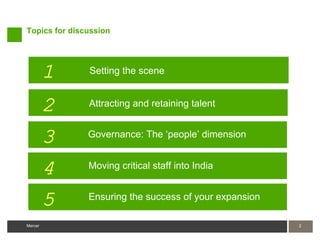
Topics for discussion


         1     Setting the scene


         2     Attracting and retaining talent


         3     Governance: The ‘people’ dimension


         4     Moving critical staff into India


         5     Ensuring the success of your expansion

Mercer                                                  2
Setting the scene
India
Setting the scene
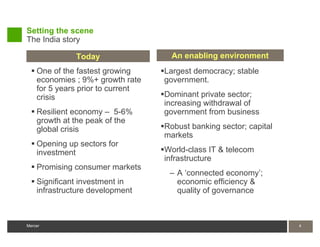
The India story

              Today                   An enabling environment
   One of the fastest growing     Largest democracy; stable
    economies ; 9%+ growth rate     government.
    for 5 years prior to current
    crisis                         Dominant private sector;
                                    increasing withdrawal of
   Resilient economy – 5-6%        government from business
    growth at the peak of the
    global crisis                  Robust banking sector; capital
                                    markets
   Opening up sectors for
    investment                     World-class IT & telecom
                                    infrastructure
   Promising consumer markets
                                     – A ‘connected economy’;
   Significant investment in          economic efficiency &
    infrastructure development         quality of governance


Mercer                                                               4
Setting the scene
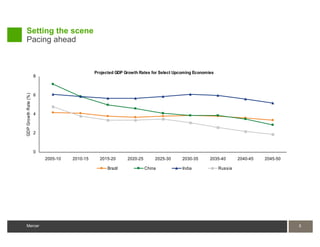
Pacing ahead


                                              Projected GDP Growth Rates for Select Upcoming Economies
                      8
GDP Growth Rate (%)


                      6


                      4


                      2


                      0
                          2005-10   2010-15     2015-20      2020-25       2025-30     2030-35      2035-40       2040-45   2045-50

                                                    Brazil             China           India             Russia


Mercer                                                                                                                                5
Setting the scene
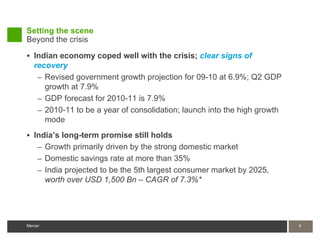
Beyond the crisis

 Indian economy coped well with the crisis; clear signs of
   recovery
    – Revised government growth projection for 09-10 at 6.9%; Q2 GDP
      growth at 7.9%
    – GDP forecast for 2010-11 is 7.9%
    – 2010-11 to be a year of consolidation; launch into the high growth
      mode
 India’s long-term promise still holds
     – Growth primarily driven by the strong domestic market
     – Domestic savings rate at more than 35%
     – India projected to be the 5th largest consumer market by 2025,
         worth over USD 1,500 Bn – CAGR of 7.3%*


Mercer                                                                     6
Attracting and retaining talent
Workforce trends
 Where we stand

       Population Median Age (In years)                    Ever expanding workforce

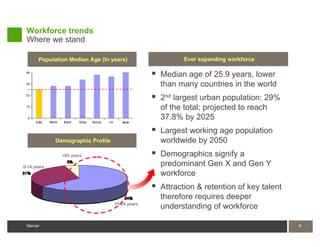
                                                    Median age of 25.9 years, lower
                                                     than many countries in the world
                                                    2nd largest urban population: 29%
                                                     of the total; projected to reach
                                                     37.8% by 2025
                                                    Largest working age population
             Demographic Profile                     worldwide by 2050
               >65 years                            Demographics signify a
0-14 years
                                                     predominant Gen X and Gen Y
                                                     workforce
                                                    Attraction & retention of key talent
                                                     therefore requires deeper
                                   15-64 years
                                                     understanding of workforce

 Mercer                                                                                     8
Understanding workforce expectations
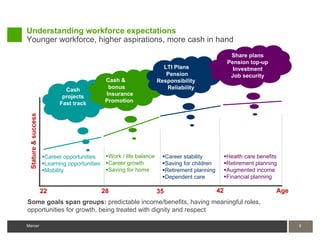
Younger workforce, higher aspirations, more cash in hand
                                                                                                     Share plans
                                                                                                    Pension top-up
                                                                       LTI Plans                      Investment
                                                                        Pension                      Job security
                                              Cash &                 Responsibility
                              Cash             bonus                    Reliability
                             projects         Insurance
                            Fast track        Promotion
  Stature & success


                      Career opportunities   Work / life balance     Career stability           Health care benefits
                      Learning opportunities Career growth           Saving for children        Retirement planning
                      Mobility               Saving for home         Retirement planning        Augmented income
                                                                       Dependent care             Financial planning

                      22                     28                      35                       42                       Age
Some goals span groups: predictable income/benefits, having meaningful roles,
opportunities for growth, being treated with dignity and respect

Mercer                                                                                                                       9
Managing workforce expectations
Approach to talent
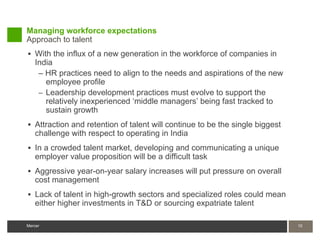
 With the influx of a new generation in the workforce of companies in
   India
    – HR practices need to align to the needs and aspirations of the new
      employee profile
    – Leadership development practices must evolve to support the
      relatively inexperienced ‘middle managers’ being fast tracked to
      sustain growth
 Attraction and retention of talent will continue to be the single biggest
   challenge with respect to operating in India
 In a crowded talent market, developing and communicating a unique
   employer value proposition will be a difficult task
 Aggressive year-on-year salary increases will put pressure on overall
   cost management
 Lack of talent in high-growth sectors and specialized roles could mean
   either higher investments in T&D or sourcing expatriate talent

Mercer                                                                        10
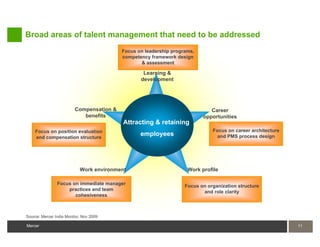
Broad areas of talent management that need to be addressed
                                          Focus on leadership programs,
                                          competency framework design
                                                 & assessment

                                                  Learning &
                                                 development


                         Compensation &                                      Career
                            benefits                                      opportunities
                                           Attracting & retaining
    Focus on position evaluation                                              Focus on career architecture
    and compensation structure
                                                 employees                      and PMS process design


                            Work environment                        Work profile

                Focus on immediate manager                         Focus on organization structure
                    practices and team                                    and role clarity
                       cohesiveness


Source: Mercer India Monitor, Nov 2009

Mercer                                                                                                       11
Governance
The ‘people’ dimension
Dimensions to governance


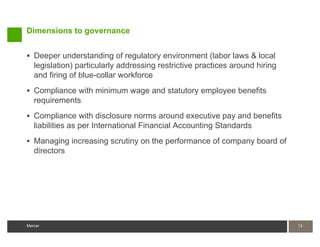
 Deeper understanding of regulatory environment (labor laws & local
   legislation) particularly addressing restrictive practices around hiring
   and firing of blue-collar workforce
 Compliance with minimum wage and statutory employee benefits
   requirements
 Compliance with disclosure norms around executive pay and benefits
   liabilities as per International Financial Accounting Standards
 Managing increasing scrutiny on the performance of company board of
   directors


Mercer                                                                        13
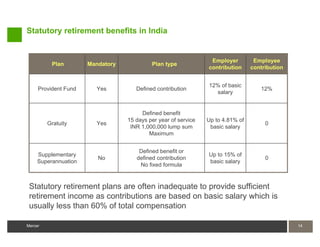
Statutory retirement benefits in India


                                                                 Employer         Employee
          Plan        Mandatory            Plan type
                                                                contribution     contribution


                                                                12% of basic
     Provident Fund     Yes          Defined contribution                           12%
                                                                  salary


                                       Defined benefit
                                  15 days per year of service   Up to 4.81% of
         Gratuity       Yes                                                           0
                                   INR 1,000,000 lump sum        basic salary
                                          Maximum


                                      Defined benefit or
     Supplementary                                              Up to 15% of
                         No          defined contribution                             0
     Superannuation                                             basic salary
                                      No fixed formula


 Statutory retirement plans are often inadequate to provide sufficient
 retirement income as contributions are based on basic salary which is
 usually less than 60% of total compensation

Mercer                                                                                          14
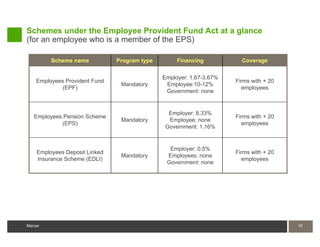
Schemes under the Employee Provident Fund Act at a glance
(for an employee who is a member of the EPS)

         Scheme name           Program type        Financing           Coverage


                                              Employer: 1.67-3.67%
    Employees Provident Fund                                         Firms with + 20
                                Mandatory      Employee:10-12%
             (EPF)                                                     employees
                                               Government: none


                                                Employer: 8.33%
   Employees Pension Scheme                                          Firms with + 20
                                Mandatory       Employee: none
            (EPS)                                                      employees
                                               Government: 1.16%


                                                Employer: 0.5%
    Employees Deposit Linked                                         Firms with + 20
                                Mandatory      Employees: none
    Insurance Scheme (EDLI)                                            employees
                                               Government: none


Mercer                                                                                 15
Driving pay governance through increasing board effectiveness


                                 Board of directors
                          Delegates authority to the committee

                                                          Monitors executive pay
                                                           from a shareholder
                                 Remuneration              perspective
                                                          Approves pay philosophy,
                                  committee
                                                           programs, and actions
                                                          Ensures good processes
                                                              Executive sessions
   Provides market                                           Transparency
    trends and
    financial analyses              Executives
   Ensures informed
    decisions based
                         Outside                   Internal           Provides
    on objective                                                       strategic and
    advice, not          advisors                 resources
                                                                       cultural context
    just data


Mercer                                                                                    16
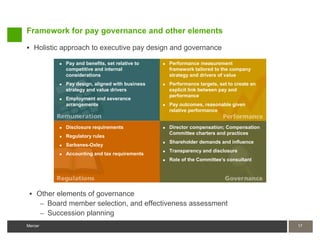
Framework for pay governance and other elements

 Holistic approach to executive pay design and governance

            Pay and benefits, set relative to      Performance measurement
             competitive and internal                framework tailored to the company
             considerations                          strategy and drivers of value
            Pay design, aligned with business      Performance targets, set to create an
             strategy and value drivers              explicit link between pay and
                                                     performance
            Employment and severance
             arrangements                           Pay outcomes, reasonable given
                                                     relative performance


            Disclosure requirements                Director compensation; Compensation
                                                     Committee charters and practices
            Regulatory rules
                                                    Shareholder demands and influence
            Sarbanes-Oxley
                                                    Transparency and disclosure
            Accounting and tax requirements
                                                    Role of the Committee’s consultant


  Other elements of governance
    – Board member selection, and effectiveness assessment
    – Succession planning
Mercer                                                                                       17
Moving critical staff to India
Employee mobility
International assignment issues in India
Employer perspective
 Talent readiness: Lack of skilled and readily employable talent in
  specialized roles requires companies to source expatriate talent
 Diminishing labor cost arbitrage in high-growth sectors

 Unavailability of reliable market intelligence and benchmarking data for
  tier 2 and tier 3 cities
 Managing employee mobility costs e.g. housing, hardship allowance
  and travel


Mercer                                                                       19
International assignment issues in India
Employee perspective

  Safety                               Medical care

  Cost of living                       Remote location

  Inability to obtain certain goods    Benefits

  Tax issues                           Pollution

  Work visas                           Internet access

  Quality of living                    Logistics

  SARS/Bird Flu/Pandemics              Schooling in rural areas

  Hardship                             Housing costs and availability

  Food                                 Cultural differences

  Language barriers                    Difficult living conditions

  Health concerns

Mercer                                                                    20
Ensuring the success of your expansion
M&A in India
Transactions in India
How M&A deals are done

 Regulated process
     – National-level regulatory agencies and processes, e.g.:
         Ministry of Commerce
         Foreign Investment Promotion Board
         Securities and Exchange board of India
     – Industry specific laws (e.g. BFSI sector highly regulated by
       watchdogs)


Mercer                                                                22
Transactions in India
How M&A deals are done cont’d

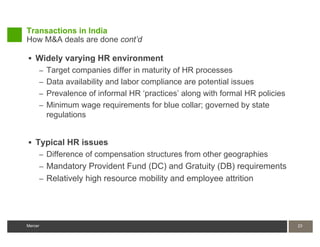
 Widely varying HR environment
     – Target companies differ in maturity of HR processes
     – Data availability and labor compliance are potential issues
     – Prevalence of informal HR ‘practices’ along with formal HR policies
     – Minimum wage requirements for blue collar; governed by state
         regulations


 Typical HR issues
     – Difference of compensation structures from other geographies
     – Mandatory Provident Fund (DC) and Gratuity (DB) requirements
     – Relatively high resource mobility and employee attrition


Mercer                                                                       23
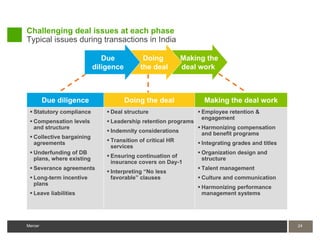
Challenging deal issues at each phase
Typical issues during transactions in India

                              Due            Doing           Making the
                           diligence        the deal         deal work


         Due diligence                 Doing the deal              Making the deal work
  Statutory compliance         Deal structure                   Employee retention &
                                                                   engagement
  Compensation levels          Leadership retention programs
   and structure                                                  Harmonizing compensation
                                Indemnity considerations          and benefit programs
  Collective bargaining
   agreements                   Transition of critical HR        Integrating grades and titles
                                 services
  Underfunding of DB                                             Organization design and
   plans, where existing        Ensuring continuation of          structure
                                 insurance covers on Day-1
  Severance agreements                                           Talent management
                                Interpreting “No less
  Long-term incentive           favorable” clauses               Culture and communication
   plans
                                                                  Harmonizing performance
  Leave liabilities                                               management systems


Mercer                                                                                             24
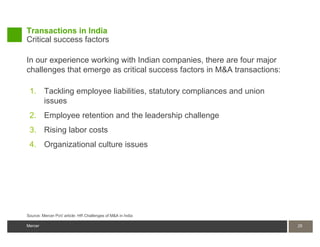
Transactions in India
Critical success factors

In our experience working with Indian companies, there are four major
challenges that emerge as critical success factors in M&A transactions:

 1. Tackling employee liabilities, statutory compliances and union
    issues
 2. Employee retention and the leadership challenge
 3. Rising labor costs
 4. Organizational culture issues


Source: Mercer PoV article: HR Challenges of M&A in India

Mercer                                                                    25
Questions?
Questions & answers


 Please use the Q&A panel on the bottom right hand of your screen to
   type your question
 To ask a question while in full screen mode, click on the question mark
   button on the floating panel at the bottom right hand side of your
   screen
 If there is not enough time to answer your question during the Q&A
   period, we will send you an answer by e-mail


Mercer                                                                      27
Additional information
Where to go for help
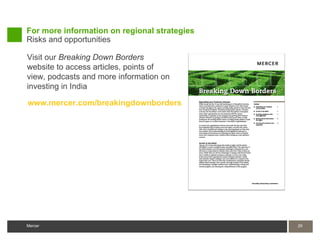
For more information on regional strategies
Risks and opportunities

Visit our Breaking Down Borders
website to access articles, points of
view, podcasts and more information on
investing in India

www.mercer.com/breakingdownborders


Mercer                                        29
Future markets in the Breaking down Borders webcast series


 Doing business in India
   Held                                     When:
                                            Webcasts will begin at
 Doing business in Japan                   the following times:
   26 November
                                            Delhi – 11:30 am
 Doing business in China                   Bangkok – 1:00 pm
   2 December                               Shanghai, Hong Kong,
                                            Singapore – 2:00 pm
 Doing business in Korea                   Seoul, Tokyo – 3:00 pm
   16 December                              Sydney – 4:00 pm

Additional markets will be added in 2011


www.mercer.com/breakingdownborders


Mercer                                                               30
www.mercer.com

Mercer bdb doing_business_in_india_nov_2010

  • 1.
    Breaking Down Borders Doingbusiness in India Padmaja Alaganandan Vijay Gopal www.mercer.com
  • 2.
    Today’s speakers Padmaja Alaganandan Vijay Gopal India Business Leader, Human Senior Associate, Human Capital Capital India padmaja.alaganandan@mercer.com vijay.gopal@mercer.com +91 9741522661 +91 9810049665 Mercer 1
  • 3.
    Topics for discussion 1 Setting the scene 2 Attracting and retaining talent 3 Governance: The ‘people’ dimension 4 Moving critical staff into India 5 Ensuring the success of your expansion Mercer 2
  • 4.
  • 5.
    Setting the scene TheIndia story Today An enabling environment  One of the fastest growing Largest democracy; stable economies ; 9%+ growth rate government. for 5 years prior to current crisis Dominant private sector; increasing withdrawal of  Resilient economy – 5-6% government from business growth at the peak of the global crisis Robust banking sector; capital markets  Opening up sectors for investment World-class IT & telecom infrastructure  Promising consumer markets – A ‘connected economy’;  Significant investment in economic efficiency & infrastructure development quality of governance Mercer 4
  • 6.
    Setting the scene Pacingahead Projected GDP Growth Rates for Select Upcoming Economies 8 GDP Growth Rate (%) 6 4 2 0 2005-10 2010-15 2015-20 2020-25 2025-30 2030-35 2035-40 2040-45 2045-50 Brazil China India Russia Mercer 5
  • 7.
    Setting the scene Beyondthe crisis  Indian economy coped well with the crisis; clear signs of recovery – Revised government growth projection for 09-10 at 6.9%; Q2 GDP growth at 7.9% – GDP forecast for 2010-11 is 7.9% – 2010-11 to be a year of consolidation; launch into the high growth mode  India’s long-term promise still holds – Growth primarily driven by the strong domestic market – Domestic savings rate at more than 35% – India projected to be the 5th largest consumer market by 2025, worth over USD 1,500 Bn – CAGR of 7.3%* Mercer 6
  • 8.
  • 9.
    Workforce trends Wherewe stand Population Median Age (In years) Ever expanding workforce  Median age of 25.9 years, lower than many countries in the world  2nd largest urban population: 29% of the total; projected to reach 37.8% by 2025  Largest working age population Demographic Profile worldwide by 2050 >65 years  Demographics signify a 0-14 years predominant Gen X and Gen Y workforce  Attraction & retention of key talent therefore requires deeper 15-64 years understanding of workforce Mercer 8
  • 10.
    Understanding workforce expectations Youngerworkforce, higher aspirations, more cash in hand Share plans Pension top-up LTI Plans Investment Pension Job security Cash & Responsibility Cash bonus Reliability projects Insurance Fast track Promotion Stature & success Career opportunities Work / life balance Career stability Health care benefits Learning opportunities Career growth Saving for children Retirement planning Mobility Saving for home Retirement planning Augmented income Dependent care Financial planning 22 28 35 42 Age Some goals span groups: predictable income/benefits, having meaningful roles, opportunities for growth, being treated with dignity and respect Mercer 9
  • 11.
    Managing workforce expectations Approachto talent  With the influx of a new generation in the workforce of companies in India – HR practices need to align to the needs and aspirations of the new employee profile – Leadership development practices must evolve to support the relatively inexperienced ‘middle managers’ being fast tracked to sustain growth  Attraction and retention of talent will continue to be the single biggest challenge with respect to operating in India  In a crowded talent market, developing and communicating a unique employer value proposition will be a difficult task  Aggressive year-on-year salary increases will put pressure on overall cost management  Lack of talent in high-growth sectors and specialized roles could mean either higher investments in T&D or sourcing expatriate talent Mercer 10
  • 12.
    Broad areas oftalent management that need to be addressed Focus on leadership programs, competency framework design & assessment Learning & development Compensation & Career benefits opportunities Attracting & retaining Focus on position evaluation Focus on career architecture and compensation structure employees and PMS process design Work environment Work profile Focus on immediate manager Focus on organization structure practices and team and role clarity cohesiveness Source: Mercer India Monitor, Nov 2009 Mercer 11
  • 13.
  • 14.
    Dimensions to governance Deeper understanding of regulatory environment (labor laws & local legislation) particularly addressing restrictive practices around hiring and firing of blue-collar workforce  Compliance with minimum wage and statutory employee benefits requirements  Compliance with disclosure norms around executive pay and benefits liabilities as per International Financial Accounting Standards  Managing increasing scrutiny on the performance of company board of directors Mercer 13
  • 15.
    Statutory retirement benefitsin India Employer Employee Plan Mandatory Plan type contribution contribution 12% of basic Provident Fund Yes Defined contribution 12% salary Defined benefit 15 days per year of service Up to 4.81% of Gratuity Yes 0 INR 1,000,000 lump sum basic salary Maximum Defined benefit or Supplementary Up to 15% of No defined contribution 0 Superannuation basic salary No fixed formula Statutory retirement plans are often inadequate to provide sufficient retirement income as contributions are based on basic salary which is usually less than 60% of total compensation Mercer 14
  • 16.
    Schemes under theEmployee Provident Fund Act at a glance (for an employee who is a member of the EPS) Scheme name Program type Financing Coverage Employer: 1.67-3.67% Employees Provident Fund Firms with + 20 Mandatory Employee:10-12% (EPF) employees Government: none Employer: 8.33% Employees Pension Scheme Firms with + 20 Mandatory Employee: none (EPS) employees Government: 1.16% Employer: 0.5% Employees Deposit Linked Firms with + 20 Mandatory Employees: none Insurance Scheme (EDLI) employees Government: none Mercer 15
  • 17.
    Driving pay governancethrough increasing board effectiveness Board of directors Delegates authority to the committee  Monitors executive pay from a shareholder Remuneration perspective  Approves pay philosophy, committee programs, and actions  Ensures good processes  Executive sessions  Provides market  Transparency trends and financial analyses Executives  Ensures informed decisions based Outside Internal  Provides on objective strategic and advice, not advisors resources cultural context just data Mercer 16
  • 18.
    Framework for paygovernance and other elements  Holistic approach to executive pay design and governance  Pay and benefits, set relative to  Performance measurement competitive and internal framework tailored to the company considerations strategy and drivers of value  Pay design, aligned with business  Performance targets, set to create an strategy and value drivers explicit link between pay and performance  Employment and severance arrangements  Pay outcomes, reasonable given relative performance  Disclosure requirements  Director compensation; Compensation Committee charters and practices  Regulatory rules  Shareholder demands and influence  Sarbanes-Oxley  Transparency and disclosure  Accounting and tax requirements  Role of the Committee’s consultant  Other elements of governance – Board member selection, and effectiveness assessment – Succession planning Mercer 17
  • 19.
    Moving critical staffto India Employee mobility
  • 20.
    International assignment issuesin India Employer perspective  Talent readiness: Lack of skilled and readily employable talent in specialized roles requires companies to source expatriate talent  Diminishing labor cost arbitrage in high-growth sectors  Unavailability of reliable market intelligence and benchmarking data for tier 2 and tier 3 cities  Managing employee mobility costs e.g. housing, hardship allowance and travel Mercer 19
  • 21.
    International assignment issuesin India Employee perspective  Safety  Medical care  Cost of living  Remote location  Inability to obtain certain goods  Benefits  Tax issues  Pollution  Work visas  Internet access  Quality of living  Logistics  SARS/Bird Flu/Pandemics  Schooling in rural areas  Hardship  Housing costs and availability  Food  Cultural differences  Language barriers  Difficult living conditions  Health concerns Mercer 20
  • 22.
    Ensuring the successof your expansion M&A in India
  • 23.
    Transactions in India HowM&A deals are done  Regulated process – National-level regulatory agencies and processes, e.g.:  Ministry of Commerce  Foreign Investment Promotion Board  Securities and Exchange board of India – Industry specific laws (e.g. BFSI sector highly regulated by watchdogs) Mercer 22
  • 24.
    Transactions in India HowM&A deals are done cont’d  Widely varying HR environment – Target companies differ in maturity of HR processes – Data availability and labor compliance are potential issues – Prevalence of informal HR ‘practices’ along with formal HR policies – Minimum wage requirements for blue collar; governed by state regulations  Typical HR issues – Difference of compensation structures from other geographies – Mandatory Provident Fund (DC) and Gratuity (DB) requirements – Relatively high resource mobility and employee attrition Mercer 23
  • 25.
    Challenging deal issuesat each phase Typical issues during transactions in India Due Doing Making the diligence the deal deal work Due diligence Doing the deal Making the deal work  Statutory compliance  Deal structure  Employee retention & engagement  Compensation levels  Leadership retention programs and structure  Harmonizing compensation  Indemnity considerations and benefit programs  Collective bargaining agreements  Transition of critical HR  Integrating grades and titles services  Underfunding of DB  Organization design and plans, where existing  Ensuring continuation of structure insurance covers on Day-1  Severance agreements  Talent management  Interpreting “No less  Long-term incentive favorable” clauses  Culture and communication plans  Harmonizing performance  Leave liabilities management systems Mercer 24
  • 26.
    Transactions in India Criticalsuccess factors In our experience working with Indian companies, there are four major challenges that emerge as critical success factors in M&A transactions: 1. Tackling employee liabilities, statutory compliances and union issues 2. Employee retention and the leadership challenge 3. Rising labor costs 4. Organizational culture issues Source: Mercer PoV article: HR Challenges of M&A in India Mercer 25
  • 27.
  • 28.
    Questions & answers Please use the Q&A panel on the bottom right hand of your screen to type your question  To ask a question while in full screen mode, click on the question mark button on the floating panel at the bottom right hand side of your screen  If there is not enough time to answer your question during the Q&A period, we will send you an answer by e-mail Mercer 27
  • 29.
  • 30.
    For more informationon regional strategies Risks and opportunities Visit our Breaking Down Borders website to access articles, points of view, podcasts and more information on investing in India www.mercer.com/breakingdownborders Mercer 29
  • 31.
    Future markets inthe Breaking down Borders webcast series  Doing business in India Held When: Webcasts will begin at  Doing business in Japan the following times: 26 November Delhi – 11:30 am  Doing business in China Bangkok – 1:00 pm 2 December Shanghai, Hong Kong, Singapore – 2:00 pm  Doing business in Korea Seoul, Tokyo – 3:00 pm 16 December Sydney – 4:00 pm Additional markets will be added in 2011 www.mercer.com/breakingdownborders Mercer 30
  • 32.