Re-Evaluating
Masculinities for
SRH and GBV
Programming
Key findings, Gaps and
Recommendations from the Mardon
Wali Baatein Research Project
Research Question and Objectives
How are masculinities constituted and expressed by young college-going
men in urban Uttar Pradesh?
• To explore the intersections between gender, sexuality, caste, class
and religion in discussions on masculinities
• To probe the impact of social media (especially apps such as Facebook
and Whatsapp) on masculinities
• To explore the value of relationships such as friendships, love, marriage
and infidelity for men
• To probe men’s perceptions around consent, sexual health,
contraception and violence
Research Design
• 3 locations – Lucknow, Benaras and Aligarh
• Purposive Snowball Sampling – over 80 young men (18-26 years)
• Diverse sample – college-going men, working class men, men from
multiple castes and religions, men from LGBTQIA+ community
• Tools – FGDs, IDIs and life history mapping
Summary of Key
Findings
Theme 1: Intersectionalities
Gender Norms
❑Courage, fortuitous,
physical strength, ability
to stand up against
anyone alone
❑“fair skin vs. dark skin”
❑Socialization of
competition among men
❑Multiple, sometimes
contrasting behavioural
codes
❑Sense of alienation and
loss of selfhood among
young men
Caste
❑ “Thakur boys don’t walk like
this! Thakur men must eat a
lot.”
❑ Caste-based hierarchies
become more glaring in
schools and university
spaces
❑ Challenges to lower caste
masculinities and limits to
upper caste masculinities in
the everyday
Masculine Spaces
❑Household interpreted
as a “feminine space”
❑Difference in
masculinities and
femininities within the
household
❑Socialization and
policing of masculinities
at the house, school
❑Contested masculinities
in universities; conflicts
and masculine violence
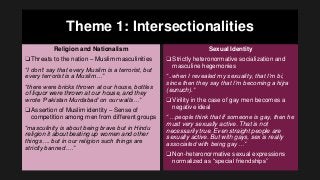
Theme 1: Intersectionalities
Religion and Nationalism
❑Threats to the nation – Muslim masculinities
“I don’t say that every Muslim is a terrorist, but
every terrorist is a Muslim…”
“there were bricks thrown at our house, bottles
of liquor were thrown at our house, and they
wrote ‘Pakistan Murdabad’ on our walls…”
❑Assertion of Muslim identity – Sense of
competition among men from different groups
“masculinity is about being brave but in Hindu
religion it about beating up women and other
things…. but in our religion such things are
strictly banned….”
Sexual Identity
❑Strictly heteronormative socialization and
masculine hegemonies
“..when I revealed my sexuality, that I’m bi,
since then they say that I’m becoming a hijra
(eunuch).”
❑Virility in the case of gay men becomes a
negative ideal
“…people think that if someone is gay, then he
must very sexually active. That is not
necessarily true. Even straight people are
sexually active. But with gays, sex is really
associated with being gay…”
❑Non-heteronormative sexual expressions
normalized as “special friendships”
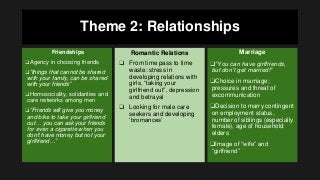
Theme 2: Relationships
Friendships
❑Agency in choosing friends
❑“things that cannot be shared
with your family, can be shared
with your friends”
❑Homosociality, solidarities and
care networks among men
❑“Friends will give you money
and bike to take your girlfriend
out… you can ask your friends
for even a cigarette when you
don’t have money but not your
girlfriend…”
Romantic Relations
❑ From time pass to time
waste: stress in
developing relations with
girls, “taking your
girlfriend out”, depression
and betrayal
❑ Looking for male care
seekers and developing
‘bromances’
Marriage
❑“You can have girlfriends,
but don’t get married!”
❑Choice in marriage;
pressures and threat of
excommunication
❑Decision to marry contingent
on employment status,
number of siblings (especially
female), age of household
elders
❑Image of “wife” and
“girlfriend”
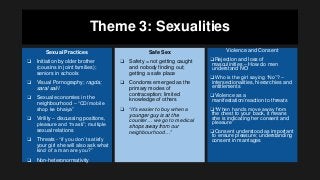
Theme 3: Sexualities
Sexual Practices
❑ Initiation by older brother
(cousins in joint families);
seniors in schools
❑ Visual Pornography; ragda;
saral salil
❑ Sexual economies in the
neighbourhood – “CD/mobile
shop ke bhaiya”
❑ Virility – discussing positions,
pleasure and “masti”; multiple
sexual relations
❑ Threats - “if you don’t satisfy
your girl she will also ask what
kind of a man are you?”
❑ Non-heteronormativity
Safe Sex
❑ Safety = not getting caught
and nobody finding out;
getting a safe place
❑ Condoms emerged as the
primary modes of
contraception; limited
knowledge of others
❑ “It’s easier to buy when a
younger guy is at the
counter… we go to medical
shops away from our
neighbourhood…”
Violence and Consent
❑Rejection and loss of
masculinities – How do men
understand NO
❑Who is the girl saying “No”? –
intersectionalities, hierarchies and
entitlements
❑Violence as a
manifestation/reaction to threats
❑“When hands move away from
the chest to your back, it means
she is indicating her consent and
pleasure”
❑Consent understood as important
to ensure pleasure; understanding
consent in marriages
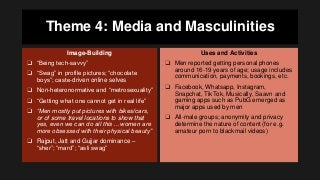
Theme 4: Media and Masculinities
Image-Building
❑ “Being tech-savvy”
❑ “Swag” in profile pictures; “chocolate
boys”; caste-driven online selves
❑ Non-heteronormative and “metrosexuality”
❑ “Getting what one cannot get in real life”
❑ “Men mostly put pictures with bikes/cars,
or of some travel locations to show that
yes, even we can do all this… women are
more obsessed with their physical beauty”
❑ Rajput, Jatt and Gujjar dominance –
“sher”; “mard”; “asli swag”
Uses and Activities
❑ Men reported getting personal phones
around 16-19 years of age; usage includes
communication, payments, bookings, etc.
❑ Facebook, Whatsapp, Instagram,
Snapchat, TikTok, Musically, Saavn and
gaming apps such as PubG emerged as
major apps used by men
❑ All-male groups; anonymity and privacy
determine the nature of content (for e.g.
amateur porn to blackmail videos)
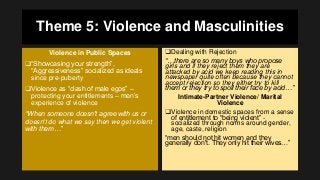
Theme 5: Violence and Masculinities
Violence in Public Spaces
❑“Showcasing your strength”,
“Aggressiveness” socialized as ideals
since pre-puberty
❑Violence as “clash of male egos” –
protecting your entitlements – men’s
experience of violence
“When someone doesn't agree with us or
doesn't do what we say then we get violent
with them…”
❑Dealing with Rejection
“…there are so many boys who propose
girls and if they reject them they are
attacked by acid we keep reading this in
newspaper quite often because they cannot
accept rejection so they either try to kill
them or they try to spoil their face by acid…”
Intimate-Partner Violence/ Marital
Violence
❑Violence in domestic spaces from a sense
of entitlement to “being violent” -
socialized through norms around gender,
age, caste, religion
“men should not hit women and they
generally don't. They only hit their wives…”
Gaps in Programming with Men and
Recommendations
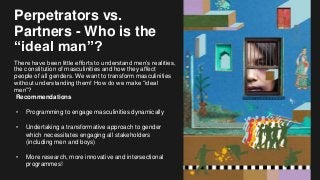
Perpetrators vs.
Partners - Who is the
“ideal man”?
There have been little efforts to understand men’s realities,
the constitution of masculinities and how they affect
people of all genders. We want to transform masculinities
without understanding them! How do we make “ideal
men”?
Recommendations
• Programming to engage masculinities dynamically
• Undertaking a transformative approach to gender
which necessitates engaging all stakeholders
(including men and boys)
• More research, more innovative and intersectional
programmes!
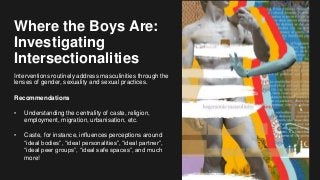
Where the Boys Are:
Investigating
Intersectionalities
Interventions routinely address masculinities through the
lenses of gender, sexuality and sexual practices.
Recommendations
• Understanding the centrality of caste, religion,
employment, migration, urbanisation, etc.
• Caste, for instance, influences perceptions around
“ideal bodies”, “ideal personalities”, “ideal partner”,
“ideal peer groups”, “ideal safe spaces”, and much
more!
Higher Attrition Rates
and Lower
Participation Rates
● Men can seldom associate to the conversations we
have inside curriculum spaces as their stories are not
integrated - except as perpetrators or changemakers.
● Conversations are more often than not about male
privilege, which is important, but not sufficient.
Recommendations
• Being intersectional means that you have to hold both
privileges and vulnerabilities in a single conversation
• Identifying safe spaces we want to create for men to
share and reflect – how would these look like if we
wish to make these inclusive and open?
‘Teaching’ Consent vs.
Addressing
Masculinities:
competition and
rejection?Concepts such as dhoka routinely come up in our
conversations with men and despite this, few interventions
talk to men about dealing with rejection
Consent is conveyed as a universal concept, without taking
into account men’s differential valuation of the same
Recommendations
Sessions should integrate the idea of consent with
masculinities, competition and the impact of rejection on
men’s sense of self.
It’s important to have conversations around dealing with
rejection.
Evaluating
methodologies of
working with Men and
Boys● Lack of comprehensive evaluation frameworks and
efficient indicators to measure work with boys and men
● Lack of integration of gender transformative approach in
our evaluation systems
Recommendations
• Developing robust and contextualized monitoring indicators
through in-depth research and innovation
• Indicators that capture men’s agency and negotiating
power with patriarchy
• Not tying monitoring indicators with programmatic
outcomes simply but rather developing indicators that
capture trajectories of change
Taking the research further…
Programming during a Pandemic: Impact
of COVID-19 on Men and Masculinities
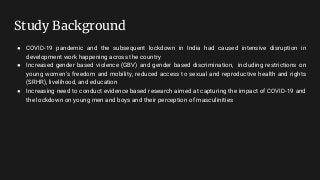
Study Background
● COVID-19 pandemic and the subsequent lockdown in India had caused intensive disruption in
development work happening across the country
● Increased gender based violence (GBV) and gender based discrimination, including restrictions on
young women’s freedom and mobility, reduced access to sexual and reproductive health and rights
(SRHR), livelihood, and education
● Increasing need to conduct evidence based research aimed at capturing the impact of COVID-19 and
the lockdown on young men and boys and their perception of masculinities
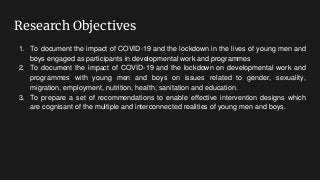
Research Objectives
1. To document the impact of COVID-19 and the lockdown in the lives of young men and
boys engaged as participants in developmental work and programmes
2. To document the impact of COVID-19 and the lockdown on developmental work and
programmes with young men and boys on issues related to gender, sexuality,
migration, employment, nutrition, health, sanitation and education.
3. To prepare a set of recommendations to enable effective intervention designs which
are cognisant of the multiple and interconnected realities of young men and boys.
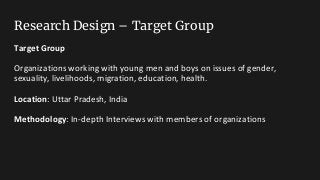
Research Design – Target Group
Target Group
Organizations working with young men and boys on issues of gender,
sexuality, livelihoods, migration, education, health.
Location: Uttar Pradesh, India
Methodology: In-depth Interviews with members of organizations
Thank you! ☺

APCRSHR10 Virtual abstract presentation of Sagar Sachdeva

  • 1.
    Re-Evaluating Masculinities for SRH andGBV Programming Key findings, Gaps and Recommendations from the Mardon Wali Baatein Research Project
  • 2.
    Research Question andObjectives How are masculinities constituted and expressed by young college-going men in urban Uttar Pradesh? • To explore the intersections between gender, sexuality, caste, class and religion in discussions on masculinities • To probe the impact of social media (especially apps such as Facebook and Whatsapp) on masculinities • To explore the value of relationships such as friendships, love, marriage and infidelity for men • To probe men’s perceptions around consent, sexual health, contraception and violence
  • 3.
    Research Design • 3locations – Lucknow, Benaras and Aligarh • Purposive Snowball Sampling – over 80 young men (18-26 years) • Diverse sample – college-going men, working class men, men from multiple castes and religions, men from LGBTQIA+ community • Tools – FGDs, IDIs and life history mapping
  • 4.
  • 5.
    Theme 1: Intersectionalities GenderNorms ❑Courage, fortuitous, physical strength, ability to stand up against anyone alone ❑“fair skin vs. dark skin” ❑Socialization of competition among men ❑Multiple, sometimes contrasting behavioural codes ❑Sense of alienation and loss of selfhood among young men Caste ❑ “Thakur boys don’t walk like this! Thakur men must eat a lot.” ❑ Caste-based hierarchies become more glaring in schools and university spaces ❑ Challenges to lower caste masculinities and limits to upper caste masculinities in the everyday Masculine Spaces ❑Household interpreted as a “feminine space” ❑Difference in masculinities and femininities within the household ❑Socialization and policing of masculinities at the house, school ❑Contested masculinities in universities; conflicts and masculine violence
  • 6.
    Theme 1: Intersectionalities Religionand Nationalism ❑Threats to the nation – Muslim masculinities “I don’t say that every Muslim is a terrorist, but every terrorist is a Muslim…” “there were bricks thrown at our house, bottles of liquor were thrown at our house, and they wrote ‘Pakistan Murdabad’ on our walls…” ❑Assertion of Muslim identity – Sense of competition among men from different groups “masculinity is about being brave but in Hindu religion it about beating up women and other things…. but in our religion such things are strictly banned….” Sexual Identity ❑Strictly heteronormative socialization and masculine hegemonies “..when I revealed my sexuality, that I’m bi, since then they say that I’m becoming a hijra (eunuch).” ❑Virility in the case of gay men becomes a negative ideal “…people think that if someone is gay, then he must very sexually active. That is not necessarily true. Even straight people are sexually active. But with gays, sex is really associated with being gay…” ❑Non-heteronormative sexual expressions normalized as “special friendships”
  • 7.
    Theme 2: Relationships Friendships ❑Agencyin choosing friends ❑“things that cannot be shared with your family, can be shared with your friends” ❑Homosociality, solidarities and care networks among men ❑“Friends will give you money and bike to take your girlfriend out… you can ask your friends for even a cigarette when you don’t have money but not your girlfriend…” Romantic Relations ❑ From time pass to time waste: stress in developing relations with girls, “taking your girlfriend out”, depression and betrayal ❑ Looking for male care seekers and developing ‘bromances’ Marriage ❑“You can have girlfriends, but don’t get married!” ❑Choice in marriage; pressures and threat of excommunication ❑Decision to marry contingent on employment status, number of siblings (especially female), age of household elders ❑Image of “wife” and “girlfriend”
  • 8.
    Theme 3: Sexualities SexualPractices ❑ Initiation by older brother (cousins in joint families); seniors in schools ❑ Visual Pornography; ragda; saral salil ❑ Sexual economies in the neighbourhood – “CD/mobile shop ke bhaiya” ❑ Virility – discussing positions, pleasure and “masti”; multiple sexual relations ❑ Threats - “if you don’t satisfy your girl she will also ask what kind of a man are you?” ❑ Non-heteronormativity Safe Sex ❑ Safety = not getting caught and nobody finding out; getting a safe place ❑ Condoms emerged as the primary modes of contraception; limited knowledge of others ❑ “It’s easier to buy when a younger guy is at the counter… we go to medical shops away from our neighbourhood…” Violence and Consent ❑Rejection and loss of masculinities – How do men understand NO ❑Who is the girl saying “No”? – intersectionalities, hierarchies and entitlements ❑Violence as a manifestation/reaction to threats ❑“When hands move away from the chest to your back, it means she is indicating her consent and pleasure” ❑Consent understood as important to ensure pleasure; understanding consent in marriages
  • 9.
    Theme 4: Mediaand Masculinities Image-Building ❑ “Being tech-savvy” ❑ “Swag” in profile pictures; “chocolate boys”; caste-driven online selves ❑ Non-heteronormative and “metrosexuality” ❑ “Getting what one cannot get in real life” ❑ “Men mostly put pictures with bikes/cars, or of some travel locations to show that yes, even we can do all this… women are more obsessed with their physical beauty” ❑ Rajput, Jatt and Gujjar dominance – “sher”; “mard”; “asli swag” Uses and Activities ❑ Men reported getting personal phones around 16-19 years of age; usage includes communication, payments, bookings, etc. ❑ Facebook, Whatsapp, Instagram, Snapchat, TikTok, Musically, Saavn and gaming apps such as PubG emerged as major apps used by men ❑ All-male groups; anonymity and privacy determine the nature of content (for e.g. amateur porn to blackmail videos)
  • 10.
    Theme 5: Violenceand Masculinities Violence in Public Spaces ❑“Showcasing your strength”, “Aggressiveness” socialized as ideals since pre-puberty ❑Violence as “clash of male egos” – protecting your entitlements – men’s experience of violence “When someone doesn't agree with us or doesn't do what we say then we get violent with them…” ❑Dealing with Rejection “…there are so many boys who propose girls and if they reject them they are attacked by acid we keep reading this in newspaper quite often because they cannot accept rejection so they either try to kill them or they try to spoil their face by acid…” Intimate-Partner Violence/ Marital Violence ❑Violence in domestic spaces from a sense of entitlement to “being violent” - socialized through norms around gender, age, caste, religion “men should not hit women and they generally don't. They only hit their wives…”
  • 11.
    Gaps in Programmingwith Men and Recommendations
  • 12.
    Perpetrators vs. Partners -Who is the “ideal man”? There have been little efforts to understand men’s realities, the constitution of masculinities and how they affect people of all genders. We want to transform masculinities without understanding them! How do we make “ideal men”? Recommendations • Programming to engage masculinities dynamically • Undertaking a transformative approach to gender which necessitates engaging all stakeholders (including men and boys) • More research, more innovative and intersectional programmes!
  • 13.
    Where the BoysAre: Investigating Intersectionalities Interventions routinely address masculinities through the lenses of gender, sexuality and sexual practices. Recommendations • Understanding the centrality of caste, religion, employment, migration, urbanisation, etc. • Caste, for instance, influences perceptions around “ideal bodies”, “ideal personalities”, “ideal partner”, “ideal peer groups”, “ideal safe spaces”, and much more!
  • 14.
    Higher Attrition Rates andLower Participation Rates ● Men can seldom associate to the conversations we have inside curriculum spaces as their stories are not integrated - except as perpetrators or changemakers. ● Conversations are more often than not about male privilege, which is important, but not sufficient. Recommendations • Being intersectional means that you have to hold both privileges and vulnerabilities in a single conversation • Identifying safe spaces we want to create for men to share and reflect – how would these look like if we wish to make these inclusive and open?
  • 15.
    ‘Teaching’ Consent vs. Addressing Masculinities: competitionand rejection?Concepts such as dhoka routinely come up in our conversations with men and despite this, few interventions talk to men about dealing with rejection Consent is conveyed as a universal concept, without taking into account men’s differential valuation of the same Recommendations Sessions should integrate the idea of consent with masculinities, competition and the impact of rejection on men’s sense of self. It’s important to have conversations around dealing with rejection.
  • 16.
    Evaluating methodologies of working withMen and Boys● Lack of comprehensive evaluation frameworks and efficient indicators to measure work with boys and men ● Lack of integration of gender transformative approach in our evaluation systems Recommendations • Developing robust and contextualized monitoring indicators through in-depth research and innovation • Indicators that capture men’s agency and negotiating power with patriarchy • Not tying monitoring indicators with programmatic outcomes simply but rather developing indicators that capture trajectories of change
  • 17.
    Taking the researchfurther… Programming during a Pandemic: Impact of COVID-19 on Men and Masculinities
  • 18.
    Study Background ● COVID-19pandemic and the subsequent lockdown in India had caused intensive disruption in development work happening across the country ● Increased gender based violence (GBV) and gender based discrimination, including restrictions on young women’s freedom and mobility, reduced access to sexual and reproductive health and rights (SRHR), livelihood, and education ● Increasing need to conduct evidence based research aimed at capturing the impact of COVID-19 and the lockdown on young men and boys and their perception of masculinities
  • 19.
    Research Objectives 1. Todocument the impact of COVID-19 and the lockdown in the lives of young men and boys engaged as participants in developmental work and programmes 2. To document the impact of COVID-19 and the lockdown on developmental work and programmes with young men and boys on issues related to gender, sexuality, migration, employment, nutrition, health, sanitation and education. 3. To prepare a set of recommendations to enable effective intervention designs which are cognisant of the multiple and interconnected realities of young men and boys.
  • 20.
    Research Design –Target Group Target Group Organizations working with young men and boys on issues of gender, sexuality, livelihoods, migration, education, health. Location: Uttar Pradesh, India Methodology: In-depth Interviews with members of organizations
  • 21.