Eris and Ethereum
Decentralized computing on a blockchain
Aron van Ammers
Blockstars.io
A bit about me
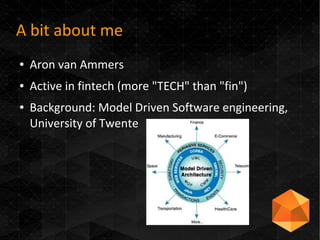
● Aron van Ammers
● Active in fintech (more "TECH" than "fin")
● Background: Model Driven Software engineering,
University of Twente
A bit about me
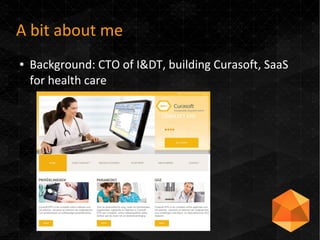
● Background: CTO of I&DT, building Curasoft, SaaS
for health care
Down the rabbit hole
● 2014: time for a change
● What's happening?
– Bitcoin
– Cryptocurrency
– Smart contracts
– Decentralization
● May 2014: Certinio, independent consultant
Down the rabbit hole
● Nov 2014: Blockstars.io
● A full-service agency dedicated to designing,
developing, launching and managing Blockchain
businesses
● Projects
– MoneyCircles.com
– AssetCha.in
– Several other projects in stealth
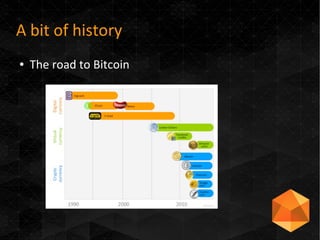
A bit of history
● The road to Bitcoin
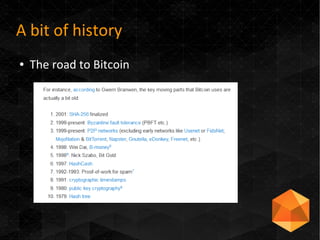
A bit of history
● The road to Bitcoin
Bitcoin: the first blockchain
● Solution to the "byzantine generals problem"
– A minority of bad actors can't game the system
● Digital scarcity
● Trustworthy ledger without the need to trust a
single party
Bitcoin: the first blockchain
● How does it work?
– Peer-to-peer technology
– A shared public "database"
– "Wasting" energy as a proof of work
– Easy to check, extremely hard to break
● More or less detailed explanations of the "how"
available on demand
So what is a blockchain?
● Wikipedia:
– "...a distributed database that serves as a public
ledger.."
So what is a blockchain?
● Vitalik Buterin (Ethereum founder):
– "A blockchain is a magic computer that anyone can upload
programs to and leave the programs to self-execute, where
the current and all previous states of every program are
always publicly visible, and which carries a very strong
cryptoeconomically secured guarantee that programs
running on the chain will continue to execute in exactly the
way that the blockchain protocol specifies."
https://blog.ethereum.org/2015/04/13/visions-part-1-the-value
So what is a blockchain?
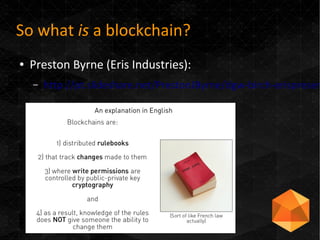
● Preston Byrne (Eris Industries):
– http://pt.slideshare.net/PrestonJByrne/dgw-birch-erispresen
"Bitcoin 2.0"
● After the success of Bitcoin and its limits, a lot of initiatives to build "Bitcoin
2.0":
– Alternative coins or "altcoins"
– Sidechains
– Smart contracts
– Smart assets
– Crypto-equity
– ...
● Our take:
– Distributed, decentralized, verifiable information systems that possibly have an
economic aspect to them.
Decentralized applications
● Both Ethereum and Eris are platforms for building
decentralized applications or "DApps"
● Away from the client-server model
● Freedom?
Decentralized applications
● Like Bitcoin is "decentralized money" (or money of the people),
DApps allow "decentralized computing" or (apps of the people)
● Decentralized development leads to fundamental questions:
– What is money?
– What is identity?
– What is reputation?
– What is a business?
– What is a government?
Decentralized applications: why?
● Trust
● Traceability
● Verifiability
● Preventing concentration of power
Ethereum
Ethereum
● Building a new blockchain from scratch
● "Computer on a blockchain" (very slow, but very
trustworthy)
● Single, public blockchain like Bitcoin
● Many implementations
● Infinite possibilities
– which may or may not be practical and useful
Ethereum: culture
● Crowd funded
● Open source
● No commercial motives
● "hackers and hippies"
● Politically motivated
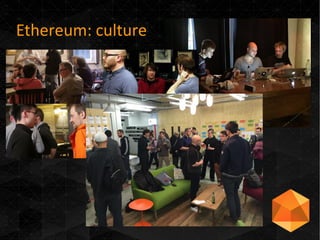
Ethereum: culture
Ethereum: business
● But: "big corp" is watching and taking part
● IBM/Samsung ADEPT
– Ethereum fork
– Connected washing
machine that is a
financial actor
Ethereum: how does it work?
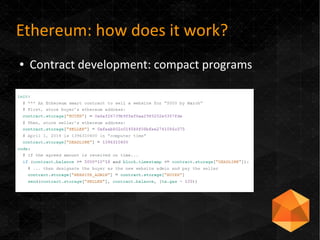
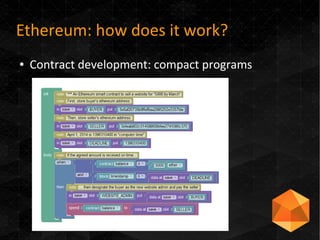
● The blockchain contains "contracts", which are
compact computer programs
● Every node in the network verifies the execution
● Every user can create a contract
● All transactions cost a small amount of
cryptocurrency
Ethereum: how does it work?
● Contract development: compact programs
Ethereum: how does it work?
● Contract development: compact programs
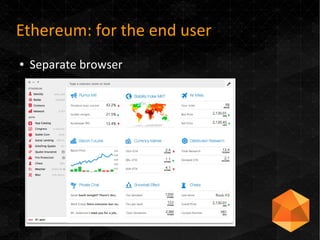
Ethereum: for the end user
● Separate browser
Ethereum for the end user
● Or in every browser?
● Problem: security
Ethereum for the end user
● Access by end users is an unsolved problem for all
"crypto 2.0" platforms
– Low barrier to entry
– Usable security
Ethereum: state of the platform
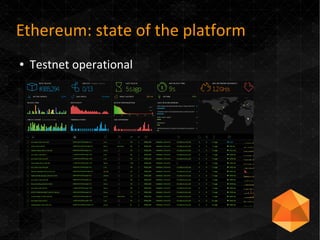
● Testnet operational
Ethereum: state of the platform
● Early days
● Development environment is stabilizing
● Many applications / businesses are being built
● No projects in production yet
Ethereum: state of the platform
● Whisper: secure direct communication
● Swarm: secure file storage
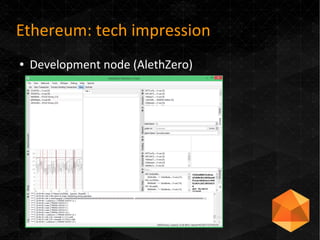
Ethereum: tech impression
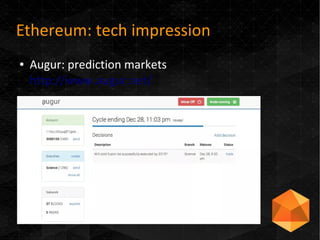
● Augur: prediction markets
http://www.augur.net/
Ethereum: tech impression
● Development node (AlethZero)
Eris Industries
● "Fork" (clone) of Ethereum
● Building a platform for
the enterprise
● Strong legal background
● A playful bunch of people
Eris Industries vs Ethereum
● Not "one true blockchain", but millions of them
● Blockchains are useful for closed and open purposes
● Applications may or may not have a financial aspect
● Blockchains have permissions (and hence
controllers)
Eris Industries
● File storage: builds on IPFS (independent)
● No parallel for Whisper yet
Eris Industries: state of the platform
● More stable
● Well-documented toolset
● Commercial support
● But also early days. Ready for development, not
ready for apps in production.
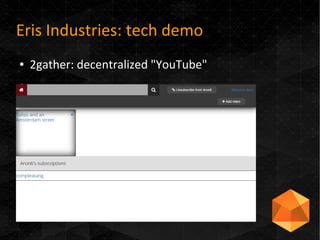
Eris Industries: tech demo
● 2gather: decentralized "YouTube"
●
Case studies
● What are your challenges?
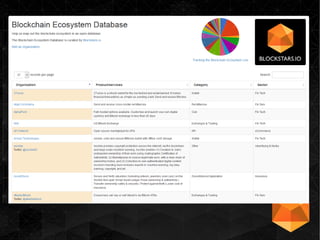
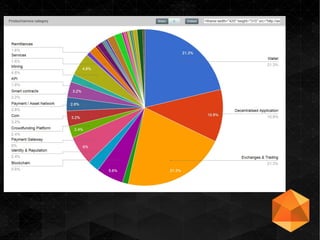
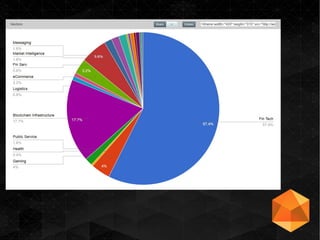
Tracking the blockchain ecosystem
● 200+ blockchain startups
● Financial and non-financial
● Big, small, non-profit, corporate
https://www.blockstars.io/ecosystem
Impact for future development
● Software and devices as economic actors
● The question of "What is money" will be further
debated
● As will revenue models, business structures,
government, …
● Much more secure software altogether
● From "client-server" to "participatory architecture"
Contact
@aronvanammers
@blockstarsio
Slides will be on:
http://www.slideshare.net/Blockstarsio

Eris and Ethereum - Decentralized computing on a blockchain

  • 1.
    Eris and Ethereum Decentralizedcomputing on a blockchain Aron van Ammers Blockstars.io
  • 2.
    A bit aboutme ● Aron van Ammers ● Active in fintech (more "TECH" than "fin") ● Background: Model Driven Software engineering, University of Twente
  • 3.
    A bit aboutme ● Background: CTO of I&DT, building Curasoft, SaaS for health care
  • 4.
    Down the rabbithole ● 2014: time for a change ● What's happening? – Bitcoin – Cryptocurrency – Smart contracts – Decentralization ● May 2014: Certinio, independent consultant
  • 5.
    Down the rabbithole ● Nov 2014: Blockstars.io ● A full-service agency dedicated to designing, developing, launching and managing Blockchain businesses ● Projects – MoneyCircles.com – AssetCha.in – Several other projects in stealth
  • 6.
    A bit ofhistory ● The road to Bitcoin
  • 7.
    A bit ofhistory ● The road to Bitcoin
  • 8.
    Bitcoin: the firstblockchain ● Solution to the "byzantine generals problem" – A minority of bad actors can't game the system ● Digital scarcity ● Trustworthy ledger without the need to trust a single party
  • 9.
    Bitcoin: the firstblockchain ● How does it work? – Peer-to-peer technology – A shared public "database" – "Wasting" energy as a proof of work – Easy to check, extremely hard to break ● More or less detailed explanations of the "how" available on demand
  • 10.
    So what isa blockchain? ● Wikipedia: – "...a distributed database that serves as a public ledger.."
  • 11.
    So what isa blockchain? ● Vitalik Buterin (Ethereum founder): – "A blockchain is a magic computer that anyone can upload programs to and leave the programs to self-execute, where the current and all previous states of every program are always publicly visible, and which carries a very strong cryptoeconomically secured guarantee that programs running on the chain will continue to execute in exactly the way that the blockchain protocol specifies." https://blog.ethereum.org/2015/04/13/visions-part-1-the-value
  • 12.
    So what isa blockchain? ● Preston Byrne (Eris Industries): – http://pt.slideshare.net/PrestonJByrne/dgw-birch-erispresen
  • 13.
    "Bitcoin 2.0" ● Afterthe success of Bitcoin and its limits, a lot of initiatives to build "Bitcoin 2.0": – Alternative coins or "altcoins" – Sidechains – Smart contracts – Smart assets – Crypto-equity – ... ● Our take: – Distributed, decentralized, verifiable information systems that possibly have an economic aspect to them.
  • 14.
    Decentralized applications ● BothEthereum and Eris are platforms for building decentralized applications or "DApps" ● Away from the client-server model ● Freedom?
  • 15.
    Decentralized applications ● LikeBitcoin is "decentralized money" (or money of the people), DApps allow "decentralized computing" or (apps of the people) ● Decentralized development leads to fundamental questions: – What is money? – What is identity? – What is reputation? – What is a business? – What is a government?
  • 16.
    Decentralized applications: why? ●Trust ● Traceability ● Verifiability ● Preventing concentration of power
  • 17.
  • 18.
    Ethereum ● Building anew blockchain from scratch ● "Computer on a blockchain" (very slow, but very trustworthy) ● Single, public blockchain like Bitcoin ● Many implementations ● Infinite possibilities – which may or may not be practical and useful
  • 19.
    Ethereum: culture ● Crowdfunded ● Open source ● No commercial motives ● "hackers and hippies" ● Politically motivated
  • 20.
  • 21.
    Ethereum: business ● But:"big corp" is watching and taking part ● IBM/Samsung ADEPT – Ethereum fork – Connected washing machine that is a financial actor
  • 22.
    Ethereum: how doesit work? ● The blockchain contains "contracts", which are compact computer programs ● Every node in the network verifies the execution ● Every user can create a contract ● All transactions cost a small amount of cryptocurrency
  • 23.
    Ethereum: how doesit work? ● Contract development: compact programs
  • 24.
    Ethereum: how doesit work? ● Contract development: compact programs
  • 25.
    Ethereum: for theend user ● Separate browser
  • 26.
    Ethereum for theend user ● Or in every browser? ● Problem: security
  • 27.
    Ethereum for theend user ● Access by end users is an unsolved problem for all "crypto 2.0" platforms – Low barrier to entry – Usable security
  • 28.
    Ethereum: state ofthe platform ● Testnet operational
  • 29.
    Ethereum: state ofthe platform ● Early days ● Development environment is stabilizing ● Many applications / businesses are being built ● No projects in production yet
  • 30.
    Ethereum: state ofthe platform ● Whisper: secure direct communication ● Swarm: secure file storage
  • 31.
    Ethereum: tech impression ●Augur: prediction markets http://www.augur.net/
  • 32.
    Ethereum: tech impression ●Development node (AlethZero)
  • 33.
    Eris Industries ● "Fork"(clone) of Ethereum ● Building a platform for the enterprise ● Strong legal background ● A playful bunch of people
  • 34.
    Eris Industries vsEthereum ● Not "one true blockchain", but millions of them ● Blockchains are useful for closed and open purposes ● Applications may or may not have a financial aspect ● Blockchains have permissions (and hence controllers)
  • 35.
    Eris Industries ● Filestorage: builds on IPFS (independent) ● No parallel for Whisper yet
  • 36.
    Eris Industries: stateof the platform ● More stable ● Well-documented toolset ● Commercial support ● But also early days. Ready for development, not ready for apps in production.
  • 37.
    Eris Industries: techdemo ● 2gather: decentralized "YouTube" ●
  • 38.
    Case studies ● Whatare your challenges?
  • 39.
    Tracking the blockchainecosystem ● 200+ blockchain startups ● Financial and non-financial ● Big, small, non-profit, corporate https://www.blockstars.io/ecosystem
  • 43.
    Impact for futuredevelopment ● Software and devices as economic actors ● The question of "What is money" will be further debated ● As will revenue models, business structures, government, … ● Much more secure software altogether ● From "client-server" to "participatory architecture"
  • 44.
    Contact @aronvanammers @blockstarsio Slides will beon: http://www.slideshare.net/Blockstarsio