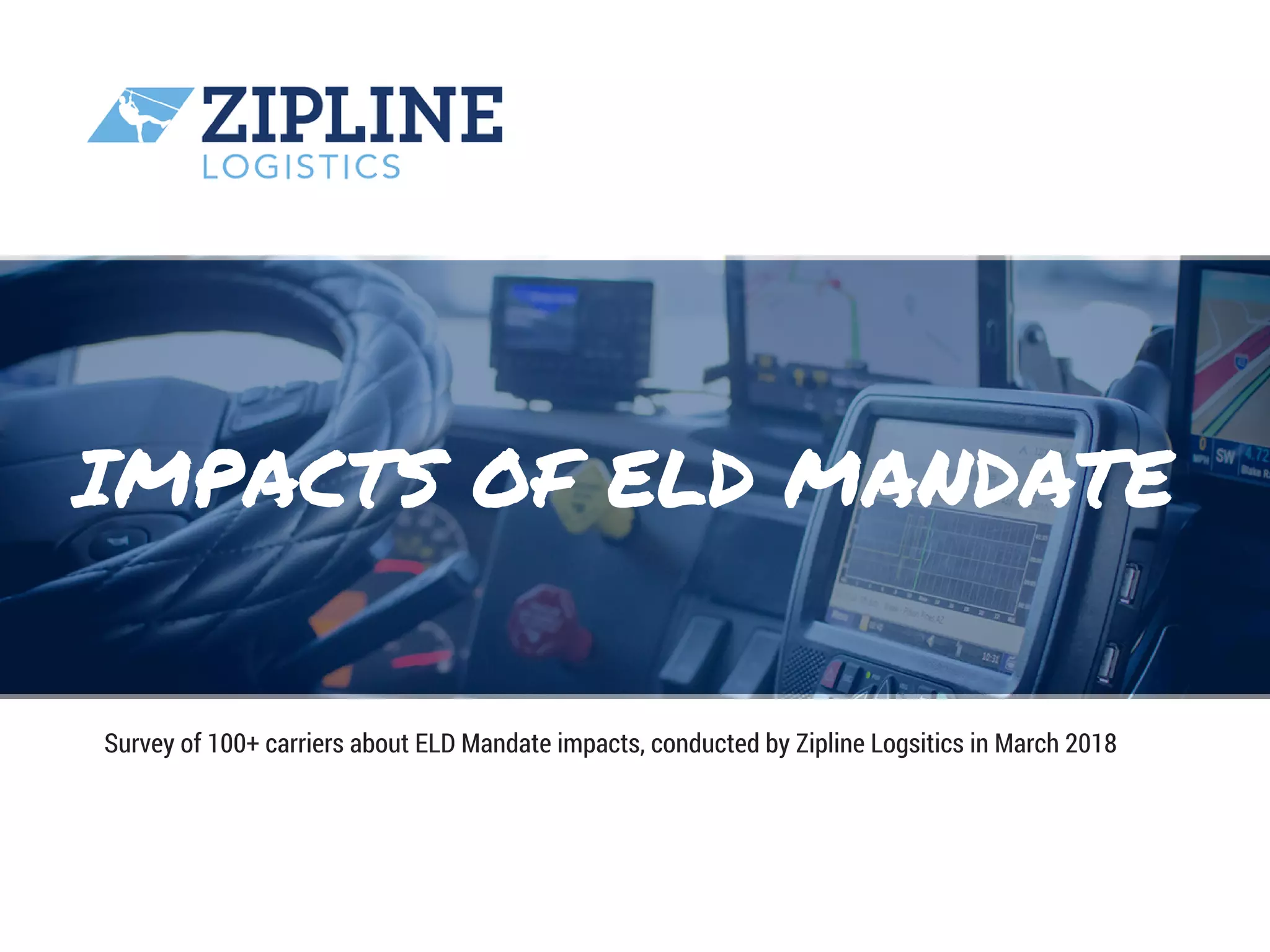
IMPACTS OF ELD MANDATE
60+ Years of Design + Innovation + Excellence
433 Fulton Street  New City New York City 10956a
Survey of 100+ carriers about ELD Mandate impacts, conducted by Zipline Logsitics in March 2018
Table of Contents
Summary
Key Findings
Survey Questions
On-time Deliveries
Productivity
Rates
Dispatching
Fleet Size
Morale
Safety
Page 4
Page 5
Page 7
Page 9
Page 10
Page 12
Page 14
Page 18
Page 20
“We chose to conduct this survey because the ELD
Mandate is one of the most significant regulatory
disruptions to the trucking industry in recent history.
It will have a ripple effect throughout supply chains
everywhere from truck drivers all the way to end
consumers. With this survey, we wanted to gain pointed
insight from the people who are primarily impacted by
the Mandate.”
3
- Mike Horn, Carrier Sales Representative, Zipline Logistics
Zipline Logistics will conduct similar surveys throughout the year to maintain a pulse on
ELD impacts and the larger trucking industry. 
ELD Survey Summary
Zipline Logistics, a third-party logistics service provider specializing in retail and
grocery transportation, surveyed more than 100 trucking companies of various
sizes about the Electronic Logging Device (ELD) Mandate.
The ELD Mandate is a rule published by the Federal Motor Carrier Safety
Administration that requires all operators of commercial vehicles to use ELDs to
keep a record of their hours of service and duty status. Before the Mandate went
into effect on December 18, 2017, drivers could keep paper logs, which were easy
to manipulate but gave drivers more flexibility.
4
March 2018
KEY FINDINGS
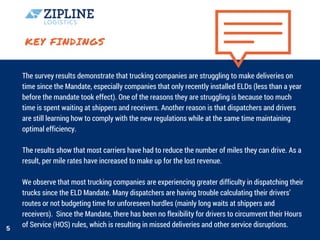
The survey results demonstrate that trucking companies are struggling to make deliveries on
time since the Mandate, especially companies that only recently installed ELDs (less than a year
before the mandate took effect). One of the reasons they are struggling is because too much
time is spent waiting at shippers and receivers. Another reason is that dispatchers and drivers
are still learning how to comply with the new regulations while at the same time maintaining
optimal efficiency.
The results show that most carriers have had to reduce the number of miles they can drive. As a
result, per mile rates have increased to make up for the lost revenue.
We observe that most trucking companies are experiencing greater difficulty in dispatching their
trucks since the ELD Mandate. Many dispatchers are having trouble calculating their drivers’
routes or not budgeting time for unforeseen hurdles (mainly long waits at shippers and
receivers).  Since the Mandate, there has been no flexibility for drivers to circumvent their Hours
of Service (HOS) rules, which is resulting in missed deliveries and other service disruptions.5
KEY FINDINGS, CONTD.
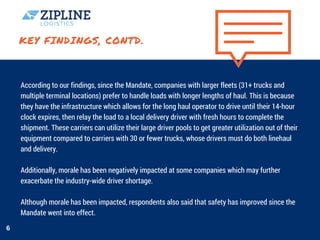
According to our findings, since the Mandate, companies with larger fleets (31+ trucks and
multiple terminal locations) prefer to handle loads with longer lengths of haul. This is because
they have the infrastructure which allows for the long haul operator to drive until their 14-hour
clock expires, then relay the load to a local delivery driver with fresh hours to complete the
shipment. These carriers can utilize their large driver pools to get greater utilization out of their
equipment compared to carriers with 30 or fewer trucks, whose drivers must do both linehaul
and delivery.  
Additionally, morale has been negatively impacted at some companies which may further
exacerbate the industry-wide driver shortage.
Although morale has been impacted, respondents also said that safety has improved since the
Mandate went into effect. 
6
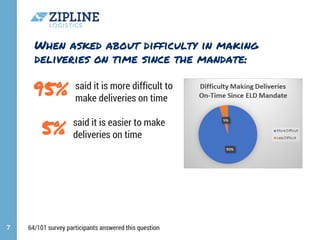
When asked about difficulty in making
deliveries on time since the mandate:
 said it is more difficult to
 make deliveries on time
said it is easier to make
deliveries on time
7
95%
5%
64/101 survey participants answered this question
Comments from respondents: 
“Loads either take too long to load or off load. Not enough time.”
“Loads must be ready when trucks get there to load or we pull out
of the shipper.”
“The ELD mandate just makes it harder to hit specific pickup and
delivery times, especially when facilities keep us for an extended
period of time, past 2 hours.”
8
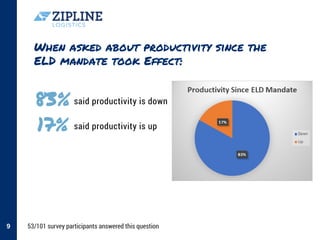
When asked about productivity since the
ELD mandate took Effect:
said productivity is down
said productivity is up
9
83%
 17%
53/101 survey participants answered this question
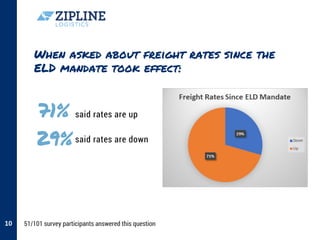
When asked about freight rates since the
ELD mandate took effect:
10
said rates are up
said rates are down
71%
 29%
51/101 survey participants answered this question
Comments from respondents about
productivity and rates:
“It basically has cut out one load a week for us.”
“We can’t make money.”
"Drivers are getting fewer miles, so they are asking for more
money."
“Slowed down productivity, Increased freight rates.”
11
When asked whether dispatching has
become more or less difficult:
said dispatching trucks is more difficult
said it is less difficult
84%
 16%
12 64/101 survey participants answered this question
Comments from the respondents about
dispatching:
“It is more work for the dispatch team, but less work for safety
team, better rates, drivers have better and more efficient rest time.”
“Learning curve will be lengthy for dispatchers.”
“Takes out any doubt about your drivers’ report, very accurate.
We are ok with ELDs.”
13
Smaller fleets (30 trucks or less)
Now view loads with shorter
haul lengths as MORE desirable
And longer haul lengths as
LESS desirable  
41.82 % have had ELDs for more than a year
14
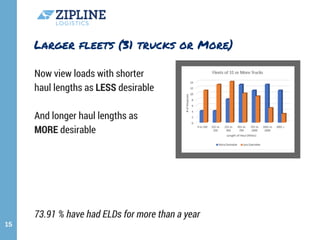
Larger fleets (31 trucks or More)
Now view loads with shorter
haul lengths as LESS desirable
And longer haul lengths as
MORE desirable  
73.91 % have had ELDs for more than a year
15
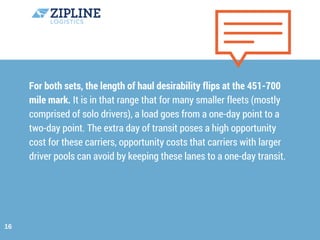
For both sets, the length of haul desirability flips at the 451-700
mile mark. It is in that range that for many smaller fleets (mostly
comprised of solo drivers), a load goes from a one-day point to a
two-day point. The extra day of transit poses a high opportunity
cost for these carriers, opportunity costs that carriers with larger
driver pools can avoid by keeping these lanes to a one-day transit.
16
Comments from respondents about
productivity and rates:
“Our company doesn’t do long-haul anymore because it’s more
stressful for the drivers to be on duty 14 straight hours
without the flexibility of going on/off duty when tired.”
“Have had to be more aware of each driver’s hours. Hard to
accept long distance since it takes so much time to make
delivery due to hours required.”
17
When asked about morale:
                            of respondents said morale is down
                            said morale has improved
18
84%
16%
Of carriers that said "Yes, morale is down"
    71% said productivity is down
    87% said it is more difficult to make deliveries on time
    84% said dispatching trucks is more difficult
37/101 survey participants answered this question
Comments about morale:
“Big chunk of drivers left the company.”
“Drivers are not happy about ELD.”
“Many drivers are getting out of the business.”
19
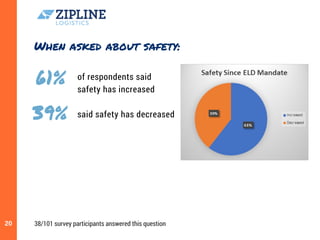
When asked about safety:
20
of respondents said
safety has increased
said safety has decreased
61%
 39%
38/101 survey participants answered this question
CONTACT ZIPLINE LOGISTICS:
www.ziplinelogistics.com
888-469-4754
2300 W. 5th Ave.
Columbus, Ohio 43215
Have any questions? 

ELD Mandate Impacts: Survey Results March 2018

  • 1.
    IMPACTS OF ELDMANDATE 60+ Years of Design + Innovation + Excellence 433 Fulton Street  New City New York City 10956a Survey of 100+ carriers about ELD Mandate impacts, conducted by Zipline Logsitics in March 2018
  • 2.
    Table of Contents Summary KeyFindings Survey Questions On-time Deliveries Productivity Rates Dispatching Fleet Size Morale Safety Page 4 Page 5 Page 7 Page 9 Page 10 Page 12 Page 14 Page 18 Page 20
  • 3.
    “We chose toconduct this survey because the ELD Mandate is one of the most significant regulatory disruptions to the trucking industry in recent history. It will have a ripple effect throughout supply chains everywhere from truck drivers all the way to end consumers. With this survey, we wanted to gain pointed insight from the people who are primarily impacted by the Mandate.” 3 - Mike Horn, Carrier Sales Representative, Zipline Logistics Zipline Logistics will conduct similar surveys throughout the year to maintain a pulse on ELD impacts and the larger trucking industry. 
  • 4.
    ELD Survey Summary ZiplineLogistics, a third-party logistics service provider specializing in retail and grocery transportation, surveyed more than 100 trucking companies of various sizes about the Electronic Logging Device (ELD) Mandate. The ELD Mandate is a rule published by the Federal Motor Carrier Safety Administration that requires all operators of commercial vehicles to use ELDs to keep a record of their hours of service and duty status. Before the Mandate went into effect on December 18, 2017, drivers could keep paper logs, which were easy to manipulate but gave drivers more flexibility. 4 March 2018
  • 5.
    KEY FINDINGS The surveyresults demonstrate that trucking companies are struggling to make deliveries on time since the Mandate, especially companies that only recently installed ELDs (less than a year before the mandate took effect). One of the reasons they are struggling is because too much time is spent waiting at shippers and receivers. Another reason is that dispatchers and drivers are still learning how to comply with the new regulations while at the same time maintaining optimal efficiency. The results show that most carriers have had to reduce the number of miles they can drive. As a result, per mile rates have increased to make up for the lost revenue. We observe that most trucking companies are experiencing greater difficulty in dispatching their trucks since the ELD Mandate. Many dispatchers are having trouble calculating their drivers’ routes or not budgeting time for unforeseen hurdles (mainly long waits at shippers and receivers).  Since the Mandate, there has been no flexibility for drivers to circumvent their Hours of Service (HOS) rules, which is resulting in missed deliveries and other service disruptions.5
  • 6.
    KEY FINDINGS, CONTD. Accordingto our findings, since the Mandate, companies with larger fleets (31+ trucks and multiple terminal locations) prefer to handle loads with longer lengths of haul. This is because they have the infrastructure which allows for the long haul operator to drive until their 14-hour clock expires, then relay the load to a local delivery driver with fresh hours to complete the shipment. These carriers can utilize their large driver pools to get greater utilization out of their equipment compared to carriers with 30 or fewer trucks, whose drivers must do both linehaul and delivery.   Additionally, morale has been negatively impacted at some companies which may further exacerbate the industry-wide driver shortage. Although morale has been impacted, respondents also said that safety has improved since the Mandate went into effect.  6
  • 7.
    When asked aboutdifficulty in making deliveries on time since the mandate:  said it is more difficult to  make deliveries on time said it is easier to make deliveries on time 7 95% 5% 64/101 survey participants answered this question
  • 8.
    Comments from respondents:  “Loadseither take too long to load or off load. Not enough time.” “Loads must be ready when trucks get there to load or we pull out of the shipper.” “The ELD mandate just makes it harder to hit specific pickup and delivery times, especially when facilities keep us for an extended period of time, past 2 hours.” 8
  • 9.
    When asked aboutproductivity since the ELD mandate took Effect: said productivity is down said productivity is up 9 83%  17% 53/101 survey participants answered this question
  • 10.
    When asked aboutfreight rates since the ELD mandate took effect: 10 said rates are up said rates are down 71%  29% 51/101 survey participants answered this question
  • 11.
    Comments from respondentsabout productivity and rates: “It basically has cut out one load a week for us.” “We can’t make money.” "Drivers are getting fewer miles, so they are asking for more money." “Slowed down productivity, Increased freight rates.” 11
  • 12.
    When asked whetherdispatching has become more or less difficult: said dispatching trucks is more difficult said it is less difficult 84%  16% 12 64/101 survey participants answered this question
  • 13.
    Comments from therespondents about dispatching: “It is more work for the dispatch team, but less work for safety team, better rates, drivers have better and more efficient rest time.” “Learning curve will be lengthy for dispatchers.” “Takes out any doubt about your drivers’ report, very accurate. We are ok with ELDs.” 13
  • 14.
    Smaller fleets (30trucks or less) Now view loads with shorter haul lengths as MORE desirable And longer haul lengths as LESS desirable   41.82 % have had ELDs for more than a year 14
  • 15.
    Larger fleets (31trucks or More) Now view loads with shorter haul lengths as LESS desirable And longer haul lengths as MORE desirable   73.91 % have had ELDs for more than a year 15
  • 16.
    For both sets,the length of haul desirability flips at the 451-700 mile mark. It is in that range that for many smaller fleets (mostly comprised of solo drivers), a load goes from a one-day point to a two-day point. The extra day of transit poses a high opportunity cost for these carriers, opportunity costs that carriers with larger driver pools can avoid by keeping these lanes to a one-day transit. 16
  • 17.
    Comments from respondentsabout productivity and rates: “Our company doesn’t do long-haul anymore because it’s more stressful for the drivers to be on duty 14 straight hours without the flexibility of going on/off duty when tired.” “Have had to be more aware of each driver’s hours. Hard to accept long distance since it takes so much time to make delivery due to hours required.” 17
  • 18.
    When asked aboutmorale:                             of respondents said morale is down                             said morale has improved 18 84% 16% Of carriers that said "Yes, morale is down"     71% said productivity is down     87% said it is more difficult to make deliveries on time     84% said dispatching trucks is more difficult 37/101 survey participants answered this question
  • 19.
    Comments about morale: “Bigchunk of drivers left the company.” “Drivers are not happy about ELD.” “Many drivers are getting out of the business.” 19
  • 20.
    When asked aboutsafety: 20 of respondents said safety has increased said safety has decreased 61%  39% 38/101 survey participants answered this question
  • 21.
    CONTACT ZIPLINE LOGISTICS: www.ziplinelogistics.com 888-469-4754 2300W. 5th Ave. Columbus, Ohio 43215 Have any questions?