GDPR and Domino: Everything you need to know to
become and stay compliant
Speakers: Ben Menesi, Head of Products
Michael Wall, Head of Content
Agenda
GDPR Overview
Data Subject Rights
Domino as a Data Container
Searching Domino
Ytria tools and how we can help
Introduction
GDPR in a nutshell – a one liner summary
The GDPR Regulation provides the means for
EU citizens to better control their personal and
sensitive data
Introduction
GDPR in a nutshell – reasons
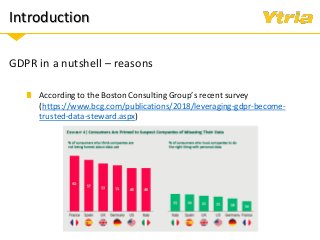
According to the Boston Consulting Group’s recent survey
(https://www.bcg.com/publications/2018/leveraging-gdpr-become-
trusted-data-steward.aspx)
Introduction
GDPR in a nutshell – Definitions
Data Processor: a natural or legal person, public authority, agency or any
other body which processes personal data on behalf of the controller
Data Subject: A living individual to whom personal data relates / whom
personal data identifies.
Data Controller: natural or legal person, public authority, agency or any
other body which alone or jointly with others determines the purposes
and means of the processing of personal data
Introduction
GDPR in a nutshell – Basics
It has been approved by the EU Parliament in April 2016 (already in effect),
set to be enforced as of May 25 2018.
Member states may introduce further provisions as long as they do not
weaken the principles outlined in GDPR
Repeals directive 95/46/EC – while principles remain, the GDPR will be
much more effective.
Fines up to 10M EUR or 2& of WW turnover for failing responsibilities,
20M EUR or 4% of WW turnover for personal data
Introduction
GDPR in a nutshell – Consent
In plain English: Gone are the days of burying end users in pages and
pages of legal mazes for consent (think cookies)
Out of scope: This doesn’t directly relate to our topic today so we won’t
be discussing it more in detail. Read more: https://iapp.org/news/a/top-
10-operational-impacts-of-the-gdpr-part-3-consent/
Consent is key to the GDPR: Freely given, specific, informed and
unambiguous indication of the data subject’s wishes by which they agree
to the processing of personal data
Introduction
GDPR in a nutshell – DPO (Data Protection Officer)
Exceptions: If processing personal / sensitive data isn’t considered to be a
core activity (no key operations rely on it)
Every organization (regardless their size) must appoint a Data Protection
Officer who’ll be the face of the organization to the Information
Commissioner’s Office and to the public.
See also: http://pwc.blogs.com/data_protection/2017/02/data-
protection-officer-do-you-need-to-appoint-one.html
Conclusion: It’s best to appoint a DPO no matter your company’s size, core
activities or the scale at which you process personal data.
Introduction
GDPR in a nutshell – Cyber Attacks
Report personal data breaches: within 72 hours of detection
What is a personal data breach: Loss of confidentiality that may result in
physical, material or non-material damage to natural persons.
Report to the relevant authority: Contact the ICO and provide a
description of the breach including the categories and number of
individuals concerned, personal data records, DPO contact information,
measures taken to address the breach. (Information may be provided in
phases according to article 34(4))
About detection: According to FireEye, global average for intrusion
detection is 146 days and 469 days in the EMEA region. Read more:
https://www.fireeye.com/company/press-releases/2016/fireeye-releases-
first-mandiant-mtrends-emea-report.html
Data Subject Rights
What rights does the GDPR grant to data subjects?
Right of rectification: Is my data accurate? I want it deleted / rectified.
Right of to be forgotten: You don’t need my data anymore. (Google paper:
https://drive.google.com/file/d/1H4MKNwf5MgeztG7OnJRnl3ym3gIT3HU
K/view)
Right of access: Whether and where my data is processed? For what
purposes? Recipients with whom my data is shared? For how long?
Right of data portability: I want a copy of my personal data.
Right of objection: Stop processing my data unless you can prove you
legally need to continue.
Right to not be evaluated on the basis of automated processing: Do not
profile me and make decisions about me unless it’s lawfully authorized or I
explicitly consented to it.
Domino as a data container
Debunking hoaxes about Domino and GDPR
Some of you might have come across articles such as this one:
https://www.realwire.com/releases/Lotus-Notes-and-the-GDPR-
conundrum
Domino can’t be made GDPR compliant: FALSE.
No matter what software you use, complying with the GDPR requires
significant legwork. Domino is no exception but it’s doable.
Domino is VERY SECURE. (No major data breach in the last decade, last
public exploit over 2 years ago)
Domino as a data container
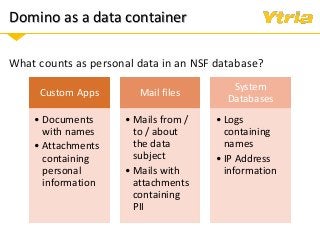
What counts as personal data in an NSF database?
Custom Apps
• Documents
with names
• Attachments
containing
personal
information
Mail files
• Mails from /
to / about
the data
subject
• Mails with
attachments
containing
PII
System
Databases
• Logs
containing
names
• IP Address
information
Domino as a data container
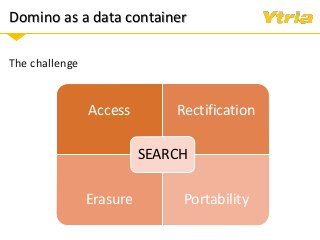
The challenge
Access Rectification
Erasure Portability
SEARCH
Domino as a data container
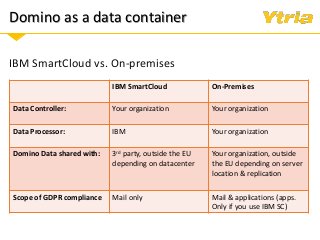
IBM SmartCloud vs. On-premises
IBM SmartCloud On-Premises
Data Controller: Your organization Your organization
Data Processor: IBM Your organization
Domino Data shared with: 3rd party, outside the EU
depending on datacenter
Your organization, outside
the EU depending on server
location & replication
Scope of GDPR compliance Mail only Mail & applications (apps.
Only if you use IBM SC)
Domino as a data container
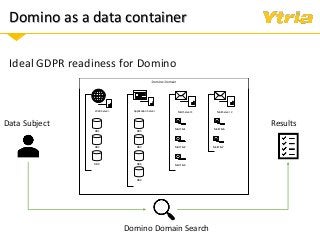
Ideal GDPR readiness for Domino
Web Server Application Server Mail Server 1 Mail Server 2
DB1
DB2
DBX
DB5
DB2
DBX
DB6
Mail File1
Mail File2
Mail File3
Mail File6
Mail File7
Data Subject
Domino Domain Search
Results
Domino as a data container
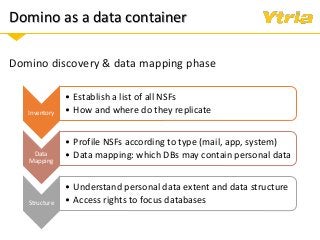
Domino discovery & data mapping phase
Inventory
• Establish a list of all NSFs
• How and where do they replicate
Data
Mapping
• Profile NSFs according to type (mail, app, system)
• Data mapping: which DBs may contain personal data
Structure
• Understand personal data extent and data structure
• Access rights to focus databases
Domino as a data container
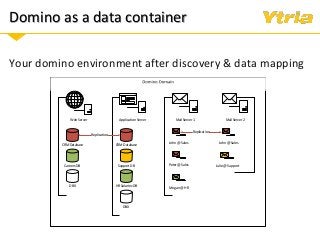
Your domino environment after discovery & data mapping
Web Server Application Server Mail Server 1 Mail Server 2
CRM Database
Careers DB
DBX
CRM Database
Support DB
DBX
HR Salaries DB
John @ Sales
Peter @ Sales
Megan @ HR
John @ Sales
Julie @ Support
Replication
Replication
Domino as a data container
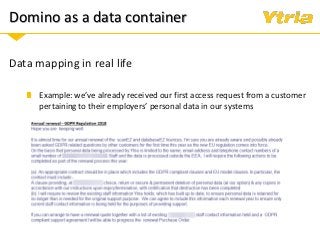
Data mapping in real life
Example: we’ve already received our first access request from a customer
pertaining to their employers’ personal data in our systems
Searching Domino
The key to locating personal data: Search, search and search
When no FTI possible: more work, you need to identify items that can be
used to connect documents to data subjects, and then use them for
searches via Formulas, LS or Java.
Full Text Indexing is your friend
Database by database search: not enough. You will need a larger
framework to comply and make your data subject request response time
and resource efficient.
Identify focus mail files
& mail-in DBs
Searching Domino
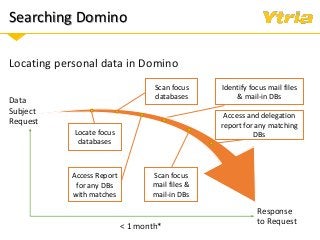
Locating personal data in Domino
Data
Subject
Request
Response
to Request
Locate focus
databases
Scan focus
databases
Access Report
for any DBs
with matches
Scan focus
mail files &
mail-in DBs
Access and delegation
report for any matching
DBs
< 1 month*
How we can help you
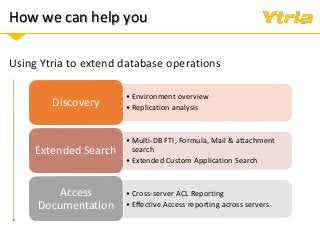
Using Ytria to extend database operations
• Environment overview
• Replication analysis
Discovery
• Multi-DB FTI, Formula, Mail & attachment
search
• Extended Custom Application Search
Extended Search
• Cross-server ACL Reporting
• Effective Access reporting across servers
Access
Documentation
Ytria – Discovery
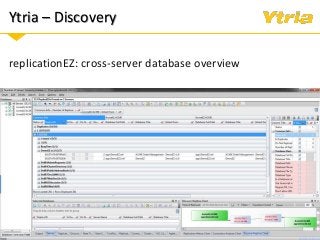
replicationEZ: cross-server database overview
Ytria - Discovery
With replicationEZ you can
List every single database across all servers and find out where and when
they replicated
Easily identify focus databases with personal information based on their
template inheritance or any other database information
Filter out templates and non-relevant, standard IBM databases to focus on
what really matters.
Ytria - Discovery
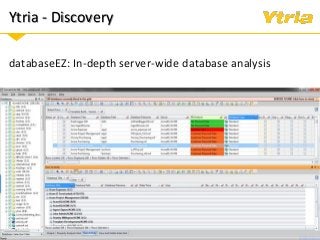
databaseEZ: In-depth server-wide database analysis
Ytria - Discovery
With databaseEZ you can
Analyze all apps server by server including 130+ database properties
Classify databases by type, template, amount of documents and more
Analyze user activity across multiple databases to establish usage patterns
and locate focus databases.
Ytria – Extended Search
scanEZ search automation
Use databaseEZ for database selection and process selected databases
using scanEZ automation XML scripts
Find all pre-made scripts here:
http://www.ytria.com/WebSite.nsf/WebPageRequest/GDPR-
considerationsen
Easily edit your XMLs to modify / add search terms.
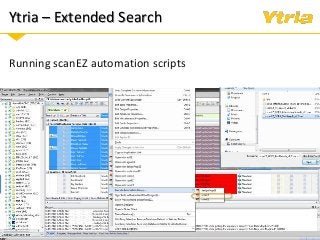
Load server using databaseEZ, select databases to scan and use ‘Execute
Automation Scripts on’ > scanEZ before selecting the appropriate XML file.
Ytria – Extended Search
Running scanEZ automation scripts
Ytria – Extended Search
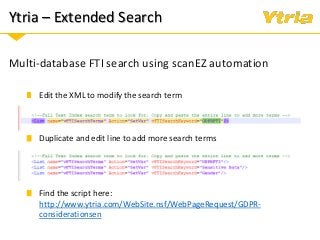
Multi-database FTI search using scanEZ automation
Edit the XML to modify the search term
Duplicate and edit line to add more search terms
Find the script here:
http://www.ytria.com/WebSite.nsf/WebPageRequest/GDPR-
considerationsen
Ytria – Extended Search
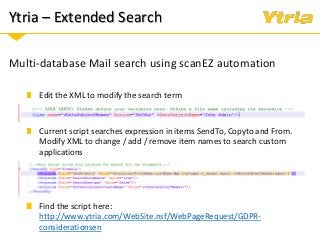
Multi-database Mail search using scanEZ automation
Edit the XML to modify the search term
Current script searches expression in items SendTo, Copyto and From.
Modify XML to change / add / remove item names to search custom
applications
Find the script here:
http://www.ytria.com/WebSite.nsf/WebPageRequest/GDPR-
considerationsen
Ytria – Extended Search
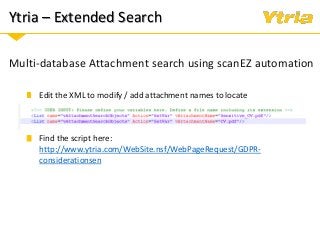
Multi-database Attachment search using scanEZ automation
Edit the XML to modify / add attachment names to locate
Find the script here:
http://www.ytria.com/WebSite.nsf/WebPageRequest/GDPR-
considerationsen
Ytria – Access Documentation
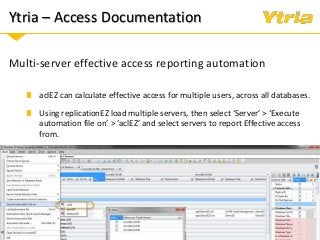
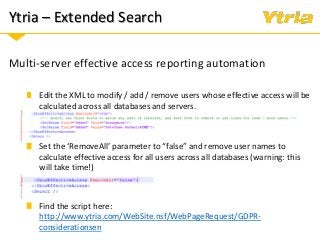
Multi-server effective access reporting automation
aclEZ can calculate effective access for multiple users, across all databases.
Using replicationEZ load multiple servers, then select ‘Server’ > ‘Execute
automation file on’ > ‘aclEZ’ and select servers to report Effective access
from.
Ytria – Extended Search
Multi-server effective access reporting automation
Edit the XML to modify / add / remove users whose effective access will be
calculated across all databases and servers.
Set the ‘RemoveAll’ parameter to “false” and remove user names to
calculate effective access for all users across all databases (warning: this
will take time!)
Find the script here:
http://www.ytria.com/WebSite.nsf/WebPageRequest/GDPR-
considerationsen
Need Help?
Ytria Tandem Jump
Includes temporary licenses and help with Automation script configuration
2h remote session with one of our engineers using the Ytria tools
Flat pricing at USD $500
More info: http://www.ytria.com/tandem
Next Webinar…
Free webcast on Domino Security
Mitigating internal risks from application design flaws to agent security
External Domino security and all that's involved
Real life attack scenarios and how to defend yourself against them
Apr 18, 2018 9:00 AM in Eastern Time (US and Canada)
www.ytria.com/ibmdominosecurity
Thank you
Thank you for attending our webinar
Any feedback or questions:
support@ytria.com
Recording available:
https://youtu.be/ELOO4RU6ss4

GDPR considerations for your IBM Domino environment

  • 2.
    GDPR and Domino:Everything you need to know to become and stay compliant Speakers: Ben Menesi, Head of Products Michael Wall, Head of Content
  • 3.
    Agenda GDPR Overview Data SubjectRights Domino as a Data Container Searching Domino Ytria tools and how we can help
  • 4.
    Introduction GDPR in anutshell – a one liner summary The GDPR Regulation provides the means for EU citizens to better control their personal and sensitive data
  • 5.
    Introduction GDPR in anutshell – reasons According to the Boston Consulting Group’s recent survey (https://www.bcg.com/publications/2018/leveraging-gdpr-become- trusted-data-steward.aspx)
  • 6.
    Introduction GDPR in anutshell – Definitions Data Processor: a natural or legal person, public authority, agency or any other body which processes personal data on behalf of the controller Data Subject: A living individual to whom personal data relates / whom personal data identifies. Data Controller: natural or legal person, public authority, agency or any other body which alone or jointly with others determines the purposes and means of the processing of personal data
  • 7.
    Introduction GDPR in anutshell – Basics It has been approved by the EU Parliament in April 2016 (already in effect), set to be enforced as of May 25 2018. Member states may introduce further provisions as long as they do not weaken the principles outlined in GDPR Repeals directive 95/46/EC – while principles remain, the GDPR will be much more effective. Fines up to 10M EUR or 2& of WW turnover for failing responsibilities, 20M EUR or 4% of WW turnover for personal data
  • 8.
    Introduction GDPR in anutshell – Consent In plain English: Gone are the days of burying end users in pages and pages of legal mazes for consent (think cookies) Out of scope: This doesn’t directly relate to our topic today so we won’t be discussing it more in detail. Read more: https://iapp.org/news/a/top- 10-operational-impacts-of-the-gdpr-part-3-consent/ Consent is key to the GDPR: Freely given, specific, informed and unambiguous indication of the data subject’s wishes by which they agree to the processing of personal data
  • 9.
    Introduction GDPR in anutshell – DPO (Data Protection Officer) Exceptions: If processing personal / sensitive data isn’t considered to be a core activity (no key operations rely on it) Every organization (regardless their size) must appoint a Data Protection Officer who’ll be the face of the organization to the Information Commissioner’s Office and to the public. See also: http://pwc.blogs.com/data_protection/2017/02/data- protection-officer-do-you-need-to-appoint-one.html Conclusion: It’s best to appoint a DPO no matter your company’s size, core activities or the scale at which you process personal data.
  • 10.
    Introduction GDPR in anutshell – Cyber Attacks Report personal data breaches: within 72 hours of detection What is a personal data breach: Loss of confidentiality that may result in physical, material or non-material damage to natural persons. Report to the relevant authority: Contact the ICO and provide a description of the breach including the categories and number of individuals concerned, personal data records, DPO contact information, measures taken to address the breach. (Information may be provided in phases according to article 34(4)) About detection: According to FireEye, global average for intrusion detection is 146 days and 469 days in the EMEA region. Read more: https://www.fireeye.com/company/press-releases/2016/fireeye-releases- first-mandiant-mtrends-emea-report.html
  • 11.
    Data Subject Rights Whatrights does the GDPR grant to data subjects? Right of rectification: Is my data accurate? I want it deleted / rectified. Right of to be forgotten: You don’t need my data anymore. (Google paper: https://drive.google.com/file/d/1H4MKNwf5MgeztG7OnJRnl3ym3gIT3HU K/view) Right of access: Whether and where my data is processed? For what purposes? Recipients with whom my data is shared? For how long? Right of data portability: I want a copy of my personal data. Right of objection: Stop processing my data unless you can prove you legally need to continue. Right to not be evaluated on the basis of automated processing: Do not profile me and make decisions about me unless it’s lawfully authorized or I explicitly consented to it.
  • 12.
    Domino as adata container Debunking hoaxes about Domino and GDPR Some of you might have come across articles such as this one: https://www.realwire.com/releases/Lotus-Notes-and-the-GDPR- conundrum Domino can’t be made GDPR compliant: FALSE. No matter what software you use, complying with the GDPR requires significant legwork. Domino is no exception but it’s doable. Domino is VERY SECURE. (No major data breach in the last decade, last public exploit over 2 years ago)
  • 13.
    Domino as adata container What counts as personal data in an NSF database? Custom Apps • Documents with names • Attachments containing personal information Mail files • Mails from / to / about the data subject • Mails with attachments containing PII System Databases • Logs containing names • IP Address information
  • 14.
    Domino as adata container The challenge Access Rectification Erasure Portability SEARCH
  • 15.
    Domino as adata container IBM SmartCloud vs. On-premises IBM SmartCloud On-Premises Data Controller: Your organization Your organization Data Processor: IBM Your organization Domino Data shared with: 3rd party, outside the EU depending on datacenter Your organization, outside the EU depending on server location & replication Scope of GDPR compliance Mail only Mail & applications (apps. Only if you use IBM SC)
  • 16.
    Domino as adata container Ideal GDPR readiness for Domino Web Server Application Server Mail Server 1 Mail Server 2 DB1 DB2 DBX DB5 DB2 DBX DB6 Mail File1 Mail File2 Mail File3 Mail File6 Mail File7 Data Subject Domino Domain Search Results
  • 17.
    Domino as adata container Domino discovery & data mapping phase Inventory • Establish a list of all NSFs • How and where do they replicate Data Mapping • Profile NSFs according to type (mail, app, system) • Data mapping: which DBs may contain personal data Structure • Understand personal data extent and data structure • Access rights to focus databases
  • 18.
    Domino as adata container Your domino environment after discovery & data mapping Web Server Application Server Mail Server 1 Mail Server 2 CRM Database Careers DB DBX CRM Database Support DB DBX HR Salaries DB John @ Sales Peter @ Sales Megan @ HR John @ Sales Julie @ Support Replication Replication
  • 19.
    Domino as adata container Data mapping in real life Example: we’ve already received our first access request from a customer pertaining to their employers’ personal data in our systems
  • 20.
    Searching Domino The keyto locating personal data: Search, search and search When no FTI possible: more work, you need to identify items that can be used to connect documents to data subjects, and then use them for searches via Formulas, LS or Java. Full Text Indexing is your friend Database by database search: not enough. You will need a larger framework to comply and make your data subject request response time and resource efficient.
  • 21.
    Identify focus mailfiles & mail-in DBs Searching Domino Locating personal data in Domino Data Subject Request Response to Request Locate focus databases Scan focus databases Access Report for any DBs with matches Scan focus mail files & mail-in DBs Access and delegation report for any matching DBs < 1 month*
  • 22.
    How we canhelp you Using Ytria to extend database operations • Environment overview • Replication analysis Discovery • Multi-DB FTI, Formula, Mail & attachment search • Extended Custom Application Search Extended Search • Cross-server ACL Reporting • Effective Access reporting across servers Access Documentation
  • 23.
    Ytria – Discovery replicationEZ:cross-server database overview
  • 24.
    Ytria - Discovery WithreplicationEZ you can List every single database across all servers and find out where and when they replicated Easily identify focus databases with personal information based on their template inheritance or any other database information Filter out templates and non-relevant, standard IBM databases to focus on what really matters.
  • 25.
    Ytria - Discovery databaseEZ:In-depth server-wide database analysis
  • 26.
    Ytria - Discovery WithdatabaseEZ you can Analyze all apps server by server including 130+ database properties Classify databases by type, template, amount of documents and more Analyze user activity across multiple databases to establish usage patterns and locate focus databases.
  • 27.
    Ytria – ExtendedSearch scanEZ search automation Use databaseEZ for database selection and process selected databases using scanEZ automation XML scripts Find all pre-made scripts here: http://www.ytria.com/WebSite.nsf/WebPageRequest/GDPR- considerationsen Easily edit your XMLs to modify / add search terms. Load server using databaseEZ, select databases to scan and use ‘Execute Automation Scripts on’ > scanEZ before selecting the appropriate XML file.
  • 28.
    Ytria – ExtendedSearch Running scanEZ automation scripts
  • 29.
    Ytria – ExtendedSearch Multi-database FTI search using scanEZ automation Edit the XML to modify the search term Duplicate and edit line to add more search terms Find the script here: http://www.ytria.com/WebSite.nsf/WebPageRequest/GDPR- considerationsen
  • 30.
    Ytria – ExtendedSearch Multi-database Mail search using scanEZ automation Edit the XML to modify the search term Current script searches expression in items SendTo, Copyto and From. Modify XML to change / add / remove item names to search custom applications Find the script here: http://www.ytria.com/WebSite.nsf/WebPageRequest/GDPR- considerationsen
  • 31.
    Ytria – ExtendedSearch Multi-database Attachment search using scanEZ automation Edit the XML to modify / add attachment names to locate Find the script here: http://www.ytria.com/WebSite.nsf/WebPageRequest/GDPR- considerationsen
  • 32.
    Ytria – AccessDocumentation Multi-server effective access reporting automation aclEZ can calculate effective access for multiple users, across all databases. Using replicationEZ load multiple servers, then select ‘Server’ > ‘Execute automation file on’ > ‘aclEZ’ and select servers to report Effective access from.
  • 33.
    Ytria – ExtendedSearch Multi-server effective access reporting automation Edit the XML to modify / add / remove users whose effective access will be calculated across all databases and servers. Set the ‘RemoveAll’ parameter to “false” and remove user names to calculate effective access for all users across all databases (warning: this will take time!) Find the script here: http://www.ytria.com/WebSite.nsf/WebPageRequest/GDPR- considerationsen
  • 34.
    Need Help? Ytria TandemJump Includes temporary licenses and help with Automation script configuration 2h remote session with one of our engineers using the Ytria tools Flat pricing at USD $500 More info: http://www.ytria.com/tandem
  • 35.
    Next Webinar… Free webcaston Domino Security Mitigating internal risks from application design flaws to agent security External Domino security and all that's involved Real life attack scenarios and how to defend yourself against them Apr 18, 2018 9:00 AM in Eastern Time (US and Canada) www.ytria.com/ibmdominosecurity
  • 36.
    Thank you Thank youfor attending our webinar Any feedback or questions: support@ytria.com Recording available: https://youtu.be/ELOO4RU6ss4

Editor's Notes

  • #6 DUI analogy?
  • #7 Data Subject: important to understand that this doesn’t just mean customer data, but HR data, too (as in: internal employees!)
  • #8 General differences between GDPR and the directive: While the directive is more vague on some articles such as the time limits within which the controller must react to requests: the GDPR defines one month as the baseline. In some other areas, the GDPR actually toughens guidelines in the directive: for example when it comes to cost of data subject requests – whereas according to the directive, controllers could charge something for those requests, under the GDPR this must be free.
  • #9  Where 95/46/EC allowed controllers to rely on implicit and out out consent, GDPR requires signal agreement upfront.
  • #10 Because in most cases, Domino will only be a subset of your IT environment, and if you’re a large organization – your DPO will probably not come from the Domino world, we’ll more be focusing on how to work with Domino than processes and high level stuff. Important: no distinction beween SMB and enterprises! Regardless employee headcount. For SMB it might not need to be a full-time employee
  • #12 Access requests are FREE (improvement as opposed to the directive)