Second Republic
1931-1936
Proclamation of the Republic
Municipal elections were hold on April 1931
Republican victory
Proclamation of the Republic  Alphonse 13th went
to the exile
Formation of a provisional government:
 Alcala Zamora was its president
 Members: those who had signed San Sebastian Pact
Proclamation of the Republic
Measures of the provisional government:
Call for Constituent Courts
Military reforms:
 Close of the General Military Academy
 Elimination of ranks on the basis of war merit
 Jurisdiction law was abolished
 Creation of the Assault Guard
Proclamation of the Republic
Educational reforms:
 Religious education is not compulsory any longer
 About 6,000 new schools were created
 Increase of teachers’ wages
Labour reforms:
 Mix juries created in Rural Work
 Compulsory to contract for work local peasants without
land.
Constituent Courts
Centre-left won the electoral polls
Creation of a commission to elaborate the constitution
Provisional government continues but now under
Azaña’s presidency
December: approval of the constitution and new
government:
President of the Republic: Alcalá Zamora
President of the Republican Government: Azaña
1931 Constitution
The main characteristics of the constitutional text
are:
Left wing republican, not socialist
Separation Church / State
One chamber
Universal suffrage
Opens the possibility for a state of autonomies.
Reforms of the first two-years and
opposition
Azaña formed government with:
Republicans
Socialists
Measures:
Development of autonomies:
 Catalan statute approved  Macià first president of the
Generalitat
 Approval of Basque statute delayed
Reforms of the first two-years and
opposition
Agrarian reform:
 Expropriations
 Slow speed in the application of the law
Secularization:
 Jesus Company dissolved
 Law of religious congregations
Reforms of the first two-years and
opposition
Opposition:
CNT and UGT consider the reforms too slow
Strikes and incidents Casas Viejas
Unrest among industrialist and landowners due to
the reforms
Church did not accept secularization measures
Part of the Army did not accept the Republican
government  Sanjurjo’s failed coup d’ etat.
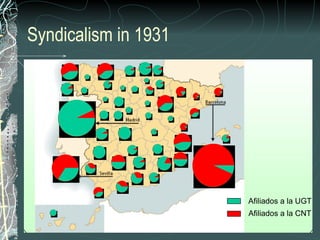
Syndicalism in 1931
Unidad
15 La Segunda República (1931 – 1936) Imagen 5 HISTORIA DE ESPAÑA - 2º BACHILLERATO
SINDICALISMO EN 1931
Afiliados a la UGT
Afiliados a la CNT
Radical-Cedist two-year
Azaña’s government dissolution due to:
World crisis that aggravated
Bad economic situation:
 High inflation and reduction of exports
 Factory closing
 Urban and rural unemployment increase
 Frequent strikes and social protests.
Radical-Cedist two-year
Elections were hold in 1933 victory of the
Radical Party and CEDA
Lerroux formed government:
First measures:
 Stop the reforms of the first two-year
 Right wing generals are put in key sectors
 Unions’ work is made more difficult
 Basque Country’s statute is bloked.
Radical-Cedist two-year
Consequences:
 Increase of political radicalization  peasants and
workers agitation
 Revolution of October 1934
• General strike failed in several areas
• Catalonia marked independent's aims  harsh repression
• Real revolution in Asturias where the general strike organised by
CNT and UGT ended in repression.
Popular Front and social radicalisation
Prestige of the Radical Party faded away due to:
Estraperlo scandal
Strong repression of the strikes
Consequences:
 Lerroux’s dimission
 Elections called for February 1936
 Left wing parties united for the polls.
Popular Front and social radicalisation
Victory of the Popular Front:
Violent confrontation among left and right followers
Part of the Army tried a coup d’etat failed  Civil War
Azaña led the government until made president of the
Republic Casares Quiroga directed government
Measures taken:
Amnesty for political prisoners
Retake the reforms of the first two-years
Preparation of the statures of Basque Country and Galicia
Restoration of the Generalitat.

Document 1.2 second republic

  • 1.
  • 2.
    Proclamation of theRepublic Municipal elections were hold on April 1931 Republican victory Proclamation of the Republic  Alphonse 13th went to the exile Formation of a provisional government:  Alcala Zamora was its president  Members: those who had signed San Sebastian Pact
  • 3.
    Proclamation of theRepublic Measures of the provisional government: Call for Constituent Courts Military reforms:  Close of the General Military Academy  Elimination of ranks on the basis of war merit  Jurisdiction law was abolished  Creation of the Assault Guard
  • 4.
    Proclamation of theRepublic Educational reforms:  Religious education is not compulsory any longer  About 6,000 new schools were created  Increase of teachers’ wages Labour reforms:  Mix juries created in Rural Work  Compulsory to contract for work local peasants without land.
  • 5.
    Constituent Courts Centre-left wonthe electoral polls Creation of a commission to elaborate the constitution Provisional government continues but now under Azaña’s presidency December: approval of the constitution and new government: President of the Republic: Alcalá Zamora President of the Republican Government: Azaña
  • 6.
    1931 Constitution The maincharacteristics of the constitutional text are: Left wing republican, not socialist Separation Church / State One chamber Universal suffrage Opens the possibility for a state of autonomies.
  • 7.
    Reforms of thefirst two-years and opposition Azaña formed government with: Republicans Socialists Measures: Development of autonomies:  Catalan statute approved  Macià first president of the Generalitat  Approval of Basque statute delayed
  • 8.
    Reforms of thefirst two-years and opposition Agrarian reform:  Expropriations  Slow speed in the application of the law Secularization:  Jesus Company dissolved  Law of religious congregations
  • 9.
    Reforms of thefirst two-years and opposition Opposition: CNT and UGT consider the reforms too slow Strikes and incidents Casas Viejas Unrest among industrialist and landowners due to the reforms Church did not accept secularization measures Part of the Army did not accept the Republican government  Sanjurjo’s failed coup d’ etat.
  • 10.
    Syndicalism in 1931 Unidad 15La Segunda República (1931 – 1936) Imagen 5 HISTORIA DE ESPAÑA - 2º BACHILLERATO SINDICALISMO EN 1931 Afiliados a la UGT Afiliados a la CNT
  • 11.
    Radical-Cedist two-year Azaña’s governmentdissolution due to: World crisis that aggravated Bad economic situation:  High inflation and reduction of exports  Factory closing  Urban and rural unemployment increase  Frequent strikes and social protests.
  • 12.
    Radical-Cedist two-year Elections werehold in 1933 victory of the Radical Party and CEDA Lerroux formed government: First measures:  Stop the reforms of the first two-year  Right wing generals are put in key sectors  Unions’ work is made more difficult  Basque Country’s statute is bloked.
  • 13.
    Radical-Cedist two-year Consequences:  Increaseof political radicalization  peasants and workers agitation  Revolution of October 1934 • General strike failed in several areas • Catalonia marked independent's aims  harsh repression • Real revolution in Asturias where the general strike organised by CNT and UGT ended in repression.
  • 14.
    Popular Front andsocial radicalisation Prestige of the Radical Party faded away due to: Estraperlo scandal Strong repression of the strikes Consequences:  Lerroux’s dimission  Elections called for February 1936  Left wing parties united for the polls.
  • 15.
    Popular Front andsocial radicalisation Victory of the Popular Front: Violent confrontation among left and right followers Part of the Army tried a coup d’etat failed  Civil War Azaña led the government until made president of the Republic Casares Quiroga directed government Measures taken: Amnesty for political prisoners Retake the reforms of the first two-years Preparation of the statures of Basque Country and Galicia Restoration of the Generalitat.