www.MathWorksheetsGo.com
On Twitter: twitter.com/mathprintables
I. Model Problems.
II. Vector Basics
III. Addition Of Vectors
IV. Find Resultant Magnitude
V. Find Angle associated with Resultant
VI. Answer Key
Web Resources
Vectors : www.mathwarehouse.com/vectors
Resultant Vectors : www.mathwarehouse.com/vectors/resultant-vector.php
© www.MathWorksheetsGo.com All Rights Reserved
Commercial Use Prohibited
Terms of Use: By downloading this file you are agreeing to the Terms of Use Described at
http://www.mathworksheetsgo.com/downloads/terms-of-use.php .
Online Graphing Calculator : www.mathworksheetsgo.com/tools/free-online-graphing-calculator.php
Free Printable Math Worksheets
www.MathWorksheetsGo.com
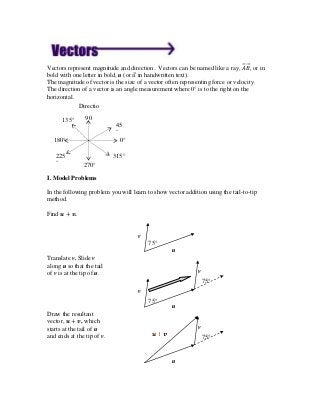
Vectors represent magnitude and direction. Vectors can be named like a ray, or in
bold with one letter in bold, u (or in handwritten text).
The magnitude of vector is the size of a vector often representing force or velocity.
The direction of a vector is an angle measurement where 0° is to the right on the
horizontal.
I. Model Problems
In the following problem you will learn to show vector addition using the tail-to-tip
method.
Find .
Translate v. Slide v
along u so that the tail
of v is at the tip of u.
Draw the resultant
vector, , which
starts at the tail of u
and ends at the tip of v.
u
75°
v
u
v
75°
75°
v
u
v
75°
270°
0°
45
°
90
°
135°
180°
225
°
315°
Directio
n
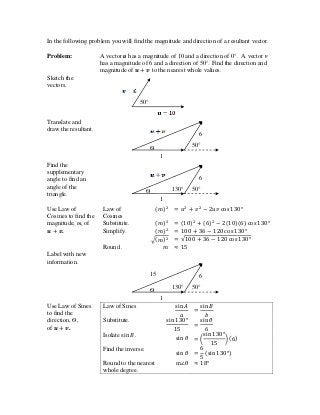
In the following problem you will find the magnitude and direction of a resultant vector.
Problem: A vector u has a magnitude of 10 and a direction of 0°. A vector v
has a magnitude of 6 and a direction of 50°. Find the direction and
magnitude of to the nearest whole values.
Sketch the
vectors.
Translate and
draw the resultant.
Find the
supplementary
angle to find an
angle of the
triangle.
Use Law of
Cosines to find the
magnitude, m, of
.
Law of
Cosines
Substitute.
Simplify.
Round .
Label with new
information.
Use Law of Sines
to find the
direction, Ѳ,
of .
Law of Sines
Substitute.
Isolate .
Find the inverse.
Round to the nearest
whole degree.
1
0
6
50°
15
130°Ѳ
1
0
6
50°130°Ѳ
1
0
6
50°Ѳ
50°
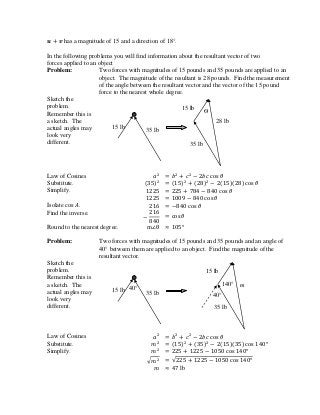
has a magnitude of 15 and a direction of 18°.
In the following problems you will find information about the resultant vector of two
forces applied to an object
Problem: Two forces with magnitudes of 15 pounds and 35 pounds are applied to an
object. The magnitude of the resultant is 28 pounds. Find the measurement
of the angle between the resultant vector and the vector of the 15 pound
force to the nearest whole degree.
Sketch the
problem.
Remember this is
a sketch. The
actual angles may
look very
different.
Law of Cosines
Substitute.
Simplify.
Isolate .
Find the inverse.
Round to the nearest degree.
Problem: Two forces with magnitudes of 15 pounds and 35 pounds and an angle of
40° between them are applied to an object. Find the magnitude of the
resultant vector.
Sketch the
problem.
Remember this is
a sketch. The
actual angles may
look very
different.
Law of Cosines
Substitute.
Simplify.
lb
35 lb
15 lb
35 lb
m
40°15 lb
40°
140°
15 lb
35 lb
35 lb
28 lb
Ѳ
15 lb
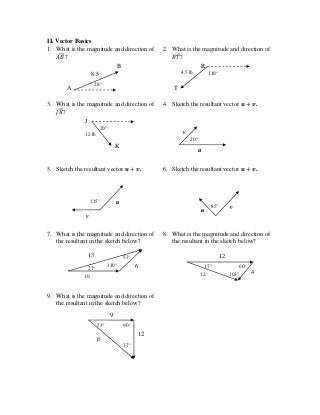
II. Vector Basics
1. What is the magnitude and direction of 2. What is the magnitude and direction of
3. What is the magnitude and direction of 4. Sketch the resultant vector .
5. Sketch the resultant vector . 6. Sketch the resultant vector .
7. What is the magnitude and direction of
the resultant in the sketch below
8. What is the magnitude and direction of
the resultant in the sketch below
9. What is the magnitude and direction of
the resultant in the sketch below
12
37°
9
15
90°53°
4103°
12
12
60°17°6110°
13
10
53°
27°
85°
u
v
115° u
v
20°
u
v
K
70°
J
12 lb
T
110°
R
4.5 lb
A
28°
B
8.5
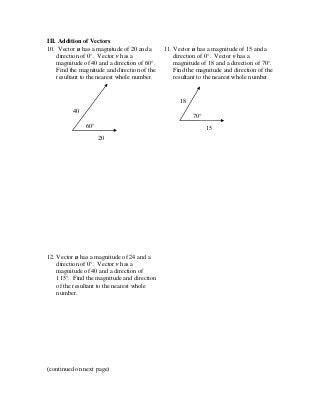
III. Addition of Vectors
10. Vector u has a magnitude of 20 and a
direction of 0°. Vector v has a
magnitude of 40 and a direction of 60°.
Find the magnitude and direction of the
resultant to the nearest whole number.
11. Vector u has a magnitude of 15 and a
direction of 0°. Vector v has a
magnitude of 18 and a direction of 70°.
Find the magnitude and direction of the
resultant to the nearest whole number.
12. Vector u has a magnitude of 24 and a
direction of 0°. Vector v has a
magnitude of 40 and a direction of
115°. Find the magnitude and direction
of the resultant to the nearest whole
number.
(continued on next page)
70°
15
18
60°
20
40
IV. Find the magnitude of the resultant vector when two forces are applied to an
object.
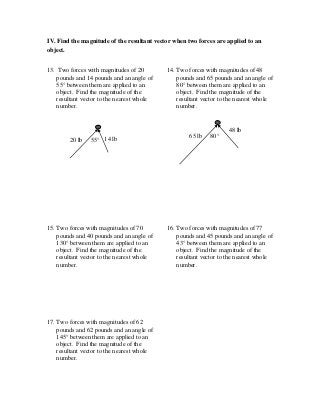
13. Two forces with magnitudes of 20
pounds and 14 pounds and an angle of
55° between them are applied to an
object. Find the magnitude of the
resultant vector to the nearest whole
number.
14. Two forces with magnitudes of 48
pounds and 65 pounds and an angle of
80° between them are applied to an
object. Find the magnitude of the
resultant vector to the nearest whole
number.
15. Two forces with magnitudes of 70
pounds and 40 pounds and an angle of
130° between them are applied to an
object. Find the magnitude of the
resultant vector to the nearest whole
number.
16. Two forces with magnitudes of 77
pounds and 45 pounds and an angle of
43° between them are applied to an
object. Find the magnitude of the
resultant vector to the nearest whole
number.
17. Two forces with magnitudes of 62
pounds and 62 pounds and an angle of
145° between them are applied to an
object. Find the magnitude of the
resultant vector to the nearest whole
number.
80°
48 lb
65 lb
55° 14 lb20 lb
V. Find the angle measurements between the resultant vector and force vector when
two forces are applied to an object.
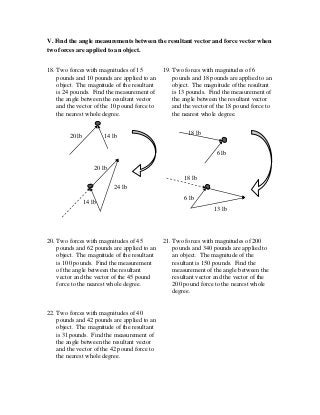
18. Two forces with magnitudes of 15
pounds and 10 pounds are applied to an
object. The magnitude of the resultant
is 24 pounds. Find the measurement of
the angle between the resultant vector
and the vector of the 10 pound force to
the nearest whole degree.
19. Two forces with magnitudes of 6
pounds and 18 pounds are applied to an
object. The magnitude of the resultant
is 13 pounds. Find the measurement of
the angle between the resultant vector
and the vector of the 18 pound force to
the nearest whole degree.
20. Two forces with magnitudes of 45
pounds and 62 pounds are applied to an
object. The magnitude of the resultant
is 100 pounds. Find the measurement
of the angle between the resultant
vector and the vector of the 45 pound
force to the nearest whole degree.
21. Two forces with magnitudes of 200
pounds and 340 pounds are applied to
an object. The magnitude of the
resultant is 150 pounds. Find the
measurement of the angle between the
resultant vector and the vector of the
200 pound force to the nearest whole
degree.
22. Two forces with magnitudes of 40
pounds and 42 pounds are applied to an
object. The magnitude of the resultant
is 31pounds. Find the measurement of
the angle between the resultant vector
and the vector of the 42 pound force to
the nearest whole degree.
13 lb
6 lb
18 lb
6 lb
18 lb
24 lb
14 lb20 lb
14 lb
20 lb
V. Challenge Problems
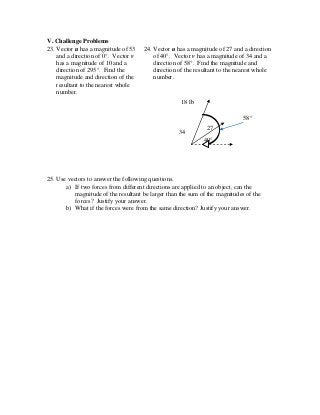
23. Vector u has a magnitude of 53
and a direction of 0°. Vector v
has a magnitude of 10 and a
direction of 295°. Find the
magnitude and direction of the
resultant to the nearest whole
number.
24. Vector u has a magnitude of 27 and a direction
of 40°. Vector v has a magnitude of 34 and a
direction of 58°. Find the magnitude and
direction of the resultant to the nearest whole
number.
25. Use vectors to answer the following questions.
a) If two forces from different directions are applied to an object, can the
magnitude of the resultant be larger than the sum of the magnitudes of the
forces? Justify your answer.
b) What if the forces were from the same direction? Justify your answer.
34
18 lb
27
40°
58°
VI. Answers
1. 8.5, 28°
2. 4.5 lb, 250°
3. 12 lb, 310°
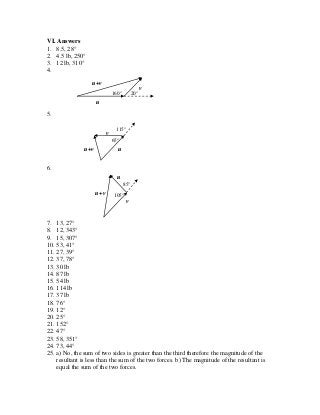
4.
5.
6.
7. 13, 27°
8. 12, 343°
9. 15, 307°
10. 53, 41°
11. 27, 39°
12. 37, 78°
13. 30 lb
14. 87 lb
15. 54 lb
16. 114 lb
17. 37 lb
18. 76°
19. 12°
20. 25°
21. 152°
22. 47°
23. 58, 351°
24. 73, 44°
25. a) No, the sum of two sides is greater than the third therefore the magnitude of the
resultant is less than the sum of the two forces. b) The magnitude of the resultant is
equal the sum of the two forces.
85°
u
v
105°u+v
115°
u
v
65°
u+v
20°
u
v
160°
u+v
Resultant vector-worksheet

  • 1.
    www.MathWorksheetsGo.com On Twitter: twitter.com/mathprintables I.Model Problems. II. Vector Basics III. Addition Of Vectors IV. Find Resultant Magnitude V. Find Angle associated with Resultant VI. Answer Key Web Resources Vectors : www.mathwarehouse.com/vectors Resultant Vectors : www.mathwarehouse.com/vectors/resultant-vector.php © www.MathWorksheetsGo.com All Rights Reserved Commercial Use Prohibited Terms of Use: By downloading this file you are agreeing to the Terms of Use Described at http://www.mathworksheetsgo.com/downloads/terms-of-use.php . Online Graphing Calculator : www.mathworksheetsgo.com/tools/free-online-graphing-calculator.php Free Printable Math Worksheets www.MathWorksheetsGo.com
  • 2.
    Vectors represent magnitudeand direction. Vectors can be named like a ray, or in bold with one letter in bold, u (or in handwritten text). The magnitude of vector is the size of a vector often representing force or velocity. The direction of a vector is an angle measurement where 0° is to the right on the horizontal. I. Model Problems In the following problem you will learn to show vector addition using the tail-to-tip method. Find . Translate v. Slide v along u so that the tail of v is at the tip of u. Draw the resultant vector, , which starts at the tail of u and ends at the tip of v. u 75° v u v 75° 75° v u v 75° 270° 0° 45 ° 90 ° 135° 180° 225 ° 315° Directio n
  • 3.
    In the followingproblem you will find the magnitude and direction of a resultant vector. Problem: A vector u has a magnitude of 10 and a direction of 0°. A vector v has a magnitude of 6 and a direction of 50°. Find the direction and magnitude of to the nearest whole values. Sketch the vectors. Translate and draw the resultant. Find the supplementary angle to find an angle of the triangle. Use Law of Cosines to find the magnitude, m, of . Law of Cosines Substitute. Simplify. Round . Label with new information. Use Law of Sines to find the direction, Ѳ, of . Law of Sines Substitute. Isolate . Find the inverse. Round to the nearest whole degree. 1 0 6 50° 15 130°Ѳ 1 0 6 50°130°Ѳ 1 0 6 50°Ѳ 50°
  • 4.
    has a magnitudeof 15 and a direction of 18°. In the following problems you will find information about the resultant vector of two forces applied to an object Problem: Two forces with magnitudes of 15 pounds and 35 pounds are applied to an object. The magnitude of the resultant is 28 pounds. Find the measurement of the angle between the resultant vector and the vector of the 15 pound force to the nearest whole degree. Sketch the problem. Remember this is a sketch. The actual angles may look very different. Law of Cosines Substitute. Simplify. Isolate . Find the inverse. Round to the nearest degree. Problem: Two forces with magnitudes of 15 pounds and 35 pounds and an angle of 40° between them are applied to an object. Find the magnitude of the resultant vector. Sketch the problem. Remember this is a sketch. The actual angles may look very different. Law of Cosines Substitute. Simplify. lb 35 lb 15 lb 35 lb m 40°15 lb 40° 140° 15 lb 35 lb 35 lb 28 lb Ѳ 15 lb
  • 5.
    II. Vector Basics 1.What is the magnitude and direction of 2. What is the magnitude and direction of 3. What is the magnitude and direction of 4. Sketch the resultant vector . 5. Sketch the resultant vector . 6. Sketch the resultant vector . 7. What is the magnitude and direction of the resultant in the sketch below 8. What is the magnitude and direction of the resultant in the sketch below 9. What is the magnitude and direction of the resultant in the sketch below 12 37° 9 15 90°53° 4103° 12 12 60°17°6110° 13 10 53° 27° 85° u v 115° u v 20° u v K 70° J 12 lb T 110° R 4.5 lb A 28° B 8.5
  • 6.
    III. Addition ofVectors 10. Vector u has a magnitude of 20 and a direction of 0°. Vector v has a magnitude of 40 and a direction of 60°. Find the magnitude and direction of the resultant to the nearest whole number. 11. Vector u has a magnitude of 15 and a direction of 0°. Vector v has a magnitude of 18 and a direction of 70°. Find the magnitude and direction of the resultant to the nearest whole number. 12. Vector u has a magnitude of 24 and a direction of 0°. Vector v has a magnitude of 40 and a direction of 115°. Find the magnitude and direction of the resultant to the nearest whole number. (continued on next page) 70° 15 18 60° 20 40
  • 7.
    IV. Find themagnitude of the resultant vector when two forces are applied to an object. 13. Two forces with magnitudes of 20 pounds and 14 pounds and an angle of 55° between them are applied to an object. Find the magnitude of the resultant vector to the nearest whole number. 14. Two forces with magnitudes of 48 pounds and 65 pounds and an angle of 80° between them are applied to an object. Find the magnitude of the resultant vector to the nearest whole number. 15. Two forces with magnitudes of 70 pounds and 40 pounds and an angle of 130° between them are applied to an object. Find the magnitude of the resultant vector to the nearest whole number. 16. Two forces with magnitudes of 77 pounds and 45 pounds and an angle of 43° between them are applied to an object. Find the magnitude of the resultant vector to the nearest whole number. 17. Two forces with magnitudes of 62 pounds and 62 pounds and an angle of 145° between them are applied to an object. Find the magnitude of the resultant vector to the nearest whole number. 80° 48 lb 65 lb 55° 14 lb20 lb
  • 8.
    V. Find theangle measurements between the resultant vector and force vector when two forces are applied to an object. 18. Two forces with magnitudes of 15 pounds and 10 pounds are applied to an object. The magnitude of the resultant is 24 pounds. Find the measurement of the angle between the resultant vector and the vector of the 10 pound force to the nearest whole degree. 19. Two forces with magnitudes of 6 pounds and 18 pounds are applied to an object. The magnitude of the resultant is 13 pounds. Find the measurement of the angle between the resultant vector and the vector of the 18 pound force to the nearest whole degree. 20. Two forces with magnitudes of 45 pounds and 62 pounds are applied to an object. The magnitude of the resultant is 100 pounds. Find the measurement of the angle between the resultant vector and the vector of the 45 pound force to the nearest whole degree. 21. Two forces with magnitudes of 200 pounds and 340 pounds are applied to an object. The magnitude of the resultant is 150 pounds. Find the measurement of the angle between the resultant vector and the vector of the 200 pound force to the nearest whole degree. 22. Two forces with magnitudes of 40 pounds and 42 pounds are applied to an object. The magnitude of the resultant is 31pounds. Find the measurement of the angle between the resultant vector and the vector of the 42 pound force to the nearest whole degree. 13 lb 6 lb 18 lb 6 lb 18 lb 24 lb 14 lb20 lb 14 lb 20 lb
  • 9.
    V. Challenge Problems 23.Vector u has a magnitude of 53 and a direction of 0°. Vector v has a magnitude of 10 and a direction of 295°. Find the magnitude and direction of the resultant to the nearest whole number. 24. Vector u has a magnitude of 27 and a direction of 40°. Vector v has a magnitude of 34 and a direction of 58°. Find the magnitude and direction of the resultant to the nearest whole number. 25. Use vectors to answer the following questions. a) If two forces from different directions are applied to an object, can the magnitude of the resultant be larger than the sum of the magnitudes of the forces? Justify your answer. b) What if the forces were from the same direction? Justify your answer. 34 18 lb 27 40° 58°
  • 10.
    VI. Answers 1. 8.5,28° 2. 4.5 lb, 250° 3. 12 lb, 310° 4. 5. 6. 7. 13, 27° 8. 12, 343° 9. 15, 307° 10. 53, 41° 11. 27, 39° 12. 37, 78° 13. 30 lb 14. 87 lb 15. 54 lb 16. 114 lb 17. 37 lb 18. 76° 19. 12° 20. 25° 21. 152° 22. 47° 23. 58, 351° 24. 73, 44° 25. a) No, the sum of two sides is greater than the third therefore the magnitude of the resultant is less than the sum of the two forces. b) The magnitude of the resultant is equal the sum of the two forces. 85° u v 105°u+v 115° u v 65° u+v 20° u v 160° u+v