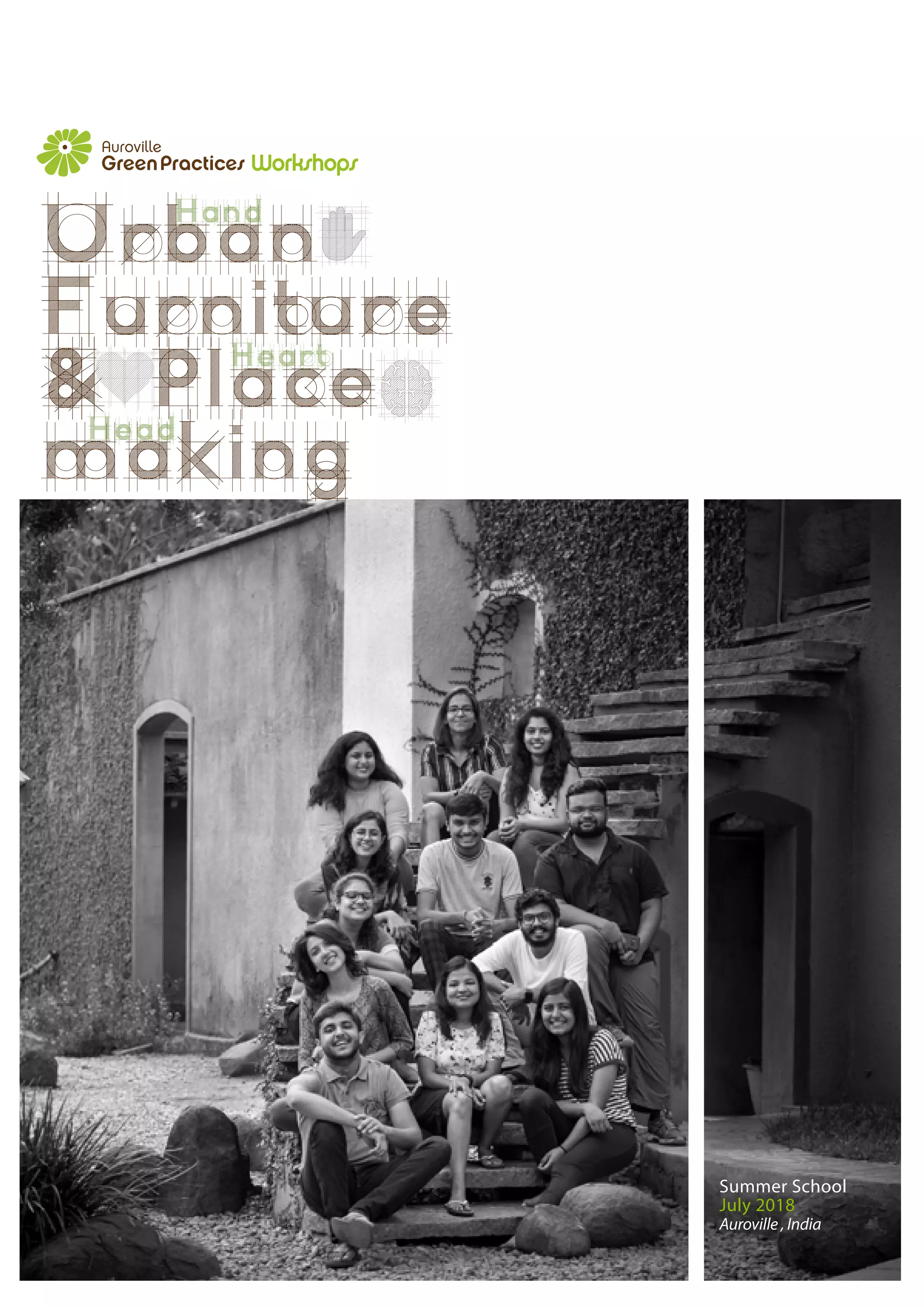
Auroville, India
Registration open now
www.agpworkshops.com
Urban
Furniture
& Place
making
Hand
Head
Heart
15th July - 5th August 20183H Summer School
Summer School
July 2018
Auroville , India
www.agpworkshops.com2
Urban Furniture
& Place making
“IN ORDER TO CARRY A POSITIVE ACTION WE MUST DEVELOP HERE A POSITIVE
VISION.”
- DALAI LAMA
Auroville Green Practices
July 2018
www.agpworkshops.com4
FOREWORD
An urban space is where encounters take place,
when you and I meet, a space of the in between.
In between you and me
In between out and in
In between yesterday and tomorrow
It is where space becomes place
Aldo van Eyck redefined a myriad of bombed out
crevices in the urban fabric of postwar Amsterdam
by designing a network of interventions in the
public space. These interventions were no longer
contributions to the monumental character of
public space in the traditional sense, but instead
were places of engagement, where play and
interaction became centre stage. The urban
furniture consisted of an effective “catalogue”
of simple steel tubes, curved to become arches,
linear to become rails and parallel bars, defining
space but always insisting on transparency, on
the interrelation between spaces. Lines, circles,
rectangles and triangles formed beautiful
compositions on the ground as an abstract
artwork in itself, but also defined spatial
relationships with the surrounding urban fabric.
Fast backward a couple of centuries, but closer to
home: around 500km south of Auroville, one of
the most beautiful infrastructural public transport
projects I have ever seen: the Ambalama in
Karagahagedara. Sited on a modest rock outcrop,
an island amongst a sea of paddy fields, this
structure delicately balances on 4 boulders of
around 1 meter in size. The height of the boulders
carefully levels the difference between the slope
of the rock surface and the horizontal plane. 4
large rectangular shaped tree trunks overlay
like a puzzle piece into each other to form the
support of the super structure, as well functions
as a bench to sit or sleep on. Pilgrims, traders and
travellers from countries as far as Maharasthra,
Gujarat and Andhra would find a place here to
rest, meet and share stories with each other.
Space, functionality, tectonics, materialisation
and structural essence all converge here. Heavy
and down to earth but transparent and light at the
same time. The spatial quality of the ambalama
is one of continuity while being anchored and
rooted to its specific location.
The Ambalama which functions pretty much the
same as a modern-day bus stop, and the playful
interventions in public space in Amsterdam could
serve as two inspiring historical case studies for
the design of a bus stop at the Solar
Kitchen in Auroville. The case studies
in Amsterdam indicate the endless
possibilities of the most rudimentary
urban furniture and the significance
of the definition of ground surface in
creating opportunities for play. The
Ambalama in Sri Lanka shows the
enormous potential of the process of
making with a basic material palette.
As the initial workshops with the
children from Auroville indicated,
the functionality and significance of
this project is much more than a bus
stop though: it acts as a place for
shelter from the elements, but also for
interaction, for communication, and
invite play and exploration. A place
that can accommodate the various
conditions in the passing of time
during day and the seasons. Van Eyck
once said: “whatever space and time
mean place and occasion mean more!”
Robert Verrijt,
from Netherlands
Co-Founder of Architecture Brio,
Mumbai
www.agpworkshops.com6
ACKNOWLEDGMENT
3H Summer School is the result of the dedicated work of
Auroville Green Practices. We would like to express our
deep appreciation to the team at Bharat Nivas, for their
encouragement and support in providing a venue for the
program. Another special appreciation for the dedication
and enthusiasm of the teachers and children of Deepanam
and Transition schools, for their inspiring ideas on designs
for the bus waiting area. Another special thanks to Ramco
Industries, Auroville Security Service and Auryaj for their
support to help manifest this program. Many thanks to the
countless Auroville resource persons that interacted with
the participants and shared their expertise.
List of contributing resource persons:
Anita Gaur, Auroville Town Development Council
Audrey Wallace-Taylor, Center For Research, Education, And
Experience in The Visual Arts
Ayyappan, Auroville Earth Institute
Balu Ramalingam, Auroville Consulting
Baskaran and workers, Nala Builders
Debabrata Sahoo, Kinisi
Elke Vankoert, Theatre Games
Eric Clapton, African Pavilion
Fabian Ostner, White Ant Studio
Hita, Auroville Consulting
Jaswanth Yaddala, Auroville Consulting
Kiran Kamal, Capoeira
Lucas Dengel, EcoPro
Mahesh, Svaram
Martin Scherfler, Auroville Consulting
Miroslava Pankova, Auroville Consulting
Nidhi Gupta, Auroville Consulting
OK Jeonglee, Upcycling Studio
Omar Rabie, Unitary Design Studio
Paul Blanchflower, Auroville Botanical Gardens
Priya Bose, Auroville Consulting
Radhika Soni, Auroville Earth Institute
Samuka da Índia, Capoeira
Sanata Prakash, Auroville Consulting
Sathya, Center For Research, Education, And Experience in The
Visual Arts
Satprem Maini, Auroville Earth Institute
Tejaswini Mistry-Kapoor, Auroville Town Development Council
Vimal Bhojraj, Auroville Consulting
Zdenek Ondrak, Auroville Consulting
www.agpworkshops.com8
The theme of the 3H Summer School
2018 was “Urban Furniture and Place
Making”. Urban furniture refers to objects
and facilities located in urban community
spaces that provide various services and
functions to the community. It is one
of the essential elements of the urban
environment that contributes to humans
andtheiractivities.Althoughcomparatively
small in scale, urban furniture plays
a significant role, in determining the
quality of an urban environment and in
representing the image of a city. Of all the
landscape elements, urban furniture has
the closest contact and interaction with
humans. Urban furniture design involves a
wide range of concerns, including function,
environment, and meaning. The program
was designed to contribute towards urban
furniture of Auroville through enquiry into
the principles of placemaking.
The end result was to create a cohesive unit
that creates greater value than just the sum
of its parts. The students engaged in the
design and implementation of an Urban
Furniture project in order to enhance the
community experience and quality of life
by providing places to encounter.
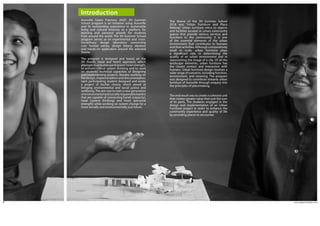
Introduction
Auroville Green Practices (AGP) 3H Summer
School program is an initiative using Auroville
and its outstanding experience in sustainable
living and cultural diversity as a platform for
learning and personal growth for students
from around the world. The 3H Summer School
program serves as an experimental and cross-
disciplinary design laboratory connecting
core human values, design theory, ideation
and hands-on application around the selected
theme.
The program is designed and based on the
3H (hands, head and heart) approach, which
attemptstoactualizeparticipants’innerstrength,
to activate critical system thinking and to work
on students’ technical capacities of designing
and implementing projects. Besides working on
the design, implementation and documentation,
each participating student designed and wrote
a project of his/her choice, which aimed at
bringing environmental and social justice and
wellbeing.The aim was to train a new generation
ofenvironmentalandsociallyresponsibleleaders
that are capable of connecting hands (capacity),
head (system thinking) and heart (personal
strength) while working on system change for a
more socially and environmentally just future.
www.agpworkshops.com10
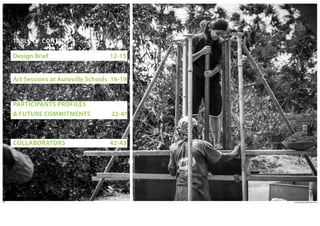
TABLE OF CONTENT
Design Brief							12-15
Art Sessions at Auroville Schools 16-19
PARTICIPANTS PROFILES
& FUTURE COMMITMENTS 		 22-41
COLLABORATORS 					42-43
www.agpworkshops.com12
Design Brief
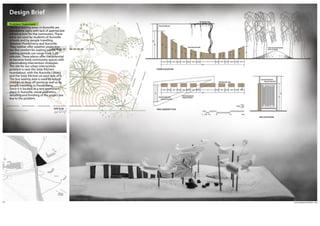
Problem Statement
The bus waiting areas in Auroville are
standalone signs with lack of appropriate
infrastructure for the commuters. These
areas are used by students of Auroville
schools and by people travelling
between Pondicherry and Auroville.
They neither offer weather protection
nor the comfort for waiting period. The
waiting periods can range from 5-20
minutes. These places offer the potential
to become lively community spaces with
placemaking intervention strategies.
The site for our urban intervention
problem is near the Solar Kitchen
roundabout, with the Auroville Library
and the Solar Kitchen on each side of it.
The bus waiting area is used by school
children as drop off points as well as by
people travelling to Pondicherry.
Since it is located at a very prominent
place in Auroville, visual aesthetics,
detailing and finishing of the project are
key to the problem.
www.agpworkshops.com14
Objectives of urban
intervention
The design should be visually appealing, account
for weather protection and universally comfortable.
Innovative use of material and technique will be
encouraged.
Visually appealing – Since the roundabout is
in a prominent location in Auroville, one of the
important aspects of the design is aesthetics and
finishing. This space offers potential of interaction
to all, visual as well as physical. Hence, the quality of
construction and detailing is key to the project.
Weather protection – Auroville has a very harsh
summer from April-June and monsoons in the
month of October-February. The bus waiting area
should consider for shade from weather protection.
Comfort – In addition to ergonomics of the design
interventions, the designers are encouraged to
incorporate utility elements for waste management,
drinking water facilities, etc within the space design
Innovative use of material & technique – Innovative
use of local materials (such as earth & stone) and
upcycling of waste materials (such as electric light
poles) is expected.
The above four considerations are non-negotiables.
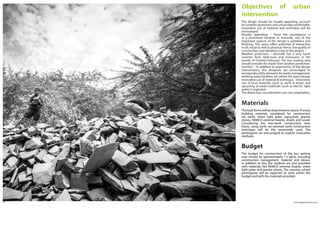
Materials
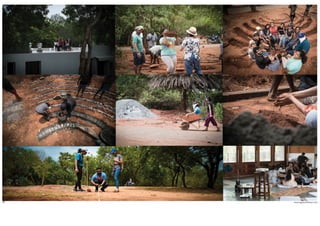
The built forms will be of permanent nature. Primary
building materials considered for construction
are earth, street light poles (upcycled), granite
stones, RAMCO external boards, sheets and wood.
Considering the two-week construction time
frame, using earth via rammed earth construction
technique will be the extensively used. The
participants are encouraged to explore innovative
methods.
Budget
The budget for construction of the bus waiting
area should be approximately 1.3 lakhs; including
construction management, material and labour.
In addition to this, the students are also provided
with materials like RAMCO external boards, street
light poles and granite stones. The summer school
participants will be expected to work within the
budget and with the materials provided.
www.agpworkshops.com16
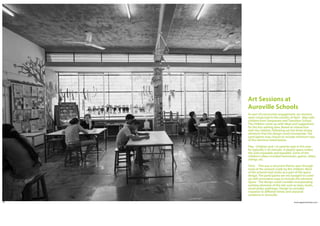
Art Sessions at
Auroville Schools
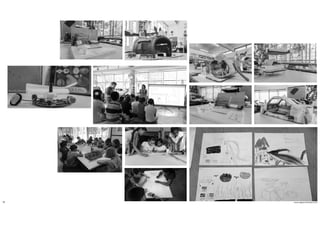
As part of community engagement, art sessions
were conducted in the months of April - May with
children from Deepanam and Transition School.
The children came up with ideas and suggestions
for the bus waiting area. Based on interaction
with the children, following are the three strong
elements that the design could incorporate. The
participants may choose to include minimum two
of the elements listed below:
Play - Children and / or parents wait in this area
for typically 5-20 minutes. A playful space makes
the wait enjoyable and bearable. Some of the
children’s ideas included hammocks, games, slides,
swings, etc.
Time -	 This was a recurrent theme seen through
most of the artwork made by the children. Most
of the artwork had clocks as a part of the space
design. The participants are encouraged to come
up with innovative ways to include this element.
Space - The design could consider incorporating
existing elements of the site such as trees, levels,
street poles, pathways. Design to consider
response to different timely and seasonal
variations in Auroville.
www.agpworkshops.com18
www.agpworkshops.com20
www.agpworkshops.com22
PARTICIPANTS
PROFILES & FUTURE
COMMITMENTS
Participants voluntary projects
www.agpworkshops.com24
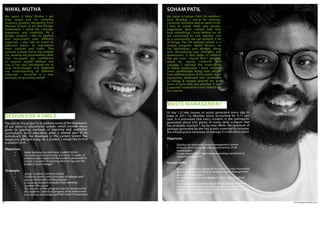
DESIGN FOR A SMILE
My name is Nihal Mutha. I am
from Satara and I’m currently
studying product designing from
Woxsen School of Art and Design
Hyderabad. I stand for courage,
happiness and creativity. As a
design student, I like to explore
and experiment with different
materials. I also like to travel to
different places to experience
their cultures and crafts. This
summer school course has helped
me develop my presentation skills
and increased my confidence
to express myself without any
fear. It has also introduced me to
new technologies and bettered
my understanding of different
materials - Auroville is a true
example of upcycling waste!
NIHAL MUTHA
The aim of this project is to address some of the drawbacks
of our existing educational system, which include stress
given to grading, methods of teaching and restrictive
curriculums. Since education plays a pivotal part in an
individual’s life, the drawback in the current system has
negatively affected many. As a student, I would like to find
a solution to it.
Objectives
	•	Make learning fun and more student centric
	 •	 Introduce extracurricular activities in order to 	
enhance other aspects of the students personalities
	 • Create a system of learning that brings out the 	
student’s inner strength
Strategies
	•	Design a holistic summer school
	 •	 Establish contact with principles of colleges and 	
discuss the benefits of the program
	 •	 Encourage students to widen their learning
	 •	 Conduct the course
	 • The success of the program can be measured by 	
the students’ individual progress, their enthusiasm 	
in acquiring knowledge and their level of happiness
WASTE MANAGEMENT
My name is Soham Patil. I’m architect
from Mumbai. I stand for courage,
creativity, kindness and an open mind.
I love to travel, meet new people,
experience their culture and take
back something. I truly believe we all
are connected to one another and
as a community we can achieve a lot
of things. The 3H summer school is a
unique program, which focuses on
the techniques and designs along
with discovering new strengths and
weaknesses. It also helps in refining
the old ones. I learnt that I strongly
stand for equity, creativity and
courage. I realised the importance
of living sustainably. I have become
more comfortable being with people
from different parts of the world, more
expressive, observant and connected
to things & people around me and
more in tune with one another. It was
a peaceful experience that helped me
be creative.
SOHAM PATIL
Of the 1,27,486 tonnes of waste generated every day in
India in 2011-12, Mumbai alone accounted for 6.11 per
cent. It is estimated that every resident in the metropolis
generated about 630 grams of waste daily, a figure that
has probably touched 1 kg by now. While the quantum of
garbage generated by the city is only expected to increase,
the infrastructure necessary to manage it is still not in place.
Objectives
•	 Develop an integrated waste management system
•	 Enhance the knowledge and good practices of all 		
	stakeholders
•	 Create employment and improve working conditions in 	
	 waste management
System shifts
•	 Request societies to segregate the waste in every household
•	 Speak to fellow architects to include a waste management 	
	 system in their projects
•	 Encourage lower income people to start upcycling from 	
	waste
•	 Request municipal authorities in the vicinity to introduce 	
	 schemes and promote seminars on waste management
•	 Create a photo exhibition and articles that would exhibit 	
	 the current scenario of waste
www.agpworkshops.com26
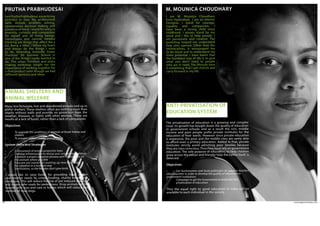
ANIMAL SHELTERS AND
ANIMAL WELFARE
IamPruthaPrabhudesai,apracticing
architect in Goa. My professional
skills include problem solving,
spontaneous decision making and
presence of mind. I stand for unity in
diversity, curiosity and compassion
for myself and all living beings.
Stereotypes and narrow minded
thinking are things that affect me a
lot. Being a rebel, I follow my heart
and always do the things I wish
to do. Attending Auroville Green
Practices’ 3H Summer School is
one of the things I really wanted to
do. This urban furniture and place
making workshop taught me the
importance of working together for
a final product even though we had
different opinions and ideas.
PRUTHA PRABHUDESAI
Many less fortunate, lost and abandoned animals end up in
pitiful shelters. These shelters often are nothing more than
shacks without walls and provide no protection from the
weather, diseases, or fights with other animals. These are
results of a lack of funds, rather than a lack of compassion.
Objectives
•	 To upgrade the conditions of animals at foster homes and 	
shelters
•	 To prevent animal cruelty and suffering
System shifts and Strategies
•	 Enforcement of animal protection laws
•	 Develop infrastructure to rescue and care for stray animals
•	 Establish a proper adoption process with information on 	
the animals where possible
•	 Educate pet owners on putting up new born pups 	
for adoption in a humane way
•	 Sterilization, so the females don’t give birth.
I would like to raise funds for providing food, shelter
and medical needs by crowd funding, charity events and
donations. This will reduce the risk of pet induced diseases
and create safer roads for pedestrians. Stray animals will be
treated with love and care in homes which will reduce the
number of stray dogs.
ANTI-PRIVATISATION OF
EDUCATION SYSTEM
I am M. Mounica Choudhary
from Hyderabad. I am an Interior
Designer. I stand for courage,
equality and compassion. I
have been a strong child since
childhood. I always stand by my
word and I like to help people. I
am passionate and creative. The
workshop helped me understand
how sites operate. Other than the
technicalities, it encouraged me
to be social and to understand my
inner potential. I have learnt that
the humblest way of life is to give
what you don’t need to people
who are in need. The lifestyle here
is something that I will cherish and
carry forward in my life.
M. MOUNICA CHOUDHARY
The privatisation of education is a growing and complex
issue. Its growth has bought down the quality of education
in government schools and as a result the rich, middle
income and poor people prefer private institutes for the
education of their wards. However since private education
is expensive, the poor and the middle class are rarely able
to afford even a primary education. Added to that, private
institutes strictly avoid admitting poor families because
they are class conscious.Thus they must rely on government
education. The sole purpose of education, to help children
grow across the nation and thereby help the nation itself, is
deterred.
Objectives
•	 Get businessmen and local politicians to support teachers
who volunteer in order to develop the quality of education in 		
government institutions
•	 Campaign to get the Government to eradicate this 		
	 privatisation of education
			
Thus the equal right to good education in India will be
available to each individual in the society.
www.agpworkshops.com28
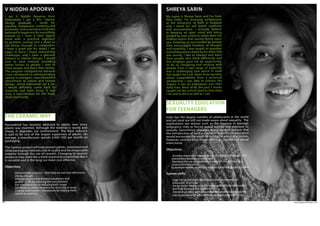
THE CERAMIC WAY
I am V. Niddhi Apoorva from
Hyderabad. I am a BSc. Interior
Design graduate. I stand for
equality, compassion, creativity and
humanity. I was a sensitive child who
believed in happiness for everything
around us. I have a clear, logical
mind with a practical approach
to problem solving and a drive to
see things through to completion.
I have a great eye for detail. I am
eager to learn, I enjoy overcoming
challenges, and I have a genuine
interest in Interior Design. I would
love to work towards providing
better homes to people. I love to
meet people and learn their stories.
The program intrigued me because
I was introduced to communicating
openly to strangers. I saw a beautiful
attachment to nature and human
beings, which interested me a lot.
I would definitely come back to
Auroville and learn more. It was
truly a nourishment for the head,
heart and hands.
V NIDDHI APOORVA
Humankind has become addicted to plastic ever since
plastic was invented. Although the material is sturdy and
cheap, it degrades our environment. The food industry
is said to be one of the largest supporters of plastic. On
average, a manufacturer spends 3,900 USD per month on
packaging.
The Ceramic project will help convert plastic, aluminium and
other packaging materials into re-usable and decomposable
material through the use of ceramic. Changing to ceramic
products may seem like a more expensive proposition but it
is reusable and in the long run more cost effective.
Objectives
•	 Demystifying ceramics - that they are not cost effective or 	
	 strong enough
•	 Helping preserve soil & water conditions and 			
	 quality 	of life by reducing the use of plastic
•	 Get manufacturers to reduce plastic usage
•	 Get stores to collect ceramics for recycling or reuse
•	 Change hotel owners’ behaviours by helping them 		
	 switch to ceramics
SEXUALITY EDUCATION
FOR TEENAGERS
My name is Shreya Sarin and I’m from
New Delhi. I’m pursuing architecture
at the University of Bath in England
and I stand for self belief, creativity
and perseverance. I strongly believe
in keeping an open mind and being
guided by your instincts rather than the
endless norms that society forces upon
you. Growing up surrounded by people
who encouraged freedom of thought
and creativity, I was taught to question
everything and to stand up for what I felt
was wrong. I like to interact and learn
from people who think differently and
this program gave me an opportunity
to do so. Designing and working with
people from a vast range of expertise
was a challenging task which in itself
has taught me a lot. Apart from learning
about sustainability from a technical
perspective, I was able to witness the
impact it has on individuals and their
daily lives. Most of all, the past 3 weeks
taught me the critical need to love what
I do and to do it as well as I can.
SHREYA SARIN
India has the largest number of adolescents in the world
and yet most are still not made aware about sexuality.  The
implications are serious such as the increase in teenage
pregnancy, risky or forced sexual activity and exposure to
sexually transmitted diseases. Many parents believe that
the introduction of such a course in mainstream education
would encourage the youth to indulge in physical activities.
However, reviews have shown delays in initiation of sexual
intercourse.
Objectives
·         Increase awareness regarding use of contraceptives, sexually 	
transmitted diseases and consent
·        Decrease the use of unreliable content on the internet as a 	
source of information
·        To promote health, respect for human rights and gender equality
System shifts
·         Urge the government to introduce and implement sex 		
education 	in schools.
·         Set up social media accounts to provide reliable information 	
and help during times of emergency
·         Establish an NGO with knowledgeable and reliable experts 	
which partner with schools to provide sexuality education
www.agpworkshops.com30
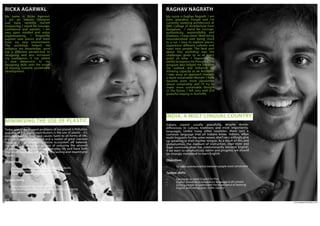
MINIMISING THE USE OF PLASTIC
My name is Ricka Agarwal.
I am an Interior Designer
and have recently started
freelancing. I stand for courage,
confidence and passion. I am
very open minded and enjoy
experimenting. I frequently
explore new places and learn
from my new environment.
The workshop helped me
enhance my knowledge, gave
me a different perspective to
designing and also increased
my confidence. It has added
a new dimension to my
designing skills with the vision
of moving towards sustainable
development.
RICKA AGARWAL
Today one of the biggest problems of our planet is Pollution
and one of the major contributors is the use of plastic - it’s
non-degradable, toxic and causes harm to all forms of life.
It is a fact well documented and a matter of great concern
because it can throw our entire ecosystem off balance.
Therefore I took up the project of reducing the amount
of plastic consumption in our everyday life and have faith
that small measures will add up to a lasting and meaningful
impact.
Objectives
· Increase awareness about the ill effects of plastic 	
amongst family, neighbours and friends
· Create a healthier environment starting at home
System shifts
· Carry a reusable bag while shopping
· Pick better alternatives to plastic materials, e.g. saying 	
no to straws, using refillable bottles
INDIA, A MULT-LINGUAL COUNTRY
My name is Raghav Nagrath. I am
from Jalandhar, Punjab and I’m
currently studying architecture at
BMS College of Architecture from
Bangalore. I stand for courage,
authenticity, responsibility and
kindness. I have never liked being
misunderstood and being stuck
in a rut. I love to explore places,
experience different cultures and
meet new people. The best part
about this workshop was the
challenges given to us at every
point of time. I improved my
ability to express my thoughts. The
program also helped me broaden
my outlook and enhance my
thinking capacity as an Architect.
I take away an approach towards
a more sustainable lifestyle. I have
become even more passionate
about sustainably and I’ll try to
make more sustainable designs
in the future. I felt very well and
peaceful staying in Auroville.
RAGHAV NAGRATH
Indians coexist usually peacefully, despite drastic
differences in culture, traditions and most importantly,
languages. Unlike many other countries, there isn’t a
common language that all Indians know. Indians, often
multi-linguistic for the same reason, don’t very willingly give
up speaking in their mother tongue. As a result of this and
globalization, the medium of instruction, inter-state and
legal communication has predominantly become English.
If we want to communicate better and progress, we should
be strongly motivated to learn English.
Objectives
•	 To make communication between people more convenient
System shifts
•	 Campaign to teach English for free
•	 English should be a compulsory language in all schools
•	 Getting people to understand the importance of learning 	
	 English and having unity in the country
www.agpworkshops.com32
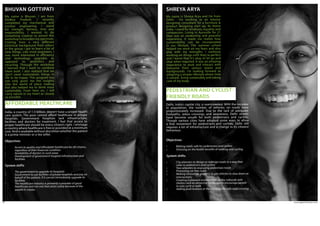
AFFORDABLE HEALTHCARE
My name is Bhuvan. I am from
Andhra Pradesh. I recently
completed my mechanical and
nuclear engineering. I stand
for strength, fairness, love and
responsibility. I wanted to do
something creative so joined this
workshop to broaden my spectrum.
Coming from a very different
technical background from others
in the group I got to learn a lot of
new things. Like most engineers, I
was more interested in efficiency
and technology upgrades as
opposed to aesthetics and
recycling. Through the workshop
I learned that I want to combine
them both. I also realized that we
don’t need materialistic things in
life to be happy. This program has
not only given me the insights
into the world of place making
but also helped me to think more
sustainably. From here on, I will
carry nature in my heart as closely
as possible.
BHUVAN GOTTIPATI
India, a country of 1.3 billion, doesn’t have a proper health
care system. The poor cannot afford healthcare in private
hospitals. Government hospitals lack infrastructure,
facilities and doctors for treatment. I feel that access to
proper healthcare should be every citizen’s right. I envisage
a country where healthcare is free or provided at a minimum
cost. And is available without discretion whether the patient
is a prime minister or a tea seller.
Objectives
•	 Access to quality and affordable healthcare for all citizens, 	
	 regardless of their financial condition
•	 Availability of doctors in rural areas
•	 Development of government hospital infrastructure and 	
	facilities
System shifts
•	 The government to upgrade its hospitals
•	 Government to use facilities of private hospitals and pay on 	
	 behalf of the patient, if it cannot immediately upgrade its 	
	facilities
•	 The healthcare industry is primarily a provider of good 		
	 healthcare and not one that exists solely because of the 	
	 wealth it creates
PEDESTRIAN AND CYCLIST-
FRIENDLY ROADS 
My name is Shreya Arya and I’m from
Delhi.  I’m working as an interior
designing consultant for a furniture &
product designing start up, Iki Home
India. I stand for kindness, equality and
compassion. Living in Auroville for 21
days was an awakening and peaceful
experience. It made me realize how
sustainability can be incorporated
in our lifestyle. The summer school
helped me work on my fears and also
play with my strengths. I continue
working on things until they’re perfect
and I learnt that it’s okay to let go and
stop when required. It was an amazing
experience to work and interact with
everyone from various towns and
backgrounds. I’m looking forward to
adopting a simpler lifestyle where time
is valued, living sustainably and taking
care of my body.
SHREYA ARYA
Delhi, India’s capital city, is overcrowded. With the increase
in population, the number of vehicles on roads have
proportionately increased. Due to the lack of adequate
footpaths,  zebra crossings and awareness, Delhi streets
have become unsafe for both pedestrians and cyclists. 
Though various cities have adopted some ways to allow
a free movement for pedestrians and cyclists, Delhi still
requires a lot of infrastructure and a change in its citizens’
behaviour.
Objectives
•	 Making roads safe for pedestrians and cyclists
•	 Stressing on the health benefits of walking and cycling
System shifts
•	 City planners to design or redesign roads in a way that 		
	 cater to pedestrians and cyclists
•	 Two-wheelers to stop using pedestrian roads
•	 Promoting car free roads
•	 Making innovative graphics to get vehicles to slow down at 	
	intersections
•	 Creating a pleasant environment on the sidewalk with 		
	 shelters and an attractive landscape to encourage people 	
	 to uses cycle or walk
•	 Adding push buttons at the crossings for safe road crossing
www.agpworkshops.com34
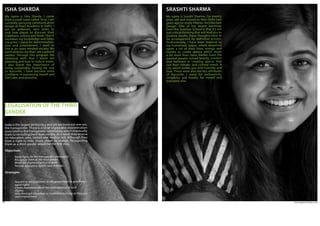
LEGALISATION OF THE THIRD
GENDER 
My name is Isha Sharda. I come
from a small town called Sirsa. I am
currently pursuing communication
design at Pearl Academy in Delhi. I
am an ambivert, who loves to
visit new places to discover their
traditions, culture and food; I feel it
increases my knowledge and helps
me grow. I stand for determination,
love and commitment. I want to
live in an open minded society. My
work abilities are that I am a patient
worker. Through this program the
technical skills that I learnt are
planning and how to reduce waste.
I also learnt the importance of
living sustainably. During my stay
in Auroville, I have become more
confident in expressing myself and
feel calm and peaceful.
ISHA SHARDA
India is the largest democracy and yet we leave out one sex,
the transgender.  There is a lot of stigma and discrimination
associated to the transgender community, which eventually
leads to secluding them from society. As a result they receive
no education, jobs, homes and medical aid. Although they
have a right to vote, much needs to change. Recognizing
them as a third gender would be the first step.
Objectives
•	 Equal rights for the transgender community 
•	 Recognize them as the third gender
•	 Break the stigma attached to them
•	 Provide education, health care and jobs  
Strategies
•	 Request or send petitions to the government to give them 	
	 equal rights 
•	 Create awareness about the unacceptance of such 		
	stigma
•	 Help them get education or vocational training so they can 	
	 seed employment 
My name is Srasthi Sharma. I’m twenty
years old and moved to New Delhi two
years ago to study Interior Architecture
Design. One of my recent learnings
from this Summer School is that it’s not
just critical thinking that will lead you to
positive results; these thoughts have to
be accompanied by definitive actions.
Professionally, I have been inspired by
my hometown Jaipur, where emperors
spent a lot of their time, energy and
money to create spaces which mean
a lot more than mere shelter. Even the
poorest people valued beauty, comfort
and believed in creating spaces that
suit their climatic and cultural needs. A
city which invites you with humility and
love. These were also the key attributes
of Auroville. I stand for authenticity,
simplicity and loyalty for myself and
everyone else.
SRASHTI SHARMA
www.agpworkshops.com36
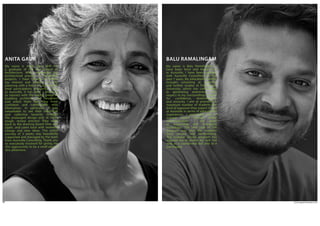
My name is Anita Gaur and I’m
a graduate of the Goa School of
Architecture. While continuing my
architectural practice in residential
projects, I have chosen to follow
my interest and passion for city
planning with a focus on community
level participatory processes. I live
in Auroville. It has been a pleasure
to interact with the young group of
budding architects and designers
and watch them becoming more
confident and comfortable with
themselves. In particular, it was
remarkable to see their individual
and collective tenacity through
the prolonged design and, at times
tough, review process! They went
back to the drawing board time and
again, and came back with renewed
energy and new ideas. This entire
journey of 3 weeks was beautifully
supported and managed by the team
from Auroville Consulting. Thank you
to everybody involved for giving me
this opportunity to be a small part of
this adventure.
ANITA GAUR
My name is Balu Ramalingam, I
have been born and bought up
in Auroville. I have been working
with Auroville Consulting for the
past 7 years. My educational profile
includes schooling at Auroville
and further studies at Puducherry
University, which has contributed
in generating awareness with
respect to my surroundings. I stand
for confidence, determination
and sincerity. I aim at providing a
maximum number of students the
kind of exposure they expect to get
at Auroville in terms of educational
experiences. I personally like to
express myself through verbal
communication. I am good
at organizing and managing
workshops. The best part of the
program was that the students
were sincere and hardworking.
The Summer School program has
inspired me to evolve my role not
only as a coordinator but also as a
participant.
BALU RAMALINGAM
www.agpworkshops.com38
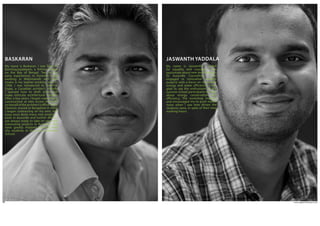
My name is Baskaran. I was born in
Bommayarpalayam, a fishing village
on the Bay of Bengal. Two of my
early experiences in Auroville were
working in Matrimandir and with
Andre in his leather-working unit. In
1999, I was introduced to Dominic
Dube, a Canadian architect. Initially
I learned how to draft plans and
make intricate architectural models.
After a few years, I began supervising
construction at sites across Auroville
on behalf of the architect’s office. Once
Dominic moved to Bangalore in 2002,
I began contracting on my own, and
have since done many new projects -
both in Auroville and further afield. I
am always ready to take on new and
interesting projects in Auroville, and
have greatly enjoyed working with
the students in this year’s Summer
School.
BASKARAN
My name is Jaswanth, I stand
for equality and courage. I am
passionate about new technologies.
At Auroville Consulting, I am
engaged in innovative research
projects with a focus on renewable
energy and water efficiency. I was
glad to see the enthusiasm of the
summer school participants to learn
about energy conservation and
efficiency. The workshop inspired
and encouraged me to push myself
more when I saw how driven the
students were, in spite of their long
working hours.
JASWANTH YADDALA
www.agpworkshops.com40
My name is Martin. I stand for
integrity, equality and courage. I was
born in a small village settlement at
the heart of Austria. I grew up playing
in the local forests, running after
the soccer ball and supporting my
parents in their daily farm work and
their restaurant business. I hold a
master degree in sociology. In 2005 I
moved to Auroville, where I have been
living and working since. Inspired by
the environmental and educational
work done at Auroville, I chose to
make this my main area of activity.
I am passionate about creating
learning programs that contribute
to environmental and social justices.
I love to share this passion with my
students, volunteers and interns of all
ages and backgrounds.
MARTIN SCHERFLER
My name is Nidhi. A typical city girl
from Mumbai; I moved to Auroville
on a professional break for three
months, but stayed on. I hold a
master’s degree in environmental
architecture. During my entire
tenure in Mumbai, I advocated
sustainability as “doing less harm”.
It’s here that I experienced living
by “doing no harm” and through
“re-generation”. I stand for peace
and harmony. I am passionate
about projects and programs
that inspire behavioural change
towards creating a harmonious
life on our planet. The summer
school for me has been one such
program. Despite all the design
and execution challenges that the
participants encountered, they
smiled through and never gave up.
Their determination has been an
inspiration for me all along. Learning
to expect the unexpected and be
prepared for the changing weather
is what this three week journey was
for me.
NIDHI GUPTA
www.agpworkshops.com42
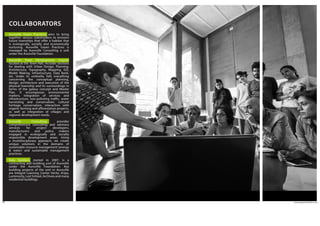
COLLABORATORS
Auroville Green Practices aims to bring
together various stakeholders to envision
future townships that offer a habitat that
is ecologically, socially and economically
nurturing. Auroville Green Practices is
managed by Auroville Consulting a unit
under the Auroville Foundation.
Auroville Town Development Council
located at the Town Hall, includes sections
for dealing with Urban Design, Planning,
Architecture, Topography, Mapping, GIS,
Model Making, Infrastructure, Data Bank,
etc. Under its umbrella, falls everything
concerning the conceptual planning,
design, architecture and execution of the
physical township and its surroundings in
terms of the galaxy concept and Master
Plan. It encompasses environmental
matters, integration of services and
infrastructure, non-polluting traffic, water
harvesting and conservation, cultural
heritage conservation, interaction with
organic farming and afforestation projects,
as well as integration of villages and
regional development needs.
Auroville Consulting provides
comprehensive consulting and advisory
services for project developers,
manufacturers and policy makers
engaged in ecologically and socially
responsible development areas. Using
a multidisciplinary approach, we create
unique solutions in the domains of
sustainable resource management (energy
& water) and sustainable management
practices.
Nala Builders, started in 2007, is a
contracting and building unit of Auroville
under the Auroville Foundation. Key
building projects of the unit in Auroville
are Integral Learning Center Verite, Kripa,
Luminosity, Last School, Archives and many
residential buildings.
www.agpworkshops.com

3H Summer School 2018

  • 1.
    Auroville, India Registration opennow www.agpworkshops.com Urban Furniture & Place making Hand Head Heart 15th July - 5th August 20183H Summer School Summer School July 2018 Auroville , India
  • 2.
    www.agpworkshops.com2 Urban Furniture & Placemaking “IN ORDER TO CARRY A POSITIVE ACTION WE MUST DEVELOP HERE A POSITIVE VISION.” - DALAI LAMA Auroville Green Practices July 2018
  • 3.
    www.agpworkshops.com4 FOREWORD An urban spaceis where encounters take place, when you and I meet, a space of the in between. In between you and me In between out and in In between yesterday and tomorrow It is where space becomes place Aldo van Eyck redefined a myriad of bombed out crevices in the urban fabric of postwar Amsterdam by designing a network of interventions in the public space. These interventions were no longer contributions to the monumental character of public space in the traditional sense, but instead were places of engagement, where play and interaction became centre stage. The urban furniture consisted of an effective “catalogue” of simple steel tubes, curved to become arches, linear to become rails and parallel bars, defining space but always insisting on transparency, on the interrelation between spaces. Lines, circles, rectangles and triangles formed beautiful compositions on the ground as an abstract artwork in itself, but also defined spatial relationships with the surrounding urban fabric. Fast backward a couple of centuries, but closer to home: around 500km south of Auroville, one of the most beautiful infrastructural public transport projects I have ever seen: the Ambalama in Karagahagedara. Sited on a modest rock outcrop, an island amongst a sea of paddy fields, this structure delicately balances on 4 boulders of around 1 meter in size. The height of the boulders carefully levels the difference between the slope of the rock surface and the horizontal plane. 4 large rectangular shaped tree trunks overlay like a puzzle piece into each other to form the support of the super structure, as well functions as a bench to sit or sleep on. Pilgrims, traders and travellers from countries as far as Maharasthra, Gujarat and Andhra would find a place here to rest, meet and share stories with each other. Space, functionality, tectonics, materialisation and structural essence all converge here. Heavy and down to earth but transparent and light at the same time. The spatial quality of the ambalama is one of continuity while being anchored and rooted to its specific location. The Ambalama which functions pretty much the same as a modern-day bus stop, and the playful interventions in public space in Amsterdam could serve as two inspiring historical case studies for the design of a bus stop at the Solar Kitchen in Auroville. The case studies in Amsterdam indicate the endless possibilities of the most rudimentary urban furniture and the significance of the definition of ground surface in creating opportunities for play. The Ambalama in Sri Lanka shows the enormous potential of the process of making with a basic material palette. As the initial workshops with the children from Auroville indicated, the functionality and significance of this project is much more than a bus stop though: it acts as a place for shelter from the elements, but also for interaction, for communication, and invite play and exploration. A place that can accommodate the various conditions in the passing of time during day and the seasons. Van Eyck once said: “whatever space and time mean place and occasion mean more!” Robert Verrijt, from Netherlands Co-Founder of Architecture Brio, Mumbai
  • 4.
    www.agpworkshops.com6 ACKNOWLEDGMENT 3H Summer Schoolis the result of the dedicated work of Auroville Green Practices. We would like to express our deep appreciation to the team at Bharat Nivas, for their encouragement and support in providing a venue for the program. Another special appreciation for the dedication and enthusiasm of the teachers and children of Deepanam and Transition schools, for their inspiring ideas on designs for the bus waiting area. Another special thanks to Ramco Industries, Auroville Security Service and Auryaj for their support to help manifest this program. Many thanks to the countless Auroville resource persons that interacted with the participants and shared their expertise. List of contributing resource persons: Anita Gaur, Auroville Town Development Council Audrey Wallace-Taylor, Center For Research, Education, And Experience in The Visual Arts Ayyappan, Auroville Earth Institute Balu Ramalingam, Auroville Consulting Baskaran and workers, Nala Builders Debabrata Sahoo, Kinisi Elke Vankoert, Theatre Games Eric Clapton, African Pavilion Fabian Ostner, White Ant Studio Hita, Auroville Consulting Jaswanth Yaddala, Auroville Consulting Kiran Kamal, Capoeira Lucas Dengel, EcoPro Mahesh, Svaram Martin Scherfler, Auroville Consulting Miroslava Pankova, Auroville Consulting Nidhi Gupta, Auroville Consulting OK Jeonglee, Upcycling Studio Omar Rabie, Unitary Design Studio Paul Blanchflower, Auroville Botanical Gardens Priya Bose, Auroville Consulting Radhika Soni, Auroville Earth Institute Samuka da Índia, Capoeira Sanata Prakash, Auroville Consulting Sathya, Center For Research, Education, And Experience in The Visual Arts Satprem Maini, Auroville Earth Institute Tejaswini Mistry-Kapoor, Auroville Town Development Council Vimal Bhojraj, Auroville Consulting Zdenek Ondrak, Auroville Consulting
  • 5.
    www.agpworkshops.com8 The theme ofthe 3H Summer School 2018 was “Urban Furniture and Place Making”. Urban furniture refers to objects and facilities located in urban community spaces that provide various services and functions to the community. It is one of the essential elements of the urban environment that contributes to humans andtheiractivities.Althoughcomparatively small in scale, urban furniture plays a significant role, in determining the quality of an urban environment and in representing the image of a city. Of all the landscape elements, urban furniture has the closest contact and interaction with humans. Urban furniture design involves a wide range of concerns, including function, environment, and meaning. The program was designed to contribute towards urban furniture of Auroville through enquiry into the principles of placemaking. The end result was to create a cohesive unit that creates greater value than just the sum of its parts. The students engaged in the design and implementation of an Urban Furniture project in order to enhance the community experience and quality of life by providing places to encounter. Introduction Auroville Green Practices (AGP) 3H Summer School program is an initiative using Auroville and its outstanding experience in sustainable living and cultural diversity as a platform for learning and personal growth for students from around the world. The 3H Summer School program serves as an experimental and cross- disciplinary design laboratory connecting core human values, design theory, ideation and hands-on application around the selected theme. The program is designed and based on the 3H (hands, head and heart) approach, which attemptstoactualizeparticipants’innerstrength, to activate critical system thinking and to work on students’ technical capacities of designing and implementing projects. Besides working on the design, implementation and documentation, each participating student designed and wrote a project of his/her choice, which aimed at bringing environmental and social justice and wellbeing.The aim was to train a new generation ofenvironmentalandsociallyresponsibleleaders that are capable of connecting hands (capacity), head (system thinking) and heart (personal strength) while working on system change for a more socially and environmentally just future.
  • 6.
    www.agpworkshops.com10 TABLE OF CONTENT DesignBrief 12-15 Art Sessions at Auroville Schools 16-19 PARTICIPANTS PROFILES & FUTURE COMMITMENTS 22-41 COLLABORATORS 42-43
  • 7.
    www.agpworkshops.com12 Design Brief Problem Statement Thebus waiting areas in Auroville are standalone signs with lack of appropriate infrastructure for the commuters. These areas are used by students of Auroville schools and by people travelling between Pondicherry and Auroville. They neither offer weather protection nor the comfort for waiting period. The waiting periods can range from 5-20 minutes. These places offer the potential to become lively community spaces with placemaking intervention strategies. The site for our urban intervention problem is near the Solar Kitchen roundabout, with the Auroville Library and the Solar Kitchen on each side of it. The bus waiting area is used by school children as drop off points as well as by people travelling to Pondicherry. Since it is located at a very prominent place in Auroville, visual aesthetics, detailing and finishing of the project are key to the problem.
  • 8.
    www.agpworkshops.com14 Objectives of urban intervention Thedesign should be visually appealing, account for weather protection and universally comfortable. Innovative use of material and technique will be encouraged. Visually appealing – Since the roundabout is in a prominent location in Auroville, one of the important aspects of the design is aesthetics and finishing. This space offers potential of interaction to all, visual as well as physical. Hence, the quality of construction and detailing is key to the project. Weather protection – Auroville has a very harsh summer from April-June and monsoons in the month of October-February. The bus waiting area should consider for shade from weather protection. Comfort – In addition to ergonomics of the design interventions, the designers are encouraged to incorporate utility elements for waste management, drinking water facilities, etc within the space design Innovative use of material & technique – Innovative use of local materials (such as earth & stone) and upcycling of waste materials (such as electric light poles) is expected. The above four considerations are non-negotiables. Materials The built forms will be of permanent nature. Primary building materials considered for construction are earth, street light poles (upcycled), granite stones, RAMCO external boards, sheets and wood. Considering the two-week construction time frame, using earth via rammed earth construction technique will be the extensively used. The participants are encouraged to explore innovative methods. Budget The budget for construction of the bus waiting area should be approximately 1.3 lakhs; including construction management, material and labour. In addition to this, the students are also provided with materials like RAMCO external boards, street light poles and granite stones. The summer school participants will be expected to work within the budget and with the materials provided.
  • 9.
    www.agpworkshops.com16 Art Sessions at AurovilleSchools As part of community engagement, art sessions were conducted in the months of April - May with children from Deepanam and Transition School. The children came up with ideas and suggestions for the bus waiting area. Based on interaction with the children, following are the three strong elements that the design could incorporate. The participants may choose to include minimum two of the elements listed below: Play - Children and / or parents wait in this area for typically 5-20 minutes. A playful space makes the wait enjoyable and bearable. Some of the children’s ideas included hammocks, games, slides, swings, etc. Time - This was a recurrent theme seen through most of the artwork made by the children. Most of the artwork had clocks as a part of the space design. The participants are encouraged to come up with innovative ways to include this element. Space - The design could consider incorporating existing elements of the site such as trees, levels, street poles, pathways. Design to consider response to different timely and seasonal variations in Auroville.
  • 10.
  • 11.
  • 12.
  • 13.
    www.agpworkshops.com24 DESIGN FOR ASMILE My name is Nihal Mutha. I am from Satara and I’m currently studying product designing from Woxsen School of Art and Design Hyderabad. I stand for courage, happiness and creativity. As a design student, I like to explore and experiment with different materials. I also like to travel to different places to experience their cultures and crafts. This summer school course has helped me develop my presentation skills and increased my confidence to express myself without any fear. It has also introduced me to new technologies and bettered my understanding of different materials - Auroville is a true example of upcycling waste! NIHAL MUTHA The aim of this project is to address some of the drawbacks of our existing educational system, which include stress given to grading, methods of teaching and restrictive curriculums. Since education plays a pivotal part in an individual’s life, the drawback in the current system has negatively affected many. As a student, I would like to find a solution to it. Objectives • Make learning fun and more student centric • Introduce extracurricular activities in order to enhance other aspects of the students personalities • Create a system of learning that brings out the student’s inner strength Strategies • Design a holistic summer school • Establish contact with principles of colleges and discuss the benefits of the program • Encourage students to widen their learning • Conduct the course • The success of the program can be measured by the students’ individual progress, their enthusiasm in acquiring knowledge and their level of happiness WASTE MANAGEMENT My name is Soham Patil. I’m architect from Mumbai. I stand for courage, creativity, kindness and an open mind. I love to travel, meet new people, experience their culture and take back something. I truly believe we all are connected to one another and as a community we can achieve a lot of things. The 3H summer school is a unique program, which focuses on the techniques and designs along with discovering new strengths and weaknesses. It also helps in refining the old ones. I learnt that I strongly stand for equity, creativity and courage. I realised the importance of living sustainably. I have become more comfortable being with people from different parts of the world, more expressive, observant and connected to things & people around me and more in tune with one another. It was a peaceful experience that helped me be creative. SOHAM PATIL Of the 1,27,486 tonnes of waste generated every day in India in 2011-12, Mumbai alone accounted for 6.11 per cent. It is estimated that every resident in the metropolis generated about 630 grams of waste daily, a figure that has probably touched 1 kg by now. While the quantum of garbage generated by the city is only expected to increase, the infrastructure necessary to manage it is still not in place. Objectives • Develop an integrated waste management system • Enhance the knowledge and good practices of all stakeholders • Create employment and improve working conditions in waste management System shifts • Request societies to segregate the waste in every household • Speak to fellow architects to include a waste management system in their projects • Encourage lower income people to start upcycling from waste • Request municipal authorities in the vicinity to introduce schemes and promote seminars on waste management • Create a photo exhibition and articles that would exhibit the current scenario of waste
  • 14.
    www.agpworkshops.com26 ANIMAL SHELTERS AND ANIMALWELFARE IamPruthaPrabhudesai,apracticing architect in Goa. My professional skills include problem solving, spontaneous decision making and presence of mind. I stand for unity in diversity, curiosity and compassion for myself and all living beings. Stereotypes and narrow minded thinking are things that affect me a lot. Being a rebel, I follow my heart and always do the things I wish to do. Attending Auroville Green Practices’ 3H Summer School is one of the things I really wanted to do. This urban furniture and place making workshop taught me the importance of working together for a final product even though we had different opinions and ideas. PRUTHA PRABHUDESAI Many less fortunate, lost and abandoned animals end up in pitiful shelters. These shelters often are nothing more than shacks without walls and provide no protection from the weather, diseases, or fights with other animals. These are results of a lack of funds, rather than a lack of compassion. Objectives • To upgrade the conditions of animals at foster homes and shelters • To prevent animal cruelty and suffering System shifts and Strategies • Enforcement of animal protection laws • Develop infrastructure to rescue and care for stray animals • Establish a proper adoption process with information on the animals where possible • Educate pet owners on putting up new born pups for adoption in a humane way • Sterilization, so the females don’t give birth. I would like to raise funds for providing food, shelter and medical needs by crowd funding, charity events and donations. This will reduce the risk of pet induced diseases and create safer roads for pedestrians. Stray animals will be treated with love and care in homes which will reduce the number of stray dogs. ANTI-PRIVATISATION OF EDUCATION SYSTEM I am M. Mounica Choudhary from Hyderabad. I am an Interior Designer. I stand for courage, equality and compassion. I have been a strong child since childhood. I always stand by my word and I like to help people. I am passionate and creative. The workshop helped me understand how sites operate. Other than the technicalities, it encouraged me to be social and to understand my inner potential. I have learnt that the humblest way of life is to give what you don’t need to people who are in need. The lifestyle here is something that I will cherish and carry forward in my life. M. MOUNICA CHOUDHARY The privatisation of education is a growing and complex issue. Its growth has bought down the quality of education in government schools and as a result the rich, middle income and poor people prefer private institutes for the education of their wards. However since private education is expensive, the poor and the middle class are rarely able to afford even a primary education. Added to that, private institutes strictly avoid admitting poor families because they are class conscious.Thus they must rely on government education. The sole purpose of education, to help children grow across the nation and thereby help the nation itself, is deterred. Objectives • Get businessmen and local politicians to support teachers who volunteer in order to develop the quality of education in government institutions • Campaign to get the Government to eradicate this privatisation of education Thus the equal right to good education in India will be available to each individual in the society.
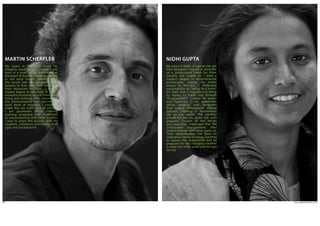
  • 15.
    www.agpworkshops.com28 THE CERAMIC WAY Iam V. Niddhi Apoorva from Hyderabad. I am a BSc. Interior Design graduate. I stand for equality, compassion, creativity and humanity. I was a sensitive child who believed in happiness for everything around us. I have a clear, logical mind with a practical approach to problem solving and a drive to see things through to completion. I have a great eye for detail. I am eager to learn, I enjoy overcoming challenges, and I have a genuine interest in Interior Design. I would love to work towards providing better homes to people. I love to meet people and learn their stories. The program intrigued me because I was introduced to communicating openly to strangers. I saw a beautiful attachment to nature and human beings, which interested me a lot. I would definitely come back to Auroville and learn more. It was truly a nourishment for the head, heart and hands. V NIDDHI APOORVA Humankind has become addicted to plastic ever since plastic was invented. Although the material is sturdy and cheap, it degrades our environment. The food industry is said to be one of the largest supporters of plastic. On average, a manufacturer spends 3,900 USD per month on packaging. The Ceramic project will help convert plastic, aluminium and other packaging materials into re-usable and decomposable material through the use of ceramic. Changing to ceramic products may seem like a more expensive proposition but it is reusable and in the long run more cost effective. Objectives • Demystifying ceramics - that they are not cost effective or strong enough • Helping preserve soil & water conditions and quality of life by reducing the use of plastic • Get manufacturers to reduce plastic usage • Get stores to collect ceramics for recycling or reuse • Change hotel owners’ behaviours by helping them switch to ceramics SEXUALITY EDUCATION FOR TEENAGERS My name is Shreya Sarin and I’m from New Delhi. I’m pursuing architecture at the University of Bath in England and I stand for self belief, creativity and perseverance. I strongly believe in keeping an open mind and being guided by your instincts rather than the endless norms that society forces upon you. Growing up surrounded by people who encouraged freedom of thought and creativity, I was taught to question everything and to stand up for what I felt was wrong. I like to interact and learn from people who think differently and this program gave me an opportunity to do so. Designing and working with people from a vast range of expertise was a challenging task which in itself has taught me a lot. Apart from learning about sustainability from a technical perspective, I was able to witness the impact it has on individuals and their daily lives. Most of all, the past 3 weeks taught me the critical need to love what I do and to do it as well as I can. SHREYA SARIN India has the largest number of adolescents in the world and yet most are still not made aware about sexuality.  The implications are serious such as the increase in teenage pregnancy, risky or forced sexual activity and exposure to sexually transmitted diseases. Many parents believe that the introduction of such a course in mainstream education would encourage the youth to indulge in physical activities. However, reviews have shown delays in initiation of sexual intercourse. Objectives ·         Increase awareness regarding use of contraceptives, sexually transmitted diseases and consent ·        Decrease the use of unreliable content on the internet as a source of information ·        To promote health, respect for human rights and gender equality System shifts ·         Urge the government to introduce and implement sex education in schools. ·         Set up social media accounts to provide reliable information and help during times of emergency ·         Establish an NGO with knowledgeable and reliable experts which partner with schools to provide sexuality education
  • 16.
    www.agpworkshops.com30 MINIMISING THE USEOF PLASTIC My name is Ricka Agarwal. I am an Interior Designer and have recently started freelancing. I stand for courage, confidence and passion. I am very open minded and enjoy experimenting. I frequently explore new places and learn from my new environment. The workshop helped me enhance my knowledge, gave me a different perspective to designing and also increased my confidence. It has added a new dimension to my designing skills with the vision of moving towards sustainable development. RICKA AGARWAL Today one of the biggest problems of our planet is Pollution and one of the major contributors is the use of plastic - it’s non-degradable, toxic and causes harm to all forms of life. It is a fact well documented and a matter of great concern because it can throw our entire ecosystem off balance. Therefore I took up the project of reducing the amount of plastic consumption in our everyday life and have faith that small measures will add up to a lasting and meaningful impact. Objectives · Increase awareness about the ill effects of plastic amongst family, neighbours and friends · Create a healthier environment starting at home System shifts · Carry a reusable bag while shopping · Pick better alternatives to plastic materials, e.g. saying no to straws, using refillable bottles INDIA, A MULT-LINGUAL COUNTRY My name is Raghav Nagrath. I am from Jalandhar, Punjab and I’m currently studying architecture at BMS College of Architecture from Bangalore. I stand for courage, authenticity, responsibility and kindness. I have never liked being misunderstood and being stuck in a rut. I love to explore places, experience different cultures and meet new people. The best part about this workshop was the challenges given to us at every point of time. I improved my ability to express my thoughts. The program also helped me broaden my outlook and enhance my thinking capacity as an Architect. I take away an approach towards a more sustainable lifestyle. I have become even more passionate about sustainably and I’ll try to make more sustainable designs in the future. I felt very well and peaceful staying in Auroville. RAGHAV NAGRATH Indians coexist usually peacefully, despite drastic differences in culture, traditions and most importantly, languages. Unlike many other countries, there isn’t a common language that all Indians know. Indians, often multi-linguistic for the same reason, don’t very willingly give up speaking in their mother tongue. As a result of this and globalization, the medium of instruction, inter-state and legal communication has predominantly become English. If we want to communicate better and progress, we should be strongly motivated to learn English. Objectives • To make communication between people more convenient System shifts • Campaign to teach English for free • English should be a compulsory language in all schools • Getting people to understand the importance of learning English and having unity in the country
  • 17.
    www.agpworkshops.com32 AFFORDABLE HEALTHCARE My nameis Bhuvan. I am from Andhra Pradesh. I recently completed my mechanical and nuclear engineering. I stand for strength, fairness, love and responsibility. I wanted to do something creative so joined this workshop to broaden my spectrum. Coming from a very different technical background from others in the group I got to learn a lot of new things. Like most engineers, I was more interested in efficiency and technology upgrades as opposed to aesthetics and recycling. Through the workshop I learned that I want to combine them both. I also realized that we don’t need materialistic things in life to be happy. This program has not only given me the insights into the world of place making but also helped me to think more sustainably. From here on, I will carry nature in my heart as closely as possible. BHUVAN GOTTIPATI India, a country of 1.3 billion, doesn’t have a proper health care system. The poor cannot afford healthcare in private hospitals. Government hospitals lack infrastructure, facilities and doctors for treatment. I feel that access to proper healthcare should be every citizen’s right. I envisage a country where healthcare is free or provided at a minimum cost. And is available without discretion whether the patient is a prime minister or a tea seller. Objectives • Access to quality and affordable healthcare for all citizens, regardless of their financial condition • Availability of doctors in rural areas • Development of government hospital infrastructure and facilities System shifts • The government to upgrade its hospitals • Government to use facilities of private hospitals and pay on behalf of the patient, if it cannot immediately upgrade its facilities • The healthcare industry is primarily a provider of good healthcare and not one that exists solely because of the wealth it creates PEDESTRIAN AND CYCLIST- FRIENDLY ROADS  My name is Shreya Arya and I’m from Delhi.  I’m working as an interior designing consultant for a furniture & product designing start up, Iki Home India. I stand for kindness, equality and compassion. Living in Auroville for 21 days was an awakening and peaceful experience. It made me realize how sustainability can be incorporated in our lifestyle. The summer school helped me work on my fears and also play with my strengths. I continue working on things until they’re perfect and I learnt that it’s okay to let go and stop when required. It was an amazing experience to work and interact with everyone from various towns and backgrounds. I’m looking forward to adopting a simpler lifestyle where time is valued, living sustainably and taking care of my body. SHREYA ARYA Delhi, India’s capital city, is overcrowded. With the increase in population, the number of vehicles on roads have proportionately increased. Due to the lack of adequate footpaths,  zebra crossings and awareness, Delhi streets have become unsafe for both pedestrians and cyclists.  Though various cities have adopted some ways to allow a free movement for pedestrians and cyclists, Delhi still requires a lot of infrastructure and a change in its citizens’ behaviour. Objectives • Making roads safe for pedestrians and cyclists • Stressing on the health benefits of walking and cycling System shifts • City planners to design or redesign roads in a way that cater to pedestrians and cyclists • Two-wheelers to stop using pedestrian roads • Promoting car free roads • Making innovative graphics to get vehicles to slow down at intersections • Creating a pleasant environment on the sidewalk with shelters and an attractive landscape to encourage people to uses cycle or walk • Adding push buttons at the crossings for safe road crossing
  • 18.
    www.agpworkshops.com34 LEGALISATION OF THETHIRD GENDER  My name is Isha Sharda. I come from a small town called Sirsa. I am currently pursuing communication design at Pearl Academy in Delhi. I am an ambivert, who loves to visit new places to discover their traditions, culture and food; I feel it increases my knowledge and helps me grow. I stand for determination, love and commitment. I want to live in an open minded society. My work abilities are that I am a patient worker. Through this program the technical skills that I learnt are planning and how to reduce waste. I also learnt the importance of living sustainably. During my stay in Auroville, I have become more confident in expressing myself and feel calm and peaceful. ISHA SHARDA India is the largest democracy and yet we leave out one sex, the transgender.  There is a lot of stigma and discrimination associated to the transgender community, which eventually leads to secluding them from society. As a result they receive no education, jobs, homes and medical aid. Although they have a right to vote, much needs to change. Recognizing them as a third gender would be the first step. Objectives • Equal rights for the transgender community  • Recognize them as the third gender • Break the stigma attached to them • Provide education, health care and jobs   Strategies • Request or send petitions to the government to give them equal rights  • Create awareness about the unacceptance of such stigma • Help them get education or vocational training so they can seed employment  My name is Srasthi Sharma. I’m twenty years old and moved to New Delhi two years ago to study Interior Architecture Design. One of my recent learnings from this Summer School is that it’s not just critical thinking that will lead you to positive results; these thoughts have to be accompanied by definitive actions. Professionally, I have been inspired by my hometown Jaipur, where emperors spent a lot of their time, energy and money to create spaces which mean a lot more than mere shelter. Even the poorest people valued beauty, comfort and believed in creating spaces that suit their climatic and cultural needs. A city which invites you with humility and love. These were also the key attributes of Auroville. I stand for authenticity, simplicity and loyalty for myself and everyone else. SRASHTI SHARMA
  • 19.
    www.agpworkshops.com36 My name isAnita Gaur and I’m a graduate of the Goa School of Architecture. While continuing my architectural practice in residential projects, I have chosen to follow my interest and passion for city planning with a focus on community level participatory processes. I live in Auroville. It has been a pleasure to interact with the young group of budding architects and designers and watch them becoming more confident and comfortable with themselves. In particular, it was remarkable to see their individual and collective tenacity through the prolonged design and, at times tough, review process! They went back to the drawing board time and again, and came back with renewed energy and new ideas. This entire journey of 3 weeks was beautifully supported and managed by the team from Auroville Consulting. Thank you to everybody involved for giving me this opportunity to be a small part of this adventure. ANITA GAUR My name is Balu Ramalingam, I have been born and bought up in Auroville. I have been working with Auroville Consulting for the past 7 years. My educational profile includes schooling at Auroville and further studies at Puducherry University, which has contributed in generating awareness with respect to my surroundings. I stand for confidence, determination and sincerity. I aim at providing a maximum number of students the kind of exposure they expect to get at Auroville in terms of educational experiences. I personally like to express myself through verbal communication. I am good at organizing and managing workshops. The best part of the program was that the students were sincere and hardworking. The Summer School program has inspired me to evolve my role not only as a coordinator but also as a participant. BALU RAMALINGAM
  • 20.
    www.agpworkshops.com38 My name isBaskaran. I was born in Bommayarpalayam, a fishing village on the Bay of Bengal. Two of my early experiences in Auroville were working in Matrimandir and with Andre in his leather-working unit. In 1999, I was introduced to Dominic Dube, a Canadian architect. Initially I learned how to draft plans and make intricate architectural models. After a few years, I began supervising construction at sites across Auroville on behalf of the architect’s office. Once Dominic moved to Bangalore in 2002, I began contracting on my own, and have since done many new projects - both in Auroville and further afield. I am always ready to take on new and interesting projects in Auroville, and have greatly enjoyed working with the students in this year’s Summer School. BASKARAN My name is Jaswanth, I stand for equality and courage. I am passionate about new technologies. At Auroville Consulting, I am engaged in innovative research projects with a focus on renewable energy and water efficiency. I was glad to see the enthusiasm of the summer school participants to learn about energy conservation and efficiency. The workshop inspired and encouraged me to push myself more when I saw how driven the students were, in spite of their long working hours. JASWANTH YADDALA
  • 21.
    www.agpworkshops.com40 My name isMartin. I stand for integrity, equality and courage. I was born in a small village settlement at the heart of Austria. I grew up playing in the local forests, running after the soccer ball and supporting my parents in their daily farm work and their restaurant business. I hold a master degree in sociology. In 2005 I moved to Auroville, where I have been living and working since. Inspired by the environmental and educational work done at Auroville, I chose to make this my main area of activity. I am passionate about creating learning programs that contribute to environmental and social justices. I love to share this passion with my students, volunteers and interns of all ages and backgrounds. MARTIN SCHERFLER My name is Nidhi. A typical city girl from Mumbai; I moved to Auroville on a professional break for three months, but stayed on. I hold a master’s degree in environmental architecture. During my entire tenure in Mumbai, I advocated sustainability as “doing less harm”. It’s here that I experienced living by “doing no harm” and through “re-generation”. I stand for peace and harmony. I am passionate about projects and programs that inspire behavioural change towards creating a harmonious life on our planet. The summer school for me has been one such program. Despite all the design and execution challenges that the participants encountered, they smiled through and never gave up. Their determination has been an inspiration for me all along. Learning to expect the unexpected and be prepared for the changing weather is what this three week journey was for me. NIDHI GUPTA
  • 22.
    www.agpworkshops.com42 COLLABORATORS Auroville Green Practicesaims to bring together various stakeholders to envision future townships that offer a habitat that is ecologically, socially and economically nurturing. Auroville Green Practices is managed by Auroville Consulting a unit under the Auroville Foundation. Auroville Town Development Council located at the Town Hall, includes sections for dealing with Urban Design, Planning, Architecture, Topography, Mapping, GIS, Model Making, Infrastructure, Data Bank, etc. Under its umbrella, falls everything concerning the conceptual planning, design, architecture and execution of the physical township and its surroundings in terms of the galaxy concept and Master Plan. It encompasses environmental matters, integration of services and infrastructure, non-polluting traffic, water harvesting and conservation, cultural heritage conservation, interaction with organic farming and afforestation projects, as well as integration of villages and regional development needs. Auroville Consulting provides comprehensive consulting and advisory services for project developers, manufacturers and policy makers engaged in ecologically and socially responsible development areas. Using a multidisciplinary approach, we create unique solutions in the domains of sustainable resource management (energy & water) and sustainable management practices. Nala Builders, started in 2007, is a contracting and building unit of Auroville under the Auroville Foundation. Key building projects of the unit in Auroville are Integral Learning Center Verite, Kripa, Luminosity, Last School, Archives and many residential buildings.
  • 23.