SEPAC SURVEY
FEEDBACK
SEPAC and HPS
Survey completed Spring 2021
This brief summary will:
Present questions from the survey that
generated the highest percentage of
common or similar feedback
Present the original SEPAC Question
and the prevailing or most prominent
type of responses from respondents
In cases where it occurs, multiple
responses may be presented to show
the range of feedback
For each question presented, the
District response/feedback will reflect
the work done, being done, or is
planned for the future
SEPAC recommendations will be
shared
This response will also include
reflection on identified areas of growth
for future planning when applicable to
the question
Survey Respondents:
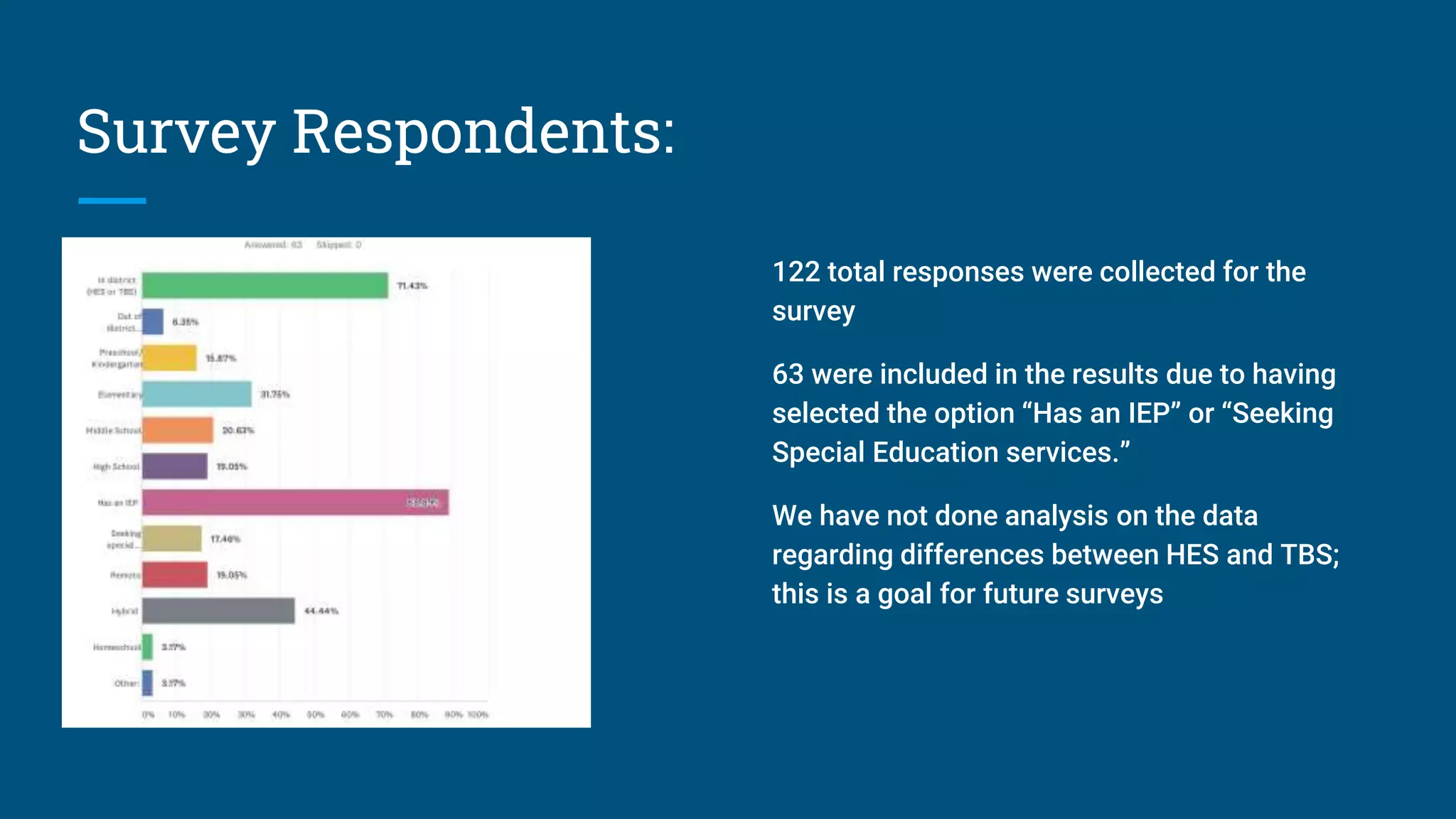
122 total responses were collected for the
survey
63 were included in the results due to having
selected the option “Has an IEP” or “Seeking
Special Education services.”
We have not done analysis on the data
regarding differences between HES and TBS;
this is a goal for future surveys
Question 2
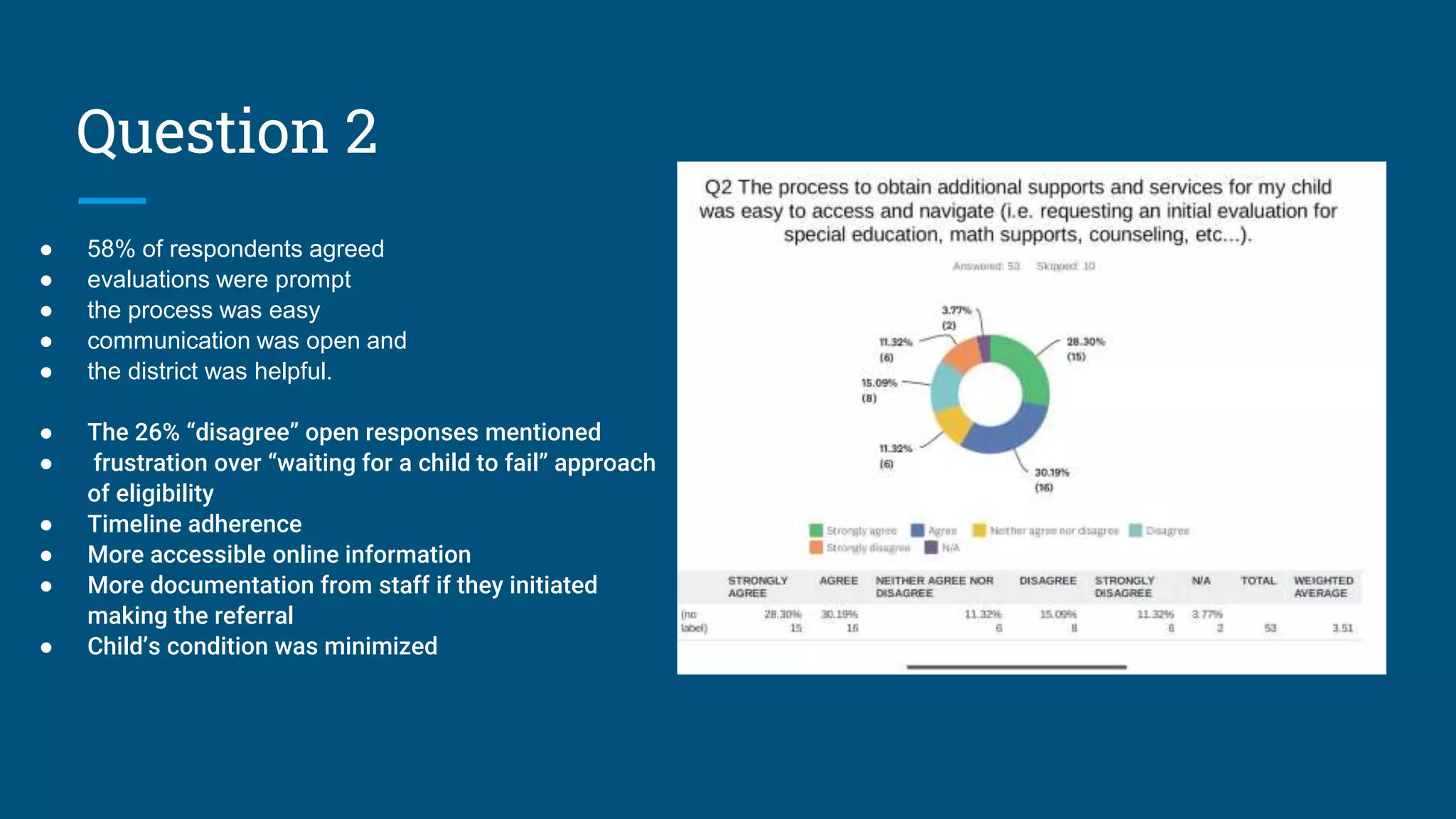
● 58% of respondents agreed
● evaluations were prompt
● the process was easy
● communication was open and
● the district was helpful.
● The 26% “disagree” open responses mentioned
● frustration over “waiting for a child to fail” approach
of eligibility
● Timeline adherence
● More accessible online information
● More documentation from staff if they initiated
making the referral
● Child’s condition was minimized
Question 2
● HPS provides numerous supports and interventions for students who may need targeted or
short-term intervention, including Social/Emotional groups and classes, Intervention services to
target speech, OT, and academic needs
● HPS has counseling services and supports for all students at both schools
● Both schools implement DCAP strategies, considered “best practices” that are available to all
students without needing to have a formal plan
● Both schools have a referral process/team that reviews teacher concerns in conjunction with
parent reports and other feedback
● Both schools have a process for identifying students who may be eligible for accommodations
through Section 504
These interventions and supports are not tied to Special Education, though information or progress
monitoring in these areas may lead to a referral for Special Education evaluation
SEPAC
● Provide the IEP eligibility timeline infographic in the consent to
evaluate initial packet
● Direct parents to the SEPAC website and contact information for
more support
● Use reflective listening techniques and validation to build trust
and rapport
Question 3: Are you satisfied with the communication between your
child’s special education team, general education providers, and your
family?
Response:
Majority of respondents were
satisfied or highly satisfied
with the communication:
66.67%
Greatest feedback from
families that were less
satisfied with communication
was to focus on improvement
between general education
teachers and both the special
educators and the families
Looking forward to showcasing the FAQ section that
SEPAC agreed to create for families to include on our
new website: “What to expect” and “Things to Consider”
when preparing for meeting with special and general
education teachers and attending Team meetings.
Work in the schools will continue to emphasize
“empathic listening” as important to the success of two-
way communication
Administration will continue to work with building based
and out of district coordinators to model and promote
effective communication and conversation between all
members of a student’s education Team.
SEPAC
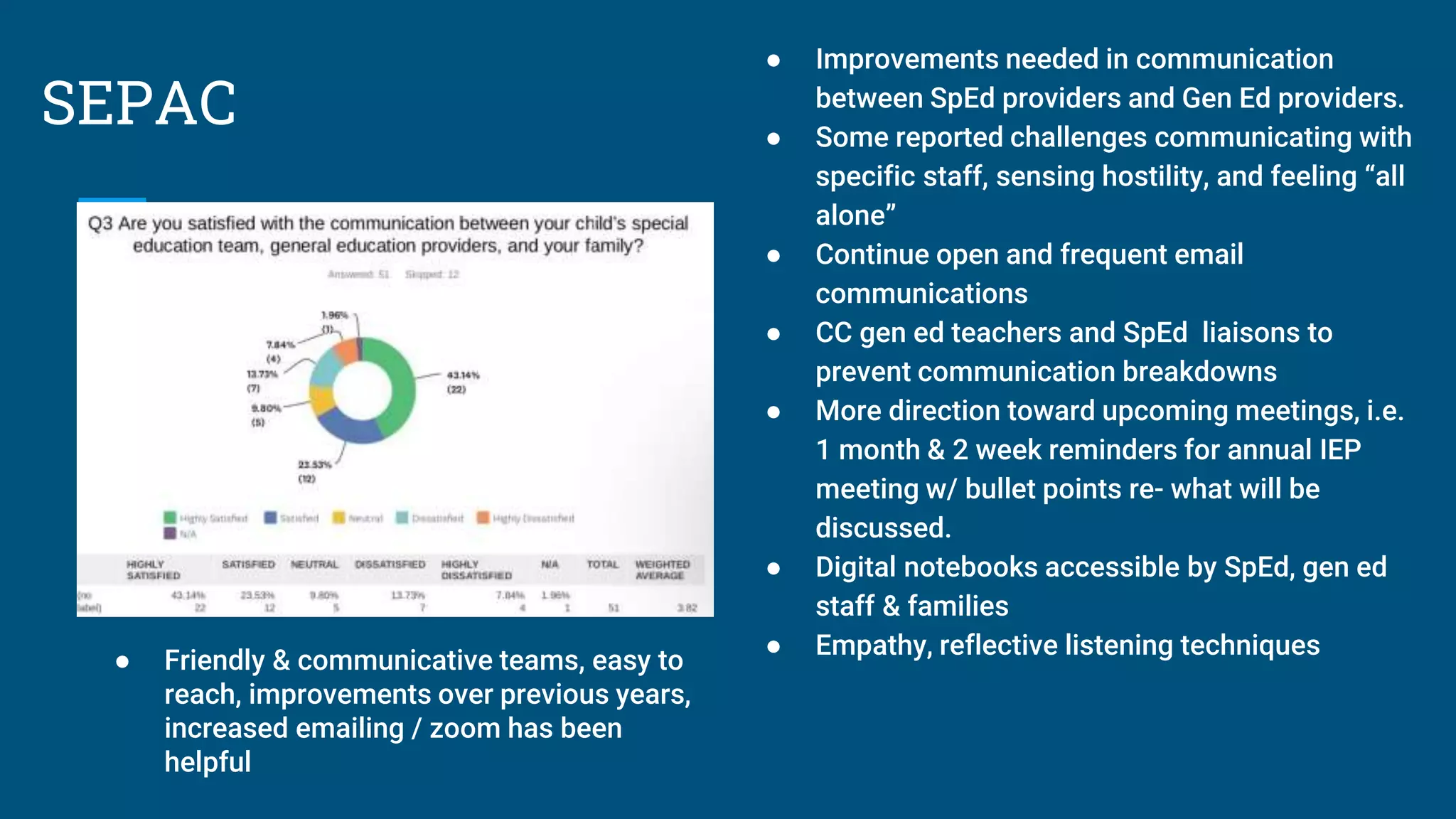
● Improvements needed in communication
between SpEd providers and Gen Ed providers.
● Some reported challenges communicating with
specific staff, sensing hostility, and feeling “all
alone”
● Continue open and frequent email
communications
● CC gen ed teachers and SpEd liaisons to
prevent communication breakdowns
● More direction toward upcoming meetings, i.e.
1 month & 2 week reminders for annual IEP
meeting w/ bullet points re- what will be
discussed.
● Digital notebooks accessible by SpEd, gen ed
staff & families
● Empathy, reflective listening techniques
● Friendly & communicative teams, easy to
reach, improvements over previous years,
increased emailing / zoom has been
helpful
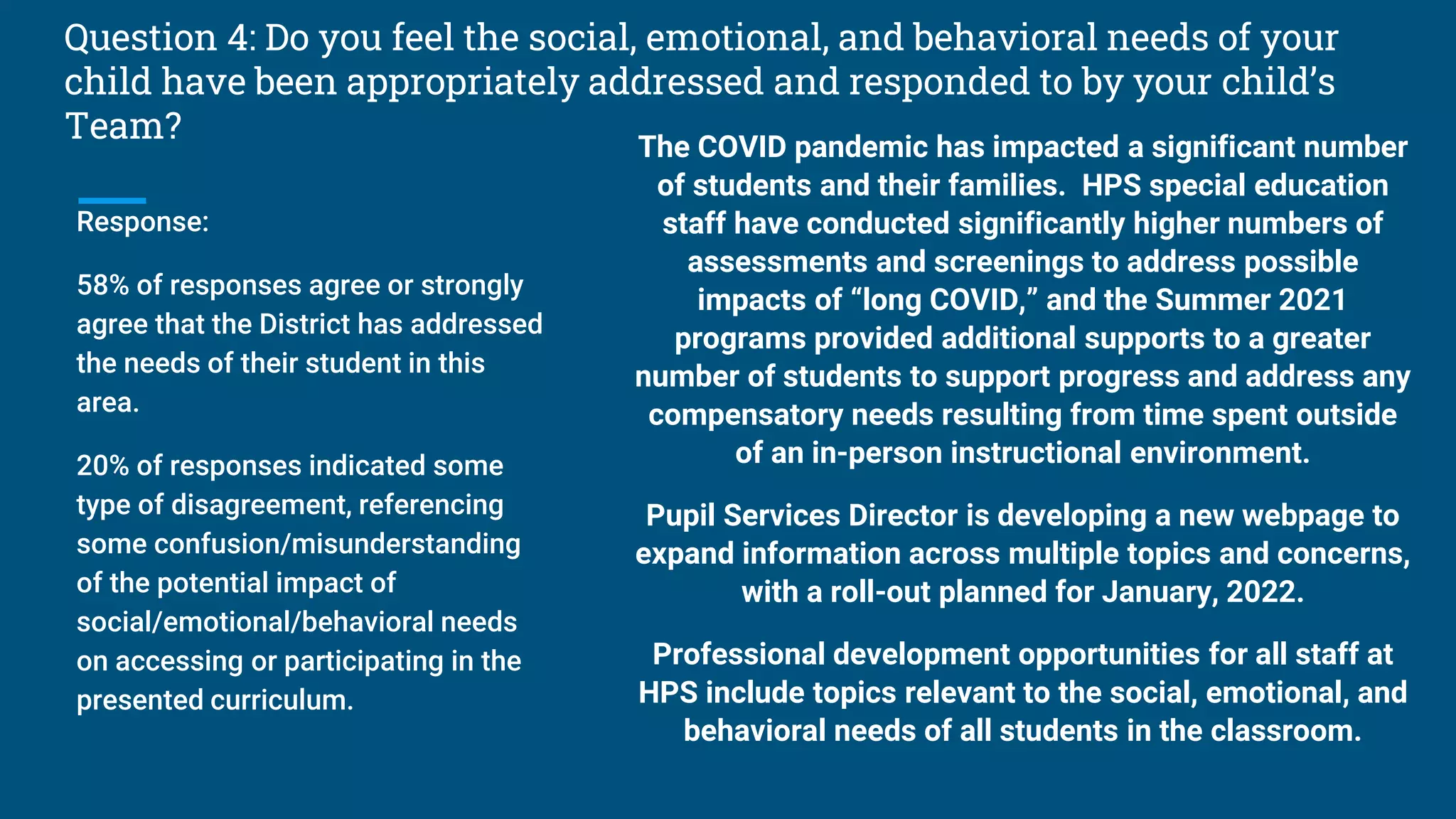
Question 4: Do you feel the social, emotional, and behavioral needs of your
child have been appropriately addressed and responded to by your child’s
Team?
Response:
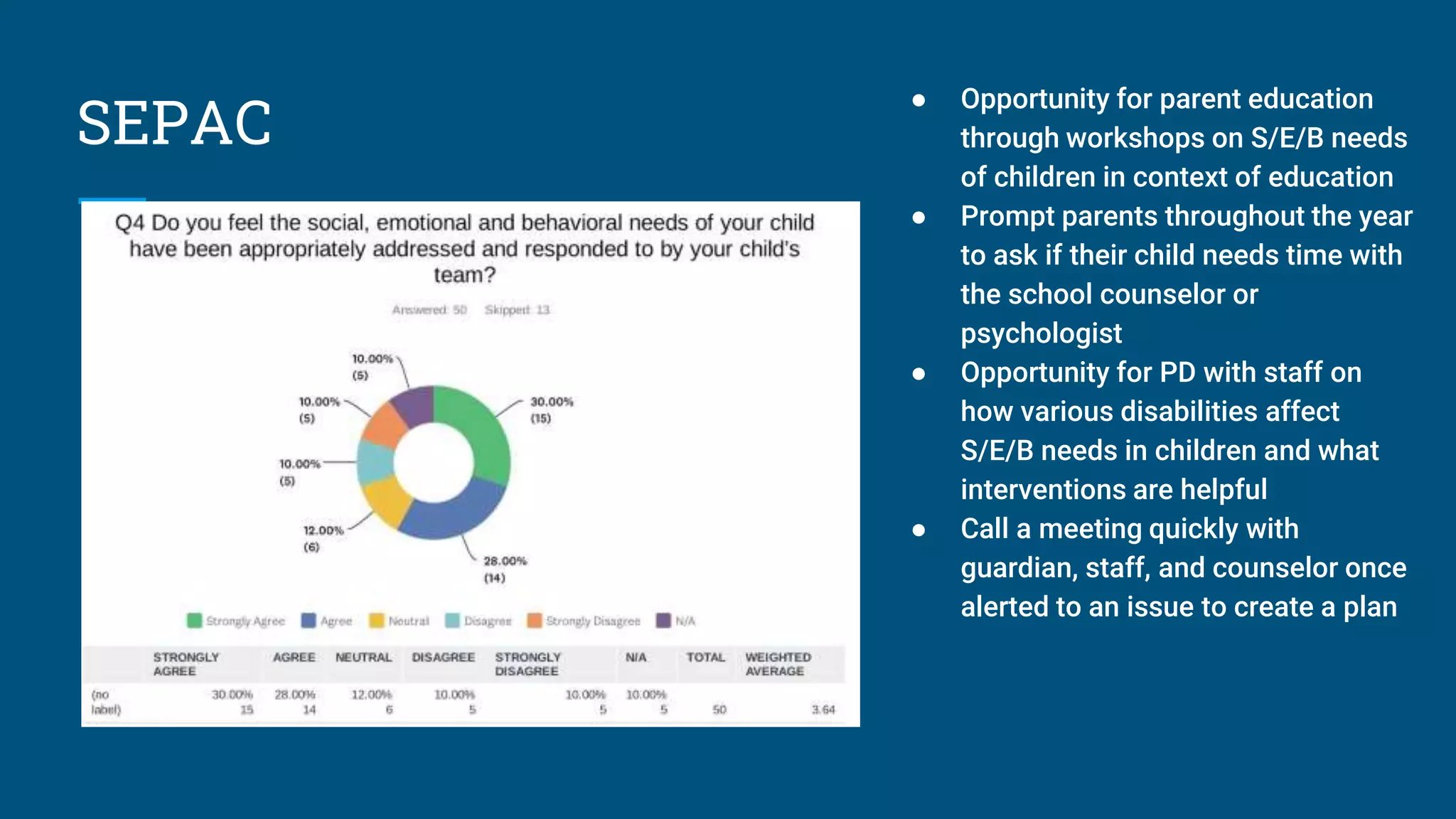
58% of responses agree or strongly
agree that the District has addressed
the needs of their student in this
area.
20% of responses indicated some
type of disagreement, referencing
some confusion/misunderstanding
of the potential impact of
social/emotional/behavioral needs
on accessing or participating in the
presented curriculum.
The COVID pandemic has impacted a significant number
of students and their families. HPS special education
staff have conducted significantly higher numbers of
assessments and screenings to address possible
impacts of “long COVID,” and the Summer 2021
programs provided additional supports to a greater
number of students to support progress and address any
compensatory needs resulting from time spent outside
of an in-person instructional environment.
Pupil Services Director is developing a new webpage to
expand information across multiple topics and concerns,
with a roll-out planned for January, 2022.
Professional development opportunities for all staff at
HPS include topics relevant to the social, emotional, and
behavioral needs of all students in the classroom.
SEPAC
● Opportunity for parent education
through workshops on S/E/B needs
of children in context of education
● Prompt parents throughout the year
to ask if their child needs time with
the school counselor or
psychologist
● Opportunity for PD with staff on
how various disabilities affect
S/E/B needs in children and what
interventions are helpful
● Call a meeting quickly with
guardian, staff, and counselor once
alerted to an issue to create a plan
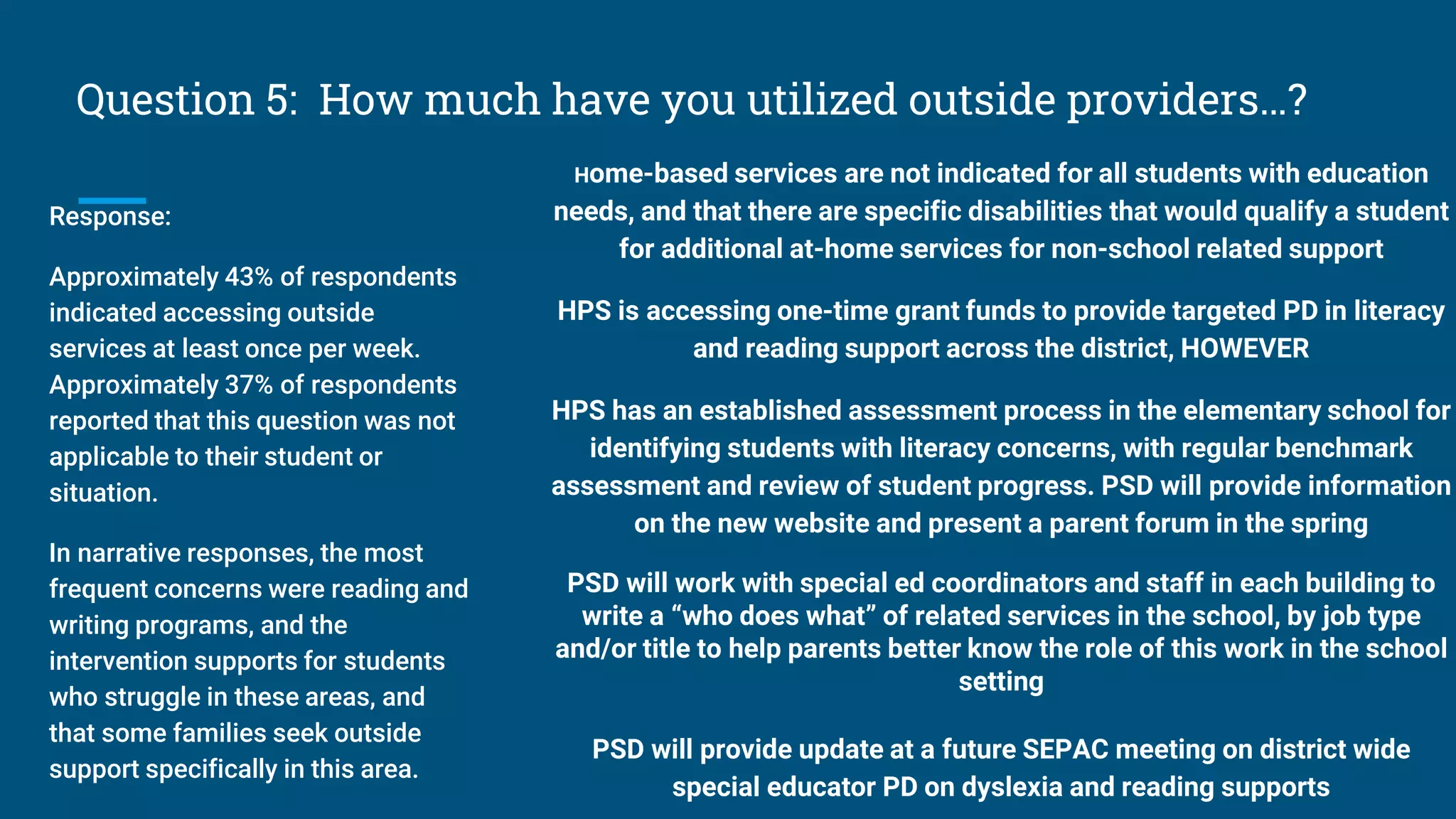
Question 5: How much have you utilized outside providers…?
Response:
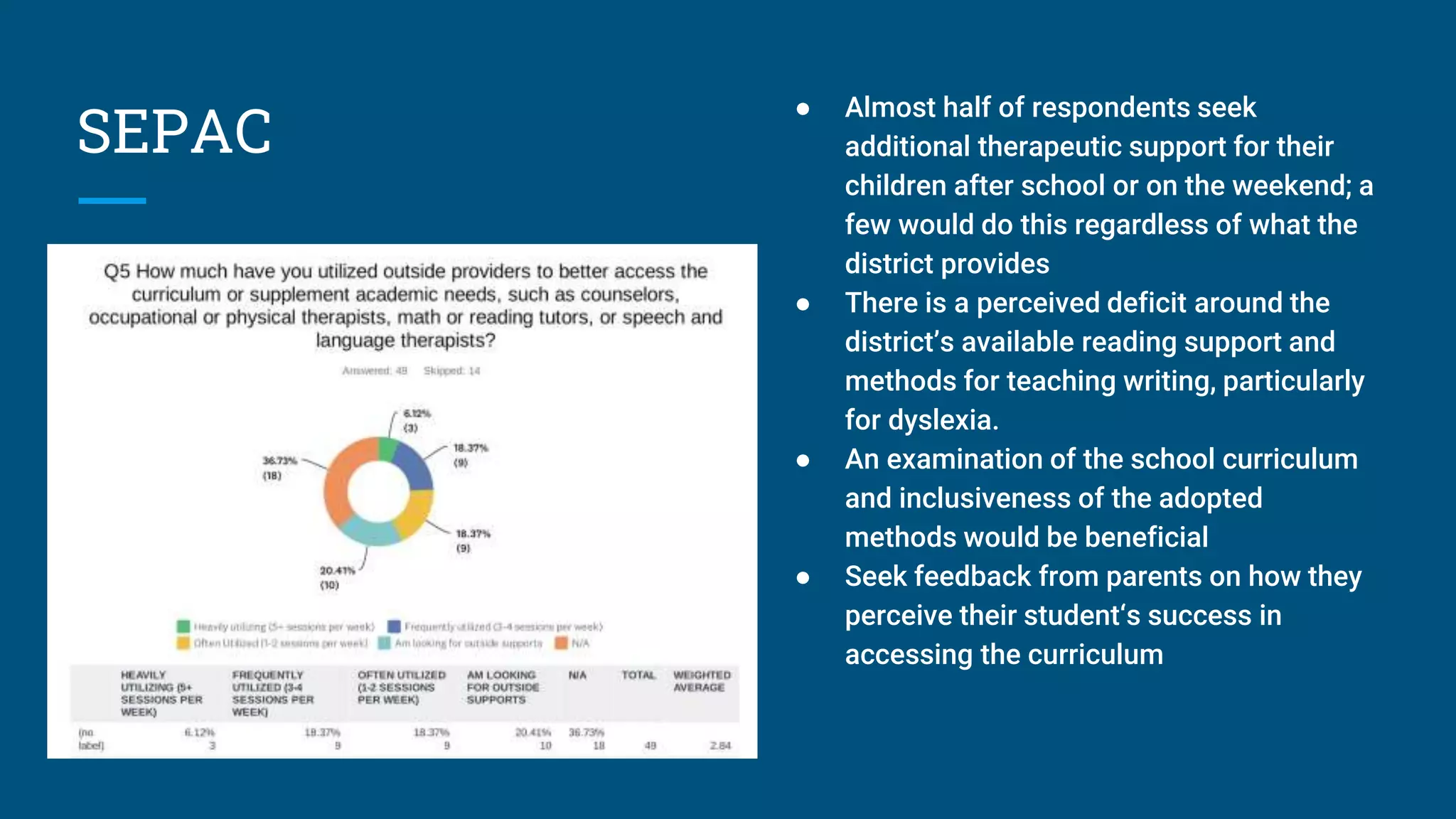
Approximately 43% of respondents
indicated accessing outside
services at least once per week.
Approximately 37% of respondents
reported that this question was not
applicable to their student or
situation.
In narrative responses, the most
frequent concerns were reading and
writing programs, and the
intervention supports for students
who struggle in these areas, and
that some families seek outside
support specifically in this area.
Home-based services are not indicated for all students with education
needs, and that there are specific disabilities that would qualify a student
for additional at-home services for non-school related support
HPS is accessing one-time grant funds to provide targeted PD in literacy
and reading support across the district, HOWEVER
HPS has an established assessment process in the elementary school for
identifying students with literacy concerns, with regular benchmark
assessment and review of student progress. PSD will provide information
on the new website and present a parent forum in the spring
PSD will work with special ed coordinators and staff in each building to
write a “who does what” of related services in the school, by job type
and/or title to help parents better know the role of this work in the school
setting
PSD will provide update at a future SEPAC meeting on district wide
special educator PD on dyslexia and reading supports
SEPAC
● Almost half of respondents seek
additional therapeutic support for their
children after school or on the weekend; a
few would do this regardless of what the
district provides
● There is a perceived deficit around the
district’s available reading support and
methods for teaching writing, particularly
for dyslexia.
● An examination of the school curriculum
and inclusiveness of the adopted
methods would be beneficial
● Seek feedback from parents on how they
perceive their student‘s success in
accessing the curriculum
Question 6: I believe the school professionals providing specialized instruction
and/or related services are knowledgeable regarding my child’s disability
● HPS provides multiple opportunities for special educators and general education teachers to
share information and update practitioners on the needs of students
● Special Education Teams consistently include content or grade level general education teachers
and all related service providers
● HPS special education teachers will participate in a multi-session professional development
program covering dyslexia and related disabilities. This will include opportunities for the
educators to become facilitators of training with content teachers after completing this work
● PSD continues to work with building administration to further the work between schools in
transition planning between grades 5 and 6
● HPS is open to additional sources and resources for professional development for all staff
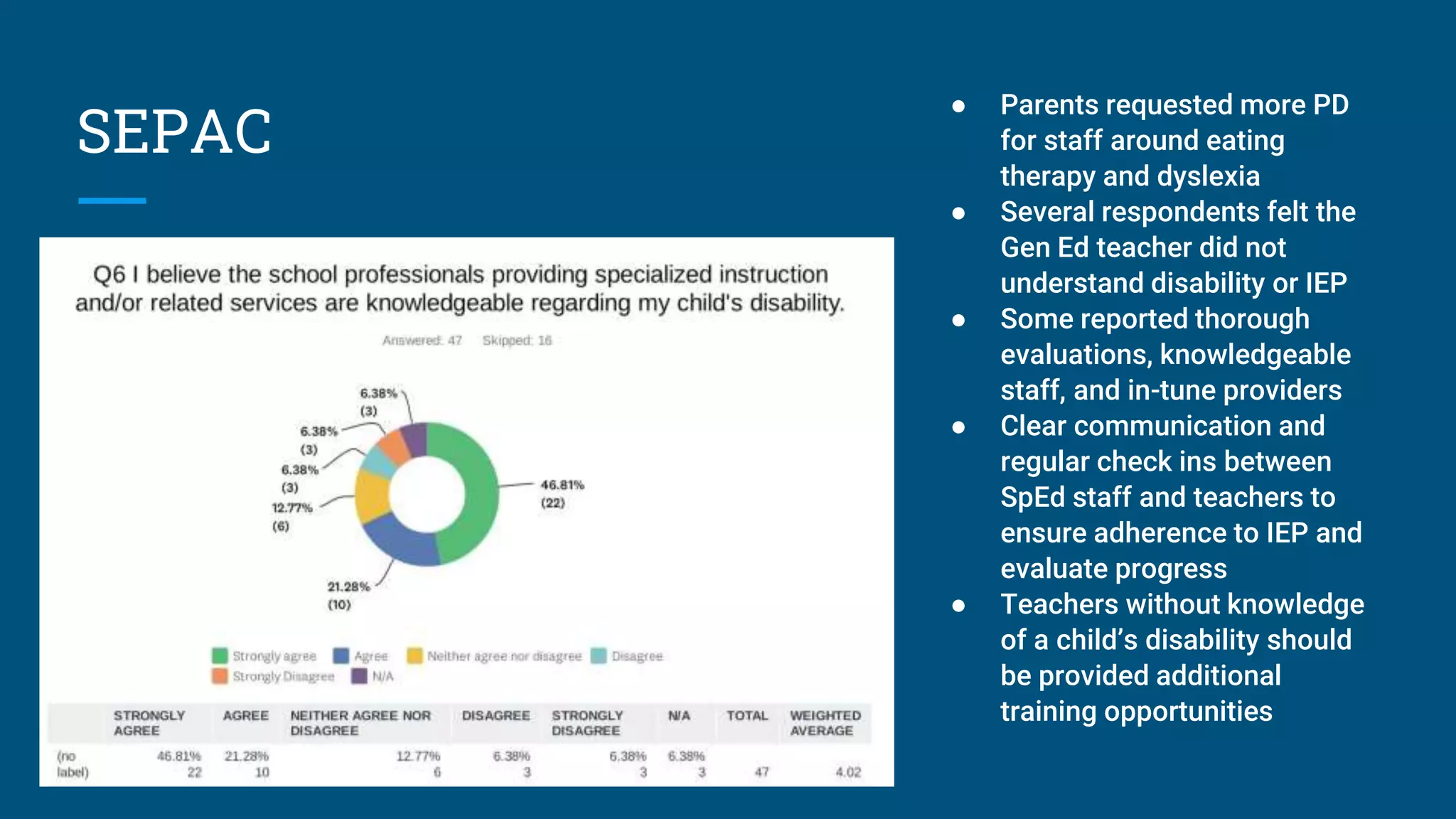
SEPAC
● Parents requested more PD
for staff around eating
therapy and dyslexia
● Several respondents felt the
Gen Ed teacher did not
understand disability or IEP
● Some reported thorough
evaluations, knowledgeable
staff, and in-tune providers
● Clear communication and
regular check ins between
SpEd staff and teachers to
ensure adherence to IEP and
evaluate progress
● Teachers without knowledge
of a child’s disability should
be provided additional
training opportunities
Question 7: The special education/support services…are scheduled so that my child sdoes
not miss important academic time in the general education classes to the maximum extent
possible.
Response:
66% of respondents agree or strongly
agree that student schedules reflect
this type of planning
A few responses indicated that some
schedules include multiple back-to-
back services that may be indicative
of scheduling around staff availability
Some responses included a question
about whether or not services are
scheduled during “specials,” and
would like this to be avoided
HPS administration has made a consistent effort to avoid
the scheduling of services such as PT, OT, and SLP
therapies during “specials” (such as physical education,
music, and art courses) to the greatest extent possible.
Skills courses at the MS/HS level are part of the
scheduling process to avoid conflict with other offerings
Service times are based on multiple factors: student
needs, level of need, availability of provider, and time of
day when delivered.Services must be provided during the
school day.
Parents and providers are part of the Team process, and
have input during IEP meetings.
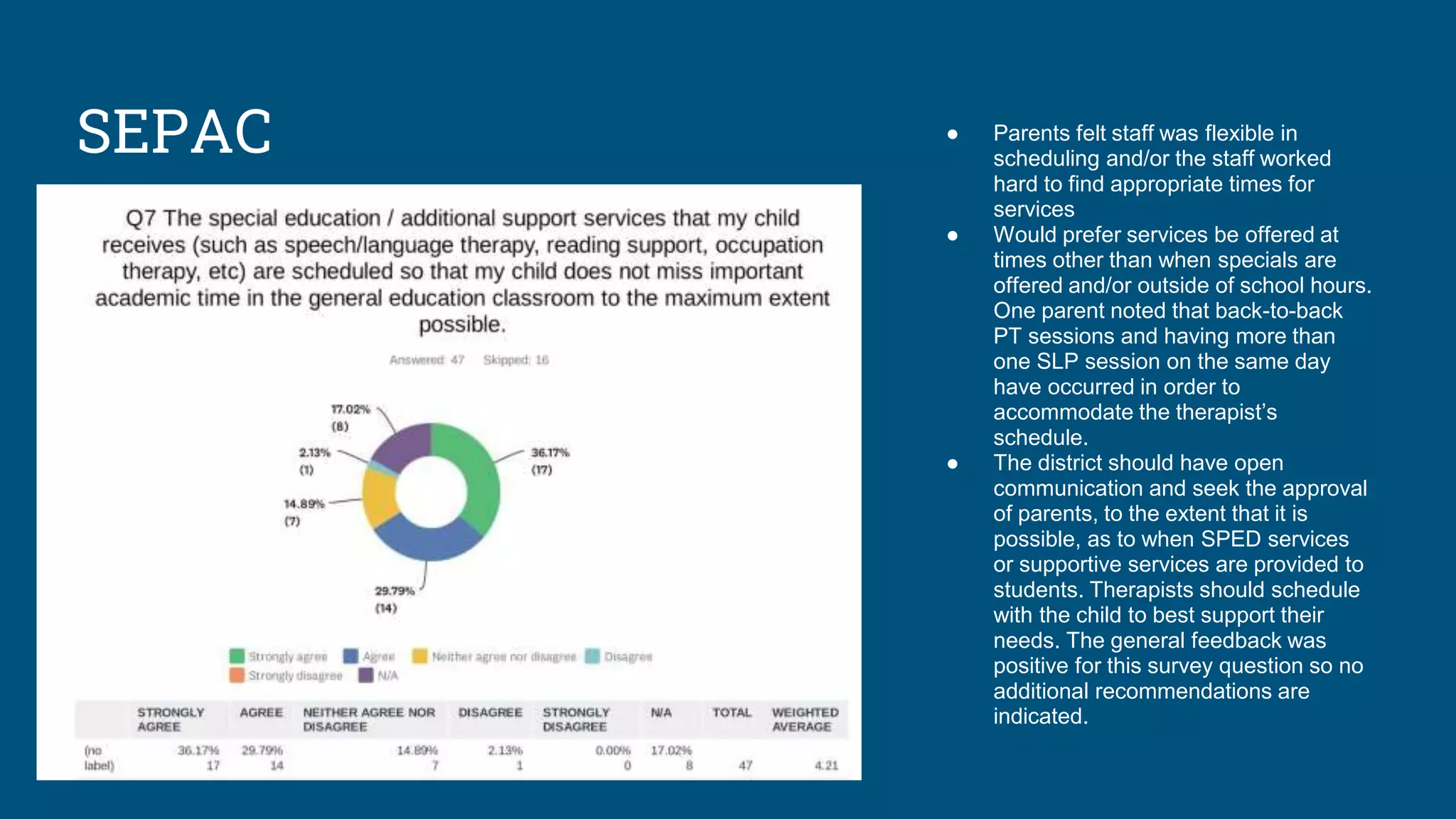
SEPAC ● Parents felt staff was flexible in
scheduling and/or the staff worked
hard to find appropriate times for
services
● Would prefer services be offered at
times other than when specials are
offered and/or outside of school hours.
One parent noted that back-to-back
PT sessions and having more than
one SLP session on the same day
have occurred in order to
accommodate the therapist’s
schedule.
● The district should have open
communication and seek the approval
of parents, to the extent that it is
possible, as to when SPED services
or supportive services are provided to
students. Therapists should schedule
with the child to best support their
needs. The general feedback was
positive for this survey question so no
additional recommendations are
indicated.
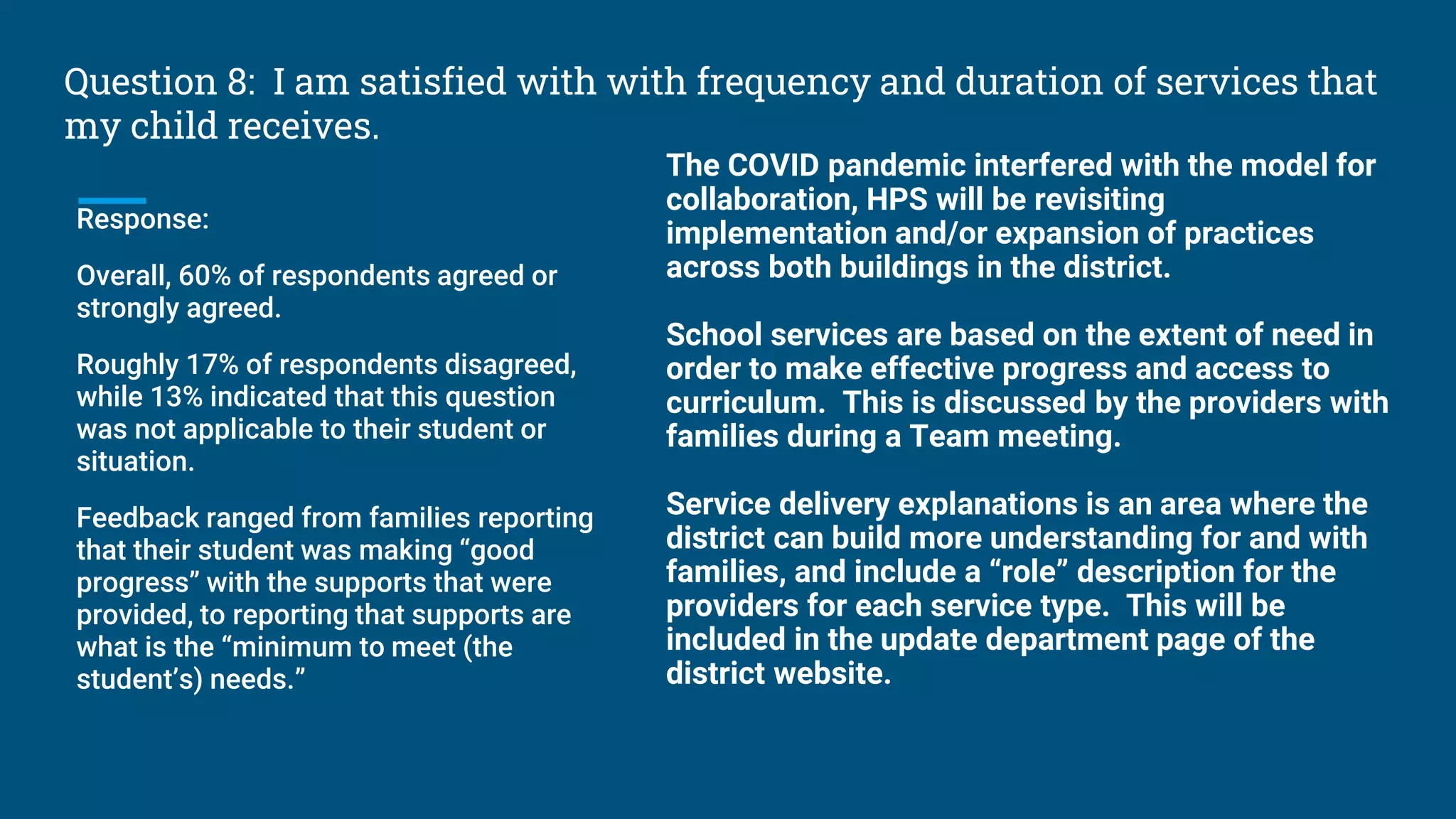
Question 8: I am satisfied with with frequency and duration of services that
my child receives.
Response:
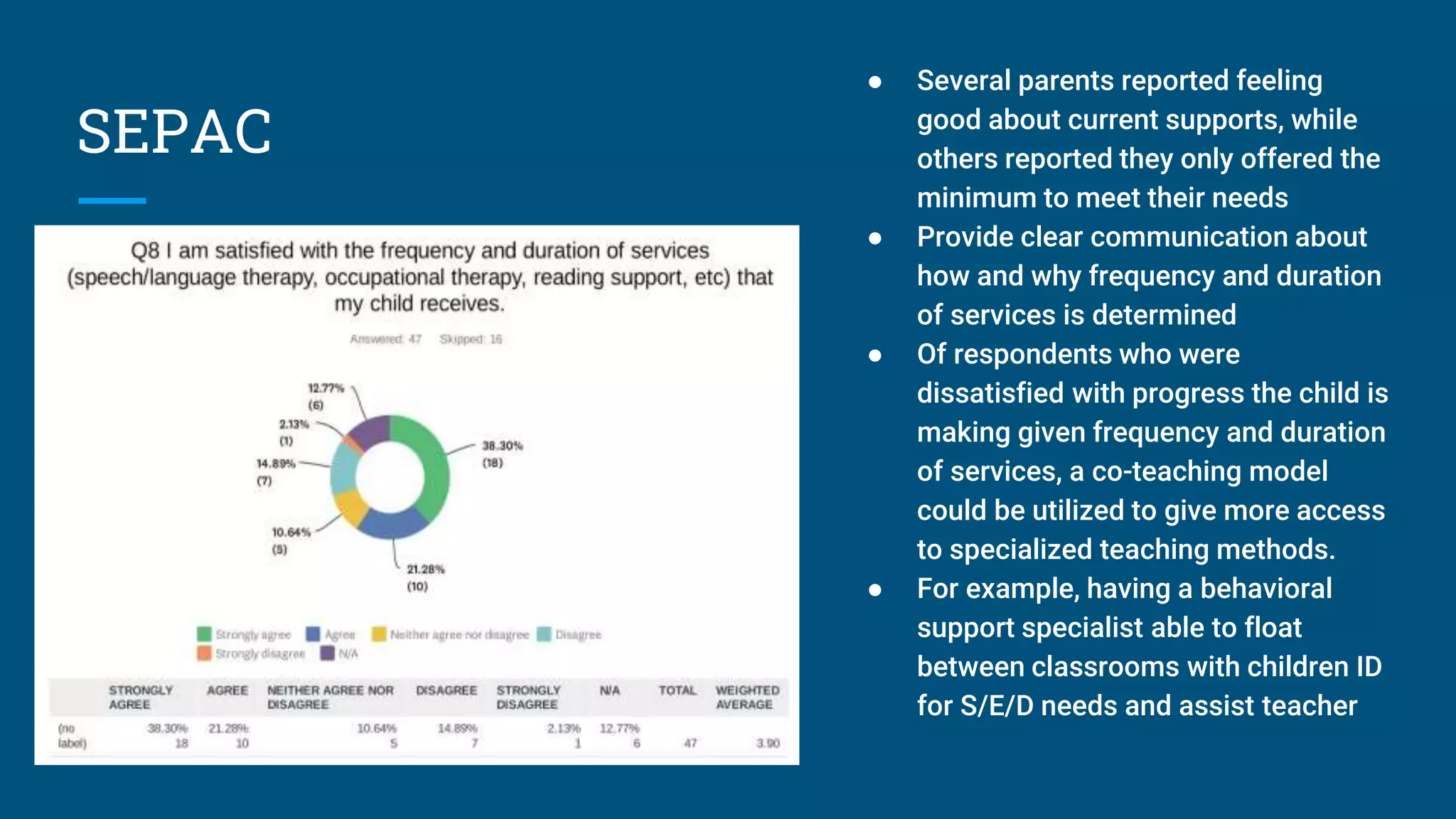
Overall, 60% of respondents agreed or
strongly agreed.
Roughly 17% of respondents disagreed,
while 13% indicated that this question
was not applicable to their student or
situation.
Feedback ranged from families reporting
that their student was making “good
progress” with the supports that were
provided, to reporting that supports are
what is the “minimum to meet (the
student’s) needs.”
The COVID pandemic interfered with the model for
collaboration, HPS will be revisiting
implementation and/or expansion of practices
across both buildings in the district.
School services are based on the extent of need in
order to make effective progress and access to
curriculum. This is discussed by the providers with
families during a Team meeting.
Service delivery explanations is an area where the
district can build more understanding for and with
families, and include a “role” description for the
providers for each service type. This will be
included in the update department page of the
district website.
SEPAC
● Several parents reported feeling
good about current supports, while
others reported they only offered the
minimum to meet their needs
● Provide clear communication about
how and why frequency and duration
of services is determined
● Of respondents who were
dissatisfied with progress the child is
making given frequency and duration
of services, a co-teaching model
could be utilized to give more access
to specialized teaching methods.
● For example, having a behavioral
support specialist able to float
between classrooms with children ID
for S/E/D needs and assist teacher
Question 9: ESY (Extended School Year)
HPS provides ESY services during the months of
July and August, as an extension of supports for
students who would otherwise experience a
significant regression in their progress toward
goals.
ESY services include supports for related
services and academics (when a student is
identified with an specific learning disability).
The IEP Team addresses ESY on a student-by-
student basis, as not all students qualify for
summer programming (not experience
significant regression)
HPS has recognized that more information is
needed for families about the purpose and eligibility
factors that relate to ESY
● The special education leaders are finalizing a
ESY review document that will be used to
identify if and when services would be
provided, and will share with parents at the
initial conversation regarding ESY (for initial
student consideration) or when considering
discharge from this service
● ESY schedules will be produced earlier, and a
commitment to attend requested from parents
no later than June 1st of each year.
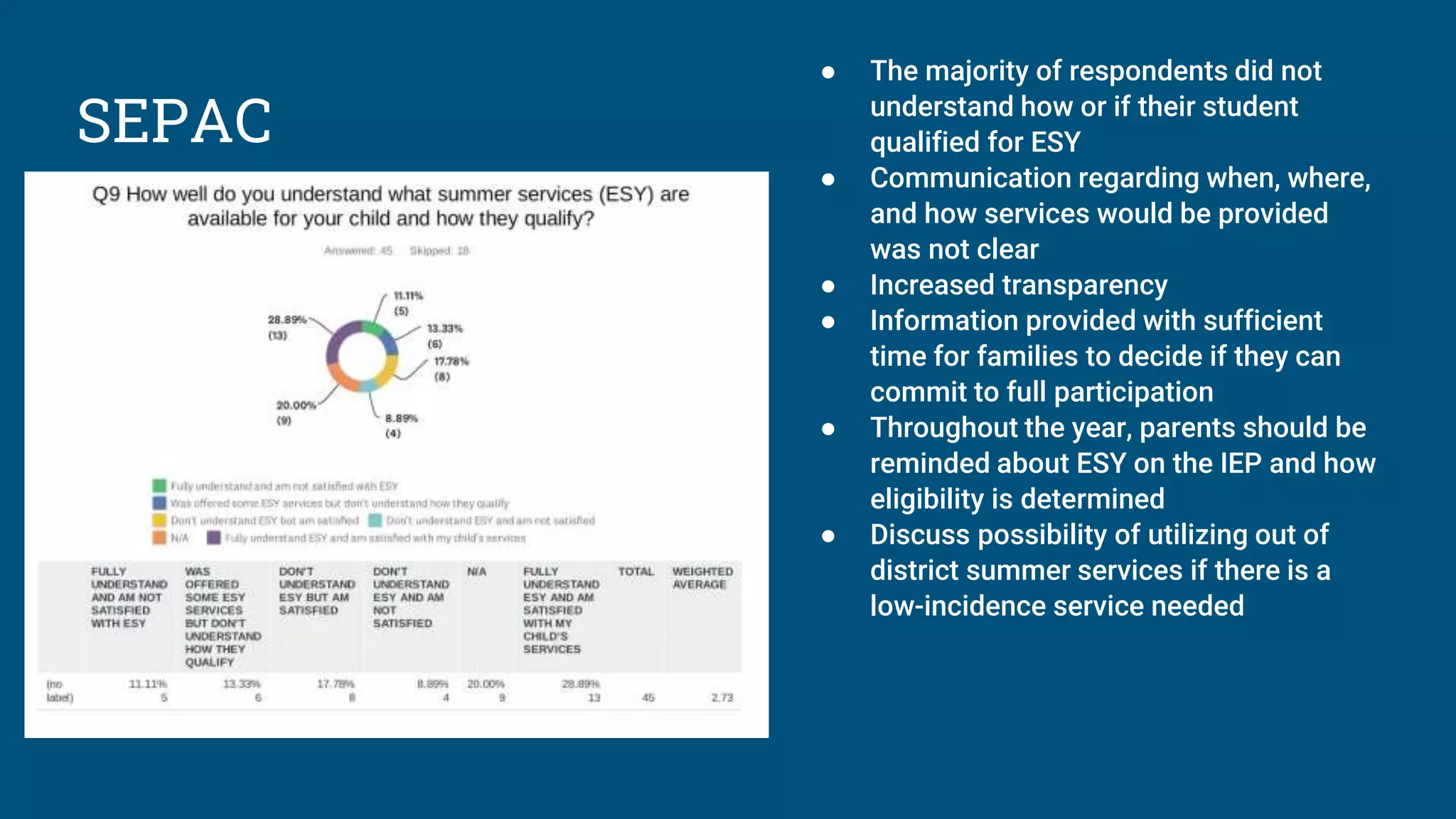
SEPAC
● The majority of respondents did not
understand how or if their student
qualified for ESY
● Communication regarding when, where,
and how services would be provided
was not clear
● Increased transparency
● Information provided with sufficient
time for families to decide if they can
commit to full participation
● Throughout the year, parents should be
reminded about ESY on the IEP and how
eligibility is determined
● Discuss possibility of utilizing out of
district summer services if there is a
low-incidence service needed
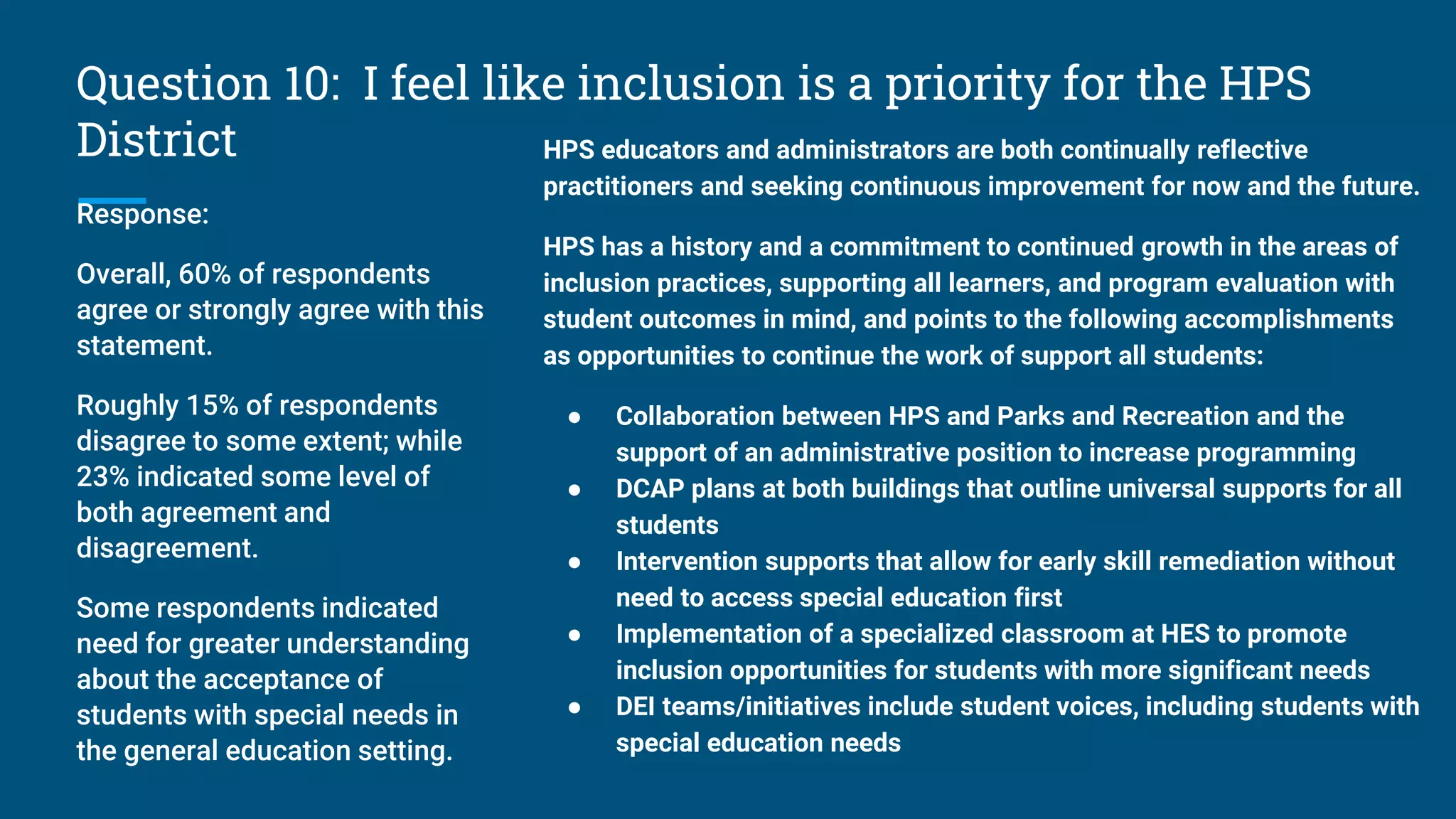
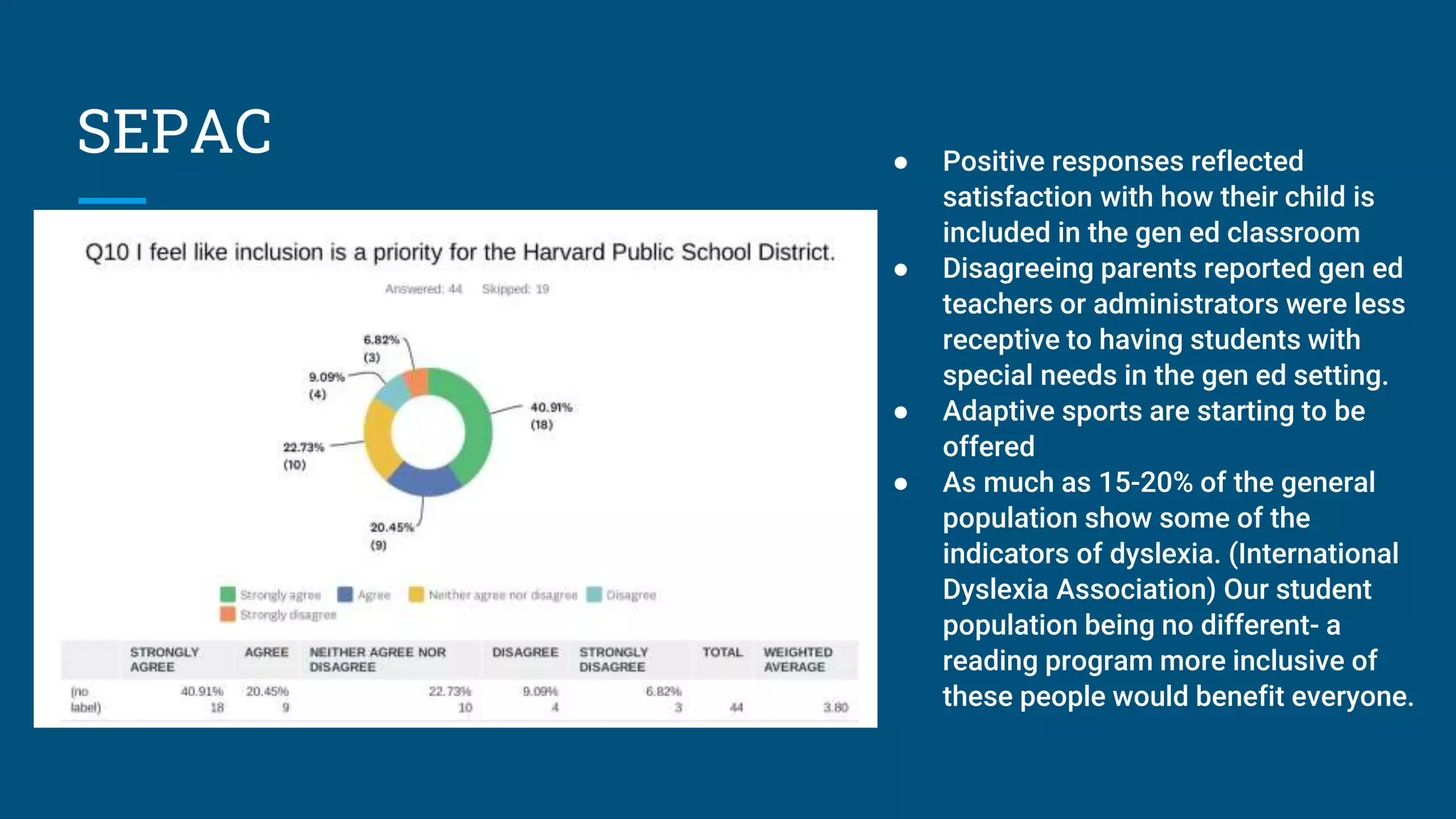
Question 10: I feel like inclusion is a priority for the HPS
District
Response:
Overall, 60% of respondents
agree or strongly agree with this
statement.
Roughly 15% of respondents
disagree to some extent; while
23% indicated some level of
both agreement and
disagreement.
Some respondents indicated
need for greater understanding
about the acceptance of
students with special needs in
the general education setting.
HPS educators and administrators are both continually reflective
practitioners and seeking continuous improvement for now and the future.
HPS has a history and a commitment to continued growth in the areas of
inclusion practices, supporting all learners, and program evaluation with
student outcomes in mind, and points to the following accomplishments
as opportunities to continue the work of support all students:
● Collaboration between HPS and Parks and Recreation and the
support of an administrative position to increase programming
● DCAP plans at both buildings that outline universal supports for all
students
● Intervention supports that allow for early skill remediation without
need to access special education first
● Implementation of a specialized classroom at HES to promote
inclusion opportunities for students with more significant needs
● DEI teams/initiatives include student voices, including students with
special education needs
SEPAC ● Positive responses reflected
satisfaction with how their child is
included in the gen ed classroom
● Disagreeing parents reported gen ed
teachers or administrators were less
receptive to having students with
special needs in the gen ed setting.
● Adaptive sports are starting to be
offered
● As much as 15-20% of the general
population show some of the
indicators of dyslexia. (International
Dyslexia Association) Our student
population being no different- a
reading program more inclusive of
these people would benefit everyone.
TAKE AWAYS and NEXT STEPS
Other areas where SEPAC and the District can
deepen conversation and seek feedback
included:
Summer Services, including the purpose and
the determination of eligibility can be better
outlined for families, and process for families
to communicate their commitment to
participation in programming before the end of
the school year.
Role of Providers and Purpose of Services will
be provided to families about what services
“are,” and “how” services are determined to
support the Team process
How SEPAC, HPS, and families can continue to
build on the work being done with students:
PSD recommends incorporating presentations on
topics that address areas of interest or concern
identified by families in the recent survey,
perhaps taking a portion of the monthly SEPAC
meeting or offering a forum presentation every
few months in the school year.
The District will continue its plans to enhance the
information and communication opportunities.
SEPAC recommended that a future survey of
families, later in the school year, may be able to
gain insight to the success of the District’s work.

Presentation of Survey Results

  • 1.
    SEPAC SURVEY FEEDBACK SEPAC andHPS Survey completed Spring 2021
  • 2.
    This brief summarywill: Present questions from the survey that generated the highest percentage of common or similar feedback Present the original SEPAC Question and the prevailing or most prominent type of responses from respondents In cases where it occurs, multiple responses may be presented to show the range of feedback For each question presented, the District response/feedback will reflect the work done, being done, or is planned for the future SEPAC recommendations will be shared This response will also include reflection on identified areas of growth for future planning when applicable to the question
  • 3.
    Survey Respondents: 122 totalresponses were collected for the survey 63 were included in the results due to having selected the option “Has an IEP” or “Seeking Special Education services.” We have not done analysis on the data regarding differences between HES and TBS; this is a goal for future surveys
  • 4.
    Question 2 ● 58%of respondents agreed ● evaluations were prompt ● the process was easy ● communication was open and ● the district was helpful. ● The 26% “disagree” open responses mentioned ● frustration over “waiting for a child to fail” approach of eligibility ● Timeline adherence ● More accessible online information ● More documentation from staff if they initiated making the referral ● Child’s condition was minimized
  • 5.
    Question 2 ● HPSprovides numerous supports and interventions for students who may need targeted or short-term intervention, including Social/Emotional groups and classes, Intervention services to target speech, OT, and academic needs ● HPS has counseling services and supports for all students at both schools ● Both schools implement DCAP strategies, considered “best practices” that are available to all students without needing to have a formal plan ● Both schools have a referral process/team that reviews teacher concerns in conjunction with parent reports and other feedback ● Both schools have a process for identifying students who may be eligible for accommodations through Section 504 These interventions and supports are not tied to Special Education, though information or progress monitoring in these areas may lead to a referral for Special Education evaluation
  • 6.
    SEPAC ● Provide theIEP eligibility timeline infographic in the consent to evaluate initial packet ● Direct parents to the SEPAC website and contact information for more support ● Use reflective listening techniques and validation to build trust and rapport
  • 7.
    Question 3: Areyou satisfied with the communication between your child’s special education team, general education providers, and your family? Response: Majority of respondents were satisfied or highly satisfied with the communication: 66.67% Greatest feedback from families that were less satisfied with communication was to focus on improvement between general education teachers and both the special educators and the families Looking forward to showcasing the FAQ section that SEPAC agreed to create for families to include on our new website: “What to expect” and “Things to Consider” when preparing for meeting with special and general education teachers and attending Team meetings. Work in the schools will continue to emphasize “empathic listening” as important to the success of two- way communication Administration will continue to work with building based and out of district coordinators to model and promote effective communication and conversation between all members of a student’s education Team.
  • 8.
    SEPAC ● Improvements neededin communication between SpEd providers and Gen Ed providers. ● Some reported challenges communicating with specific staff, sensing hostility, and feeling “all alone” ● Continue open and frequent email communications ● CC gen ed teachers and SpEd liaisons to prevent communication breakdowns ● More direction toward upcoming meetings, i.e. 1 month & 2 week reminders for annual IEP meeting w/ bullet points re- what will be discussed. ● Digital notebooks accessible by SpEd, gen ed staff & families ● Empathy, reflective listening techniques ● Friendly & communicative teams, easy to reach, improvements over previous years, increased emailing / zoom has been helpful
  • 9.
    Question 4: Doyou feel the social, emotional, and behavioral needs of your child have been appropriately addressed and responded to by your child’s Team? Response: 58% of responses agree or strongly agree that the District has addressed the needs of their student in this area. 20% of responses indicated some type of disagreement, referencing some confusion/misunderstanding of the potential impact of social/emotional/behavioral needs on accessing or participating in the presented curriculum. The COVID pandemic has impacted a significant number of students and their families. HPS special education staff have conducted significantly higher numbers of assessments and screenings to address possible impacts of “long COVID,” and the Summer 2021 programs provided additional supports to a greater number of students to support progress and address any compensatory needs resulting from time spent outside of an in-person instructional environment. Pupil Services Director is developing a new webpage to expand information across multiple topics and concerns, with a roll-out planned for January, 2022. Professional development opportunities for all staff at HPS include topics relevant to the social, emotional, and behavioral needs of all students in the classroom.
  • 10.
    SEPAC ● Opportunity forparent education through workshops on S/E/B needs of children in context of education ● Prompt parents throughout the year to ask if their child needs time with the school counselor or psychologist ● Opportunity for PD with staff on how various disabilities affect S/E/B needs in children and what interventions are helpful ● Call a meeting quickly with guardian, staff, and counselor once alerted to an issue to create a plan
  • 11.
    Question 5: Howmuch have you utilized outside providers…? Response: Approximately 43% of respondents indicated accessing outside services at least once per week. Approximately 37% of respondents reported that this question was not applicable to their student or situation. In narrative responses, the most frequent concerns were reading and writing programs, and the intervention supports for students who struggle in these areas, and that some families seek outside support specifically in this area. Home-based services are not indicated for all students with education needs, and that there are specific disabilities that would qualify a student for additional at-home services for non-school related support HPS is accessing one-time grant funds to provide targeted PD in literacy and reading support across the district, HOWEVER HPS has an established assessment process in the elementary school for identifying students with literacy concerns, with regular benchmark assessment and review of student progress. PSD will provide information on the new website and present a parent forum in the spring PSD will work with special ed coordinators and staff in each building to write a “who does what” of related services in the school, by job type and/or title to help parents better know the role of this work in the school setting PSD will provide update at a future SEPAC meeting on district wide special educator PD on dyslexia and reading supports
  • 12.
    SEPAC ● Almost halfof respondents seek additional therapeutic support for their children after school or on the weekend; a few would do this regardless of what the district provides ● There is a perceived deficit around the district’s available reading support and methods for teaching writing, particularly for dyslexia. ● An examination of the school curriculum and inclusiveness of the adopted methods would be beneficial ● Seek feedback from parents on how they perceive their student‘s success in accessing the curriculum
  • 13.
    Question 6: Ibelieve the school professionals providing specialized instruction and/or related services are knowledgeable regarding my child’s disability ● HPS provides multiple opportunities for special educators and general education teachers to share information and update practitioners on the needs of students ● Special Education Teams consistently include content or grade level general education teachers and all related service providers ● HPS special education teachers will participate in a multi-session professional development program covering dyslexia and related disabilities. This will include opportunities for the educators to become facilitators of training with content teachers after completing this work ● PSD continues to work with building administration to further the work between schools in transition planning between grades 5 and 6 ● HPS is open to additional sources and resources for professional development for all staff
  • 14.
    SEPAC ● Parents requestedmore PD for staff around eating therapy and dyslexia ● Several respondents felt the Gen Ed teacher did not understand disability or IEP ● Some reported thorough evaluations, knowledgeable staff, and in-tune providers ● Clear communication and regular check ins between SpEd staff and teachers to ensure adherence to IEP and evaluate progress ● Teachers without knowledge of a child’s disability should be provided additional training opportunities
  • 15.
    Question 7: Thespecial education/support services…are scheduled so that my child sdoes not miss important academic time in the general education classes to the maximum extent possible. Response: 66% of respondents agree or strongly agree that student schedules reflect this type of planning A few responses indicated that some schedules include multiple back-to- back services that may be indicative of scheduling around staff availability Some responses included a question about whether or not services are scheduled during “specials,” and would like this to be avoided HPS administration has made a consistent effort to avoid the scheduling of services such as PT, OT, and SLP therapies during “specials” (such as physical education, music, and art courses) to the greatest extent possible. Skills courses at the MS/HS level are part of the scheduling process to avoid conflict with other offerings Service times are based on multiple factors: student needs, level of need, availability of provider, and time of day when delivered.Services must be provided during the school day. Parents and providers are part of the Team process, and have input during IEP meetings.
  • 16.
    SEPAC ● Parentsfelt staff was flexible in scheduling and/or the staff worked hard to find appropriate times for services ● Would prefer services be offered at times other than when specials are offered and/or outside of school hours. One parent noted that back-to-back PT sessions and having more than one SLP session on the same day have occurred in order to accommodate the therapist’s schedule. ● The district should have open communication and seek the approval of parents, to the extent that it is possible, as to when SPED services or supportive services are provided to students. Therapists should schedule with the child to best support their needs. The general feedback was positive for this survey question so no additional recommendations are indicated.
  • 17.
    Question 8: Iam satisfied with with frequency and duration of services that my child receives. Response: Overall, 60% of respondents agreed or strongly agreed. Roughly 17% of respondents disagreed, while 13% indicated that this question was not applicable to their student or situation. Feedback ranged from families reporting that their student was making “good progress” with the supports that were provided, to reporting that supports are what is the “minimum to meet (the student’s) needs.” The COVID pandemic interfered with the model for collaboration, HPS will be revisiting implementation and/or expansion of practices across both buildings in the district. School services are based on the extent of need in order to make effective progress and access to curriculum. This is discussed by the providers with families during a Team meeting. Service delivery explanations is an area where the district can build more understanding for and with families, and include a “role” description for the providers for each service type. This will be included in the update department page of the district website.
  • 18.
    SEPAC ● Several parentsreported feeling good about current supports, while others reported they only offered the minimum to meet their needs ● Provide clear communication about how and why frequency and duration of services is determined ● Of respondents who were dissatisfied with progress the child is making given frequency and duration of services, a co-teaching model could be utilized to give more access to specialized teaching methods. ● For example, having a behavioral support specialist able to float between classrooms with children ID for S/E/D needs and assist teacher
  • 19.
    Question 9: ESY(Extended School Year) HPS provides ESY services during the months of July and August, as an extension of supports for students who would otherwise experience a significant regression in their progress toward goals. ESY services include supports for related services and academics (when a student is identified with an specific learning disability). The IEP Team addresses ESY on a student-by- student basis, as not all students qualify for summer programming (not experience significant regression) HPS has recognized that more information is needed for families about the purpose and eligibility factors that relate to ESY ● The special education leaders are finalizing a ESY review document that will be used to identify if and when services would be provided, and will share with parents at the initial conversation regarding ESY (for initial student consideration) or when considering discharge from this service ● ESY schedules will be produced earlier, and a commitment to attend requested from parents no later than June 1st of each year.
  • 20.
    SEPAC ● The majorityof respondents did not understand how or if their student qualified for ESY ● Communication regarding when, where, and how services would be provided was not clear ● Increased transparency ● Information provided with sufficient time for families to decide if they can commit to full participation ● Throughout the year, parents should be reminded about ESY on the IEP and how eligibility is determined ● Discuss possibility of utilizing out of district summer services if there is a low-incidence service needed
  • 21.
    Question 10: Ifeel like inclusion is a priority for the HPS District Response: Overall, 60% of respondents agree or strongly agree with this statement. Roughly 15% of respondents disagree to some extent; while 23% indicated some level of both agreement and disagreement. Some respondents indicated need for greater understanding about the acceptance of students with special needs in the general education setting. HPS educators and administrators are both continually reflective practitioners and seeking continuous improvement for now and the future. HPS has a history and a commitment to continued growth in the areas of inclusion practices, supporting all learners, and program evaluation with student outcomes in mind, and points to the following accomplishments as opportunities to continue the work of support all students: ● Collaboration between HPS and Parks and Recreation and the support of an administrative position to increase programming ● DCAP plans at both buildings that outline universal supports for all students ● Intervention supports that allow for early skill remediation without need to access special education first ● Implementation of a specialized classroom at HES to promote inclusion opportunities for students with more significant needs ● DEI teams/initiatives include student voices, including students with special education needs
  • 22.
    SEPAC ● Positiveresponses reflected satisfaction with how their child is included in the gen ed classroom ● Disagreeing parents reported gen ed teachers or administrators were less receptive to having students with special needs in the gen ed setting. ● Adaptive sports are starting to be offered ● As much as 15-20% of the general population show some of the indicators of dyslexia. (International Dyslexia Association) Our student population being no different- a reading program more inclusive of these people would benefit everyone.
  • 23.
    TAKE AWAYS andNEXT STEPS Other areas where SEPAC and the District can deepen conversation and seek feedback included: Summer Services, including the purpose and the determination of eligibility can be better outlined for families, and process for families to communicate their commitment to participation in programming before the end of the school year. Role of Providers and Purpose of Services will be provided to families about what services “are,” and “how” services are determined to support the Team process How SEPAC, HPS, and families can continue to build on the work being done with students: PSD recommends incorporating presentations on topics that address areas of interest or concern identified by families in the recent survey, perhaps taking a portion of the monthly SEPAC meeting or offering a forum presentation every few months in the school year. The District will continue its plans to enhance the information and communication opportunities. SEPAC recommended that a future survey of families, later in the school year, may be able to gain insight to the success of the District’s work.