THE ELECTRICITY ACT, 2003
MINISTRY OF LAW AND JUSTICE
(Legislative Department)
New Delhi, the 2nd June, 2003.Jyaistha 12, 1925 (Saka)
The following Act of Parliament received the assent of the President on the 26th
May, 2003, and is hereby published for general information:
THE ELECTRICITY ACT, 2003
[No.36 of 2003]
[26th May, 2003]
• An Act to consolidate the laws relating to generation, transmission, distribution trading and use of electricity
and generally for taking measures conducive to development of electricity industry, promoting competition
therein, protecting interest of consumers and supply of electricity to all areas, rationalization of electricity
tariff, ensuring transparent policies regarding subsidies, promotion of efficient and environmentally benign
policies, constitution of Central Electricity Authority, Regulatory Commissions and establishment of Appellate
Tribunal and for matters connected therewith or incidental thereto.
• Be it enacted by Parliament in the Fifty-fourth Year of the Republic of India as follows:-
PART I
PRELIMINARY
Section 1. (Short title, extent and commencement):---
(1) This Act may be called the Electricity Act, 2003.
(2) It extends to the whole of India except the State of Jammu and Kashmir.
(3) It shall come into force on such date as the Central Government may, by notification, appoint:
Provided that different dates may be appointed for
different provisions of this Act and any reference in any
such provision to the commencement of this.
Act shall be construed as a reference to the coming into
force of that provision.
SECTION 2. (DEFINITIONS): --- IN THIS ACT, UNLESS THE CONTEXT OTHERWISE REQUIRES:--
(1)“APPELLATE TRIBUNAL” MEANS THE APPELLATE TRIBUNAL FOR ELECTRICITY ESTABLISHED UNDER SECTION 110;
(2) "APPOINTED DATE" MEANS SUCH DATE AS THE CENTRAL GOVERNMENT MAY, BY NOTIFICATION, APPOINT;
(3) "AREA OF SUPPLY” MEANS THE AREA WITHIN WHICH A DISTRIBUTION LICENSEE IS AUTHORISED BY HIS LICENCE TO SUPPLY
ELECTRICITY;
(4) "APPROPRIATE COMMISSION” MEANS THE CENTRAL REGULATORY COMMISSION REFERRED TO IN SUB-SECTION (1) OF
SECTION 76 OR THE STATE REGULATORY COMMISSION REFERRED TO IN SECTION 82 OR THE JOINT COMMISSION REFERRED TO
IN SECTION 83, AS THE CASE MAY BE ;
(5) "APPROPRIATE GOVERNMENT" MEANS, -
(A) THE CENTRAL GOVERNMENT, -
(I) IN RESPECT OF A GENERATING COMPANY WHOLLY OR PARTLY OWNED BY IT;
(II) IN RELATION TO ANY INTER-STATE GENERATION, TRANSMISSION, TRADING OR SUPPLY OF ELECTRICITY AND WITH RESPECT
TO ANY MINES, OIL-FIELDS, RAILWAYS, NATIONAL HIGHWAYS, AIRPORTS , TELEGRAPHS , BROADCASTING STATIONS AND ANY
WORKS OF DEFENCE , DOCKYARD, NUCLEAR POWER INSTALLATIONS;
(III) IN RESPECT OF NATIONAL LOAD DESPATCH CENTRE; AND REGIONAL LOAD DESPATCH CENTRE;
(IV) IN RELATION TO ANY WORKS OR ELECTRIC INSTALLATION BELONGING TO IT OR UNDER ITS CONTROL ;
(B) IN ANY OTHER CASE, THE STATE GOVERNMENT, HAVING JURISDICTION UNDER THIS ACT;
(6) “AUTHORITY” MEANS THE CENTRAL ELECTRICITY AUTHORITY REFERRED TO IN SUB-SECTION(1) OF SECTION 70;
(7) "BOARD" MEANS, A STATE ELECTRICITY BOARD, CONSTITUTED BEFORE THE COMMENCEMENT OF THIS ACT, UNDER SUB-
SECTION (1) OF SECTION 5 OF THE ELECTRICITY (SUPPLY) ACT, 1948;
(8) “CAPTIVE GENERATING PLANT” MEANS A POWER PLANT SET UP BY ANY PERSON TO GENERATE ELECTRICITY PRIMARILY FOR
HIS OWN USE AND INCLUDES A POWER PLANT SET UP BY ANY CO-OPERATIVE SOCIETY OR ASSOCIATION OF PERSONS FOR
GENERATING ELECTRICITY PRIMARILY FOR USE OF MEMBERS OF SUCH COOPERATIVE SOCIETY OR ASSOCIATION;
(9) "CENTRAL COMMISSION" MEANS THE CENTRAL ELECTRICITY REGULATORY COMMISSION REFERRED TO IN SUB-SECTION (1)
OF SECTION 76;
(10) "CENTRAL TRANSMISSION UTILITY" MEANS ANY GOVERNMENT COMPANY WHICH THE CENTRAL GOVERNMENT MAY
NOTIFY UNDER SUB-SECTION (1) OF SECTION 38; (11) "CHAIRPERSON" MEANS THE CHAIRPERSON OF THE AUTHORITY OR
APPROPRIATE COMMISSION OR THE APPELLATE TRIBUNAL, AS THE CASE MAY BE;
(12) “COGENERATION” MEANS A PROCESS WHICH SIMULTANEOUSLY PRODUCES TWO OR MORE FORMS OF USEFUL ENERGY
(INCLUDING ELECTRICITY);
(13) "COMPANY" MEANS A COMPANY FORMED AND REGISTERED UNDER THE COMPANIES ACT, 1956 AND INCLUDES ANY BODY
CORPORATE UNDER A CENTRAL, STATE OR PROVINCIAL ACT;
(14) "CONSERVATION" MEANS ANY REDUCTION IN CONSUMPTION OF ELECTRICITY AS A RESULT OF INCREASE IN THE
EFFICIENCY IN SUPPLY AND USE OF ELECTRICITY;
(15) "CONSUMER" MEANS ANY PERSON WHO IS SUPPLIED WITH ELECTRICITY FOR HIS OWN USE BY A LICENSEE OR THE
GOVERNMENT OR BY ANY OTHER PERSON ENGAGED IN THE BUSINESS OF SUPPLYING ELECTRICITY TO THE PUBLIC
UNDER THIS ACT OR ANY OTHER LAW FOR THE TIME BEING IN FORCE AND INCLUDES ANY PERSON WHOSE PREMISES
ARE FOR THE TIME BEING CONNECTED FOR THE PURPOSE OF RECEIVING ELECTRICITY WITH THE WORKS OF A LICENSEE,
THE GOVERNMENT OR SUCH OTHER PERSON, AS THE CASE MAY BE;
(16) “DEDICATED TRANSMISSION LINES" MEANS ANY ELECTRIC SUPPLY-LINE FOR POINT TO POINT TRANSMISSION WHICH
ARE REQUIRED FOR THE PURPOSE OF CONNECTING ELECTRIC LINES OR ELECTRIC PLANTS OF A CAPTIVE GENERATING
PLANT REFERRED TO IN SECTION 9 OR GENERATING STATION REFERRED TO IN SECTION 10 TO ANY TRANSMISSION LINES
OR SUB-STATIONS OR GENERATING STATIONS, OR THE LOAD CENTER, AS THE CASE MAY BE;
(17) "DISTRIBUTION LICENSEE" MEANS A LICENSEE AUTHORIZED TO OPERATE AND MAINTAIN A DISTRIBUTION SYSTEM
FOR SUPPLYING ELECTRICITY TO THE CONSUMERS IN HIS AREA OF SUPPLY;
(18) "DISTRIBUTING MAIN" MEANS THE PORTION OF ANY MAIN WITH WHICH A SERVICE LINE IS, OR IS INTENDED TO BE,
IMMEDIATELY CONNECTED;
(19) "DISTRIBUTION SYSTEM" MEANS THE SYSTEM OF WIRES AND ASSOCIATED FACILITIES BETWEEN THE DELIVERY
POINTS ON THE TRANSMISSION LINES OR THE GENERATING STATION CONNECTION AND THE POINT OF CONNECTION TO
THE INSTALLATION OF THE CONSUMERS
(20) "ELECTRIC LINE" MEANS ANY LINE WHICH IS USED FOR CARRYING ELECTRICITY FOR ANY PURPOSE AND INCLUDES
(A) ANY SUPPORT FOR ANY SUCH LINE, THAT IS TO SAY, ANY STRUCTURE, TOWER, POLE OR OTHER THING IN, ON, BY OR
FROM WHICH ANY SUCH LINE IS, OR MAY BE, SUPPORTED, CARRIED OR SUSPENDED; AND
(B) ANY APPARATUS CONNECTED TO ANY SUCH LINE FOR THE PURPOSE OF CARRYING ELECTRICITY;
21) "ELECTRICAL INSPECTOR" MEANS A PERSON APPOINTED AS SUCH BY THE APPROPRIATE GOVERNMENT UNDER SUB-
SECTION (1) OF SECTION 162 AND ALSO INCLUDES CHIEF ELECTRICAL INSPECTOR;
(22) "ELECTRICAL PLANT" MEANS ANY PLANT, EQUIPMENT, APPARATUS OR APPLIANCE OR ANY PART THEREOF USED
FOR, OR CONNECTED WITH, THE GENERATION, TRANSMISSION, DISTRIBUTION OR SUPPLY OF ELECTRICITY BUT DOES
NOT INCLUDE-
(A) AN ELECTRIC LINE; OR
(B) A METER USED FOR ASCERTAINING THE QUANTITY OF ELECTRICITY SUPPLIED TO ANY PREMISES; OR
(C) AN ELECTRICAL EQUIPMENT, APPARATUS OR APPLIANCE UNDER THE CONTROL OF A CONSUMER;
(23) "ELECTRICITY" MEANS ELECTRICAL ENERGY-
(A) GENERATED, TRANSMITTED, SUPPLIED OR TRADED FOR ANY PURPOSE; OR
(B) USED FOR ANY PURPOSE EXCEPT THE TRANSMISSION OF A MESSAGE;
(24) "ELECTRICITY SUPPLY CODE" MEANS THE ELECTRICITY SUPPLY CODE SPECIFIED UNDER SECTION 50;
(26) "electricity trader" means a person who has been granted a licence to undertake trading in electricity under section 12;
(27) “franchisee means a persons authorised by a distribution licensee to distribute electricity on its behalf in a particular area within his
area of supply;
(28) "generating company" means any company or body corporate or association or body of ndividuals, whether incorporated or not, or
artificial juridical person, which owns or operates or maintains a generating station;
(29) "generate" means to produce electricity from a generating station for the purpose of giving supply to any premises or enabling a supply
to be so given;
(30) "generating station" or “station” means any station for generating electricity, including any building and plant with step-up transformer,
switchgear, switch yard, cables or other appurtenant equipment, if any, used for that purpose and the site thereof; a site intended to be
used for a generating station, and any building used for housing the operating staff of a generating station, and where electricity is
generated by water-power, includes penstocks, head and tailworks, main and regulating reservoirs, dams and other hydraulic works, but
does not in any case include any sub-station;
(31) “Government company” shall have the meaning assigned to it in section 617 of the Companies Act, 1956;
(32) "grid" means the high voltage backbone system of inter-connected transmission lines, sub-stations and generating plants;
(33) "Grid Code" means the Grid Code specified by the Central Commission under clause (h) of sub-section (l) of section 79;
(34) "Grid Standards" means the Grid Standards specified under clause (d) of section 73 by the Authority;
(35) "high voltage line” means an electric line or cable of a nominal voltage as may be specified by the Authority from time to time;
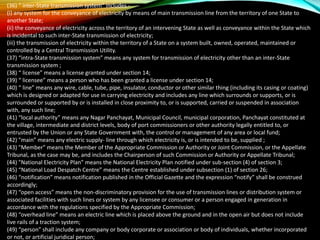
(36) “ inter-State transmission system” includes -
(i) any system for the conveyance of electricity by means of main transmission line from the territory of one State to
another State;
(ii) the conveyance of electricity across the territory of an intervening State as well as conveyance within the State which
is incidental to such inter-State transmission of electricity;
(iii) the transmission of electricity within the territory of a State on a system built, owned, operated, maintained or
controlled by a Central Transmission Utility.
(37) “intra-State transmission system” means any system for transmission of electricity other than an inter-State
transmission system ;
(38) “ license” means a license granted under section 14;
(39) “ licensee” means a person who has been granted a license under section 14;
(40) “ line” means any wire, cable, tube, pipe, insulator, conductor or other similar thing (including its casing or coating)
which is designed or adapted for use in carrying electricity and includes any line which surrounds or supports, or is
surrounded or supported by or is installed in close proximity to, or is supported, carried or suspended in association
with, any such line;
(41) “local authority” means any Nagar Panchayat, Municipal Council, municipal corporation, Panchayat constituted at
the village, intermediate and district levels, body of port commissioners or other authority legally entitled to, or
entrusted by the Union or any State Government with, the control or management of any area or local fund;
(42) "main” means any electric supply- line through which electricity is, or is intended to be, supplied ;
(43) "Member" means the Member of the Appropriate Commission or Authority or Joint Commission, or the Appellate
Tribunal, as the case may be, and includes the Chairperson of such Commission or Authority or Appellate Tribunal;
(44) "National Electricity Plan" means the National Electricity Plan notified under sub-section (4) of section 3;
(45) “National Load Despatch Centre” means the Centre established under subsection (1) of section 26;
(46) “notification” means notification published in the Official Gazette and the expression “notify” shall be construed
accordingly;
(47) “open access” means the non-discriminatory provision for the use of transmission lines or distribution system or
associated facilities with such lines or system by any licensee or consumer or a person engaged in generation in
accordance with the regulations specified by the Appropriate Commission;
(48) “overhead line” means an electric line which is placed above the ground and in the open air but does not include
live rails of a traction system;
(49) “person” shall include any company or body corporate or association or body of individuals, whether incorporated
or not, or artificial juridical person;
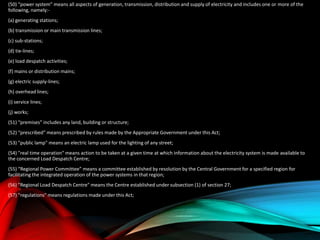
(50) "power system" means all aspects of generation, transmission, distribution and supply of electricity and includes one or more of the
following, namely:-
(a) generating stations;
(b) transmission or main transmission lines;
(c) sub-stations;
(d) tie-lines;
(e) load despatch activities;
(f) mains or distribution mains;
(g) electric supply-lines;
(h) overhead lines;
(i) service lines;
(j) works;
(51) “premises” includes any land, building or structure;
(52) “prescribed” means prescribed by rules made by the Appropriate Government under this Act;
(53) "public lamp" means an electric lamp used for the lighting of any street;
(54) "real time operation" means action to be taken at a given time at which information about the electricity system is made available to
the concerned Load Despatch Centre;
(55) “Regional Power Committee” means a committee established by resolution by the Central Government for a specified region for
facilitating the integrated operation of the power systems in that region;
(56) "Regional Load Despatch Centre" means the Centre established under subsection (1) of section 27;
(57) "regulations" means regulations made under this Act;
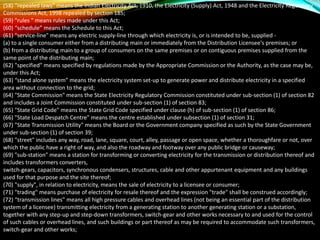
(58) “repealed laws” means the Indian Electricity Act, 1910, the Electricity (Supply) Act, 1948 and the Electricity Regulatory
Commissions Act, 1998 repealed by section 185;
(59) "rules " means rules made under this Act;
(60) “schedule” means the Schedule to this Act;
(61) "service-line" means any electric supply-line through which electricity is, or is intended to be, supplied -
(a) to a single consumer either from a distributing main or immediately from the Distribution Licensee's premises; or
(b) from a distributing main to a group of consumers on the same premises or on contiguous premises supplied from the
same point of the distributing main;
(62) "specified" means specified by regulations made by the Appropriate Commission or the Authority, as the case may be,
under this Act;
(63) “stand alone system” means the electricity system set-up to generate power and distribute electricity in a specified
area without connection to the grid;
(64) "State Commission" means the State Electricity Regulatory Commission constituted under sub-section (1) of section 82
and includes a Joint Commission constituted under sub-section (1) of section 83;
(65) "State Grid Code" means the State Grid Code specified under clause (h) of sub-section (1) of section 86;
(66) "State Load Despatch Centre" means the centre established under subsection (1) of section 31;
(67) "State Transmission Utility" means the Board or the Government company specified as such by the State Government
under sub-section (1) of section 39;
(68) "street" includes any way, road, lane, square, court, alley, passage or open space, whether a thoroughfare or not, over
which the public have a right of way, and also the roadway and footway over any public bridge or causeway;
(69) "sub-station" means a station for transforming or converting electricity for the transmission or distribution thereof and
includes transformers converters,
switch-gears, capacitors, synchronous condensers, structures, cable and other appurtenant equipment and any buildings
used for that purpose and the site thereof;
(70) "supply", in relation to electricity, means the sale of electricity to a licensee or consumer;
(71) "trading" means purchase of electricity for resale thereof and the expression "trade" shall be construed accordingly;
(72) “transmission lines" means all high pressure cables and overhead lines (not being an essential part of the distribution
system of a licensee) transmitting electricity from a generating station to another generating station or a substation,
together with any step-up and step-down transformers, switch-gear and other works necessary to and used for the control
of such cables or overhead lines, and such buildings or part thereof as may be required to accommodate such transformers,
switch-gear and other works;
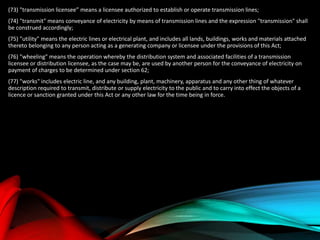
(73) "transmission licensee” means a licensee authorized to establish or operate transmission lines;
(74) "transmit" means conveyance of electricity by means of transmission lines and the expression "transmission" shall
be construed accordingly;
(75) "utility" means the electric lines or electrical plant, and includes all lands, buildings, works and materials attached
thereto belonging to any person acting as a generating company or licensee under the provisions of this Act;
(76) "wheeling" means the operation whereby the distribution system and associated facilities of a transmission
licensee or distribution licensee, as the case may be, are used by another person for the conveyance of electricity on
payment of charges to be determined under section 62;
(77) "works" includes electric line, and any building, plant, machinery, apparatus and any other thing of whatever
description required to transmit, distribute or supply electricity to the public and to carry into effect the objects of a
licence or sanction granted under this Act or any other law for the time being in force.
PART II
NATIONAL ELECTRICITY POLICY AND PLAN
Section 3. (National Electricity Policy and Plan) --- (1) The Central Government shall, from time to time, prepare
the National Electricity Policy and tariff policy, in consultation with the State Governments and the Authority for
development of the power system based on optimal utilisation of resources such as coal, natural gas, nuclear
substances or materials, hydro and renewable sources of energy.
(2) The Central Government shall publish National Electricity Policy and tariff policy from time to time.
(3) The Central Government may, from time to time, in consultation with the State Governments and the Authority,
review or revise, the National Electricity Policy and tariff policy referred to in sub-section (1) .
(4) The Authority shall prepare a National Electricity Plan in accordance with the National Electricity Policy and notify
such plan once in five years: Provided that the Authority while preparing the National Electricity Plan shall publish the
draft National Electricity Plan and invite suggestions and objections thereon from licensees, generating companies and
the public within such time as may be prescribed: Provided further that the Authority shall -
(a) notify the plan after obtaining the approval of the Central Government;
(b) revise the plan incorporating therein the directions, if any, given by the Central Government while granting approval
under clause (a).
Section 4. (National Policy on stand alone systems for rural areas and non conventional energy systems):
The Central Government shall, after consultation with the State Governments, prepare and notify a national policy,
permitting stand alone systems (including those based on renewable sources of energy and other nonconventional sources
of energy) for rural areas.
Section 5. (National policy on electrification and local distribution in rural areas):
The Central Government shall also formulate a national policy, in consultation with the State Governments and the State
Commissions, for rural electrification and for bulk purchase of power and management of local distribution in rural areas
through Panchayat Institutions, users’ associations, cooperative societies, non-Governmental organisations or franchisees.
Section 6. (Joint responsibility of State Government and Central Government in rural electrification.)
The concerned State Government and the Central Government shall jointly endeavour to provide access to electricity to all
areas including villages and hamlets through rural electricity infrastructure and electrification of households.]
PART III
GENERATION OF ELECTRICITY
Section 7. (Generating company and requirement for setting up of generating station):
Any generating company may establish, operate and maintain a generating station without obtaining a licence under this
act if it complies with the technical standards relating to connectivity with the grid referred to in clause (b) of section 73.
Section 8. (Hydro-electric generation): --- (1) Notwithstanding anything contained in section 7, any Generating company
intending to set-up a hydrogenating station shall prepare and submit to the authority for its concurrence, A scheme
estimated to involve a capital expenditure exceeding such sum, as may be fixed by the central government, from time to
time, by notification.
(2) the authority shall, before concurring in any scheme submitted to it under sub-section (1) have particular regard to,
whether or not in its opinion,-
(A) the proposed river-works will prejudice the prospects for the best ultimate development of the river or its tributaries
for power generation, consistent with the requirements of drinking water, irrigation, navigation, flood-control, or
other public purposes, and for this purpose the Authority shall satisfy itself, after consultation with the State
Government, the Central Government, or such other agencies as it may deem appropriate, that an adequate study
has been made of the optimum location of dams and other river works;
(B) the proposed scheme meets the norms regarding dam design and safety.
(3) Where a multi-purpose scheme for the development of any river in any region is in operation, the
State Government and the generating company shall
co-ordinate their activities with the activities of the person responsible for such scheme in so far as they
are inter-related.
Section 9. (Captive generation):
(1) Notwithstanding anything contained in this Act, a person may construct, maintain or operate a
captive generating plant and dedicated transmission lines:
Provided that the supply of electricity from the captive generating plant
through the grid shall be regulated in the same manner as the generating station
of a generating company.
1[Provided further that no licence shall be required under this Act for supply of electricity generated
from a captive generating plant to any licence in accordance with the provisions of this Act and the rules
and regulations made there under and to any consumer subject to the regulations made under
subsection (2) of section 42.]
(2) Every person, who has constructed a captive generating plant and maintains and operates such
plant, shall have the right to open access for the
purposes of carrying electricity from his captive generating plant to the destination of his use:
Provided that such open access shall be subject to availability of adequate transmission facility and such
availability of transmission facility shall be determined by the Central Transmission Utility or the State
Transmission
Utility, as the case may be:
Provided further that any dispute regarding the availability of transmission facility shall be adjudicated
upon by the Appropriate Commission.
Section 10. (Duties of generating companies): --- (1) Subject to the provisions of this
Act, The duties of a generating company shall be to establish, operate and maintain generating stations,
tie-lines, sub-stations and dedicated transmission lines connected therewith in accordance with the
provisions of this act or the rules or regulations made thereunder.
(2) a generating company may supply electricity to any licensee in accordance with this act and the rules
and regulations made there under and may, subject to the regulations made under sub-section (2) of
section 42, supply electricity to any consumer.
(3) every generating company shall submit technical details regarding its generating stations to the
appropriate commission and the authority;
Section 11. (Directions to generating companies): --- (1) Appropriate
Government may specify that a generating company shall, in extraordinary circumstances operate and maintain
any generating station in accordance with The directions of that government. Explanation. - For the purposes of
this section, the expression “extraordinary Circumstances” means circumstances arising out of threat to security
of the State, public order or a natural calamity or such other circumstances arising in The public interest.
(2) the appropriate commission may offset the adverse financial impact of The directions referred to in sub-
section (1) on any generating company in such Manner as it considers appropriate.
PART IV
LICENSING
Section 12. (Authorised persons to transmit, supply, etc., electricity):
No person shall
(A) transmit electricity; or
(B) distribute electricity; or
(C) undertake trading in electricity,
Unless he is authorised to do so by a licence issued under section 14, or is exempt under section 13.
Section 13. (Power to exempt):
The appropriate commission may, on the recommendations, of the appropriate government, in accordance with the
national policy formulated under section 5 and in the public interest, direct, by notification that subject to
Such conditions and restrictions, if any, and for such period or periods, as may be specified in the notification, the
provisions of section 12 shall not apply to any
Local authority, panchayat institution, users’ association, co-operative societies, non-governmental organizations, or
franchisees:
Section 14. (Grant of licence):
The Appropriate Commission may, on an application made to it under section 15, grant a licence to any person -
(a) to transmit electricity as a transmission licensee; or
(b) to distribute electricity as a distribution licensee; or
(c) to undertake trading in electricity as an electricity trader,
in any area as may be specified in the licence:
Provided that any person engaged in the business of transmission or supply of electricity under the provisions of the
repealed laws or any Act specified in the Schedule on or before the appointed date shall be deemed to be a licensee under
this Act for such period as may be stipulated in the licence, clearance or approval granted to him under the repealed laws or
such Act specified in the Schedule, and the provisions of the repealed laws or such Act
specified in the Schedule in respect of such licence shall apply for a period of one year from the date of commencement of
this Act or such earlier period as may be specified, at the request of the licensee, by the Appropriate Commission and
thereafter the provisions of this Act shall apply to such business:
Provided further that the Central Transmission Utility or the State Transmission Utility shall be deemed to be a transmission
licensee under this Act:
Provided also that in case an Appropriate Government transmits electricity or distributes electricity or undertakes trading in
electricity, whether before or after the commencement of this Act, such Government shall be deemed to be a licensee
under this Act, but shall not be required to obtain a licence under this Act:
Provided also that the Damodar Valley Corporation, established under sub-section (1) of section 3 of the Damodar Valley
Corporation Act, 1948, shall be deemed to be a licensee under this Act but shall not be required to obtain a licence under
this Act and the provisions of the Damodar Valley Corporation Act, 1948, in so far as they are not inconsistent with the
provisions of this Act, shall continue to apply to that Corporation:
Provided also that the Government company or the company referred to in sub-section
(2) of section 131 of this Act and the company or companies created in pursuance of the Acts specified in the Schedule,
shall be deemed to be a licensee under this Act:
Provided also that the Appropriate Commission may grant a licence to two or more persons for distribution of electricity
through their own distribution system within the same area, subject to the conditions that the applicant for grant of licence
within the same area shall, without prejudice to the other conditions or requirements under this Act, comply with the
additional requirements 1[relating to the capital adequacy, credit-worthiness, or code of conduct] as may be prescribed by
the Central Government, and no such applicant, who complieswith all the requirements for grant of licence, shall be
refused grant of licence on the ground that there already exists a licensee in the same area for the same purpose.
Provided also that in a case where a distribution licensee proposes to Undertake distribution of electricity for a
specified area within his area of Supply through another person, that person shall not be required to obtain Any
separate licence from the concerned state commission and such Distribution licensee shall be responsible for
distribution of electricity in his area Of supply:
Provided also that where a person intends to generate and distribute Electricity in a rural area to be notified by the
state government, such person Shall not require any licence for such generation and distribution of electricity, But he
shall comply with the measures which may be specified by the authority.
Under section 53: Provided also that a distribution licensee shall not require a licence to Undertake trading in electricity.
Section 23. (Directions to licensees): If the Appropriate Commission is of the opinion that it is necessary or expedient so
to do for maintaining the efficient supply, securing the equitable distribution of electricity and promoting competition,
it may, by order, provide for regulating supply, distribution, consumption or use thereof.
Section 24. (Suspension of distribution licence and sale of utility): --- (1) If at any time the Appropriate Commission is of
the opinion that a distribution licensee –
(a) has persistently failed to maintain uninterrupted supply of electricity conforming to standards regarding quality of
electricity to the consumers; or
(b) is unable to discharge the functions or perform the duties mposed on it by or under the provisions of this Act; or
(c) has persistently defaulted in complying with any direction given by the Appropriate Commission under this Act; or
(d) has broken the terms and conditions of licence,
Section 25. (Inter-State, regional and inter-regional transmission):
For the purposes of this Part, the Central Government may, make regionwise demarcation of the country, and, from time to
time, make such modifications therein as it may consider necessary for the efficient, economical and integrated
transmission and supply of electricity, and in particular to facilitate voluntary inter-connections and co-ordination of
facilities for the inter- State, regional and inter-regional generation and transmission of electricity.
Section 26. (National Load Despatch Centre) : ---
(1) The Central Government may establish a centre at the national level, to be known as the National Load Despatch Centre
for optimum scheduling and despatch of electricity among the Regional Load Despatch Centres.
(2) The constitution and functions of the National Load Despatch Centre shall be such as may be prescribed by the Central
Government: Provided that the National Load Despatch Centre shall not engage in the business of trading in electricity.
(3) The National Load Despatch Centre shall be operated by a Government company or any authority or corporation
established or constituted by or under any Central Act, as may be notified by the Central Government.
Section 30. (Transmission within a State):
The State Commission shall facilitate and promote transmission, wheeling and inter-connection arrangements within its
territorial jurisdiction for the transmission and supply of electricity by economical and efficient utilisation of the electricity.
Section 34. (Grid Standards):
Every transmission licensee shall comply with such technical standards, of operation and maintenance of transmission lines,
in accordance with the Grid Standards, as may be specified by the Authority.
Section 35. (Intervening transmission facilities):
The Appropriate Commission may, on an application by any licensee, by order require any other licensee owning or
operating intervening transmission facilities to provide the use of such facilities to the extent of surplus capacity available
with such licensee: Provided that any dispute, regarding the extent of surplus capacity available with the licensee, shall be
adjudicated upon by the Appropriate Commission.
PART V
TRANSMISSION OF ELECTRICITY
PART VI
DISTRIBUTION OF
ELELCTRICITY
Provisions with respect to distribution licensee
Section 42. (Duties of distribution licensee and open access): --- (1) It shall be the duty of a distribution licensee
to develop and maintain an efficient, co-ordinated and economical distribution system in his area of supply and to supply
electricity in accordance with the provisions contained in this Act.
(2) The State Commission shall introduce open access in such phases and subject to such conditions, (including the cross
subsidies, and other operational constraints) as may be specified within one year of the appointed date by it and in
specifying the extent of open access in successive phases and in determining the charges for wheeling, it shall have due
regard to all relevant factors including such cross subsidies, and other operational constraints: Provided that 1[such open
access shall be allowed on payment of a surcharge] in addition to the charges for wheeling as may be determined by the
State Commission: Provided further that such surcharge shall be utilised to meet the requirements of current level of cross
subsidy within the area of supply of the distribution licensee : Provided also that such surcharge and cross subsidies shall be
progressively reduced 2[***] in the manner as may be specified by the State Commission: Provided also that such surcharge
shall not be leviable in case open access is
[provided to a person who has established a captive generating plant for carrying the electricity to the destination of his
own use: Provided also that the State Commission shall, not later than five years from the date of commencement of the
Electricity (Amendment) Act, 2003, by regulations, provide such open access to all consumers who require a supply of
electricity where the maximum power to be made available at any time exceeds one megawatt.]
(3) Where any person, whose premises are situated within the area of supply of a distribution licensee, (not being a local
authority engaged in the business of distribution of electricity before the appointed date) requires a supply of electricity
from a generating company or any licensee other than such distribution licensee, such person may, by notice, require the
distribution licensee for wheeling such electricity in accordance with regulations made by the State Commission and the
duties of the distribution licensee with respect to such supply shall be of a common carrier providing non-discriminatory
open access .
(4) Where the State Commission permits a consumer or class of consumers to receive supply of electricity from a person
other than the distribution licensee of his area of supply, such consumer shall be liable to pay an additional surcharge
on the charges of wheeling, as may be specified by the State Commission, to meet the fixed cost of such distribution
licensee arising out of his obligation to supply.
(5) Every distribution licensee shall, within six months from the appointed date or date of grant of licence, whichever is
earlier, establish a forum for redressal of grievances of the consumers in accordance with the guidelines as may be
specified by the State Commission.
(6) Any consumer, who is aggrieved by non-redressal of his grievances under sub-section (5), may make a representation for
the redressal of his grievance to an authority to be known as Ombudsman to be appointed or designated by the State
Commission.
(7) The Ombudsman shall settle the grievance of the consumer within such time and in such manner as may be specified by
the State Commission.
(8) The provisions of sub-sections (5),(6) and (7) shall be without prejudice to right which the consumer may have apart
from the rights conferred upon him by those sub-sections.
Section 56. (Disconnection of supply in default of payment): -- (1) Where any person neglects to pay any
charge for electricity or any sum other than a charge for electricity due from him to a licensee or the generating
company in respect of
supply, transmission or distribution or wheeling of electricity to him, the licensee or the generating company may,
after giving not less than fifteen clear days’ notice in writing, to such person and without prejudice to his rights to
recover such charge or other sum by suit, cut off the supply of electricity and for that purpose cut or disconnect
any electric supply line or other works being the property of such licensee or the generating company through
which electricity may have been supplied, transmitted, distributed or wheeled and may discontinue the supply until
such charge or other sum, together with any expenses incurred by him in cutting off and reconnecting the supply,
are paid, but no longer: Provided that the supply of electricity shall not be cut off if such person deposits, under
protest, -
(a) an amount equal to the sum claimed from him, or
b) the electricity charges due from him for each month calculated on the basis of average charge for electricity
paid by him during the preceding six months, whichever is less, pending disposal of any dispute between him and
the licensee.
(2) Notwithstanding anything contained in any other law for the time being in force, no sum due from any
consumer, under this section shall be recoverable after the period of two years from the date when such sum
became first due unless such sum has been shown continuously as recoverable as arrear of charges for electricity
supplied and the licensee shall not cut off the supply of the electricity.
PART-VII
TARIFF
Section 61. (Tariff regulations):
The appropriate commission shall, subject to the provisions of this act, Specify the terms and conditions for the
determination of tariff, and in doing so, Shall be guided by the following, namely:-
(A) the principles and methodologies specified by the central Commission for determination of the tariff applicable to
Generating companies and transmission licensees;
(B) the generation, transmission, distribution and supply of electricity Are conducted on commercial principles;
(C) the factors which would encourage competition, efficiency, Economical use of the resources, good performance and
optimum Investments;
(D) safeguarding of consumers' interest and at the same time, recovery Of the cost of electricity in a reasonable manner;
(E) the principles rewarding efficiency in performance;
(F) multi year tariff principles;
(g) that the tariff progressively reflects the cost of supply of electricity And also, reduces cross-subsidies in the manner
specified by the Appropriate commission;
(H) the promotion of co-generation and generation of electricity from Renewable sources of energy;
(I) the national electricity policy and tariff policy: Provided that the terms and conditions for determination of tariff under
The electricity (supply) act, 1948, the electricity regulatory commission act, 1998 and the enactments specified in the
schedule as they stood immediately before the appointed date, shall continue to apply for a period of one year or
until the terms and conditions for tariff are specified under this section, whichever is earlier.
Section 62. (Determination of tariff): --- (1) The Appropriate Commission shall determine the tariff in
accordance with the provisions of this Act for –
(a) supply of electricity by a generating company to a distribution licensee: Provided that the Appropriate
Commission may, in case of shortage of supply of electricity, fix the minimum and maximum ceiling of tariff for sale
or purchase of electricity in pursuance of an agreement, entered into between a generating company and a
licensee or between licensees, for a period not exceeding one year to ensure reasonable prices of electricity;
(b) transmission of electricity ;
(c) wheeling of electricity;
(d) retail sale of electricity: Provided that in case of distribution of electricity in the same area by two or more
distribution licensees, the Appropriate Commission may, for promoting competition among distribution licensees,
ceiling of tariff for retail sale of electricity.
Section 62. (Determination of tariff): --- (1) The Appropriate Commission shall determine the tariff in
accordance with the provisions of this Act for –
(a) supply of electricity by a generating company to a distribution licensee: Provided that the Appropriate
Commission may, in case of shortage of supply of electricity, fix the minimum and maximum ceiling of tariff for sale
or purchase of electricity in pursuance of an agreement, entered into between a generating company and a
licensee or between licensees, for a period not exceeding one year to ensure reasonable prices of electricity;
(b) transmission of electricity ;
(c) wheeling of electricity;
(d) retail sale of electricity: Provided that in case of distribution of electricity in the same area by two or more
distribution licensees, the Appropriate Commission may, for promoting
competition among distribution licensees, fix only maximum ceiling of tariff for retail sale of electricity.
(2) The Appropriate Commission may require a licensee or a generating company to furnish separate details, as
may be specified in respect of generation, transmission and distribution for determination of tariff.
(3) The Appropriate Commission shall not, while determining the tariff under this Act, show undue preference to
any consumer of electricity but may differentiate according to the consumer's load factor, power factor, voltage,
total consumption of electricity during any specified period or the time at which the supply is required or the
geographical position of any area, the nature of supply and the purpose for which the supply is required.
(4) No tariff or part of any tariff may ordinarily be amended, more frequently than once in any financial year, except
in respect of any changes expressly permitted under the terms of any fuel surcharge formula as may be specified.
(5) The Commission may require a licensee or a generating company to comply with such procedures as may be
specified for calculating the expected revenues from the tariff and charges which he or it is permitted to recover.
(6) If any licensee or a generating company recovers a price or charge exceeding the tariff determined under this
section, the excess amount shall be recoverable by the person who has paid such price or charge along with
interest equivalent to the bank rate without prejudice to any other liability incurred by the licensee.
Section 66. (Development of market):
The Appropriate Commission shall endeavor to promote the development of a market (including trading) in power
in such manner as may be specified and shall be guided by the National Electricity Policy referred to in section 3
in this regard.

Electricity act 2003 INDIA

  • 1.
    THE ELECTRICITY ACT,2003 MINISTRY OF LAW AND JUSTICE (Legislative Department) New Delhi, the 2nd June, 2003.Jyaistha 12, 1925 (Saka) The following Act of Parliament received the assent of the President on the 26th May, 2003, and is hereby published for general information: THE ELECTRICITY ACT, 2003 [No.36 of 2003] [26th May, 2003] • An Act to consolidate the laws relating to generation, transmission, distribution trading and use of electricity and generally for taking measures conducive to development of electricity industry, promoting competition therein, protecting interest of consumers and supply of electricity to all areas, rationalization of electricity tariff, ensuring transparent policies regarding subsidies, promotion of efficient and environmentally benign policies, constitution of Central Electricity Authority, Regulatory Commissions and establishment of Appellate Tribunal and for matters connected therewith or incidental thereto. • Be it enacted by Parliament in the Fifty-fourth Year of the Republic of India as follows:-
  • 2.
    PART I PRELIMINARY Section 1.(Short title, extent and commencement):--- (1) This Act may be called the Electricity Act, 2003. (2) It extends to the whole of India except the State of Jammu and Kashmir. (3) It shall come into force on such date as the Central Government may, by notification, appoint: Provided that different dates may be appointed for different provisions of this Act and any reference in any such provision to the commencement of this. Act shall be construed as a reference to the coming into force of that provision.
  • 3.
    SECTION 2. (DEFINITIONS):--- IN THIS ACT, UNLESS THE CONTEXT OTHERWISE REQUIRES:-- (1)“APPELLATE TRIBUNAL” MEANS THE APPELLATE TRIBUNAL FOR ELECTRICITY ESTABLISHED UNDER SECTION 110; (2) "APPOINTED DATE" MEANS SUCH DATE AS THE CENTRAL GOVERNMENT MAY, BY NOTIFICATION, APPOINT; (3) "AREA OF SUPPLY” MEANS THE AREA WITHIN WHICH A DISTRIBUTION LICENSEE IS AUTHORISED BY HIS LICENCE TO SUPPLY ELECTRICITY; (4) "APPROPRIATE COMMISSION” MEANS THE CENTRAL REGULATORY COMMISSION REFERRED TO IN SUB-SECTION (1) OF SECTION 76 OR THE STATE REGULATORY COMMISSION REFERRED TO IN SECTION 82 OR THE JOINT COMMISSION REFERRED TO IN SECTION 83, AS THE CASE MAY BE ; (5) "APPROPRIATE GOVERNMENT" MEANS, - (A) THE CENTRAL GOVERNMENT, - (I) IN RESPECT OF A GENERATING COMPANY WHOLLY OR PARTLY OWNED BY IT; (II) IN RELATION TO ANY INTER-STATE GENERATION, TRANSMISSION, TRADING OR SUPPLY OF ELECTRICITY AND WITH RESPECT TO ANY MINES, OIL-FIELDS, RAILWAYS, NATIONAL HIGHWAYS, AIRPORTS , TELEGRAPHS , BROADCASTING STATIONS AND ANY WORKS OF DEFENCE , DOCKYARD, NUCLEAR POWER INSTALLATIONS; (III) IN RESPECT OF NATIONAL LOAD DESPATCH CENTRE; AND REGIONAL LOAD DESPATCH CENTRE; (IV) IN RELATION TO ANY WORKS OR ELECTRIC INSTALLATION BELONGING TO IT OR UNDER ITS CONTROL ; (B) IN ANY OTHER CASE, THE STATE GOVERNMENT, HAVING JURISDICTION UNDER THIS ACT; (6) “AUTHORITY” MEANS THE CENTRAL ELECTRICITY AUTHORITY REFERRED TO IN SUB-SECTION(1) OF SECTION 70; (7) "BOARD" MEANS, A STATE ELECTRICITY BOARD, CONSTITUTED BEFORE THE COMMENCEMENT OF THIS ACT, UNDER SUB- SECTION (1) OF SECTION 5 OF THE ELECTRICITY (SUPPLY) ACT, 1948; (8) “CAPTIVE GENERATING PLANT” MEANS A POWER PLANT SET UP BY ANY PERSON TO GENERATE ELECTRICITY PRIMARILY FOR HIS OWN USE AND INCLUDES A POWER PLANT SET UP BY ANY CO-OPERATIVE SOCIETY OR ASSOCIATION OF PERSONS FOR GENERATING ELECTRICITY PRIMARILY FOR USE OF MEMBERS OF SUCH COOPERATIVE SOCIETY OR ASSOCIATION; (9) "CENTRAL COMMISSION" MEANS THE CENTRAL ELECTRICITY REGULATORY COMMISSION REFERRED TO IN SUB-SECTION (1) OF SECTION 76; (10) "CENTRAL TRANSMISSION UTILITY" MEANS ANY GOVERNMENT COMPANY WHICH THE CENTRAL GOVERNMENT MAY NOTIFY UNDER SUB-SECTION (1) OF SECTION 38; (11) "CHAIRPERSON" MEANS THE CHAIRPERSON OF THE AUTHORITY OR APPROPRIATE COMMISSION OR THE APPELLATE TRIBUNAL, AS THE CASE MAY BE; (12) “COGENERATION” MEANS A PROCESS WHICH SIMULTANEOUSLY PRODUCES TWO OR MORE FORMS OF USEFUL ENERGY (INCLUDING ELECTRICITY); (13) "COMPANY" MEANS A COMPANY FORMED AND REGISTERED UNDER THE COMPANIES ACT, 1956 AND INCLUDES ANY BODY CORPORATE UNDER A CENTRAL, STATE OR PROVINCIAL ACT; (14) "CONSERVATION" MEANS ANY REDUCTION IN CONSUMPTION OF ELECTRICITY AS A RESULT OF INCREASE IN THE EFFICIENCY IN SUPPLY AND USE OF ELECTRICITY;
  • 4.
    (15) "CONSUMER" MEANSANY PERSON WHO IS SUPPLIED WITH ELECTRICITY FOR HIS OWN USE BY A LICENSEE OR THE GOVERNMENT OR BY ANY OTHER PERSON ENGAGED IN THE BUSINESS OF SUPPLYING ELECTRICITY TO THE PUBLIC UNDER THIS ACT OR ANY OTHER LAW FOR THE TIME BEING IN FORCE AND INCLUDES ANY PERSON WHOSE PREMISES ARE FOR THE TIME BEING CONNECTED FOR THE PURPOSE OF RECEIVING ELECTRICITY WITH THE WORKS OF A LICENSEE, THE GOVERNMENT OR SUCH OTHER PERSON, AS THE CASE MAY BE; (16) “DEDICATED TRANSMISSION LINES" MEANS ANY ELECTRIC SUPPLY-LINE FOR POINT TO POINT TRANSMISSION WHICH ARE REQUIRED FOR THE PURPOSE OF CONNECTING ELECTRIC LINES OR ELECTRIC PLANTS OF A CAPTIVE GENERATING PLANT REFERRED TO IN SECTION 9 OR GENERATING STATION REFERRED TO IN SECTION 10 TO ANY TRANSMISSION LINES OR SUB-STATIONS OR GENERATING STATIONS, OR THE LOAD CENTER, AS THE CASE MAY BE; (17) "DISTRIBUTION LICENSEE" MEANS A LICENSEE AUTHORIZED TO OPERATE AND MAINTAIN A DISTRIBUTION SYSTEM FOR SUPPLYING ELECTRICITY TO THE CONSUMERS IN HIS AREA OF SUPPLY; (18) "DISTRIBUTING MAIN" MEANS THE PORTION OF ANY MAIN WITH WHICH A SERVICE LINE IS, OR IS INTENDED TO BE, IMMEDIATELY CONNECTED; (19) "DISTRIBUTION SYSTEM" MEANS THE SYSTEM OF WIRES AND ASSOCIATED FACILITIES BETWEEN THE DELIVERY POINTS ON THE TRANSMISSION LINES OR THE GENERATING STATION CONNECTION AND THE POINT OF CONNECTION TO THE INSTALLATION OF THE CONSUMERS (20) "ELECTRIC LINE" MEANS ANY LINE WHICH IS USED FOR CARRYING ELECTRICITY FOR ANY PURPOSE AND INCLUDES (A) ANY SUPPORT FOR ANY SUCH LINE, THAT IS TO SAY, ANY STRUCTURE, TOWER, POLE OR OTHER THING IN, ON, BY OR FROM WHICH ANY SUCH LINE IS, OR MAY BE, SUPPORTED, CARRIED OR SUSPENDED; AND (B) ANY APPARATUS CONNECTED TO ANY SUCH LINE FOR THE PURPOSE OF CARRYING ELECTRICITY; 21) "ELECTRICAL INSPECTOR" MEANS A PERSON APPOINTED AS SUCH BY THE APPROPRIATE GOVERNMENT UNDER SUB- SECTION (1) OF SECTION 162 AND ALSO INCLUDES CHIEF ELECTRICAL INSPECTOR; (22) "ELECTRICAL PLANT" MEANS ANY PLANT, EQUIPMENT, APPARATUS OR APPLIANCE OR ANY PART THEREOF USED FOR, OR CONNECTED WITH, THE GENERATION, TRANSMISSION, DISTRIBUTION OR SUPPLY OF ELECTRICITY BUT DOES NOT INCLUDE- (A) AN ELECTRIC LINE; OR (B) A METER USED FOR ASCERTAINING THE QUANTITY OF ELECTRICITY SUPPLIED TO ANY PREMISES; OR (C) AN ELECTRICAL EQUIPMENT, APPARATUS OR APPLIANCE UNDER THE CONTROL OF A CONSUMER; (23) "ELECTRICITY" MEANS ELECTRICAL ENERGY- (A) GENERATED, TRANSMITTED, SUPPLIED OR TRADED FOR ANY PURPOSE; OR (B) USED FOR ANY PURPOSE EXCEPT THE TRANSMISSION OF A MESSAGE; (24) "ELECTRICITY SUPPLY CODE" MEANS THE ELECTRICITY SUPPLY CODE SPECIFIED UNDER SECTION 50;
  • 5.
    (26) "electricity trader"means a person who has been granted a licence to undertake trading in electricity under section 12; (27) “franchisee means a persons authorised by a distribution licensee to distribute electricity on its behalf in a particular area within his area of supply; (28) "generating company" means any company or body corporate or association or body of ndividuals, whether incorporated or not, or artificial juridical person, which owns or operates or maintains a generating station; (29) "generate" means to produce electricity from a generating station for the purpose of giving supply to any premises or enabling a supply to be so given; (30) "generating station" or “station” means any station for generating electricity, including any building and plant with step-up transformer, switchgear, switch yard, cables or other appurtenant equipment, if any, used for that purpose and the site thereof; a site intended to be used for a generating station, and any building used for housing the operating staff of a generating station, and where electricity is generated by water-power, includes penstocks, head and tailworks, main and regulating reservoirs, dams and other hydraulic works, but does not in any case include any sub-station; (31) “Government company” shall have the meaning assigned to it in section 617 of the Companies Act, 1956; (32) "grid" means the high voltage backbone system of inter-connected transmission lines, sub-stations and generating plants; (33) "Grid Code" means the Grid Code specified by the Central Commission under clause (h) of sub-section (l) of section 79; (34) "Grid Standards" means the Grid Standards specified under clause (d) of section 73 by the Authority; (35) "high voltage line” means an electric line or cable of a nominal voltage as may be specified by the Authority from time to time;
  • 6.
    (36) “ inter-Statetransmission system” includes - (i) any system for the conveyance of electricity by means of main transmission line from the territory of one State to another State; (ii) the conveyance of electricity across the territory of an intervening State as well as conveyance within the State which is incidental to such inter-State transmission of electricity; (iii) the transmission of electricity within the territory of a State on a system built, owned, operated, maintained or controlled by a Central Transmission Utility. (37) “intra-State transmission system” means any system for transmission of electricity other than an inter-State transmission system ; (38) “ license” means a license granted under section 14; (39) “ licensee” means a person who has been granted a license under section 14; (40) “ line” means any wire, cable, tube, pipe, insulator, conductor or other similar thing (including its casing or coating) which is designed or adapted for use in carrying electricity and includes any line which surrounds or supports, or is surrounded or supported by or is installed in close proximity to, or is supported, carried or suspended in association with, any such line; (41) “local authority” means any Nagar Panchayat, Municipal Council, municipal corporation, Panchayat constituted at the village, intermediate and district levels, body of port commissioners or other authority legally entitled to, or entrusted by the Union or any State Government with, the control or management of any area or local fund; (42) "main” means any electric supply- line through which electricity is, or is intended to be, supplied ; (43) "Member" means the Member of the Appropriate Commission or Authority or Joint Commission, or the Appellate Tribunal, as the case may be, and includes the Chairperson of such Commission or Authority or Appellate Tribunal; (44) "National Electricity Plan" means the National Electricity Plan notified under sub-section (4) of section 3; (45) “National Load Despatch Centre” means the Centre established under subsection (1) of section 26; (46) “notification” means notification published in the Official Gazette and the expression “notify” shall be construed accordingly; (47) “open access” means the non-discriminatory provision for the use of transmission lines or distribution system or associated facilities with such lines or system by any licensee or consumer or a person engaged in generation in accordance with the regulations specified by the Appropriate Commission; (48) “overhead line” means an electric line which is placed above the ground and in the open air but does not include live rails of a traction system; (49) “person” shall include any company or body corporate or association or body of individuals, whether incorporated or not, or artificial juridical person;
  • 7.
    (50) "power system"means all aspects of generation, transmission, distribution and supply of electricity and includes one or more of the following, namely:- (a) generating stations; (b) transmission or main transmission lines; (c) sub-stations; (d) tie-lines; (e) load despatch activities; (f) mains or distribution mains; (g) electric supply-lines; (h) overhead lines; (i) service lines; (j) works; (51) “premises” includes any land, building or structure; (52) “prescribed” means prescribed by rules made by the Appropriate Government under this Act; (53) "public lamp" means an electric lamp used for the lighting of any street; (54) "real time operation" means action to be taken at a given time at which information about the electricity system is made available to the concerned Load Despatch Centre; (55) “Regional Power Committee” means a committee established by resolution by the Central Government for a specified region for facilitating the integrated operation of the power systems in that region; (56) "Regional Load Despatch Centre" means the Centre established under subsection (1) of section 27; (57) "regulations" means regulations made under this Act;
  • 8.
    (58) “repealed laws”means the Indian Electricity Act, 1910, the Electricity (Supply) Act, 1948 and the Electricity Regulatory Commissions Act, 1998 repealed by section 185; (59) "rules " means rules made under this Act; (60) “schedule” means the Schedule to this Act; (61) "service-line" means any electric supply-line through which electricity is, or is intended to be, supplied - (a) to a single consumer either from a distributing main or immediately from the Distribution Licensee's premises; or (b) from a distributing main to a group of consumers on the same premises or on contiguous premises supplied from the same point of the distributing main; (62) "specified" means specified by regulations made by the Appropriate Commission or the Authority, as the case may be, under this Act; (63) “stand alone system” means the electricity system set-up to generate power and distribute electricity in a specified area without connection to the grid; (64) "State Commission" means the State Electricity Regulatory Commission constituted under sub-section (1) of section 82 and includes a Joint Commission constituted under sub-section (1) of section 83; (65) "State Grid Code" means the State Grid Code specified under clause (h) of sub-section (1) of section 86; (66) "State Load Despatch Centre" means the centre established under subsection (1) of section 31; (67) "State Transmission Utility" means the Board or the Government company specified as such by the State Government under sub-section (1) of section 39; (68) "street" includes any way, road, lane, square, court, alley, passage or open space, whether a thoroughfare or not, over which the public have a right of way, and also the roadway and footway over any public bridge or causeway; (69) "sub-station" means a station for transforming or converting electricity for the transmission or distribution thereof and includes transformers converters, switch-gears, capacitors, synchronous condensers, structures, cable and other appurtenant equipment and any buildings used for that purpose and the site thereof; (70) "supply", in relation to electricity, means the sale of electricity to a licensee or consumer; (71) "trading" means purchase of electricity for resale thereof and the expression "trade" shall be construed accordingly; (72) “transmission lines" means all high pressure cables and overhead lines (not being an essential part of the distribution system of a licensee) transmitting electricity from a generating station to another generating station or a substation, together with any step-up and step-down transformers, switch-gear and other works necessary to and used for the control of such cables or overhead lines, and such buildings or part thereof as may be required to accommodate such transformers, switch-gear and other works;
  • 9.
    (73) "transmission licensee”means a licensee authorized to establish or operate transmission lines; (74) "transmit" means conveyance of electricity by means of transmission lines and the expression "transmission" shall be construed accordingly; (75) "utility" means the electric lines or electrical plant, and includes all lands, buildings, works and materials attached thereto belonging to any person acting as a generating company or licensee under the provisions of this Act; (76) "wheeling" means the operation whereby the distribution system and associated facilities of a transmission licensee or distribution licensee, as the case may be, are used by another person for the conveyance of electricity on payment of charges to be determined under section 62; (77) "works" includes electric line, and any building, plant, machinery, apparatus and any other thing of whatever description required to transmit, distribute or supply electricity to the public and to carry into effect the objects of a licence or sanction granted under this Act or any other law for the time being in force.
  • 10.
    PART II NATIONAL ELECTRICITYPOLICY AND PLAN Section 3. (National Electricity Policy and Plan) --- (1) The Central Government shall, from time to time, prepare the National Electricity Policy and tariff policy, in consultation with the State Governments and the Authority for development of the power system based on optimal utilisation of resources such as coal, natural gas, nuclear substances or materials, hydro and renewable sources of energy. (2) The Central Government shall publish National Electricity Policy and tariff policy from time to time. (3) The Central Government may, from time to time, in consultation with the State Governments and the Authority, review or revise, the National Electricity Policy and tariff policy referred to in sub-section (1) . (4) The Authority shall prepare a National Electricity Plan in accordance with the National Electricity Policy and notify such plan once in five years: Provided that the Authority while preparing the National Electricity Plan shall publish the draft National Electricity Plan and invite suggestions and objections thereon from licensees, generating companies and the public within such time as may be prescribed: Provided further that the Authority shall - (a) notify the plan after obtaining the approval of the Central Government; (b) revise the plan incorporating therein the directions, if any, given by the Central Government while granting approval under clause (a).
  • 11.
    Section 4. (NationalPolicy on stand alone systems for rural areas and non conventional energy systems): The Central Government shall, after consultation with the State Governments, prepare and notify a national policy, permitting stand alone systems (including those based on renewable sources of energy and other nonconventional sources of energy) for rural areas. Section 5. (National policy on electrification and local distribution in rural areas): The Central Government shall also formulate a national policy, in consultation with the State Governments and the State Commissions, for rural electrification and for bulk purchase of power and management of local distribution in rural areas through Panchayat Institutions, users’ associations, cooperative societies, non-Governmental organisations or franchisees. Section 6. (Joint responsibility of State Government and Central Government in rural electrification.) The concerned State Government and the Central Government shall jointly endeavour to provide access to electricity to all areas including villages and hamlets through rural electricity infrastructure and electrification of households.]
  • 12.
    PART III GENERATION OFELECTRICITY Section 7. (Generating company and requirement for setting up of generating station): Any generating company may establish, operate and maintain a generating station without obtaining a licence under this act if it complies with the technical standards relating to connectivity with the grid referred to in clause (b) of section 73. Section 8. (Hydro-electric generation): --- (1) Notwithstanding anything contained in section 7, any Generating company intending to set-up a hydrogenating station shall prepare and submit to the authority for its concurrence, A scheme estimated to involve a capital expenditure exceeding such sum, as may be fixed by the central government, from time to time, by notification. (2) the authority shall, before concurring in any scheme submitted to it under sub-section (1) have particular regard to, whether or not in its opinion,- (A) the proposed river-works will prejudice the prospects for the best ultimate development of the river or its tributaries for power generation, consistent with the requirements of drinking water, irrigation, navigation, flood-control, or other public purposes, and for this purpose the Authority shall satisfy itself, after consultation with the State Government, the Central Government, or such other agencies as it may deem appropriate, that an adequate study has been made of the optimum location of dams and other river works; (B) the proposed scheme meets the norms regarding dam design and safety.
  • 13.
    (3) Where amulti-purpose scheme for the development of any river in any region is in operation, the State Government and the generating company shall co-ordinate their activities with the activities of the person responsible for such scheme in so far as they are inter-related. Section 9. (Captive generation): (1) Notwithstanding anything contained in this Act, a person may construct, maintain or operate a captive generating plant and dedicated transmission lines: Provided that the supply of electricity from the captive generating plant through the grid shall be regulated in the same manner as the generating station of a generating company. 1[Provided further that no licence shall be required under this Act for supply of electricity generated from a captive generating plant to any licence in accordance with the provisions of this Act and the rules and regulations made there under and to any consumer subject to the regulations made under subsection (2) of section 42.] (2) Every person, who has constructed a captive generating plant and maintains and operates such plant, shall have the right to open access for the purposes of carrying electricity from his captive generating plant to the destination of his use: Provided that such open access shall be subject to availability of adequate transmission facility and such availability of transmission facility shall be determined by the Central Transmission Utility or the State Transmission Utility, as the case may be: Provided further that any dispute regarding the availability of transmission facility shall be adjudicated upon by the Appropriate Commission.
  • 14.
    Section 10. (Dutiesof generating companies): --- (1) Subject to the provisions of this Act, The duties of a generating company shall be to establish, operate and maintain generating stations, tie-lines, sub-stations and dedicated transmission lines connected therewith in accordance with the provisions of this act or the rules or regulations made thereunder. (2) a generating company may supply electricity to any licensee in accordance with this act and the rules and regulations made there under and may, subject to the regulations made under sub-section (2) of section 42, supply electricity to any consumer. (3) every generating company shall submit technical details regarding its generating stations to the appropriate commission and the authority; Section 11. (Directions to generating companies): --- (1) Appropriate Government may specify that a generating company shall, in extraordinary circumstances operate and maintain any generating station in accordance with The directions of that government. Explanation. - For the purposes of this section, the expression “extraordinary Circumstances” means circumstances arising out of threat to security of the State, public order or a natural calamity or such other circumstances arising in The public interest. (2) the appropriate commission may offset the adverse financial impact of The directions referred to in sub- section (1) on any generating company in such Manner as it considers appropriate.
  • 15.
    PART IV LICENSING Section 12.(Authorised persons to transmit, supply, etc., electricity): No person shall (A) transmit electricity; or (B) distribute electricity; or (C) undertake trading in electricity, Unless he is authorised to do so by a licence issued under section 14, or is exempt under section 13. Section 13. (Power to exempt): The appropriate commission may, on the recommendations, of the appropriate government, in accordance with the national policy formulated under section 5 and in the public interest, direct, by notification that subject to Such conditions and restrictions, if any, and for such period or periods, as may be specified in the notification, the provisions of section 12 shall not apply to any Local authority, panchayat institution, users’ association, co-operative societies, non-governmental organizations, or franchisees:
  • 16.
    Section 14. (Grantof licence): The Appropriate Commission may, on an application made to it under section 15, grant a licence to any person - (a) to transmit electricity as a transmission licensee; or (b) to distribute electricity as a distribution licensee; or (c) to undertake trading in electricity as an electricity trader, in any area as may be specified in the licence: Provided that any person engaged in the business of transmission or supply of electricity under the provisions of the repealed laws or any Act specified in the Schedule on or before the appointed date shall be deemed to be a licensee under this Act for such period as may be stipulated in the licence, clearance or approval granted to him under the repealed laws or such Act specified in the Schedule, and the provisions of the repealed laws or such Act specified in the Schedule in respect of such licence shall apply for a period of one year from the date of commencement of this Act or such earlier period as may be specified, at the request of the licensee, by the Appropriate Commission and thereafter the provisions of this Act shall apply to such business: Provided further that the Central Transmission Utility or the State Transmission Utility shall be deemed to be a transmission licensee under this Act: Provided also that in case an Appropriate Government transmits electricity or distributes electricity or undertakes trading in electricity, whether before or after the commencement of this Act, such Government shall be deemed to be a licensee under this Act, but shall not be required to obtain a licence under this Act: Provided also that the Damodar Valley Corporation, established under sub-section (1) of section 3 of the Damodar Valley Corporation Act, 1948, shall be deemed to be a licensee under this Act but shall not be required to obtain a licence under this Act and the provisions of the Damodar Valley Corporation Act, 1948, in so far as they are not inconsistent with the provisions of this Act, shall continue to apply to that Corporation: Provided also that the Government company or the company referred to in sub-section (2) of section 131 of this Act and the company or companies created in pursuance of the Acts specified in the Schedule, shall be deemed to be a licensee under this Act: Provided also that the Appropriate Commission may grant a licence to two or more persons for distribution of electricity through their own distribution system within the same area, subject to the conditions that the applicant for grant of licence within the same area shall, without prejudice to the other conditions or requirements under this Act, comply with the additional requirements 1[relating to the capital adequacy, credit-worthiness, or code of conduct] as may be prescribed by the Central Government, and no such applicant, who complieswith all the requirements for grant of licence, shall be refused grant of licence on the ground that there already exists a licensee in the same area for the same purpose.
  • 17.
    Provided also thatin a case where a distribution licensee proposes to Undertake distribution of electricity for a specified area within his area of Supply through another person, that person shall not be required to obtain Any separate licence from the concerned state commission and such Distribution licensee shall be responsible for distribution of electricity in his area Of supply: Provided also that where a person intends to generate and distribute Electricity in a rural area to be notified by the state government, such person Shall not require any licence for such generation and distribution of electricity, But he shall comply with the measures which may be specified by the authority. Under section 53: Provided also that a distribution licensee shall not require a licence to Undertake trading in electricity. Section 23. (Directions to licensees): If the Appropriate Commission is of the opinion that it is necessary or expedient so to do for maintaining the efficient supply, securing the equitable distribution of electricity and promoting competition, it may, by order, provide for regulating supply, distribution, consumption or use thereof. Section 24. (Suspension of distribution licence and sale of utility): --- (1) If at any time the Appropriate Commission is of the opinion that a distribution licensee – (a) has persistently failed to maintain uninterrupted supply of electricity conforming to standards regarding quality of electricity to the consumers; or (b) is unable to discharge the functions or perform the duties mposed on it by or under the provisions of this Act; or (c) has persistently defaulted in complying with any direction given by the Appropriate Commission under this Act; or (d) has broken the terms and conditions of licence,
  • 18.
    Section 25. (Inter-State,regional and inter-regional transmission): For the purposes of this Part, the Central Government may, make regionwise demarcation of the country, and, from time to time, make such modifications therein as it may consider necessary for the efficient, economical and integrated transmission and supply of electricity, and in particular to facilitate voluntary inter-connections and co-ordination of facilities for the inter- State, regional and inter-regional generation and transmission of electricity. Section 26. (National Load Despatch Centre) : --- (1) The Central Government may establish a centre at the national level, to be known as the National Load Despatch Centre for optimum scheduling and despatch of electricity among the Regional Load Despatch Centres. (2) The constitution and functions of the National Load Despatch Centre shall be such as may be prescribed by the Central Government: Provided that the National Load Despatch Centre shall not engage in the business of trading in electricity. (3) The National Load Despatch Centre shall be operated by a Government company or any authority or corporation established or constituted by or under any Central Act, as may be notified by the Central Government. Section 30. (Transmission within a State): The State Commission shall facilitate and promote transmission, wheeling and inter-connection arrangements within its territorial jurisdiction for the transmission and supply of electricity by economical and efficient utilisation of the electricity. Section 34. (Grid Standards): Every transmission licensee shall comply with such technical standards, of operation and maintenance of transmission lines, in accordance with the Grid Standards, as may be specified by the Authority. Section 35. (Intervening transmission facilities): The Appropriate Commission may, on an application by any licensee, by order require any other licensee owning or operating intervening transmission facilities to provide the use of such facilities to the extent of surplus capacity available with such licensee: Provided that any dispute, regarding the extent of surplus capacity available with the licensee, shall be adjudicated upon by the Appropriate Commission. PART V TRANSMISSION OF ELECTRICITY
  • 19.
    PART VI DISTRIBUTION OF ELELCTRICITY Provisionswith respect to distribution licensee Section 42. (Duties of distribution licensee and open access): --- (1) It shall be the duty of a distribution licensee to develop and maintain an efficient, co-ordinated and economical distribution system in his area of supply and to supply electricity in accordance with the provisions contained in this Act. (2) The State Commission shall introduce open access in such phases and subject to such conditions, (including the cross subsidies, and other operational constraints) as may be specified within one year of the appointed date by it and in specifying the extent of open access in successive phases and in determining the charges for wheeling, it shall have due regard to all relevant factors including such cross subsidies, and other operational constraints: Provided that 1[such open access shall be allowed on payment of a surcharge] in addition to the charges for wheeling as may be determined by the State Commission: Provided further that such surcharge shall be utilised to meet the requirements of current level of cross subsidy within the area of supply of the distribution licensee : Provided also that such surcharge and cross subsidies shall be progressively reduced 2[***] in the manner as may be specified by the State Commission: Provided also that such surcharge shall not be leviable in case open access is [provided to a person who has established a captive generating plant for carrying the electricity to the destination of his own use: Provided also that the State Commission shall, not later than five years from the date of commencement of the Electricity (Amendment) Act, 2003, by regulations, provide such open access to all consumers who require a supply of electricity where the maximum power to be made available at any time exceeds one megawatt.] (3) Where any person, whose premises are situated within the area of supply of a distribution licensee, (not being a local authority engaged in the business of distribution of electricity before the appointed date) requires a supply of electricity from a generating company or any licensee other than such distribution licensee, such person may, by notice, require the distribution licensee for wheeling such electricity in accordance with regulations made by the State Commission and the duties of the distribution licensee with respect to such supply shall be of a common carrier providing non-discriminatory open access . (4) Where the State Commission permits a consumer or class of consumers to receive supply of electricity from a person other than the distribution licensee of his area of supply, such consumer shall be liable to pay an additional surcharge
  • 20.
    on the chargesof wheeling, as may be specified by the State Commission, to meet the fixed cost of such distribution licensee arising out of his obligation to supply. (5) Every distribution licensee shall, within six months from the appointed date or date of grant of licence, whichever is earlier, establish a forum for redressal of grievances of the consumers in accordance with the guidelines as may be specified by the State Commission. (6) Any consumer, who is aggrieved by non-redressal of his grievances under sub-section (5), may make a representation for the redressal of his grievance to an authority to be known as Ombudsman to be appointed or designated by the State Commission. (7) The Ombudsman shall settle the grievance of the consumer within such time and in such manner as may be specified by the State Commission. (8) The provisions of sub-sections (5),(6) and (7) shall be without prejudice to right which the consumer may have apart from the rights conferred upon him by those sub-sections. Section 56. (Disconnection of supply in default of payment): -- (1) Where any person neglects to pay any charge for electricity or any sum other than a charge for electricity due from him to a licensee or the generating company in respect of supply, transmission or distribution or wheeling of electricity to him, the licensee or the generating company may, after giving not less than fifteen clear days’ notice in writing, to such person and without prejudice to his rights to recover such charge or other sum by suit, cut off the supply of electricity and for that purpose cut or disconnect any electric supply line or other works being the property of such licensee or the generating company through which electricity may have been supplied, transmitted, distributed or wheeled and may discontinue the supply until such charge or other sum, together with any expenses incurred by him in cutting off and reconnecting the supply, are paid, but no longer: Provided that the supply of electricity shall not be cut off if such person deposits, under protest, - (a) an amount equal to the sum claimed from him, or b) the electricity charges due from him for each month calculated on the basis of average charge for electricity paid by him during the preceding six months, whichever is less, pending disposal of any dispute between him and the licensee. (2) Notwithstanding anything contained in any other law for the time being in force, no sum due from any consumer, under this section shall be recoverable after the period of two years from the date when such sum became first due unless such sum has been shown continuously as recoverable as arrear of charges for electricity supplied and the licensee shall not cut off the supply of the electricity.
  • 21.
    PART-VII TARIFF Section 61. (Tariffregulations): The appropriate commission shall, subject to the provisions of this act, Specify the terms and conditions for the determination of tariff, and in doing so, Shall be guided by the following, namely:- (A) the principles and methodologies specified by the central Commission for determination of the tariff applicable to Generating companies and transmission licensees; (B) the generation, transmission, distribution and supply of electricity Are conducted on commercial principles; (C) the factors which would encourage competition, efficiency, Economical use of the resources, good performance and optimum Investments; (D) safeguarding of consumers' interest and at the same time, recovery Of the cost of electricity in a reasonable manner; (E) the principles rewarding efficiency in performance; (F) multi year tariff principles; (g) that the tariff progressively reflects the cost of supply of electricity And also, reduces cross-subsidies in the manner specified by the Appropriate commission; (H) the promotion of co-generation and generation of electricity from Renewable sources of energy; (I) the national electricity policy and tariff policy: Provided that the terms and conditions for determination of tariff under The electricity (supply) act, 1948, the electricity regulatory commission act, 1998 and the enactments specified in the schedule as they stood immediately before the appointed date, shall continue to apply for a period of one year or until the terms and conditions for tariff are specified under this section, whichever is earlier. Section 62. (Determination of tariff): --- (1) The Appropriate Commission shall determine the tariff in accordance with the provisions of this Act for – (a) supply of electricity by a generating company to a distribution licensee: Provided that the Appropriate Commission may, in case of shortage of supply of electricity, fix the minimum and maximum ceiling of tariff for sale or purchase of electricity in pursuance of an agreement, entered into between a generating company and a licensee or between licensees, for a period not exceeding one year to ensure reasonable prices of electricity; (b) transmission of electricity ; (c) wheeling of electricity; (d) retail sale of electricity: Provided that in case of distribution of electricity in the same area by two or more distribution licensees, the Appropriate Commission may, for promoting competition among distribution licensees,
  • 22.
    ceiling of tarifffor retail sale of electricity. Section 62. (Determination of tariff): --- (1) The Appropriate Commission shall determine the tariff in accordance with the provisions of this Act for – (a) supply of electricity by a generating company to a distribution licensee: Provided that the Appropriate Commission may, in case of shortage of supply of electricity, fix the minimum and maximum ceiling of tariff for sale or purchase of electricity in pursuance of an agreement, entered into between a generating company and a licensee or between licensees, for a period not exceeding one year to ensure reasonable prices of electricity; (b) transmission of electricity ; (c) wheeling of electricity; (d) retail sale of electricity: Provided that in case of distribution of electricity in the same area by two or more distribution licensees, the Appropriate Commission may, for promoting competition among distribution licensees, fix only maximum ceiling of tariff for retail sale of electricity. (2) The Appropriate Commission may require a licensee or a generating company to furnish separate details, as may be specified in respect of generation, transmission and distribution for determination of tariff. (3) The Appropriate Commission shall not, while determining the tariff under this Act, show undue preference to any consumer of electricity but may differentiate according to the consumer's load factor, power factor, voltage, total consumption of electricity during any specified period or the time at which the supply is required or the geographical position of any area, the nature of supply and the purpose for which the supply is required. (4) No tariff or part of any tariff may ordinarily be amended, more frequently than once in any financial year, except in respect of any changes expressly permitted under the terms of any fuel surcharge formula as may be specified. (5) The Commission may require a licensee or a generating company to comply with such procedures as may be specified for calculating the expected revenues from the tariff and charges which he or it is permitted to recover. (6) If any licensee or a generating company recovers a price or charge exceeding the tariff determined under this section, the excess amount shall be recoverable by the person who has paid such price or charge along with interest equivalent to the bank rate without prejudice to any other liability incurred by the licensee. Section 66. (Development of market): The Appropriate Commission shall endeavor to promote the development of a market (including trading) in power in such manner as may be specified and shall be guided by the National Electricity Policy referred to in section 3 in this regard.