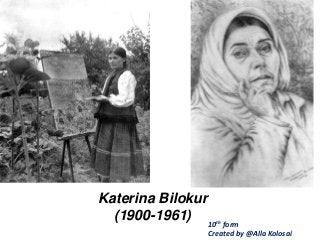
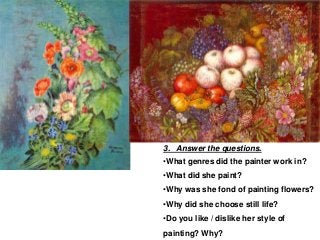
This presentation is about a famous Ukrainian amateur painter of the previous century.It can be used in the 10th foem while teaching topic "Art.Painting.Famous artists."
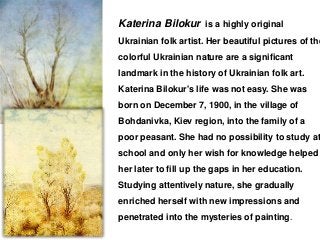
Katerina Bilokur isa highly original
Ukrainian folk artist. Her beautiful pictures of the
colorful Ukrainian nature are a significant
landmark in the history of Ukrainian folk art.
Katerina Bilokur's life was not easy. She was
born on December 7, 1900, in the village of
Bohdanivka, Kiev region, into the family of a
poor peasant. She had no possibility to study at
school and only her wish for knowledge helped
her later to fill up the gaps in her education.
Studying attentively nature, she gradually
enriched herself with new impressions and
penetrated into the mysteries of painting.
3.
The first worksof Bilokur (1920s –
early 30s) were amateurish. They
were the portraits of people made
with charcoal and self-made
vegetable paints. The second half
of the 1930s was an important
period in her creativity. Then she
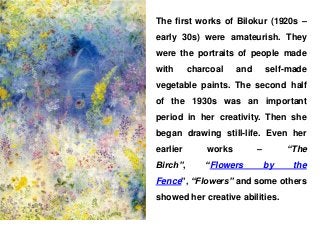
began drawing still-life. Even her
earlier works – “The
Birch”, “Flowers by the
Fence”, “Flowers” and some others
showed her creative abilities.
4.
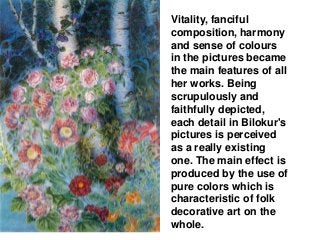
Vitality, fanciful
composition, harmony
andsense of colours
in the pictures became
the main features of all
her works. Being
scrupulously and
faithfully depicted,
each detail in Bilokur's
pictures is perceived
as a really existing
one. The main effect is
produced by the use of
pure colors which is
characteristic of folk
decorative art on the
whole.
5.
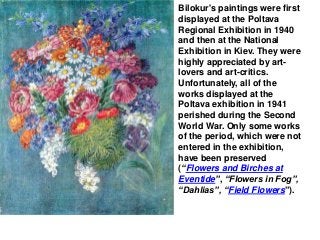
Bilokur's paintings werefirst
displayed at the Poltava
Regional Exhibition in 1940
and then at the National
Exhibition in Kiev. They were
highly appreciated by art-
lovers and art-critics.
Unfortunately, all of the
works displayed at the
Poltava exhibition in 1941
perished during the Second
World War. Only some works
of the period, which were not
entered in the exhibition,
have been preserved
(“Flowers and Birches at
Eventide”, “Flowers in Fog”,
“Dahlias”, “Field Flowers”).
6.
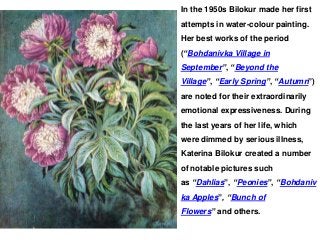
In the 1950sBilokur made her first
attempts in water-colour painting.
Her best works of the period
(“Bohdanivka Village in
September”, “Beyond the
Village”, “Early Spring”, “Autumn”)
are noted for their extraordinarily
emotional expressiveness. During
the last years of her life, which
were dimmed by serious illness,
Katerina Bilokur created a number
of notable pictures such
as “Dahlias”, “Peonies”, “Bohdaniv
ka Apples”, “Bunch of
Flowers” and others.
7.
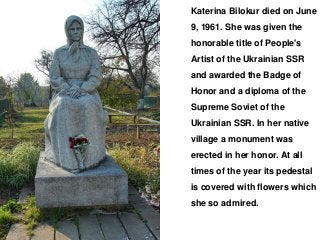
Katerina Bilokur diedon June
9, 1961. She was given the
honorable title of People's
Artist of the Ukrainian SSR
and awarded the Badge of
Honor and a diploma of the
Supreme Soviet of the
Ukrainian SSR. In her native
village a monument was
erected in her honor. At all
times of the year its pedestal
is covered with flowers which
she so admired.
8.
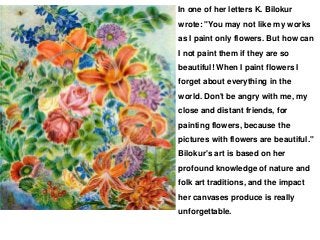
In one ofher letters K. Bilokur
wrote: "You may not like my works
as I paint only flowers. But how can
I not paint them if they are so
beautiful! When I paint flowers I
forget about everything in the
world. Don't be angry with me, my
close and distant friends, for
painting flowers, because the
pictures with flowers are beautiful."
Bilokur's art is based on her
profound knowledge of nature and
folk art traditions, and the impact
her canvases produce is really
unforgettable.
9.
3. Answer thequestions.
•What genres did the painter work in?
•What did she paint?
•Why was she fond of painting flowers?
•Why did she choose still life?
•Do you like / dislike her style of
painting? Why?