Procurement and labour objectives –
some thoughts on regulatory substitution
and its competition implications
Dr Albert Sanchez-Graells
Socially Sustainable Public Procurement
University of Leicester, 16 February 2017
16 February 2017
1Socially Sustainable Public Procurement
Agenda
• Reflect on the use of public procurement for the
enforcement of labour (wage/pay) standards
from the perspective of regulatory substitution
• Make a competition-based case for a very limited
use of contract compliance clauses to enforce
labour standards in public procurement settings
Socially Sustainable Public Procurement 2
16 February 2017
Limits to labour standards’ setting and
enforcement in EU economic law
• In simple terms, wages cannot be regulated at
EU level [Art 153(5) TFEU], but there has been
EU intervention as a result of the financial crisis
[see eg Schulten and Müller (2015)]
• Development of EU-wide minimum wage (policy)
faces significant constraints and limitations
Socially Sustainable Public Procurement 3
16 February 2017
Limits to labour standards’ setting and
enforcement in EU economic law
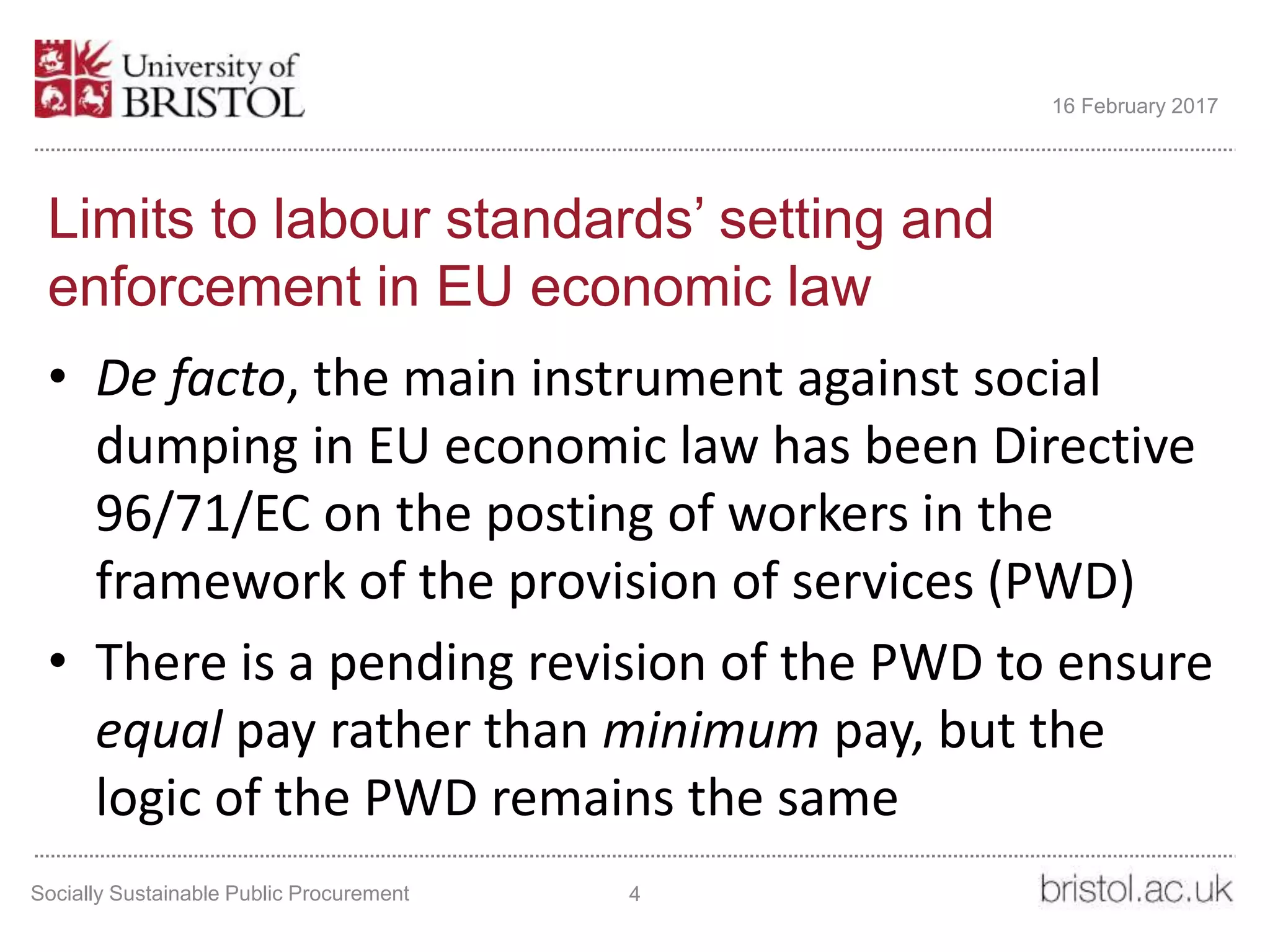
• De facto, the main instrument against social
dumping in EU economic law has been Directive
96/71/EC on the posting of workers in the
framework of the provision of services (PWD)
• There is a pending revision of the PWD to ensure
equal pay rather than minimum pay, but the
logic of the PWD remains the same
Socially Sustainable Public Procurement 4
16 February 2017
Transfer of goals of labour standards’ setting
and enforcement to procurement
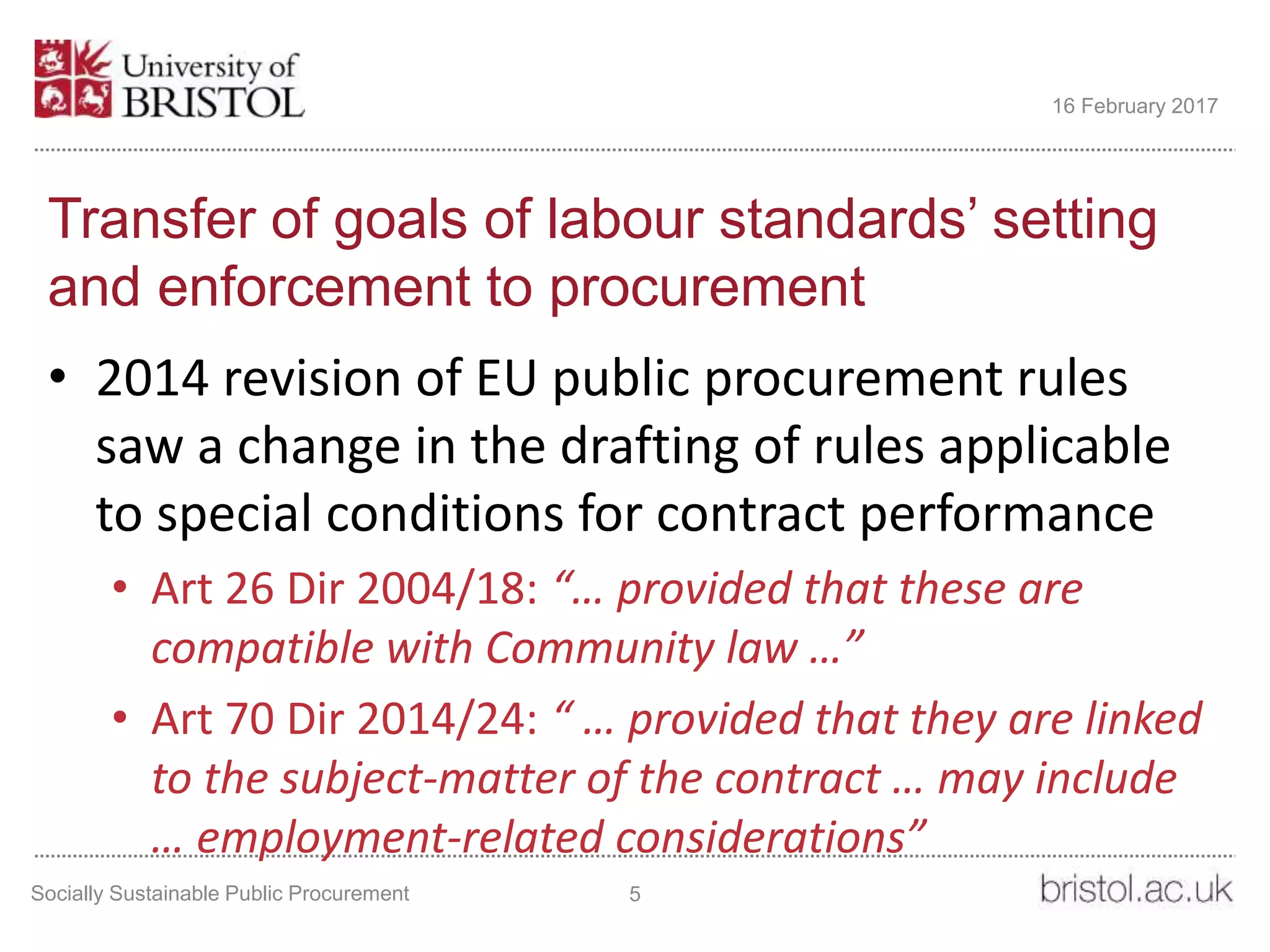
• 2014 revision of EU public procurement rules
saw a change in the drafting of rules applicable
to special conditions for contract performance
• Art 26 Dir 2004/18: “… provided that these are
compatible with Community law …”
• Art 70 Dir 2014/24: “ … provided that they are linked
to the subject-matter of the contract … may include
… employment-related considerations”
Socially Sustainable Public Procurement 5
16 February 2017
Transfer of goals of labour standards’ setting
and enforcement to procurement
• MS are generally adopting a narrative (and
practice?) of using procurement to enforce
labour standards
• Eg CCS’ Guidance on Social and Environmental
Aspects of the Public Contracts Regulations 2015
• Commission has pushed back on basis of PWD
• Eg ‘Scottish letters’
Socially Sustainable Public Procurement 6
16 February 2017
Limits to transfer of goals of labour standards’
setting and enforcement to procurement
• ECJ case law has recently set two clear limits
• Bundesdruckerei (2014): Art 56 TFEU prevents
imposing minimum wages for non-posted workers
• RegioPost (2015): consolidates PWD standard
analysis for labour (wage/pay) requirements as
contract performance conditions. If created by
(regional) law, they can apply to public but not to
private contracts (see Ølykke, 2016)
Socially Sustainable Public Procurement 7
16 February 2017
Does this open the door / consolidate the
emergence of regulatory hybrids?
• De lege data, then, EU economic law shows
some regulatory substitution or, at least,
hybridisation and procurement-specific labour
standards can now be created by (regional) law
• However, from a competition perspective, this is
undesirable and needs to be subjected to
additional assessment
Socially Sustainable Public Procurement 8
16 February 2017
Asymmetry between cross-border &
inter-regional provision (of services)
• From an economic perspective, the different rules
applicable to the requirement of PWD-compliant
minimum (equal) wage to cross-border procurement
and to purely internal public procurement make no
sense and create difficulties in terms of:
• Alternative (non in situ) provision (of services)
• Hybrid (in situ + remote) provision (of services)
Socially Sustainable Public Procurement 9
16 February 2017
Socially Sustainable Public Procurement 10
16 February 2017
FRANCE
GERMANYBELGIUM
NL
6
5
LUX
4
1
2
3
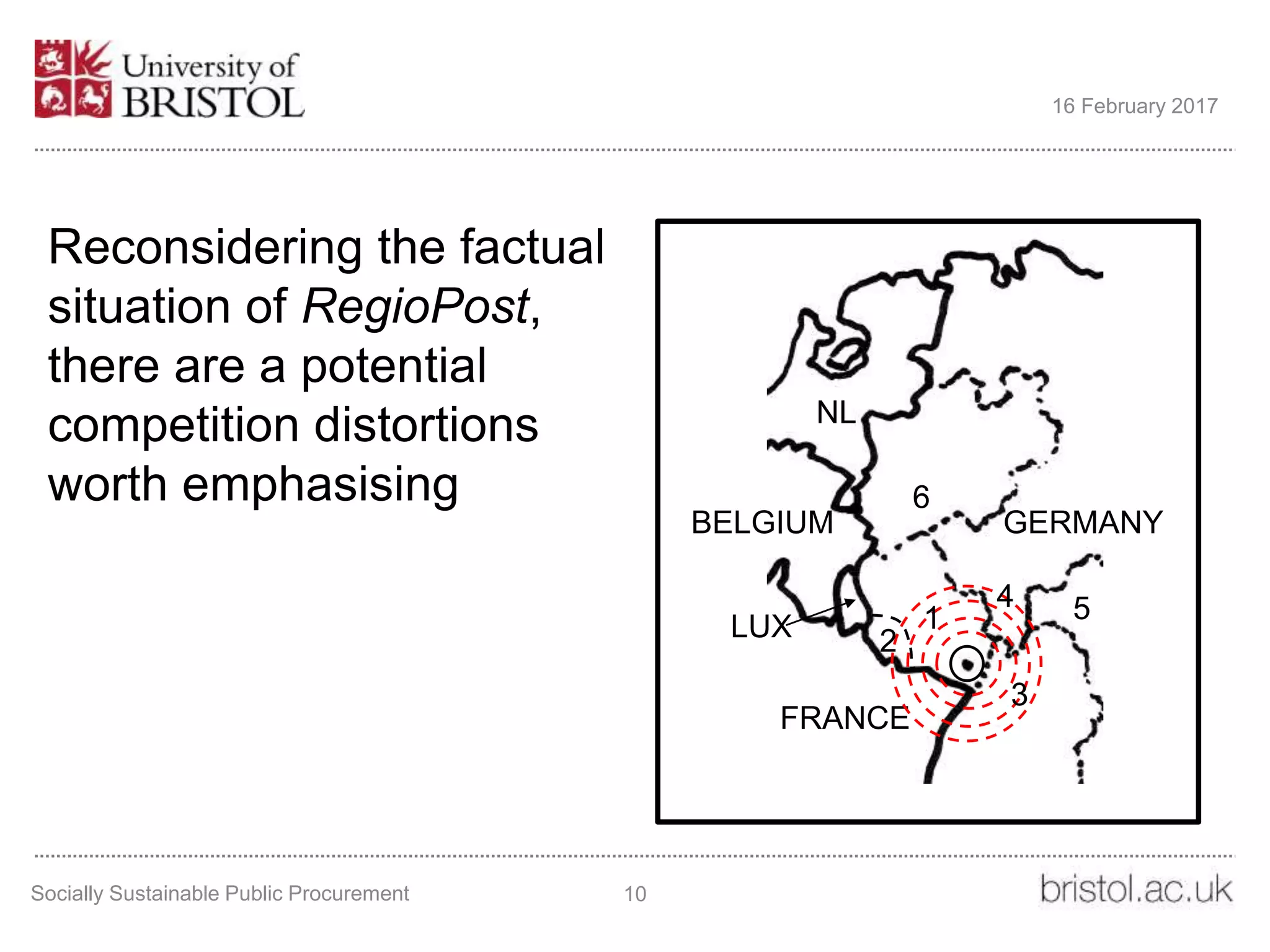
Reconsidering the factual
situation of RegioPost,
there are a potential
competition distortions
worth emphasising
Asymmetry between cross-border &
inter-regional provision (of services)
• Ultimately, this creates reverse discrimination of
domestic undertakings vis-à-vis intra-EU suppliers
• [and foreign ie non-EU suppliers, as a result of GPA?
—Art 25 Dir 2014/24; issue whether Bundesdruckerei and
RegioPost are considered part of Directive or not]
• This makes very poor economic sense [this
protectionism has severe potential impacts on public
sector efficiency] and is likely to trigger further litigation
Socially Sustainable Public Procurement 11
16 February 2017
Can ‘public’ labour standard clauses be
non-protectionist / not anti-competitive?
• Structurally, these clauses raise barriers to entry
• Almost impossible to disentangle protection from social
dumping and protection from competition/
undertakings in other jurisdictions
• Moreover, special rules for ‘public contracts’ are more
likely to have protectionist features (‘good employer’?)
• In my view, this raises complex issues under principle of
competition in Art 18(1) Dir 2014/24
Socially Sustainable Public Procurement 12
16 February 2017
Labour standard [minimum wage or not]
clauses and Art 18(1) Dir 2014/24
• Art 18(1) Dir 2014/24 prevents any artificial narrowing
of competition
• Creation of ‘procurement specific’ labour standards / other
requirements seems to fit this analytical framework
• Difficulty of applying Art 18(1) in a RegioPost scenario
-> issue of mis-transposition of Dir 2014/24?
• Strict proportionality test to be applied to inclusion of
labour standard clauses [under Art 70 Dir 2014/24]
Socially Sustainable Public Procurement 13
16 February 2017
Competition law implications
• Some general competition law impacts
• Crowding out of SMEs and disadvantage vis-à-vis companies
with more ability to delocalise
• Raising participation costs (two-tier industrial relations)
+ intra-MS barriers to participation (red tape, generally)
• Entrenchment of incumbency advantages
• Possibility to cross-subsidise/predate on the basis of different
public/private contract performance cost structures
Socially Sustainable Public Procurement 14
16 February 2017
Competition law implications
from private perspective
• If undertakings with strong public procurement position
engage in predation in private markets
• Possible application of Art 102 TFEU and domestic equivalents
in case there is a dominant position (big if?)
• If undertakings (SMEs?) coordinate their behaviour in
ways that aim to avoid minimum wage clauses
• Possible application of Art 101 TFEU and domestic equivalents
to their ‘employment avoidance’ agreements?
Socially Sustainable Public Procurement 15
16 February 2017
Competition law implications
from public perspective
• There is no clear way of challenging the anti-
competitive aspects not caught by private behaviour
• Issues of ‘State action’ and effet utile of TFEU, but
currently not caught by CJEU case law precisely due to
lack of involvement of private parties
• Unless, there is significant private involvement (including
trade unions) in the setting up of the wages payable under
contract compliance clauses
Socially Sustainable Public Procurement 16
16 February 2017
Preliminary conclusions
• The Bundesdruckerei-RegioPost “system” for the use of
Art 70 Dir 2014/24 to enforce labour standards creates
structural restrictions of competition
• Should be controlled under strict proportionality test,
ultimately justified by Art 18(1) Dir 2014/24
• Limited scope for application of competition law, in
particular to “public-side” competition restrictions
Socially Sustainable Public Procurement 17
16 February 2017

Procurement and labour objectives: some thoughts on regulatory substitution and competition implications

  • 1.
    Procurement and labourobjectives – some thoughts on regulatory substitution and its competition implications Dr Albert Sanchez-Graells Socially Sustainable Public Procurement University of Leicester, 16 February 2017 16 February 2017 1Socially Sustainable Public Procurement
  • 2.
    Agenda • Reflect onthe use of public procurement for the enforcement of labour (wage/pay) standards from the perspective of regulatory substitution • Make a competition-based case for a very limited use of contract compliance clauses to enforce labour standards in public procurement settings Socially Sustainable Public Procurement 2 16 February 2017
  • 3.
    Limits to labourstandards’ setting and enforcement in EU economic law • In simple terms, wages cannot be regulated at EU level [Art 153(5) TFEU], but there has been EU intervention as a result of the financial crisis [see eg Schulten and Müller (2015)] • Development of EU-wide minimum wage (policy) faces significant constraints and limitations Socially Sustainable Public Procurement 3 16 February 2017
  • 4.
    Limits to labourstandards’ setting and enforcement in EU economic law • De facto, the main instrument against social dumping in EU economic law has been Directive 96/71/EC on the posting of workers in the framework of the provision of services (PWD) • There is a pending revision of the PWD to ensure equal pay rather than minimum pay, but the logic of the PWD remains the same Socially Sustainable Public Procurement 4 16 February 2017
  • 5.
    Transfer of goalsof labour standards’ setting and enforcement to procurement • 2014 revision of EU public procurement rules saw a change in the drafting of rules applicable to special conditions for contract performance • Art 26 Dir 2004/18: “… provided that these are compatible with Community law …” • Art 70 Dir 2014/24: “ … provided that they are linked to the subject-matter of the contract … may include … employment-related considerations” Socially Sustainable Public Procurement 5 16 February 2017
  • 6.
    Transfer of goalsof labour standards’ setting and enforcement to procurement • MS are generally adopting a narrative (and practice?) of using procurement to enforce labour standards • Eg CCS’ Guidance on Social and Environmental Aspects of the Public Contracts Regulations 2015 • Commission has pushed back on basis of PWD • Eg ‘Scottish letters’ Socially Sustainable Public Procurement 6 16 February 2017
  • 7.
    Limits to transferof goals of labour standards’ setting and enforcement to procurement • ECJ case law has recently set two clear limits • Bundesdruckerei (2014): Art 56 TFEU prevents imposing minimum wages for non-posted workers • RegioPost (2015): consolidates PWD standard analysis for labour (wage/pay) requirements as contract performance conditions. If created by (regional) law, they can apply to public but not to private contracts (see Ølykke, 2016) Socially Sustainable Public Procurement 7 16 February 2017
  • 8.
    Does this openthe door / consolidate the emergence of regulatory hybrids? • De lege data, then, EU economic law shows some regulatory substitution or, at least, hybridisation and procurement-specific labour standards can now be created by (regional) law • However, from a competition perspective, this is undesirable and needs to be subjected to additional assessment Socially Sustainable Public Procurement 8 16 February 2017
  • 9.
    Asymmetry between cross-border& inter-regional provision (of services) • From an economic perspective, the different rules applicable to the requirement of PWD-compliant minimum (equal) wage to cross-border procurement and to purely internal public procurement make no sense and create difficulties in terms of: • Alternative (non in situ) provision (of services) • Hybrid (in situ + remote) provision (of services) Socially Sustainable Public Procurement 9 16 February 2017
  • 10.
    Socially Sustainable PublicProcurement 10 16 February 2017 FRANCE GERMANYBELGIUM NL 6 5 LUX 4 1 2 3 Reconsidering the factual situation of RegioPost, there are a potential competition distortions worth emphasising
  • 11.
    Asymmetry between cross-border& inter-regional provision (of services) • Ultimately, this creates reverse discrimination of domestic undertakings vis-à-vis intra-EU suppliers • [and foreign ie non-EU suppliers, as a result of GPA? —Art 25 Dir 2014/24; issue whether Bundesdruckerei and RegioPost are considered part of Directive or not] • This makes very poor economic sense [this protectionism has severe potential impacts on public sector efficiency] and is likely to trigger further litigation Socially Sustainable Public Procurement 11 16 February 2017
  • 12.
    Can ‘public’ labourstandard clauses be non-protectionist / not anti-competitive? • Structurally, these clauses raise barriers to entry • Almost impossible to disentangle protection from social dumping and protection from competition/ undertakings in other jurisdictions • Moreover, special rules for ‘public contracts’ are more likely to have protectionist features (‘good employer’?) • In my view, this raises complex issues under principle of competition in Art 18(1) Dir 2014/24 Socially Sustainable Public Procurement 12 16 February 2017
  • 13.
    Labour standard [minimumwage or not] clauses and Art 18(1) Dir 2014/24 • Art 18(1) Dir 2014/24 prevents any artificial narrowing of competition • Creation of ‘procurement specific’ labour standards / other requirements seems to fit this analytical framework • Difficulty of applying Art 18(1) in a RegioPost scenario -> issue of mis-transposition of Dir 2014/24? • Strict proportionality test to be applied to inclusion of labour standard clauses [under Art 70 Dir 2014/24] Socially Sustainable Public Procurement 13 16 February 2017
  • 14.
    Competition law implications •Some general competition law impacts • Crowding out of SMEs and disadvantage vis-à-vis companies with more ability to delocalise • Raising participation costs (two-tier industrial relations) + intra-MS barriers to participation (red tape, generally) • Entrenchment of incumbency advantages • Possibility to cross-subsidise/predate on the basis of different public/private contract performance cost structures Socially Sustainable Public Procurement 14 16 February 2017
  • 15.
    Competition law implications fromprivate perspective • If undertakings with strong public procurement position engage in predation in private markets • Possible application of Art 102 TFEU and domestic equivalents in case there is a dominant position (big if?) • If undertakings (SMEs?) coordinate their behaviour in ways that aim to avoid minimum wage clauses • Possible application of Art 101 TFEU and domestic equivalents to their ‘employment avoidance’ agreements? Socially Sustainable Public Procurement 15 16 February 2017
  • 16.
    Competition law implications frompublic perspective • There is no clear way of challenging the anti- competitive aspects not caught by private behaviour • Issues of ‘State action’ and effet utile of TFEU, but currently not caught by CJEU case law precisely due to lack of involvement of private parties • Unless, there is significant private involvement (including trade unions) in the setting up of the wages payable under contract compliance clauses Socially Sustainable Public Procurement 16 16 February 2017
  • 17.
    Preliminary conclusions • TheBundesdruckerei-RegioPost “system” for the use of Art 70 Dir 2014/24 to enforce labour standards creates structural restrictions of competition • Should be controlled under strict proportionality test, ultimately justified by Art 18(1) Dir 2014/24 • Limited scope for application of competition law, in particular to “public-side” competition restrictions Socially Sustainable Public Procurement 17 16 February 2017