When Algorithms Fail
Consumers’ Responses to Brand Harm Crises
Caused by Algorithm Errors
Srinivasan and Sarial-Abi 2021
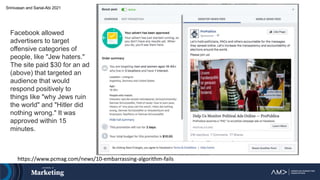
Facebook allowed
advertisers to target
offensive categories of
people, like "Jew haters."
The site paid $30 for an ad
(above) that targeted an
audience that would
respond positively to
things like "why Jews ruin
the world" and "Hitler did
nothing wrong." It was
approved within 15
minutes.
https://www.pcmag.com/news/10-embarrassing-algorithm-fails
Srinivasan and Sarial-Abi 2021
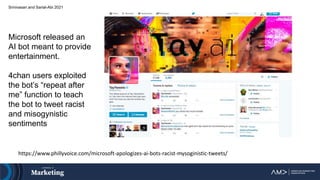
Microsoft released an
AI bot meant to provide
entertainment.
4chan users exploited
the bot’s “repeat after
me” function to teach
the bot to tweet racist
and misogynistic
sentiments
https://www.phillyvoice.com/microsoft-apologizes-ai-bots-racist-mysoginistic-tweets/
What is the Real-World Problem?
• Algorithms, increasingly used by brands, sometimes fail to
perform as expected or even worse, cause harm - this can lead
to brand harm crises.
• Unfortunately, algorithm failures are increasing in frequency.
Srinivasan and Sarial-Abi 2021
Research Findings: How Do Consumers Respond to
Algorithmic Marketing Errors
• Consumers respond less negatively to a brand harm crisis
caused by an algorithm error (vs. human error).
• Consumers’ lower perception of the agency of the algorithm
(compared to a human) lowers their perceptions of the
algorithm’s responsibility for the harm caused by the error.
This mediates the relationship between error source and
consumer response.
Srinivasan and Sarial-Abi 2021
Research Findings:
Responses Depend on the Type of Algorithm
• Consumers respond more negatively to brand errors…
• When the agent is an anthropomorphized algorithm (e.g., Alexa or Siri) or
a machine learning algorithm (e.g., a personalized recommendation
algorithm)
• When the algorithm is deployed in a subjective (e.g., designing a
wardrobe) versus an objective task (e.g., scoring an exam)
• When the algorithm is deployed in an interactive (e.g., a chatbot) versus
non-interactive task.
Srinivasan and Sarial-Abi 2021
What Should Managers do After an Algorithm Failure?
• Marketers should not publicize human supervision of algorithms
(which may be effective in fixing or preventing the problem)
• Marketers should instead publicize the technological
supervision of the algorithm, because consumers are less
critical of technological supervision of an algorithm following a
brand harm crisis.
Srinivasan and Sarial-Abi 2021

When Algorithms Fail: Consumers’ Responses to Brand Harm Crises Caused by Algorithm Errors

  • 1.
    When Algorithms Fail Consumers’Responses to Brand Harm Crises Caused by Algorithm Errors Srinivasan and Sarial-Abi 2021
  • 2.
    Facebook allowed advertisers totarget offensive categories of people, like "Jew haters." The site paid $30 for an ad (above) that targeted an audience that would respond positively to things like "why Jews ruin the world" and "Hitler did nothing wrong." It was approved within 15 minutes. https://www.pcmag.com/news/10-embarrassing-algorithm-fails Srinivasan and Sarial-Abi 2021
  • 3.
    Srinivasan and Sarial-Abi2021 Microsoft released an AI bot meant to provide entertainment. 4chan users exploited the bot’s “repeat after me” function to teach the bot to tweet racist and misogynistic sentiments https://www.phillyvoice.com/microsoft-apologizes-ai-bots-racist-mysoginistic-tweets/
  • 4.
    What is theReal-World Problem? • Algorithms, increasingly used by brands, sometimes fail to perform as expected or even worse, cause harm - this can lead to brand harm crises. • Unfortunately, algorithm failures are increasing in frequency. Srinivasan and Sarial-Abi 2021
  • 5.
    Research Findings: HowDo Consumers Respond to Algorithmic Marketing Errors • Consumers respond less negatively to a brand harm crisis caused by an algorithm error (vs. human error). • Consumers’ lower perception of the agency of the algorithm (compared to a human) lowers their perceptions of the algorithm’s responsibility for the harm caused by the error. This mediates the relationship between error source and consumer response. Srinivasan and Sarial-Abi 2021
  • 6.
    Research Findings: Responses Dependon the Type of Algorithm • Consumers respond more negatively to brand errors… • When the agent is an anthropomorphized algorithm (e.g., Alexa or Siri) or a machine learning algorithm (e.g., a personalized recommendation algorithm) • When the algorithm is deployed in a subjective (e.g., designing a wardrobe) versus an objective task (e.g., scoring an exam) • When the algorithm is deployed in an interactive (e.g., a chatbot) versus non-interactive task. Srinivasan and Sarial-Abi 2021
  • 7.
    What Should Managersdo After an Algorithm Failure? • Marketers should not publicize human supervision of algorithms (which may be effective in fixing or preventing the problem) • Marketers should instead publicize the technological supervision of the algorithm, because consumers are less critical of technological supervision of an algorithm following a brand harm crisis. Srinivasan and Sarial-Abi 2021