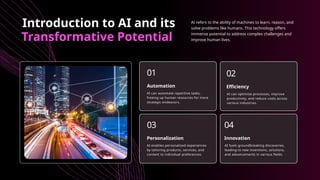
Introduction to AIand its
Transformative Potential
01
03
02
04
AI refers to the ability of machines to learn, reason, and
solve problems like humans. This technology offers
immense potential to address complex challenges and
improve human lives.
Automation
Personalization
Efficiency
Innovation
AI can automate repetitive tasks,
freeing up human resources for more
strategic endeavors.
AI enables personalized experiences
by tailoring products, services, and
content to individual preferences.
AI can optimize processes, improve
productivity, and reduce costs across
various industries.
AI fuels groundbreaking discoveries,
leading to new inventions, solutions,
and advancements in various fields.
3.
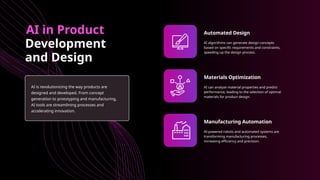
AI in Product
Development
andDesign
AI is revolutionizing the way products are
designed and developed. From concept
generation to prototyping and manufacturing,
AI tools are streamlining processes and
accelerating innovation.
AI algorithms can generate design concepts
based on specific requirements and constraints,
speeding up the design process.
AI can analyze material properties and predict
performance, leading to the selection of optimal
materials for product design.
Automated Design
Materials Optimization
AI-powered robots and automated systems are
transforming manufacturing processes,
increasing efficiency and precision.
Manufacturing Automation
4.
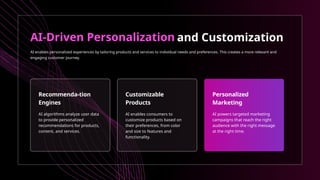
AI-Driven Personalization andCustomization
AI enables personalized experiences by tailoring products and services to individual needs and preferences. This creates a more relevant and
engaging customer journey.
AI algorithms analyze user data
to provide personalized
recommendations for products,
content, and services.
AI powers targeted marketing
campaigns that reach the right
audience with the right message
at the right time.
Recommenda-tion
Engines
Personalized
Marketing
AI enables consumers to
customize products based on
their preferences, from color
and size to features and
functionality.
Customizable
Products
5.
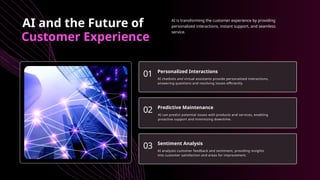
AI and theFuture of
Customer Experience
01
03
02
AI is transforming the customer experience by providing
personalized interactions, instant support, and seamless
service.
Personalized Interactions
AI chatbots and virtual assistants provide personalized interactions,
answering questions and resolving issues efficiently.
Sentiment Analysis
AI analyzes customer feedback and sentiment, providing insights
into customer satisfaction and areas for improvement.
Predictive Maintenance
AI can predict potential issues with products and services, enabling
proactive support and minimizing downtime.
6.
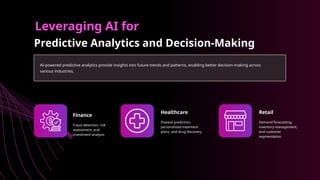
Leveraging AI for
PredictiveAnalytics and Decision-Making
AI-powered predictive analytics provide insights into future trends and patterns, enabling better decision-making across
various industries.
Fraud detection, risk
assessment, and
investment analysis
Disease prediction,
personalized treatment
plans, and drug discovery
Finance
Healthcare
Demand forecasting,
inventory management,
and customer
segmentation
Retail
7.
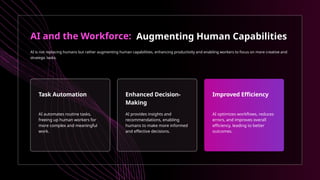
AI and theWorkforce: Augmenting Human Capabilities
AI is not replacing humans but rather augmenting human capabilities, enhancing productivity and enabling workers to focus on more creative and
strategic tasks.
AI automates routine tasks,
freeing up human workers for
more complex and meaningful
work.
AI optimizes workflows, reduces
errors, and improves overall
efficiency, leading to better
outcomes.
Task Automation Improved Efficiency
AI provides insights and
recommendations, enabling
humans to make more informed
and effective decisions.
Enhanced Decision-
Making
8.
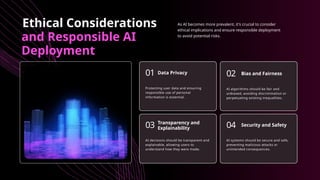
Ethical Considerations
and ResponsibleAI
Deployment
01
03
02
04
As AI becomes more prevalent, it's crucial to consider
ethical implications and ensure responsible deployment
to avoid potential risks.
Data Privacy
Transparency and
Explainability
Bias and Fairness
Security and Safety
Protecting user data and ensuring
responsible use of personal
information is essential.
AI decisions should be transparent and
explainable, allowing users to
understand how they were made.
AI algorithms should be fair and
unbiased, avoiding discrimination or
perpetuating existing inequalities.
AI systems should be secure and safe,
preventing malicious attacks or
unintended consequences.
9.
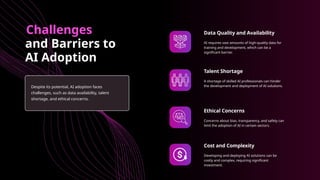
AI requires vastamounts of high-quality data for
training and development, which can be a
significant barrier.
Data Quality and Availability
A shortage of skilled AI professionals can hinder
the development and deployment of AI solutions.
Talent Shortage
Concerns about bias, transparency, and safety can
limit the adoption of AI in certain sectors.
Ethical Concerns
Developing and deploying AI solutions can be
costly and complex, requiring significant
investment.
Cost and Complexity
Challenges
and Barriers to
AI Adoption
Despite its potential, AI adoption faces
challenges, such as data availability, talent
shortage, and ethical concerns.
10.
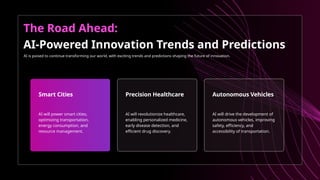
The Road Ahead:
AI-PoweredInnovation Trends and Predictions
AI is poised to continue transforming our world, with exciting trends and predictions shaping the future of innovation.
AI will power smart cities,
optimizing transportation,
energy consumption, and
resource management.
AI will drive the development of
autonomous vehicles, improving
safety, efficiency, and
accessibility of transportation.
Smart Cities Autonomous Vehicles
AI will revolutionize healthcare,
enabling personalized medicine,
early disease detection, and
efficient drug discovery.
Precision Healthcare