Analyzing the Cultural Contradictions of
Authenticity: Theoretical and Managerial
Insights from the Market Logic of
Conscious Capitalism
Defining Authenticity: An Elusive Endeavor
• Prior academic work has assumed that the definition of authenticity is
consistent across different cultures and contexts
• Marketers who make decisions based on these outcomes have not had success, leading
to skepticism around the term “authenticity”
• We suggest that the meaning of authenticity changes based on the cultural
context
• We have developed a tool to analyze authenticity within its cultural context
• Brand managers can use this tool to better understand and control the cultural meanings
that generate perceptions of authenticity or inauthenticity in a given market context.
It may be nice to use the extra space here to talk about how authenticity and inauthenticity
are separate constructs, that can compliment and contradict each other.
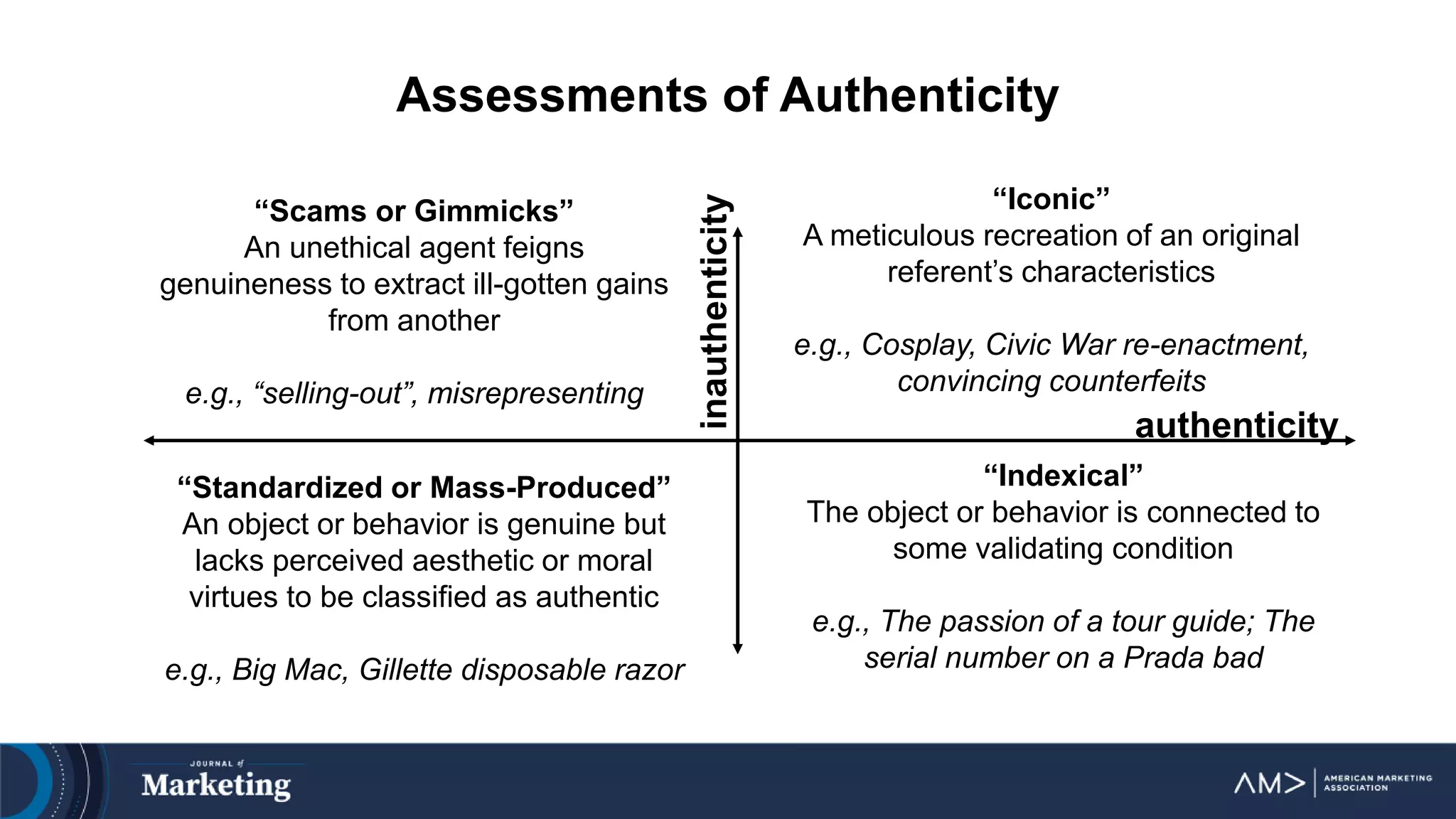
Assessments of Authenticity
authenticity
inauthenticity
“Indexical”
The object or behavior is connected to
some validating condition
e.g., The passion of a tour guide; The
serial number on a Prada bad
“Iconic”
A meticulous recreation of an original
referent’s characteristics
e.g., Cosplay, Civic War re-enactment,
convincing counterfeits
“Standardized or Mass-Produced”
An object or behavior is genuine but
lacks perceived aesthetic or moral
virtues to be classified as authentic
e.g., Big Mac, Gillette disposable razor
“Scams or Gimmicks”
An unethical agent feigns
genuineness to extract ill-gotten gains
from another
e.g., “selling-out”, misrepresenting
• I agree that including the tool is also important. Can you add it here
(minimum font size = Arial 20), and describe why the different types of
contradictions are important?
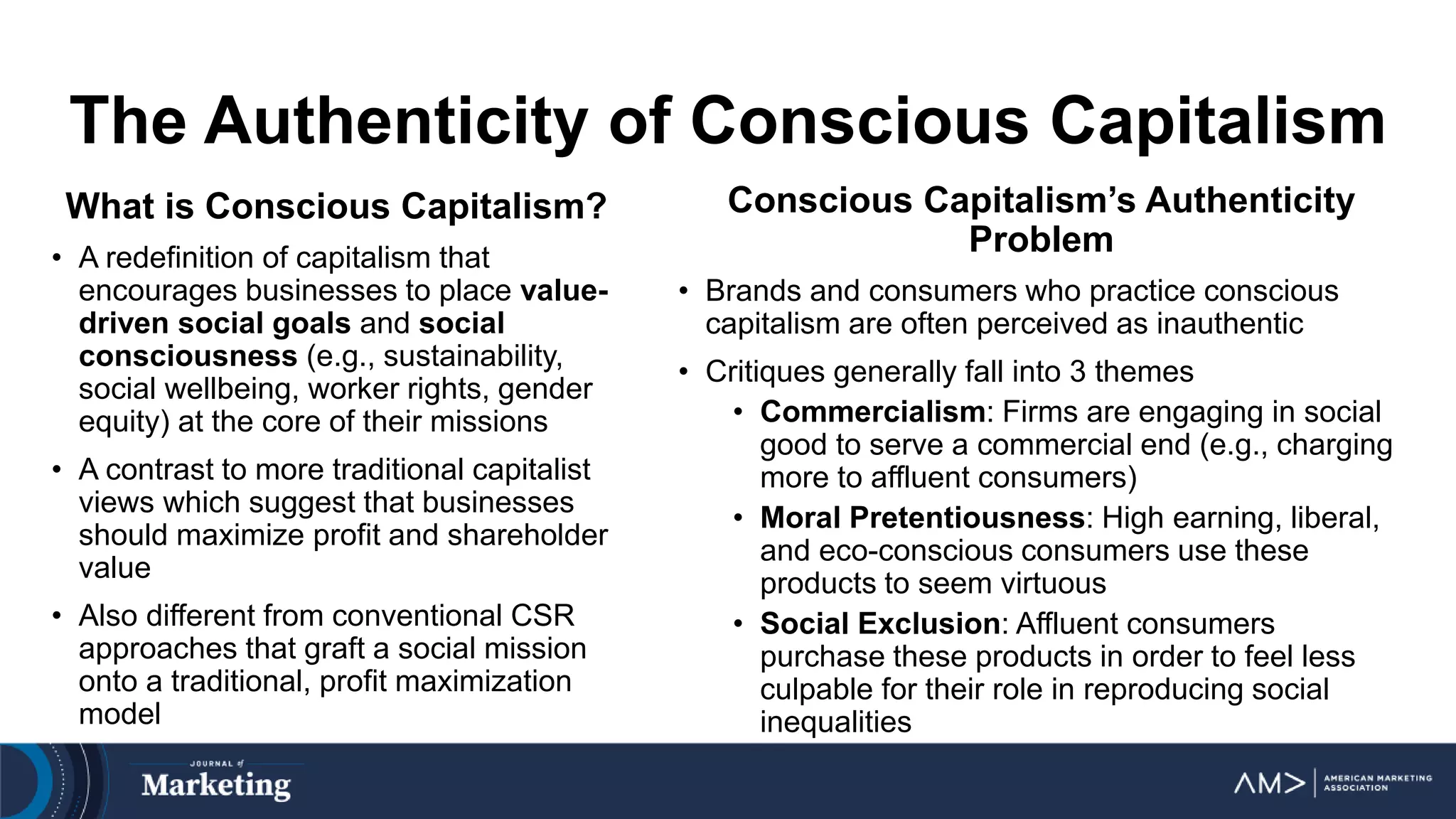
The Authenticity of Conscious Capitalism
What is Conscious Capitalism?
• A redefinition of capitalism that
encourages businesses to place value-
driven social goals and social
consciousness (e.g., sustainability,
social wellbeing, worker rights, gender
equity) at the core of their missions
• A contrast to more traditional capitalist
views which suggest that businesses
should maximize profit and shareholder
value
• Also different from conventional CSR
approaches that graft a social mission
onto a traditional, profit maximization
model
Conscious Capitalism’s Authenticity
Problem
• Brands and consumers who practice conscious
capitalism are often perceived as inauthentic
• Critiques generally fall into 3 themes
• Commercialism: Firms are engaging in social
good to serve a commercial end (e.g., charging
more to affluent consumers)
• Moral Pretentiousness: High earning, liberal,
and eco-conscious consumers use these
products to seem virtuous
• Social Exclusion: Affluent consumers
purchase these products in order to feel less
culpable for their role in reproducing social
inequalities
Understanding Authenticity of
Conscious Capitalist Brands
through the Slow Food Market
This research addresses three questions:
1. How do market stakeholders (e.g., consumers,
entrepreneurs) understand critiques of a
conscious capitalist brand’s authenticity?
2. What strategies do they use to counter critiques of
inauthenticity?
3. How can brand managers use this knowledge to
address their own authenticity challenges? The Slow Food market includes ideologically aligned
brands, enterprises (e.g., farm-to-table restaurants,
organic farmers, artisanal food producers), consumption
practices (e.g., shopping at farmers’ markets), and goods
& services (e.g., heirloom produce, grass-fed meat).
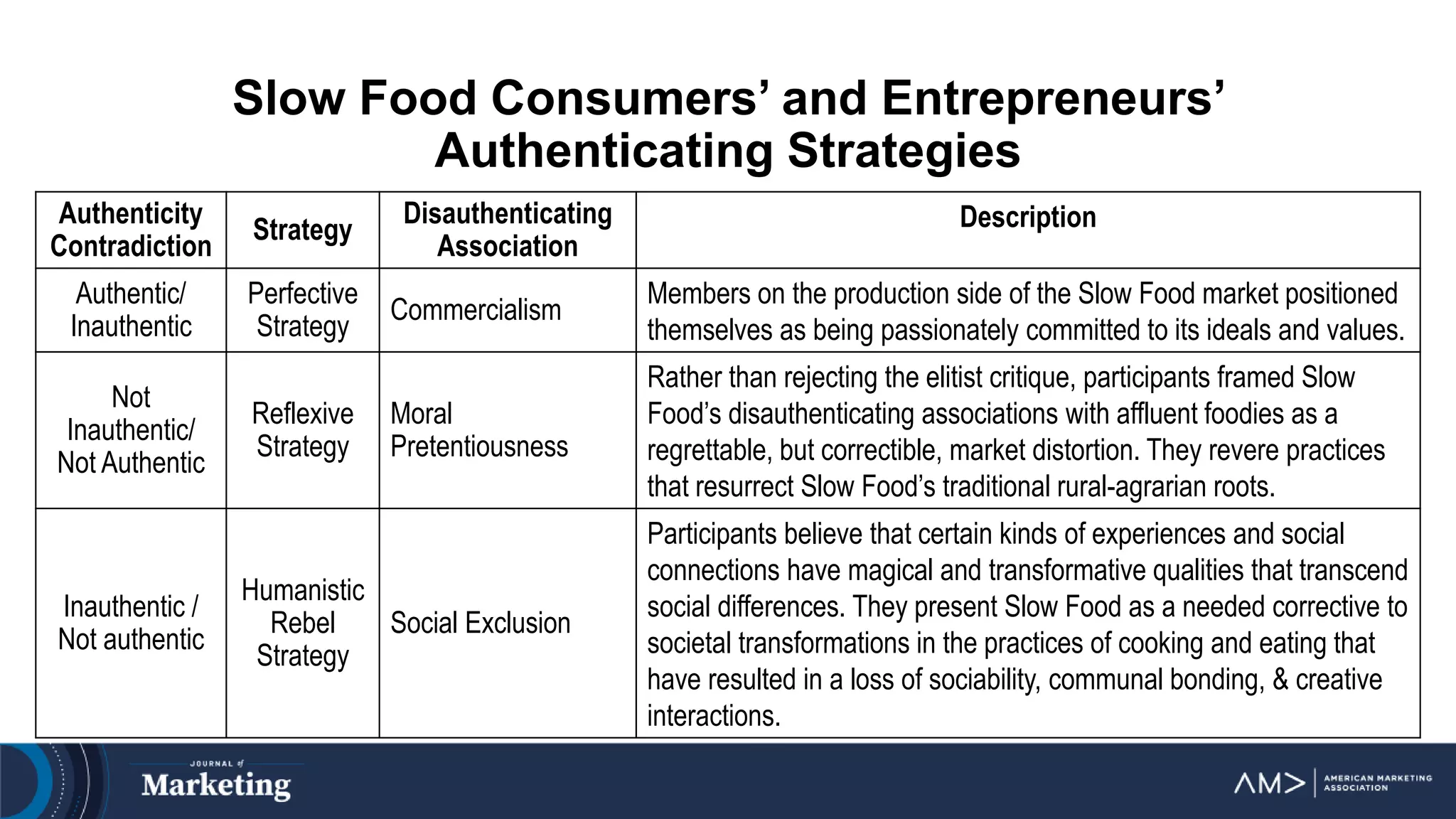
Slow Food Consumers’ and Entrepreneurs’
Authenticating Strategies
Authenticity
Contradiction
Strategy
Disauthenticating
Association
Description
Authentic/
Inauthentic
Perfective
Strategy
Commercialism
Members on the production side of the Slow Food market positioned
themselves as being passionately committed to its ideals and values.
Not
Inauthentic/
Not Authentic
Reflexive
Strategy
Moral
Pretentiousness
Rather than rejecting the elitist critique, participants framed Slow
Food’s disauthenticating associations with affluent foodies as a
regrettable, but correctible, market distortion. They revere practices
that resurrect Slow Food’s traditional rural-agrarian roots.
Inauthentic /
Not authentic
Humanistic
Rebel
Strategy
Social Exclusion
Participants believe that certain kinds of experiences and social
connections have magical and transformative qualities that transcend
social differences. They present Slow Food as a needed corrective to
societal transformations in the practices of cooking and eating that
have resulted in a loss of sociability, communal bonding, & creative
interactions.
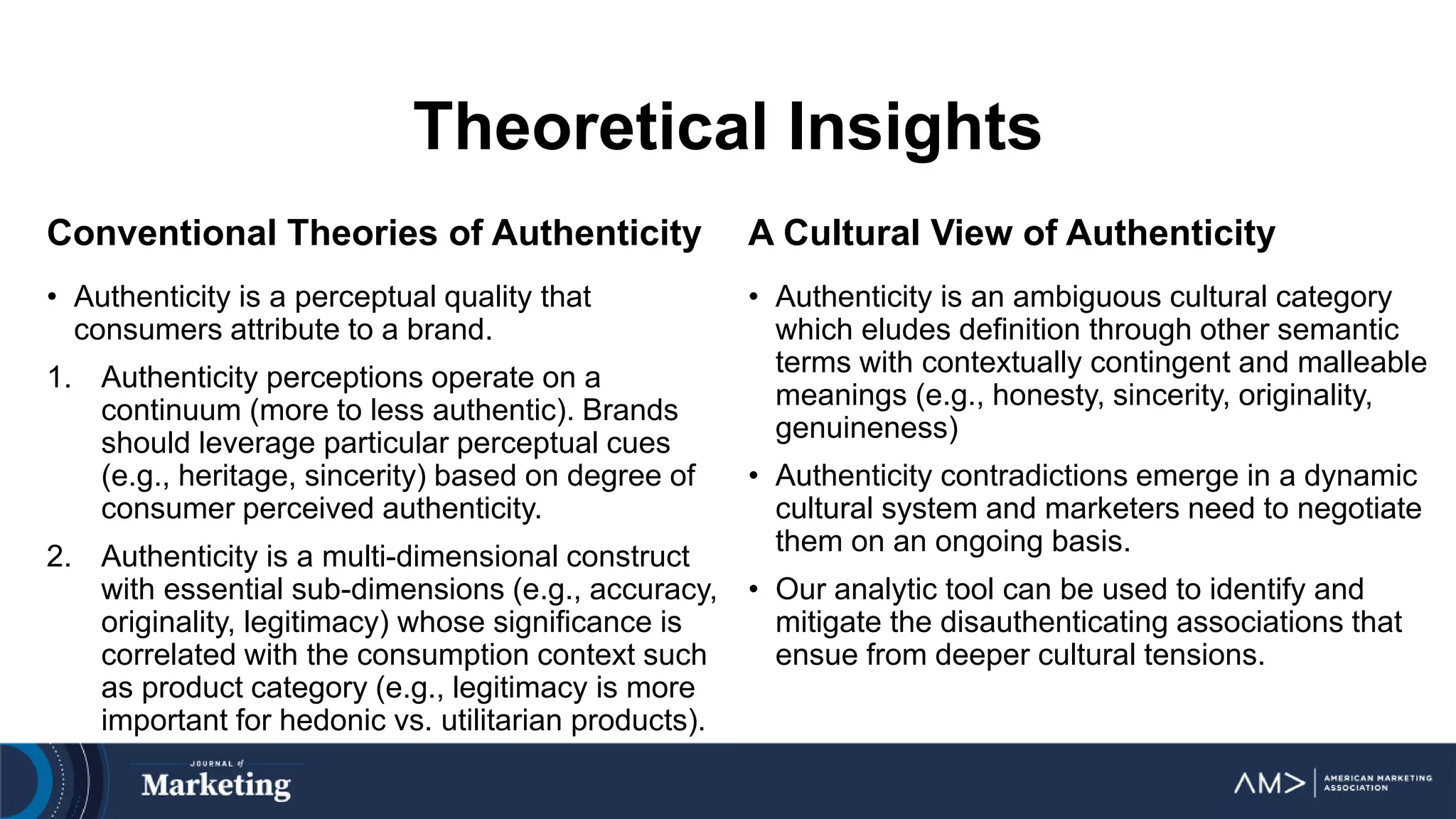
Conventional Theories of Authenticity
• Authenticity is a perceptual quality that
consumers attribute to a brand.
1. Authenticity perceptions operate on a
continuum (more to less authentic). Brands
should leverage particular perceptual cues
(e.g., heritage, sincerity) based on degree of
consumer perceived authenticity.
2. Authenticity is a multi-dimensional construct
with essential sub-dimensions (e.g., accuracy,
originality, legitimacy) whose significance is
correlated with the consumption context such
as product category (e.g., legitimacy is more
important for hedonic vs. utilitarian products).
A Cultural View of Authenticity
• Authenticity is an ambiguous cultural category
which eludes definition through other semantic
terms with contextually contingent and malleable
meanings (e.g., honesty, sincerity, originality,
genuineness)
• Authenticity contradictions emerge in a dynamic
cultural system and marketers need to negotiate
them on an ongoing basis.
• Our analytic tool can be used to identify and
mitigate the disauthenticating associations that
ensue from deeper cultural tensions.
Theoretical Insights
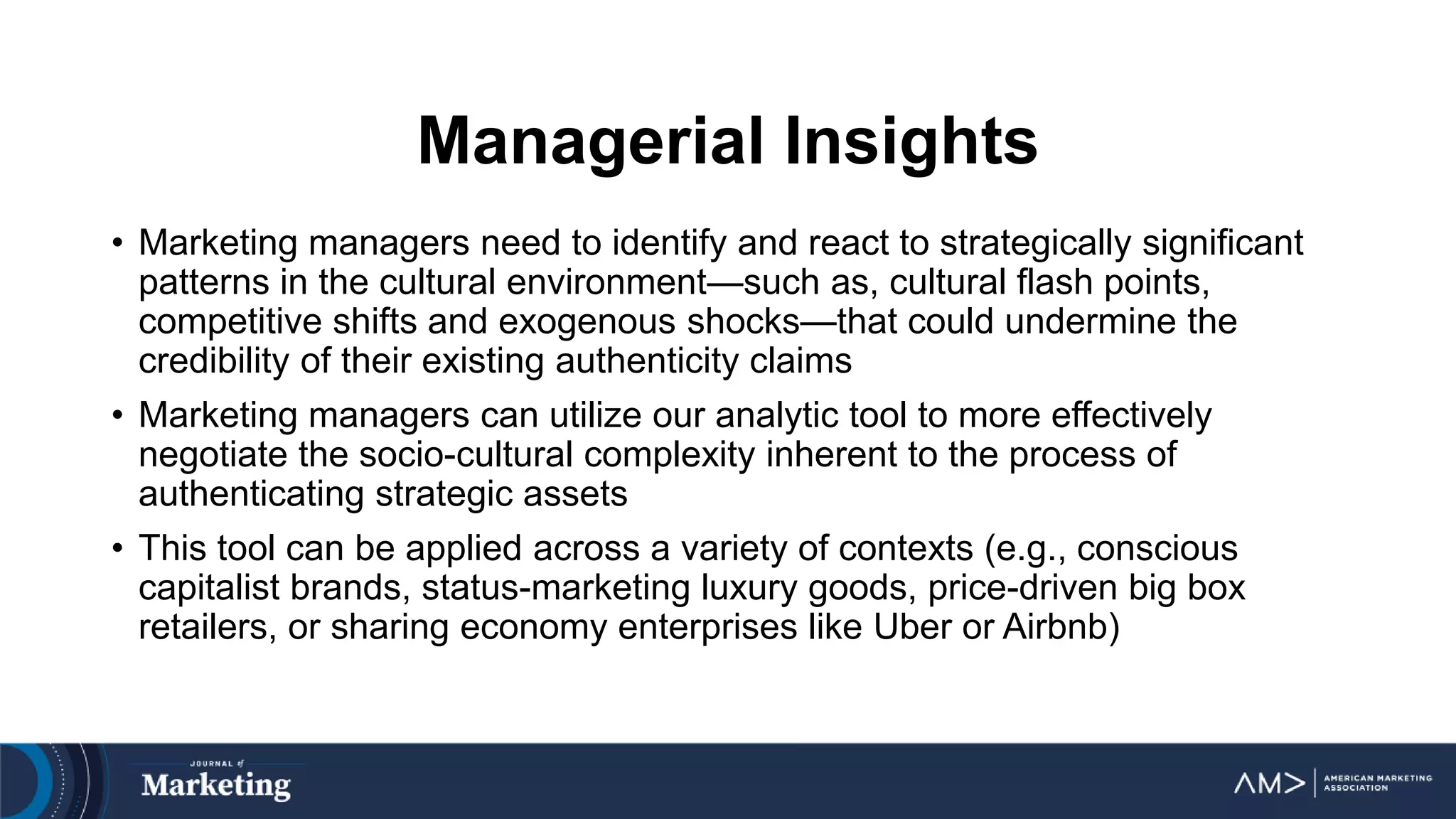
Managerial Insights
• Marketing managers need to identify and react to strategically significant
patterns in the cultural environment—such as, cultural flash points,
competitive shifts and exogenous shocks—that could undermine the
credibility of their existing authenticity claims
• Marketing managers can utilize our analytic tool to more effectively
negotiate the socio-cultural complexity inherent to the process of
authenticating strategic assets
• This tool can be applied across a variety of contexts (e.g., conscious
capitalist brands, status-marketing luxury goods, price-driven big box
retailers, or sharing economy enterprises like Uber or Airbnb)

Thompson & Kumar (2022).pptx

  • 1.
    Analyzing the CulturalContradictions of Authenticity: Theoretical and Managerial Insights from the Market Logic of Conscious Capitalism
  • 2.
    Defining Authenticity: AnElusive Endeavor • Prior academic work has assumed that the definition of authenticity is consistent across different cultures and contexts • Marketers who make decisions based on these outcomes have not had success, leading to skepticism around the term “authenticity” • We suggest that the meaning of authenticity changes based on the cultural context • We have developed a tool to analyze authenticity within its cultural context • Brand managers can use this tool to better understand and control the cultural meanings that generate perceptions of authenticity or inauthenticity in a given market context. It may be nice to use the extra space here to talk about how authenticity and inauthenticity are separate constructs, that can compliment and contradict each other.
  • 3.
    Assessments of Authenticity authenticity inauthenticity “Indexical” Theobject or behavior is connected to some validating condition e.g., The passion of a tour guide; The serial number on a Prada bad “Iconic” A meticulous recreation of an original referent’s characteristics e.g., Cosplay, Civic War re-enactment, convincing counterfeits “Standardized or Mass-Produced” An object or behavior is genuine but lacks perceived aesthetic or moral virtues to be classified as authentic e.g., Big Mac, Gillette disposable razor “Scams or Gimmicks” An unethical agent feigns genuineness to extract ill-gotten gains from another e.g., “selling-out”, misrepresenting
  • 4.
    • I agreethat including the tool is also important. Can you add it here (minimum font size = Arial 20), and describe why the different types of contradictions are important?
  • 5.
    The Authenticity ofConscious Capitalism What is Conscious Capitalism? • A redefinition of capitalism that encourages businesses to place value- driven social goals and social consciousness (e.g., sustainability, social wellbeing, worker rights, gender equity) at the core of their missions • A contrast to more traditional capitalist views which suggest that businesses should maximize profit and shareholder value • Also different from conventional CSR approaches that graft a social mission onto a traditional, profit maximization model Conscious Capitalism’s Authenticity Problem • Brands and consumers who practice conscious capitalism are often perceived as inauthentic • Critiques generally fall into 3 themes • Commercialism: Firms are engaging in social good to serve a commercial end (e.g., charging more to affluent consumers) • Moral Pretentiousness: High earning, liberal, and eco-conscious consumers use these products to seem virtuous • Social Exclusion: Affluent consumers purchase these products in order to feel less culpable for their role in reproducing social inequalities
  • 6.
    Understanding Authenticity of ConsciousCapitalist Brands through the Slow Food Market This research addresses three questions: 1. How do market stakeholders (e.g., consumers, entrepreneurs) understand critiques of a conscious capitalist brand’s authenticity? 2. What strategies do they use to counter critiques of inauthenticity? 3. How can brand managers use this knowledge to address their own authenticity challenges? The Slow Food market includes ideologically aligned brands, enterprises (e.g., farm-to-table restaurants, organic farmers, artisanal food producers), consumption practices (e.g., shopping at farmers’ markets), and goods & services (e.g., heirloom produce, grass-fed meat).
  • 7.
    Slow Food Consumers’and Entrepreneurs’ Authenticating Strategies Authenticity Contradiction Strategy Disauthenticating Association Description Authentic/ Inauthentic Perfective Strategy Commercialism Members on the production side of the Slow Food market positioned themselves as being passionately committed to its ideals and values. Not Inauthentic/ Not Authentic Reflexive Strategy Moral Pretentiousness Rather than rejecting the elitist critique, participants framed Slow Food’s disauthenticating associations with affluent foodies as a regrettable, but correctible, market distortion. They revere practices that resurrect Slow Food’s traditional rural-agrarian roots. Inauthentic / Not authentic Humanistic Rebel Strategy Social Exclusion Participants believe that certain kinds of experiences and social connections have magical and transformative qualities that transcend social differences. They present Slow Food as a needed corrective to societal transformations in the practices of cooking and eating that have resulted in a loss of sociability, communal bonding, & creative interactions.
  • 8.
    Conventional Theories ofAuthenticity • Authenticity is a perceptual quality that consumers attribute to a brand. 1. Authenticity perceptions operate on a continuum (more to less authentic). Brands should leverage particular perceptual cues (e.g., heritage, sincerity) based on degree of consumer perceived authenticity. 2. Authenticity is a multi-dimensional construct with essential sub-dimensions (e.g., accuracy, originality, legitimacy) whose significance is correlated with the consumption context such as product category (e.g., legitimacy is more important for hedonic vs. utilitarian products). A Cultural View of Authenticity • Authenticity is an ambiguous cultural category which eludes definition through other semantic terms with contextually contingent and malleable meanings (e.g., honesty, sincerity, originality, genuineness) • Authenticity contradictions emerge in a dynamic cultural system and marketers need to negotiate them on an ongoing basis. • Our analytic tool can be used to identify and mitigate the disauthenticating associations that ensue from deeper cultural tensions. Theoretical Insights
  • 9.
    Managerial Insights • Marketingmanagers need to identify and react to strategically significant patterns in the cultural environment—such as, cultural flash points, competitive shifts and exogenous shocks—that could undermine the credibility of their existing authenticity claims • Marketing managers can utilize our analytic tool to more effectively negotiate the socio-cultural complexity inherent to the process of authenticating strategic assets • This tool can be applied across a variety of contexts (e.g., conscious capitalist brands, status-marketing luxury goods, price-driven big box retailers, or sharing economy enterprises like Uber or Airbnb)