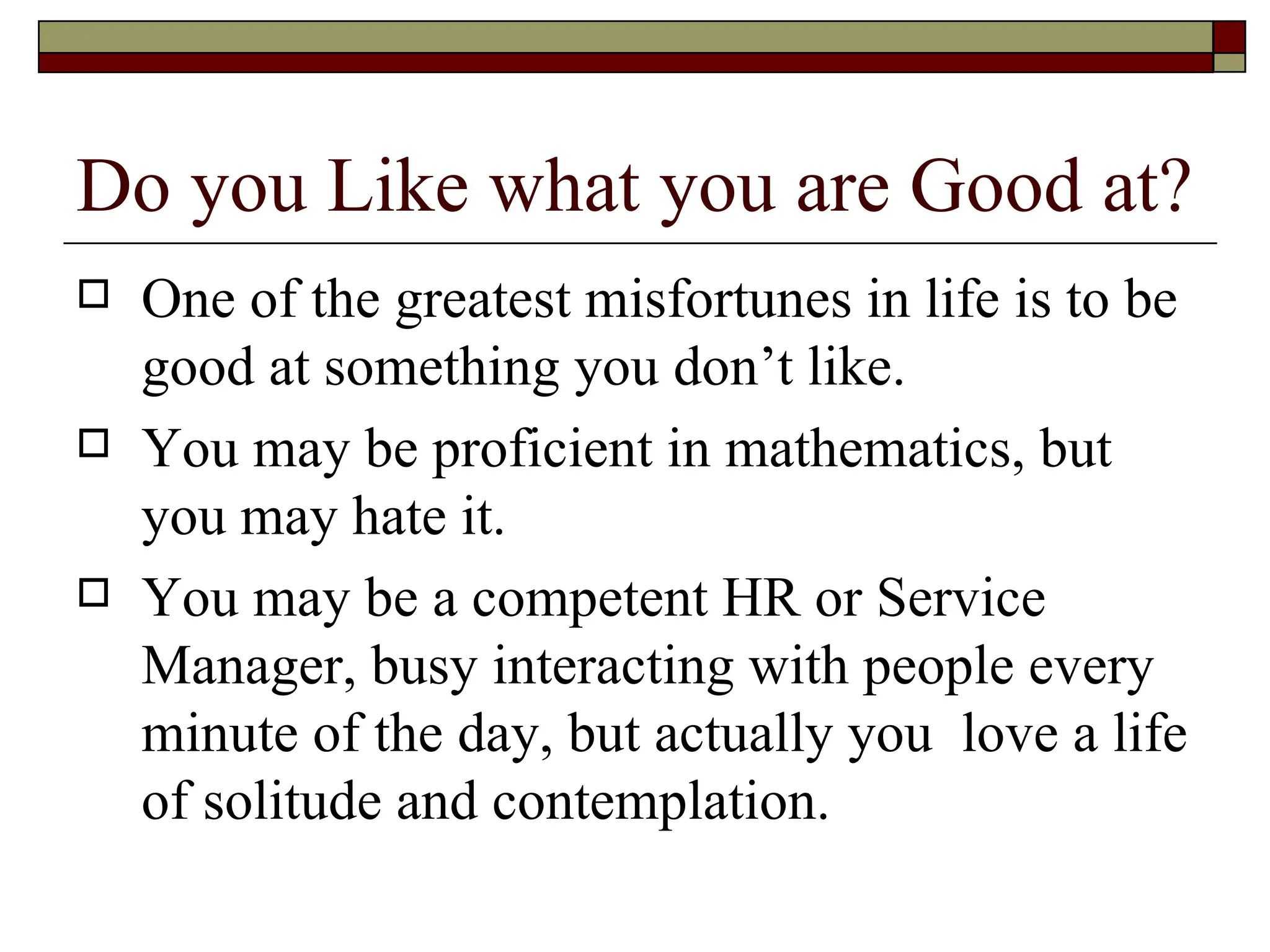
Do you Likewhat you are Good at? One of the greatest misfortunes in life is to be good at something you don’t like. You may be proficient in mathematics, but you may hate it. You may be a competent HR or Service Manager, busy interacting with people every minute of the day, but actually you love a life of solitude and contemplation.
3.
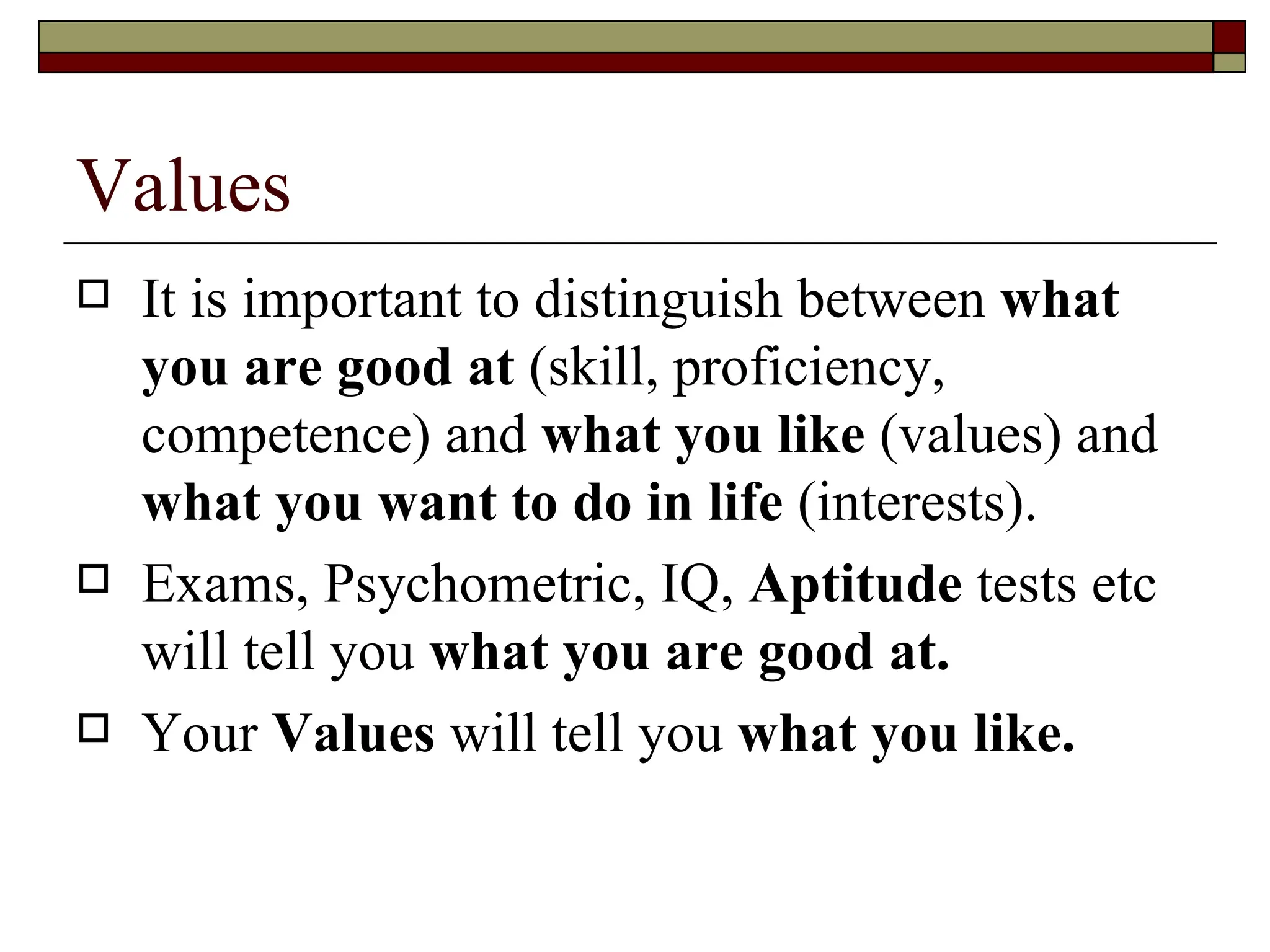
Values Itis important to distinguish between what you are good at (skill, proficiency, competence) and what you like (values) and what you want to do in life (interests). Exams, Psychometric, IQ, Aptitude tests etc will tell you what you are good at. Your Values will tell you what you like.
4.
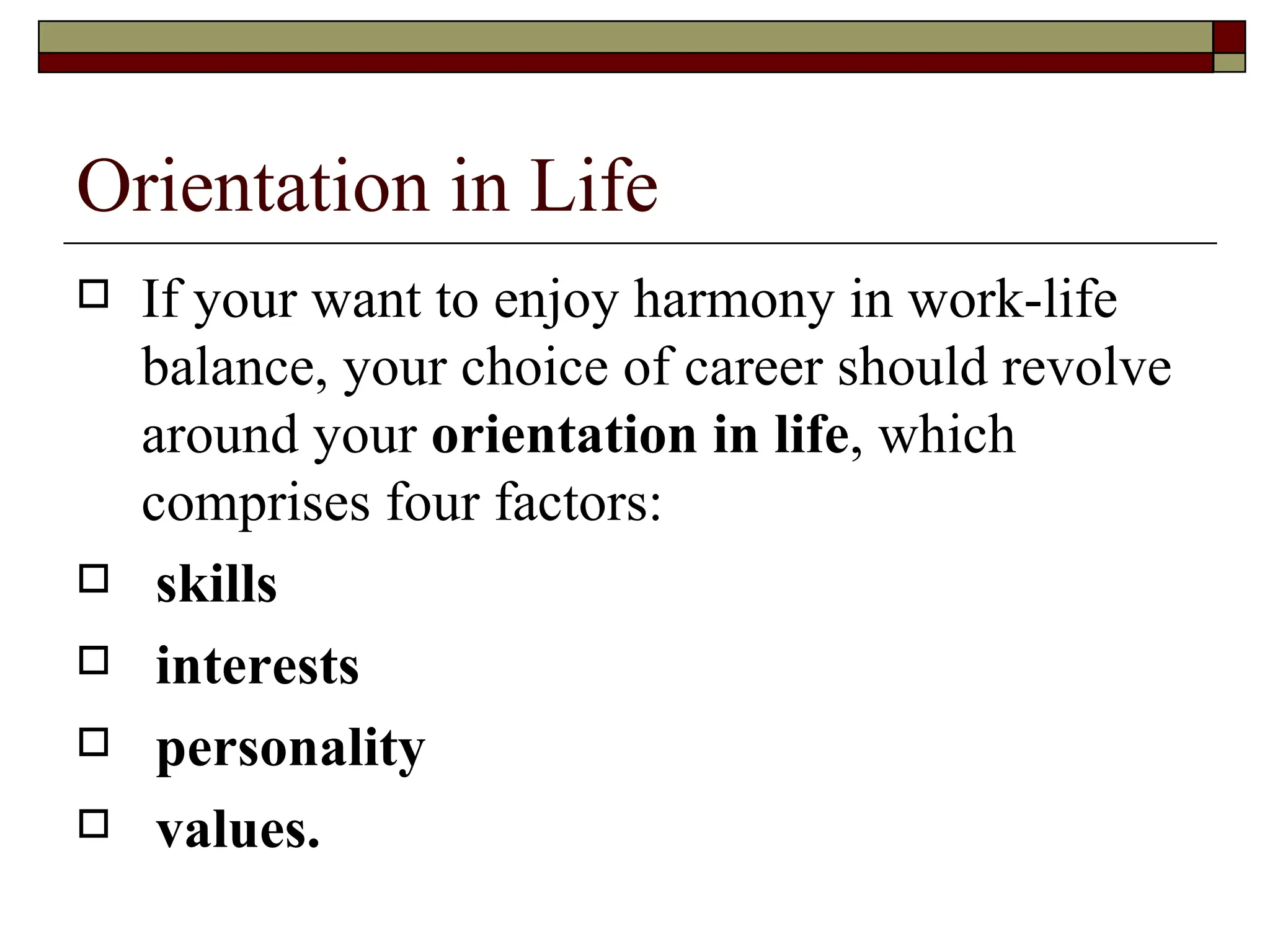
Orientation in LifeIf your want to enjoy harmony in work-life balance, your choice of career should revolve around your orientation in life , which comprises four factors: skills interests personality values.
5.
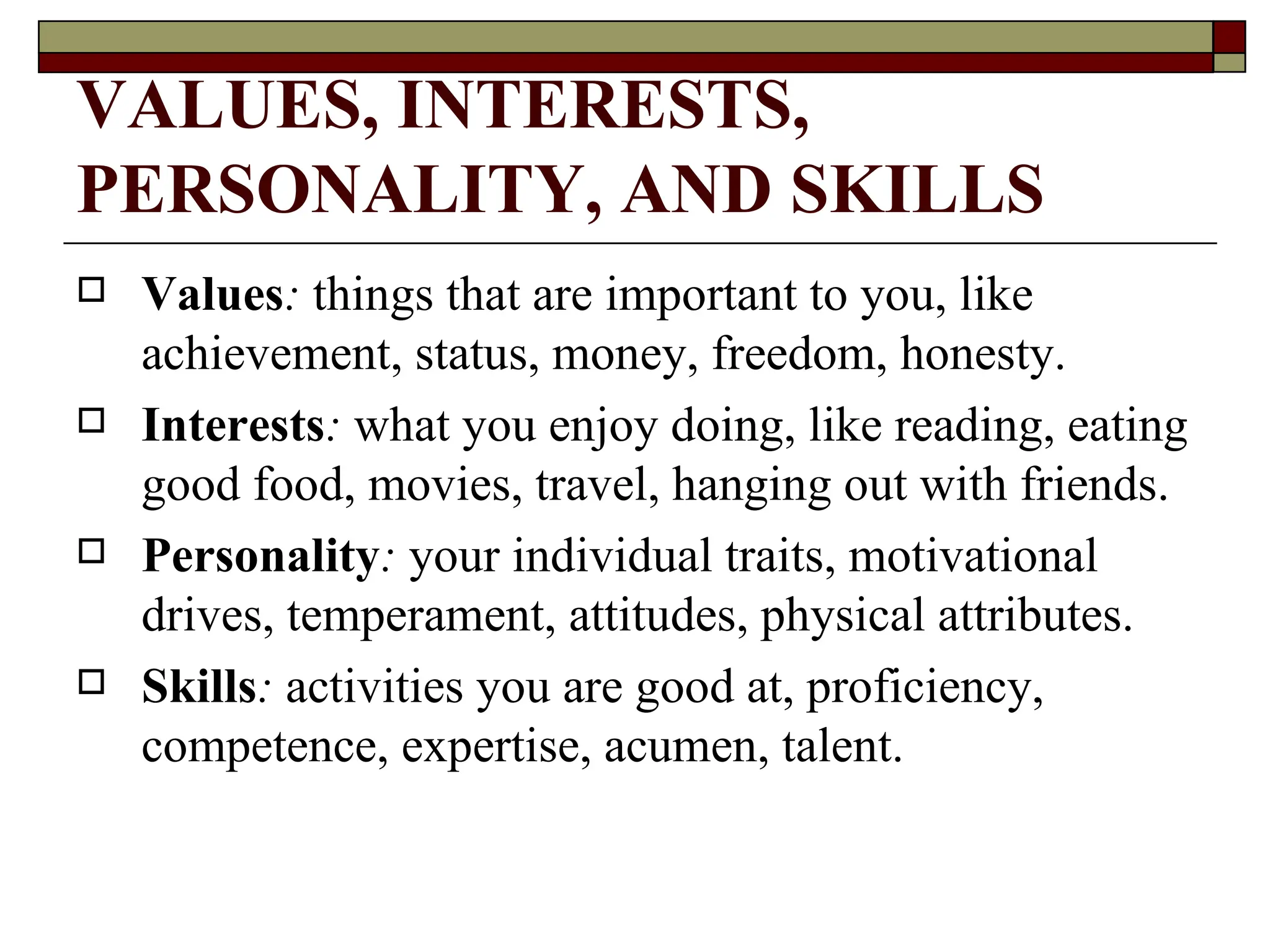
VALUES, INTERESTS, PERSONALITY,AND SKILLS Values : things that are important to you, like achievement, status, money, freedom, honesty. Interests : what you enjoy doing, like reading, eating good food, movies, travel, hanging out with friends. Personality : your individual traits, motivational drives, temperament, attitudes, physical attributes. Skills : activities you are good at, proficiency, competence, expertise, acumen, talent.
6.
VALUES Values are core beliefs which guide and motivate attitudes and behaviour. When you value something you want it or want it to happen. Values are relatively permanent desires. Values are answers to the “why” question.
7.
Values – SubjectiveReactions Values are our subjective reactions to the world around us. They guide and mould our options and behaviour. Values are developed early in life and are very resistant to change and are permanent in nature. Values develop out of our direct experiences with people who are important to us, particularly our parents, early teachers. Values evolve within us not out of what people tell us, but as a result how people behave toward us and others.
8.
Values are Holisticin nature There cannot be any “partial” values. for example: you cannot be 50% honest (half - honest) – either you are honest or you are not honest!
9.
DISCOVER YOUR VALUESYou keep on asking “why” questions until you reach a point where you no longer want something for the sake of something else. At this point you have arrived at your value.
10.
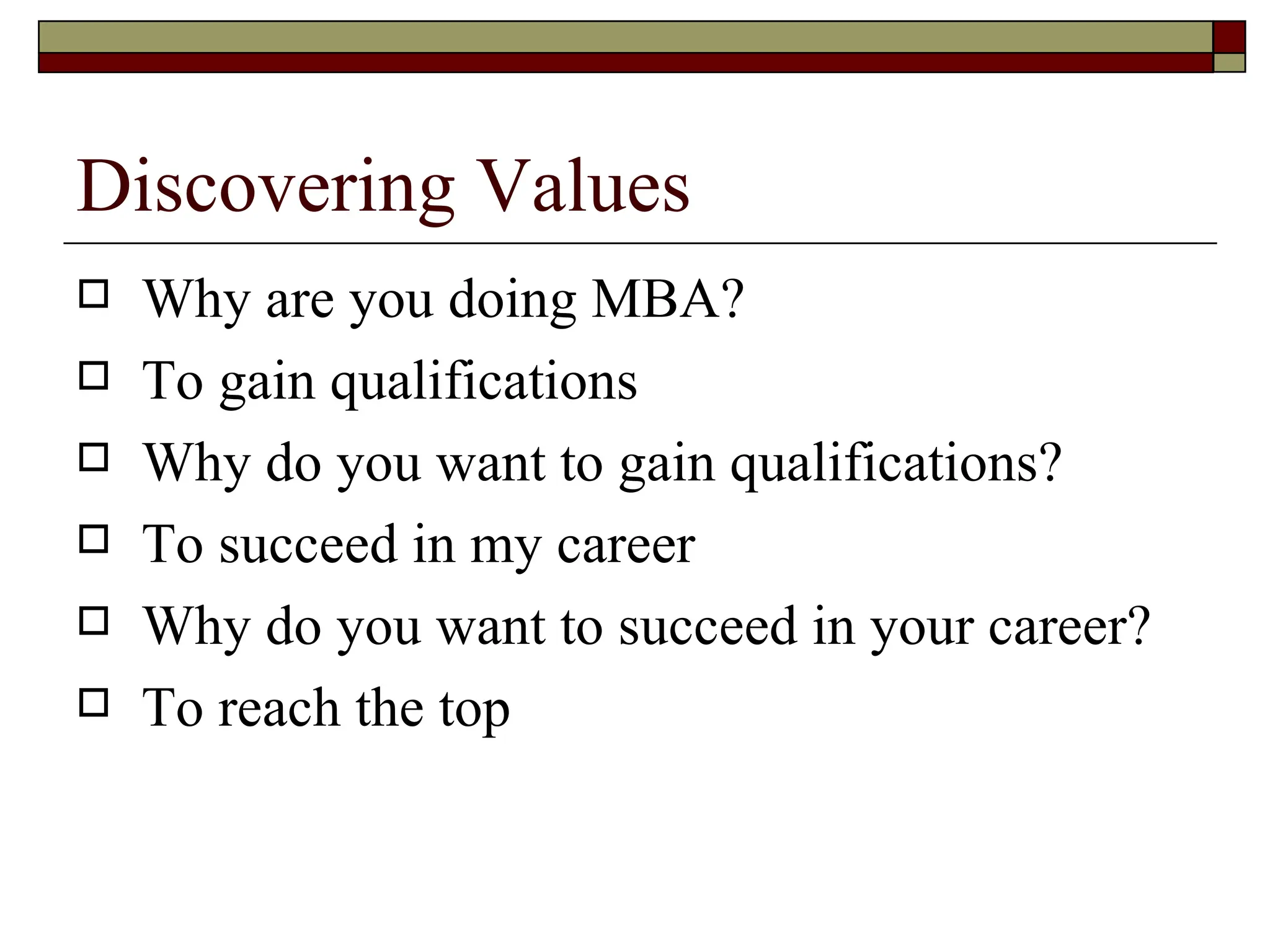
Discovering Values Whyare you doing MBA? To gain qualifications Why do you want to gain qualifications? To succeed in my career Why do you want to succeed in your career? To reach the top
11.
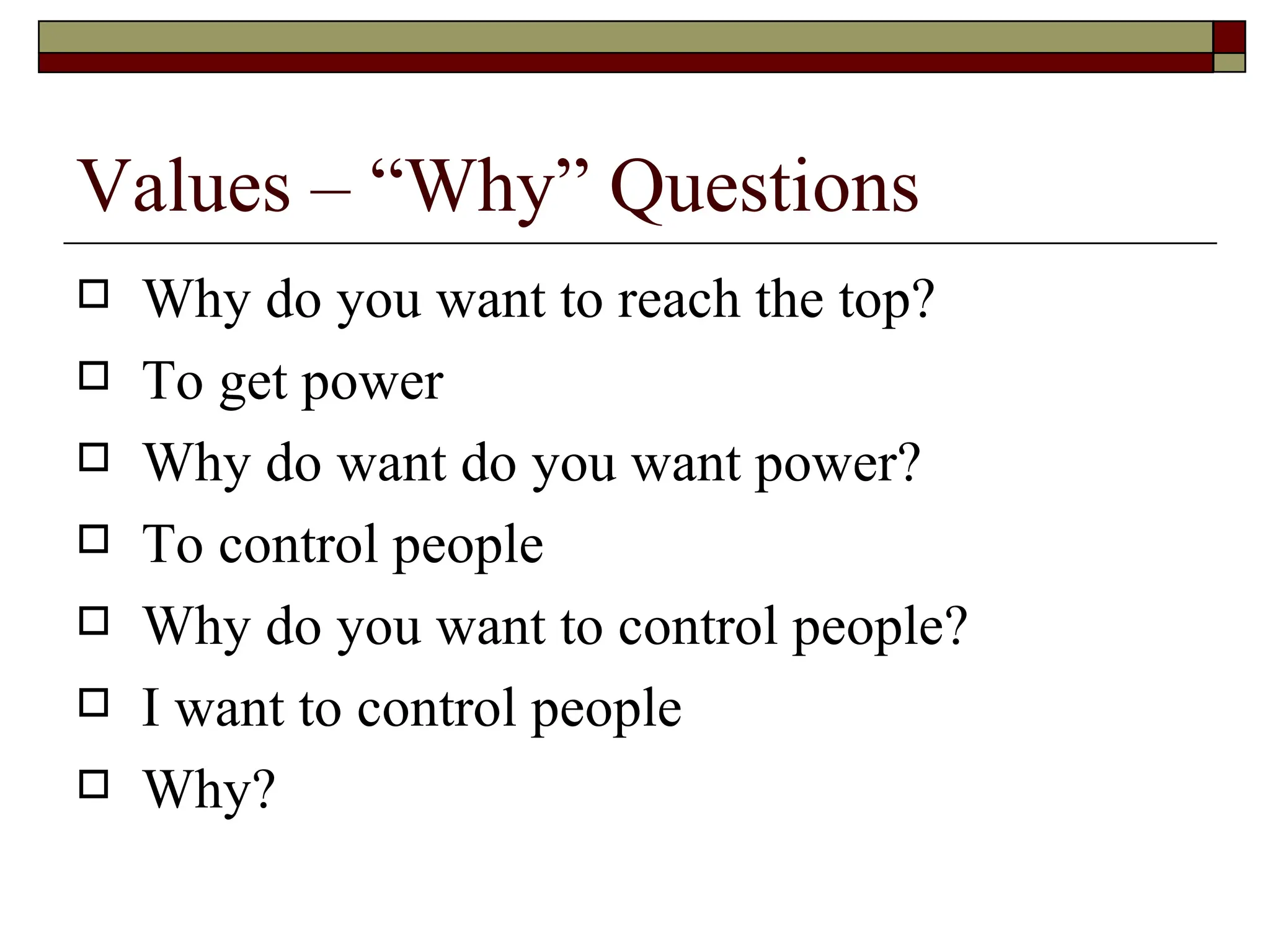
Values – “Why”Questions Why do you want to reach the top? To get power Why do want do you want power? To control people Why do you want to control people? I want to control people Why?
12.
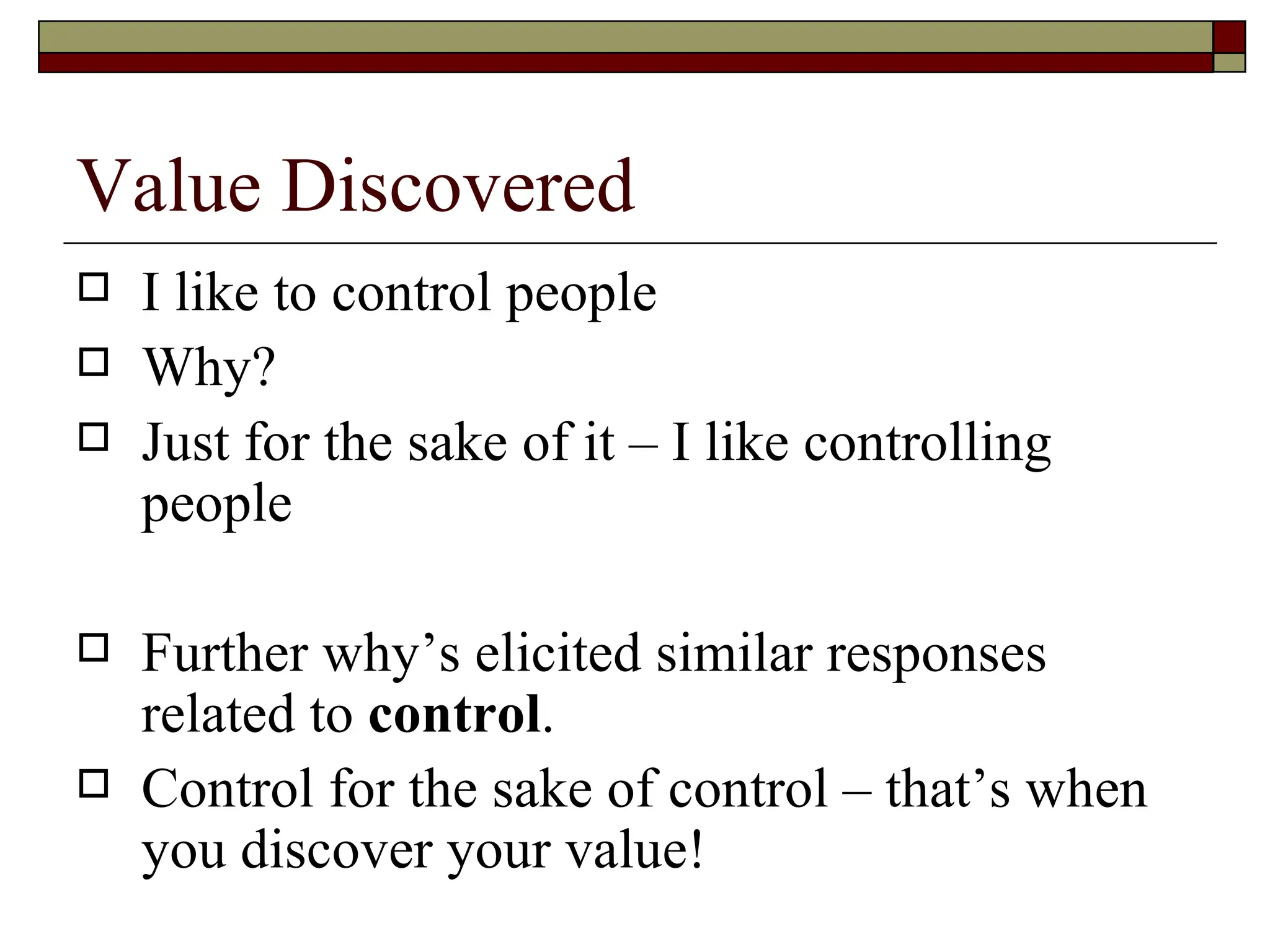
Value Discovered Ilike to control people Why? Just for the sake of it – I like controlling people Further why’s elicited similar responses related to control . Control for the sake of control – that’s when you discover your value!
13.
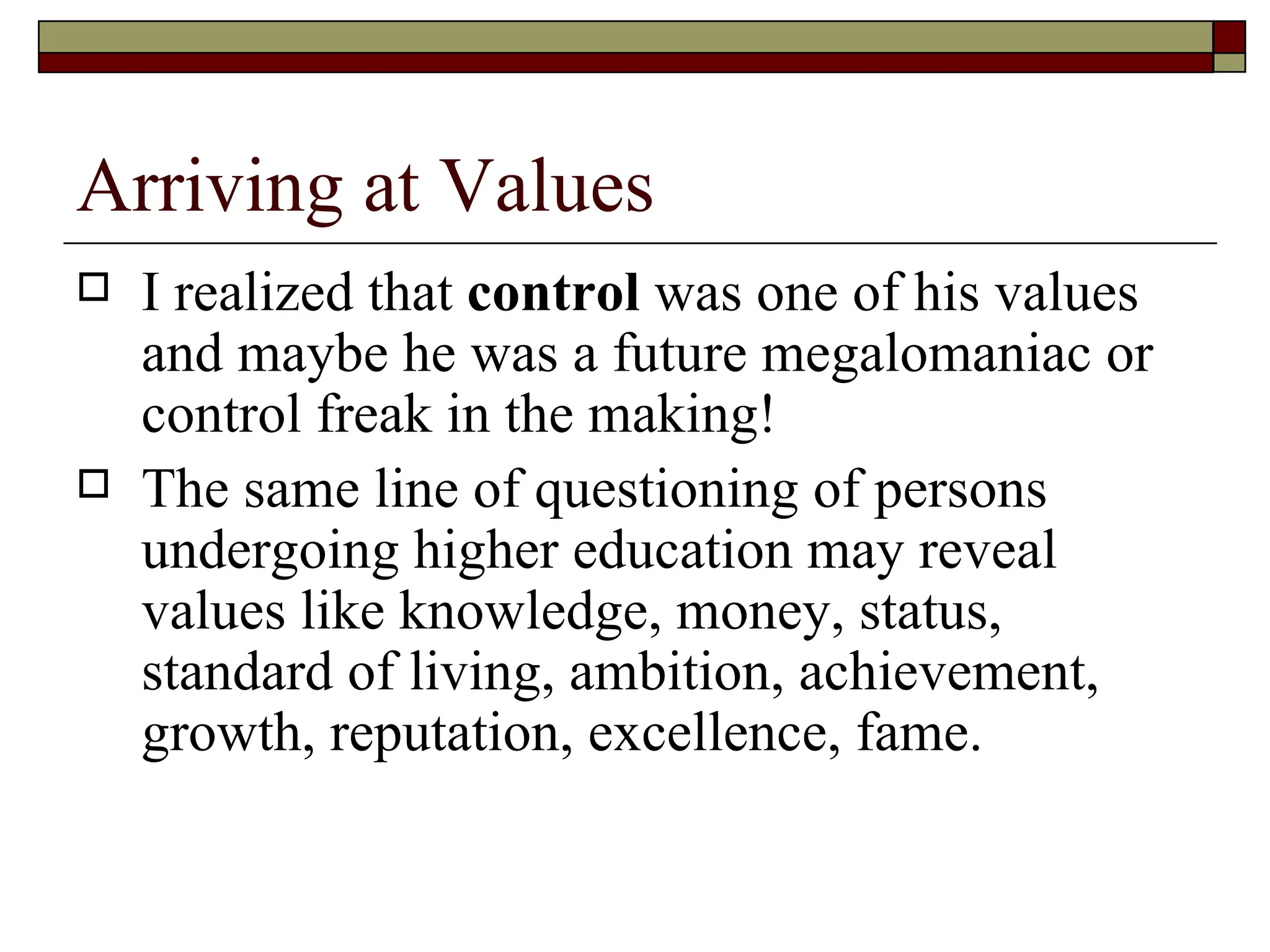
Arriving at ValuesI realized that control was one of his values and maybe he was a future megalomaniac or control freak in the making! The same line of questioning of persons undergoing higher education may reveal values like knowledge, money, status, standard of living, ambition, achievement, growth, reputation, excellence, fame.
14.
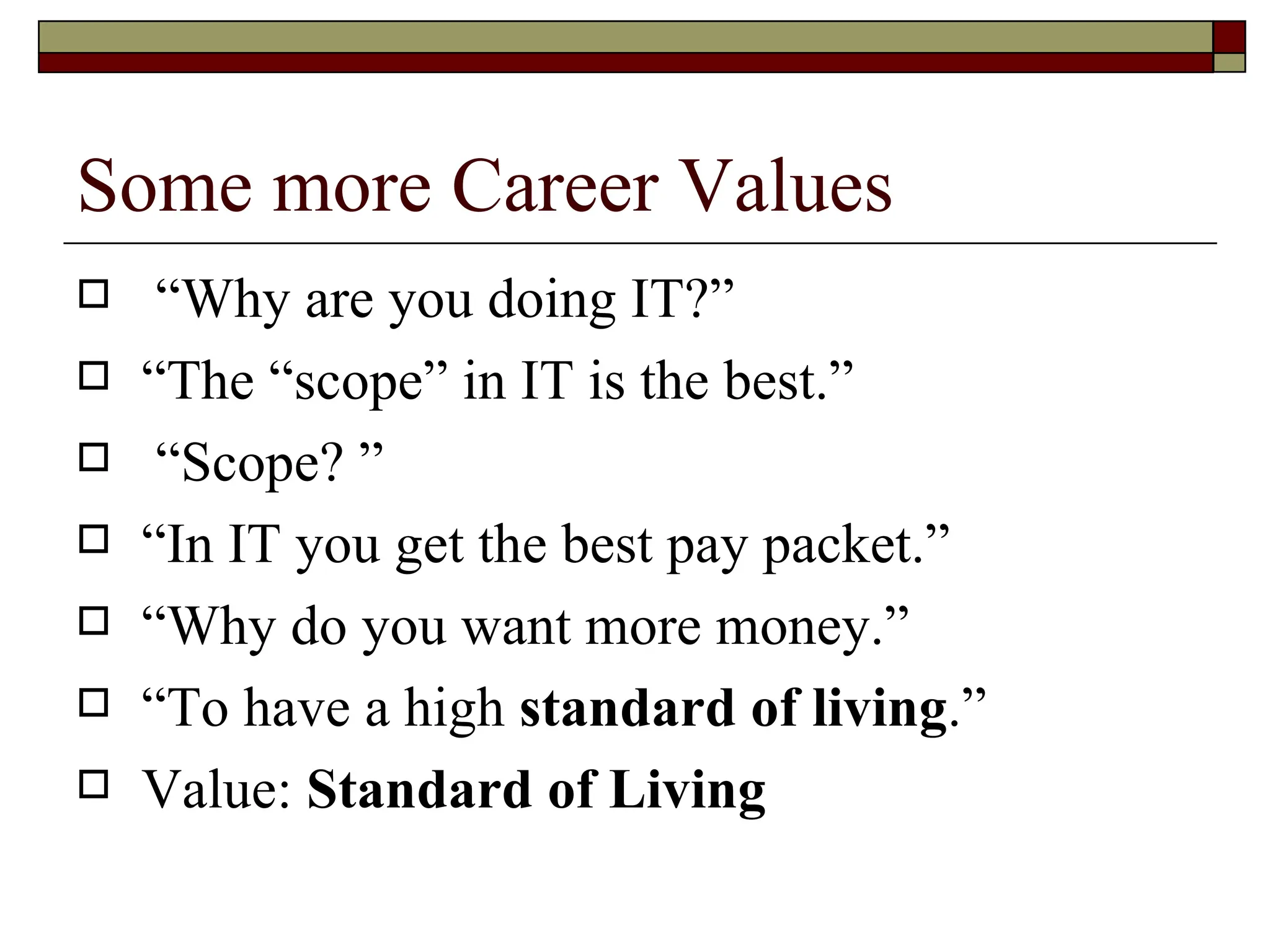
Some more CareerValues “ Why are you doing IT?” “ The “scope” in IT is the best.” “ Scope? ” “ In IT you get the best pay packet.” “ Why do you want more money.” “ To have a high standard of living .” Value: Standard of Living
15.
Ask Yourself Isa high salary important to you? [ Money ] Is it important for your work to involve interacting with people? [ Social ] Is it important for your work to make a contribution to society? [ Altruistic ] Is having a prestigious job important for you? [ Status ] Quality of Life or Standard of Living ?
16.
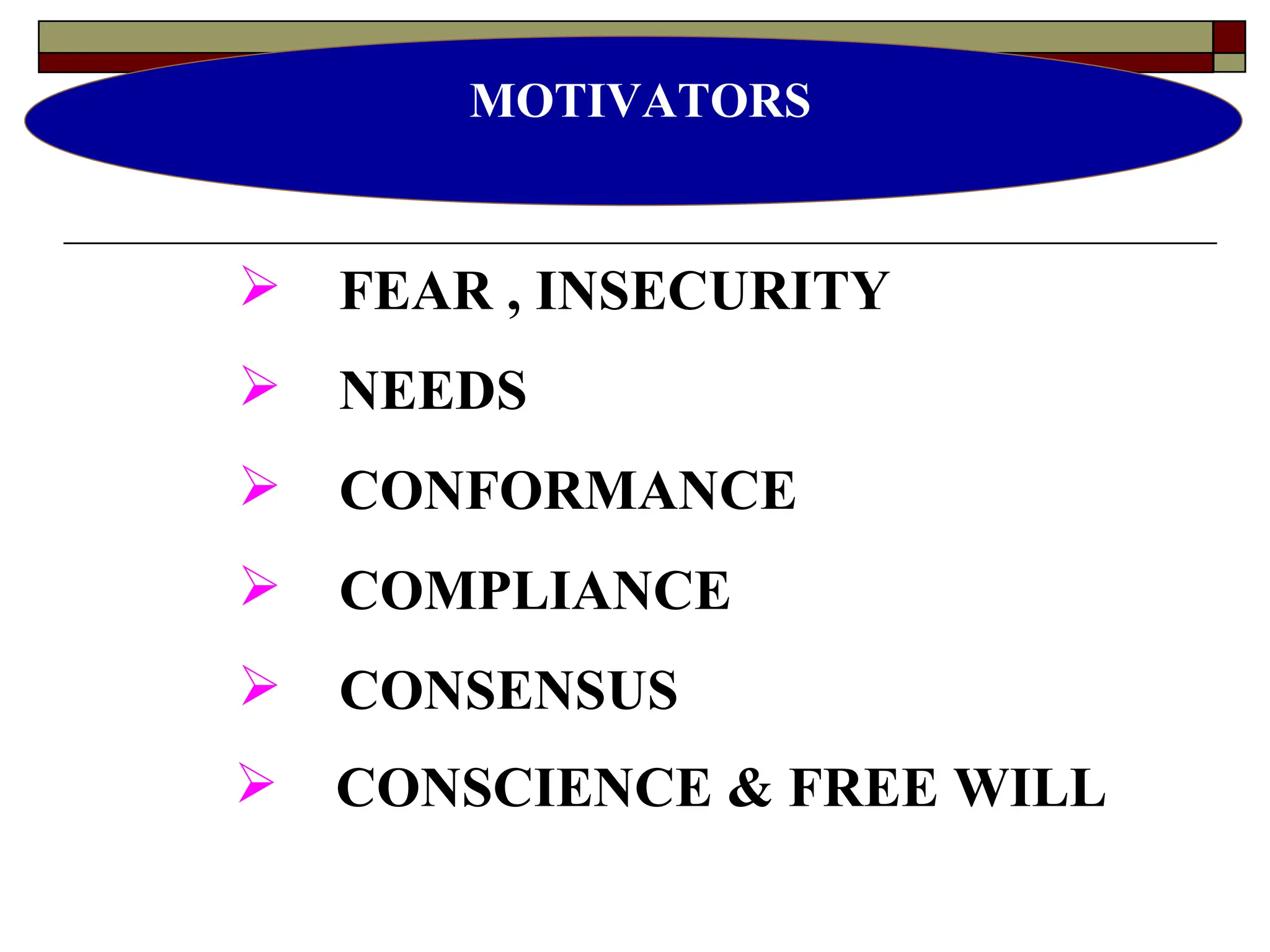
Ask Yourself Doyou want to get married? Why? Keep on asking why, why, why…till you discover your value. Love, Companionship, Security, Conformance [Because everyone gets married], Compliance [I obey my parents]
17.
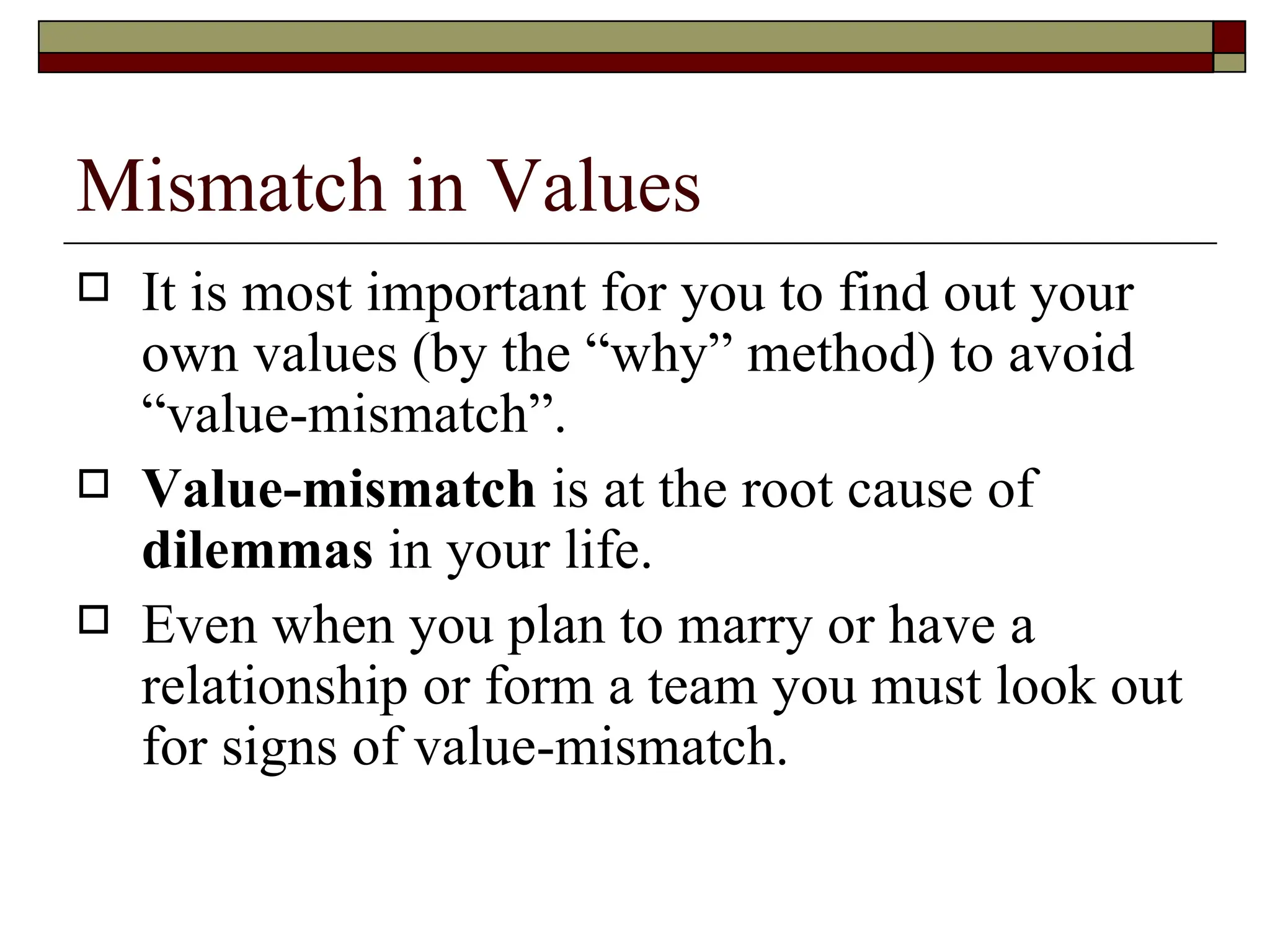
Mismatch in ValuesIt is most important for you to find out your own values (by the “why” method) to avoid “value-mismatch”. Value-mismatch is at the root cause of dilemmas in your life. Even when you plan to marry or have a relationship or form a team you must look out for signs of value-mismatch.
18.
Conflict in ValuesA conflict between your personal and organizational values may result in ethical dilemmas at the workplace, while value mismatch between two persons may sow discord and cause stress and turbulence in a relationship. Your values are possibly the most important thing to consider when you're choosing a workplace or partner.
19.
Values and CareerIf you do not take your values into account when planning your career, there is a good chance you will dislike your work and therefore not enjoy it. For example, someone who needs to have autonomy (freedom) in his work would not be happy in a job where every action is decided by someone else.
20.
First know yourself.Then know others. Please sit down in a quiet place all by yourself, introspect, ask yourself the “why” question and find out your own values. Try to ascertain others’ values (personal values and organizational values too!). The extent of mutual harmony in your values should determine your choice of workplace, career, relationships, friends and partner.
21.
APTITUDE and ATTITUDESKILLS [Proficiency, Competence, Intelligence, Talent] govern APTITUDE. VALUES, INTERESTS and PERSONALITY determine ATTITUDE.
22.
Workplace vs CareerDistinguish between WORKPLACE and CAREER ATTRIBUTES [Type of Work] Workplace – IT Firm XXX Career – HR Manager, Software Engineer, Project Manager, Analyst, Quality Auditor, Marketing, Business Development, Team
23.
Values & CareerOrientation Your values are the most important and critical aspect of your career orientation. If you want to enhance certain skills , you can work on it. Similarly, you can change your interests , devoting time to those interests you would like to create, acquire or strengthen, you can develop your personality, but you cannot change your Values .
24.
Values are PermanentSkills can be learned, interests can be developed, personality can be changed, but values are intrinsic. It is very difficult to change your core values. You may compromise your values, but you cannot change them.
25.
Job Satisfaction Ifyou choose a career that enables you achieve success facilitating optimal utilization of your best skills , doing the kinds of work that relate to your favourite interests, blending with your personality, and in consonance with your core values , you will derive total job satisfaction in life.
26.
Discover your trueInterests How do you find out your interests? Assume you have enough leisure and plenty of resources; what would you do? How you like to spend your leisure gives a clue to your interests. Will the career you choose enable you to satisfy your interests at work, or will you have enough leisure to pursue them on your own.
27.
List and Prioritizeyour Values This list might include values like honesty, integrity, loyalty, prestige, happiness, friendship, family life, achievement, independence, education, power, money, independence, freedom and so on. Now prioritize your values in order of importance to discover your core values.
28.
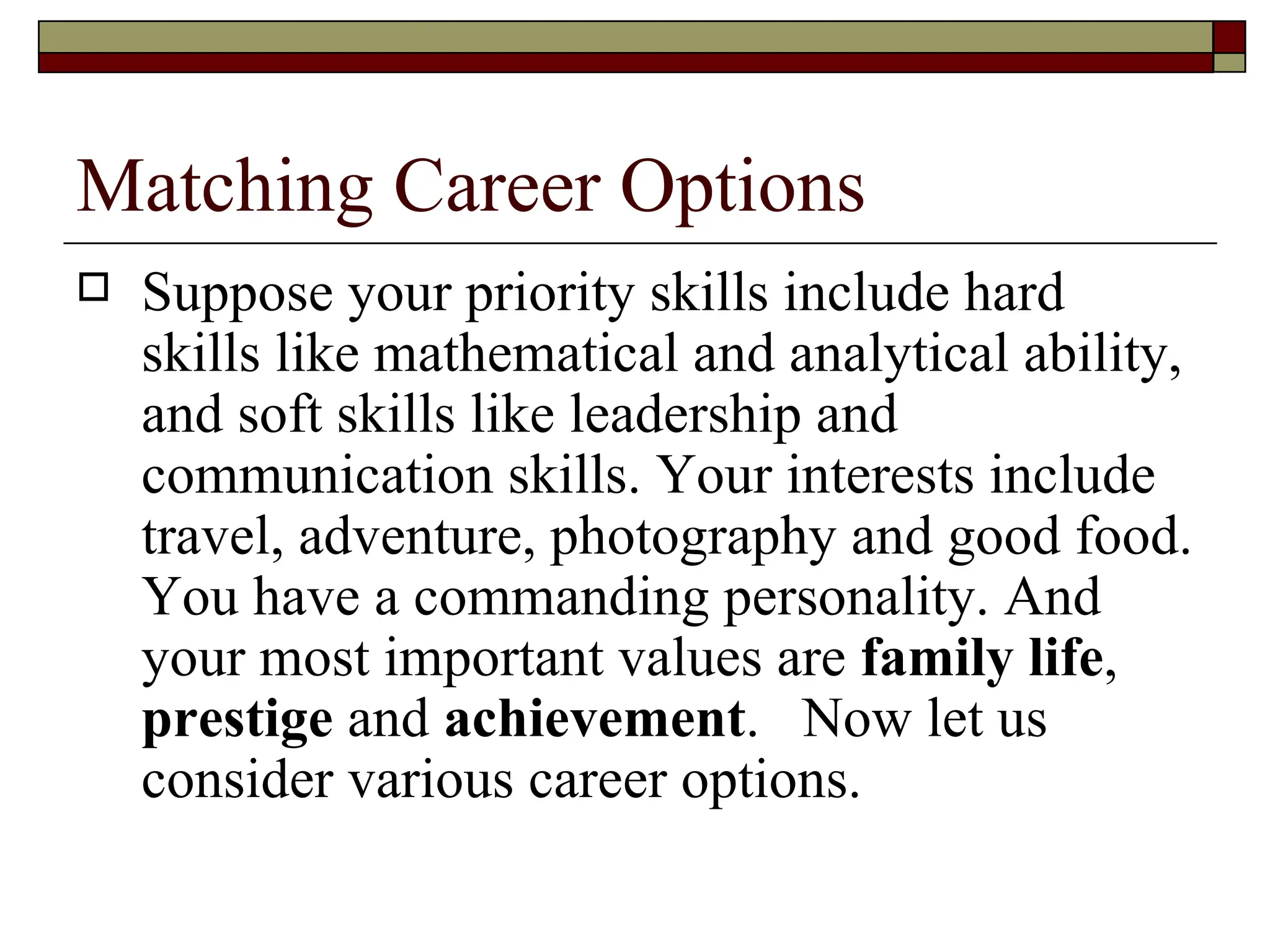
Matching Career OptionsSuppose your priority skills include hard skills like mathematical and analytical ability, and soft skills like leadership and communication skills. Your interests include travel, adventure, photography and good food. You have a commanding personality. And your most important values are family life , prestige and achievement . Now let us consider various career options.
29.
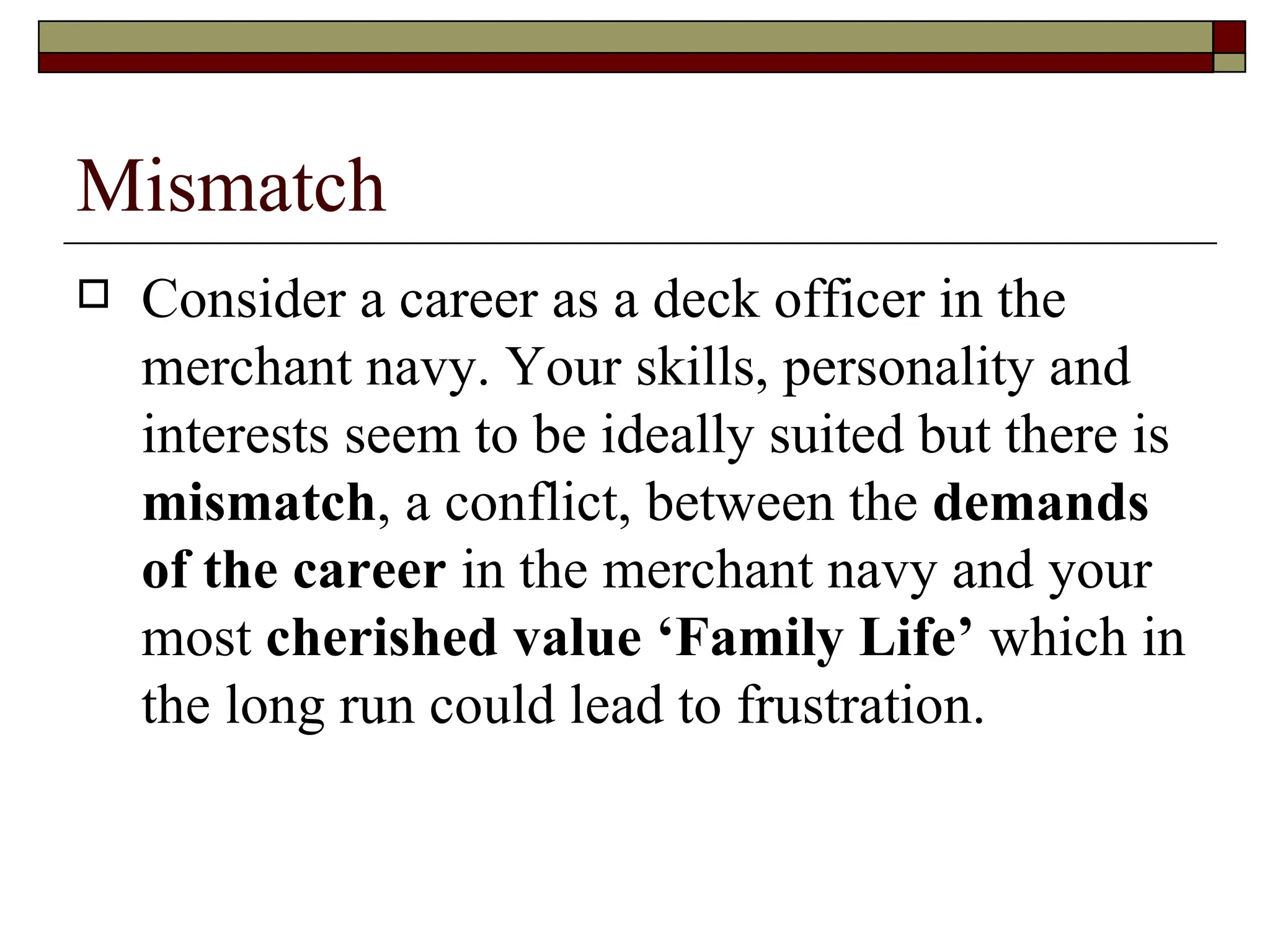
Mismatch Consider acareer as a deck officer in the merchant navy. Your skills, personality and interests seem to be ideally suited but there is mismatch , a conflict, between the demands of the career in the merchant navy and your most cherished value ‘Family Life’ which in the long run could lead to frustration.
30.
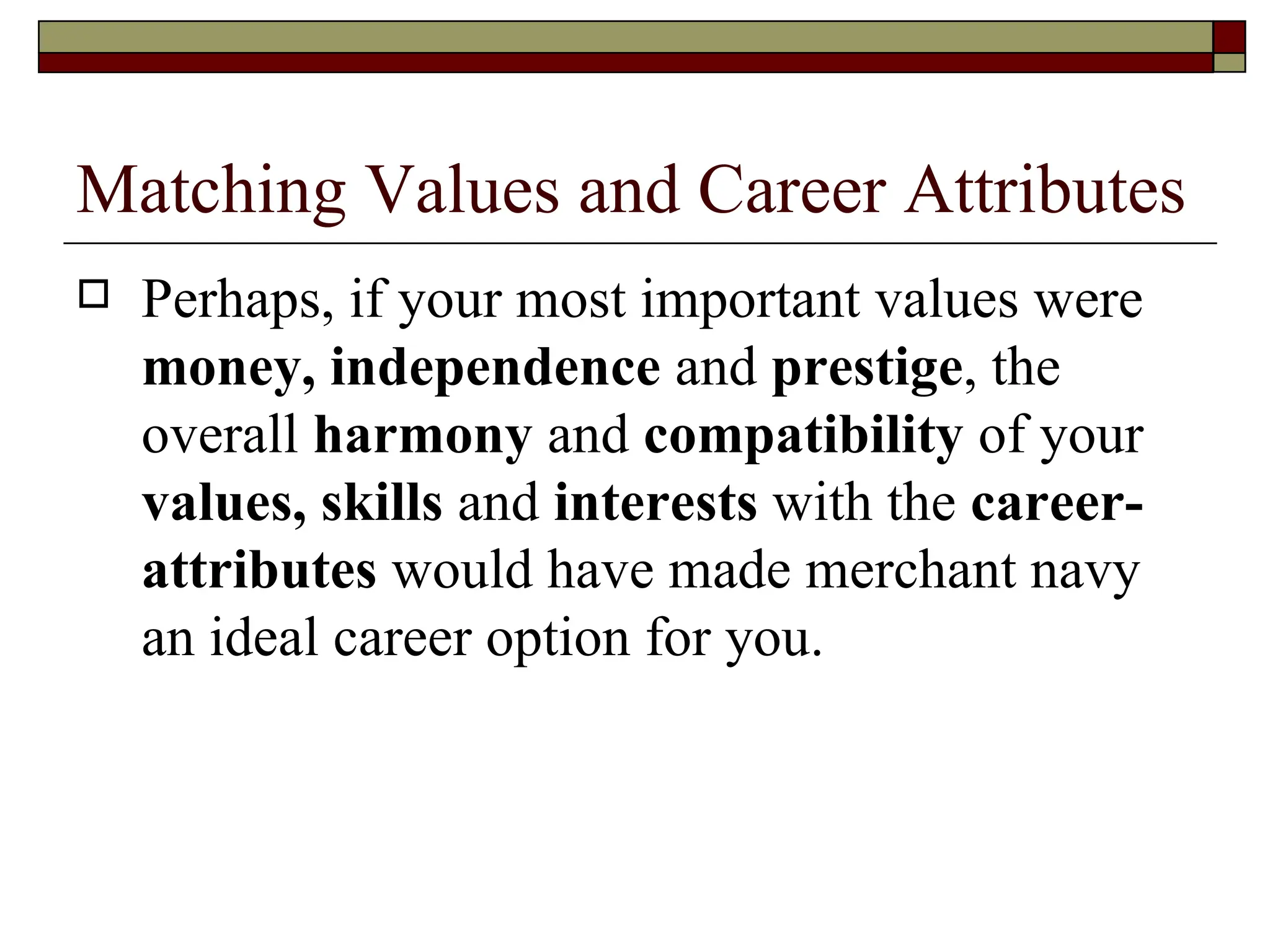
Matching Values andCareer Attributes Perhaps, if your most important values were money, independence and prestige , the overall harmony and compatibility of your values, skills and interests with the career-attributes would have made merchant navy an ideal career option for you.
31.
Work Life HarmonyBefore you choose your career, introspect and ascertain the compatibility, congruence and harmony between the career and your orientation in life [your skills, interests, personality and values]. Values are most important, because you cannot change your values
32.
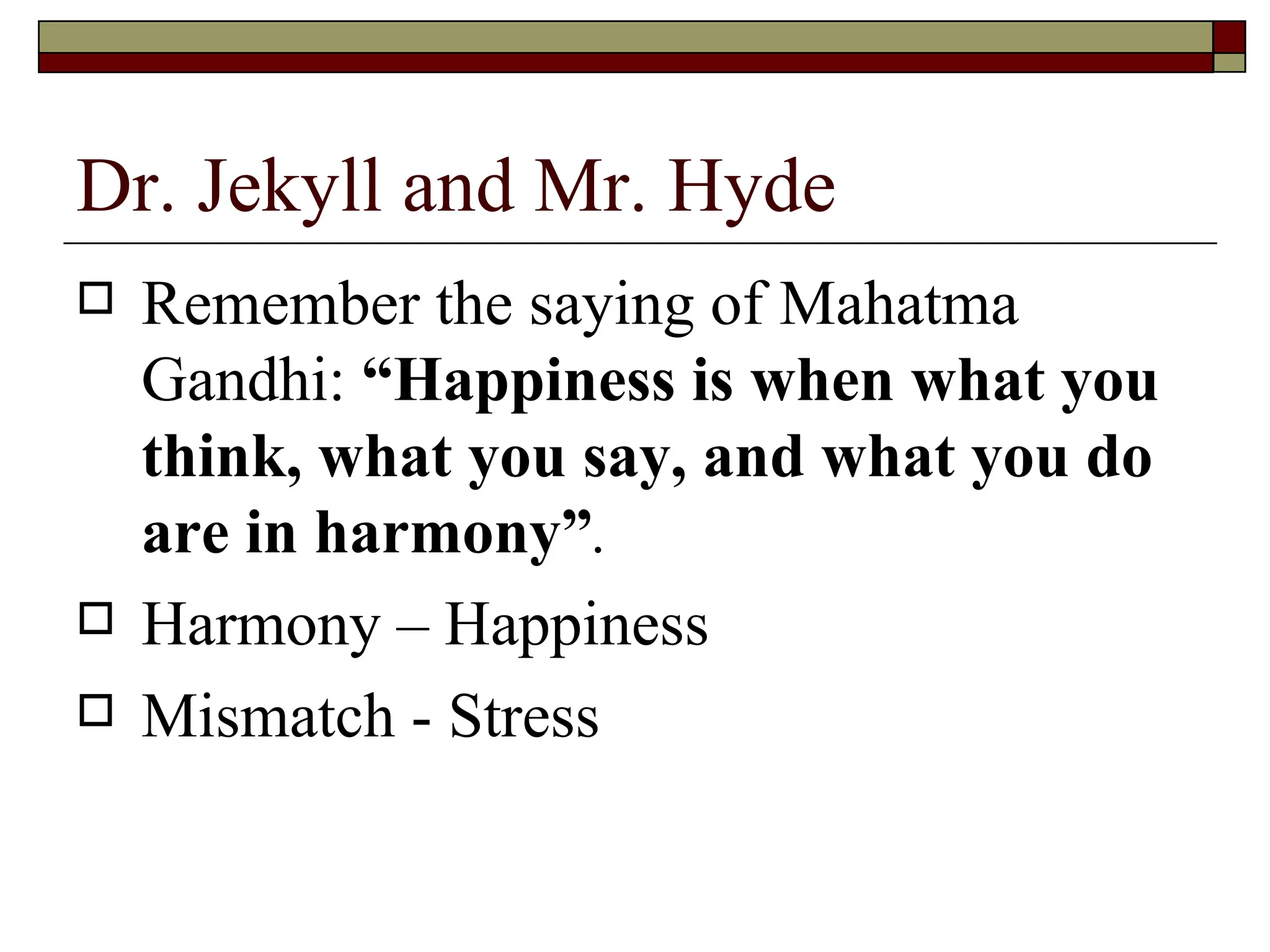
Dr. Jekyll andMr. Hyde Remember the saying of Mahatma Gandhi: “Happiness is when what you think, what you say, and what you do are in harmony” . Harmony – Happiness Mismatch - Stress
33.
Look Inwards Interests,skills and personality can be developed, but values are intrinsic core beliefs inherent within you. You have to look inwards, analyse, introspect, reflect and endeavour to discover your own true values.
34.
Value Congruence Whetherit is your work or relationships, value congruence is of paramount importance your values must be in harmony for the relationship to tick. Career, Marriage, Friendship, Team-spirit
35.
Value Dissonance Theextent of mutual harmony in your values should determine your choice of work, activities, relationships, friends and partner. Value Dissonance due to mismatch between individual values and organizational values can cause great strain and trauma at the workplace.
36.
Freedom Is freedom an important value for you? Is the career or job you are considering (or the person you want to marry) going to give you enough freedom?
37.
Leisure Do youvalue leisure ? Leisure is not only an important value but also a determinant of character If you want to know about a man find out how he spends his leisure If you had a day off what will you do? How you spend your leisure reveals vital clues about your values too!
38.
How would youspend your Leisure? Would you read a book, write a story, go hiking outdoors, play your favourite sport, adventure sports, chat with friends, picnic, see a movie, eat your favourite cuisine in a restaurant, or cook it yourself, socialize in your club, spend the day at home with your family, study, play with your pet dog, or see TV at home, or just spend the day in glorious solitude enjoying quality time with yourself?
39.
Workaholic & “Achiever”Or would you rather not “waste” your leisure time and spend the day doing something “useful” connected with your work, career or advancement towards “achieving” your “goals”?
40.
Match and HarmonizeValues Do you value humour, fun, pleasure, food, enjoyment, sex, family life, quality of life, status, money, success, fame, power, prestige, security, nature, loyalty, love, affection, independence, privacy, togetherness, tranquillity, adventure, leadership, followership, competition, contentment, creativity – look within, reflect, find out for yourself, and the values of others too who you want to relate with – match and harmonize your values , and be happy and fulfilled in your work and your relationships.
41.
Trust your Senseof Values Remember, at any important milestone in your life , when you have to make a vital decision, whether you are on the verge of selecting a career, a job, a house, or a marriage partner – trust your sense of values ! Don’t make a hasty decision or you may find yourself on the wrong road and then it may be too late to turn back.
42.
Choose your careercarefully Devoid of intrinsic motivation to purse a career which is not in harmony with one’s orientation in life , but caught up in the need to retain parental affection , materialistic rewards and extrinsic recognition (peer and societal acceptance) , young people often enter careers which never offer them true inner happiness or fulfilment that evolves from harmonious work-life balance. Thus, though they may appear outwardly successful, inwardly they lament over the reality of inner dissonance owing to work-life imbalance.
43.
Thank You “A man who has work that suits him, and a wife whom he loves, has squared his accounts with life” …… Friedrich Hegel
![Ask Yourself Is a high salary important to you? [ Money ] Is it important for your work to involve interacting with people? [ Social ] Is it important for your work to make a contribution to society? [ Altruistic ] Is having a prestigious job important for you? [ Status ] Quality of Life or Standard of Living ?](https://image.slidesharecdn.com/vikramkarve-viit-23-jan-2009-1234807726251671-2/75/HOW-TO-SELECT-YOUR-CAREER-A-Value-Based-Approach-15-2048.jpg)
![Ask Yourself Do you want to get married? Why? Keep on asking why, why, why…till you discover your value. Love, Companionship, Security, Conformance [Because everyone gets married], Compliance [I obey my parents]](https://image.slidesharecdn.com/vikramkarve-viit-23-jan-2009-1234807726251671-2/75/HOW-TO-SELECT-YOUR-CAREER-A-Value-Based-Approach-16-2048.jpg)
![APTITUDE and ATTITUDE SKILLS [Proficiency, Competence, Intelligence, Talent] govern APTITUDE. VALUES, INTERESTS and PERSONALITY determine ATTITUDE.](https://image.slidesharecdn.com/vikramkarve-viit-23-jan-2009-1234807726251671-2/75/HOW-TO-SELECT-YOUR-CAREER-A-Value-Based-Approach-21-2048.jpg)
![Workplace vs Career Distinguish between WORKPLACE and CAREER ATTRIBUTES [Type of Work] Workplace – IT Firm XXX Career – HR Manager, Software Engineer, Project Manager, Analyst, Quality Auditor, Marketing, Business Development, Team](https://image.slidesharecdn.com/vikramkarve-viit-23-jan-2009-1234807726251671-2/75/HOW-TO-SELECT-YOUR-CAREER-A-Value-Based-Approach-22-2048.jpg)
![Work Life Harmony Before you choose your career, introspect and ascertain the compatibility, congruence and harmony between the career and your orientation in life [your skills, interests, personality and values]. Values are most important, because you cannot change your values](https://image.slidesharecdn.com/vikramkarve-viit-23-jan-2009-1234807726251671-2/75/HOW-TO-SELECT-YOUR-CAREER-A-Value-Based-Approach-31-2048.jpg)
![Contact Details – Vikram Karve EMAIL: [email_address] BLOG: http://vikramkarve.sulekha.com](https://image.slidesharecdn.com/vikramkarve-viit-23-jan-2009-1234807726251671-2/75/HOW-TO-SELECT-YOUR-CAREER-A-Value-Based-Approach-44-2048.jpg)