The document critiques Nagios as a monitoring tool, highlighting its simplicity and existing plugin support while pointing out its major shortcomings such as poor scalability, configuration complexity, and inadequate API integration. It suggests leveraging the strengths of Nagios alongside more modern and scalable tools like Sensu, and advocates for creating a comprehensive monitoring solution by combining various best-in-class technologies. The author calls for community engagement to develop a superior monitoring system that avoids the pitfalls of Nagios while maintaining its reliable traits.
Please stop usingNagios
(so it can die peacefully)
Andy Sykes
Devops @ Forward3D
@supersheep
andy@forward3d.com
2.
Do you useNagios?
Tell me why you picked it.
Go on.
If you don't, why don't you?
3.
Reasons for choosingNagios
• stupid simple plugin system
• billions* of existing plugins
• years of development behind it
• you can hire people who know it
"Everybody uses it."**
* may not actually be true
** except me. and maybe you. and that guy at the back, who really likes Zabbix. you know
who you are.
4.
Reasons for choosingNagios
• stupid simple plugin system
• billions* of existing plugins
• years of development behind it
• you can hire people who know it
"Everybody uses it."**
* may not actually be true
** except me. and maybe you. and that guy at the back, who really likes Zabbix. you know
who you are.
5.
So why didyou pick Nagios?
Because it's the "safe", default choice.
Because we've grown accustomed to the things
that really, really suck about it.
It's a little like we've all got Stockholm
Syndrome.
6.
What Nagios getsright
Incredibly simple plugin model.
Fairly secure (SSL between agents + master).
Very simple conceptually.
Reliable.
7.
Nagios, I hatethee; let me count thy ways
Doesn't scale. At all.
World's second most horrible configuration*.
Horrendous interface**.
Assumes a static infrastructure.
No decent programmatic interfaces***.
Throws away perfdata.
Stupid wire format for clients (NRPE/NSCA).
* the world's most horrible configuration is, obviously, Sendmail.
** even the paid Nagios XI one is ugly as sin and unusable.
*** if I catch you parsing status.dat, I will beat your ass.
8.
Expansion about config
Configurationhas to be in two places:
Server has to know what checks to invoke
via NRPE.
Client has to know what checks it will be
asked to invoke with NRPE.
THIS IS MADNESS.
9.
Scaling, or lackof it
No such thing as a Nagios cluster.
More checks = more work = longer before you
know something's happened!
Every check increases your master's load
average.
10.
Okay, yes, there’smod_gearman
But it’s a hack at best.
No redundancy for the machine that distributes
the checks, so it’s not a real cluster.
11.
API poverty
Can't easilyintegrate with other systems.
Can't easily write custom dashboards.
Can't get information out again!
Assumes a static infra
Master has to be told about a client before
things can happen.
12.
The bandaids wemake
Interface:
Opsview, Icinga, Shinken, others
API:
Parsing status.dat, NDO
Client wire format:
Opsview's NRPE, NRD
Config management:
Puppet types, Chef cookbooks
None of it is good enough.
13.
The take-home point:
"Ifwe keep using Nagios,
we'll never get anything
better."
(Writing monitoring systems is hard, and needs community involvement and
real world adoption. Nagios steals mindshare by being just good enough. It's
the monitoring system we deserve, but not the one we need right now.)
14.
So, smart guy.What do we do?
Steal all the things that are great about Nagios.
(existing plugin investment, simplicity, security, reliability)
Strap them to something more awesome.
(scalable, API-ready, config management friendly, modern!)
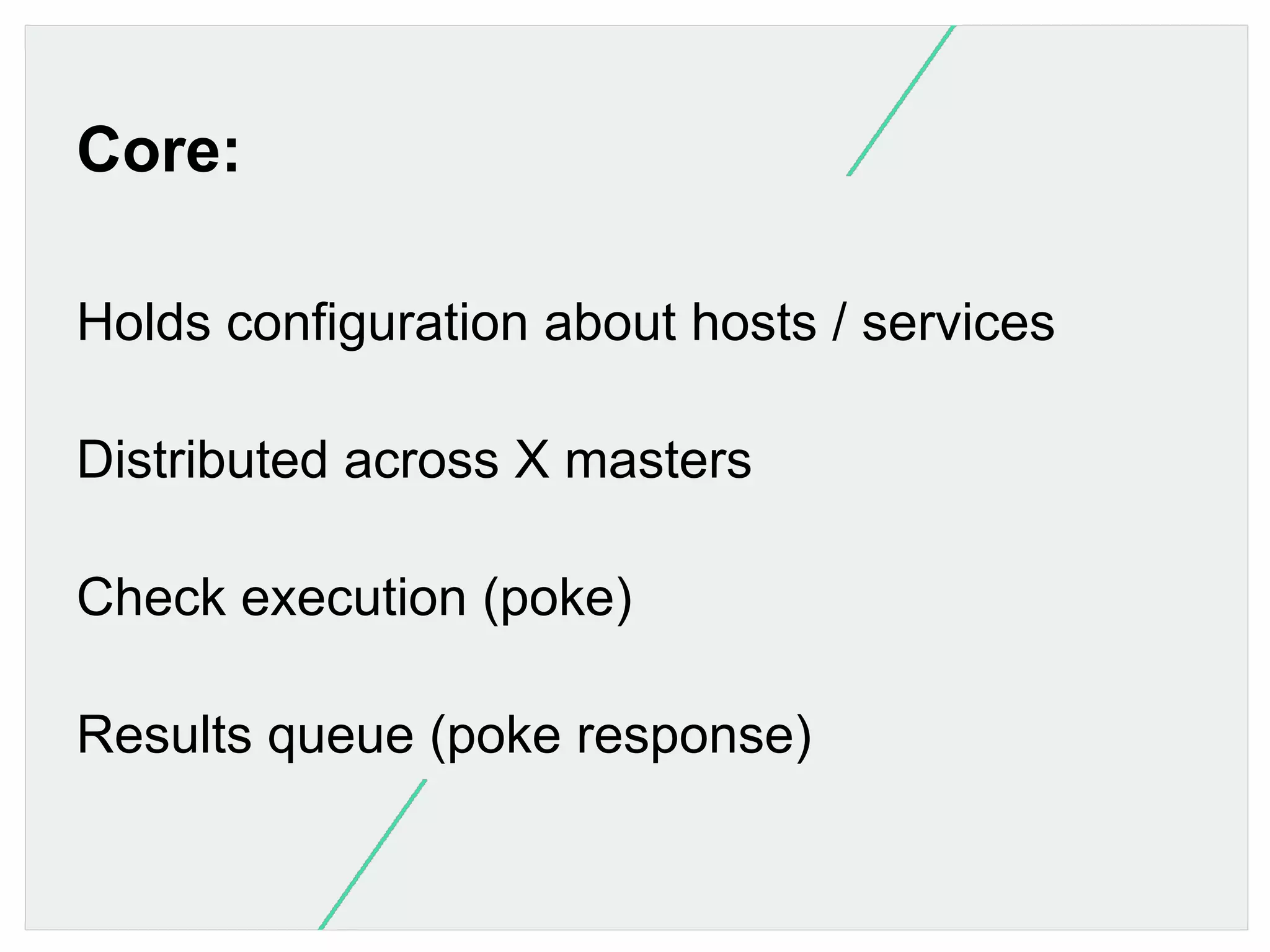
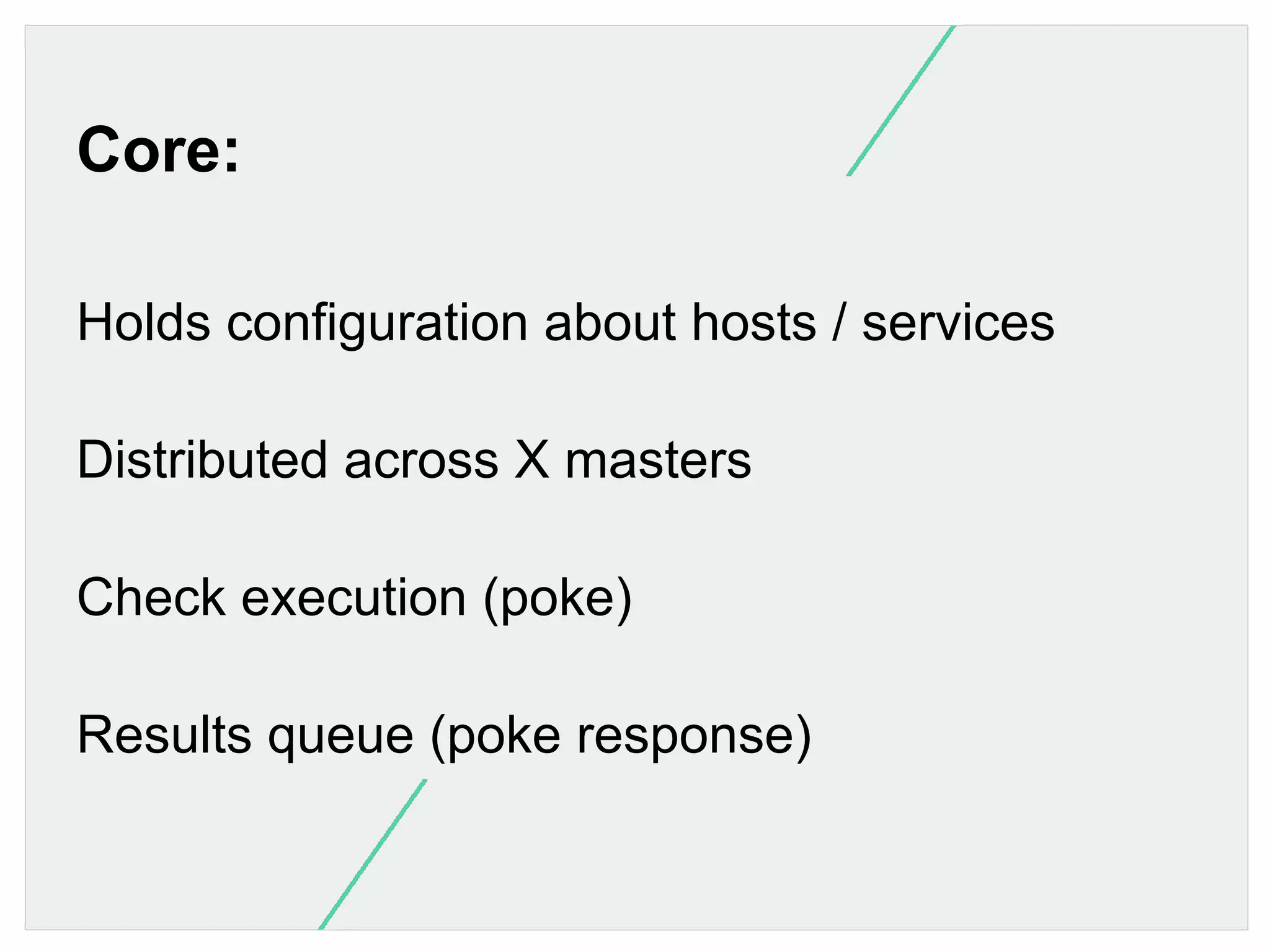
Core:
Holds configuration abouthosts / services
Distributed across X masters
Check execution (poke)
Results queue (poke response)
20.
There’s something wecan use for this.
Sensu!
Sensu is often described as the “monitoring router”.
22.
{
"checks": {
"chef_client": {
"command":"check-chef-client.rb",
"subscribers": [
"production" ],
"interval": 60,
"handlers": [
"pagerduty",
"irc"
]
}
}
}
Only on the server
23.
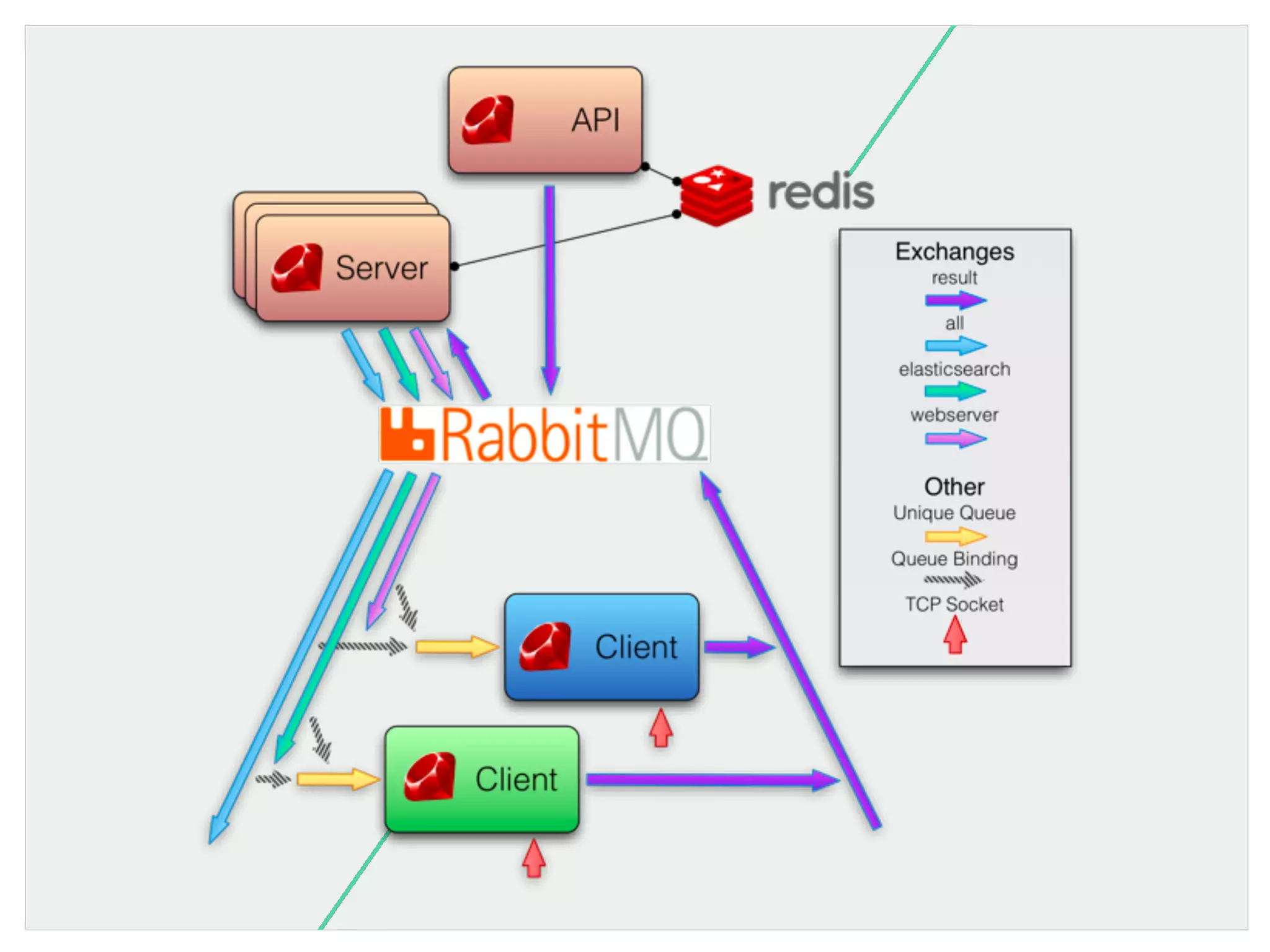
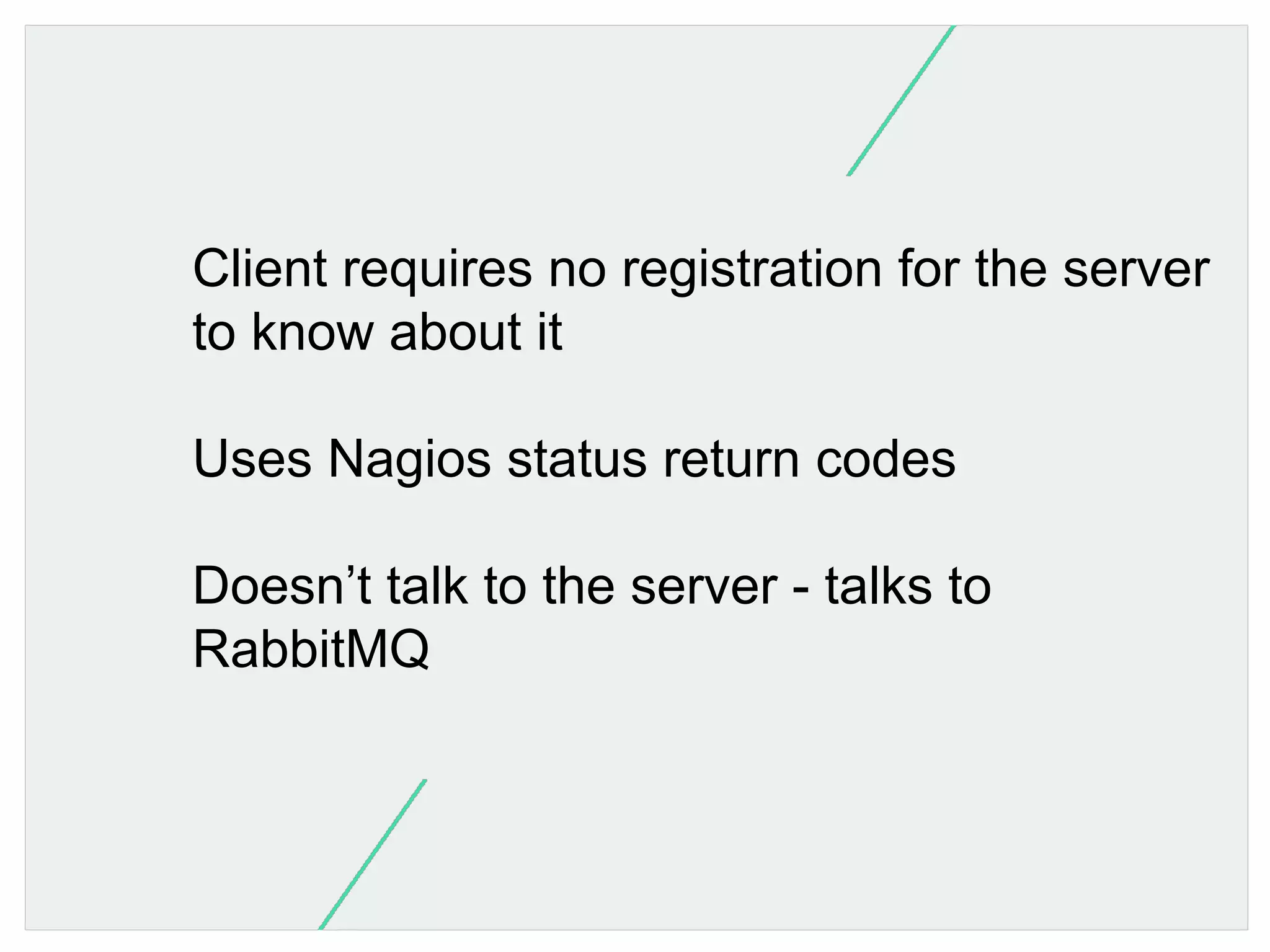
Client requires noregistration for the server
to know about it
Uses Nagios status return codes
Doesn’t talk to the server - talks to
RabbitMQ
24.
Core:
Holds configuration abouthosts / services
Distributed across X masters
Check execution (poke)
Results queue (poke response)
25.
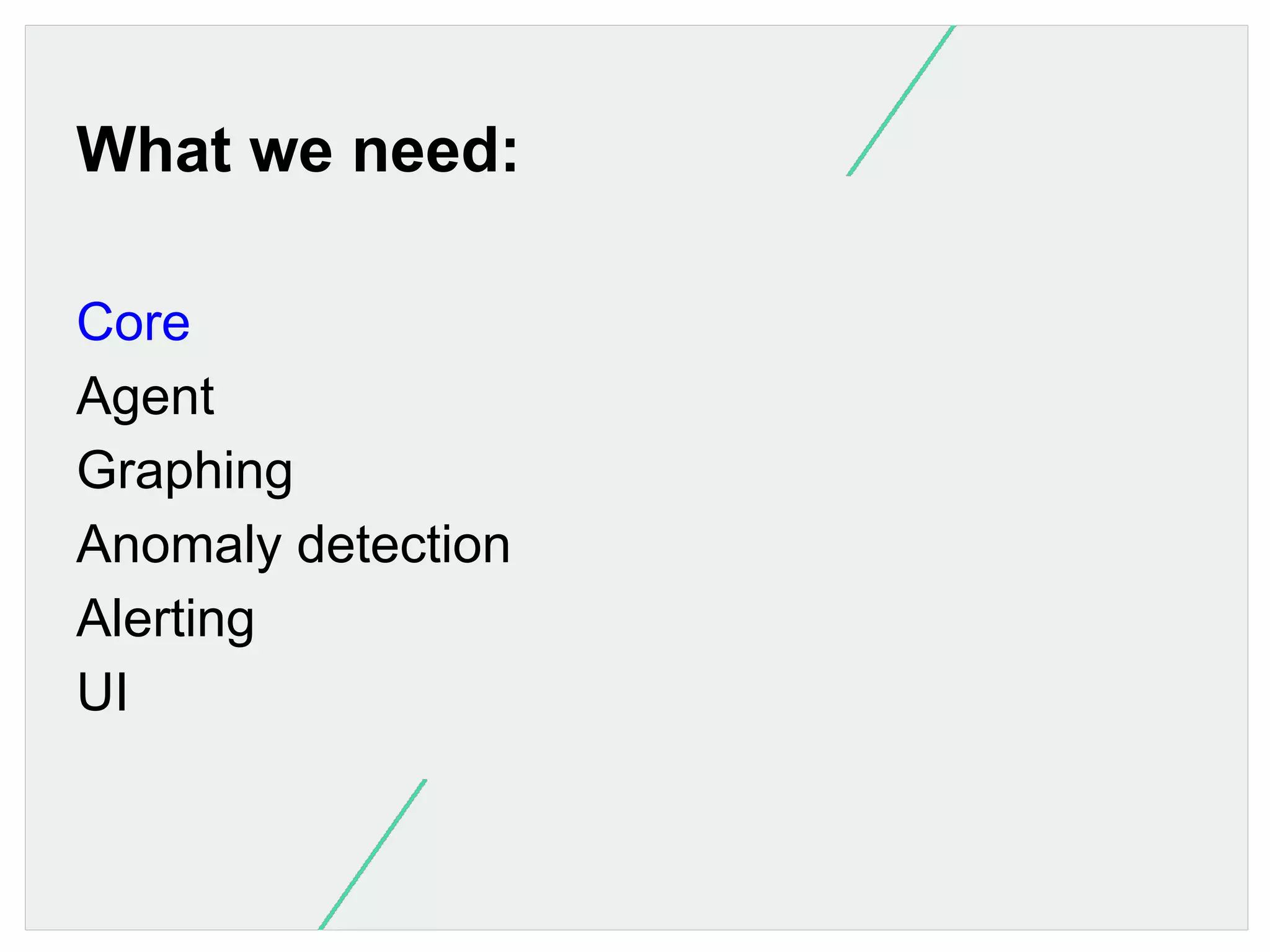
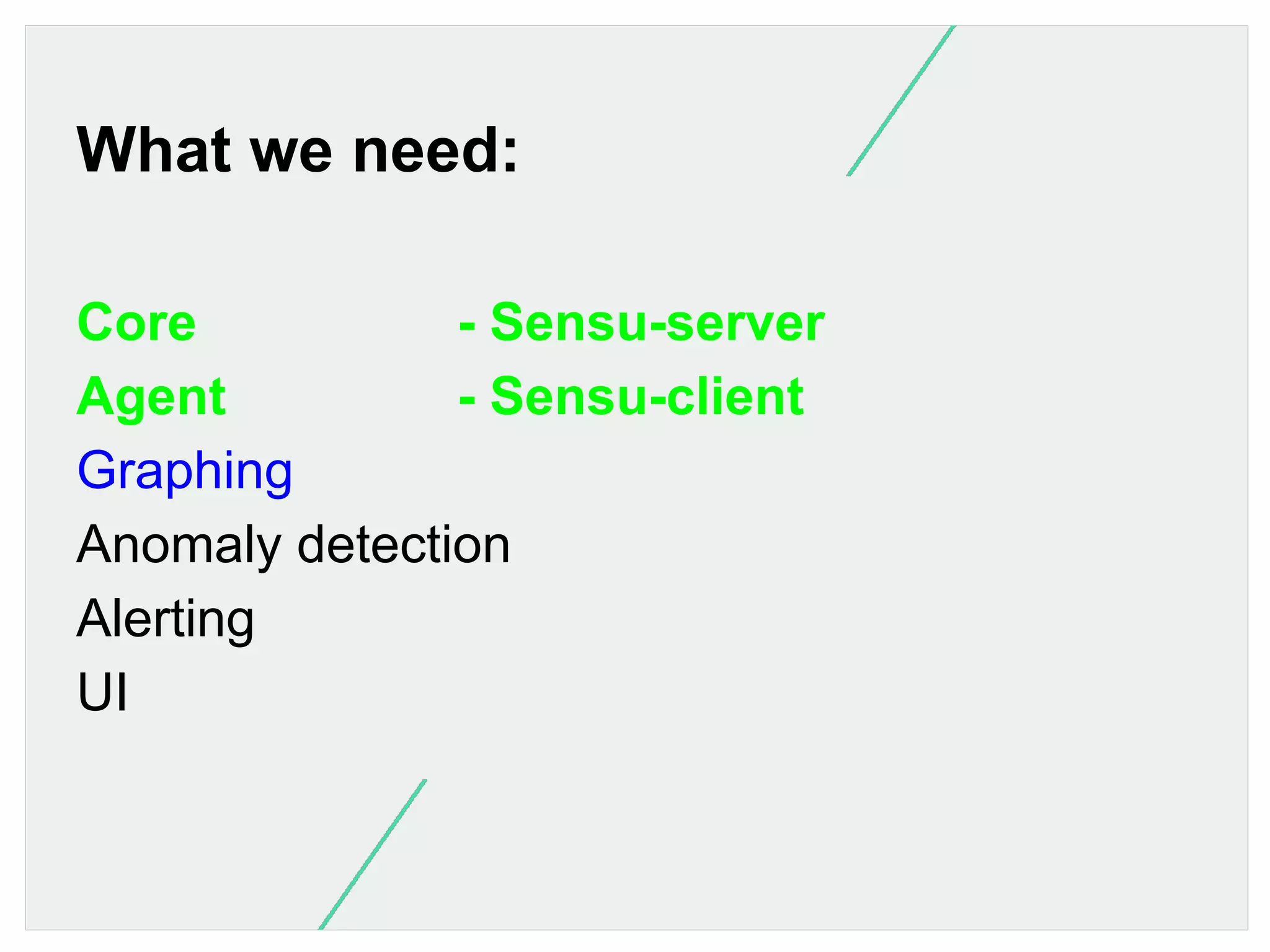
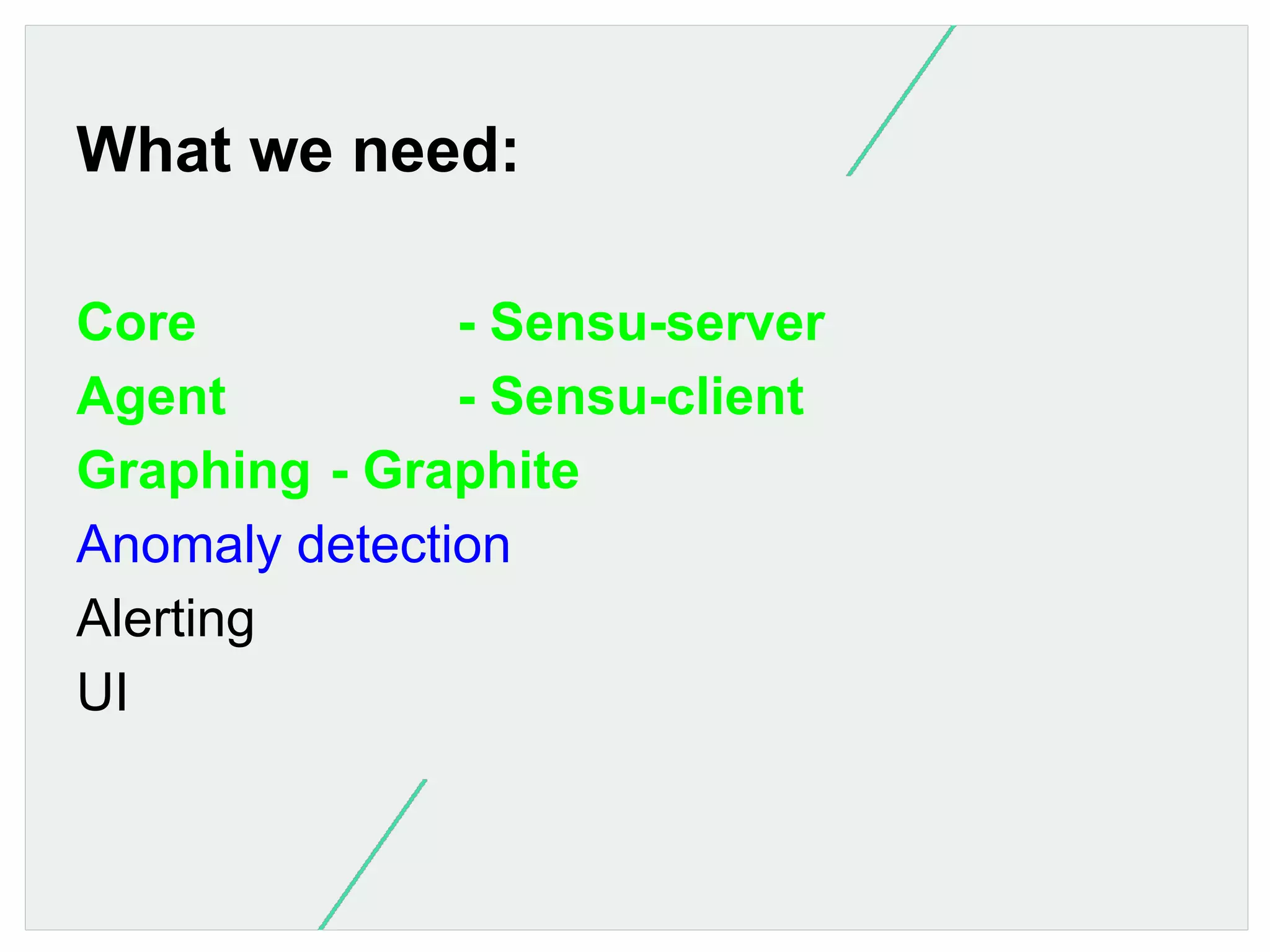
What we need:
Core
-Sensu-server
Agent
- Sensu-client
Graphing
Anomaly detection
Alerting
UI
26.
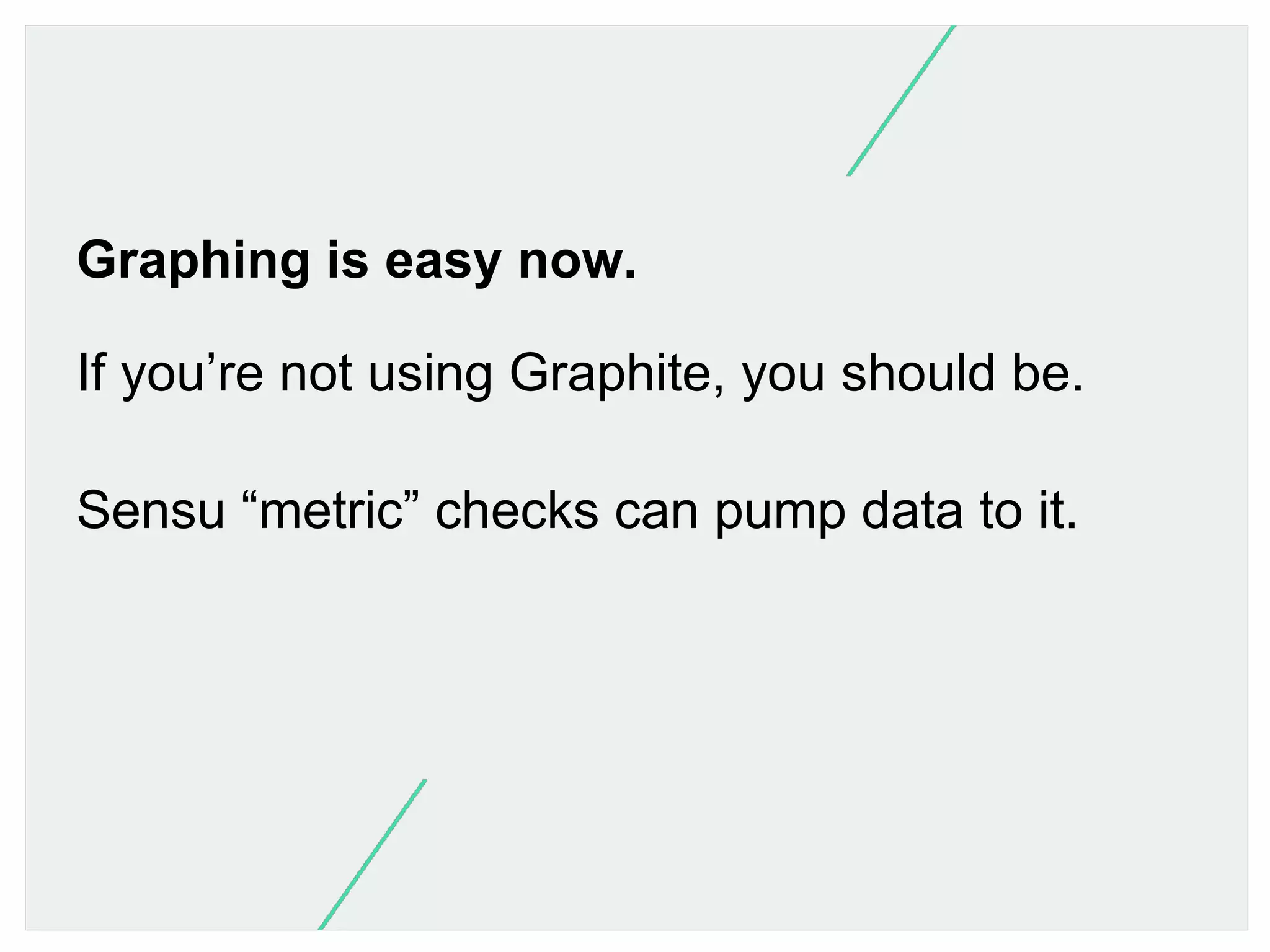
Graphing is easynow.
If you’re not using Graphite, you should be.
Sensu “metric” checks can pump data to it.
27.
What we need:
Core
-Sensu-server
Agent
- Sensu-client
Graphing - Graphite
Anomaly detection
Alerting
UI
28.
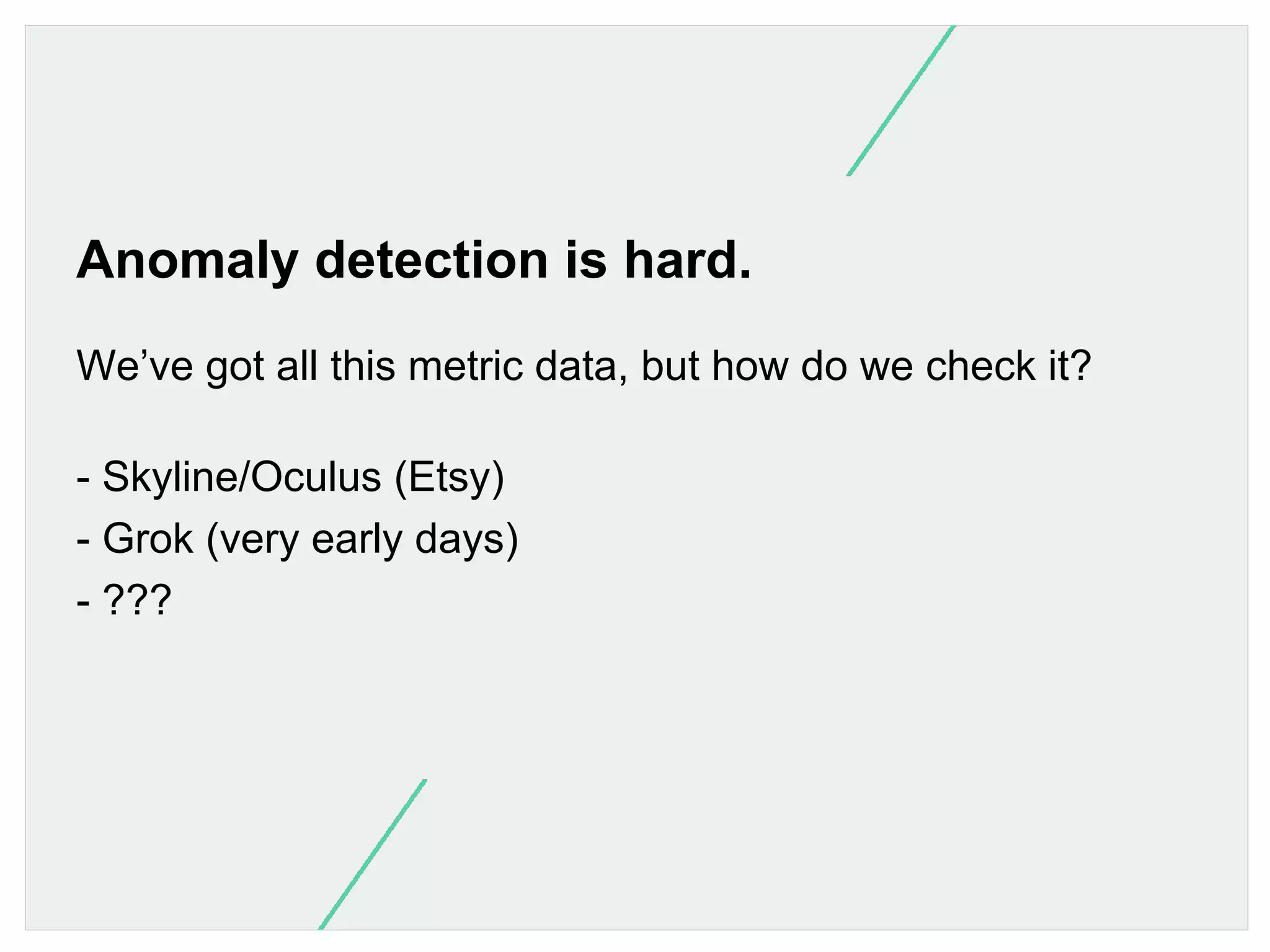
Anomaly detection ishard.
We’ve got all this metric data, but how do we check it?
- Skyline/Oculus (Etsy)
- Grok (very early days)
- ???
29.
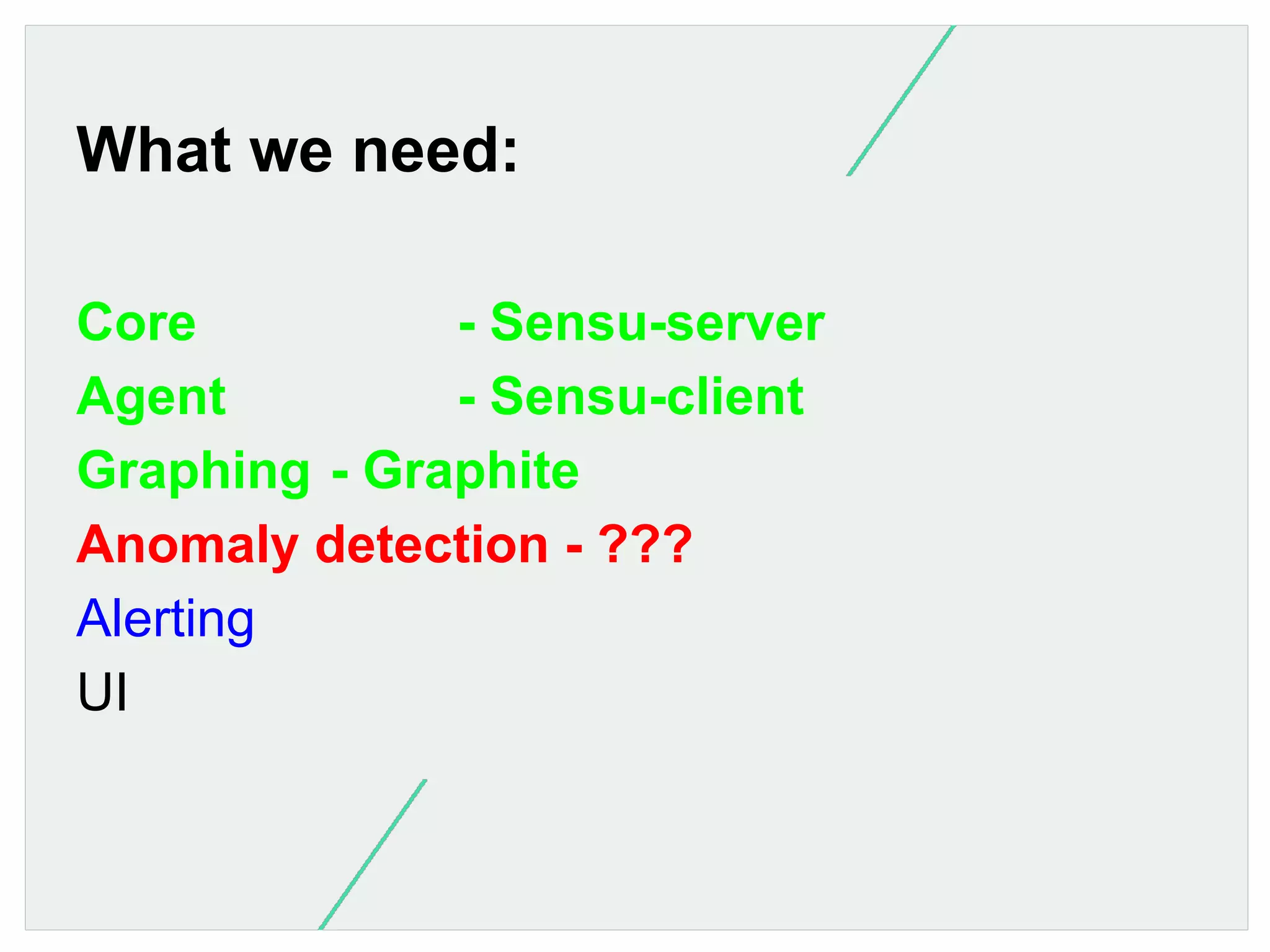
What we need:
Core
-Sensu-server
Agent
- Sensu-client
Graphing - Graphite
Anomaly detection - ???
Alerting
UI
30.
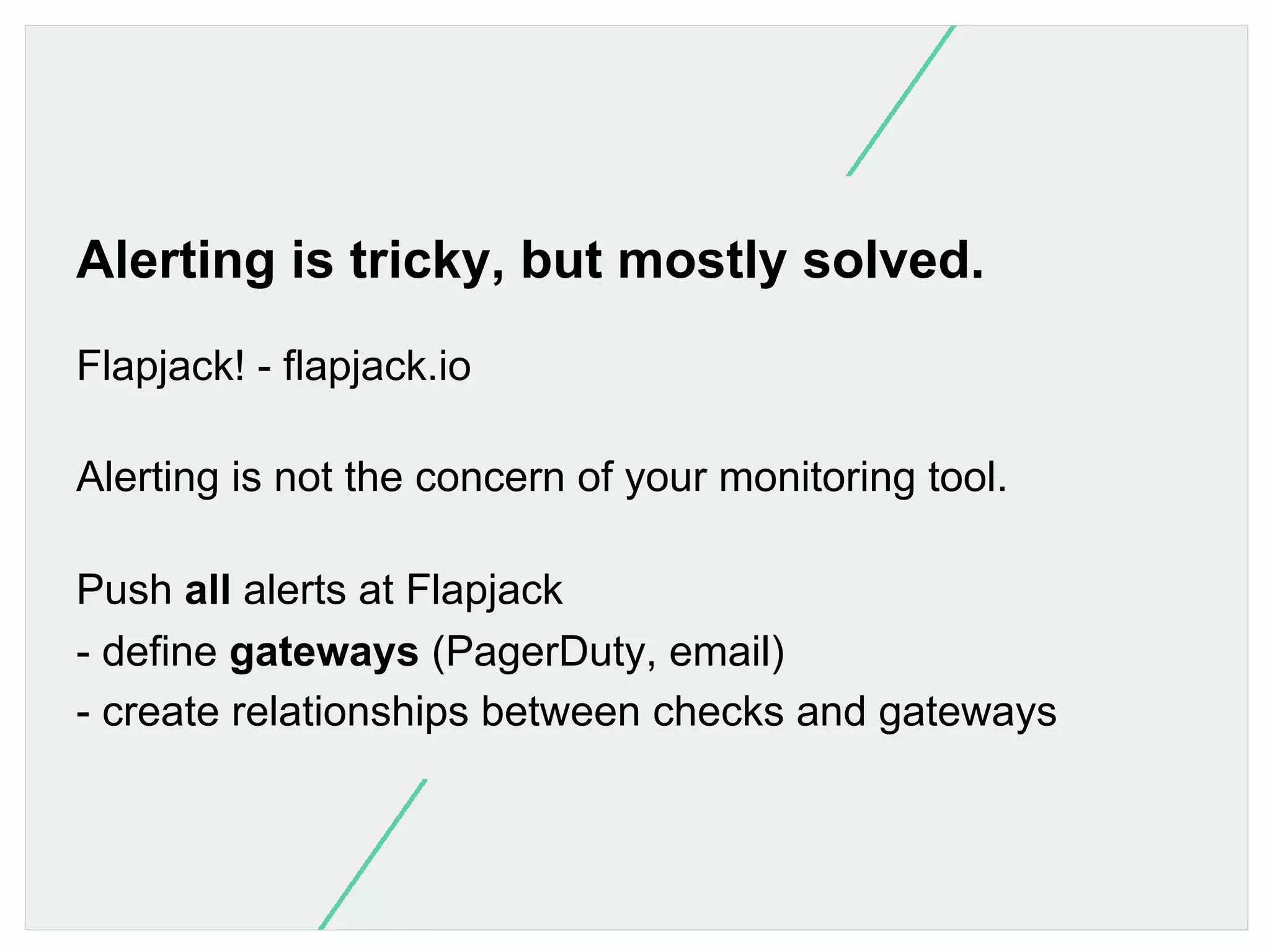
Alerting is tricky,but mostly solved.
Flapjack! - flapjack.io
Alerting is not the concern of your monitoring tool.
Push all alerts at Flapjack
- define gateways (PagerDuty, email)
- create relationships between checks and gateways
31.
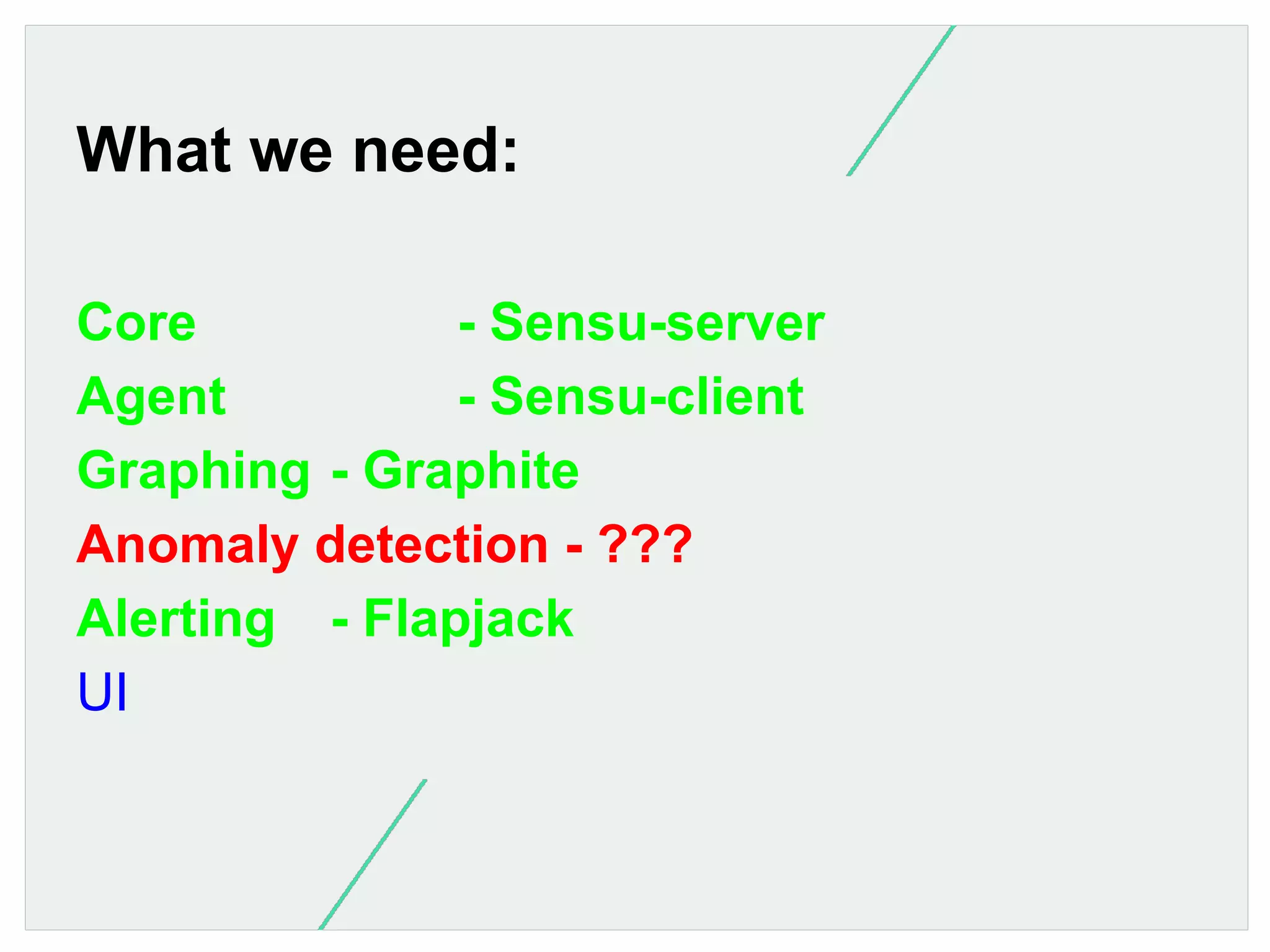
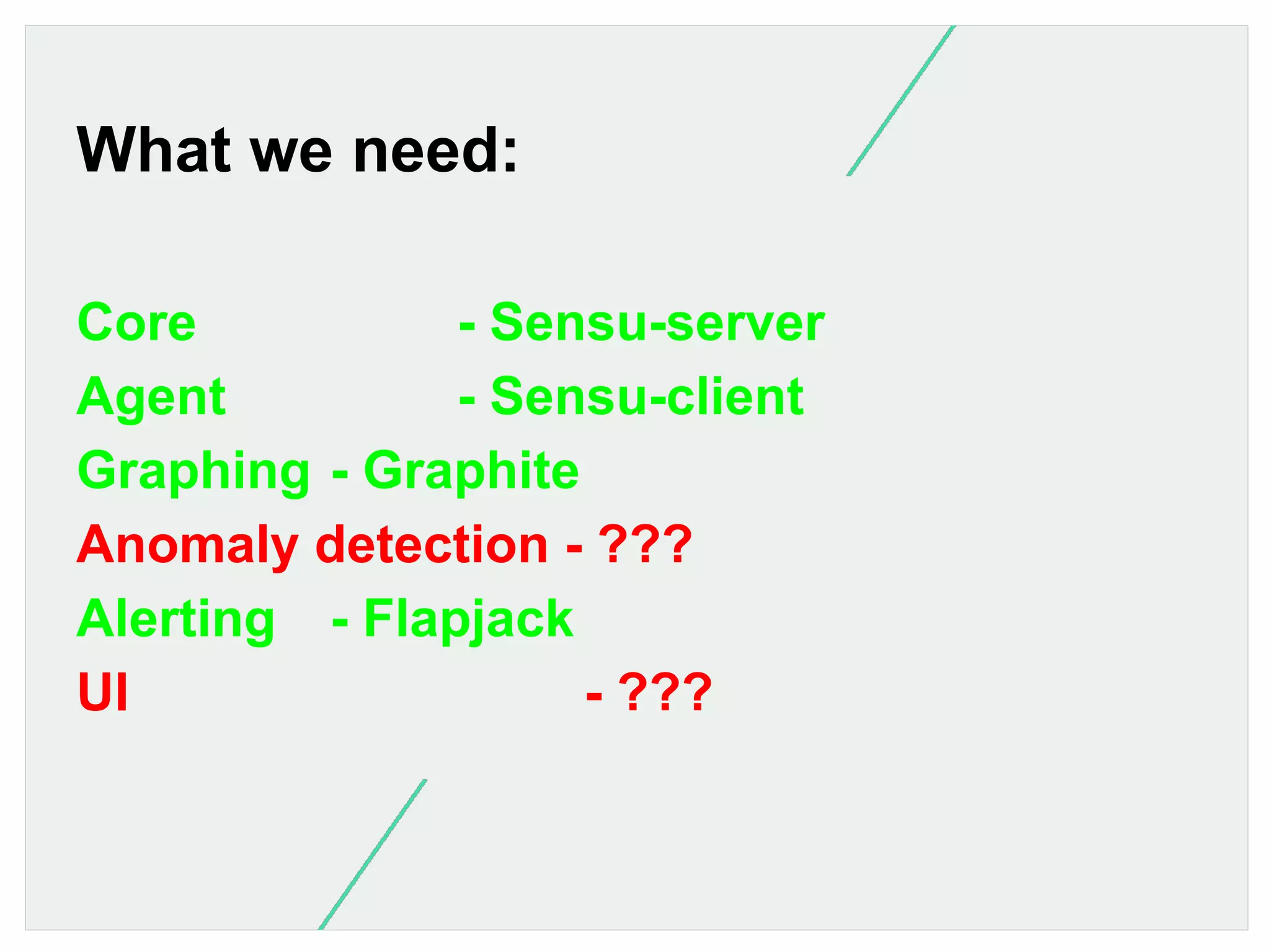
What we need:
Core
-Sensu-server
Agent
- Sensu-client
Graphing - Graphite
Anomaly detection - ???
Alerting - Flapjack
UI
32.
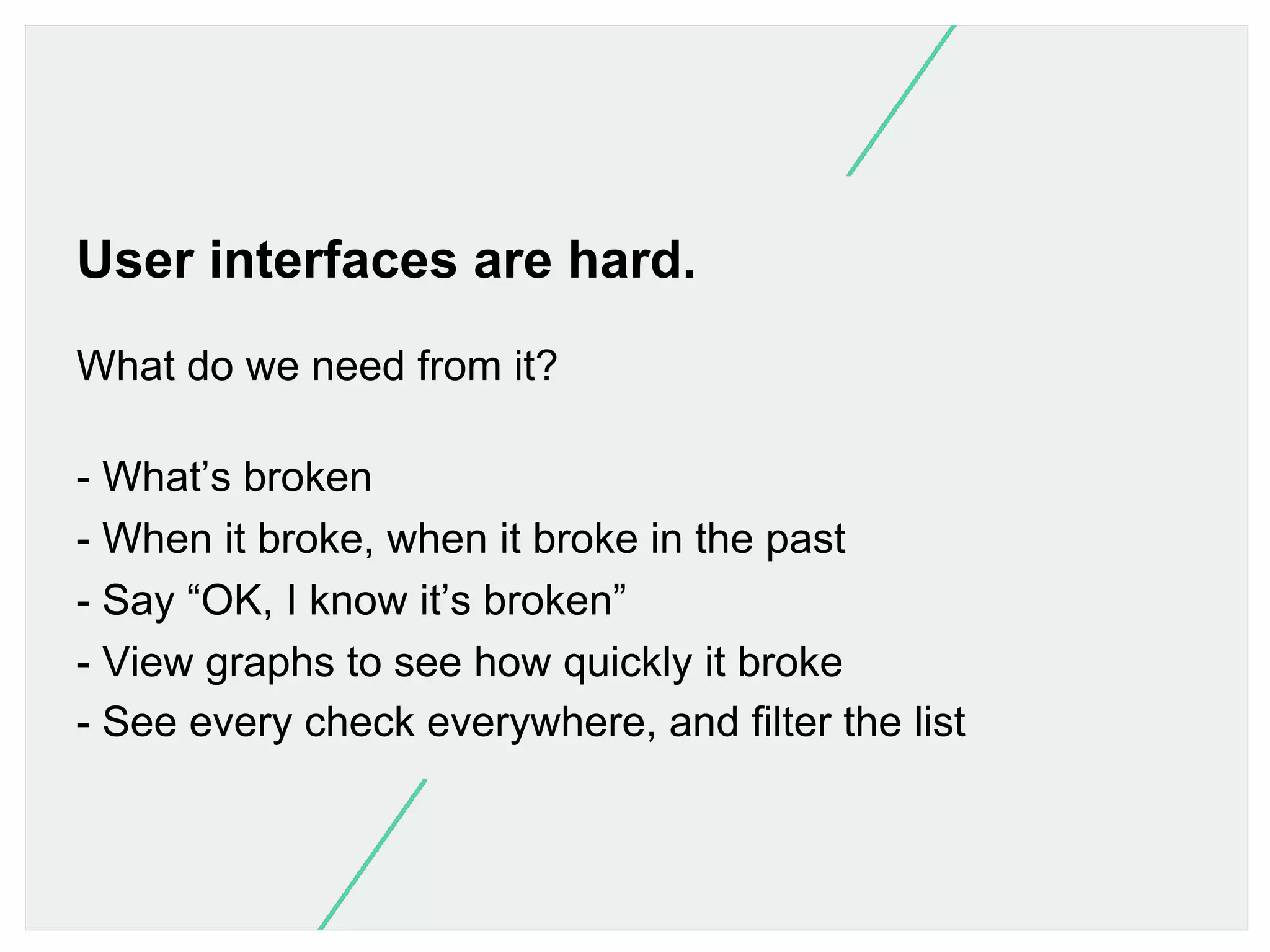
User interfaces arehard.
What do we need from it?
- What’s broken
- When it broke, when it broke in the past
- Say “OK, I know it’s broken”
- View graphs to see how quickly it broke
- See every check everywhere, and filter the list
33.
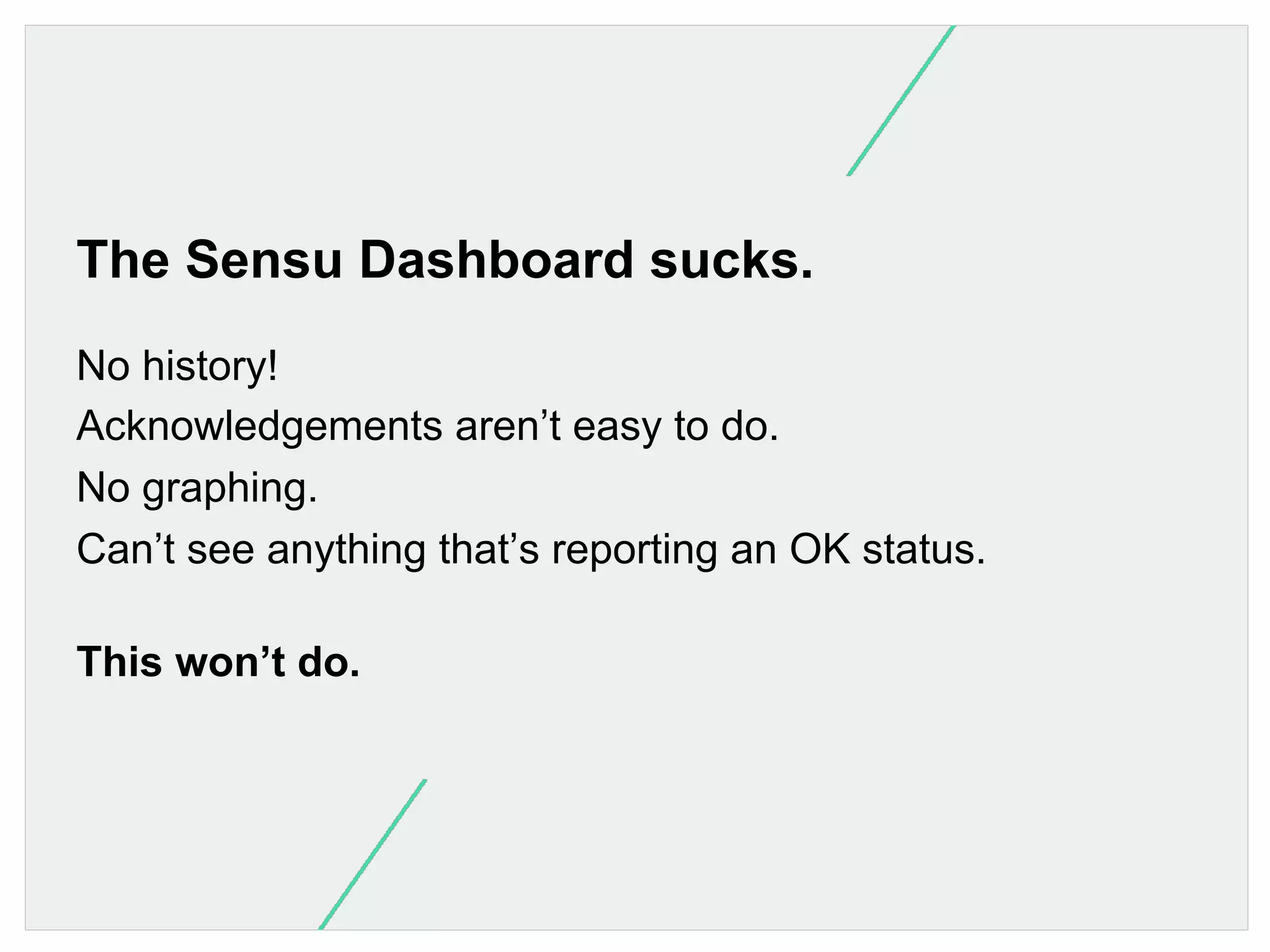
The Sensu Dashboardsucks.
No history!
Acknowledgements aren’t easy to do.
No graphing.
Can’t see anything that’s reporting an OK status.
This won’t do.