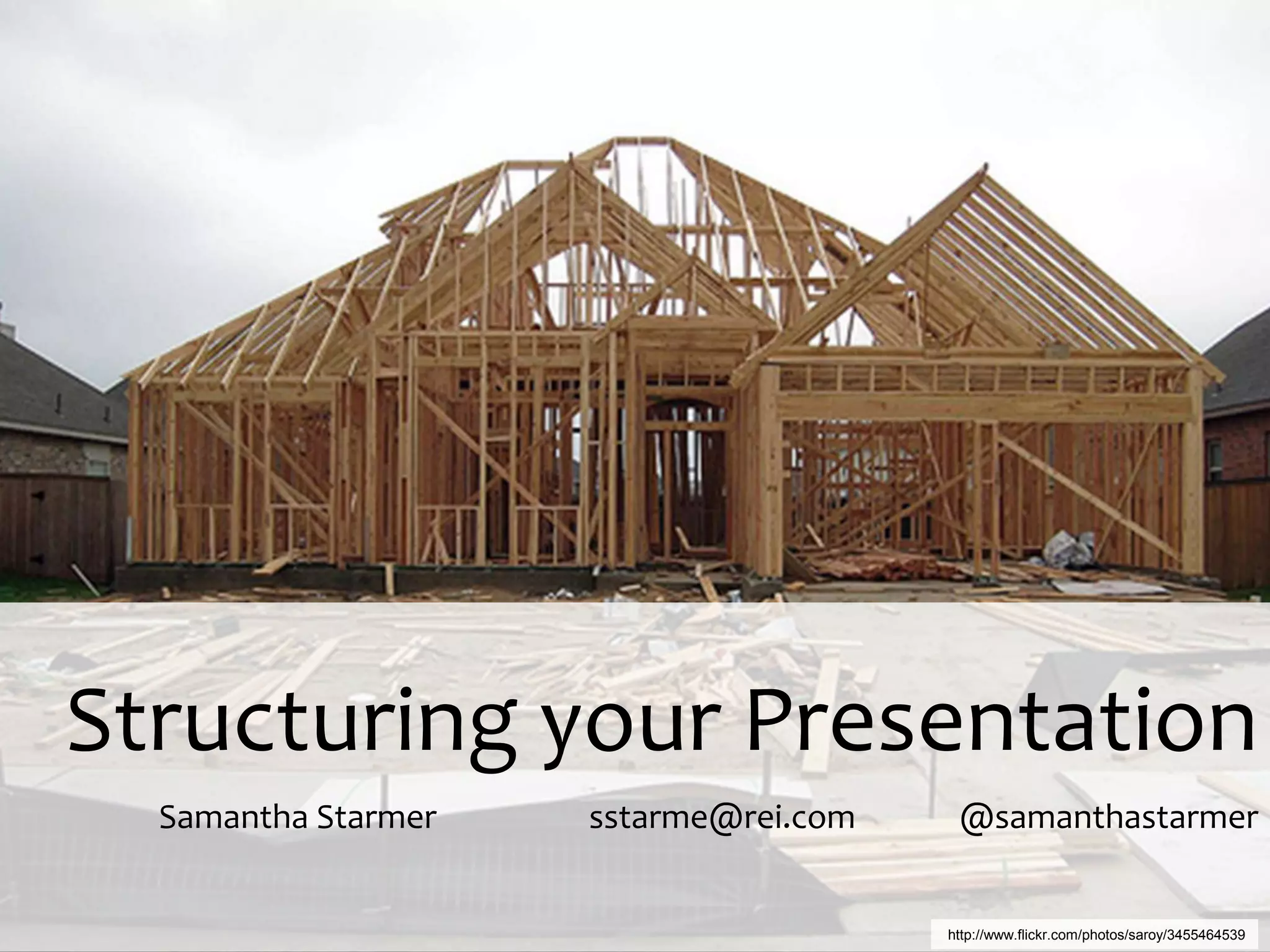
Structuring your Presentation
  Samantha Starmer   sstarme@rei.com    @samanthastarmer


                                       http://www.flickr.com/photos/saroy/3455464539
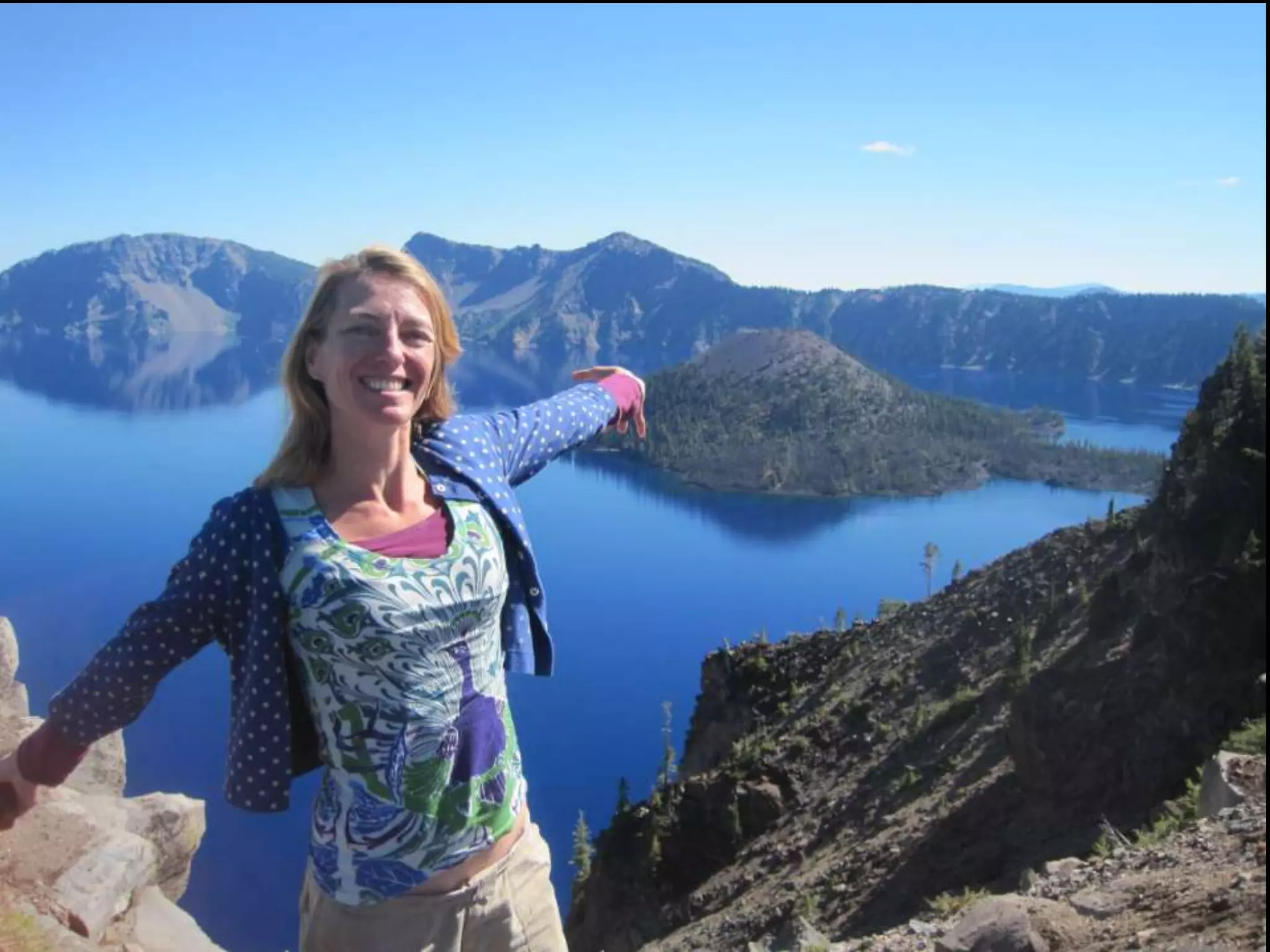
me
     experience, web stuff: Amazon, Microsoft
             REI – Recreational Equipment, Inc.
            lead design, IA & experience teams
             teach at University of Washington
4 key principles
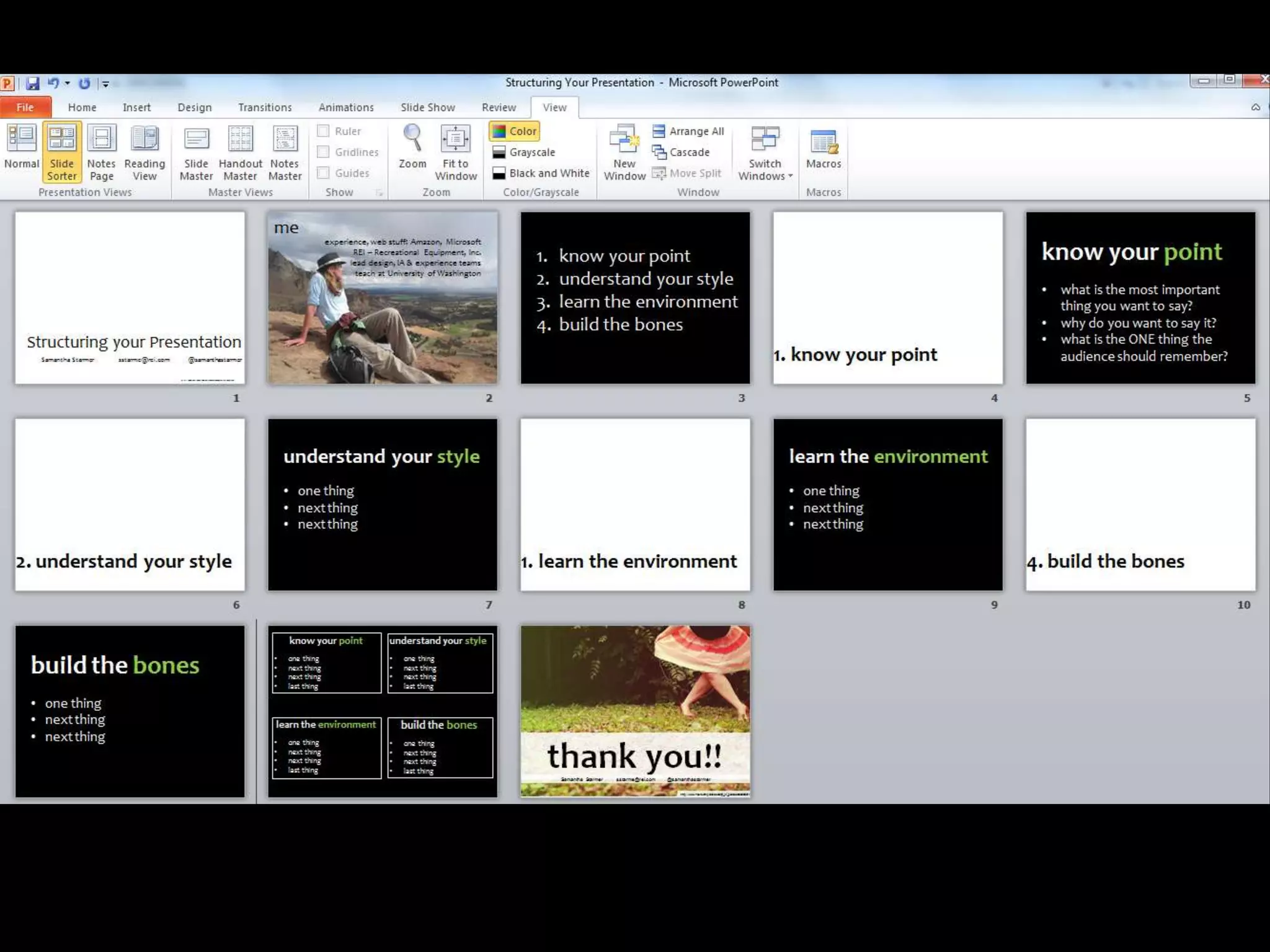
1.   start with you
2.   learn the environment
3.   build the bones
4.   leave time to adjust
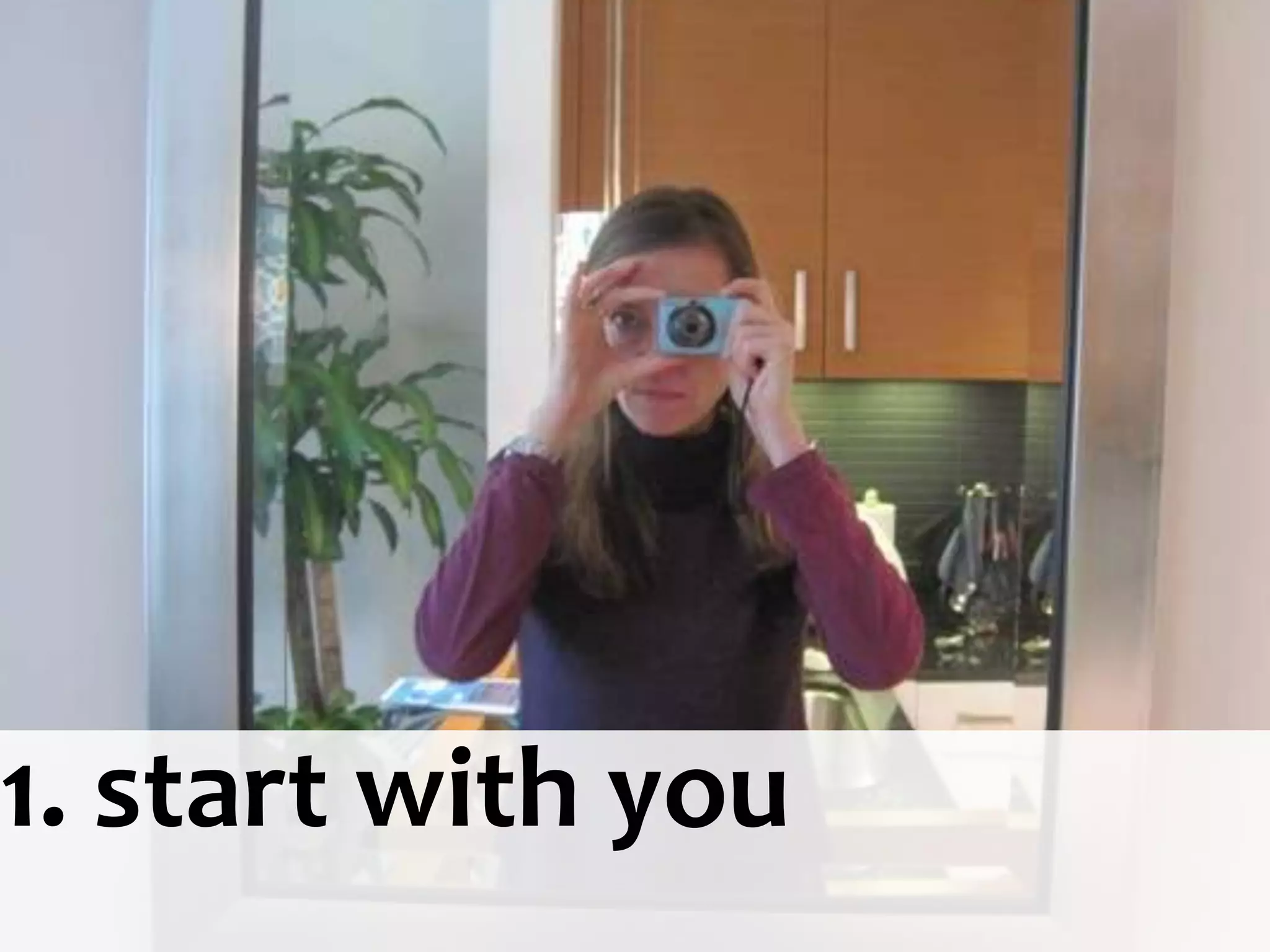
1. start with you
1. start with you
•   what is the ONE thing?
•   think about the story
•   what is your style?
•   are you scared?
what is the ONE thing?


               http://www.flickr.com/photos/14617207@N00/4872111479
what is the ONE thing?

• why are you speaking?
• what is your point?
• what is the ONE thing you want
  your audience to remember?


                   http://www.flickr.com/photos/14617207@N00/4872111479
think about the story


                 http://www.flickr.com/photos/sugarpond/3016905349
think about the story

• beginning, middle and end
  (make sure there is an end)
• all points to your ONE thing
• how would you tell it to your
  grandma? to a child?

                     http://www.flickr.com/photos/sugarpond/3016905349
what is your style?


                      http://
what is your style?

• formal or informal?
• deep details or inspirational?
• don’t try to be funny if it isn’t
  natural
• get feedback. lots of it.
are you scared?


                  http://www.flickr.com/photos/mindaugasdanys/3766009204/
are you scared?
• the more nervous you are, the
  more structure you need
• unless you are a very skilled
  improviser
• in which case, you probably
  wouldn’t be in this class

                   http://www.flickr.com/photos/14617207@N00/4872111479
2. learn the environment
                  http://www.flickr.com/photos/brue/4806532954
2. learn the environment
•   scout the space
•   know your audience
•   build to your time limit
•   understand expectations
scout the space


                  http://www.flickr.com/photos/mikecogh/4157191493
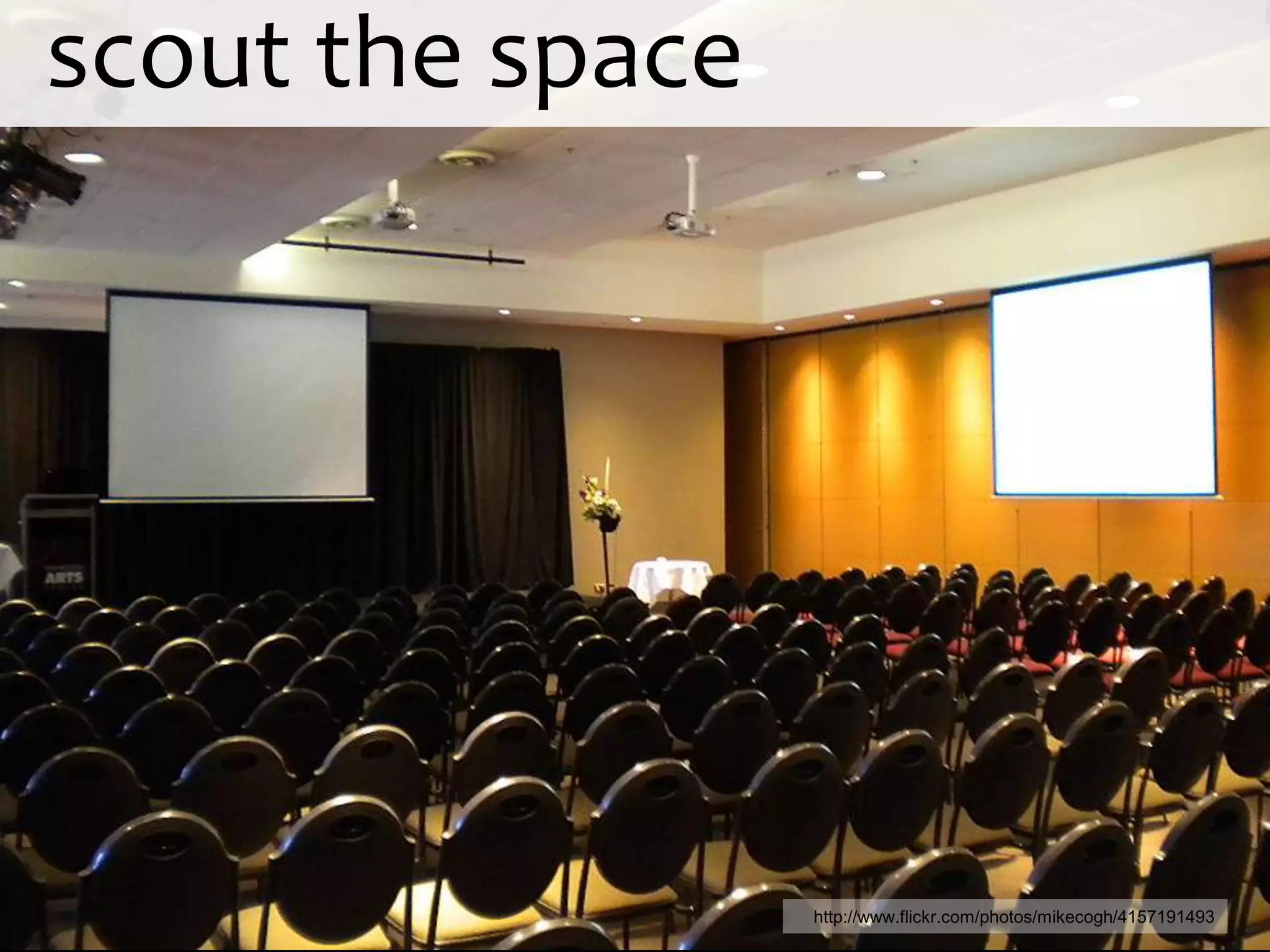
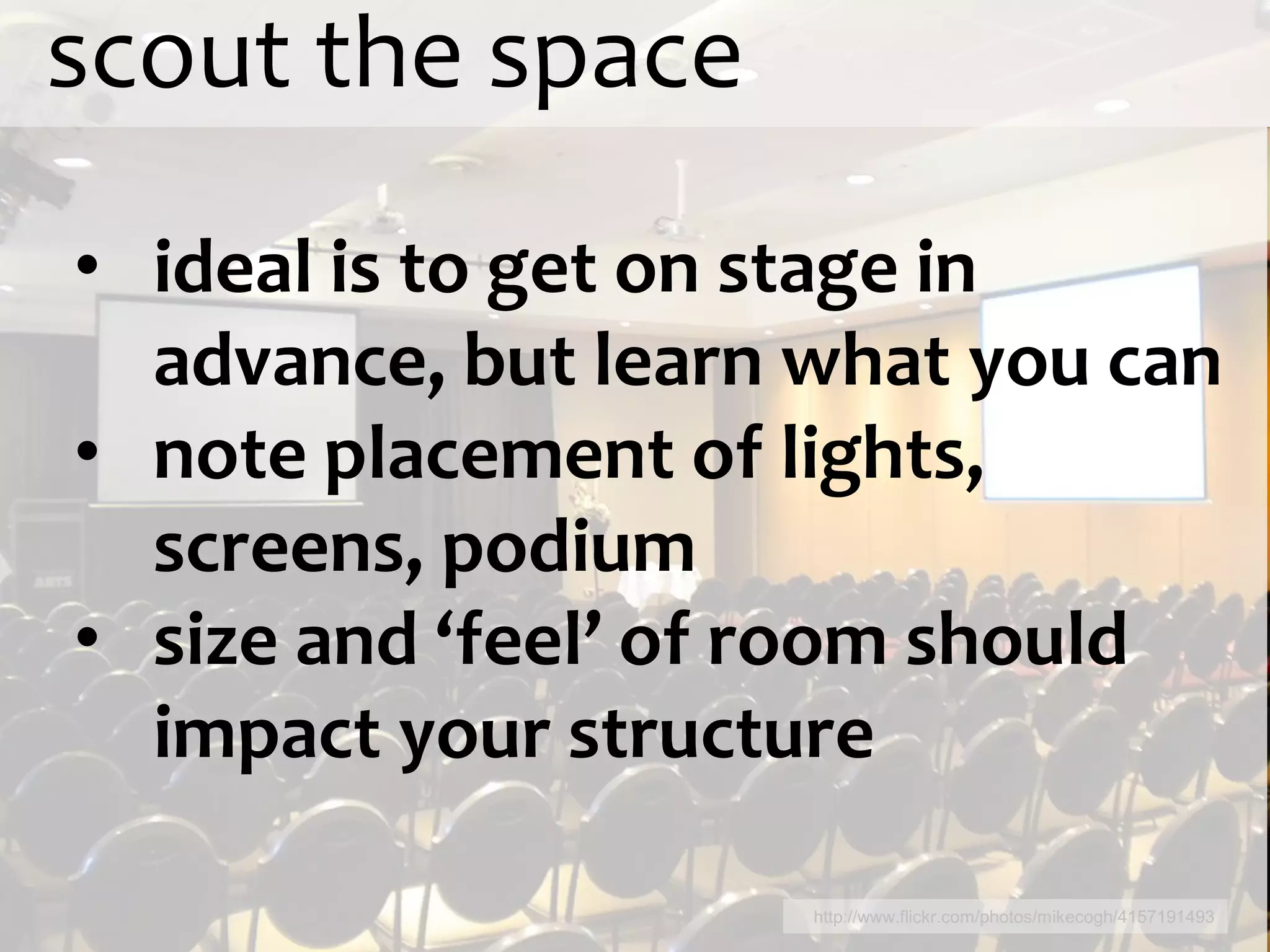
scout the space
• ideal is to get on stage in
  advance, but learn what you can
• note placement of lights,
  screens, podium
• size and ‘feel’ of room should
  impact your structure

                     http://www.flickr.com/photos/mikecogh/4157191493
know your audience


              http://www.flickr.com/photos/36714668@N02/4598065240
know your audience

•   size, level of expertise
•   what do they want from you?
•   voluntary or hostage?
•   bored or interested?
•   friendly or combative?

                    http://www.flickr.com/photos/14617207@N00/4872111479
build to your time limit


                  http://www.flickr.com/photos/wwarby/3297205226
build to your time limit
• focus your topic on the time limit
• focus your scope & detail on the
  time limit
• the less time to prepare, the more
  structure you need
• experience will improve your gut
  sense

                        http://www.flickr.com/photos/wwarby/3297205226
understand expectations


              http://www.flickr.com/photos/kristin-and-adam/2778203028
understand expectations

• do they expect results? or is the
  journey more relevant?
• technical or high level?
• what kind of assets/deliverables?


                    http://www.flickr.com/photos/kristin-and-adam/2778203028
3. build the bones
                     http://www.flickr.com/photos/ianturton/9555513
3. build the bones
•   free your mind
•   remember the story
•   just jump in
•   make it FUN!
free your mind


                 http://en.wikipedia.org/wiki/File:PhrenologyPix.jpg
free your mind

•   don’t constrain too early
•   use your creative juice makers
•   let it percolate
•   be willing to throw out initial ideas
•   which means you need twice the
    planning time you expect

                          http://en.wikipedia.org/wiki/File:PhrenologyPix.jpg
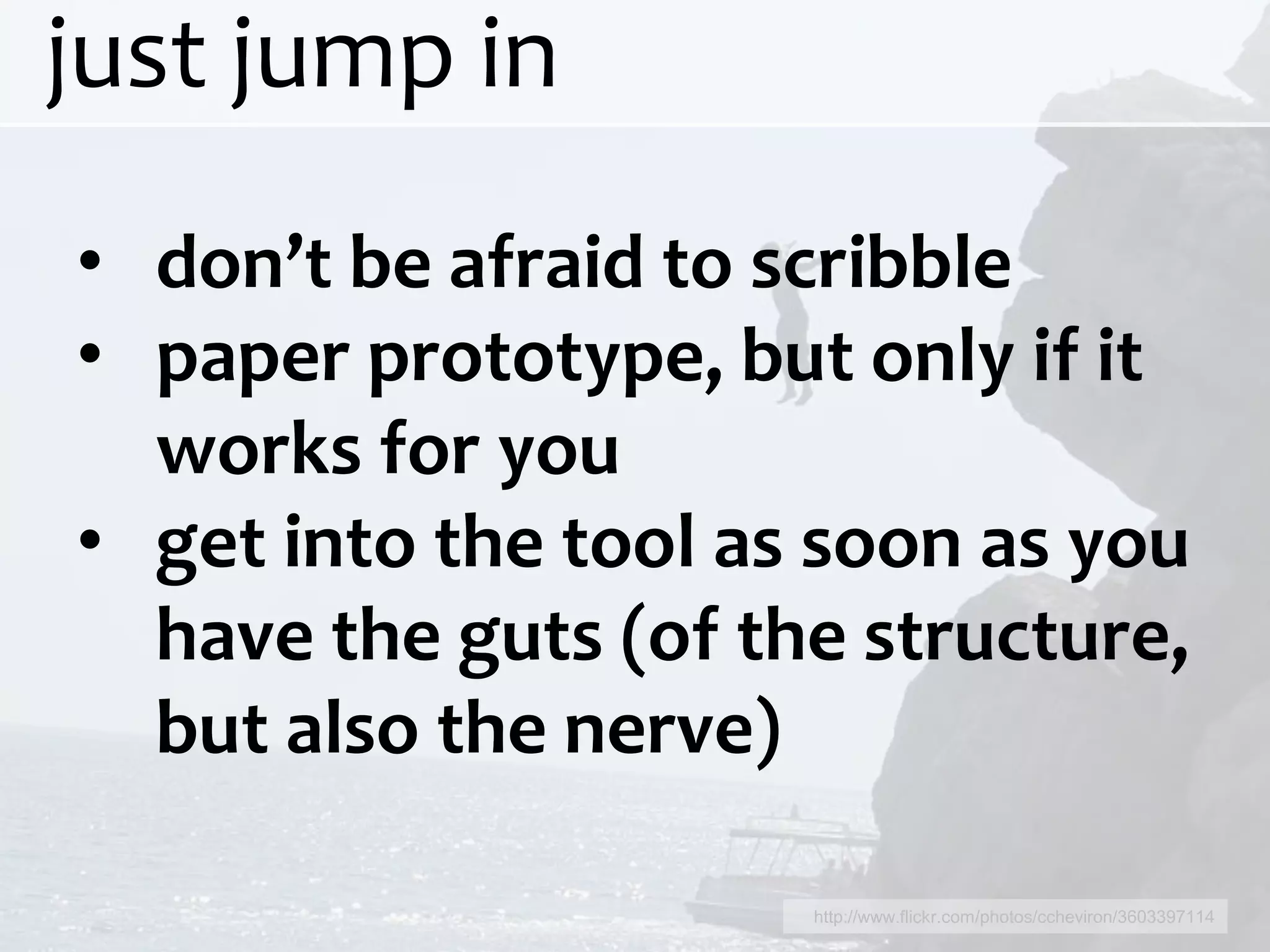
just jump in


               http://www.flickr.com/photos/ccheviron/3603397114
just jump in
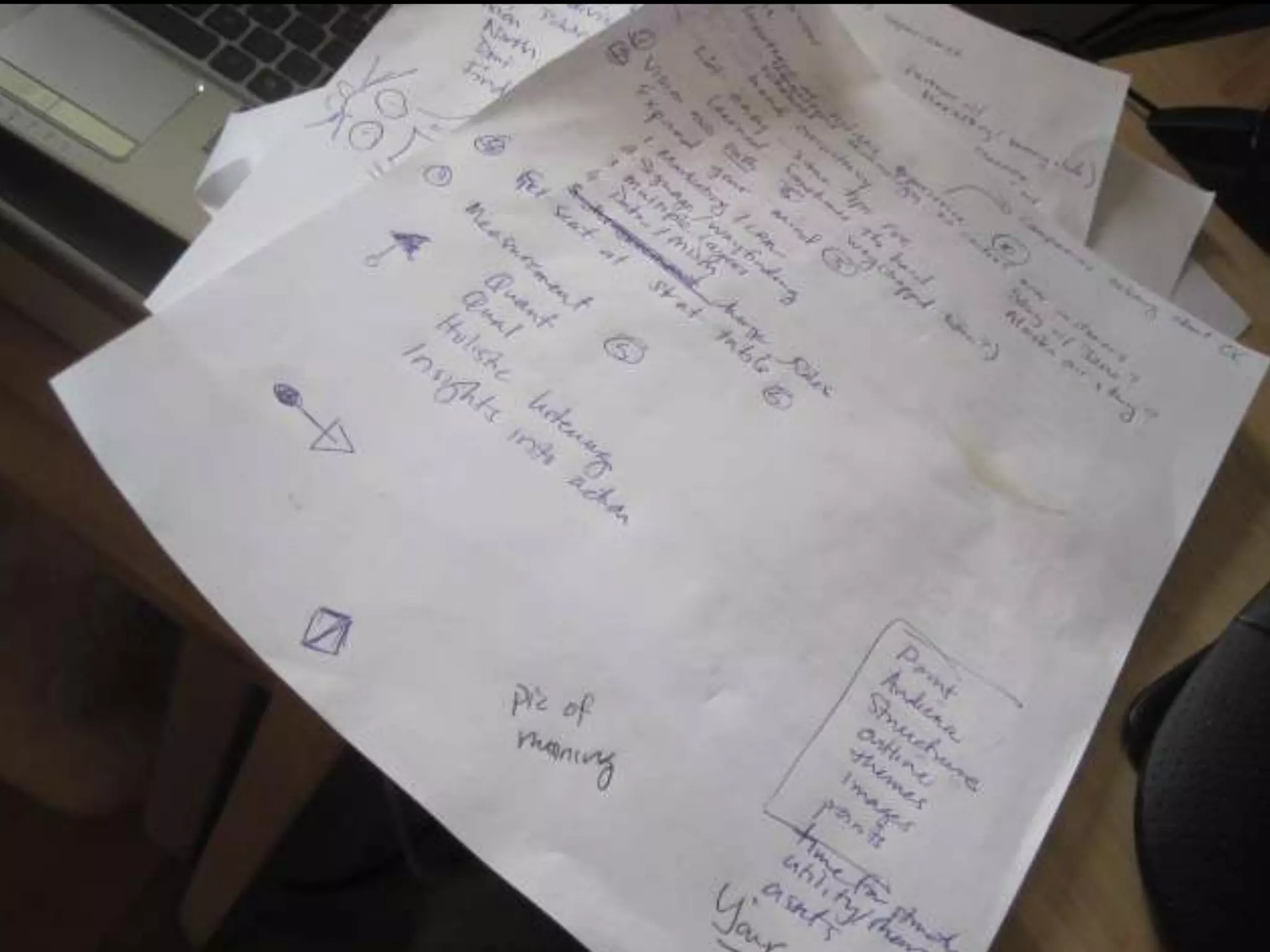
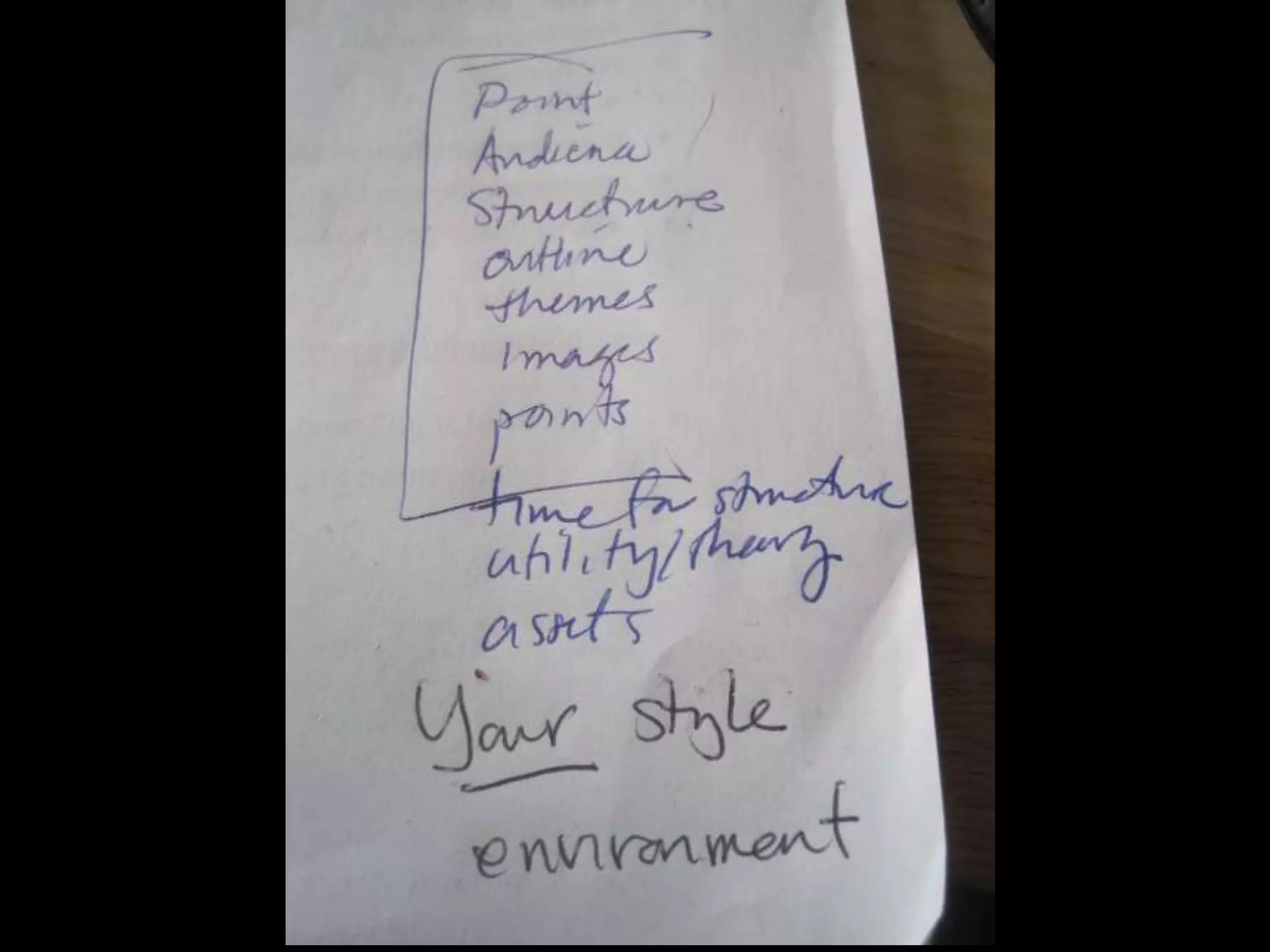
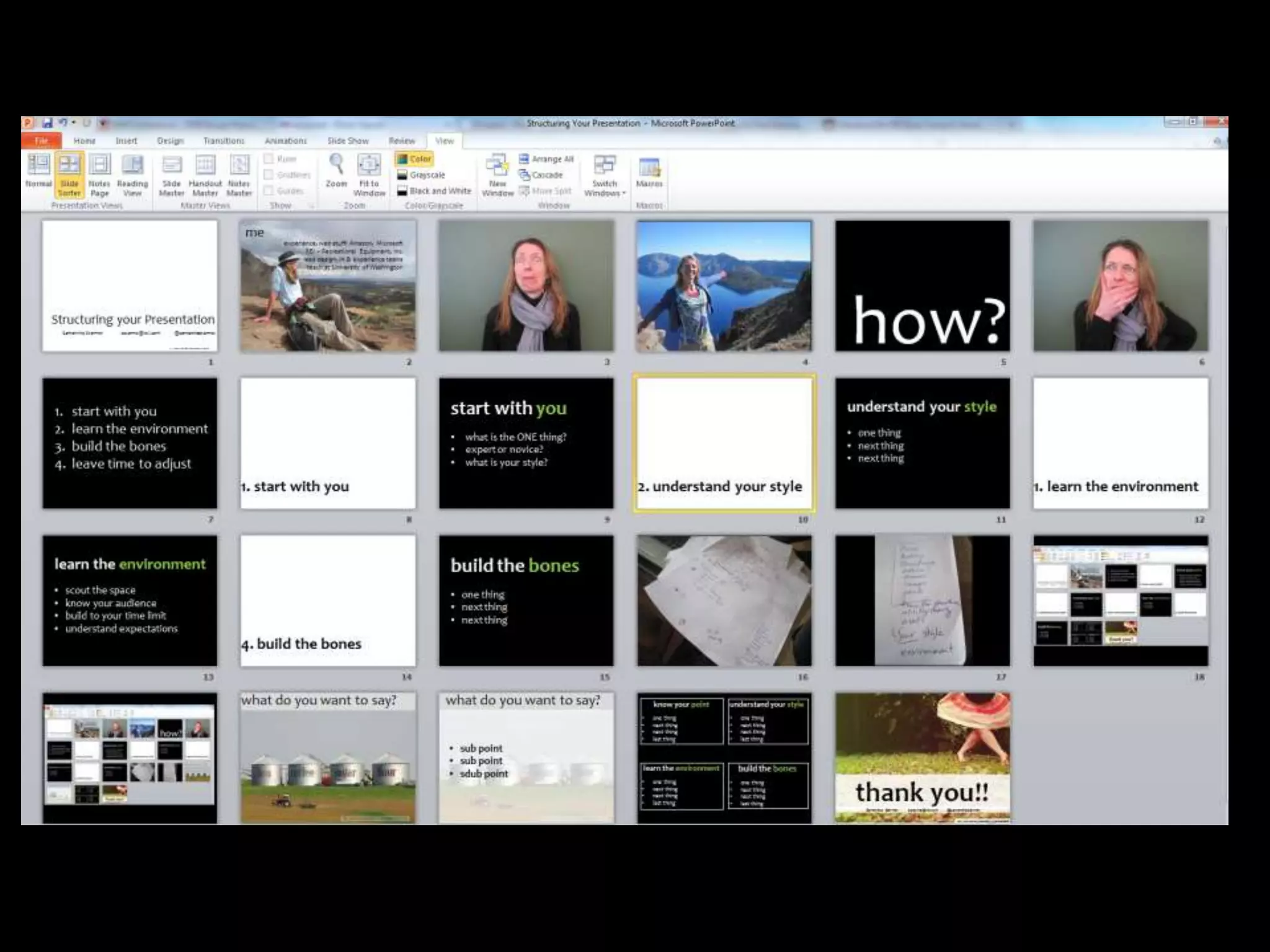
• don’t be afraid to scribble
• paper prototype, but only if it
  works for you
• get into the tool as soon as you
  have the guts (of the structure,
  but also the nerve)

                      http://www.flickr.com/photos/ccheviron/3603397114
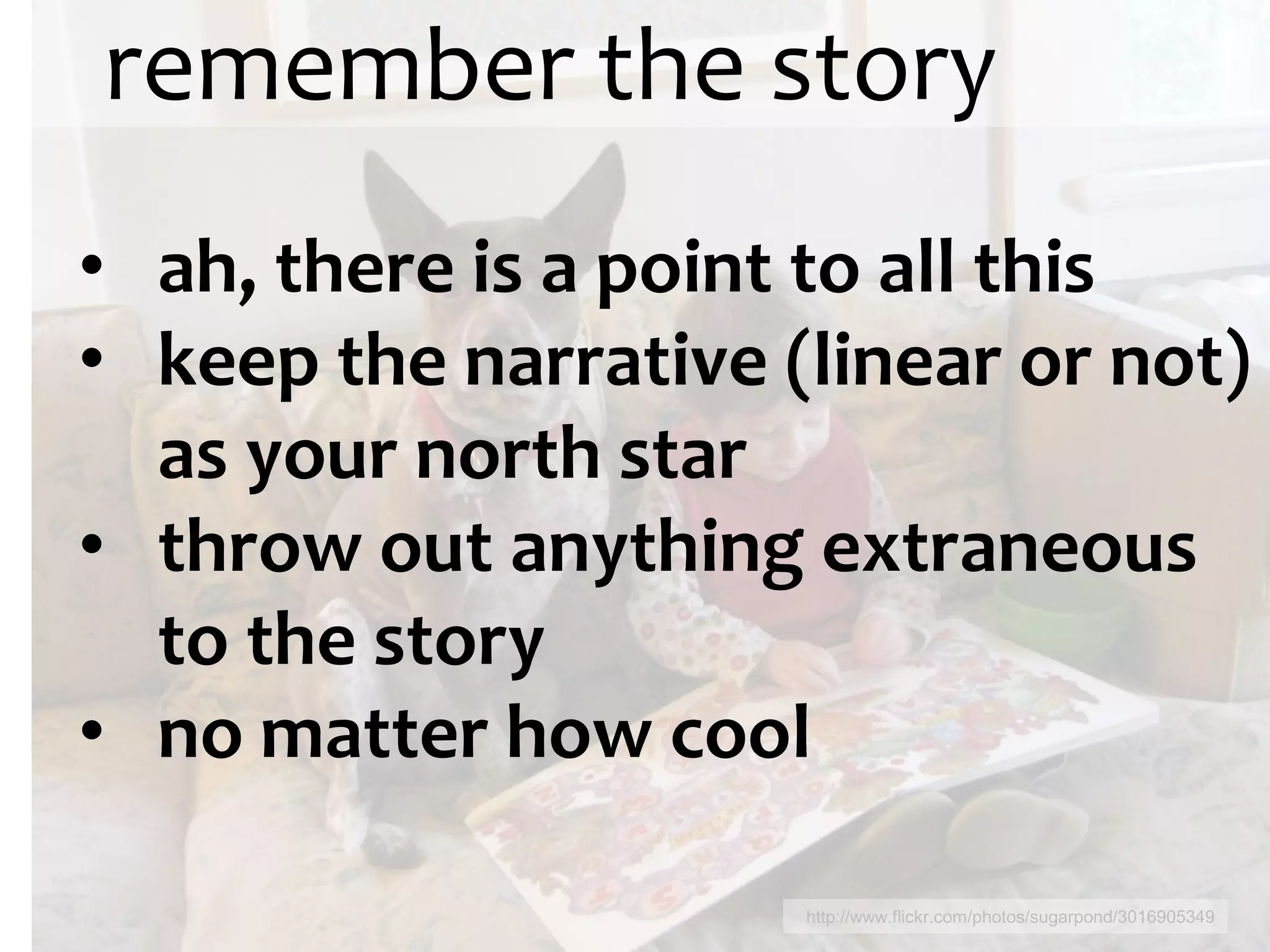
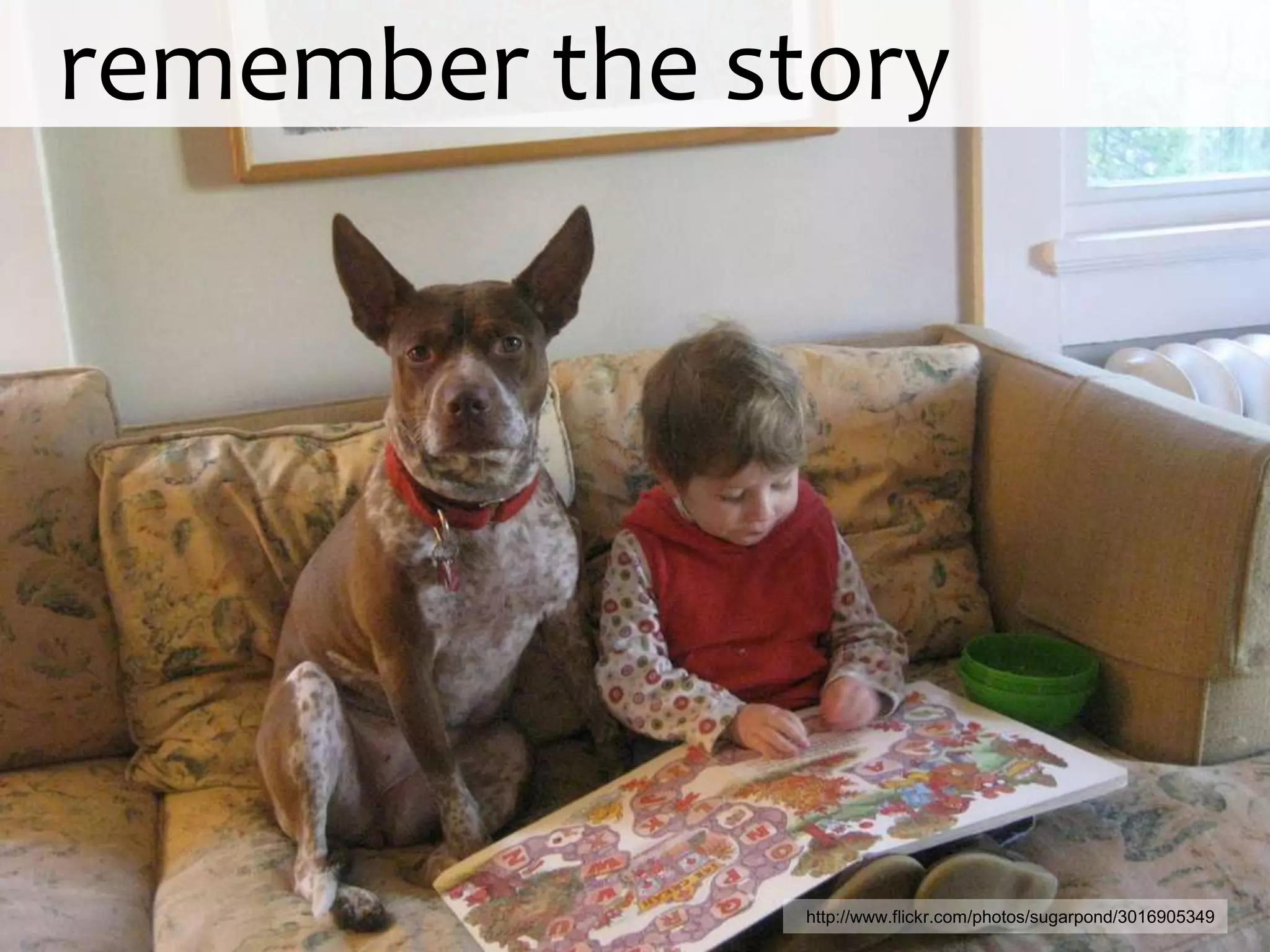
remember the story


               http://www.flickr.com/photos/sugarpond/3016905349
remember the story
• ah, there is a point to all this
• keep the narrative (linear or not)
  as your north star
• throw out anything extraneous
  to the story
• no matter how cool

                      http://www.flickr.com/photos/sugarpond/3016905349
make it FUN!
make it FUN!
 • you should enjoy building the
   story
 • you should enjoy creating the
   structure
 • you will feel a quiet ping when it
   starts to come together
4. leave time to adjust
                    http://www.flickr.com/photos/clintjcl/4001170877
4. leave time to adjust
•   lift your head out of the trees
•   remember the ONE thing
•   practice time is critical
•   minimum formula: 70%, 25%, 5%
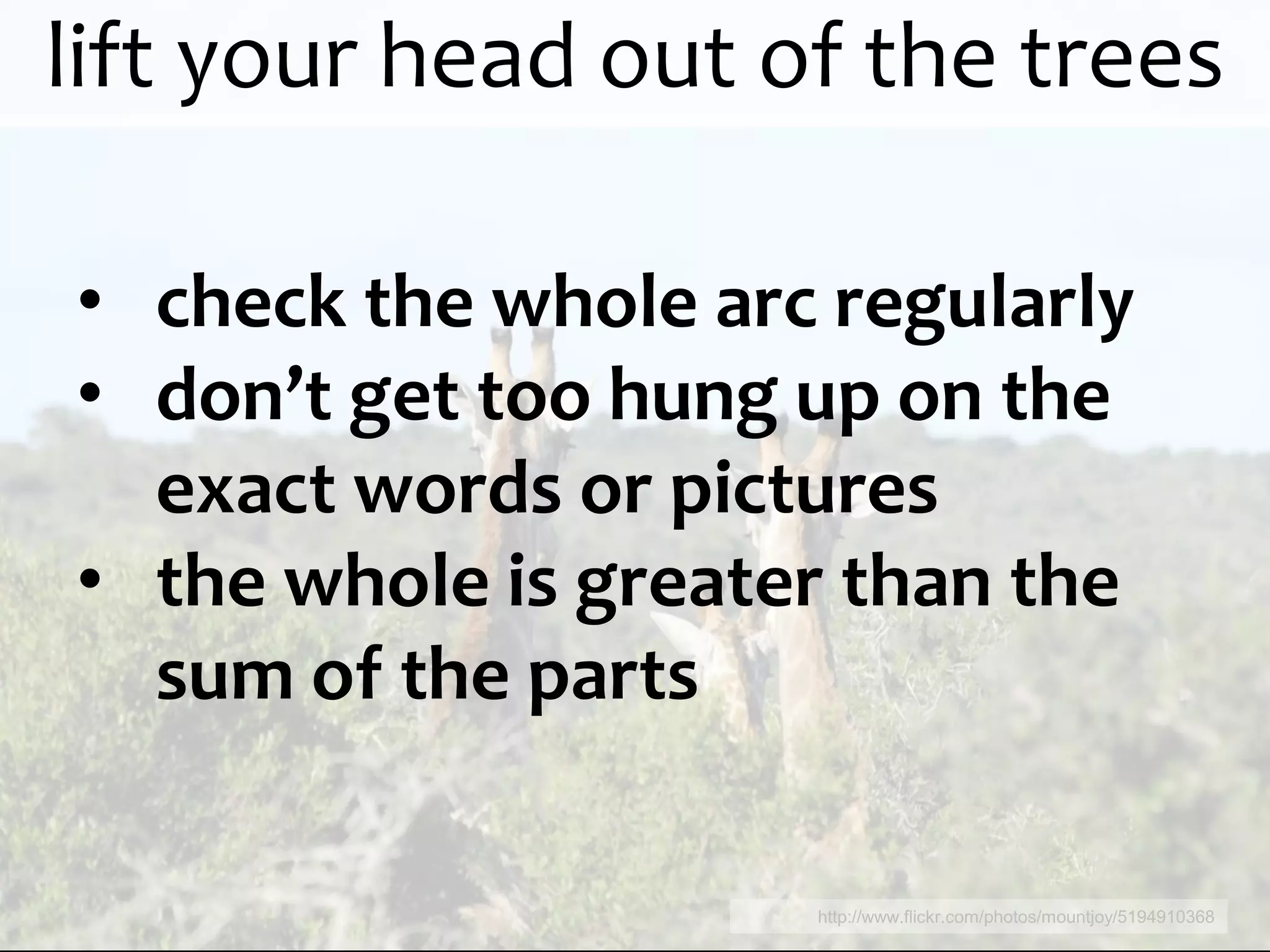
lift your head out of the trees


                    http://www.flickr.com/photos/mountjoy/5194910368
lift your head out of the trees

• check the whole arc regularly
• don’t get too hung up on the
  exact words or pictures
• the whole is greater than the
  sum of the parts

                     http://www.flickr.com/photos/mountjoy/5194910368
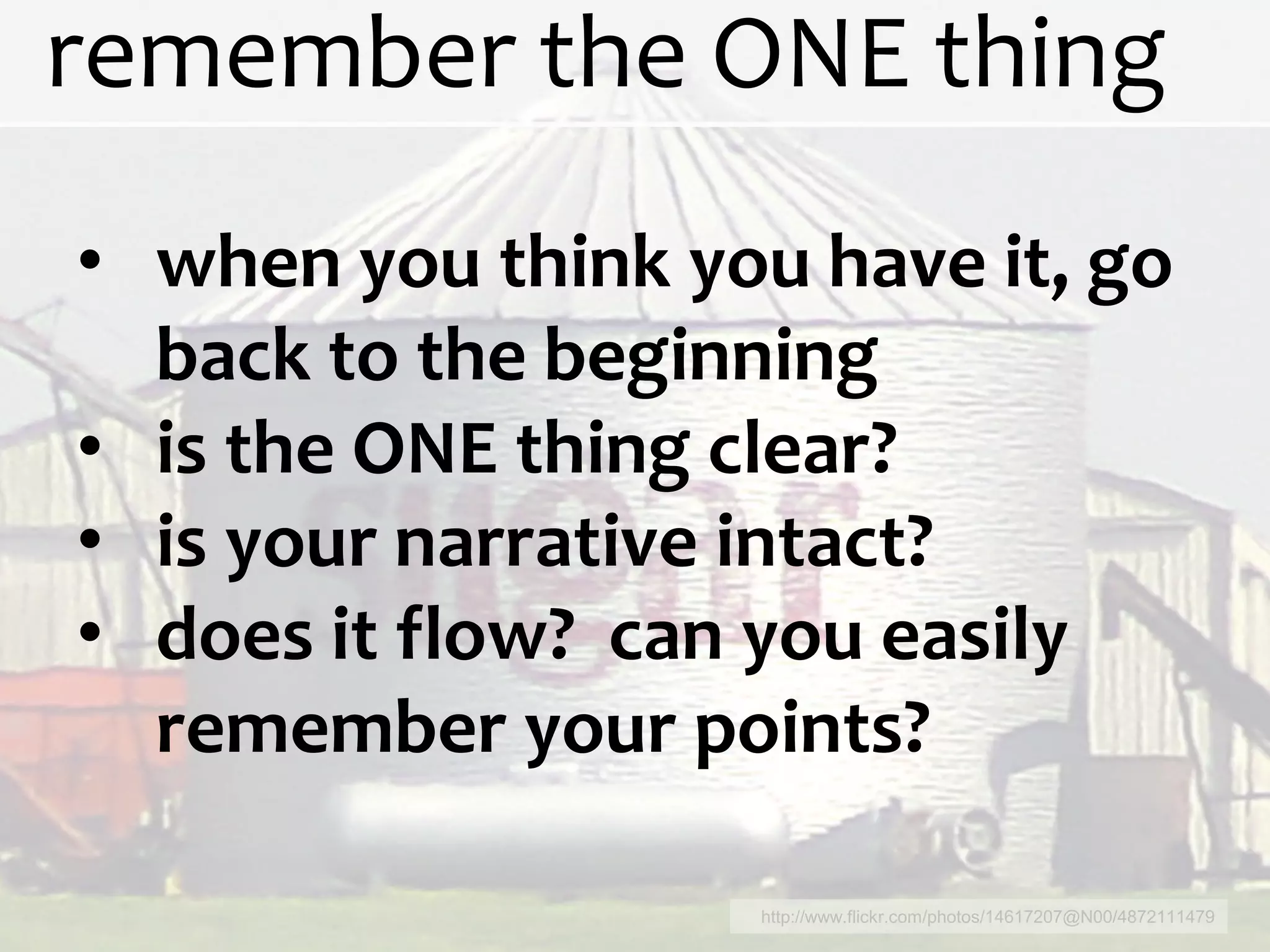
remember the ONE thing


              http://www.flickr.com/photos/14617207@N00/4872111479
remember the ONE thing
• when you think you have it, go
  back to the beginning
• is the ONE thing clear?
• is your narrative intact?
• does it flow? can you easily
  remember your points?

                   http://www.flickr.com/photos/14617207@N00/4872111479
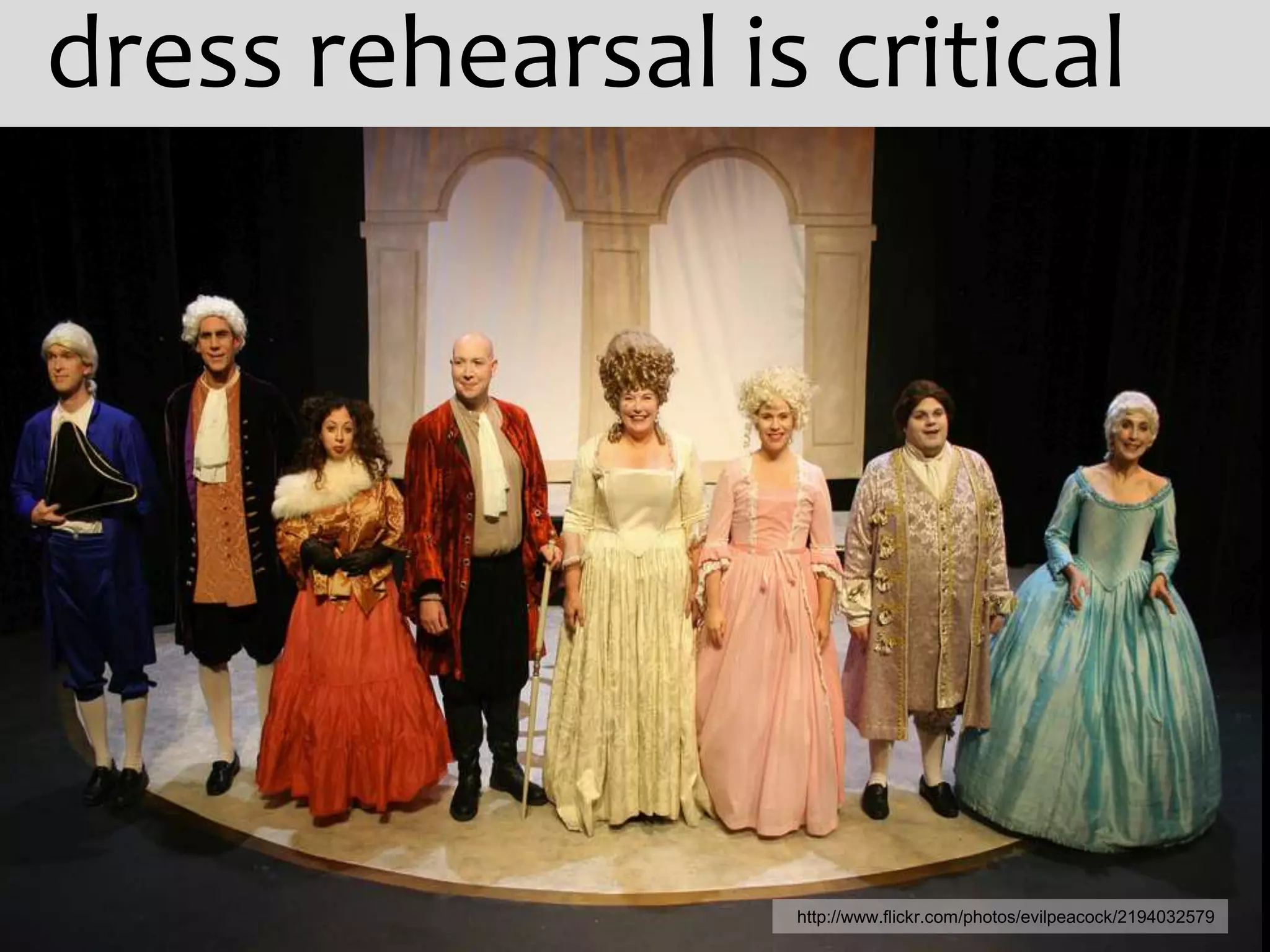
dress rehearsal is critical


                  http://www.flickr.com/photos/evilpeacock/2194032579
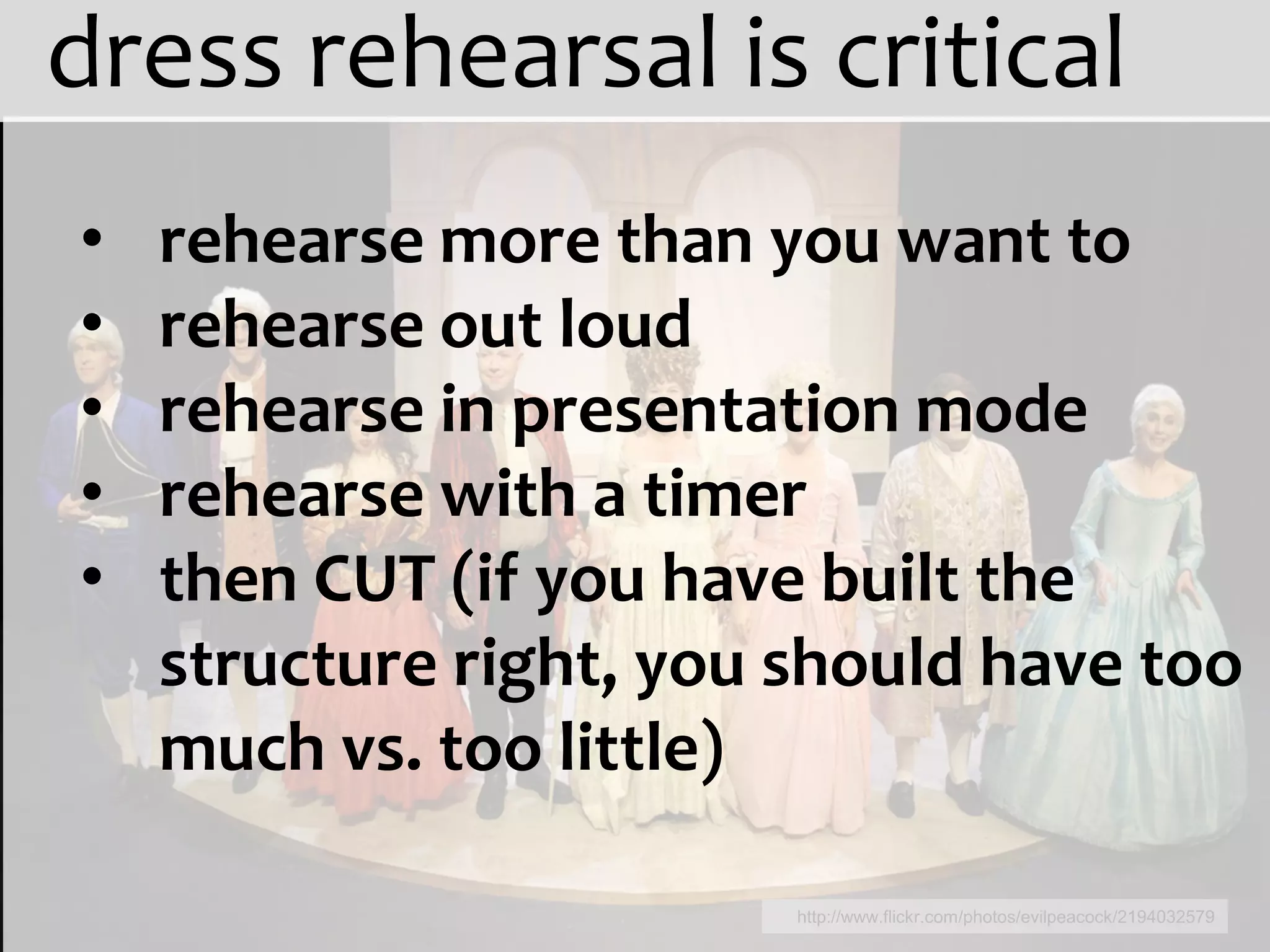
dress rehearsal is critical
•   rehearse more than you want to
•   rehearse out loud
•   rehearse in presentation mode
•   rehearse with a timer
•   then CUT (if you have built the
    structure right, you should have too
    much vs. too little)

                         http://www.flickr.com/photos/evilpeacock/2194032579
minimum formula


             http://www.flickr.com/photos/joao_trindade/4362414729
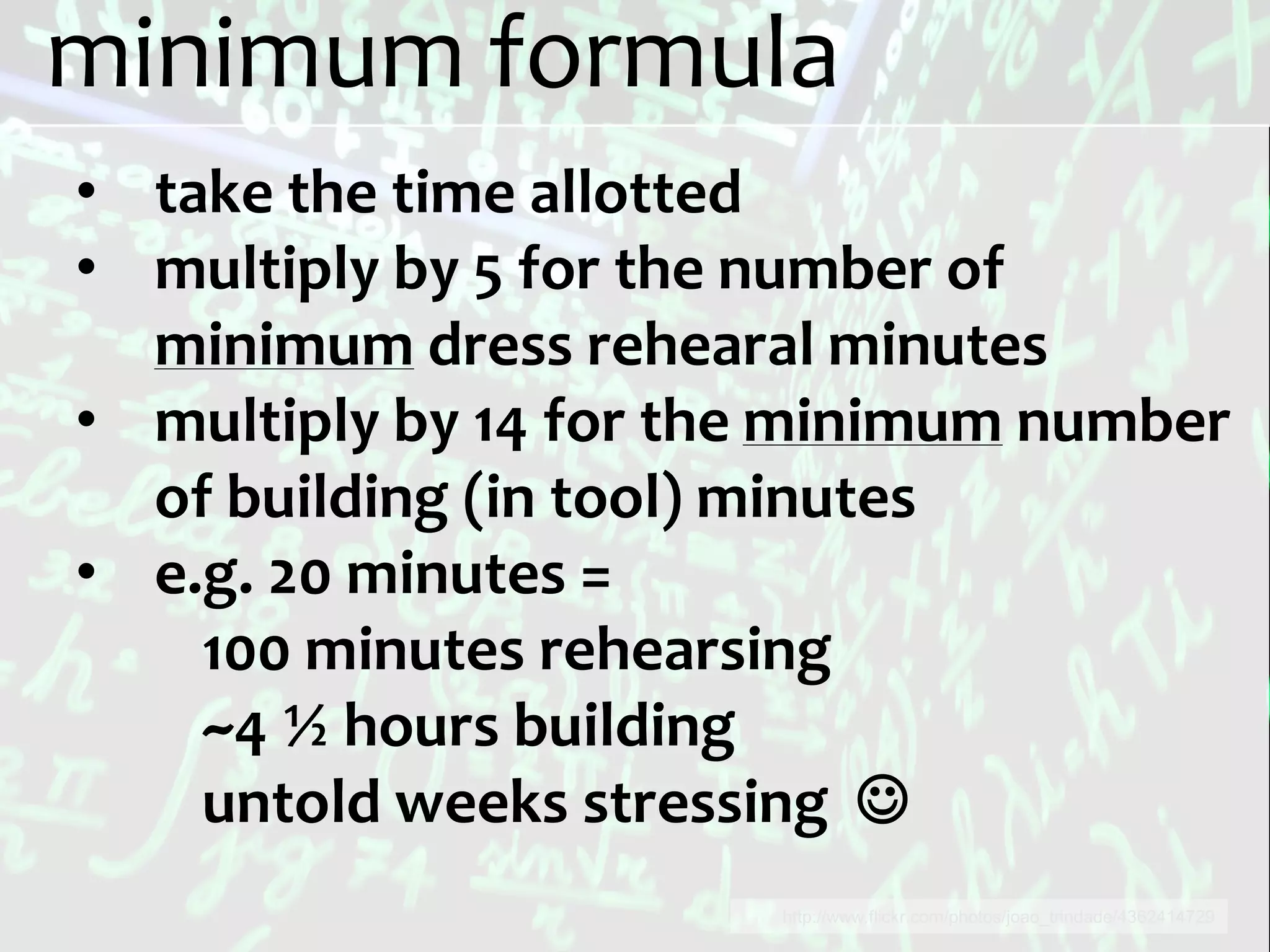
minimum formula
• take the time allotted
• multiply by 5 for the number of
  minimum dress rehearal minutes
• multiply by 14 for the minimum number
  of building (in tool) minutes
• e.g. 20 minutes =
    100 minutes rehearsing
    ~4 ½ hours building
    untold weeks stressing 
                       http://www.flickr.com/photos/joao_trindade/4362414729
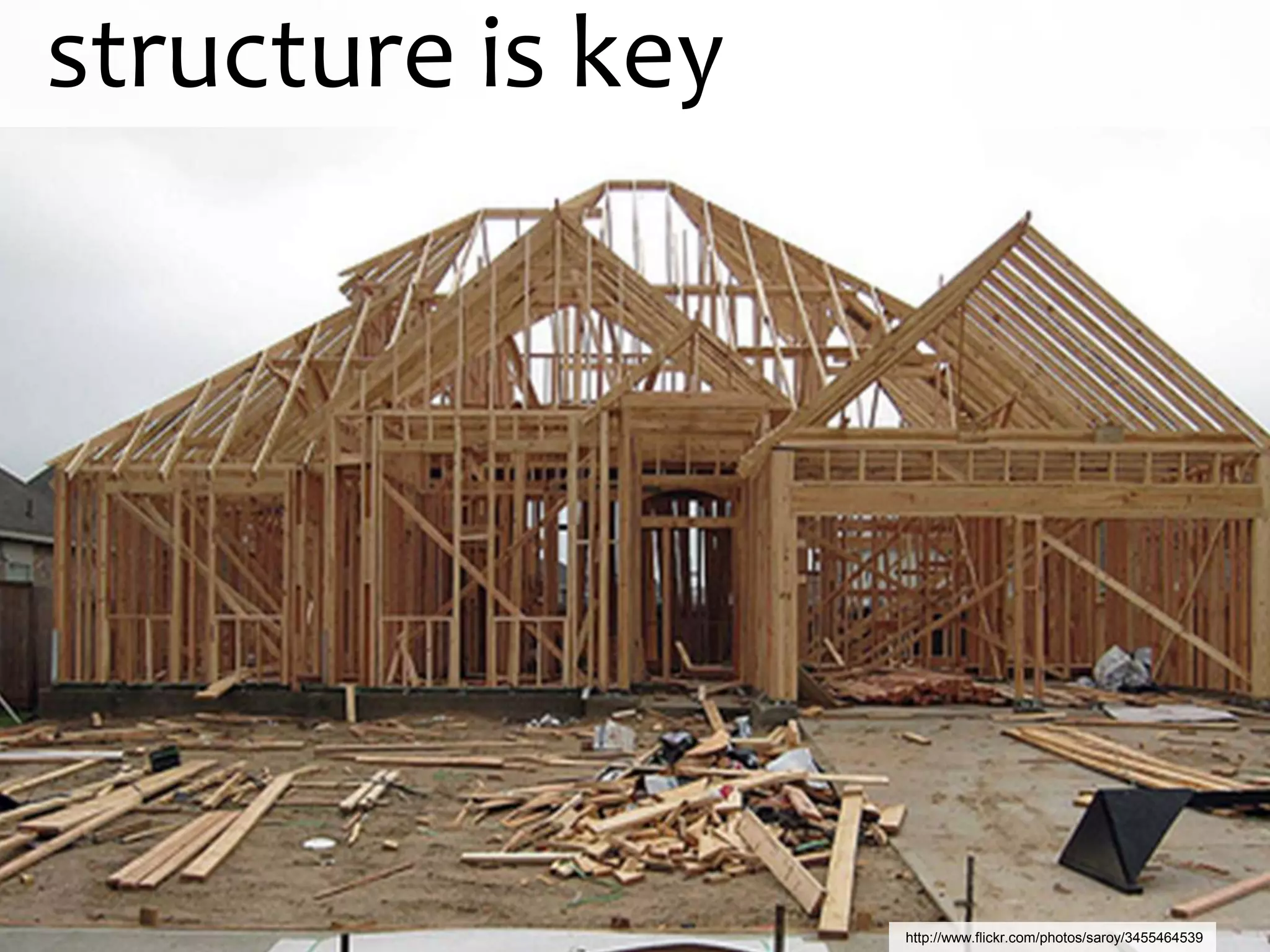
structure is key


                   http://www.flickr.com/photos/saroy/3455464539
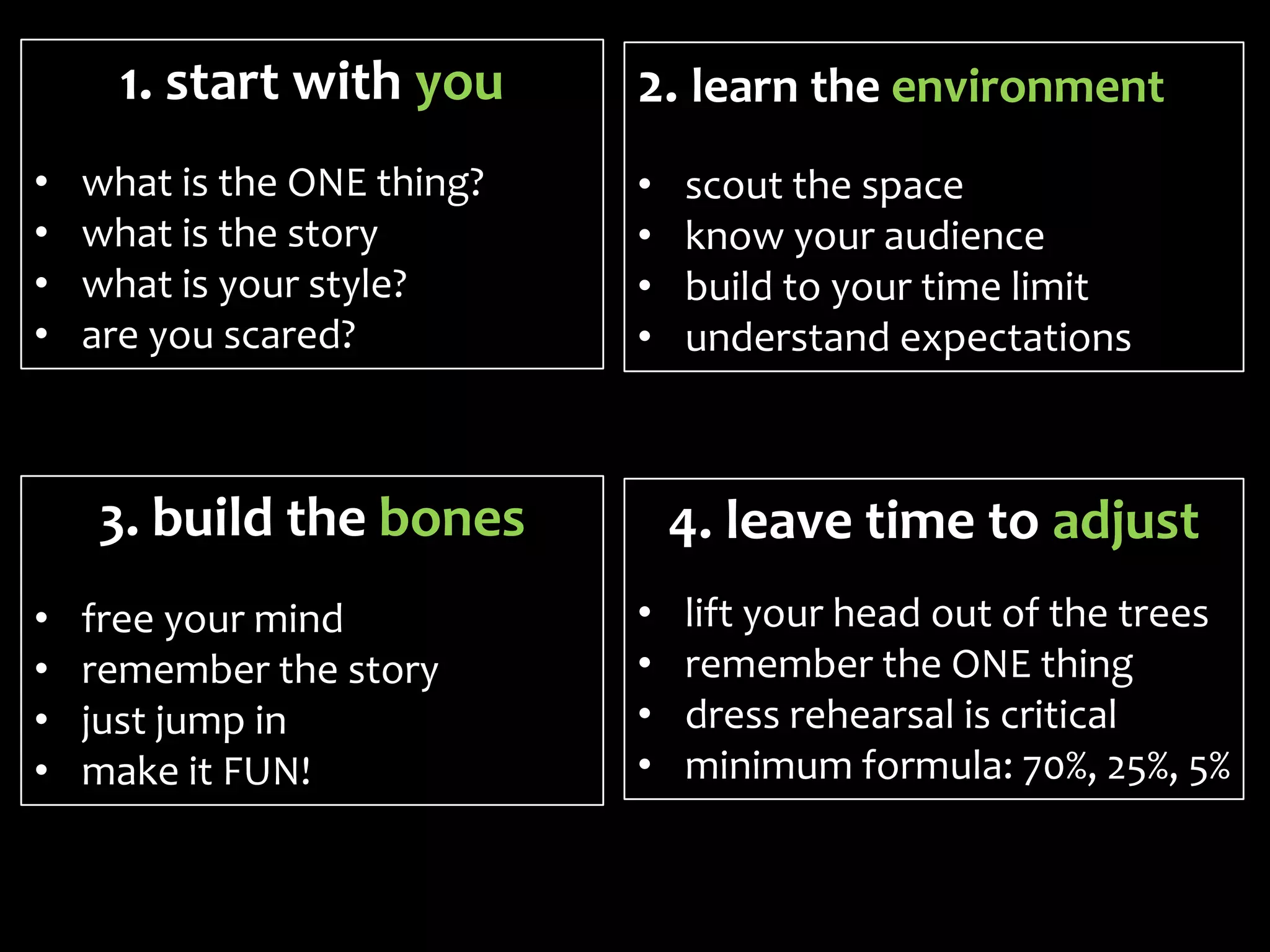
1. start with you      2. learn the environment
•   what is the ONE thing?   •   scout the space
•   what is the story        •   know your audience
•   what is your style?      •   build to your time limit
•   are you scared?          •   understand expectations


    3. build the bones           4. leave time to adjust
•   free your mind           •   lift your head out of the trees
•   remember the story       •   remember the ONE thing
•   just jump in             •   dress rehearsal is critical
•   make it FUN!             •   minimum formula: 70%, 25%, 5%
thank you!!
Samantha Starmer   sstarme@rei.com   @samanthastarmer

                                         http://www.flickr.com/photos/baking_in_pearls/3960662314

Structuring your Presentation - Cranky Talk 2011

  • 1.
    Structuring your Presentation Samantha Starmer sstarme@rei.com @samanthastarmer http://www.flickr.com/photos/saroy/3455464539
  • 2.
    me experience, web stuff: Amazon, Microsoft REI – Recreational Equipment, Inc. lead design, IA & experience teams teach at University of Washington
  • 9.
    4 key principles 1. start with you 2. learn the environment 3. build the bones 4. leave time to adjust
  • 10.
  • 11.
    1. start withyou • what is the ONE thing? • think about the story • what is your style? • are you scared?
  • 12.
    what is theONE thing? http://www.flickr.com/photos/14617207@N00/4872111479
  • 13.
    what is theONE thing? • why are you speaking? • what is your point? • what is the ONE thing you want your audience to remember? http://www.flickr.com/photos/14617207@N00/4872111479
  • 14.
    think about thestory http://www.flickr.com/photos/sugarpond/3016905349
  • 15.
    think about thestory • beginning, middle and end (make sure there is an end) • all points to your ONE thing • how would you tell it to your grandma? to a child? http://www.flickr.com/photos/sugarpond/3016905349
  • 16.
    what is yourstyle? http://
  • 17.
    what is yourstyle? • formal or informal? • deep details or inspirational? • don’t try to be funny if it isn’t natural • get feedback. lots of it.
  • 18.
    are you scared? http://www.flickr.com/photos/mindaugasdanys/3766009204/
  • 19.
    are you scared? •the more nervous you are, the more structure you need • unless you are a very skilled improviser • in which case, you probably wouldn’t be in this class http://www.flickr.com/photos/14617207@N00/4872111479
  • 20.
    2. learn theenvironment http://www.flickr.com/photos/brue/4806532954
  • 21.
    2. learn theenvironment • scout the space • know your audience • build to your time limit • understand expectations
  • 22.
    scout the space http://www.flickr.com/photos/mikecogh/4157191493
  • 23.
    scout the space •ideal is to get on stage in advance, but learn what you can • note placement of lights, screens, podium • size and ‘feel’ of room should impact your structure http://www.flickr.com/photos/mikecogh/4157191493
  • 24.
    know your audience http://www.flickr.com/photos/36714668@N02/4598065240
  • 25.
    know your audience • size, level of expertise • what do they want from you? • voluntary or hostage? • bored or interested? • friendly or combative? http://www.flickr.com/photos/14617207@N00/4872111479
  • 26.
    build to yourtime limit http://www.flickr.com/photos/wwarby/3297205226
  • 27.
    build to yourtime limit • focus your topic on the time limit • focus your scope & detail on the time limit • the less time to prepare, the more structure you need • experience will improve your gut sense http://www.flickr.com/photos/wwarby/3297205226
  • 28.
    understand expectations http://www.flickr.com/photos/kristin-and-adam/2778203028
  • 29.
    understand expectations • dothey expect results? or is the journey more relevant? • technical or high level? • what kind of assets/deliverables? http://www.flickr.com/photos/kristin-and-adam/2778203028
  • 30.
    3. build thebones http://www.flickr.com/photos/ianturton/9555513
  • 31.
    3. build thebones • free your mind • remember the story • just jump in • make it FUN!
  • 32.
    free your mind http://en.wikipedia.org/wiki/File:PhrenologyPix.jpg
  • 33.
    free your mind • don’t constrain too early • use your creative juice makers • let it percolate • be willing to throw out initial ideas • which means you need twice the planning time you expect http://en.wikipedia.org/wiki/File:PhrenologyPix.jpg
  • 34.
    just jump in http://www.flickr.com/photos/ccheviron/3603397114
  • 35.
    just jump in •don’t be afraid to scribble • paper prototype, but only if it works for you • get into the tool as soon as you have the guts (of the structure, but also the nerve) http://www.flickr.com/photos/ccheviron/3603397114
  • 39.
    remember the story http://www.flickr.com/photos/sugarpond/3016905349
  • 40.
    remember the story •ah, there is a point to all this • keep the narrative (linear or not) as your north star • throw out anything extraneous to the story • no matter how cool http://www.flickr.com/photos/sugarpond/3016905349
  • 42.
  • 43.
    make it FUN! • you should enjoy building the story • you should enjoy creating the structure • you will feel a quiet ping when it starts to come together
  • 44.
    4. leave timeto adjust http://www.flickr.com/photos/clintjcl/4001170877
  • 45.
    4. leave timeto adjust • lift your head out of the trees • remember the ONE thing • practice time is critical • minimum formula: 70%, 25%, 5%
  • 46.
    lift your headout of the trees http://www.flickr.com/photos/mountjoy/5194910368
  • 47.
    lift your headout of the trees • check the whole arc regularly • don’t get too hung up on the exact words or pictures • the whole is greater than the sum of the parts http://www.flickr.com/photos/mountjoy/5194910368
  • 49.
    remember the ONEthing http://www.flickr.com/photos/14617207@N00/4872111479
  • 50.
    remember the ONEthing • when you think you have it, go back to the beginning • is the ONE thing clear? • is your narrative intact? • does it flow? can you easily remember your points? http://www.flickr.com/photos/14617207@N00/4872111479
  • 51.
    dress rehearsal iscritical http://www.flickr.com/photos/evilpeacock/2194032579
  • 52.
    dress rehearsal iscritical • rehearse more than you want to • rehearse out loud • rehearse in presentation mode • rehearse with a timer • then CUT (if you have built the structure right, you should have too much vs. too little) http://www.flickr.com/photos/evilpeacock/2194032579
  • 54.
    minimum formula http://www.flickr.com/photos/joao_trindade/4362414729
  • 55.
    minimum formula • takethe time allotted • multiply by 5 for the number of minimum dress rehearal minutes • multiply by 14 for the minimum number of building (in tool) minutes • e.g. 20 minutes = 100 minutes rehearsing ~4 ½ hours building untold weeks stressing  http://www.flickr.com/photos/joao_trindade/4362414729
  • 56.
    structure is key http://www.flickr.com/photos/saroy/3455464539
  • 57.
    1. start withyou 2. learn the environment • what is the ONE thing? • scout the space • what is the story • know your audience • what is your style? • build to your time limit • are you scared? • understand expectations 3. build the bones 4. leave time to adjust • free your mind • lift your head out of the trees • remember the story • remember the ONE thing • just jump in • dress rehearsal is critical • make it FUN! • minimum formula: 70%, 25%, 5%
  • 58.
    thank you!! Samantha Starmer sstarme@rei.com @samanthastarmer http://www.flickr.com/photos/baking_in_pearls/3960662314

Editor's Notes

  • #46 20 minute presentationRehearse 5x (100 minutes)Build 14x (280 minutes; 4 hours, 40 minutes)I can do 15-30 seconds per slide for concept presentations that are well rehearsed. Otherwise I shoot for no more than 2 minutes per slide unless it is a demo or an academic lecture.