XHTML2 Design Aims
• Use existing XML facilities rather
than duplicating them (implies
namespace support)
• Less scripting (vs declarative approach)
• Integration with Semantic Web
Things HTML5 doesn’t do
• Does not favor XML facilities
• Does not avoid scripting
• Does not consider integration
with the SemWeb a priority
• No arbitrary namespaces
Things XHTML2 doesn’t do
• Does not support existing content in
the same way that HTML5 does
• Does not precisely define UA behavior
• Does not handle errors non-
draconically (uses “catch fire and fail”
error handling)
Important point:
XHTML2 is a different
language than XHTML1
...“different language” in
that XHTML2 does not
fully support existing
XHTML1 content (not
backward compatible)
A representative statement about
the difference in philosophy:
“HTML is the assembly
language of the Web.”
Important point: in some
cases HTML5 offers a
choice of both
declarative and scripting
approaches.
About error handling...
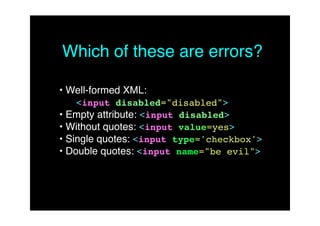
Which of these are errors?
•
Well-formed XML:
<input disabled="disabled">
•
Empty attribute: <input disabled>
•
Without quotes: <input value=yes>
•
Single quotes: <input type='checkbox'>
•
Double quotes: <input name="be evil">
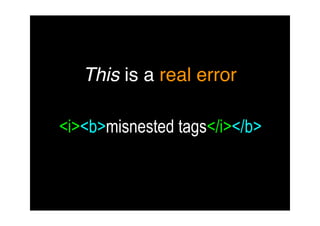
This is a real error
<i><b>misnested tags</i></b>
HTML5 parsers can handle
real errors interoperably
and gracefully.
Why is it important to
handle errors?
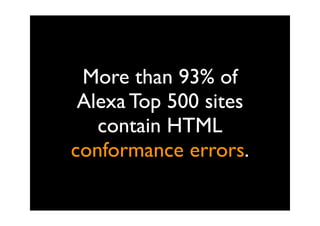
More than 93% of
Alexa Top 500 sites
contain HTML
conformance errors.
A little history...
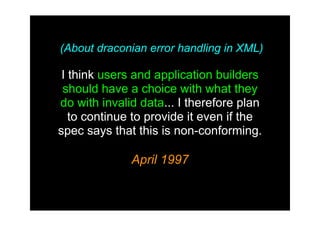
(About draconian error handling in XML)
I think users and application builders
should have a choice with what they
do with invalid data... I therefore plan
to continue to provide it even if the
spec says that this is non-conforming.
April 1997
◦ I think users and application builders should have a choice with what they do with invalid data. I cannot see
how a user or application builder can be disadvantaged by being provided with this choice, and I therefore
plan to continue to provide it even if the spec says that this
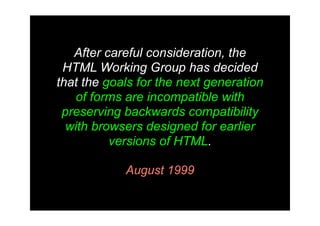
After careful consideration, the
HTML Working Group has decided
that the goals for the next generation
of forms are incompatible with
preserving backwards compatibility
with browsers designed for earlier
versions of HTML.
August 1999
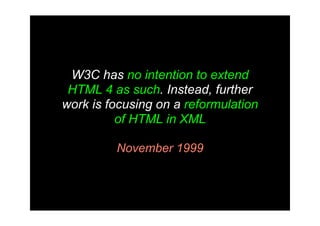
W3C has no intention to extend
HTML 4 as such. Instead, further
work is focusing on a reformulation
of HTML in XML
November 1999
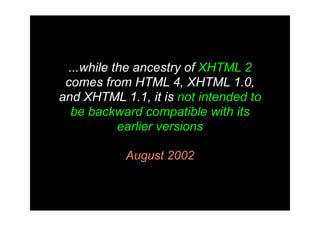
...while the ancestry of XHTML 2
comes from HTML 4, XHTML 1.0,
and XHTML 1.1, it is not intended to
be backward compatible with its
earlier versions
August 2002
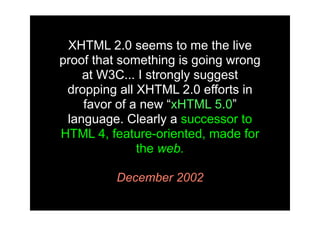
XHTML 2.0 seems to me the live
proof that something is going wrong
at W3C... I strongly suggest
dropping all XHTML 2.0 efforts in
favor of a new “xHTML 5.0”
language. Clearly a successor to
HTML 4, feature-oriented, made for
the web.
December 2002
The W3C had so far failed to
address a need in the Web
community: There is no language for
Web applications... I intend to do
something about this (hopefully
within a W3C context, although that
will depend on the politics
of the situation).
January 2004
The dream of a new web, based on
XHTML+SVG+SMIL+XForms, is just
that — a dream... The best way to
help the Web is to incrementally
improve the existing web
standards... so that web content
authors can actually deploy new
formats interoperably.
June 2004
We need to specify error handling
behavior to ensure interoperability
“even in the face of documents that
do not comply to the letter of the
specifications”.
Authors will write invalid content
regardless of what we spec. So the
spec states “what authors must not
do, and then tells implementors what
they must do when an author
does it anyway”.
It is necessary to evolve HTML
incrementally. The attempt to get the
world to switch to XML, including
quotes around attribute values and
slashes in empty tags and namespaces
all at once didn’t work...
October 2006
more HTML history
http://esw.w3.org/topic/HTML/history
HTML5 has a major focus on
facilitating use of a browser as
a Web application platform (or
Web application runtime
environment).
XHTML2 has a major focus
on providing a general-
purpose document language
declarative mechanisms for
enabling interactive features.
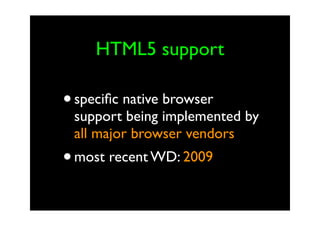
HTML5 support
• specific native browser
support being implemented by
all major browser vendors
• most recent WD: 2009
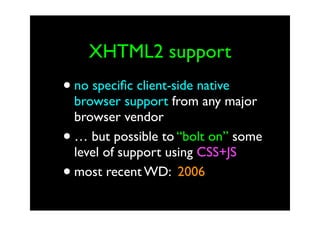
XHTML2 support
• no specific client-side native
browser support from any major
browser vendor
• … but possible to “bolt on” some
level of support using CSS+JS
• most recent WD: 2006
The bottom line...
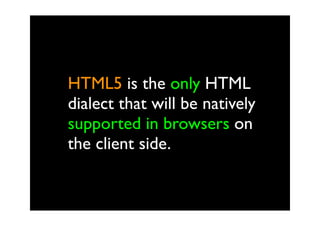
HTML5 is the only HTML
dialect that will be natively
supported in browsers on
the client side.
XHTML2 will likely remain useful
more as a choice for authoring
and storing documents on the
server side and down-
transforming them to HTML+JS.
Some HTML5 differences...
HTML5 defines HTML as an abstract
language with two standard
syntaxes supported by browsers:
• a text/html syntax, with parsing
rules defined by the HTML5 spec
• an XML syntax, with parsing rules
defined by the XML spec
Similarly, applications can
potentially represent HTML in
memory in any number of ways.
However, there’s only one standard
in-memory representation supported
by browsers: The W3C DOM.
The HTML5 spec precisely defines
the DOM representation that
browsers must use to represent
HTML content in memory.
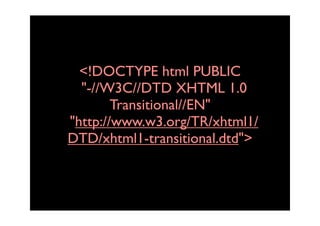
<!DOCTYPE html PUBLIC
"-//W3C//DTD XHTML 1.0
Transitional//EN"
"http://www.w3.org/TR/xhtml1/
DTD/xhtml1-transitional.dtd">
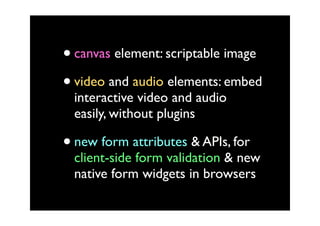
• canvas element: scriptable image
• video and audio elements: embed
interactive video and audio
easily, without plugins
• new form attributes & APIs, for
client-side form validation & new
native form widgets in browsers
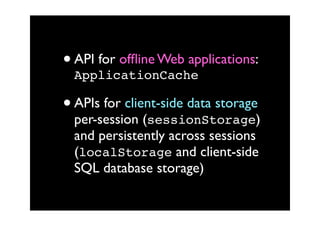
• API for offline Web applications:
ApplicationCache
• APIs for client-side data storage
per-session (sessionStorage)
and persistently across sessions
(localStorage and client-side
SQL database storage)
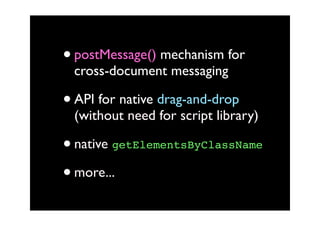
• postMessage() mechanism for
cross-document messaging
• API for native drag-and-drop
(without need for script library)
• native getElementsByClassName
• more...
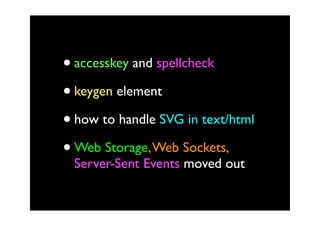
• accesskey and spellcheck
• keygen element
• how to handle SVG in text/html
• Web Storage, Web Sockets,
Server-Sent Events moved out
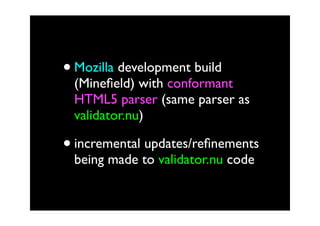
• Mozilla development build
(Minefield) with conformant
HTML5 parser (same parser as
validator.nu)
• incremental updates/refinements
being made to validator.nu code
Somewhat related
work outside of the
core HTML5 effort...
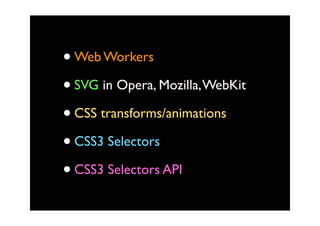
• Web Workers
• SVG in Opera, Mozilla, WebKit
• CSS transforms/animations
• CSS3 Selectors
• CSS3 Selectors API
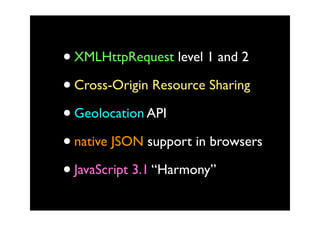
• XMLHttpRequest level 1 and 2
• Cross-Origin Resource Sharing
• Geolocation API
• native JSON support in browsers
• JavaScript 3.1 “Harmony”
1–1 of 1 previous next