Pregel: A System for Large-
                  Scale Graph Processing

                              Written by G. Malewicz et al. at SIGMOD 2010
                                        Presented by Chris Bunch
                                       Tuesday, October 12, 2010


                                                   1
Wednesday, October 13, 2010
Graphs are hard

                   • Poor locality of memory access
                   • Very little work per vertex
                   • Changing degree of parallelism
                   • Running over many machines
                              makes the problem worse


                                           2
Wednesday, October 13, 2010
State of the Art Today
                   • Write your own infrastructure
                    • Substantial engineering effort
                   • Use MapReduce
                    • Inefficient - must store graph state in
                              each stage, too much communication
                              between stages


                                              3
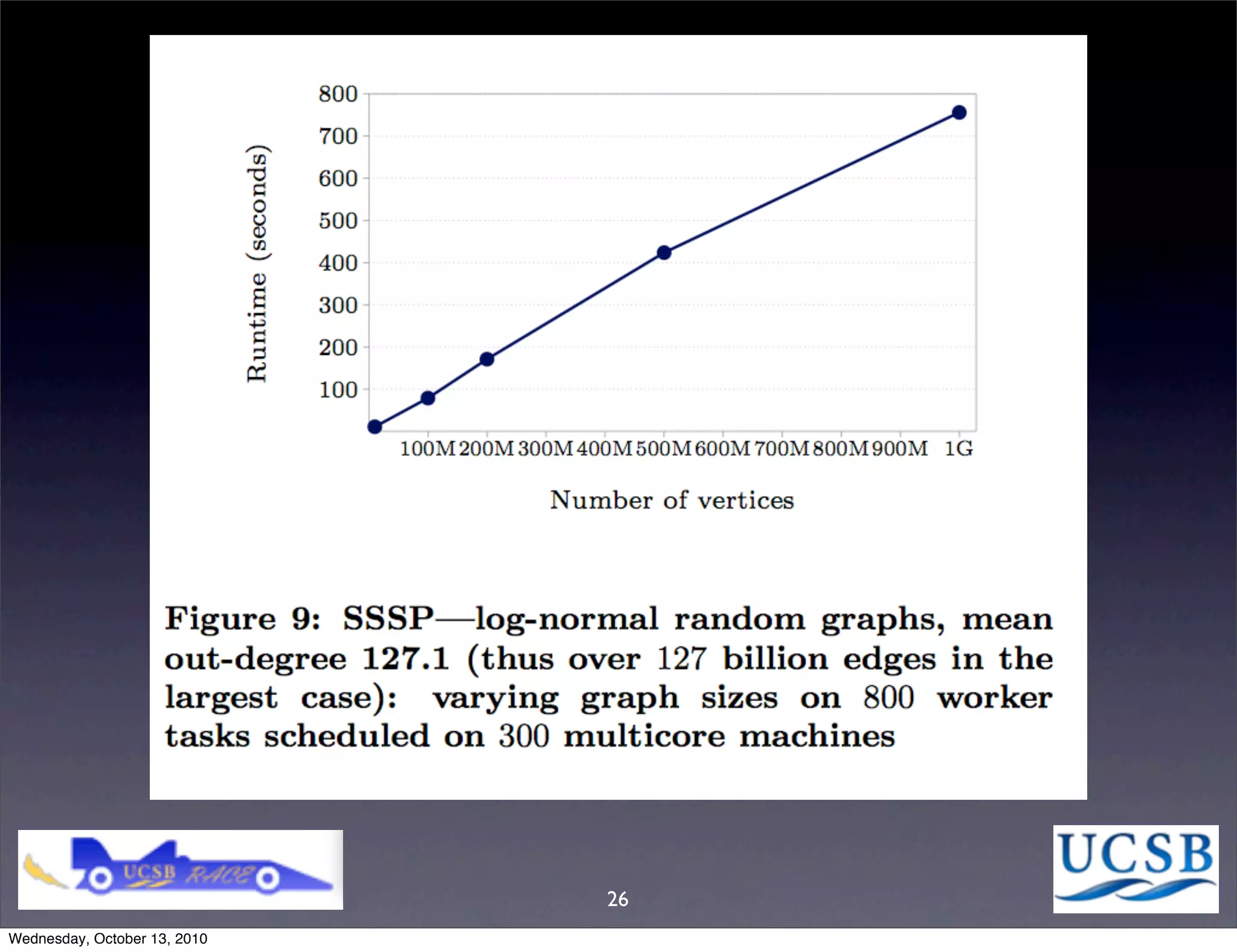
Wednesday, October 13, 2010
State of the Art Today

                   • Use a single-computer graph library
                    • Not scalable ☹
                   • Use existing parallel graph systems
                    • No fault tolerance ☹

                                        4
Wednesday, October 13, 2010
Bulk Synchronous
                                    Parallel
                   • Series of iterations (supersteps)
                   • Each vertex invokes a function in parallel
                   • Can read messages sent in previous
                              superstep
                   • Can send messages, to be read at the next
                              superstep
                   • Can modify state of outgoing edges
                                          5
Wednesday, October 13, 2010
Compute Model

                   • You give Pregel a directed graph
                   • It runs your computation at each vertex
                   • Do this until every vertex votes to halt
                   • Pregel gives you a directed graph back

                                        6
Wednesday, October 13, 2010
Primitives

                   • Vertices - first class
                   • Edges - not
                   • Both can be dynamically created and
                              destroyed


                                              7
Wednesday, October 13, 2010
Vertex State Machine


                                8
Wednesday, October 13, 2010
C++ API

                   • Your code subclasses Vertex, writes a
                              Compute method
                   • Can get/set vertex value
                   • Can get/set outgoing edges values
                   • Can send/receive messages

                                               9
Wednesday, October 13, 2010
C++ API

                   • Message passing:
                   • No guaranteed message delivery order
                   • Messages are delivered exactly once
                   • Can send messages to any node
                   • If dest doesn’t exist, user’s function is called
                                          10
Wednesday, October 13, 2010
C++ API
                   • Combiners (off by default):
                   • User specifies a way to reduce many
                              messages into one value (ala Reduce in MR)
                   • Must be commutative and associative
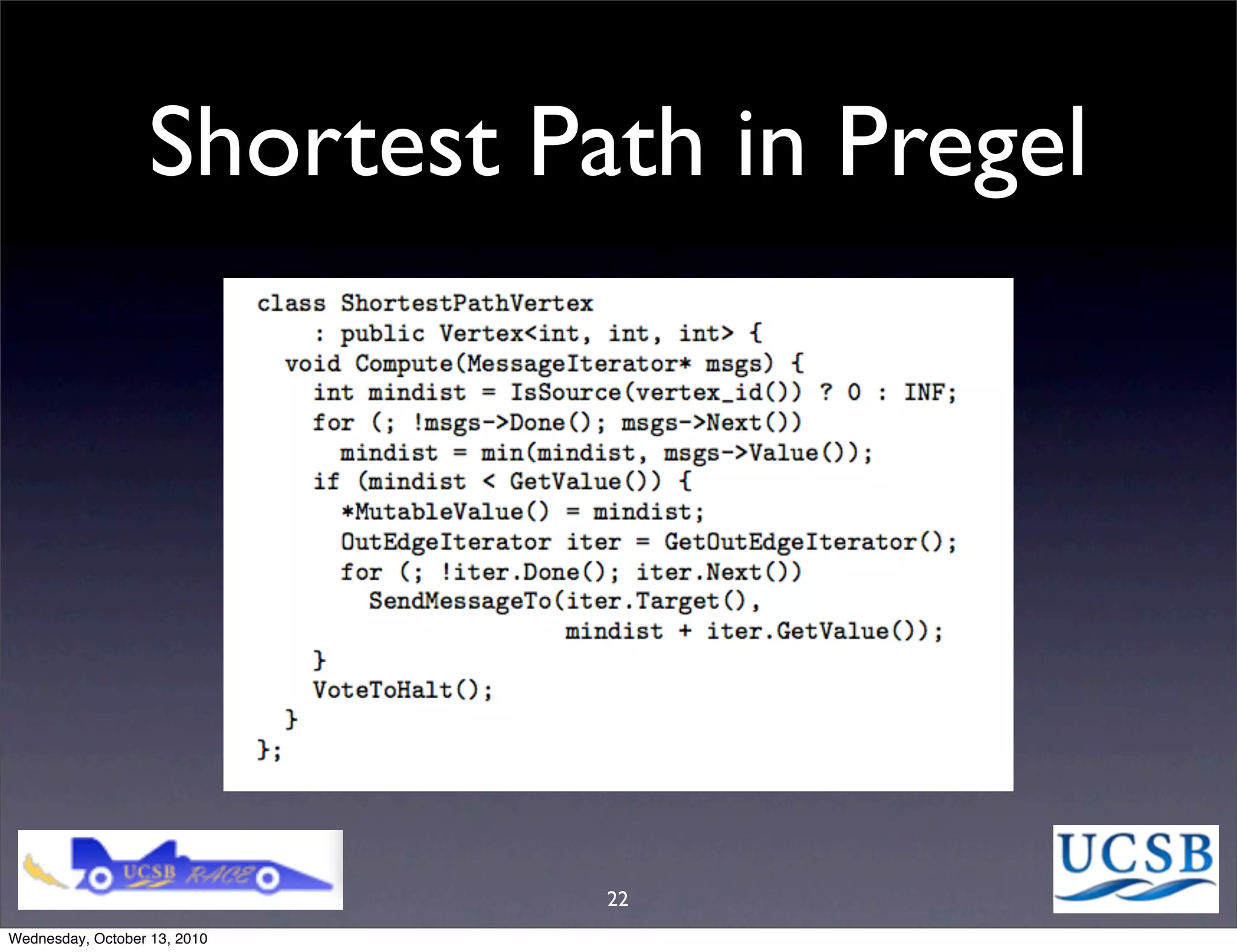
                   • Exceedingly useful in certain contexts (e.g.,
                              4x speedup on shortest-path compuation)


                                                11
Wednesday, October 13, 2010
C++ API

                   • Aggregators:
                   • User specifies a function
                   • Each vertex sends it a value
                   • Each vertex receives aggregate(vals)
                   • Can be used for statistics or coordination
                                        12
Wednesday, October 13, 2010
C++ API
                   • Topology mutations:
                   • Vertices can create / destroy vertices at will
                   • Resolving conflicting requests:
                    • Partial ordering: E Remove,V Remove,V
                              Add, E Add
                         • User-defined handlers:You fix the
                              conflicts on your own

                                             13
Wednesday, October 13, 2010
C++ API

                   • Input and output:
                    • Text file
                    • Vertices in a relational DB
                    • Rows in BigTable
                    • Custom - subclass Reader/Writer classes
                                       14
Wednesday, October 13, 2010
Implementation

                   • Executable is copied to many machines
                   • One machine becomes the Master
                    • Coordinates activities
                   • Other machines become Workers
                    • Performs computation
                                       15
Wednesday, October 13, 2010
Implementation
                   • Master partitions the graph
                   • Master partitions the input
                    • If a Worker receives input that is not for
                              their vertices, they pass it along
                   • Supersteps begin
                   • Master can tell Workers to save graphs
                                                16
Wednesday, October 13, 2010
Fault Tolerance
                   • At each superstep S:
                    • Workers checkpoint V, E, and Messages
                    • Master checkpoints Aggregators
                   • If a node fails, everyone starts over at S
                   • Confined recovery is under development
                   • what happens if the Master fails?
                                         17
Wednesday, October 13, 2010
The Worker

                   • Keeps graph in memory
                   • Message queues for supersteps S and S+1
                   • Remote messages are buffered
                   • Combiner is used when messages are sent
                              or received (save network and disk)


                                                18
Wednesday, October 13, 2010
The Master
                   • Master keeps track of which Workers own
                              each partition
                         • Not who owns each Vertex
                   • Coordinates all operations (via barriers)
                   • Maintains statistics and runs a HTTP server
                              for users to view info on


                                                 19
Wednesday, October 13, 2010
Aggregators

                   • Worker passes values to its aggregator
                   • Aggregator uses tree structure to reduce
                              vals w/ other aggregators
                         • Better parallelism than chain pipelining
                   • Final value is sent to Master

                                                 20
Wednesday, October 13, 2010
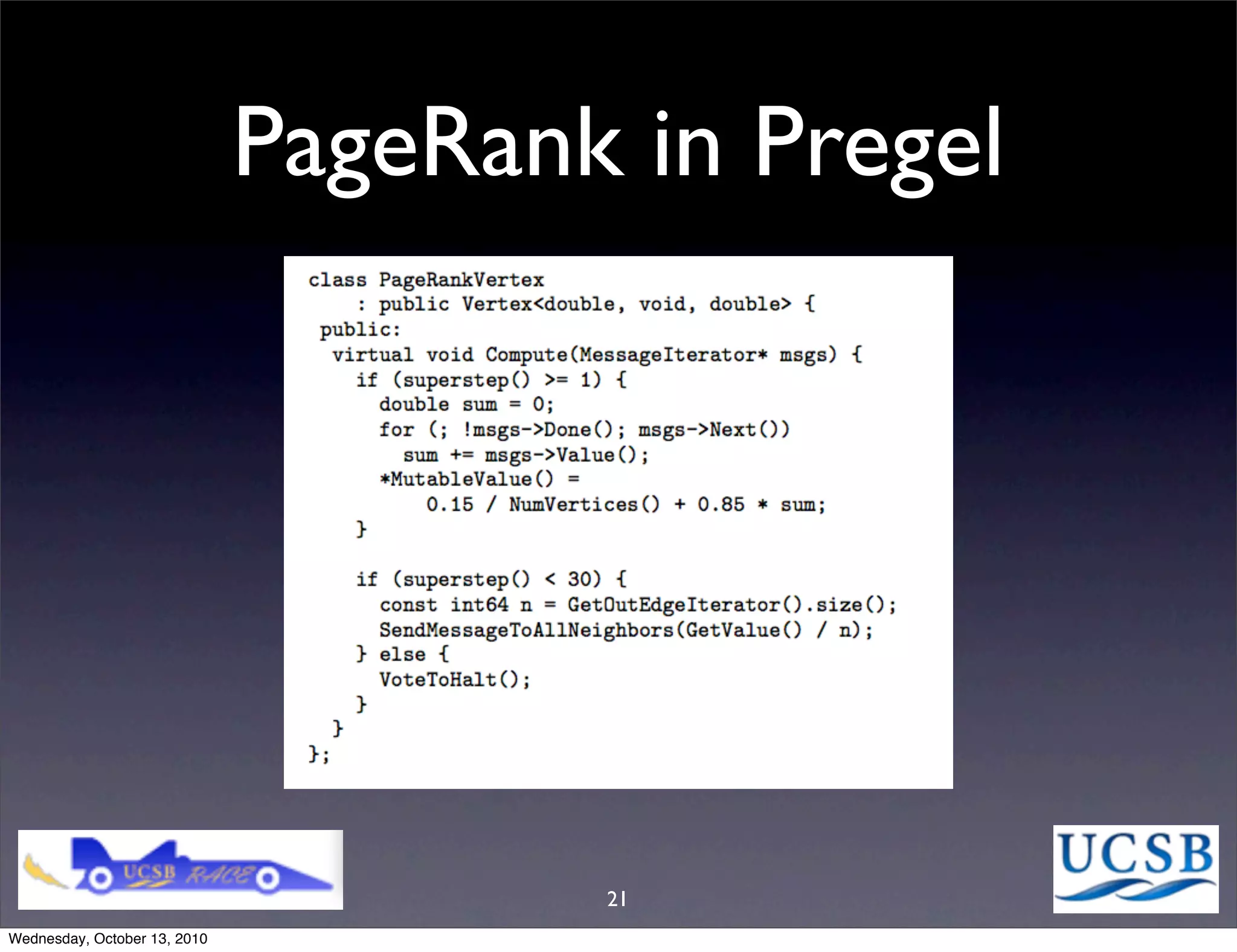
PageRank in Pregel


                                      21
Wednesday, October 13, 2010
Shortest Path in Pregel


                              22
Wednesday, October 13, 2010
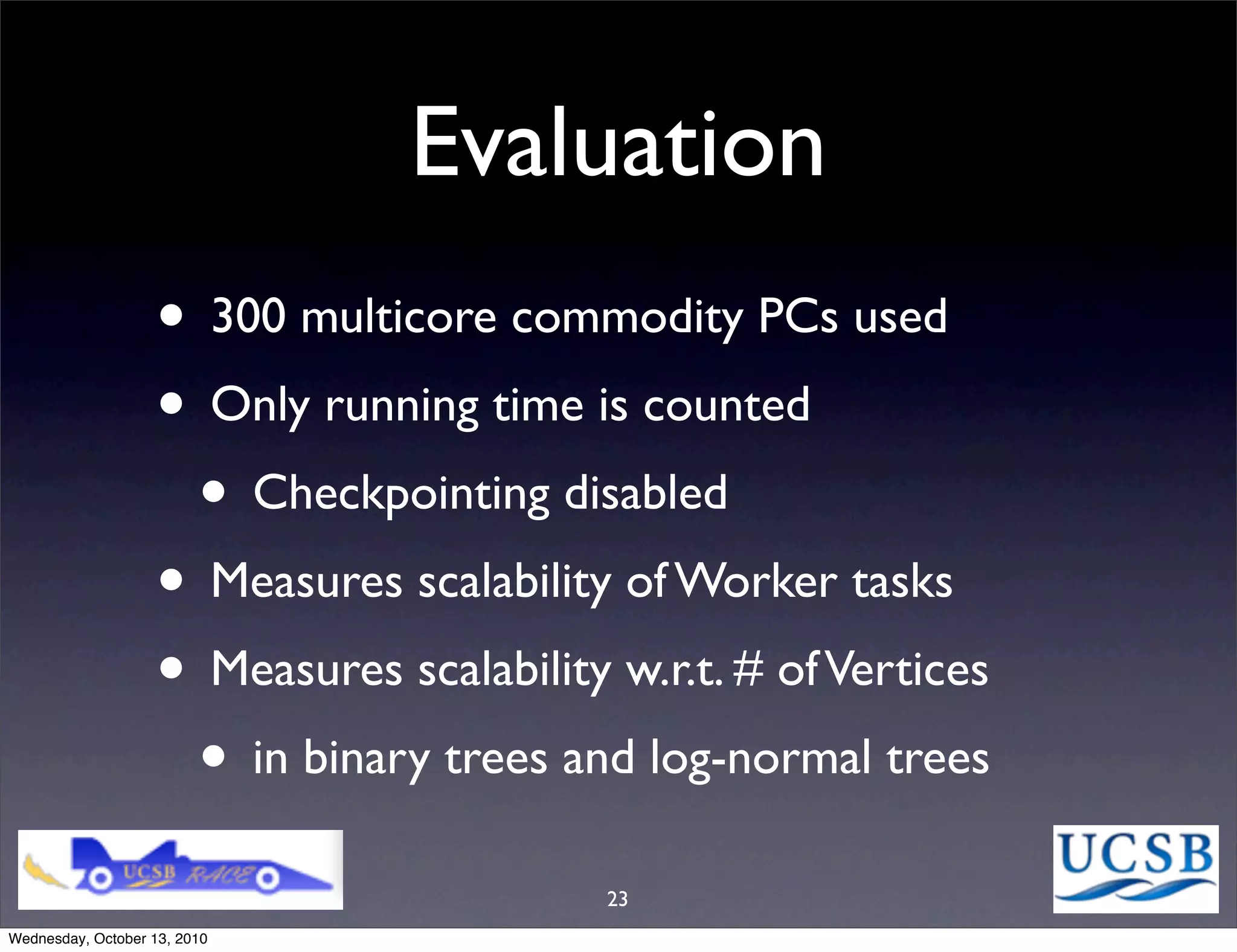
Evaluation
                   • 300 multicore commodity PCs used
                   • Only running time is counted
                    • Checkpointing disabled
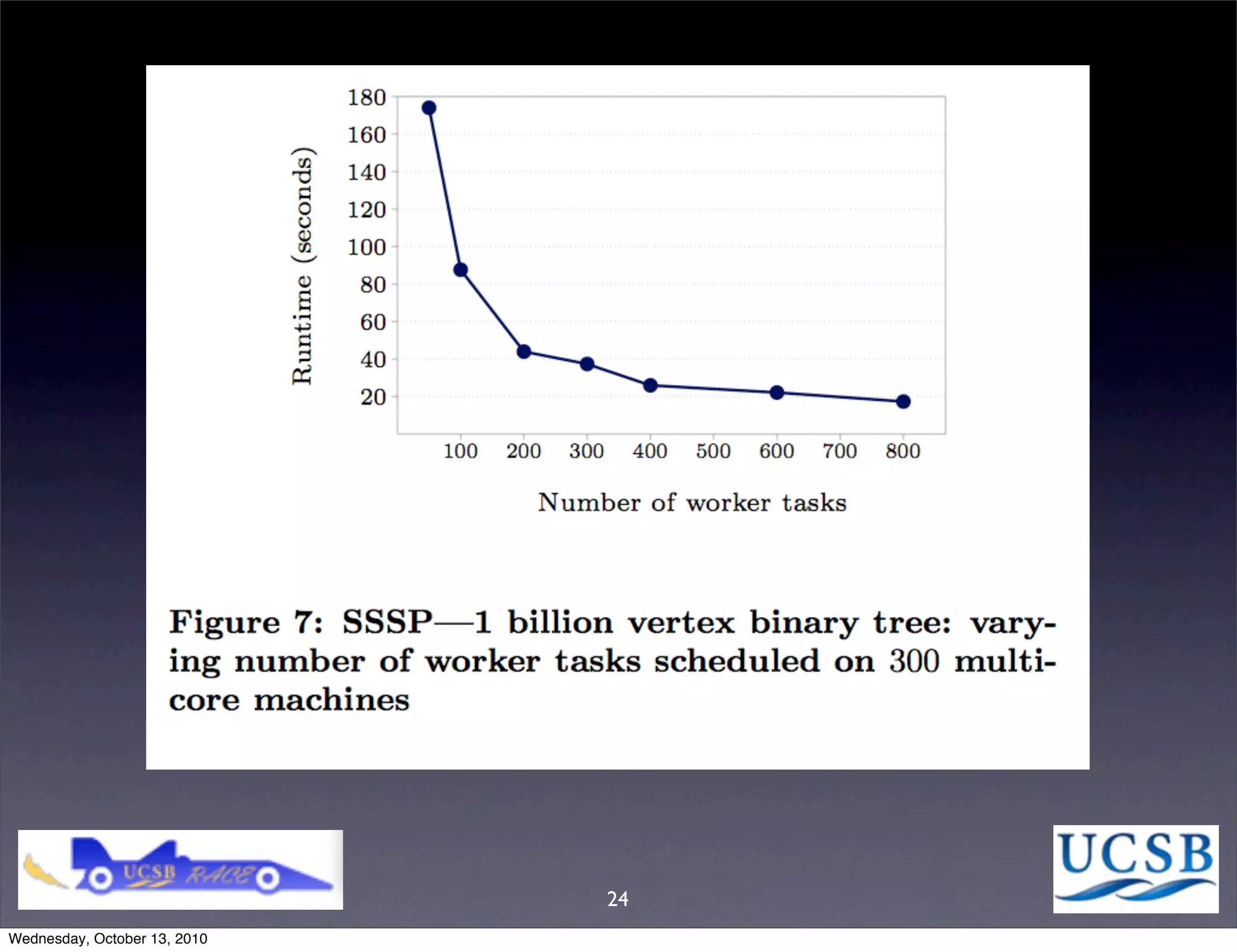
                   • Measures scalability of Worker tasks
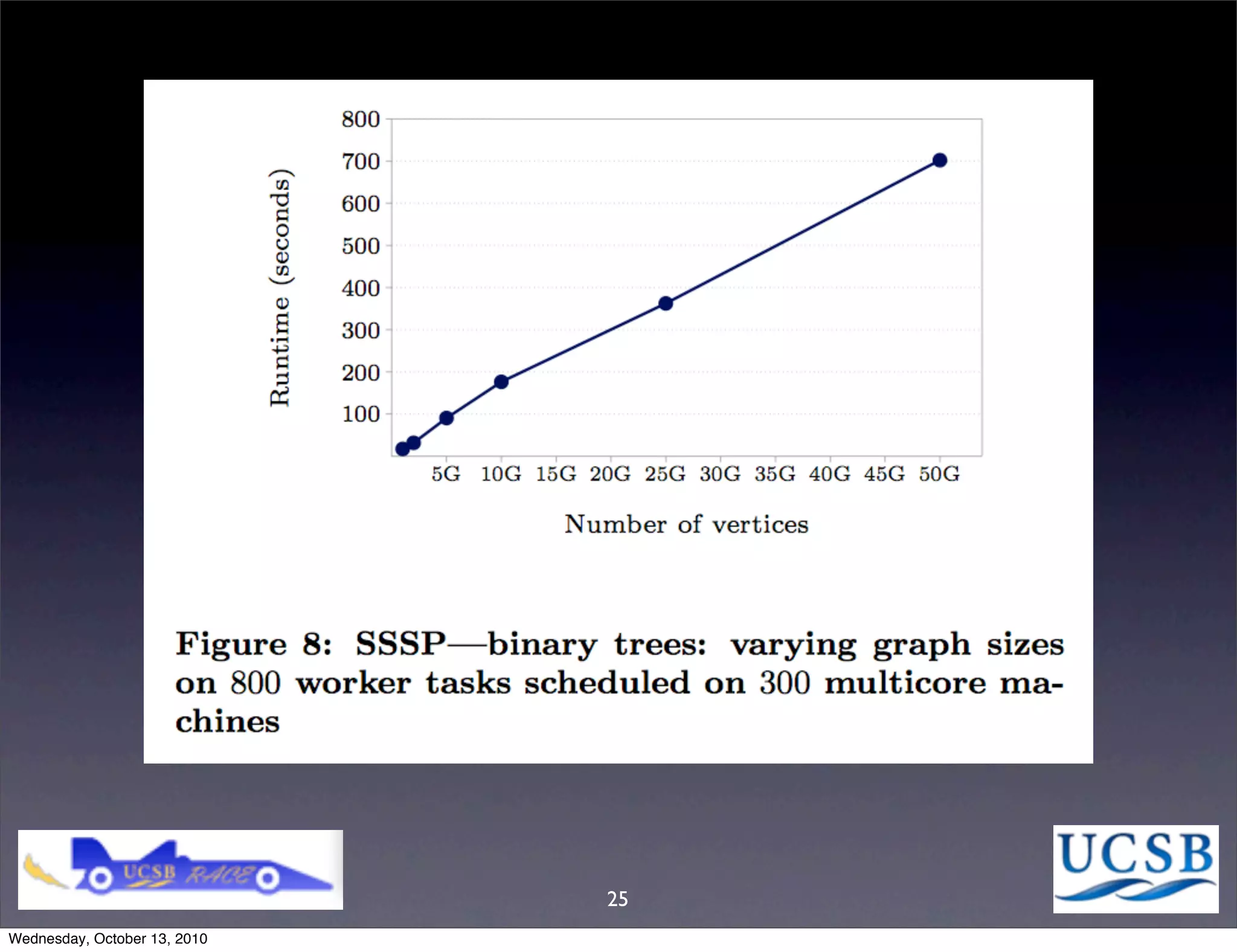
                   • Measures scalability w.r.t. # of Vertices
                    • in binary trees and log-normal trees
                                          23
Wednesday, October 13, 2010
24
Wednesday, October 13, 2010
25
Wednesday, October 13, 2010
26
Wednesday, October 13, 2010
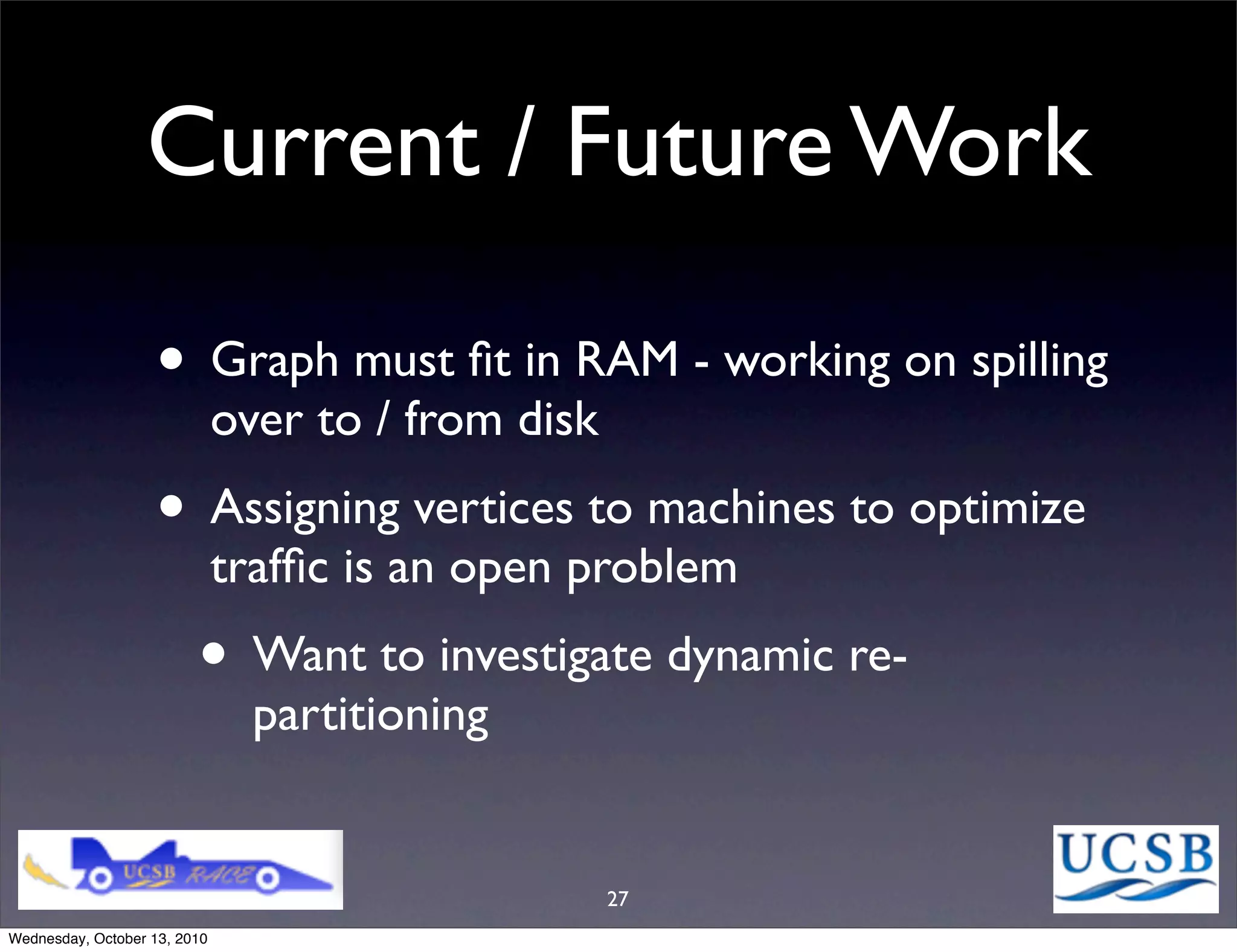
Current / Future Work

                   • Graph must fit in RAM - working on spilling
                              over to / from disk
                   • Assigning vertices to machines to optimize
                              traffic is an open problem
                         • Want to investigate dynamic re-
                                partitioning


                                                    27
Wednesday, October 13, 2010
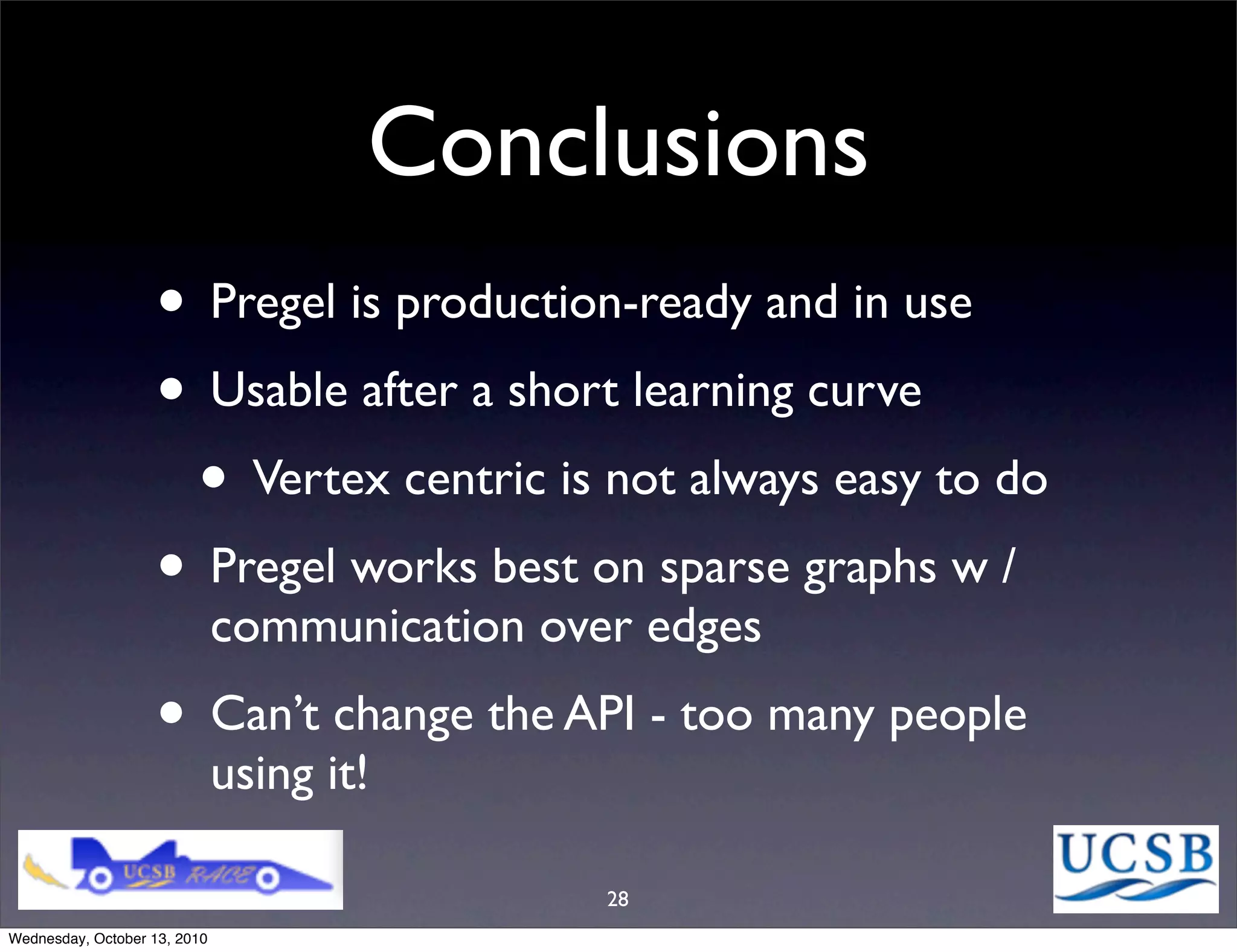
Conclusions
                   • Pregel is production-ready and in use
                   • Usable after a short learning curve
                    • Vertex centric is not always easy to do
                   • Pregel works best on sparse graphs w /
                              communication over edges
                   • Can’t change the API - too many people
                              using it!

                                               28
Wednesday, October 13, 2010
Related Work

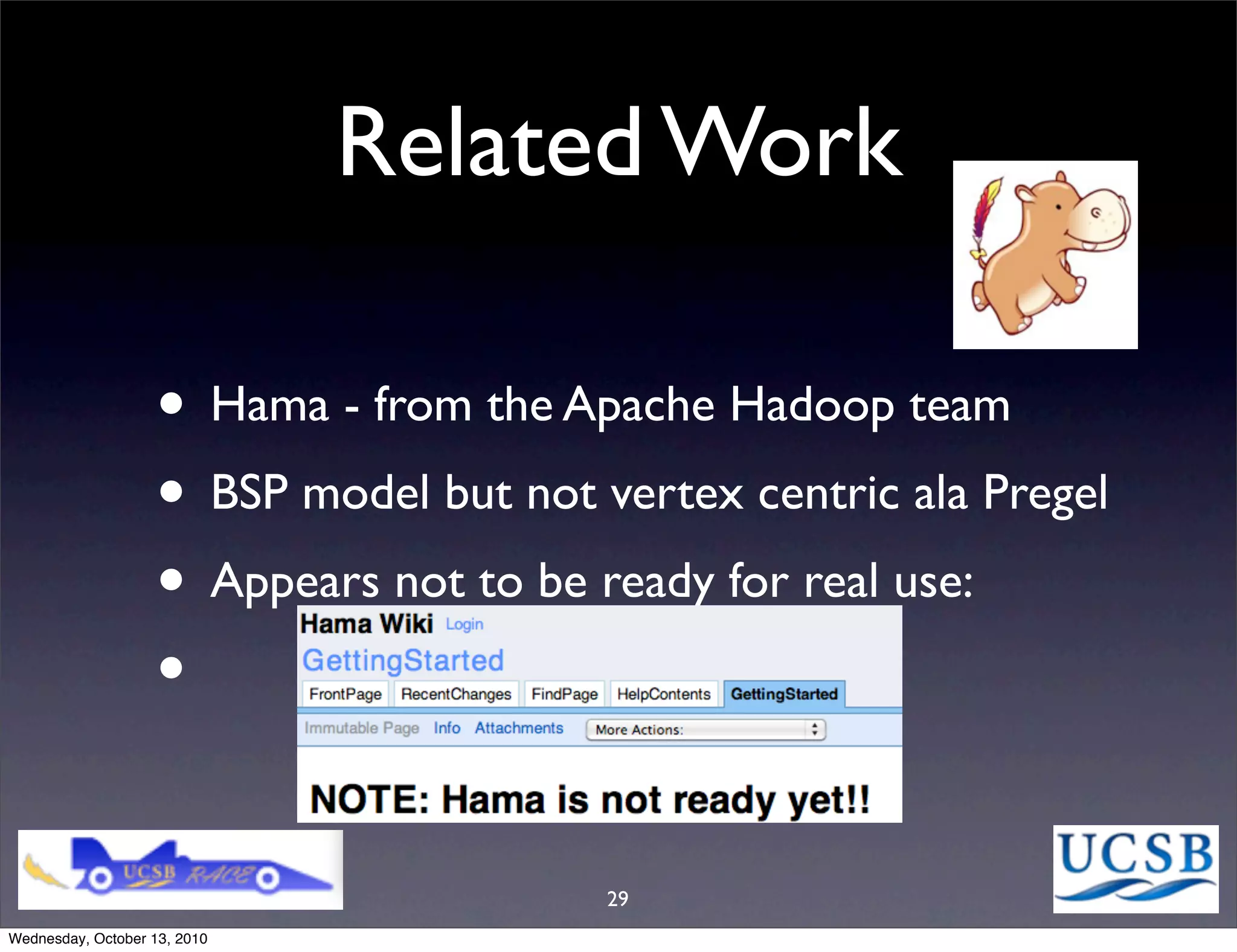
                   • Hama - from the Apache Hadoop team
                   • BSP model but not vertex centric ala Pregel
                   • Appears not to be ready for real use:
                   •

                                        29
Wednesday, October 13, 2010
Related Work
                   • Phoebus, released last week on github
                   • Runs on Mac OS X
                   • Cons (as of this writing):
                    • Doesn’t work on Linux
                    • Must write code in Erlang (since Phoebus
                              is written in it)

                                                  30
Wednesday, October 13, 2010
Thanks!

                   • To my advisor, Chandra Krintz
                   • To Google for this paper
                   • To all of you for coming!

                                       31
Wednesday, October 13, 2010

Pregel: A System for Large-Scale Graph Processing

  • 1.
    Pregel: A Systemfor Large- Scale Graph Processing Written by G. Malewicz et al. at SIGMOD 2010 Presented by Chris Bunch Tuesday, October 12, 2010 1 Wednesday, October 13, 2010
  • 2.
    Graphs are hard • Poor locality of memory access • Very little work per vertex • Changing degree of parallelism • Running over many machines makes the problem worse 2 Wednesday, October 13, 2010
  • 3.
    State of theArt Today • Write your own infrastructure • Substantial engineering effort • Use MapReduce • Inefficient - must store graph state in each stage, too much communication between stages 3 Wednesday, October 13, 2010
  • 4.
    State of theArt Today • Use a single-computer graph library • Not scalable ☹ • Use existing parallel graph systems • No fault tolerance ☹ 4 Wednesday, October 13, 2010
  • 5.
    Bulk Synchronous Parallel • Series of iterations (supersteps) • Each vertex invokes a function in parallel • Can read messages sent in previous superstep • Can send messages, to be read at the next superstep • Can modify state of outgoing edges 5 Wednesday, October 13, 2010
  • 6.
    Compute Model • You give Pregel a directed graph • It runs your computation at each vertex • Do this until every vertex votes to halt • Pregel gives you a directed graph back 6 Wednesday, October 13, 2010
  • 7.
    Primitives • Vertices - first class • Edges - not • Both can be dynamically created and destroyed 7 Wednesday, October 13, 2010
  • 8.
    Vertex State Machine 8 Wednesday, October 13, 2010
  • 9.
    C++ API • Your code subclasses Vertex, writes a Compute method • Can get/set vertex value • Can get/set outgoing edges values • Can send/receive messages 9 Wednesday, October 13, 2010
  • 10.
    C++ API • Message passing: • No guaranteed message delivery order • Messages are delivered exactly once • Can send messages to any node • If dest doesn’t exist, user’s function is called 10 Wednesday, October 13, 2010
  • 11.
    C++ API • Combiners (off by default): • User specifies a way to reduce many messages into one value (ala Reduce in MR) • Must be commutative and associative • Exceedingly useful in certain contexts (e.g., 4x speedup on shortest-path compuation) 11 Wednesday, October 13, 2010
  • 12.
    C++ API • Aggregators: • User specifies a function • Each vertex sends it a value • Each vertex receives aggregate(vals) • Can be used for statistics or coordination 12 Wednesday, October 13, 2010
  • 13.
    C++ API • Topology mutations: • Vertices can create / destroy vertices at will • Resolving conflicting requests: • Partial ordering: E Remove,V Remove,V Add, E Add • User-defined handlers:You fix the conflicts on your own 13 Wednesday, October 13, 2010
  • 14.
    C++ API • Input and output: • Text file • Vertices in a relational DB • Rows in BigTable • Custom - subclass Reader/Writer classes 14 Wednesday, October 13, 2010
  • 15.
    Implementation • Executable is copied to many machines • One machine becomes the Master • Coordinates activities • Other machines become Workers • Performs computation 15 Wednesday, October 13, 2010
  • 16.
    Implementation • Master partitions the graph • Master partitions the input • If a Worker receives input that is not for their vertices, they pass it along • Supersteps begin • Master can tell Workers to save graphs 16 Wednesday, October 13, 2010
  • 17.
    Fault Tolerance • At each superstep S: • Workers checkpoint V, E, and Messages • Master checkpoints Aggregators • If a node fails, everyone starts over at S • Confined recovery is under development • what happens if the Master fails? 17 Wednesday, October 13, 2010
  • 18.
    The Worker • Keeps graph in memory • Message queues for supersteps S and S+1 • Remote messages are buffered • Combiner is used when messages are sent or received (save network and disk) 18 Wednesday, October 13, 2010
  • 19.
    The Master • Master keeps track of which Workers own each partition • Not who owns each Vertex • Coordinates all operations (via barriers) • Maintains statistics and runs a HTTP server for users to view info on 19 Wednesday, October 13, 2010
  • 20.
    Aggregators • Worker passes values to its aggregator • Aggregator uses tree structure to reduce vals w/ other aggregators • Better parallelism than chain pipelining • Final value is sent to Master 20 Wednesday, October 13, 2010
  • 21.
    PageRank in Pregel 21 Wednesday, October 13, 2010
  • 22.
    Shortest Path inPregel 22 Wednesday, October 13, 2010
  • 23.
    Evaluation • 300 multicore commodity PCs used • Only running time is counted • Checkpointing disabled • Measures scalability of Worker tasks • Measures scalability w.r.t. # of Vertices • in binary trees and log-normal trees 23 Wednesday, October 13, 2010
  • 24.
  • 25.
  • 26.
  • 27.
    Current / FutureWork • Graph must fit in RAM - working on spilling over to / from disk • Assigning vertices to machines to optimize traffic is an open problem • Want to investigate dynamic re- partitioning 27 Wednesday, October 13, 2010
  • 28.
    Conclusions • Pregel is production-ready and in use • Usable after a short learning curve • Vertex centric is not always easy to do • Pregel works best on sparse graphs w / communication over edges • Can’t change the API - too many people using it! 28 Wednesday, October 13, 2010
  • 29.
    Related Work • Hama - from the Apache Hadoop team • BSP model but not vertex centric ala Pregel • Appears not to be ready for real use: • 29 Wednesday, October 13, 2010
  • 30.
    Related Work • Phoebus, released last week on github • Runs on Mac OS X • Cons (as of this writing): • Doesn’t work on Linux • Must write code in Erlang (since Phoebus is written in it) 30 Wednesday, October 13, 2010
  • 31.
    Thanks! • To my advisor, Chandra Krintz • To Google for this paper • To all of you for coming! 31 Wednesday, October 13, 2010