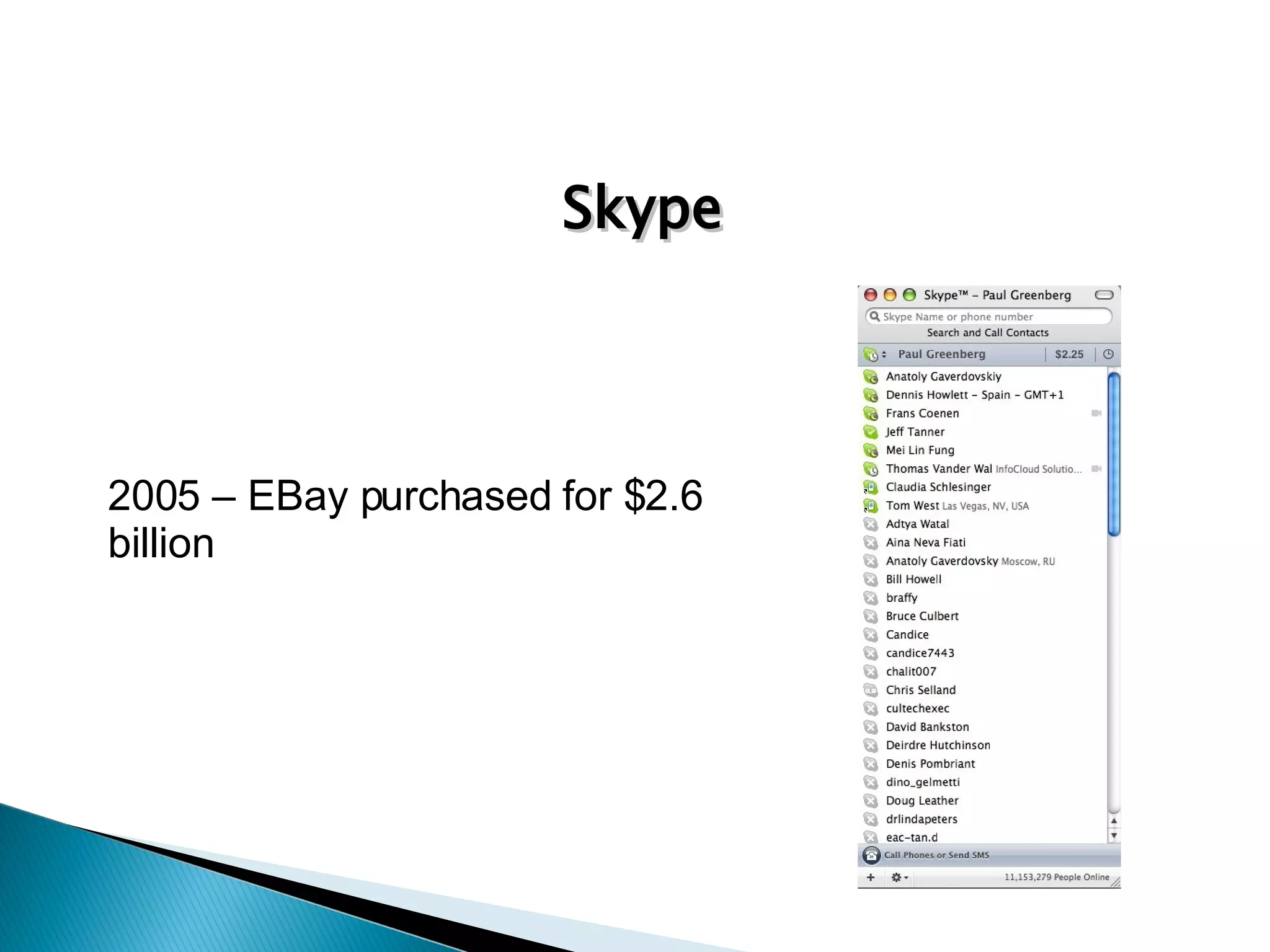
Skype 2005 – EBay purchased for $2.6 billion
The Social Customer
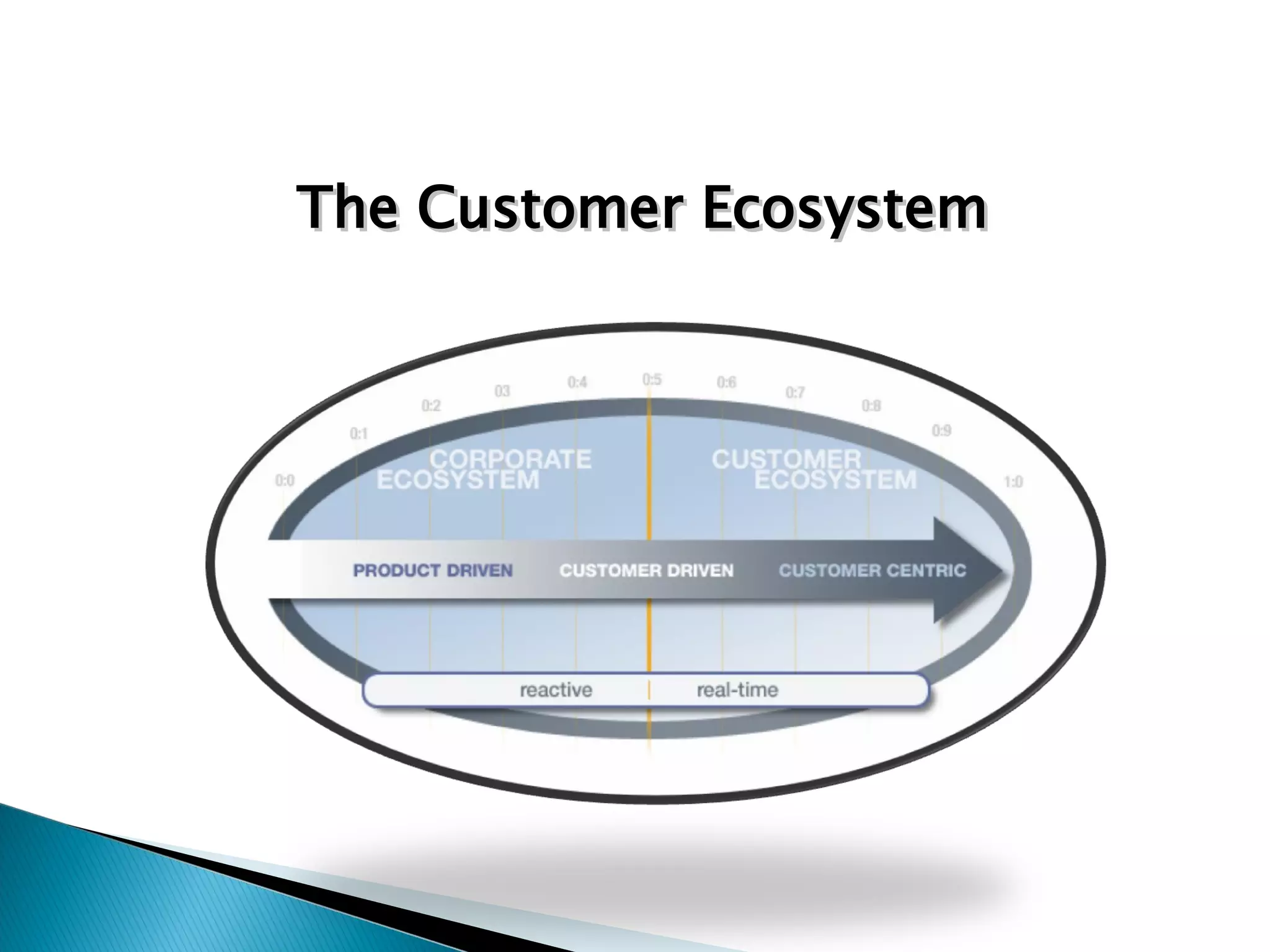
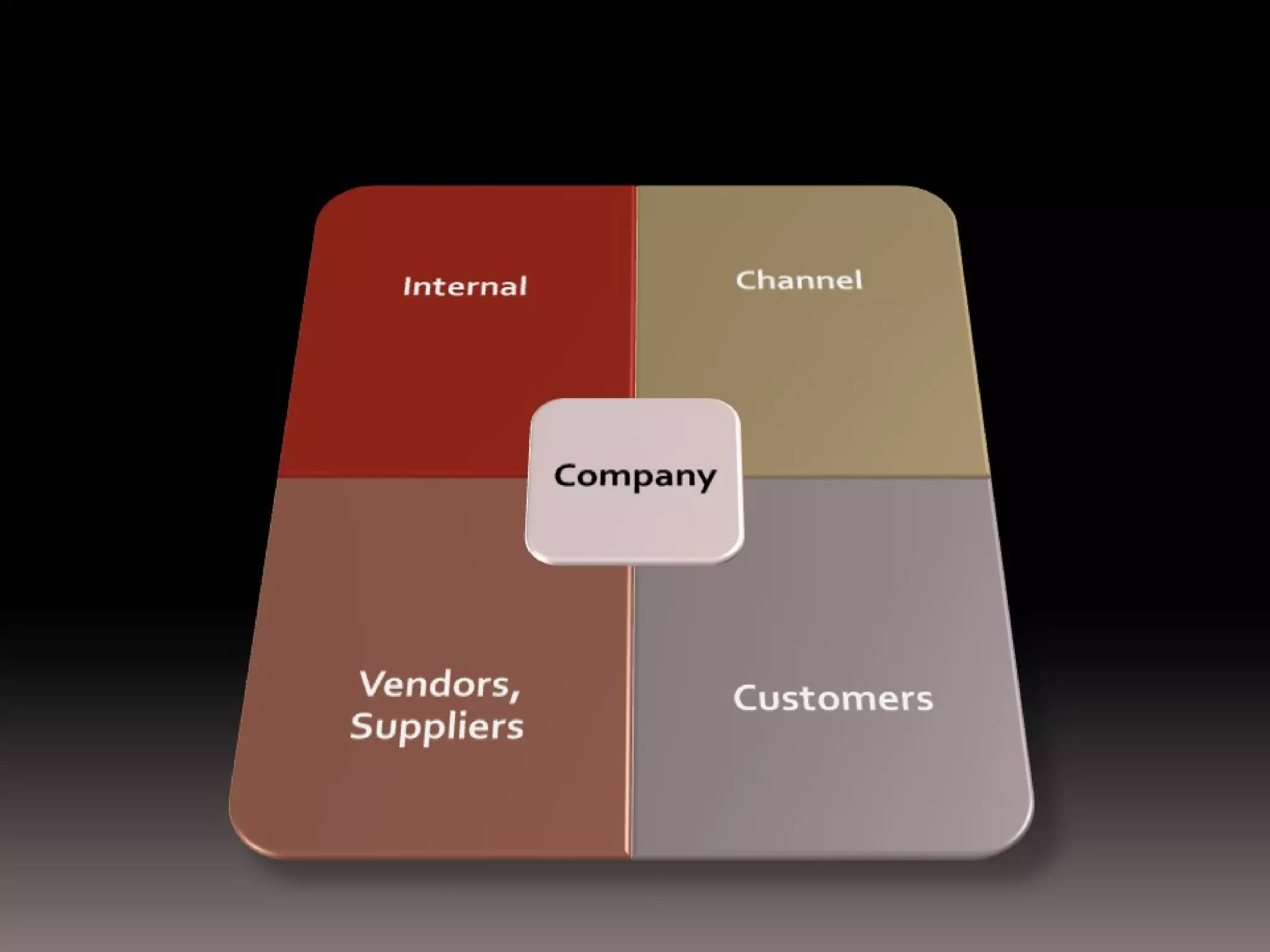
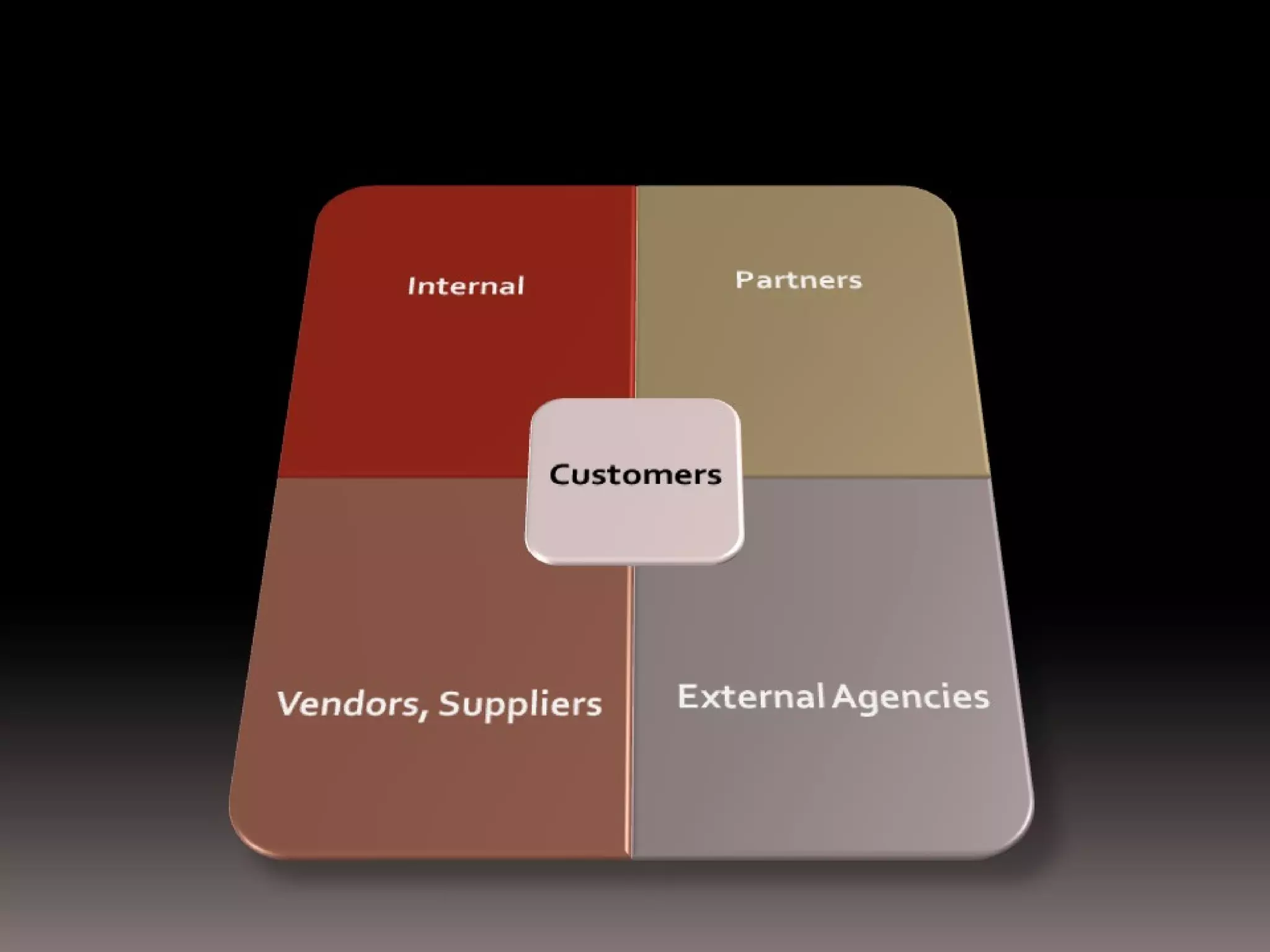
The Customer Ecosystem
This is a  SOCIAL  transformation that impacts all institutions – business among them – not exclusively
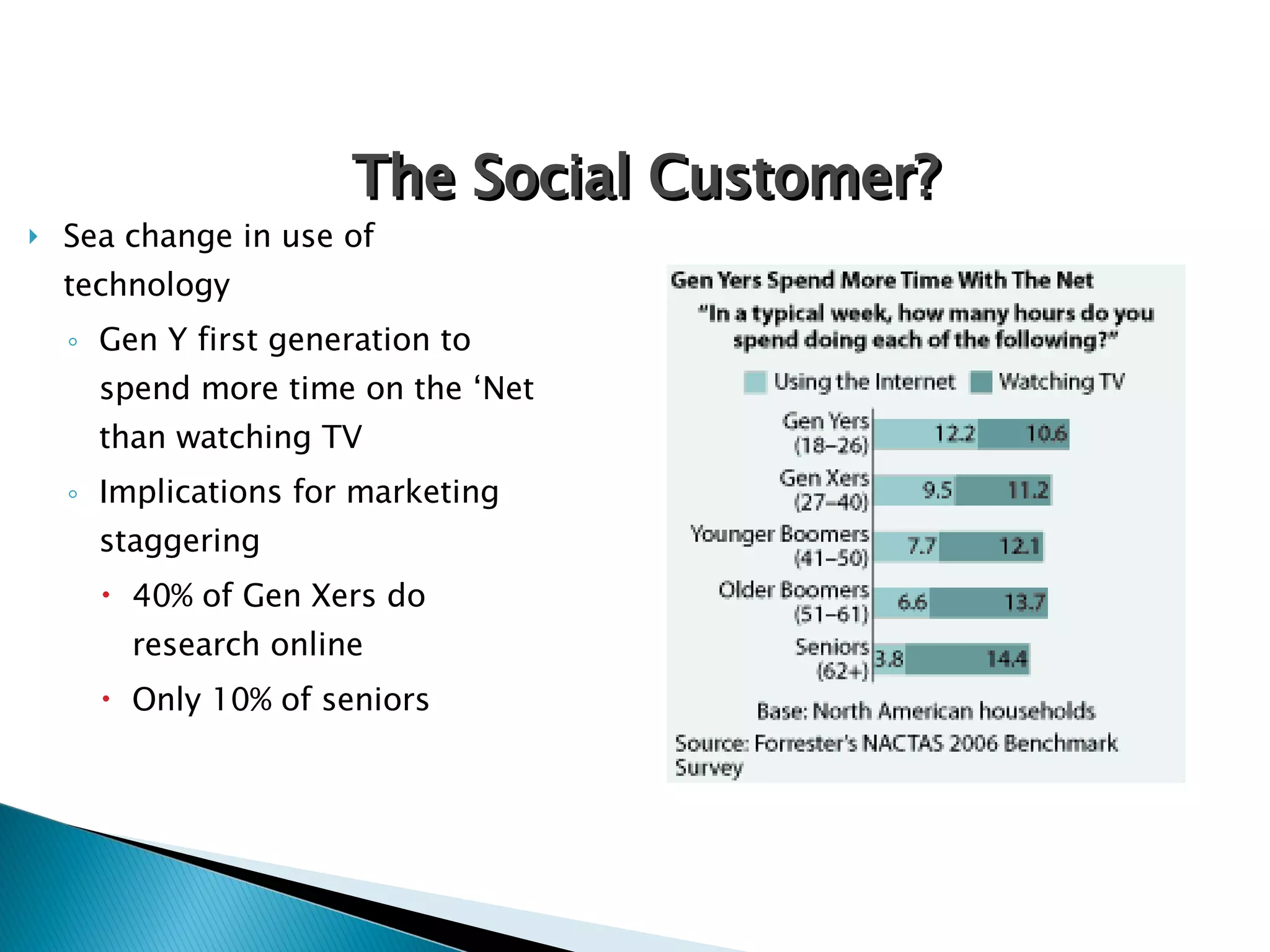
Sea change in use of technology Gen Y first generation to spend more time on the ‘Net than watching TV Implications for marketing staggering 40% of Gen Xers do research online Only 10% of seniors The Social Customer?
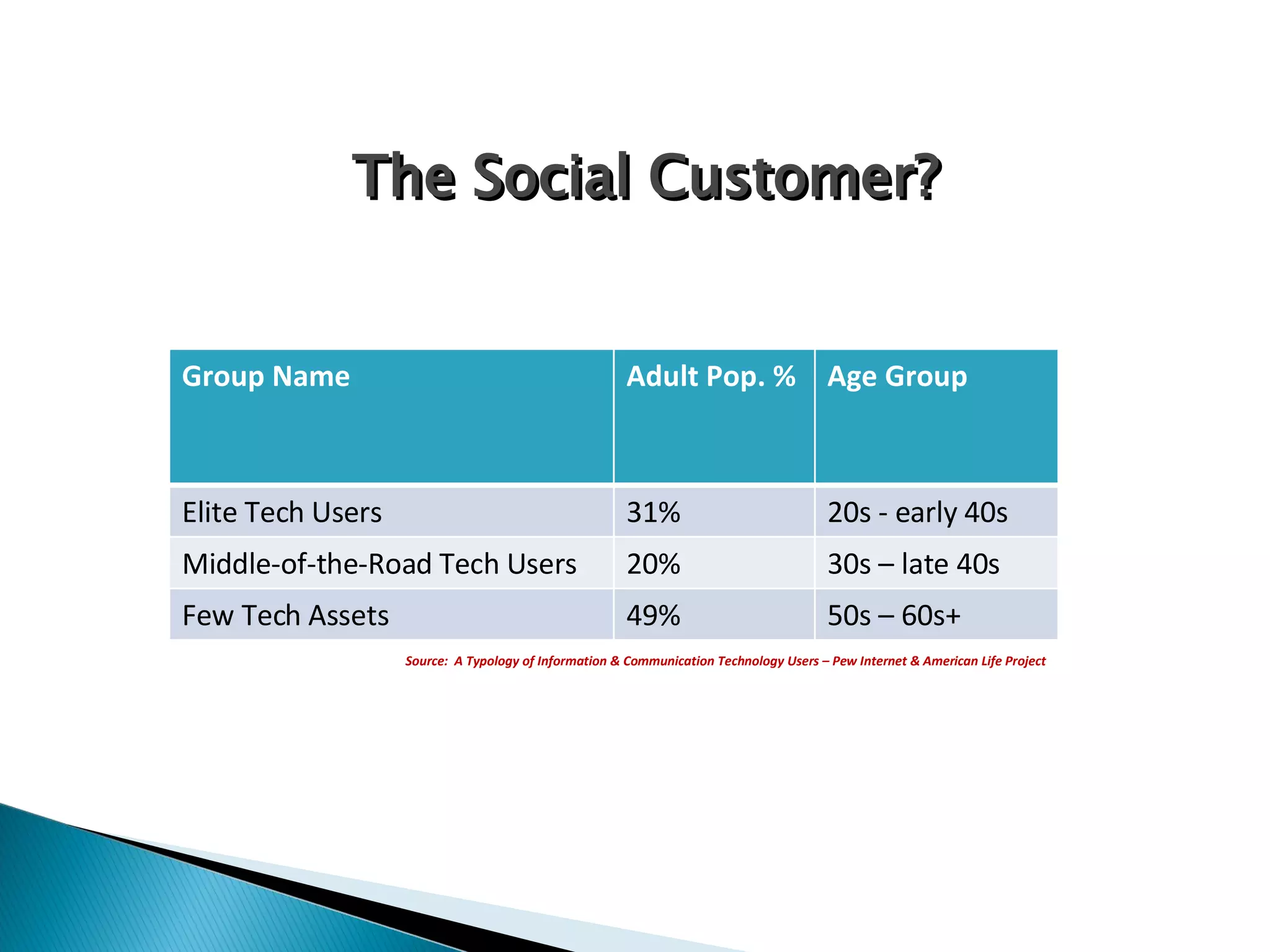
Source:  A Typology of Information & Communication Technology Users – Pew Internet & American Life Project The Social Customer? Group Name Adult Pop. % Age Group Elite Tech Users 31% 20s - early 40s Middle-of-the-Road Tech Users 20% 30s – late 40s Few Tech Assets 49% 50s – 60s+
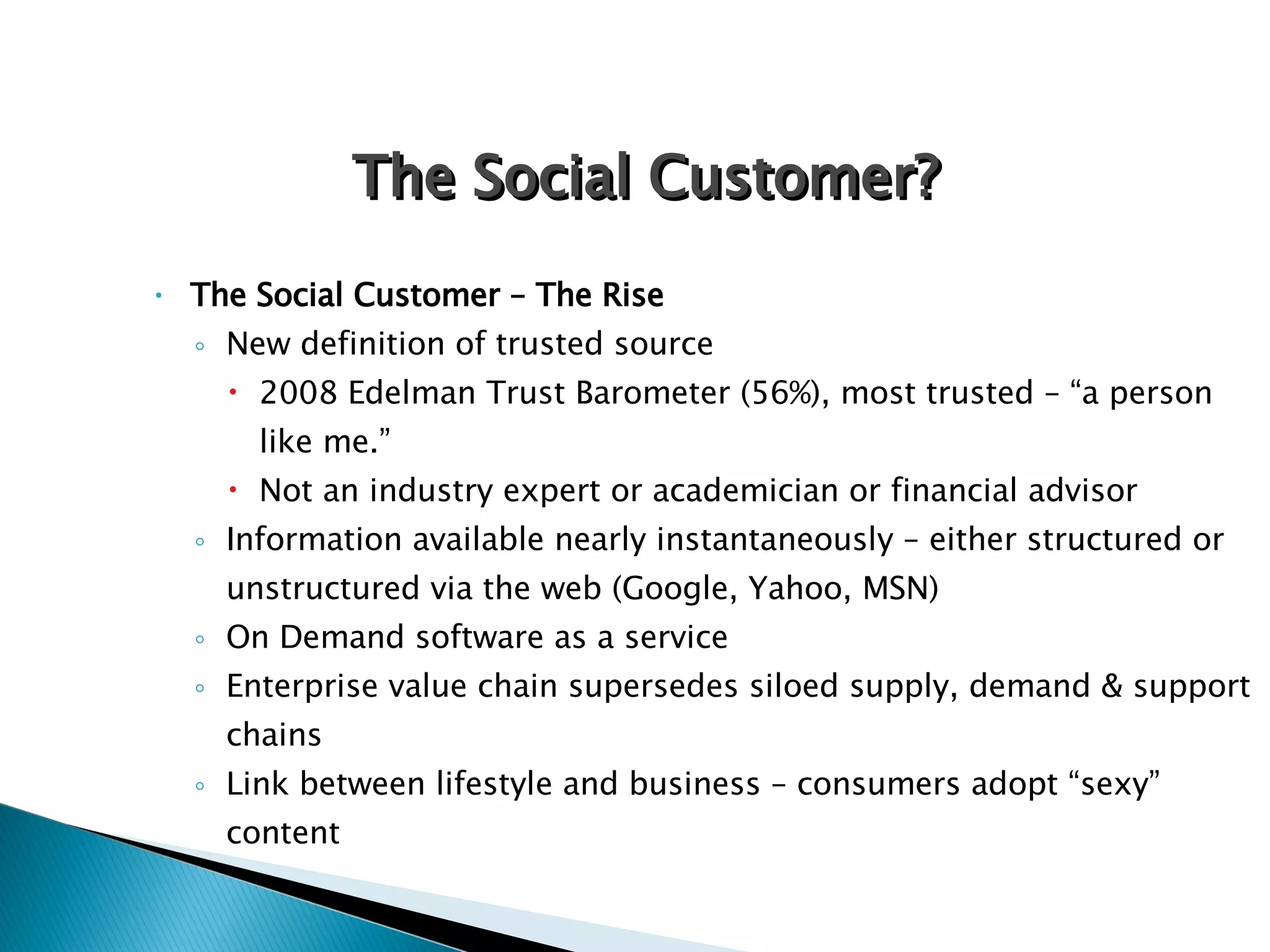
The Social Customer – The Rise New definition of trusted source 2008 Edelman Trust Barometer (56%), most trusted – “a person like me.”  Not an industry expert or academician or financial advisor Information available nearly instantaneously – either structured or unstructured via the web (Google, Yahoo, MSN) On Demand software as a service Enterprise value chain supersedes siloed supply, demand & support chains Link between lifestyle and business – consumers adopt “sexy” content The Social Customer?
The Social Customer – The Establishment Social networks as active participants in effecting change (blogosphere, podcasting) Collaboration between company & customers to provide useful value for each Personal value chain subsumes enterprise value chain Ubiquitous technologies leading platform The Live Web (Web 2.0) (MySpace, Facebook) Customer begin to include business as feature of life choice, not a separate factor – user generated content becomes part of business (Samsung open IP to engineers) The social customer is increasingly a mobile customer The Social Customer?
Each customer wants a personalized experience… They couldn’t care less if they are high value or low value customers They don’t know if they are high or low value to you But you have to accommodate even low value customers because of what they can do to you if you don’t But how do you begin to “know” millions of customers? First, understand how they interact with you at every point, in every channel That means detailed mapping, not just surveys, etc. Ultimately, the tools for the customer to manage their own experience are paramount Give them access to information that allows them to make informed, empowering choices which thus, provide value
Generation C – Cross-generation (source: Springwise) C stands for: Content-driven Connected Creative  Collaborative Contextual Communicative Age is irrelevant to Gen C Its nature and ease of information availability makes it empowered The social customer engages businesses for personal agendas The Social Customer?
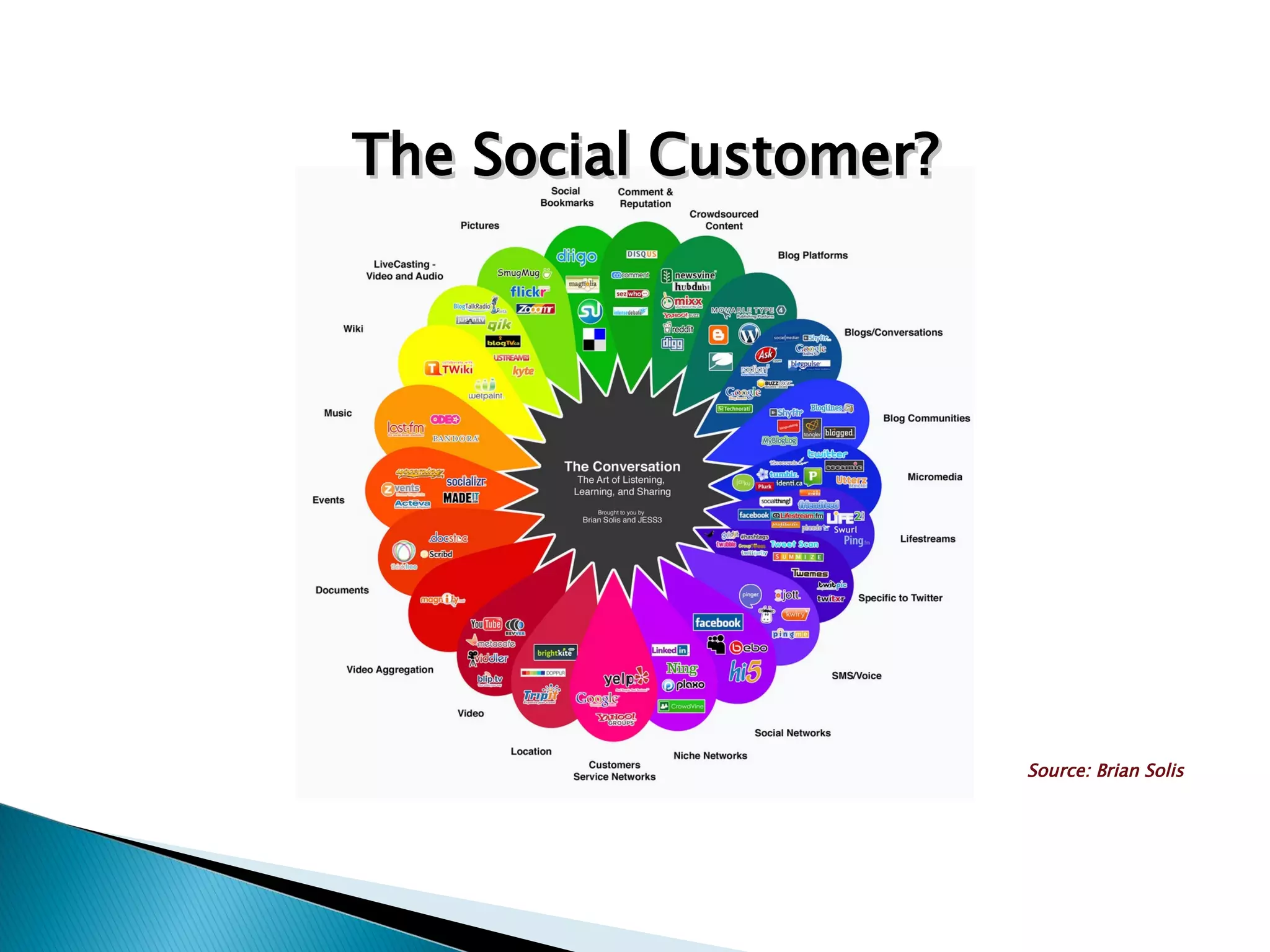
Source: Brian Solis The Social Customer?
Definition
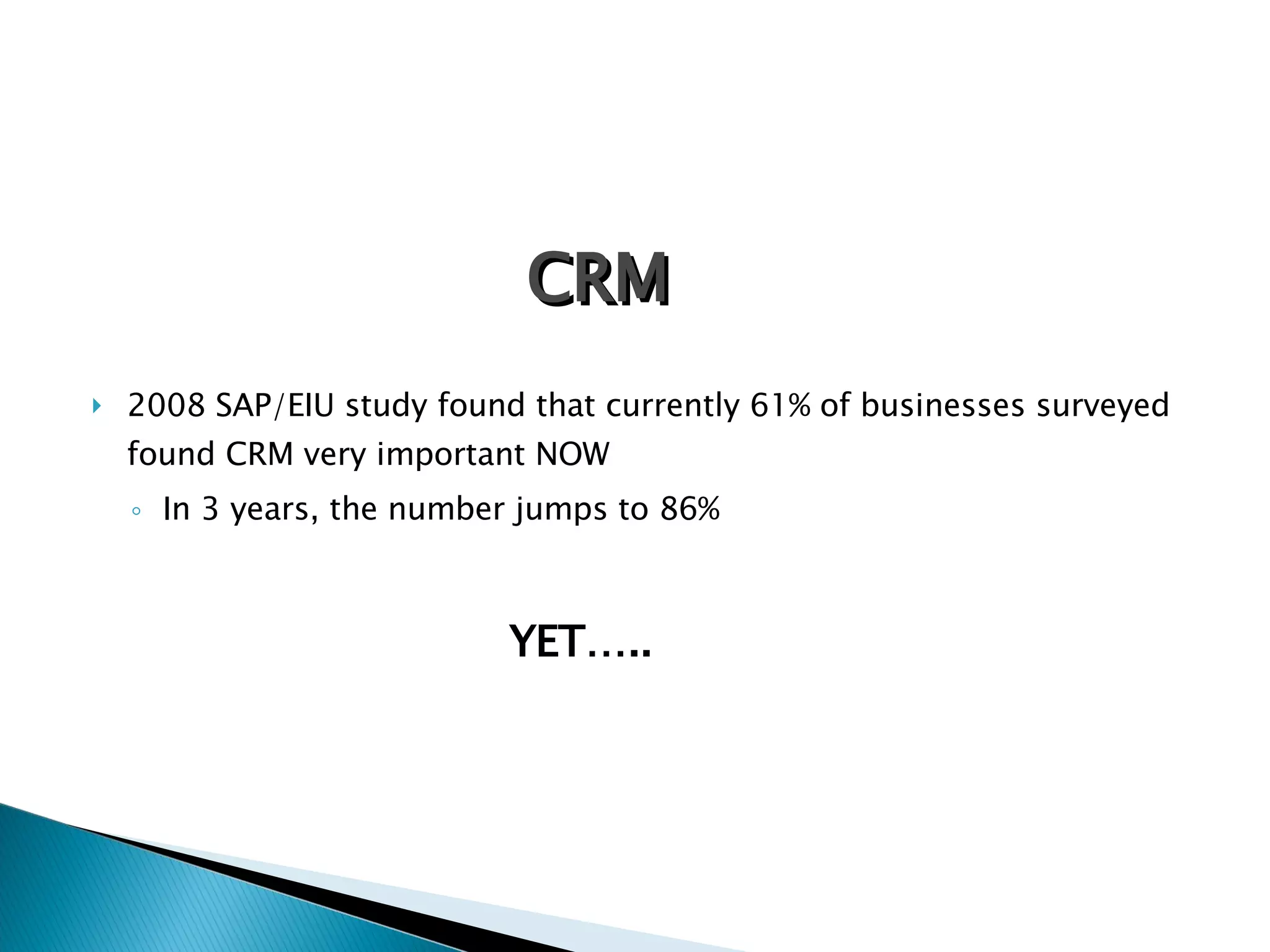
2008 SAP/EIU study found that currently 61% of businesses surveyed found CRM very important NOW In 3 years, the number jumps to 86% CRM YET…..
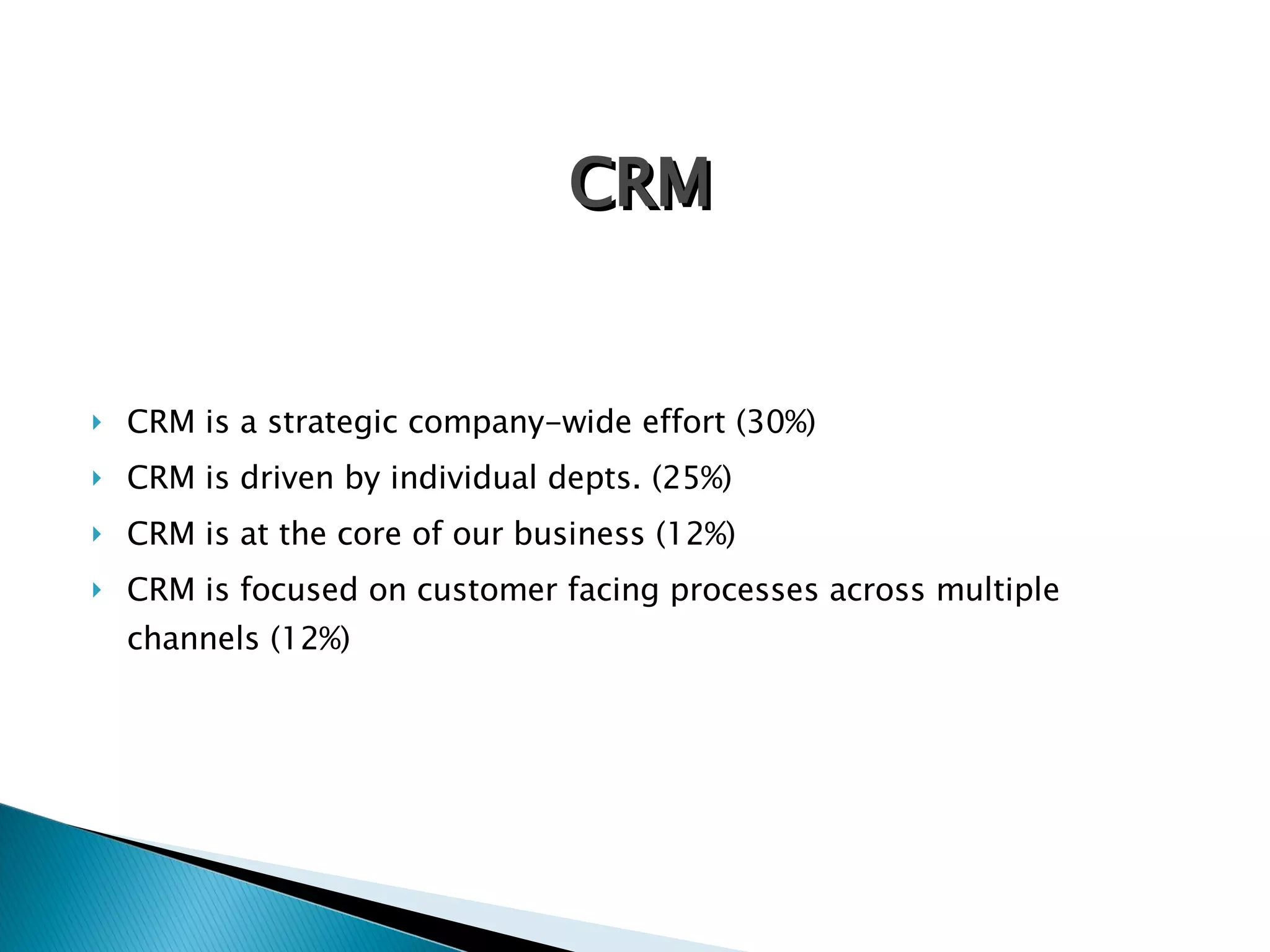
CRM is a strategic company-wide effort (30%) CRM is driven by individual depts. (25%) CRM is at the core of our business (12%) CRM is focused on customer facing processes across multiple channels (12%) CRM
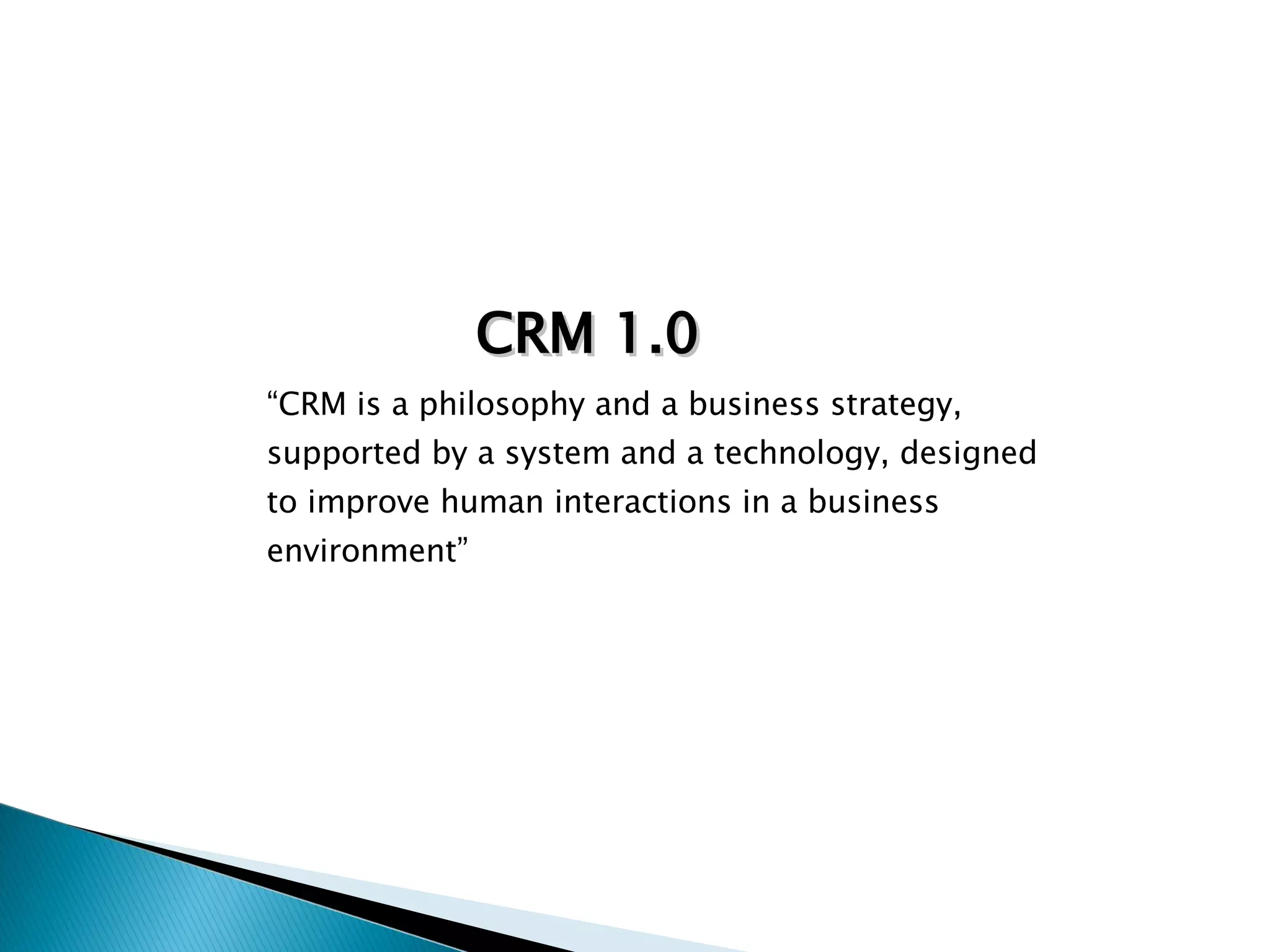
“ CRM is a philosophy and a business strategy, supported by a system and a technology, designed to improve human interactions in a business environment” CRM 1.0
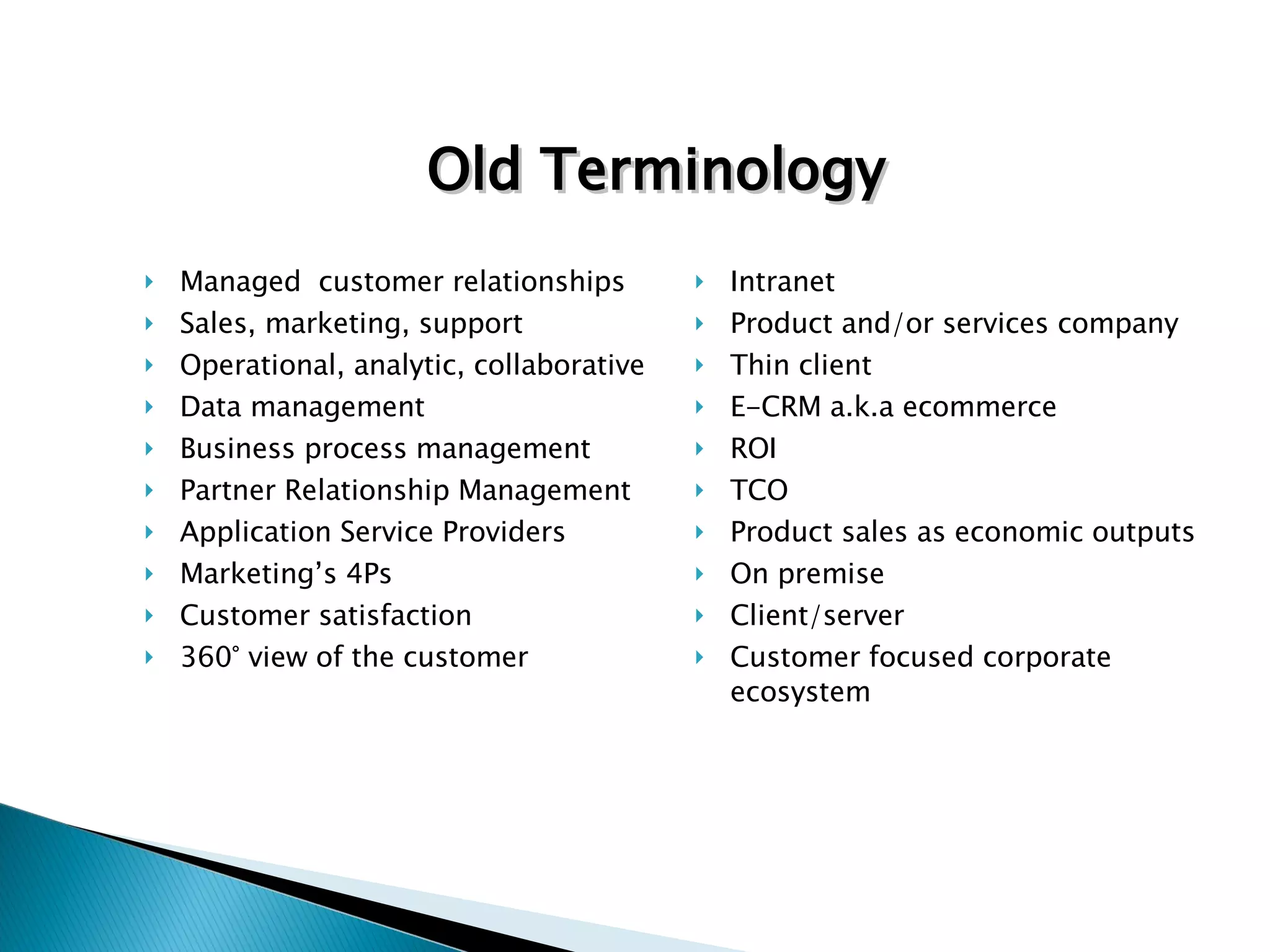
Managed  customer relationships Sales, marketing, support Operational, analytic, collaborative Data management Business process management Partner Relationship Management Application Service Providers Marketing’s 4Ps Customer satisfaction 360° view of the customer Intranet Product and/or services company Thin client E-CRM a.k.a ecommerce ROI TCO Product sales as economic outputs On premise  Client/server Customer focused corporate ecosystem Old Terminology
 
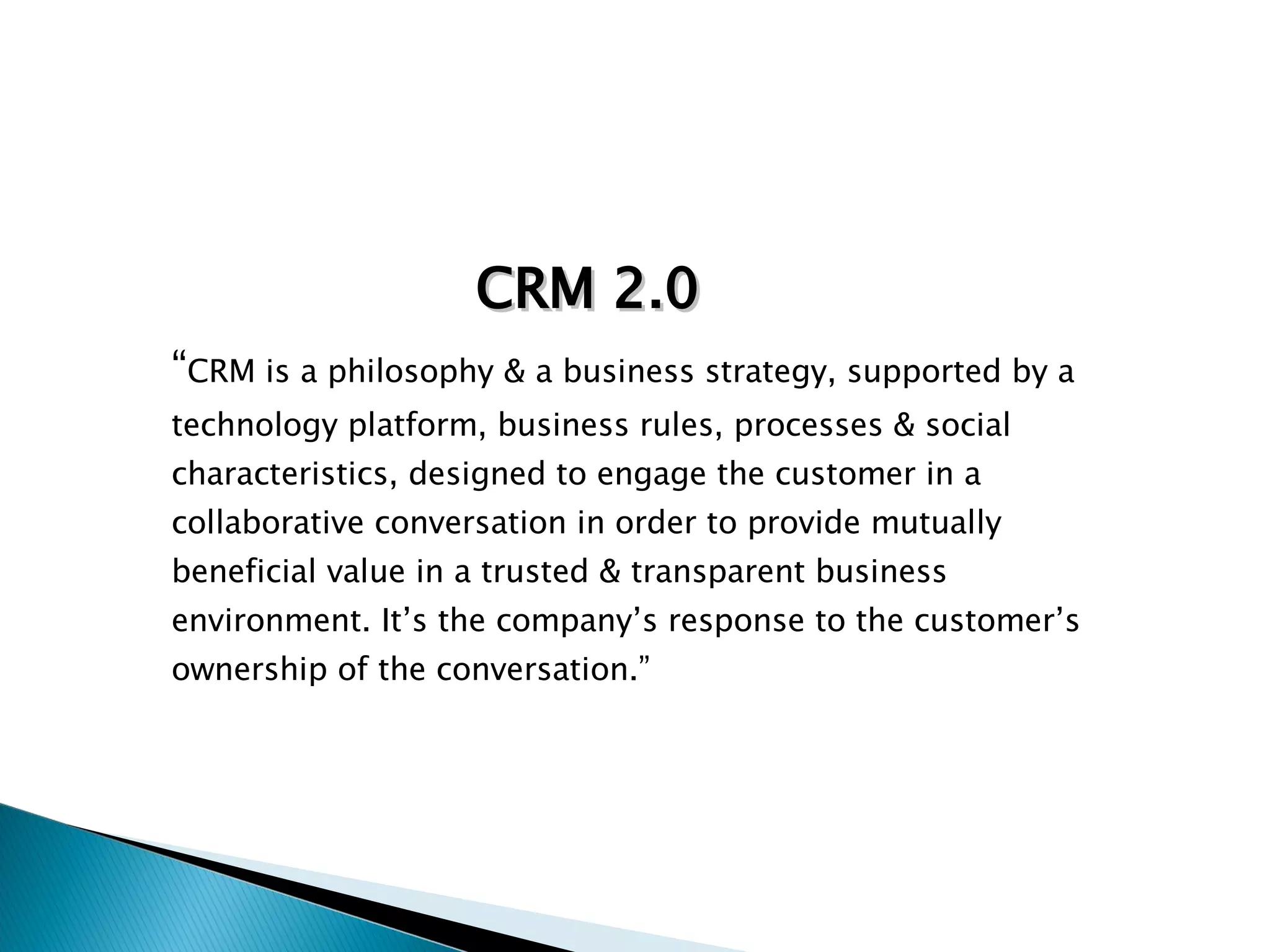
“ CRM is a philosophy & a business strategy, supported by a technology platform, business rules, processes & social characteristics, designed to engage the customer in a collaborative conversation in order to provide mutually beneficial value in a trusted & transparent business environment. It’s the company’s response to the customer’s ownership of the conversation.” CRM 2.0
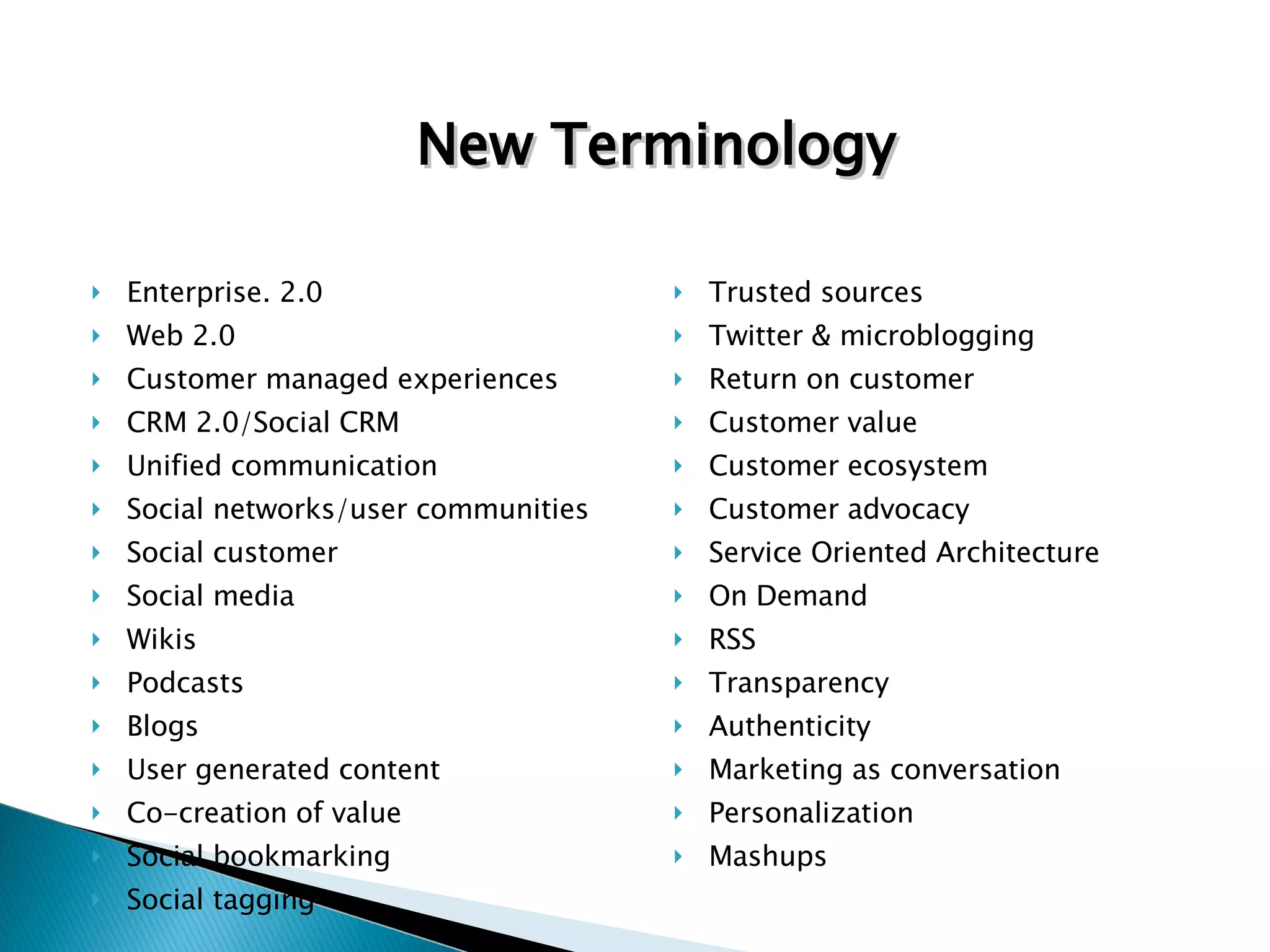
Enterprise. 2.0 Web 2.0 Customer managed experiences CRM 2.0/Social CRM Unified communication Social networks/user communities Social customer Social media Wikis Podcasts Blogs User generated content Co-creation of value Social bookmarking Social tagging Trusted sources Twitter & microblogging Return on customer Customer value Customer ecosystem  Customer advocacy Service Oriented Architecture On Demand RSS Transparency Authenticity Marketing as conversation Personalization Mashups New Terminology
 
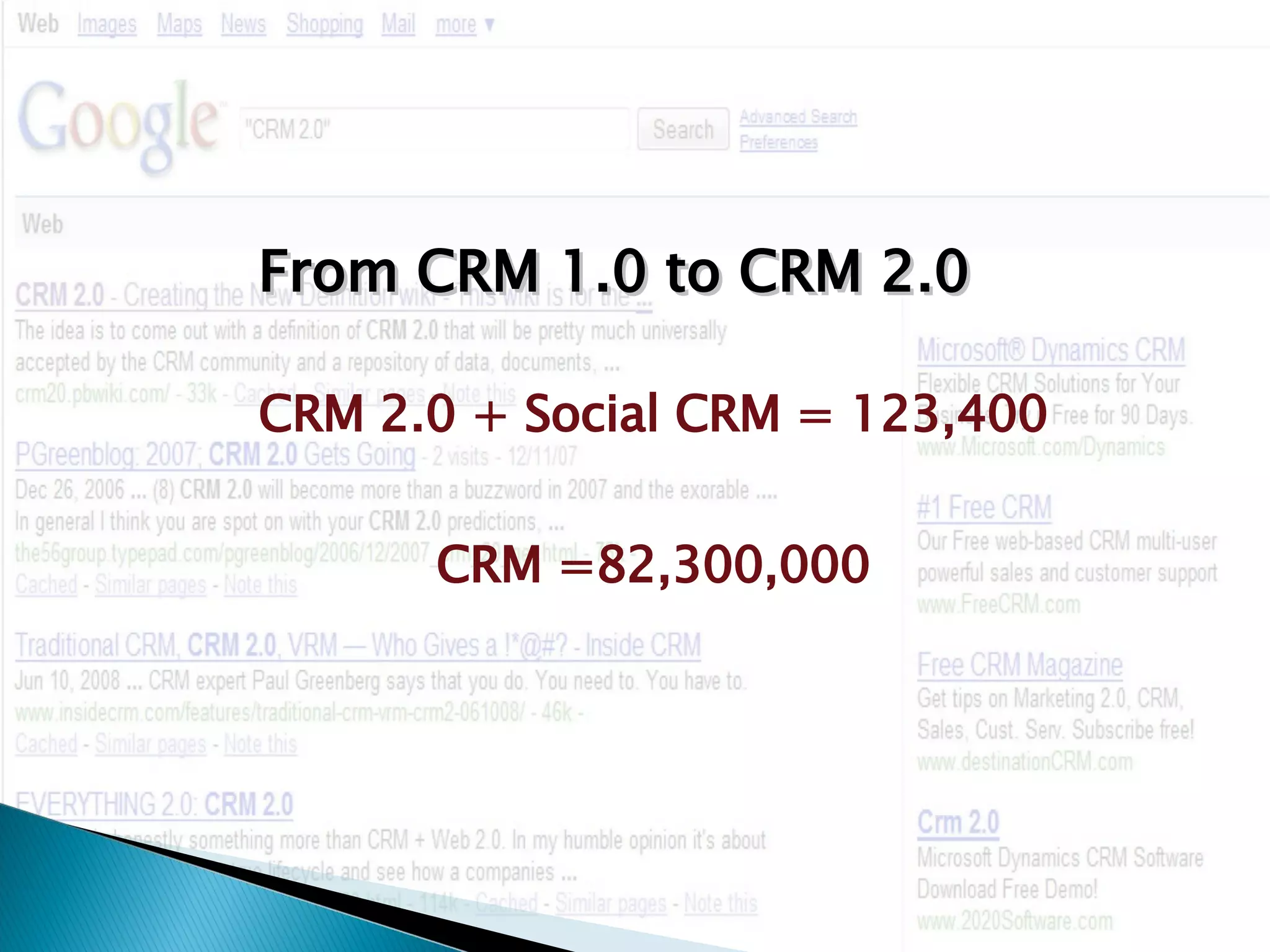
CRM 2.0 + Social CRM = 123,400 CRM =82,300,000 From CRM 1.0 to CRM 2.0
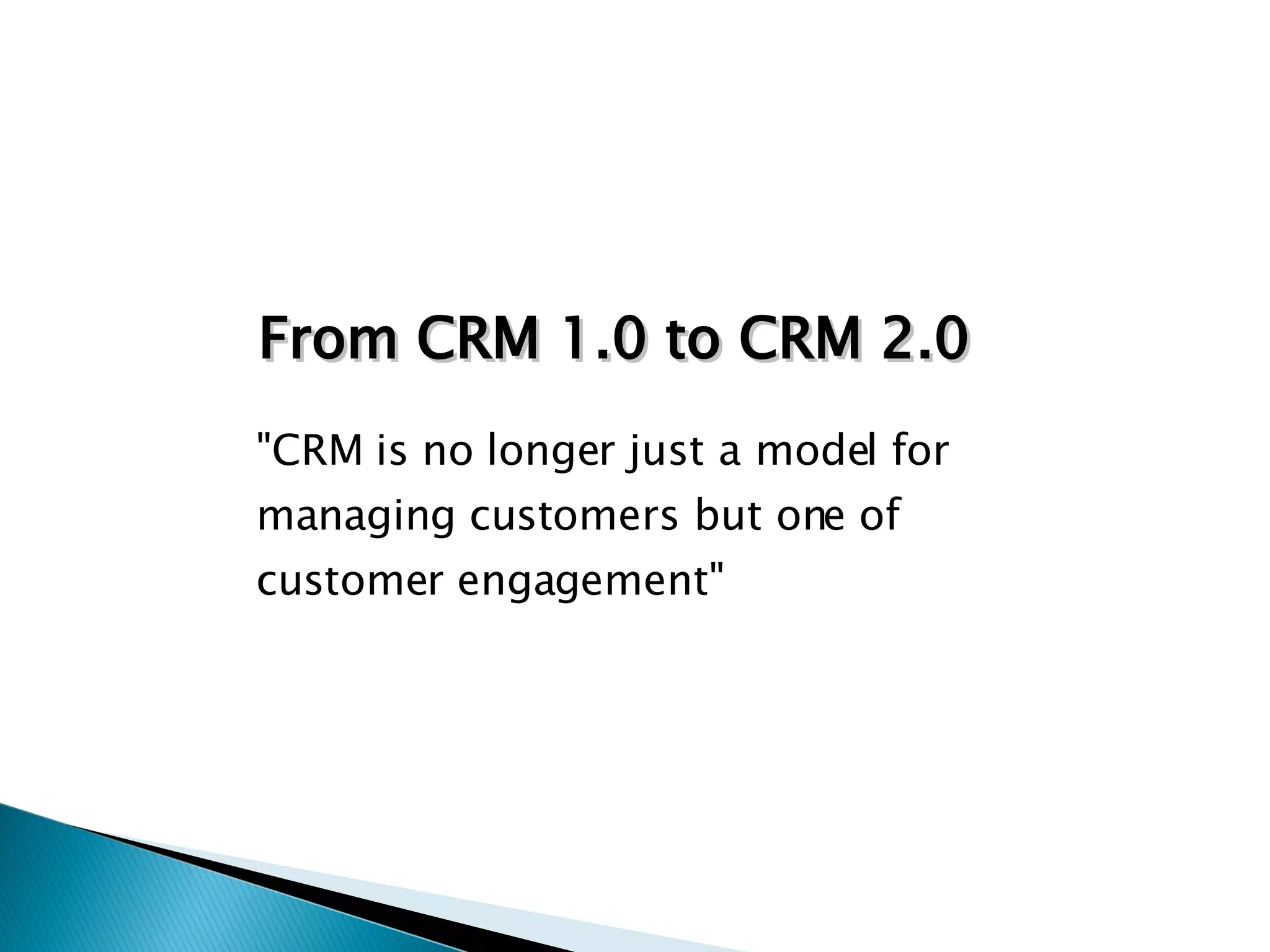
"CRM is no longer just a model for managing customers but one of customer engagement" From CRM 1.0 to CRM 2.0
Strategy/Business Model
Characteristics of the prototype The lines between producer and consumer are blurred The users and producers are engaged in the co-creation of value – they become collaborators The users have the tools to configure and/or customize their personal experience with the product The users and the producers encourage each other and mutually define the future directions of the specific products
Characteristics of the prototype (part deux) The users and producers take advantage of the most advanced methods of communication within the global matrix (e.g. user communities within the worldwide web) Even though the users are working on the product changes for their own experience, the changes to the product have universal and commercial value and drive the sales of the product The producer is not just the publisher/manufacturer but operates as an aggregator for the user's creative activity The user is an advocate of the experience and, directly and by extension, the company
Old School to New School Innovation Toolkits online 15 telematics feature for future BMW models Now ongoing 25 customer touchpoints identified and developed with the customers Products developed with direct collaboration with customers
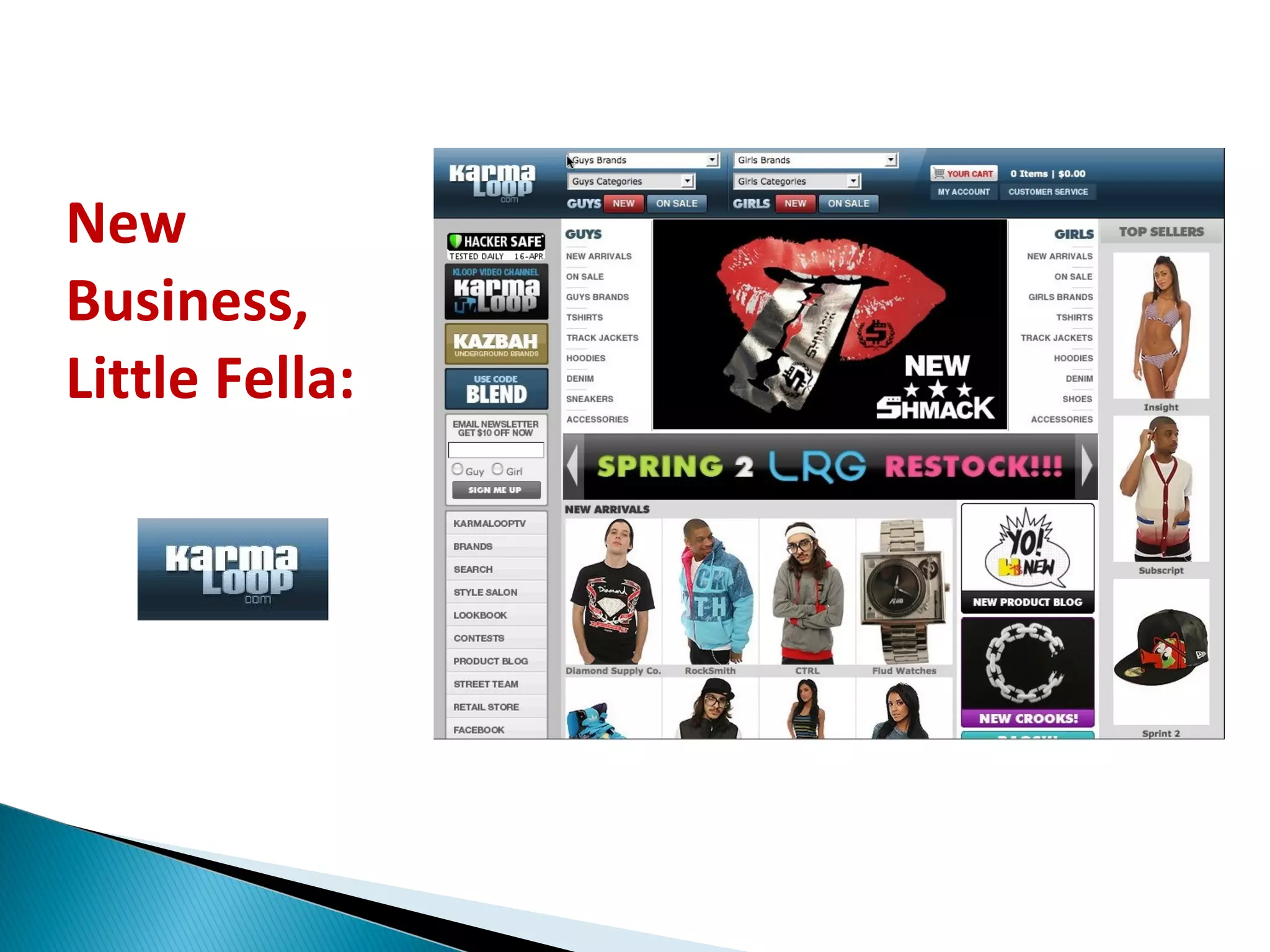
New Business, Little Fella:
Community retailing Multiple brands Established (Adidas, Vans) Independent (The Kazbah) Community of 800,000 Own clothing line (Sons of Liberty Innovations
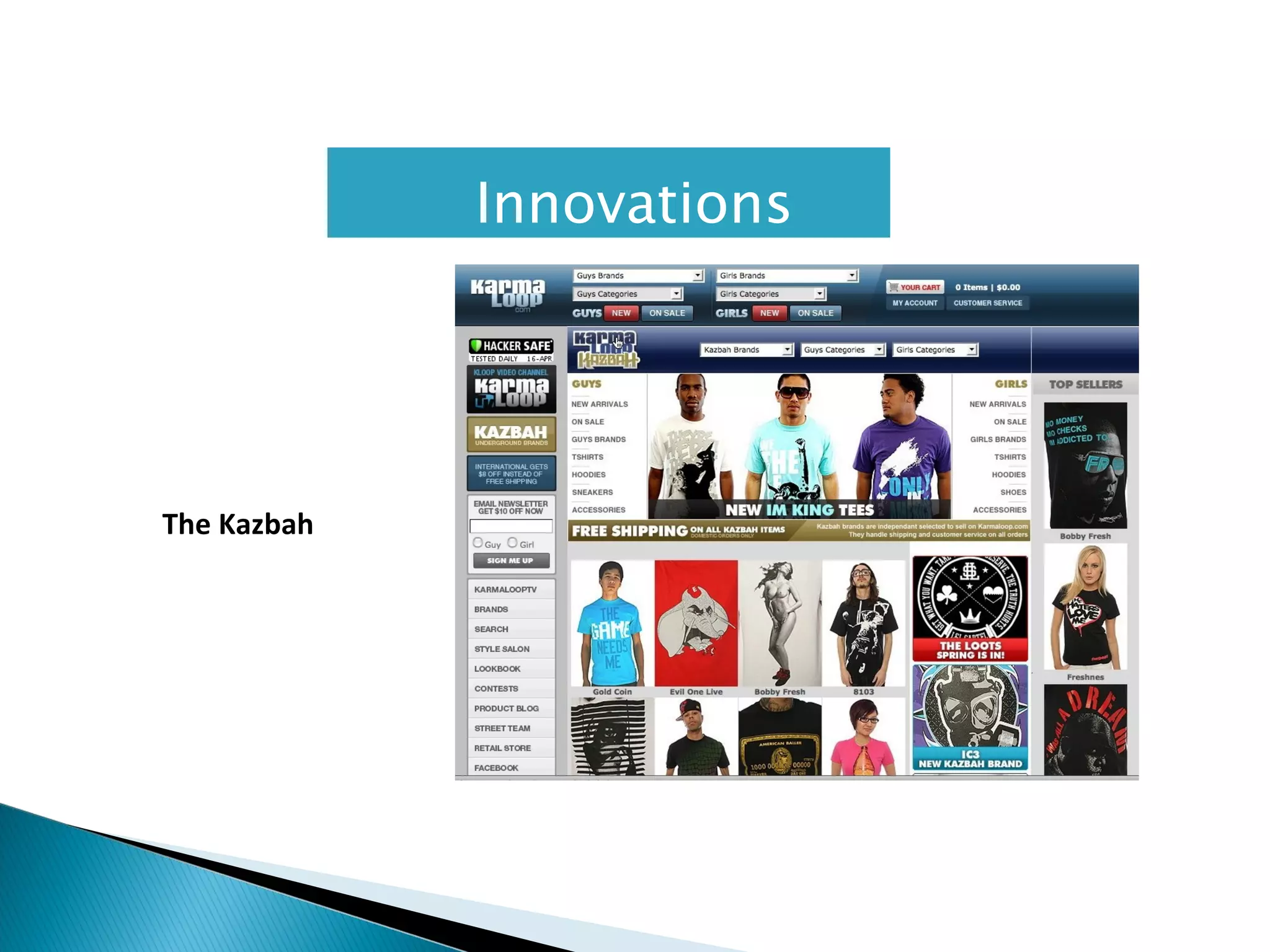
The Kazbah Innovations
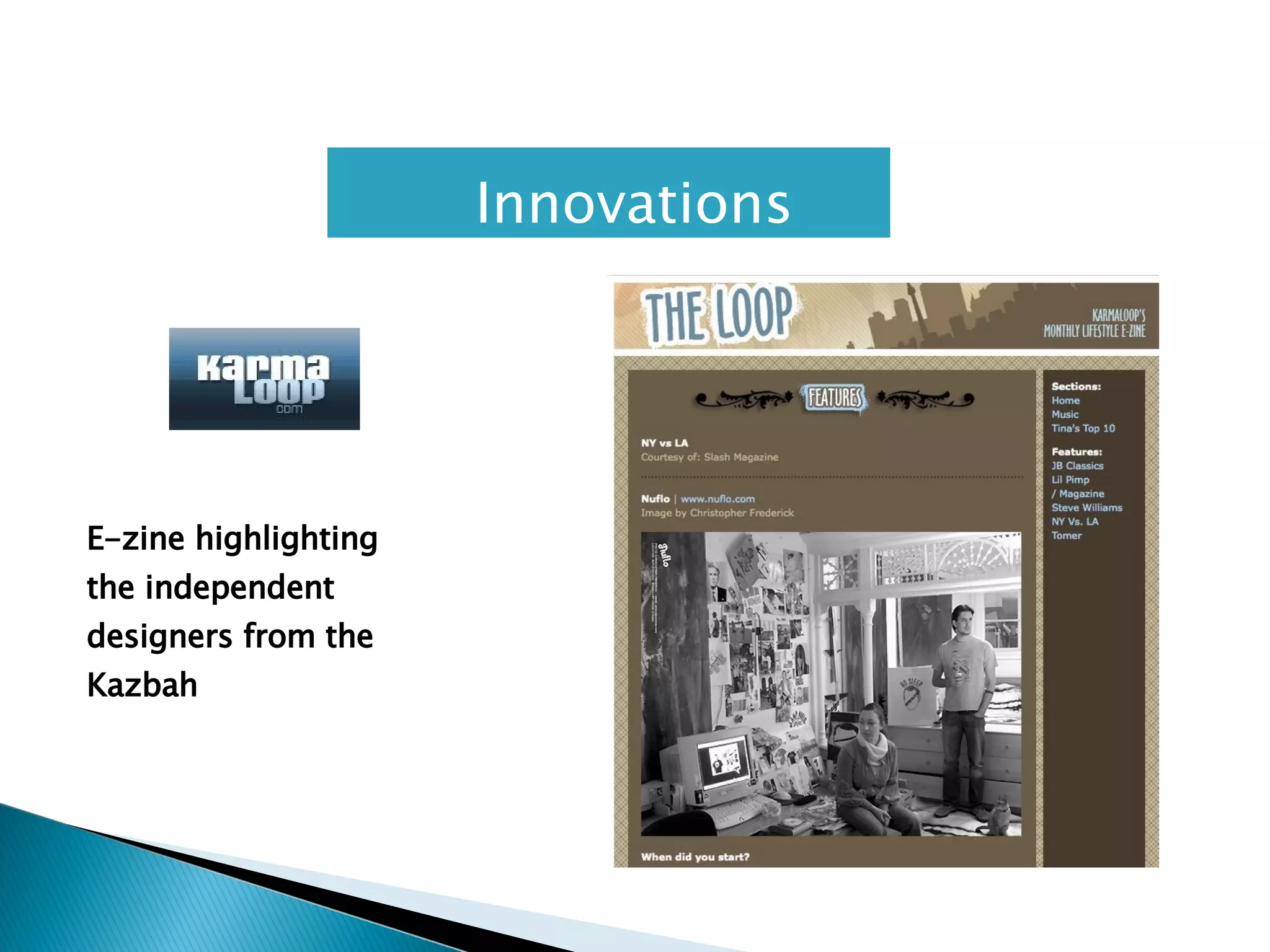
E-zine highlighting the independent designers from the Kazbah Innovations
Innovations
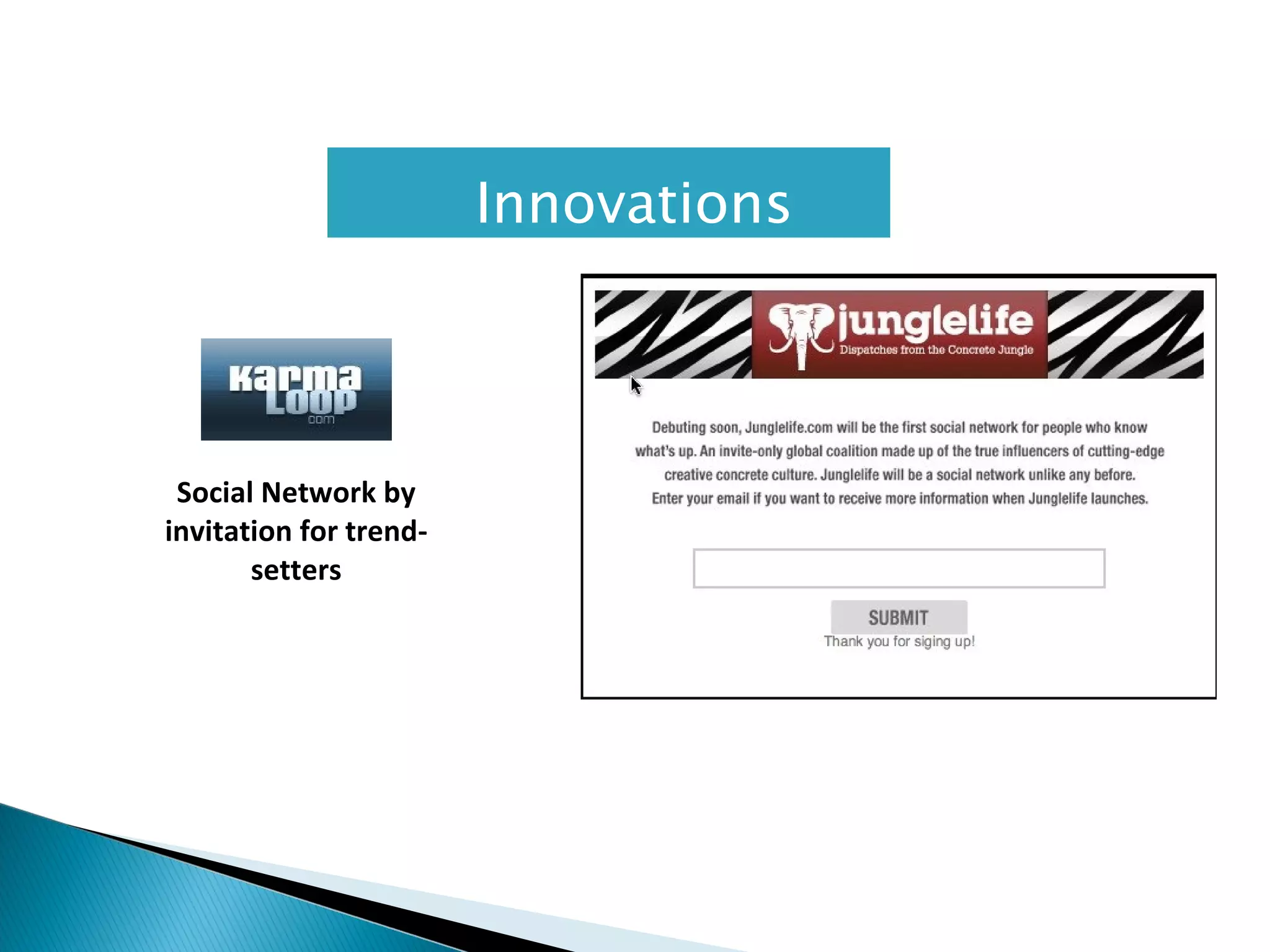
Social Network by invitation for trend-setters Innovations
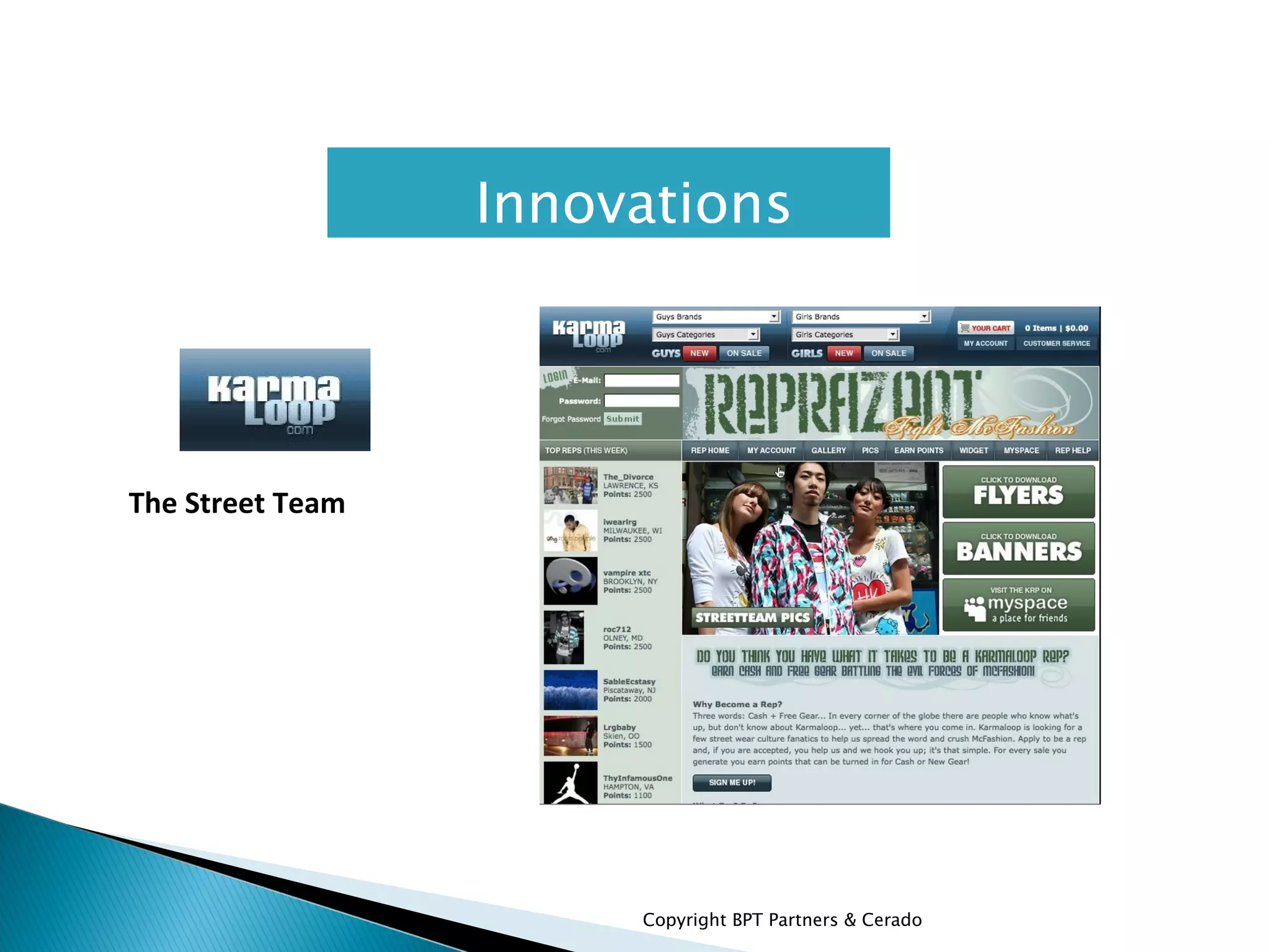
Copyright BPT Partners & Cerado The Street Team Innovations
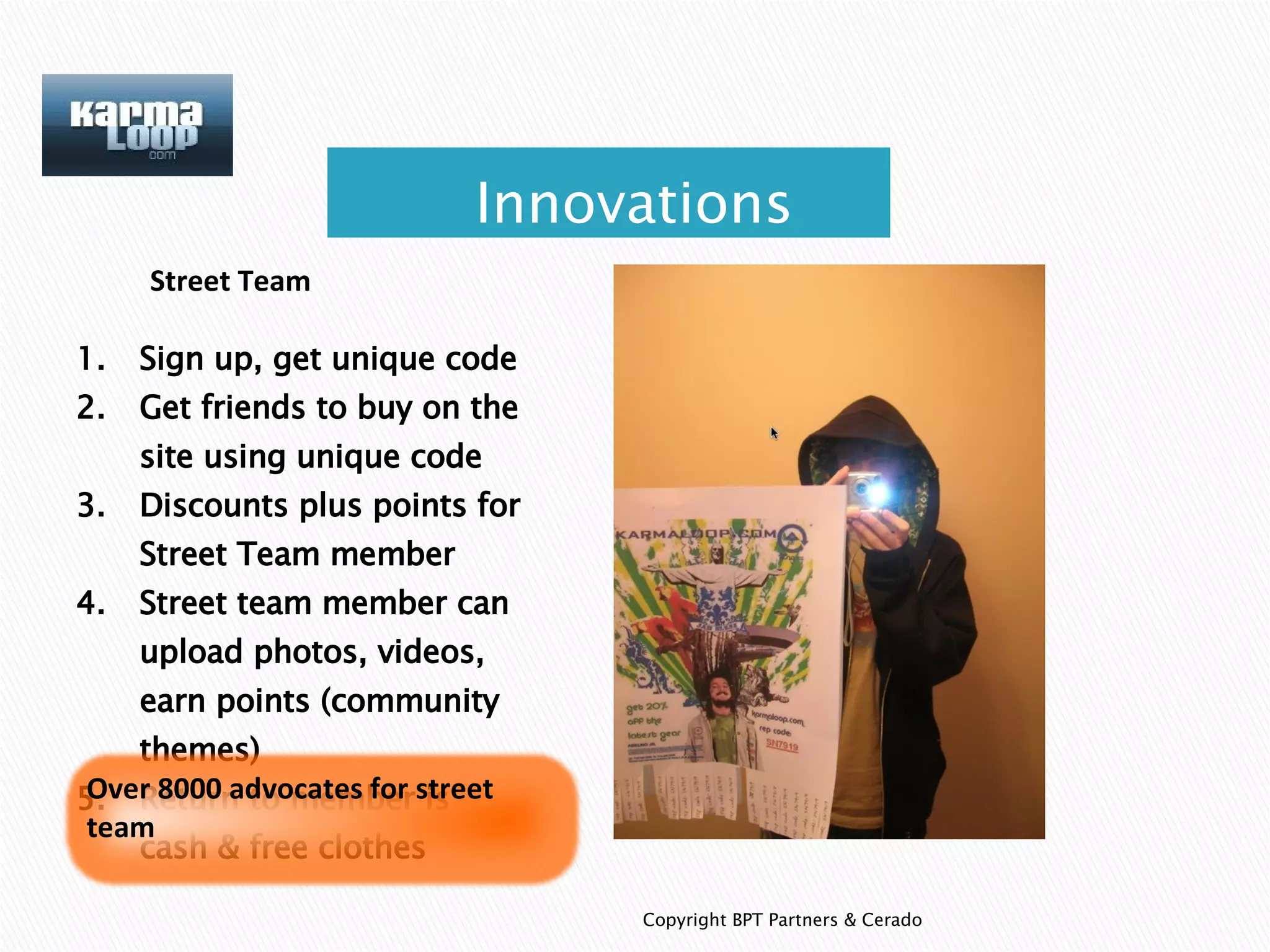
Copyright BPT Partners & Cerado Street Team Sign up, get unique code Get friends to buy on the site using unique code Discounts plus points for Street Team member Street team member can upload photos, videos, earn points (community themes) Return to member is cash & free clothes Innovations Over 8000 advocates for street team
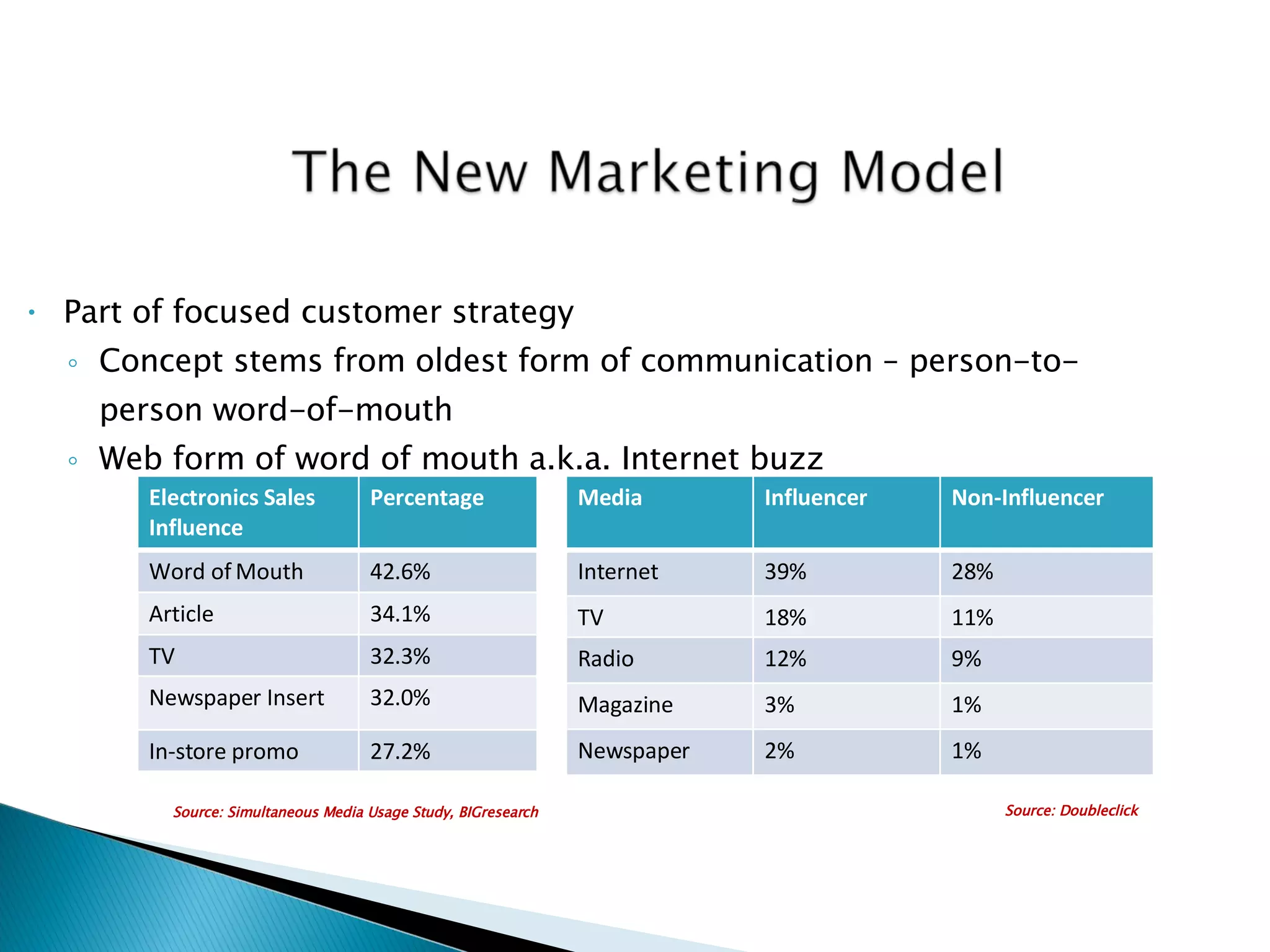
Part of focused customer strategy Concept stems from oldest form of communication – person-to-person word-of-mouth Web form of word of mouth a.k.a. Internet buzz Source: Simultaneous Media Usage Study, BIGresearch Source: Doubleclick Electronics Sales Influence Percentage Word of Mouth 42.6% Article 34.1% TV 32.3% Newspaper Insert 32.0% In-store promo 27.2% Media Influencer Non-Influencer Internet 39% 28% TV 18% 11% Radio 12% 9% Magazine 3% 1% Newspaper 2% 1%
The Cluetrain Manifesto: The End of Business As Usual Markets are conversations Markets consist of human beings, not demographic sectors Networked conversations are enabling powerful new forms of social organization and knowledge exchange to emerge There are no secrets. The networked market knows more than companies do about their own products. And whether the news is good or bad, they tell everyone Already companies that speak in the language of the pitch…are no longer speaking to anyone Most marketing programs are based on the fear that the market might see what’s really going on in the company
Because the model is built on trust, the reputation of the company, not the message, becomes the brand That means, both the perception but also the actual quantified assessment of the marketing practices as certified by third parties (TRUSTe, etc.) The practical side would be an authenticated or accredited message that is validated by the ISP or whoever is transmitting it. Marketing becomes the center point for  engagement  of the customer   Messages are not to be pushed at the customer about products and services; Marketing uses the media tools that are available to engage the customer But with authenticity (Walmart & Edelman screw-up)
Authenticity and trust is what matters – more than even the “consistency” of the message
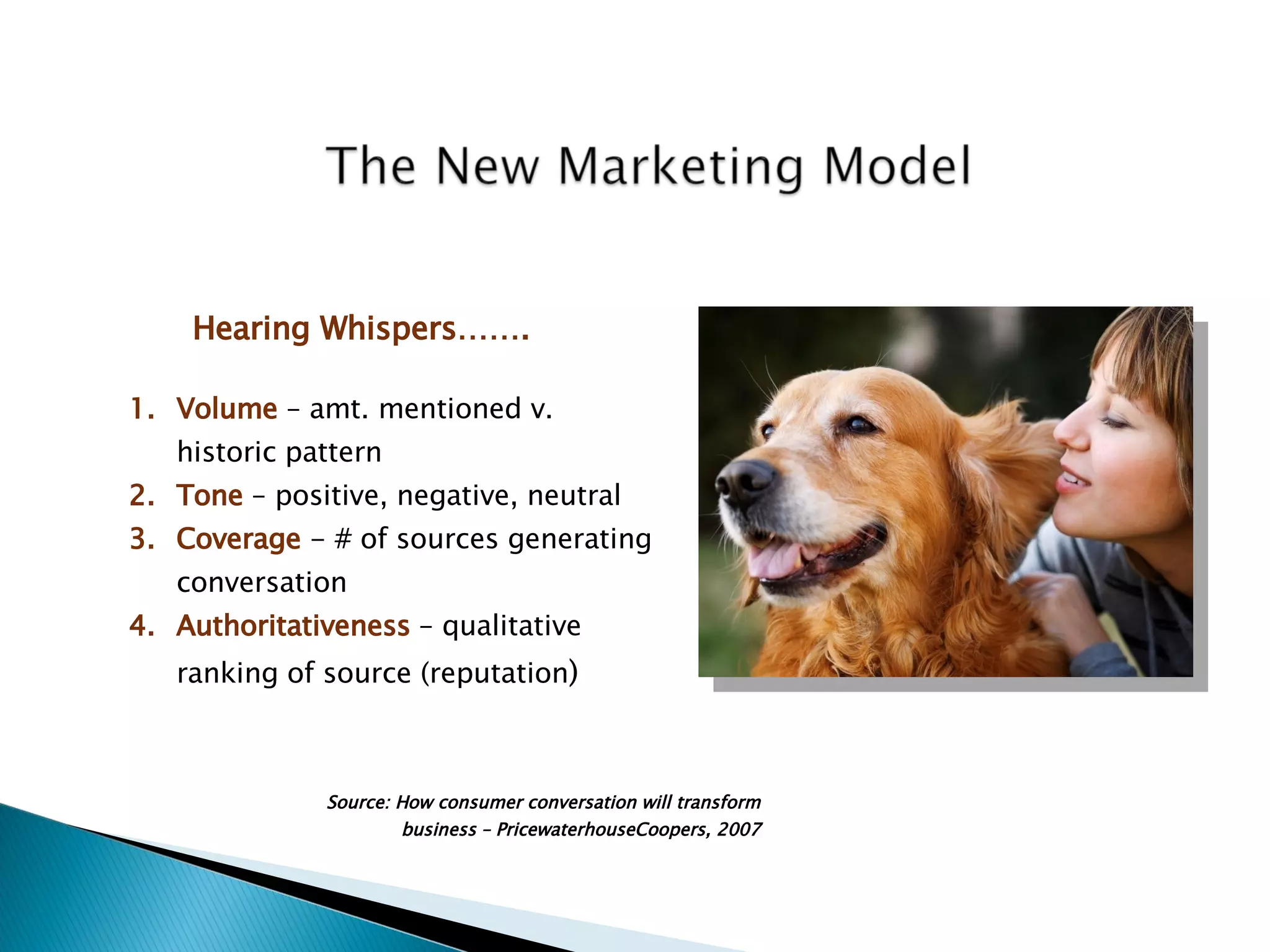
Volume  – amt. mentioned v. historic pattern Tone  – positive, negative, neutral Coverage  - # of sources generating conversation Authoritativeness  – qualitative ranking of source (reputation ) Hearing Whispers……. Source: How consumer conversation will transform business – PricewaterhouseCoopers, 2007
The Tools
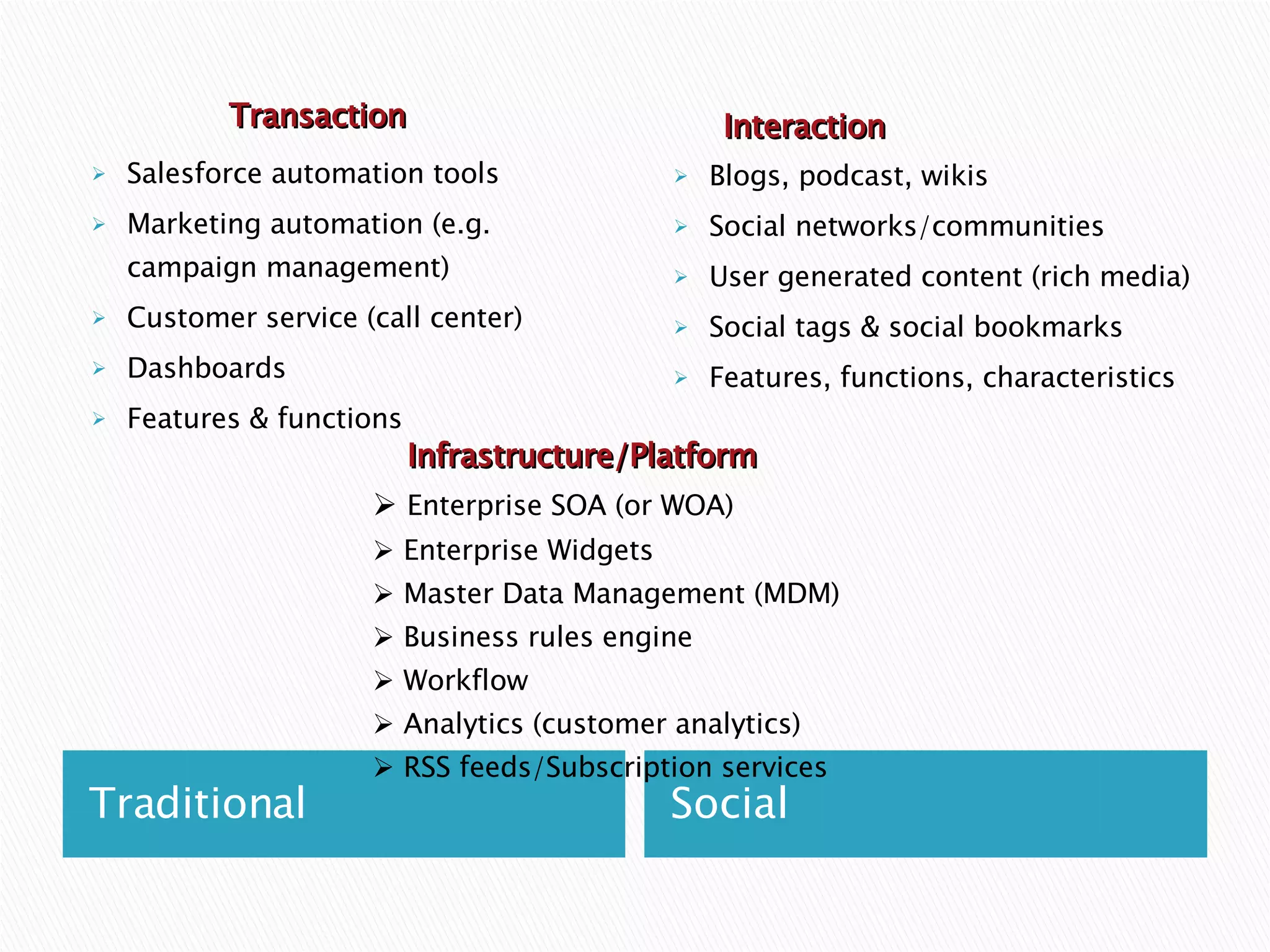
Traditional Salesforce automation tools Marketing automation (e.g. campaign management) Customer service (call center) Dashboards Features & functions Social Blogs, podcast, wikis Social networks/communities User generated content (rich media) Social tags & social bookmarks Features, functions, characteristics Enterprise SOA (or WOA) Enterprise Widgets Master Data Management (MDM) Business rules engine Workflow Analytics (customer analytics) RSS feeds/Subscription services Transaction Interaction Infrastructure/Platform
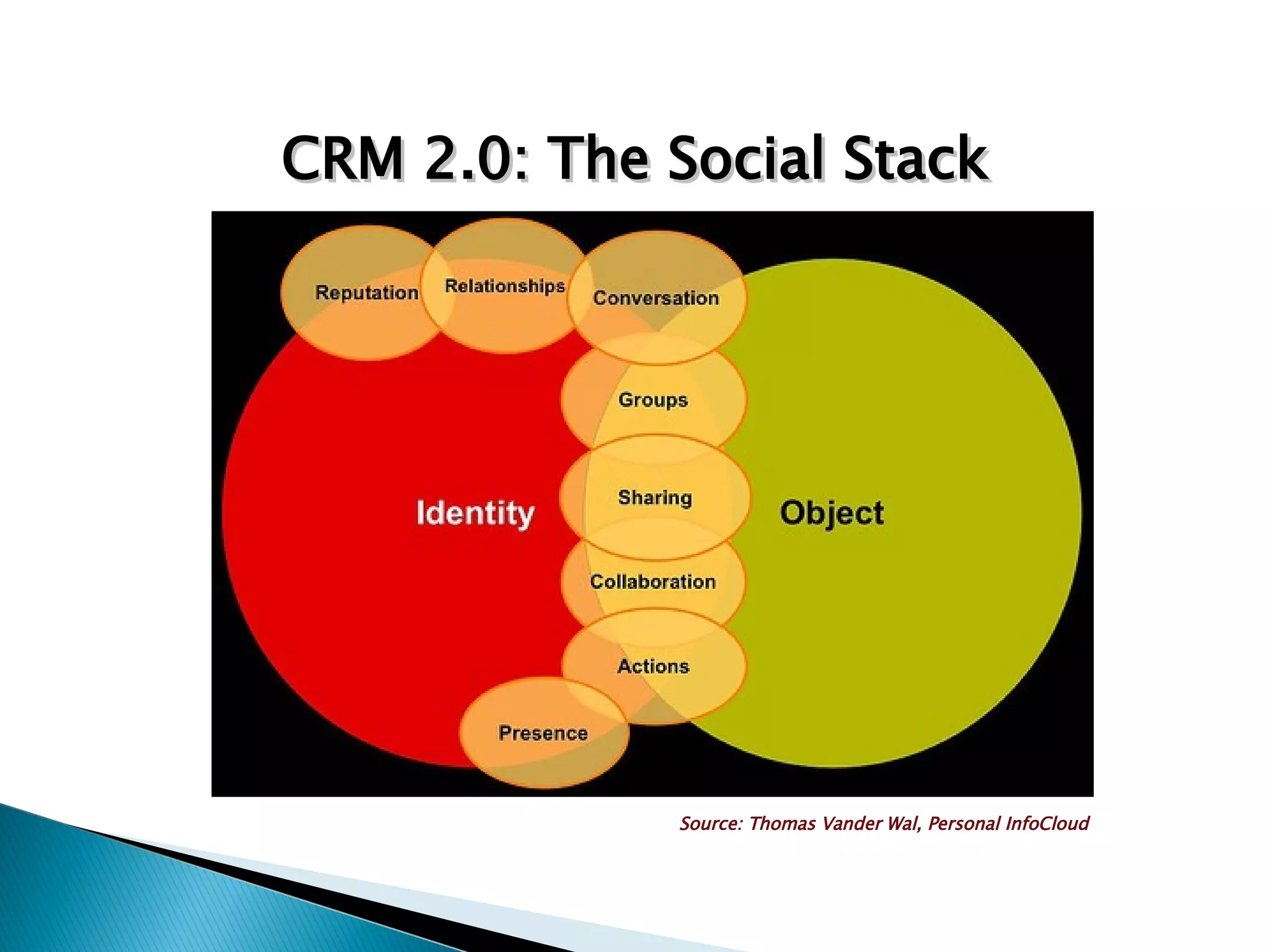
CRM 2.0: The Social Stack Source: Thomas Vander Wal, Personal InfoCloud
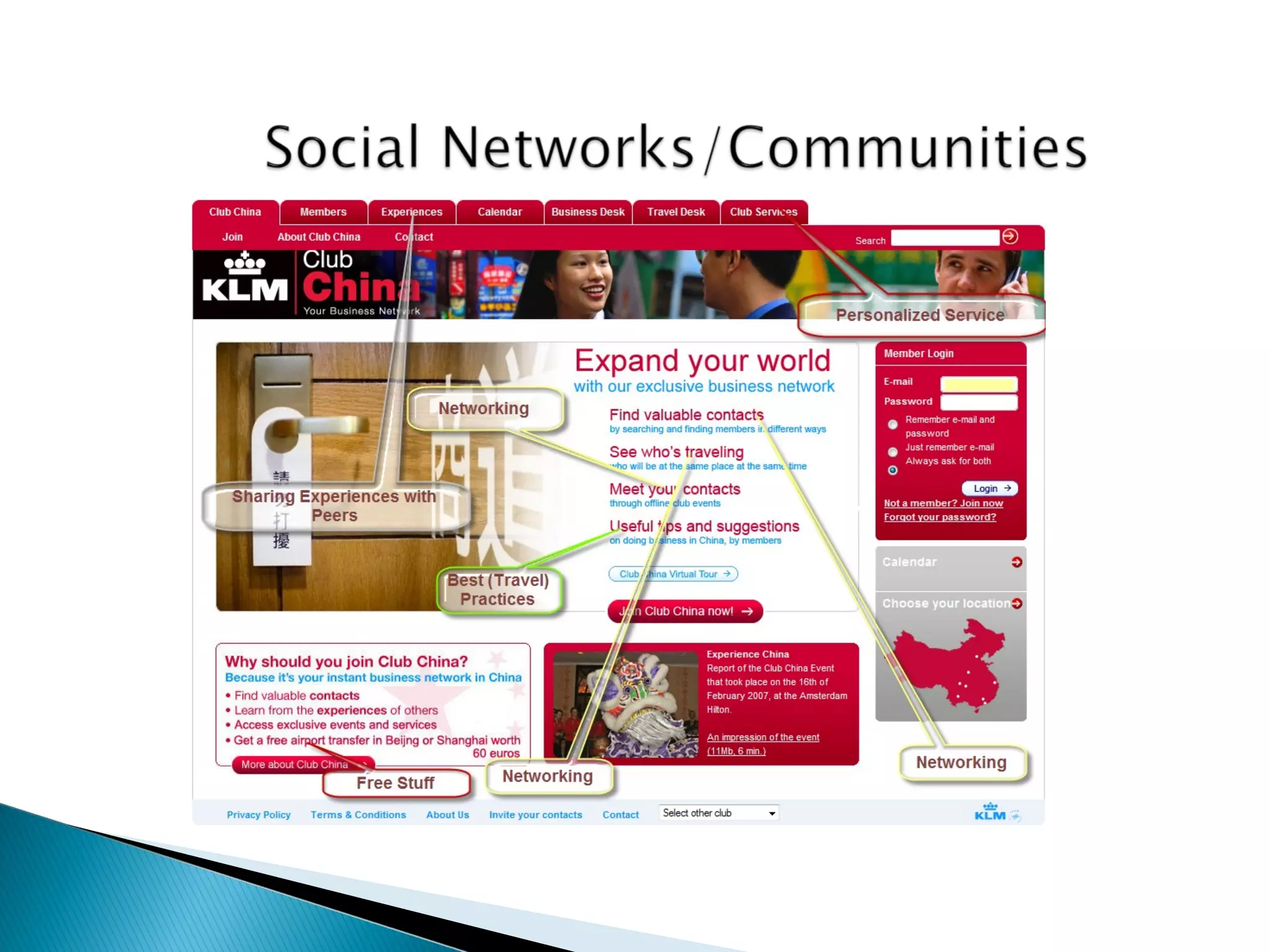
The Communities
There should be a solid business reason for having one beyond: Everyone else is Coolness The strategy & purpose & plan for the social network should be clear before technology is chosen But the platform needs to be solid & highly functional Cheapness can’t be a factor Social Networks/Communities
Content is what brings members back It must be continually refreshed The purpose of this whole endeavor is ongoing engagement That means that peer-to-peer interactions need to be encouraged within the borders of the social network Members should be encouraged to collaborate with the company (e.g. help find new routes) Members need to feel valued continuously Social Networks/Communities
Rules for the Social Network There is an expectation of  trust  by members - the social network is a trusted peer – not abstract entity Privacy is the secondary consideration w/in the confines of that trust The member profile is  licensed to  the social network,  not owned by   the social network The terms of that license need to be mutually agreed upon and transparent at all times The member must feel that they retain control over their profile –  MISSION CRITICAL Social Networks/Communities
Rules for the Members They have no inherent right to be a member. There are risks associated there is no complete privacy guaranteed (what is it about “social” they don’t understand?) While they retain ownership of their profile, by signing up, they are providing a limited license to the social network to use that profile as an asset – as defined by the terms of the agreement That profile well may be used commercially with their permission Social Networks/Communities
 
The Details: Don’t Sweat ‘Em, But There Are Quite a Few
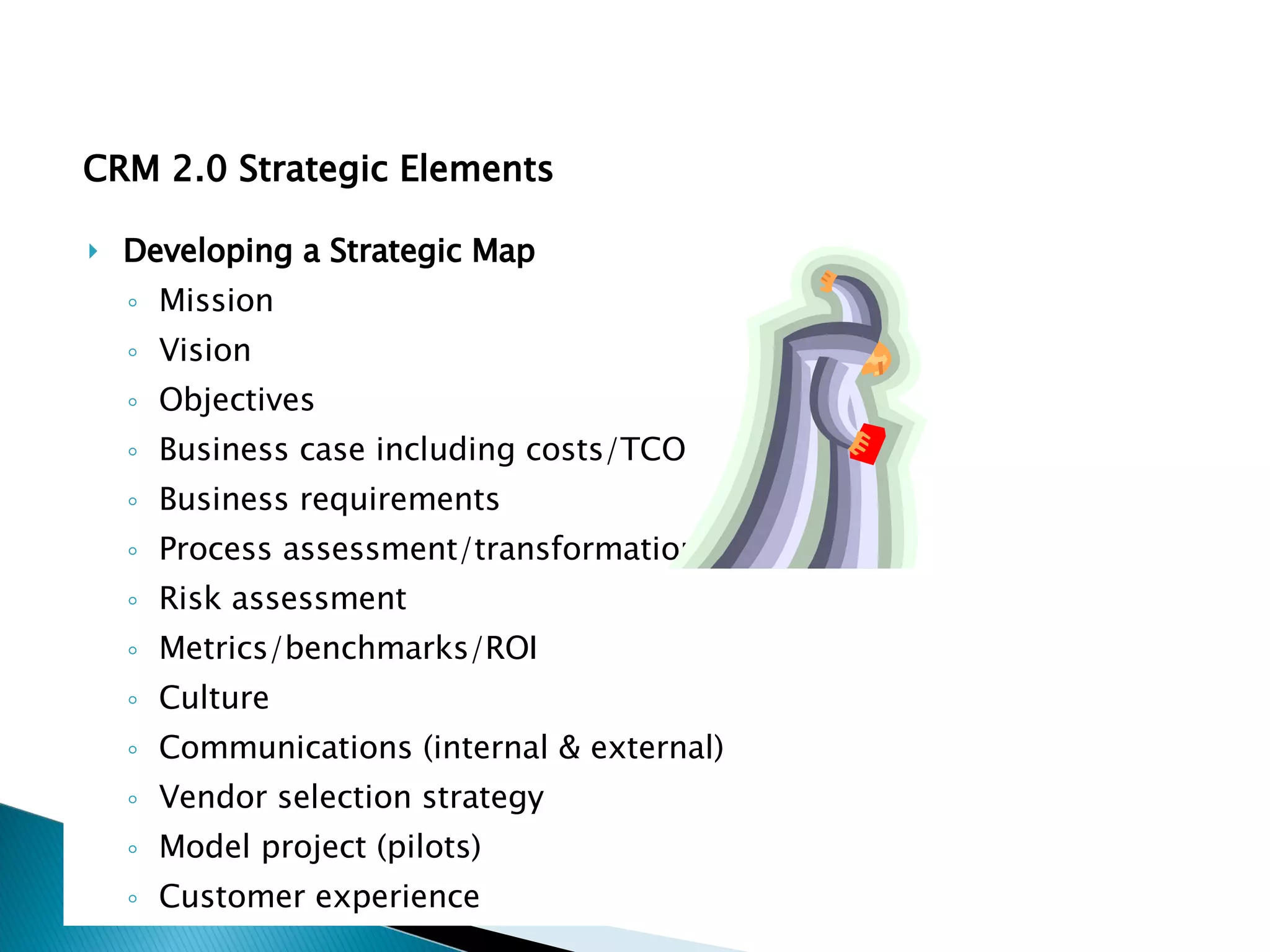
Developing a Strategic Map Mission Vision Objectives Business case including costs/TCO Business requirements Process assessment/transformation Risk assessment Metrics/benchmarks/ROI Culture Communications (internal & external) Vendor selection strategy Model project (pilots) Customer experience CRM 2.0 Strategic Elements
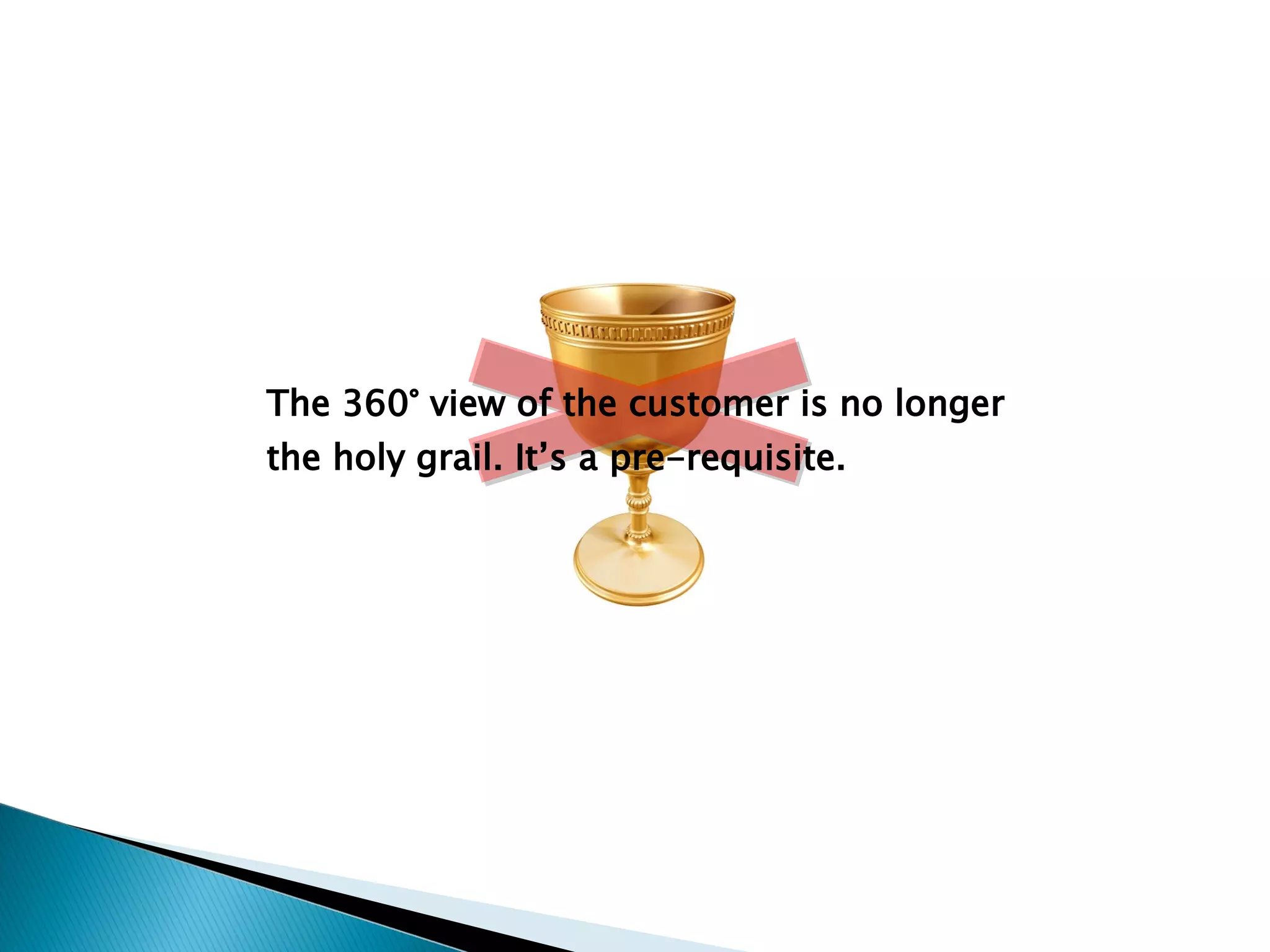
The 360° view of the customer is no longer the holy grail. It’s a pre-requisite.
The new holy grail: A company like me
The Vendors
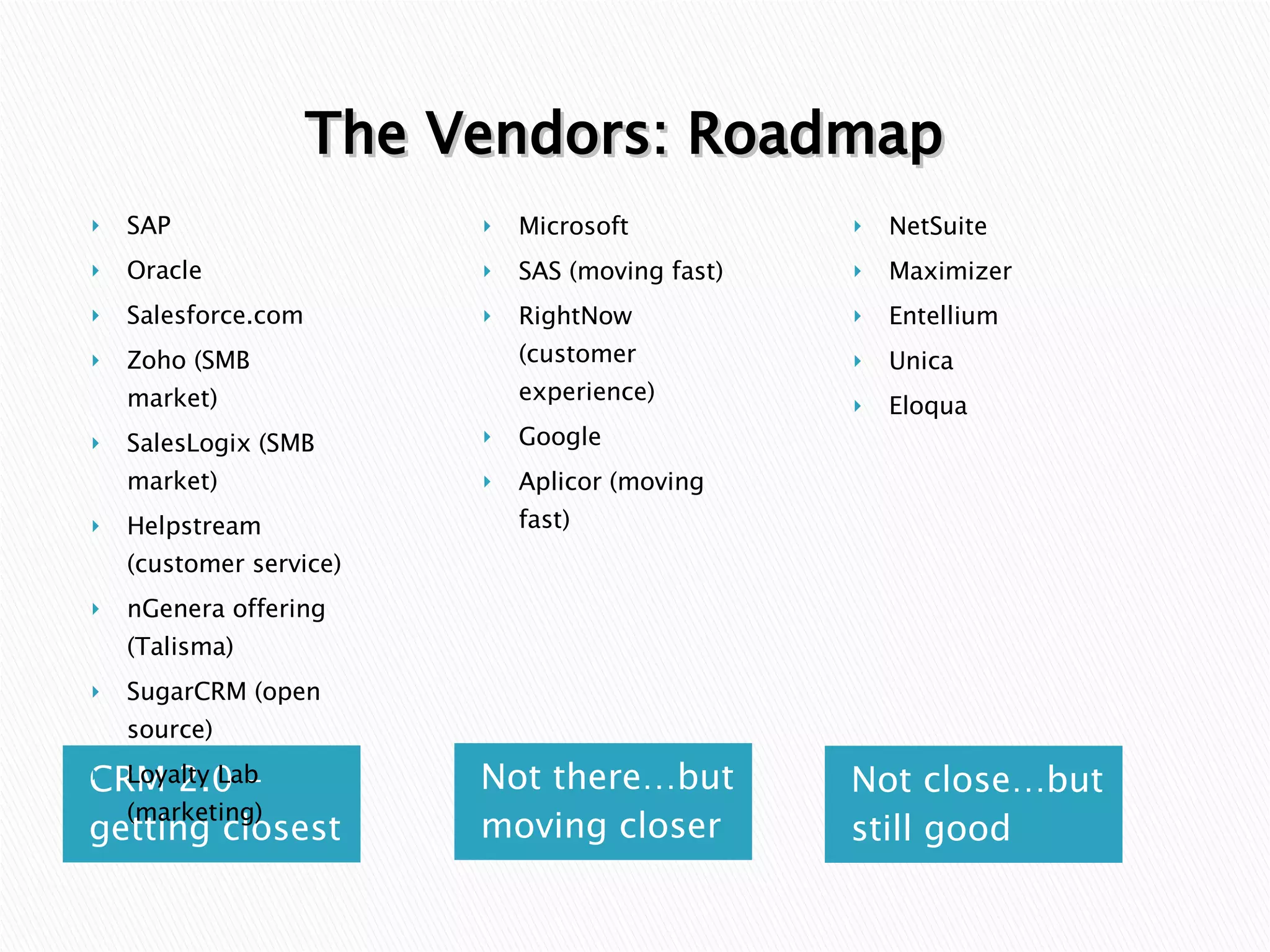
CRM 2.0 – getting closest SAP Oracle Salesforce.com Zoho (SMB market) SalesLogix (SMB market) Helpstream (customer service) nGenera offering (Talisma) SugarCRM (open source) Loyalty Lab (marketing) Not there…but moving closer Microsoft SAS (moving fast) RightNow (customer experience) Google Aplicor (moving fast) Not close…but still good NetSuite Maximizer Entellium Unica Eloqua The Vendors: Roadmap
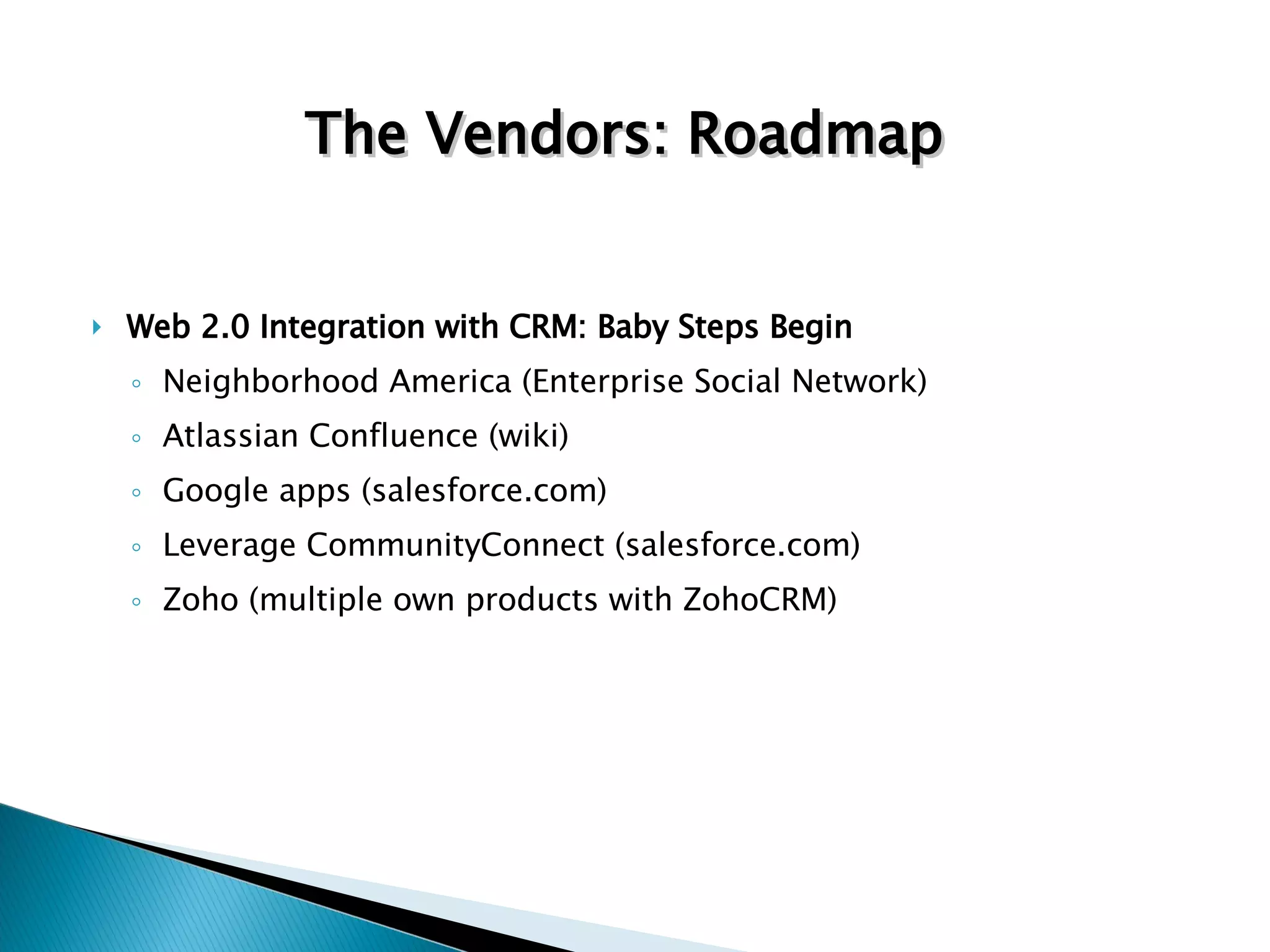
Web 2.0 Integration with CRM: Baby Steps Begin Neighborhood America (Enterprise Social Network) Atlassian Confluence (wiki) Google apps (salesforce.com) Leverage CommunityConnect (salesforce.com) Zoho (multiple own products with ZohoCRM) The Vendors: Roadmap
Closing Time
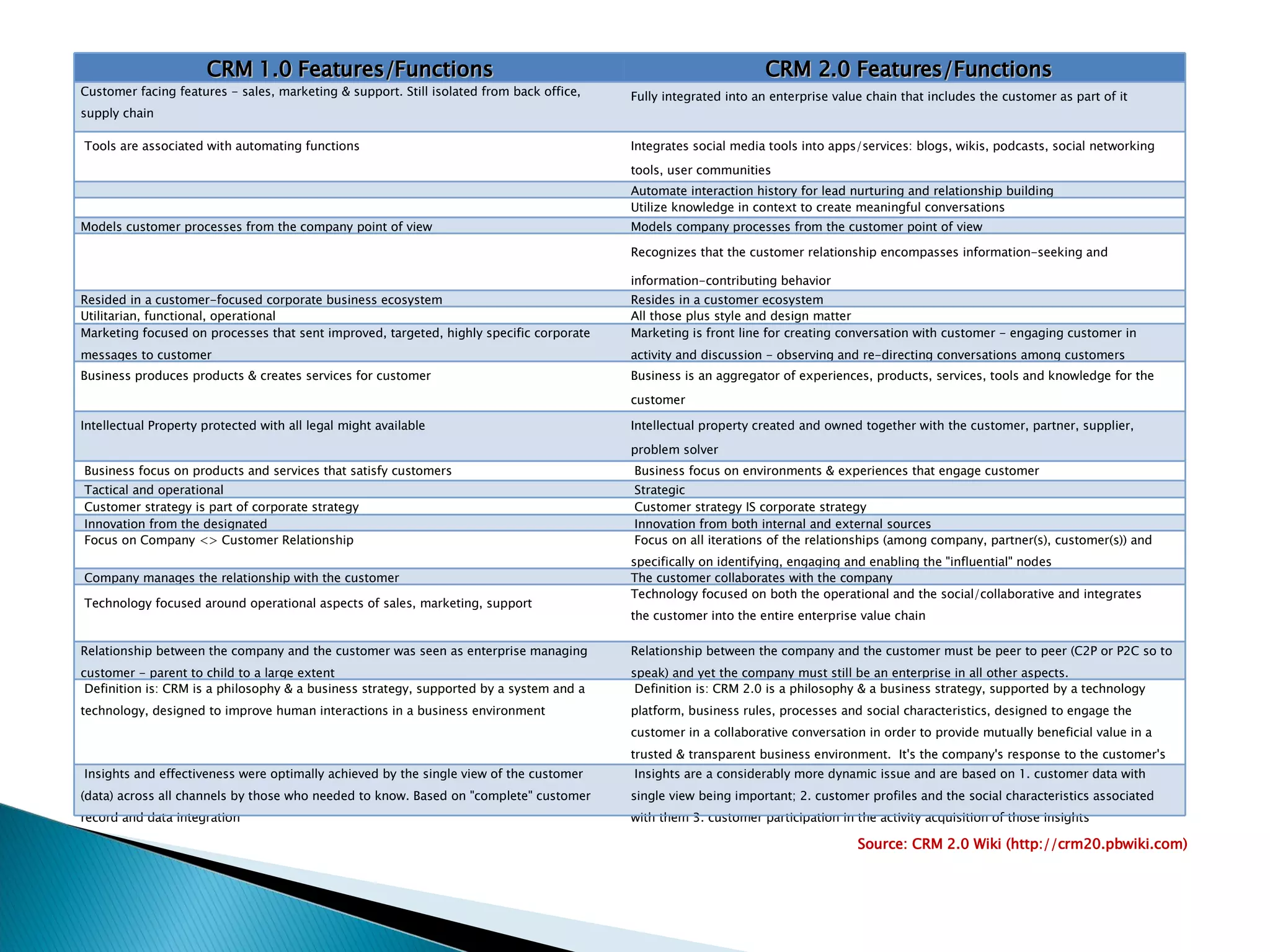
Source: CRM 2.0 Wiki (http://crm20.pbwiki.com) CRM 1.0 Features/Functions   CRM 2.0 Features/Functions Customer facing features - sales, marketing & support. Still isolated from back office, supply chain Fully integrated into an enterprise value chain that includes the customer as part of it   Tools are associated with automating functions Integrates social media tools into apps/services: blogs, wikis, podcasts, social networking tools, user communities    Automate interaction history for lead nurturing and relationship building   Utilize knowledge in context to create meaningful conversations  Models customer processes from the company point of view  Models company processes from the customer point of view     Recognizes that the customer relationship encompasses information-seeking and information-contributing behavior   Resided in a customer-focused corporate business ecosystem   Resides in a customer ecosystem   Utilitarian, functional, operational   All those plus style and design matter   Marketing focused on processes that sent improved, targeted, highly specific corporate messages to customer Marketing is front line for creating conversation with customer - engaging customer in activity and discussion - observing and re-directing conversations among customers   Business produces products & creates services for customer Business is an aggregator of experiences, products, services, tools and knowledge for the customer   Intellectual Property protected with all legal might available Intellectual property created and owned together with the customer, partner, supplier, problem solver     Business focus on products and services that satisfy customers   Business focus on environments & experiences that engage customer   Tactical and operational   Strategic   Customer strategy is part of corporate strategy   Customer strategy IS corporate strategy   Innovation from the designated   Innovation from both internal and external sources   Focus on Company <> Customer Relationship   Focus on all iterations of the relationships (among company, partner(s), customer(s)) and specifically on identifying, engaging and enabling the &quot;influential&quot; nodes   Company manages the relationship with the customer The customer collaborates with the company   Technology focused around operational aspects of sales, marketing, support Technology focused on both the operational and the social/collaborative and integrates the customer into the entire enterprise value chain Relationship between the company and the customer was seen as enterprise managing customer - parent to child to a large extent Relationship between the company and the customer must be peer to peer (C2P or P2C so to speak) and yet the company must still be an enterprise in all other aspects.    Definition is: CRM is a philosophy & a business strategy, supported by a system and a technology, designed to improve human interactions in a business environment   Definition is: CRM 2.0 is a philosophy & a business strategy, supported by a technology platform, business rules, processes and social characteristics, designed to engage the customer in a collaborative conversation in order to provide mutually beneficial value in a trusted & transparent business environment.  It's the company's response to the customer's ownership of the conversation.   Insights and effectiveness were optimally achieved by the single view of the customer (data) across all channels by those who needed to know. Based on &quot;complete&quot; customer record and data integration   Insights are a considerably more dynamic issue and are based on 1. customer data with single view being important; 2. customer profiles and the social characteristics associated with them 3. customer participation in the activity acquisition of those insights
Author: CRM at the Speed of Light (4th Edition, February 2009) President: The 56 Group, LLC Managing Partner/CCO: BPT Partners, EVP: National CRM Assn. Co-Chair: Rutgers CRM Research Center Named #1 CRM Influencer (Non Vendor) by InsideCRM 2007 Named #1 CRM Blogger 2005, twice in 2007 by TechTarget and InsideCRM CRM Magazine 2008 Top Influencer PGreenblog:  http://the56group.typepad.com Email:  [email_address] Twitter:  http://www.twitter.com/pgreenbe Cell phone: 703-551-2337 THANK YOU

What The Hell Is Crm 2 2008

  • 1.
  • 2.
    Skype 2005 –EBay purchased for $2.6 billion
  • 3.
  • 4.
  • 5.
    This is a SOCIAL transformation that impacts all institutions – business among them – not exclusively
  • 6.
    Sea change inuse of technology Gen Y first generation to spend more time on the ‘Net than watching TV Implications for marketing staggering 40% of Gen Xers do research online Only 10% of seniors The Social Customer?
  • 7.
    Source: ATypology of Information & Communication Technology Users – Pew Internet & American Life Project The Social Customer? Group Name Adult Pop. % Age Group Elite Tech Users 31% 20s - early 40s Middle-of-the-Road Tech Users 20% 30s – late 40s Few Tech Assets 49% 50s – 60s+
  • 8.
    The Social Customer– The Rise New definition of trusted source 2008 Edelman Trust Barometer (56%), most trusted – “a person like me.” Not an industry expert or academician or financial advisor Information available nearly instantaneously – either structured or unstructured via the web (Google, Yahoo, MSN) On Demand software as a service Enterprise value chain supersedes siloed supply, demand & support chains Link between lifestyle and business – consumers adopt “sexy” content The Social Customer?
  • 9.
    The Social Customer– The Establishment Social networks as active participants in effecting change (blogosphere, podcasting) Collaboration between company & customers to provide useful value for each Personal value chain subsumes enterprise value chain Ubiquitous technologies leading platform The Live Web (Web 2.0) (MySpace, Facebook) Customer begin to include business as feature of life choice, not a separate factor – user generated content becomes part of business (Samsung open IP to engineers) The social customer is increasingly a mobile customer The Social Customer?
  • 10.
    Each customer wantsa personalized experience… They couldn’t care less if they are high value or low value customers They don’t know if they are high or low value to you But you have to accommodate even low value customers because of what they can do to you if you don’t But how do you begin to “know” millions of customers? First, understand how they interact with you at every point, in every channel That means detailed mapping, not just surveys, etc. Ultimately, the tools for the customer to manage their own experience are paramount Give them access to information that allows them to make informed, empowering choices which thus, provide value
  • 11.
    Generation C –Cross-generation (source: Springwise) C stands for: Content-driven Connected Creative Collaborative Contextual Communicative Age is irrelevant to Gen C Its nature and ease of information availability makes it empowered The social customer engages businesses for personal agendas The Social Customer?
  • 12.
    Source: Brian SolisThe Social Customer?
  • 13.
  • 14.
    2008 SAP/EIU studyfound that currently 61% of businesses surveyed found CRM very important NOW In 3 years, the number jumps to 86% CRM YET…..
  • 15.
    CRM is astrategic company-wide effort (30%) CRM is driven by individual depts. (25%) CRM is at the core of our business (12%) CRM is focused on customer facing processes across multiple channels (12%) CRM
  • 16.
    “ CRM isa philosophy and a business strategy, supported by a system and a technology, designed to improve human interactions in a business environment” CRM 1.0
  • 17.
    Managed customerrelationships Sales, marketing, support Operational, analytic, collaborative Data management Business process management Partner Relationship Management Application Service Providers Marketing’s 4Ps Customer satisfaction 360° view of the customer Intranet Product and/or services company Thin client E-CRM a.k.a ecommerce ROI TCO Product sales as economic outputs On premise Client/server Customer focused corporate ecosystem Old Terminology
  • 18.
  • 19.
    “ CRM isa philosophy & a business strategy, supported by a technology platform, business rules, processes & social characteristics, designed to engage the customer in a collaborative conversation in order to provide mutually beneficial value in a trusted & transparent business environment. It’s the company’s response to the customer’s ownership of the conversation.” CRM 2.0
  • 20.
    Enterprise. 2.0 Web2.0 Customer managed experiences CRM 2.0/Social CRM Unified communication Social networks/user communities Social customer Social media Wikis Podcasts Blogs User generated content Co-creation of value Social bookmarking Social tagging Trusted sources Twitter & microblogging Return on customer Customer value Customer ecosystem Customer advocacy Service Oriented Architecture On Demand RSS Transparency Authenticity Marketing as conversation Personalization Mashups New Terminology
  • 21.
  • 22.
    CRM 2.0 +Social CRM = 123,400 CRM =82,300,000 From CRM 1.0 to CRM 2.0
  • 23.
    &quot;CRM is nolonger just a model for managing customers but one of customer engagement&quot; From CRM 1.0 to CRM 2.0
  • 24.
  • 25.
    Characteristics of theprototype The lines between producer and consumer are blurred The users and producers are engaged in the co-creation of value – they become collaborators The users have the tools to configure and/or customize their personal experience with the product The users and the producers encourage each other and mutually define the future directions of the specific products
  • 26.
    Characteristics of theprototype (part deux) The users and producers take advantage of the most advanced methods of communication within the global matrix (e.g. user communities within the worldwide web) Even though the users are working on the product changes for their own experience, the changes to the product have universal and commercial value and drive the sales of the product The producer is not just the publisher/manufacturer but operates as an aggregator for the user's creative activity The user is an advocate of the experience and, directly and by extension, the company
  • 27.
    Old School toNew School Innovation Toolkits online 15 telematics feature for future BMW models Now ongoing 25 customer touchpoints identified and developed with the customers Products developed with direct collaboration with customers
  • 28.
  • 29.
    Community retailing Multiplebrands Established (Adidas, Vans) Independent (The Kazbah) Community of 800,000 Own clothing line (Sons of Liberty Innovations
  • 30.
  • 31.
    E-zine highlighting theindependent designers from the Kazbah Innovations
  • 32.
  • 33.
    Social Network byinvitation for trend-setters Innovations
  • 34.
    Copyright BPT Partners& Cerado The Street Team Innovations
  • 35.
    Copyright BPT Partners& Cerado Street Team Sign up, get unique code Get friends to buy on the site using unique code Discounts plus points for Street Team member Street team member can upload photos, videos, earn points (community themes) Return to member is cash & free clothes Innovations Over 8000 advocates for street team
  • 36.
    Part of focusedcustomer strategy Concept stems from oldest form of communication – person-to-person word-of-mouth Web form of word of mouth a.k.a. Internet buzz Source: Simultaneous Media Usage Study, BIGresearch Source: Doubleclick Electronics Sales Influence Percentage Word of Mouth 42.6% Article 34.1% TV 32.3% Newspaper Insert 32.0% In-store promo 27.2% Media Influencer Non-Influencer Internet 39% 28% TV 18% 11% Radio 12% 9% Magazine 3% 1% Newspaper 2% 1%
  • 37.
    The Cluetrain Manifesto:The End of Business As Usual Markets are conversations Markets consist of human beings, not demographic sectors Networked conversations are enabling powerful new forms of social organization and knowledge exchange to emerge There are no secrets. The networked market knows more than companies do about their own products. And whether the news is good or bad, they tell everyone Already companies that speak in the language of the pitch…are no longer speaking to anyone Most marketing programs are based on the fear that the market might see what’s really going on in the company
  • 38.
    Because the modelis built on trust, the reputation of the company, not the message, becomes the brand That means, both the perception but also the actual quantified assessment of the marketing practices as certified by third parties (TRUSTe, etc.) The practical side would be an authenticated or accredited message that is validated by the ISP or whoever is transmitting it. Marketing becomes the center point for engagement of the customer Messages are not to be pushed at the customer about products and services; Marketing uses the media tools that are available to engage the customer But with authenticity (Walmart & Edelman screw-up)
  • 39.
    Authenticity and trustis what matters – more than even the “consistency” of the message
  • 40.
    Volume –amt. mentioned v. historic pattern Tone – positive, negative, neutral Coverage - # of sources generating conversation Authoritativeness – qualitative ranking of source (reputation ) Hearing Whispers……. Source: How consumer conversation will transform business – PricewaterhouseCoopers, 2007
  • 41.
  • 42.
    Traditional Salesforce automationtools Marketing automation (e.g. campaign management) Customer service (call center) Dashboards Features & functions Social Blogs, podcast, wikis Social networks/communities User generated content (rich media) Social tags & social bookmarks Features, functions, characteristics Enterprise SOA (or WOA) Enterprise Widgets Master Data Management (MDM) Business rules engine Workflow Analytics (customer analytics) RSS feeds/Subscription services Transaction Interaction Infrastructure/Platform
  • 43.
    CRM 2.0: TheSocial Stack Source: Thomas Vander Wal, Personal InfoCloud
  • 44.
  • 45.
    There should bea solid business reason for having one beyond: Everyone else is Coolness The strategy & purpose & plan for the social network should be clear before technology is chosen But the platform needs to be solid & highly functional Cheapness can’t be a factor Social Networks/Communities
  • 46.
    Content is whatbrings members back It must be continually refreshed The purpose of this whole endeavor is ongoing engagement That means that peer-to-peer interactions need to be encouraged within the borders of the social network Members should be encouraged to collaborate with the company (e.g. help find new routes) Members need to feel valued continuously Social Networks/Communities
  • 47.
    Rules for theSocial Network There is an expectation of trust by members - the social network is a trusted peer – not abstract entity Privacy is the secondary consideration w/in the confines of that trust The member profile is licensed to the social network, not owned by the social network The terms of that license need to be mutually agreed upon and transparent at all times The member must feel that they retain control over their profile – MISSION CRITICAL Social Networks/Communities
  • 48.
    Rules for theMembers They have no inherent right to be a member. There are risks associated there is no complete privacy guaranteed (what is it about “social” they don’t understand?) While they retain ownership of their profile, by signing up, they are providing a limited license to the social network to use that profile as an asset – as defined by the terms of the agreement That profile well may be used commercially with their permission Social Networks/Communities
  • 49.
  • 50.
    The Details: Don’tSweat ‘Em, But There Are Quite a Few
  • 51.
    Developing a StrategicMap Mission Vision Objectives Business case including costs/TCO Business requirements Process assessment/transformation Risk assessment Metrics/benchmarks/ROI Culture Communications (internal & external) Vendor selection strategy Model project (pilots) Customer experience CRM 2.0 Strategic Elements
  • 52.
    The 360° viewof the customer is no longer the holy grail. It’s a pre-requisite.
  • 53.
    The new holygrail: A company like me
  • 54.
  • 55.
    CRM 2.0 –getting closest SAP Oracle Salesforce.com Zoho (SMB market) SalesLogix (SMB market) Helpstream (customer service) nGenera offering (Talisma) SugarCRM (open source) Loyalty Lab (marketing) Not there…but moving closer Microsoft SAS (moving fast) RightNow (customer experience) Google Aplicor (moving fast) Not close…but still good NetSuite Maximizer Entellium Unica Eloqua The Vendors: Roadmap
  • 56.
    Web 2.0 Integrationwith CRM: Baby Steps Begin Neighborhood America (Enterprise Social Network) Atlassian Confluence (wiki) Google apps (salesforce.com) Leverage CommunityConnect (salesforce.com) Zoho (multiple own products with ZohoCRM) The Vendors: Roadmap
  • 57.
  • 58.
    Source: CRM 2.0Wiki (http://crm20.pbwiki.com) CRM 1.0 Features/Functions   CRM 2.0 Features/Functions Customer facing features - sales, marketing & support. Still isolated from back office, supply chain Fully integrated into an enterprise value chain that includes the customer as part of it   Tools are associated with automating functions Integrates social media tools into apps/services: blogs, wikis, podcasts, social networking tools, user communities    Automate interaction history for lead nurturing and relationship building   Utilize knowledge in context to create meaningful conversations  Models customer processes from the company point of view  Models company processes from the customer point of view     Recognizes that the customer relationship encompasses information-seeking and information-contributing behavior   Resided in a customer-focused corporate business ecosystem   Resides in a customer ecosystem   Utilitarian, functional, operational   All those plus style and design matter   Marketing focused on processes that sent improved, targeted, highly specific corporate messages to customer Marketing is front line for creating conversation with customer - engaging customer in activity and discussion - observing and re-directing conversations among customers   Business produces products & creates services for customer Business is an aggregator of experiences, products, services, tools and knowledge for the customer   Intellectual Property protected with all legal might available Intellectual property created and owned together with the customer, partner, supplier, problem solver     Business focus on products and services that satisfy customers   Business focus on environments & experiences that engage customer   Tactical and operational   Strategic   Customer strategy is part of corporate strategy   Customer strategy IS corporate strategy   Innovation from the designated   Innovation from both internal and external sources   Focus on Company <> Customer Relationship   Focus on all iterations of the relationships (among company, partner(s), customer(s)) and specifically on identifying, engaging and enabling the &quot;influential&quot; nodes   Company manages the relationship with the customer The customer collaborates with the company   Technology focused around operational aspects of sales, marketing, support Technology focused on both the operational and the social/collaborative and integrates the customer into the entire enterprise value chain Relationship between the company and the customer was seen as enterprise managing customer - parent to child to a large extent Relationship between the company and the customer must be peer to peer (C2P or P2C so to speak) and yet the company must still be an enterprise in all other aspects.    Definition is: CRM is a philosophy & a business strategy, supported by a system and a technology, designed to improve human interactions in a business environment   Definition is: CRM 2.0 is a philosophy & a business strategy, supported by a technology platform, business rules, processes and social characteristics, designed to engage the customer in a collaborative conversation in order to provide mutually beneficial value in a trusted & transparent business environment.  It's the company's response to the customer's ownership of the conversation.   Insights and effectiveness were optimally achieved by the single view of the customer (data) across all channels by those who needed to know. Based on &quot;complete&quot; customer record and data integration   Insights are a considerably more dynamic issue and are based on 1. customer data with single view being important; 2. customer profiles and the social characteristics associated with them 3. customer participation in the activity acquisition of those insights
  • 59.
    Author: CRM atthe Speed of Light (4th Edition, February 2009) President: The 56 Group, LLC Managing Partner/CCO: BPT Partners, EVP: National CRM Assn. Co-Chair: Rutgers CRM Research Center Named #1 CRM Influencer (Non Vendor) by InsideCRM 2007 Named #1 CRM Blogger 2005, twice in 2007 by TechTarget and InsideCRM CRM Magazine 2008 Top Influencer PGreenblog: http://the56group.typepad.com Email: [email_address] Twitter: http://www.twitter.com/pgreenbe Cell phone: 703-551-2337 THANK YOU