Brief Introduction to IT Planning and Project Management

Loading...

Flash Player 9 (or above) is needed to view presentations.
We have detected that you do not have it on your computer. To install it, go here.

3 comments

Comments 1 - 3 of 3 previous next Post a comment

  • + only1kiku Kikuyu Daniels 1 month ago
    Corrected a typo on the slides on 10/1/2009 and uploaded the corrected version. Many thanks to Sandi Matthews who pointed out the error to me.
    Kikuyu
  • + guestab68800 guestab68800 5 months ago
    guesta8b479,

    If by 'any people' you mean 'just anyone', then it is addressed under project management common mistakes to avoid -- 'wrong people on project'.

    Glad to know you enjoyed the slides. Thanks for the feedback.

    Kikuyu
  • + guesta8b479 guesta8b479 5 months ago
    Great!! a single way to show the theme.

    The 'common mistake avoid' must include...'dont let any people lead the process'.

    estrategos_cruz@hotmail.com
Post a comment
Embed Video
Edit your comment Cancel

Notes on slide 1

The are numerous approaches to and theories for project management. Some have been around since the 50s and 60s and others were created, like… yesterday. Most can be loosely grouped by methodology like sequential and mathematical for example. Sequential approaches identify a sequence of steps (or gates) to be completed . For example… In the traditional approach (which we talked about earlier as initiation, planning, executing, controlling and closing) we can distinguish the 5 components of a project during the development of the project. While some projects may go through steps 2, 3 and 4 multiple times the method is sill very sequential in nature. PRINCE2 is a newer method for managing projects within a clearly defined framework. In the method each process is specified with its key inputs and outputs and with specific goals and activities to be carried out, so this gives sort of an automatic control of any deviations from the plan. The plus about all sequential approaches is that they provide common language for talking about projects. So in this way they can be widely used regardless of project or industry. Mathematical approaches typically provide some type of algorithm for determining priorities. In Critical Chain or critical path Project Management emphasis is placed on the resources (people, equipment, time, etc.) required to execute project tasks and the constraints placed on those resources. So let’s say Susan and Greg are resources working together to upgrade a suite of web servers. Susan is purchasing the hardware and Greg is configuring it. Obviously, Greg can’t compete his task until Susan has completed hers. In other words, Greg is constrained by Susan on the project. The longest sequence of resource-constrained tasks is what is called the “critical chain or path”. Tasks on the critical chain are given priority and projects are planned and managed to ensure that the critical chain tasks are ready to start as soon as the resources are available. Event chain methodology takes this up a notch. It uses a fancy uncertainty modeling technique to determine the critical path. The goal of all mathematical approaches to increase the rate of throughput (or completion rates) of projects through resource allocation and prioritization. Lastly there is a school of methodology that arose based on function or process. Some of the more traditional approaches to project management were suited for large, one-time, non-routine projects and actually slowed down projects with strong development components such as the creation of software and products. Extreme Project Management uses principles of human interaction management to deal with the complexities of human collaboration on complex and very uncertain projects. In Process-based management the project is seen as a series of small tasks to be conceived and executed as the situation demands in an adaptive manner, rather than as a completely pre-planned process. The Rational Unified Process is an iterative software development process framework created by the Rational Software Corporation (which began here in Massachusetts and was bought by IBM in 2003). RUP as it is called is not a concrete prescriptive process. It’s a adaptable frame work intended to be tailored by the development organizations and software project teams as appropriate for their needs. All of the function and process based approaches are geared for use in development environments where there is a great deal of uncertainty at the onset of a project.

Notes:

4 Favorites

Brief Introduction to IT Planning and Project Management - Presentation Transcript

  1. Kikuyu Daniels
    • Strategic IT Planning
    • IT Project Management
    • How they are related
    • Ways to help
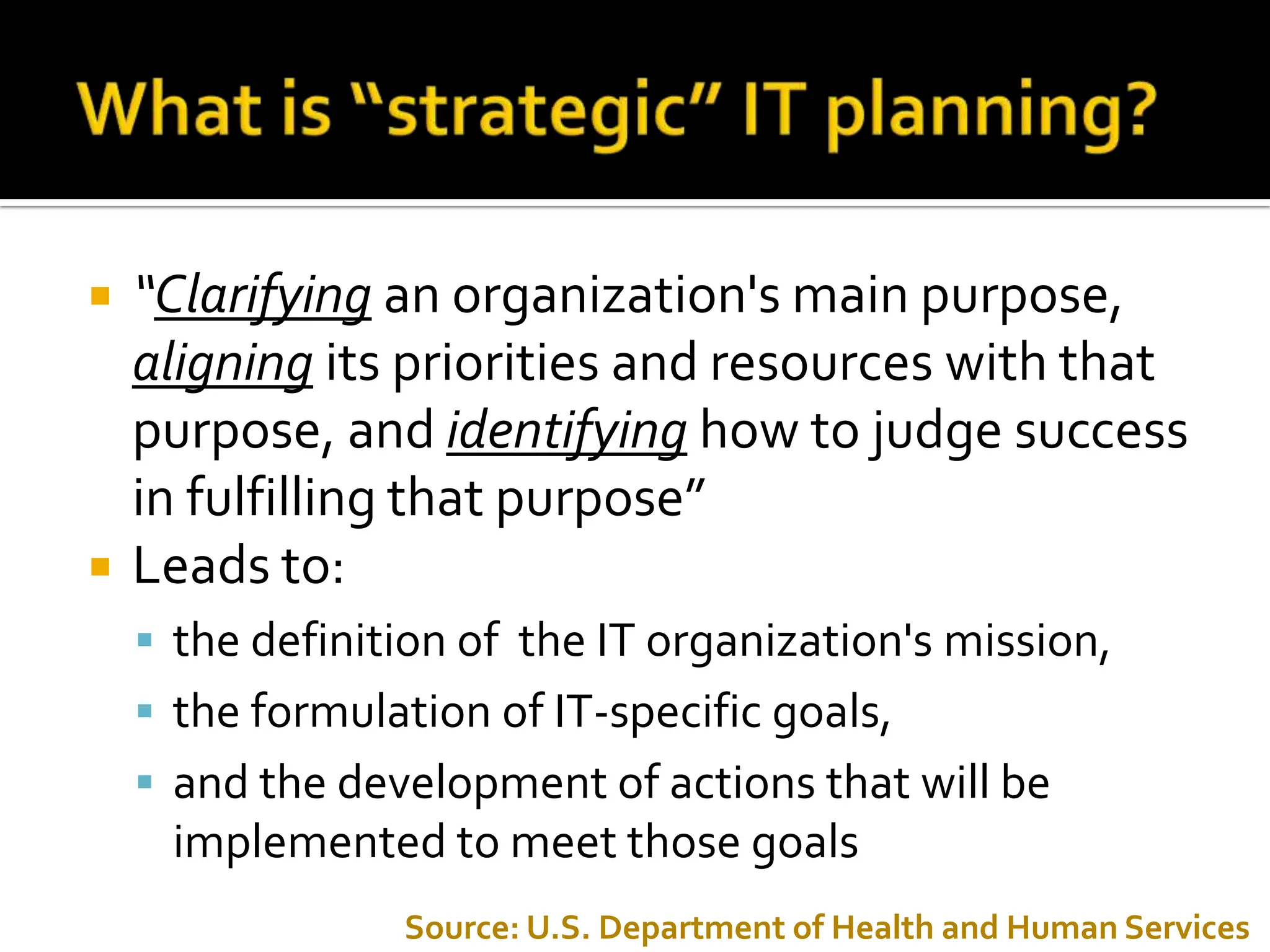
    • “ Clarifying an organization's main purpose, aligning its priorities and resources with that purpose, and identifying how to judge success in fulfilling that purpose”
    • Leads to:
      • the definition of  the IT organization's mission,
      • the formulation of IT-specific goals,
      • and the development of actions that will be implemented to meet those goals
    Source: U.S. Department of Health and Human Services
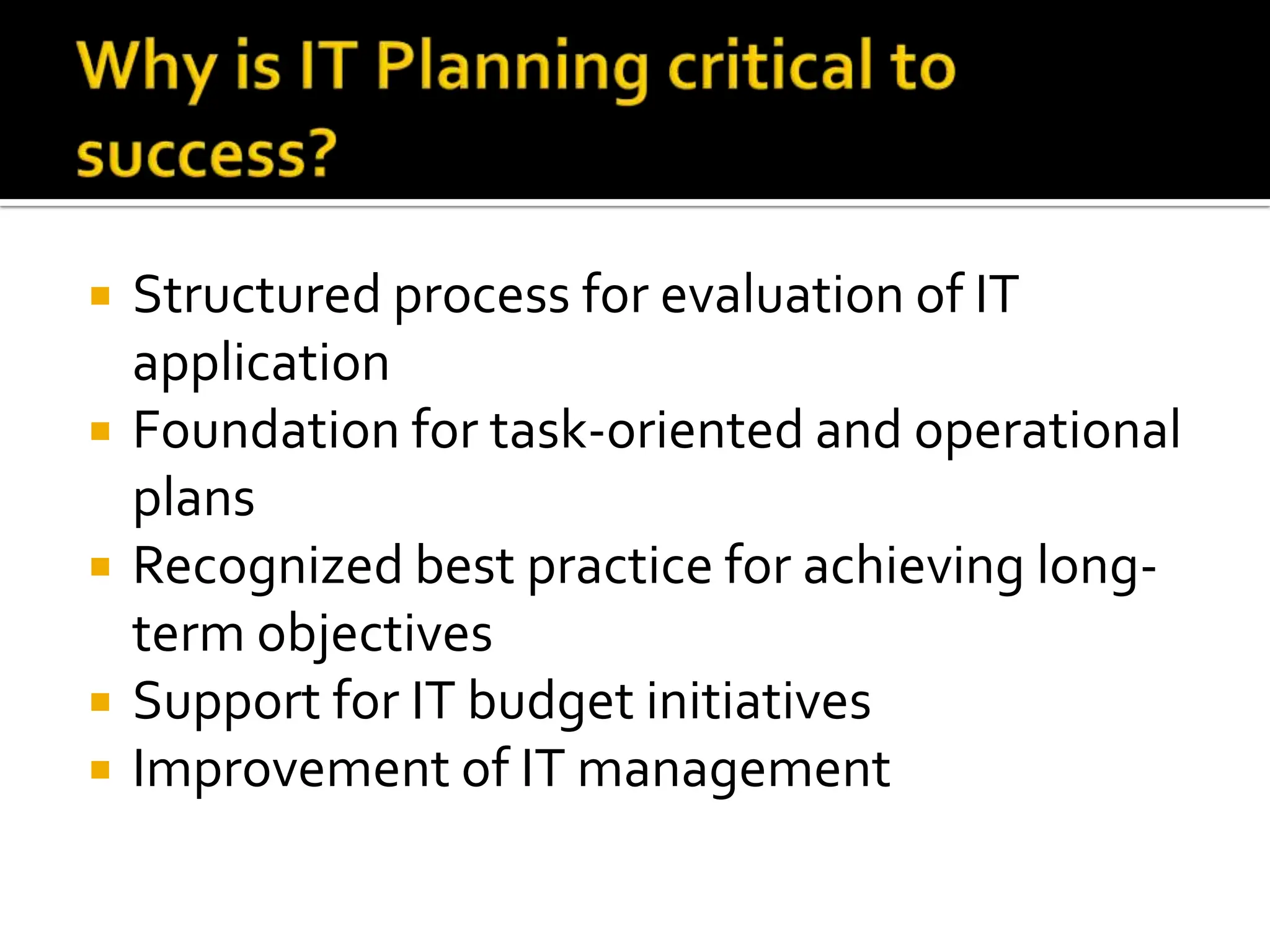
    • Structured process for evaluation of IT application
    • Foundation for task-oriented and operational plans
    • Recognized best practice for achieving long-term objectives
    • Support for IT budget initiatives
    • Improvement of IT management
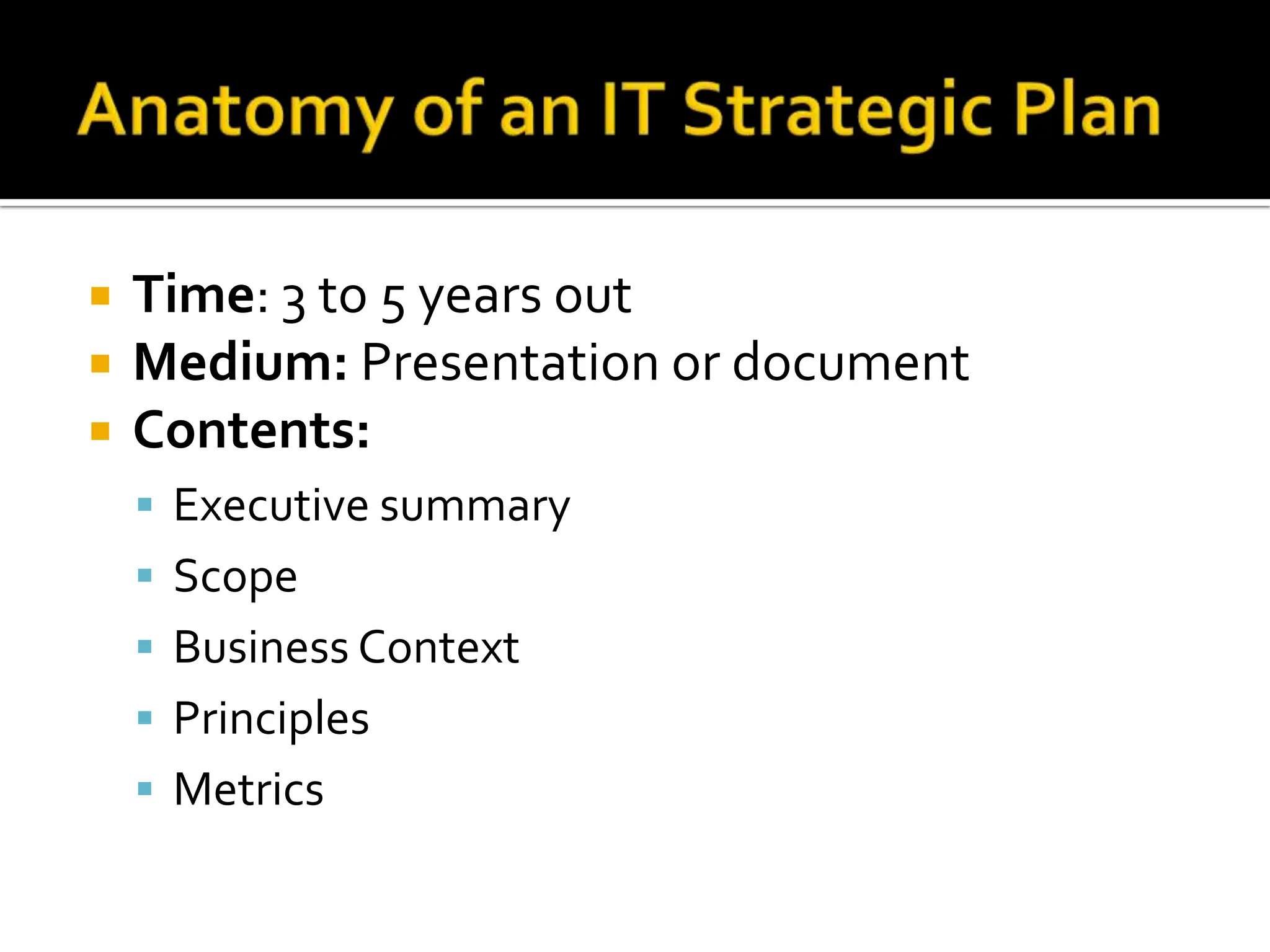
    • Time : 3 to 5 years out
    • Medium: Presentation or document
    • Contents:
      • Executive summary
      • Scope
      • Business Context
      • Principles
      • Metrics
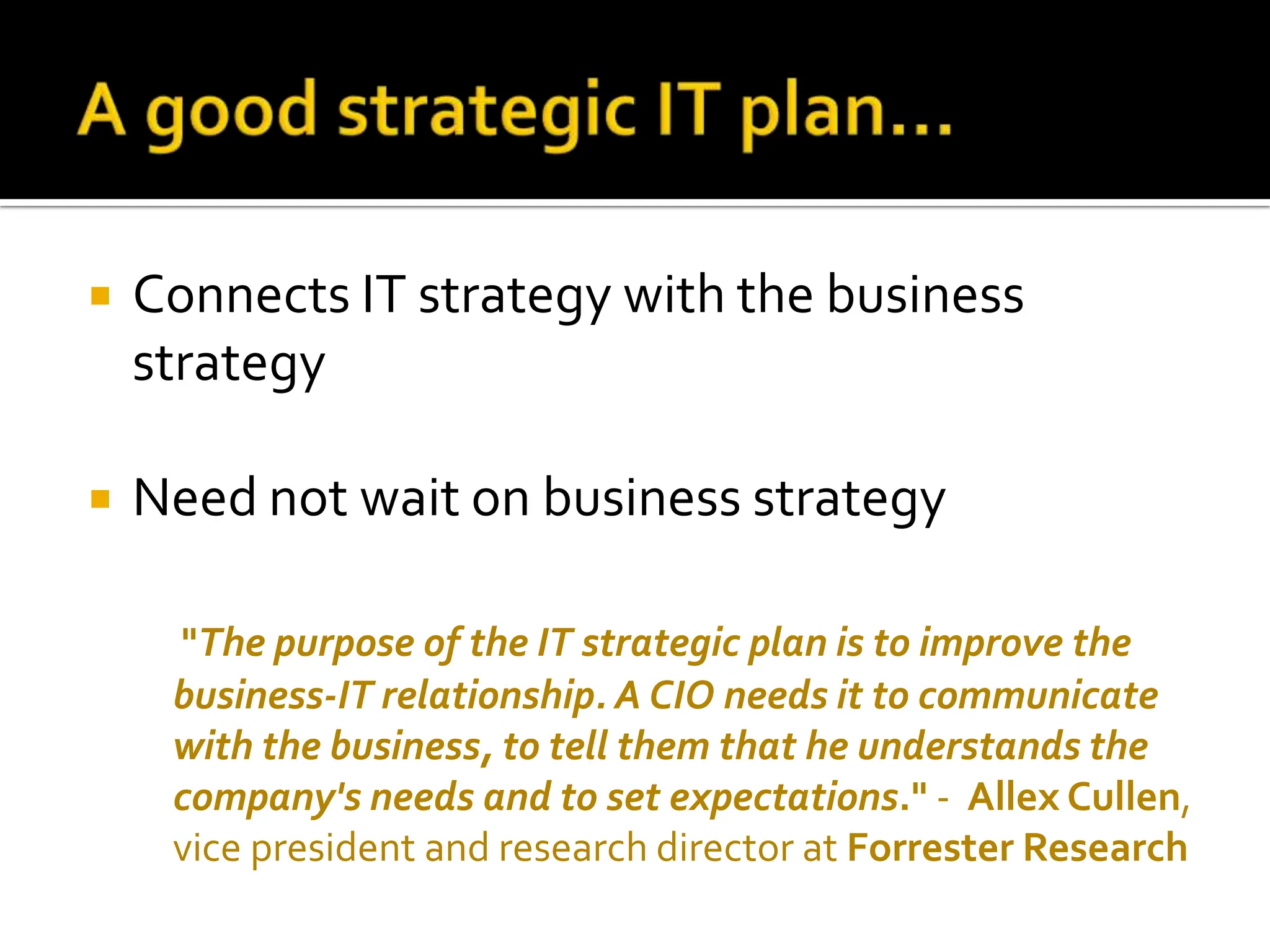
    • Connects IT strategy with the business strategy
    • Need not wait on business strategy
      • " The purpose of the IT strategic plan is to improve the business-IT relationship. A CIO needs it to communicate with the business, to tell them that he understands the company's needs and to set expectations ." - Allex Cullen , vice president and research director at Forrester Research
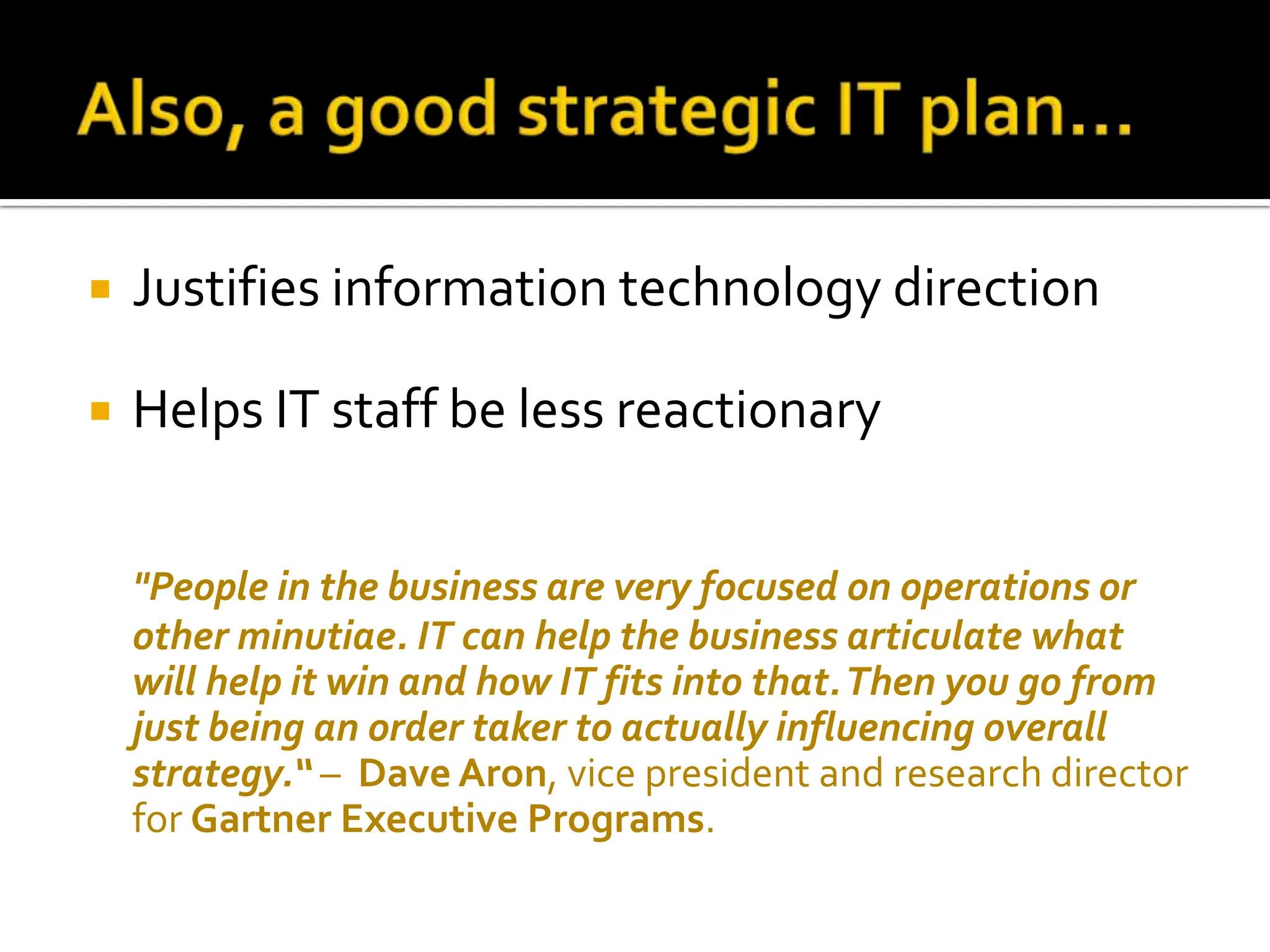
    • Justifies information technology direction
    • Helps IT staff be less reactionary
    • "People in the business are very focused on operations or other minutiae. IT can help the business articulate what will help it win and how IT fits into that. Then you go from just being an order taker to actually influencing overall strategy.“ – Dave Aron , vice president and research director for Gartner Executive Programs .
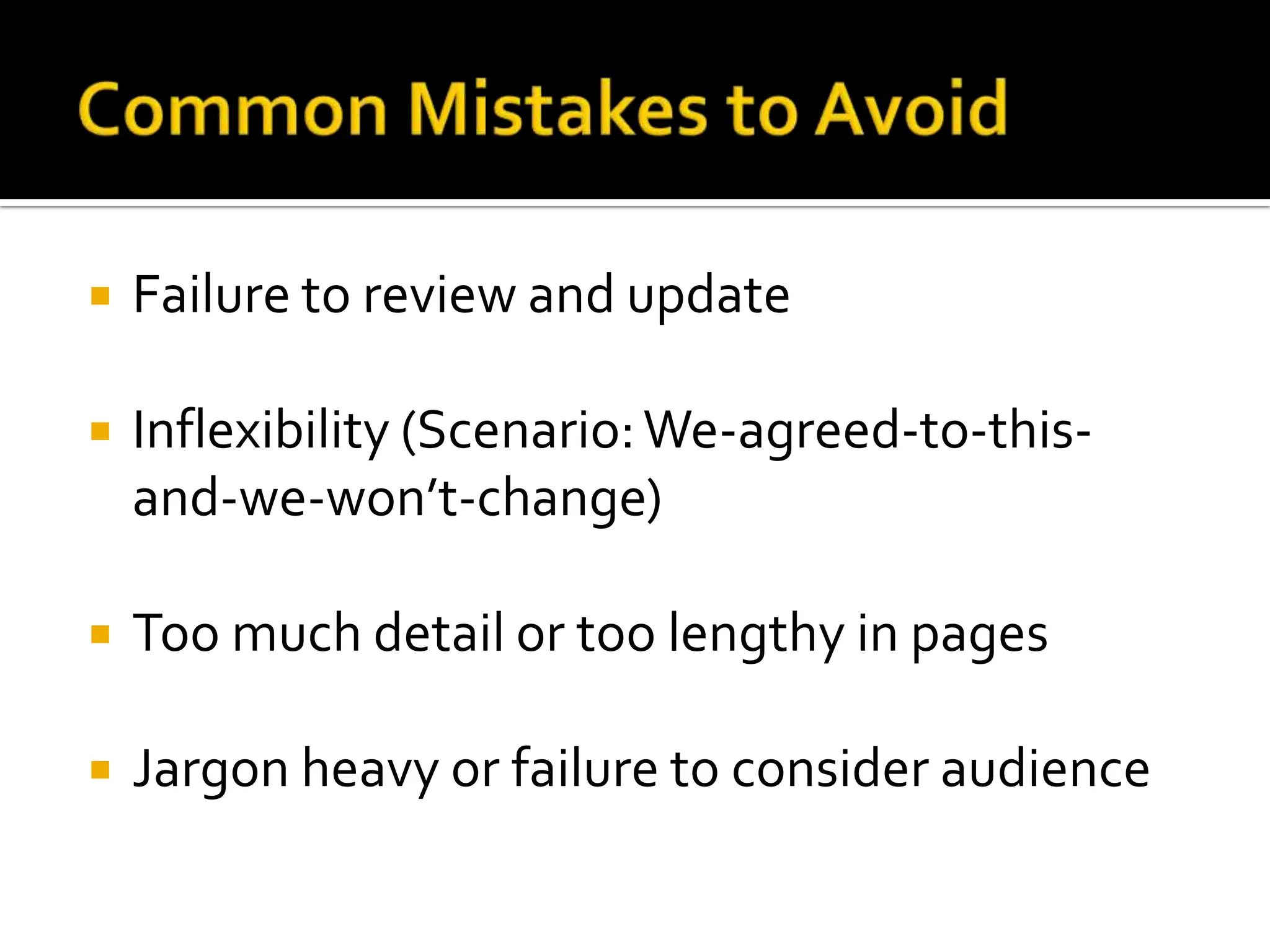
    • Failure to review and update
    • Inflexibility (Scenario: We-agreed-to-this-and-we-won’t-change)
    • Too much detail or too lengthy in pages
    • Jargon heavy or failure to consider audience
    • Strategic IT Planning
    • IT Project Management
    • How they are related
    • Ways to help
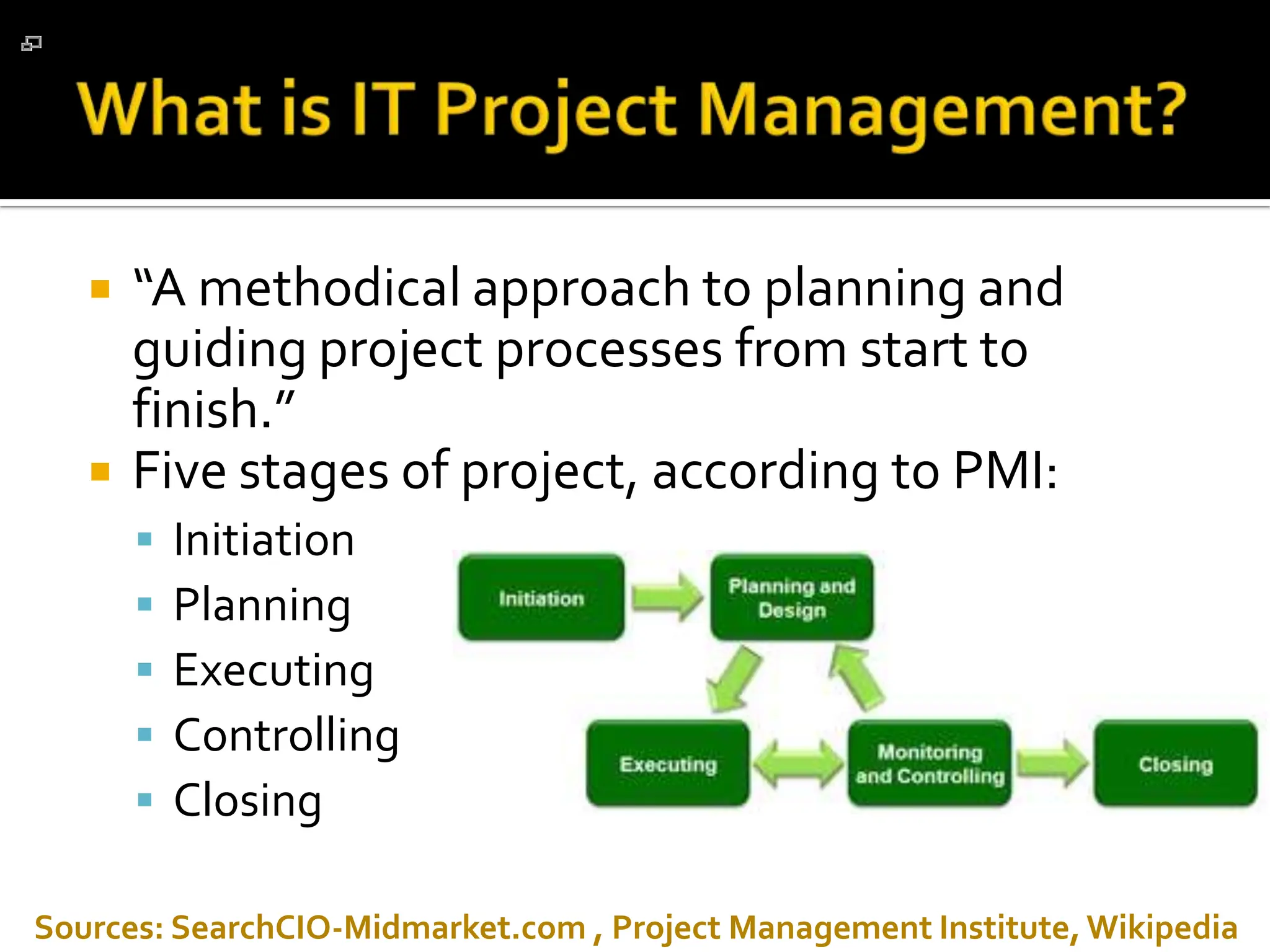
    • “ A methodical approach to planning and guiding project processes from start to finish.”
    • Five stages of project, according to PMI:
      • Initiation
      • Planning
      • Executing
      • Controlling
      • Closing
    Sources: SearchCIO-Midmarket.com , Project Management Institute, Wikipedia
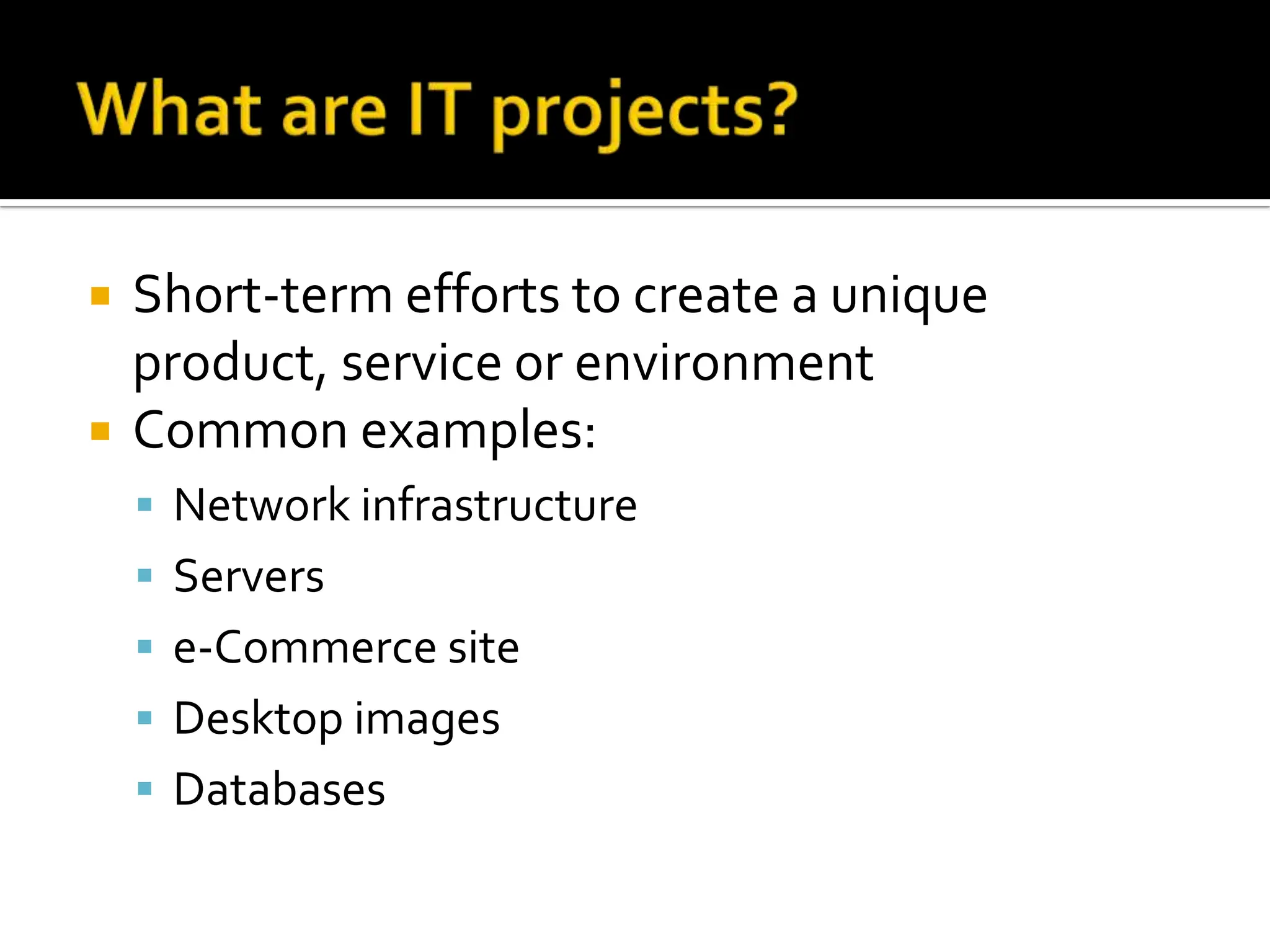
    • Short-term efforts to create a unique product, service or environment
    • Common examples:
      • Network infrastructure
      • Servers
      • e-Commerce site
      • Desktop images
      • Databases
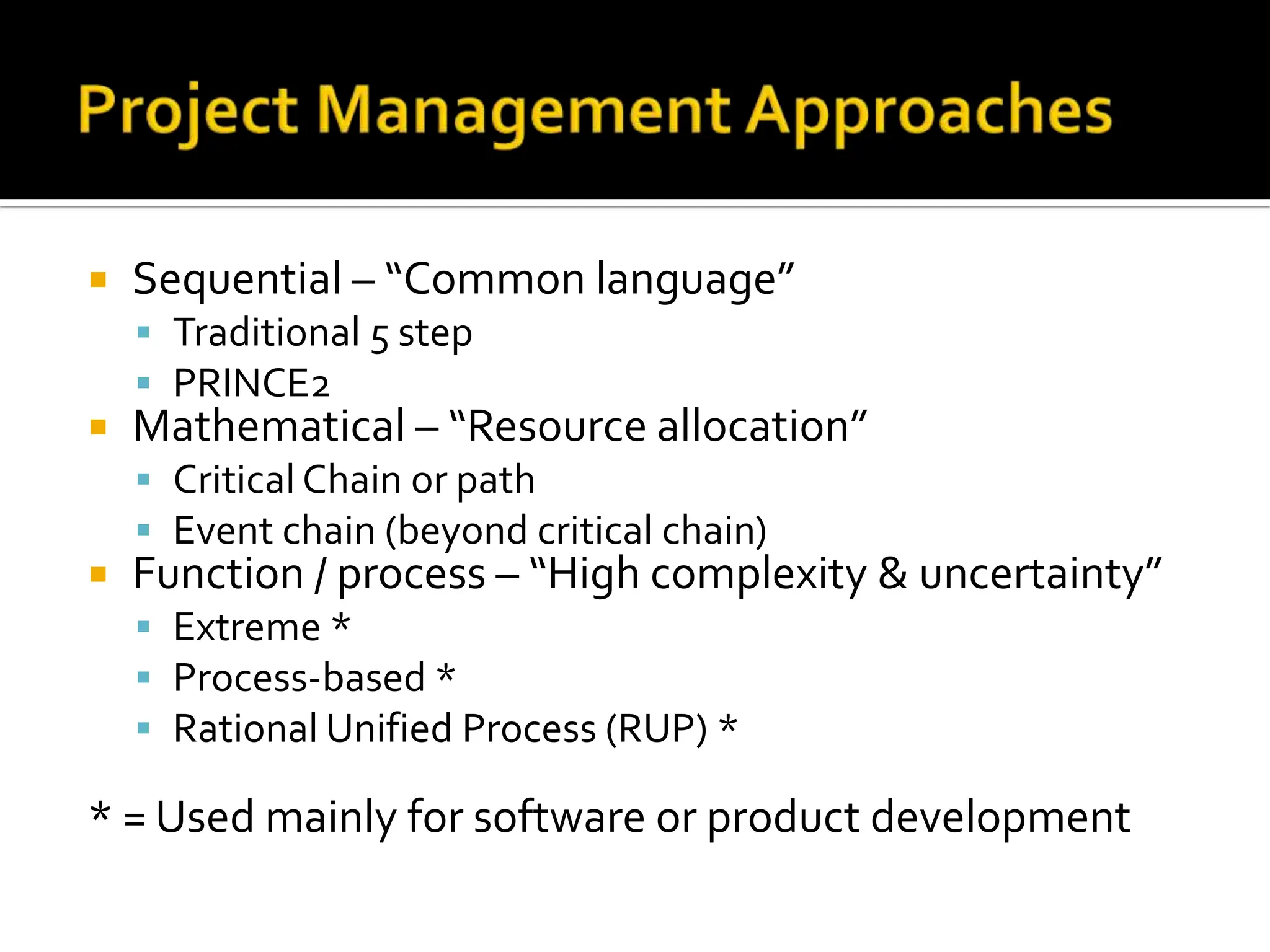
    • Sequential – “Common language”
      • Traditional 5 step
      • PRINCE2
    • Mathematical – “Resource allocation”
      • Critical Chain or path
      • Event chain (beyond critical chain)
    • Function / process – “High complexity & uncertainty”
      • Extreme *
      • Process-based *
      • Rational Unified Process (RUP) *
    • * = Used mainly for software or product development
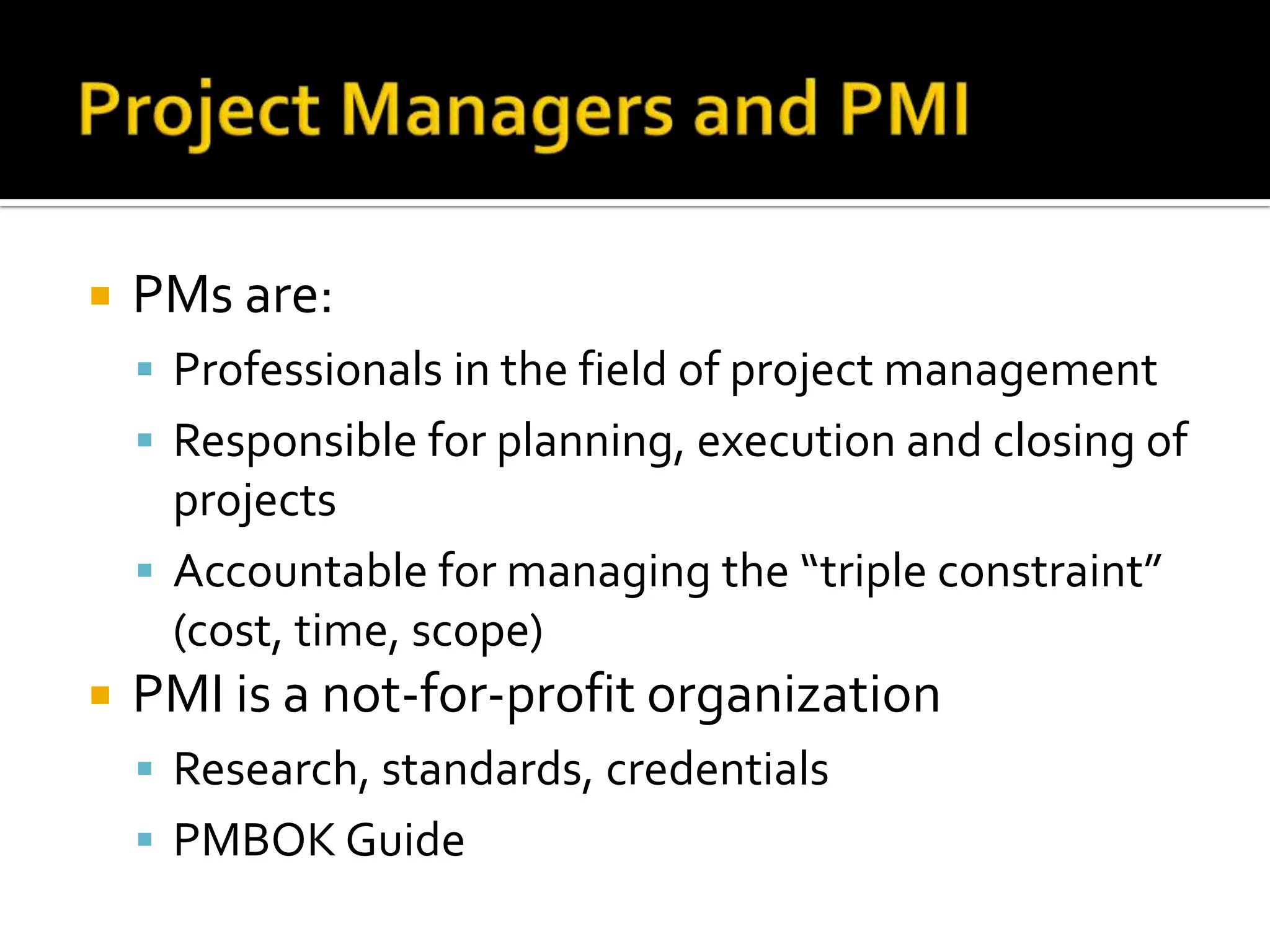
    • PMs are:
      • Professionals in the field of project management
      • Responsible for planning, execution and closing of projects
      • Accountable for managing the “triple constraint” (cost, time, scope)
    • PMI is a not-for-profit organization
      • Research, standards, credentials
      • PMBOK Guide
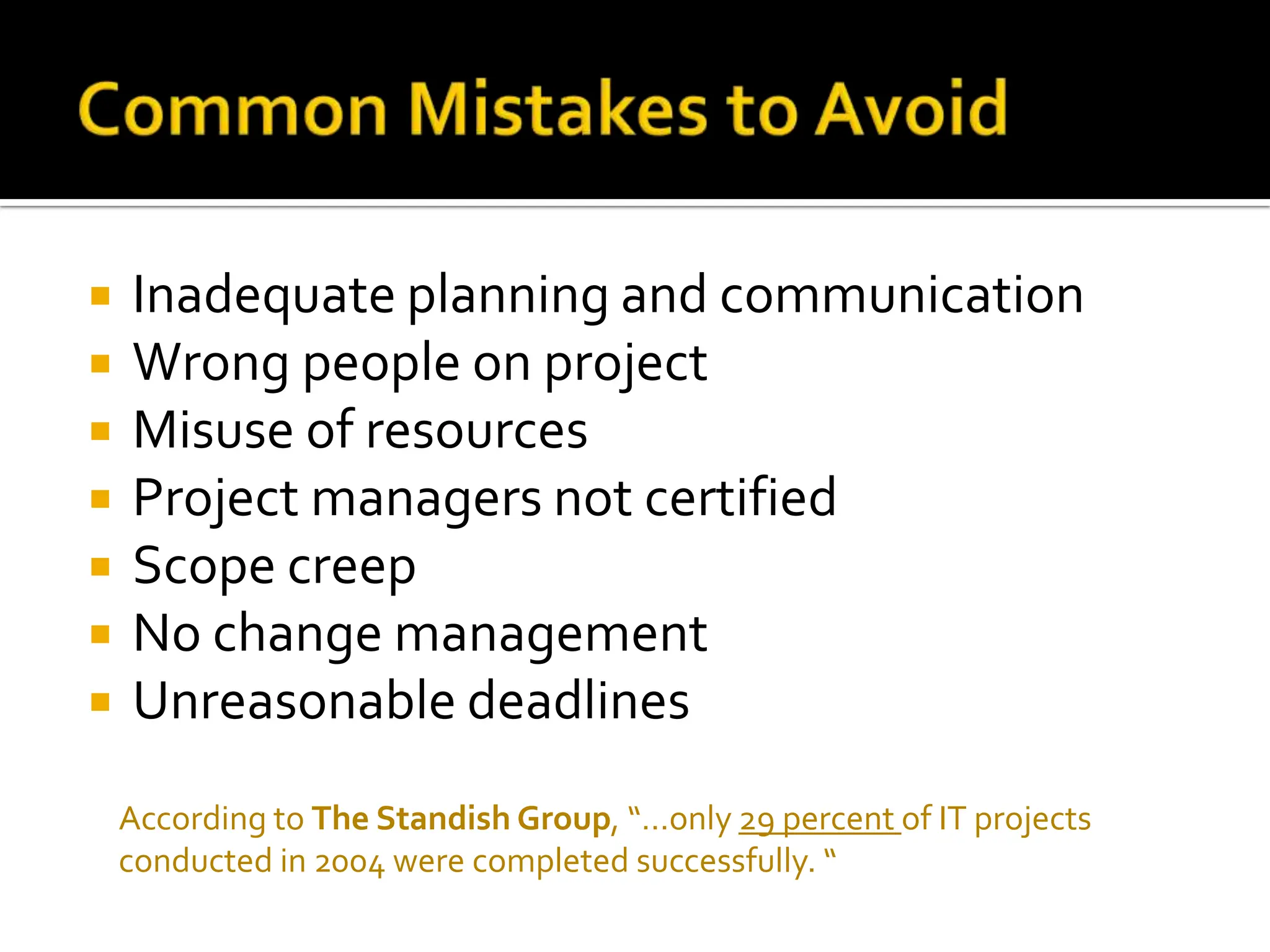
    • Inadequate planning and communication
    • Wrong people on project
    • Misuse of resources
    • Project managers not certified
    • Scope creep
    • No change management
    • Unreasonable deadlines
    According to The Standish Group , “…only 29 percent of IT projects conducted in 2004 were completed successfully. “
    • Strategic IT Planning
    • IT Project Management
    • How they are related
    • Ways to help
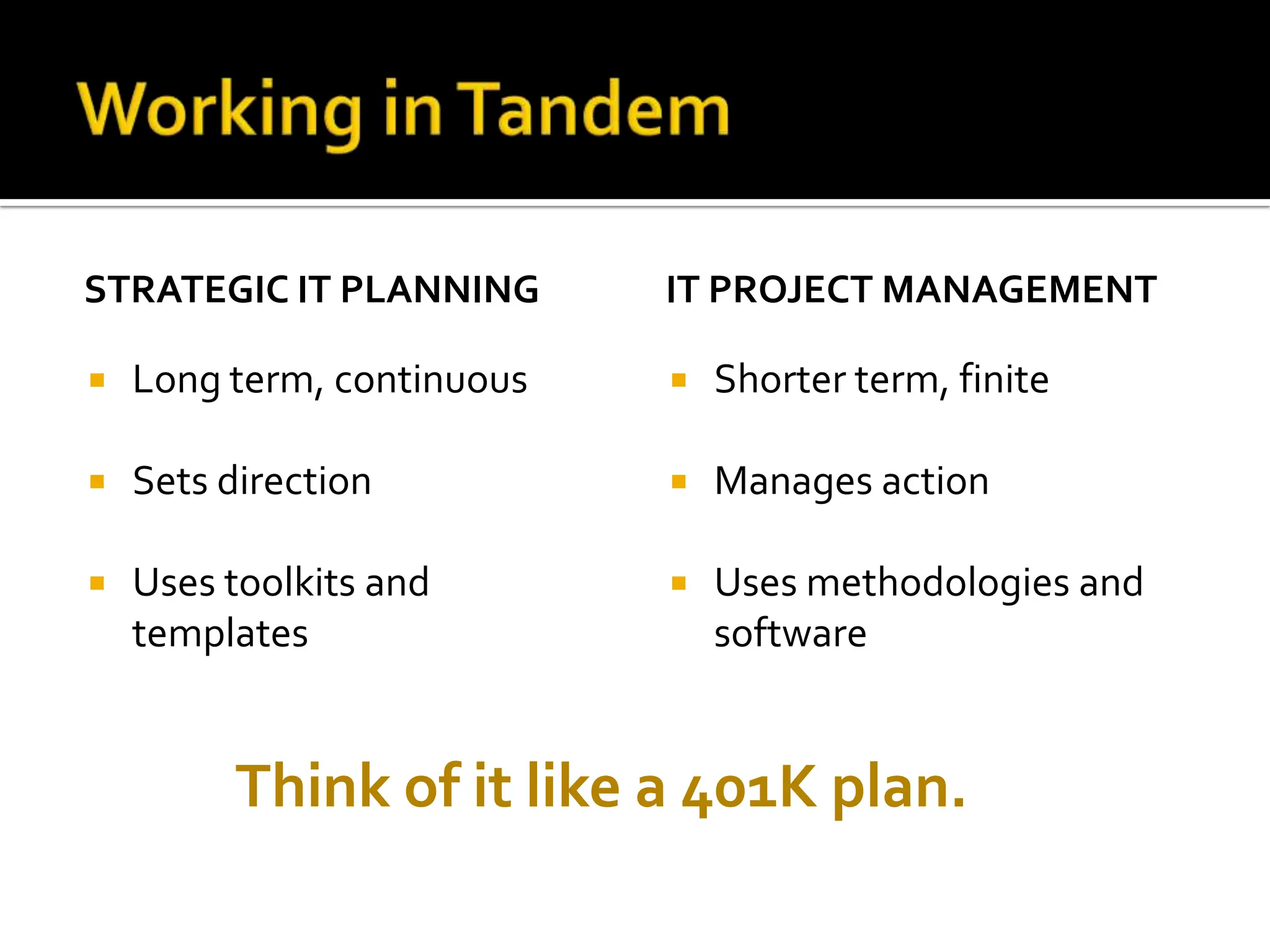
    • STRATEGIC IT PLANNING
    • Long term, continuous
    • Sets direction
    • Uses toolkits and templates
    • IT PROJECT MANAGEMENT
    • Shorter term, finite
    • Manages action
    • Uses methodologies and software
    Think of it like a 401K plan.
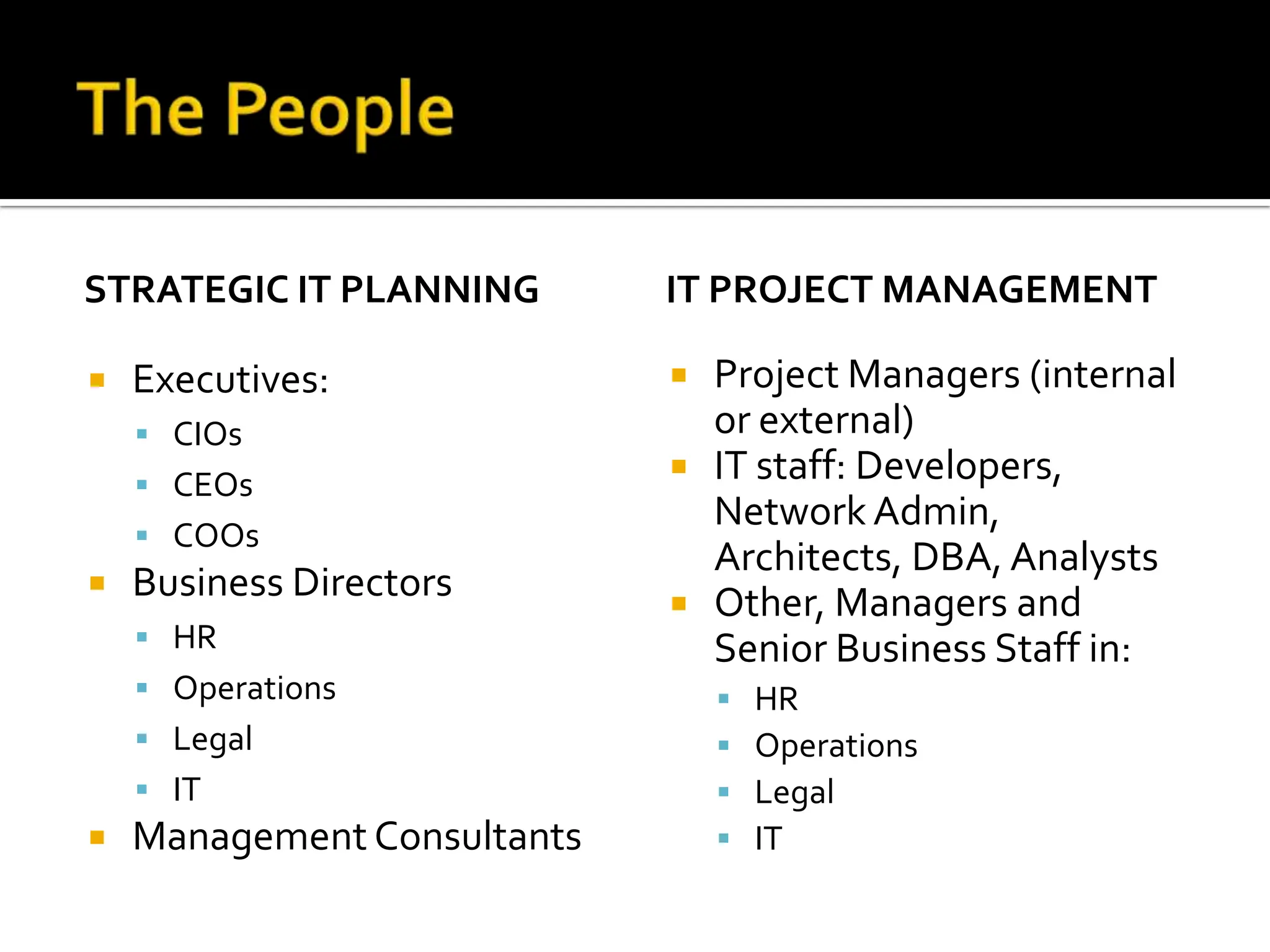
    • STRATEGIC IT PLANNING
    • Executives:
      • CIOs
      • CEOs
      • COOs
    • Business Directors
      • HR
      • Operations
      • Legal
      • IT
    • Management Consultants
    • IT PROJECT MANAGEMENT
    • Project Managers (internal or external)
    • IT staff: Developers, Network Admin, Architects, DBA, Analysts
    • Other, Managers and Senior Business Staff in:
      • HR
      • Operations
      • Legal
      • IT
    • Strategic IT Planning
    • IT Project Management
    • How they are related
    • Ways to help
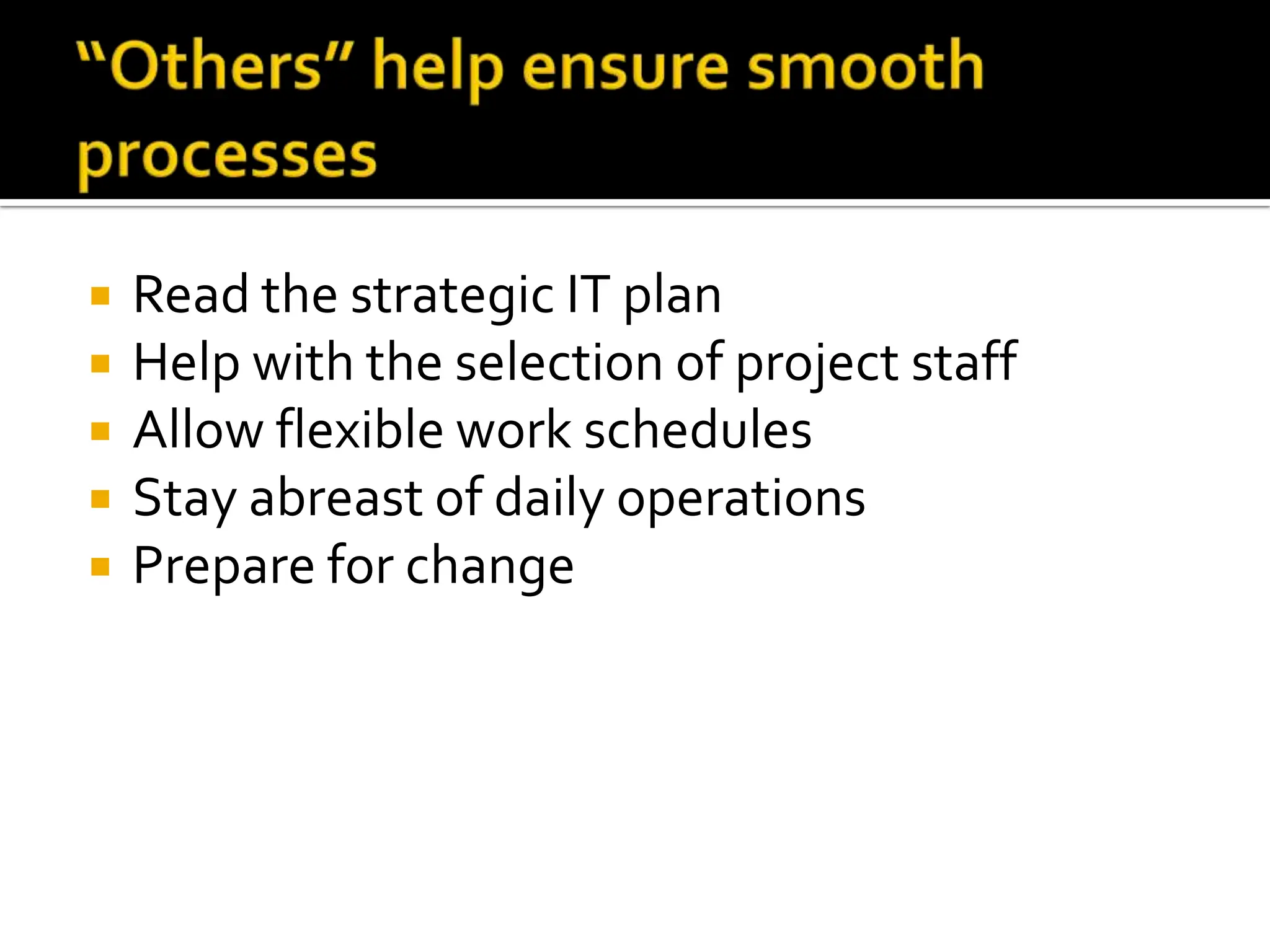
    • Read the strategic IT plan
    • Help with the selection of project staff
    • Allow flexible work schedules
    • Stay abreast of daily operations
    • Prepare for change
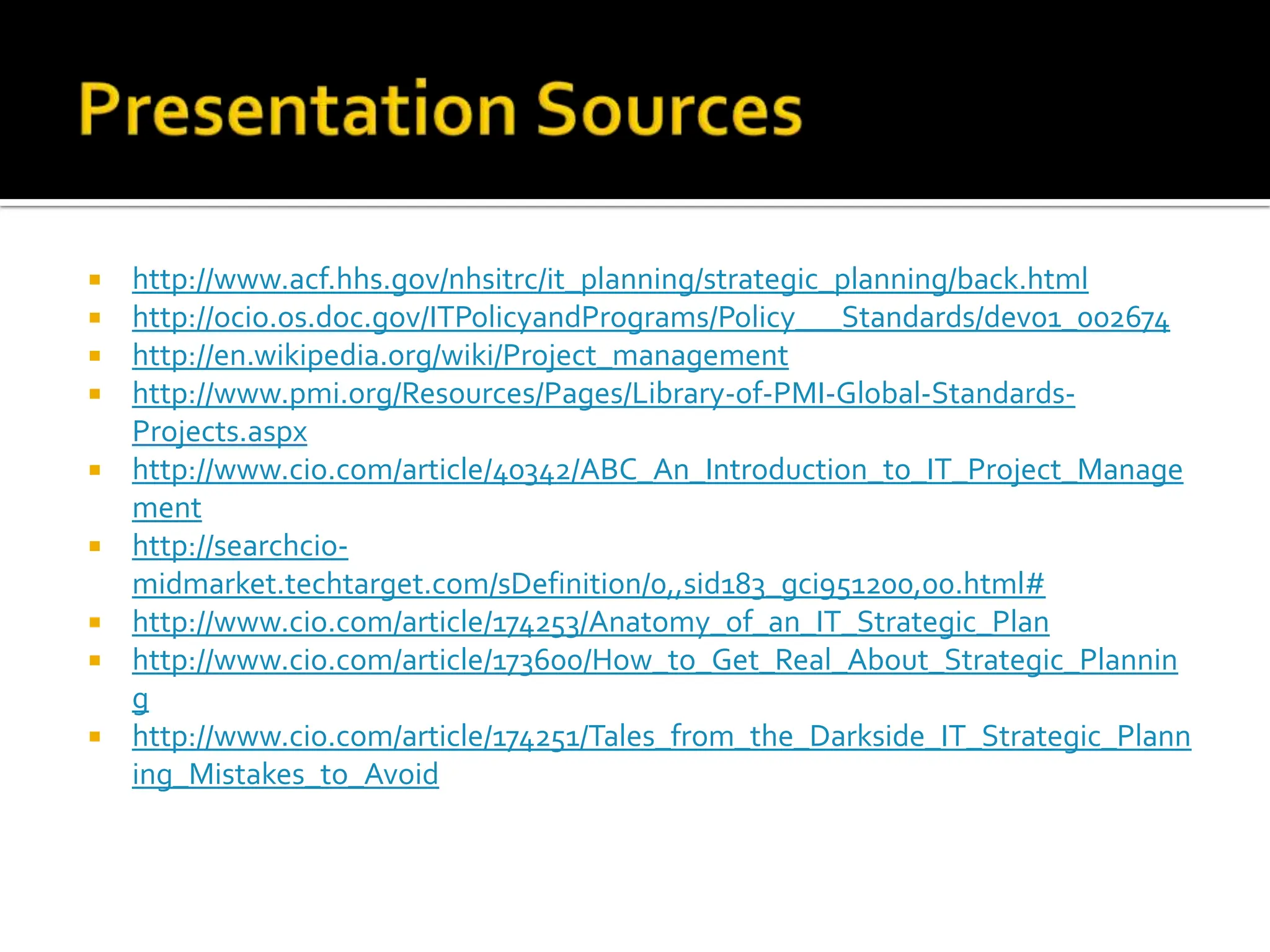
      • http://www.acf.hhs.gov/nhsitrc/it_planning/strategic_planning/back.html
      • http://ocio.os.doc.gov/ITPolicyandPrograms/Policy___Standards/dev01_002674
    • http://en.wikipedia.org/wiki/Project_management
    • http://www.pmi.org/Resources/Pages/Library-of-PMI-Global-Standards-Projects.aspx
    • http://www.cio.com/article/40342/ABC_An_Introduction_to_IT_Project_Management
    • http://searchcio-midmarket.techtarget.com/sDefinition/0,,sid183_gci951200,00.html#
    • http://www.cio.com/article/174253/Anatomy_of_an_IT_Strategic_Plan
    • http://www.cio.com/article/173600/How_to_Get_Real_About_Strategic_Planning
    • http://www.cio.com/article/174251/Tales_from_the_Darkside_IT_Strategic_Planning_Mistakes_to_Avoid

+ Kikuyu DanielsKikuyu Daniels, 6 months ago

custom

2170 views, 4 favs, 1 embeds more stats

This presentation is the result of a class assignme more

More info about this document

© All Rights Reserved

Go to text version

  • Total Views 2170
    • 2160 on SlideShare
    • 10 from embeds
  • Comments 3
  • Favorites 4
  • Downloads 276
Most viewed embeds
  • 10 views on http://www.fachak.com

more

All embeds
  • 10 views on http://www.fachak.com

less

Flagged as inappropriate Flag as inappropriate
Flag as inappropriate

Select your reason for flagging this presentation as inappropriate. If needed, use the feedback form to let us know more details.

Cancel
File a copyright complaint
Having problems? Go to our helpdesk?

Categories