Utrecht University
Freudenthal Institute
Faculty of Science
Inquiry-Based Whole-Class Teaching
with Computer Simulations in Physics
dr. Nico Rutten
dr. Jan T. van der Veen
Prof.dr. Wouter R. van Joolingen
10-4-2015
FI lunch meeting - presentation Nico Rutten
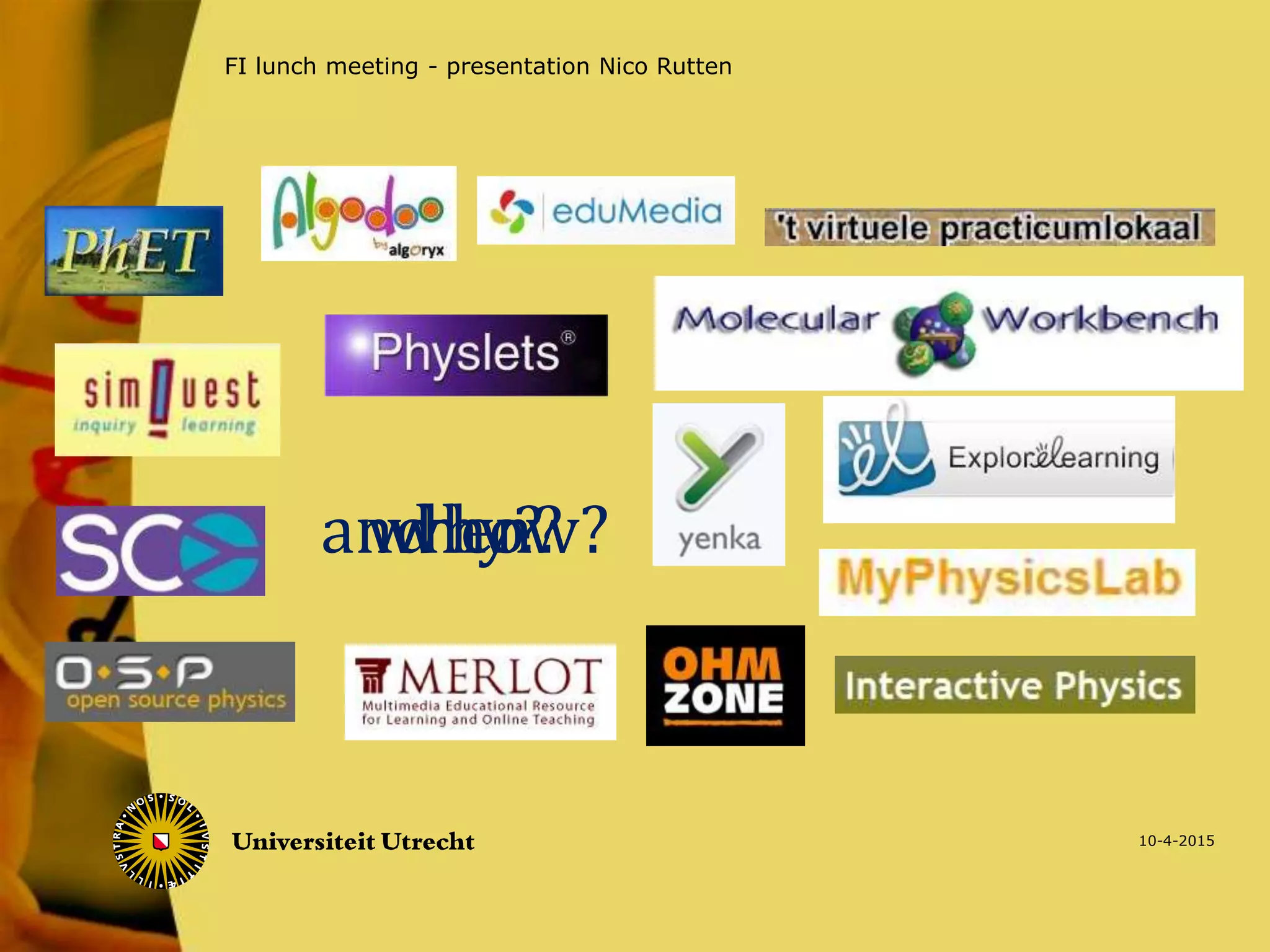
why?when?and how?
10-4-2015
FI lunch meeting - presentation Nico Rutten
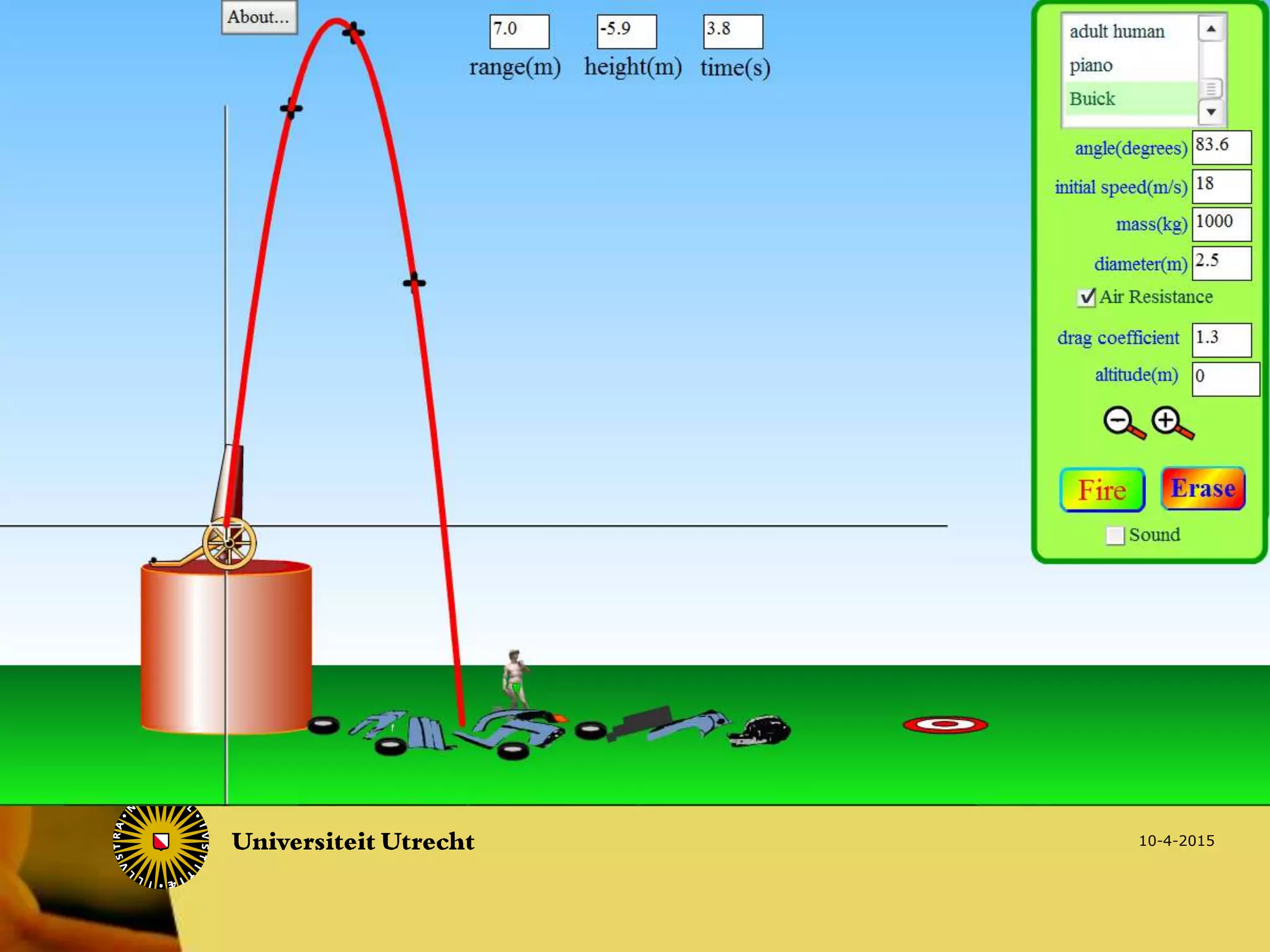
EXAMPLE
Computer simulations
are programs based
on a scientific model
of a system
or process.
10-4-2015
FI lunch meeting - presentation Nico Rutten
reference: de Jong, T., 1998, Scientific discovery learning with computer simulations of conceptual
domains
FI lunch meeting - presentation Nico Rutten
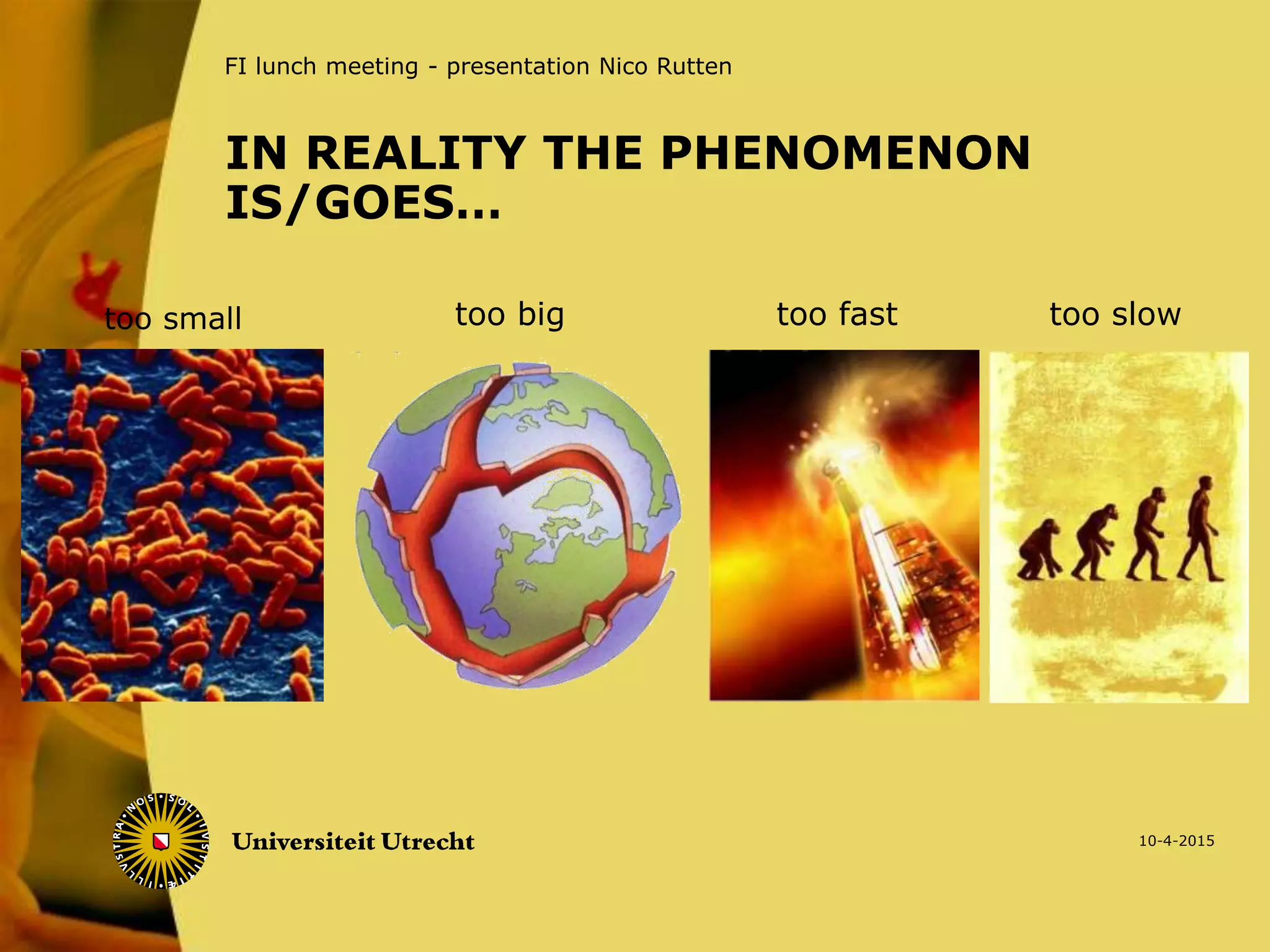
IN REALITY THE PHENOMENON
IS/GOES…
too small too big too fast too slow
10-4-2015
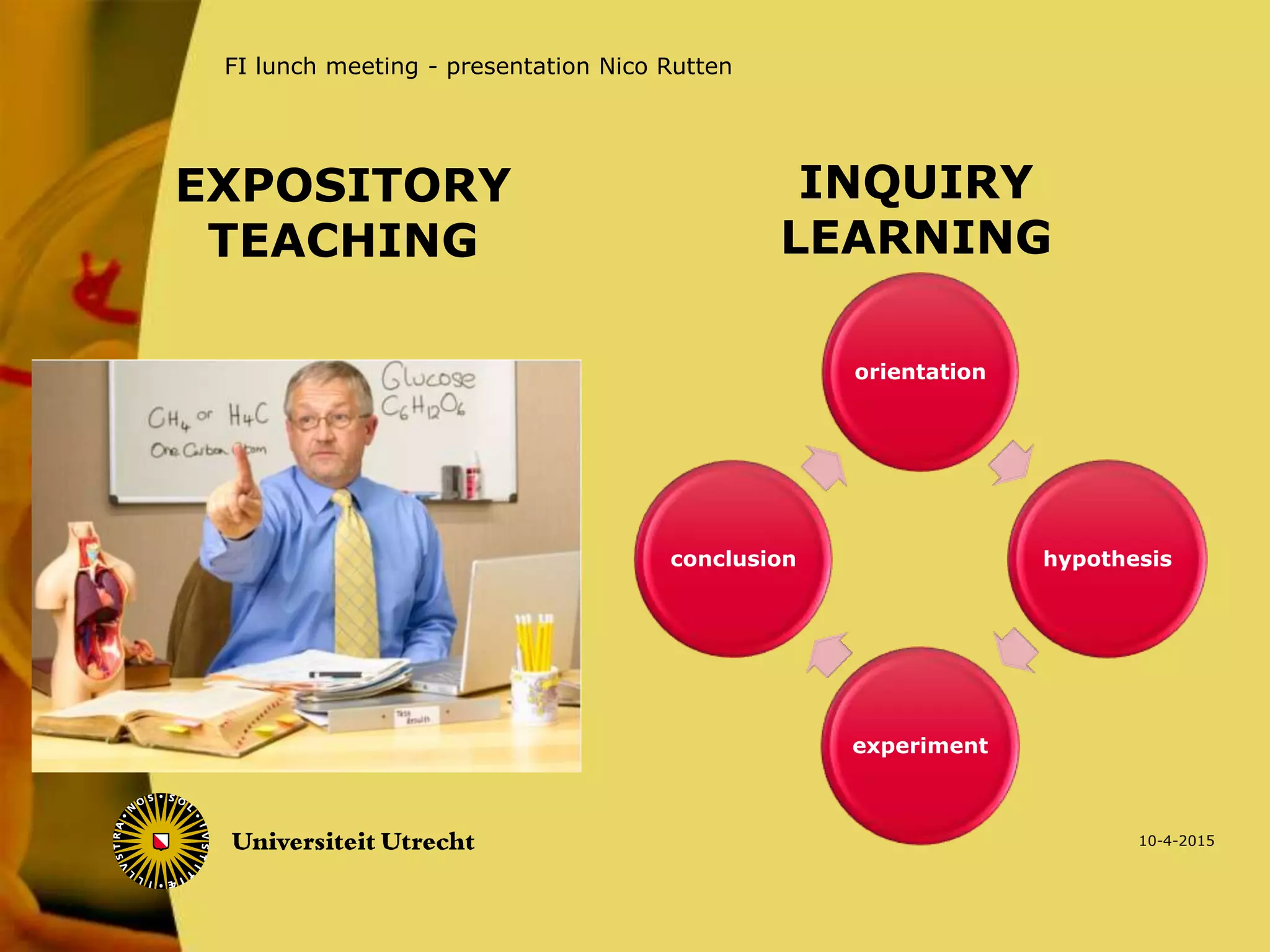
orientation
hypothesis
experiment
conclusion
FI lunch meeting - presentation Nico Rutten
INQUIRY
LEARNING
EXPOSITORY
TEACHING
10-4-2015
Learners experiment and construct knowledge as ‘scientists’:
They provide the simulation with input,
observe the output,
draw their conclusions,
and go to the next experiment.
INQUIRY LEARNING
10-4-2015
FI lunch meeting - presentation Nico Rutten
reference: de Jong, T., 1998, Self-directed learning in simulation-based discovery environments
10-4-2015
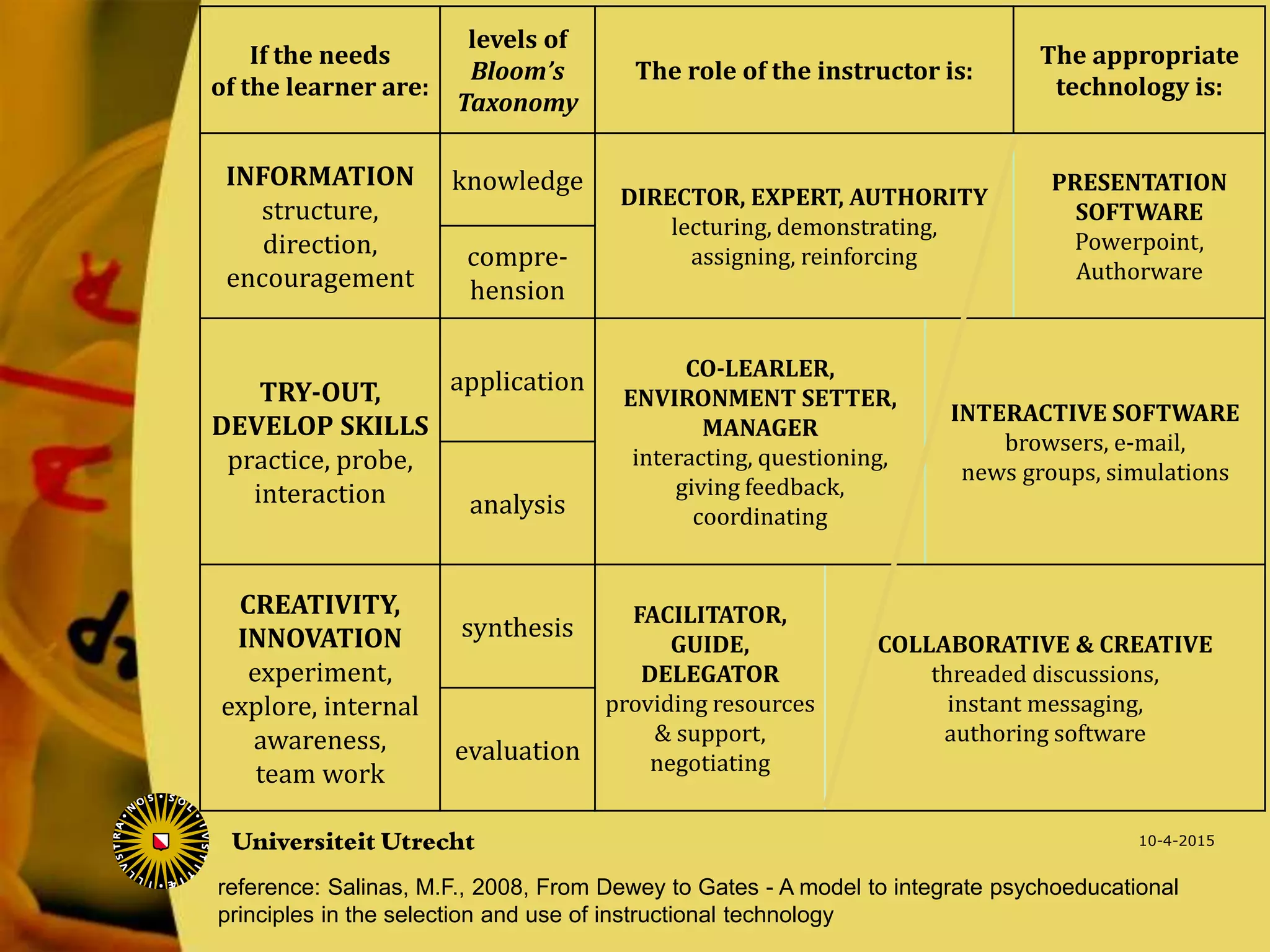
If the needs
of the learner are:
levels of
Bloom’s
Taxonomy
The role of the instructor is:
The appropriate
technology is:
INFORMATION
structure,
direction,
encouragement
knowledge
DIRECTOR, EXPERT, AUTHORITY
lecturing, demonstrating,
assigning, reinforcing
PRESENTATION
SOFTWARE
Powerpoint,
Authorware
compre-
hension
TRY-OUT,
DEVELOP SKILLS
practice, probe,
interaction
application CO-LEARLER,
ENVIRONMENT SETTER,
MANAGER
interacting, questioning,
giving feedback,
coordinating
INTERACTIVE SOFTWARE
browsers, e-mail,
news groups, simulations
analysis
CREATIVITY,
INNOVATION
experiment,
explore, internal
awareness,
team work
synthesis FACILITATOR,
GUIDE,
DELEGATOR
providing resources
& support,
negotiating
COLLABORATIVE & CREATIVE
threaded discussions,
instant messaging,
authoring software
evaluation
reference: Salinas, M.F., 2008, From Dewey to Gates - A model to integrate psychoeducational
principles in the selection and use of instructional technology
10-4-2015
FI lunch meeting - presentation Nico Rutten
The purpose of the present
study was to investigate
relations between teachers‘
use of computer simulations
in whole-class teaching,
and teachers' and students'
attitudes and learning goals
regarding such use of
computer simulations.
OBSERVATIONS
10-4-2015
10-4-2015
FI lunch meeting - presentation Nico Rutten
10-4-2015
FI lunch meeting - presentation Nico Rutten
Coding scheme for lesson observations
questions posed by the teacher that are related to physics
codes application examples
What kind of
question is it?
recall
Questions that students should be
able to answer with the knowledge
they already have.
“In what unit is this
variable measured?“
prediction
Students are asked to predict how
a phenomenon will develop further
before this has actually happened.
“What happens if that
variable is doubled?”
observation
The teacher inquires about what
students observe at that moment.
“And what do you see
right now?”
explanation
Students are asked to explain how
it is that a phenomenon has
developed in a certain way.
“Now how do you
explain this result?“
Who answers the
question?
teacher
The question of the teacher is answered by the teacher him-
/herself.
student The question of the teacher is answered by a student.
orientation
hypothesis
experiment
conclusion
INQUIRY LEARNING
10-4-2015
FI lunch meeting - presentation Nico Rutten
Teacher asks
for a
prediction.
Teacher asks
for an
observation.
Teacher asks
for an
explanation.
10-4-2015
FI lunch meeting - presentation Nico Rutten
Note. N = 24; *p < .05 (2-tailed); **p < .01 (2-tailed).
Pearson correlations
variable
Student-
Response-
Rate
Inquiry-
Cycle-
Score
M factor
motiva-
tion
M factor
insight
M factor
inspira-
tiondata source
lesson
observations
Student-
Response-Rate
1
Inquiry-Cycle-
Score
-.45* 1
question-
naires
M factor
motivation
.43* .32 1
M factor
insight
.14 .50* .70** 1
M factor
inspiration
.22 .00 .62** .55** 1
10-4-2015
FI lunch meeting - presentation Nico Rutten
CONCLUSIONS
The more one’s
teaching approach
resembles the
inquiry cycle,
The more one’s
teaching approach
is student-centered,
the more students are
convinced that teaching
with computer
simulations contributes
to their insight.
the more students are
convinced that teaching
with computer
simulations contributes
to their motivation.
10-4-2015
FI lunch meeting - presentation Nico Rutten
http://bit.ly/NRutten (case sensitive)

Inquiry-Based Whole-Class Teaching with Computer Simulations in Physics

  • 1.
    Utrecht University Freudenthal Institute Facultyof Science Inquiry-Based Whole-Class Teaching with Computer Simulations in Physics dr. Nico Rutten dr. Jan T. van der Veen Prof.dr. Wouter R. van Joolingen
  • 3.
    10-4-2015 FI lunch meeting- presentation Nico Rutten why?when?and how?
  • 4.
    10-4-2015 FI lunch meeting- presentation Nico Rutten EXAMPLE
  • 5.
    Computer simulations are programsbased on a scientific model of a system or process. 10-4-2015 FI lunch meeting - presentation Nico Rutten reference: de Jong, T., 1998, Scientific discovery learning with computer simulations of conceptual domains
  • 6.
    FI lunch meeting- presentation Nico Rutten
  • 7.
    FI lunch meeting- presentation Nico Rutten IN REALITY THE PHENOMENON IS/GOES… too small too big too fast too slow 10-4-2015
  • 8.
    orientation hypothesis experiment conclusion FI lunch meeting- presentation Nico Rutten INQUIRY LEARNING EXPOSITORY TEACHING 10-4-2015
  • 9.
    Learners experiment andconstruct knowledge as ‘scientists’: They provide the simulation with input, observe the output, draw their conclusions, and go to the next experiment. INQUIRY LEARNING 10-4-2015 FI lunch meeting - presentation Nico Rutten reference: de Jong, T., 1998, Self-directed learning in simulation-based discovery environments
  • 10.
    10-4-2015 If the needs ofthe learner are: levels of Bloom’s Taxonomy The role of the instructor is: The appropriate technology is: INFORMATION structure, direction, encouragement knowledge DIRECTOR, EXPERT, AUTHORITY lecturing, demonstrating, assigning, reinforcing PRESENTATION SOFTWARE Powerpoint, Authorware compre- hension TRY-OUT, DEVELOP SKILLS practice, probe, interaction application CO-LEARLER, ENVIRONMENT SETTER, MANAGER interacting, questioning, giving feedback, coordinating INTERACTIVE SOFTWARE browsers, e-mail, news groups, simulations analysis CREATIVITY, INNOVATION experiment, explore, internal awareness, team work synthesis FACILITATOR, GUIDE, DELEGATOR providing resources & support, negotiating COLLABORATIVE & CREATIVE threaded discussions, instant messaging, authoring software evaluation reference: Salinas, M.F., 2008, From Dewey to Gates - A model to integrate psychoeducational principles in the selection and use of instructional technology
  • 11.
    10-4-2015 FI lunch meeting- presentation Nico Rutten The purpose of the present study was to investigate relations between teachers‘ use of computer simulations in whole-class teaching, and teachers' and students' attitudes and learning goals regarding such use of computer simulations.
  • 12.
  • 13.
    10-4-2015 FI lunch meeting- presentation Nico Rutten
  • 14.
    10-4-2015 FI lunch meeting- presentation Nico Rutten Coding scheme for lesson observations questions posed by the teacher that are related to physics codes application examples What kind of question is it? recall Questions that students should be able to answer with the knowledge they already have. “In what unit is this variable measured?“ prediction Students are asked to predict how a phenomenon will develop further before this has actually happened. “What happens if that variable is doubled?” observation The teacher inquires about what students observe at that moment. “And what do you see right now?” explanation Students are asked to explain how it is that a phenomenon has developed in a certain way. “Now how do you explain this result?“ Who answers the question? teacher The question of the teacher is answered by the teacher him- /herself. student The question of the teacher is answered by a student.
  • 15.
    orientation hypothesis experiment conclusion INQUIRY LEARNING 10-4-2015 FI lunchmeeting - presentation Nico Rutten Teacher asks for a prediction. Teacher asks for an observation. Teacher asks for an explanation.
  • 16.
    10-4-2015 FI lunch meeting- presentation Nico Rutten Note. N = 24; *p < .05 (2-tailed); **p < .01 (2-tailed). Pearson correlations variable Student- Response- Rate Inquiry- Cycle- Score M factor motiva- tion M factor insight M factor inspira- tiondata source lesson observations Student- Response-Rate 1 Inquiry-Cycle- Score -.45* 1 question- naires M factor motivation .43* .32 1 M factor insight .14 .50* .70** 1 M factor inspiration .22 .00 .62** .55** 1
  • 17.
    10-4-2015 FI lunch meeting- presentation Nico Rutten CONCLUSIONS The more one’s teaching approach resembles the inquiry cycle, The more one’s teaching approach is student-centered, the more students are convinced that teaching with computer simulations contributes to their insight. the more students are convinced that teaching with computer simulations contributes to their motivation.
  • 18.
    10-4-2015 FI lunch meeting- presentation Nico Rutten http://bit.ly/NRutten (case sensitive)